There’s a certain kind of person the world seems to admire—sharp-tongued, composed, deliberate. He moves through life as if he’s never doubted the sound of his own voice. His gestures are practiced, his opinions unshakable. It’s a performance of authority, and to many, it’s compelling.
But I’ve never fit that mold. I don’t hold myself like someone bracing for a fight with the world. I don’t presume to master a room. And more and more, I’ve come to believe that what makes a person is not how forcefully he presents himself, but how honestly he shows up.
Vulnerability has never been fashionable. It doesn’t draw applause or dominate the stage. But it’s where I’ve found the most truth. Not in being right, or revered, or untouchable—but in admitting how little I know, how often I’ve failed, and how much of life resists explanation.
We’re taught to act as if we’ve earned our place—through effort, through cleverness, through some innate worth. But I’ve lived long enough to see how much is assumed, how much is favored, how many doors open not because of merit but because of circumstance, appearance, proximity to power. The world flatters performance. It often mistakes loudness for depth, certainty for wisdom.
But beneath all that, we’re fallible—achingly so. We get things wrong. We hurt people. We retreat when we should have stayed, and speak when silence would have been kinder. We tell ourselves stories to survive, not always to understand.
And yet, that fallibility isn’t shameful. It’s not a flaw to be punished—it’s the most human part of us. The mistake is not in being wrong; it’s in pretending we’re not. Intimacy begins where performance ends—when we stop curating ourselves and let others see what is: our confusion, our fear, our imperfect love.
I’ve stopped wanting to impress. I want to be known. I want to know others—not through their accomplishments or their poses, but through the quiet truths they carry. I don’t need anyone to be flawless. I need them to be present, to meet me somewhere beneath the surface.
That, to me, is strength. Not the kind that commands a crowd, but the kind that sits across from others, unguarded, and says, “Me too. I don’t have it either.”
The world may never reward dishonesty with applause. But it will reward it with connection—with moments that feel real, human, and lasting. And in the end, I think that’s the only recognition that ever matters. Not the illusion of certainty or the performance of strength, but the willingness to return, again and again, to the quiet inside us—the one where we are fallible, open, and fully alive.
Sometimes sudden, sometimes creeping in with the years, there comes a moment when mortality ceases to be an abstraction. It is no longer a distant eventuality, an idea tucked away in the folds of daily existence, softened by distractions and routine. Instead, it steps forward, undeniable and weighty, as certain as breath and just as fleeting.
Perhaps it arrives with the quiet betrayal of the body—a stiffness upon waking that does not pass, the faltering of memory, the slight hesitation before a step once taken with ease. Or maybe it comes with loss: a friend, a sibling, a parent, a spouse, whose absence feels like a rehearsal for one’s own. The awareness sharpens and turns time into something both more precious and more fragile. We begin to measure life in what remains rather than what has passed.
And yet, even with this awareness, there is resistance. The mind flits away and grasps at plans, distractions, the comfortable illusion of continuity. We fear death, but we also refuse to fully look at it, as if acknowledgment alone might hasten its approach. We craft rituals around it, philosophies to explain it, but we rarely sit with it, silent and unadorned. It is not death itself that terrifies—it is the knowing, the certainty that it will come, whether with warning or in a moment unguarded.
But what if, instead of turning away, we let the awareness settle? Not as a burden, but as a quiet companion. If we could bear to see loss not as a theft but as an inevitable passage, one that has always been woven into the fabric of living, then death itself might lose its urgency. To know we are mortal is not to despair, but to understand the shape of what we are given. The question is not whether death will come, but whether we can carry that knowledge without fear—whether we can, at last, learn to live with it.
~
*
II. The Decline: Mind and Body
The body does not falter all at once. Its undoing is slow, measured in the smallest betrayals—steps that once felt effortless but now require consideration, a name that lingers just out of reach, the gradual dimming of senses that once shaped the world in sharp relief. At first, these changes seem like passing inconveniences, momentary lapses rather than the steady drift toward an inescapable fate. But the truth settles in with time: this is not a phase, not something to be recovered from, but the quiet unraveling of what once felt permanent.
The mind, too, shows its wear. Thought slows; memories surface in fragments, elusive and unreliable. There is irony in the awareness that remains—sharp enough to perceive the very faculties now fading. It is one thing to lose oneself unknowingly, another to watch the process unfold with lucid understanding. Here lies the deepest struggle: not merely the failing of body or mind, but the tension between resisting the inevitable and surrendering to it.
Some fight against this decline with a desperate energy and will themselves to retain what is slipping away. They train the body, challenge the mind, cling to routines as though discipline alone can hold back time. Others yield more readily and see in each loss a reminder that life is not meant to be held onto with clenched fists. Acceptance, however, does not come easily—it is not passive resignation, nor is it defeat. It is an uneasy balance between effort and surrender, between maintaining what can be kept and releasing what must go.
Suffering wears many faces. For some, it arrives as a single, catastrophic moment—a diagnosis, an accident, an unforeseen unraveling of the body’s delicate order. For others, it creeps in gradually, its presence felt in the weight of each passing year. The pain may be physical, unrelenting in its demands, or it may be the subtler ache of losing one’s sense of self, of becoming unrecognizable to one’s own reflection. Yet suffering, no matter its form, is universal. It does not measure its presence by fairness or logic. It simply is.
Against this backdrop, medicine intervenes—an effort to slow, to repair, to resist the natural course of deterioration. And yet, there is a discord in this. The body is finite, its functions destined to wane, yet we press forward with treatments, procedures, and endless prescriptions, each promising to forestall the inevitable. The line between care and prolongation blurs. To fight for life is instinctive, but at what point does the fight itself become suffering?
In the quiet moments, away from doctors and treatments, the question lingers: is decline something to battle, or is there dignity in allowing nature to take its course? And if the answer is neither absolute resistance nor passive surrender, then where, exactly, does one find the balance?
~
*
III. The Distractions That Delay Acceptance
To accept death fully would require a stillness that few can bear. The mind, restless and cunning, finds ways to avoid such stillness, to weave a life so full of movement and intention that mortality remains a distant, theoretical concern. And so, we fill our days with efforts to prolong them.
Longevity itself becomes a pursuit, an industry built on the promise that decline can be postponed, perhaps even avoided altogether. Diets, regimens, supplements, and treatments—all aimed at fortifying the body against its inevitable unraveling. Science, too, lends its hand, in offering new ways to repair, replace, and sustain. Medicine intervenes not only to heal but to extend, technology whispers of futures in which aging is optional, and ritual grants the comfort of structure to what cannot be controlled. Each of these offers something real—time, ease, a semblance of mastery over the body’s betrayals. But beneath them all is the same unspoken hope: that death, if not conquerable, might at least be postponed long enough to be forgotten.
Yet it is not only the fear of death itself that keeps us tethered to life but the weight of what remains unfinished. The obligations we have not yet fulfilled, the words left unsaid, the people who still need us—all of these create a sense that departure is premature, that to leave now would be to abandon something essential. Even in old age, when life has been long and full, there lingers the feeling that there is more to do, more to settle, more to understand. The past tugs at us with its unresolved questions; the future, though narrowing, still holds the illusion of possibility.
And so, we resist stillness. We resist the quiet where truth is most easily heard. The mind, unoccupied, might begin to accept what the body already knows. And so, we fill the hours, surround ourselves with routine, distraction, movement. Even suffering, in its strange way, can serve as a tether—something to focus on, something to endure, rather than a void to surrender to.
But what if we let the distractions fall away? If we stopped grasping for more time, more purpose, more noise? What would remain? The fear, yes—but also the possibility of peace. For all our striving, death will not be bargained with. It comes when it will, unmoved by the measures taken against it. Perhaps the final act of wisdom is not to resist, but to release—to allow the quiet to settle, to let the mind and body, at last, align in their understanding.
~
*
IV. The Weight of Suffering and Endurance
Suffering is the one certainty all sentient beings share. It is neither rare nor exceptional; it is the undercurrent of existence, woven into the fabric of life from its first breath to its last. And yet, for all its universality, suffering is deeply personal—felt in ways no other can fully understand, borne in ways that cannot be measured.
Pain takes many forms. It may be the slow tightening of the body against itself, the ache of illness, the heaviness of fatigue that never fully lifts. Or it may be the quieter pains—the loss of self as the mind falters, the loneliness of watching the world move on without you, the grief of knowing that, no matter how much one has endured, there is still more to bear. Some suffer in the open, their pain visible and acknowledged. Others carry it in silence, as though to admit its weight would be to surrender to it.
Yet suffering alone does not mark the end. There is something beyond it, something deeper: endurance. The threshold of what one can bear is not fixed; it shifts, expands, contracts. A pain once unthinkable becomes routine; a burden that seemed insurmountable is carried, day after day. And yet, there is always a limit, a moment—often unspoken, often known only in the quiet of one’s own thoughts—when endurance is no longer enough.
This is the reckoning, the moment when staying alive is no longer an act of living but of mere persistence. For some, it comes as a sudden recognition, as clear as a breaking dawn. For others, it arrives gradually, the body whispers before the mind dares to listen. It is not simply about pain, nor is it about age. It is the moment when the will to remain no longer outweighs the cost of doing so.
There is no universal measure for when this moment arrives; it is known only to the one who bears it. To endure is an instinct, a habit built into the core of existence. But to know when endurance has reached its end—that is something else entirely. It is not weakness, nor is it surrender. It is a quiet knowing, a recognition that every life carries within it the right to determine when it has been enough.
And so the question lingers: is suffering the price of life, or is there a point at which one is justified in setting the burden down? The answer is not written in doctrine, nor in medicine, nor in the opinions of those who do not bear the weight themselves. It is written in the individual, in the silent moment when one understands—this is enough.
~
*
V. The Unseen Threshold
Life does not depart all at once. It recedes, quietly at first, almost imperceptible in its withdrawal. The breath grows shallower, not in gasps but in a gradual easing, as though the body has decided to take up less space in the world. Weight diminishes, not only in flesh but in presence—the self becomes lighter, less tethered to the demands of existence. A once-restless mind drifts, thoughts untangle, as if loosening its grip on the past, the future, even the urgency of the present.
These are not signs of failure, nor of defeat. They are the body’s way of whispering that it is time. Time to ease away from effort, from the relentless task of sustaining itself. Time to let go of the struggle to remain. For all the fear that surrounds death, the body itself does not fear it. It knows when to surrender long before the mind is ready to accept.
And so comes the moment of knowing—not a grand realization, not an epiphany, but a quiet certainty. It is not measured in days or dictated by diagnosis. It is something deeper, something felt. Some fight against it and grasp at every last breath as though sheer will alone can anchor it. Others meet it as one meets sleep—reluctant at first, then trust, then finally yield to its pull.
There is dignity in this release. Not the dignity others impose, the kind measured in stoicism or restraint, but the simple dignity of relinquishing control. Of allowing the body to do what it was always meant to do: to reach its end not as a tragedy, but as a completion. To fight against this moment is to resist the natural rhythm of life itself. But to accept it—to welcome the stillness, to let breath slow without fear—that is its own kind of grace.
In the end, death is not something that must be conquered, nor something that must be endured beyond what one can bear. It is simply the last threshold, unseen until it is reached, known only to the one who crosses it. And when the time comes, there is nothing left to do but step forward—light, unburdened, and without regret.
~
*
VI. The Quiet Acceptance
To think of death without fear—to sit with it, unguarded, and allow it to be what it is—this is a rare and difficult peace. For so long, the mind has recoiled from its certainty and wrapped it in distractions, explanations, and resistance. But there comes a point when all of that falls away, when death is no longer something to be argued with or postponed, but simply recognized as the inevitable conclusion to a life that has been lived.
Fear untangles itself when death is no longer treated as an interruption, no longer seen as a theft, but rather as something as natural as breath itself. The body, in its wisdom, has already begun to let go. It is the mind that lingers and clings to meaning, to unfinished things, to the illusion that one more day, one more hour, might change something essential. But in the end, no justification is needed. One does not have to prove that it is the right time. The right time comes, whether welcomed or not, and acceptance is simply the act of ceasing to resist.
Stillness is not the same as resignation. Resignation carries a sense of defeat, of something being taken against one’s will. But true stillness—true acceptance—is something else entirely. It is an arrival, a settling into the inevitable without fear or regret. It is the moment when the mind and body, long at odds, finally move in the same direction. No more effort. No more bargaining. Only the quiet understanding that what was given has been enough.
To embrace the end is not to let go of life’s value, but to affirm it fully—by allowing it to complete itself with grace. There is nothing left to do, no more debts to settle, no more battles to fight. There is only the quiet, and the quiet is enough.
~
*
VII, In Closing
No life is lived in solitude, and no journey—especially the one toward acceptance—is walked alone. Along the way, we are shaped, guided, and held by those who have touched our hearts and left their presence within us even after they are gone. In facing mortality, we recognize not only our own, but also those who have come before us, whose lives continue to echo in memory, in love, in the quiet places where absence becomes something enduring.
Their presence lingers—not as shadows, but as light. They have taught us, challenged us, consoled us, and, in their own ways, prepared us for the path we all must take.
Death, in its harshness, strips us bare and confronts us with what is essential. Yet, it also unites us, for the love we have given and received does not fade with physical absence.
Our loved ones remain until the end; they sustain us through their memory and the love they have left within us.
To them, we offer our deepest gratitude. They are not gone. They remain, in the heart, in the soul, in the quiet acceptance of all that has been and all that will be.
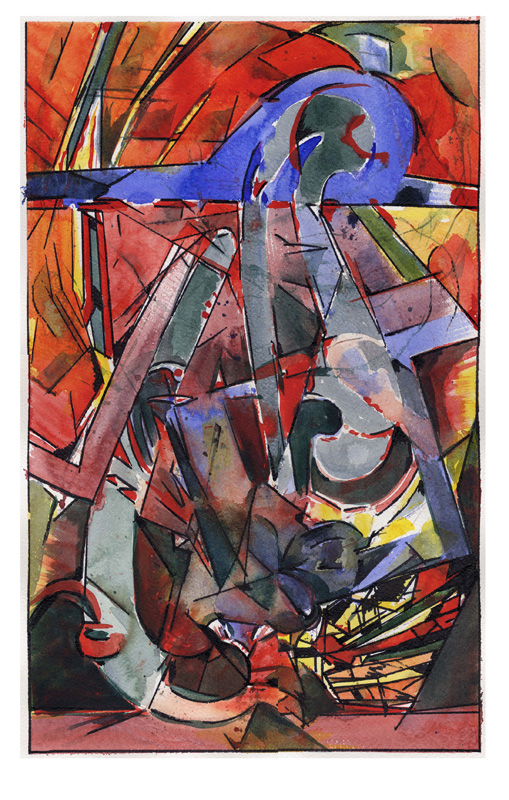
Pendular Ricardo Morín, Watercolor, and ink on paper 14” x 20″ 2003
*
Prologue
The Quiet Turning
In the fading light of a world obsessed with spectacle, she endures—not as a relic of past sacrifices, but as a living, evolving force. The desire for attention has always been a double-edged sword in her life: both a demand imposed by a society fixated on appearances and a tool she has learned to wield with fierce determination. Every public gaze, every moment magnified by the glare of expectation, has shaped her journey and molded not only her destiny but also that of the visionary she helped nurture.
She does not merely recall the weight of expectation; she transforms it. Her life is not a static ledger of sacrifices but a dynamic chronicle of adaptation—of a woman whose responses shift with time, whose convictions evolve with every challenge, and whose internal conflicts are as fluid as the changing tides of public adulation. There were moments when the burden of spectacle pressed heavily upon her, yet she never allowed it to define her entirety. Instead, she learned to let the circumstances speak and allowed the ever-changing world to refine her purpose.
In a culture where every gesture is scrutinized and every act measured by its ability to capture the spotlight, she chose to forge an authenticity that defies constant performance. Amid the relentless pursuit of recognition, she discovered that resilience is not about enduring static hardships but about embracing change—to be both the guiding light when needed and the adaptable spirit who reinvents herself as life demands.
Her legacy is woven into the very fabric of the visionary’s rise, yet it is not confined to the ephemeral glow of public applause. It lives in the decisions yet to be made, in the quiet defiance against a world intent on reducing complex lives to mere performances. As the storm of public attention recedes, one truth remains: while the spectacle may return with renewed fervor, so too will her unyielding, ever-shifting light—ever responsive to the world, ever true to her evolving self.
~
*
Chapter 1
The Origins of Strength
She was not born into privilege, nor was she shaped by an easy path. Strength, in her world, was not inherited—it was constructed, piece by piece, through necessity, through the quiet urgency of survival. The home she knew was one of expectations, where resilience was not a virtue but a requirement.
Her parents, figures of discipline and quiet ambition, did not speak of success in terms of indulgence or grandeur. They spoke of perseverance, of self-sufficiency, of the kind of fortitude that does not wait for the world’s permission. The values they instilled in her were not gentle reassurances but firm, unwavering truths: that beauty alone is fleeting, that intellect is a tool to be sharpened, that hard work is the currency of progress.
The first adversities she faced were not singular, dramatic upheavals, but the steady, relentless challenges of making oneself indispensable in a world that often overlooks those who do not demand attention. She learned early that admiration is conditional, that approval must be earned again and again, and that the only certainty lay in one’s ability to adapt.
Beyond the walls of her upbringing, the world around her was shifting. The socio-economic landscape offered few guarantees, especially for a woman determined to carve her own space. Success was not simply a matter of talent or intelligence—it was a performance, a negotiation, a test of endurance. The weight of expectation pressed upon her from all sides: to conform, to excel, to be both formidable and gracious, independent yet admired.
Yet, she did not recoil from these pressures; she absorbed them, studied them, and found within them a rhythm she could move to. While others saw obstacles, she saw opportunities to refine her instincts, to wield resilience not as a defense, but as a weapon. Every closed door was a lesson in persistence. Every rejection, a refinement of her strategy.
She did not yet know what shape her life would take, nor could she have predicted the enormity of the path ahead. But one truth had already taken root: survival was not enough. If she was to endure, she would do so on her own terms.
~
*
Chapter 2
A Woman in a Man’s World
She learned quickly that talent alone was not enough. In a world where men dictated the terms of power, a woman had to be twice as prepared, twice as composed, twice as relentless. Her ambitions did not align neatly with the roles assigned to her—not the ones whispered by tradition, nor those imposed by an industry that measured a woman’s worth by the fleeting currency of youth and allure.
Her career was not handed to her; it was negotiated, fought for in spaces where her presence was tolerated but not welcomed. She had to navigate the subtle dismissals, the unspoken ceilings, the expectation that she should be grateful for whatever space she was allowed to occupy. To be assertive was to risk being labeled difficult. To be strategic was to be called calculating. And yet, to be anything less was to disappear.
But she would not disappear.
The spectacle was always present, shaping her choices as much as her ambitions. Visibility was power, and she understood that better than most. She learned to wield attention, to control the narrative before it controlled her. If she was to succeed in a man’s world, she had to become more than just competent—she had to be seen.
Yet, the gaze was fickle. It admired strength but punished defiance. It celebrated beauty but scorned aging. It permitted ambition, but only if it did not overshadow the ambitions of men. She walked this tightrope daily: she adjusted, adapted, and never allowed herself the luxury of complacency.
Independence was her quiet rebellion. Every choice she made—where she worked, whom she trusted, how she carried herself in a room—was a declaration. The tension between expectation and desire was relentless. The world wanted her to conform, to soften, to submit. But she had already seen what submission offered: silence, erasure, irrelevance.
So she carved her own space, one decision at a time. She played the part when necessary, and knew when to perform, when to retreat, when to push forward. But beneath the careful facade was a woman who refused to be reduced to an image.
She had become part of the spectacle, but she was also its master.
~
*
Chapter 3
The Birth of a Titan
She did not set out to shape a legend. She set out to prepare a child for a world that did not bend easily, a world that would test him, discard him if he faltered. She had seen enough to know that brilliance alone was not enough—resilience was the true currency of survival. And so, she became both the architect and the adversary, the foundation upon which he would build and the force that would push him to withstand the weight of expectation.
Her guidance was a paradox: fiercely protective, yet unsparing. She did not indulge fragility, though she understood its presence. There were no idle comforts, no assurances that the world would be kind. Instead, she instilled an unshakable creed—one did not wait for permission to take up space; one carved it, owned it, refused to apologize for it.
But strength, once given, takes on a life of its own. She watched as he absorbed her lessons, sometimes with gratitude, sometimes with defiance. He was not a child who followed; he was one who questioned, who tested the limits of every rule, including hers. He did not always see the wisdom in her distance, the purpose behind her expectations. To him, love should have been softer, less conditional.
She knew better.
The spectacle had already begun to shape him, as it had shaped her. Attention became both validation and weapon, which sharpened his confidence and his restlessness. He saw the world not as something to navigate, but as something to master. And yet, she wondered—had she given him too much certainty? Had she fortified him so well that he no longer knew how to doubt, to hesitate, to seek counsel outside himself?
There were moments when she questioned. In the rare silences between them, in the brief flickers of vulnerability he quickly buried, she wondered if she had built not just a titan, but a fortress—one that would one day struggle to let anything in.
She told herself it was necessary. That the world had no use for the unprepared. That he would thank her in time.
And yet, as she watched him step further into the glare of the spectacle, as the weight of his own myth grew heavier, she could not shake the quiet thought that gnawed at the edges of her certainty:
Had she given him everything except the ability to stop?
~
*
Chapter 4
Sacrifice and Distance
She had always known he would leave. It was, after all, what she had prepared him for—to move forward with unrelenting momentum, to step beyond the boundaries of what was known, to belong not to a single place or person, but to the vision that consumed him. And yet, knowing did not make it easier.
At first, the distance was practical, a byproduct of ambition. His world expanded at a pace hers could not match, each success widened the space between them. Conversations became brief, punctuated by time zones and obligations, his voice measured, always moving toward the next thing. He spoke in ideas, in projects, in revolutions yet to come. Rarely did he speak of himself.
But distance is rarely just physical. She saw it in the way he carried himself, in the careful detachment of his gaze when the cameras were on him. The spectacle had fully claimed him now—not just as an audience but as an identity. Attention was no longer something he sought; it was something he commanded, something he wielded. He had become larger than life, and in doing so, he had begun to shrink the parts of himself that did not serve the myth.
She recognized the toll, though he would never name it. The weight of scrutiny, the exhaustion of living up to a persona that left no room for hesitation, for frailty, for uncertainty. He was brilliant, polarizing, untouchable—an architect of impossible things. But he was also her son. And that was the one role he no longer had time to play.
She had always understood sacrifice. She had made her own, time and time again, choices that had cost her comfort, companionship, a quieter kind of life.But she had not anticipated this: the realization that her greatest success—his unshakable independence—had also made her dispensable.
She would not chase him. She had taught him to walk alone, and she would not contradict that lesson now. Instead, she watched from afar, her pride and her sorrow intertwined, knowing that he was too far gone to look back, but she still hoped—one day—he might.
~
*
Chapter 5
Shadows and Echoes
She was no longer a presence in his world, but her shadow remained. It stretched across his decisions, his mannerisms, the unspoken rules he followed even as he pretended they were his own. She saw it in the way he carried himself in a room—how he mastered attention, held silence just long enough for discomfort to become intrigue. He had learned that from her.
Yet, influence is a slippery thing. Once released into the world, it takes on a life of its own; it bends and reshapes itself in ways the originator never intended. She wondered, at times, if he had misunderstood her lessons or if she had failed to articulate them well enough. Had she armed him with resilience or simply taught him to endure at any cost? Had she instilled vision or merely a hunger for dominance?
She had always believed in independence, in the power of carving one’s own path. But watching him now—uncompromising, relentless, willing to set fire to bridges before anyone could cross them—she questioned whether she had emphasized too much the need to stand apart, and not enough the importance of standing with.
And yet, despite his defiance, he could not fully sever what bound them. She glimpsed traces of her voice in his words, echoes of her own battles in the way he faced down adversaries. He may have long since left her behind, but he carried fragments of her wherever he went.
Still, influence is not ownership. She had shaped him, but she did not control him. The choices he made were his own, and she had no claim over them—neither the triumphs nor the failures. She could only watch, aware that what she had given him was both foundation and burden, a blueprint he had long since altered to fit a design only he could see.
And so, she did what all who shape the future must eventually do: she let go and knew that her presence in his life was no longer defined by proximity, but by the weight of what had already been left behind.
~
*
Epilogue
The Silent Architect
She was never the one at center stage. That was never her role, never her desire. And yet, in the hushed spaces between history’s grand pronouncements, she remained—unseen but undeniable, a force imprinted on the architecture of a life that reshaped the world.
There is a certain power in being forgotten. The world rarely remembers the hands that steady the foundation, only the ones that raise the monument. But she had never needed recognition to know her presence endured. She saw it in the echoes of her words, in the contours of a mind sharpened by her lessons, in the restless ambition that had been, at least in part, her doing.
Yet power, she had learned, is not a gift—it is an affliction, a hunger that grows even as it devours. She had taught him to reach, to question, to never yield to the weight of convention. But had she, in doing so, unleashed something beyond even her understanding? He had become an architect of the future, but was he building a world of brilliance or ruin? Had she given him wings, or simply made him blind to the ground beneath him?
The burden of vision is that it rarely allows for stillness. She had spent her life in motion, forged her own path, and demanded her own place. But now, standing at the edges of a world that no longer looked back at her, she allowed herself a moment of pause. Not to claim victory, nor to lament what could not be undone, but simply to acknowledge what was.
Love and legacy are rarely pure. They are made of sacrifice and silence, of pride and regret, of truths that remain unspoken. She had played her part, and though the stage belonged to another, she knew the script still bore traces of her hand.
And so she stepped back, into the quiet. Not erased, not forgotten—simply unseen. The architect, no longer needed, but always present in the walls of what had been built.
~
*
Author’s Note
This is a work of fiction. While inspired by the complexities of ambition, legacy, and the forces that shape extraordinary lives, the characters and events depicted are products of imagination. Any resemblance to actual persons, alive or deceased, is purely coincidental. This story is not an account of any individual but rather an exploration of the universal tensions between sacrifice, power, and the silent architects behind great destinies.
She comes to me in an endless flow of memories quieting her absence.
You return to me in every heartbeat . . .
There is no light nor shadow, nor color nor texture.
There is no pain in the embrace of uncertainty.
~
Our coexistence ceases to exist;
the rancor of fear departs as the idea takes us in.
Pain turns silent, emptied of guilt and regret.
Though your lungs exhale not,
I feel the breath of your longing in search of union.
~
I understand better your inexorable faith,
with no sting of doubt.
Resentment held no place, the frankness of your soul loved everything.
I feel you in my chest, tight with not seeing you
I see you in the resonance of your mind upon mine.
*
Pain shatters my chest,
I am dying as well,
I fear the very meanness of not accepting
your dignified and glorious absence.
~
How can one ponder eternal love
without knowing eternity,
I do not understand and tears choke me.
~
Eternity is a story we tell ourselves
from our first appearance.
Before, we were nothing
and nothingness impregnated us with clumsiness
to create stories that console our finitude.
~
We are nothing,
and to nothing we return.
~
I believe in the goddess of love
for she sustains me,
but immortality and eternity do not depend on her.
Abstraction is a pretense that believes it heals itself.
~
Confuse reality not with abstraction,
if you know nothing;
unconsciousness is soaked in the unjustifiable.
Contradiction is the palpable reality,
Humility and neutrality do not exist:
and are not controllable.
~
Intelligence is a tool of fiction.
We are nothing.
~
Words of comfort ruminate me and my feelings,
they assume compassion for filling the void
Yet compassion, like humility, can
not boast of itself.
They come from nothing
and are nothing.
~
The feelings of death arise in old age,
our fragility is tangible.
“If newly born, what do you know of old age?”
How can we boast … even if for the best of reasons!
~
Words can evoke the void of silence,
yet they remain a pretense.
~
Silence is deeper than declarations.
Listen to silence, filled with nothingness.
Yet, an energy that’s unchangeable, immutable.
Persistence is yet another vanity,
a desire to accumulate the unsustainable.
Parallels are paradoxical, yet real.
*
Ricardo Federico Morín Tortolero,
Oakland Park, Fl. 5:00 am, 3 de Feberero de 2025
Edited by Billy Bussell Thompson
*
(A Poem written by our mother, María Teresa Tortolero Rivero, English translation by this author, and read by Andreina in Spanish)


GREATNESS YOU BESTOWED UPON MY SPIRIT

[July 1979]

*

Greatness you bestowed upon my spirit
for the whole world rests upon my bosom
though in sadness I stray
in vain attempts to redeem my heart.

As pariah in a desert
in my migrant existence
I feel the prick of painful thorns.
and the corrosive doubt of uncertainty.

My home’s encumbered by the punching of loneliness
only absence occupies it.
Why have you forsaken me?
Why so much cruelty?
If born to love
when for love’s sake
I wish to be faithful.
*
In Memoriam Andreina Teresa
~
We, the Morín Tortolero siblings: Alberto José, Ricardo Federico, María Teresa, and José Galdino, deeply regret to announce to our family and friends the heartfelt passing of our beloved sister
ANDREINA TERESA MORÍN TORTOLERO
November 10, 1955 – February 2, 2025
*
The wake was held at Funeraria Tendencia Ecológica, located in the Las Acacias neighborhood in Valencia, next to the CICPC, on Monday, February 3, 2025, at 12:00 PM.
The funeral service took place at the Puertas al Cielo crematorium, located in La Entrada, Naguanagua, on Tuesday, February 4, 2025.The Novena is held at Valencia’s El Viñedo Church starting on February 5th at 4:30 pm.
We are grateful for your support and prayers during this time of deep sorrow.
Here, Andreina was among friends and relatives between Valencia, Venezuela in 2024 and her last visit to Broward and Dade Counties in Florida, January 2024,
First, I would like to share with my readers my utmost gratitude to Billy Bussell Thompson (b. November 23, 1942), Ph.D., Professor Emeritus of Linguistics at Hofstra University, for his generosity in being a mentor and editor. His scholarly trajectory goes from 1963 to 1993. Among his most salient publications in English, we have: Relic and Literature . . .; Bilingualism in Moorish Spain; The Myth of the Magdalen . . .; etc. . . .
II
Since 1989, our friendship has extended over more than three decades. We have worked in close proximity on at least a dozen articles and short stories (published in WordPress). I have been fortunate to count on his frankness and support. He has never minced words. He has been blunt, when any of my drafts seemed without merit. When that was the case, the articles went into a shredder, and I was satisfied by the integrity of his prose, as well as by my understanding of my own limitations as a writer. Prof. Bussell Thompson (B.B.T.) usually compares the skill of prose writing with that of a narrowing cone of vision. This selective cone of vision is akin to the aesthetic integrity of a visual work of art. With the present endeavor, Prof. B.B.T. believed, from the very beginning, in the possibility of bringing forth this story as a team. Even though we live in different regions – geographically far apart – of the USA, we have had no trouble communicating via phone and email.
III
This narrative seeks to explain the confusion found in society and politics, and even their seeming lack of purpose. For this reason, I dedicate my narrative to the readers.
IV
Initially, I knew not where this would lead. I submitted a five-paragraph draft to professor B.B.T. As he began to read, he paused and asked if I was alluding to Plato’s allegory of the cave. Surprised, I asked him to stop. I replied that his reference to Plato placed me in a different perspective. Gratefully, I added that his question was most welcome; at that point, I wanted to read more before continuing.
V
He encouraged me to reread Plato’s dialogues. To this he added that I take into account any ambiguity associated with Plato’s conception of the ideal authority of the State (politeia) or Nation. He referred to the Platonic ideas controversial in current discussions. He also recommended reading José Ortega y Gasset (1883-1955). He included The Revolt of the Masses[1929]and The Dehumanization of Art[1925]. He suggested that I be aware of Ortega’s meritocratic liberal perspective (though we believed that Ortega had not been known for openly endorsing any political ideology) and to heed the relevance Ortega gives to the man who is aware of his limitations – opposed to the man who is unaware: both the bourgeoisie and the mass man (who exemplify, for him la razón sinrazón [the reason for unreason]) – as explained in The Revolt of the Masses. And finally, I focus on the distinction between “content” and “form,” to explain the break by the avant-garde from the bourgeoisie.
VI
Professor B.B.T. and I also had an exchange of ideas over the parallels between the Platonic and Orteguian thought. He advised me then to read anew Meditations on Quixote[1914] both in Spanish and in English. There, B.B.T. thought that I could find a significant or productive landscape of ideas on which to reflect and, thus, be able to develop my own interpretations about the nature of knowledge, its limits, and how to find the meaning of the ideal of truth.
VII
In writing my last short story, entitled In Darkness, Professor B.B.T. had already urged me to note the meaning for circunstancia1 (“circumstance”) as defined by Ortega in Meditations on Quixote. It was clear to us that both Ortega’s phenomenological approach to “circumstance” and Plato’s thesis on the transformation of the individual (through knowledge) shared commonalities, which nurtured my own narrative.
VIII
But, the narrative journey proved to be just as challenging as Professor B.B.T. had pointed out. His criticism, even then, never ceased being constructive and energetic. His compassion was present as long as I was mindful of the necessity for clarity and precision. Often, he would cite Ernest Hemingway’s authenticity and precision.
IX
Time and time again, I experienced enormous pain in trying to comprehend what I wished to express. Freeing my prose from superficiality was like taking a deep breath to exhale the vagueness of my anxieties. Sometimes I was unable to get away from the obvious. Other times, either I hid behind the complex, or I would cling to abstract and cryptic thinking: the reductive jargon of the social sciences. Professor B.B.T. repeatedly suggested succinctness: I needed to respect the simplicity of language and find a way to its accessibility. Bringing Plato and Ortega to the reader was my responsibility. I was not to imitate them nor to think like them, but to represent them authentically. My first obligation was to the reader. For this I had to avoid euphemisms, randomness, and diversion. The affirmation of effective communication is an objective worth the effort. I would only understand myself, if I were to understand the reader.
X
B.B.T.’s exhortations and criticisms, I welcomed enthusiastically. His challenge became mine. He has been exorcising my limitations for two decades: Every time we have worked together, I have discovered something new in myself. I have become more attuned to both English and Spanish. I have had to be my own translator. In these instances, I have grown more respectful of the two languages. I have had to capture their essence by comparing them: the one informs the other.
*
Prologue
In Plato’s dialogue Theaetetus[circa 369 B.C.E.], Socrates proposes that the extraordinary extraction of ideas is like bringing forth a new life and purging what is unnecessary. Likewise, the aim here is to produce and discuss what enlightenment is, and the obstacles to its achievement. Socrates has helped me in my definition of knowledge: Is morality universal, or is objective morality even possible? For these ideas I am indebted both to Plato and to Ortega y Gasset.
Ricardo F Morin, December 19, 2022
Editor Billy Bussell Thompson
*
Plato, Roman marble bust copied from Greek original, 4th century B.C.E., Capitoline Museums, Rome.
*
Socrates, Roman marble bust copied from Greek original, 2nd half of the 4th century B.C.E., Capitoline Museums, Rome.
*
José Ortega y Gasset (1883-1955), detail of photograph of his impersonation of Honoré de Balzac, circa 1900.
*
One way to objectivity is to recognize one’s own subjectivity. Metaphors for understanding reality are rare. One sees the world primarily through one’s own experience. It is difficult (though not impossible) to understand what one has not experienced. Truth never rests: It is not singular, but always plural.
Anonymous
*
1
Index
1. Awareness of the Transformation of One’s Self:
The highest principle of inquiry is consciousness of one’s self. In inquiry lie the beginnings of change.
2
Index
2. The Absence of Trust:
In our age of disbelief, the stories we tell each other about the past and the present seem to be in a state of collapse. There is a lack of continuity in the social order, increasingly suffocated by misinformation and distrust. We challenge each other over what is real and what is not.
3
Index
3. The Unassailable Truth:
For most of us an ultimate truth remains unattainable and the stories we share from the past and the present no longer seem useful. Along with the disappearance of our past stories, both the person who seeks truth and the act of giving a person his due are in crisis. Our society finds itself defined by a decline in trust both in government and its institutions. Despairingly, the challenge is that the creation of new stories has become an act of preservation. Likewise, autocracy is on the ascendance. A lack of faith has sown aimlessness. What can change this course of despair? What will bring enlightenment to us?
4
Index
4. Consciousness:
Knowledge is constantly changing and the result of this destabilization carries us into greater disorder. For this reason clarity is more necessary than ever to understand ourselves. Even if clarity is not always possible, to know oneself is imperative. Thus arises the tension between continuity and change. Here lies the quest for survival.
5
Index
5. Not Knowing:
Not knowing is the essential condition of existence, despite one’s apparent desire for knowledge or for authority. To know is to inquire. Reality, though fleeting, inspires reflection. Change begins with the recognition that one is not in isolation. Not even the one (who seeks self-sacrifice for his spiritual advancement) by absolute cloister could get rid of his entanglement with the world. It is by relating to other people and his environment that this person comes to know who he is. Not even he (who despises the symbols of fear) is capable of freeing himself from his anguish. The fear of not knowing hangs over all of us. It is possible that striving without measure (in the aspiration for rationality) only leads us to end up being irrational: Here lies the origin of complexity given the absence of innocence.
6
Index
6. The Energy of Life:
In his theory of cultural attributes (Meditaciones del Quijote, Meditaciónpreliminar; Índice8, Lapantera o del sensualismo, pág. 21), José Ortega y Gasset gives us his concept of razón vital2, which means reason is expressed through life itself. Ortega parses the European mind into two archetypes: the Germanic and the Mediterranean. The former is meditative and the latter sensuous. Of the sensuous he says: The predominance of the senses usually implies a deficiency in inner powers. What is meditating as compared with seeing? As soon as the retina is hit by the arrow from without, our inner personal energy hastens and stops the intrusion. The impression is registered, subjected to civilized order; it is thought, and in this way it is integrated in the building up of our personality, and cooperates within it – Evelyn Rugg and Diego Martín’s translation – Notes and Introduction by Julián Marías – pp. 85-86. The Orteguian admonition here is to find the balance between extremes: between the excesses and deficiencies of these two archetypes.
7
Index
7. Human Agency and Its History:
A second source for my understanding of the mind and the senses is found in Plato’s Republic (politeia) – Socrates’s dialogue of the allegory of the cave at the beginning of Book Seven. There have been many interpretations. Mine differs. My purpose is to rid suffering from the mind of the freed slave. Once freed from shackles, the mind of the freed slave (who ascends to the mouth of the cave) discovers its own vision of the world. Despite the sun’s glare, the uneducated mind is transformed by the newly found ideal of truth. But the awareness by the prisoner (who has remained behind) is inseparable from the condition of the freed man: The slave (remaining in shadows of suffering) is not entirely separable from the memory of the freed man. Because of suffering, the freed man’s mind is aware of its inability to know. At the same time, the freed mind learns how its own transformation may be dependent on the new course of its history. This mind’s actions allow participation in change, and change is possible through self examination. The mind examines itself through meditating. Meditation is not an obligation, but a necessity. Meditation is the result of the mind’s freedom and it is the means to understanding its own choices in its approach to truth: But this effort is only an approximation to the infinity of truth. The freed mind (facing the visible world) is lacking here. Thus, the freed mind recognizes that neither its actions nor the course of its history is predictable. They (i.e. the mind’s actions and the course of its history) come from multiple possibilities about belief.
The freed mind realizes that time is an illusion: Time is fleeting, false, and deceitful. The mind, habitually trapped in its past, remains mired in pain. Anger (which comes from the past in search for justice) has for its sole purpose the manifestation of resentment. But anger only manages to put its existence on hold, awaiting compensation. Just as time is an illusion for the mind, the quest for emotional reparation is also an illusion. For the mind, there is no vindication by being trapped in the labyrinth of illusion. Only the rationality of active love can compensate for anger. If the mind of the lover of truth can project itself lovingly in the direction that it resents, then a liberating sense of bravery arises towards itself. Anger and sentimentality are one and the same. As the force of love sheds sentimentality, one’s desires dissipate and with them anger as well. Thereby, violence ceases to exist. Socrates’s allegory of the mind (freed from suffering) carries all these implications and comparisons towards a goal of Ideal Truth.
8
Index
8. Alertness:
In an effort to understand Ortega’s concept of circumstancia (“circumstance”), his Meditación preliminar, Indice 6,Culturamediterránea, explains to us that when he goes through the landscape of ideas he has to meditate with alertnesson the influence of his experiences. Needless to say, this includes all his past and present relations, the geographies he has occupied, and everything he has done in life. Ortega forewarns us of the risks in this act of meditation: We are accompanied by a keen suspicion that, at the slightest hesitation on our part, the whole world could collapse, and we with it. When we meditate, our mind has to be kept at full tension; it is a painful and integral effort – Index 6, Mediterranean Culture, translated by Evelyn Rugg and Diego Marín (Introduction and notes by Julián Marías [a favorite student of Ortega y Gasset]), p. 34. In Plato’s dialogues, the same “effort” is found: Through the act of meditation, Socrates’s freed man draws transformation and redemption from the narrow crevices among ideas. Meditation helps the lover of truth get closer to his existential condition; it offers him the possibility of reacting differently, and sustains him with the very energy that life provides.
9
Index
9. Faith:
For the one who fears meditation, having faith in one’s own actions and changes are not sufficient for inquiry. History is not alive for him: It is at a point of no return; it is dead. This person is in a world of despair and surrounded by the proverbial dancing of shadows. This person is bound in his own chains, is overwhelmed by a lack of confidence, and is, without trust, unable to make a leap of faith. Neither the notion of individuality nor the concept of free will seems satisfactory any longer. This person relinquishes personal power and is unaware of the forces influencing his mind and his senses. His refusal to face reality becomes a conscious decision for the suppression of truth. This refusal is antithetical to life itself. For him, life becomes enslavement and stands in opposition to the freed man, who fearlessly ponders the reality of the visible world, and passionately delves into the exploration of the unknown. The mind of the freed man represents Ortega’s concept of razón vital, desirous to be absorbed by it.
10
Index
10.Deliverance:
Distractions can be multiple. In Ortega’s playful analysis, he implies that if meditation is extraneous to the fears of the mind, it can succumb to obsession, and even fall despairingly into manias. Ortega values the relevance of every influence. He understands that a human being and his landscape are not separate. The unity of the two means his salvation by circunstancia (“circumstance”): Thus his appreciation of circunstancia: Yo soy yo y mi circunstancia, si no la salvo a ella no me salvo yo – Al Lector, Índice, pág. 41 (which I translate as “I am myself [in a world of perceptions] and also the material world that surrounds me; if I don’t save them, I don’t save myself”). Incidentally, here Ortega preempts his conclusion with what he has read in the Bible: Benefac loco illi quo notus es3 (loosely translated into English as “do good in the place where you are known”). With these remarks, Ortega reinforces the idea that he is unable to disassociate himself from his surroundings. If he is to flourish and to find salvation, it will be necessary for him to understand and protect what he shares with his environment.
Parallel to Ortega’s analysis is Plato’s Socratic allegory, which teaches us the effect that the visible world has on our mind. From these two perspectives, the mind tends to be discouraged by what it does not understand. Awareness of the visible world’s influence is for both thinkers an instinct for survival. To be aware, therefore, means to be silent, away from the deafening sound of fear. As long as there is fear, promoted by the progress of civilization, there will be no movement or separation from distractions. Confronting fear means dispersing it, making it disappear. Dispersal of fear is fundamental to the understanding of self. Releasing oneself from fear is confronting one’s not-knowing. Enslavement (at the depth of the cave) is equivalent to accepting the impositions of fear. Both, for Ortega and Plato, the opposition to indifference is found through meditation; thereby one is able to be alert and know oneself.
11
Index
11. Perception and Storytelling:
True confidence is living in uncertainty. An overriding fact is that human beings organize themselves around the making of stories. Every story we create is an act of piety that consoles the mind. Yet new stories and old ones are provisional tools that fill the gap of our faith, filling in the void of our ignorance. Whether the story be true or not, storytelling rescues us from ourselves. Storytelling is our razón vital. It seeks to expose us to the best possible meaning of ourselves: Meaning in storytelling is found by investing oneself with the willpower to exceed adversity. Meaning is found by creating something new within oneself. Meaning is found in one’s vulnerability and in the constant pain to overcome it. The process of finding meaning reveals that one cannot control Truth. Happiness depends on how one accepts the absence of control, and how we can stop disliking our limitations.
Storytelling persuades us to think that one’s actions will spread deeply into one’s consciousness. One may not always be able to defeat the element of preconception, for bias is always with us. As long as suffering, uncertainty, and the effort to overcome them exist, bias will persist. Bias lurks behind our thoughts, quiet and insidious, yet it is there for a reason in spite of its harmful effects. The irony is that if one banished preconceptions, there would be no further progress. In any story, if the hero overcomes the villainy of bias, it is because he is able to change: If one does not overcome bias, one does not grow and there is no transformation. Success is not as important as the struggle to overcome bias. Every time adversity comes to us, it is an opportunity for the recognition of those preconceptions that still reside in ourselves. Success does not provide happiness. Happiness is only possible through self discovery. As such, one becomes symbolically the whole of humanity. This is its highest expression: The creation of something new as we face adversity, and the worse the adversity, the greater the opportunity.
12
Index
12. Reasoning (sentience vs sapience):
Awareness of fiction is the appreciation of the paradox between what is and what is not. Knowledge expresses not only the awareness of one’s own intuitions and senses, but also the reasoning about those intuitions, senses, and impressions. That is, every time we examine the perception of our memory, we are editing our understanding. Thus, the way we organize and observe ourselves comes from our desires and senses at that moment, and this comes from our memories. For instance, it is difficult for us to agree on a common origin or a common thread uniting us as a species, even if that may be true. Whether we wish it or not, we define ourselves by the histories we create either in groups or in countries. In doing so, we are actually imagining separate and fragmented believes that we belong to separate locales, cultures, and races. Yet, there is an unavoidable thread that connects us as a species. Such composition is found in our common and preponderant origin, though our perception may resist being part of it. We endow ourselves with differences dictated by the conditioning of our perceptions. InThe Revolt of the Masses, Ortega refers to this condition as la razón de sinrazón (“reason without reason”), which explains our deeply rooted irrationality and fragmentation. Knowledge implies greater content than what is gained through the form of our perceptions. Our minds tend to abbreviate history, even believing that it does not exist. Yet the more expansive the “circumstance” or condition of apprehending truth, the greater the maturity our existence demands from us.
13
Index
13. Maturing Emotional Intelligence:
If a human being is the measure of all things, then also one comes to appreciate that knowledge is always inconclusive. Thus, meditation strengthens our mind, our memory, our learning, our attention, and our self awareness. Meditation on the past, the present, or the future depends on emotional intelligence. Emotional intelligence is based on capturing the import of influences from all areas of a man’s life, from one’s behavior to one’s relationship with others and one’s environment. Ultimate reality depends on the level of maturity of a person, and it is through meditation that one matures. Hence, how a person chooses to act depends on meditation and his level of emotional intelligence. For the fanatic (obsessed with fear) meditation seems impossible. For the fanatic, doubt is not the issue. The fanatic seeks to reiterate cycles. The fanatic fails to understand that fear of change is irrational because it is inevitable that the world is constantly evolving. The fanatic seeks to change what is beyond his control. From the Orteguian point of view, this person,within a closed valuation system, does not find consolation because his mind fears what it does not understand.
14
Index
14. Our Connection to the Universe:
From Ortega’s perspective of Cervantes’s Don Quixote[1605-15], we learn that the courage granted by Love – not hate – impels us towards understanding …the useless remains of a shipwreck that life, in its perpetual surge, throws at our feet. – To The Reader, p. 31. Loveis a divine architect who, according to Plato came down to the world – ὥστε τὀ πᾶν αὐτῶ ξυνδέδέσθα – so that every thing in the universe might be linked together: Separation means extinction. Hatred, which separates, isolates, and pulls apart, dismembers the world, and destroys individuality – To the Reader, p. 33.
Hence, Ortega explains that the imperative for the individual is to reflect on one’s circunstancia (in medias res), … to arouse the desire of understanding the universal in its particulars. – To the Reader, p. 31: To ignore the fact that each thing has a character of its own, and not that we wish to demand of it, is, in my opinion, the true capital sin, which I call a sin of the heart because it derives its nature from lack of love. There is nothing so illicit as to dwarf the world by means of our manias and blindness, to minimize reality, to suppress mentally fragments of what exists. This happens when one demands that what is deep should appear in the same way as what is superficial. No, there are things that present only that part of themselves which is strictly necessary to enable us to realize that they lie concealed behind it. – p. 62.
15
Index
15. A Heroic Perspective:
Knowledge comes before fanaticism. Fanaticism is, for Ortega, the rejection of the perspectives of others. Ortega points to reasoning as an act of charity, which uncovers differences, and suggests that understanding is akin to the circling of an eagle in flight. To be oneself, for Ortega, is the same as it is for Cervantes. The act of being a hero takes place through a sensitive exploration of the nature of reality. In Ortega’s view, as well as for Cervantes’s, the will of the hero belongs only to the persona of Don Quixote: Because to be a hero means to be one out of many, to be oneself if we refuse to have our actions determined by heredity or environment, it is because we seek to base the origin of our actions on ourselves and only on ourselves. The hero’s will is not that of his ancestors, nor of his society, but his own. This will to be oneself is heroism. – First Meditation, 15, The Hero, p. 149. … I do not think that there is a more profound originality than this practical, active originality of the hero. His life is a perpetual resistance to the habitual and customary. Each movement that he has to make has first had to overcome custom and invent a new kind of gesture. Such a life is a perpetual suffering, a constant tearing oneself away from the part of oneself, which is given over to habit and is a prisoner of matter. – First Meditation, 15, The Hero – p. 149.
16
Index
16. The Fear of fate:
A Socratic life is heroic, but if unexamined, of no value. In the pain of living, one has to embrace the fact that the examination of fear is part of life. Alongside this examination, fate is never artificial. Fate does not deceive, even in our misfortunes. Fate is not illusive, though our perception of time may be. Instead, fate challenges us to change. In change, fate protects us from stagnation. What appears to be random is, in fact, an opportunity for learning. Consequently, fate exists not for attacking, but for stimulating our transformation. Fate does not move against us, but challenges us to change by confronting obstacles. Fate attacks fear, because one’s fear takes away one’s ability to make choices. Narratives of fear turn out to be self-fulfilling prophesies. Fear deceives and defines us. It hampers survival. Fear prevents our evolving, it paralices us: We resist giving up habits because of fear. Thus one languishes and fails to overcome disbelief.
17
Index
17. Boundlessness and Humility:
The shadow of shame represents one’s flaws. The shadow is what one wishes not to be, though its shadow be part of oneself. Only, when the shadow is accepted with humility, do its flaws dissolve in the act of loving oneself with compassion. Ultimately, the fanatic will recognize his incompleteness and become aware of his own insignificance: The incapacity for completeness looms over all of us. Only through risk does one learn the extent of one’s bounds and how much further one may go. We advance through humility and humility appreciates neither truth nor falsehood. Humility is the acknowledgment of one’s inexorable estrangement from an infinite truth. Only the humble voice recognizes the struggle for understanding and change. Both depend on a flight from despair. For Ortega and for Plato, the mark of the highest values is found in our vulnerability. If we surrender absolutely, then we find redemption.
18
Index
18. Epilogue:
My perspective treats Plato and Ortega outside of any theistic justification. I leave aside any application of Plato to theological thought. Likewise, I ignore any attempt to ascribe religious respects to Ortega’s theory of values. For me their notions, when applied to theology, are not credible. I understand Plato and Ortega in their search for the limits of human perception and rationality. Efforts to apply their philosophies as religious foundations are outside of my purpose.
The depth of Plato and Ortega’s thought is not to be found in a method for objective morality. Nor is it ethical relativism, nor even is it found in a claim of universality. Ideologies on morality are derived from norms dictated by theologians, seemingly unwilling to relinquish authority. The role of the lovers of truth is not to dictate virtue nor to define the godhead. Their teachings are centered on rationalism. Their humanism is based on a concept of justice that is antithetical to fixed norms. The paradigm of true knowledge – according to Plato and Ortega – is derived from love based on the originality of heroism. This love does not reside outside of the individual. This love is not found in the promise of a transcendental world. This love finds man’s salvation in the present. This love calls for self examination. And above all, this love is a liberation from the numbness of the mind.
*
Endnotes:
1 For Ortega circunstancia, is a representation of the sum total of influences in the consciousness of a man, thus expressing the reason for his existence.
2Razón vital stands as Ortega y Gasset’s philosophy which views that reason is, in of itself, an expression of life.
Ortega y Gasset, José, Meditaciones del Quijote: Meditación Preliminar y Meditación Primera, (Madrid: PUBLICACIONES DE LA RESIDENCIA DE ESTUDIANTES, SERIE II.—VOL. I, Universidad Central de Madrid, 1914)
Cervantes Saavedra, Miguel de. The Ingenious Gentleman Don Quixote of La Mancha[1605–1615] (Cambridge: Harvard Publishing Company, 1893. Translated by John Ormsby. 4 vols. in 8 books. Limited Edition No. 71/320. 1st edition.
Platón. Teeteto. Introducción, traducción y notas de Marcelo Boeri. Buenos Aires: Editorial Losada, 2006.
Ortega y Gasset, José, La rebelión de las masas (Madrid: Editorial Revista de Occidente, 1928). Fue publicado inicialmente en 1927 como una serie de artículos en el diario El Sol, antes de ser recopilado en formato de libro en 1928 por Editorial Revista de Occidente en Madrid.





 Observations On Perception