Posts Tagged ‘Mortality’

“Ricardo F. Morín”

May 18, 2026

During those first years through 1976, Buffalo accumulated heavier snowfalls than usual, with blizzards exceeding those of previous winters.  In some neighborhoods the snow rose beyond the rooftops of houses.  The wind crossed the streets with an intensity unfamiliar to someone who had grown up in Valencia, Venezuela.  In the art studios of Bethune Hall, at the State University of New York at Buffalo, canvases leaned against one another while students worked for hours in silence or beneath scattered conversations.  The smell of oil, turpentine, and damp wood continuously permeated the interiors.

He had arrived in the United States in 1972 at seventeen years of age.  Displacement did not consist solely in leaving one country behind.  It also altered the daily perception of the simplest things:  the scent of cities, winter light entering through windows, the relation between the body and climate, the constant sound of a language still only partially familiar.

Before Buffalo there had been Valencia.  The Arturo Michelena School of Fine Arts.  The first hours of drawing during childhood.  Later, during adolescence, the summers studying painting in the private studio of the Hungarian painter Lazlo Lenyel.  Even then, however, painting seemed less a future profession than a form of attention.  Preparing the surface of a canvas produced an experience difficult to explain outside the act of painting itself.

During those years canvases began accumulating rapidly.  Some were destroyed.  Others remained leaning against walls for months before receiving another layer of paint.  The organization of the studio changed constantly.  Painting did not yet follow a precise theory.  There was instead a physical insistence:  returning each day to observe relations of color, spatial tension, surface, and rhythm.

In 1976 he returned briefly to Venezuela.  There he studied privately with the Málaga-born artist José Luis Montero before returning once again to Buffalo under the guidance of Herta Kane and James Jipson.  Gradually the first exhibitions began.  In May of that same year he presented “Works by Ricardo Morin” at the Villa Maria College Gallery.

Conversations about art during those years frequently revolved around movements, historical legitimacy, abstraction, expressionism, or formal theory.  Yet many of the most intense hours occurred far from any discourse.  Remaining alone in the studio, slowly shaping how certain surfaces retained or rejected light, seemed to contain an experience more concrete than many of the explanations later constructed around the work.

In 1977 the Venezuelan Ministry of Education awarded him a full scholarship to complete a B.F.A. at SUNY Buffalo.  The thesis exhibition, Buffalo Series 1979, was later curated by Seymour Drumlevitch at the Alamo Gallery of the State University of New York at Buffalo. [1]  Shortly afterward, Buffalo Series No. 1, 1980, received the Birge Wall Covering Award and the Reed Foundation Award at the 38th Western New York Show at the Albright Knox Art Gallery. [2]

Awards, exhibitions, and scholarships briefly made continuity seem attainable.  During certain periods it seemed possible to imagine a relatively stable professional trajectory.  Yet that stability coexisted with another sensation more difficult to name:  the persistent impression that the real work was taking place elsewhere, far from the forms through which it was publicly interpreted.

In 1979 he attended stage design seminars taught by Gunther Schneider-Siemsen at the Internationale Sommerakademie für Bildende Kunst Salzburg.  There he received the Förderungspreis Leistung der Stadt Salzburg award.  Shortly afterward Drumlevitch recommended that he apply to the M.F.A. program of the Yale School of Drama.

At Yale the theater workshops functioned on another scale of production.  Constructions, lighting, scenic architecture, models, and technical equipment occupied spaces inside buildings adapted for the stage.  Physical labor was continuous.  Stage design also offered a concrete possibility of economic survival within New York.

During the first years after Yale he worked as a set designer in New York’s Off-Off-Broadway circuit, collaborating with Irene Fornés and Max Ferrá at INTAR. [3]  At the same time he worked as principal assistant to established Broadway designers.  Workshops, constructions, and rehearsals occupied much of the days and nights.

By the late 1980s he obtained a loft in Tribeca devoted exclusively to painting.  Large-format canvases leaned against high walls while painting once again began occupying the center of daily life.  The studio was filled with accumulated materials:  stretchers, pigments, tools, fragments of canvas, and drawings tacked against the walls.

At certain moments it seemed possible to sustain both lives simultaneously:  theater and painting.  New York still retained industrial areas where some artists could work within relatively spacious environments.  Yet even during those years of greatest professional activity, a tension persisted between the public continuity of a career and the quieter experience of the work itself.

In 1993 interruption appeared.  Due to AIDS he was forced to abandon the loft, suspend professional activity, and return to Venezuela seeking refuge with his family.  The diagnosis rapidly altered the entire structure of daily life.  Many previous continuities disappeared within a few months:  work, economic stability, studio, city, professional rhythm.

Between 1993 and 1996 his health deteriorated considerably.  He spent long periods inside the family home with little physical energy and frequent medical interruptions.  It was then that the Aposentos series began.  The second painting of the series, Aposento No. 2, was selected for the “XIV Municipal Painting Salon: Homage to Carlos Cruz-Diez,” held in 1994 at the Municipal Art Gallery of Maracay. [4]

He painted slowly.  Canvases remained stacked against the walls for entire weeks before receiving another intervention.  The body fatigued quickly.  Light shifted inside the room while the paintings remained motionless for hours or entire days.  At times the work advanced only a few centimeters.

Painting then began acquiring another rhythm.  It no longer seemed to respond solely to the continuity of a career or to the possibility of exhibition.  Some works emerged more as accompaniment than affirmation.

During those same years he worked voluntarily at Fundación Metaguardia, created in Valencia as a center of information and support for people with terminal illnesses, many of them also living in conditions of indigence.  The foundation integrated emotional support, activities connected to the arts, and pro bono medical services.

Silent conversations, long periods of waiting, weakened bodies, and shared vulnerability slowly altered the perception of many previous categories.  Illness seemed to render secondary many differences that had previously organized much of daily attention.

In 1996 he finally returned to New York in order to access the new antiretroviral treatment.  His immunity was practically nonexistent.  Soon afterward he sought assistance from the Department of Human Resources because of his condition of destitution.  He first stayed at the transitional Paradise Hotel in the Bronx and later at the Common Ground program at the Hotel Times Square.

Paradise was a profoundly unstable place.  Narrow corridors, moldering rooms, and constant precariousness altered the perception of time.  Some people disappeared suddenly.  Others remained locked inside their rooms for entire days.  The noise of doors, televisions, and arguments continuously crossed through the walls of the building.

Even so he continued painting.  Small canvases rested against walls or on improvised furniture near the window.  The continuity of the work no longer depended upon ideal conditions.  It depended only upon continuing to work within whatever circumstances were available.

During those years an unexpected sensation of emptiness also appeared.  Not necessarily as absolute loss, but rather as a gradual reduction of the interior noise through which ambition, identity, or permanence had once been sustained.  Within that emptiness certain forms of attention slowly began acquiring greater intensity:  breathing, light upon surfaces, the rhythm of the body while walking through the city, the noise of certain rooms, the momentary presence of familiar faces.

In September 1998 he received support from the New York organization Visual AIDS, which organized a joint exhibition based on watercolor and oil portraits together with Nicolo Cataldi at St. Mark’s Church.  Later came other collective exhibitions and alternative platforms.  Some of the paintings from the early 1990s were later described by the artist Jo-ey Tang as “love letters to the city of New York”.

In 2000 he received a VESID rehabilitation grant that included specialized training in digital tools and computer equipment.  The computer then slowly became incorporated into the visual work.  Between 2000 and 2003 he used digital media combined with watercolor and hand drawing to reinterpret fifteenth-century Persian miniatures through geometric processes of reconstruction. [5]

Later, between 2005 and 2012, he taught a course titled Pictorial Perspective at Pratt Institute.  Meanwhile he developed the Triangulation Series, working with suspended geometries, reduced spaces, and hanging formats. [6]

After completing chemotherapy in 2008 for an AIDS-related Non-Hodgkin lymphoma, systemic muscular disorders began preventing him from even stretching large canvases.  The hanging canvases then emerged also as a direct consequence of physical limitations.  The body slowly began imposing another relation to space, time, and work.

The canvases remained suspended for weeks while light varied across the surfaces.  Physical movements were slower.  Material reduction altered perception as well.  Silence ceased feeling like absence and began functioning as another form of attention.

Between 2009 and 2010 he initiated the Metaphors of Silence series. [7]  Many of the works emerged slowly within prolonged periods of physical stillness.  The need to explain aesthetic experience intellectually gradually began losing intensity before the experience of observation itself.

During those same years he collaborated with Dr. Andrew Irving in an experimental project on art, anthropology, and human experience related to New York Stories.  Part of those dialogues were later incorporated into The Art of Life and Death: Radical Aesthetics and Ethnographic Practice. [8]

With the passing of years certain tensions slowly began losing sharpness.  Illness remained present, although it no longer organized each moment of the day in the same way.  Certain forms of ambition or anxiety surrounding continuity, recognition, or permanence seemed gradually to diminish without disappearing entirely.

Painting continued occupying a central place, though no longer necessarily as an exclusive affirmation of identity.  Other things also remained:  conversations, walks, reading, physical exercise, breathing finding rhythm again, the momentary attenuation of certain aches, light changing across the surfaces of the city, brief encounters throughout the day.

Some afternoons he continued walking slowly while breathing found rhythm and light descended across the buildings.  Aging, fragility, and the proximity of death did not disappear.  Neither did they remain completely separate from the movement of existence itself.

Ricardo F. Morín

May 17, 2026

Bala Cynwyd, Pennsylvania


Endnotes

[1] Buffalo Series 1979:
https://www.ricardomorin.com/l-series-html/62.html

[2] Buffalo Series No. 1, 1980:
https://www.ricardomorin.com/l-series-html/53.html

[3] Theater productions and press references:
https://www.nytimes.com/1986/04/17/theater/stage-lovers-at-intar.html

[4] Aposento No. 2:
https://www.ricardomorin.com/l-series-html/11.html

[5] Platonic Interactions Series and related works:
https://www.artmajeur.com/en/rfmorin/artworks?page=5

[6] Triangulation Series:
https://www.ricardomorin.com/Triangulation_Series.html

[7] Metaphors of Silence:
https://ricardomorin.wordpress.com/2010/11/24/metaforas-del-silencio/

[8] Andrew Irving, The Art of Life and Death: Radical Aesthetics and Ethnographic Practice:
https://www.academia.edu/53478128/The_Art_of_Life_and_Death_Radical_Aesthetics_and_Ethnographic_Practice_Andrew_Irving_Chicago_Hau_Books_2017_264_pp

“Stirrings”

November 30, 2025

*

Ricardo Morín
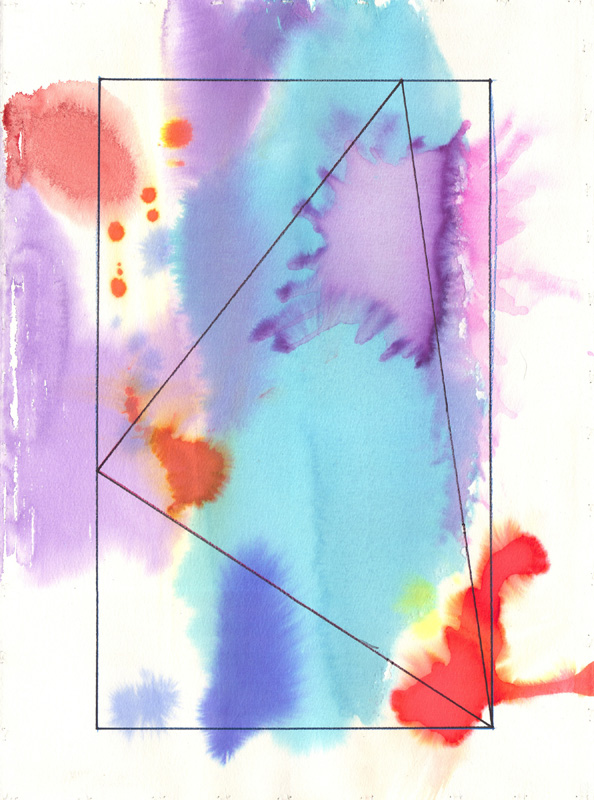
Triangulation 6: Stirrings—Remociones
22″ x 30″
Watercolor and ink
2006

Ricardo Morin

November 2025

Oakland Park, Florida

Stirrings is a four-part haiku cycle that traces the quiet movement from openness to pain, from endurance to renewal.   Each poem enters the body—breath, joints, thought, sweetness—to reveal how life continues in fleeting moments of air, light, and vitality.   The sequence is presented in parallel English and Castilian Spanish.


I

heart thrown wide

breath cradled in blood—

the world stirs the air

*

corazón abierto

el aliento en la sangre—

el mundo agita el aire

II

joints drawn tight

thought held within pain—

the day lifts its light

*

articulaciones tensas

el pensamiento en el dolor—

el día alza su luz

III

may I be love

through the deepening lows—

to rise once again

*

que yo sea amor

en estos hondos descensos—

para alzarme otra vez

IV

sweet peaches warm

their juice the taste of life—

as if death forgot

*

melocotones tibios

su jugo el sabor de la vida—

como si la muerte olvidara

“A Threshold of Silence”

February 12, 2025

*

Michael Basso
(June 28, 1955 – May 28, 2025)

~


During the last decade of his life, Michael’s health declined steadily, much as his father’s had in the years before him, burdened by a succession of illnesses that gradually narrowed the ordinary horizons of living.  Yet he continued to embrace each day with quiet resolve, even as the growing uncertainty of his own body became impossible to ignore.  His suffering was never his alone.  It was shared by the husband who remained at his side and by those who loved him. His final years revealed a condition that ultimately belongs to every human life.

*

Sometimes suddenly, sometimes almost imperceptibly through the passing years, there comes a moment when mortality ceases to be an abstraction.  It is no longer a distant eventuality, safely concealed beneath the routines of ordinary life or softened by the expectation of time still remaining.  It becomes immediate, undeniable, and inseparable from the consciousness through which we experience the world.

For some, this awakening begins with the quiet betrayals of the body.  A stiffness that no longer disappears with rest, a memory that hesitates before returning, a step taken with unexpected caution, each becomes a subtle reminder that permanence was always an illusion.  For others, it begins with loss.  The death of a friend, a sibling, a parent, or a spouse quietly reveals that what has happened to another now belongs, inevitably, to oneself.

Such awareness alters the measure of time.  The future no longer appears boundless, nor does the past remain merely a record of what has been.  Each assumes a different proportion.  Without consciously intending it, we begin to measure life less by what has been accomplished than by what still remains possible.

The mind instinctively resists this recognition.  It seeks refuge in plans, obligations, familiar routines, and the reassuring continuity of ordinary existence, as though attention itself might postpone what reason already knows.  Mortality becomes something acknowledged intellectually while remaining emotionally distant.

This awakening is neither an achievement nor a failure.  It is simply one of the conditions of being human.  From the moment mortality is no longer imagined but personally recognized, every subsequent experience of decline, suffering, endurance, and acceptance acquires a meaning it could not previously possess.

~


*

II. The Decline: Mind and Body

Decline rarely announces itself through a single decisive event.  More often, it advances quietly, measured by changes so gradual that they are first mistaken for passing inconveniences.  The body no longer responds with its former certainty.  Movements once performed without thought require intention.  Strength diminishes, endurance shortens, and the senses begin, almost imperceptibly, to surrender their former clarity.

The mind follows a similar course.  Memory hesitates where it once answered effortlessly.  Thoughts arrive more slowly or dissolve before reaching completion.  Attention becomes increasingly fragile, interrupted by moments of uncertainty that were once unknown.  Yet awareness often remains sufficiently intact to perceive these changes with unsettling precision.  There is a particular solitude in witnessing the gradual alteration of one’s own faculties while still possessing the clarity to understand what is being lost.

Medicine seeks, rightly, to preserve function, relieve suffering, and extend the years in which life may continue with purpose.  Its achievements have transformed the experience of aging and illness beyond what earlier generations could have imagined.  Yet no intervention alters the fundamental condition from which every life begins.  The body remains finite, and every effort to preserve it ultimately encounters limits beyond which restoration is no longer possible.

The deepest transformation, however, is neither physical nor intellectual.  It lies in the gradual recognition that decline is not an interruption of life, but one of its final expressions.  What first appeared exceptional slowly reveals itself to be part of the same natural order through which every living being passes.

~


*

III. The Distractions That Delay Acceptance

To recognize mortality is not the same as to accept it.  Awareness may arrive suddenly, yet acceptance often remains distant, deferred by the mind’s persistent inclination to continue living as though time were still without measure.  We do not turn away because we are incapable of understanding death.  We turn away because we remain deeply attached to life.

This attachment reveals itself in countless ways.  We make plans, pursue ambitions, strengthen the body, cultivate the mind, and seek new remedies for the illnesses that accompany advancing age.  We continue to build, repair, organize, and anticipate tomorrow, not merely because these activities possess value in themselves, but because they reaffirm our place within a future we instinctively presume will continue.

The reluctance to let go arises from more than fear alone.  Lives remain unfinished.  Promises have yet to be fulfilled, conversations remain incomplete, responsibilities endure, and those we love continue to depend upon us.  Even after a long and abundant life, there persists the quiet conviction that something essential still awaits completion.  What binds us to life is often less the fear of dying than the unwillingness to leave unfinished what we believe still belongs to our care.

These attachments are neither weaknesses nor illusions to be dismissed.  They are expressions of love, responsibility, curiosity, and hope, the very qualities through which life acquires meaning.  Yet they also postpone the inward stillness from which acceptance may eventually emerge.  Before the end can be received with peace, the mind must gradually relinquish not only its fear of death, but also its expectation that life must always continue.

~


*

IV. The Weight of Suffering and Endurance

Suffering is among the few certainties shared by every sentient being.   It is neither rare nor exceptional, but woven into the fabric of existence from its first breath to its last.   Yet, for all its universality, suffering remains profoundly individual.   No two lives experience it in precisely the same way, nor can its weight be fully measured by those who do not bear it.

Pain assumes many forms.   It may arise from illness, injury, or the gradual weakening of the body.   It may also emerge from quieter losses, the diminishing of memory, the erosion of independence, the loneliness of watching the world continue without us, or the grief that accompanies every meaningful attachment.   Some burdens are visible and readily acknowledged.   Others remain concealed, carried in silence and known only to the one who endures them.

Suffering, however, is not the same as endurance.   Suffering is what life imposes.   Endurance is the human response to what has been imposed.   It is the quiet capacity to continue despite pain, uncertainty, or loss.   It allows ordinary lives to bear extraordinary burdens without surrendering the desire to remain engaged with the world.

The measure of endurance cannot be determined from the outside.   What one person carries with apparent ease may overwhelm another.   A burden once thought unbearable may gradually become part of daily existence, while a seemingly lesser sorrow may exhaust reserves that have long been silently diminishing.   Endurance follows no universal scale, for it reflects not only the magnitude of suffering but also the unique history, temperament, relationships, and inner resources of the individual who bears it.

For this reason, suffering should never be confused with weakness, nor endurance with invulnerability.   To endure is not to deny pain, but to continue living in its presence.   It is one of the quietest expressions of human dignity, requiring neither recognition nor admiration to possess its full measure.

Every life eventually encounters the limits of endurance, although those limits cannot be predicted or judged by others.   They reveal themselves only within the silent experience of the individual who bears them.   Before acceptance becomes possible, one must first come to understand not only the reality of suffering, but also the extraordinary capacity to endure it.

~


*

V. The Unseen Threshold

Life does not depart all at once.   It recedes quietly at first, almost imperceptibly in its withdrawal.   The breath grows shallower, not in gasps but in a gradual easing, as though the body has begun to ask less of the world.   Weight diminishes, not only in flesh but also in presence.   The self appears to loosen its attachment to the demands that once defined ordinary existence.   A once restless mind drifts more freely, its thoughts lingering less upon the past, the future, or even the urgency of the present.

These changes need not be understood as signs of failure or defeat.   They often resemble a gradual lessening of effort.   The body begins to relinquish tasks it once performed without thought.   Rest occupies more of the day than activity.   Silence becomes more welcome than conversation.   Even the struggle to remain gradually yields to intervals of quiet that seem neither forced nor resisted.   The body often appears to recognize this transition before the mind fully understands it.

There also comes a moment of recognition that seldom announces itself dramatically.   It is rarely defined by a diagnosis or measured by the calendar.   Rather, it emerges through lived experience.   Some continue to resist its approach and devote their remaining strength to extending each day.   Others seem gradually to accommodate its presence, much as one yields to sleep after a long period of wakefulness.

Within this progression, control itself begins to assume a different meaning.   The effort to command every remaining moment often gives way to a willingness to accompany the body’s own course.   What earlier appeared to demand resistance may gradually invite release.   The conclusion of life comes to resemble not an interruption of its order, but one of its final expressions.

Death remains neither something to be conquered nor something that can be indefinitely postponed.   It stands as the final threshold of every life, unseen until it is approached and fully known only by the one who crosses it.

~


*

To think of death without fear, to sit with it unguarded and allow it to be what it is, may represent one of the last transformations of consciousness.   For much of life the mind recoils from its certainty, surrounding it with distractions, explanations, ambitions, and unfinished obligations.   Yet there often comes a time when these gradually lose their urgency, and death no longer appears as an interruption but as the natural conclusion of a life that has followed its own course.

As this change unfolds, fear itself may begin to assume a different character.   The body has already entered the work of relinquishment.   The mind, more slowly, begins releasing its attachment to unfinished meanings, unresolved questions, and the expectation that one more day might alter what has already become complete.   Acceptance does not arise from certainty.   It emerges gradually as resistance itself becomes less necessary.

No single course belongs to every life.   Some meet mortality with acceptance, others with fear, resistance, or uncertainty.   Illness, circumstance, or the limits of consciousness may leave little opportunity for reflection.   The experience admits no universal progression.   Yet where acceptance gradually emerges, it reveals not a victory over death, but one possible way of inhabiting its certainty.

Stillness differs from resignation.   Resignation suggests defeat before an unwanted circumstance.   Stillness suggests something quieter, an increasing harmony between the body’s condition and the mind’s understanding of it.   The effort to negotiate with what cannot be altered slowly diminishes.   What remains is neither triumph nor surrender, but a growing reconciliation with the course life has taken.

From within that reconciliation, life may be seen differently.   Its value no longer depends upon its indefinite continuation, but upon having been lived.   The quiet that once seemed empty gradually becomes sufficient in itself.   Little remains to be defended.   Little remains to be explained.   What has been given begins to appear complete.

~


*

VII. The Living Memory

No life is lived in solitude, and no journey toward acceptance is completed alone.   Along the way we are shaped, guided, and sustained by those whose lives become inseparable from our own.   Even after they are gone, their presence continues in memory, affection, and the countless ways they have altered the lives they touched.

Michael’s final years offered such a presence.   Those who remained beside him witnessed not only the gradual demands of illness, but also the quiet persistence with which he continued to inhabit each day.   His life, no less than his death, reminds us that mortality is never experienced by one person alone.   It is shared by families, by companions, and by all who accompany another through the final chapters of life.

Death strips away much that once appeared essential.   What remains is often simpler than we had imagined.   Affection endures.   Gratitude remains.   Memory continues its work long after physical presence has departed.

To those who have accompanied us through life, we owe more than remembrance.   We owe the recognition that much of who we have become was formed through their companionship, their patience, and their love.   Their absence does not erase that gift.   It leaves it more clearly visible.

They are no longer present as they once were.   Yet what they entrusted to those who loved them continues beyond their lives, carried quietly within the memory and affection of others.   In that continuing presence, gratitude finds its most enduring expression.

*

Ricardo F. Morín Tortolero

June 11, 2025, Capitol Hill , D.C.


*