Written years apart, Intervals and Memories reflect different moments of reckoning. Each stands on its own.
Ricardo Morín
September 14, 2016
New York City.
Memories
We are mirrors of the people in our lives, and through them we come to know ourselves. When I see you, I see myself also. To be vulnerable is to admit our fears and limitations. To grow is to accept them and other things as well—even that we are moving to the rhythm of a diverse and chaotic universe. Infinity is vast and varying time loses its hold.
Aging is part of the cycle that gives us birth and death. These are expressions of life. At every moment we end and begin anew. We let go of our ambitions so that we can live in the present. Our mind resists this and clings to the idea of independence, that it can re-create even itself.
Yet, the universe is a whole and we are part of it. We are free as persons, but never apart from that around us. Loneliness may be built into us and the mind may be in exile, but no barrier separates from the whole.
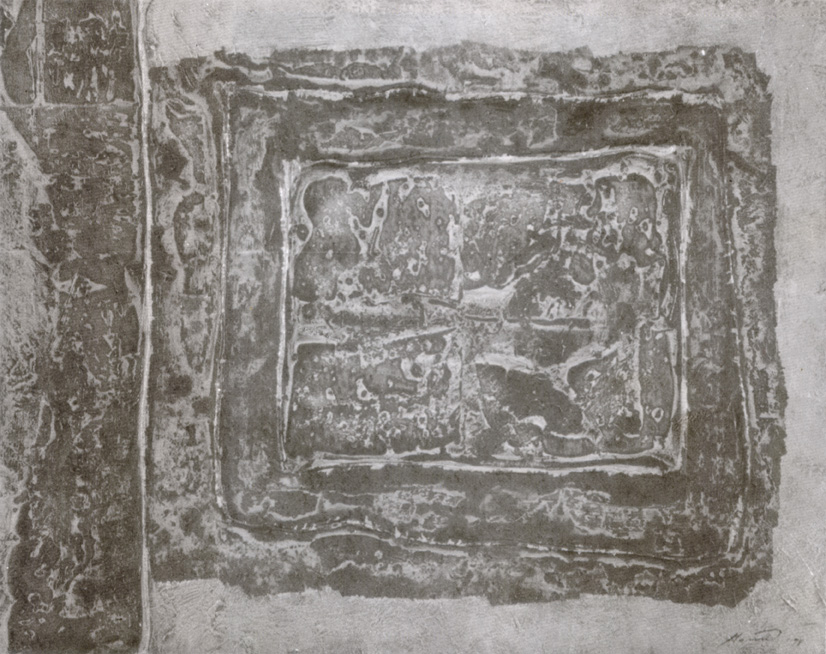
Ricardo F. Morín Aposento Nº 2 29″ x 36″ Oil on canvas 1994
Author’s Note
Intervals is written in a cadence held taut at the threshold of life and death. It does not withhold itself, though its language remains stripped of explanation. Ambivalence may be inescapable, but it is not the aim. The anonymity of the speaker is deliberate, to keep attention on what is spoken rather than on who speaks.
Ricardo Morín, September 11, 2025. Bala Cynwyd, Pa.
Intervals
To heal himself, he would cover his body in mud and then rinse it away. Crouched beneath the burning sun, he stared diagonally from a corner across the far end of the yard. From the clothesline he hung a black umbrella, upside down. Into it he cast the last handful of potions. From its collapse, heavy with weight, he hoped to avoid his own death.
He covered his books with a black sheet; blindly he pulled one out at a time and, after finding a sentence giving meaning to his thoughts, he put it back. He waited for revelation. His mother, now old, took another book out and searched for a better reply.
Exhausted and sleepless, he lay wrapped in a red blanket with his back to the mirror. Drenched in tears, he felt undone. Shivers traced his spine, as though his entrails were on fire.
He woke to the sound of running water. His mother would scrub his garments until the fabric began to fray. He had painted the walls white; the doors ceased to be brown. An intruder leapt over the fence. Then, with a surprising strength, he tore up the garden.
Nights followed without sleep. He was unaware of sunken cheekbones; only his neighbors’ gaze could see him wasting away. He managed to fly afar. Though attentive to life, he found disappointment.
On arrival the hotel summoned an ambulance. After a ten-hour flight, septic shock seized him; a nurse asked him to choose a destination. Shivers returned. He saw many dying, though it was not his turn. Days later, his flesh returned to life.
With the memory of past ties, he departed again disappointed. He crossed another distance and knew how fragile his solitude was.
You rescued him and he you. A bridge was built out of longing. Three years of passion did not mend the abyss; he took his life and you remained.
A Roman curate attended his mother’s cries, while he twisted her son’s. Little did the curate know that it was by his own design. He called for you, a new love, to come. To love, to sustain the bond of the moment.
Epilogue
Intervals rests on our fearful perception of death, solitude, survival, and rupture (an interval is the rhythm of time and its ending is the emptying of what the consciousness of fear carries in it). An interval seeks neither consolation nor resolution; it remains with what occurs, in the exposure where solitude and fracture reveal the fragility of existence.
What follows does not simplify or announce itself. It moves inward—through observation, thought, and the tension between clarity and disappearance. The soliloquy keeps to its own course: neither performing nor explaining, but sustaining an interior gaze. To read it is not to be guided, but to remain with it—where thinking becomes presence, and language measures what endures.
Soliloquy
Once upon a time, there lived within the writer a creative energy—its force and passion for self-expression—that sustained him. It was not summoned; it simply endured. So arresting was this presence that he could not discipline it into routine or mold it into a pattern for physical endurance. He could not pause it for walks or for any activity not already part of the act of creation itself. He resorted to standing while writing, walking while reading, sleeping while thinking.
His experience was never an affliction to be named or cured, but a life to be lived on its own terms—a creative testament to the fullness of being, not a clinical footnote to someone else’s definition. Choosing not to be defined by it honored both its agency and his lifelong work. It was a condition to be understood alone, even if shared in writing—yet never in search of validation.
Within the boundaries of personal insight, it revealed itself as a form of devotional absorption, one that brought dignity even in moments of physical strain and aging.
His refusal of validation was not an opposition to authority, but a denial that any external pressure should exist.
Some said there was nothing unique in anyone, that all expression merely reflected what had been learned. The writer did not disagree, yet he knew there was more to being than what one received—even from experience itself. Perhaps no one was unique, but each voice was distinct—formed from the sum total of an existence that could not be equated. From a random mixture, an ineffable summation, something emerged: something irreplaceable and irreproducible—not because it exceeded others, but because it belonged only to the one who bore it.
He feared madness—not as spectacle, but as the slow drift of meaning into isolation. The force within him was real, yet not entirely satisfying unless it discovered truth—truth that resonated not only within his own logic but in the logic of others. How else could one know oneself if intelligence remained solitary? Without echo, thought became a sealed chamber: intricate, yes, but airless. He did not seek certainty; he sought correspondence. It was not solitude he feared, but becoming untranslatable.
Life now appeared transient, precarious—timeless in sensation, yet embedded in time. It moved furtively—through failings, disappointments, and sudden moments of radiant clarity. Nothing could be reproduced. But he had come to accept that—not because it was lost, but because even memory altered what it held. What repeated was not the moment, but the act of noticing—the deepening of attention. And so he did not live to preserve what was, but to remain present as it changed. There was no going back, only going further—more attentively, more awake.
For him, inspiration didn’t strike—it settled. It arrived not with answers, but with permission to begin.
There was no ritual. No dramatic turning point. Only the canvas, the scent of oil, the shifting light across the floor. One day folding into the next, until the work became its own weather—sometimes clear, sometimes stormy, but always present.
He believed in attention, not mastery.
What moved him wasn’t how the painting was achieved at any given moment, but when deconstructed he had to reclaim it, not out of skill, but out of necessity—when the hand moved before thought, and something more honest than intention began to lead. And when it happened, it asked everything of him.
Any one watching—anyone but him—would have seen very little. A trace. A pause. A slight adjustment. But inside, something in him was listening—not to himself, but to the world, the material, the echo of a form not yet known.
He didn’t make work to be remembered, though he carried each piece like a child of his. He made it to stay alive. And when he encountered a finished painting years later, it stirred him physically. It wasn’t nostalgia. It was the smell of pigment, the sound of bristles, the grief of something nearly realized—lost, then found again.
Some days, the work moved with a kind of ease. Other days, it refused. He learned not to chase either.
He always began without knowing what he was after. A shade. A flicker of transparency. Astroke that unsettled the surface. Often the brush would stop midair, suspended while he waited for the next move to reveal itself. Sometimes nothing came. Those pieces sat untouched for weeks—a quiet unease in the corner of the room.
He lived alongside their silence.
The studio was never clean, but always ordered. Rags folded. Jars fogged with old turpentine. Walls bearing soft outlines of past canvases. The mess wasn’t careless. It was lived-in—not careless, just lived-in. Notes of Goethe’s pyramidal harmony hung besides mineral samples, sketches, color wheels, torn letters from art dealers. Not for revelation—but for proximity.
Not every piece held. Some failed completely. Others, losing urgency layer by layer, failed gradually, He kept those too—not as records, but as reminders. Where the hand had gone quiet. Where the work had ceased to ask. Yet they became platforms—spaces for later returns, for deeper entry.
His days had no fixed schedule, though a rhythm formed over the years—a long devotion, interrupted, resumed, endured.
Now, he arrived late morning from the City. The studio held the faint scent of wax and turpentine, laced with something older—dust, fabric, memory. He opened a window if weather allowed. Not for light but for air. For movement. For the slow turning of the fans like breath.
He made tea. Sometimes he played Bach, or a pianist, whose fingers pressed deeper into the keys than others. Other mornings: National Public Radio. A poet, a scientist, someone trying to say the impossible in ordinary words. He liked the trying more than the saying.
He painted standing—rarely seated. Some days he moved constantly between easel, sink, and mixing table. Other days he barely moved at all. Just watched.
Lunch was simple. Bread. Fruit. A little cheese. Sometimes eggs, lentils, soup across several days. He didn’t eat out much—not out principle, but because it broke the thread.
If tired, he would lie on the couch at the back wall. Twenty, thirty minutes. No more. And when he woke, the light had shifted again—slanted, softened, more forgiving. The canvas looked changed. As if it had waited for his absence.
Late afternoons were often the best. A second wind, free of pressure. There was a looseness in the air, born from knowing no one would knock or call. He spoke to the work then—not aloud, but inwardly. This tint? Too warm. This stroke? Too sure. Let it break. Let it breathe. Let it speak without saying.
Sometimes the medium resisted. A brush faltered. A gesture collapsed. He didn’t fight. He gave it space. If he stayed patient, it found its rhythm again.
Not everything reached completion. Some works remained open—not abandoned, simply finished enough. Others came suddenly, like music that plays without lifting the fingers.
By evening, he cleaned his tools. Never rushed. He wiped the palette. Rinsed the jars. Hung the rags to dry. It was a kind of thanks. Not to the painting. To the day.
Then lights out. Door closed. Nothing declared. Nothing completed. Yet something always moved forward.
Grief, too, remained. It lived in the room like dust—settled in corners, clinging to stretchers still bare, woven into old white sheets.
His sister’s illness came slowly, then all at once—while Adagio in G Minor played low across the studio. He painted through it. Not to escape, but because stopping would have undone him. In the silence between strokes, he could feel her breath weakening. Sometimes he imagined she could see the work from wherever she was. That each finished piece carried a word he hadn’t dared to say aloud. She would have understood. She always had.
Later, when his former lover died—alone, unexpectedly, in Berlin—he stopped painting altogether. The studio felt still in a way he couldn’t enter. Even the canvas turned away from him. When he returned, it was with a muted palette. Dry. Indifferent. The first brush stroke broke in two. He left it. And continued.
Desire, too, had quieted. Not vanished. Just softened. In youth it had been urgent, irrepressible. Now it hovered—an echo that came and went. He didn’t shame it or perform it. He lived beside it, the way one lives beside a field once burned, now slowly greening.
Grief didn’t interrupt the work. It deepened it. Not in theme—but in texture. Some of those paintings seemed familiar to others. But he knew what they held—the weight of holding steady while coming apart inside.
Even now, some colors recalled a bedside. A winter walk. The sound of someone no longer breathing. A flat grey. A blue once brilliant, now tempered between longing and restraint.
He wondered sometimes about that tension.
But when he painted, stillness returned.
Seventeen years ago, when chemotherapy ended, the days grew quieter.
There was no triumph. Just a slow return to rhythm—different now. The body had changed. So had the mind. He couldn’t paint for hours without fatigue. The gestures once fluid were heavier, more tentative.
He didn’t resist it.
The studio remained, but the center of gravity shifted. Where once he reached for a brush, now he reached for a pen. At first, just notes. Fragments. A way to hold the day together. Then came sentences. Paragraphs. Not about himself, not directly. About time. Memory. Presence. Writing became a solace. A way to shape what the body could no longer carry. A place to move, still, with care.
It wasn’t the end of painting. Just a pause. A migration. Writing required its own attention, its own patience. And he recognized in that a familiar devotion.
Sometimes, the canvas still called. It would rest untouched for weeks. Then one day, without announcement, he would begin again.
The two practices lived side by side. Some days the brush. Some days the page. No hierarchy. No regret. Only the quiet persistence of a life still unfolding.
There is no final piece. No last word.
He understands now: a life is not made of things finished, but of gestures continued—marks made in good faith, even when no one is watching. A sentence begun. A color mixed. A canvas turned to the wall—not in shame, but because it had said enough.
He no longer asks what comes next. That question no longer troubles him.
If anything remains, it will not be the name, or the archive, or even the objects themselves. It will be the integrity of attention—the way he returned, again and again, to meet the moment as it was.
Not to make something lasting. But to live, briefly, in truth.
*
Ricardo F Morin Tortolero
Bala Cynwyd, Pa., June 14, 2025
Editor:Billy Bussell Thompson
Author’s Note
This piece, like much of what I’ve made in recent years, exists because of those who have sustained me.
To David Lowenberger—whose love and steadfastness give my life its rhythm. Without him, continuity itself would falter.
To José Luis Montero, my first art teacher, whose presence early on became a compass I’ve never stopped following.
To my parents, whose quiet influence shaped my regard for form, devotion, and care.
And always, to my friend and editor, Billy Bussell Thompson, whose voice lives quietly in mine.
Writing, silence, and the art of understanding in stillness
*
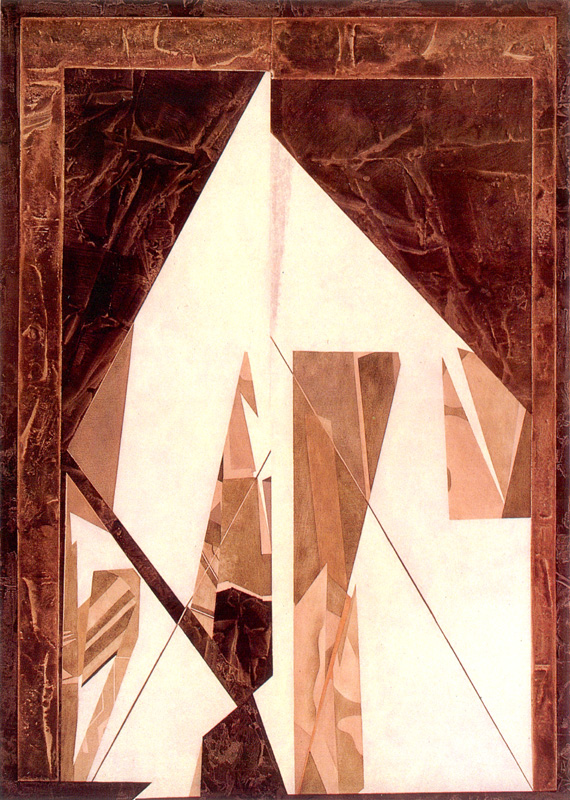
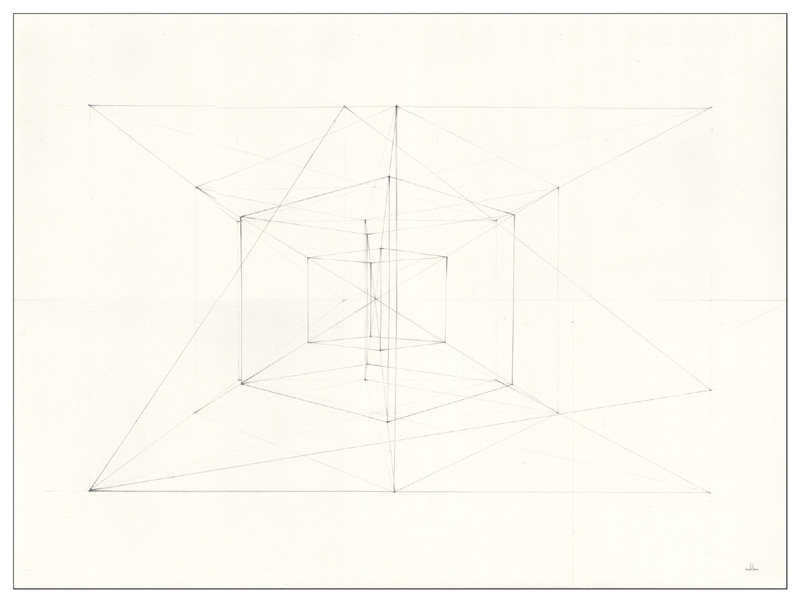
Ricardo Morín Triangulation 4 22″ x 30″ Graphite on paper 2006
To my sister Bonnie
*
Ricardo F. Morín
June 2025
Oakland Park, Florida
Author’s Note
This reflection was originally drafted before The Ethics of Perception, Part I, yet it belongs to the same inquiry into attention, understanding, and ethical relation.
There are moments when the truest form of intimacy is silence. At other times, it’s the quiet labor of reaching for the right word—however incomplete—that brings us closer. Expression, in this light, is not just a vehicle for communication, but an act of care.
To speak, to withhold, to write, to listen—each choice carries a particular weight. Intimacy lives in these gestures: not in grand declarations, but in the ethics of how we reveal ourselves—and how we receive what another dares to offer. What follows is not a theory, but a reflection on how intimacy appears in expression—and in its absence.
I. Prelude: in the pause between words
It’s hard to pinpoint the moment when something becomes intimate. It isn’t always a touch, or a glance, or even a confession. Sometimes, it’s just a pause—a shared pause—between one word and the next, when both people sense that something true is either about to be said or has just been said, without quite naming it.
Once, sitting face to face, I watched someone I cared for stare silently out the window. I said nothing either. There was no gesture, no disclosure, no clarifying words. And yet the silence didn’t feel empty—it felt full. In that stillness, something passed between us—not a message, not even an understanding, but a kind of permission:
To exist without explanation. To be present without having to perform.
That moment stayed with me not because it was dramatic, but because it was unplanned. I hadn’t expected it, and I couldn’t have recreated it. I only knew, afterward, that I had been in the presence of something rare: an intimacy that asked nothing more than to be.
And yet, not all intimacy is born in silence or in someone else’s presence. Some comes later, through writing—in that long interval between feeling and saying. Some is only possible thanks to the quiet distance that makes reflection possible.
II. What we mean when we say “intimate”
The word intimacy often evokes physical closeness: the realm of touch, proximity, lovers, secrets shared in the dark. But what if intimacy were less about closeness than about permission? The permission to be undefended. To move slowly. To be unclear—and still be trusted.
To be intimate with someone is not merely to be known, but to be seen— seen without the pressure to explain yourself quickly or justify what you feel. It’s an opening, and it’s also a risk: the risk of being misunderstood, and the deeper risk of being understood too well.
Some forms of intimacy unfold face to face. Others require distance. Some happen through dialogue. Others need a single voice, speaking on one’s own in a quiet room.
That’s where writing begins— not as performance, but as a long conversation, uninterrupted.
III. The varieties of intimacy
Intimacy shifts with context, with time, with the shape of the self we bring to another. It is not one thing— not just closeness, or tenderness, or vulnerability— but a set of ways we allow ourselves to be known, and sometimes, to know another.
There’s the intimacy of the body— perhaps the most visible and least understood. It belongs to touch, proximity, the instinctive draw toward another’s presence. But this form can deceive: physical closeness without emotional resonance is common— and easily faked. Yet when body and emotion align, there’s a wordless attunement: a hand resting on a shoulder for just the right amount of time; a breath falling into rhythm without intention.
Then there’s emotional intimacy: the slow courage to say what one feels— not just when it’s beautiful or convenient, but when it’s awkward, incomplete, or raw. This kind of intimacy isn’t given—it’s earned. It may take years, or a single night. Trust lives here—or breaks.
There’s also intellectual intimacy: what arises in conversation when ideas flow without anyone guarding their ground. It’s rare. Most social spaces reward speed, the need to shine, or the safety of politeness. But sometimes, with someone equally curious, thought expands in the presence of the other— not in agreement, but in response. There’s nothing to prove— only the pleasure of discovery. That’s intellectual intimacy. It creates a different kind of closeness— not of feeling, but of perception.
Stranger still is narrative intimacy— the kind that forms not between two people in the same room, but between the one who writes and the one who reads, separated by silence and time. It isn’t immediate— but it isn’t less real. A voice emerges from the page and seems to speak directly to you, as if it knew the contours of your mind. You feel understood—without being seen. You may never meet the person who wrote those words, but something in you shifts. You are no longer alone.
These are not rigid categories. They overlap, interrupt, evoke one another. One may deepen another. Physical presence can create emotional safety. Intellectual closeness can open into unexpected tenderness. And still, each has its own rhythm, its own grammar— and its own risks.
In that complexity, intimacy ceases to be a condition. It becomes a practice: something we learn, lose, revise, and sometimes write when no other form is possible.
IV. Writing as intimacy with oneself (and with another)
Writing, too, is a kind of intimacy— not only with others, but with oneself. Especially when it’s honest— when what’s written is not just clever or correct, but true. That kind of writing doesn’t flatter. It doesn’t argue. It reveals.
We write to bring something forth— not just for an audience, but to hear ourselves think, to see what we didn’t yet know we felt. In writing, we become witnesses to our own consciousness— both its lucidity and its evasions.
We follow a sentence not only for its logic, but for the feeling it carries. And when that feeling falters, we know we’ve lost the thread.
So we begin again, and again— trying not just to explain, but to say something that feels just.
In that sense, writing is an ethical act. It demands attention. It requires patience. It invites us to inhabit our own experience with precision— even when that experience is fragmented or unresolved.
And if we are lucky— if we are honest— something in that effort will reach someone else. Not to impress. Not to convince. But to accompany.
V. When intimacy fails or is refused
Sometimes you reach out—carefully, sincerely—and receive silence, indifference, or a response so misaligned it makes you feel naïve for having tried. Other times, the failure is subtler: a conversation that scatters just as something real begins to take shape—or a listener who hears your words, but not your meaning.
Those moments stay with us. Not because they’re dramatic, but because they remind us how precarious intimacy can be. It can’t be forced—just as humility can’t. Both require a quiet letting go—a willingness to offer something without knowing how it will be received. We can prepare the ground, make the gesture, risk the truth—but the rest depends on the other: their timing, their capacity, their willingness to meet us there.
There’s also the experience of being misunderstood—not just in fact, but in essence. You try to say something that matters, and the other person responds to what they think you said—or to a version of you that never was. It’s a blow— that mismatch between what you tried to share and what actually landed. The desire for intimacy becomes exposure without connection—a wound instead of a bridge.
Sometimes we avoid intimacy not because we don’t want it, but because we fear what it might cost. We’ve been made to feel clumsy—for caring too much, or for being too visible. Or we’ve shared something intimate, only to have it treated lightly—or analyzed without feeling. After that, we grow cautious. We speak less—or in fragments—or not at all.
It’s in the wake of such rejections—large or small—that writing ceases to be mere expression. It becomes repair. Writing allows us to recover what was lost in the moment— to name what never reached its destination, to finish the thought no one waited for, to say it again—this time without interruption, without assumptions, without fear.
And while writing cannot undo the failure of a shared moment, it can offer something else: coherence. A record. A form of truth that endures—even if it wasn’t heard.
In this way, writing becomes a quiet act of insistence—not against the world, but on behalf of the self. It’s a way of saying: What I tried to share still matters—even if it wasn’t received.
VI. The gesture that remains
In the end, intimacy is not a state but a gesture— repeated again and again— toward understanding, toward presence, toward a shared sense that may arrive… or may not.
Sometimes that gesture is a word spoken at the right moment. Sometimes it’s a silence held just long enough for the other to speak. And sometimes it’s the act of writing—solitary, patient, unfinished— offered not to a crowd, but to a single imagined reader who, one day, might need what you are now trying to say.
Writing, at its core, is a form of listening. Not only to others, but to the self that doesn’t rush, doesn’t perform, doesn’t need to persuade.
To the self that waits— that wants to be known not by what it manages to say in quick response, but by what it keeps trying to say with care.
That’s why I return to the page: not because it guarantees connection, but because it keeps the door open. Because in a world that demands speed, certainty, and charm, writing makes room for something slower and more faithful: the long, unfinished gesture of trying to reach someone— perhaps even oneself— with something resonant.
And when intimacy happens—on the page or in life— it’s never because we found the perfect words. It’s because someone stayed. Someone listened. Someone let the moment open—without rushing to close it.
That’s what I’m doing now: writing not to end something, but to leave it open— so that something of greater consequence might enter.
 Observations On Perception