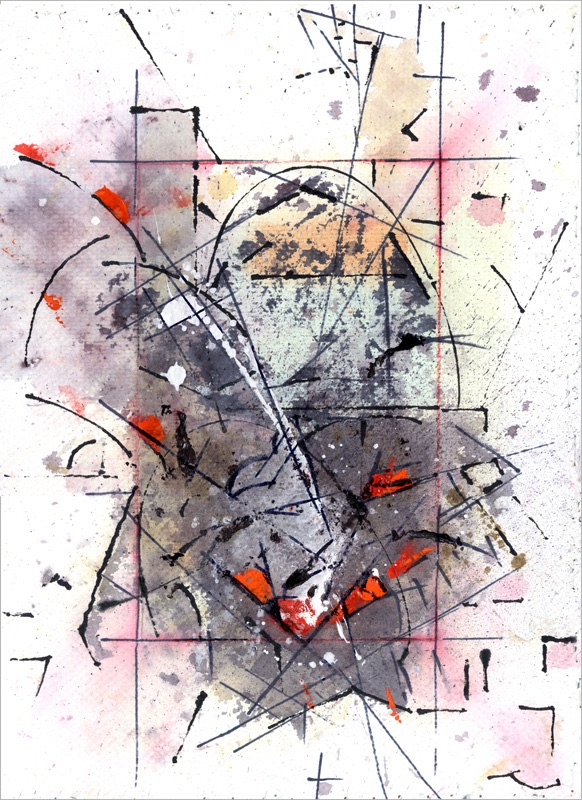
Ricardo F Morín Window I 8” x 10” Watercolor and ink on paper 2003
Ricardo F. Morín
February 18, 2026
Oakland Park, Fl
1 Most people first recognize vulnerability not through abstract reflection but when ordinary functions change. Sleep becomes fragmented. Movement requires calculation. Attention shifts toward signals that once remained unnoticed. Human life begins not from stability but from exposure. The body exists within conditions it does not fully control and must continuously adapt to forces that exceed intention. Vulnerability is not an exception. It is a structural condition of being alive. Wellbeing does not remove this condition. It reorganizes how one lives within it.
2 Attempts to explain healing often rely on simplified narratives of control, positivity, or emotional purification. Such narratives overlook the complexity through which biological systems regulate themselves. Hormones, neural pathways, immune responses, and behavioral patterns operate through feedback rather than command. The organism adjusts through interaction, not through absolute mastery. Understanding this distinction allows healing to be viewed less as conquest over illness and more as participation in an ongoing process of regulation.
3 Mental practices such as meditation, visualization, or structured breathing may influence physiological states. Their value lies not in eliminating difficulty but in altering how perception interacts with bodily response. Attention can change tension, breathing patterns can modify autonomic responses, and emotional framing can influence how stress signals are interpreted. These practices do not replace biological realities. They operate within existing physiological processes.
4 Many discussions of emotional life rely on familiar language about resentment or anger without examining how such patterns function in practice. Emotional fixation narrows perception because it reduces the range of possible interpretations available to the mind. When attention becomes rigid, the body often reflects that rigidity through muscular contraction, altered breathing, or disrupted sleep. Recognizing this does not deny legitimate grievances. It clarifies how sustained cognitive patterns shape physiological experience. What appears biologically as regulation appears conceptually as participation.
5 Healing must also acknowledge limits. Not all illness can be traced to emotional origin, and not all suffering yields explanation. Biological variability, environmental exposure, and genetic inheritance create outcomes that cannot be reduced to intention or belief. Humility recognizes that the absence of explanation neither invalidates the search for meaning nor guarantees it.
6 Contemporary medical technology introduces a further dimension into this landscape. Adaptive systems capable of measuring neural activity and adjusting stimulation in real time demonstrate that regulation is inherently dynamic. The nervous system functions through continuous feedback loops. Closed loop neuromodulation technologies reveal this principle by making adjustment visible and measurable. Rather than blocking pain entirely, such systems alter how signals are transmitted and interpreted, and allow the body to reorganize patterns that have become fixed through chronic strain.
7 Technology in this context does not replace the organism. It participates alongside it. The device measures electrical responses, modifies stimulation within clinical parameters, and supports gradual adaptation rather than immediate elimination of discomfort. This reflects a shift in how regulation is understood. Healing increasingly involves collaboration between biological systems and external adaptive tools. The boundary between internal regulation and technological assistance becomes relational rather than oppositional.
8 Because of this shift, improvement may appear indirectly. Functional changes such as more consistent sleep, increased movement, or reduced hesitation in daily tasks often emerge before subjective perception of pain changes significantly. The nervous system learns through repetition across time rather than through instant resolution. Observing patterns over days or weeks becomes more meaningful than evaluating isolated moments.
9 The language of self healing therefore requires revision. Healing does not imply independence from vulnerability. It involves learning to inhabit vulnerability with greater precision, supported by practices, relationships, and technologies that expand the range of possible responses. Faith, meditation, medical science, and personal discipline may each contribute, not as competing explanations but as complementary modes of engagement with the unknown.
10 Experience itself does not provide ultimate meaning. Meaning arises from how experience is integrated into awareness. When experience is treated as proof of certainty, rigidity follows. When experience is held as information rather than identity, adaptation remains possible. The aim is not to silence the mind or eliminate difficulty, but to allow perception to remain flexible enough to respond to change.
11 Healing, then, is neither purely psychological nor purely technological. It is the ongoing negotiation between organism and environment, perception and physiology, vulnerability and adaptation. Modern tools may refine this negotiation by providing new forms of feedback, yet the underlying condition remains unchanged. Human beings continue to live within limits while developing new ways to respond to them. The task is not to escape vulnerability but to regulate within it.
Written years apart, Intervals and Memories reflect different moments of reckoning. Each stands on its own.
Ricardo Morín
September 14, 2016
New York City.
Memories
We are mirrors of the people in our lives, and through them we come to know ourselves. When I see you, I see myself also. To be vulnerable is to admit our fears and limitations. To grow is to accept them and other things as well—even that we are moving to the rhythm of a diverse and chaotic universe. Infinity is vast and varying time loses its hold.
Aging is part of the cycle that gives us birth and death. These are expressions of life. At every moment we end and begin anew. We let go of our ambitions so that we can live in the present. Our mind resists this and clings to the idea of independence, that it can re-create even itself.
Yet, the universe is a whole and we are part of it. We are free as persons, but never apart from that around us. Loneliness may be built into us and the mind may be in exile, but no barrier separates from the whole.
Writing, silence, and the art of understanding in stillness
*
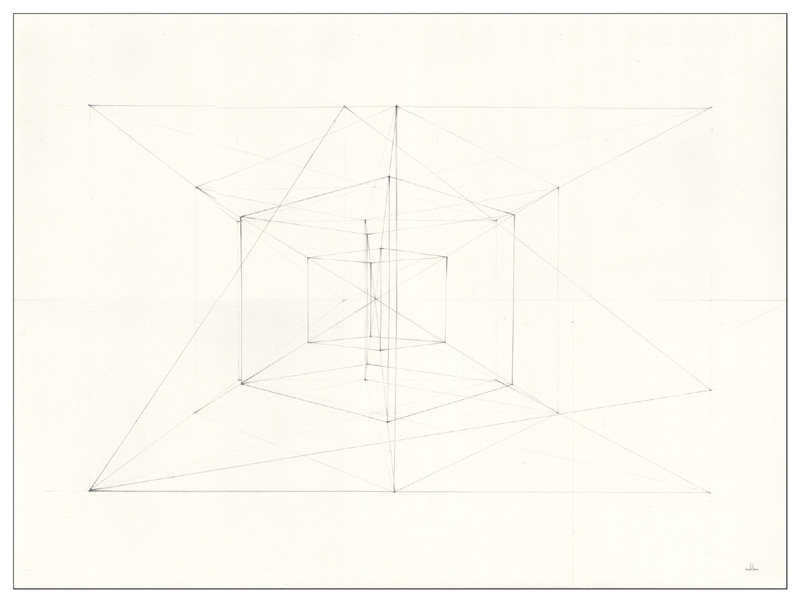
Ricardo Morín Triangulation 4 22″ x 30″ Graphite on paper 2006
To my sister Bonnie
*
Ricardo F. Morín
June 2025
Oakland Park, Florida
Author’s Note
This reflection was originally drafted before The Ethics of Perception, Part I, yet it belongs to the same inquiry into attention, understanding, and ethical relation.
There are moments when the truest form of intimacy is silence. At other times, it’s the quiet labor of reaching for the right word—however incomplete—that brings us closer. Expression, in this light, is not just a vehicle for communication, but an act of care.
To speak, to withhold, to write, to listen—each choice carries a particular weight. Intimacy lives in these gestures: not in grand declarations, but in the ethics of how we reveal ourselves—and how we receive what another dares to offer. What follows is not a theory, but a reflection on how intimacy appears in expression—and in its absence.
I. Prelude: in the pause between words
It’s hard to pinpoint the moment when something becomes intimate. It isn’t always a touch, or a glance, or even a confession. Sometimes, it’s just a pause—a shared pause—between one word and the next, when both people sense that something true is either about to be said or has just been said, without quite naming it.
Once, sitting face to face, I watched someone I cared for stare silently out the window. I said nothing either. There was no gesture, no disclosure, no clarifying words. And yet the silence didn’t feel empty—it felt full. In that stillness, something passed between us—not a message, not even an understanding, but a kind of permission:
To exist without explanation. To be present without having to perform.
That moment stayed with me not because it was dramatic, but because it was unplanned. I hadn’t expected it, and I couldn’t have recreated it. I only knew, afterward, that I had been in the presence of something rare: an intimacy that asked nothing more than to be.
And yet, not all intimacy is born in silence or in someone else’s presence. Some comes later, through writing—in that long interval between feeling and saying. Some is only possible thanks to the quiet distance that makes reflection possible.
II. What we mean when we say “intimate”
The word intimacy often evokes physical closeness: the realm of touch, proximity, lovers, secrets shared in the dark. But what if intimacy were less about closeness than about permission? The permission to be undefended. To move slowly. To be unclear—and still be trusted.
To be intimate with someone is not merely to be known, but to be seen— seen without the pressure to explain yourself quickly or justify what you feel. It’s an opening, and it’s also a risk: the risk of being misunderstood, and the deeper risk of being understood too well.
Some forms of intimacy unfold face to face. Others require distance. Some happen through dialogue. Others need a single voice, speaking on one’s own in a quiet room.
That’s where writing begins— not as performance, but as a long conversation, uninterrupted.
III. The varieties of intimacy
Intimacy shifts with context, with time, with the shape of the self we bring to another. It is not one thing— not just closeness, or tenderness, or vulnerability— but a set of ways we allow ourselves to be known, and sometimes, to know another.
There’s the intimacy of the body— perhaps the most visible and least understood. It belongs to touch, proximity, the instinctive draw toward another’s presence. But this form can deceive: physical closeness without emotional resonance is common— and easily faked. Yet when body and emotion align, there’s a wordless attunement: a hand resting on a shoulder for just the right amount of time; a breath falling into rhythm without intention.
Then there’s emotional intimacy: the slow courage to say what one feels— not just when it’s beautiful or convenient, but when it’s awkward, incomplete, or raw. This kind of intimacy isn’t given—it’s earned. It may take years, or a single night. Trust lives here—or breaks.
There’s also intellectual intimacy: what arises in conversation when ideas flow without anyone guarding their ground. It’s rare. Most social spaces reward speed, the need to shine, or the safety of politeness. But sometimes, with someone equally curious, thought expands in the presence of the other— not in agreement, but in response. There’s nothing to prove— only the pleasure of discovery. That’s intellectual intimacy. It creates a different kind of closeness— not of feeling, but of perception.
Stranger still is narrative intimacy— the kind that forms not between two people in the same room, but between the one who writes and the one who reads, separated by silence and time. It isn’t immediate— but it isn’t less real. A voice emerges from the page and seems to speak directly to you, as if it knew the contours of your mind. You feel understood—without being seen. You may never meet the person who wrote those words, but something in you shifts. You are no longer alone.
These are not rigid categories. They overlap, interrupt, evoke one another. One may deepen another. Physical presence can create emotional safety. Intellectual closeness can open into unexpected tenderness. And still, each has its own rhythm, its own grammar— and its own risks.
In that complexity, intimacy ceases to be a condition. It becomes a practice: something we learn, lose, revise, and sometimes write when no other form is possible.
IV. Writing as intimacy with oneself (and with another)
Writing, too, is a kind of intimacy— not only with others, but with oneself. Especially when it’s honest— when what’s written is not just clever or correct, but true. That kind of writing doesn’t flatter. It doesn’t argue. It reveals.
We write to bring something forth— not just for an audience, but to hear ourselves think, to see what we didn’t yet know we felt. In writing, we become witnesses to our own consciousness— both its lucidity and its evasions.
We follow a sentence not only for its logic, but for the feeling it carries. And when that feeling falters, we know we’ve lost the thread.
So we begin again, and again— trying not just to explain, but to say something that feels just.
In that sense, writing is an ethical act. It demands attention. It requires patience. It invites us to inhabit our own experience with precision— even when that experience is fragmented or unresolved.
And if we are lucky— if we are honest— something in that effort will reach someone else. Not to impress. Not to convince. But to accompany.
V. When intimacy fails or is refused
Sometimes you reach out—carefully, sincerely—and receive silence, indifference, or a response so misaligned it makes you feel naïve for having tried. Other times, the failure is subtler: a conversation that scatters just as something real begins to take shape—or a listener who hears your words, but not your meaning.
Those moments stay with us. Not because they’re dramatic, but because they remind us how precarious intimacy can be. It can’t be forced—just as humility can’t. Both require a quiet letting go—a willingness to offer something without knowing how it will be received. We can prepare the ground, make the gesture, risk the truth—but the rest depends on the other: their timing, their capacity, their willingness to meet us there.
There’s also the experience of being misunderstood—not just in fact, but in essence. You try to say something that matters, and the other person responds to what they think you said—or to a version of you that never was. It’s a blow— that mismatch between what you tried to share and what actually landed. The desire for intimacy becomes exposure without connection—a wound instead of a bridge.
Sometimes we avoid intimacy not because we don’t want it, but because we fear what it might cost. We’ve been made to feel clumsy—for caring too much, or for being too visible. Or we’ve shared something intimate, only to have it treated lightly—or analyzed without feeling. After that, we grow cautious. We speak less—or in fragments—or not at all.
It’s in the wake of such rejections—large or small—that writing ceases to be mere expression. It becomes repair. Writing allows us to recover what was lost in the moment— to name what never reached its destination, to finish the thought no one waited for, to say it again—this time without interruption, without assumptions, without fear.
And while writing cannot undo the failure of a shared moment, it can offer something else: coherence. A record. A form of truth that endures—even if it wasn’t heard.
In this way, writing becomes a quiet act of insistence—not against the world, but on behalf of the self. It’s a way of saying: What I tried to share still matters—even if it wasn’t received.
VI. The gesture that remains
In the end, intimacy is not a state but a gesture— repeated again and again— toward understanding, toward presence, toward a shared sense that may arrive… or may not.
Sometimes that gesture is a word spoken at the right moment. Sometimes it’s a silence held just long enough for the other to speak. And sometimes it’s the act of writing—solitary, patient, unfinished— offered not to a crowd, but to a single imagined reader who, one day, might need what you are now trying to say.
Writing, at its core, is a form of listening. Not only to others, but to the self that doesn’t rush, doesn’t perform, doesn’t need to persuade.
To the self that waits— that wants to be known not by what it manages to say in quick response, but by what it keeps trying to say with care.
That’s why I return to the page: not because it guarantees connection, but because it keeps the door open. Because in a world that demands speed, certainty, and charm, writing makes room for something slower and more faithful: the long, unfinished gesture of trying to reach someone— perhaps even oneself— with something resonant.
And when intimacy happens—on the page or in life— it’s never because we found the perfect words. It’s because someone stayed. Someone listened. Someone let the moment open—without rushing to close it.
That’s what I’m doing now: writing not to end something, but to leave it open— so that something of greater consequence might enter.
There’s a certain kind of person the world seems to admire—sharp-tongued, composed, deliberate. He moves through life as if he’s never doubted the sound of his own voice. His gestures are practiced, his opinions unshakable. It’s a performance of authority, and to many, it’s compelling.
But I’ve never fit that mold. I don’t hold myself like someone bracing for a fight with the world. I don’t presume to master a room. And more and more, I’ve come to believe that what makes a person is not how forcefully he presents himself, but how honestly he shows up.
Vulnerability has never been fashionable. It doesn’t draw applause or dominate the stage. But it’s where I’ve found the most truth. Not in being right, or revered, or untouchable—but in admitting how little I know, how often I’ve failed, and how much of life resists explanation.
We’re taught to act as if we’ve earned our place—through effort, through cleverness, through some innate worth. But I’ve lived long enough to see how much is assumed, how much is favored, how many doors open not because of merit but because of circumstance, appearance, proximity to power. The world flatters performance. It often mistakes loudness for depth, certainty for wisdom.
But beneath all that, we’re fallible—achingly so. We get things wrong. We hurt people. We retreat when we should have stayed, and speak when silence would have been kinder. We tell ourselves stories to survive, not always to understand.
And yet, that fallibility isn’t shameful. It’s not a flaw to be punished—it’s the most human part of us. The mistake is not in being wrong; it’s in pretending we’re not. Intimacy begins where performance ends—when we stop curating ourselves and let others see what is: our confusion, our fear, our imperfect love.
I’ve stopped wanting to impress. I want to be known. I want to know others—not through their accomplishments or their poses, but through the quiet truths they carry. I don’t need anyone to be flawless. I need them to be present, to meet me somewhere beneath the surface.
That, to me, is strength. Not the kind that commands a crowd, but the kind that sits across from others, unguarded, and says, “Me too. I don’t have it either.”
The world may never reward dishonesty with applause. But it will reward it with connection—with moments that feel real, human, and lasting. And in the end, I think that’s the only recognition that ever matters. Not the illusion of certainty or the performance of strength, but the willingness to return, again and again, to the quiet inside us—the one where we are fallible, open, and fully alive.
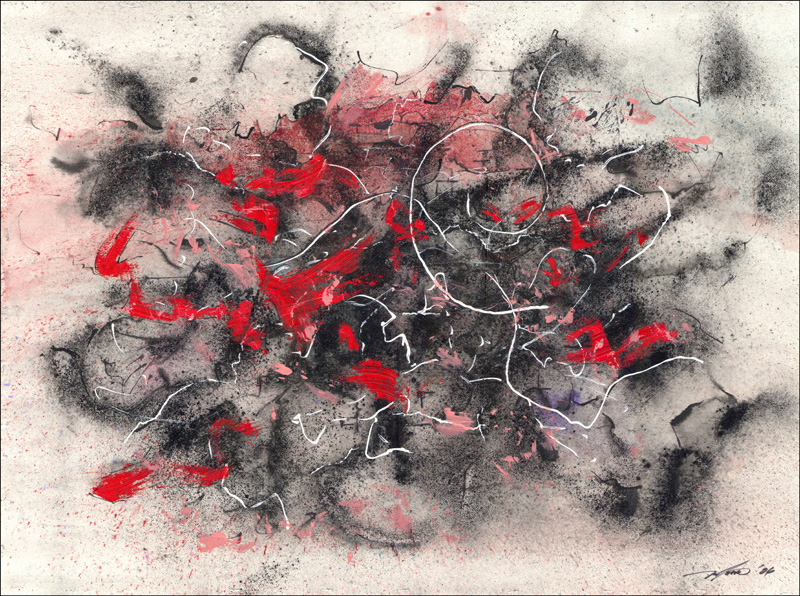
Untitled 012by Ricardo Morín 22″ x 30″ Watercolors, charcoal, oil, white-out and ink on paper 2006
There exists a threshold beyond which suffering ceases to be endurance and becomes something else—something raw, incommunicable. It is not simply a matter of pain, nor even of despair, but of a silent depletion where the self finds itself at the precipice of its own dissolution. Yet, how does one define this limit?
It is tempting to believe suffering has purpose, that it can be transmuted into wisdom or resilience. This belief sustains us through its early stages. We endure in the name of meaning, in the hope that suffering refines rather than annihilates. But there comes a point where suffering becomes a force unto itself, severed from justification. It no longer instructs, no longer dignifies—only persists.
The problem of suffering is not only how much one can bear, but how much one should reveal. Silence often protects both the sufferer and the witness. There are pains too intimate, too profound to translate into language without reducing them to spectacle. To expose suffering in its entirety risks transforming it into something unrecognizable, stripping it of the dignity that private endurance affords. Yet, concealment can create its own form of exile, a loneliness where pain festers unseen.
Some attempt to navigate this tension by offering fragments—enough to acknowledge suffering’s presence without inviting intrusion. Others say nothing at all. This is not cowardice but a final assertion of control, a refusal to be defined by pain. To impose the expectation of disclosure upon those who suffer is to misunderstand the nature of their burden. The gravity of suffering is not only in the experience itself but in the impossible task of making it understood.
We live under the illusion that the mind and body will hold, that endurance is limitless. But suffering reminds us otherwise. There is a breaking point, whether visible or silent, sudden or drawn out.
It is not the same for everyone. Some withstand more than others—not through superior strength, but through a different alchemy of circumstance, temperament, and sheer chance. What remains constant is that all thresholds, eventually, are met. There is no single way to live with suffering.Sometimes, what brings relief is not endurance, but the quiet act of self-recognition.To speak, when one can.To remain silent, when one must.In the space between what cannot be said and what must be accepted, a simple truth may emerge: even uncertainty can sustain us, if we meet it with honesty.
And when that release is impossible, when suffering stretches beyond its own limits, only the silent acknowledgment of its presence remains—a weight that, sooner or later, must either be laid down or consume what is left.
First, I would like to share with my readers my utmost gratitude to Billy Bussell Thompson (b. November 23, 1942), Ph.D., Professor Emeritus of Linguistics at Hofstra University, for his generosity in being a mentor and editor. His scholarly trajectory goes from 1963 to 1993. Among his most salient publications in English, we have: Relic and Literature . . .; Bilingualism in Moorish Spain; The Myth of the Magdalen . . .; etc. . . .
II
Since 1989, our friendship has extended over more than three decades. We have worked in close proximity on at least a dozen articles and short stories (published in WordPress). I have been fortunate to count on his frankness and support. He has never minced words. He has been blunt, when any of my drafts seemed without merit. When that was the case, the articles went into a shredder, and I was satisfied by the integrity of his prose, as well as by my understanding of my own limitations as a writer. Prof. Bussell Thompson (B.B.T.) usually compares the skill of prose writing with that of a narrowing cone of vision. This selective cone of vision is akin to the aesthetic integrity of a visual work of art. With the present endeavor, Prof. B.B.T. believed, from the very beginning, in the possibility of bringing forth this story as a team. Even though we live in different regions – geographically far apart – of the USA, we have had no trouble communicating via phone and email.
III
This narrative seeks to explain the confusion found in society and politics, and even their seeming lack of purpose. For this reason, I dedicate my narrative to the readers.
IV
Initially, I knew not where this would lead. I submitted a five-paragraph draft to professor B.B.T. As he began to read, he paused and asked if I was alluding to Plato’s allegory of the cave. Surprised, I asked him to stop. I replied that his reference to Plato placed me in a different perspective. Gratefully, I added that his question was most welcome; at that point, I wanted to read more before continuing.
V
He encouraged me to reread Plato’s dialogues. To this he added that I take into account any ambiguity associated with Plato’s conception of the ideal authority of the State (politeia) or Nation. He referred to the Platonic ideas controversial in current discussions. He also recommended reading José Ortega y Gasset (1883-1955). He included The Revolt of the Masses[1929]and The Dehumanization of Art[1925]. He suggested that I be aware of Ortega’s meritocratic liberal perspective (though we believed that Ortega had not been known for openly endorsing any political ideology) and to heed the relevance Ortega gives to the man who is aware of his limitations – opposed to the man who is unaware: both the bourgeoisie and the mass man (who exemplify, for him la razón sinrazón [the reason for unreason]) – as explained in The Revolt of the Masses. And finally, I focus on the distinction between “content” and “form,” to explain the break by the avant-garde from the bourgeoisie.
VI
Professor B.B.T. and I also had an exchange of ideas over the parallels between the Platonic and Orteguian thought. He advised me then to read anew Meditations on Quixote[1914] both in Spanish and in English. There, B.B.T. thought that I could find a significant or productive landscape of ideas on which to reflect and, thus, be able to develop my own interpretations about the nature of knowledge, its limits, and how to find the meaning of the ideal of truth.
VII
In writing my last short story, entitled In Darkness, Professor B.B.T. had already urged me to note the meaning for circunstancia1 (“circumstance”) as defined by Ortega in Meditations on Quixote. It was clear to us that both Ortega’s phenomenological approach to “circumstance” and Plato’s thesis on the transformation of the individual (through knowledge) shared commonalities, which nurtured my own narrative.
VIII
But, the narrative journey proved to be just as challenging as Professor B.B.T. had pointed out. His criticism, even then, never ceased being constructive and energetic. His compassion was present as long as I was mindful of the necessity for clarity and precision. Often, he would cite Ernest Hemingway’s authenticity and precision.
IX
Time and time again, I experienced enormous pain in trying to comprehend what I wished to express. Freeing my prose from superficiality was like taking a deep breath to exhale the vagueness of my anxieties. Sometimes I was unable to get away from the obvious. Other times, either I hid behind the complex, or I would cling to abstract and cryptic thinking: the reductive jargon of the social sciences. Professor B.B.T. repeatedly suggested succinctness: I needed to respect the simplicity of language and find a way to its accessibility. Bringing Plato and Ortega to the reader was my responsibility. I was not to imitate them nor to think like them, but to represent them authentically. My first obligation was to the reader. For this I had to avoid euphemisms, randomness, and diversion. The affirmation of effective communication is an objective worth the effort. I would only understand myself, if I were to understand the reader.
X
B.B.T.’s exhortations and criticisms, I welcomed enthusiastically. His challenge became mine. He has been exorcising my limitations for two decades: Every time we have worked together, I have discovered something new in myself. I have become more attuned to both English and Spanish. I have had to be my own translator. In these instances, I have grown more respectful of the two languages. I have had to capture their essence by comparing them: the one informs the other.
*
Prologue
In Plato’s dialogue Theaetetus[circa 369 B.C.E.], Socrates proposes that the extraordinary extraction of ideas is like bringing forth a new life and purging what is unnecessary. Likewise, the aim here is to produce and discuss what enlightenment is, and the obstacles to its achievement. Socrates has helped me in my definition of knowledge: Is morality universal, or is objective morality even possible? For these ideas I am indebted both to Plato and to Ortega y Gasset.
Ricardo F Morin, December 19, 2022
Editor Billy Bussell Thompson
*
Plato, Roman marble bust copied from Greek original, 4th century B.C.E., Capitoline Museums, Rome.
*
Socrates, Roman marble bust copied from Greek original, 2nd half of the 4th century B.C.E., Capitoline Museums, Rome.
*
José Ortega y Gasset (1883-1955), detail of photograph of his impersonation of Honoré de Balzac, circa 1900.
*
One way to objectivity is to recognize one’s own subjectivity. Metaphors for understanding reality are rare. One sees the world primarily through one’s own experience. It is difficult (though not impossible) to understand what one has not experienced. Truth never rests: It is not singular, but always plural.
Anonymous
*
1
Index
1. Awareness of the Transformation of One’s Self:
The highest principle of inquiry is consciousness of one’s self. In inquiry lie the beginnings of change.
2
Index
2. The Absence of Trust:
In our age of disbelief, the stories we tell each other about the past and the present seem to be in a state of collapse. There is a lack of continuity in the social order, increasingly suffocated by misinformation and distrust. We challenge each other over what is real and what is not.
3
Index
3. The Unassailable Truth:
For most of us an ultimate truth remains unattainable and the stories we share from the past and the present no longer seem useful. Along with the disappearance of our past stories, both the person who seeks truth and the act of giving a person his due are in crisis. Our society finds itself defined by a decline in trust both in government and its institutions. Despairingly, the challenge is that the creation of new stories has become an act of preservation. Likewise, autocracy is on the ascendance. A lack of faith has sown aimlessness. What can change this course of despair? What will bring enlightenment to us?
4
Index
4. Consciousness:
Knowledge is constantly changing and the result of this destabilization carries us into greater disorder. For this reason clarity is more necessary than ever to understand ourselves. Even if clarity is not always possible, to know oneself is imperative. Thus arises the tension between continuity and change. Here lies the quest for survival.
5
Index
5. Not Knowing:
Not knowing is the essential condition of existence, despite one’s apparent desire for knowledge or for authority. To know is to inquire. Reality, though fleeting, inspires reflection. Change begins with the recognition that one is not in isolation. Not even the one (who seeks self-sacrifice for his spiritual advancement) by absolute cloister could get rid of his entanglement with the world. It is by relating to other people and his environment that this person comes to know who he is. Not even he (who despises the symbols of fear) is capable of freeing himself from his anguish. The fear of not knowing hangs over all of us. It is possible that striving without measure (in the aspiration for rationality) only leads us to end up being irrational: Here lies the origin of complexity given the absence of innocence.
6
Index
6. The Energy of Life:
In his theory of cultural attributes (Meditaciones del Quijote, Meditaciónpreliminar; Índice8, Lapantera o del sensualismo, pág. 21), José Ortega y Gasset gives us his concept of razón vital2, which means reason is expressed through life itself. Ortega parses the European mind into two archetypes: the Germanic and the Mediterranean. The former is meditative and the latter sensuous. Of the sensuous he says: The predominance of the senses usually implies a deficiency in inner powers. What is meditating as compared with seeing? As soon as the retina is hit by the arrow from without, our inner personal energy hastens and stops the intrusion. The impression is registered, subjected to civilized order; it is thought, and in this way it is integrated in the building up of our personality, and cooperates within it – Evelyn Rugg and Diego Martín’s translation – Notes and Introduction by Julián Marías – pp. 85-86. The Orteguian admonition here is to find the balance between extremes: between the excesses and deficiencies of these two archetypes.
7
Index
7. Human Agency and Its History:
A second source for my understanding of the mind and the senses is found in Plato’s Republic (politeia) – Socrates’s dialogue of the allegory of the cave at the beginning of Book Seven. There have been many interpretations. Mine differs. My purpose is to rid suffering from the mind of the freed slave. Once freed from shackles, the mind of the freed slave (who ascends to the mouth of the cave) discovers its own vision of the world. Despite the sun’s glare, the uneducated mind is transformed by the newly found ideal of truth. But the awareness by the prisoner (who has remained behind) is inseparable from the condition of the freed man: The slave (remaining in shadows of suffering) is not entirely separable from the memory of the freed man. Because of suffering, the freed man’s mind is aware of its inability to know. At the same time, the freed mind learns how its own transformation may be dependent on the new course of its history. This mind’s actions allow participation in change, and change is possible through self examination. The mind examines itself through meditating. Meditation is not an obligation, but a necessity. Meditation is the result of the mind’s freedom and it is the means to understanding its own choices in its approach to truth: But this effort is only an approximation to the infinity of truth. The freed mind (facing the visible world) is lacking here. Thus, the freed mind recognizes that neither its actions nor the course of its history is predictable. They (i.e. the mind’s actions and the course of its history) come from multiple possibilities about belief.
The freed mind realizes that time is an illusion: Time is fleeting, false, and deceitful. The mind, habitually trapped in its past, remains mired in pain. Anger (which comes from the past in search for justice) has for its sole purpose the manifestation of resentment. But anger only manages to put its existence on hold, awaiting compensation. Just as time is an illusion for the mind, the quest for emotional reparation is also an illusion. For the mind, there is no vindication by being trapped in the labyrinth of illusion. Only the rationality of active love can compensate for anger. If the mind of the lover of truth can project itself lovingly in the direction that it resents, then a liberating sense of bravery arises towards itself. Anger and sentimentality are one and the same. As the force of love sheds sentimentality, one’s desires dissipate and with them anger as well. Thereby, violence ceases to exist. Socrates’s allegory of the mind (freed from suffering) carries all these implications and comparisons towards a goal of Ideal Truth.
8
Index
8. Alertness:
In an effort to understand Ortega’s concept of circumstancia (“circumstance”), his Meditación preliminar, Indice 6,Culturamediterránea, explains to us that when he goes through the landscape of ideas he has to meditate with alertnesson the influence of his experiences. Needless to say, this includes all his past and present relations, the geographies he has occupied, and everything he has done in life. Ortega forewarns us of the risks in this act of meditation: We are accompanied by a keen suspicion that, at the slightest hesitation on our part, the whole world could collapse, and we with it. When we meditate, our mind has to be kept at full tension; it is a painful and integral effort – Index 6, Mediterranean Culture, translated by Evelyn Rugg and Diego Marín (Introduction and notes by Julián Marías [a favorite student of Ortega y Gasset]), p. 34. In Plato’s dialogues, the same “effort” is found: Through the act of meditation, Socrates’s freed man draws transformation and redemption from the narrow crevices among ideas. Meditation helps the lover of truth get closer to his existential condition; it offers him the possibility of reacting differently, and sustains him with the very energy that life provides.
9
Index
9. Faith:
For the one who fears meditation, having faith in one’s own actions and changes are not sufficient for inquiry. History is not alive for him: It is at a point of no return; it is dead. This person is in a world of despair and surrounded by the proverbial dancing of shadows. This person is bound in his own chains, is overwhelmed by a lack of confidence, and is, without trust, unable to make a leap of faith. Neither the notion of individuality nor the concept of free will seems satisfactory any longer. This person relinquishes personal power and is unaware of the forces influencing his mind and his senses. His refusal to face reality becomes a conscious decision for the suppression of truth. This refusal is antithetical to life itself. For him, life becomes enslavement and stands in opposition to the freed man, who fearlessly ponders the reality of the visible world, and passionately delves into the exploration of the unknown. The mind of the freed man represents Ortega’s concept of razón vital, desirous to be absorbed by it.
10
Index
10.Deliverance:
Distractions can be multiple. In Ortega’s playful analysis, he implies that if meditation is extraneous to the fears of the mind, it can succumb to obsession, and even fall despairingly into manias. Ortega values the relevance of every influence. He understands that a human being and his landscape are not separate. The unity of the two means his salvation by circunstancia (“circumstance”): Thus his appreciation of circunstancia: Yo soy yo y mi circunstancia, si no la salvo a ella no me salvo yo – Al Lector, Índice, pág. 41 (which I translate as “I am myself [in a world of perceptions] and also the material world that surrounds me; if I don’t save them, I don’t save myself”). Incidentally, here Ortega preempts his conclusion with what he has read in the Bible: Benefac loco illi quo notus es3 (loosely translated into English as “do good in the place where you are known”). With these remarks, Ortega reinforces the idea that he is unable to disassociate himself from his surroundings. If he is to flourish and to find salvation, it will be necessary for him to understand and protect what he shares with his environment.
Parallel to Ortega’s analysis is Plato’s Socratic allegory, which teaches us the effect that the visible world has on our mind. From these two perspectives, the mind tends to be discouraged by what it does not understand. Awareness of the visible world’s influence is for both thinkers an instinct for survival. To be aware, therefore, means to be silent, away from the deafening sound of fear. As long as there is fear, promoted by the progress of civilization, there will be no movement or separation from distractions. Confronting fear means dispersing it, making it disappear. Dispersal of fear is fundamental to the understanding of self. Releasing oneself from fear is confronting one’s not-knowing. Enslavement (at the depth of the cave) is equivalent to accepting the impositions of fear. Both, for Ortega and Plato, the opposition to indifference is found through meditation; thereby one is able to be alert and know oneself.
11
Index
11. Perception and Storytelling:
True confidence is living in uncertainty. An overriding fact is that human beings organize themselves around the making of stories. Every story we create is an act of piety that consoles the mind. Yet new stories and old ones are provisional tools that fill the gap of our faith, filling in the void of our ignorance. Whether the story be true or not, storytelling rescues us from ourselves. Storytelling is our razón vital. It seeks to expose us to the best possible meaning of ourselves: Meaning in storytelling is found by investing oneself with the willpower to exceed adversity. Meaning is found by creating something new within oneself. Meaning is found in one’s vulnerability and in the constant pain to overcome it. The process of finding meaning reveals that one cannot control Truth. Happiness depends on how one accepts the absence of control, and how we can stop disliking our limitations.
Storytelling persuades us to think that one’s actions will spread deeply into one’s consciousness. One may not always be able to defeat the element of preconception, for bias is always with us. As long as suffering, uncertainty, and the effort to overcome them exist, bias will persist. Bias lurks behind our thoughts, quiet and insidious, yet it is there for a reason in spite of its harmful effects. The irony is that if one banished preconceptions, there would be no further progress. In any story, if the hero overcomes the villainy of bias, it is because he is able to change: If one does not overcome bias, one does not grow and there is no transformation. Success is not as important as the struggle to overcome bias. Every time adversity comes to us, it is an opportunity for the recognition of those preconceptions that still reside in ourselves. Success does not provide happiness. Happiness is only possible through self discovery. As such, one becomes symbolically the whole of humanity. This is its highest expression: The creation of something new as we face adversity, and the worse the adversity, the greater the opportunity.
12
Index
12. Reasoning (sentience vs sapience):
Awareness of fiction is the appreciation of the paradox between what is and what is not. Knowledge expresses not only the awareness of one’s own intuitions and senses, but also the reasoning about those intuitions, senses, and impressions. That is, every time we examine the perception of our memory, we are editing our understanding. Thus, the way we organize and observe ourselves comes from our desires and senses at that moment, and this comes from our memories. For instance, it is difficult for us to agree on a common origin or a common thread uniting us as a species, even if that may be true. Whether we wish it or not, we define ourselves by the histories we create either in groups or in countries. In doing so, we are actually imagining separate and fragmented believes that we belong to separate locales, cultures, and races. Yet, there is an unavoidable thread that connects us as a species. Such composition is found in our common and preponderant origin, though our perception may resist being part of it. We endow ourselves with differences dictated by the conditioning of our perceptions. InThe Revolt of the Masses, Ortega refers to this condition as la razón de sinrazón (“reason without reason”), which explains our deeply rooted irrationality and fragmentation. Knowledge implies greater content than what is gained through the form of our perceptions. Our minds tend to abbreviate history, even believing that it does not exist. Yet the more expansive the “circumstance” or condition of apprehending truth, the greater the maturity our existence demands from us.
13
Index
13. Maturing Emotional Intelligence:
If a human being is the measure of all things, then also one comes to appreciate that knowledge is always inconclusive. Thus, meditation strengthens our mind, our memory, our learning, our attention, and our self awareness. Meditation on the past, the present, or the future depends on emotional intelligence. Emotional intelligence is based on capturing the import of influences from all areas of a man’s life, from one’s behavior to one’s relationship with others and one’s environment. Ultimate reality depends on the level of maturity of a person, and it is through meditation that one matures. Hence, how a person chooses to act depends on meditation and his level of emotional intelligence. For the fanatic (obsessed with fear) meditation seems impossible. For the fanatic, doubt is not the issue. The fanatic seeks to reiterate cycles. The fanatic fails to understand that fear of change is irrational because it is inevitable that the world is constantly evolving. The fanatic seeks to change what is beyond his control. From the Orteguian point of view, this person,within a closed valuation system, does not find consolation because his mind fears what it does not understand.
14
Index
14. Our Connection to the Universe:
From Ortega’s perspective of Cervantes’s Don Quixote[1605-15], we learn that the courage granted by Love – not hate – impels us towards understanding …the useless remains of a shipwreck that life, in its perpetual surge, throws at our feet. – To The Reader, p. 31. Loveis a divine architect who, according to Plato came down to the world – ὥστε τὀ πᾶν αὐτῶ ξυνδέδέσθα – so that every thing in the universe might be linked together: Separation means extinction. Hatred, which separates, isolates, and pulls apart, dismembers the world, and destroys individuality – To the Reader, p. 33.
Hence, Ortega explains that the imperative for the individual is to reflect on one’s circunstancia (in medias res), … to arouse the desire of understanding the universal in its particulars. – To the Reader, p. 31: To ignore the fact that each thing has a character of its own, and not that we wish to demand of it, is, in my opinion, the true capital sin, which I call a sin of the heart because it derives its nature from lack of love. There is nothing so illicit as to dwarf the world by means of our manias and blindness, to minimize reality, to suppress mentally fragments of what exists. This happens when one demands that what is deep should appear in the same way as what is superficial. No, there are things that present only that part of themselves which is strictly necessary to enable us to realize that they lie concealed behind it. – p. 62.
15
Index
15. A Heroic Perspective:
Knowledge comes before fanaticism. Fanaticism is, for Ortega, the rejection of the perspectives of others. Ortega points to reasoning as an act of charity, which uncovers differences, and suggests that understanding is akin to the circling of an eagle in flight. To be oneself, for Ortega, is the same as it is for Cervantes. The act of being a hero takes place through a sensitive exploration of the nature of reality. In Ortega’s view, as well as for Cervantes’s, the will of the hero belongs only to the persona of Don Quixote: Because to be a hero means to be one out of many, to be oneself if we refuse to have our actions determined by heredity or environment, it is because we seek to base the origin of our actions on ourselves and only on ourselves. The hero’s will is not that of his ancestors, nor of his society, but his own. This will to be oneself is heroism. – First Meditation, 15, The Hero, p. 149. … I do not think that there is a more profound originality than this practical, active originality of the hero. His life is a perpetual resistance to the habitual and customary. Each movement that he has to make has first had to overcome custom and invent a new kind of gesture. Such a life is a perpetual suffering, a constant tearing oneself away from the part of oneself, which is given over to habit and is a prisoner of matter. – First Meditation, 15, The Hero – p. 149.
16
Index
16. The Fear of fate:
A Socratic life is heroic, but if unexamined, of no value. In the pain of living, one has to embrace the fact that the examination of fear is part of life. Alongside this examination, fate is never artificial. Fate does not deceive, even in our misfortunes. Fate is not illusive, though our perception of time may be. Instead, fate challenges us to change. In change, fate protects us from stagnation. What appears to be random is, in fact, an opportunity for learning. Consequently, fate exists not for attacking, but for stimulating our transformation. Fate does not move against us, but challenges us to change by confronting obstacles. Fate attacks fear, because one’s fear takes away one’s ability to make choices. Narratives of fear turn out to be self-fulfilling prophesies. Fear deceives and defines us. It hampers survival. Fear prevents our evolving, it paralices us: We resist giving up habits because of fear. Thus one languishes and fails to overcome disbelief.
17
Index
17. Boundlessness and Humility:
The shadow of shame represents one’s flaws. The shadow is what one wishes not to be, though its shadow be part of oneself. Only, when the shadow is accepted with humility, do its flaws dissolve in the act of loving oneself with compassion. Ultimately, the fanatic will recognize his incompleteness and become aware of his own insignificance: The incapacity for completeness looms over all of us. Only through risk does one learn the extent of one’s bounds and how much further one may go. We advance through humility and humility appreciates neither truth nor falsehood. Humility is the acknowledgment of one’s inexorable estrangement from an infinite truth. Only the humble voice recognizes the struggle for understanding and change. Both depend on a flight from despair. For Ortega and for Plato, the mark of the highest values is found in our vulnerability. If we surrender absolutely, then we find redemption.
18
Index
18. Epilogue:
My perspective treats Plato and Ortega outside of any theistic justification. I leave aside any application of Plato to theological thought. Likewise, I ignore any attempt to ascribe religious respects to Ortega’s theory of values. For me their notions, when applied to theology, are not credible. I understand Plato and Ortega in their search for the limits of human perception and rationality. Efforts to apply their philosophies as religious foundations are outside of my purpose.
The depth of Plato and Ortega’s thought is not to be found in a method for objective morality. Nor is it ethical relativism, nor even is it found in a claim of universality. Ideologies on morality are derived from norms dictated by theologians, seemingly unwilling to relinquish authority. The role of the lovers of truth is not to dictate virtue nor to define the godhead. Their teachings are centered on rationalism. Their humanism is based on a concept of justice that is antithetical to fixed norms. The paradigm of true knowledge – according to Plato and Ortega – is derived from love based on the originality of heroism. This love does not reside outside of the individual. This love is not found in the promise of a transcendental world. This love finds man’s salvation in the present. This love calls for self examination. And above all, this love is a liberation from the numbness of the mind.
*
Endnotes:
1 For Ortega circunstancia, is a representation of the sum total of influences in the consciousness of a man, thus expressing the reason for his existence.
2Razón vital stands as Ortega y Gasset’s philosophy which views that reason is, in of itself, an expression of life.
Ortega y Gasset, José, Meditaciones del Quijote: Meditación Preliminar y Meditación Primera, (Madrid: PUBLICACIONES DE LA RESIDENCIA DE ESTUDIANTES, SERIE II.—VOL. I, Universidad Central de Madrid, 1914)
Cervantes Saavedra, Miguel de. The Ingenious Gentleman Don Quixote of La Mancha[1605–1615] (Cambridge: Harvard Publishing Company, 1893. Translated by John Ormsby. 4 vols. in 8 books. Limited Edition No. 71/320. 1st edition.
Platón. Teeteto. Introducción, traducción y notas de Marcelo Boeri. Buenos Aires: Editorial Losada, 2006.
Ortega y Gasset, José, La rebelión de las masas (Madrid: Editorial Revista de Occidente, 1928). Fue publicado inicialmente en 1927 como una serie de artículos en el diario El Sol, antes de ser recopilado en formato de libro en 1928 por Editorial Revista de Occidente en Madrid.


 Observations On Perception