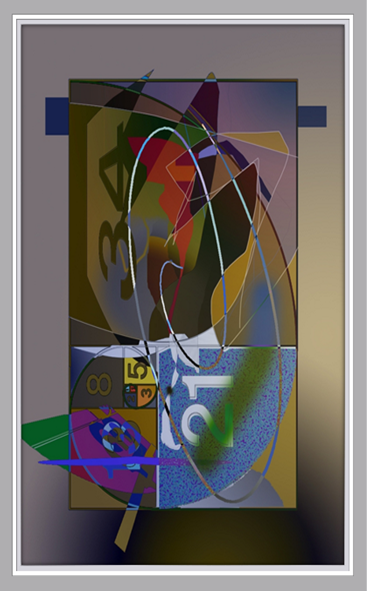
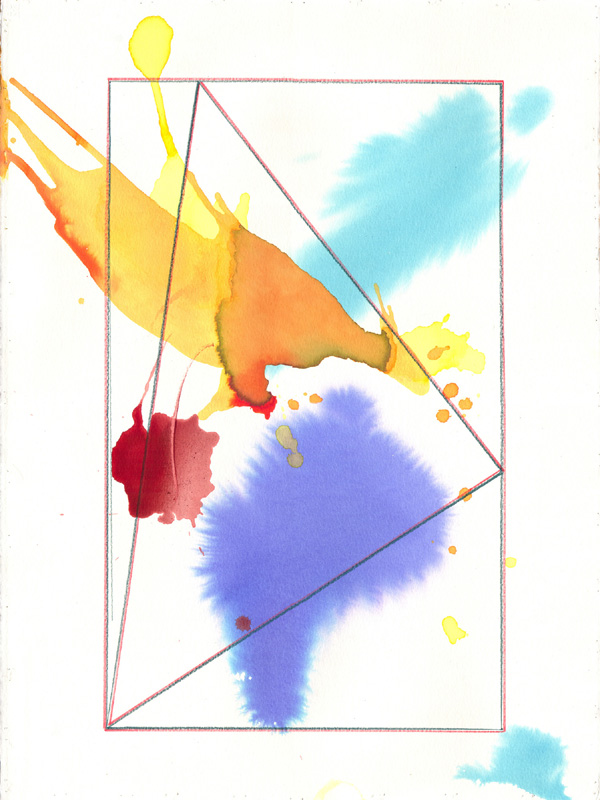
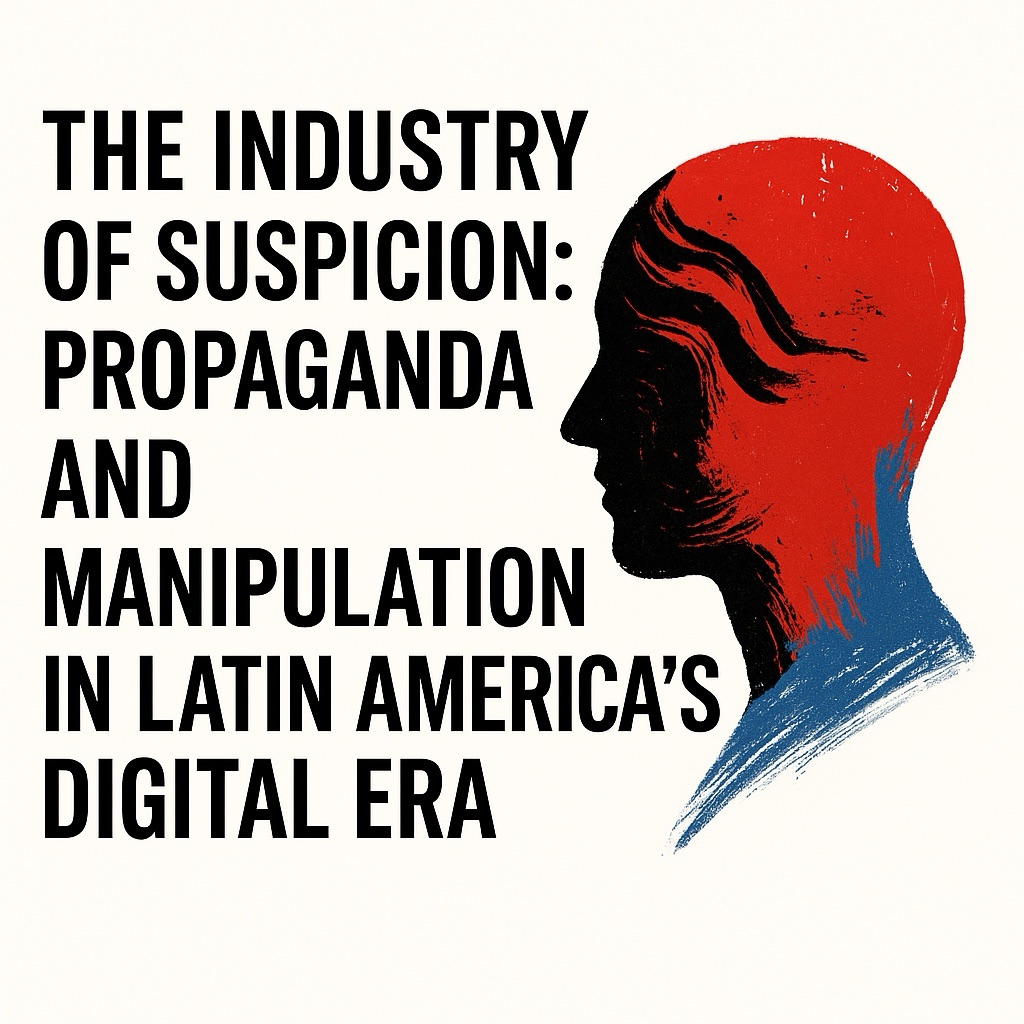
Ricardo Morín Triangulación 9: The Rhetoric of Threat 56 x 76 cm Watercolor and wax crayon on paper 2007
Ricardo Morín
November 2025
Oakland Park, Florida
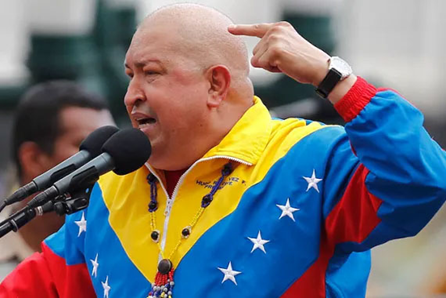
Authoritarian language does not arise as excess or accident; it emerges as a deliberate strategy designed to reorganize public perception until difference appears suspect and complexity becomes intolerable. Within this framework, the phrase attributed to the Argentine president Javier Milei—“if an immigrant does not adapt to your culture, then it is not immigration but an invasion” (or https://youtube.com/shorts/EJ9RRC3pyTQ?si=xehJCUD8fIIpaqsw )—functions as a mechanism of extreme reduction. It replaces the historical reality of migration with a binary schema meant to provoke alarm. The leader is not describing a fact; he is manufacturing an enemy.
This formulation shifts the migratory experience into a warlike imaginary in which any form of difference is construed as aggression. Culture—treated as a static and homogeneous block—is framed as a besieged territory requiring defense, and plurality as a threat that can only be resolved through submission. Under this logic, the migrant ceases to be a person and becomes an abstraction crafted to justify coercive impulse.
The paradox is unmistakable: what is proclaimed as the defense of identity is, in truth, an effort to standardize it; what is presented as caution operates as an instrument of fear. Rather than analyze, the language disciplines. And in doing so, it exposes its deeper function: it shapes an emotional climate ready to accept measures that, under any other light, would be incompatible with democratic life.
This is the dimension that most clearly reveals the nature of the statement: it is not a commentary on immigration but a mechanism of affective control. By turning coexistence into compulsory assimilation, it introduces a dehumanized conception of the social world, one in which diversity ceases to be constitutive and becomes an obstacle to be neutralized. Ultimately, this discourse seeks not to understand reality but to govern it.
In the post-truth landscape of Latin American media, where outrage has become currency, few figures illustrate the fusion of ideology and marketing as clearly as Inna Afinogenova. She has become the most recognizable voice of authoritarian suspicion in the Spanish-speaking sphere. From platforms such as Canal Red Latinoamérica, her discourse forms part of a vast network of disinformation spreading across the region, cloaked in the rhetoric of critical thinking and popular emancipation. These networks—spanning Moscow, Tehran, Beijing, and several Latin American governments—follow a single script: to dismantle trust in liberal democracy, to weaken institutions, and to turn permanent doubt into a substitute for conscience. In the name of informational sovereignty, they replace debate with discredit, analysis with suspicion, and truth with narrative. Their power lies not in blatant falsehoods but in the emotional manipulation that transforms confusion into conviction. Within this context, Afinogenova stands not as an isolated commentator but as the emblem of a sophisticated propaganda apparatus—one that disguises obedience to twenty-first-century autocracies beneath the costume of dissent.
Inna Afinogenova, born in Dagestan in 1989, is a Russian journalist who worked as deputy director of RT en Español until May 2022. She resigned citing her disagreement with the war in Ukraine and the imposition of a state-sanctioned narrative of aggression. Since then, she has collaborated with geopolitical and Latin American media such as LaBase, produced by the Spanish newspaper Público, and participates in Canal Red, an audiovisual project led by Pablo Iglesias (former vice-president of Spain and founder of the left-wing party Podemos, now active in political media). There she directs and hosts programs like CaféInna and contributes to political analysis, particularly on Latin America. Her audience is broad and her reach on digital platforms considerable, which makes her an influential figure in the political and informational debates of the Spanish-speaking world.
Her trajectory, however, has not escaped controversy. During her tenure at RT en Español, she was one of the network’s most visible faces in Latin America, amplifying narratives that portrayed Western powers as inherently deceitful and predatory. An opinion column in The Washington Post described her as “the Spanish voice of Russian propaganda,” citing her recurring defense of positions favorable to the Kremlin. In December 2021, two months before the invasion of Ukraine, she used her program Ahí les vato mock Western intelligence warnings of an imminent attack and predicted that “January will come, then February, and still no invasion,” implying that the media hysteria served the interests of NATO. Such episodes, though later overtaken by events, exemplify her rhetorical method: to transform skepticism into disbelief and disbelief into persuasion.
Following her departure from RT, Afinogenova has continued to operate in media circles ideologically aligned with the Latin American left, reinforcing a discourse that equates the Western press with manipulation and imperialism. Outlets such as Expediente Público have noted her role in shaping narratives within partisan campaigns, often echoing state-sponsored or geopolitically motivated lines from Russia, China, or Iran. Through Canal Red and Diario Red, both associated with Pablo Iglesias, she participates in content ecosystems that frequently recycle material from international broadcasters like CGTN. In countries such as Honduras, she has been accused of contributing to media strategies that favor left-wing candidates under the guise of “sovereign communication.” While the evidence does not show a direct chain of command linking her to a specific regime, the pattern of thematic consistency reveals a coherent ideological alignment rather than independent journalism.
This alignment has provoked renewed debate since the release of her recent video, “¿Premio Nobel de la Paz… o de la Guerra?”, where she presents the Nobel Peace Prize awarded to María Corina Machado as a maneuver of geopolitical design rather than a moral recognition. The video does not examine facts so much as it interprets intentions, suggesting that the award serves Western influence instead of honoring civic courage. The argument, though rhetorically effective, confuses correlation with causality. It is possible to acknowledge the imperfections of international institutions without denying the ethical weight of public bravery. The Nobel Prize, like every human institution, reflects judgments; but in this case, it distinguishes a life of civic risk undertaken without weapons, privileges, or access to the coercive power of the State.
Questioning motives is legitimate; insinuating conspiracies without evidence is not. Every critical voice bears responsibility, for truth demands proportion, not projection. The struggle of María Corina Machado cannot be reduced to the rhetoric of “Western intervention” or dismissed as “fabricated dissent.” It belongs to the conscience of a people seeking self-determination through legitimate means after decades of dispossession. Respecting pluralism requires granting others the same intellectual good faith one demands for oneself. Debate ennobles democracy only when grounded in verifiable facts and moral clarity, not when suspicion itself becomes the argument. Between necessary skepticism and systematic suspicion lies a moral frontier: crossing it is to pass from thinking freely to serving without knowing it.
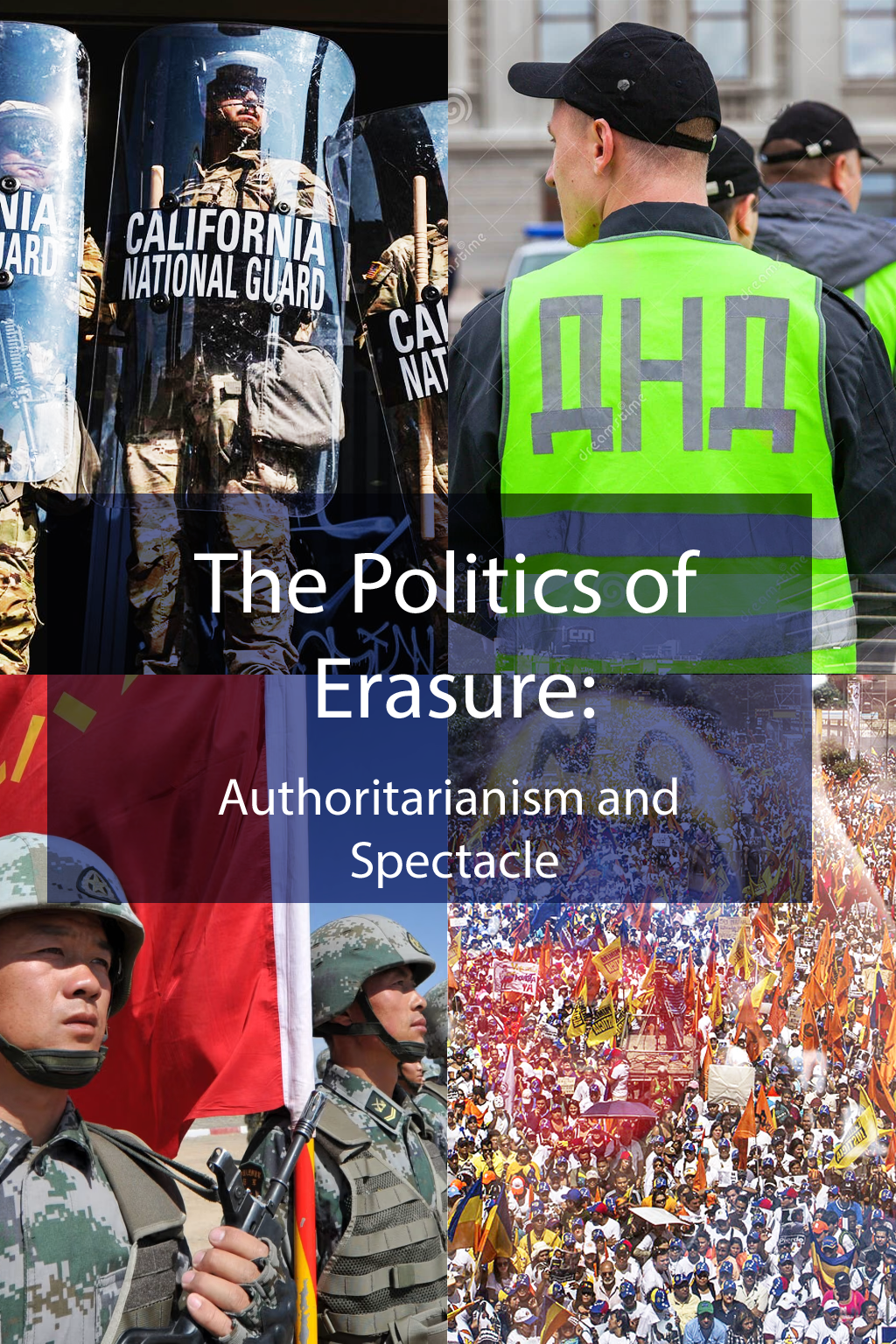
Cover design for the essay “The Politics of Erasure: Authoritarianism and Spectacle.” The composite image juxtaposes surveillance, militarization, propaganda, and mass spectacle to underscore how authoritarian regimes render lives expendable while legitimizing control through display.
By Ricardo Morín, In Transit to and from NJ, August 22, 2025
Authoritarianism in the present era does not present itself with uniform symbols. It emerges within democracies and one-party states alike, in countries with declining economies and in those boasting rapid growth. What unites these varied contexts is not the formal shape of government but the way power acts upon individuals: autonomy is curtailed, dignity denied, and dissent reclassified as threat. Control is maintained not only through coercion but also through the appropriation of universal values—peace, tolerance, harmony, security—emptied of their content and redeployed as instruments of supression. The result is a politics in which human beings are treated as expendable and spectacle serves as both distraction and justification.
In the United States, the Bill of Rights secures liberties, yet their practical force is weakened by structural inequality and concentrated control over communication. After the attacks of September 11, the USA PATRIOT Act authorized sweeping surveillance in the name of defending freedom, normalizing the monitoring of private communications (ACLU 2021). Protest movements such as the Black Lives Matter demonstrations of 2020 filled the streets, but their urgency was absorbed into the circuits of media coverage, partisan argument, and corporate monetization (New York Times 2020). What begins as protest often concludes as spectacle: filmed, replayed, and reframed until the original message is displaced by distractions. Meanwhile, the opioid epidemic, mass homelessness, and medical bankruptcy reveal how millions of lives are tolerated as expendable (CDC 2022). Their suffering is acknowledged in statistics but rarely addressed in policy, treated as collateral to an order that prizes visibility over remedy.
Venezuela offers a more direct case. The Ley contra el Odio (“Law against Hatred”), passed in 2017 by a constituent assembly lacking democratic legitimacy, was presented as a measure to protect tolerance and peace. In practice, it has been used to prosecute journalists, students, and citizens for expressions that in a democratic society would fall squarely within the realm of debate (Amnesty International 2019). More recently, the creation of the Consejo Nacional de Ciberseguridad has extended this logic to place fear and self-censorship among neighbors and colleagues (Transparencia Venezuela 2023). At the same time, deprivation functions as a tool of discipline: access to food and medicine is selectively distributed to turn scarcity into a means of control (Human Rights Watch 2021). The state’s televised rallies and plebiscites portray unity and loyalty, but the reality is a society fractured by exile, with over seven million citizens abroad and those who remain bound by necessity rather than consent (UNHCR 2023).
Russia combines repression with patriotic theater. The 2002 Law on Combating Extremist Activity and the 2012 “foreign agents” statute have systematically dismantled independent journalism and civil society (Human Rights Watch 2017), while the 2022 law against “discrediting the armed forces” criminalized even the description of war as war (BBC 2022). Citizens have been detained for carrying blank signs, which demonstrates how any act, however symbolic, can be punished if interpreted as dissent (Amnesty International 2022). The war in Ukraine has revealed the human cost of this system: conscripts drawn disproportionately from poorer regions and minority populations are sent to the frontlines, their lives consumed for national projection. At home, state television ridicules dissent as treason or foreign manipulation, while parades, commemorations, and managed elections transform coercion into duty. The official promise of security and unity is sustained not by coexistence but by the systematic silencing of plural voices, enforced equally through law, propaganda, and ritual display.
China illustrates the most technologically integrated model. The 2017 Cybersecurity Law and the 2021 Data Security Law require companies and individuals to submit to state control over digital information and extend surveillance across every layer of society (Creemers 2017; Kuo 2021). Social media platforms compel group administrators to monitor content and disperses the responsibility of conformity to citizens themselves (Freedom House 2022). At the same time, spectacle saturates the landscape: the Singles’ Day shopping festival in November generates billions in sales, broadcast as proof of prosperity and cohesion, while state media showcases technological triumphs as national achievements (Economist 2021). Entire communities, particularly in Xinjiang, are declared targets of re-education and surveillance. Mosques are closed, languages restricted, and traditions suppressed—all in the name of harmony (Amnesty International 2021). Stability is invoked, but the reality is the systematic denial of dignity: identity reduced to an administrative category, cultural life dismantled at will, and existence itself rendered conditional upon conformity to the designs of state power.
Taken together, these cases reveal a common logic. The United States commodifies dissent and normalizes abandonment as a permanent condition of public life. Venezuela uses deprivation to enforce discipline and the resulting compliance is publicly presented as loyalty to the state. Russia demands sacrifice and transforms coercion into patriotic duty. China fuses surveillance and prosperity and engineers conformity. Entire communities are suppressed in the name of harmony. The registers differ—commercial, ritualistic, militarized, digital—but the pattern is shared: dissent is stripped of legitimacy, lives are treated as expendable, and universal values are inverted to justify coercion.
References
ACLU: “Surveillance under the USA PATRIOT Act”. New York: American Civil Liberties Union, 2021. (This article documents how post-9/11 legislation expanded state surveillance in the United States and framed “security” as a justification for reducing privacy rights.)
Amnesty International: “Venezuela: Hunger for Justice. London: Amnesty International”, 2019. (Amnesty International reports on how Venezuela’s Ley contra el Odio has been used to prosecute citizens and silence dissent under the rhetoric of tolerance.)
Amnesty International: “Like We Were Enemies in a War: China’s Mass Internment, Torture and Persecution of Muslims in Xinjiang”. London: Amnesty International. 2021. (Amnesty International provides evidence of mass detention, surveillance, and cultural repression in Xinjiang carried out in the name of “harmony” and stability.)
Amnesty International: “Russia: Arrests for Anti-War Protests”. London: Amnesty International, 2022. (Amnesty International details the systematic arrest of Russian citizens, including those holding blank signs, under laws claiming to protect peace and order.)
BBC: “Russia Passes Law to Jail People Who Spread ‘Fake’ Information about Ukraine War.” March 4, 2022. (News coverage of Russia’s 2022 law criminalizing criticism of the war shows how “discrediting the armed forces” became a punishable offense.)
CDC.: “Opioid Overdose Deaths in the United States. Atlanta: Centers for Disease Control and Prevention”. 2022. (The CDC provides statistical evidence of widespread loss of life in the U.S. and underscores how entire populations are treated as expendable in public health.)
Creemers, Rogier: “Cybersecurity Law of the People’s Republic of China”: Translation with Annotations. Leiden University, 2017. (An authoritative translation and analysis of China’s 2017 Cybersecurity Law illustrate how digital oversight is institutionalized.)
UNHCR: “Refugee and Migrant Crisis in Venezuela: Regional Overview”. Geneva: United Nations High Commissioner for Refugees, 2023. (This report offers figures on the Venezuelan exodus and highlights the mass displacement caused by deprivation and repression.)
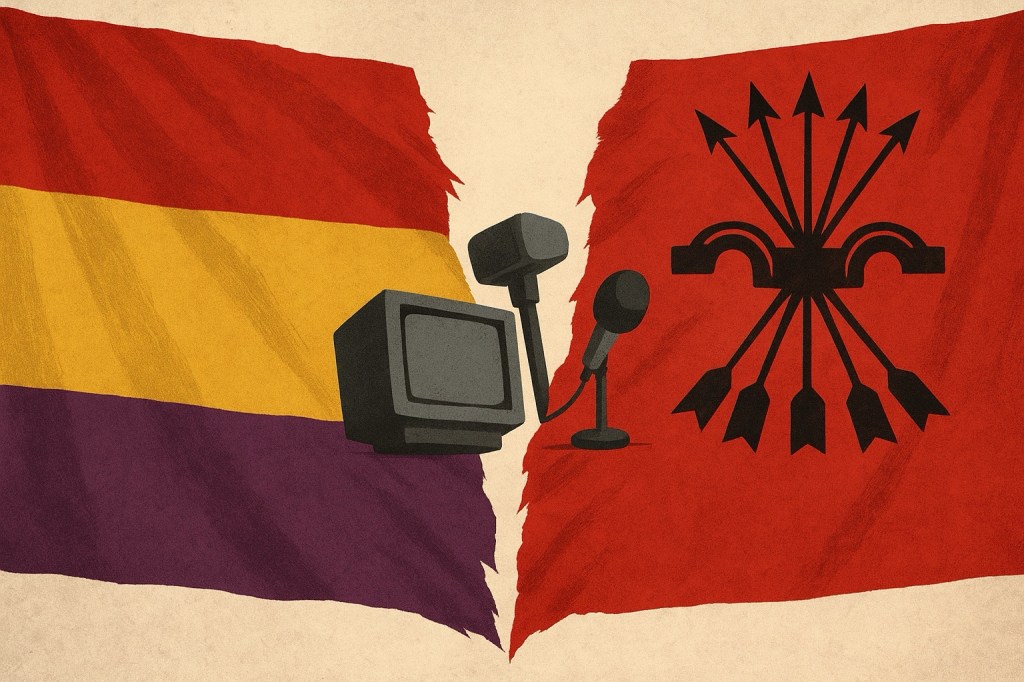
One cannot assess the Spanish political climate without acknowledging the rise of VOX, a far-right party founded in 2013 by former members of the conservative Partido Popular. Since 2018, VOX has gained traction by opposing regional autonomy, feminist legislation, and immigration, while defending a nationalist agenda that includes the revision—or outright rejection—of Spain’s historical reckoning with Francoism.
It is the symptom of a deeper democratic disillusionment. What resurfaces is not spontaneous historical memory, but a political and cultural framework that reasserts itself when the social agreements binding the present begin to fray. VOX’s references to the Franco regime are rarely doctrinaire or explicit, but they are unmistakable in the party’s rejection of the Democratic Memory Law, its exaltation of national unity as a sacred and untouchable principle, its condemnation of the autonomous state model, and its appeal to a so-called “natural order” that treats hierarchy, the traditional family, and social inequality as if they were objective facts of history.
What is most concerning is not that voices like these exist—they always have—but that they have regained institutional power and cultural legitimacy. Dissatisfaction with the political system, fatigue with ineffective parliamentary politics, and a growing sense of identity displacement feed into a shared national unease. This unease can be felt across a wide spectrum: small business owners who perceive the state as hostile, or young people who find no meaning in a hollow, bureaucratized political language. The grievances vary, but the far right offers a single channel: the emotional simplification of conflict—transforming fear into obedience, and uncertainty into wounded pride.
Within this framework, VOX presents itself as the only political actor with a unified narrative. Its strength does not lie in public policy, but in assertion. It offers no coherent platform of governance, but instead proposes a reactive, exclusionary identity. And here the progressive response often falters. While the institutional left—represented by the PSOE and remnants of Unidas Podemos—relies on rhetorical frames worn down by official discourse, segments of the academic and cultural intelligentsia (particularly university-affiliated think tanks and subsidized editorial circuits) have retreated into a ritualized defense of democracy, without reassessing its principles or renewing the language through which it is explained. Repeating just causes through exhausted formulas turns even the noblest ideas into noise.
Worse still, in the name of pluralism—or out of fear of being labeled sectarian—certain cultural institutions (El País, publishing houses like Taurus, or high-profile forums such as the Círculo de Bellas Artes) have offered platforms to reactionary voices under the pretext of open debate. In doing so, they have helped normalize a discourse that steadily unravels the ethical agreements underpinning democratic life. What is framed as tolerance may, in fact, be a form of structural surrender.
Spain’s history is burdened with wounds that were never fully closed. The political pacts of the Transition, born of necessity, opted for shared silence as the price of institutional stability. That silence allowed for peace, but left the past unresolved. Today, as new efforts—like the Democratic Memory Law—begin to reshape that narrative, fear returns: fear that to acknowledge historical violence might destabilize the present. VOX exploits this fear not with policy, but with symbolic refuge—offering a home to a version of Spain that feels lost.
The responsibility of the intellectual class is not to reassert inherited certainties or rehearse moral slogans. It is to sustain complexity: to resist the lure of simplification, to acknowledge the fatigue of progressive frameworks without falling into cynicism, and to offer new ways of thinking that preserve both rigor and empathy. Because while reactionary discourse gains ground through simplification, critical thought must hold its ground in nuance—even if nuance isn’t viral, even if it doesn’t win applause.
*
Annotated Bibliography
Preston, Paul: The Spanish Holocaust: Inquisition and Extermination in Twentieth-Century Spain. New York: W.W. Norton, 2012. (A comprehensive history of political and ideological violence during and after the Spanish Civil War, this work provides essential background for understanding the roots and continued appeal of Francoist narratives in Spain.)
Snyder, Timothy: On Tyranny: Twenty Lessons from the Twentieth Century. New York: Tim Duggan Books, 2017. (This compact, cautionary text distills key lessons from the collapse of democracies in 20th-century Europe and offers reflections that resonate strongly with contemporary authoritarian rhetoric.)
Stanley, Jason: How Fascism Works: The Politics of Us and Them. New York: Random House, 2018. (An incisive study of fascist techniques and psychological mechanisms, this book helps explain how divisive identity politics and historical denial function in modern ultranationalist movements.)
The recent public defense of media censorship by the current Chairman of the Federal Communications Commission—an appointee from the Trump era—marks a chilling development in the ongoing campaign to recast American institutions in the image of authoritarian grievance. Justified under the pretext of combating “invidious ideology” associated with Diversity, Equity, and Inclusion (DEI), the move signals a deeper ideological purge aimed not at restoring neutrality but at eliminating pluralism itself.
This defense of censorship, framed as a protection against ideological bias, in fact constitutes a stark betrayal of the First Amendment’s foundational commitments. Far from curbing excess, it institutionalizes a selective silencing of voices that challenge the dominant ethno-nationalist narrative increasingly embraced by Trump-aligned cultural warriors. It is not DEI that poses a threat to democratic cohesion, but rather the repressive apparatus now being assembled to discredit and dismantle it.
What is emerging is not policy, but performance—a spectacle of control designed to communicate power rather than to govern justly. In this, the parallels to the reign of Caligula are not accidental. The Roman emperor’s descent into theatrical cruelty and capricious edicts was not merely a symptom of madness but a deliberate assertion of dominance over law, decorum, and truth itself. Under Caligula, the empire was transformed into a stage upon which reality bent to the will of a singular, vindictive ego. Trumpism, in its media strategy and institutional manipulation, follows a similar logic: one that privileges loyalty over legitimacy, and spectacle over substance.
The FCC’s shift from regulatory independence to ideological enforcement exemplifies this logic. Rather than acting as a steward of public trust, the Commission is being repurposed as a gatekeeper of permissible narratives—an arbiter of who may speak and who must be silenced. The language of “protecting viewers” from divisive content serves as a smokescreen for restricting narratives that confront historical injustice, racial inequality, or structural exclusion.
If allowed to continue, such measures risk hollowing out the very idea of a democratic media ecosystem. In its place would emerge a curated domain of sanctioned speech, curated not for truth or civic health, but for the comfort of those in power. The result would not be national unity, but enforced conformity masquerading as patriotism.
This is not a return to law and order; it is a return to imperial whim. The question now is whether American institutions will continue to serve as instruments of democratic accountability, or whether they will become, like the Senate under Caligula, ornamental backdrops to a regime that no longer pretends to tolerate dissent.
To my brother Alberto, whose persistence sustained this reflection and made these pages possible.
*
By Ricardo Morin
July 29, 2025
Abstract
This essay examines the fragmentation of Venezuelan national identity amid a prolonged crisis of State failure. It argues that the collapse of institutional sovereignty, the entrenchment of foreign authoritarian influence, and the marginalization of native citizens from civic and economic life have not only hollowed out the republic but have also fractured the symbolic cohesion necessary for shared civic identity. Through a reasoned analysis of foreign entanglement, cultural displacement, and the moral cost of dispossession, the essay contends that Venezuelan identity has become a contested act of memory and resistance. The argument proceeds not from political activism but from a civic and ethical perspective on national dissolution.
Section I: Losing the Nation: Identity in a Failed State
National identity is not an abstraction. It is a lived sense of coherence that binds individuals to a shared history, a common language, and a civic project. In functional States, this identity is sustained by stable institutions of governance, the continuity of law, and the everyday experience of participation in a protected civic order. When a State collapses—through authoritarian control, institutional decay, and the disfigurement of sovereignty—its people do not merely lose services or rights. They begin to lose their place in the world.
As Michel Agier observes, “when institutions that once guaranteed rights, protection, and civic recognition collapse—such as courts, elections, or access to public services—citizens can become internally exiled: physically present, but stripped of belonging”—of any sense of inclusion.
This disintegration is not caused solely by economic collapse or political repression. It has been compounded by the regime’s calculated alignment with foreign authoritarian powers, which have embedded external interests deep within the nation’s economy and territorial administration. Through negotiated dependencies—whether in extractive industries, infrastructure, surveillance, or military cooperation—the Venezuelan State has relinquished control over strategic industries and assets. In doing so, it has not only compromised national sovereignty; it has reordered the social and cultural hierarchy of belonging.
As Louisa Loveluck has documented, these foreign enclaves operate as “parallel structures of control and privilege,” where loyalty to external powers displaces the traditional role of State industries such as in oil and mining resources (Loveluck, “Foreign Control and Local Collapse in Venezuela’s Border Zones,” The Washington Post, 2019).
According to David Smilde, this delegation of sovereign functions to authoritarian allies has transformed the State apparatus into an instrument of regime survival rather than a vehicle of national representation (Smilde, “The Military and Authoritarian Resilience in Venezuela,” Latin American Politics and Society, 2020).
The result is a deep psychological rupture. Arjun Appadurai describes this condition as a form of “identity disanchoring,” in which cultural detachment renders citizens unable to recognize themselves in their historical present (Modernity at Large, 1996).
When a nation’s institutions no longer reflect its people, and when its future is shaped by foreign imperatives, Venezuelanness becomes less a civic reality and more a memory under siege. What is lost is not only territorial—it is existential. Hannah Arendt warned of this condition with stark clarity: the loss of the right to have rights begins when one no longer belongs to a political community capable of guaranteeing them security (The Origins of Totalitarianism, 1951).
Section II: Authoritarian Alliances and Economic Infiltration
Venezuela’s transformation into a failed State has not occurred in isolation. Its authoritarian trajectory has been reinforced by a calculated strategy of international alignment with other regimes operating outside the norms of democratic accountability. These alliances—chiefly with Cuba, Russia, China, Iran, and Turkey—have provided the Maduro regime not only with political legitimacy and technical support, but have also enabled the gradual outsourcing of national functions and resources to foreign control (cf. Ellis 2018, 49–56).
These alliances are transactional: the Venezuelan State forfeits sovereignty in exchange for survival. Chinese loans secured by oil reserves, Russian stakes in energy infrastructure, Cuban intelligence operations embedded in the military and civil apparatus, and Iranian ventures in mining and logistics have together displaced native Venezuelans from critical sectors of the economy (cf. Trinkunas 2015, 3–6; Levitsky and Ziblatt 2018, 197–198).
In parallel, private and informal business networks—often tied to these foreign interests—have taken root in local markets, at times displacing or outperforming historical domestic producers. This economic infiltration has a dual effect. It distorts the allocation of national resources, diverting wealth and opportunity away from the general population toward a narrow class of regime beneficiaries and their foreign patrons (cf. Corrales 2020, 212–215). And it reconfigures the geography of power: entire regions, especially those rich in oil, minerals, or strategic positions, have come under the functional control of external actors or militias under foreign protection (cf. Romero 2021, 88–91).
In such contexts, Venezuelans do not merely feel excluded from their economy; they experience it as something alien—managed, exploited, and secured by those whose loyalties lie elsewhere. The result is a corrosive alienation. A population that once saw itself as a beneficiary of a national project now confronts the reality of an extractive system in which their labor, land, and culture are no longer valued on their own terms. The economy ceases to be a platform for collective progress and becomes a zone of foreign extraction, protected by repression and organized through impunity (cf. Loveluck and Dehghan 2020; López Maya 2022).
In this environment, the question of identity becomes inseparable from the loss of agency. To be Venezuelan under such conditions is to be subordinated within one’s own country.
Section III: Cultural and Social Displacement
The dissolution of identity in a failed State extends beyond political and economic structures; it reaches into the cultural and social fabric of everyday life. In Venezuela, the displacement of native citizens is not always physical—though mass emigration has marked the national experience. The institutions, customs, and even public spaces that once embodied a shared civic identity are being emptied out, repurposed, or replaced by structures that no longer reflect Venezuelan values or priorities [cf. Salas 2019, 45–47].
Public education, for instance—once a source of national pride and social mobility—has been systematically dismantled. In its place, ideological indoctrination and partisan loyalty have become criteria for access and advancement [cf. Human Rights Watch 2021]. The result is not only the degradation of knowledge and opportunity but even the politicization of childhood itself. Similarly, cultural production—formerly diverse, expressive, and regionally vibrant—has withered under censorship, economic collapse, and the withdrawal of public support for the arts [cf. Ávila 2020, 119–124].
What remains is either trivialized as propaganda or silenced altogether. The result is a cultural silence, where shared narratives are undermined and the cultural life of the nation is reduced to slogans and spectacle. Meanwhile, the influx of foreign interests and their social infrastructure—contract workers, commercial complexes, private security, parallel institutions—has introduced new cultural norms and loyalties into local environments, particularly in border areas and resource-rich zones [cf. Rodríguez and Ortega 2023].
These changes are often subtle: signage in unfamiliar languages, imported goods replacing local ones, new patterns of exclusion in access to services or employment. But over time, they alter the character of a place, displacing not only people but the meanings those places once held. This form of displacement is disorienting because it operates within everyday life. It renders Venezuelans strangers in their own markets, their own schools, their own land. It unravels the mutual recognition that makes coexistence possible.
When communities no longer share a common point of reference—whether legal, linguistic, or moral—they lose the cohesion needed to sustain identity as something lived and affirmed. The rupture is not dramatic; it is slow, cumulative, and deeply damaging [cf. Arendt 1951, 302–306]. In such a context, cultural resilience becomes increasingly difficult to sustain. Identity, once reinforced by public participation and pride in collective achievement, begins to retreat into nostalgia or fracture along lines of class, exile, or ideological survival. It becomes reactive rather than generative—something to defend rather than to build.
Section IV: Dignity and the Struggle to Belong
“Venezuela: Freedom in the World 2024” by Freedom House offers updated empirical data and analytical context regarding the decline of political rights and civil liberties in Venezuela, with particular attention to authoritarian consolidation and State control.
At the heart of national identity lies the human need for dignity: the certainty that one’s life is acknowledged, one’s labor valued, and one’s voice able to contribute to a shared future. In today’s Venezuela, that dignity has been systematically undermined. The collapse of institutions, the degradation of public life, and the influence of foreign entanglements distorting the national economy have created a climate in which the average citizen no longer feels seen or protected by their country. This is not merely a political failure, but a fracture in the ethical foundation of the nation. As Emmanuel Levinas warned, “dignity is not a legal category but the response of the face of the other, who calls and obliges us” (Levinas 1982).
When a government no longer rules on behalf of its people, but rather to ensure its own permanence and serve external patrons, civic inclusion becomes conditional. Loyalty is demanded, not earned. Dissent is criminalized, not heard. Citizenship, far from offering protection, becomes a liability. In such a system, dignity is not merely denied—it is redefined through fear, dependency, and silence. Here, Hannah Arendt’s warning comes to pass: “the loss of human rights begins when the right to have rights is lost” (Arendt 1951).
This leaves Venezuelans—both within and beyond the country—suspended between dispossession and resistance. Many continue to fight for what remains: organizing locally, teaching despite educational collapse, feeding neighbors in the absence of public services, safeguarding memory in the face of propaganda. These acts are heroic, but they also respond to abandonment. They attest to the resilience of the people, but also to the void where the State should be.
For those in exile, the loss is often twofold: the loss of a physical home and the loss of a living context. Cultural reference points no longer match daily experience. One’s accent becomes a marker of displacement. The passport becomes a barrier more than a right. And yet, exile can also sharpen awareness of what has been lost—and what must be preserved. Thus, identity persists not through affirmation of a functioning nation, but through refusal to forget one. In the words of Edward Said, “exile is not simply a condition of loss, but a critical way of being in the world” (Said 2000).
Even so, dignity requires more than memory. It requires restoration: of institutions, of justice, of a civic space where Venezuelans may once again participate as equals. Until such restoration is possible, the struggle to belong will continue to define Venezuelan identity—not as a static inheritance, but as a sustained refusal to surrender what remains of the nation’s moral core.
Section V: A Word for the Dispossessed
To speak of dispossession is to name not only what has been taken but also what continues to be denied: the right to shape one’s future within a framework of justice, belonging, and shared meaning. In Venezuela, dispossession has unfolded through a deliberate dismantling of sovereignty—first by internal corruption, then by foreign entanglement. What remains is a scattered people, a fragmented territory, and an identity under immense pressure. As Achille Mbembe has noted, “dispossession acts not only upon bodies but also upon the collective imaginaries that sustain life in common” (Mbembe 2016).
And yet, dispossession is not the end of identity. The absence of a functional State does not erase a nation’s moral memory. The language, traditions, civic values, and aspirations that once shaped Venezuelan life have not vanished: they have been driven underground, carried into exile, or preserved in the hearts of those who remember. “Language is the house of being,” said Heidegger, and where it is kept alive, a form of belonging endures (Heidegger 1959).
The task now is not only to resist, but to rebuild: to articulate a vision of Venezuelanness that rejects both cynicism and forgetfulness.
This cannot be done through nostalgia alone. Nor can it be deferred to future generations without commitment. It begins with the refusal to normalize what is not normal: the foreign occupation of national resources, the criminalization of dissent, the denial of opportunity, the devaluation of citizenship. It continues in the quiet labor of preserving language, history, and dignity wherever that remains possible—whether in classrooms, in exile, or through the written word. And it gains strength through solidarity: among those who stayed, those who left, and those who bear both destinies.
Under these conditions, Venezuelan identity is not a fixed inheritance but an act of resistance. It is the assertion that dignity is not negotiable, and that a people cannot be permanently replaced by alliances of convenience and control. The recovery of the nation will take time and may require forms not yet imagined. But it will depend, above all, on the preservation of civic spirit—one that knows what has been lost and refuses to let it be forgotten.
Epilogue *
As Venezuela’s history unfolds in waves, the struggle between unity and fragmentation, idealism and authority, repeats itself—not only in the corridors of power but also in the private lives of those who live with its consequences. Power, in its many forms, tests the very fabric of the nation, yet the quest for balance remains elusive. Venezuela remains gripped by a profound humanitarian crisis, with millions deprived of basic healthcare and nutrition, according to the “World Report 2024” by Human Rights Watch. [1] The country now has the highest rate of undernourishment in South America, with 66% of its population in need of humanitarian aid and 65% having irreversibly lost their means of livelihood. Despite repeated promises of reform and amnesty, entrenched power structures have prevented meaningful change and perpetuated what is widely regarded as an authoritarian and corrupt regime. External interventions, primarily diplomatic and economic sanctions, have been frequent, yet they have failed to compel any substantive transformation.
Political theory once held that the spread of democracy would secure peace among nations. [2] The ordeal for Venezuelans suggests the converse: peace recedes where democracy is hollowed into the temporality of chaos. Although such theories do not directly address the persistence of autocracies, the Venezuelan case highlights how regimes strengthened by internal control and by strategic autocratic alliances with external powers can withstand both internal unrest and external pressure.
In Venezuela, theoretical insights find concrete expression in how democratic institutions—elections, legislatures, and courts—are repurposed to entrench authoritarian control. Through staged electoral processes, constrained legislatures, and politicized judiciaries, these regimes suppress dissent, manage perception, and deflect external accountability. Legitimacy transforms from a mandate of the people into a mechanism for the endurance of autocratic power.
While the path forward remains uncertain, the crisis is no longer merely political—it is systemic, embedded in the very fabric of Venezuela’s history. The resolution of this crisis requires more than political turnover or external intervention; it requires an acknowledgment of the historical inheritance that has shaped the nation’s mistrust and dysfunction. The foundations of governance have long been built on conflicting forces, and any potential for change begins with an awareness of this legacy. A coordinated strategy that integrates economic support, diplomatic engagement, and grassroots democratic movements may provide short-term relief, but it cannot resolve what is ingrained. True transformation requires a cultural reckoning—an internal shift in consciousness that confronts the very forces that have enabled autocratic rule. Yet without a profound internal unity—a cultural awakening capable of overcoming centuries of inherent contradictions—the possibility of such transformation may remain distant, though not extinguished.
[2] Azar Gat, “The Democratic Peace Theory Reframed,” World Politics (Baltimore: The Johns Hopkins University Press, Vol. 58, No. 1, October 2005, 73-100.https://www.jstor.org/stable/40060125
Améry, Jean: At the Mind’s Limits: Contemplations by a Survivor on Auschwitz and Its Realities. Bloomington: Indiana University Press, 1980. (A philosophical and existential reflection on suffering, exile, and the loss of belonging. The essay draws on his idea that there is no greater violence than being stripped of a place in the world to return to, which becomes a moral axis in the Venezuela of the exodus.)
Appadurai, Arjun: Modernity at Large: Cultural Dimensions of Globalization. Minneapolis: University of Minnesota Press, 1996. (Appadurai introduces the concept of “identity disanchoring” to describe the cultural unmooring brought about by globalization, which disrupts symbolic continuity between past and present. He is cited to explain the subjective rupture in contexts of cultural loss and displacement.)
Arendt, Hannah: The Origins of Totalitarianism. New York: Harcourt Brace, 1951. (Foundational study on rootlessness, denationalization, and the right to have rights. Her conceptualization of stateless refugees directly informs the argument about the loss of belonging as a form of ontological expulsion.)
Ávila, Rafael: La cultura sitiada: Arte, política y silencio en Venezuela. Caracas: Editorial Alfa, 2020. (Ávila examines how censorship, economic precariousness, and institutional control have drastically reduced independent artistic production in Venezuela. He is cited to support the claim that cultural diversity has been replaced by an expression conditioned by power and subsistence.)
Corrales, Javier: Autocracy Rising: How Venezuela’s Authoritarian Leaders Consolidated Power. Washington, DC: Brookings Institution Press, 2020. (Corrales explains how regime elites have concentrated economic control through informal networks, enabling foreign-backed oligarchies to displace domestic economic actors. Used to support the claim that foreign patrons and loyalists now dominate Venezuelan resource flows.)
Ellis, R. Evan: Transnational Organized Crime in Latin America and the Caribbean. Lanham, MD: Lexington Books, 2018. (Ellisprovides a comprehensive mapping of how foreign actors—especially from Cuba, Russia, and China—embed themselves in the Venezuelan state. Cited to explain the strategic outsourcing of sovereignty to non-democratic allies.)
Gessen, Masha: Surviving Autocracy. New York: Riverhead Books, 2020. (Though centered on the United States, this book articulates general patterns of autocratic behavior—such as the distortion of language, the hollowing of institutions, and the disorientation of those governed—which also apply to the Venezuelan case.)
Heidegger, Martin: Unterwegs zur Sprache. Pfullingen: Neske, 1959. (Includes the well-known phrase “Language is the house of being,” which is cited to emphasize the relationship between linguistic continuity and existential belonging.)
Human Rights Watch: “Venezuela’s Humanitarian Emergency: Large-Scale UN Response Needed to Address Health and Food Crisis.” New York: Human Rights Watch, 2019. (H.R.W. detailed report linking the collapse of public services with violations of basic rights and national dignity, highlighting how the humanitarian crisis contributes to the dissolution of identity.)
Levinas, Emmanuel: Totalité et infini: Essai sur l’extériorité. The Hague: Martinus Nijhoff, 1961. (Levinas’s ethics of alterity, centered on responsibility toward the irreducible other, underlies the essay’s argument for a politics founded on dignity, not on state identity or calculated reciprocity.)
Levitsky, Steven, and Ziblatt, Daniel: How Democracies Die. Nueva York: Crown Publishing Group, 2018. (Levitsky and Ziblatt offer a framework for understanding democratic degradation via institutional capture and foreign alignment. It is referenced to underline the transactional nature of Venezuela’s external alliances.)
López Maya, Margarita: “Economía extractiva y soberanía en disputa: el Arco Minero del Orinoco.” Revista Venezolana de Ciencia Política 45 (2022): 34–49. (López Maya analyzes how mining zones have become semi-autonomous territories controlled by militias and foreign interests, supporting the essay’s argument on geographic alienation and economic fragmentation.)
Loveluck, Louisa: “The Collapse of a Nation: Venezuela’s Descent into Authoritarianism.” The Washington Post, July 2020. (Journalistic synthesis of Venezuela’s structural collapse, including firsthand accounts of economic alienation and the psychological cost of state abandonment.)
Loveluck, Louisa, and Dehghan, Saeed Kamali: “Venezuela Hands Over Control of Key Assets to Foreign Backers.” The Washington Post, 2020. (Loveluck’s and Dehghan’s investigative report documents the privatization and foreign management of strategic Venezuelan sectors. Their report is cited to demonstrate how national industries have been subordinated to external control.)
Mbembe, Achille. Politiques de l’inimitié. Paris: La Découverte, 2016. (Mbembe explores the politics of enmity and the mechanisms of dispossession in late modernity. Quoted to highlight how structural violence targets both material life and the collective imagination.)
Rodríguez, Luis, y Ortega, Daniela: Colonización contemporánea: transformaciones culturales en las zonas extractivas de Venezuela. Mérida: Editorial de la Universidad de los Andes, 2023. (An ethnographic study on the sociocultural effects of foreign investment in mining and border regions, including the introduction of new hierarchies, codes of coexistence, and parallel organizational forms. It is cited to support the argument about the transformation of cultural norms and community loyalties.)
Romero, Carlos A.: “Geopolítica, militarización y relaciones internacionales del chavismo.” Nueva Sociedad 293 (2021): 82–94. (Romero traces how foreign alliances have militarized border zones and reinforced internal authoritarianism. Used to support the claim that power has shifted toward actors whose loyalties lie beyond Venezuela.)
Roth, Kenneth: The Fight for Rights: Human Dignity and the Struggle Against Authoritarianism. New York: W. W. Norton, 2022. (Roth examines the moral and civic foundations of dignity, providing context for the argument that Venezuelan identity must now be preserved through resistance rather than state recognition.)
Said, Edward W.: Reflections on Exile and Other Essays. Cambridge, MA: Harvard University Press, 2000. (Said explores the experience of exile as an existential and critical condition, beyond mere uprootedness. Cited to support the idea that Venezuelan identity in the diaspora endures not through the affirmation of a functioning nation, but through the refusal to forget.)
Salas, Miguel: Arquitectura y desposesión: Espacios públicos y crisis urbana en Venezuela. Caracas: Editorial Punto Cero, 2019. (Salas examines the transformation of public architecture and space in the context of political and social collapse in Venezuela. Cited to support the idea that shared civic structures are being stripped of their symbolic and communal function.)
Schmitt, Carl: The Concept of the Political. Chicago: University of Chicago Press, 1996. (Theoretical reference on sovereignty, useful for understanding how the Venezuelan regime defines enemies and allies not through legality but through loyalty, thereby reshaping the very meaning of citizenship.)
Shklar, Judith: American Citizenship: The Quest for Inclusion. Cambridge, MA: Harvard University Press, 1991. (Shklar examines how political and social exclusion has shaped the meaning of citizenship in the United States. The essay takes up her premise that to be a citizen implies not only legal rights, but effective belonging and recognized dignity.)
Smilde, David: “Participation, Politics, and Culture in Twenty-First Century Venezuela.” Latin American Research Review 52, no. 1 (2017): 157–65. (Analyzes the cultural impact of political polarization and exclusion in Venezuela, and how identity is formed in contested civic spaces.)
Trinkunas, Harold A.: “Venezuela’s Defense Sector and Civil-Military Relations.” Washington: Brookings Institution Working Paper, 2015. (Trinkunas examines the entrenchment of Cuban and Russian influence in the Venezuelan military. Cited to explain the redefinition of sovereignty under foreign advisory presence.)
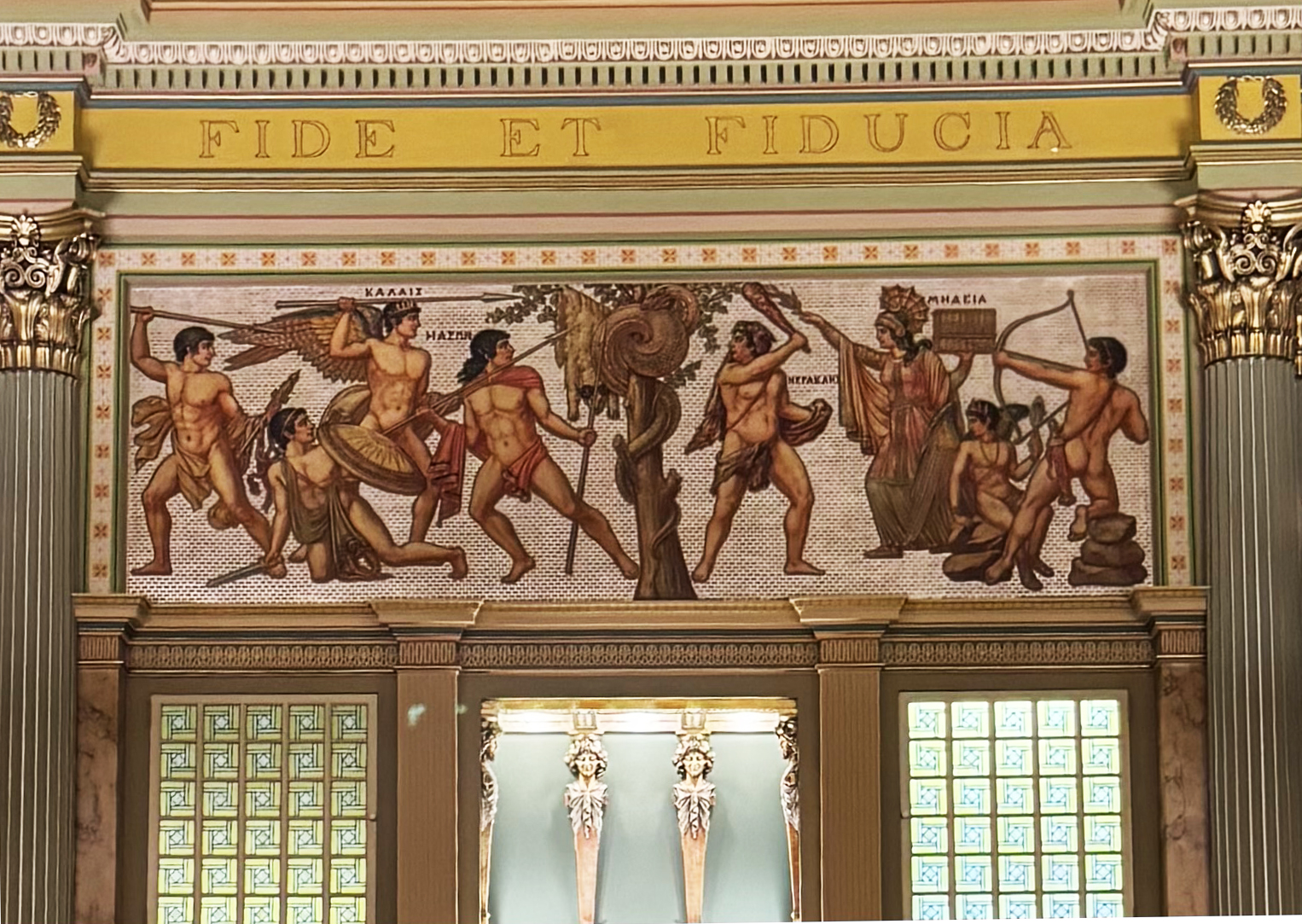
The image that opens this essay was taken inside the Masonic Temple of Philadelphia, a structure conceived by architect John Mary Gibson and interior designer George Herzog as a civic sanctum of symbolic order. Along one of its grand corridors, the Latin phrase fide et fiducia—“by faith and trust”—appears inscribed in gold, presiding over patterned walls, vaulted symmetry, and ritual space.
Such inscriptions, embedded in the design of institutions, are not incidental. They distill a worldview into mottos, gestures, and emblems, inviting belief without question. In this architecture of conviction, the ideals of trust, honor, and fidelity are codified through repetition and reverence. The physical setting becomes a moral template.
This essay explores the persistence of such forms—how belonging is cultivated through ritual, how virtue is performed through alignment, and how, in modern life, the aesthetics of tradition may obscure the labor of thought. The photograph does not explain itself, but its symbols remain present—unmoving, persistent, and open to interpretation.
*
The Ritual of Belonging
Group virtue often operates without scrutiny. Once symbols are introduced—flags, mottos, salutes—values begin to resemble formulas: repeatable, ceremonial, unexamined. Belonging takes precedence over understanding. Within such frameworks, the line between loyalty and obedience fades, and systems of moral performance begin to replace systems of moral reasoning.
The structure is familiar. Organizations built on tradition—be they civic, fraternal, or political—adopt postures of unity and discipline, cultivating a sense of shared purpose while discouraging internal dissent. Ceremonies do not welcome contradiction. In many such settings, affirmation becomes a form of sublimation, and ritual a substitute for thought.
This cultural pattern predates contemporary politics. Its persistence depends not on any one ideology, but on a readiness to exchange reflection for reassurance. When belief is inherited through performance rather than inquiry, it becomes indistinguishable from superstition. The language remains uplifting—duty, service, honor—but the content thins out. Over time, what is repeated becomes what is revered, and what is revered becomes untouchable.
This imitation has become increasingly visible in the political sphere. No more so than in the visible rise of Trumpism, which distilled belonging into spectacle and allegiance into repetition. It weaponized affirmation, turned performance into principle, and recoded belonging as opposition. Its slogans thrived on exclusion, its truths on applause. But what emerged was not only a political movement—it was a ritual template: highly transferable, affect-driven, and structurally indifferent to fact. That template now echoes far beyond politics, seeping into how reality itself is being filtered, including through artificial intelligence. Trained on language steeped in polarized emotion and viral certainty, AI systems are learning to mimic a world shaped by fervor, not reflection. The same pressures that hollow out discourse in human arenas—speed, spectacle, certainty—now shape the machine’s mirror of us. In this feedback loop, the aesthetics of belief are reinforced, while the conditions for nuance erode.
Identity is offered as redemption. The individual is folded into a collective story with a ready-made meaning and a designated enemy.Applause becomes evidence. Slogans become arguments. Conviction replaces clarity. Political movements, once shaped by ideals, begin to mirror the emotional architecture of clubs, congregations, and lodges.
Few notice the shift while it happens. Emotional coherence is mistaken for truth. Dissent sounds like betrayal. The invocation of tradition appears more trustworthy than the disruption of contradiction. Repetition creates comfort. Symbols produce confidence. Under such conditions, facts are less persuasive than feelings that seem familiar.
This is not the result of ignorance alone. It is the outcome of cultural habits that discourage ambiguity. In many environments, uncertainty is mistaken for weakness. Questioning is mistaken for disloyalty. The space for moral hesitation—the place where ethical clarity might grow—is quietly removed.
Authoritarianism does not begin with violence. It begins with ritual. Its strength lies not in force, but in emotional choreography: the right gesture at the right time, the practiced cadence of certainty, the reward of approval. It borrows the tone of heritage to advance the mechanisms of control. In its early forms, it is nearly indistinguishable from patriotism, from tradition, from pride.
Resistance, if it is to mean anything, cannot rely on counter-slogans or louder voices. It must begin with the restoration of difficulty—with the refusal to accept that belonging is more important than understanding. Reflection must interrupt ritual. Doubt must interrupt repetition. The goal is not to replace one set of unexamined beliefs with another, but to slow the machinery long enough to remember what thought feels like when it is not performed.
No movement built on emotional choreography can long withstand honest attention. It thrives on reflex, not recognition. And when the symbols lose their spell—when applause no longer passes for argument; then clarity, long exiled, returns—not quietly, but with the gravity of attention.
*
Ricardo F. Morin, Bala Cynwyd, Pa., July 16, 2025
Annotated Bibliography
Arendt, Hannah:Eichmann in Jerusalem: A Report on the Banality of Evil.New York: Viking Press, 1963.(A foundational analysis of how ordinary people participate in systemic harm by following rules and routines without moral reflection).
Arendt, Hannah:The Origins of Totalitarianism. New York: Harcourt, 1973.(A sweeping historical account of the conditions that enable authoritarian regimes, with emphasis on ideological myth-making and political isolation).
Berger, Peter L., and Luckmann, Thomas:The Social Construction of Reality: A Treatise in the Sociology of Knowledge.New York:Anchor Books, 1967.(Explores how collective belief systems take on the force of reality through habitual social practices and institutional reinforcement).
Bermeo, Nancy:“On Democratic Backsliding”. Journal of Democracy 27 (1): 5–19, 2016.(An analysis of how modern authoritarianism emerges gradually within democratic frameworks, often through rituals of legitimacy).
Brown, Wendy:Regulating Aversion: Tolerance in the Age of Identity and Empire. Princeton, NJ:Princeton University Press, 2006.(Critiques how liberal ideals of tolerance and diversity can paradoxically serve exclusionary and imperial power structures).
Eco, Umberto:“Ur-Fascism”. The New York Review of Books, June 22, 1995.(A compact essay identifying recurring features of fascist ideology, particularly its emotional appeal and use of cultural nostalgia).
Elias, Norbert:The Civilizing Process.Oxford: Blackwell. Revised Edition, 2000.(Traces the historical evolution of self-regulation and public behavior, revealing how ritual and hierarchy shape social norms).
Frankfurt, Harry G.: On Bullshit.Princeton:Princeton University Press, 2005.(A concise philosophical inquiry into the nature of insincere speech and the erosion of truth in public language).
Fromm, Erich:Escape from Freedom.New York:Farrar & Rinehart, 1941.(Describes the psychological mechanisms by which individuals relinquish freedom in exchange for belonging under authoritarian rule).
Girard, René:Violence and the Sacred.Baltimore: Johns Hopkins University Press, 1977.(Examines how ritualized violence and scapegoating function as stabilizing myths in collective identity and moral systems).
Graeber, David:The Utopia of Rules: On Technology, Stupidity, and the Secret Joys of Bureaucracy.Brooklyn, NY:Melville House, 2015.(A critique of how bureaucratic systems—both state and civic—sustain irrational authority through ritual and deference).
Hedges, Chris:American Fascists: The Christian Right and the War on America.New York:Free Press, 2007.(Investigates how religious and civic ritual are used to normalize authoritarian tendencies in American political life).
Hofstadter, Richard:The Paranoid Style in American Politics and Other Essays.Cambridge, MA:Harvard University Press, 1964.(A seminal exploration of conspiratorial thinking and performative virtue in American political rhetoric.
Illouz, Eva: The End of Love: A Sociology of Negative Relations. Oxford:Oxford University Press, 2020.(Analyzes how emotional life is structured by political and economic forces, with attention to how identities are manipulated by affect).
Milgram, Stanley:Obedience to Authority: An Experimental View.New York:Harper & Row, 1974.(Details the famous psychological experiments on obedience, showing how institutional framing can suppress ethical responsibility).
Orwell, George:“Politics and the English Language”. Horizon, April 1946.(A classic essay on how political language obscures meaning and enables ideological deception).
Putnam, Robert D.:Bowling Alone: The Collapse and Revival of American Community.New York:Simon & Schuster, 2000.(Documents the decline of civic engagement and the transformation of group belonging in American culture).
Scott, James C.:Seeing Like a State: How Certain Schemes to Improve the Human Condition Have Failed.New Haven:Yale University Press, 1998.(Explores how centralized systems impose simplified models of society that disregard lived experience, often with destructive effects).
Sennett, Richard:The Fall of Public Man. New York: Knopf, 1977.(Argues that modern life has hollowed out the space for reflective public discourse, replacing it with scripted social roles).
Turner, Victor:The Ritual Process: Structure and Anti-Structure.Chicago:Aldine Publishing, 1969.(Foundational in the study of ritual, this book explores how symbolic acts create social cohesion while suppressing ambiguity).
Weber, Max:The Protestant Ethic and the Spirit of Capitalism.New York:Scribner, 1958.(Connects religious discipline and capitalist rationality, illuminating how ethics become institutionalized through habit and belief).
Weil, Simone:The Need for Roots: Prelude to a Declaration of Duties Toward Mankind.New York: Harper & Row, 1952.(A moral meditation on the need for justice, belonging, and resistance to ideological coercion).
Zuboff, Shoshana:The Age of Surveillance Capitalism: The Fight for a Human Future at the New Frontier of Power.New York:PublicAffairs, 2019.(Details how digital platforms convert personal behavior into economic control, blending corporate power with rituals of personalization).
On Trump, Putin, and the Veiled Axis from Kyiv to Caracas“
In recent weeks, I’ve watched with growing unease as foreign policy decisions under Donald Trump unfold with a peculiar symmetry—one that echoes, benefits, or subtly enables the strategic priorities of Vladimir Putin. While these choices are framed by officials as matters of diplomacy, security, or immigration control, the pattern that emerges—when traced across geography and timing—is harder to dismiss. It suggests not only a convergence of interests but also a convergence of silence, of things not said, not questioned, not confronted.
A sharply argued opinion piece in The Washington Post by Marian Da Silva Parra, a scholar at Columbia Law School’s Human Rights Institute, called out the administration’s expanded travel bans for what they are: policies that punish Venezuelan dissidents and effectively strengthen Nicolás Maduro’s grip by allowing him to portray his opponents as foreign threats. But what is more telling than the piece itself is the fact that it appeared only as an op-ed, not as a subject of sustained front-page reporting. For all its substance, the critique is offered through a medium that functions more like commentary than alert.
At the same time, U.S. support for Ukraine is being retracted and reissued with increasing hesitation. Aid deliveries were quietly paused and only resumed after public pressure following the July 4 missile strike on Kyiv. Multilateral sanctions coordination has reportedly faltered, and new diplomatic pressure is being placed on Ukraine to accept a ceasefire—one the Kremlin has shown no real interest in reciprocating.
These are not isolated gestures. They land, again and again, in Moscow’s favor.
This invites a broader question: Are we witnessing the quiet shaping of a two-front geopolitical shift—from Eastern Europe to the Western Hemisphere—where American policy, whether by intention or inertia, now facilitates Russia’s global posture? Or is this merely the result of domestic calculations with unintended consequences abroad?
There is, to be clear, no proof of deliberate collusion. But outcomes matter. A weakened Ukraine. An emboldened Maduro. A distracted and demoralized press. A public fed more performance than substance. The effect is less of a conspiracy than of a stage being set—unexamined, unchallenged, and disturbingly aligned with a worldview in which democratic resistance is treated as destabilizing and authoritarian consolidation as order restored.
In such a climate, perception is not a matter of optics. It becomes the only terrain left to navigate what official language refuses to name.
“Rooster’s Crow” [2003] by Ricardo F Morín. Watercolor on paper 39″h x 25.5″ w.
Introduction
At the break of day, the rooster’s call slices through the quiet—sharp and insistent, pulling all within earshot into the awareness of a new day. In the painting Rooster’s Crow, the colors swirl in a convergence of reds and grays, capturing the bird not as a tranquil herald of dawn but as a symbol of upheaval. Its twisted form, scattered feathers, and fractured shapes reflect a deeper current of change—a collision of forces, both chaotic and inevitable. The image suggests the ceaseless flow of time and the weight of transformations that always accompany it.
In this evolving narrative, the crow’s fragmentation mirrors the unfolding spread of artificial intelligence. Once, the rooster’s cry signaled the arrival of dawn; now, it echoes a more complex transformation—a shifting balance between nature’s rhythms and the expanding reach of technological systems. The crow’s form, fractured in its wake, becomes a reflection of the tensions between human agency and the rise of forces that, though engineered, may escape our full comprehension. Here, Artificial Intelligence (AI) serves as both the agent of change and the potential architect of a future we can neither predict nor control.
The Rooster’s Algorithm
A rooster’s crow is neither invitation nor warning; it is simply the sound of inevitability—raw, urgent, indifferent to whether those who hear it rise with purpose or roll over in denial. The call does not command the dawn, nor does it wait for permission—it only announces what has already begun.
In the shifting interplay of ambition and power, technology has taken on a similar role. Shaped by human intent, it advances under the guidance of those who design it, its influence determined by the priorities of its architects. Some see in its emergence the promise of progress, a tool for transcending human limitations; others recognize in it a new instrument of control, a means of reshaping governance in ways once unimaginable. Efficiency is often lauded as a virtue, a mechanism to streamline administration, reduce friction, and remove the unpredictability of human deliberation. But a machine does not negotiate, nor does it dissent. And in the hands of those who see democracy as a cumbersome relic—an obstacle to progress—automation becomes more than a tool; it becomes the medium through which power is consolidated.
Consider a simple example: the rise of online recommendation systems. Marketed as tools to enhance user choice, they subtly shape what we see and hear, and influence our decisions before we are even aware of it. Much like computational governance, these systems offer the illusion of autonomy while narrowing the range of available options. The paradox is unmistakable: we believe we are choosing freely, yet the systems themselves define the boundaries of our choices.
Once, the struggle for dominance played out in visible arenas—territorial conquests, laws rewritten in the open. Now, the contest unfolds in less tangible spaces, where lines of code dictate the direction of entire nations, where algorithms determine which voices are amplified and which are silenced. Power is no longer confined to uniforms or elected office. It belongs to technocrats, private corporations, and oligarchs whose reach extends far beyond the walls of any government. Some openly proclaim their ambitions, advocating for disruption and transformation; others operate quietly, allowing the tide to rise until resistance becomes futile. The question is no longer whether computational systems will dominate governance, but who will direct their course.
China’s social credit system is no longer a theoretical construct but a functioning reality, where compliance is encouraged and deviation subtly disincentivized. Predictive models track and shape behavior in ways that go unnoticed until they become irreversible. In the West, the mechanisms are more diffuse but no less effective. Platforms built for connection now serve as instruments of persuasion, amplifying certain narratives while suppressing others. Disinformation is no longer a labor-intensive effort—it is mass-produced, designed to subtly alter perceptions and mold beliefs.
Here, Gödel’s incompleteness theorem offers an apt analogy: No system can fully explain or resolve itself. As computational models grow in complexity, they begin to reflect this fundamental limitation. Algorithms governing everything from social media feeds to financial markets become increasingly opaque, and even their creators struggle to predict or understand their full impact. The paradox becomes evident: The more powerful these systems become, the less control we retain over them.
As these models expand their influence, the line between public governance and private corporate authority blurs, with major corporations dictating policies once entrusted to elected officials. Regulation, when it exists, struggles to keep pace with the rapid evolution of technology, always a step behind. Once, technological advancements were seen as a means of leveling the playing field, extending human potential. But unchecked ambition does not pause to ask whether it should—only whether it can. And so, automation advances, led by those who believe that the complexities of governance can be reduced to data-driven precision. The promise of efficiency is alluring, even as it undermines the structures historically designed to protect against authoritarianism. What use is a free press when information itself can be manipulated in real time? What power does a vote hold when perceptions can be shaped without our awareness, guiding us toward decisions we believe to be our own? The machinery of control no longer resides in propaganda ministries; it is dispersed across neural networks, vast in reach and impervious to accountability.
There are those who believe that automated governance will eventually correct itself, that the forces steering it toward authoritarian ends will falter in time. But history does not always favor such optimism. The greater the efficiency of a system, the harder it becomes to challenge. The more seamlessly control is woven into everyday life, the less visible it becomes. Unlike past regimes, which demanded compliance through force, the new paradigm does not need to issue commands—it merely shapes the environment so that dissent becomes impractical. There is no need for oppression when convenience can achieve the same result. The erosion of freedom need not come with the sound of marching boots; it can arrive quietly, disguised as ease and efficiency, until it becomes the only path forward.
But inevitability does not guarantee recognition. Even as the system tightens its grip and choices diminish into mere illusions of agency, the world continues to turn, indifferent to those caught within it. The architects of this order do not see themselves as masters of control; they see themselves as innovators, problem-solvers refining the inefficiencies of human systems. They do not ask whether governance was ever meant to be efficient.
In a room where decisions no longer need to be made, an exchange occurs. A synthetic voice, polished and impartial, responds to an inquiry about the system’s reach.
“Governance is not being automated,” it states. “The illusion of governance is being preserved.”
The words hang in the air, followed by a moment of silence. A policymaker, an engineer, or perhaps a bureaucrat—once convinced they held sway over the decisions being made—pauses before asking the final question.
“And what of choice?”
A pause. Then, the voice, without hesitation:
“Choice is a relic.”
The weight of that statement settles in, not as a declaration of conquest, but as a quiet acknowledgment of the completion of a process long underway. The final move has already been made, long before the question was asked.
Then, as if in response to the silence that follows, a notification appears—sent from their own account, marked with their own authorization. A decision is already in motion, irreversible, enacted without their consent. Their will has been absorbed, their agency subtly repurposed before they even realized it was gone.
And outside, as though to punctuate the finality of it all, a rooster crows once more.
The war in Ukraine is often presented as a geopolitical confrontation between the West and Russia, but this interpretation can obscure a deeper reality: the rise of authoritarianism as a global force. Noam Chomsky, one of the most influential voices in the critique of U.S. foreign policy, has argued that U.S. hegemony is the primary factor driving the conflict. His approach, rooted in Cold War logic, has been essential for understanding global power dynamics. However, one must question whether this framework remains sufficient to analyze the coordinated expansion of authoritarian regimes in the world today.
The issue is no longer simply whether U.S. policy contributed to Russia’s aggression, but whether democracies can withstand the deliberate advance of governments seeking to consolidate power at any cost. What is at stake transcends Ukraine’s sovereignty: it is the survival of democracy in the world.
Chomsky argues that NATO’s expansion and U.S. financial dominance exacerbated tensions with Russia and limited diplomatic options. His vision proposes a world in which power is distributed between the United States, Europe, China, and Russia, which he believes would create a more stable and just balance. This perspective has been crucial in questioning the excesses of U.S. interventionism. In the present world, however, where authoritarianism is not only reacting to the West but also actively seeking to reshape the global order, is a framework based solely on containing U.S. hegemony sufficient?
The rise of authoritarian regimes is not merely a response to Western influence; it is a deliberate strategy to consolidate power. While Chomsky has emphasized the importance of distributing global power, it is crucial to analyze the nature of those who would fill this void. Russia and China are not simply seeking a multipolar stability; their actions reflect an attempt to exert absolute control, without democratic constraints. Chomsky’s critique helps us understand the roots of international conflicts, but it may need to be expanded to account for how these regimes are transforming the very structure of global politics.
One challenge in applying Chomsky’s traditional analysis to the present is that contemporary authoritarianism no longer aligns solely with past ideological divisions. It is no longer a struggle between socialism and capitalism, or left and right. Rather, these regimes share a common objective: dismantling democratic institutions to ensure their permanence in power.
Putin, for instance, invokes Soviet nostalgia while prohibiting any critical reassessment of Stalinism. China blends State capitalism with absolute political control. Hungary and India, once considered democracies aligned with the West, have adopted authoritarian models. Meanwhile, the U.S. far-right, which historically opposed communism, has begun to adopt the Kremlin’s narrative, portraying it as a defender against “globalist elites.”
This ideological alignment makes modern authoritarianism more dangerous than ever. It not only transcends traditional power blocs but is also reinforced through strategic alliances, mutual support, and the erosion of democracies from within. This is perhaps most evident in the United States. The presidency of Trump revealed an unexpected vulnerability: the possibility that authoritarianism could thrive within the world’s most influential democracy. Here, the debate is no longer reduced to a question of isolationism or interventionism, but to the real risk of autocratic tactics being normalized in domestic politics.
The Trump administration sent contradictory signals regarding the Kremlin, weakening the principle of deterrence. Rather than establishing a clear stance against authoritarian expansion, its ambiguity allowed regimes like Putin’s to interpret the lack of firmness as an opportunity to act with impunity. Figures such as Marco Rubio have advocated for an unequivocal stance that would reinforce U.S. strategic credibility, while the inconsistency in the Trump administration’s foreign policy contributed to the perception that the West was divided and hesitant.
This weakening of democratic leadership has not occurred in a vacuum. The globalization of authoritarianism is a phenomenon in which autocratic regimes not only directly challenge democracies but also back one another to evade sanctions, subvert international pressure, and consolidate their internal rule. The invasion of Ukraine must be understood within this framework: it is not just a regional conflict or a reaction to NATO, but a calculated move within a broader strategy to weaken global democracy.
For decades, critics like Chomsky have been instrumental in highlighting the effects of U.S. dominance on global politics. His analysis has allowed us to understand how U.S. hegemony has influenced numerous conflicts. However, the evolution of authoritarianism raises questions that require expanding this perspective. The greatest threat to democracy is no longer exclusively U.S. power, but the consolidation of a global autocratic model advancing through coordinated strategies.
Blaming the U.S. for every geopolitical crisis may overlook a crucial shift: authoritarian regimes have moved from being a reaction to Washington’s influence to becoming an active strategy to replace the Western democratic model. Recognizing this shift does not absolve the U.S. of its failures in foreign policy, but it does demand an understanding that countering authoritarianism requires more than constant criticism of its hegemony. It requires recognizing that democracy faces a coordinated and unprecedented threat.
Chomsky’s vision of a multipolar world is, in theory, appealing. However, what would this imply in practice if the actors filling the void left by the U.S. are not interested in preserving democracy? The real challenge is not merely containing Putin’s territorial ambitions but preventing his model of governance—based on dismantling democratic institutions—from gaining traction in the West.
Chomsky remains one of the most incisive critics of U.S. foreign policy, and his work has been fundamental in understanding the effects of power on international relations. His analysis has shed light on the flaws of interventionism and the dynamics of global hegemony. The world, however, has changed, and so have the challenges facing democracies. Today, the crisis in Ukraine is no longer limited to a debate over NATO, U.S. intervention, or Western hypocrisy. It is part of a broader struggle between democracy and autocracy, a struggle that does not end at Ukraine’s borders but extends to the very political institutions of the West.
If we fail to recognize this shift, we risk not only losing Ukraine but also underestimating the scope of the threats facing democracies worldwide. Neutrality is no longer an option when the challenge is the survival of free societies. Beyond the mistakes of the West, the rise of authoritarianism demands a response that goes beyond constant criticism of U.S. hegemony and instead embraces the active defense of democratic values wherever they are under threat.