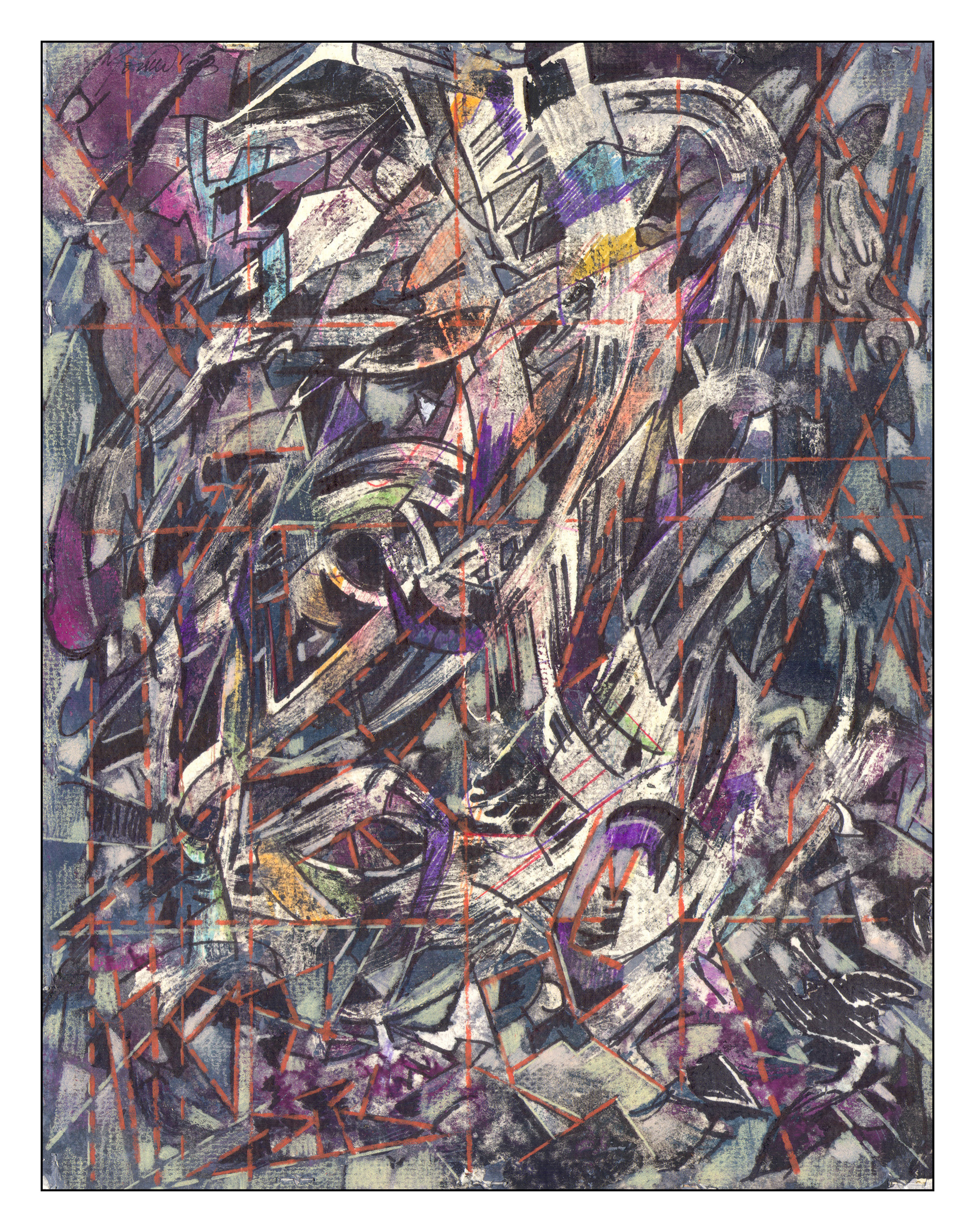
Ricardo F. Morín Untitled, 2005 Charcoal and black Sharpie pen 24 × 18 inches
Developers, governments, and those affected by artificial intelligence assign different significance to the same technical achievement. A developer seeking commercial advantage may treat an advance as grounds for ownership. A government concerned with strategic predominance may treat it as an instrument of national power. Those exposed to its consequences may judge it through its effects upon employment, education, communication, or public judgment. Each perspective depends upon relations that the achievement alone does not disclose.
These relations participate in development itself. Investors influence which problems receive attention. Owners determine who may use a capability and under what conditions. Governments establish permissions, restrictions, and incentives. The technology available to a user embodies decisions whose purposes need not be evident in its operation.
An answer appears on a screen. Its fluency may lead the user to accept it as sufficient for understanding. Yet the answer alone does not disclose how developers trained the system, which sources informed its response, what restrictions govern its output, or how developers organize its presentation to invite confidence. The user may find the answer useful without knowing all these conditions. That usefulness does not establish the adequacy of the answer.
Mediation names this dependence: understanding rests upon relations that attention to its immediate object does not necessarily reveal. The answer occupies the user’s attention. The conditions supporting its production, presentation, and acceptance remain only partially visible.
The public accounts of artificial intelligence exhibit a comparable dependence. Commercial accounts identify innovation through investment, demand, and return. Strategic accounts identify technological capacity through advantage over competitors. Security accounts identify uses through the dangers they introduce or prevent. Each account directs attention toward relations relevant to its purpose. Each leaves questions that its governing purpose cannot adequately answer.
These accounts also inform decisions. An institution that measures achievement through commercial return has grounds to favor applications for which customers will pay. A government that measures achievement through strategic advantage has grounds to favor capabilities that strengthen its position. The criteria through which an institution recognizes value therefore bear upon the purposes it authorizes and the resources it assigns. What remains outside those criteria may lack an effective claim upon its decisions.
Those who determine the terms of recognition can influence which needs count as reasons for action. Their authority does not follow from the completeness of their account. It may rest upon ownership, financial resources, statutory powers, or control over infrastructure. An account can govern development and can still leave much of its social significance unexamined.
The United States’ 2025 AI Action Plan explicitly frames development as a race for global dominance, and links technological leadership with economic and military advantage. The United Nations’ Global Digital Compact places international governance within a commitment to public benefit and inclusive participation. The former sets out actions for federal agencies; the latter records commitments among participating states. The purposes expressed in these documents operate through different institutional means. Their coexistence supplies no common authority for deciding between them when their demands conflict. [1]
Commercial success establishes that a product attracts expenditure. It does not establish how its benefits and burdens are distributed. National predominance establishes an advantage relative to other powers. It does not establish that the advantage improves the circumstances of those subject to its consequences. Protection against malicious use addresses a necessary concern. Authorized uses may also diminish the ability of people to understand, question, or influence decisions affecting them.
The capacities under development nevertheless permit achievements of substantial human value. Researchers can incorporate particular capabilities into successive stages of inquiry, and use them to examine complex relations, formulate hypotheses, and assist the design of inventions. Particular applications may support advances in medicine, materials, or other fields concerned with human welfare. The value of an achievement depends upon what it enables people to do and upon the consequences of its use. Commercial ownership or strategic sponsorship does not exhaust that value.
The same capacity to assist inquiry introduces uncertainty when institutions delegate decisions and actions to systems. Developers and users may permit a system to select means, initiate operations, or act upon other systems with limited intervention. Its effects then depend upon the scope of that permission, the conditions governing its operation, and the ability of those responsible to inspect or interrupt its actions.
Agency in these circumstances need not resemble human intention to exert power over human affairs. A system can influence conduct through recommendations that institutions routinely accept, classifications upon which access depends, or operations carried out under delegated authority. Uncertainty concerns how its actions will interact with circumstances its designers and users cannot fully anticipate, and how effectively human beings can retain control over those interactions.
The system may also influence the relations through which people understand and authorize its use. If an institution relies upon it to identify priorities, assess evidence, or evaluate performance, its outputs inform decisions about subsequent delegation. Authority initially granted by human beings can therefore support operations that shape the grounds upon which further authority is granted. The institution’s reliance upon the system extends beyond the performance of a task to the judgment of what tasks deserve performance and under whose direction.
Incremental benefit and uncertainty about agency can coexist within the same arrangement. An invention may improve human welfare, and may increase reliance upon systems that those affected cannot readily examine or contest. That reliance may rest upon cost, infrastructure, contractual restrictions, or the absence of practicable alternatives. Limited understanding can impede scrutiny of the arrangement without constituting its sole cause. The achievement retains its value. That value supplies no sufficient account of the reliance established through its use.
The betterment of society consequently depends upon more than the intentions of those directing development. If those institutions retain exclusive authority to define improvement, their criteria govern which consequences receive recognition. A gain in productivity may accompany diminished security of employment. Greater access to information may accompany greater reliance upon a small number of providers. Expanded capabilities may leave those affected with fewer means of challenging their application.
Who receives the benefit, who bears the burden, and who possesses authority to decide are distinct questions. An assessment confined to aggregate improvement can conceal the differences upon which its judgment rests.
The global reach of artificial intelligence extends those differences across societies. Worldwide availability does not establish worldwide participation in determining its purposes. A community may receive a system without the resources to adapt it to its language, examine its limitations, or challenge its terms of use. Providers extend access while they retain control over the conditions of participation. The technology serves a wider population without a corresponding distribution of authority over its development.
Nor does an appeal to the common good settle whose purposes should govern. Judgments about the common good depend upon whose circumstances receive attention, which consequences carry weight, and what forms of reliance people are prepared to accept. Institutions may affirm universal benefit while excluding affected communities from those judgments.
Technical competence, financial resources, political authority, security, and social need each sustain claims upon development. None supplies a sufficient account of the whole. Their unequal institutional power bears upon which claims govern, which remain negotiable, and which lack any effective means of expression.
Where institutions treat one criterion as sufficient, their judgments substitute a partial measure for the relations supporting it. Commercial actors identify expansion with progress. Governments identify predominance with protection. Security authorities identify the prevention of prohibited uses with safety. Providers identify availability with participation. Each identification leaves dependencies outside the account through which the undertaking is justified.
The answer on the screen offers the user something immediately available for judgment. Its usefulness may be real. Its fluency does not disclose who determined its conditions, what authority supports its use, or how reliance upon it influences subsequent judgment. The emerging capacities of artificial intelligence extend the consequences of those relations. Those who delegate authority to systems require knowledge of the conditions governing the systems and powers to withhold, limit, or revoke that delegation. Those affected without participating in the delegation stand in a different relation: their ability to contest its consequences depends upon access to the grounds of decisions and institutional means of holding the delegating authorities answerable.
Ricardo Morín Weightless Thoughts Acuarela y lápiz sobre papel 14 x 20 pulgadas 2005
Ricardo F Morín, Dec. 18, 2025, Oakland Park, Fl
I
Intellectual life does not require freedom in the civic sense to persist. It requires space, continuity, and reward. Where these are provided—through markets, institutions, or private channels—thought can circulate even when public agency is constrained. What disappears under such conditions is not intelligence, nor curiosity, nor sophistication, but friction. Ideas move freely because they are not asked to carry consequence.
In these environments, thinking becomes agile rather than anchored. It adapts to incentives, learns the contours of what is permitted, and develops fluency without exposure. The absence of civic agency does not silence inquiry; it changes its weight. Thought no longer presses against shared conditions. It hovers above them, unburdened by the obligation to answer for its effects.
This is not an impoverishment of intellect but a reorientation of it. Intellectual life becomes efficient, mobile, and polished—capable of range without depth of risk. It survives precisely because it is not required to intervene.
II
When civic participation is limited, exchange does not cease; it becomes transactional by default. Speech, labor, expertise, and culture continue to circulate, but always under terms that prioritize continuity over exposure. The public sphere narrows, yet private exchange expands. What cannot be contested collectively is negotiated individually.
Under these conditions, intellectual production aligns with systems that reward stability. Analysis sharpens, but it avoids points of rupture. Critique refines itself into commentary. Complexity is welcomed so long as it does not demand revision of the structures that sustain it. The result is not conformity, but containment.
This containment does not require repression. It relies instead on predictability. When the limits of action are known, thought learns where it can move without consequence. Over time, this learning becomes instinctive. The question ceases to be what is true, and becomes what is viable. Thought remains active, but its horizon contracts around what can circulate without resistance.
III
What emerges from this arrangement is not cynicism, but distance. Relations take on the character of exchange rather than exposure. Engagement is shaped less by shared risk than by mutual advantage. The language of values remains intact, but it floats free of obligation. Conviction becomes performative rather than binding.
In such a climate, depth appears excessive. Urgency feels misplaced. Appeals that depend on shared responsibility lose traction, not because they are rejected, but because they exceed the available structure. What cannot be absorbed by the system is not debated; it is bypassed.
This is the condition that gives the essay its name. Thought becomes weightless—not because it lacks intelligence, but because it is no longer tethered to civic consequence. It travels far, connects widely, and impresses easily. What it does not do is settle. And what it does not settle into cannot generate accountability, only circulation.
Life does not begin with power. It begins with dependence. Before a human being becomes capable of judgment, choice, consent, or resistance, existence already unfolds within relationships upon which survival depends. No one enters the world invested with autonomy. Every human life begins by being sustained through the action of another.
Dependence, however, is not sufficient to explain authority. Whoever possesses greater strength may preserve another’s life, abandon it, or destroy it. Physical superiority alone cannot explain the character of the relationship through which human life ordinarily comes to develop. If force alone governed the bond between the one who requires protection and the one capable of providing it, care would cease to be distinguishable from domination.
Care begins to reveal itself as something different from domination through an experience so ordinary that it seldom becomes an object of reflection. The child gradually discovers a world in which the guidance received is not experienced solely as a limitation imposed from without, but as guidance properly exercised by the person who provides it. Before authority becomes an object of understanding, it constitutes a lived experience. Its first appearance assumes not the form of command, but that of care.
Care makes possible a form of dependence that force could never produce: a dependence that does not extinguish future freedom, but prepares the conditions for its emergence. The guidance received becomes intelligible because it is exercised for the benefit of a life still in formation, rather than for the immediate satisfaction of the person possessing greater power.
Power and authority operate jointly in the development of civilized life. Power designates the capacity to act. Authority designates the acknowledged right to guide, direct, judge, or decide. Both may be present in the same person, but neither necessarily implies the existence of the other. Power may exist without authority, just as authority may endure even after power has considerably diminished.
Obedience does not resolve the problem either. Human beings obey for many different reasons. They obey because they fear punishment. They obey because custom has rendered the alternatives invisible. They obey because deception has concealed the true nature of what is being required of them. They obey because every form of resistance appears futile. None of these circumstances constitutes authority. They explain only submission.
Authority begins only where recognition becomes possible. The guidance offered by one who leads must possess a title that renders its recognition justifiable independently of force. A person who accepts the guidance of another does not merely yield before a more powerful will. The person recognizes that such guidance possesses a title extending beyond the mere fact that it can be imposed.
That recognition constitutes legitimacy. Legitimacy is not identical with effectiveness, popularity, success, antiquity, or duration. Nor does it arise from the mere assertion of the person claiming obedience. It designates the condition under which authority may be recognized as due, rather than merely acknowledged as existing.
Because legitimacy depends upon recognition rather than upon the possession of power, it is more fragile than power itself. Force may remain intact after legitimacy has already begun to disappear. Armies may continue to obey. Institutions may continue to function. Laws may continue to be enforced. Yet the basis of recognition has already changed: what was once acknowledged as due begins to be experienced only as imposed.
From that moment onward, human relationships begin to change without commotion. Guidance approaches coercion. Trust yields to calculation. Responsibility begins to be confused with control. Instruction approaches indoctrination. Judgment begins to be perceived as domination. Authority remains visible while the intelligibility that once made it recognizable gradually recedes. A son may continue to obey his father from habit long after he has ceased to trust his judgment. From the outside, the relationship between father and son may appear scarcely altered. The same words continue to be spoken. The same decisions continue to be obeyed. Yet what inwardly sustained the father’s authority has already begun to disappear.
The disappearance of legitimacy does not bring about the immediate collapse of social life. Human relationships begin to reorganize themselves through means that no longer rest upon recognition. Where recognition ceases to sustain authority, substitutes arise to take its place. Force attempts to compensate for what recognition no longer grants. Fear seeks to secure the obedience that trust has withdrawn. Custom prolongs practices that scarcely continue to rest upon recognition. Manipulation manufactures the appearance of consent after genuine recognition has ceased to exist.
None of those means, however, constitutes authority. Force obtains conduct, but not recognition. Fear silences resistance, but does not produce assent. Custom prolongs forms whose intelligibility has weakened. Manipulation imitates legitimacy because it can no longer produce it. All such means depend upon the absence of the recognition they seek to replace.
What makes it possible for one human being to recognize the authority of another without reducing that recognition to force, fear, custom, or manipulation? Every subsequent form of authority will receive its intelligibility from the answer given to that question.
The first manifestation of authority remains inseparable from care because life still depends upon the constant presence of another. As the child grows, however, dependence begins to change. Survival ceases to occupy the center of the relationship. Understanding gradually begins to take its place.
No experience reveals more clearly than language how survival ceases to occupy the center of dependence and understanding begins to assume its place. No child invents the language through which the world begins to become intelligible. Words are received before they are used. Meanings are recognized before they are examined. Grammar is obeyed long before it can be explained. Every act of speech therefore presupposes an inheritance that no individual has produced independently.
The transmission of that inheritance cannot be obtained by force. A child may be compelled to repeat a word, but repetition does not yet amount to understanding. Language becomes one’s own because correction eventually comes to be recognized as something distinct from imposition. The child does not merely reproduce sounds. The child learns that certain words name the world more faithfully than others. Correction therefore always refers to a reality that transcends the person who corrects.
The acquisition of language also changes the nature of authority. The dependence characteristic of early childhood ceases to constitute its principal foundation. Authority now begins to arise from shared participation in an order that precedes both teacher and pupil. The language existed before either of them. Neither may claim it as an exclusive possession. Both remain subject to the same structure that makes communication possible.
For that reason, the teaching of language can never be reduced to the exercise of command. Whoever corrects an expression ultimately answers to the language itself, and not merely to personal will. The legitimacy of correction does not arise from the speaker’s desire, but from the fidelity with which the transmitted word corresponds to the language held in common. Authority then ceases to rest principally upon the person who teaches and begins to rest upon the reality to which that person remains subordinate.
Authority may be recognized even after the personal dependence characteristic of the earliest years of life has disappeared. The child begins to discover that someone deserves to be heard, not because that person is stronger or continues to provide care, but because that person permits faithful access to a reality existing independently of them both. Recognition thus ceases to be directed exclusively toward the person and begins to be directed toward what that person makes accessible.
The redirection of recognition toward the reality transmitted, rather than exclusively toward the person transmitting it, profoundly alters human experience. Authority may now be examined without thereby being abolished. Correction itself may be corrected. The teacher may be mistaken. Neither the examination of authority, nor the correction of what has been taught, nor the teacher’s error destroys the legitimacy of teaching, because legitimacy no longer resides exclusively in the person who teaches, but in the fidelity with which that person transmits what transcends both teacher and pupil.
Civilization begins to be constructed upon this displacement of authority from the person who transmits toward the integrity of what is transmitted. Once authority becomes attributable to the integrity of what is transmitted rather than simply to the person transmitting it, every higher form of learning becomes possible. Education, scientific inquiry, moral life, judgment, and constitutional government will each reproduce, within its own sphere, the subordination of authority to an antecedent reality that governs its exercise and makes its recognition possible.
Language, however, does not yet constitute education. It provides only the possibility of communicating the understanding upon which education may act. Through language, understanding may be communicated. Education pursues a different purpose: the deliberate formation of the understanding.
A teacher corrects a mistaken line of reasoning. The pupil first recognizes the error in the answer before fully understanding the truth of the explanation received. Correction does not require obedience alone. It requires sufficient trust to accept that another person may guide the understanding toward a reality it cannot yet perceive. With education, authority undergoes a further transformation. The child no longer depends upon the adult solely in order to inhabit a shared language, but in order to gain access to bodies of knowledge that cannot be acquired through individual experience alone. Every generation receives a world whose complexity vastly exceeds the duration of any single human life. Education exists because no human being can always begin again from the beginning.
The authority of the educator cannot therefore derive from age, office, or membership in an institution. None of those circumstances confers, by itself, the right to guide another person’s intelligence. The teacher acquires legitimacy only by making accessible a form of knowledge whose validity does not proceed from the teacher. Where teaching turns the teacher into the true object of learning, education has already ceased to exist.
Intellectual formation therefore requires a discipline common to teacher and pupil. The teacher answers to the truth of what is taught. The pupil answers to the effort required to understand it. Neither governs the educational relationship unilaterally, because both appear before a body of knowledge that neither has created.
Education therefore differs radically from indoctrination. Indoctrination seeks adherence to the teacher or the preservation of a doctrine irrespective of whether that doctrine retains its intelligibility. Education pursues the opposite end. It seeks to enable the pupil to recognize the truth even when that recognition ultimately surpasses the understanding of the teacher. The success of teaching consists in rendering the authority of the teacher progressively less necessary.
Education thereby reveals one of the least noticed characteristics of legitimate authority. The more faithfully knowledge is transmitted, the less the pupil depends upon the person who served as mediator. Education does not perpetuate dependence. It prepares autonomy without destroying the legitimacy of the relationship through which that autonomy became possible.
Legitimate authority and domination reveal here with greater clarity the contrary directions toward which they move. Domination needs to perpetuate itself because it depends upon the continuing subordination of the person subjected to it. Legitimate authority, by contrast, works so that recognition may ultimately sustain itself. It does not fear the intellectual maturity of the pupil, because it never sought possession of the pupil, but formation.
When teaching attempts to prevent examination, discourages correction, or seeks indefinitely to prolong the pupil’s dependence, it begins to depart from the subordination to knowledge that justified its authority. Corruption begins when the teacher ceases to understand the self as subordinate to the knowledge transmitted and demands recognition solely by virtue of the continued possession of authority.
A new question arises from the displacement of educational legitimacy away from the person of the teacher and toward fidelity to knowledge. If the legitimacy of education depends upon fidelity to knowledge rather than exclusively upon the educator, what makes it possible for knowledge to possess authority without becoming another form of institutional power? That question leads naturally from education toward scientific inquiry.
A researcher devotes years to developing a hypothesis. The results of new experiments eventually contradict it. The researcher may ignore them in order to preserve personal prestige or publicly acknowledge that reality has disproved the conclusions. That decision reveals whether the researcher remains subordinate to the evidence obtained or instead employs the institutional authority of science to preserve personal standing. Scientific inquiry arises from the obligation to submit the researcher’s conclusions to evidence capable of disproving them. No proposition becomes true because it was formulated by a prestigious scholar, approved by a renowned institution, or accepted by the majority of specialists. The authority of science does not proceed from those who practice it. It proceeds from the discipline through which every assertion remains exposed to examination, replication, correction, or rejection by others. The scientist therefore appears under the same requirements imposed upon every conclusion.
For that reason, scientific authority possesses a singular character. The possibility of error does not weaken it; it constitutes one of the conditions that make its legitimacy possible. An inquiry remains scientifically legitimate because it permits the public correction of its own results. Error belongs to the ordinary life of science. What delegitimizes inquiry is not the fact of being mistaken, but the withdrawal of conclusions from the procedure through which they might be shown to be mistaken.
An erroneous conclusion does not destroy the authority of science so long as it remains exposed to demonstration and correction through the same procedures that justify the inquiry. Error assumes another character when examination is no longer possible, when institutional prestige replaces demonstration, or when assent is demanded independently of any further verification. At that moment the researcher ceases to mediate knowledge of reality and begins instead to mediate recognition of the self.
Scientific authority, consequently, never resides in the scientist. It resides in the continuing fidelity of inquiry to the reality it seeks to understand. The researcher retains authority only while remaining subject to that reality. From the moment the researcher seeks exemption from that subordination, legitimacy begins to withdraw, even though the institutional power of science may appear to remain intact.
The temptation disclosed within scientific inquiry does not belong exclusively to science. Every enduring institution eventually confronts the danger of confusing the preservation of its own authority with the preservation of the reality that originally justified its existence. Institutions seldom lose legitimacy merely by exercising authority. They begin to lose it when their principal concern ceases to be what was entrusted to them and becomes their own permanence. Fidelity then yields to self-preservation. Mediation becomes self-reference. Authority, which formerly allowed the reality justifying it to be seen with transparency, gradually begins to obscure it.
Scientific inquiry thus leads toward the problem of moral authority. If science receives legitimacy from its fidelity to truth, does a similar structure govern those forms of authority that cannot be demonstrated experimentally and yet remain indispensable to common life? That question introduces the problem of moral authority.
A person who exhorts others to tell the truth is discovered in a lie. The principle remains. The authority of the person who invoked it disappears. That ordinary experience introduces a question distinct from all the preceding ones. What permits one person legitimately to guide the conscience of another? Moral authority presents greater difficulties than scientific authority because the goods to which it refers cannot be reproduced experimentally or reduced to measurement.
The answer cannot be found in the intensity of conviction. Every society knows individuals who proclaim virtue while contradicting through their conduct the very principles they affirm. Neither eloquence, reputation, prestige, nor office confers moral authority by itself. Before a judgment concerning the good merits recognition, there must exist a correspondence between the life of the speaker and the principles invoked.
Integrity makes that correspondence visible. It does not guarantee that every judgment will be true. Nor does it transform anyone into a perfect example. It permits moral authority to become intelligible because the person who exhorts others remains equally subject to the norms whose observance is proposed. What human beings recognize is not perfection, but coherence.
Hypocrisy therefore possesses an incomparable power of dissolution. It does not destroy the moral principle invoked. It destroys the authority of the person claiming to speak in its name. A moral requirement may retain its full truth while a particular person loses the right to formulate it. The contradiction resides not in the principle, but in the rupture between the principle and the conduct of the person invoking it.
Here too, error must be carefully distinguished from corruption. A morally serious person may err, correct a judgment, or retrospectively discover the insufficiency of earlier conclusions. So long as that person remains subject to the principles acknowledged, legitimacy remains intact. Hypocrisy is not a moral error susceptible to correction, but the deliberate claim to an exemption from the norms imposed upon others. From that moment onward, the principle ceases to govern the person’s conduct, and the person begins to govern the principle.
The experience accumulated thus far reveals a constant. The father remains subordinate to the good of the child. The teacher remains subordinate to knowledge. The researcher remains subordinate to truth. Whoever speaks in the name of the good remains subordinate to the principles proposed. In none of these cases does authority arise from personal superiority. It arises from sustained fidelity to a reality antecedent and superior to the person exercising it.
When that subordination is reversed, corruption begins to manifest itself without any visible rupture. The good ceases to govern conduct. Truth ceases to govern inquiry. Knowledge ceases to govern teaching. Principles cease to govern conscience. What originally justified authority begins to be used to preserve authority itself. The person becomes the source of an authority previously received from the reality to which that person remained subordinate.
Two persons appear with incompatible claims. Both believe themselves to be right. Both appeal to justice. Neither can independently decide which of the two claims should prevail. There the need for judgment first appears. Moral life thus leads toward another and still more complex requirement. Where several persons advance mutually incompatible claims, the guidance of an individual conscience is no longer sufficient. It becomes necessary to discern between competing rights. The need to discern between competing rights gives rise to judgment.
Judgment introduces a mode of authority distinct from all those previously considered. The father guides the child. The teacher leads the pupil. The researcher investigates the truth. The person who lives according to principles seeks to order personal conduct and guide the conduct of others. The judge, by contrast, appears where two or more incompatible claims simultaneously demand recognition. Authority then ceases to stand before one person alone and takes its place between persons whose claims must be weighed according to justice.
The complexity of that function does not alter the structure of legitimacy. No judge acquires authority by occupying a bench, wearing a robe, or possessing the power necessary to enforce decisions. Such circumstances make the institutional exercise of judgment possible, but they do not explain why that judgment deserves to be recognized as due. Judicial authority becomes intelligible only when those appearing before it may recognize that the decision remains subject to justice rather than to the interests, preferences, or convenience of the person judging.
Impartiality, consequently, does not constitute a virtue added to the exercise of jurisdiction. It constitutes a requirement inherent in the act of judgment itself. The parties seek not merely a decision. They seek a decision whose authority proceeds from its conformity with a justice that neither judge nor litigants have created. Justice thereby occupies the place toward which judicial authority points without ever becoming the possession of the person exercising it.
For that reason, even the appearance of partiality may profoundly erode the legitimacy of judgment. When those who come before the courts begin to perceive that decisions respond principally to the interests of the judge, the institution, or an external power, authority begins to separate itself from justice. Judgments continue to be issued. Obedience may continue. The judicial machinery remains in operation. Yet recognition gradually ceases to be directed toward the justice of the decision and begins to be directed toward the force ensuring its enforcement.
Within judgment as well, error must be distinguished from the loss of legitimacy. Judges remain human beings whose understanding is necessarily limited. An erroneous judgment does not by itself destroy judicial authority so long as the legal order preserves public procedures capable of correcting it. Appeal, review, and reasoned dissent do not weaken justice. They manifest the continued subordination of the judicial function to it.
The corruption of judgment begins in an entirely different place. It begins when the person judging ceases to understand the self as a servant of justice and begins to understand justice as whatever confirms personal authority. The exercise of jurisdiction then ceases to disclose the law and begins instead to disclose the power of the judge. Fidelity once more yields to self-reference. Office occupies the place formerly belonging to justice.
The same reversal has already recurred under successive forms. Care degenerates when it transforms another life into an object of possession. Education degenerates when it replaces formation with indoctrination. Scientific inquiry degenerates when prestige replaces demonstration. Moral authority degenerates when principles are used to exempt from them the person invoking them. Judgment degenerates when justice ceases to constitute the end to which judicial authority remains subordinate.
The recurrence of the displacement through which authority occupies the place of what ought to govern it reveals that the inquiry has reached another threshold. The question is no longer the examination of particular instances of authority. What now appears is the common subordination of all legitimate authority to what precedes it and governs its exercise. The inquiry ceases to ask what makes a particular authority legitimate and begins to ask what makes the legitimacy of all authority possible.
Care, language, education, scientific inquiry, moral conscience, and judgment belong to widely different domains of human experience. Care belongs to the beginning of life. Language makes a common world possible. Education transmits knowledge. Scientific inquiry disciplines the search for truth. Moral conscience orders conduct. Judgment restores justice between conflicting claims. Despite their diversity, all these experiences remain united by a common structure.
In none of them does authority find its origin in the person who exercises it. The father does not constitute the good of the child. The speaker does not constitute the language. The teacher does not constitute knowledge. The researcher does not constitute truth. Conscience does not constitute moral principles. The judge does not constitute justice. Each receives legitimacy only while remaining faithful to what precedes the exercise of authority and continues to govern it.
Power and legitimacy thus reveal that they proceed from entirely different conditions. Power exists wherever someone possesses sufficient capacity to impose conduct. Legitimacy exists only where authority remains intelligible as the faithful mediation of a reality that does not belong to it. Power may assert itself through possession. Legitimacy can be sustained only through fidelity.
Legitimacy is therefore at once more fragile and more enduring than power. It is more fragile because recognition may disappear while institutions continue effectively to perform their functions. It is more enduring because the realities from which authority receives legitimacy remain beyond those who exercise it temporarily. Persons disappear. Institutions change. Truth, justice, knowledge, the good, and care continue to judge all those who claim to represent them.
The inquiry undertaken thus far has shown the conditions under which legitimacy arises. The examination must now turn toward the inverse movement. It becomes necessary to ask how authority begins to lose the very quality that originally rendered it worthy of recognition.
The corruption of authority does not begin with the abuse of power. Abuse merely makes visible a corruption already under way. The true deterioration appears at the moment when authority ceases to refer to the reality that legitimized it and begins to demand recognition for itself. What formerly remained transparent to truth, care, justice, or knowledge slowly begins to obscure them. The institution, office, person, or tradition occupies the place belonging to the care, knowledge, truth, justice, or common good that originally justified its authority.
The abandonment of the reality that legitimized authority, followed by the demand that authority itself be recognized, is seldom announced by spectacular ruptures. It almost always proceeds through imperceptible substitutions. Fidelity yields to preservation. Mediation becomes representation. Representation eventually identifies itself with what it claimed to represent. Little by little, the distance disappears between authority and the reality from which it received legitimacy. Authority begins to present itself as though it were the source of what it was merely called upon to preserve.
When authority begins to claim itself as the source of its own legitimacy, legitimacy begins gradually to dissolve even while external stability appears intact. Recognition ceases to be directed toward the good protected, the truth investigated, the justice administered, or the knowledge transmitted. It begins instead to be directed toward the prestige of office, the permanence of the institution, the continuity of a tradition, or the influence of particular persons. Trust is demanded because authority exists, rather than because authority remains faithful to what justified its existence.
The consequences reach every form of civilized life. Where authority loses the capacity to refer beyond itself, the substitutes encountered at the beginning of this inquiry inevitably reappear. Force attempts to replace lost recognition. Fear seeks to preserve obedience. Custom prolongs practices whose foundation has weakened. Manipulation manufactures the appearance of a legitimacy it can no longer produce.
Civilization does not therefore consist in the mere accumulation of institutions. It consists in a complex network of authorities whose legitimacy depends upon continuing fidelity to the realities that gave rise to them. The health of a civilization is not measured by the magnitude of the power it concentrates, but by the degree of transparency with which its authorities continue to refer to care, knowledge, truth, justice, and the common good.
Only at this point does political authority acquire its full meaning. Constitutional government does not constitute a problem separate from all that precedes it. Within the sphere of public life, it gathers together all the forms of legitimacy examined thus far. The question is no longer whether political power possesses a legitimacy peculiar to itself. It is whether the constitutional order remains subject to the same requirement of fidelity to a reality that precedes and transcends it.
Civilization preserves these forms of authority through institutions. No generation could transmit language, knowledge, justice, or political order by itself. Institutions extend the transmission of language, knowledge, justice, and political order through time.
An institution, however, never possesses legitimacy in itself. A school exists to educate. A university exists to cultivate knowledge. A court exists to administer justice. A research center exists to conduct inquiry. Constitutional government exists to order the political life of a community through law. None of these institutions constitutes the principle from which its authority derives. All remain subordinate to the reality entrusted to their care.
Institutions therefore combine a strength and a vulnerability that do not appear with equal intensity in personal relationships. Their permanence permits the preservation of achievements extending beyond the duration of any individual life. Yet that same permanence introduces a constant temptation. What endures eventually develops interests of its own. The preservation of what the institution was meant to protect gradually gives way to the preservation of the institution itself.
The subordination of an institutional mission to the preservation of the institution seldom begins through a deliberate act of corruption. Institutions initially seek to secure the conditions necessary for the continued fulfillment of their mission. That concern remains legitimate so long as it remains subordinate to the purpose that justified the institution’s existence. The problem appears when preservation ceases to serve the mission and the mission begins to serve preservation. Means occupy the place of ends. The continuity of the institution gradually occupies the place of fidelity to the purpose that justified its existence.
When institutional preservation begins to prevail over mission, the institution ceases to ask whether it continues to make present the reality entrusted to its care. Its principal concern becomes its own survival. A university may continue to inaugurate buildings, expand its programs, increase enrollment, and improve its position in the rankings while the formation of the understanding gradually ceases to occupy the center of academic life. Nothing appears to indicate an institutional crisis. Yet the purpose that justified the institution’s existence has begun to yield to the preservation of the institution itself. Truth, justice, knowledge, or the common good ceases to constitute the supreme criterion of institutional examination. The center of gravity shifts toward the preservation of the organization.
The loss of legitimacy rarely manifests itself immediately because institutional power ordinarily survives the weakening of legitimacy for a considerable period. Buildings remain open. Procedures continue to be applied. Offices remain occupied. Decisions continue to be produced. External forms remain recognizable while the foundation that rendered them intelligible begins to withdraw from public experience.
Institutional deterioration is therefore frequently attributed to secondary causes. Political hostility, economic difficulties, cultural change, or external pressure is blamed. All these factors may accelerate decline. None constitutes its origin. Decline begins when the institution ceases to measure itself by fidelity to the reality it was meant to preserve and begins instead to measure itself by the effectiveness with which it secures its own continuity.
To understand that decline begins when an institution privileges its continuity over the reality entrusted to its care is to clarify one of the most persistent confusions of public life. Criticism directed toward an institution is often mistaken for hostility toward it. Yet genuine institutional fidelity may require precisely such criticism when it seeks to restore the institution to the purpose that justified its origin.
Conversely, the most impassioned defense of an institution may contribute to its delegitimation when it seeks to preserve the institution independently of the good it was called upon to serve.
Recognition, consequently, does not necessarily follow permanence, nor does it inevitably accompany change. It follows fidelity. Institutions remain legitimate only so long as they continue to make present what originally conferred authority upon them.
Among all institutions, one bears a responsibility greater than the rest. Unlike the school, the court, or the laboratory, the constitutional order does not administer one particular sphere of human experience. It establishes the juridical framework within which all other authorities may legitimately exercise their respective functions. Constitutional legitimacy therefore constitutes the broadest expression of the same structure that has unfolded from the earliest relationships of care.
Constitutional authority does not constitute an exception to the preceding forms of legitimacy. On the contrary, it presupposes and gathers them within the organization of public life. What care accomplishes within the family, teaching within the formation of the understanding, inquiry within the knowledge of truth, moral conscience within conduct, and judgment within the administration of justice, the constitutional order must accomplish in relation to the political community as a whole.
Government therefore never acquires legitimacy merely by governing. To govern demonstrates the existence of power. Constitutional legitimacy raises a different question. The existence of a government does not answer that question. It merely makes the question impossible to evade.
The answer cannot depart from the structure already disclosed within every preceding form of authority. Just as the teacher does not constitute knowledge, the researcher does not constitute truth, and the judge does not constitute justice, government does not constitute the origin of the public authority it exercises. Political authority necessarily remains subordinate to a reality that precedes and transcends it.
That reality is not the government itself, the organs composing it, administrative continuity, the effectiveness of public policy, institutional permanence, international recognition, partisan support, or the practical necessity of maintaining order. All these circumstances may accompany the exercise of power. None is sufficient to confer legitimacy upon it.
Public authority remains legitimate only so long as it continues to be attributable to the political community from which it proceeds. A government may retain control over ministries, public administration, the armed forces, and international relations. None of those circumstances yet answers the decisive question. All describe who exercises power. None yet demonstrates to whom public authority is constitutionally attributable. Government is not the owner of public power. It exercises that power in the capacity of a derivative authority. The source of that authority always remains outside government itself.
That same subordination protects the constitutional order from one of the oldest temptations of politics. Every government tends spontaneously to identify the continuity of its own existence with the continuity of the political community it administers. Yet the two can never be identical. The political community remains. Governments pass away. Public power does not belong to those who temporarily exercise it.
When government begins to identify the continuity of its own existence with the continuity of the political community, the corruption through which authority occupies the place of the reality that ought to govern it reappears. Government gradually ceases to refer to the political community from which it receives legitimacy. It begins to claim recognition because it governs, because it administers, because it preserves order, because it has survived, or because no immediate alternative appears to exist. The source of legitimacy begins to yield its place to the exercise of power itself.
At that moment, constitutional attribution begins to be replaced by mere political effectiveness. Public recognition ceases to be directed toward the constitutional conditions from which authority arises and begins instead to be directed toward the continued possession of power. Administration replaces attribution. Continuity replaces legitimacy. Possession replaces title. Elections may continue to be held. Courts may continue to issue judgments. The budget may continue to be executed. Yet public discussion may already have ceased to inquire into the constitutional title of power and begun to concern itself solely with the administration of those exercising it. There the substitution begins to become visible.
The replacement of constitutional attribution by political effectiveness does not require the immediate collapse of the constitutional order. Constitutions may continue to be invoked. Institutions may continue to function. Elections may continue to be held. Governments may continue to administer the state. The visible forms of constitutionalism remain standing while the legitimacy that gave them meaning gradually withdraws from public consciousness.
The consequence extends beyond the political sphere. When public authority begins to claim recognition by virtue of its mere permanence, subordinate institutions eventually reproduce the same reversal. The subordination of authority to the good, knowledge, truth, justice, and the political community weakens throughout civilized life. The substitution of control for care, first perceived within relationships of dependence, ultimately reaches its broadest political expression when the permanent exercise of power occupies the place of constitutional attribution. Civilization then begins to reorganize its understanding of authority around power rather than legitimacy. The displacement seldom manifests itself simultaneously within every sphere. It may begin in the family, continue within the school, become visible in institutions, and eventually reach the political order. Wherever authority begins to justify itself through the permanence of the person exercising it rather than through the reality to which it remains subordinate, permanence occupies the place of legitimacy.
No civilization can sustain itself exclusively upon power. Power organizes conduct, secures obedience, protects borders, administers resources, and represses disorder. None of this explains, however, why authority continues to be recognized as due after fear disappears, circumstances change, or a greater force arises. Power governs conduct. Legitimacy governs recognition. Where recognition disappears, power must rely with increasing intensity upon the substitutes that legitimacy had rendered unnecessary.
The most profound danger confronting a civilization therefore seldom appears initially in the form of violence. It begins when attention ceases to be directed toward the realities that justified authority. Care is replaced by control. Knowledge by prestige. Truth by consensus. Justice by decision. Constitutional attribution by the administration of power. Little by little, attention ceases to be directed toward what conferred legitimacy and becomes fixed exclusively upon the person exercising authority.
None of this need assume a revolutionary appearance. Parents continue to raise their children. Teachers continue to teach. Researchers continue their work. Judges continue to issue decisions. Governments continue to govern. Outwardly, civilization appears to preserve the same physiognomy. Yet beneath those familiar forms, another source of recognition has been established, founded upon utility, influence, identity, necessity, or mere permanence, which begins to occupy the place formerly belonging to legitimacy.
When the substitution of legitimating reality by the authority that claimed to represent it becomes habitual, the nature of disagreement itself changes. Discussion ceases to ask whether authority remains faithful to the reality that legitimized it. It begins to ask only whether authority is effective, convenient, representative, or sufficiently powerful to impose itself. Inquiry into legitimacy slowly disappears from the public horizon. Power begins to explain itself.
From that moment onward, every authority bears an increasing burden. No institution can indefinitely replace through force what legitimacy alone can sustain. Fear is eventually exhausted. Custom loses force with the passing of generations. Manipulation ultimately reveals the will directing it. Even force encounters limits beyond which obedience ceases to produce recognition. Authority that has ceased to refer to a superior reality ultimately depends upon itself alone.
The decisive question has never consisted in determining whether civilization requires authority. No form of common life can exist without it. The true question is whether authority will continue to recognize the realities from which it derives legitimacy or whether it will ultimately replace them with itself. No generation is exempt from answering that question anew.
The abolition of legitimacy destroys more than governments or institutions. It destroys the very possibility that one human being might recognize the authority of another without being reduced to force, fear, custom, or manipulation. The loss does not belong exclusively to the political order. It reaches every relationship through which a common world may come into existence.
Legitimacy therefore does not constitute an incidental attribute of civilization or a quality reserved for constitutionalism. It constitutes the silent condition permitting human beings to inhabit a common world without having to explain every form of authority through domination. So long as that condition remains alive, authority will continue to be transparent to the reality that legitimizes it. When it disappears, civilization will not perish immediately. It will simply begin to forget why authority existed.
This essay examines abuse as a distortion of entrusted authority within hierarchical life. It traces how authority expands when restraint weakens, how insulation forms through identifiable decisions, and how dispersed responsibility allows misuse to persist. The purpose is to clarify sequence rather than to invoke scandal or moral spectacle.
Authority arises when one person holds decision-making power over another. A parent directs a child. A teacher evaluates a student. A supervisor assigns tasks. An elected official issues orders. In each case, the authority holder receives discretion, which means the capacity to act without seeking approval from those subject to the decision. Discretion allows coordination. Without discretion, hierarchy cannot function. In this essay, authority refers to entrusted discretion assigned for coordination, not to an unlimited right to command. Power, by contrast, refers to the capacity to compel compliance regardless of entrusted purpose.
Discretion requires restraint. Law sets boundaries by defining prohibited conduct. Independent review limits authority by examining decisions. Shared norms discourage conduct that violates expectation. When these restraints operate together, authority remains aligned with its assigned purpose. Distortion begins when one restraint weakens or disappears.
Review weakens when those assigned to examine authority depend upon the same hierarchy for position or advancement. Dependence alters evaluation. A reviewer who risks institutional harm may weigh that harm against corrective action. If preservation appears safer than exposure, the reviewer delays intervention. Delay increases the time during which authority operates without correction.
Norms weaken when questioning authority is treated as disloyal. When disloyalty carries social penalty, individuals hesitate before raising concern. Hesitation reduces the number of reports. Fewer reports reduce information available for review. Reduced information limits corrective response. In this sequence, silence expands discretion.
Expanded discretion alters conditions so that violation becomes visible only later. An authority holder can increase private access under legitimate pretext. Repeated unsupervised interaction lowers perception of irregularity. Lowered perception reduces scrutiny. Reduced scrutiny allows further access. The sequence proceeds incrementally rather than abruptly.
Sexual exploitation of minors reveals this structure in its most asymmetric form. A minor lacks equal agency and depends upon adult control for safety and approval. When an adult initiates sexual conduct under these conditions, the adult converts dependency into leverage. If the minor expects disbelief or punishment, disclosure decreases. Decreased disclosure permits repetition. Repetition consolidates control. The ethical consequence follows from this sequence: a role assigned for protection has been used for domination.
Institutions can reproduce similar dynamics. An administrator receives complaint against a respected employee. Termination may expose the institution to litigation or public criticism. To reduce immediate harm, the administrator reassigns the employee. Reassignment preserves institutional standing. It also preserves access to potential victims. Preserved access permits further misconduct. A decision intended to protect reputation becomes the mechanism through which harm continues.
Several amplifiers intensify insulation without changing the underlying sequence. Wealth and status reinforce insulation through identifiable actions. They narrow disclosure: legal advisors limit disclosure to reduce liability. Communication advisors shape public explanation to maintain standing. Financial stakeholders discourage exposure that threatens shared investment. Each decision reduces transparency. Reduced transparency raises the evidentiary threshold required to initiate investigation. A raised threshold delays review. Delayed review extends unexamined discretion.
Charisma alters evaluation by causing observers to treat visible success as evidence of reliability. When a leader demonstrates visible success, observers associate success with reliability. When allegation arises, observers compare the allegation to established image. If image contradicts allegation, doubt attaches first to the accuser. Doubt slows inquiry. Slowed inquiry protects authority.
Political authority magnifies these mechanisms. An elected leader commands loyalty from supporters. Supporters interpret oversight as threat to collective identity. Legislators who share affiliation hesitate to initiate review because review may weaken political position. Reduced review expands executive discretion. Expanded discretion reduces transparency. Reduced transparency limits correction. Scale changes magnitude, not sequence.
Responsibility disperses across layered roles. One office receives complaint. Another evaluates evidence. Another communicates publicly. Each actor performs a defined task within assigned boundaries. No single actor carries full accountability for outcome. Fragmented accountability lowers the felt cost of inaction. Lower pressure favors procedural completion over substantive correction.
Communities assign cost to dissent. In some settings, questioning elders invites isolation. In others, criticizing leadership risks employment or status. When anticipated penalty exceeds anticipated benefit, individuals choose silence. Silence reduces information flow. Reduced information impairs review. Impaired review allows discretion to persist.
Structural prevention requires interruption at identifiable points. Separate investigative authority from the hierarchy under examination. Limit unsupervised access where dependency exists. Require reporting through defined channels with enforceable timelines. Protect complainants from retaliation through formal sanction. Each measure restores restraint. Restored restraint narrows discretion. Narrowed discretion reduces opportunity for misuse.
After exposure, institutions often adopt reform. New policies increase oversight. Over time, enforcement may relax because urgency declines or leadership changes. Relaxed enforcement returns discretion to previous level. When discretion returns without external review, earlier mechanisms reactivate. Recurrence follows diminished restraint rather than inevitable vice.
Hierarchy and vulnerability remain features of organized life. Authority cannot be removed without dissolving coordination. The decisive condition concerns review. When authority remains subject to review that it does not control, discretion operates within limit. When authority controls its own review or evades it through delay, discretion expands. In that expansion, conditions for abuse reappear.
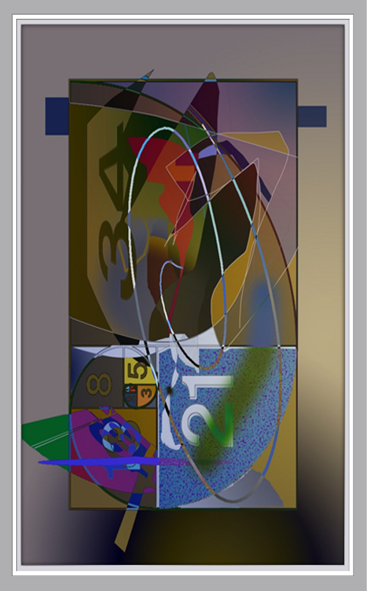
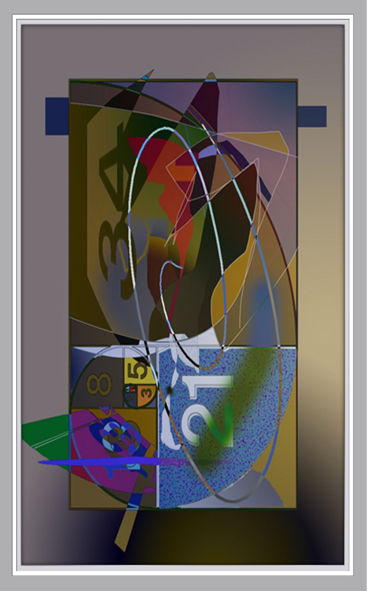
“Geometric Allegory” digital painting 2023 by Ricardo Morin (American visual artist born in Venezuela–1954)
Ricardo F. Morín
January 13, 2026
Oakland Park, Fl.
Author’s Note
This installment continues the diagnostic examination of Venezuela’s political condition and focuses on the ethical and institutional consequences that emerge when authority, governance, and accountability are no longer aligned. Rather than advancing prescriptions, it examines how the degradation of human rights, the normalization of violence, and the diffusion of responsibility function as systemic conditions within a prolonged authoritarian context. The inquiry remains situated within a broader historical pattern, attentive to structures rather than events and to consequences rather than intentions. Documented cases are treated as occasions on which the framework’s claims become testable, and the analysis refrains from extending beyond what the evidence supports.
Chapter XVII
The Fourth Issue
On Human Rights
1
Venezuela’s modern political history has been marked by recurring skepticism toward collective institutions and a persistent substitution of personal authority for shared civic frameworks. Over time, citizens have lost the expectation that freedom can be exercised in daily life rather than merely invoked in public language. In such contexts, human rights do not disappear rhetorically; they lose their operational force. Their absence becomes visible not in formal declarations, but in the diminished capacity of individuals to act without fear, to participate without coercion, and to sustain dignity without dependence.
2
A society may retain wealth, institutions, and formal declarations while individuals lose the practical ability to move, speak, work, dissent, or plan without fear. In that condition, human rights no longer operate as aspirations stated in public language; they become thresholds that determine whether social and political life remain possible. Where those thresholds are upheld, individuals retain agency within public life. Where they are suspended, social possibility contracts regardless of available resources.
3
Isolation, whether political, ideological, or institutional, accelerates this contraction. When governments or social groups withdraw from accountability, corruption ceases to be an anomaly and becomes a governing mechanism. In Venezuela, where the State has progressively withdrawn from democratic norms and international oversight, citizens increasingly act as though institutional procedures will not protect them, and arbitrary decisions by officials have ceased to provoke either correction or surprise. From a diagnostic standpoint, the State’s primary responsibility is not moral leadership but the preservation of civic conditions under which individuals can exercise consequential choices. Approaches such as the framework of capabilities articulate this responsibility not as charity, but as an institutional obligation to preserve the material and political preconditions of dignity. [1]
4
Individuals cannot exercise freedom meaningfully where daily life is shaped simultaneously by fear and material precarity: conditions whose prolonged operation in Venezuela has displaced approximately 6.9 million citizens beyond the country’s borders. [3] Protection from arbitrary violence and access to the basic conditions necessary for survival therefore operate together rather than separately within civic life. Political conflict itself does not indicate social failure; plural societies inevitably generate disagreement, competition, and tension. The decisive distinction emerges in how institutions regulate those conflicts: courts no longer rule against the executive; citizens who comply with the law are not thereby protected from detention; State’s agents act knowing that internal review will not follow, The rights enumerated in the 1999 Constitution become unavailable in practice to those who would invoke them. The constitutional text remains present within official language even as its protections become progressively absent from lived civic reality. [2]
Endnotes — Chapter XVII
§ 3
[1] Martha C. Nussbaum, Women and Human Development: The Capabilities Approach (Cambridge: Cambridge University Press, 2000), 4–14, 71–72, 114–123.
§ 4
[2] John Rawls, A Theory of Justice, Cambridge: Harvard University Press (1971), 111, 337–338, 511, 515, 545.
[3] Inter-Agency Coordination Platform for Refugees and Migrants from Venezuela (R4V), Refugees and Migrants from Venezuela, https://www.r4v.info/en/refugeeandmigrants. As of mid-2025, R4V reports approximately 6.9 million Venezuelans displaced across the seventeen host countries of the regional response. Accessed January 2026.
Chapter XVIII
The Fifth Issue
On the Nature of Violence
1
Violence shapes a society not only through the harm inflicted on those it reaches, but through what follows or fails to follow: whether perpetrators are identified; whether evidence is preserved and prosecutions proceed; and whether the institutions charged with these tasks are themselves subject to review. Its regulation depends on two interdependent structures: the social contract and governance. The social contract establishes the conditions under which individuals relinquish certain freedoms in exchange for protection and justice. Governance operationalizes that contract by translating authority into predictable, constrained action. When governance fails, whether through incapacity, corruption, or deliberate distortion, violence ceases to be exceptional and becomes systemic.
2
The distinction between legitimate force and illegitimate violence is not merely rhetorical. The legal-procedural tradition grounds the distinction in law, proportionality, and institutional accountability: force exercised within these constraints differs in kind from force exercised outside them. The critical tradition, while attending more closely to the historical and political conditions under which legitimacy is constituted, similarly distinguishes between power that preserves the capacity for collective action and violence that destroys it. Both traditions, despite their differences, converge on a common diagnostic point: force severed from ethical constraint and institutional oversight ceases to operate as legitimate authority. Historical revolutions demonstrate that when governance collapses entirely, violence may emerge as a substitute rather than a solution. Such substitutions rarely restore order; instead, they entrench instability, break authority into non-accountable centers, and prolong social recovery across generations.
3
In contemporary Venezuela, violence has become an instrument of political preservation rather than public protection. The pattern is documented rather than inferred. The UN Independent International Fact-Finding Mission on Venezuela has reported, across successive findings since 2020, that state security forces and intelligence services participated in extrajudicial executions, arbitrary detentions, torture, and sexual violence against perceived opponents, and that these acts followed identifiable chains of command rather than individual deviation. During the 2017 protests, more than one hundred deaths were recorded over four months, alongside the deployment of military tribunals against civilians. The 2024 post-electoral repression produced over two thousand detentions within weeks, including minors, under a framework the government termed “Operación Tun Tun.” Earlier emblematic cases, Leopoldo López imprisoned in 2014, Antonio Ledezma detained in 2015, Manuel Rosales arrested the same year, prefigured a pattern in which judicial institutions, including the Tribunal Supremo de Justicia, functioned not as safeguards but as mechanisms legitimizing repression through legal form. [1][2][3]
4
Official narratives frame such actions as defenses of national security. Yet when intelligence services monitor opposition figures rather than foreign threats, when the National Guard is deployed against neighborhood protests rather than against external incursion, and when detention without charge becomes a tool applied to citizens rather than to combatants, the citizen approaching a uniformed officer or a courthouse no longer expects protection from harm but calculates the likelihood of becoming its next subject. Citizens no longer experience institutions as safeguards operating under law, but as structures through which uncertainty and exposure are administered. In that condition, legitimacy weakens even when authority remains intact: governance increasingly depends on public performance rather than civic trust; legal procedure detaches itself from protective function; and violence is gradually normalized as an instrument of rule.
5
The normalization of violence proceeds incrementally and is rarely perceived in real time. What is initially defended as exceptional, curfews, military tribunals for civilians, indefinite pretrial detention, restrictions on assembly, accumulates into the ordinary architecture of governance.Each measure recalibrates expectation: citizens adapt their conduct; institutions adapt their procedures; and the threshold separating legitimate force from arbitrary coercion migrates without formal declaration. Diagnostic vigilance consists in tracking that migration rather than awaiting its terminus.
6
Where these institutional restraints fail or disappear, abuses are no longer interrupted consistently through judicial review, public documentation, legislative inquiry, or prosecutorial independence. Violations accumulate without reliable correction; officials increasingly operate without expectation of consequence; and citizens gradually adapt themselves to diminished protections. Under such conditions, institutional repetition itself begins to normalize abuse: the same operations recur against successive cohorts of citizens; the same categories of case remain unopened; and the same outcomes continue to receive judicial confirmation. What would once have required justification as an emergency measure no longer requires justification at all.
Endnotes — Chapter XVIII
§ 3
[1] William Newman, “Venezuelan Opposition Leader Leopoldo López Sentenced to Prison Over Protest,” New York Times, September 10, 2015.
[2] “Venezuelan Opposition Politician Manuel Rosales Arrested,” BBC News, October 15, 2015.
[3] “Venezuela Police Raid Arrests Caracas Mayor Antonio Ledezma,” BBC News, February 20, 2015.
Chapter XIX
The Sixth Issue
On the Persistence of Injustice
1
In political systems where decisions are made without transparent review, where institutional failures carry few consequences for those responsible, and where citizens gradually lose confidence that participation can alter outcomes, injustice acquires durability beyond the intentions of individual leaders. A decade of institutional substitution and electoral exclusion in Venezuela, documented progressively across Series IX, has demonstrated the process. Where decisions are made by a narrowing circle of officials who face no review, the costs of those decisions (economic, legal, and personal) are absorbed by citizens who had no part in making them. Under such conditions, citizens increasingly occupy the position of spectators rather than participants, and governance loses the corrective pressures through which democratic systems ordinarily adjust, restrain, and renew themselves. [1]
2
Apathy is not merely a personal disposition; it is a political condition produced by sustained exclusion from meaningful agency. Where participation carries risk without influence, disengagement becomes rational. The Venezuelan presidential election of July 2024, following the precedent established in 2018 and documented in earlier chapters of Series IX, illustrates the dynamic in its concentrated form. Opposition witnesses collected poll-station tallies documenting a result the official authority refused to recognize; the declared outcome reversed the documented one, and the citizens, jurists, and electoral observers who pressed the discrepancy were detained, exiled, or stripped of standing. Once the witnesses who held the tallies had been detained, the jurists who challenged the proclamation had been exiled, and the observers who documented the discrepancy had been stripped of standing, the official result faced no remaining domestic institution capable of revising it, and what began as a contested outcome settled into the country’s operative reality.
3
In political systems where elections can be lost by incumbents, where legislatures can refuse executive requests, and where courts can rule against the government that appointed them, justice and freedom are sustained not as fixed possessions but through the ordinary repetition of these adjustments; in systems where each of these outcomes has been foreclosed, the appearance of stability is purchased at the cost of the corrective mechanism itself. When governance forecloses negotiation among competing interests, it must present its decisions as already settled; the appearance of certainty then replaces the slower work of adjustment, and the system loses the capacity to correct itself when conditions change. Effective governance depends on the capacity to absorb conflict without suppressing it. [2]
4
Individual agency remains relevant not as moral heroism but as structural participation. When citizens can still publish what officials would prefer unpublished, still gather without prior authorization, and still petition courts that retain some margin of independence, an official contemplating an arbitrary act must weigh the likelihood that the act will be recorded, contested, and at some later date reviewed; some, facing that weight, do not proceed. [3]
The restoration of justice depends on reconstituting conditions under which individuals can act without fear and without illusion. Citizens must be able to criticize public officials without anticipating detention, to document irregularities without expecting retaliation, and to petition courts without assuming in advance that outcomes have already been decided elsewhere. Elections cannot function as ceremonial affirmations whose outcomes are settled before votes are cast. Journalists cannot operate under the expectation that investigation itself may trigger surveillance, prosecution, or exile. Under such conditions, participation ceases to resemble managed exposure and begins again to recover the practical character of civic agency.
The restoration of justice also depends on reconnecting personal responsibility to collective structures rather than isolating it within conscience alone. A judge who privately recognizes procedural abuse but understands that appellate review no longer functions may remain silent despite personal objection. When editors, courts, universities, and professional associations cease defending independent inquiry, journalists who continue documenting irregularities eventually operate without institutional protection. Citizens who recognize electoral manipulation but encounter no reliable mechanism through which evidence can alter outcomes gradually retreat from participation into private disillusionment. Under such conditions, ethical recognition survives individually while corrective capacity disappears collectively. Responsibility becomes internalized as private awareness rather than sustained through institutions capable of transforming recognition into civic consequence.
[2] Amartya Sen, Development as Freedom (New York: Knopf, 1999), 123–137, 146–159, 282–287.
§ 4
[3] Martha C. Nussbaum, Women and Human Development: The Capabilities Approach, (Cambridge: Cambridge University Press, 2000), 66–72, 104–110, 124–130.
This installment concludes Chapter XII, “The Fourth Sign.” It presents §§ 26–34 under the heading The Asymmetry of Sanctions, examining the unequal application and effects of external economic and political measures in the broader context established by the preceding sections on Autocracy and Venezuela.
Ricardo F. Morín, December 29, 2026, Oakland Park, Fl
*
Chapter XII: Part 3
*
The Asymmetry of Sanctions
*
26
Sanctions are often employed as a diplomatic tool to weaken autocratic regimes. Yet, their use reveals a deeper asymmetry in the struggle between democratic accountability and authoritarian resilience. According to data from the V-Dem Institute, nearly 72% of the world’s population now lives under autocratic rule—the highest proportion since 1978. This reality reframes sanctions not as exceptional measures against isolated regimes, but as policies deployed within a global order where autocracy has become the prevailing form of governance.
27
On one hand, sanctions aim to isolate autocracies economically and politically. On the other hand, regimes like Nicolás Maduro’s have demonstrated remarkable adaptability in the face of such measures. Such regimes’ endurance exposes the limitations of tools designed for a world in which democracy was presumed dominant.
27a
Subsequent developments, including the removal of Nicolás Maduro from power, alter the immediate object toward which sanctions were directed but do not resolve the structural conditions examined here. The networks of authority, the institutional arrangements, and the external alliances that sustained his rule have not been dissolved by his departure. What is observed in this case is not the endurance of a single figure, but the persistence of a governing structure capable of adaptation beyond him.
28
Maduro has formed adversarial alliances to circumvent external pressure and maintain his rule. By invoking themes of sovereignty and resistance against Western influence, he has turned isolation into a narrative of defiance.
29
This narrative serves as a foundation for partnerships with other autocratic States, including Russia, China, Cuba, Iran, and Turkey. [43][44][45][46][47] Driven by pragmatic interests rather than strict ideological alignment, these alliances enable Venezuela to mitigate the intended effects of sanctions.
30
The result is a paradox: while sanctions aim to weaken autocracies, they unintentionally contribute to their resilience. Reliance on alternative alliances allows regimes like Maduro’s to access resources, military aid, and political support, which in turn shields them from severe economic disruption and international scrutiny. In a world where the majority of the world’s population now lives under autocratic rule, the logic of isolation loses its potency; it becomes a misreading of the global balance itself.
31
In this way, sanctions contribute to the persistence of autocracy. Regimes like Maduro’s exploit their isolation to present themselves as defenders of national sovereignty and resistance to global hegemony. [48] This dynamic amplifies the concept of a multipolar world order. As global power shifts away from unipolar dominance, regimes like Maduro’s find new avenues to thrive.
32
By framing their cooperation as resistance to Western dominance, authoritarian regimes justify their alliances under the banner of multipolarity. This strategic repositioning does more than circumvent sanctions—it actively reshapes the global order. As these regimes expand their influence, they undermine democratic norms by replacing them with a system in which power is consolidated without external accountability.
33
This shift is not confined to regimes like Maduro’s: it reflects a broader trend in which authoritarianism gains ground by exploiting ideological fractures within democratic societies. Across Europe and Asia, nationalist and right-wing movements increasingly echo Kremlin-aligned narratives to amplify skepticism toward Western institutions. The rise of such forces in countries like Hungary, Italy, and India is not merely a domestic shift—it signals an alignment with a global framework where sovereignty is invoked not to empower citizens, but to insulate leaders from accountability.
34
Contrary to the argument that authoritarianism is solely a reaction to U.S. hegemony, its expansion demonstrates an independent momentum, one that persists regardless of American intervention. China and Russia do not seek to challenge the U.S. in pursuit of a more equitable world order; they aim to consolidate their power free from external constraints. In this landscape, the traditional ideological divide between left and right becomes secondary to a more fundamental struggle—the contest between concentrated power and democratic resilience. Whether under the guise of populism or nationalism, the objective remains the same: to undermine institutional checks and to consolidate power without sufficient accountability. [49]
~
Endnotes—Chapter XII: Part 3
§ 29
[43] In 2019, Russia’s State-owned Rosneft handled 70% of Venezuela’s crude oil exports and circumvented U.S. sanctions. Russia also supplied military equipment and training to bolster Maduro’s control over the armed forces.
[44] China’s involvement includes joint oil ventures in the Orinoco Belt, infrastructure projects like the Tinaco-Anaco railway project, and housing initiatives (Great Housing Mission). Despite operational challenges, these investments highlight China’s strategic interest in Venezuela’s energy sector.
[45]According to the Brookings Institution, Cuba and Venezuela have maintained close political and strategic ties, particularly during the Chávez and Maduro administrations. This relationship has extended beyond diplomatic and economic cooperation to include security and intelligence collaboration. Cuban institutions have provided training, advisory support, and technical expertise to Venezuelan military and security forces: 1). Dirección de Inteligencia(DI, a.k.a G2) [1961]: The Intelligence Directorate, also known as G2, has been involved in providing intelligence training and support to Venezuelan security forces, particularly in surveillance and national security operations. 2). Comité de Defensa de la Revolución(CDR) [1960]: The Committee for the Defense of the Revolution, created in Cuba, focused on grassroots mobilization and surveillance. Its activities extended to Venezuela, where it contributed to internal security and the promotion of political ideology. 3). Brigada Especial Nacional(BEN) del Ministerio del Interior(a.k.a.Avispas Negras or“Boinas Negras”) [1986]: The National Special Brigade, known as Black Wasps or Black Berets, has been involved in specialized military and security training; it has provided high-level tactical training to Venezuelan military and security personnel.
[46]Iran has aided Venezuela through energy and military cooperation, providing refined fuel and technical support for Venezuela’s oil industry. Barter agreements and drone technology exchanges underscore their deepening alliance.
[47]Turkey facilitated Venezuela’s gold trade, enabling Maduro to bypass sanctions. This trade, involving $900 million in 2018, has drawn criticism for its opacity and links to illegal mining in the Arco Minero region.
§ 31
[48]Aníbal Pérez-Liñán and Scott Mainwaring, Democracies and Dictatorships in Latin America: Emergence, Survival, and Fall (Cambridge: Cambridge University Press, 2014), 183-87, 199-202.
§ 34
[49]Steven Levitsky and Daniel Ziblatt, How Democracies Die (New York: Crown, 2018), 212-15.
Ricardo F. Morín Erasures Watercolor rub-offs on Japanese tissue paper 14″x20″ 2005
Ricardo F. Morín
January 10, 2026
Oakland Park, Fl
*
1.
Public discussion often treats corruption as a series of discrete scandals attached to identifiable individuals. That framing is misleading. Investigative reporting and judicial records increasingly show that, particularly in the Venezuelan case, responsibility is displaced through repeatable actions that allow illicit benefit while obscuring accountability.
2.
The PBS Frontline documentary examining the rise and role of Alex Saab provides a clear point of entry. Saab did not function as a policymaker or symbolic representative. According to United States indictments and sustained investigative reporting, he acted as a testaferro—a fraudulent front man—through whom contracts, assets, and payments were routed to conceal the true beneficiaries.
3.
The diagnostic importance of Saab lies not in his personal profile but in the action he performed. A testaferro is not a neutral intermediary. He lends his name so that authority may receive benefit while denying responsibility for the consequences of its decisions. The contractual signatory does not indicate decision-making authority.
4.
This action appears repeatedly in Venezuela across multiple domains: oil sales conducted through intermediaries, food import programs delivering overpriced or tainted goods, housing projects funded and left incomplete, and financial transfers designed to evade sanctions and scrutiny. Each domain differs in form, but the same action recurs: authorization is granted, benefit accrues, and responsibility is displaced.
5.
The same displacement of responsibility appears in the use of irregular armed groups that exercise coercion without formal attribution. Their actions do not require demonstrable command. The absence of a traceable chain of authority is not incidental but integral: force is applied while authorship remains deniable.
6.
At this stage, individual corruption gives way to criminal conduct sustained over time. United States prosecutors have alleged that these financial and logistical actions coincide with narcotics trafficking and money laundering attributed to senior civilian and military officials, including Nicolás Maduro. These allegations rest on claims of coordination, protection, and benefit.
7.
What U.S. indictments and investigative journalism describe as the Cartel de los Soles does not depend on the existence of a unified chain of command. The term refers to a condition in which drug trafficking depends on permission, tolerance, or protection by state authorities rather than independent criminal initiative.
8.
Under this account, Saab is neither anomaly nor mastermind. He is a replaceable participant whose removal does not interrupt the conduct described. The persistence of the activity depends on substitution, not on loyalty or hierarchy.
9.
This clarification resolves a recurrent confusion in public debate. Describing these actions does not constitute moral judgment or ideological hostility. It identifies delegated fraud through which authority preserves outward legitimacy while transferring legal exposure to intermediaries.
10.
When these actions extend across ministries, borders, and markets and are sustained by coercive power, they exceed ordinary corruption. They constitute organized criminal conduct exercised with the capacity of the State, regardless of whether a classic cartel form is present.
11.
The significance of the Frontline investigation is not that it adds another episode to a familiar narrative. It shows how the use of front men allows this conduct to persist over time. What follows from this recognition is not vindication but clarity about why accountability cannot be achieved by removing individuals alone.
Venezuela’s transition and Ukraine’s survival now constitute a single test: whether power can be constrained without illusion, and whether the United States can act coherently even when its president cannot perceive coherence himself.
This text does not argue for a policy or predict an outcome. It marks the threshold at which coherence ceases to be discretionary and becomes a condition of survival.
The United States cannot act in one theater in a way that invalidates the principles it claims to defend in another. If sovereignty, territorial integrity, institutional continuity, and legal accountability are treated as binding in Ukraine, they cannot become flexible, provisional, or strategically inconvenient in Venezuela. And the reverse must also hold: if those principles are treated as binding in Venezuela, they cannot be relaxed, reinterpreted, or selectively applied in Ukraine. Once that line is crossed in either direction, coherence collapses—not only rhetorically, but structurally. Power ceases to stabilize outcomes and instead begins to manage decay.
This is not a moral claim; it is a functional one. Modern power does not fail because it lacks force, but because it loses internal consistency. When the same instruments—sanctions, indictments, military pressure, diplomatic recognition—are applied according to circumstance rather than principle, they no longer constrain adversaries. They instruct them. Russia and China do not need to prevail militarily if they can demonstrate that legality itself is selective, contingent, and subject to reinterpretation by whoever holds advantage in the moment.
For this reason, no transition can rest on personalization. Trust between leaders is not a substitute for verification, nor can rapport replace institutions. This vulnerability is well known in personality-driven diplomacy and has been particularly visible under Donald Trump in his repeated misreading of Vladimir Putin. Yet the deeper danger is not psychological; it is procedural. Policy that depends on who speaks to whom cannot survive stress. Only policy that remains legible when personalities are removed can endure.
Nor can outcomes be declared before institutions exist to carry them. Territorial control without civilian authority is not stability. Elections conducted without enforceable security guarantees are not legitimacy. Resource access without escrow, audit, and legal review is not recovery, but extraction under a different name. When the United States accepts results without structures, it postpones collapse rather than preventing it.
Equally corrosive is legal improvisation. Law applied after action—indictments justified retroactively, sanctions reshaped to accommodate faits accomplis—does not constrain power; it performs it. Once legality becomes explanatory rather than directive, it loses its disciplining force. Adversaries learn that rules are narrative instruments, not boundaries.
Finally, there can be no tolerance for proxy preservation. A transition that leaves intact militias, shadow financiers, or coercive intermediaries is not a transition at all. It is a redistribution of risk that guarantees future rupture. External backers may be delayed, constrained, or audited, but they cannot be placated through ambiguity without undermining the entire process.
The test is stark and unforgiving. If an action taken in either Venezuela or Ukraine could not be defended, word for word, if taken in the other—or if a compromise tolerated in one would be condemned if replicated in the other—then the axiom has already been broken.
What must therefore remain true, in both places at once, is this: power must submit to the same standard it invokes—without exception, without personalization, and without retreat into expediency disguised as realism.
*
Authority Where Legitimacy Has Not Yet Converged
*
This section does not assess democratic legitimacy or political merit. It observes how authority is presently constituted and enforced when coherence is under stress.
A question posed during a press conference—regarding the opposition coalition led by María Corina Machado and the electoral victory of Edmundo González Urrutia—elicited a dismissive response from President Donald Trump. Asked why a transitional leadership would not center on that coalition, he replied that there was “no respect for her,” implying an absence of authority within the country.
Taken at face value, the remark appears personal. Read diagnostically, it exposes a more consequential distinction: legitimacy does not presently translate into authority inside Venezuela. The same distinction—between legitimacy and enforceable authority—has shaped Ukraine’s resistance to Russian invasion, where legitimacy was established internally but had to be defended materially against external aggression.
Electoral victory, international recognition, and moral credibility confer legitimacy. They do not, by themselves, confer enforceable power. Authority, as it exists on the ground, flows from the capacity to compel compliance—whether through control of coercive institutions, resource chokepoints, or the operational machinery of the state. In Ukraine, that authority is exercised defensively to preserve an already legitimate sovereign order against external aggression. In Venezuela, it persists independently of electoral outcome, sustained by institutions and mechanisms detached from legitimacy.
In this sense, the question raised by Trump’s remark is not whether Machado’s coalition is legitimate, but what presently lends authority within the country—and who is capable of enforcing decisions, preventing fragmentation, or compelling compliance. The answer is neither rhetorical nor normative. It is about how authority is currently constituted and exercised under present conditions.
Recent commentary surrounding U.S. engagement with Venezuelan actors has made this distinction operational rather than abstract. The marginalization of María Corina Machado has not turned on questions of democratic legitimacy, electoral mandate, or international recognition. It has turned on her unwillingness to participate in transactional arrangements with the existing technocratic and financial strata that currently exercise control within the State. In contrast, figures such as the Vice President Delcy Rodríguez are treated as viable interlocutors precisely because they command enforceable authority through continuity with those mechanisms—coercive, financial, and administrative—that persist independent of legitimacy. Criminality, in this logic, is not disqualifying. It is evidence of control. What is being selected for is not moral credibility, but negotiability under pressure.
This distinction matters because transitions that confuse legitimacy with authority tend to collapse into disorder or entrenchment. Authority negotiated without legitimacy produces repression. Legitimacy asserted without authority produces paralysis. Durable transition requires that the two converge—but they do not begin from the same place, nor do they converge through the same means.
In Ukraine, legitimacy and authority are aligned but strained by external aggression; in Venezuela, authority persists in the absence of legitimacy. Treating these conditions as morally or procedurally equivalent obscures the obligations they impose. When support is conditioned more heavily where legitimacy is intact than where it is absent, coherence gives way to ethical imbalance.
Trump’s comment does not clarify U.S. strategy. It does, however, expose the fault line along which policy now risks fracturing: whether authority is assessed and transformed in relation to legitimacy, or accommodated independently of it in the name of order. The choice is not neutral. It determines whether power reinforces or undermines the principles it invokes.
The distinction between legitimacy and authority does not negate the requirement of coherence. It sharpens it. When coherence is abandoned selectively, collapse is no longer an accident of transition but a consequence of duplicity.
Ricardo Morín Portrait of a President 14 x 20 inches Watercolor, sumi ink, crayon on paper 2003
*
Author’s Note
This essay continues an inquiry begun in “Portrait of a President: A Diagnostic Essay on Power, Posture, and Historical Pattern,” where patterns of executive behavior were examined through observable action rather than declared intent. The present text shifts that inquiry from description to procedure and takes a recent executive order on artificial intelligence as a case through which decisions are advanced, reviewed, and sustained.
It follows The Arithmetic of Progress, which considers how contemporary narratives of advancement often detach calculation from consequence. Read in sequence, that essay establishes the broader conditions under which claims of inevitability and efficiency gain force; the present text examines how such claims operate within the executive process itself.
The essay also builds upon Governing by Exception: The American Executive, published earlier this year, which examined how exceptional measures become normalized within the modern presidency. Where that essay focused on the expansion of executive discretion, the present text examines the procedural consequences that follow when exception becomes routine.
This essay further stands in relation to Convergence by Design or Consequence? On Trump, Putin, and the Veiled Axis from Kyiv to Caracas, which addressed alignment among contemporary autocracies at the geopolitical level. Here, the focus moves inward, toward domestic executive procedure, to consider how similar methods of authority can emerge without explicit coordination or ideological declaration.
Each essay approaches the same problem from a different register—exception, calculation, procedure, and alignment—without requiring continuity of title or theme.
This essay occupies the center of that sequence of essays. Throughout the analysis, action designates executive action as it bears upon the other branches of the American government. It begins from an observation about executive ordering under conditions of urgency and traces how constitutional constraint may be displaced in practice without being formally abolished.
Ricardo F. Morín
November 2025
Oakland Park, Florida
*
Procedural Dislocation and the Rhetoric of Dominance
I
The recent executive order framing artificial intelligence as a matter of “global dominance” offers a useful example on procedural dislocation and the rhetoric of dominance. Agreement with its stated aims is not required for the executive order to warrant examination. Its relevance does not lie in what it promises to achieve, but in the manner in which it propels decisions forward before the terms under which they should be evaluated have been configured.
Artificial intelligence enters this discussion not as a technical subject, but as a context in which executive action is presented as urgent. The order proceeds on the assumption that speed and centralized direction are necessary for success. As a result, decisions advance before existing forms of review, coordination, and regulatory formation have had an opportunity to shape their terms.
This ordering is significant. When presidential authority is asserted first, deliberation is relegated to constrained conditions. Institutional review—understood here as the pre-action criteria, thresholds, and sequencing through which decisions are ordinarily authorized—ceases to determine whether executive action should proceed and instead adjusts to action already underway. Once this sequence is fixed, subsequent forms of participation—whether arising from agencies, advisory bodies, or constitutional institutioins—may temper implementation without necessarily altering the direction of presidential decrees.
This essay treats the order as an instance of that ordering. It examines what follows when urgency governs the timing of decisions and broad assertions of purpose begin to do work normally performed by review, coordination, and rulemaking.
II
Executive decisions determine direction within the executive domain; executive action commits that determination to institutional consequence.
When decisions are taken prior to sustained review, the order of evaluation is reversed. Procedural review (as a condition of pre-authorization) no longer governs whether executive action is authorized, but instead becomes a step anticipated after executive action has already been set in motion. This inversion of review and authorization alters how responsibility is distributed within the executive process.
In this sequence, articulated criteria are deferred rather than established. Judicial review exists, but typically occurs after implementation, once policies have already taken effect. Congressional checks exist, but depend on coordination, timing, and political alignment that narratives of urgency actively compress, displace, and bypass. Constitutional remedies exist, but operate on temporal horizons incompatible with accelerated executive action. Standards by which a decision might be assessed—scope, limits, benchmarks, or conditions for revision—remain undefined at the moment of execution. The absence of articulated criteria is presented as provisional, even as executive action proceeds as though those criteria were already settled.
This analysis does not proceed from the assumption that constitutional checks are absent.Without articulated criteria, no stable reference exists against which a decision can be evaluated, adjusted, or halted. Review becomes reactive, tasked with accommodating decisions rather than testing their premises.
This sequence also alters the role of institutional participation. Agencies and advisory bodies are positioned to respond within post-implementation review rather than to contribute to the formation of the decision itself. Their involvement shifts from deliberation to implementation, narrowing the space for substantive input.
What emerges is not the elimination of review. Constraints remain formally intact, but no longer determine whether executive action proceeds; they intervene only after its action has already begun.
The result is not the elimination of constraint, but its displacement: mechanisms—designed to govern whether executive action should proceed—are repositioned to manage action already set in motion. Constitutional checks remain operative only after executive action has been set in motion, rather than governing whether that action may proceed.
III
Federal preemption is asserted before a substitute structure exists. In this case, state-level regulatory activity is set aside even though no comprehensive federal framework has yet been established to take its place. Rule by decree is asserted in advance of the mechanisms that would ordinarily support, coordinate, or limit executive action.
This is not a question of constitutional supremacy. The constitutional framework governing federal preemption state law is well established even as its application remains contested. The issue is one of sequence. Preemption typically displaces existing regulation by replacing it with a defined alternative through which responsibility, oversight, and accountability are reassigned. When that replacement is absent, displacement produces a gap rather than a transition.
This sequence reorders the role of the states. Rather than serving as sites of coordination, experimentation, or interim governance, they are treated primarily as sources of friction. Their regulatory efforts are characterized as interference even though no structure has been offered to absorb the regulatory functions being displaced.
The result of this ordeering is a form of authority exercised in advance of the institutional support required to sustain it. Preemption operates as assertion rather than as arrangement. The question that follows is not whether authority exists, but how the executive authority is expected to function once exercised without the structures that normally sustain it.
IV
The executive order invokes a global race of dominance as a justification for urgency. This reference is introduced without specification of its participants, scope, or criteria and is presented as a condition rather than as a claim requiring articulation or examination.
Because the race is not defined, it cannot be procedurally evaluated. No benchmarks are offered by which advancement or delay might be measured, and no temporal horizon is established against which executive actions might be paced. Yet the invocation is treated as decisive.
Once invoked, this global framing reshapes the timing and sequence of domestic review and coordination. Internal processes of review, coordination, and federal balance are measured against an externally asserted tempo. Procedural safeguards begin to appear as liabilities, not because they have failed, but because they operate at a pace deemed incompatible with the asserted race.
In this way, the invocation of a global race does not specify what is at stake; instead, the invocation of global competition relocates the timing of decision-making to an externally asserted pace. The absence of specification enables acceleration.
The significance of this procedural reordering lies not in whether global competition exists, but in how its invocation alters internal sequence within the American executive. An external reference is imported as a procedural rationale and allows executive decisions to advance ahead of sustained review and articulated structure.
V
Alongside external competitive framing, internal pressure also alters when and how executive decisions move forward. This pressure arises from private actors with concentrated financial exposure to the development and deployment of artificial intelligence technologies. Their investments depend on acceleration, scale, and limited regulatory constraint.
These actors do not require coordination to exert influence. Their interests converge structurally. Delays associated with sustained review, layered oversight, or decentralized regulation introduce uncertainty into investment horizons. Acceleration, by contrast, stabilizes expectations and preserves potential revenue.
Such pressure operates prior to public deliberation. It is expressed through advisory roles, policy consultations, and formal lobbying mechanisms that exist outside the sequence of open review. The influence is not illicit; it is institutionalized. What distinguishes this influence is its timing and asymmetry.
Because these interests are not fully disclosed within the formal record of decision-making and review, their effects appear indirect. Yet they shape the conditions under which urgency is framed as necessity and executive preemption as inevitability. The absence of articulated criteria does not impede this process; it facilitates it by keeping outcomes flexible while direction remains fixed.
External competition supplies a rationale for acceleration, while the pressure of internal investment sustains it. In this way, procedural dislocation is reinforced from within the executive sequence itself. Together, they create an executive environment in which acceleration is continuously justified even as institutional review and the structures of substitution remain deferred.
VI
What follows marks a shift not in policy substance, but in how executive action is oriented once procedural guidance no longer governs its timing.
When decisions continue to advance without articulated criteria or substitution structures, language begins to assume functions ordinarily carried by procedural guidance. By procedural guidance, this analysis refers to the articulated criteria, review thresholds, institutional sequencing, and substitution structures through which decisions are ordinarily evaluated, revised, or withheld before executive action proceeds. Instead, executive orders are used to frame executive action and to supply orientation where procedural guidance is missing.
In this context, words such as “dominance,” “necessity,” or “leadership” do not operate primarily as descriptions. Such terms establish direction without specification. The function of such terms is to move decisions forward while leaving objectives, limits, and measures unresolved.
This enlargement of language alters how executive action is understood. Rather than clarifying what is being done and under what conditions, language organizes attention around procedural momentum. Movement itself becomes the priority, even as the grounds for evaluation remain unsettled.
The effect is cumulative over time. As reliance on rhetorical framing increases, fewer procedural markers remain available to slow, revise, or redirect executive action. Language begins to carry responsibilities normally handled by review and specification.
At this stage, language has not displaced explanation entirely, but it has begun to exceed it. This language continues to refer to policy, yet it now performs additional work by sustaining executive action in the absence of settled procedural support.
VII
Requests for specification no longer lead to articulated criteria or review mechanisms, but to restatement of the original framing. Explanation gives way to emphasis, and emphasis to repetition, without resolving the underlying procedural gaps.
As language begins to carry responsibilities normally handled by review and specification, its relationship to explanation changes. Statements initially intended to orient understanding become reference points that are repeated rather than examined.
Over time, this pattern reduces the capacity to pause, reconsider, or revise decisions already underway. When language is relied upon to sustain action, revisiting its premises becomes more difficult. Adjustment appears as retreat, and reconsideration as delay, even though no settled standards have been articulated.
The effect of this rhetorical substitution is not overt resistance to review, but a narrowing of the scope of review. Review persists formally, yet review is increasingly tasked with accommodating decisions already advanced. The space for questioning sequence, authority, or criteria contracts without being explicitly closed.
At this point, language no longer merely advances executive action; it begins to shield it. Decisions remain explainable in broad terms, but they become less accessible to sustained examination. What has changed is not transparency, but the conditions under which clarification can still occur.
VIII
This section traces the consequences of earlier procedural substitutions by showing how evaluative reference points disappear even as executive action continues.
Outcomes are projected but not specified. Means are deployed but not measured against stable standards. A shared point of reference by which both means and outcomes might be assessed is absent. When decisions are taken prior to sustained review and sustained by rhetorical framing rather than articulated criteria, the available bases for judging decisions narrow.
In such conditions, projected outcomes can no longer function as checks on present executive action. Projected benefits remain abstract, deferred, or contingent on future clarification. Without defined benchmarks or review mechanisms, outcomes function more as justification than as objects of evaluation.
This places increased weight on the process. When ends remain indeterminate, procedural sequence becomes the only available measure of legitimacy. If that sequence is dislocated, no basis remains for distinguishing provisional executive action from settled direction.
Appeals to necessity gain prominence under these conditions. These appeals bridge the gap between uncertain means and unspecified ends by asserting inevitability. Yet inevitability does not supply measure; it advances executive action while deferring assessment.
What results is the suspension of evaluation, as judgment is deferred to outcomes that have not yet been defined. Executive means proceed without reference to ends that can be examined and leave evaluation suspended rather than resolved.
IX
The significance of what follows lies not in escalation or collapse, but in the capacity of this governing pattern to persist without triggering a formal breakdown.
Viewed through the preceding sequence, the executive order appears less as a response to a technological challenge than as an expression of how presidential authority now operates. In this sequence, constitutional constraint persists formally while losing its capacity to govern presidential timing. What defines this mode of operation is not declared ambition, but the exercise of executive authority in advance of settled structure, review, and measure.
Despite the suspension of procedural evaluation, executive action continues to advance and stabilize as a governing pattern. Executive action advances without stable criteria, and evaluation follows rather than guides it. Rhetorical framing sustains continuity once authorization, specification, and review no longer govern the initiation of action, and inevitability substitutes for articulation.
Under these conditions, governance retains motion but loses procedural reference. Decisions remain intelligible in broad terms, yet increasingly difficult to assess, revise, or halt.
Rather than resolving into crisis, the condition persists through executive assertion rather than procedural sequence. Executive authority continues to function, but it does so with fewer internal points of correction.
The significance of this condition lies not in its novelty, but in its durability. When procedural dislocation becomes a stable feature of executive action, it reshapes how legitimacy is understood and how accountability can be exercised. What is produced is not exception, but a normalized way of proceeding.
X
A constitutional order presumes cooperation without being able to compel it in advance. Law establishes procedures, thresholds, and divisions of authority, but it cannot secure the disposition of the actors who must inhabit those roles. The responsibility for cooperation is therefore placed precisely at the point where predictability can no longer be secured—human judgment, ambition, fear, calculation, fatigue, pride. This is not a failure of law as text; it is a condition of law as lived structure.
Seen this way, instability is not an aberration introduced by bad actors alone. It is an ever-present possibility generated by the fact that constitutional systems rely on restraint exercised voluntarily, sequentially, and often against immediate interest. Where cooperation falters, procedures remain formally intact yet lose operational force in practice. Law persists on paper while its coordinating capacity weakens over time.
This is why the problem traced throughout this essay is ultimately ethical rather than moralistic. It does not ask who is right or wrong, but what can reasonably be expected of human agents operating under pressure, asymmetry, and incomplete trust. Constitutional governance assumes a minimum ethic of reciprocity—an agreement to wait, to contest, to defer, to revise. When that ethic fails to be sustained, the system does not collapse at once; it persists in a condition where coordination no longer governs action. The authority of the Executive fills the gap left by cooperation, often in the name of continuity.
This explains why displacement proves durable, why restraint remains fragile, and why systems can continue to function even as their ethical foundations lose sustaining force. The irony sustained here is not pessimistic; it is lucid as an end to the inquiry.
Cooperative frameworks are always provisional. They exist in tension with mistrust, strategic defection, and shifting circumstance. They are never resolved, only renegotiated. The ethical fact is not that mistrust appears, but that governance must function despite it.
*
Pre-Procedural Conditions of Dislocation
*
Political responsibility begins before governance does. It precedes programs, slogans, and institutional choreography. Long before authority is exercised, it is entrusted, and in that act a judgment is already made—not about policy detail, but about temperament, restraint, and capacity for self-limitation.
The ethical center of leadership is not revealed through ambition or rhetorical promise, but through signs that are immediately legible: flexibility without opportunism, firmness without domination, caution without paralysis. These qualities are visible almost at once, often within moments of exposure. To miss them is not a failure of intelligence, but of attention.
This responsibility cannot be displaced onto institutions after the fact. Nor can it be excused by urgency, fatigue, or personal grievance. Once authority is conferred, law is required to manage what has already been authorized, even when correction becomes costly or delayed. No procedural safeguard can fully compensate for ethical indifference at the moment of selection.
Political systems do not deteriorate solely because of those who govern. They also reflect the standards—explicit or tacit—by which leaders are chosen. Collective well-being depends less on promised outcomes than on the character permitted to command. In this sense, leadership is not imposed upon a society. It is recognized, accepted, and sustained by it.