Posts Tagged ‘philosophy’

“The Ethics of Perception, Part I”

November 20, 2025

Ricardo Morín
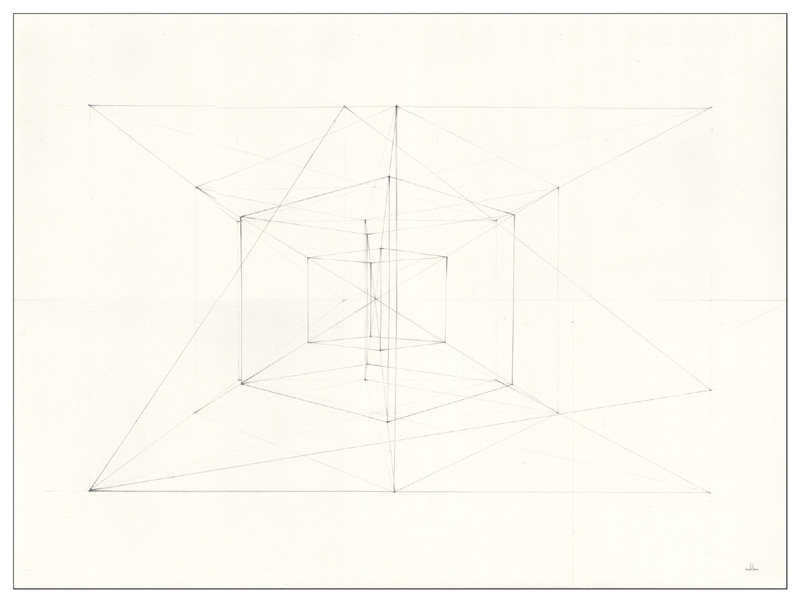
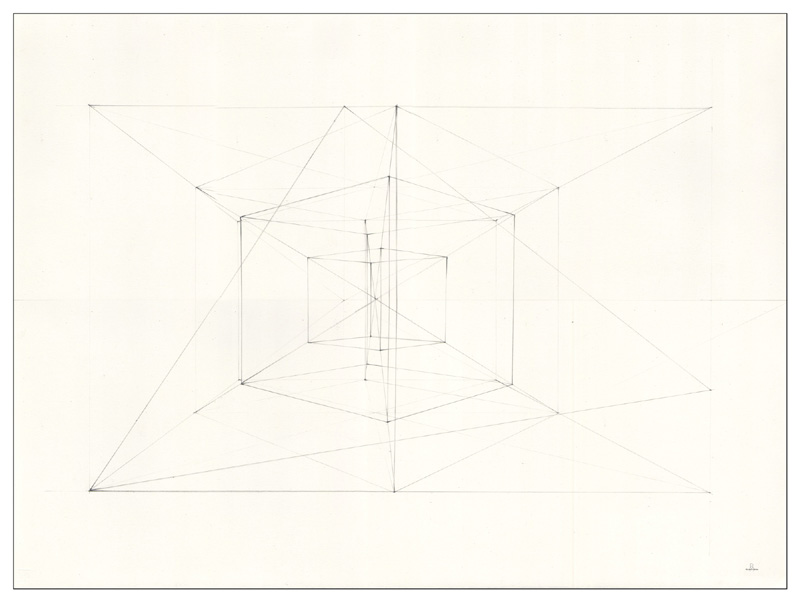
Triangulation 4: The Ethics of Perception
22″ x 30″
Graphite on paper
2006

Ricardo F. Morín

October 2025

Oakland Park, Fl

Introduction

Perception often seems immediate and uncomplicated.    We see, we hear, we react.    Yet between that first contact with the world and the choices we make in response, something slower and more fragile takes place:    the formation of meaning.    In that interval—between what appears and what we assert—not only understanding is at stake, but ethics as well.

This essay begins with a simple question:    what changes when understanding matters more than assertion?    In a culture that prioritizes reaction, utility, and certainty, pausing to perceive can seem inefficient.    Yet it is precisely this pause that allows experience to take shape without force and keeps the relationship between consciousness and the shared world in proportion.

The Ethics of Perception does not propose rules or moral systems.    It examines how sustained attention—able to receive before imposing—can restore coherence between inner life and external reality.    From this basic gesture, ethics ceases to operate as an external norm and becomes a way of being in relation.

Perception

Perception may be understood as the emergent outcome of mechanisms collectively designated as intelligence in the abstract.    These mechanisms do not operate solely as interior cognitive functions, nor are they reducible to external systems, conventions, or instruments.    Perception arises at the continuous interface between interior awareness and exterior structure, where sensory intake, pattern recognition, and interpretive ordering converge through sustained attunement.

Such a relation does not presume opposition between internal and external domains.    Cognitive processes and environmental conditions function as co-present and mutually generative forces.    Disruptions frequently described as pathological more accurately reflect misalignment within this reciprocal relation rather than intrinsic deficiency in any constituent mechanism.    When normative frameworks privilege particular modes of perceptual attunement, divergence is reclassified as deviation and difference is rendered as dysfunction.

Models grounded in categorization or spectral positioning provide descriptive utility but often presuppose hierarchical centers.    An account oriented toward attunement redirects emphasis away from comparative placement and toward relational orientation.    Perceptual coherence depends less on position within a classificatory schema than on sensitivity to the ongoing exchange between interior processing and exterior configuration.

Claims of authority over perceptual normality weaken under recognition of ubiquity.    If the interaction between cognitive mechanism and environmental structure constitutes a universal condition rather than an exceptional trait, no institution, metric, or discipline retains exclusive legitimacy to define deviation.    Evaluation becomes contextual, norms provisional, and classification descriptive rather than prescriptive.

Within this framework, perception is not measured by conformity, efficiency, or accommodation to dominant systems.    Perception denotes the sustained capacity to remain aligned with the dynamic interaction of interior awareness and exterior articulation without collapsing one domain into the other.    Such an understanding accommodates analytical abstraction, scientific modeling, artistic discernment, contemplative depth, and systemic reasoning without elevating any singular mode of intelligence above others.

Considered in this light, perception resists enclosure within diagnostic, cultural, or hierarchical boundaries.    What persists is not a ranked spectrum of cognitive worth but a field of relational variance governed by emergence, attunement, and reciprocal presence.


1

Understanding begins with seeing the world as it is, before any claim or assertion shapes its meaning.    My disposition turns toward perceiving, attending, and responding rather than toward struggle or untested impulse.    This orientation works as a discipline through which clarity and proportion take form.    Thought, in this sense, does not impose significance; it receives it through the living exchange of experience.    Perceiving gathers the immediate presence of the world, and understanding shapes that presence into sense.    Both arise from the same motion of awareness, where observation ripens into comprehension.    Philosophy then ceases to be an act of mastery and becomes a way of seeing that restores balance between mind and existence.

2

Philosophy has long been driven by the impulse to assert rather than to understand.    From antiquity to modern times, thinkers built systems meant to secure certainty and protect thought from doubt.    Nietzsche inherited that impulse and inverted it by turning volition into affirmation.    His view freed reason from dogma yet confined it within self-assertion.    Understanding, by contrast, grows from recognizing that meaning arises in relation.    The act of grasping does not depend on force but on perception.    When thought observes instead of imposing, the world reveals its own coherence.    Ethics springs from that revelation, because to understand is already to enter into relation with what is seen.    Comprehension is therefore not passive; it is active participation in the unfolding of reality.

3

Perception becomes ethical when it recognizes that every act of seeing carries responsibility.    To perceive is to acknowledge what stands before us—not as an object to be mastered but as a presence that coexists with our own.    Awareness is never neutral; it bears the weight of how we attend, interpret, and respond.    When perception remains steady, recognition deepens into connection.    A single moment makes this visible:    watching an elderly person struggle with opening a door, the mind perceives first, then understands, and then responds—not out of impulse, but out of the recognition of a shared human condition.    Art enacts this same movement.    The painter, the writer, and the musician do not invent the world; they meet it through form.    Each creative gesture records a dialogue between inner and outer experience, where understanding becomes recognition of relation.    The moral value of art lies not in a message but in the quality of attention it sustains.    To live perceptively is to practice restraint and openness together:    restraint keeps volition from overpowering what is seen, and openness lets the world speak through its details.    In that steady practice, ethics ceases to be rule and becomes a way of living attentively within relation.

4

Modern life tempts the mind to react before it perceives.    The speed of information, the immediacy of communication, and the constant surge of stimuli fragment awareness.    In that climate, unexamined volition regains its force; it asserts, selects, and consumes out of bias rather than understanding.    What vanishes is the interval between experience and reflection—the pause in which perception matures into thought.    Ethical life, understood as living with awareness of relation, re-emerges when that interval is restored.    A culture that values perception above reaction can recover the sense of proportion that technology and ideology often distort.    The task is not to reject innovation but to exercise discernment within it.    Every act of attention becomes resistance to distraction, and every moment of silence reclaims the depth that noise obscures.    When perception reaches the point of recognizing another consciousness as equal in its claim to reality, understanding acquires moral weight.    Such recognition requires patience—the willingness to see without appropriation and to remain present without possession.

5

All philosophy begins as a gesture toward harmony.    The mind seeks to know its bond with the world yet often confuses harmony with control.    When understanding replaces conquest, thought rediscovers its natural proportion.    The world is not a stage for self-assertion but a field of correspondence where awareness meets what it perceives.    To think ethically is to think in relation.    The act of grasping restores continuity between inner and outer life and shows that knowing itself is participation.    Each meeting with reality—each moment of seeing, listening, or remembering—becomes an occasion to act with measure.    The reflective mind neither retreats from the world nor dominates it.    It stands within experience as both witness and participant, and lets perception reach its human fullness:    the ability to recognize what lies beyond oneself and to respond without domination.    When thought arises from attention instead of struggle, it reconciles intelligence with presence and restores the quiet balance that modern life has displaced.    In that reconciliation, philosophy fulfills its oldest task—to bring awareness into harmony with existence.

“The Myth of Rupture:

September 30, 2025

Continuity as the Enabling Condition of Change”


Ricardo F. Morín
Untitled #6
Watercolor
2003

BY Ricardo Morin

September 30, 2025

Bala Cynwyd, Pa

Nothing human begins from nothing.   Institutions, languages, belief systems, and works of art all arise from what preceded them.   Creation is not the rejection of inheritance but the transformation of it.   Every act of making draws upon accumulated perception, memory, and experience.   This insight is crucial to understanding contemporary culture, where claims of unprecedented change often conceal deep continuities beneath the surface of novelty.   Human beings, bound by temporality, cannot detach themselves from what has been; they can only reorder and reinterpret the materials already available to them.

The notion of invention is often described as a break with the past, a leap into the unknown.   Yet even the most radical departures are shaped by what came before.   The ideals of modern democracy, for example, did not emerge spontaneously.   They were built upon classical Greek ideas of citizenship as a shared civic responsibility, rooted in isonomia—equality before the law—and in the belief that legitimate authority derives from the deliberation and participation of free citizens.   They also drew deeply on Roman conceptions of law as a universal and rational order capable of binding diverse peoples into a common political framework, and on the Roman principle of res publica, which conceived the State as a public entity oriented toward the common good rather than the will of a single ruler.   These foundational ideas, adapted and reinterpreted over centuries, provided the intellectual architecture on which modern democratic institutions were constructed.   Perception frames invention.   It provides the vocabulary, assumptions, and conceptual tools that make new ideas possible.   What seems entirely new still carries the imprint of what it sought to move beyond.   On closer examination, the products of creativity are not isolated acts of originality but reconfigurations of existing structures.   Evolution, rather than spontaneous emergence, governs how ideas, institutions, and cultures take shape.

Memory underlies this process.   It is not a passive record of events but an active medium through which possibilities are conceived and action becomes intelligible.   Imagination draws its material from memory; it combines and redirects memory toward conditions not yet realized.   This is nowhere more evident than in the idea of freedom, a concept that resists simple definition yet has long carried two complementary meanings.   The first, articulated most clearly in the classical Greek tradition, understands freedom as eleutheria—the condition of living without domination or external constraint, a state in which individuals are not subject to arbitrary power.   The second, rooted in the Roman legal and civic tradition, conceives freedom as libertas—the capacity to participate actively in the governance of a political community and to shape its laws and institutions.   Both meanings reveal how deeply freedom depends on historical precedent:   it requires language to articulate its claims, institutions to guarantee its exercise, and collective memory to frame its significance.   Far from existing apart from what has been, freedom is shaped and enabled by what has already been conceived, argued, and enacted.   Prior experience supplies the references and alternatives against which choices acquire meaning.   Without that reservoir of knowledge, novelty would lack coherence and direction, and the exercise of freedom would collapse into arbitrary impulse.   Human beings do not invent in a void; they work within the continuity of time and adapt what has been lived and learned into forms suited to what is yet to come.

This same dynamic defines the formation of identity.   Selfhood is not an isolated act of invention but a continuous negotiation with what has been received.   The very idea of the self has itself evolved through history:   in classical philosophy, it was often conceived as a psyche—an inner essence shaped by reason and virtue and embedded within a larger cosmic order.   Christian thought reinterpreted this understanding through the notion of the soul as a unique bearer of moral responsibility, oriented toward salvation and defined by its relationship to God.   Early modern thinkers such as John Locke then transformed this inheritance by grounding personal identity in memory and consciousness — a conception that would later inform modern ideas of individual autonomy.   Even the impulse to define oneself against the past relies on categories inherited from it.   Identity is therefore neither static nor wholly self-created; it is a process of reinterpretation through which the individual positions what is given in relation to what is chosen.   Human beings exist in the tension between inheritance and aspiration, between the weight of memory and the desire for renewal.   That tension is not an obstacle to authenticity but its condition, for without the framework provided by the past there would be nothing from which to depart.   Continuity and change are not opposing forces.   Without continuity, there is no ground on which to become.   Without change, continuity hardens into mere repetition.   The act of becoming depends on the dynamic between the two.

Viewed from this perspective, the human condition is defined less by pure invention than by the capacity to transform.   What is called “new” is the familiar reorganized with new intentions, the established redirected toward new purposes.   Recognizing this does not diminish creativity.   It clarifies its nature.   Humanity’s most significant achievements—in politics, art, science, and thought—are not escapes from what has been.   They are deliberate reinterpretations of what has been, shaped to answer new questions and confront new circumstances.   In the sciences, paradigmatic shifts often described as revolutions still follow this pattern.   Einstein’s theory of relativity did not erase Newtonian mechanics; it incorporated and extended its principles, a revision that revealed their limits while preserving their usefulness within a broader understanding of space, time, and motion.   This same principle governs artistic innovation.   The Renaissance revival of classical forms did not merely reproduce antiquity; it reinterpreted ancient visual languages to express the spiritual and humanistic concerns of a new era.   The evolution of digital communication and artificial intelligence reflects a comparable continuity.   The internet did not replace human interaction; it expanded its reach and scale, a transformation that altered how language circulates, how memory is archived, and how collective knowledge is formed.   Similarly, artificial intelligence—often portrayed as autonomous or unprecedented—rests on centuries of linguistic, mathematical, and conceptual developments.   These systems extend rather than supersede the cognitive inheritance from which they originate.   The future is built in this way:   not in its rejection of the past but in its continuous interaction with it.

Resistance to this understanding persists wherever the idea of evolution is denied.   Such resistance is rarely a matter of evidence alone.   It reflects a desire for permanence—for a beginning that is untouched by change and a truth that stands apart from time.   It offers certainty where process allows none and promises stability in place of adaptation.   Yet even this resistance is shaped by the forces it seeks to escape.   Languages evolve, beliefs adjust, and traditions adapt, even as they proclaim their immutability.   Those who defend what is fixed do so with concepts and arguments that themselves have been shaped by historical change.   The very doctrines that claim timeless authority — such as the medieval conception of divine sovereignty, once invoked to legitimize monarchies and later transformed into the principle of popular sovereignty in modern constitutional systems—reveal this dependence:   they persist not by remaining unchanged but by being continually reinterpreted to meet new contexts.   The contrast, therefore, is not between evolution and its absence, but between recognition and refusal.   The reality remains:   existence unfolds through transformation, and humanity, whether consciously or not, participates in that unfolding—a truth with profound implications for how societies remember their past, shape their present, and imagine their future.


Further Reading:

  • Arendt, Hannah: Between Past and Future: Eight Exercises in Political Thought. New York: Viking Press, 1961.
  • Kuhn, Thomas S.: The Structure of Scientific Revolutions. Chicago: University of Chicago Press, 1962.
  • MacIntyre, Alasdair: After Virtue: A Study in Moral Theory. Notre Dame, IN: University of Notre Dame Press, 1981.
  • Floridi, Luciano: The Philosophy of Information. Oxford: Oxford University Press, 2011.
  • Koselleck, Reinhart: Futures Past: On the Semantics of Historical Time. Translated by Keith Tribe. New York: Columbia University Press, 2004.

“When All We Know Is Borrowed”

August 29, 2025

*

Ricardo Morín
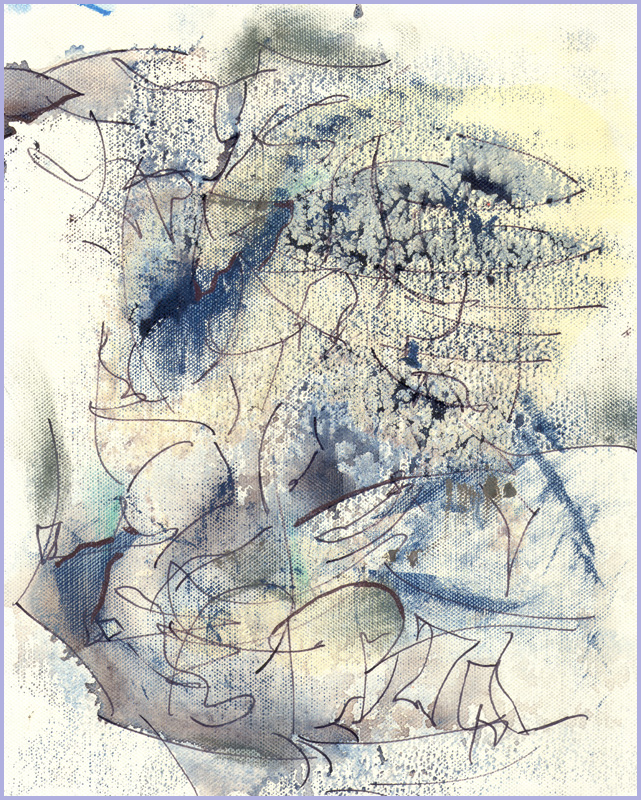
Still Thirty-three: When All We Know Is Borrowed
Oil on linen & board, 15″ x 12″x 1/2″
2012.

This essay concludes the trilogy begun with The Colors of Certainty and continued with The Discipline of Doubt. It reflects on perception, ambiguity, and ambivalence as conditions that complicate our access to truth, especially in an age of mistrust. The trilogy as a whole asks how certainty, doubt, and ambivalence each shape the paradoxes of human understanding—and how reality is always encountered in fragments, never in full possession.

The purpose of this essay is not to resolve these tensions but to articulate them. Its value lies less in offering solutions than in clarifying the paradoxes that underlie our shared attempts to understand reality.

Ricardo Morín, Bala Cynwyd, Pa. August 30, 2025.

Abstract:

This essay examines perception, ambiguity, and belief as distinct but interrelated conditions that shape human access to reality.   Ambiguity marks the instability of meaning; perception denotes our filtered and partial contact with the world; and ambivalence names the paradoxical ground on which truth is sought.   Ambivalence sustains the search even as it undermines the certainty that truth has been attained.   Writing and reading reveal these dynamics with particular clarity.   Through writing, thought evolves; the writer participates in this evolution and discovers that meaning may remain both untranslatable and questionable.   Yet this very incompleteness expands understanding, even when what is grasped cannot be fully shared.   Extending beyond communication, the essay suggests that reality itself is encountered only in fragments—through gestures, silences, and misperceptions that weaken the line between appearance and reality.   Artificial intelligence illustrates this condition in two ways:   as a tool, it amplifies practical doubts about authorship and authenticity; as a mirror, it reflects the deeper ambivalence that precedes it.   The essay concludes that ambivalence is not a detour from truth but the paradox through which truth, if it arises at all, briefly appears.

~

Perception

The word perception carries within it a history that mirrors the shifting ways in which cultures have understood reality.   From the Latin perceptio, it meant first a “taking in,” a “gathering,” or even a “harvest.”   To perceive was to collect impressions, as one might collect grain from a field: passive in form, but active in intent.

In Greek thought, perception was bound to aisthēsis—sensation was the contact one felt with the world.   Here it stood closer to the arts, to the immediacy of feeling, than to the systematic reasoning of philosophy.

During the Middle Ages, particularly in the twelfth and thirteenth centuries, Aristotle’s writings were recovered and incorporated into Christian scholastic thought.   What had been a pagan philosophy of sensation and intellect was reinterpreted by thinkers such as Thomas Aquinas within a theological framework of knowledge.   Perception was defined as the reception of sensory data by the intellect, a necessary stage through which sensation was elevated into understanding.

With the rise of modern philosophy, the term fractured.   For Descartes, perception could deceive;   for Locke, it formed the foundation of experience; for Kant, it was structured by categories that both opened and constrained our access to reality.   By then perception had already become ambivalent:   indispensable for knowing, but never certain in its truth.

Today the word extends further still, connoting not only sensation but also interpretation, bias, and opinion. To say “that is your perception” is no longer to affirm contact with the real but to indicate distance, distortion, or subjectivity. The evolution of the word reveals a semantic instability that parallels the essay’s claim: our access to reality is always shaped by ambivalence. What perception grants, it also unsettles.

Perception is never a simple act of receiving what is already there.   It is always mediated by memory, expectation, and predisposition.   In every exchange—whether in words on a page or in silence between two people—meaning shifts, unsettled and provisional.   From this shifting ground arises ambiguity, and from ambiguity, the unease that unsettles belief.

For the reader, this instability is unavoidable.   Every response, even silence, is colored by trust or mistrust, sympathy or suspicion, openness or fatigue.   Rarely does a reader approach a text in innocence, for every act of reading is shaped by assumptions that condition the reception of words.

The author is not exempt from this interpretive burden.   The act of writing does not end with publication but continues in the uncertain work of reading readers.   A pause in conversation, a fleeting acknowledgment, or a lack of reply can be interpreted as disinterest, disapproval, or indifference.   In this way, writing interprets interpretations and multiplies the layers of ambiguity until the meaning of the work appears not only untranslatable but also questionable.   Yet it is precisely through this reflection that writing continues, for without it thought cannot develop.   By persevering in this process, the writer participates in a widening of understanding, even when that understanding cannot be fully shared.

Such uncertainty is not a flaw of communication but part of its structure.   Anyone who seeks to understand through writing must accept that clarity will always be provisional and that expression will always fall short.   The act of putting thought into words reveals the distance between intention and reception, but it also creates the possibility of seeing reality from new angles.   Even when what is expressed cannot be communicated in full, the process itself enlarges understanding and deepens awareness of what is partial and in flux.

Ambivalence, therefore, is not hesitation but the paradoxical condition in which the search for meaning takes place.   It joins conviction and doubt, the desire for certainty and the recognition of its limits.   To write within ambivalence is to continue searching even when the result cannot be communicated without loss.   This condition—and not the illusion of final clarity—enables thought to move forward.

Truth, if it is ever reached, emerges despite the unstable ground of perception and ambiguity.   We arrive at it in spite of ourselves, our tensions, and our limitations.   It is not only major errors that weaken certainty:   a nuance misperceived, a pause misunderstood, or an ambiguous gesture may also diminish trust.   Daily experience shows that the line between appearance and reality is too thin to provide lasting assurance.

But this tension is not limited to writing or reading.   It extends more deeply, into our relation with reality itself.   Ambivalence is not only a feature of communication but also a feature of existence.   To perceive is always to partake of the world incompletely; to live is to do so under conditions of partial presence.   At times we see clearly, at other times dimly, and often not at all.   This rhythm of presence and withdrawal marks every relationship—between persons, between societies, and even between humanity and nature.

Technology has sharpened our awareness of this condition.   Artificial intelligence, for example, dramatizes the instability already present in human perception.   As a tool, it enables refinement of expression while amplifying doubts about authorship and authenticity.   As a mirror, it reflects the deeper ambivalence that precedes it and shapes all mediation.   Thus AI does not diminish thought but magnifies the unease that accompanies human access to reality:   the sense that what is offered is incomplete, unreliable, and never fully participatory.

The task, then, is not to eliminate ambiguity but to recognize it as part of reality itself.   Perception is interpretive, belief is unstable, and mistrust is a constant companion.   Ambivalence is not a detour from truth but the path along which truth—if it comes at all—must travel.   The challenge is not to restore a certainty that never existed but to learn to live within partial participation, to accept that what we call reality is always encountered in fragments.

In this sense, perception, ambiguity, and belief will always remain unsettled.   The writer cannot control how words are read, nor can the reader fully grasp what was meant.   No one can claim full possession of reality.   Every relation to the world depends on fragile conditions, where appearance and reality touch without ever coinciding.   If truth appears at all, it does so briefly and incompletely, arising only through ambivalence.   Yet ambivalence itself is a paradoxical condition:   it sustains our search for truth even as it undermines the certainty we long to possess.   Truth cannot confer ownership because it never rests.


Annotated Bibliography

  • Arendt, Hannah: The Human Condition. Chicago: University of Chicago Press, 1958. (Arendt analyzes action, labor, and work as distinct ways of engaging reality. Her distinction between appearance and reality, and her insistence that truth emerges through shared human activity, is directly relevant to the essay’s theme of perception and ambivalence.)
  • Gadamer, Hans-Georg: Truth and Method. New York: Continuum, 1975. (In this foundational text in hermeneutics, Gadamer explores how understanding arises through interpretation rather than objectivity. His view that truth is approached dialogically supports the essay’s claim that truth emerges “within ambivalence rather than beyond it.”)
  • Girard, René: Deceit, Desire, and the Novel. Baltimore: Johns Hopkins University Press, 1965. (Girard’s theory of mimetic desire shows how interpretation, desire, and misunderstanding shape human relations. His work underlines the fragility of belief and the unstable boundary between appearance and reality.)
  • Nussbaum, Martha: Political Emotions: Why Love Matters for Justice. Cambridge, MA: Harvard University Press, 2013. (Nussbaum argues that public emotions—such as love, compassion, and solidarity—are essential to sustaining justice. Her insights reveal how belief is fragile and shaped by interpretation; it resonates with the essay’s concern about trust, ambivalence, and human participation in reality.)
  • Turkle, Sherry: Alone Together: Why We Expect More from Technology and Less from Each Other. New York: Basic Books, 2011. (Turkle investigates how technology mediates human relationships and perceptions. Her work frames AI as a mirror of doubt; it shows how mediation both enables connection and erodes authenticity—an idea central to the essay.)

“The Discipline of Doubt”

August 24, 2025

*

**

Author’s Note:

This essay is the second part of a trilogy that examines certainty, doubt, and ambivalence as conditions shaping our understanding of reality. It turns to doubt as both discipline and burden: a practice that unsettles claims of knowledge yet makes understanding possible. Here doubt is not treated as weakness but as a necessary stance within human communication. Its value lies not in closure but in keeping open the fragile line between appearance and reality. The trilogy begins with The Colors of Certainty and concludes with When All We Know Is Borrowed.

The Discipline of Doubt

Skepticism and doubt are often spoken of as if they were the same, yet they differ in essential ways. Skepticism inclines toward distrust: it assumes claims are false until proven otherwise. Doubt, by contrast, does not begin with rejection. It suspends judgment, while it withholds both assent and denial, so that questions may unfold. Skepticism closes inquiry prematurely; doubt preserves its possibility. Properly understood, inquiry belongs not to belief or disbelief, but to doubt.

This distinction matters because inquiry rarely follows a direct path to certainty. More often it is layered, restless, and incomplete. Consider the case of medicine. A patient may receive a troubling diagnosis and consult several physicians, while each offers a different prognosis. One may be more hopeful, another more guarded, yet none entirely conclusive. The temptation in such circumstances is to cling to the most reassuring answer or to dismiss all of them as unreliable. Both impulses distort the situation. Inquiry requires another path: to compare, to weigh, to test, and ultimately to accept that certainty may not be attainable. In this recognition, doubt demonstrates its discipline: it sustains investigation without promising resolution and teaches that the absence of finality is not failure but the condition for continued understanding.

Even within medicine itself, leaders recognize this tension. Abraham Verghese, together with other Stanford scholars, has pointed out that barely half of what is taught in medical schools proves directly relevant to diagnosis; the rest is speculative or unfounded. This observation does not aim to discredit medical education but rather to underline the need for a method that privileges verification over uncritical repetition. Clinical diagnosis, therefore, does not rest on an accumulation of certainties but on the constant practice of disciplined doubt: to question, to discard what is irrelevant, and to hold what is provisional while seeking greater precision.

History provides another vivid lesson in the figure of Galileo Galilei. When he trained his telescope on the night sky in 1609, he observed four moons orbiting Jupiter and phases of Venus that could only be explained if the planet circled the sun. These discoveries contradicted the Ptolemaic system, which for centuries had fixed the earth at the center of creation. Belief demanded obedience to tradition; skepticism might have dismissed all inherited knowledge as corrupt. Galileo’s path was different. He measured, documented, and published, while he knew that evidence had to be weighed rather than simply asserted or denied. The cost of this doubt was severe: interrogation, censorship, and house arrest. Yet it was precisely his refusal to assent too quickly—his suspension of judgment until the evidence was overwhelming—that made inquiry possible. Galileo shows how doubt can preserve the conditions of knowledge even under the heaviest pressure to believe.

Literature offers a parallel insight. In Shakespeare’s Hamlet, the young prince is confronted by the ghost of his murdered father, who demands vengeance. To believe would be to accept the apparition’s word at once and to kill the king without hesitation. To be skeptical would be to dismiss the ghost as hallucination or trickery. Hamlet does neither. He allows doubt to govern his response. He tests the ghost’s claim by staging a play that mirrors the supposed crime, as he watches the king’s reaction for confirmation. Hamlet’s refusal to act on belief alone, and his unwillingness to dismiss the ghost outright, illustrates the discipline of doubt. His tragedy lies not in doubting, but in stretching doubt beyond proportion, until hesitation itself consumes action. Shakespeare makes clear that inquiry requires balance: enough doubt to test what is claimed, enough resolve to act when evidence has spoken.

The demands of public life make the difference equally clear. In the early months of the COVID-19 pandemic, citizens were asked to place immediate trust in official pronouncements or, conversely, to dismiss them as deliberate falsehoods. Belief led some to cling uncritically to each reassurance, however inconsistent; skepticism led others to reject all guidance as propaganda. Doubt offered another course: to ask what evidence supported the claims, to weigh early reports against later studies, and to accept that knowledge was provisional and evolving. The uncertainty was uncomfortable, but it was also the only honest response to a rapidly changing reality.

A similar pattern emerged after the September 11 attacks. Governments urged populations to choose: either support military intervention or stand accused of disloyalty. Belief accepted the justification for war at face value; skepticism dismissed all official claims as manipulation. Doubt, however, asked what evidence existed for weapons of mass destruction, what interests shaped the rush to invasion, and what alternatives were excluded from consideration. To doubt in such circumstances was not disloyalty but responsibility: the attempt to withhold assent until claims could be verified. These examples show that doubt is not passivity. It is the active discipline of testing what is said against what can be known: to resist the lure of premature closure.

Verification requires precisely this suspension: not the comfort of belief, nor the dismissal of skepticism, but the discipline of lingering within uncertainty long enough for proof to take shape. One might say that verification becomes possible only when belief is held in abeyance. Belief craves closure, skepticism assumes falsehood, but doubt stills the mind in the interval—where truth may draw near without the illusion of possession.

The same principle extends to the temptations of success and recognition. Success and fame resemble ashes: the hollow remains of a fire once bright but now extinguished, incapable of offering true joy to an inquiring mind. Ashes evoke a flame that once burned but has spent itself. So it is with fame: when the applause fades, only residue lingers. Belief, too, provides temporary shelter, yet it grows brittle when never tested. Recognition and conviction alike promise permanence, yet both prove fragile. A mind intent on inquiry cannot find rest in them. It requires something less visible, more enduring: the refusal to define itself too quickly, the discipline of anonymity.

Anonymity here does not mean retreat from the world. It means withholding assertion or purpose until knowledge has ripened. To declare too swiftly what one is—or what one knows—is to foreclose discovery. By necessity, the inquiring mind remains anonymous. It resists capture by labels or the scaffolding of recognition. Its openness is its strength. It stays attuned to what has not yet been revealed.

Our present age makes such discipline all the more urgent. Technology hastens every demand for certainty: headlines must be immediate, opinions instantaneous, identities reduced to profiles and tags. Social media thrives on belief asserted and repeated, rarely on doubt considered and tested. Algorithms reward speed and outrage, punishing hesitation as weakness and contradiction as betrayal. To cultivate doubt and anonymity is therefore a form of resistance. It shelters the subtlety of thought from the pressure of velocity and spectacle. It refuses to allow inquiry to be diminished into slogans or certainty compressed into catchphrases.

The discipline of doubt teaches that truth is never possessed, only pursued. Success, fame, and belief may glitter briefly, but they collapse into ashes. What endures is the quiet labor of questioning, the patience of remaining undefined until knowledge gathers form. To believe is to settle into residue; to doubt is to stand within the living fire. To question is to stir the flame; to believe is to collect the ashes.

*

** Cover Design:

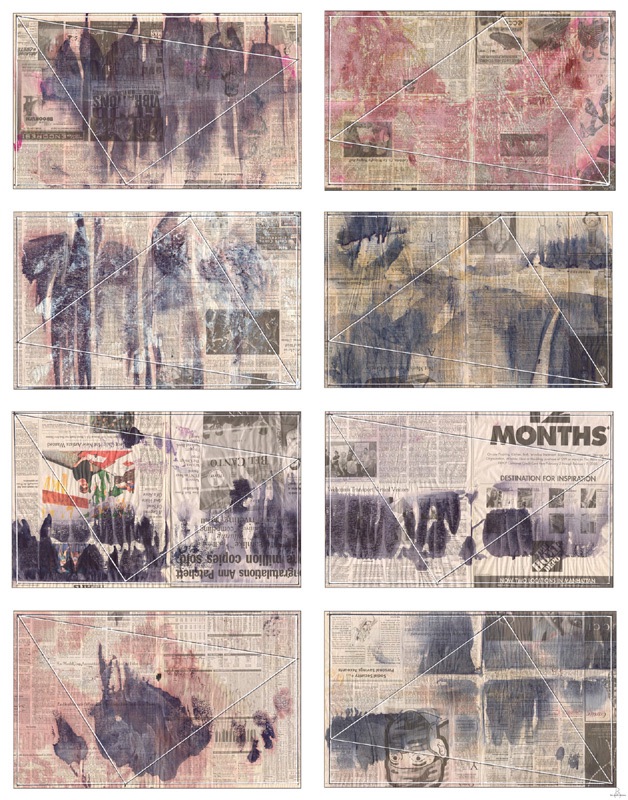
Ricardo Morín: Newsprint Series Nº 2 (2006). 51″ × 65″. Ink, white-out, and blotted oil paint on newsprint. From the Triangulation series.


Annotated Bibliography

  • Arendt, Hannah: Between Past and Future. New York: Viking Press, 1961. (Arendt examines the importance of thinking without absolute supports and illuminates how the discipline of doubt resists political and social certainties).
  • Bauman, Zygmunt: Liquid Modernity. Cambridge: Polity Press, 2000. (Bauman describes the fluidity and precariousness of certainties in modern life and reinforces the idea of doubt as a condition in the face of contemporary volatility).
  • Berlin, Isaiah: The Crooked Timber of Humanity. Princeton: Princeton University Press, 1991. (Berlin analyzes the pluralism of values and the impossibility of single certainties and supports the need to live with unresolved tensions).
  • Bitbol-Hespériès, Annie: Descartes’ Natural Philosophy. New York: Routledge, 2023. (Bitbol-Hespériès examines how Cartesian natural philosophy emerges from a constant exercise of methodical doubt; she offers a contemporary reading that links science and metaphysics in Descartes’ thought).
  • Han, Byung-Chul: In the Swarm: Digital Prospects. Cambridge, MA: MIT Press, 2017. (Han critiques the pressure of transparency and digital acceleration; he provides insights into how technology disfigures the patience required for doubt).
  • Han, Byung-Chul: The Disappearance of Rituals. Cambridge: Polity Press, 2020. (Han explores how digital society weakens spaces of repetition and anticipation to highlight the urgency of recovering anonymity and slowness in inquiry).
  • Croskerry, Pat, Cosby, Karen S., Graber, Mark, and Singh, Hardeep, eds.: Diagnosis: Interpreting the Shadows. Boca Raton, FL: CRC Press, 2017. (Croskerry, Cosby, Graber, and Singh address the cognitive complexity of diagnostic reasoning: they show how uncertainty is inherent in clinical practice and how disciplined doubt can reduce diagnostic error).
  • Elstein, Arthur S., and Schwartz, Alan: Clinical Problem Solving and Diagnostic Decision Making: Selective Review of the Cognitive Literature. New York: Oxford University Press, 2002. (A landmark study in medical decision-making, it shows how diagnostic reasoning is less about static knowledge and more about methodical doubt and verification).
  • Finocchiaro, Maurice: Retrying Galileo, 1633–1992. Berkeley: University of California Press, 2005. (Finocchiaro explores the trials and historical reinterpretations of Galileo’s case; he shows how scientific doubt clashed with religious authority and how it has been re-evaluated in modernity).
  • Gaukroger, Stephen: Descartes: An Intellectual Biography. Oxford: Oxford University Press, 2002. (An intellectual biography that situates Descartes in the cultural context of the seventeenth century and illuminates how Cartesian doubt was also a strategy against religious and scientific tensions).
  • Garber, Daniel: Descartes Embodied: Reading Cartesian Philosophy through Cartesian Science. Cambridge: Cambridge University Press, 2001. (Garber analyzes the close relationship between Descartes’ science and his philosophical method and underscores how scientific practice reinforced the discipline of doubt).
  • Graber, Mark L., Gordon D. Schiff, and Hardeep Singh: The Patient and the Diagnosis: Navigating Clinical Uncertainty. New York: Oxford University Press, 2020. (Graber explores how physicians manage uncertainty and emphasizes that precision in diagnosis emerges from structured methods rather than unquestioned knowledge).
  • Machamer, Peter, ed.: The Cambridge Companion to Galileo. Cambridge: Cambridge University Press, 1998. (In this collection of updated essays presenting Galileo’s work from historical, philosophical, and political perspectives, Machamer illuminates how empirical doubt transformed cosmology).
  • Nussbaum, Martha: Political Emotions: Why Love Matters for Justice. Cambridge, MA: Harvard University Press, 2013. (Nussbaum examines how liberal institutions can responsibly cultivate public emotions—such as love, tolerance, and solidarity. Her arguments enrich the section of the essay on civic-life, which shows how emotional cultivation, beyond belief or skepticism, supports societal inquiry).
  • Popkin, Richard: The History of Scepticism: From Savonarola to Bayle. Oxford: Oxford University Press, 2003. (In this historical study of skepticism, Popkin shows how skepticism evolved between radical distrust and the discipline of inquiry).
  • Shakespeare, William: Hamlet. New Haven: Yale University Press, 2003. (This play offers a literary embodiment of doubt as an ambivalent force: it functions both as the engine of inquiry and the risk of paralysis).
  • Shea, William, and Artigas, Mariano : Galileo in Rome: The Rise and Fall of a Troublesome Genius. Oxford: Oxford University Press, 2003. (An accessible and well-documented narrative of Galileo’s conflict with the Church; it illustrates how persistence in verifying doubt had vital and political consequences).
  • Verghese, Abraham, Saint, Sanjay, and Cooke, Molly: “Critical Analysis of the ‘One Half of Medical Education Is Wrong’ Maxim.” Academic Medicine 86, no. 4 (2011): 419–423. (Authored by Stanford-affiliated leaders in medical education, the report argues that much of medical teaching lacks direct relevance to diagnostic accuracy and underscores the necessity of disciplined doubt and re-evaluation).

“Listening Beyond the Trance: …

July 21, 2025

… Reassessing Krishnamurti in Later Life”

by Ricardo Morín
July 2025

Ricardo Morin
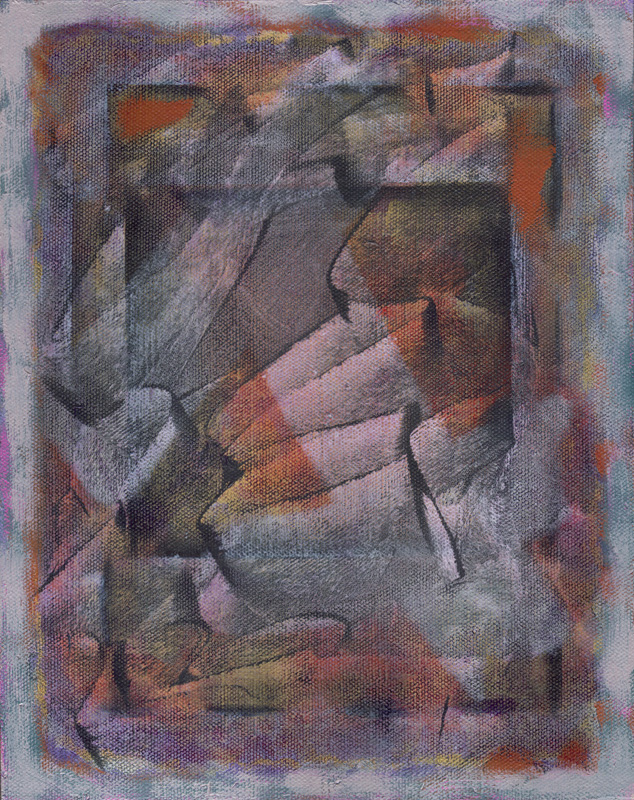
Infinity 6
12” x 15”
Oil and ink on linen
2005

*

Abstract

This reflective essay reconsiders the thought of Jiddu Krishnamurti through the lens of aging and evolving philosophical expectations. While Krishnamurti’s teachings once offered inspiration and a path toward inner freedom, they now appear to dissolve into rhetorical mysticism and incoherence. The essay critiques his rejection of “intellectual understanding” and analyzes the contradictions inherent in his style of spiritual discourse. It argues for the necessity of rational clarity, especially in later stages of life when discernment becomes more valuable than inspiration alone. This shift is presented not as a betrayal of earlier insight, but as its maturation.

“Listening Beyond the Trance: Reassessing Krishnamurti in Later Life”

In my forties and fifties, I found great inspiration in the thought of Jiddu Krishnamurti. His emphasis on freedom from authority, his critique of systems, and his call to radical self-awareness spoke directly to a part of me that sought liberation from inherited dogmas and psychological conditioning. He offered, or seemed to offer, a clarity beyond tradition—a voice that felt both universal and personal.

But now, in my seventies, I find myself rereading his words with a different ear. What once felt revelatory now strikes me as elusive, at times incoherent. A recent passage shared by the Krishnamurti Foundation, drawn from a 1962 public talk in New Delhi, crystallized this shift for me:

“There is no such thing as intellectual understanding; you really only mean that you hear the words, and the words have some meaning similar to your own, and that similarity you call understanding, intellectual agreement. There is no such thing as intellectual agreement – either you understand or do not understand. To understand deeply, with all your being, you have to listen”.

This line of thinking—expressed in varied forms across his oeuvre—once felt like an invitation to presence. Now, I hear it differently: as a kind of rhetorical mysticism that dismisses the very faculties we depend on to make meaning. The claim that “there is no such thing as intellectual understanding” is not merely provocative; it is self-undermining. If words cannot convey meaning through reason, then why speak? Why write? Why gather an audience at all?

Krishnamurti’s sharp dichotomy between “intellectual” and “real” understanding collapses under scrutiny. Intellectual reflection is not merely passive recognition of familiar ideas. It is the groundwork of discernment—of logic, dialogue, and ethical clarity. To discard it is to unravel the very possibility of communication. What he seems to offer instead is a kind of pure, undefinable receptivity—“listening with all your being”—a state left vague, idealized, and unexamined.

This tendency is not unique to Krishnamurti. It is a feature of a broader strand of Indian and global spiritual discourse that wraps itself in the aura of wisdom while resisting the discipline of logic. It blurs the line between paradox and nonsense, invoking transcendence but offering no clear ground. What results is not insight but opacity.

None of this erases what Krishnamurti once offered me. His call to question, to observe without prejudice, helped me unlearn many habits of thought. But inspiration and clarity are not the same. The mind that once needed liberation may later need precision.

We change. What moves us at one stage of life may lose its grip as our questions evolve. That does not make earlier experiences false—it simply means that our standards grow. In listening now, I want something more than the echo of profundity. I want coherence. I want meaning that can stand up to thought.

Krishnamurti taught me to listen. That lesson remains. But now, I listen not only with receptivity—but with reason, with discernment, and with the quiet courage to call abstraction what it is.

*


Annotated Bibliography:

  • Krishnamurti, Jiddu: The First and Last Freedom. San Francisco: Harper & Row, 1954. (A collection of early talks that established Krishnamurti’s core ideas; includes his foundational argument against psychological authority and tradition.)
  • ———: Commentaries on Living, First Series. Madras: Krishnamurti Foundation India, 1956. (Brief philosophical dialogues drawn from real encounters; written in prose that oscillates between clarity and metaphysical opacity.)
  • ———: The Awakening of Intelligence. New York: Harper & Row, 1973. (A comprehensive transcript of public discussions and interviews where Krishnamurti expands his rejection of intellectual systems and explores “pure observation.”)
  • ———: The Wholeness of Life. London: Victor Gollancz, 1978. (A late-career synthesis that juxtaposes technological anxiety with inward freedom; his critique of organized thought becomes more abstract here.)
  • ———: Krishnamurti to Himself: His Last Journal. San Francisco: Harper San Francisco, 1987. (Dictated reflections shortly before his death; his rejection of analysis deepens and borders on mysticism, with lyrical but imprecise language.)
  • ———: The Ending of Time: Where Philosophy and Physics Meet. San Francisco: Harper & Row, 1985. (Conversations with physicist David Bohm; illustrative of Krishnamurti’s dismissal of conventional logic even when in dialogue with a scientist.)
  • Murti, T. R. V.: The Central Philosophy of Buddhism: A Study of the Mādhyamika System. London: George Allen & Unwin, 1955. (A key work in Buddhist philosophical reasoning; useful contrast to Krishnamurti in that it pursues dialectical rigor rather than mystical generality.)
  • Ganeri, Jonardon: Philosophy in Classical India: The Proper Work of Reason. London: Routledge, 2001. (Challenges the stereotype that Indian thought is mystical or anti-rational; highlights traditions that value analysis and inference over insight alone.)
  • Nussbaum, Martha C.: Cultivating Humanity: A Classical Defense of Reform in Liberal Education Cambridge, MA: Harvard University Press, 1997. (Advocates for clarity, rational argument, and intellectual pluralism; offers a counterpoint to Krishnamurti’s anti-intellectualism.)
  • McGinn, Colin: The Making of a Philosopher: My Journey Through Twentieth-Century Philosophy. New York: HarperCollins, 2002. (A memoir that models the philosophical maturation process; echoes the author’s own shift from inspiration to the pursuit of clarity.)

*


“The Ethics of Expression, Part II”

June 13, 2025

*


Ricardo Morín
Triangulation 4
22″ x 30″
Graphite on paper
2006

To my sister Bonnie

*

Ricardo F. Morín

June 2025

Oakland Park, Florida

Author’s Note

This reflection was originally drafted before The Ethics of Perception, Part I, yet it belongs to the same inquiry into attention, understanding, and ethical relation.


There are moments when the truest form of intimacy is silence.
At other times, it’s the quiet labor of reaching for the right word—however incomplete—that brings us closer.
Expression, in this light, is not just a vehicle for communication, but an act of care.

To speak, to withhold, to write, to listen—each choice carries a particular weight.   
Intimacy lives in these gestures:    not in grand declarations, but in the ethics of how we reveal ourselves—and how we receive what another dares to offer.
What follows is not a theory, but a reflection on how intimacy appears in expression—and in its absence.

It’s hard to pinpoint the moment when something becomes intimate.
It isn’t always a touch, or a glance, or even a confession.
Sometimes, it’s just a pause—a shared pause—between one word and the next, when both people sense that something true is either about to be said or has just been said, without quite naming it.

Once, sitting face to face, I watched someone I cared for stare silently out the window.
I said nothing either.
There was no gesture, no disclosure, no clarifying words.
And yet the silence didn’t feel empty—it felt full.
In that stillness, something passed between us—not a message, not even an understanding, but a kind of permission:

To exist without explanation.
To be present without having to perform.

That moment stayed with me not because it was dramatic, but because it was unplanned.
I hadn’t expected it, and I couldn’t have recreated it.
I only knew, afterward, that I had been in the presence of something rare:
an intimacy that asked nothing more than to be.

And yet, not all intimacy is born in silence or in someone else’s presence.
Some comes later, through writing—in that long interval between feeling and saying.
Some is only possible thanks to the quiet distance that makes reflection possible.

The word intimacy often evokes physical closeness:
the realm of touch, proximity, lovers, secrets shared in the dark.
But what if intimacy were less about closeness than about permission?
The permission to be undefended.
To move slowly.
To be unclear—and still be trusted.

To be intimate with someone is not merely to be known, but to be seen—
seen without the pressure to explain yourself quickly or justify what you feel.
It’s an opening, and it’s also a risk:
the risk of being misunderstood, and the deeper risk of being understood too well.

Some forms of intimacy unfold face to face.
Others require distance.
Some happen through dialogue.
Others need a single voice, speaking on one’s own in a quiet room.

That’s where writing begins—
not as performance, but as a long conversation, uninterrupted.

Intimacy shifts with context, with time,
with the shape of the self we bring to another.
It is not one thing—
not just closeness, or tenderness, or vulnerability—
but a set of ways we allow ourselves to be known,
and sometimes, to know another.

There’s the intimacy of the body—
perhaps the most visible and least understood.
It belongs to touch, proximity,
the instinctive draw toward another’s presence.
But this form can deceive:
physical closeness without emotional resonance is common—
and easily faked.
Yet when body and emotion align,
there’s a wordless attunement:
a hand resting on a shoulder for just the right amount of time;
a breath falling into rhythm without intention.

Then there’s emotional intimacy:
the slow courage to say what one feels—
not just when it’s beautiful or convenient,
but when it’s awkward, incomplete, or raw.
This kind of intimacy isn’t given—it’s earned.
It may take years, or a single night.
Trust lives here—or breaks.

There’s also intellectual intimacy:
what arises in conversation
when ideas flow without anyone guarding their ground.
It’s rare.
Most social spaces reward speed,
the need to shine, or the safety of politeness.
But sometimes, with someone equally curious,
thought expands in the presence of the other—
not in agreement, but in response.
There’s nothing to prove—
only the pleasure of discovery.
That’s intellectual intimacy.
It creates a different kind of closeness—
not of feeling, but of perception.

Stranger still is narrative intimacy—
the kind that forms not between two people in the same room,
but between the one who writes and the one who reads,
separated by silence and time.
It isn’t immediate—
but it isn’t less real.
A voice emerges from the page
and seems to speak directly to you,
as if it knew the contours of your mind.
You feel understood—without being seen.
You may never meet the person who wrote those words,
but something in you shifts.
You are no longer alone.

These are not rigid categories.
They overlap, interrupt, evoke one another.
One may deepen another.
Physical presence can create emotional safety.
Intellectual closeness can open into unexpected tenderness.
And still, each has its own rhythm,
its own grammar—
and its own risks.

In that complexity, intimacy ceases to be a condition.
It becomes a practice:
something we learn,
lose,
revise,
and sometimes write
when no other form is possible.

Writing, too, is a kind of intimacy—
not only with others,
but with oneself.
Especially when it’s honest—
when what’s written is not just clever or correct,
but true.
That kind of writing doesn’t flatter.
It doesn’t argue.
It reveals.

We write to bring something forth—
not just for an audience,
but to hear ourselves think,
to see what we didn’t yet know we felt.
In writing, we become witnesses to our own consciousness—
both its lucidity and its evasions.

We follow a sentence
not only for its logic,
but for the feeling it carries.
And when that feeling falters,
we know we’ve lost the thread.

So we begin again, and again—
trying not just to explain,
but to say something that feels just.

In that sense, writing is an ethical act.
It demands attention.
It requires patience.
It invites us to inhabit our own experience
with precision—
even when that experience is fragmented or unresolved.

And if we are lucky—
if we are honest—
something in that effort will reach someone else.
Not to impress.
Not to convince.
But to accompany.

Sometimes you reach out—carefully, sincerely—and receive silence, indifference, or a response so misaligned it makes you feel naïve for having tried.
Other times, the failure is subtler:
a conversation that scatters just as something real begins to take shape—or a listener who hears your words, but not your meaning.

Those moments stay with us.
Not because they’re dramatic, but because they remind us how precarious intimacy can be.
It can’t be forced—just as humility can’t.
Both require a quiet letting go—a willingness to offer something without knowing how it will be received.
We can prepare the ground, make the gesture, risk the truth—but the rest depends on the other: their timing, their capacity, their willingness to meet us there.

There’s also the experience of being misunderstood—not just in fact, but in essence.
You try to say something that matters, and the other person responds to what they think you said—or to a version of you that never was.
It’s a blow—
that mismatch between what you tried to share and what actually landed.
The desire for intimacy becomes exposure without connection—a wound instead of a bridge.

Sometimes we avoid intimacy not because we don’t want it, but because we fear what it might cost.
We’ve been made to feel clumsy—for caring too much, or for being too visible.
Or we’ve shared something intimate, only to have it treated lightly—or analyzed without feeling.
After that, we grow cautious.
We speak less—or in fragments—or not at all.

It’s in the wake of such rejections—large or small—that writing ceases to be mere expression.
It becomes repair.
Writing allows us to recover what was lost in the moment—
to name what never reached its destination,
to finish the thought no one waited for,
to say it again—this time without interruption, without assumptions, without fear.

And while writing cannot undo the failure of a shared moment, it can offer something else:
coherence.
A record.
A form of truth that endures—even if it wasn’t heard.

In this way, writing becomes a quiet act of insistence—not against the world, but on behalf of the self.
It’s a way of saying:
What I tried to share still matters—even if it wasn’t received.

In the end, intimacy is not a state but a gesture—
repeated again and again—
toward understanding,
toward presence,
toward a shared sense that may arrive… or may not.

Sometimes that gesture is a word spoken at the right moment.
Sometimes it’s a silence held just long enough for the other to speak.
And sometimes it’s the act of writing—solitary, patient, unfinished—
offered not to a crowd,
but to a single imagined reader
who, one day, might need what you are now trying to say.

Writing, at its core, is a form of listening.
Not only to others,
but to the self that doesn’t rush,
doesn’t perform,
doesn’t need to persuade.

To the self that waits—
that wants to be known not by what it manages to say in quick response,
but by what it keeps trying to say with care.

That’s why I return to the page:
not because it guarantees connection,
but because it keeps the door open.
Because in a world that demands speed, certainty, and charm,
writing makes room for something slower and more faithful:
the long, unfinished gesture of trying to reach someone—
perhaps even oneself—
with something resonant.

And when intimacy happens—on the page or in life—
it’s never because we found the perfect words.
It’s because someone stayed.
Someone listened.
Someone let the moment open—without rushing to close it.

That’s what I’m doing now:
writing not to end something,
but to leave it open—
so that something of greater consequence might enter.

*

Ricardo F Morín Tortolero

Capitol Hill, D.C., June 9, 2025


“The Fetters of Power”

January 14, 2025

*

Introduction

Power, in its rawest form, bends and distorts.    It reflects the body depicted in Ascension as it strains against the scaffolding of controland embodies the turbulent forces we inhabit.[1]    These elements frame a reflection not only on Venezuela’s struggles but on the universal gravity of power that entraps us all.    I wonder if blaming these forces oversimplifies a system thriving on collective complicity.    Can self-compassion hold us accountable without succumbing to guilt—when despair paralyzes?

Positioned between The Stream of Emery, a fable of renewal, and Unmasking Disappointment, an upcoming essay on historical reckoning, this story continues a journey through entanglement, responsibility, and the enduring search for self-liberation.[2]

~

THE FETTERS OF POWER

I

While my husband drove from Fort Lauderdale to Orlando, I had a conversation with my friend BBT.    It was one of those unsettling conversations that reveals how vast forces can overwhelm us.    He spoke of power, not as a tool, nor even as a desire, but as the primal force that pushes humanity toward authoritarian oligarchies.    Greed, according to him, is secondary, a symptom of something deeper:    the irresistible gravity of power itself.

II

I thought of Michel Foucault and his theories on power, and for a moment, I felt a flash of clarity.     But the more I tried to articulate his ideas, the more inadequate they seemed.        The weight of reality crushes academic musings as the world descends into ruin.      We fail to recognize ourselves as creatures trapped by our own errors.

III

Then, I remembered my cousin Ivelisse’s voice, trembling while holding back tears, as she recounted Nicolás Maduro’s inauguration, January 10.     For her, it was not just a political event; it was a symbol of our fall, of our dissolution as a people.     Her despair was mine, and ours was Venezuela’sa nation habitually entrusting faith in saviors who never arrive.

IV

Across the world, power and greed—legitimized by crime or not—justify the rise of tyranny.   And we, in our confusion, have no answers in the face of these tides of unchecked ambition.

 V

BBT, ever pragmatic, said simply:   “Just enjoy yourself.”    His advice both stung and comforted me.   But how could I?    How could I enjoy anything when the world feels so fragile?   Every thought circles back to the same questions:   What can I do to counteract these forces?    How can I make sense of this struggle?

 VI

Still, I cling to one belief:  that one day, a collective awakening will emerge, a rising tide of awareness.   If there is to be a better world, it will not come from saviors or struggles for power, but from an alignment of minds and hearts.   My role, if I have one, is to contribute to that legacy—not for fame or ambition, but for peace.

 VII

Peace is what I seek, not only for myself but for others: a legacy that transcends my own life, one that serves as a quiet resistance to the forces of greed and power.    Only then, perhaps, will I find the simplicity BBT spoke of—not as surrender, but as understanding.

Postscript

It is easy to lose sight of the deeper currents that drive us, particularly when we are immersed in the tides of ambition, power, and cynicism.     In moments of crisis, these forces surge, often obscuring our judgment and steering us off course.     Yet, amidst their overwhelming presence, one truth remains:     surrendering to love sustains us.

Ultimately, what really matters is love.    It alone sustains us above all else.    It can anchor us against the forces that threaten to lead us astray.

Perhaps with that recognition is where peace begins—not in the world outside or its lack of validation, but in the quiet acceptance of what we can change, and what we cannot.

~

Endnotes:

[2]   Ricardo Morín, “The Stream of Emery,” WordPress, December 29, 2024, https://observationsonthenatureofperception.com/2024/12/29/the-stream-of-hermes/


Ricardo F. Morin Tortolero, January 14, 2025; Oakland Park, Florida.

Billy Bussell Thompson, February 14, 2025, New York City