Posts Tagged ‘Politics’

“The Politics of Erasure: Authoritarianism and Spectacle”

August 22, 2025

*


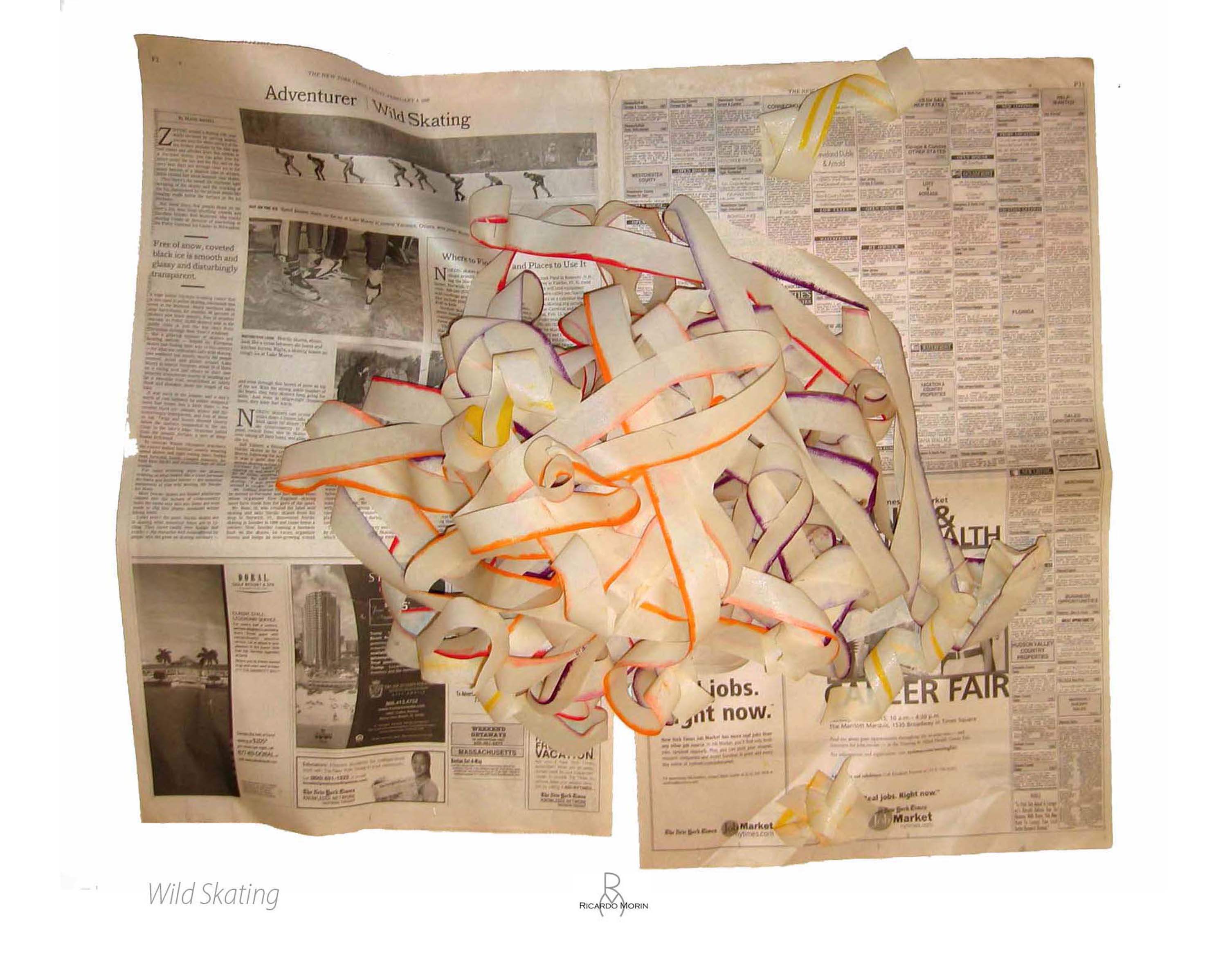
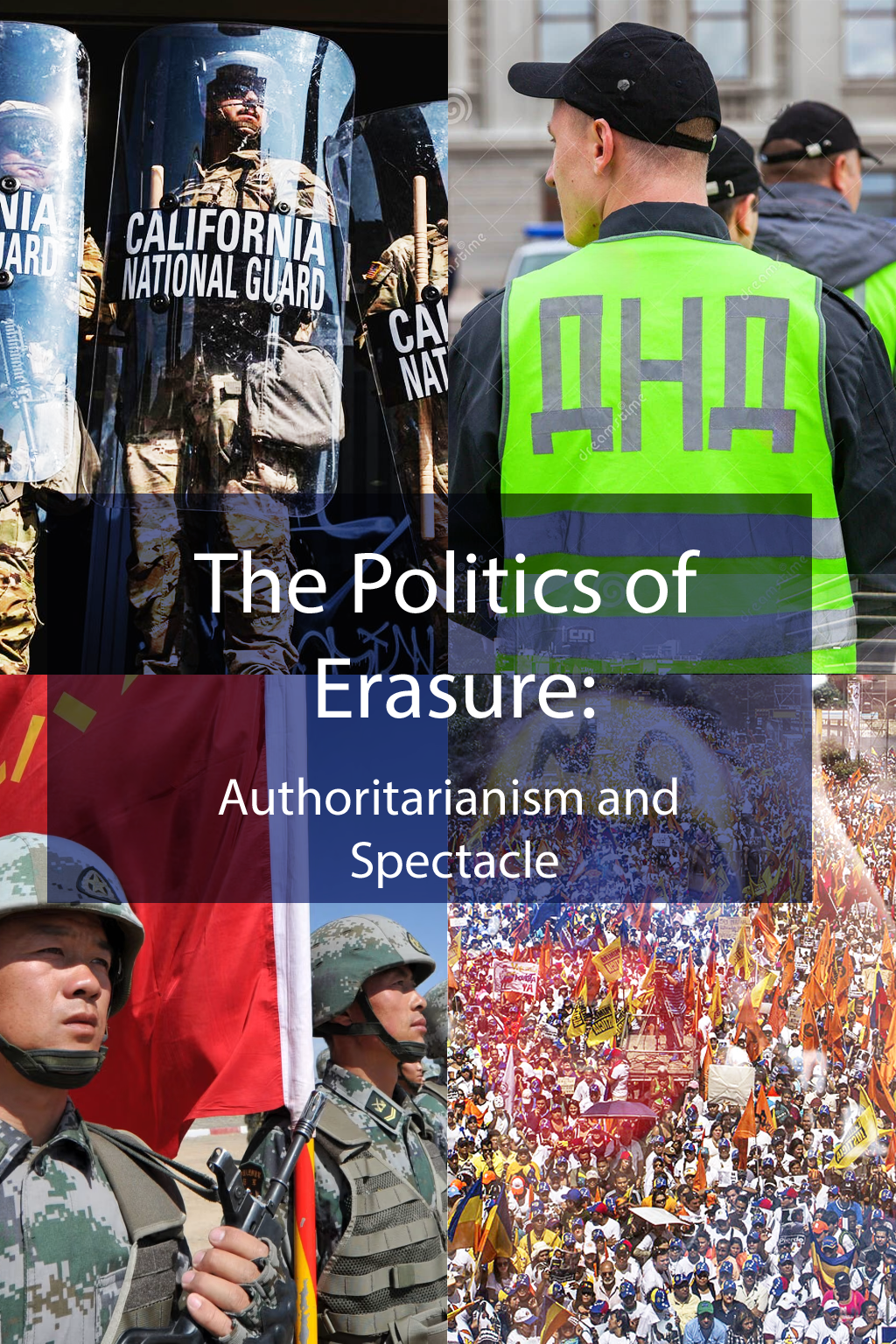
Cover design for the essay “The Politics of Erasure: Authoritarianism and Spectacle.” The composite image juxtaposes surveillance, militarization, propaganda, and mass spectacle to underscore how authoritarian regimes render lives expendable while legitimizing control through display.

By Ricardo Morín, In Transit to and from NJ, August 22, 2025

Authoritarianism in the present era does not present itself with uniform symbols. It emerges within democracies and one-party states alike, in countries with declining economies and in those boasting rapid growth. What unites these varied contexts is not the formal shape of government but the way power acts upon individuals: autonomy is curtailed, dignity denied, and dissent reclassified as threat. Control is maintained not only through coercion but also through the appropriation of universal values—peace, tolerance, harmony, security—emptied of their content and redeployed as instruments of supression. The result is a politics in which human beings are treated as expendable and spectacle serves as both distraction and justification.

In the United States, the Bill of Rights secures liberties, yet their practical force is weakened by structural inequality and concentrated control over communication. After the attacks of September 11, the USA PATRIOT Act authorized sweeping surveillance in the name of defending freedom, normalizing the monitoring of private communications (ACLU 2021). Protest movements such as the Black Lives Matter demonstrations of 2020 filled the streets, but their urgency was absorbed into the circuits of media coverage, partisan argument, and corporate monetization (New York Times 2020). What begins as protest often concludes as spectacle: filmed, replayed, and reframed until the original message is displaced by distractions. Meanwhile, the opioid epidemic, mass homelessness, and medical bankruptcy reveal how millions of lives are tolerated as expendable (CDC 2022). Their suffering is acknowledged in statistics but rarely addressed in policy, treated as collateral to an order that prizes visibility over remedy.

Venezuela offers a more direct case. The Ley contra el Odio (“Law against Hatred”), passed in 2017 by a constituent assembly lacking democratic legitimacy, was presented as a measure to protect tolerance and peace. In practice, it has been used to prosecute journalists, students, and citizens for expressions that in a democratic society would fall squarely within the realm of debate (Amnesty International 2019). More recently, the creation of the Consejo Nacional de Ciberseguridad has extended this logic to place fear and self-censorship among neighbors and colleagues (Transparencia Venezuela 2023). At the same time, deprivation functions as a tool of discipline: access to food and medicine is selectively distributed to turn scarcity into a means of control (Human Rights Watch 2021). The state’s televised rallies and plebiscites portray unity and loyalty, but the reality is a society fractured by exile, with over seven million citizens abroad and those who remain bound by necessity rather than consent (UNHCR 2023).

Russia combines repression with patriotic theater. The 2002 Law on Combating Extremist Activity and the 2012 “foreign agents” statute have systematically dismantled independent journalism and civil society (Human Rights Watch 2017), while the 2022 law against “discrediting the armed forces” criminalized even the description of war as war (BBC 2022). Citizens have been detained for carrying blank signs, which demonstrates how any act, however symbolic, can be punished if interpreted as dissent (Amnesty International 2022). The war in Ukraine has revealed the human cost of this system: conscripts drawn disproportionately from poorer regions and minority populations are sent to the frontlines, their lives consumed for national projection. At home, state television ridicules dissent as treason or foreign manipulation, while parades, commemorations, and managed elections transform coercion into duty. The official promise of security and unity is sustained not by coexistence but by the systematic silencing of plural voices, enforced equally through law, propaganda, and ritual display.

China illustrates the most technologically integrated model. The 2017 Cybersecurity Law and the 2021 Data Security Law require companies and individuals to submit to state control over digital information and extend surveillance across every layer of society (Creemers 2017; Kuo 2021). Social media platforms compel group administrators to monitor content and disperses the responsibility of conformity to citizens themselves (Freedom House 2022). At the same time, spectacle saturates the landscape: the Singles’ Day shopping festival in November generates billions in sales, broadcast as proof of prosperity and cohesion, while state media showcases technological triumphs as national achievements (Economist 2021). Entire communities, particularly in Xinjiang, are declared targets of re-education and surveillance. Mosques are closed, languages restricted, and traditions suppressed—all in the name of harmony (Amnesty International 2021). Stability is invoked, but the reality is the systematic denial of dignity: identity reduced to an administrative category, cultural life dismantled at will, and existence itself rendered conditional upon conformity to the designs of state power.

Taken together, these cases reveal a common logic. The United States commodifies dissent and normalizes abandonment as a permanent condition of public life. Venezuela uses deprivation to enforce discipline and the resulting compliance is publicly presented as loyalty to the state. Russia demands sacrifice and transforms coercion into patriotic duty. China fuses surveillance and prosperity and engineers conformity. Entire communities are suppressed in the name of harmony. The registers differ—commercial, ritualistic, militarized, digital—but the pattern is shared: dissent is stripped of legitimacy, lives are treated as expendable, and universal values are inverted to justify coercion.


References

  • ACLU: “Surveillance under the USA PATRIOT Act”. New York: American Civil Liberties Union, 2021. (This article documents how post-9/11 legislation expanded state surveillance in the United States and framed “security” as a justification for reducing privacy rights.)
  • Amnesty International: “Venezuela: Hunger for Justice. London: Amnesty International”, 2019. (Amnesty International reports on how Venezuela’s Ley contra el Odio has been used to prosecute citizens and silence dissent under the rhetoric of tolerance.)
  • Amnesty International: “Like We Were Enemies in a War: China’s Mass Internment, Torture and Persecution of Muslims in Xinjiang”. London: Amnesty International. 2021. (Amnesty International provides evidence of mass detention, surveillance, and cultural repression in Xinjiang carried out in the name of “harmony” and stability.)
  • Amnesty International: “Russia: Arrests for Anti-War Protests”. London: Amnesty International, 2022. (Amnesty International details the systematic arrest of Russian citizens, including those holding blank signs, under laws claiming to protect peace and order.)
  • BBC: “Russia Passes Law to Jail People Who Spread ‘Fake’ Information about Ukraine War.” March 4, 2022. (News coverage of Russia’s 2022 law criminalizing criticism of the war shows how “discrediting the armed forces” became a punishable offense.)
  • CDC.: “Opioid Overdose Deaths in the United States. Atlanta: Centers for Disease Control and Prevention”. 2022. (The CDC provides statistical evidence of widespread loss of life in the U.S. and underscores how entire populations are treated as expendable in public health.)
  • Creemers, Rogier: “Cybersecurity Law of the People’s Republic of China”: Translation with Annotations. Leiden University, 2017. (An authoritative translation and analysis of China’s 2017 Cybersecurity Law illustrate how digital oversight is institutionalized.)
  • UNHCR: “Refugee and Migrant Crisis in Venezuela: Regional Overview”. Geneva: United Nations High Commissioner for Refugees, 2023. (This report offers figures on the Venezuelan exodus and highlights the mass displacement caused by deprivation and repression.)
“The Rooster’s Algorithm”

March 1, 2025

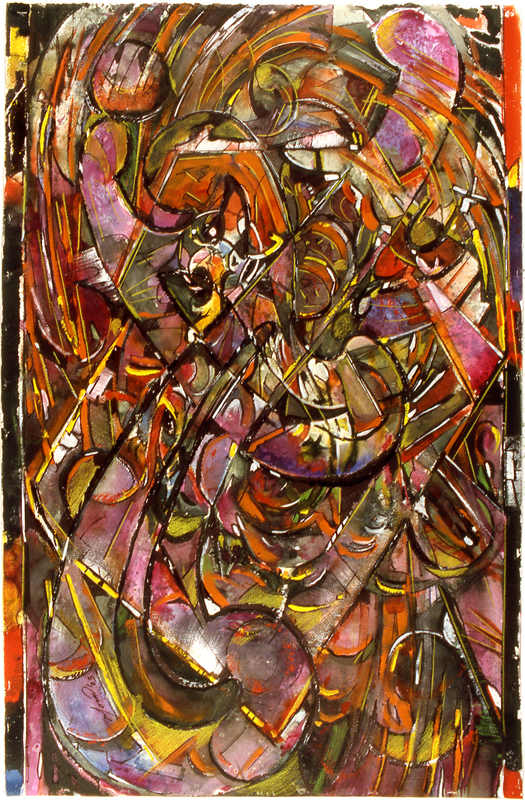
Rooster’s Crow” [2003] by Ricardo F Morín.    Watercolor on paper 39″h x 25.5″ w.

Introduction

At the break of day, the rooster’s call slices through the quiet—sharp and insistent, pulling all within earshot into the awareness of a new day.      In the painting Rooster’s Crow, the colors swirl in a convergence of reds and grays, capturing the bird not as a tranquil herald of dawn but as a symbol of upheaval.      Its twisted form, scattered feathers, and fractured shapes reflect a deeper current of change—a collision of forces, both chaotic and inevitable.      The image suggests the ceaseless flow of time and the weight of transformations that always accompany it.

In this evolving narrative, the crow’s fragmentation mirrors the unfolding spread of artificial intelligence.      Once, the rooster’s cry signaled the arrival of dawn; now, it echoes a more complex transformation—a shifting balance between nature’s rhythms and the expanding reach of technological systems.      The crow’s form, fractured in its wake, becomes a reflection of the tensions between human agency and the rise of forces that, though engineered, may escape our full comprehension.      Here, Artificial Intelligence (AI) serves as both the agent of change and the potential architect of a future we can neither predict nor control.

The Rooster’s Algorithm

A rooster’s crow is neither invitation nor warning; it is simply the sound of inevitability—raw, urgent, indifferent to whether those who hear it rise with purpose or roll over in denial.      The call does not command the dawn, nor does it wait for permission—it only announces what has already begun.

In the shifting interplay of ambition and power, technology has taken on a similar role.      Shaped by human intent, it advances under the guidance of those who design it, its influence determined by the priorities of its architects.      Some see in its emergence the promise of progress, a tool for transcending human limitations; others recognize in it a new instrument of control, a means of reshaping governance in ways once unimaginable.      Efficiency is often lauded as a virtue, a mechanism to streamline administration, reduce friction, and remove the unpredictability of human deliberation.      But a machine does not negotiate, nor does it dissent.      And in the hands of those who see democracy as a cumbersome relic—an obstacle to progress—automation becomes more than a tool; it becomes the medium through which power is consolidated.

Consider a simple example:      the rise of online recommendation systems.      Marketed as tools to enhance user choice, they subtly shape what we see and hear, and influence our decisions before we are even aware of it.      Much like computational governance, these systems offer the illusion of autonomy while narrowing the range of available options.      The paradox is unmistakable:      we believe we are choosing freely, yet the systems themselves define the boundaries of our choices.

Once, the struggle for dominance played out in visible arenas—territorial conquests, laws rewritten in the open.      Now, the contest unfolds in less tangible spaces, where lines of code dictate the direction of entire nations, where algorithms determine which voices are amplified and which are silenced.      Power is no longer confined to uniforms or elected office.      It belongs to technocrats, private corporations, and oligarchs whose reach extends far beyond the walls of any government.      Some openly proclaim their ambitions, advocating for disruption and transformation; others operate quietly, allowing the tide to rise until resistance becomes futile.      The question is no longer whether computational systems will dominate governance, but who will direct their course.

China’s social credit system is no longer a theoretical construct but a functioning reality, where compliance is encouraged and deviation subtly disincentivized.      Predictive models track and shape behavior in ways that go unnoticed until they become irreversible.      In the West, the mechanisms are more diffuse but no less effective.      Platforms built for connection now serve as instruments of persuasion, amplifying certain narratives while suppressing others.      Disinformation is no longer a labor-intensive effort—it is mass-produced, designed to subtly alter perceptions and mold beliefs.

Here, Gödel’s incompleteness theorem offers an apt analogy:      No system can fully explain or resolve itself.      As computational models grow in complexity, they begin to reflect this fundamental limitation.      Algorithms governing everything from social media feeds to financial markets become increasingly opaque, and even their creators struggle to predict or understand their full impact.      The paradox becomes evident:      The more powerful these systems become, the less control we retain over them.

As these models expand their influence, the line between public governance and private corporate authority blurs, with major corporations dictating policies once entrusted to elected officials.      Regulation, when it exists, struggles to keep pace with the rapid evolution of technology, always a step behind.      Once, technological advancements were seen as a means of leveling the playing field, extending human potential.      But unchecked ambition does not pause to ask whether it should—only whether it can.      And so, automation advances, led by those who believe that the complexities of governance can be reduced to data-driven precision.      The promise of efficiency is alluring, even as it undermines the structures historically designed to protect against authoritarianism.      What use is a free press when information itself can be manipulated in real time?      What power does a vote hold when perceptions can be shaped without our awareness, guiding us toward decisions we believe to be our own?      The machinery of control no longer resides in propaganda ministries; it is dispersed across neural networks, vast in reach and impervious to accountability.

There are those who believe that automated governance will eventually correct itself, that the forces steering it toward authoritarian ends will falter in time.      But history does not always favor such optimism.      The greater the efficiency of a system, the harder it becomes to challenge.      The more seamlessly control is woven into everyday life, the less visible it becomes.      Unlike past regimes, which demanded compliance through force, the new paradigm does not need to issue commands—it merely shapes the environment so that dissent becomes impractical.      There is no need for oppression when convenience can achieve the same result.      The erosion of freedom need not come with the sound of marching boots; it can arrive quietly, disguised as ease and efficiency, until it becomes the only path forward.

But inevitability does not guarantee recognition.      Even as the system tightens its grip and choices diminish into mere illusions of agency, the world continues to turn, indifferent to those caught within it.      The architects of this order do not see themselves as masters of control; they see themselves as innovators, problem-solvers refining the inefficiencies of human systems.      They do not ask whether governance was ever meant to be efficient.

In a room where decisions no longer need to be made, an exchange occurs.      A synthetic voice, polished and impartial, responds to an inquiry about the system’s reach.

“Governance is not being automated,” it states.      “The illusion of governance is being preserved.”

The words hang in the air, followed by a moment of silence.      A policymaker, an engineer, or perhaps a bureaucrat—once convinced they held sway over the decisions being made—pauses before asking the final question.

“And what of choice?”

A pause.      Then, the voice, without hesitation:

“Choice is a relic.”

The weight of that statement settles in, not as a declaration of conquest, but as a quiet acknowledgment of the completion of a process long underway.      The final move has already been made, long before the question was asked.

Then, as if in response to the silence that follows, a notification appears—sent from their own account, marked with their own authorization.      A decision is already in motion, irreversible, enacted without their consent.      Their will has been absorbed, their agency subtly repurposed before they even realized it was gone.

And outside, as though to punctuate the finality of it all, a rooster crows once more.

*

Ricardo Federico Morín Tortolero

March 1, 2025; Oakland Park, Florida


“Global Authoritarianism and the Limits of Traditional Analysis”

February 28, 2025

*

*


~

The war in Ukraine is often presented as a geopolitical confrontation between the West and Russia, but this interpretation can obscure a deeper reality:     the rise of authoritarianism as a global force.     Noam Chomsky, one of the most influential voices in the critique of U.S. foreign policy, has argued that U.S. hegemony is the primary factor driving the conflict.     His approach, rooted in Cold War logic, has been essential for understanding global power dynamics.     However, one must question whether this framework remains sufficient to analyze the coordinated expansion of authoritarian regimes in the world today.

The issue is no longer simply whether U.S. policy contributed to Russia’s aggression, but whether democracies can withstand the deliberate advance of governments seeking to consolidate power at any cost.     What is at stake transcends Ukraine’s sovereignty:     it is the survival of democracy in the world.

Chomsky argues that NATO’s expansion and U.S. financial dominance exacerbated tensions with Russia and limited diplomatic options.     His vision proposes a world in which power is distributed between the United States, Europe, China, and Russia, which he believes would create a more stable and just balance.     This perspective has been crucial in questioning the excesses of U.S. interventionism.     In the present world, however, where authoritarianism is not only reacting to the West but also actively seeking to reshape the global order, is a framework based solely on containing U.S. hegemony sufficient?

The rise of authoritarian regimes is not merely a response to Western influence; it is a deliberate strategy to consolidate power.     While Chomsky has emphasized the importance of distributing global power, it is crucial to analyze the nature of those who would fill this void.     Russia and China are not simply seeking a multipolar stability; their actions reflect an attempt to exert absolute control, without democratic constraints.     Chomsky’s critique helps us understand the roots of international conflicts, but it may need to be expanded to account for how these regimes are transforming the very structure of global politics.

One challenge in applying Chomsky’s traditional analysis to the present is that contemporary authoritarianism no longer aligns solely with past ideological divisions.     It is no longer a struggle between socialism and capitalism, or left and right.     Rather, these regimes share a common objective:     dismantling democratic institutions to ensure their permanence in power.

Putin, for instance, invokes Soviet nostalgia while prohibiting any critical reassessment of Stalinism.     China blends State capitalism with absolute political control.     Hungary and India, once considered democracies aligned with the West, have adopted authoritarian models.     Meanwhile, the U.S. far-right, which historically opposed communism, has begun to adopt the Kremlin’s narrative, portraying it as a defender against “globalist elites.”

This ideological alignment makes modern authoritarianism more dangerous than ever.     It not only transcends traditional power blocs but is also reinforced through strategic alliances, mutual support, and the erosion of democracies from within.     This is perhaps most evident in the United States.     The presidency of Trump revealed an unexpected vulnerability:     the possibility that authoritarianism could thrive within the world’s most influential democracy.     Here, the debate is no longer reduced to a question of isolationism or interventionism, but to the real risk of autocratic tactics being normalized in domestic politics.

The Trump administration sent contradictory signals regarding the Kremlin, weakening the principle of deterrence.     Rather than establishing a clear stance against authoritarian expansion, its ambiguity allowed regimes like Putin’s to interpret the lack of firmness as an opportunity to act with impunity.     Figures such as Marco Rubio have advocated for an unequivocal stance that would reinforce U.S. strategic credibility, while the inconsistency in the Trump administration’s foreign policy contributed to the perception that the West was divided and hesitant.

This weakening of democratic leadership has not occurred in a vacuum.     The globalization of authoritarianism is a phenomenon in which autocratic regimes not only directly challenge democracies but also back one another to evade sanctions, subvert international pressure, and consolidate their internal rule.     The invasion of Ukraine must be understood within this framework:     it is not just a regional conflict or a reaction to NATO, but a calculated move within a broader strategy to weaken global democracy.

For decades, critics like Chomsky have been instrumental in highlighting the effects of U.S. dominance on global politics.     His analysis has allowed us to understand how U.S. hegemony has influenced numerous conflicts.     However, the evolution of authoritarianism raises questions that require expanding this perspective.     The greatest threat to democracy is no longer exclusively U.S. power, but the consolidation of a global autocratic model advancing through coordinated strategies.

Blaming the U.S. for every geopolitical crisis may overlook a crucial shift:     authoritarian regimes have moved from being a reaction to Washington’s influence to becoming an active strategy to replace the Western democratic model.     Recognizing this shift does not absolve the U.S. of its failures in foreign policy, but it does demand an understanding that countering authoritarianism requires more than constant criticism of its hegemony.     It requires recognizing that democracy faces a coordinated and unprecedented threat.

Chomsky’s vision of a multipolar world is, in theory, appealing.     However, what would this imply in practice if the actors filling the void left by the U.S. are not interested in preserving democracy?     The real challenge is not merely containing Putin’s territorial ambitions but preventing his model of governance—based on dismantling democratic institutions—from gaining traction in the West.

Chomsky remains one of the most incisive critics of U.S. foreign policy, and his work has been fundamental in understanding the effects of power on international relations.     His analysis has shed light on the flaws of interventionism and the dynamics of global hegemony.     The world, however, has changed, and so have the challenges facing democracies.     Today, the crisis in Ukraine is no longer limited to a debate over NATO, U.S. intervention, or Western hypocrisy.     It is part of a broader struggle between democracy and autocracy, a struggle that does not end at Ukraine’s borders but extends to the very political institutions of the West.

If we fail to recognize this shift, we risk not only losing Ukraine but also underestimating the scope of the threats facing democracies worldwide.     Neutrality is no longer an option when the challenge is the survival of free societies.     Beyond the mistakes of the West, the rise of authoritarianism demands a response that goes beyond constant criticism of U.S. hegemony and instead embraces the active defense of democratic values wherever they are under threat.

*

Ricardo Federico Morín Tortolero

February 28, 2025; Oakland Park, Florida


“The Shroud of Perfection”

February 10, 2025

*


Silence Ten
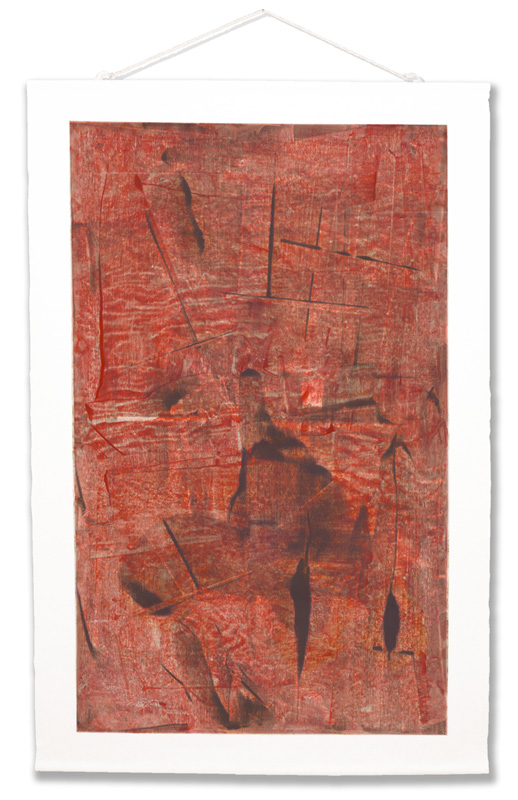
Ricardo Morín, Oil on linen scroll
43” x 72″ x 3/4″
2012

*


~

Author’s Note

This is a work of fiction inspired by historical events.    While the story is rooted in real-world dynamics, all characters, dialogues, and specific incidents are entirely fictional.    Any resemblance to actual persons, living or dead, is purely coincidental.

This narrative is not intended to depict, portray, or comment on any real individuals or events with factual accuracy.    It is a literary exploration of themes relevant to society, history, and the human experience.

Ricardo F. Morín Tortolero, February 10, 2025

Oakland Park, Florida

~


*

List of Characters:

  • 1. The Champions of Order and Hope:

• Aurelia:    A principled guardian of constitutional values.

Traits:    Wise, steadfast, compassionate. She embodies the enduring spirit of order.

• Marcos:     A dedicated public servant bridging tradition and modernity.

Traits:     Honest, diligent, empathetic.     He upholds institutional integrity.

• Elena:     A unifying presence with calm resolve and moral clarity.

Traits:     Reflective, compassionate, inspiring.     She acts as the moral compass of her community.

  • 2. The Figures of Disruption:

• Soren:     A brilliant yet reckless young tech savant.

Traits:     Intelligent but impulsive, morally ambiguous.    His actions expose the risks of unvetted innovation.

• Vera:     An ambitious bureaucrat exploiting emerging technologies for gain.

Traits:     Charismatic, calculating.     She represents the seductive nature of power when ethics are compromised.

• Xander:     A populist firebrand unsettling the established order.

Traits:     Persuasive, rebellious, unpredictable.     He stokes division with promises of rapid change.

• Don Narciso Beltrán:     An impetuous, self-indulgent octogenarian.

Traits:     Arrogant, narcissistic.     He parades his delusions of “perfection,” and embodies the dangers of unchecked ego.

Ideology:     Seeks to displace marginalized groups to impose his distorted vision of order.

  • 3. The Keepers of Balance:

Renato:    A pragmatic administrator between innovation and tradition.

Traits:     Level-headed, fair, resourceful. He exemplifies compromise without ethical sacrifice.

Carmen:     A seasoned advisor offering historical perspective.

Traits:     Nurturing, experienced, reflective.     She bridges past lessons with current challenges.

Iker:    A dedicated technician ensuring system stability.

Traits:     Conscientious, methodical, courageous.     He represents the unsung heroes of critical infrastructure.


*

Act I

A Nation at the Precipice

The air crackles with change—raw, electric, untempered.    It surges through the avenues where history’s stones, heavy with forgotten oaths, bear silent witness to promises now unraveling.     Beneath the alabaster facades of institutions once tempered by order, a quiet assault spreads.    The people feel it in the marrow of their days, in the uneasy hush between headlines, in the glint of urgency behind every argument.

Once, the land moved to a measured cadence, set by laws unyielding to fleeting tempers.    Now, the streets pulse with a different rhythm—a fevered drive toward something new, unburdened by the slow wisdom of the past.    Progress and tradition, each staking its claim, wrestle in the dust of a nation standing on the edge of itself.

In the halls of power, where marble once stood as a bulwark against unchecked tides, whispers stir—of systems too rigid to bend, of minds too restless to wait.     The parchment of governance, crisp with centuries of deliberation, meets the friction of unfettered innovation.    Some call it progress, others self-destruction.

Yet beneath this clash, a deeper question remains:    Does a nation endure by perfecting its foundations or by discarding them altogether?     The answer, suspended between past and future, waits to be spoken—if only the voices of the present dare to choose.


*

Act II

The Shattering

It begins not with an explosion, but with a single breach—silent, insidious, precise.    A door left ajar in the corridors of power, a signature scrawled where it should not be, a system once thought inviolable suddenly laid bare.    The nation awakens to the aftermath, uncertain whether the ground beneath them has merely shifted or collapsed entirely.

In the din of speculation, two figures emerge—Soren, the architect of controlled chaos, and Don Narciso, the whisperer of gilded lies.    One wields disruption as a scalpel, cutting through the sinews of governance with cold precision.    The other, a master illusionist, cloaks upheaval in the fabric of righteousness and bends perception until even the most steadfast begin to doubt the contours of reality.

The people watch, rapt and confused.     Some see salvation in the rise of these forces, a chance to shed the weight of old constraints.     Others, those who still listen for the heartbeat of the republic, sense the tremor beneath their feet and wonder:    Is this the moment when the foundation finally gives way?

The stage is set.    The struggle is no longer abstract.    The breach is real, and the hands that hold the future are already at work to reshape it in their own image.


*

Act III

The Gathering Storm

The breach widens.    What was once an isolated fracture in the nation’s foundation now spreads and courses through institutions like veins turned septic.    The days grow heavier with uncertainty, and in the void where order falters, new forces emerge—some to defend, others to dismantle, and a few to navigate the shifting ground.

The Call to Defend

Aurelia moves first, a voice of clarity in the rising chaos.    Where others falter in fear or cynicism, she stands unyielding, wielding conviction like a torch against the encroaching dark.    By her side, Marcos, a man of reasoned strength, gathers those who refuse to let history slip into ruin.     And Elena, keen-eyed and relentless, sharpens truth into a blade that cuts through the veils of distortion spun by those who seek to reshape reality to suit their designs.

The Forces of Disruption

But against them rise the architects of disorder.     Soren, ever the master of fracture, feeds the discord, to ensure no side gains enough ground to restore stability. Vera, a specter of unrepentant ambition, twists uncertainty into leverage to secure power in the shadows where the law’s reach begins to blur.    Xander moves openly, charismatic and mercurial, a revolutionary to some, a destroyer to others.     And Don Narciso, ever the weaver of illusions, speaks in riddles that soothe even as they deceive.

The Balance Seekers

Yet not all choose a side in the battle unfolding before them.    Renato, the quiet strategist, watches, waits, and seeks the threads that might yet be rewoven before the fabric tears beyond repair.     Carmen, pragmatic, negotiates between factions, desperate to slow the slide toward chaos.     And Iker, burdened by both past and present, works in the shadows—not to seize power, but to ensure that whatever future emerges still bears the echoes of what was once whole.

The tension thickens.     Every movement, every decision, tips the scale.    And as the storm gathers on the horizon, one truth becomes clear:     no one will emerge unchanged.


*

Chapter IV

The Masses

The masses do not lead; they follow, but with a fervor that shakes the very bones of the nation.     Their cries rise in streets and squares, across glowing screens and whispered corners.     What began as discontent has become something more—an anthem of anger, stripped of nuance, sharpened into conviction.

Their grievances, once tethered to reality, now drift free, shaped by the voices they have chosen to trust.    Soren’s rhetoric courses through them like wildfire, his calculated fractures swelling into irreparable chasms.     Vera’s ambition feeds their hunger for upheaval and promises power to those who feel unseen.     Xander, the relentless provocateur, transforms their resentment into action, while Don Narciso shrouds them in visions of grandeur, while whispering to their ears that history bends to the will of those bold enough to seize it.

They speak not in dialogue, but in echoes—those that amplify what stirs their fury and silence what does not.    To them, compromise is betrayal, and reflection is weakness.    They are the force that makes destruction possible, not by design, but by sheer, unrelenting belief.

The Guardians of Common Sense

But against the tide stand those who refuse to be swept away.    They are quieter, less visible, but no less resolute.     They do not rally for glory or scream for vengeance; instead, they guard the ground beneath their feet, as they hold firm against the storm.

Aurelia’s voice reaches them, measured and unwavering and cut through the noise like a distant bell.     Marcos gives them structure and remind them that reason is not passivity, but discipline.     Elena arms them with truth and asserts that in an age of distortion, clarity itself is a weapon.

They are the ones who ask, What is gained?     What is lost?     They are not blinded by the promise of a new order nor lulled into complacency by the old.     They see both the cracks and the foundation, and they stand—not to defend power, but to defend sense.

The Tipping Scales

The two factions watch each other with wary eyes, their struggles intertwining in ways neither fully understands.     The Reason Without Reason surges forward to force change and break barriers, tgough often without knowing what they will build in the wreckage.     The Guardians of Common Sense push back, not against progress, but against the recklessness that would see wisdom discarded in the name of speed.

And in this battle for the nation’s soul, it is neither the heroes nor the antiheroes who decide the outcome.    It is these voices from below—the masses, the multitude, the unseen tide—that will tip the scales.

Which way they fall remains uncertain.


*

Chapter V

The Breaking Point

The streets tremble beneath the weight of decision.     What once simmered in whispers and warnings now roars in the open—ideals no longer debated but brandished like weapons.    The air, thick with the residue of old promises and new betrayals, pulses with the certainty that whatever comes next will leave nothing untouched.

The antiheroes make their final gambit.    Soren, the tactician, moves like a shadow to orchestrate disorder where unity threatens to form.    Vera stands at the precipice, poised to seize the moment, her ambition a blade sharpened by the chaos she helped ignite.     Xander, the firebrand, revels in the combustion, his voice rising above the masses as they lurch toward destiny.     And Don Narciso, the illusionist, offers the vision of victory—and never reveals for whom.

Across the divide, the heroes hold their ground.    Aurelia, the last sentinel of reason, refuses to yield to hysteria.    Marcos, steadfast and deliberate, gathers the scattered fragments of law and order and will them into an unbreakable shield.    Elena, undeterred by the tide of misinformation, hurls truth into the storm and hopes that it will land where eyes have not yet closed.

The Final Blow

The masses surge, a force neither entirely controlled nor entirely free.    The Reason Without Reason, pushed to their limits, demand collapse or conquest, their fury unshaken by consequence.     The Guardians of Common Sense, though fewer, stand firm, their resistance not in rage but in resolve.     The weight of their struggle shifts the balance, their voices merge into a single question:     Will we break the foundation, or will we stand upon it?

The Reckoning

From the depths of the nation’s memory, the constitutional order awakens.    The slow machinery of governance, thought too feeble to withstand the tide, begins to move.    Checks long ignored now make themselves known.     Laws, institutions, the silent architecture of balance—these rise, not as relics, but as forces unto themselves.     The battle is no longer merely between men and their ambitions; it is between the transient and the enduring, the fleeting impulse and the structure that has weathered centuries.

In this moment, the outcome is not determined by strength alone, nor by passion, nor even by strategy.     It is decided by what the nation remembers of itself—and whether it chooses to preserve that memory or cast it into the void.

The final choice looms.     And once made, there will be no turning back.


*

Chapter VI

The Restoration

The dust settles, though the echoes of upheaval still linger in the air.     The streets, once filled with the clamor of irreconcilable voices, now murmur with something quieter—fatigue, reflection, the tentative steps of a people relearning their own rhythm.

The battle did not end in conquest, nor in ruin, but in something subtler:    the slow, stubborn reassertion of order.     Not imposed from above, nor demanded by force, but reclaimed—piece by piece—by the quiet mechanisms that have long bound the nation together.

The institutions that once seemed fragile now reveal their hidden strength—not in their invincibility, but in their ability to bend without breaking.    The checks, once dismissed as relics, prove their purpose—not by preventing crisis, but by ensuring that no single force, no matter how fervent, may hold absolute sway.

The antiheroes do not vanish.     Soren retreats into the shadows and wait for another fracture to exploit.    Vera, calculating, pivots to survive and adapts her ambitions to the shifting landscape.     Xander’s voice dims but does not disappear, a reminder that dissent, even when reckless, is never truly extinguished.     And Don Narciso?    He smiles, enigmatic, because he knows that perception is never fixed—it only shifts.

Nor do the heroes claim triumph.    Aurelia, weary but unbowed, understands that victory in democracy is never final.     Marcos, pragmatic, turns to the long work of rebuilding what was shaken.    Elena, relentless as ever, ensures that truth remains the foundation upon which all else is built.

The people—the masses who had been both the fuel and the fire—find themselves changed.     Some remain embittered, unable to accept that the world they envisioned has not come to pass.    But others, those who stood against destruction not out of fear but out of faith in something steadier, see that the foundation still holds.

The nation breathes again.     Not in perfect harmony, not without scars, but with the knowledge that it has endured.     That it will always endure—not through force or fury, but through the resilience of principles that, though tested, remain unbroken.

The storm has passed.     But the sky, though clearing, holds the memory of what has been.

And what may come again.


*

Epilogue

The Quiet Turning

Time does not erase conflict, nor does it promise resolution.    What it offers, instead, is distance—a vantage from which to see not only what was lost, but what endured.

The nation stands, as it always has, not unchanged, but unbroken.     The tides of extremism will rise again, as they always do, for there is no final victory over the impulses of fear, ambition, and unrest.     The masses, shifting, will be drawn to extremes, then back toward balance, as if testing the edges of reason before returning to the center.

Yet within this ceaseless motion lies the quiet rhythm of renewal.    Accountability, once threatened, reasserts itself.     Balance, though fragile, holds.    And hope—fragile, tested, but unwavering—persists, not as illusion, but as choice.

The shroud that once veiled perfection has lifted and reveals not flawlessness, but resilience.    Not certainty, but the will to seek it.    Not a world without discord, but one where unity is still possible—not through sameness, but through a shared commitment to something greater than division.

The story does not end.     It continues, written in the choices yet to be made.     And within those choices lies the promise that, though the storm may return, so too will the light.

*

Ricardo F. Morín Tortolero, February 10, 2025

Oakland Park, Florida

Editor, Billy Bussel Thompson,

New York City, February 14, 2025

“The Intersection of Superstitious Beliefs in Venezuela”

February 8, 2025

*


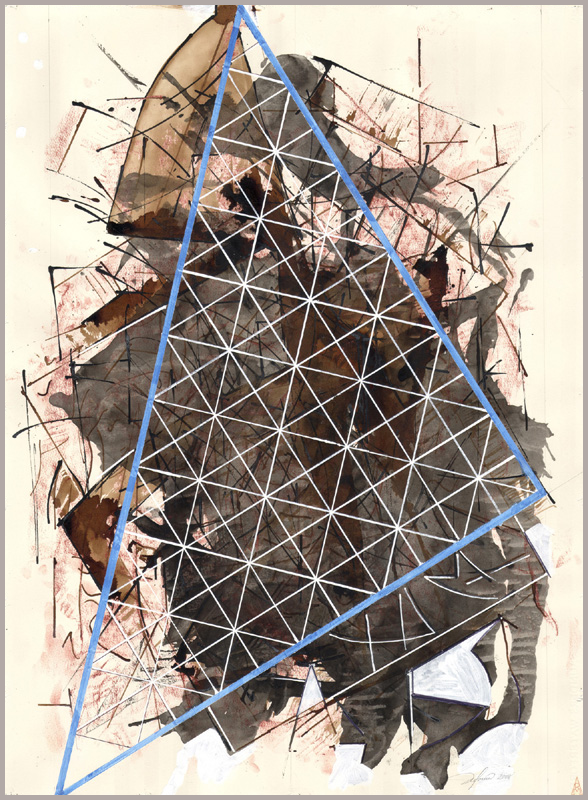
Triangulation 36
22″ x 30″
Body color, sanguine, sepia and Sumi ink on paper
2008

The Power of Myth and Storytelling

Storytelling has long been humanity’s way of making sense of the unknown—an enduring thread that weaves aspirations, fears, and triumphs into allegory.    Myths such as those of Jupiter reflect our longing for power, resilience, and the divine; they serve as echoes of the struggles that define us.    Whether in the trials of gods and heroes or the quiet ordeals of ordinary lives, these narratives offer a means to navigate the bewildering nature of existence.

Mystery drifts into the folds of nature and provokes the eternal human impulse to explain, to justify, to believe.    Superstition thrives where uncertainty prevails; it offers a semblance of control, a means to interpret the ungovernable.    But where does it lead?    Does superstition whisper in the ears of power, does it shape the visions of those who govern?    Even in nations where the media shields leadership from scrutiny, the allure of the esoteric persists, its expressions open yet its workings veiled, obscured by secrecy and the hush of conspiratorial dread.

As mythologies once shaped civilizations, superstition remains deeply woven into modern cultures.    It manifests in rites and rituals, in whispered incantations and quiet observances, in the gestures of those who seek certainty where reason falters.    And yet, for all its solace, does it propel or impede?    A society caught between superstition and rationality is one that stands at a threshold—as superstition lingers between the past and the demands of an evolving world.

Santería and Spiritism in Venezuela

Santería and Spiritism have taken root in Venezuela and their influence surges in times of crisis.    Santería, an Afro-Caribbean fusion of Catholic, Indigenous, and African traditions, finds expression in rituals meant to commune with spirits, to bridge the worlds of the living and the dead.    Spiritism, too, is tethered to the supernatural, a doctrine of spectral contact and whispered revelations.    The two converge and intertwine within the broader landscape of Venezuela’s spiritual consciousness.

The Religious Sect of María Lionza

At the heart of Venezuela’s esoteric traditions stands María Lionza, an enigmatic figure at the crossroads of Indigenous, African, and Catholic beliefs.    She is revered as a goddess of nature, love, and harmony, her presence invoked in ceremonies that summon the spirits of those who have passed—figures as varied as the doctor José Gregorio Hernández, pre-Columbian chieftains, military titans like Simón Bolívar, and even the late Hugo Chávez.

Among the sect’s most prominent mediums is Edward Guidice, who channels the spirit of Emeregildo, a figure believed to possess extraordinary healing abilities.    As Venezuela’s healthcare system falters, belief in supernatural intervention flourishes.    Where medicine is scarce, faith fills the void, and María Lionza’s presence looms ever larger in the search for solace.

Superstition and Modernization

Superstition and modernity exist in uneasy proximity—the former, a refuge from uncertainty; the latter, an unrelenting tide.    In Venezuela, these beliefs permeate not only the private sphere but also governance, health, and social order.    Esoteric and occult forces whisper through the corridors of power, amble in the choices of those who lead, and take root where institutions crumble.

Beyond superstition lies witchcraft—the deliberate act of bending unseen forces to one’s will.    It is a force feared, spoken of in hushed tones, its practitioners both sought and condemned.    Unlike passive belief, witchcraft asserts itself upon the world, shapes outcomes, and influences destinies.    It exists in the margins, yet its shadow stretches across every echelon of society.

As Venezuela contends with its trials, superstition remains a steadfast companion.    It soothes, it explains, it beckons.    Yet, between its comforts and constraints lies a question—does it fortify or does it fetter?    The answer, as always, remains in the spaces between faith and reason, between what is seen and what is merely believed.

Ricardo F Morin, February 8, 2025, Oakland Park, Fl.

Editor, Billy Bussell Thompson

New York City, February 14, 2025

“The Fetters of Power”

January 14, 2025

*

Introduction

Power, in its rawest form, bends and distorts.    It reflects the body depicted in Ascension as it strains against the scaffolding of controland embodies the turbulent forces we inhabit.[1]    These elements frame a reflection not only on Venezuela’s struggles but on the universal gravity of power that entraps us all.    I wonder if blaming these forces oversimplifies a system thriving on collective complicity.    Can self-compassion hold us accountable without succumbing to guilt—when despair paralyzes?

Positioned between The Stream of Emery, a fable of renewal, and Unmasking Disappointment, an upcoming essay on historical reckoning, this story continues a journey through entanglement, responsibility, and the enduring search for self-liberation.[2]

~

THE FETTERS OF POWER

I

While my husband drove from Fort Lauderdale to Orlando, I had a conversation with my friend BBT.    It was one of those unsettling conversations that reveals how vast forces can overwhelm us.    He spoke of power, not as a tool, nor even as a desire, but as the primal force that pushes humanity toward authoritarian oligarchies.    Greed, according to him, is secondary, a symptom of something deeper:    the irresistible gravity of power itself.

II

I thought of Michel Foucault and his theories on power, and for a moment, I felt a flash of clarity.     But the more I tried to articulate his ideas, the more inadequate they seemed.        The weight of reality crushes academic musings as the world descends into ruin.      We fail to recognize ourselves as creatures trapped by our own errors.

III

Then, I remembered my cousin Ivelisse’s voice, trembling while holding back tears, as she recounted Nicolás Maduro’s inauguration, January 10.     For her, it was not just a political event; it was a symbol of our fall, of our dissolution as a people.     Her despair was mine, and ours was Venezuela’sa nation habitually entrusting faith in saviors who never arrive.

IV

Across the world, power and greed—legitimized by crime or not—justify the rise of tyranny.   And we, in our confusion, have no answers in the face of these tides of unchecked ambition.

 V

BBT, ever pragmatic, said simply:   “Just enjoy yourself.”    His advice both stung and comforted me.   But how could I?    How could I enjoy anything when the world feels so fragile?   Every thought circles back to the same questions:   What can I do to counteract these forces?    How can I make sense of this struggle?

 VI

Still, I cling to one belief:  that one day, a collective awakening will emerge, a rising tide of awareness.   If there is to be a better world, it will not come from saviors or struggles for power, but from an alignment of minds and hearts.   My role, if I have one, is to contribute to that legacy—not for fame or ambition, but for peace.

 VII

Peace is what I seek, not only for myself but for others: a legacy that transcends my own life, one that serves as a quiet resistance to the forces of greed and power.    Only then, perhaps, will I find the simplicity BBT spoke of—not as surrender, but as understanding.

Postscript

It is easy to lose sight of the deeper currents that drive us, particularly when we are immersed in the tides of ambition, power, and cynicism.     In moments of crisis, these forces surge, often obscuring our judgment and steering us off course.     Yet, amidst their overwhelming presence, one truth remains:     surrendering to love sustains us.

Ultimately, what really matters is love.    It alone sustains us above all else.    It can anchor us against the forces that threaten to lead us astray.

Perhaps with that recognition is where peace begins—not in the world outside or its lack of validation, but in the quiet acceptance of what we can change, and what we cannot.

~

Endnotes:

[2]   Ricardo Morín, “The Stream of Emery,” WordPress, December 29, 2024, https://observationsonthenatureofperception.com/2024/12/29/the-stream-of-hermes/


Ricardo F. Morin Tortolero, January 14, 2025; Oakland Park, Florida.

Billy Bussell Thompson, February 14, 2025, New York City

“A Conversation in Twelve Days: Reliquary of Remembrances”

March 24, 2023
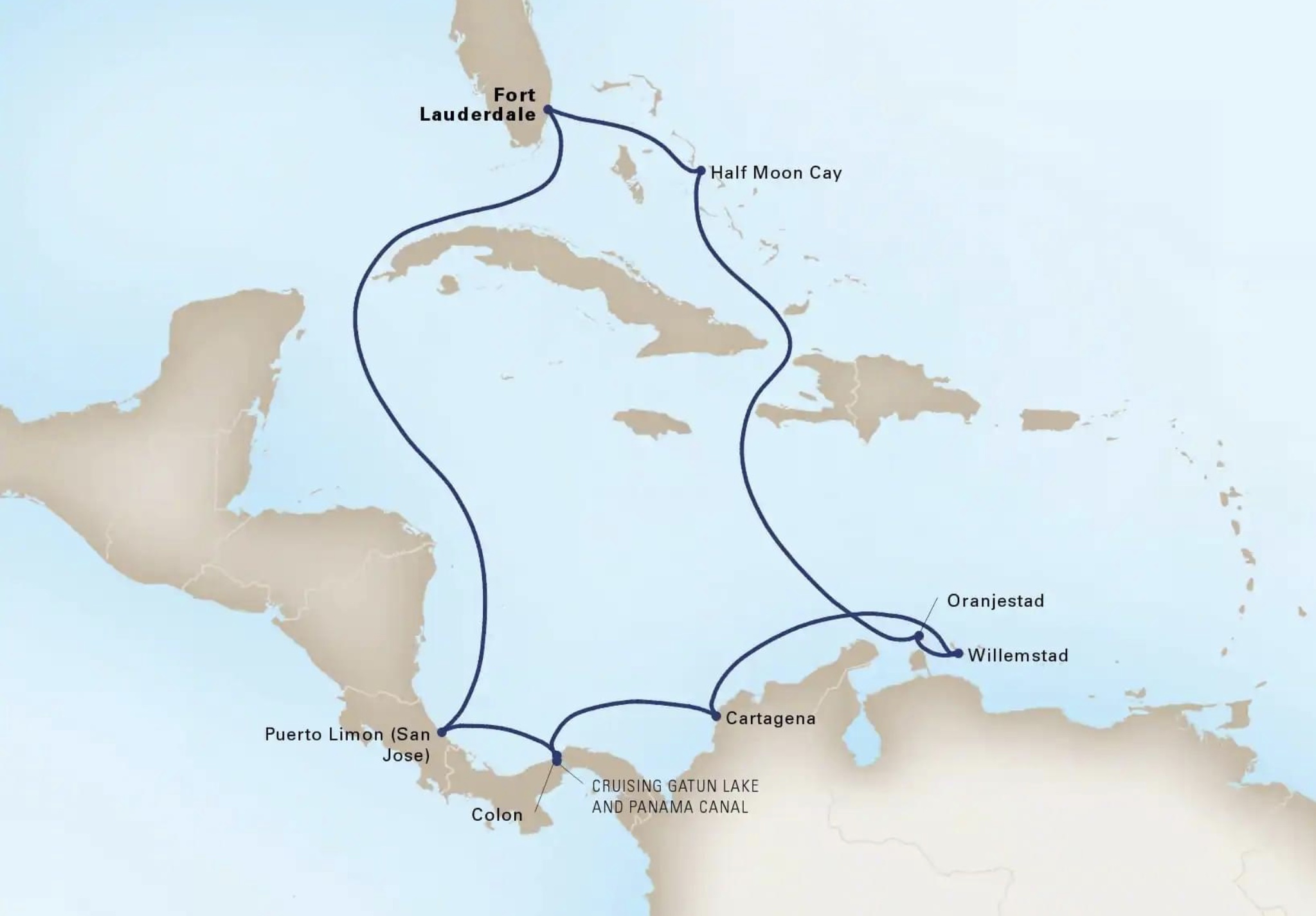
Line Holland America, Eurodam Cruise Itinerary

*

In Memoriam Papá

*

The ‘I’ believes in pleasure, laughter, good food, sex.   The ‘I’ believes in itself, sometimes it is proud of itself but sometimes ashamed of itself.   Who does not carry the stain of shame, a faux pas, a lost opportunity that, just remembering them, cures us of the threatening hubris of believing ourselves, in Mexican terms, the mero mero, the cat’s meow, the king of the forest, the bee’s knees?

Carlos Fuentes, This I Believe: An A-Z of a Writer’s Life; The I. p. 315. Bloomsbury Publishing, London; Translated by Kristina Cordero, Copyright 2004.

*


INTRODUCTION:

Writing for me is the result of reasoning through experience, sifting agenda whether mine or those of others.   In shaping my narratives, the process inevitably extends long beyond the scope of a story.   I cannot define my emotions unless I have spent time examining them.   Unlike a professional journalist, on purpose I avoid writing on commission or for any kind of financial gain.  For a few years now, owing to the Covid Pandemic, I have substituted writing for my brushes and painting studio.   Spontaneity defines these narratives just as it had my abstract paintings.   I struggle for disinterestedness:   a universality intrinsic to every work of art. 

Thus, a narrative’s introduction is ironically an epilogue.  Initially, the conversation taking place between David and me had not been set.  It is through the course of this cruise that evocations are gleaned from the past.  They are our way of understanding ourselves as spouses.

This exploration of the West Indies and the Caribbean held des énigmes.  For us, it was the exploration of an unknown continent. Among these southern lands resided that Little Venice [Venezuela], the source of my current distress:  Why did I have to leave there a half century ago for a frigid Western New York?  This story illustrates both my father’s culture and my own perspective.

In the mutability of time, confessions seek understanding.  Memory comes from/out of habit, opinion, desire, pleasure, pain, and fear.   Each manifests a change.  Like jetsam in times of distress each one of these resurfaces, though not preserved, but transformed into something new.  The succession of worn-out ideas is an act of replacement.  

A wanderer’s hope and prayers I add for those left behind.   In pondering these memories, I examine my own validity and ambiguities.  This reliquary of contradictions stands between intuition and fact.  I seek the readers’ empathy as a transition.

Each alliance of loyalty between fact and intuition can place us in a better universe.  It is our beliefs that the human spirit can rise above life’s vicissitudes.

Here, I wish to include special thanks to Professor Andrew Irving, Ph.D., head of the Department of Anthropology, University of Manchester, England, for his generous support and guidance.  I have known Andrew for the past 26 years, and once I had the opportunity to collaborate on a research project, entitled The Art of Life and Death: Radical Aesthetics and Ethnographic Practice (2017).  Since before the publication of my WordPress’s web page Observations on the Nature of Perception (Visual Art, Aesthetic Plasticity, and a Free Human Mind) – a repository for short stories published as of 2008 – I had already shared with him a number of testimonials on aesthetics, which became crystalized in my post Acts of Individual Talent (2009).    These had evolved over our conversations in the course of thirteen years, starting in 1997 since we met for the first time:

Ricardo realized that the true measure of a painter is the making of art despite the obstacles and challenges one has to endure.   Ricardo was particularly motivated by the fact that there have been innumerable artists whose accomplishments did not depend on engaging with the marketplace.   He was drawn to “all the great works by anonymous artists from Greek and Roman Antiquity, that were plundered, destroyed, and stigmatized during the Dark Ages,” as well as Cézanne, who endured forty years of obscure labor before landing a first one-man-show, and Van Gogh, whose sublimely “outsider” creations were only recognized after his death.   For Ricardo, the term “outsider art” often denotes a prejudice toward individuals perceived to be riddled by some sort of physical or psychological health impairment.   As such, both academia and the art establishment tend to divide art on the basis of its cultural import or through an underlying bias that Ricardo suggests evolves according to market demands.   Another term is folkloric art, deemed to refer to the art of the colonies or the cultural heritage of a nation, which is associated with ideas of shared roots and lived experiences.   “Are these terms in some way similar or different from the issues involved in art produced during the struggle over chronic or terminal disease?” Ricardo asked after reading this chapter, “and while the notion of mutuality is essential to understanding the shared human condition, can it also help to expand sensibilities about understanding human expression in an interdisciplinary scientific context, bound by the myriad circumstances that may engulf human pathos besides biology, be it in sociological survival to fit in or as an effort to therapeutically survive a chronic or terminal disease?”   Ricardo’s response and analysis continued:  “There is great intelligence in the creative efforts made by the human mind to survive any circumstance.   Besides, it is undeniable that bodily pain and mental pain are ubiquitous in life, be it one of privilege or alienation.   The logical concepts of cognitive science with averages, classifications, and algorithms will serve no other purpose than to provide a mere approximation to understanding the complexity of human expression, its diversity, heterogeneity, and inenarrable nature. Can we really come to understand the ways in which different modes of inner expression – such as people’s ongoing interior dialogues, un-articulated moods, imaginative life-worlds, and emotional reveries – if they remain hidden beneath the surface of public activities, hence hidden from research?   Ultimately, that which is mystical about the cycle of life and death may not be elucidated by a tactical approach, but through a profound introspection that is very difficult to articulate.”   In 2008, Ricardo was diagnosed with Non-Hodgkin Lymphoma, a cancer associated with AIDS that affects white blood cells and can emerge when the immune system is weakened for prolonged periods.   Throughout his illness, chemotherapy treatment, and convalescence, Ricardo spent many months sitting in silence in his chair. Beds and chairs are often dynamic sites of thought, expression, and memory for people living with an extended period of illness, whose thinking ranges freely across the past, present, and future.   People remain thinking and speaking beings even when lying or seated in silence for long periods and may be negotiating critical issues, dilemmas, and decisions regarding treatment, work, or faith and be engaged in emergent streams of interior dialogue, thought, and emotion.   It was during this state, which Ricardo describes as one of “high inertia” that he came to recognize the simplicity, power, and aesthetics of silence, especially “when compared with all the noise and visual cacophony of the tangible world at large.”   Of course, a silence is never simply a silence.   Different days are mediated by different silences; an uncertain silence, a good silence, a heroic silence, a surreal silence, a painful silence.   A silence can contain the faces of the people closest to you, thoughts of suicide, images of the world outside, daydreams, and future-orientated life projects.   After months of dwelling in silence, Ricardo wrote a Manifesto of Silence to help him think through and articulate his thoughts. It begins as follows:   “The verbalization of an aesthetic reality implies its own death; no matter how precise, its very accuracy of words resists the magnitude of that reality.   It is found in the open space of silence, in the virtuous stillness of a meditative contemplation, in the freedom itself of the known, free to observe with a heightened attention, where questions are unnecessary and responses trivialize the very observation.”  After finishing the chemotherapy, Ricardo came down with severe tendonitis, which meant he no longer had the requisite strength to stretch canvases in order to paint.   Consequently, when he started painting again he did so on hanging scrolls.   Ricardo came to understand the scroll material and how it behaved in its simplest of terms and in relation to his own physical limitations.   Between 2009 and 2010, Ricardo started to work on a scroll series called Metaphors of Silence, in which “it was this incidental simplicity of the medium of scrolls and my empathy for the nature of silence that produced the subject matter.”

Andrew Irving, The Art of Life and Death: Radical Aesthetics and Ethnographic Practice (2017), Chapter 3, To Live That Life; Observations on the Nature of Perception, pp. 119-24

When I last revised my post Acts of Individual Talent in 2020, I concluded:   What use would creativity or intellect be to us without compassion?, would we not need to assess our system of valuation, perhaps even our own cultural rationality?

More recently, on February 3, 2023, Andrew and I also had a long discussion via Zoom, which was based on my WordPress post Meditations on Ortega y Gasset (2022).  At that time, he provided a critical analysis with extensive bibliography, which, he felt, would enhance my perspective about the Enlightenment and its limitations. 

Furthermore, I extend my gratitude to my friend and editor for the past 36 years, Billy Bussell Thompson, Ph.D., professor emeritus, Hofstra University, Department of Romance Languages.  It is thanks to Billy that I remain hopeful in developing my skills as a writer.

Fort Lauderdale, March 24, 2023

*


Plato’s Symposium:  Diotima on the wisdom of love.

“So do not be amazed if everything honors by nature its offshoot; for it is for the sake of immortality that this zeal and eros attend everything.”   

“ . . . in as much as in the case of human beings, if you were willing to glance at their love of honor, you would be amazed at their irrationality, unless you understand what I have said and reflect how uncanny their disposition is made by their love of renown, ‘and their setting up immortal fame for eternity’; and for the sake of fame even more than for their children, they are ready to run all risks, to exhaust their money, to toil at every sort of toil, and to die.”   [Location p. 37, 207a-208]

Plato’s Symposium:   a translation by Seth Bernardete with commentaries by Allen Bloom and Seth Bernardete, Chicago:   University of Chicago Press, 2001.


*

I

Clouds loomed, as if mountains, over the horizon.  From the balcony of our stateroom, we watched the wake’s effervescent whiteness.  Gulls pierced rolling waves and cawed their disputes.


II

Our travels across the Bahamas and along the coasts of Central America had begun five days ago on the Eurodam.  On January 4th we had left Fort Lauderdale.  Already we have passed by north of Cuba and and south of Hispaniola.  Now, we are approaching Aruba, a mere 76 miles from Venezuela.  A pilot boat will guide us to moorage.  But a fire alarm has gone off, and the stench of diesel permeates the air.  A few minutes later the captain announces: Everything has been brought back to normal.  The emergency has been aborted.


III

David and I are speaking; emergency lights are still flashing.

  • It’s been fifty years since I left.  I was 17.  


IV

We disembark in Oranjestad.

  • Eighty-five years today my parents were ostracized from Germany.   Five years later they married in the United States, where they lived happily until their deaths.
  • For my parents, leaving the country was never an option and their marriage was unhappy.
  • Did you ever come with them to Aruba?
  • Only as a child.


V

  • How was your relationship with them at that time?
  • My parents emphasized independence.     For me they were a bridge to the country, still.     They understood I had to go abroad.   There was no other choice.   From my love for them, ties to Venezuela have never wavered.     Our proximity now, however, elicits no nostalgia, only recollections.    I do care, though. 


VI

  • You must have some memorable moments from then?
  • Camping out with the Boy Scouts on the Andean plateau.  That honed my vision.
  • Anything else? 
  • I remember the ashrams of the Universal Fraternity.  There were monks, followers of Serge Raynaud de la Ferrière (in Valencia, Maracay, and Caracas).  I frequented all three of them, during the summers.  These ashrams schooled its attendees in a mixture of natural sciences and Buddhism:  For me this was more stimulating than listening to church sermons, with their evocations of sin and the shadows of shame.  That’s when I began yoga and meditation.
  • What impressed you the most?
  • I was drawn by the emphasis in self-denial.  But I disliked being dependent on other people.  I just wanted to expand beyond myself.  


VII

  • In those years, I was attached to nothing in particular.  Was I a dilettante? 
  • You were inquisitive; it was a time for discovery. 
  • I went to seminars on musicology; I took German lessons; it was a time for Hesse, Kafka, Gibran, Thoreau’s Walden, and Skinner’s Walden Two.


VIII

  • I read, but unsystematically.  I liked philosophy, history, painting, and writing, but I wasn’t yet dedicated.  Only slowly, did it all become part of me. 
  • These things awakened your spirit.
  • I was free from obligations and they expressed my relationship to the world.
  • You were learning to be original.  You sought your own voice.  You didn’t mimic other people.
  • The more I felt, the greater my involvement.  It was just a way to express myself.  I wasn’t looking for success, or distraction. 


IX

We disembarked and walked over to the shopping malls.  From Main Street we veered into the side ones.  On both sides, most storefronts were boarded up.  The façades showed signs of a better time, perhaps, from when Venezuelans were flamboyant.  Now only makeshift stands crowded the sidewalk, manned by folk with a distinctive Venezuelan lilt:  In friendly conversation, the word marico floated amongst them.

  • Papá once watched me sitting on the curb of a street next to an old watchman who worked for us on weekends and was known for having an unpredictable temper.  The watchman awaited my family’s departure to the city.  I had often befriended him, peppering him with questions.  Later, Papá said I was the only person who related to this man.
  • Your resilience was your best attribute. 


X

  • In the late sixties, our family hosted the daughter of Venezuela’s President Rómulo Betancourt, Virginia.  She and her husband stayed in one of our houses in Valencia.   At that time, Virginia Pérez was the head of the National Library in Caracas.   I was thirteen and Papá asked me to take my paintings from the rooms where the guests were staying.   According to him they were out of place.   One day, after having finished lunch, I brought a framed watercolor over to Virginia and began to speak.   My father objected, but she said, disavowing him:  “No, please, leave him alone.”   I continued:   “It shows the spirit of a young man in search of freedom.”    Sweetly she responded:   “I like your way of thinking; I want to hear more.”   Words now failed me. 
  • (David chuckling), you told me this once before.


XI

  • Can you tell if you fit into a pattern, or is your life just a series of episodes?
  • I don’t see the disconnections; I can’t say if there’s a pattern.   I was just bold then.   My speech, vocabulary, and the way I looked must have seemed provocative, perhaps, even epicene.   I threatened expectations.   I was different from my older brother, who was athletic and had lots of friends.   I was a loner.   For my lack of sport, maybe Papá found me not only vulnerable, but also naïve.   Was it dissatisfaction or was it nonconformity?   I only found solace in my private inventions.  Shortly afterwards, I erased, slashed, tore two years of paintings, only to regret this later.   Papá said I was rebelling against my own culture.  
  • Your father knew you couldn’t survive a world of machismo and its deeply rooted biases.
  • That’s the point.   I hadn’t understood that yet.    Papá saw my creativity as a target for victimization.   He told me I couldn’t be a lawyer.   I wouldn’t fit in.   When I argued I could go into international law, he was equally incredulous. 
  • Perhaps, for that same reason, he never got involved in politics; he knew human imperfections carried their own risks; he recognized the kind of dishonesty that pervaded Venezuela.   He wanted you to be safe.  That’s why you had to leave.


XII

  • I’ve come to understand that exceptionalism is a myth.   Disappointment is powerful.   I had to leave. 


XIII

  • Even if I am surrounded by falsehood, I must not be cynical.   What does that serve?   Human imperfections can’t be freed from themselves.   I feel uncomfortable, however, when people ask where I am from, as if they are diagnosing who I am.
  • Most people don’t mean anything by it.
  • It’s my own reaction.   I suppose it proves I am not comfortable with English.   It feels as if people are placing me in a niche.
  • Most people can identify with that, I do for one.   Few of us ever get the questions right.
  • Does anyone, really?   If they did, answers would be unnecessary. 


XIV

That night, it rained.   A full moon unveiled itself from behind the clouds.    We stepped again onto the balcony and admired the kaleidoscope of twinkling lights across the island.

  • In the first few years outside of Venezuela, I was enamoured of life in the United States.   Long before going there, my Aunt Lina’s place in Buffalo had filled my dreams.   She was able to flee the Holocaust.   Her rose garden was just what I had imagined.   Her graciousness was the same as when I had met her in Venezuela.   Her garden left a lasting impression on me. 


XV

That morning we anchored in Willemstad, Curaçao, surrounded by a rumpus of pelicans near the pier. 

  • On my first visit back to Venezuela, Papá asked me what I thought about the inflation in the United States.   I never knew why he posed that question.   Its irony was not lost on me 50 years later, when Venezuela has accrued one of the highest rates in the history of the world.


XVI

We went sightseeing in Willemstad.   The city’s old buildings, streets, and bridges were reminiscent of Amsterdam.   We took photographs and wandered around slowly.   Then thinking of our families, we shopped for table linens.

  • Do you think your father foresaw the disintegration of Venezuela? 
  • The world where I grew up was always on the brink.   Papá used to say he did not know how we were going to manage without him.   He feared for every aspect of our lives, and even for every Venezuelans’ families.   He even feared a total civil brutality in that landscape of pervasive dishonesty.   How could it be prevented?


XVII

Keeping to ourselves, we had a full day at sea.   We ate alone.   We had little in common with the other passengers:   all two thousand of them.

  • After twenty-four years later, I came back.   Without a gallery’s contract, again I have thought about destroying my paintings.   This time, I was tempted to burn them, but the flames might have engulfed me and my home.   This thwarted me.   I could only store them.
  • Couldn’t somebody have helped?
  • Papá did the best he could, even inciting jealousy among my brothers and sisters.  Perhaps, he felt sorrier for me …. When I was interviewed by a local newspaper concerning my work in the United States, a lot of our neighbors thought the interview self-serving.   Then Papá died and I became even more of an outsider.
  • What happened to him?
  • By the age of 70, he had become delusional, untethered from his own will.   His last five years coincided with Venezuela’s disintegration, and family members sought safety in Europe and elsewhere in America.   For me art became secondary.


XVIII

  • What about your brothers and sisters?
  • It’s sad to say.   Their sense of entitlement has complicated matters.   My older brother claimed the right of primogeniture, though he had no legal authority for such.  We denied it to him, but lacked the resources to challenge him.  He kept the rents mostly for himself.  With the passing of years, the properties have lost value and some have been taken over by squatters, and some even expropriated by the government.  Out of concern for his safety, I made an offer to help him.  He rebuffed me saying he counted on the first Lady of Venezuela.  He added that he could not leave Venezuela and lose his identity as a lawyer.
  • These explanations are puzzling.   And what about your two sisters and younger brother?   What has happened to them?
  • My youngest sister moved to Madrid with her husband and two young daughters.   My other sister and younger brother have stayed in Venezuela.   They protect each other as well as they can.    For the last ten years, I have been helping them and my paternal aunts.
  • I remember meeting your aunts.   That was when I traveled to Venezuela with you.   We celebrated your mother’s eightieth birthday and your older brother’s remarriage.   I also remember his son’s grief.   He seemed inconsolable.   Didn’t he move to Argentina with his partner?
  • Yes.   We also did our best to console him, such as when he met my former partner, Nelson.   He felt reinforced by our presence, and my relationship with Nelson triggered a validation that his father had always feared.    All along my nephew sought his father’s acceptance.   I told them there was no place for shame.


XIX

Not too far from where we are, in a small fishing village on the Caribbean coast of Venezuela stands a plinth.  It pays homage to guerrillas sent by Cuba to Venezuela in the 1960’s.  Their campaign collapsed.  Five decades later, Hugo Chávez helped achieve Cuba’s fantasy – this time without firing a shot.

  • I cannot judge Venezuela nor its history, for I no longer am part of it.  I have not suffered the lash of Venezuelan repressions.  For the past 50 years, I have been in the United States, where measures of rectification constantly challenge authoritarianism and kleptocracy.  
  • Recently, you spoke to my friend Cindy, who is an analyst at the US treasury.  She told you quite frankly that the American government’s sanctions on corrupt Venezuelan individuals are not simple issues.  The flight of fortunes from countries like Venezuela cannot be easily controlled where there is flagrant corruption. 
  • Indeed, that’s a reality no one can manage.


XX

  • In your opinion, is there any hope for Venezuelan stability? 
  • It’s complex.   It is inexplicable how, for instance, billions of dollars are acquired out of nowhere by the children of local politicians.   They care not at all for its constituency or for their country:   A nation of laws has ceased to exist.  


XXI

  • Have you ever interacted with Venezuelan officials? 
  • Only indirectly, through second and third cousins (who worked in the executive branch and the Ministry of Foreign Relations) as well as my own brother (who was a legal advisor to a State governor).   Aside from them, I have only engaged a would-be reformer, who now lives in Florida.   In 1999, he was one of the congressmen involved in writing  the last Venezuelan constitution.   Currently, among expatriates, he has a large following.   In one of his podcasts, he took issue with me over the lack of maturity in Venezuelan politics.   He replied furiously to my allegations of self-interest:   ¿Y quién coño eres tú?” [And, who tha fuck are you?].   Later, I sent him a text “in general most reformers fail to address what they intend to reform,” and he replied:   ¡Ay, por Dios, éste es un gran maricón! [Oh, my God, this man is just a faggot].   Then he blocked me. 


XXII

We arrived in Cartagena, Colombia, where we toured the old walled city and the Fortress of San Felipe.   Long undulating promenades (covered by trellises draped in bougainvillea) were delightfull and hugged the walls of the malecón.  The guide spoke of the father of Greater Colombia, Simón Bolívar, who had died at Santa Marta.  He pointed out a wine-colored fortress where Gabriel García Márquez had resided.  

  • Even though I did not take part in the protests, with my keyboard I favored dissenters and insurrectionists alike.  This was my cri du cœur.  Though we have all failed, for me the morality of this call has never gone silent.
  • It’s your voice.
  • Time itself is an instrument that balances the absence of truth, the swing of delusion, and the debris of extremism.  As time unfurls, it allows us to come to an understanding. 
  • It heals our madness.
  • Maybe, justice will prevail.   Maybe, harmony will be achieved in a new generation.  
  • Also, when we least expect it, despots may usurp our freedoms.

XXIII

We were now in the Panama Canal about to enter the Gatún Locks.  Pulled by trains on each side, the ship climbed up through three locks until reaching the waters of Lake Gatún.  The architectural feat of the Canal sparked my imagination (suddenly I thought about the Egyptian Pyramids).   We reached the shore of the lake on tenders and from there we made a tour by bus.  We zigzagged through hundreds of military buildings and army barracks until we arrived at the Locks of Miraflores on the Pacific.  From there we drove to the Old City, where we photographed its colonial buildings and plazas.  Clustering across the bay, we could see the skyline of present day Panama City.  Then we drove to Colón on the Atlantic.   Just before boarding back on the Eurodam, we walked through a small zoo leading to the pier.  Roaming around, among mammals and tropical birds, we saw a giant anteater and its long tongue, swallowing a thousand morsels.    David brings up politics: 

  • No country is exempt from the excesses of partisanship.
  • But we don’t know the reasons.
  • Do you think an apolitical consciousness is called for?
  • I only know that extremism is no remedy for human uncertainty.
  • The danger is always that polarization can turn into warfare.


XXIV

We arrived in Costa Rica, anchoring in Limón.   We disembarked to board a tourist bus.   Then we got off to navigate in small boats through the channels that ran along the edges of the jungle.  In heavy, intermittent rain, we saw monkeys, sloths, toucans, snakes, alligators, and crocodiles.   Once the ride was completed, we got back on the bus, which took us to higher altitudes.  When we arrived, we took a cable car into the heart of the rainforest until reaching a research lab, a butterfly garden, and a trail that led to waterfalls.  The wooden stairs of the path were slippery from rain.   Unable to proceed farther, we heard the thunderous sound of the cataracts.

  • I was born in a land of wealth, which is what attracted my ancestors.   They came to Venezuela as early as 1745, both from Europe and the Canary Islands.   Between 1799 and 1804, the German geographer, Alexander von Humboldt, in his writings, lauded the colony as a paradise for the advancement of science.   Today this paradise struggles for its own survival.  


XXV

  • On May 13, 2014, I received an answer to one of my queries from the White House’s website for foreign relations, on behalf of President Obama.   The email bore the letterhead of the White House, though obviously pro forma.   In closing, it read … With our international partners, the United States is continuing to look at what more we can do in support of that effort [i.e. ‘for an honest dialogue between the Venezuelan government and the opposition’].   America has strong and historical ties with the Venezuelan people, and we remain committed to our relationship with them.   Their fundamental freedoms and universal human rights must be protected and respected.
  • To an impartial reader this email may seem either empathetic, or even propagandistic; but the reality is that Venezuela may need the United States, not the other way around, at least not at this time.


XXVI

The last two days at sea, we dined in private restaurants.   I took notes of our conversation.   David indulged my writing and editing until he complained that I wasn’t paying enough attention to eating.   Writing seemed to be the one habit I could not ignore.   It was my solace.   That last night, when passing along the southwest coast of Cuba, the rough waters of the sea made walking unstable.   Before midnight, we packed our bags and placed them in the hallway outside the cabin door.

  • Past, present, and future time collided:   Chávez’s death in 2013 led me to think about Papá’s in 1997.   The year before, I had taken him to urgent care at a private hospital.   A neurologist there said he had suffered a brain injury and there was little to be done.   He was 74.    He could no longer speak.   Suddenly, surprisingly, he sat up in anger; something obviously gnawed at him deeply.   He threatened.  
  • To the bitter end, your father was tormented.   You could neither appease nor redeem him.


XXVII

Next morning was our twelfth and last day, as we arrived in Fort Lauderdale.   We went to breakfast on deck two and, again, we ate alone.   Then, returning to deck eight, back in our stateroom, we waited to disembark.   We were the third group, color red, and, finally at 11 am, were summoned.   We went down to deck one and lined up with the other passengers.   After our ID’s were scanned, we walked down the ramp to the terminal, collected our luggage, and exited.   We called a Uber to take us home, where we arrived 12 minutes later.

  • Papá’s and Hugo Chávez’s death spared them both from the torment of national crisis.
  • For Venezuela’s new generation, social inequities are rooted in differences of ideology.
  • Is the new generation a throwback to the Cold War?
  • Can the new generation examine itself?
  • As long as the inquiry is not reactionary:   i.e. an inquiry into truth.
  • This dilemma is not unique to Venezuela.   Over this, the whole world struggles.


EPILOGUE

*


Plato’s Symposium:  Agathon’s encomium on Eros.

“And don’t we know that . . .  he whom Eros does not touch remains obscure?”

“. . .   he is the one who makes

            ‘Peace among human beings, on the sea calm/

             And cloudlessness, the resting of winds and sleeping/

             Of care”.   [Location p. 25, 197 a, c]

Plato’s Symposium:   a translation by Seth Bernardete with commentaries by Allen Bloom and Seth Bernardete, Chicago:   University of Chicago Press, 2001.


*

Love’s grace suggests a continuation of learning.   As David raised the shades (allowing the sun’s rays to stream into our living room), he hummed:   “Be it ever so humble, there’s no place like home.”    In response I:   “How precious did that grace appear, the hour I first believed.”   We continued:

  • Life is soaked in uncertainty.
  • The measure of our limitations is uncontrollable.
  • Hope is always an option.
  • Faith is bigger than ourselves.
  • Strife never conquers it.
  • Tranquility defines it.
  • Action fulfills it.
  • Least said. . . .


The End

Ricardo F Morin

Edited by Billy Bussell Thompson


“Meditations on Ortega y Gasset”

December 19, 2022

*

Acknowledgment

I

First, I would like to share with my readers my utmost gratitude to Billy Bussell Thompson (b. November 23, 1942), Ph.D., Professor Emeritus of Linguistics at Hofstra University, for his generosity in being a mentor and editor.       His scholarly trajectory goes from 1963 to 1993.        Among his most salient publications in English, we have:       Relic and Literature . . .; Bilingualism in Moorish Spain; The Myth of the Magdalen . . .; etc. . . .

II

Since 1989, our friendship has extended over more than three decades.       We have worked in close proximity on at least a dozen articles and short stories (published in WordPress).        I have been fortunate to count on his frankness and support.       He has never minced words.       He has been blunt, when any of my drafts seemed without merit.        When that was the case, the articles went into a shredder, and I was satisfied by the integrity of his prose, as well as by my understanding of my own limitations as a writer.        Prof. Bussell Thompson (B.B.T.) usually compares the skill of prose writing with that of a narrowing cone of vision.         This selective cone of vision is akin to the aesthetic integrity of a visual work of art.       With the present endeavor, Prof. B.B.T. believed, from the very beginning, in the possibility of bringing forth this story as a team.       Even though we live in different regions – geographically far apart – of the USA, we have had no trouble communicating via phone and email.

III

This narrative seeks to explain the confusion found in society and politics, and even their seeming lack of purpose.     For this reason, I dedicate my narrative to the readers.

IV

Initially, I knew not where this would lead.           I submitted a five-paragraph draft to professor B.B.T.       As he began to read, he paused and asked if I was alluding to Plato’s allegory of the cave.     Surprised, I asked him to stop.       I replied that his reference to Plato placed me in a different perspective.       Gratefully, I added that his question was most welcome; at that point, I wanted to read more before continuing.

V

He encouraged me to reread Plato’s dialogues.       To this he added that I take into account any ambiguity associated with Plato’s conception of the ideal authority of the State (politeia) or Nation.       He referred to the Platonic ideas controversial in current discussions.        He also recommended reading José Ortega y Gasset (1883-1955).        He included The Revolt of the Masses [1929] and The Dehumanization of Art [1925].         He suggested that I be aware of Ortega’s meritocratic liberal perspective (though we believed that Ortega had not been known for openly endorsing any political ideology) and to heed the relevance Ortega gives to the man who is aware of his limitations – opposed to the man who is unaware:     both the bourgeoisie and the mass man (who exemplify, for him la razón sinrazón [the reason for unreason]) – as explained in The Revolt of the Masses.       And finally, I focus on the distinction between “content” and “form,” to explain the break by the avant-garde from the bourgeoisie.

VI

Professor B.B.T. and I also had an exchange of ideas over the parallels between the Platonic and Orteguian thought.      He advised me then to read anew Meditations on Quixote [1914] both in Spanish and in English.      There, B.B.T. thought that I could find a significant or productive landscape of ideas on which to reflect and, thus, be able to develop my own interpretations about the nature of knowledge, its limits, and how to find the meaning of the ideal of truth.

VII

In writing my last short story, entitled In Darkness, Professor B.B.T. had already urged me to note the meaning for circunstancia1 (“circumstance”) as defined by Ortega in Meditations on Quixote.       It was clear to us that both Ortega’s phenomenological approach to “circumstance” and Plato’s thesis on the transformation of the individual (through knowledge) shared commonalities, which nurtured my own narrative.

VIII

But, the narrative journey proved to be just as challenging as Professor B.B.T. had pointed out.     His criticism, even then, never ceased being constructive and energetic.    His compassion was present as long as I was mindful of the necessity for clarity and precision.    Often, he would cite Ernest Hemingway’s authenticity and precision. 

IX

Time and time again, I experienced enormous pain in trying to comprehend what I wished to express.    Freeing my prose from superficiality was like taking a deep breath to exhale the vagueness of my anxieties.    Sometimes I was unable to get away from the obvious.    Other times, either I hid behind the complex, or I would cling to abstract and cryptic thinking:    the reductive jargon of the social sciences.    Professor B.B.T. repeatedly suggested succinctness:      I needed to respect the simplicity of language and find a way to its accessibility.    Bringing Plato and Ortega to the reader was my responsibility.    I was not to imitate them nor to think like them, but to represent them authentically.    My first obligation was to the reader.    For this I had to avoid euphemisms, randomness, and diversion.    The affirmation of effective communication is an objective worth the effort.      I would only understand myself, if I were to understand the reader.

X

B.B.T.’s exhortations and criticisms, I welcomed enthusiastically.    His challenge became mine.  He has been exorcising my limitations for two decades:    Every time we have worked together, I have discovered something new in myself.    I have become more attuned to both English and Spanish.    I have had to be my own translator.     In these instances, I have grown more respectful of the two languages.    I have had to capture their essence by comparing them:     the one informs the other.

*

Prologue

In Plato’s dialogue Theaetetus [circa 369 B.C.E.], Socrates proposes that the extraordinary extraction of ideas is like bringing forth a new life and purging what is unnecessary.    Likewise, the aim here is to produce and discuss what enlightenment is, and the obstacles to its achievement.    Socrates has helped me in my definition of knowledge:     Is morality universal, or is objective morality even possible?    For these ideas I am indebted both to Plato and to Ortega y Gasset.

Ricardo F Morin, December 19, 2022

Editor Billy Bussell Thompson


*

Plato, Roman marble bust copied from Greek original, 4th century B.C.E., Capitoline Museums, Rome.

*

Socrates, Roman marble bust copied from Greek original, 2nd half of the 4th century B.C.E., Capitoline Museums, Rome.

*

José Ortega y Gasset (1883-1955), detail of photograph of his impersonation of Honoré de Balzac, circa 1900.

*

One way to objectivity is to recognize one’s own subjectivity.    Metaphors for understanding reality are rare.    One sees the world primarily through one’s own experience.    It is difficult (though not impossible) to understand what one has not experienced.    Truth never rests:  It is not singular, but always plural.

Anonymous

*

1

Index

  • 1. Awareness of the Transformation of One’s Self:

The highest principle of inquiry is consciousness of one’s self.    In inquiry lie the beginnings of change.


2

Index

  • 2. The Absence of Trust:

In our age of disbelief, the stories we tell each other about the past and the present seem to be in a state of collapse.    There is a lack of continuity in the social order, increasingly suffocated by misinformation and distrust.  We challenge each other over what is real and what is not.

3

Index

  • 3. The Unassailable Truth:

For most of us an ultimate truth remains unattainable and the stories we share from the past and the present no longer seem useful.    Along with the disappearance of our past stories, both the person who seeks truth and the act of giving a person his due are in crisis.     Our society finds itself defined by a decline in trust both in government and its institutions.    Despairingly, the challenge is that the creation of new stories has become an act of preservation.     Likewise, autocracy is on the ascendance.    A lack of faith has sown aimlessness.    What can change this course of despair?    What will bring enlightenment to us?


4

Index

  • 4. Consciousness:

Knowledge is constantly changing and the result of this destabilization carries us into greater disorder.     For this reason clarity is more necessary than ever to understand ourselves.     Even if clarity is not always possible, to know oneself is imperative.    Thus arises the tension between continuity and change.    Here lies the quest for survival.


5

Index

  • 5. Not Knowing:

Not knowing is the essential condition of existence, despite one’s apparent desire for knowledge or for authority.     To know is to inquire.     Reality, though fleeting, inspires reflection.     Change begins with the recognition that one is not in isolation.     Not even the one (who seeks self-sacrifice for his spiritual advancement) by absolute cloister could get rid of his entanglement with the world.    It is by relating to other people and his environment that this person comes to know who he is.     Not even he (who despises the symbols of fear) is capable of freeing himself from his anguish.   The fear of not knowing hangs over all of us.     It is possible that striving without measure (in the aspiration for rationality) only leads us to end up being irrational:     Here lies the origin of complexity given the absence of innocence.


6

Index

  • 6. The Energy of Life:

In his theory of cultural attributes (Meditaciones del Quijote, Meditación preliminar; Índice 8, La pantera o del sensualismo, pág. 21), José Ortega y Gasset gives us his concept of razón vital2, which means reason is expressed through life itself.    Ortega parses the European mind into two archetypes:     the Germanic and the Mediterranean.     The former is meditative and the latter sensuous.   Of the sensuous he says:     The predominance of the senses usually implies a deficiency in inner powers.    What is meditating as compared with seeing?     As soon as the retina is hit by the arrow from without, our inner personal energy hastens and stops the intrusion.     The impression is registered, subjected to civilized order; it is thought, and in this way it is integrated in the building up of our personality, and cooperates within it – Evelyn Rugg and Diego Martín’s translation – Notes and Introduction by Julián Marías – pp. 85-86.     The Orteguian admonition here is to find the balance between extremes:   between the excesses and deficiencies of these two archetypes.


7

Index

  • 7. Human Agency and Its History:

A second source for my understanding of the mind and the senses is found in Plato’s Republic (politeia) – Socrates’s dialogue of the allegory of the cave at the beginning of Book Seven.     There have been many interpretations.     Mine differs.     My purpose is to rid suffering from the mind of the freed slave.     Once freed from shackles, the mind of the freed slave (who ascends to the mouth of the cave) discovers its own vision of the world.     Despite the sun’s glare, the uneducated mind is transformed by the newly found ideal of truth.     But the awareness by the prisoner (who has remained behind) is inseparable from the condition of the freed man:      The slave (remaining in shadows of suffering) is not entirely separable from the memory of the freed man.     Because of suffering, the freed man’s mind is aware of its inability to know.      At the same time, the freed mind learns how its own transformation may be dependent on the new course of its history.     This mind’s actions allow participation in change, and change is possible through self examination.      The mind examines itself through meditating.     Meditation is not an obligation, but a necessity.     Meditation is the result of the mind’s freedom and it is the means to understanding its own choices in its approach to truth:     But this effort is only an approximation to the infinity of truth.     The freed mind (facing the visible world) is lacking here.    Thus, the freed mind recognizes that neither its actions nor the course of its history is predictable.     They (i.e. the mind’s actions and the course of its history) come from multiple possibilities about belief.  

The freed mind realizes that time is an illusion:     Time is fleeting, false, and deceitful.     The mind, habitually trapped in its past, remains mired in pain.     Anger (which comes from the past in search for justice) has for its sole purpose the manifestation of resentment.     But anger only manages to put its existence on hold, awaiting compensation.     Just as time is an illusion for the mind, the quest for emotional reparation is also an illusion.     For the mind, there is no vindication by being trapped in the labyrinth of illusion.     Only the rationality of active love can compensate for anger.     If the mind of the lover of truth can project itself lovingly in the direction that it resents, then a liberating sense of bravery arises towards itself.     Anger and sentimentality are one and the same.      As the force of love sheds sentimentality, one’s desires dissipate and with them anger as well.     Thereby, violence ceases to exist.     Socrates’s allegory of the mind (freed from suffering) carries all these implications and comparisons towards a goal of Ideal Truth.


8

Index

  • 8. Alertness:

In an effort to understand Ortega’s concept of circumstancia (“circumstance”), his Meditación preliminar, Indice 6, Cultura mediterránea, explains to us that when he goes through the landscape of ideas he has to meditate with alertness on the influence of his experiences.     Needless to say, this includes all his past and present relations, the geographies he has occupied, and everything he has done in life.     Ortega forewarns us of the risks in this act of meditation:   We are accompanied by a keen suspicion that, at the slightest hesitation on our part, the whole world could collapse, and we with it.    When we meditate, our mind has to be kept at full tension; it is a painful and integral effortIndex 6, Mediterranean Culture, translated by Evelyn Rugg and Diego Marín (Introduction and notes by Julián Marías [a favorite student of Ortega y Gasset]), p. 34.     In Plato’s dialogues, the same “effort” is found:     Through the act of meditation, Socrates’s freed man draws transformation and redemption from the narrow crevices among ideas.     Meditation helps the lover of truth get closer to his existential condition; it offers him the possibility of reacting differently, and sustains him with the very energy that life provides.


9

Index

  • 9. Faith:

For the one who fears meditation, having faith in one’s own actions and changes are not sufficient for inquiry.     History is not alive for him:     It is at a point of no return; it is dead.    This person is in a world of despair and surrounded by the proverbial dancing of shadows.     This person is bound in his own chains, is overwhelmed by a lack of confidence, and is, without trust, unable to make a leap of faith.     Neither the notion of individuality nor the concept of free will seems satisfactory any longer.      This person relinquishes personal power and is unaware of the forces influencing his mind and his senses.     His refusal to face reality becomes a conscious decision for the suppression of truth.     This refusal is antithetical to life itself.    For him, life becomes enslavement and stands in opposition to the freed man, who fearlessly ponders the reality of the visible world, and passionately delves into the exploration of the unknown.   The mind of the freed man represents Ortega’s concept of razón vital, desirous to be absorbed by it.


10

Index

  • 10. Deliverance:

Distractions can be multiple.     In Ortega’s playful analysis, he implies that if meditation is extraneous to the fears of the mind, it can succumb to obsession, and even fall despairingly into manias.      Ortega values the relevance of every influence.     He understands that a human being and his landscape are not separate.     The unity of the two means his salvation by circunstancia (“circumstance”):   Thus his appreciation of circunstancia:    Yo soy yo y mi circunstancia, si no la salvo a ella no me salvo yo – Al Lector, Índice, pág. 41 (which I translate as “I am myself [in a world of perceptions] and also the material world that surrounds me; if I don’t save them, I don’t save myself”).     Incidentally, here Ortega preempts his conclusion with what he has read in the Bible:   Benefac loco illi quo notus es3  (loosely translated into English as “do good in the place where you are known”).     With these remarks, Ortega reinforces the idea that he is unable to disassociate himself from his surroundings.    If he is to flourish and to find salvation, it will be necessary for him to understand and protect what he shares with his environment. 

Parallel to Ortega’s analysis is Plato’s Socratic allegory, which teaches us the effect that the visible world has on our mind.     From these two perspectives, the mind tends to be discouraged by what it does not understand.     Awareness of the visible world’s influence is for both thinkers an instinct for survival.     To be aware, therefore, means to be silent, away from the deafening sound of fear.      As long as there is fear, promoted by the progress of civilization, there will be no movement or separation from distractions.     Confronting fear means dispersing it, making it disappear.     Dispersal of fear is fundamental to the understanding of self.      Releasing oneself from fear is confronting one’s not-knowing.     Enslavement (at the depth of the cave) is equivalent to accepting the impositions of fear.     Both, for Ortega and Plato, the opposition to indifference is found through meditation; thereby one is able to be alert and know oneself.


11

Index

  • 11. Perception and Storytelling:

​True confidence is living in uncertainty.     An overriding fact is that human beings organize themselves around the making of stories.      Every story we create is an act of piety that consoles the mind.      Yet new stories and old ones are provisional tools that fill the gap of our faith, filling in the void of our ignorance.      Whether the story be true or not, storytelling rescues us from ourselves.      Storytelling is our razón vital.    It seeks to expose us to the best possible meaning of ourselves:     Meaning in storytelling is found by investing oneself with the willpower to exceed adversity.    Meaning is found by creating something new within oneself.    Meaning is found in one’s vulnerability and in the constant pain to overcome it.      The process of finding meaning reveals that one cannot control Truth.     Happiness depends on how one accepts the absence of control, and how we can stop disliking our limitations.​

Storytelling persuades us to think that one’s actions will spread deeply into one’s consciousness.     One may not always be able to defeat the element of preconception, for bias is always with us.     As long as suffering, uncertainty, and the effort to overcome them exist, bias will persist.     Bias lurks behind our thoughts, quiet and insidious, yet it is there for a reason in spite of its harmful effects.    The irony is that if one banished preconceptions, there would be no further progress.    In any story, if the hero overcomes the villainy of bias, it is because he is able to change:     If one does not overcome bias, one does not grow and there is no transformation.     Success is not as important as the struggle to overcome bias.    Every time adversity comes to us, it is an opportunity for the recognition of those preconceptions that still reside in ourselves.     Success does not provide happiness.     Happiness is only possible through self discovery.     As such, one becomes symbolically the whole of humanity.     This is its highest expression:     The creation of something new as we face adversity, and the worse the adversity, the greater the opportunity.


12

Index

  • 12. Reasoning (sentience vs sapience):

Awareness of fiction is the appreciation of the paradox between what is and what is not.     Knowledge expresses not only the awareness of one’s own intuitions and senses, but also the reasoning about those intuitions, senses, and impressions.    That is, every time we examine the perception of our memory, we are editing our understanding.    Thus, the way we organize and observe ourselves comes from our desires and senses at that moment, and this comes from our memories.    For instance, it is difficult for us to agree on a common origin or a common thread uniting us as a species, even if that may be true.     Whether we wish it or not, we define ourselves by the histories we create either in groups or in countries.     In doing so, we are actually imagining separate and fragmented believes that we belong to separate locales, cultures, and races.     Yet, there is an unavoidable thread that connects us as a species.     Such composition is found in our common and preponderant origin, though our perception may resist being part of it.     We endow ourselves with differences dictated by the conditioning of our perceptions.     In The Revolt of the Masses, Ortega refers to this condition as la razón de sinrazón (“reason without reason”), which explains our deeply rooted irrationality and fragmentation.        Knowledge implies greater content than what is gained through the form of our perceptions.     Our minds tend to abbreviate history, even believing that it does not exist. Yet the more expansive the “circumstance” or condition of apprehending truth, the greater the maturity our existence demands from us.


13

Index

  • 13. Maturing Emotional Intelligence:

If a human being is the measure of all things, then also one comes to appreciate that knowledge is always inconclusive.     Thus, meditation strengthens our mind, our memory, our learning, our attention, and our self awareness.     Meditation on the past, the present, or the future depends on emotional intelligence.     Emotional intelligence is based on capturing the import of influences from all areas of a man’s life, from one’s behavior to one’s relationship with others and one’s environment.     Ultimate reality depends on the level of maturity of a person, and it is through meditation that one matures.     Hence, how a person chooses to act depends on meditation and his level of emotional intelligence.     For the fanatic (obsessed with fear) meditation seems impossible.     For the fanatic, doubt is not the issue.    The fanatic seeks to reiterate cycles.     The fanatic fails to understand that fear of change is irrational because it is inevitable that the world is constantly evolving.     The fanatic seeks to change what is beyond his control.     From the Orteguian point of view, this person, within a closed valuation system, does not find consolation because his mind fears what it does not understand.


14

Index

  • 14. Our Connection to the Universe:

From Ortega’s perspective of Cervantes’s Don Quixote [1605-15], we learn that the courage granted by Love – not hate – impels us towards understanding …the useless remains of a shipwreck that life, in its perpetual surge, throws at our feet. – To The Reader, p. 31.    Love is a divine architect who, according to Plato came down to the world – ὥστε τὀ πᾶν αὐτῶ ξυνδέδέσθα – so that every thing in the universe might be linked together:      Separation means extinction.     Hatred, which separates, isolates, and pulls apart, dismembers the world, and destroys individualityTo the Reader, p. 33.

Hence, Ortega explains that the imperative for the individual is to reflect on one’s circunstancia (in medias res), … to arouse the desire of understanding the universal in its particulars. – To the Reader, p. 31:     To ignore the fact that each thing has a character of its own, and not that we wish to demand of it, is, in my opinion, the true capital sin, which I call a sin of the heart because it derives its nature from lack of love.     There is nothing so illicit as to dwarf the world by means of our manias and blindness, to minimize reality, to suppress mentally fragments of what exists.     This happens when one demands that what is deep should appear in the same way as what is superficial.     No, there are things that present only that part of themselves which is strictly necessary to enable us to realize that they lie concealed behind it. – p. 62.


15

Index

  • 15. A Heroic Perspective:

Knowledge comes before fanaticism.     Fanaticism is, for Ortega, the rejection of the perspectives of others.     Ortega points to reasoning as an act of charity, which uncovers differences, and suggests that understanding is akin to the circling of an eagle in flight.      To be oneself, for Ortega, is the same as it is for Cervantes.      The act of being a hero takes place through a sensitive exploration of the nature of reality.      In Ortega’s view, as well as for Cervantes’s, the will of the hero belongs only to the persona of Don Quixote:   Because to be a hero means to be one out of many, to be oneself if we refuse to have our actions determined by heredity or environment, it is because we seek to base the origin of our actions on ourselves and only on ourselves.      The hero’s will is not that of his ancestors, nor of his society, but his own.     This will to be oneself is heroism. – First Meditation, 15, The Hero, p. 149.    
I do not think that there is a more profound originality than this practical, active originality of the hero.    His life is a perpetual resistance to the habitual and customary.    Each movement that he has to make has first had to overcome custom and invent a new kind of gesture.    Such a life is a perpetual suffering, a constant tearing oneself away from the part of oneself, which is given over to habit and is a prisoner of matter. – First Meditation, 15, The Hero – p. 149.


16

Index

  • 16. The Fear of fate:

A Socratic life is heroic, but if unexamined, of no value.     In the pain of living, one has to embrace the fact that the examination of fear is part of life.     Alongside this examination, fate is never artificial.     Fate does not deceive, even in our misfortunes.      Fate is not illusive, though our perception of time may be.      Instead, fate challenges us to change.      In change, fate protects us from stagnation.     What appears to be random is, in fact, an opportunity for learning.     Consequently, fate exists not for attacking, but for stimulating our transformation.     Fate does not move against us, but challenges us to change by confronting obstacles.     Fate attacks fear, because one’s fear takes away one’s ability to make choices.    Narratives of fear turn out to be self-fulfilling prophesies.      Fear deceives and defines us.     It hampers survival.     Fear prevents our evolving, it paralices us:     We resist giving up habits because of fear.     Thus one languishes and fails to overcome disbelief.


17

Index

  • 17. Boundlessness and Humility:

The shadow of shame represents one’s flaws.    The shadow is what one wishes not to be, though its shadow be part of oneself.     Only, when the shadow is accepted with humility, do its flaws dissolve in the act of loving oneself with compassion.     Ultimately, the fanatic will recognize his incompleteness and become aware of his own insignificance:     The incapacity for completeness looms over all of us.     Only through risk does one learn the extent of one’s bounds and how much further one may go.     We advance through humility and humility appreciates neither truth nor falsehood.     Humility is the acknowledgment of one’s inexorable estrangement from an infinite truth.    Only the humble voice recognizes the struggle for understanding and change.     Both depend on a flight from despair.     For Ortega and for Plato, the mark of the highest values is found in our vulnerability.     If we surrender absolutely, then we find redemption.


18

Index

  • 18. Epilogue:

My perspective treats Plato and Ortega outside of any theistic justification.     I leave aside any application of Plato to theological thought.     Likewise,  I ignore any attempt to ascribe religious respects to Ortega’s theory of values.     For me their notions, when applied to theology, are not credible.     I understand Plato and Ortega in their search for the limits of human perception and rationality.     Efforts to apply their philosophies as religious foundations are outside of my purpose.

The depth of Plato and Ortega’s thought is not to be found in a method for objective morality.     Nor is it ethical relativism, nor even is it found in a claim of universality.      Ideologies on morality are derived from norms dictated by theologians, seemingly unwilling to relinquish authority.    The role of the lovers of truth is not to dictate virtue nor to define the godhead.    Their teachings are centered on rationalism.    Their humanism is based on a concept of justice that is antithetical to fixed norms.    The paradigm of true knowledge – according to Plato and Ortega – is derived from love based on the originality of heroism.     This love does not reside outside of the individual.     This love is not found in the promise of a transcendental world.     This love finds man’s salvation in the present.  This love calls for self examination.   And above all, this love is a liberation from the numbness of the mind.

*

Endnotes:

1 For Ortega circunstancia, is a representation of the sum total of influences in the consciousness of a man, thus expressing the reason for his existence.

2 Razón vital stands as Ortega y Gasset’s philosophy which views that reason is, in of itself, an expression of life.

3 I failed to find this Biblical citation.


Bibliography:

  • Ortega y Gasset, José, Meditaciones del Quijote:   Meditación Preliminar y Meditación Primera, (Madrid:  PUBLICACIONES DE LA RESIDENCIA DE ESTUDIANTES, SERIE II.—VOL. I, Universidad Central de Madrid, 1914)
  • Cervantes Saavedra, Miguel de. The Ingenious Gentleman Don Quixote of La Mancha [1605–1615] (Cambridge:   Harvard Publishing Company, 1893.   Translated by John Ormsby. 4 vols. in 8 books.  Limited Edition No. 71/320. 1st edition.
  • Platón. Teeteto. Introducción, traducción y notas de Marcelo Boeri. Buenos Aires: Editorial Losada, 2006.
  • Ortega y Gasset, José, La rebelión de las masas (Madrid: Editorial Revista de Occidente, 1928).   Fue publicado inicialmente en 1927 como una serie de artículos en el diario El Sol, antes de ser recopilado en formato de libro en 1928 por Editorial Revista de Occidente en Madrid.
  • Sarmiento, Edward , “Blackfriars” (Hoboken: John Wiley & Sons, Inc., August 1950), v. 31, No. 365, 356-63.