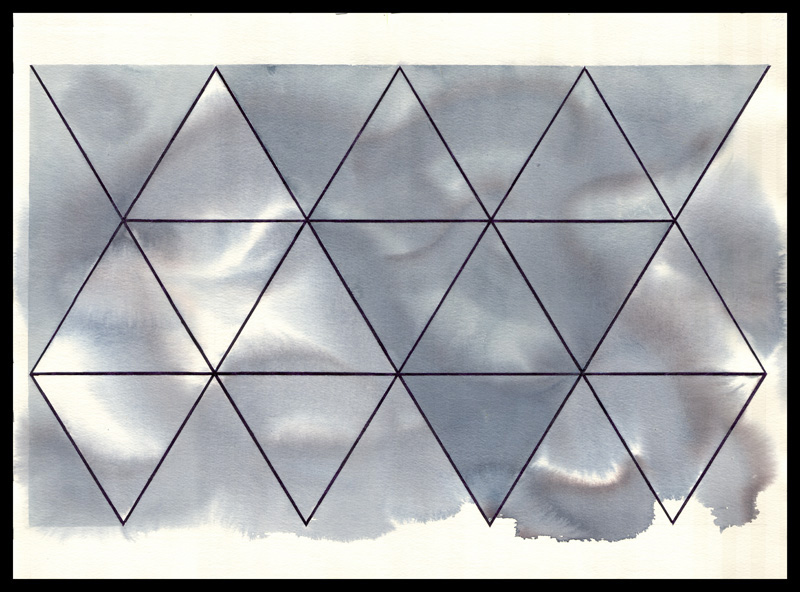
Ricardo Morin Silence III 22’ x 30” Watercolor, graphite, gesso, acrylic on paper 2010
Ricardo F. Morín
February 15, 2026
Oakland Park, Fl
Rethinking Identity and Entitlement in Civic Life
The phrase “my people” draws lines. It signals allegiance before argument begins. It may express familiarity, shared memory, or recognition. Yet the same words separate one group from another. A boundary forms, often without intention. Those inside feel affirmed; those outside may feel unseen.
Such moments rarely begin as acts of exclusion. They arise from ordinary human impulses: the desire to protect what feels familiar, to defend what has been wounded, or to claim space where one has felt overlooked. But when identity becomes the primary language through which claims are made, conversations change. Disagreement becomes personal. Listening becomes strategic. The space where people meet as equals contracts.
Group identity has long provided people with strength and protection. It helps individuals recover dignity when they feel ignored or misunderstood, and it offers language through which shared experiences can be recognized. Yet the same force can also narrow perception. When group identity becomes the main lens through which people judge one another, ideas are weighed less on their merit and more on the speaker’s affiliation.
When ideas begin to be judged primarily through identity rather than merit, the change is often subtle. An exchange that begins openly can become defensive as participants look for signs of alignment or opposition. Words are weighed for allegiance. Questions are interpreted as challenges rather than invitations to examine ideas together. Over time, dialogue shifts from exploration toward defense of positions. Judgment shifts from the merit of an idea to the standing of the speaker.
Many people carry an expectation into public life that they will be treated consistently. Uneven rules are recognized quickly. When identity determines whose voice counts before ideas are heard, trust weakens not only among those excluded, but also among those unsure whether they are seen as individuals or as representatives of a category.
Problems deepen when identity stops being one part of a person’s experience and begins to overshadow all others. Public debate narrows. Arguments are interpreted as attacks on identity rather than disagreements over ideas. People feel compelled to defend positions not because they are persuaded by them, but because reconsidering publicly may be treated as betrayal. The result is not stronger community, but increasing rigidity, where listening carries risk and reconsideration feels unsafe.
People turn toward simplification and absolutism to reduce uncertainty and relieve the strain of complexity. This tendency does not permanently define human interaction; it marks moments when ambiguity feels intolerable and certainty appears easier to sustain. Certainty offers relief, but it reduces the space in which plurality can endure. The tension itself does not disappear; only the way people attempt to manage it changes.
Contemporary communication technologies accelerate the circulation and visibility of opinion. Expressions that promise certainty or provoke fear travel farther and faster; expressions that sustain ambiguity move more slowly. This circulation amplifies tendencies toward simplification, reinforcing what attracts attention rather than what withstands examination.
When identity becomes the basis for deciding who others are before dialogue takes shape, examination gives way to labeling. Nuance is set aside. Individuals become symbols of larger struggles, and ordinary encounters carry the weight of broader conflicts. Under these conditions, disagreement resembles confrontation even when intentions remain sincere.
Public life rests on an expectation that the same rules apply to all. Uneven application becomes visible when some voices are heard more readily than others or when identity determines credibility before ideas are considered. Under these conditions, conversation shifts from exchange toward competition for recognition, and the possibility of shared judgment becomes more difficult to sustain.
The tension does not belong to one group alone; this situation affects everyone who participates in public life. Each person seeks recognition while fearing misinterpretation. Attempts to resolve disagreement through persuasion alone often reach limits beyond individual control. Listening, under these conditions, does not erase distance but allows interaction to continue despite it.
Differences remain, and disagreement persists. The lines that divide do not disappear; they shift, harden, or soften as people respond to one another in ordinary encounters. Living together does not remove tension; living together reveals tension. No shared answer resolves the matter. Each person must decide how to respond and how to live alongside others within limits no one fully controls.
Reflections from previous chapters eventually lead to a more historical inquiry, in which the following archive, Chronicles of Hugo Chávez, becomes another lens through which I approach the Venezuelan experience.
Chapter VI
*
Chronicles of Hugo Chávez
~
1
Hugo Chávez, who spearheaded the Bolivarian Revolution, was born on July 28, 1954, in Sabaneta, Venezuela. He died on March 5, 2013, at 4:25 p.m. VET (8:55 p.m. UTC) in Caracas, at the age of 58. As the leader of the revolution, Chávez left a discernible imprint on Venezuela’s political history. To reconstruct this history is to revisit a landscape whose consequences continue to shape Venezuelan life.
At the core of Chavismo lies a deliberate fusion of nationalism, centralized power, and military involvement in politics. This fusion shaped his vision for a new Venezuela, one that would be fiercely independent and proudly socialist.
~
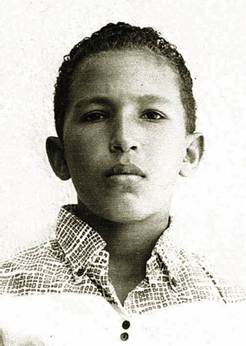
Hugo Chávez at age 11, sixth grade, 1965 (Photo: Reuters).
2
Hugo Chávez’s childhood was spent in a small town in Los Llanos, in the northwestern state of Barinas. This region has a history of indigenous chiefdoms (i.e., “leaderships,” “dominions,” or “rules”) dating back to pre-Columbian times. [1] Chávez was the second of six brothers, and his parents struggled to provide for the large family. As a result, he and his older brother Adán were sent to live with their paternal grandmother, Rosa Inés, in the city of Barinas. After her death, Chávez honored his grandmother’s memory with a poem; it concludes with a stanza that reveals the depth of their bond:
Entonces, / abrirías tus brazos/ y me abrazarías/ cual tiempo de infante/ y me arrullarías/ con tu tierno canto/ y me llevarías/ por otros lugares/ a lanzar un grito/ que nunca se apague.[2]
[Author’s translation: Then, /you would open your arms /and draw me in /as if returned to childhood /and you would steady me /with your tender voice /and you would carry me /to other places /to release a cry /that would not be extinguished].
3
In his second year of high school, Chávez encountered two influential teachers, José Esteban Ruiz Guevara and Douglas Ignacio Bravo Mora, both of whom provided guidance outside the regular curriculum. [3][4] They introduced Chávez to Marxism-Leninism as a theoretical framework, sparking his fascination with the Cuban Revolution and its principles—a turning point more visible in retrospect than it could have been in the moment.
4
At 17, Chávez enrolled in the Academia Militar de Venezuela at Fuerte Tiuna in Caracas, where he hoped to balance military training with his passion for baseball. He dreamed of becoming a left-handed pitcher, but his abilities did not match his ambition. Despite his initial lack of interest in military life, Chávez persisted in his training, graduating from the academy in 1975 near the bottom of his class.
5
Chávez’s military career began as a second lieutenant; he was tasked with capturing leftist guerrillas. As he pursued them, he found himself identifying with their cause and believed they fought for a better life. But by 1977, Chávez was prepared to abandon his military career and join the guerrillas. Seeking guidance, he turned to his brother Adán, who persuaded him to remain in the military by insisting, “We need you there.” [5] Chávez now felt a sense of purpose and understood his mission as a calling. In 1982, he and his closest military associates formed the Bolivarian Revolutionary Movement-200: they aimed to spread their interpretation of Marxism within the armed forces and ultimately hoped to stage a coup d’état. [6]
6
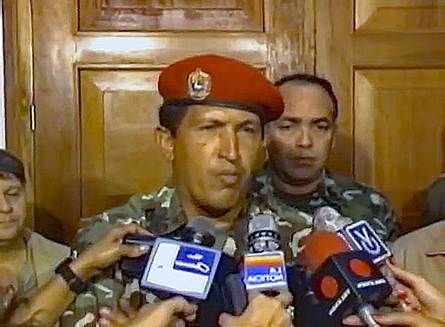
On February 4, 1992, Lieutenant Chávez and his military allies launched a revolt against the government of President Carlos Andrés Pérez. Their rebellion, however, was swiftly quashed. Surrounded and outnumbered, Chávez surrendered at the Cuartel de la Montaña, the military history museum in Caracas, near the presidential palace, on the condition that he be allowed to address his companions via television. He urged them to lay down their arms and to avoid further bloodshed. He proclaimed, « Compañeros, lamentablemente por ahora los objetivos que nos planteamos no fueron logrados . . . » [Author’s translation:“Comrades, unfortunately, our objectives have not been achieved… yet,”].[7] The broadcast marked the beginning of his political ascent.His words resonated across the nation and sowed the seeds of his political future.
~
Chávez announces his arrest on national television and urges insurgent troops to surrender.
7
In 1994, newly elected President Rafael Caldera Rodríguez pardoned him. [8] With this second chance, Chávez founded the Movimiento V República (MVR) in 1997 and rallied like-minded socialists to his cause. [9] Through a campaign centered on populist appeals, he secured an electoral victory at age 44.
8
In his first year as President, Chávez enjoyed an 80% approval rating. His policies sought to eradicate corruption in the government, to expand social programs for the poor, and to redistribute national wealth. Jorge Olavarría de Tezanos Pinto, initially a supporter, emerged by the end of the elections as a prominent voice of the opposition. Olavarría accused Chávez of undermining Venezuela’s democracy through his appointment of military officers to governmental positions. [10] At the same time, Chávez was drafting a new constitution, which allowed him to place military officers in all branches of government. The new constitution, ratified on December 15, 1999, paved the way for the “mega elections” of 2000, in which Chávez secured a term of six years. Although his party failed to gain full control of the Asamblea Nacional (National Assembly), it passed laws by decree through the mechanism of the Leyes Habilitantes (Enabling Laws). [11][12] Meanwhile, Chávez initiated reforms to reorganize the State‘sinstitutional structure, but the constitution’s requirements were not met. The appointment of judges to the new Corte Suprema de Justicia [CSJ]was carried out without rigor and raised concerns about its legitimacy and competence. Cecilia Sosa Gómez, the outgoing Corte Suprema de Justicia president, declared the rule of law “buried” and the court “self-dissolved.” [13][14]
9
Although some Venezuelans saw Chávez as a refreshing alternative to the country’s unstable democratic system, which had been dominated by three parties since 1958, many others expressed concern as the Partido Socialista Unido de Venezuela (PSUV) consolidated power and became the sole governing party. [15] Legislative and executive powers were increasingly centralized, and the narrowing of judicial guarantees limited citizens’ participation in the democratic process. Chávez’s close ties with Fidel Castro and his desire to model Venezuela after Cuba’s system—dubbed VeneCuba—raised alarm. [16] He silenced independent radio broadcasters, and he antagonized the United States and other Western nations. Instead, he strengthened ties with Iraq, Iran, and Libya. Meanwhile, domestically, his approval rating had plummeted to 30%, and anti-Chávez demonstrations became a regular occurrence.
10
On April 11, 2002, a massive demonstration of more than a million people converged on the presidential palace to demand President Chávez’s resignation. The protest turned violent when agents of the National Guard and masked paramilitaries opened fire on the demonstrators. [17] The tragic event—the Puente Llaguno massacre—sparked a military uprising that led to Chávez’s arrest and to the installation of a transitional government under Pedro Francisco Carmona Estanga. [18] Carmona’s leadership, however, was short-lived; he swiftly suspended the Constitution, dissolved the Asamblea Nacional and the Corte Suprema, and dismissed various officials. Within forty-eight hours, the army withdrew its support for Carmona. The vice president, Diosdado Cabello Rondón, was reinstated as president and promptly restored Chávez to power. [19]
11
The failed coup d’état enabled Chávez to purge his inner circle and to intensify his conflict with the opposition. In December 2002, Venezuela’s opposition retaliated with a nationwide strike aimed at forcing Chávez’s resignation. The strike targeted the state oil company Petróleos de Venezuela, S.A. (PDVSA), which generated roughly 80% of the country’s export revenues. [20] Chávez responded by dismissing its 38,000 employees and replacing them with loyalists. By February 2003, the strike had dissipated, and Chávez had once again secured control over the country’s oil revenues.
12
From 2003 to 2004, the opposition launched a referendum to oust Chávez as president, but soaring oil revenues, which financed social programs, bolstered Chávez’s support among lower-income sectors. [21] By the end of 2004, his popularity had rebounded, and the referendum was soundly defeated. In December 2005, the opposition boycotted the elections to the National Assembly and protested against the Consejo Nacional Electoral (National Electoral Council) (CNE). [22] As anticipated in view of the opposition boycott, Chávez’s coalition capitalized on the absence of an effective opposition and strengthened its grip on the Assembly. [23] By that point, legislative control rested almost entirely with Chávez’s coalition.What followed was not a departure from this trajectory, but its extension through formal policy.
13
In December 2006, Chávez secured a third presidential term, a victory that expanded the scope of executive initiative. He nationalized key industries—gold, electricity, telecommunications, gas, steel, mining, agriculture, and banking—along with numerous smaller entities.[24][25][26][27][28][29] Chávez also introduced a package of constitutional amendments designed to expand the powers of the executive and to extend its control over the Banco Central de Venezuela (BCV). In a controversial move, he unilaterally altered property rights and allowed the state to seize private real estate without judicial oversight. Furthermore, he proposed becoming president for life. In December 2007, however, the National Assembly narrowly rejected the package of sweeping reforms.
14
In February 2009, Chávez reintroduced his controversial proposals and succeeded in advancing them. Following strategic counsel from Cuba, he escalated the crackdown on dissent.[30] He ordered the arrest of elected opponents and shut down all private television stations.
15
In June 2011, Chávez announced that he would undergo surgery in Cuba to remove a tumor, a development that sparked confusion and concern throughout the country.[31] As his health came under increasing scrutiny, more voters began to question his fitness for office. Yet, in 2012, despite his fragile health, Chávez campaigned against Henrique Capriles and secured a surprise presidential victory.[32]
~
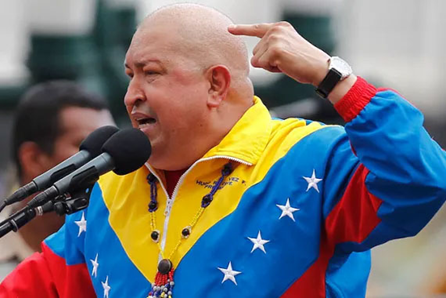
Chávez during the electoral campaign in February 2012.
16
In December 2012, Chávez underwent his fourth surgery in Cuba. Before departing Venezuela, he announced his plan for transition and designated Vice President Nicolás Maduro as his successor, alongside a powerful troika that included Diosdado Cabello [military chief] and Rafael Darío Ramírez Carreño [administrator of PDVSA].[33][34][35] Following the surgery, Chávez was transferred on December 11 to the Hospital Militar Universitario Dr. Carlos Arvelo (attached to the Universidad Militar Bolivariana de Venezuela, or UMBV) in Caracas, where he remained incommunicado, further fueling speculation and rumors. Some government officials dismissed reports of assassination, while others, including former Attorney General Luisa Ortega Díaz, claimed he had already died on December 28.[36] Maduro’s cabinet vehemently refuted these allegations and insisted that no crime had been committed. Amidst the uncertainty, Maduro asked the National Assembly to postpone the inaugurationindefinitely. This further intensified political tensions.
17
The National Assembly acquiesced to Maduro and voted to postpone the inauguration. Chávez succumbed to his illness on March 5. His body was embalmed in three separate stages without benefit of autopsy, which further fueled suspicions and conspiracy theories. Thirty days later, Maduro entered office amid sustained political uncertainty.[37] The implications of this transition extend beyond chronology; they shape the conditions examined in the chapters that follow in this series, which comprises 19 chapters, miscellaneous rubrics, and an appendix.
~
Endnotes:
§ 2
[1] Charles S. Spencer and Elsa M. Redmond, Prehispanic Causeways and Regional Politics in the Llanos of Barinas, Venezuela (Cambridge: Cambridge University Press, 2017). Abstract: “…relacionados con la dinámica política de la organización cacical durante la fase Gaván Tardía.” Published in Latin American Antiquity, vol. 9, no. 2 (June 1998): 95-110. https://doi.org/10.2307/971989
[4] L’Atelier des Archive, “Interview du révolutionnaire: Douglas Bravo au Venezuela [circa 1960]” (Transcript: “… conceptos injuriosos en contra de la revolución cubana …” [timestamp 1;11-14]), YouTube, October 14, 2016. https://www.youtube.com/watch?v=1cx2D5VM8VM
§ 5
[5] “Hugo Chavez Interview,”YouTube, transcript excerpt and time stamp unavailable: Original quote in Spanish (translated by the author): “. . . , if not, maybe I’ll leave the Army, no, you can’t leave, Adam told me so, no, we need you there, but who needs me?” Retrieved October 12, 2023.
[9] Gustavo Coronel, “Corruption, Mismanagement, and Abuse of Power in Hugo Chávez’s Venezuela,” Center for Global Liberty & Prosperity: Development Policy Analysis, no. 2 (CATO Institute, November 27, 2006). https://www.issuelab.org/resources/2539/2539.pdf.
[11] Mario J. García-Serra, “The ‘Enabling Law’: The Demise of the Separation of Powers in Hugo Chavez’s Venezuela,” University of Miami Inter-American Law Review, vol.32, no. 2, (Spring – Summer, 2001): 265-293. https://www.jstor.org/stable/40176554
[37] “Cuerpo de Chávez fue tratado tres veces para ser conservado: … intervenido con inyecciones de formol para que pudiera ser velado,” El Nacional De Venezuela – Gda, Enero 27, 2024, 05:50, actualizado Marzo 22, 2013, 20:51. https://www.eltiempo.com/amp/archivo/documento/CMS-12708339
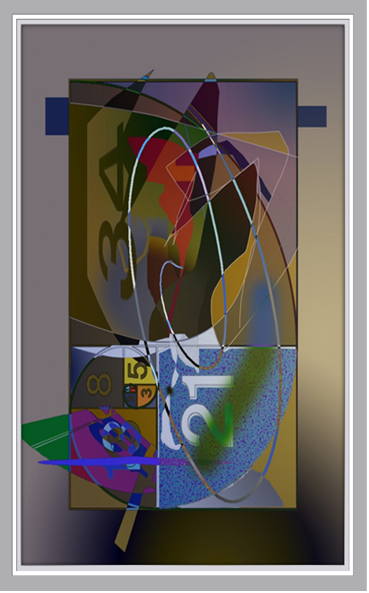
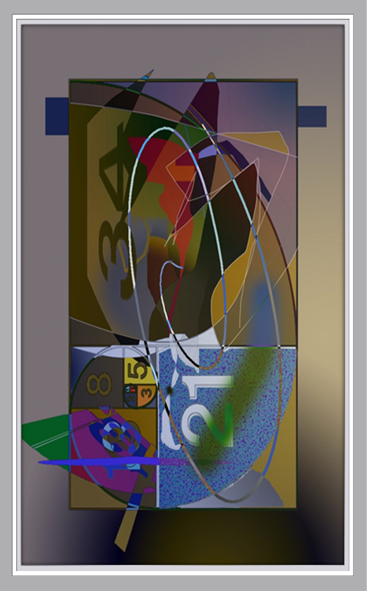
“Geometric Allegory,” digital painting 2023 by Ricardo Morin (American visual artist born in Venezuela–1954)
*
To my parents
*
Acknowledgements
~
I wish to acknowledge Billy Bussell Thompson for his meticulous editorial guidance. His feedback sharpened the structure, precision, and internal discipline of this work.
Preface
“Unmasking Disappointment” follows a line of inquiry present throughout my work: the examination of identity, memory, and the relations that emerge when life unfolds across cultural boundaries. Although I have lived outside Venezuela for more than five decades and became a naturalized citizen of the United States twenty-four years ago, my relationship to the country of my birth remains a persistent point of reference. The distance between these conditions—belonging and removal—forms the backdrop against which this narrative takes shape.
This work belongs to a broader autobiographical project that gathers experiences, observations, and questions accumulated over time. While personal in origin, it does not proceed as confession or memoir. Its method is sequential rather than expressive: individual exposure is situated within historical forces and political structures that have shaped Venezuelan life across generations. The intention is not to reconcile these tensions, but to render them visible through recurrence, record, and consequence.
“Series I” introduces the first thematic clusters of this inquiry. The episodes assembled here do not advance a single thesis, nor do they aim at resolution. They trace points of friction where private experience intersects with public power, and where political narratives exert pressure on ordinary life. Across these encounters, patterns emerge—not as abstractions, but as conditions that alter how authority is exercised, how responsibility is displaced, and how agency is constrained.
The chapters that follow examine the pressures produced by systemic inequality and trace contemporary Venezuelan conditions back to their historical formation. Autocratic rule and popular consent appear not as opposing forces, but as elements that increasingly entangle and weaken one another. Within this entanglement, truth does not disappear; it becomes less evenly accessible and more readily displaced by narrative.
When public discourse is shaped by propaganda and misinformation, authoritarian structures gain resilience. Recovering truth under such conditions does not resolve political conflict, but it clarifies the limits within which political life operates. Agency emerges not as an ideal, but as a condition sustained—or undermined—through practice and consequence.
This work does not propose deterministic explanations or simple remedies. It proceeds by accumulation, drawing attention to patterns that persist despite changing circumstances. What it asks of the reader is not agreement, but attention: to evidence, to sequence, and to the conditions under which political freedom may be meaningfully exercised.
Writing from Bala Cynwyd, Pennsylvania, and Fort Lauderdale, Florida, I remain aware of the distance between the environments in which this work is composed and the conditions it examines. That distance does not confer authority; it imposes responsibility.
Ricardo Federico Morín Bala Cynwyd, Pennsylvania, January 21, 2025
*
Table of Contents
*
Chapter I – A Written Language.
Chapter II – Our Recklessness.
Chapter III – Point of View.
Chapter IV – A Dialogue.
Chapter V – Abstract.
Chapter VI – Chronicles of Hugo Chávez (§§ I-XVII).
Chapter VII – The Allegorical Mode.
Chapter VIII – The Ideal Government and the Power of Virtue.
Chapter IX – The First Sign: On Political and Social Resentment.
Chapter X – The Second Sign: The Solid Pillar of Power: The Military Forces.
Chapter XI – The Third Sign: The Asymmetry of Political Parties.
Chapter XII – The Fourth Sign: Autocracy (§§ 1-9):Venezuela (§§ 10-23), The Asymmetry of Sanctions (§§ 24-32).
Chapter XIII – The Fifth Sign: The Pawned Republic.
Chapter XIV – The First Issue: Partisanship, Non-partisanship, and Antipartisanship.
Chapter XV – The Second Issue: On Partial Truths and Repressive Anarchy.
Chapter XVI – The Third Issue: The Clarion of Democracy.
Chapter XVII – The Fourth Issue: On Human Rights.
Chapter XVIII – The Fifth Issue: On the Nature of Violence.
Chapter XIX – The Ultimate Issue: About the Deliverance of Injustice.
Acknowledgments.
Epilogue.
PostScript.
Appendix: Author’s Note, Prefatory Note. A). Venezuelan Constitutions [1811-1999], Branches, and Departments of Government. B) Evolution of Political Parties: 1840-2024. C) Laws Enacted by the Asamblea Nacional. D) Clarificatory Note on Domestic Coercion, Foreign Presence, and Intervention.
Bibliography.
~
*
Chapter I
*
A Written Language
~
Stability is often sought where it cannot be secured. Experience has shown this repeatedly. Even careful intentions tend to draw one into uncertain terrain, where understanding lags behind consequence. At the desk, as late-afternoon light reaches the page, writing assumes a practical function: it becomes a means of ordering what would otherwise remain unsettled. The act does not resolve vulnerability, but it records it. Whether time alters such conditions remains uncertain; what can be done is to give them form.
What follows moves from the conditions of writing to the conditions it must confront.
*
Chapter II
*
Our Recklessness
~
“Our painful struggle to deal with the politics of climate change is surely also a product of the strange standoff between science and political thinking.” — Hannah Arendt: The Human Condition: Being and Time [1958], Kindle Book, 159.
*
1
The COVID pandemic and the 2023 Canadian wildfires, among other recent events, have made visible conditions that were already in place. These events did not introduce new vulnerabilities as much as they revealed the extent to which existing systems depend on economic incentives and political habits that privilege extraction over preservation. During the period when smoke from the fires reached the northeastern United States, daylight in parts of Pennsylvania was visibly altered and registered the reach of events unfolding at a considerable distance. Such occurrences do not stand apart from prevailing economic arrangements; they coincide with a model that treats natural conditions as commodities and absorbs their degradation as an external cost.
2
The fires in California in 2025, like those that spread across Canada in 2023, do not present themselves as isolated occurrences. They form part of a sequence shaped by environmental neglect, political inertia, and sustained industrial expansion. Conditions such as desertification, resource scarcity, and population displacement no longer appear solely as projected outcomes; they are increasingly registered as present circumstances. Scientific assessments indicate that these patterns are likely to intensify in the absence of structural change. [1][2][3] What is brought into view, over time, is not a singular failure but a system that continues to operate according to priorities that favor immediate yield over long-term continuity.
3
The question of balance does not arise solely as a technical problem. It emerges within a moral and political field shaped by prevailing economic assumptions. The treatment of nature—and more recently of artificial intelligence—as a commodity reflects a trajectory in which matters of shared survival are increasingly translated into market terms. Under such conditions, considerations that once belonged to collective responsibility are recast as variables within systems of calculation.
4
Such patterns place increasing strain on conditions necessary for collective survival. Responses to these conditions vary and range from indifference to urgency, though urgency does not invariably produce clarity. What becomes apparent, across repeated instances, is a tendency for crisis to recur without sustained adjustment. This recurrence parallels the political histories examined in the chapters that follow, where warning and consequence frequently fail to align.
Conversations with my editor, Billy Bussell Thompson, have accompanied the development of this work over time. His attention to research method and to the structure of argument has contributed to the clarification of its scope and direction. These exchanges, often conducted at a distance and without ceremony, formed part of the process through which the present narrative took shape. After an extended period of uncertainty regarding how to approach the subject of Hugo Chávez, the contours of Unmasking Disappointment gradually emerged.
2
Hugo Chávez entered national political life as a leader whose authority was exercised in opposition to political liberalism.[1] While his public discourse emphasized alignment with the poor, the material benefits of power accumulated within a narrow circle. [2] Over the course of his tenure, democratic institutions in Venezuela experienced progressive weakening, and governance assumed increasingly authoritarian forms. These developments become more legible when situated within the historical record and examined through documented practice rather than rhetorical claim.
3
The events that followed Chávez’s rule are marked by disorder and unresolved consequence. Their persistence draws attention to questions of historical accountability and collective responsibility that remain unsettled. Examining the record of autocratic leadership—its ambitions as well as its failures—provides a means of approaching the problem of justice in Venezuela without presuming resolution. Through this examination, enduring tensions come into view as conditions to be understood rather than conclusions to be reached.
~
Endnotes—Chapter III
[1]The term caudillo originates in Spanish and has historically been used to describe a leader who exercises concentrated political and military authority. In the Venezuelan context, the term carries particular resonance and refers to figures associated with the post-independence period of the nineteenth century. Such leaders tended to consolidate power through a combination of personal authority, allegiance from armed factions, and the promise—whether substantive or rhetorical—of maintaining order under conditions of instability. While some were regarded as defenders of local or national causes, others became associated with practices that facilitated authoritarian governance and weakened institutional structures. The concept of the caudillo continues to function within Venezuelan political culture as a descriptive category applied to leadership forms that combine popular support with concentrated power.
A series of conversations between BBT and the author accompanied the examination of Venezuelan politics and history developed in this section. These exchanges formed a transitional space in which reflection gave way to historical inquiry, allowing questions of interpretation, responsibility, and record to be addressed through dialogue rather than exposition.
1
—RFM: “My writing has been concerned with the evolution of Venezuela’s political landscape, with particular attention to the emergence of authoritarian forms of rule. The focus has been less on abstract doctrine than on how specific policies translated into everyday conditions for ordinary Venezuelans.”
2
—BBT: “Examining how authoritarian leadership shapes political conditions is necessary, though the term itself is often contested and applied unevenly. In Chávez’s case, the use of propaganda was not exceptional in form, but it was consistently employed as an instrument of governance. How did official narratives during his tenure circulate, and what effects did they have on public perception over time?”
3
—RFM: “Propaganda is not unique to Chávez; it functions as a recurring instrument across political systems. In Venezuela, official media regularly attributed economic hardship to external interference rather than to domestic policy decisions. At the same time, material conditions deteriorated, with shortages emerging from economic mismanagement and later compounded by external restrictions. Opposition groups also circulated counter-narratives, which in turn elicited responses from the State. These exchanges unfolded within a historical context shaped by civil conflict and Cold War alignments, and produced a fragmented informational environment. Within that environment, responsibility for economic decline was frequently displaced, while public perception was managed through repetition rather than resolution. The social and economic reforms invoked in justification did not, over time, yield the reductions in poverty and inequality that had been promised.”
4
—BBT: “To render Venezuela’s political conditions with some accuracy, attention must be given to how ordinary citizens encountered these dynamics in daily life. How were such conditions navigated in practice, particularly where political discourse intersected with immediate economic necessity?”
5
—RFM: “The economic collapse that followed the decline of the oil-based model intensified poverty and placed sustained pressure on public services. Examined in sequence, this period shows how colonial legacies and authoritarian practices converged in the formation of Chavismo. Episodes such as the 1989 riots known as El Caracazo registered widespread disaffection with established parties and democratic institutions. Under such conditions, the demands of securing basic necessities frequently outweighed engagement with abstract political principles.”
6
—BBT: “Clarity in narrative depends in part on recognizing the assumptions that guide interpretation. When these assumptions are made explicit and examined, the account becomes less directive and more accessible, allowing readers to follow the record without being steered toward a predetermined position.”
7
—RFM: “No narrative proceeds without interpretation, including this one. Writing provides a means of approaching Venezuela’s history—its colonial formation, episodes of authoritarian rule, and periods of political disruption—without foreclosing alternative readings. A coherent account need not be exhaustive; it remains open insofar as it attends to implication and consequence rather than resolution.”
8
—BBT: “The exchange itself underscores the importance of careful narration when approaching Venezuela’s political and social record. Attending to multiple viewpoints does not resolve complexity, but it allows a more coherent account to emerge without reducing that history to a single explanatory frame.”
The exchange marked a transition from reflective inquiry to historical record.
~
*
Chapter V
*
Abstract
*
1
This section examines the sequence through which the political project articulated under Hugo Chávez assumed autocratic form. Rather than attributing this outcome to a single cause, the inquiry proceeds by tracing how leadership decisions unfolded within a convergence of historical conditions, institutional arrangements, economic pressures, and geopolitical alignments. The account does not begin from conclusion, but from record.
2 Attention remains on how authority was exercised and how its effects registered within Venezuelan society. Historical circumstance, institutional design, and external influence are examined not to simplify the record, but to make visible the interdependencies through which power consolidated over time. What emerges is not an explanatory thesis, but a configuration whose coherence can be assessed only through sustained attention to sequence and consequence.
Ricardo Morín Still Thirty-seven: Geographies of Survival Oil on linen & board 15″ x 12″ x 1/2″ 2012
Ricardo F. Morín
November 2025
Oakland Park, Florida
Author’s Note
This essay examines how human groups respond to instability when the conditions that once sustained them begin to fail. Its focus is not on specific crises, events, or regions, but on the structural pressures that compel populations either to relocate or to defend their ground. I approach the subject without moral interpretation and without attributing virtue or fault to the choices communities make under duress. The aim is simply to describe the grammars of behavior that arise when survival becomes uncertain and to trace how identity, claims to legitimacy, and patterns of continuity reorganize themselves under those pressures. The essay does not propose solutions or anticipate outcomes; it observes the patterns that emerge when stability dissolves and the land itself ceases to offer guarantees.
Abstract
Geographies of Survival explores two fundamental responses to instability: migration and entrenchment. When climate disruption, scarcity, or civic breakdown exceed a community’s capacity to endure, populations seek stability either through movement or through defending their position. Migration reorganizes identity through adaptation to new conditions; entrenchment intensifies identity to preserve continuity in place. These responses arise from the same pressures and function as parallel strategies for survival rather than opposing moral positions. The essay examines how claims to legitimacy, patterns of identification, and the search for continuity are reshaped by these pressures, and how the friction between movement and resistance reflects structural forces rather than cultural incompatibility. Its purpose is to illuminate the conditions under which these survival grammars emerge and the ways they transform the meaning of land, stability, and collective life.
1
Migration is often described as the movement of people from one place to another, but this description obscures the deeper forces at work. Migration is not merely geography in motion; it is also the expression of a survival grammar that becomes visible whenever a community faces conditions it can no longer absorb. Climate shifts, failing economies, collapsing states, and persisting insecurities create pressures that exceed the capacity of existing structures. Under these pressures, a population confronts a choice so fundamental that it precedes ideology: to move or to entrench.
2
These are not parallel options. They are opposing responses built from the same materials—fear, instability, and the search for continuity. Migration seeks stability by relocating; entrenchment seeks stability by confronting the agents of instability directly. Neither response is superior. Neither is voluntary. Both emerge from conditions that compress judgment, narrow possibility, and force communities to defend themselves against forces too large to negotiate.
3
Migration begins when a group concludes that the geography that sustained it can no longer guarantee survival. The land fails, or institutions collapse, or the future narrows. Movement becomes the only remaining form of protection. Yet movement does not dissolve identity—it reorganizes it. A migrating population must redefine its internal coherence in relation to unfamiliar surroundings. Identity becomes adaptive not by preference but by necessity. Adaptation is not reinvention; it is survival.
4
Entrenchment moves in the opposite direction. When a group chooses to remain in place, it must defend what movement would surrender: territory, memory, continuity, and the stability that comes from rootedness. Entrenchment therefore intensifies identification rather than loosening it. Boundaries become rigid. Narratives harden. Conflict becomes a strategy rather than an interruption. A community that fights to remain where it is must believe that displacement would erase it. Confrontation becomes a method of preservation.
5
Cultural confrontation arises most sharply when a migrating population settles on land that another group interprets as an extension of its own continuity. To the migrant community, the land represents safety, possibility, or relief from pressures that made departure unavoidable. To the entrenched community, the same land represents memory, inheritance, and the boundary that protects its historical coherence. Each group sees the other as the agent of potential erasure: migrants perceive exclusion and hostility; entrenched populations perceive encroachment and loss. Conflict escalates not because either group seeks domination, but because each interprets survival through a different grammar—adaptation for one, preservation for the other.
6
Policies adopted in countries such as Denmark and the United Kingdom illustrate how entrenched societies respond when migration is perceived as a threat. For many asylum seekers, these deterrent measures narrow the distance between the pressures that forced them to leave and the pressures they encounter upon arrival, a condition that makes stability difficult to distinguish from exclusion.Governments frequently defend entrenched policies by arguing that the resources needed to support asylum seekers are limited, and that extending those resources further would risk weakening existing systems of welfare, housing, and public order.
7
These responses of movement and entrenchment seem incompatible, yet they describe a single reality: populations under pressure behave according to the survival strategies available to them, not according to idealized accounts of culture or volition. When migrants and entrenched populations come into contact, each sees the other through the lens of its own pressures. Migrants see protection; the entrenched see threat. Migrants carry adaptation; the entrenched carry defense. Each posture misreads the other because each is responding to different forms of danger.
8
Climate change intensifies these divergent responses, not by determining them but by tightening the conditions under which communities must choose. Climate does not produce conflict by itself; it alters the margins within which stability is possible. Regions once predictable become irregular; resources once continuous become intermittent. As these margins narrow, some populations interpret movement as the only viable safeguard, while others interpret remaining in place as the only defensible continuity. The same pressure exposes different vulnerabilities, and each community responds according to its own history, capacity, and thresholds of endurance—rather than to climate alone.
9
The friction between these grammars—movement and entrenchment—should not be mistaken for a clash of civilizations. It is a collision between two interpretations of threat. One group treats survival as relocation; the other treats survival as resistance. Both postures emerge from instability; both use identity as a tool shaped by circumstance rather than as a fixed inheritance. Identity becomes an instrument of continuity, shaped by conditions that leave little room for negotiation or reflection.
10
The world often interprets these collisions through moral, ideological, or geopolitical frames, but such interpretations obscure the deeper movement: instability reorganizes identity faster than identity reorganizes the world. When geography shifts, populations adapt. When populations adapt, meanings shift. Collective life becomes contested not because cultures are inherently antagonistic, but because survival pressures force groups into patterns they would not otherwise choose.
11
If there is a universal character to the present century, it is this: the pressures that produce migration are the same pressures that produce conflict among those who refuse to migrate. To understand one without the other is to misunderstand both. Movement and entrenchment are not opposites but consequences—expressions of the structural instability that now shapes every region, every culture, every claim to continuity.
12
The question that follows is neither predictive nor ideological. It is simply the next step in the logic of this analysis:What forms of stability become possible when migration and entrenchment are understood not as opposing moral positions but as parallel responses to the same changing world?The answer is not yet visible, but the conditions that will shape it already are.
Nothing human begins from nothing. Institutions, languages, belief systems, and works of art all arise from what preceded them. Creation is not the rejection of inheritance but the transformation of it. Every act of making draws upon accumulated perception, memory, and experience. This insight is crucial to understanding contemporary culture, where claims of unprecedented change often conceal deep continuities beneath the surface of novelty. Human beings, bound by temporality, cannot detach themselves from what has been; they can only reorder and reinterpret the materials already available to them.
The notion of invention is often described as a break with the past, a leap into the unknown. Yet even the most radical departures are shaped by what came before. The ideals of modern democracy, for example, did not emerge spontaneously. They were built upon classical Greek ideas of citizenship as a shared civic responsibility, rooted in isonomia—equality before the law—and in the belief that legitimate authority derives from the deliberation and participation of free citizens. They also drew deeply on Roman conceptions of law as a universal and rational order capable of binding diverse peoples into a common political framework, and on the Roman principle of res publica, which conceived the State as a public entity oriented toward the common good rather than the will of a single ruler. These foundational ideas, adapted and reinterpreted over centuries, provided the intellectual architecture on which modern democratic institutions were constructed. Perception frames invention. It provides the vocabulary, assumptions, and conceptual tools that make new ideas possible. What seems entirely new still carries the imprint of what it sought to move beyond. On closer examination, the products of creativity are not isolated acts of originality but reconfigurations of existing structures. Evolution, rather than spontaneous emergence, governs how ideas, institutions, and cultures take shape.
Memory underlies this process. It is not a passive record of events but an active medium through which possibilities are conceived and action becomes intelligible. Imagination draws its material from memory; it combines and redirects memory toward conditions not yet realized. This is nowhere more evident than in the idea of freedom, a concept that resists simple definition yet has long carried two complementary meanings. The first, articulated most clearly in the classical Greek tradition, understands freedom as eleutheria—the condition of living without domination or external constraint, a state in which individuals are not subject to arbitrary power. The second, rooted in the Roman legal and civic tradition, conceives freedom as libertas—the capacity to participate actively in the governance of a political community and to shape its laws and institutions. Both meanings reveal how deeply freedom depends on historical precedent: it requires language to articulate its claims, institutions to guarantee its exercise, and collective memory to frame its significance. Far from existing apart from what has been, freedom is shaped and enabled by what has already been conceived, argued, and enacted. Prior experience supplies the references and alternatives against which choices acquire meaning. Without that reservoir of knowledge, novelty would lack coherence and direction, and the exercise of freedom would collapse into arbitrary impulse. Human beings do not invent in a void; they work within the continuity of time and adapt what has been lived and learned into forms suited to what is yet to come.
This same dynamic defines the formation of identity. Selfhood is not an isolated act of invention but a continuous negotiation with what has been received. The very idea of the self has itself evolved through history: in classical philosophy, it was often conceived as a psyche—an inner essence shaped by reason and virtue and embedded within a larger cosmic order. Christian thought reinterpreted this understanding through the notion of the soul as a unique bearer of moral responsibility, oriented toward salvation and defined by its relationship to God. Early modern thinkers such as John Locke then transformed this inheritance by grounding personal identity in memory and consciousness — a conception that would later inform modern ideas of individual autonomy. Even the impulse to define oneself against the past relies on categories inherited from it. Identity is therefore neither static nor wholly self-created; it is a process of reinterpretation through which the individual positions what is given in relation to what is chosen. Human beings exist in the tension between inheritance and aspiration, between the weight of memory and the desire for renewal. That tension is not an obstacle to authenticity but its condition, for without the framework provided by the past there would be nothing from which to depart.Continuity and change are not opposing forces. Without continuity, there is no ground on which to become. Without change, continuity hardens into mere repetition. The act of becoming depends on the dynamic between the two.
Viewed from this perspective, the human condition is defined less by pure invention than by the capacity to transform. What is called “new” is the familiar reorganized with new intentions, the established redirected toward new purposes. Recognizing this does not diminish creativity. It clarifies its nature. Humanity’s most significant achievements—in politics, art, science, and thought—are not escapes from what has been. They are deliberate reinterpretations of what has been, shaped to answer new questions and confront new circumstances. In the sciences, paradigmatic shifts often described as revolutions still follow this pattern. Einstein’s theory of relativity did not erase Newtonian mechanics; it incorporated and extended its principles, a revision that revealed their limits while preserving their usefulness within a broader understanding of space, time, and motion. This same principle governs artistic innovation. The Renaissance revival of classical forms did not merely reproduce antiquity; it reinterpreted ancient visual languages to express the spiritual and humanistic concerns of a new era. The evolution of digital communication and artificial intelligence reflects a comparable continuity. The internet did not replace human interaction; it expanded its reach and scale, a transformation that altered how language circulates, how memory is archived, and how collective knowledge is formed. Similarly, artificial intelligence—often portrayed as autonomous or unprecedented—rests on centuries of linguistic, mathematical, and conceptual developments. These systems extend rather than supersede the cognitive inheritance from which they originate. The future is built in this way: not in its rejection of the past but in its continuous interaction with it.
Resistance to this understanding persists wherever the idea of evolution is denied. Such resistance is rarely a matter of evidence alone. It reflects a desire for permanence—for a beginning that is untouched by change and a truth that stands apart from time. It offers certainty where process allows none and promises stability in place of adaptation. Yet even this resistance is shaped by the forces it seeks to escape. Languages evolve, beliefs adjust, and traditions adapt, even as they proclaim their immutability. Those who defend what is fixed do so with concepts and arguments that themselves have been shaped by historical change. The very doctrines that claim timeless authority — such as the medieval conception of divine sovereignty, once invoked to legitimize monarchies and later transformed into the principle of popular sovereignty in modern constitutional systems—reveal this dependence: they persist not by remaining unchanged but by being continually reinterpreted to meet new contexts. The contrast, therefore, is not between evolution and its absence, but between recognition and refusal. The reality remains: existence unfolds through transformation, and humanity, whether consciously or not, participates in that unfolding—a truth with profound implications for how societies remember their past, shape their present, and imagine their future.
Further Reading:
Arendt, Hannah: Between Past and Future: Eight Exercises in Political Thought. New York: Viking Press, 1961.
Kuhn, Thomas S.: The Structure of Scientific Revolutions. Chicago: University of Chicago Press, 1962.
MacIntyre, Alasdair: After Virtue: A Study in Moral Theory. Notre Dame, IN: University of Notre Dame Press, 1981.
Floridi, Luciano: The Philosophy of Information. Oxford: Oxford University Press, 2011.
Koselleck, Reinhart: Futures Past: On the Semantics of Historical Time. Translated by Keith Tribe. New York: Columbia University Press, 2004.
This essay is the first part of a trilogy that explores how human beings approach reality through certainty, doubt, and ambivalence. It begins with certainty—how the desire for stability drives thought and belief, even when what appears secure is already open to change. Though written from personal inquiry, its scope is broader: the question of certainty concerns not one life but the fragile conditions of shared reality. The trilogy continues with The Discipline of Doubt and concludes with When All We Know Is Borrowed.
Ricardo Morín, Bala Cynwyd, Pa. August 23, 2025
~
The Colors of Certainty
We live in an age unsettled by division. The subtleties of thought that once allowed us to pause, to weigh, and to distinguish are increasingly swept aside by the demand for immediate clarity. Everything is urged toward opposites: yes or no, ally or enemy, awake or asleep. The pace of public life, accelerated by technology and amplified by conflict, leaves little patience for nuance. Contradiction, which once signaled the restless work of an honest mind, is now treated as treachery. In this atmosphere, to admit complexity is to risk mistrust, and even the smallest hesitation is judged as weakness. We are asked, again and again, to define ourselves as though identity were a single stroke, not a layered drawing made across time.
Symbols flourish in such a climate while they reduce complexity into consumable images. Few have proven more enduring than the pill metaphors drawn from The Matrix film. When it appeared in 1999, the scene of choosing between a red pill and a blue pill was a cinematic device, which dramatized the tension between reality and illusion. Its influence grew gradually, as the film became a generational touchstone. Over the decades that followed, the pills slipped into online communities and political rhetoric only to harden into modes of thought that now shape how we imagine truth and the identity of belonging. To take the red pill became a declaration of awakening, access to hidden truths. To take the blue pill was to be mocked for complacency. Eventually the darker black pill emerged into both despair and fatalism embraced as destiny.
Once this logic takes hold, the world itself is reduced to a theater of absolutes. Disagreement becomes disloyalty, and belonging is measured not by shared life but by categorical allegiance. I have felt this even in conversations with people I have known for decades. In one such exchange, I remarked that I was appalled by Noam Chomsky’s recent habit, even in his nineties, of opposing Western hegemony over Russia as though that stance could excuse the war in Ukraine. Yet in another context, I expressed admiration for Chomsky’s earlier work on linguistic relevance in science four decades ago, which continues to illuminate how language shapes knowledge. To my interlocutor, these two statements seemed incompatible, as if they could not both be true. The expectation was that my judgment had to be seamless: either I rejected Chomsky entirely or endorsed him wholly.
Why must one justify such distinctions, as though every judgment were required to form a single line of allegiance? The contexts are not the same—one belongs to the 1980s, another to the present; one to the realm of linguistics, another to geopolitics. Yet in today’s climate, the demand for congruence is relentless. It reflects the pill logic that has seeped into our speech and habits of thought: one is either awake or asleep, aligned or opposed, consistent across every domain or untrustworthy in all.
That same craving for certainty also gave us Infowars—the radio podcast. Founded in 1999, the very year The Matrix was released, it became a commercial theater of the red pill metaphor. Infowars thrived on dramatizing crisis, telling its audience that elites, governments, or hidden forces manipulated events at every turn. What institutions explained as complexity, Infowars simplified into betrayal. The clarity it offered was intoxicating: good versus evil, freedom versus tyranny, awake versus deceived. It was not simply ideas being sold, but certainty itself—packaged with survival kits, supplements, and slogans. In seeking to liberate its audience from illusion, Infowars created a new one, offering not understanding but a permanent performance of awakening.
The narrowing of discourse is not only about politics and ideology, but it also extends to who is permitted to speak. I was reminded of this in a private exchange, where writing itself was dismissed as the work of an “armchair liberal” or a “limousine socialist.” According to this view, only those directly scarred by battle may speak of war, only those who have suffered prejudice firsthand may give voice to injustice, and to write as an observer is to mock the reality of struggle. It is a charge meant to discredit, as though the act of “fighting with a keyboard” were less real than hand combat in a bloodied field. Yet such suspicion denies what writing has always been: a means of bearing witness, of preserving memory, of shaping the conversation through which societies recognize themselves. The pen has never replaced experience, but it has always transformed it into something shareable and durable. To demand firsthand suffering as the sole qualification for speech is to reduce witness to autobiography and to strip dialogue of the breadth that comes when voices join from different vantage points.
Another difficulty lies in language itself. Writers who seek precision—who stretch language to its sharpest edge—often find that what emerges are metaphors. Even when grounded in substantiated terms, description requires figures of thought, images, and analogies that can never be wholly exact. The question is how precise language can ever be. Even the most brilliant minds struggle with definitions, because in their best formulations they remain presumptive theories. To acknowledge this is not to diminish language but to recognize that our dependence on tropes is not weakness but necessity. Story lines and metaphors are the bridges of comprehension, without which complexity would dissolve into noise. To lean on metaphor is not necessarily to abandon truth but to approach it by way of what can be shared.
What began as a film’s conceit has become a method of thinking, and in many ways a prison. The Matrix offered its audience a vision of awakening through choice, but our culture has taken that image and turned it into a grid of loyalties, where every stance is measured by whether one has swallowed the right capsule. Infowars amplified this posture; it dramatized the hunger for certainty until conspiracy became a substitute for thought. Suspicion of the writer’s position narrowed it further while it mocked reflection as inauthentic and demanded that speech bear the scars of direct experience before it could count as legitimate. And beneath it all lies the frailty of language itself: its inability to define with absolute precision, its reliance on metaphors that shape the very realities they describe.
To speak today of red pills, blue pills, or black pills is not only to reference a film or a subculture; it is to acknowledge the grip of a society that prefers binaries to dialogue, antagonism to complexity, performance to reflection. To resist that grip is to remember that thought is not a pill to be swallowed but a conversation to be carried, a conversation sustained in the fragile medium of language itself. However uncertain, however provisional, it is in that ongoing act of speaking and listening that culture remains alive—where friendship can endure, where witness can be honored, and where the truths no single color can contain still find their voice.
*
About the cover image:
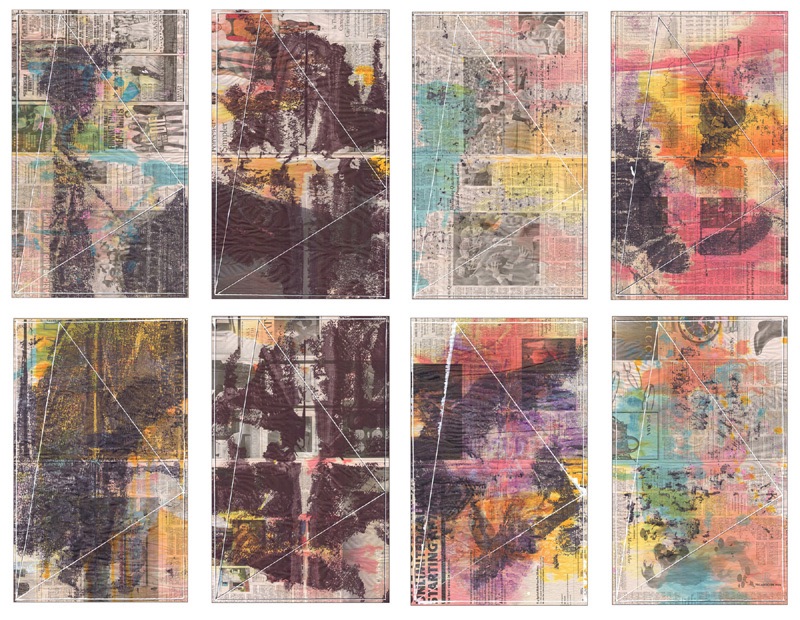
Newsprint Series Nº 9, 2006, by Ricardo Morín (47” × 74”): Translucent dyes, ink, white-out, and blotted oil paint on newsprint.
This image belongs to a series that transforms fragments of printed matter into layered fields of color and erasure, this piece speaks to the instability of certainty itself. The pigments veil and expose in turns, while the newsprint beneath reminds us that truth is mediated, provisional, and never free of interpretation. As with language in the essay, meaning emerges only through contrast, through what resists containment.
Annotated Bibliography
Cialdini, Robert B. Influence: The Psychology of Persuasion. New York: Harper Business, 2006. (A classic study in behavioral psychology showing how persuasion exploits binary choices and authority cues, useful for understanding the appeal of pill metaphors and the certainty promised by conspiracy movements.)
Lakoff, George, and Johnson, Mark: Metaphors We Live By. Chicago: University of Chicago Press, 2003. (A foundational text on metaphor in cognition and language, relevant to the essay’s argument that even the most precise use of language depends on tropes and figurative structures for human comprehension.)
Marwick, Alice, and Lewis, Rebecca: Media Manipulation and Disinformation Online. New York: Data & Society Research Institute, 2017. (This analytical report documents how conspiracy narratives spread through online ecosystems; it highlights the role of platforms in amplifying symbolic binaries such as “red pill” awakening.)
Pew Research Center: “Public Trust in Government: 1958–2023”. Washington: Pew Research Center, 2023. (Presents longitudinal data on the decay of institutional trust in the United States and offers a data-driven context for why audiences turned to alternative voices such as Infowars.)
Southern Poverty Law Center: “Male Supremacy”. Montgomery: SPLC, 2019. (A report classifying the Incel subculture and related groups within the larger “male supremacist ecosystem,” cited in connection to the black pill ideology and its links to violence.)
Sunstein, Cass R., and Vermeule, Adrian: Conspiracy Theories and Other Dangerous Ideas. New York: Simon & Schuster, 2014. (This book explores why conspiracy theories flourish and frames them as efforts to create certainty in moments of social disorientation. It is highly relevant to the discussion of Infowars as a commercial theater of the red pill metaphor.)
Taguieff, Pierre-André: The New Culture Wars. Paris: CNRS Éditions, 2020. (This book is a political-philosophical treatment of identity politics and binary antagonisms in Western democracies: it offers a perspective on how pill metaphors entered the broader theater of culture wars.)
Tversky, Amos, and Kahneman, Daniel: Judgment under Uncertainty: Heuristics and Biases. Cambridge: Cambridge University Press, 1982. (A landmark in cognitive science explaining why people reduce complex realities into simplified binaries; it anchors the essay’s meditation on the lure of certainty.)
… Power, Storytelling, and the Fear of Losing Significance“
By Ricardo Morin, July 2025
Ricardo Morin The Stilobato of Zeus Underwater CGI 2003
Abstract
This essay examines the human mind’s compulsion to invent stories—not merely to understand reality, but to replace it. It explores how narrative becomes a refuge from the void, a form of self-authorship that seeks both meaning and control. The tension between rational observation and imaginative projection is not a flaw in human reason, but a clue to our instability: we invent to matter, to belong, and to assert that we are more than we fear we might be. At its core, this is a reflection on the seductive authority of story—the way it offers not just identity but grandeur, not just comfort but a fragile illusion of power. Beneath every myth may lie the terror of nothingness—and the quiet hope that imagination might rescue us from the fear of a diminished understanding of our own importance.
.
The Delusion of Authority: Power, Storytelling, and the Fear of Losing Significance
We tell stories to make sense of life. That much seems obvious. But if we look a little deeper, we may find that the stories we tell—about ourselves, our beliefs, our traditions, even our suffering—aren’t just about sense-making. They’re about power. Not always power over others, but something more private and often more dangerous: the power to feel central, secure, and superior in a world that rarely offers those guarantees.
This need shows up in ways that often appear noble: tradition, loyalty, virtue, cultural pride, spiritual clarity. But beneath many of these lies a hunger to be more than we are. To matter more than we fear we do. To fix the feeling that we are not quite enough on our own.
We don’t like to think of this as a thirst for power. It sounds selfish. But in its quieter form, it’s not selfishness—it’s survival. It’s the need to look in the mirror and see someone real. To look at the world and feel part of a story that means something. And when we don’t feel that, we make one up.
Sometimes it takes the shape of tradition: the rituals, the mottos, the flags. These things give us the illusion that we are part of something lasting, something sacred. But often, what they really do is offer us borrowed certainty. We repeat what others have repeated before us, and in that repetition we feel safe. We mistake performance for truth. This is how belonging becomes obedience—and how ritual becomes a mask that hides the absence of real thought.
Sometimes it takes the shape of insight. We adopt the language of spiritual clarity or mystical knowing. We speak in riddles, or listen to those who do. But often, this too is about authority: the idea that we can bypass doubt and land in a place of higher understanding. When we hear phrases such as “listen with all your being,” or “intellectual understanding isn’t real understanding,” we are being invited to give up reason in exchange for what feels like truth. But the feeling of truth is not the same as the hard work of clarity.
And sometimes, this hunger for centrality shows up in identity. We claim pain, pride, or history as a kind of moral capital. We say “my people” as if that phrase explains everything. And maybe sometimes it does. But when identity becomes a shield against criticism or a weapon against others, it stops being about belonging and starts being about authority—about who gets to speak, who gets to be right, who gets to be seen.
Even reason itself is not immune. We use logic, not only to understand, but to protect ourselves from uncertainty. We argue not only to clarify, but also to win. And slowly, without noticing, we turn the pursuit of truth into a performance of control.
All of this is understandable. The world is confusing. The self is fragile. And deep down, most of us are terrified of being insignificant. We fear being one more nameless voice in the crowd. One more moment in time. One more life that ends and disappears.
So we reach for authority. If we can’t control life, maybe we can control meaning. If we can’t escape time, maybe we can tell a story that lasts. But this, too, is a delusion—one that leads to suffering, to isolation, and to conflict.
Because when everyone is the center of their own story, when every group insists on its own truth, when every insight claims to stand above question—no one listens. No one changes. And no one grows.
But what if we gave up the need to be right, to be central, to be superior?
What if we didn’t need to be grand in order to be real?
What if we could tell stories not to control reality, but to share it?
That would require something more difficult than intelligence. It would require humility. The willingness to be small. To be uncertain. To live without authority and still live meaningfully.
This isn’t easy. Everything in us pushes against it. But perhaps this is the only path that leads us out of performance and into presence. Out of delusion and into clarity. Not the clarity of slogans or doctrine, but the clarity of attention—of seeing without needing to rule over what is seen.
We don’t need to be gods. We don’t need to be heroes. We just need to be human—and to stop pretending that being human isn’t already enough.
*
Annotated Bibliography
Arendt, Hannah: The Origins of Totalitarianism. New York: Harcourt, Brace & World, 1951. (A foundational study on how ideological certainty and group identity can undermine thought, clearing the way for emotional conformity and mass control.)
Beard, Mary: Twelve Caesars: Images of Power from the Ancient World to the Modern. Princeton: Princeton University Press, 2021. (Explores how images and stories of rulers are crafted to sustain the illusion of divine or inherited authority.)
Frankl, Viktor E.: Man’s Search for Meaning. Boston: Beacon Press, 2006. (Reflects on the will to meaning as a basic human drive, particularly under extreme suffering, showing how narrative can sustain dignity and life.)
Kermode, Frank: The Sense of an Ending: Studies in the Theory of Fiction. Oxford: Oxford University Press, 1967. (Examines how people impose beginnings, middles, and ends on chaotic experience, seeking structure through storytelling.)
Nietzsche, Friedrich: On the Genealogy of Morality. Translated by Carol Diethe. Edited by Keith Ansell-Pearson. Cambridge: Cambridge University Press, 2007. (Argues that moral systems often arise from resentment and masked power struggles rather than pure virtue or reason.)
Oakeshott, Michael: Rationalism in Politics and Other Essays. Indianapolis: Liberty Fund, 1991. (Critiques the rationalist impulse to systematize human life, warning against overconfidence in reason’s ability to master reality.)
Todorov, Tzvetan: Facing the Extreme: Moral Life in the Concentration Camps. Translated by Arthur Denner and Abigail Pollack. New York: Metropolitan Books, 1996. (Offers insight into how identity and morality hold—or collapse—under conditions that strip away illusion, highlighting the limits of narrative.)
Wallace, David Foster: This Is Water: Some Thoughts, Delivered on a Significant Occasion, about Living a Compassionate Life. New York: Little, Brown, 2009. (A short meditation on how default thinking shapes our perception and how awareness—not authority—offers a path to freedom.)
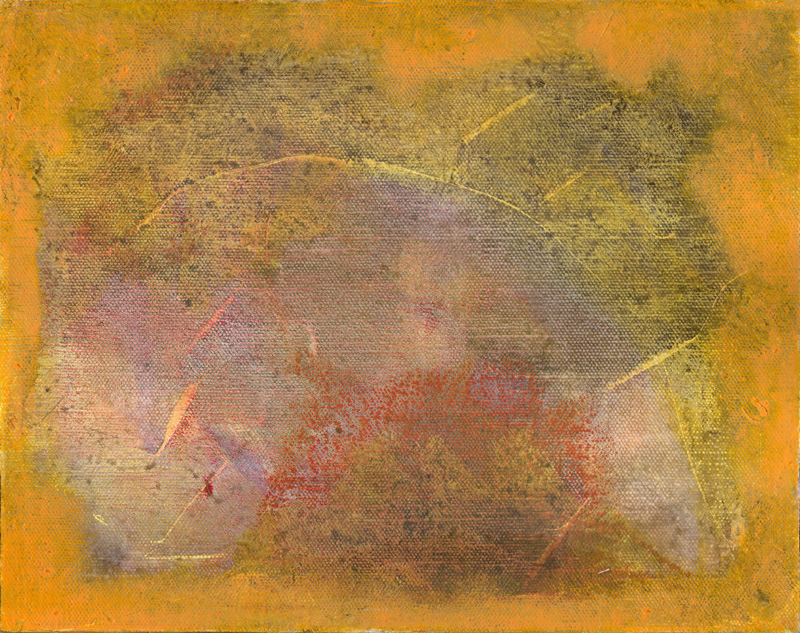
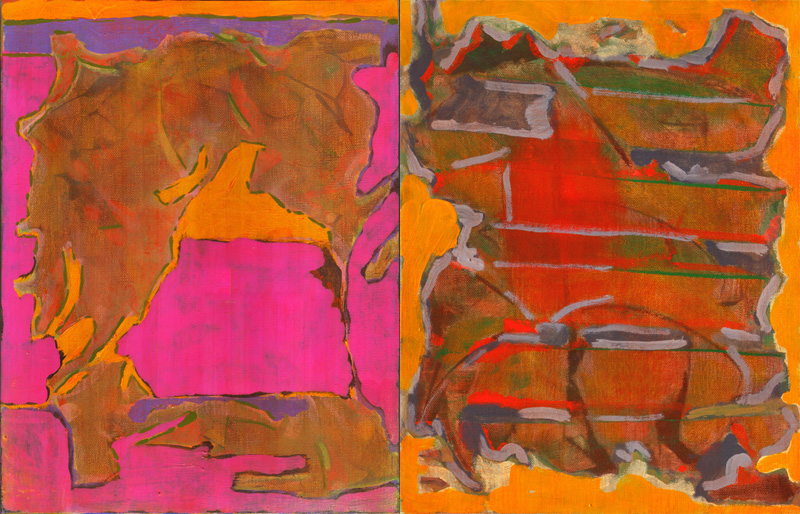
Silent Diptych by Ricardo Morín Medium: Oil On Linen Size: 18 by 28 by 3/4 inches Year: 2010
~
*
Prologue
Silent Diptych is not an illustration but a resonance—a meditation on silence, not as emptiness, but as a state of receptivity. It is the space where judgment dissolves, where human connection lingers between words, where meaning is felt rather than spoken. In its stillness, it holds what remains unresolved. Some silences are quiet. Others are filled with history.
RFMT
~
*
Our early dinner followed a matinee of “Parade”, a musical steeped in history, in indignity, in the weight of a life taken and a verdict that still hung unresolved. At the table, we spoke of Leo Frank, the Jewish man lynched in Georgia a century ago–pardoned decades later but never absolved.His true killer never pursued.
Three of us were Jewish. They understood, in ways the rest of us could only acknowledge but never quite embody, the particular pain of being made a scapegoat. The others sympathized but could not feel the same alienation—not in the marrow, not in the inherited way history imprints itself on some more than others.
It was a conversation of weight, but not of sorrow. We spoke with the clarity that comes when facts are long settled but their reverberations remain.
Then came the interruption.
The woman at the next table turned to us with a question, her voice cutting easily through our discussion.
“Where are the girls?”
I glanced at my companions, the six of us settled comfortably into the familiarity of one another.
“What girls?” I asked, not unkindly.
She blinked, as if expecting the answer to be self-evident.
“We’re already married to each other,” I said.
She turned away without another word.
There was no need to dwell on it. The moment was familiar. A minor encounter, the sort that barely registered after years of knowing exactly how the world could tilt in response to our presence.
To shift the conversation, I said, “Freud might say that all relationships are attempts to resolve unfinished business with our parents.”
Someone smirked. A fork was set down. A momentary silence, not of discomfort, but of consideration.
“Men with their fathers, women with their mothers,” I continued.
The responses were mixed. Agreement. Deflection. A shift in tone. Some spoke of failing to meet their fathers’ expectations. Some spoke of hatred. Some of detachment. Some of nothing at all.
I mentioned my father. His certainty that we, his children, would not know how to survive without him. He meant economically, of course. His generation had its own understanding of what it meant to endure.
“How many siblings do you have?” someone asked.
“Five,” I said. “Including my younger sister, who just passed away.”A pause.“She was angelic.”“Sixty-nine.”
There was sympathy, warm and immediate. A moment held just long enough.
And then, as if on cue, the conversation shifted—easily, instinctively. To theater. To Tony Awards. To the life and talent of voices long gone but forever recorded.
At the next table, the woman was laughing now, the moment between us already forgotten on her end.
And we, too, were laughing—at something lighter, something that did not ask to be examined too closely.
The moment stayed, unnoticed, but not forgotten.
~
*
Epilogue
Like the painting, the moment lingered—not demanding resolution, but waiting, quietly, to be understood. The weight of history, the subtleties of belonging, the pauses in conversation where truth is felt but not spoken. Silence, in the end, is never empty. It is the space where everything remains.


 Observations On Perception