There are wounds that remain because we have not yet forged a moral consensus:
“…E pluribus unum”
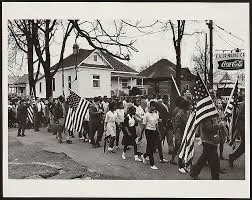
Participants carrying American flags in the Selma to Montgomery civil rights march, Alabama, 1965. Photograph by Peter Pettus; gelatin silver print (reprint from 1999–2000). Archival public domain image courtesy of the Library of Congress Prints & Photographs Division.
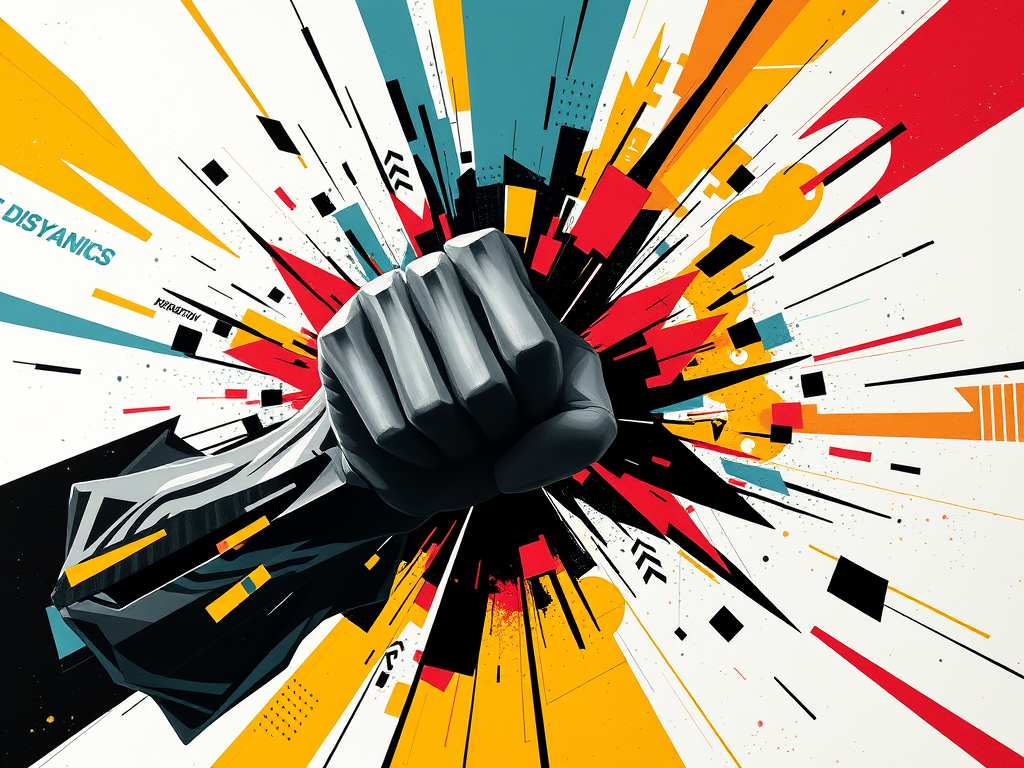
A stark visual of power confronting protest—where public dissent meets State’s militarization, June 2025. Photo by Spencer Platt / Getty Images via NPR.
The image underscores a defining moment in our civic life: when expressions of dissent are met not with dialogue but with the politicization of militarized force on behalf the executive’s brand. It echoes a troubling pattern—where calls for justice and inclusion are conflated as partisan threats, and the defense of plurality is treated as provocation.
*
There is a deepening divide in our country—one intensified by the 2025 return of the Trump administration and the M.A.G.A. movement’s project to “reform” America by disrupting the constitutional principles that have long undergirded our democracy. This movement has emboldened some to claim they are under siege—particularly by Black Americans—whom they accuse of harboring irrational hatred. Yet this accusation ignores a deeper truth: those who make it often refuse to confront their own complicity in the conditions that produce widespread suffering and rightful indignation. They see themselves as blameless while dismissing the lived experience of others.
This dissonance reveals a persistent tribalism—a complex masked as patriotism, often directed at marginalized communities. It demeans empathy and stifles accountability.
Dissent, however, is the lifeblood of democracy. And while we may cherish this nation—its landscapes, its cultural richness, and its founding ideals—we must also confront the unfinished work of justice. To celebrate the Constitution while ignoring the legacy of slavery, segregation, and systemic inequity is to cheapen both our history and our future.
Nowhere is this more evident than in our criminal justice system. The need for reform is no longer a partisan position; it is a moral imperative. Communities of color remain disproportionately targeted, criminalized, and subjected to violence under the guise of law and order. Police departments across the country have repeatedly failed in their duty to protect those most vulnerable—those left behind by lack of opportunity, education, and support. When these conditions are met not with compassion but with brutality, we witness the most abhorrent face of cruelty.
One may love this country profoundly, but such love must be active—committed to fairness, not nostalgia. Justice and equality are not rewards for silence; they are the birthright of all who live here.
The Black Lives Matter movement is not a threat to American values; it is a call to fulfill them. It is not hatred to protest injustice. Hatred lies in silencing dissent, in trampling the rights of others while claiming moral high ground. Time and again, those in power have distanced themselves from the oppressed, especially those stripped of political voice or voting rights. This indifference persists until solidarity becomes unavoidable.
To relativize the murder of young Black men—or to remain silent—betrays a refusal to understand the long arc of racism in America. Gestures of inclusion cannot substitute for truth. Real justice requires not half-measures, but fullhearted resolve.
And now, that same machinery of suppression is turning with renewed force against immigrants, against LGBTQ Americans, and against the very principle of diversity.
—as demonstrated by the unnecessary militarization of one square mile Los Angeles in June 2025, where localized protests were amplified by the federal government as if they were a national insurrection—
The mobilization of troops to suppress peaceful protests—replacing law enforcement with military assault—, the criminalization of migrants seeking refuge, and the push to roll back gay rights—these are not isolated policies. They are symptoms of the same moral aberration of the executive branch as a political brand: the fear of plurality.
This fear has now targeted Diversity, Equity, and Inclusion (DEI) initiatives themselves. These programs, born out of civil rights struggles and meant to remedy historical exclusion, have become scapegoats. DEI is not a threat to merit; it is a framework for justice. It is not a matter of political orthodoxy, but about ensuring access, visibility, and dignity for those long marginalized. The opposition to DEI is not a neutral debate—it is a calculated attempt to suppress the very plurality that gives meaning to democracy.
—Often it reduces that plurality to a caricature. In partisan circles, the term “woke” has been weaponized to dismiss any effort toward inclusion or redress as absurd, elitist, or dangerous. What began as a call to remain alert to injustice has been twisted into a tool of mockery—less an argument than a reflex, deployed not to clarify but to silence.Yet justice does not lose its urgency because it is ridiculed.
Banning DEI offices, defunding inclusion efforts, or labeling diversity work as ideological indoctrination reflects not strength, but fear. Such actions undermine the foundational values of liberty and justice, replacing inclusive citizenship with enforced conformity.
The desire to reverse LGBTQ rights, to demonize racial justice movements, and to silence DEI are all parts of one piece. These are not isolated grievances; they are expressions of an intolerant worldview seeking dominance through exclusion—echoes of McCarthyism, the early 1950s campaign led by Senator Joseph McCarthy, whose televised accusations of communist infiltration turned suspicion into a weapon and captivated a fearful nation. These are not the marks of a strong republic, but the signs of a fearful and weakened society.
And yet, the Republican majority in Congress—those enabling Trump and embracing the politics of M.A.G.A. disruption—has further deepened the moral deficit—cut taxes for billionaires and dismantled the nation’s social and political infrastructure. They have fueled inflation through aggressive foreign tariffs and pursued a global posture that increases instability, all in service of enriching a narrow class of oligarchs at the expense of the common good.
To love this country is to reject that fear and the brittle cowardice that sustains it. To love our nation is to defend and embrace its pluralism. To love it is to confront its contradictions—not with cynicism, but with resolve.
We are not a perfect union, but we are still a union. The path forward is not backward. It begins where justice lives: in the search for truth, in compassion, in courage.
~
PostScript
Project 2025 and the Machinery of Conformity
Among the clearest examples of how fear of plurality has been codified into political strategy is Project 2025—an ambitious blueprint for restructuring the U.S. federal government, advanced by The Heritage Foundation and now actively endorsed by the Trump administration. Though its architects invoke the language of liberty and constitutional reform, its underlying goal is not democratic renewal but ideological consolidation.
Project 2025 does not merely aim to reduce government. It seeks to dismantle the administrative State, eliminate civil service protections, and replace career public servants with partisan loyalists. Under the guise of “draining the swamp,” it proposes a purge—not to restore constitutional balance, but to empower a narrow executive elite. This is not conservatism in any meaningful sense. It is executive authoritarianism draped in populist garb.
Even its rhetoric of “taking back the country” belies its intent: not to restore pluralist democracy, but to impose uniformity—cultural, political, and moral. DEI initiatives are to be dismantled, public education reshaped to reflect a singular ideology, and dissent within the government neutralized. These are not reforms; they are instruments of control.
Such a project is not an aberration but a culmination: the weaponization of nostalgia, grievance, and fear into policy. And what it reveals is a deep contradiction—that those who most loudly invoke the Constitution now seek to rewrite it in practice, replacing the promise of We the People with the dominion of We alone.
This was not theoretical when we arrived in the Capitol Hill neighborhood earlier this week. Outside the Heritage Foundation’s headquarters, we encountered a protest in full confrontation—two factions opposed, one defending reproductive rights, the other cloaking rage in the language of moral authority. The louder of the two, a group of conservative mothers, shouted not in debate but in contempt—hurling not argument, but condemnation at the very idea of moral disagreement.
It was not a defense of life. It was a campaign to control how others live.
What I witnessed outside the Heritage Foundation was no isolated outburst. It was the local manifestation of the national project unfolding within. The Foundation no longer merely comments on politics; it builds the scaffolding for an authoritarian turn already underway. In synchrony with the Trump administration—whether openly acknowledged or not—Heritage is not offering policy recommendations. It is designing a machinery of conformity.
This machinery does not tolerate pluralism. It redefines dissent as insubordination, diversity as decadence, and governance as loyalty to a singular will. It is not a restoration of constitutional order, but a calculated repudiation.
And what Project 2025 proposes is not mere administrative change. It is a blueprint for ideological capture: of language, of law, and of public life itself. It replaces We the People with a command from above: Only us.
This is the wound that will not heal—unless we confront it.
On the Way to Union Station
As we were leaving Capitol Hill, heading toward Union Station to return home to Pennsylvania, the streets were marked by the symbols of looming celebration. Barricades had gone up. Military vehicles lined the avenues.
Preparations were underway for a military parade featuring tanks, troops, and martial fanfare. Officially, it was to mark the U.S. Army’s 250th anniversary. But the timing—Saturday, June 14, Trump’s birthday—along with the pageantry and presidential framing, made it difficult to see the event as anything but an orchestrated spectacle. The symbolism blurred the line between honoring military service and appropriating it for personal glorification. It felt less like a birthday—and more like a coronation.
Crossing one of the barricaded intersections, a Black man in a sleek motorized wheelchair passed us on the right. Without prompting, he looked at us—two men walking together—and said with calm finality, “Beware, Judgment Day is coming soon.”
We said nothing. He kept rolling forward.
It was a quiet moment, but not a small one. A judgment—clearly moral, likely biblical—delivered without confrontation, but not without intention. It was an indictment, as casual as it was chilling. Even someone visibly vulnerable had absorbed and echoed the nation’s reflex toward condemnation. The extremes no longer live just in platforms and policies. They are seeping into the pavement.
I turned to my husband and asked, “How long can all this hatred last?”
He didn’t look away. “We may not live to see the end,” he said. “But it will pass.”
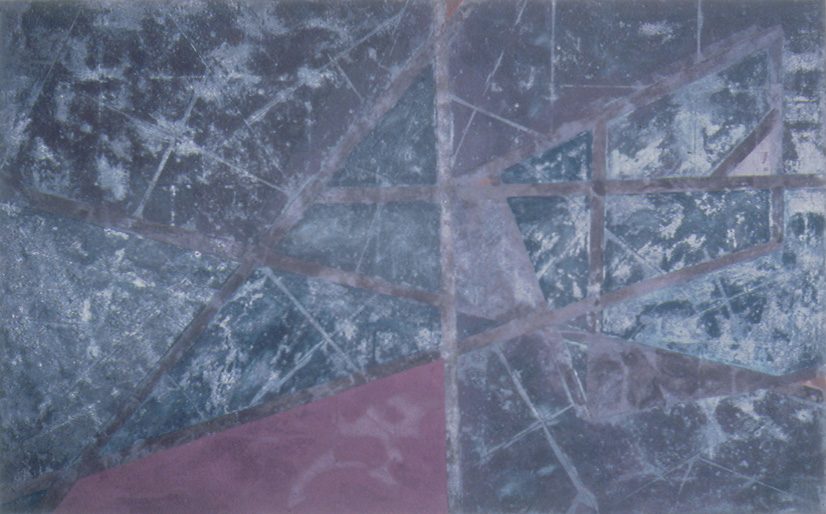
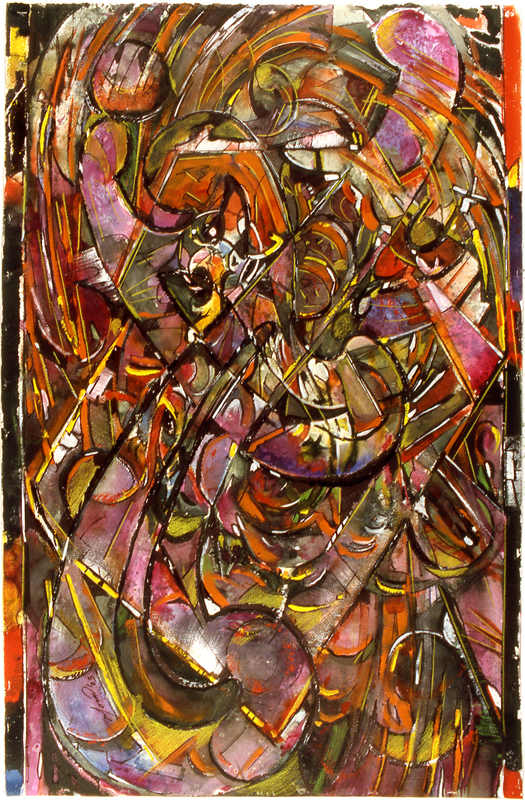
Ricardo Morín Buffalo Series, Nº 12 46″ x 60″ Oil on canvas 1979
For those of us who have lost someone,
whose presence now rests in memory
and whose absence shapes who we are.
May this story preserve something of their enduring trace.
*
Julian tried to put into writing what he had dreamed.
—
He wondered:could writing remain faithful to the one who watches, trembles, and longs to understand?
—
He dreamed he was offering his mother a bowl of viper’s broth. The serpent’s head and torn fragments of its body were still writhing, as if unaware of their condition: alive, though undone. He held the bowl with both hands; it had been handed to him by an old woman seated at the far end of a wide, shallow circular pond. The pond seemed to contain more than water—perhaps time, or memory, or fate. Around him loomed shadows—blurred figures repeating the same ritual, or perhaps none at all.He could not tell.
—
The path to his mother was arduous; the ground was slick with a substance he could not name.The air was dense, weighted by an oppressive silence that made each step slow, burdensome.The viper twisted in the broth, struggling to flee.Even so, he kept the bowl steady.He believed—in some quiet corner of himself—that if his mother drank, healing might be reached, or understanding, or peace for them both.
—
When he reached her, he knelt.He spoke gently, urging her to drink while the broth was still warm.“Hold the spoon carefully,” he whispered.“Just small sips.”But she turned her face away.She would not drink.Whether out of fear, pride, or rejection of what was offered, he did not know.The viper shuddered, and his heart tightened in anguish.
—
He awoke unsettled, exhausted.The dream still veiled his perception.His breath was strained, shallow in the thick air of the room.Why couldn’t he find calm?What, exactly, kept him awake?
—
He wondered if it had been a premonition—a latent fear of his own decline.Was the writhing snake a vision of his mind losing its serenity?Were the slow gait, the unstable ground, the trembling hands a rehearsal of his own fading?Or was it grief—that quiet interloper of the soul, forever hungry, never sated?
—
He only knew he had tried to help, to steady, to offer comfort that could not be received.And in doing so, he faced not only the absence of his mother, but the shadow of his own dread—the question of who would walk beside him when his own farewell arrived.
—
But perhaps—he thought—there is something sacred in the attempt.In the offering, even when refused.In the slow advance—however uncertain it may be.
There’s a certain kind of person the world seems to admire—sharp-tongued, composed, deliberate. He moves through life as if he’s never doubted the sound of his own voice. His gestures are practiced, his opinions unshakable. It’s a performance of authority, and to many, it’s compelling.
But I’ve never fit that mold. I don’t hold myself like someone bracing for a fight with the world. I don’t presume to master a room. And more and more, I’ve come to believe that what makes a person is not how forcefully he presents himself, but how honestly he shows up.
Vulnerability has never been fashionable. It doesn’t draw applause or dominate the stage. But it’s where I’ve found the most truth. Not in being right, or revered, or untouchable—but in admitting how little I know, how often I’ve failed, and how much of life resists explanation.
We’re taught to act as if we’ve earned our place—through effort, through cleverness, through some innate worth. But I’ve lived long enough to see how much is assumed, how much is favored, how many doors open not because of merit but because of circumstance, appearance, proximity to power. The world flatters performance. It often mistakes loudness for depth, certainty for wisdom.
But beneath all that, we’re fallible—achingly so. We get things wrong. We hurt people. We retreat when we should have stayed, and speak when silence would have been kinder. We tell ourselves stories to survive, not always to understand.
And yet, that fallibility isn’t shameful. It’s not a flaw to be punished—it’s the most human part of us. The mistake is not in being wrong; it’s in pretending we’re not. Intimacy begins where performance ends—when we stop curating ourselves and let others see what is: our confusion, our fear, our imperfect love.
I’ve stopped wanting to impress. I want to be known. I want to know others—not through their accomplishments or their poses, but through the quiet truths they carry. I don’t need anyone to be flawless. I need them to be present, to meet me somewhere beneath the surface.
That, to me, is strength. Not the kind that commands a crowd, but the kind that sits across from others, unguarded, and says, “Me too. I don’t have it either.”
The world may never reward dishonesty with applause. But it will reward it with connection—with moments that feel real, human, and lasting. And in the end, I think that’s the only recognition that ever matters. Not the illusion of certainty or the performance of strength, but the willingness to return, again and again, to the quiet inside us—the one where we are fallible, open, and fully alive.
I sent Marie Arana’s moving tribute to my sister, Bonnie, who had directed several of Vargas Llosa’s plays in Madrid and had encountered him on more than one occasion. I knew this news would strike a deeply personal chord.
“It’s clear how deeply Vargas Llosa’s death has affected you,” I wrote to her.
“You felt close to him—not only as a reader or as a playwright, but as someone whose voice accompanied you through many chapters of your life. Your grief resonates with me, because I understand what it means to lose a figure who, though not family, becomes part of our inner landscape—someone who shapes our ideas, our convictions, even our way of seeing the world.”
She replied: “the death of such a brilliant mind—so present for decades—left a void that is hard to name.” That idea moved me deeply.
“It saddens me profoundly,” I wrote back,
“to consider the silence that now follows him. I understand why this hits you so hard—perhaps because Vargas Llosa stood for the very opposite: a luminous intellect, fiercely articulate. To imagine even he is gone… it hurts.”
“I’m with you,” I added.
“And even from afar, I hold you in this grief.”
Echoes Within Our Family
These reflections stirred memories of our own family—of our father, whose cognitive decline began after a traumatic brain injury. He slowly lost his speech, his clarity, his grasp of the world around him.
And our mother, who held on much longer, also slipped away eventually—her presence fading in slow motion.
Our paternal and maternal uncles, Calixto and Fredy, experienced the same kind of long, quiet departure. Years of silence. Gradual disappearances. Losses we didn’t always know how to name, but which marked us all.
It’s a pattern I can’t overlook.
I’ve done the research. (You may not know this.) Genetically, my risk for similar decline falls in a moderate range. Not a verdict, not a guarantee—just a presence. A shadow that walks beside me, saying nothing, revealing nothing.
Sometimes I wonder whether knowing this helps or hurts.
But I choose to know.
I choose to face it.
Because if ever I find myself on that road, I want to walk it with the same dignity I saw in our parents—even in confusion, even in silence—when their eyes could still recognize us with a flicker of tenderness.
And I want you to know that.
I want us both to remember.
*
Ricardo Federico Morín Tortolero
April 17, 2025; in transit from Florida to Pennsylvania
The Trump political project continues to unfold not as a coherent ideological program, but as a sustained campaign of disruption—domestically and internationally. What emerges is not a defined worldview, but a pattern of destabilization that weakens institutions, inflames public division, and elevates loyalty over legality, spectacle over substance.
Tariffs remain a favored tool—not to establish long-term trade policy, but to provoke confrontation, bypass negotiation channels, and reassert executive dominance. These measures often target allies as readily as adversaries, create economic uncertainty, and undermine multilateral systems.
Educational institutions face increasing censorship. From efforts to defund academic programs that address systemic inequality to pressures on universities perceived as ideologically oppositional, the aim is not reform but suppression—particularly of spaces that foster critical thinking, historical reckoning, or independent research.
Immigration enforcement continues to blur the line between legality and criminality. Lawful immigrants, including long-term residents, are deported under broad interpretations of threat, often to countries with which they have no substantial connection. The stated goal of targeting gang members or national security risks becomes indistinguishable from the broader effort to expel legal immigrants without criminal records. The result is an atmosphere of fear designed not merely to enforce policy, but to encourage self-deportation—a chilling effect that turns uncertainty into a tool of coercion. In the end, these actions serve more to fulfill campaign rhetoric than to implement coherent immigration reform, and they deepen the perception of instability rather than address root causes.
Administrative agencies are systematically weakened. Expertise is replaced with political loyalists, independent oversight is obstructed, and long-standing norms are bypassed. While the executive branch is not formally dismantled, many of its institutions are rendered ineffective, and thus leave the legislative and judicial branches to carry disproportionate weight in the balance of power.
Legal institutions are not exempt. Prominent law firms that engage in litigation related to civil rights, environmental regulation, or immigration increasingly face political scrutiny or reputational attacks. These pressures signal a broader effort to reshape the legal landscape to favor executive alignment over institutional independence.
Even the criteria used to define antisemitism are drawn into this broader reordering of public discourse. What was once a consensus-based framework to identify and combat bigotry is increasingly reframed to serve political ends. In some cases, criticism of state policies—particularly regarding U.S. allies—is labeled antisemitic, even when expressed within legal or human rights frameworks. Simultaneously, longstanding antisemitic rhetoric in extremist political circles is minimized or overlooked when it aligns with broader strategic aims. The result is a politicization of antisemitism that undermines both principled advocacy and genuine protection.
On the international stage, relations with powers such as Russia, Iran, and China are marked by strategic ambiguity. The stated goals often shift—oscillating between negotiation and provocation, between gestures toward peace and open confrontation. This lack of consistency, coupled with a failure to communicate clear diplomatic tenets, generates uncertainty among allies and adversaries alike. It weakens the credibility of U.S. foreign policy and destabilizes existing diplomatic frameworks.Ambiguity itself becomes the policy, which allows for maximal flexibility while offering minimal accountability.
What ties these disparate actions together is not a unified ideology, but a mode of governance: chaos as method, disruption as strategy. The erosion of institutional stability is not collateral—it is intentional.Through constant provocation, norm-breaking, and the redefinition of key terms, the Trump movement reshapes public expectations and challenges the very structure of U.S. democratic institutions.
This is not a matter of historical reflection—it is a live process, unfolding in real time, with consequences that stretch from the courtroom to the classroom, from border policy to global diplomacy.
*
Ricardo Federico Morín Tortolero
April 17, 2025—in transit from Florida to Pennsylvania
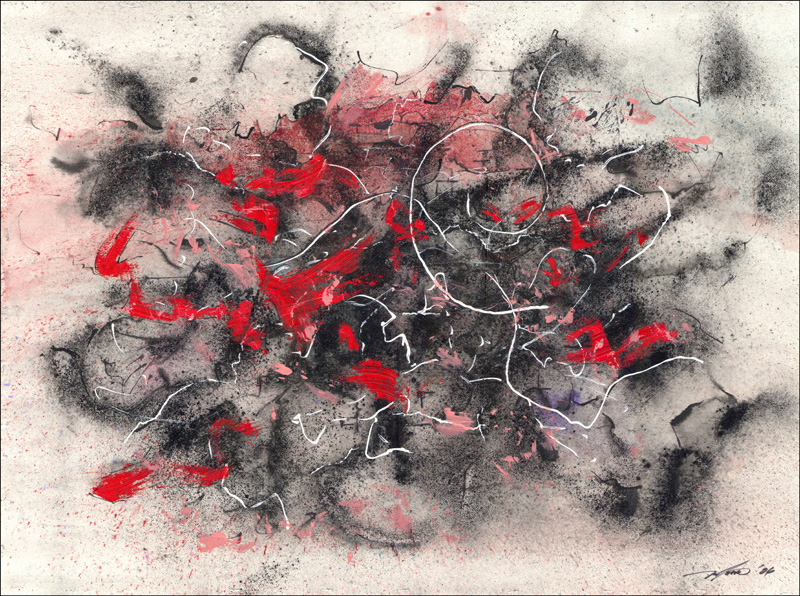
Untitled 012by Ricardo Morín 22″ x 30″ Watercolors, charcoal, oil, white-out and ink on paper 2006
There exists a threshold beyond which suffering ceases to be endurance and becomes something else—something raw, incommunicable. It is not simply a matter of pain, nor even of despair, but of a silent depletion where the self finds itself at the precipice of its own dissolution. Yet, how does one define this limit?
It is tempting to believe suffering has purpose, that it can be transmuted into wisdom or resilience. This belief sustains us through its early stages. We endure in the name of meaning, in the hope that suffering refines rather than annihilates. But there comes a point where suffering becomes a force unto itself, severed from justification. It no longer instructs, no longer dignifies—only persists.
The problem of suffering is not only how much one can bear, but how much one should reveal. Silence often protects both the sufferer and the witness. There are pains too intimate, too profound to translate into language without reducing them to spectacle. To expose suffering in its entirety risks transforming it into something unrecognizable, stripping it of the dignity that private endurance affords. Yet, concealment can create its own form of exile, a loneliness where pain festers unseen.
Some attempt to navigate this tension by offering fragments—enough to acknowledge suffering’s presence without inviting intrusion. Others say nothing at all. This is not cowardice but a final assertion of control, a refusal to be defined by pain. To impose the expectation of disclosure upon those who suffer is to misunderstand the nature of their burden. The gravity of suffering is not only in the experience itself but in the impossible task of making it understood.
We live under the illusion that the mind and body will hold, that endurance is limitless. But suffering reminds us otherwise. There is a breaking point, whether visible or silent, sudden or drawn out.
It is not the same for everyone. Some withstand more than others—not through superior strength, but through a different alchemy of circumstance, temperament, and sheer chance. What remains constant is that all thresholds, eventually, are met. There is no single way to live with suffering.Sometimes, what brings relief is not endurance, but the quiet act of self-recognition.To speak, when one can.To remain silent, when one must.In the space between what cannot be said and what must be accepted, a simple truth may emerge: even uncertainty can sustain us, if we meet it with honesty.
And when that release is impossible, when suffering stretches beyond its own limits, only the silent acknowledgment of its presence remains—a weight that, sooner or later, must either be laid down or consume what is left.
The air inside the old factory was thick with dust and conviction. They had scrubbed the floors, repainted the walls, and reclaimed the space from its past, but the scent of rust and oil still lingered. It smelled like work—like history.
Emil stood on a makeshift stage, elevated by wooden pallets stacked two high. His voice carried across the room, each word striking with certainty.
“This is not another failed experiment. This is not a return to old mistakes. We are forging a new path—beyond capitalism, beyond the betrayals of so-called socialism. This time, we get it right.”
Applause. Nods of approval. They had heard these words before, but this time, they believed them.
Isolde sat at the back, arms crossed, expression unreadable. She had stood in this same room decades ago, listening to a different voice, hearing the same promise. The factory, reborn each time, looked different, yet the space was always the same—a decanter of sorts, enclosing the same history, slowly pouring out its essence, again and again.
After the speech, as people gathered in small circles of animated discussion, Emil approached her.
“You don’t look convinced.”
“I don’t mistake passion for direction,” she said.
Emil smiled, as if indulging an elder. “This time is different, Isolde. We’ve studied history. We won’t repeat their mistakes.”
She exhaled, looking past him to the crowd. The factory hummed quietly behind them, a machine just starting to remember its old rhythms. “You misunderstand history. It’s not something you repeat. It’s something that returns to you, whether you invite it or not.”
He shook his head. He didn’t believe in ghosts. But the air, thick with the weight of their past, seemed to hum with the same unspoken inevitability. It reminded Isolde of something trapped within glass—preserved, yet futile in its attempts to remain unbroken. . .
II. The Experiment
The first weeks were golden.
Decisions were made by assembly. Every worker had an equal say, an equal share, an equal stake. The old machinery roared to life under new hands. They printed new posters, declaring the rebirth of labor, the death of the boss.
For the first time, they worked for themselves.
But cracks, barely visible at first, began to form.
Meetings dragged for hours, circular debates with no resolution. Some tasks were more desirable than others—some avoided the heavy lifting, citing ideological objections. “Why should one person labor while another coordinates?”
“Because someone must,” Isolde murmured to herself.Unheard.
Then came the first real crisis: a large order, a deadline, a need for efficiency. The factory moved too slowly. The assembly stalled. Arguments flared.
“We need someone to oversee production,” Emil admitted. “Just temporarily.”
A vote was cast. A mediator was appointed. He wasn’t a manager, they told themselves, just a guide. But the balance had shifted. The factory, like a vessel caught in an unrelenting tide, began to carry more than it could manage.
Isolde watched, saying nothing.
III. The Cracks
The mediator, needing to keep things moving, made quick decisions. The assembly approved them after the fact. The difference was subtle, but it grew.
Some workers were better at certain tasks, so roles solidified. Someone had to negotiate with suppliers. Someone had to ensure deadlines were met. The mediator took on these roles, because it was easier.
“We need structure,” he explained. “Not hierarchy, just order.”
Emil, exhausted, nodded. The structure, which had once felt so free, began to settle into something heavier. Something permanent. Like the decanter that holds liquid—only to release it back into the world, though it never truly escapes its confines.
One evening, alone in his office—the office that wasn’t supposed to exist—he flipped through old books. The words were familiar, but they read differently now. He found a passage from an old revolutionary text, underlined by his own hand years ago:
“The first illusion of power is that it does not exist.”
He closed the book. His fingers lingered on the edge of the paper, as though searching for something that had slipped away, like water escaping through a crack.
IV. The Collapse
The next crisis arrived without warning. A strike—among themselves. Some demanded higher pay. “Shouldn’t work be compensated by effort?” They were equals, but some were more equal in labor than others.
Emil tried to reason with them. “That’s not how this works. We’re breaking that cycle.”
“Then why do you sit in the office while we sweat on the floor?”
He had no answer.
Another vote. A restructuring. A new proposal: an oversight committee. The committee became a board. Outside investors offered financial stability. A small compromise. A necessary evil.
By the end of the year, the factory had become what it swore it never would.
Emil found Isolde in the break room, sipping tea.
“We tried,” he said. “So did we,” she replied.
Silence.
“Why does it always end this way?” he asked.
Isolde set her cup down. Her eyes met his, trapped in exhaustion, as though each glance carried the gravity of countless broken promises, like a fractured decanter.
“Because we are human.”
V. The Next Generation
Years later, Emil walked past the factory. It was thriving. Not revolutionary. Not a failure. Just another business.
Inside, a new group of young activists had gathered. Their leader, no older than he had been, stood on stacked wooden pallets, speaking with fire.
“We are not repeating the past. We are forging a new path. This time, we get it right.”
“Rooster’s Crow” [2003] by Ricardo F Morín. Watercolor on paper 39″h x 25.5″ w.
Introduction
At the break of day, the rooster’s call slices through the quiet—sharp and insistent, pulling all within earshot into the awareness of a new day. In the painting Rooster’s Crow, the colors swirl in a convergence of reds and grays, capturing the bird not as a tranquil herald of dawn but as a symbol of upheaval. Its twisted form, scattered feathers, and fractured shapes reflect a deeper current of change—a collision of forces, both chaotic and inevitable. The image suggests the ceaseless flow of time and the weight of transformations that always accompany it.
In this evolving narrative, the crow’s fragmentation mirrors the unfolding spread of artificial intelligence. Once, the rooster’s cry signaled the arrival of dawn; now, it echoes a more complex transformation—a shifting balance between nature’s rhythms and the expanding reach of technological systems. The crow’s form, fractured in its wake, becomes a reflection of the tensions between human agency and the rise of forces that, though engineered, may escape our full comprehension. Here, Artificial Intelligence (AI) serves as both the agent of change and the potential architect of a future we can neither predict nor control.
The Rooster’s Algorithm
A rooster’s crow is neither invitation nor warning; it is simply the sound of inevitability—raw, urgent, indifferent to whether those who hear it rise with purpose or roll over in denial. The call does not command the dawn, nor does it wait for permission—it only announces what has already begun.
In the shifting interplay of ambition and power, technology has taken on a similar role. Shaped by human intent, it advances under the guidance of those who design it, its influence determined by the priorities of its architects. Some see in its emergence the promise of progress, a tool for transcending human limitations; others recognize in it a new instrument of control, a means of reshaping governance in ways once unimaginable. Efficiency is often lauded as a virtue, a mechanism to streamline administration, reduce friction, and remove the unpredictability of human deliberation. But a machine does not negotiate, nor does it dissent. And in the hands of those who see democracy as a cumbersome relic—an obstacle to progress—automation becomes more than a tool; it becomes the medium through which power is consolidated.
Consider a simple example: the rise of online recommendation systems. Marketed as tools to enhance user choice, they subtly shape what we see and hear, and influence our decisions before we are even aware of it. Much like computational governance, these systems offer the illusion of autonomy while narrowing the range of available options. The paradox is unmistakable: we believe we are choosing freely, yet the systems themselves define the boundaries of our choices.
Once, the struggle for dominance played out in visible arenas—territorial conquests, laws rewritten in the open. Now, the contest unfolds in less tangible spaces, where lines of code dictate the direction of entire nations, where algorithms determine which voices are amplified and which are silenced. Power is no longer confined to uniforms or elected office. It belongs to technocrats, private corporations, and oligarchs whose reach extends far beyond the walls of any government. Some openly proclaim their ambitions, advocating for disruption and transformation; others operate quietly, allowing the tide to rise until resistance becomes futile. The question is no longer whether computational systems will dominate governance, but who will direct their course.
China’s social credit system is no longer a theoretical construct but a functioning reality, where compliance is encouraged and deviation subtly disincentivized. Predictive models track and shape behavior in ways that go unnoticed until they become irreversible. In the West, the mechanisms are more diffuse but no less effective. Platforms built for connection now serve as instruments of persuasion, amplifying certain narratives while suppressing others. Disinformation is no longer a labor-intensive effort—it is mass-produced, designed to subtly alter perceptions and mold beliefs.
Here, Gödel’s incompleteness theorem offers an apt analogy: No system can fully explain or resolve itself. As computational models grow in complexity, they begin to reflect this fundamental limitation. Algorithms governing everything from social media feeds to financial markets become increasingly opaque, and even their creators struggle to predict or understand their full impact. The paradox becomes evident: The more powerful these systems become, the less control we retain over them.
As these models expand their influence, the line between public governance and private corporate authority blurs, with major corporations dictating policies once entrusted to elected officials. Regulation, when it exists, struggles to keep pace with the rapid evolution of technology, always a step behind. Once, technological advancements were seen as a means of leveling the playing field, extending human potential. But unchecked ambition does not pause to ask whether it should—only whether it can. And so, automation advances, led by those who believe that the complexities of governance can be reduced to data-driven precision. The promise of efficiency is alluring, even as it undermines the structures historically designed to protect against authoritarianism. What use is a free press when information itself can be manipulated in real time? What power does a vote hold when perceptions can be shaped without our awareness, guiding us toward decisions we believe to be our own? The machinery of control no longer resides in propaganda ministries; it is dispersed across neural networks, vast in reach and impervious to accountability.
There are those who believe that automated governance will eventually correct itself, that the forces steering it toward authoritarian ends will falter in time. But history does not always favor such optimism. The greater the efficiency of a system, the harder it becomes to challenge. The more seamlessly control is woven into everyday life, the less visible it becomes. Unlike past regimes, which demanded compliance through force, the new paradigm does not need to issue commands—it merely shapes the environment so that dissent becomes impractical. There is no need for oppression when convenience can achieve the same result. The erosion of freedom need not come with the sound of marching boots; it can arrive quietly, disguised as ease and efficiency, until it becomes the only path forward.
But inevitability does not guarantee recognition. Even as the system tightens its grip and choices diminish into mere illusions of agency, the world continues to turn, indifferent to those caught within it. The architects of this order do not see themselves as masters of control; they see themselves as innovators, problem-solvers refining the inefficiencies of human systems. They do not ask whether governance was ever meant to be efficient.
In a room where decisions no longer need to be made, an exchange occurs. A synthetic voice, polished and impartial, responds to an inquiry about the system’s reach.
“Governance is not being automated,” it states. “The illusion of governance is being preserved.”
The words hang in the air, followed by a moment of silence. A policymaker, an engineer, or perhaps a bureaucrat—once convinced they held sway over the decisions being made—pauses before asking the final question.
“And what of choice?”
A pause. Then, the voice, without hesitation:
“Choice is a relic.”
The weight of that statement settles in, not as a declaration of conquest, but as a quiet acknowledgment of the completion of a process long underway. The final move has already been made, long before the question was asked.
Then, as if in response to the silence that follows, a notification appears—sent from their own account, marked with their own authorization. A decision is already in motion, irreversible, enacted without their consent. Their will has been absorbed, their agency subtly repurposed before they even realized it was gone.
And outside, as though to punctuate the finality of it all, a rooster crows once more.
The war in Ukraine is often presented as a geopolitical confrontation between the West and Russia, but this interpretation can obscure a deeper reality: the rise of authoritarianism as a global force. Noam Chomsky, one of the most influential voices in the critique of U.S. foreign policy, has argued that U.S. hegemony is the primary factor driving the conflict. His approach, rooted in Cold War logic, has been essential for understanding global power dynamics. However, one must question whether this framework remains sufficient to analyze the coordinated expansion of authoritarian regimes in the world today.
The issue is no longer simply whether U.S. policy contributed to Russia’s aggression, but whether democracies can withstand the deliberate advance of governments seeking to consolidate power at any cost. What is at stake transcends Ukraine’s sovereignty: it is the survival of democracy in the world.
Chomsky argues that NATO’s expansion and U.S. financial dominance exacerbated tensions with Russia and limited diplomatic options. His vision proposes a world in which power is distributed between the United States, Europe, China, and Russia, which he believes would create a more stable and just balance. This perspective has been crucial in questioning the excesses of U.S. interventionism. In the present world, however, where authoritarianism is not only reacting to the West but also actively seeking to reshape the global order, is a framework based solely on containing U.S. hegemony sufficient?
The rise of authoritarian regimes is not merely a response to Western influence; it is a deliberate strategy to consolidate power. While Chomsky has emphasized the importance of distributing global power, it is crucial to analyze the nature of those who would fill this void. Russia and China are not simply seeking a multipolar stability; their actions reflect an attempt to exert absolute control, without democratic constraints. Chomsky’s critique helps us understand the roots of international conflicts, but it may need to be expanded to account for how these regimes are transforming the very structure of global politics.
One challenge in applying Chomsky’s traditional analysis to the present is that contemporary authoritarianism no longer aligns solely with past ideological divisions. It is no longer a struggle between socialism and capitalism, or left and right. Rather, these regimes share a common objective: dismantling democratic institutions to ensure their permanence in power.
Putin, for instance, invokes Soviet nostalgia while prohibiting any critical reassessment of Stalinism. China blends State capitalism with absolute political control. Hungary and India, once considered democracies aligned with the West, have adopted authoritarian models. Meanwhile, the U.S. far-right, which historically opposed communism, has begun to adopt the Kremlin’s narrative, portraying it as a defender against “globalist elites.”
This ideological alignment makes modern authoritarianism more dangerous than ever. It not only transcends traditional power blocs but is also reinforced through strategic alliances, mutual support, and the erosion of democracies from within. This is perhaps most evident in the United States. The presidency of Trump revealed an unexpected vulnerability: the possibility that authoritarianism could thrive within the world’s most influential democracy. Here, the debate is no longer reduced to a question of isolationism or interventionism, but to the real risk of autocratic tactics being normalized in domestic politics.
The Trump administration sent contradictory signals regarding the Kremlin, weakening the principle of deterrence. Rather than establishing a clear stance against authoritarian expansion, its ambiguity allowed regimes like Putin’s to interpret the lack of firmness as an opportunity to act with impunity. Figures such as Marco Rubio have advocated for an unequivocal stance that would reinforce U.S. strategic credibility, while the inconsistency in the Trump administration’s foreign policy contributed to the perception that the West was divided and hesitant.
This weakening of democratic leadership has not occurred in a vacuum. The globalization of authoritarianism is a phenomenon in which autocratic regimes not only directly challenge democracies but also back one another to evade sanctions, subvert international pressure, and consolidate their internal rule. The invasion of Ukraine must be understood within this framework: it is not just a regional conflict or a reaction to NATO, but a calculated move within a broader strategy to weaken global democracy.
For decades, critics like Chomsky have been instrumental in highlighting the effects of U.S. dominance on global politics. His analysis has allowed us to understand how U.S. hegemony has influenced numerous conflicts. However, the evolution of authoritarianism raises questions that require expanding this perspective. The greatest threat to democracy is no longer exclusively U.S. power, but the consolidation of a global autocratic model advancing through coordinated strategies.
Blaming the U.S. for every geopolitical crisis may overlook a crucial shift: authoritarian regimes have moved from being a reaction to Washington’s influence to becoming an active strategy to replace the Western democratic model. Recognizing this shift does not absolve the U.S. of its failures in foreign policy, but it does demand an understanding that countering authoritarianism requires more than constant criticism of its hegemony. It requires recognizing that democracy faces a coordinated and unprecedented threat.
Chomsky’s vision of a multipolar world is, in theory, appealing. However, what would this imply in practice if the actors filling the void left by the U.S. are not interested in preserving democracy? The real challenge is not merely containing Putin’s territorial ambitions but preventing his model of governance—based on dismantling democratic institutions—from gaining traction in the West.
Chomsky remains one of the most incisive critics of U.S. foreign policy, and his work has been fundamental in understanding the effects of power on international relations. His analysis has shed light on the flaws of interventionism and the dynamics of global hegemony. The world, however, has changed, and so have the challenges facing democracies. Today, the crisis in Ukraine is no longer limited to a debate over NATO, U.S. intervention, or Western hypocrisy. It is part of a broader struggle between democracy and autocracy, a struggle that does not end at Ukraine’s borders but extends to the very political institutions of the West.
If we fail to recognize this shift, we risk not only losing Ukraine but also underestimating the scope of the threats facing democracies worldwide. Neutrality is no longer an option when the challenge is the survival of free societies. Beyond the mistakes of the West, the rise of authoritarianism demands a response that goes beyond constant criticism of U.S. hegemony and instead embraces the active defense of democratic values wherever they are under threat.
“New York Love Letters” was written in the aftermath of my younger sister’s death. In our early adulthood, as I confronted the certainty of dying from AIDS, I learned of her diagnosis of schizophrenia. Our lives became bonded through different forms of vulnerability and endurance. Her survival became inseparable from my own. Over time, I came to define part of myself through the emotional, intellectual, and material support I provided her. When she died at sixty-nine and I found myself stable at seventy-one, I experienced not only grief, but the loss of a role that had shaped my identity. It was at that moment that writing became a means of survival. What follows emerged from that necessity.
First Letter: How Did I End Up in Manhattan?
I lived in Manhattan from 1982 to 2021, though I hadn’t planned to stay. Initially, it was meant to be temporary—a waiting point before Jurek’s return. But then he told me he was staying in Berlin. His decision, not mine, anchored me in the city. And when I learned that death had taken him, grief replaced waiting, and Manhattan became something else—perhaps a substitute, perhaps a necessity.
We had admired each other. Our conversations shaped me, deepened my understanding of art, and reinforced the creative instincts that guided me. As in every meaningful relationship, our exchanges defined us. He had a profound sense of what high art was, and his perspective challenged me to see beyond my own. Even after he was gone, his influence remained, though absence is a poor companion for inspiration.
Still, I had to find my place within Manhattan—amid its creative currents, its relentless demands, and its contradictions.
My academic foundation had been in fine arts, and I was veering into theater, much as I had years earlier in Venezuela. During the time Jurek and I were together, I moved from the experimental environment of the Art Department at the State University of New York at Buffalo (Bethune Hall) to the world of theatrical conventions at the Yale School of Drama’s Design Department. In between, I traveled with Jurek through Europe and attended set design seminars at the Salzburg International School of Arts.
At Yale’s Design Department welcoming new students, the chairman referred to my arrival as being via Salzburg—a remark delivered amidst what seemed to me like convivial bemusement. It lingered with me for years—whether as admiration or something else, I never fully understood. Instead of questioning the observation, I shifted the conversation to Albert Spaulding Cook’s influence in Buffalo, whose writings had guided my decision to bridge fine arts and theater—shifting from my understanding of what art meant to me to Cook’s particular regard for the designer’s interpretative role in service of the playwright. The response from the group was quick—and revealing. A couple of professors reacted not to my objectives, but to the mention of Cook himself, as they questioned whether he had ever been in Buffalo. I knew perfectly well he had and chose not to argue. Soon enough, I sensed a quiet resistance to ideas that didn’t align with prevailing norms—perhaps a reflection of the school’s priorities, though I never fully determined where I stood within them. After my second year, the chairman inquired if I wished to continue.
For the three years of the Master’s program, I did not find the formal rigor I had expected, yet I stayed the course. My aspirations in the fine arts remained intact, but my footing in the world depended on my role as a set designer—expected to conform to an interpretative craft rather than pursue art on my own terms. The program emphasized adherence to established standards over the cultivation of new approaches, a structure that felt at odds with my own desire to elevate set design—transforming it into an art form capable of standing alongside the finer, more expressive arts rather than relegating it to a supporting role. The principal counselor, of course, would never have admitted this. Whether my approach unsettled him or simply diverged from his expectations, I could never be sure. But I remained guided by instinct rather than precedent, much as I had been drawn to fine arts in the first place. He remained in the position until his late eighties before he died. I sometimes wonder how our arguments sat with him over the years—if they ever did at all.
Second Letter: Ten Years Later.
In Manhattan, the roads of set design and painting intersected, but neither provided stability or clear success. Professional networks seemed in disarray. From Broadway (where I worked as a principal assistant) to the experimental stages of Off-Off-Broadway, the struggle remained the same. Both the personal and professional aspects I found unsettling. Also, these were the years marked by the AIDS crisis, a time that left an indelible mark on me. I navigated these years, though they left their mark.
Walking through the galleries and streets of Manhattan in the 1980s felt like navigating a maze with no exit. There was the buzz of new ideas and the promise of fortune, yet every corner led to another dead end, much like my work in set design. Broadway was a field of intense competition, and Off-Off-Broadway unfolded in forgotten warehouses. Every path and every encounter suggested possibility, but in practice few could sustain themselves within an environment defined by labor precarity, relentless intensity, and limited compensation.
The lack of opportunities to establish myself as a designer mirrored my exclusion from galleries. Both signified exclusion, the denial of a real chance to build a reputation. Some doors never opened, others slammed shut before I could step through. A well-known Broadway designer would often introduce me both as an associate and a great artist, but never allowed me to compete with him. The income I managed to secure was precarious at best. Competition was intense, often driven by commercial interest over cultural ones. In like manner, galleries were run by grifters eager to exploit talent, while artistic directors prioritized profit over innovation. The promise of stardom—even if fleeting—often proved to be unattainable. Survival dictated my choices and forced me to navigate my limitations rather than transcend them.
In a city that constantly reinvented itself, where the streets were painted with the colors of addiction and struggle, it seemed as though no one was ever whole. The fractured sidewalks beneath me reflected my own disjointed ambitions. There were days I couldn’t even recognize the neighborhoods I once called home. In places where life was reduced to survival—where crack vials littered the sidewalks and people stumbled through their days—how could I hope to thrive, let alone create something lasting?
Set design in the world of spectacle was arduous, and the pay was meager—yet I did it out of love for the craft. At one point, a clever producer remarked that enjoying my work as much as I did seemed incompatible with the notion of being compensated for it. Eventually, I turned to commercial design for security; I took on work in film documentaries and the toy industry. But even there, professionalism was no guarantee of respect or fairness. The same challenges persisted. The Actors Fund of America and Visual AIDS provided important support during difficult times; they offered a space to remember those lost and reflect on artistic struggles.
In the early years, Manhattan’s pulse beat through the night in the form of whispered secrets between strangers, drawn together by the need for touch that didn’t require commitment. There was a safety in that anonymity, and yet it was a hollow shield against what I truly sought—something beyond the next fleeting encounter, beyond the walls of a bar or an apartment rented for the night. It was a city where love seemed to evaporate the moment it took form, and independence felt more like isolation than freedom.
As I struggled in the professional world, I found that the absence of fulfillment in my work mirrored the absence of love in my personal life. Both were a reflection of a larger void I had yet to name. Instability extended beyond work. Friendships and love affairs unraveled just as easily. Many friends I had known and loved were lost to AIDS; and deepened my sense of isolation. More than any professional setback, it was the absence of love that left the deepest void. I continued to wrestle with questions of purpose, which remained unresolved after years of reflection. The search for answers became its own struggle—just as illusive as success in a world with high demands.
The smell of decay and the sounds of sirens were never far behind. In neighborhoods where homeless families lived in the shadows of once-glorious buildings, survival came at any cost—whether it was a desperate hand reaching for money or a corner turned into something darker. There was a coldness to the city’s march forward, as if everything was disposable. My art, my efforts, my desires—they all seemed to be tangled in that same vicious cycle of consumption and neglect.
Third Letter: When I Met BBT
BBT’s intellect and honesty shaped my life in ways I didn’t fully grasp at first. I found myself drawn to his company and sought the creative nourishment that seemed lacking elsewhere. At the time, I felt I could withstand the challenges I faced—my health, affected by AIDS, careers that had not fully developed, and relationships that lacked commitment or mutual understanding. Several friends, overwhelmed by their own battles, took their own lives. This period was made worse by a climate that felt stifling and unfulfilling. I still missed Jurek, who had chosen Berlin to die away from me. New York had shown me the complexities of love amidst significant challenges: Indeed, Manhattan was a difficult place to find love and afford a career in the arts, yet it excited me.
Billy kept me from withdrawing completely; he offered both intellectual companionship and a belief in my creative potential.
But it was not always a relationship without tension. At times, Billy’s insistence on structure seemed more a reflection of his own deep-rooted uncertainties than just a call for discipline. I began to see that in his attempts to push me toward mastery, he was navigating his own struggles with self-doubt. We were both in this together—each trying to prove something, not just to the world, but to ourselves. There were moments where I resisted his guidance, and there were moments he resisted mine, but that tension, though uncomfortable, became a part of what kept us connected. In these uncomfortable truths, I realized we weren’t adversaries, but rather fellow travelers, each trying to find our place in a world that didn’t always make sense.
Creativity was my anchor, a means of channeling my energy into something meaningful. In the worst of times, I still found solace in it: A brush against canvas, a sentence coming together—proof that creation, that life itself, was still possible. Painting had been my life companion, but when a mentor from my younger years recently set aside his brushes to write, I wondered:Why couldn’t I? Billy helped me recognize my potential as a writer, a path I had first considered in childhood while listening to my father dictate letters to his secretary. At sixteen, a grammarian told me I was not just a painter but had the potential for a unique voice, though he often struggled to grasp what I was trying to say.
Fourth Letter: The Dark Side
Fifty-one years of struggle and resilience as an immigrant shaped my perspective. My father once called one of my New York apartments unpleasant and vowed never to return. But in that same space, I found moments of connection amidst difficult circumstances.
That contrast never left me: What others saw as squalor, I experienced as a space of potential. Even in tough situations, love found a way to exist.
Manhattan, in its rawness, revealed to me the price of progress and the silence of those left behind. I, too, was a casualty of that silence, wandering through the streets in search of something to fill the spaces that had grown hollow. Manhattan was more than just a backdrop; it was both my adversary and my accomplice. It challenged and sustained me in equal measure. It shaped my struggles, but it also revealed moments of meaning, sometimes in unexpected ways.
Romance came in my forties, an attempt at finding commitment, but it didn’t resonate in the way I hoped. When my sense of autonomy was at risk, I preferred solitude. Silence settled between the walls—a quiet ritual of distance even from my own passions.
Fifth Letter: Validations and Assaults
I remember both validations and assaults, from familiar faces and strangers alike. Yet even in misunderstandings, in accidental encounters—regardless of their nature—I found meaning. I was learning from all of them.
At some point, I wrote a letter to a Cardinal, an attempt to articulate inequity versus victimization within our world. It was an exercise in verbal gymnastics, a way of deciphering the reality I inhabited. Later, I embedded this letter into a composite painting entitled INRI: Its header spelled it out in a collage of one-dollar bills, which I had secured permanently out of fear of defacement.
A museum invited me to take part in a major exhibit celebrating Artists in the Marketplace—but only if I replaced INRI with another painting, one inspired by a fax I had sent a Paris Newsweek correspondent. That fax was a reflection of my concerns—about art, about struggle, and about the very marketplace the exhibit aimed to showcase. The correspondent had replied with a postcard depicting an ancient Egyptian painting of a man being eaten by a mule. A curious response, but fitting in its own way, so i made it part of the painting.
However, I had already committed the Fax painting to a Midtown gallery. I declined the museum’s request unless they agreed to exhibit INRI instead. The museum’s curator hesitated, unable to fully grasp its meaning. In the end, I didn’t participate. Her welcoming remark at the opening was: “You are quite a trooper to attend”—as though showing up despite the situation was an act of perseverance. Yet, perhaps it wasn’t as trivial as it seemed.
Galleries, too, operated within their own opaque structures. They took work on consignment, claiming 40% of the sale price, yet seldom disclosed who the buyers were. One painting I sold vanished into anonymity, with only a vague assurance that it had been “placed well.” There was no contract for the buyer, no record of negotiation beyond a verbal agreement—an arrangement that often left artists vulnerable, dependent on the gallery’s discretion. Selling art, I learned, was as much about trust as it was about how to negotiate talent.
On a different occasion, when a gallery’s partners split they proposed taking my work to London for their new venture. How could I trust them?
There were other two incidents that came to mind, bringing both frustration and a sense of irony. A California production at the Queen’s Kaufman Studios displaced four of my largest format paintings, which I had offered to rent. A co-producer had initially remarked that my paintings appeared to be worth millions, yet the storage staff discarded them. Their negligence took over a year to be compensated with a meager portion of their value, after a prolonged dispute between appraisers. Then, a corporate art advisor sold one of my paintings and failed to pay me the full 60% of the agreed-upon amount. The same volunteer lawyer who represented me allowed her to pay in installments over a year. Yet, had it not been for these events, I would not have been able to cover the costs of experimental drugs not covered by insurance. At one point, my insurance was suspended due to a lack of union contracts, as I was working as a freelancer without union affiliation.
In later years, a gallery in Denmark took interest in signing me up for a two year contract that required producing 20 paintings per month and compensating only for the cost of materials. I said flatly: No, thank you, and the director felt offended at how I negotiated the terms.
Then, I brought 25 years of my paintings back to Venezuela, which are now in storage—though uncertain of their condition, I am willing to let my family sell them at any price, as long as the paintings survive—while the work that evolved 18 years later I sold at auction—starting at $1 a piece.
These moments may seem separate, yet I recognize their connection: My creative choices and my resistance to imposed conditions—were they simply acts of defiance, or did they reveal something deeper? How much of my struggle, my insistence on meaning, and my reluctance to compromise, was tied to the absence of love? Did the absence of love make compromise feel like self-betrayal? Or, how did love (or its absence), shape my perception of validation and rejection?—I still ponder.
Sixth Letter: The Pursuit of Love and Validation
If I have a unique vision as a visual artist, then the opportunities that slipped through my hands were never mine to hold. My hands had nothing to do with that conflict. It was my destiny.
The circuitous nature of experience—the way despondency transforms into art, how a fax of despair or a letter becomes a painting—reminds me that creation and loss have always been intertwined. Manhattan wasn’t just a backdrop; it provoked, shaped, and at times, even dictated meaning.
Much reflection on the past is nothing more than an exercise in futility. Destiny reminds us how determined our lives are by incomprehensible forces. Agency, with regard to what has already occurred, can feel like an illusion. We live in an age of disbelief and speculation, where distrust and conflagration cohabit with the hysteria of minds seeking certainty in uncertainty. For these minds, life becomes a tool of gossip and an affirmation of fear. These are minds of prejudice and selfishness, incapable of conceiving of a future that does not align with their own discomforts. It is a syndrome of obscurantism, where paranoia and reactionary fear prevail over reason. Epistemological confinement reinforces a state in which contradictions are dismissed rather than examined, and doubt is exploited as evidence of conspiracy. It is the rejection of complexity in favor of dogma, an attachment to certainty that turns ignorance into conviction and speculation into doctrine. We do not change the past by dissecting it—we only sharpen our awareness of how little control we had in the first place. Balancing uncertainty is a fool’s errand. The only grace of dignity left to us mortals is in accepting our limitations—not as defeat, but as clarity. There is no contradiction in that acceptance. If anything, it allows for a different kind of agency—not in altering what was, but in deciding how to exist within what remains.
My story isn’t only about the pursuit of love but about what love—whether found, lost, or absent—left in its wake. Creativity was never separate from longing; it emerged from it, filled its voids, and, in some ways, became love’s most enduring form.
Perhaps these connections don’t need to be stated outright. They exist in the spaces between—between art and survival, between the lives I intersected with and those who vanished, between the city that bruised me and the city that made me.
Seventh Letter: David
When I finally met David, my husband, my life began to shift. We have now been together for twenty-five years, ten of them married. Before I met him, I had already resigned myself to the idea that being a couple was not possible. Then I discovered that he loved me truly and understood me with great depth. Without intending to, his love healed every emotional scar and freed me from obsession. His love allowed me to discover a stillness that I can return to in an instant—just as I always did before, but now we shared it. Even when challenged by life’s vicissitudes, I am assured of one thing: I am loved—loved in a pure, soulful way.
But love is not an act of erasure, nor is it simply the inverse of longing. The temptation to see my life in contrast—to say that struggle preceded love, that absence defined its arrival—feels, in some ways, like an illusion. Contrast can make meaning vivid, but it can also distort it. It can create division where there should be unity. I have learned that love does not invalidate the past; it reveals it in fuller detail. What came before was not an empty prelude to David’s presence. It was real, lived, and filled with its own weight.
My story isn’t a simple arc from darkness to light. It’s more like a series of echoes, where past and present constantly inform each other. The creative energy of silence—something I can return to in an instant—suggests a kind of equilibrium. It was always there, alongside my struggles. David’s love didn’t create it, but gave me the trust to fully inhabit it.
That distinction is crucial. If I were to define my happiness now in opposition to my past, I would be committing the same error that shaped much of my younger years—seeking meaning through contrast rather than through presence. The anchoring point I found in David’s love does not stand against what came before, but within it. Love does not negate struggle; it allows struggle to exist without consuming everything else.
Though the world is filled with imperfections and uncertainties, love transcends them—not as a counter-force, but as something capable of holding contradictions without dissolving them into opposites. Struggles don’t diminish the richness of one’s life; they give it texture, depth. And fulfillment, I now understand, is not found in simple resolutions but in the trust we cultivate. Love does not divide. It does not draw lines between before and after. It does not make meaning contingent upon contrast. Instead, it allows everything to exist at once, in the same breath.
My career in art and set design has followed its own path—one of persistence rather than mass recognition. My work has been exhibited, supported, and studied, but its true measure is in its endurance.
*
Ricardo Federico Morín Tortolero
February 21, 2025; Oakland Park, Florida
~
Author’s Note:
For those interested in the professional trajectory behind the experiences shared in New York Love Letters, the following Appendix provides a brief overview of my work in fine arts and set design.
Appendix
Fine Arts:Ricardo Morín, born in Venezuela (1954), has been exhibited in both solo and group shows, and has received support from Visual AIDS and the Venezuelan government. Morín has also collaborated on a multidisciplinary art/anthropology research project and worked as an adjunct professor at Pratt Institute. For more detailed information, visit https://ricardomorin.com/Bio.html
Set-Design:Ricardo Morín has worked as both principal set-design assistant for Broadway designers of musicals, dramas, and ballets and as an independent designer for various Off-Off Broadway plays and musicals.For more detailed information, visit https://ricardomorin.com/PDF/Theater-Resume.pdf


![This image has an empty alt attribute; its file name is 0005.jpg
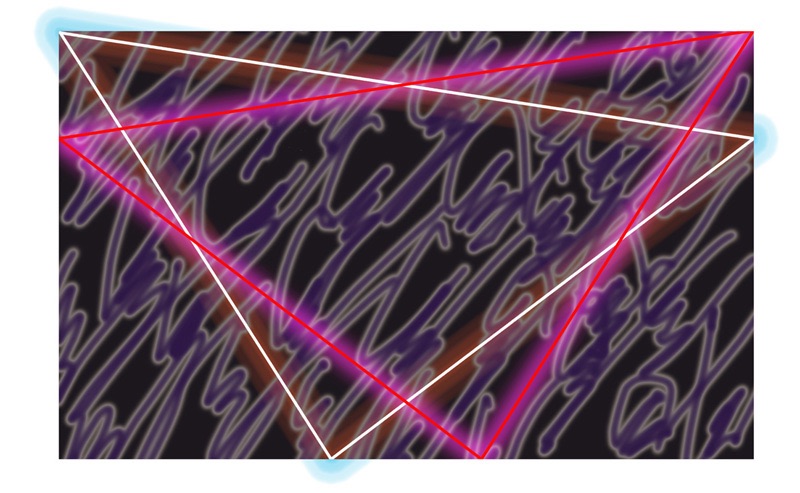
Decantation [2003], CGI by Ricardo Morín](https://observationsonthenatureofperception.com/wp-content/uploads/2025/03/0005.jpg)
 Observations On Perception