*
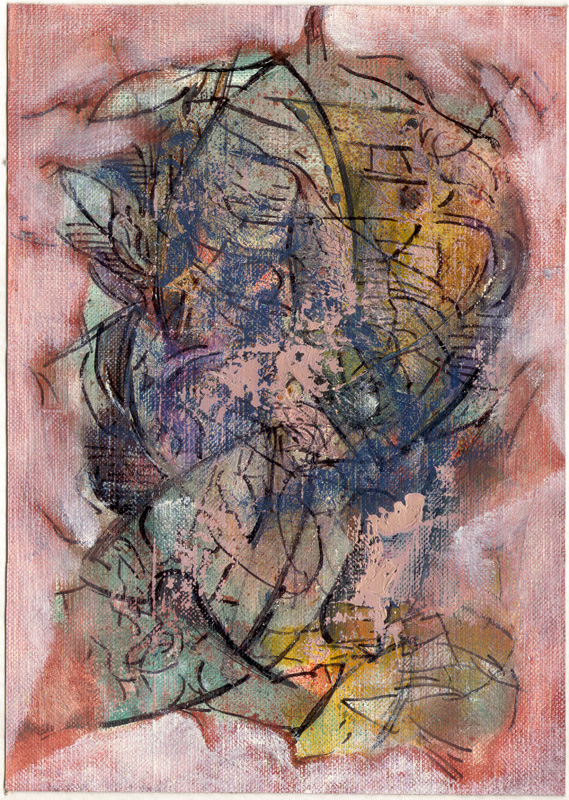
9“ x 13”
Oil on linen
2009
The decision to authorize the destruction of a collection of 145 paintings completed over many years is neither sudden nor simple. The paintings have remained in Venezuela for more than two decades under conditions favorable to the growth of mold and the spread of termites. Their recovery would require technical evaluation, laboratory analysis, conservation studies, specialized storage, transportation, and an eventual destination. None of those steps can proceed independently. Each depends upon the successful completion of the preceding one.
The paintings were created without any of those concerns. They appeared under ordinary conditions of artistic work. Time gradually altered those conditions until preservation itself became the principal question.
The physical condition of the paintings, however, does not by itself determine the decision. Even if technical studies concluded that recovery remained possible, every subsequent stage would continue to involve uncertainty. Technical reports cannot determine future deterioration. Restoration cannot guarantee permanence. Storage cannot ensure an eventual destination. Each solution introduces another condition whose fulfillment depends upon circumstances that remain beyond the creator’s control.
The cost of such an undertaking also extends beyond financial resources. No decision concerning the collection can be separated from the responsibilities it would place upon those expected to carry it out. A work created by one person cannot indefinitely become the burden of another. Under those circumstances, the question gradually changes. It no longer concerns only the condition of the paintings. It also concerns the responsibilities assumed in attempting to preserve them.
Those responsibilities do not remain abstract. Under particular circumstances, they acquire an identifiable human dimension. In the present case, they would rest upon members of my own family whose personal circumstances no longer permit burdens of that magnitude. The condition of the paintings therefore cannot be separated from the condition of those expected to preserve them.
The present circumstances recall an earlier period under conditions altogether different. In 1995, the possibility of destroying the work arose from the expectation that my life itself might be approaching its end. The paintings then appeared inseparable from the prospect of my own disappearance. Their destruction seemed a final act over which I alone retained authority.
More than three decades have elapsed since that time. The external possibility has returned. The internal circumstances have not. The present decision proceeds from no expectation of imminent death. It arises while health remains stable and life continues its ordinary course. The resemblance therefore exists only in appearance. The same decision arises from different circumstances.
The difference lies not in the paintings but in the conditions surrounding them. In 1995 the question concerned the relation between the work and its creator. The present question concerns the relation between the work and the circumstances required for its preservation.
The paintings in Venezuela present a different situation, but they raise the same question. A work may remain physically intact while its future depends increasingly upon circumstances outside the creator’s immediate care. Physical deterioration, financial resources, institutions, heirs, markets, and time each become part of that process. Their influence cannot be excluded by artistic intention alone.
During those intervening years another experience introduced a different consideration. In 2017, two hundred later paintings entered public auction in the United States. The opening bid of one dollar established neither their artistic merit nor their significance. It established only the conditions under which the market would receive them. Some were acquired for considerably more than the opening bid and continue to circulate through online auctions. From that moment forward, decisions concerning those works no longer belonged exclusively to their creator.
The question therefore extends beyond painting. The same responsibilities accompany paintings, manuscripts, digital archives, institutional collections, libraries, and executors, although each assumes a different practical form. Every body of work eventually reaches a point at which its continued existence depends less upon the act that produced it than upon conditions arising afterward. Responsibility gradually passes from the act of creation to the circumstances governing preservation.
That observation neither diminishes the work nor determines its eventual fate. Some works survive for centuries. Others disappear within a generation. Neither outcome alters the fact that they were created. What changes is the responsibility for their continued existence.
The present decision concerning the paintings belongs to those circumstances. It does not establish a general rule regarding preservation, nor does it diminish the importance of conservation where conservation remains reasonable. It defines only the limits imposed by a particular set of circumstances. Beyond those limits, preserving the work would require responsibilities no longer justified by the conditions under which the decision must be made.
The same consideration applies to a literary corpus. Libraries, executors, institutional deposits, and digital repositories may extend the life of a body of work. They cannot remove it from the ordinary conditions that govern every human undertaking. Responsibility does not consist in exhausting every conceivable means of preservation. It consists in recognizing the point at which preservation itself no longer remains a responsible undertaking.
The work begins under the care of its creator. It does not remain there indefinitely. Circumstances gradually assume a greater role than intention, until the future of the work depends upon decisions made by others and under conditions the creator neither established nor controls. Recognizing that transition acknowledges the point at which responsibility for the continued existence of the work no longer rests with the person who created it.
The question therefore does not consist in quieting the emotions naturally accompanying such a decision. It consists in accepting what circumstances no longer make possible. The two are not the same. One concerns the inner life of the individual. The other concerns the conditions under which responsibility can still be honestly exercised.
Ricardo F. Morin
July 9, 2026
Bala Cynwyd, Pennsylvania


