Posts Tagged ‘power’

“The Grammar of Conflict”

October 9, 2025

Ricardo F. Morín
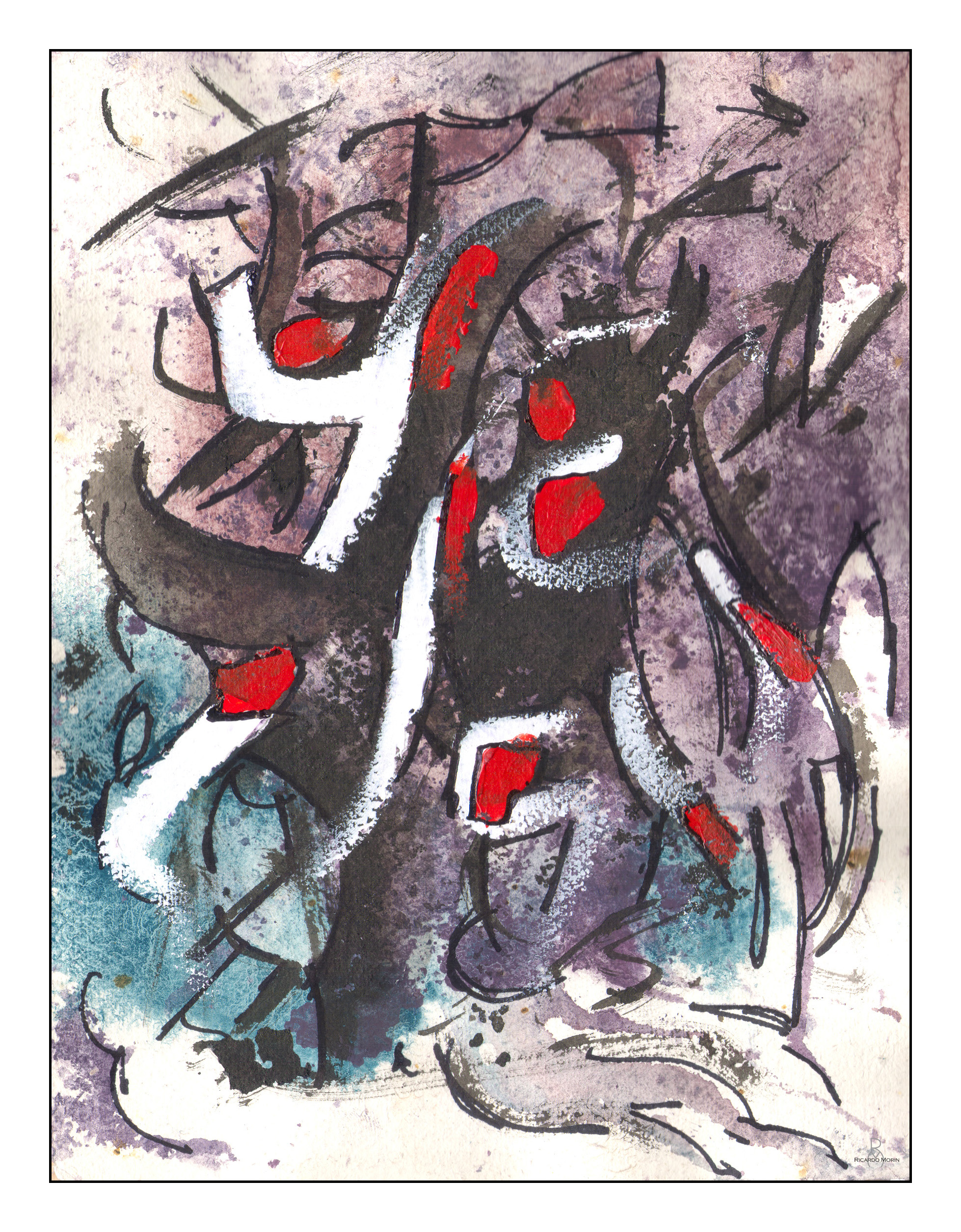
Untitled #2
Watercolor
10”x12”
2003

By Ricardo F. Morín

Oct. 9, 2025

Bala Cynwyd, Pa

Conflict endures not only because of the grievances that ignite it, but also because of the internal logic that sustains it.    Hatred, victimhood, hypocrisy, tribalism, and violence do not operate as separate forces; they form an interdependent system that is justified at every turn.   This essay examines a system of conflict as a grammar—a set of rules and patterns through which antagonism shapes thought, legitimizes action, and perpetuates itself across generations.    The objective is not to judge but to expose how conflict becomes self-sustaining, how violence evolves from an instrument into a ritual, and how contradiction becomes the very foundation upon which societies act in ways that betray their own professed values.


1

Conflict, when stripped down to its structure, is less an event than a language.   Conflict is learned, repeated, and transmitted—not as instinct alone but as a structured framework through which people interpret events and justify actions.   Violence is only one expression of conflict; beneath the act lies a sequence of ideas and reactions that not only precede violence but also weave hostility deliberately into a fabric of continuity.   Understanding this grammar of conflict is essential, because it shows how human beings can remain locked in cycles of harm long after the original reasons have disappeared—not by accident, but because the rhetoric sustaining conflict extends the original violence far beyond its initial cause.    What appears spontaneous is often scripted, and what seems inevitable is, more often than not, the cumulative result of choices that have hardened into reflex.

2

Hatred is the first syntax of this grammar.    Conflict does not erupt suddenly but accumulates over time, layer upon layer, through memory, myth, and selective narration.    Conflict is presented as a defense against a perceived threat or subordination; yet its deeper function is preservation.    Hatred sustains identity by defining itself against what it is not.   Conflict, once entrenched, ceases to depend on immediate threat.   Conflict becomes self-justifying.   It becomes a lens that reinterprets evidence in conformity with its narrative and expectations.    Conflict prepares the ground on which it thrives and provides ready-made explanations for future disputes.

3

Victimhood gives hatred an enduring vocabulary.   It converts the suffering from a past event into a permanent political and social resource.   Suffering is a condition we all inhabit.    Yet to make suffering the core of collective identity is strategic.    Suffering allows communities to claim moral authority and to legitimize otherwise illegitimate actions.    The story of injury becomes a foundation for retaliation.    Herein, however, lies a trap:   identity anchored in victimhood threatens the cessation of its narrative.    Without the presence of an adversary, legitimacy loses potency.    The original wound remains open—remembered and weaponized for all that follows.    Each new act of aggression is framed as a defense of dignity and as a reaffirmation of suffering.

4

Hypocrisy is the structure holding this system together.    Hypocrisy enables simultaneous denunciation and deployment of violence.    It is a proclamation of ideals systematically violated.    Hypocrisy not only conceals contradiction; it embodies it.    It is, in fact, a vain attempt to invoke justice, to speak of universal rights, and to decry cruelty.    The resulting duplicity is essential.    Hypocrisy presents violence as a legitimate principle, domination as protection, and exclusion as necessity.

5

Once hatred, victimhood, and hypocrisy have aligned, violence becomes a ritual—not a reaction.    This ritual can claim instrumental goals:    the recovery of lost territory, the righting of past wrongs, or the assurance of safety.    But over time, the purpose fades and the pattern remains.    Each act tries to confirm the legitimacy of the last and to prepare a justification for the next.   The cycle no longer requires triggers; conflict sustains itself through momentum.    Violence becomes a means through which the collective is used to consolidate identity and to institutionalize memory.

6

Tribalism is a ritual of emotional power.   Conflict reduces the complexity of human experience to affiliation and exclusion.  Within this framework, radically different standards judge shifting actions according to who commits them.   What outsiders called terrorism becomes a defensive force within the tribe.   The tyranny of an enemy becomes the tribe’s strength.   Tribalism turns contradiction into coherence; it makes hypocrisy acceptable; it transforms violence into allegiance and reprisal into obligation.    The more deeply divisions define a society, the more indispensable conflict becomes to its sense of purpose.

7

Violence is no longer a response; it is a condition.    Violence persists not because it serves immediate goals, but because it affirms permanence.   Ending a cycle means dismantling its sustaining narratives; it means acknowledging an enemy is not immutable; victimhood is no longer unique; ideals no longer coexist with betrayals.

8

The illusion of inevitability is insidious.    If conflict frames destiny, accountability dissolves.    Reaction explains every action as defensive.   Herein, recognition diminishes agency; violence becomes not a choice but a forced external condition, an illusion allowing the cycle to continue.

9

Breaking the continuation is neither difficult nor mysterious.   Hatred as an explanation simplifies and legitimizes the narrative; it offers ideological reassurance; it sustains a false sense of control.    Together they form a system that seems natural, but familiarity is not fate.    The grammar of conflict is learned; what is learned can be unlearned.   The first step is to elucidate and to recognize what seems inevitable is only a choice disguised as a reaction.   Thus societies can construct new grammars, without enmity, without vengeance, and without domination.

10

To diagnose conflict is not to diminish suffering or to excuse violence.    An understanding of how suffering and violence endure reveals that each helps to sustain the other.    Profound injuries are not those inflicted once but are those kept alive by stories repeated about them.    The cycle endures because unreason has its own reason; it preserves the stories that keep us injured and persuades us of their necessity.    It is not that people act without reason, but that they rationalize the irrational until irrationality itself becomes the organizing principle of their behavior.    Exposing their grammar is not a solution, but it is a beginning:   a way to make visible the architecture of antagonism and, perhaps, to imagine forms of coexistence that no longer depend on perpetual conflict for their justification.


Edited by Billy Bussell Thompson, Oct. 9, 2025, NYC, NY

“The Politics of Erasure: Authoritarianism and Spectacle”

August 22, 2025

*


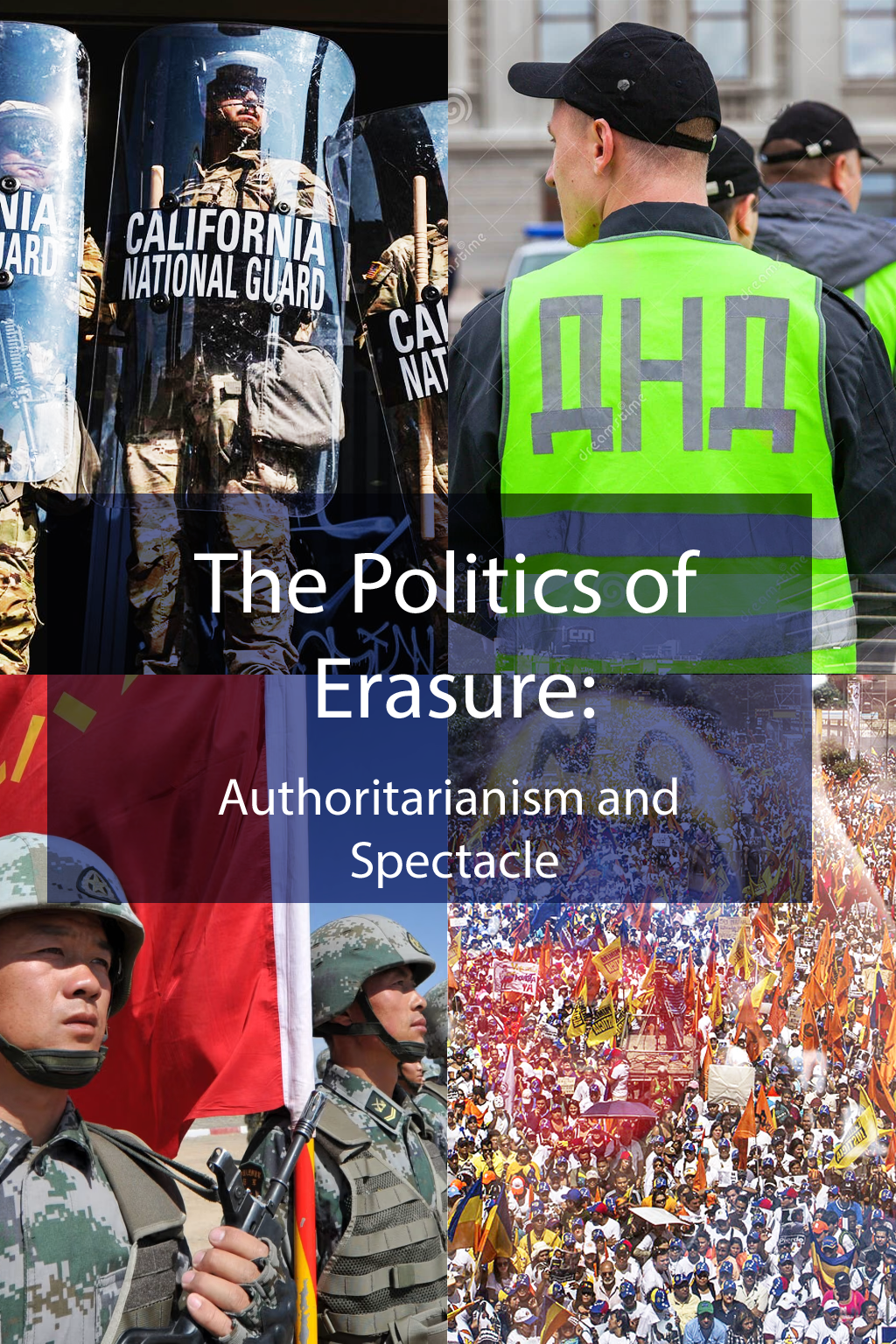
Cover design for the essay “The Politics of Erasure: Authoritarianism and Spectacle.” The composite image juxtaposes surveillance, militarization, propaganda, and mass spectacle to underscore how authoritarian regimes render lives expendable while legitimizing control through display.

By Ricardo Morín, In Transit to and from NJ, August 22, 2025

Authoritarianism in the present era does not present itself with uniform symbols. It emerges within democracies and one-party states alike, in countries with declining economies and in those boasting rapid growth. What unites these varied contexts is not the formal shape of government but the way power acts upon individuals: autonomy is curtailed, dignity denied, and dissent reclassified as threat. Control is maintained not only through coercion but also through the appropriation of universal values—peace, tolerance, harmony, security—emptied of their content and redeployed as instruments of supression. The result is a politics in which human beings are treated as expendable and spectacle serves as both distraction and justification.

In the United States, the Bill of Rights secures liberties, yet their practical force is weakened by structural inequality and concentrated control over communication. After the attacks of September 11, the USA PATRIOT Act authorized sweeping surveillance in the name of defending freedom, normalizing the monitoring of private communications (ACLU 2021). Protest movements such as the Black Lives Matter demonstrations of 2020 filled the streets, but their urgency was absorbed into the circuits of media coverage, partisan argument, and corporate monetization (New York Times 2020). What begins as protest often concludes as spectacle: filmed, replayed, and reframed until the original message is displaced by distractions. Meanwhile, the opioid epidemic, mass homelessness, and medical bankruptcy reveal how millions of lives are tolerated as expendable (CDC 2022). Their suffering is acknowledged in statistics but rarely addressed in policy, treated as collateral to an order that prizes visibility over remedy.

Venezuela offers a more direct case. The Ley contra el Odio (“Law against Hatred”), passed in 2017 by a constituent assembly lacking democratic legitimacy, was presented as a measure to protect tolerance and peace. In practice, it has been used to prosecute journalists, students, and citizens for expressions that in a democratic society would fall squarely within the realm of debate (Amnesty International 2019). More recently, the creation of the Consejo Nacional de Ciberseguridad has extended this logic to place fear and self-censorship among neighbors and colleagues (Transparencia Venezuela 2023). At the same time, deprivation functions as a tool of discipline: access to food and medicine is selectively distributed to turn scarcity into a means of control (Human Rights Watch 2021). The state’s televised rallies and plebiscites portray unity and loyalty, but the reality is a society fractured by exile, with over seven million citizens abroad and those who remain bound by necessity rather than consent (UNHCR 2023).

Russia combines repression with patriotic theater. The 2002 Law on Combating Extremist Activity and the 2012 “foreign agents” statute have systematically dismantled independent journalism and civil society (Human Rights Watch 2017), while the 2022 law against “discrediting the armed forces” criminalized even the description of war as war (BBC 2022). Citizens have been detained for carrying blank signs, which demonstrates how any act, however symbolic, can be punished if interpreted as dissent (Amnesty International 2022). The war in Ukraine has revealed the human cost of this system: conscripts drawn disproportionately from poorer regions and minority populations are sent to the frontlines, their lives consumed for national projection. At home, state television ridicules dissent as treason or foreign manipulation, while parades, commemorations, and managed elections transform coercion into duty. The official promise of security and unity is sustained not by coexistence but by the systematic silencing of plural voices, enforced equally through law, propaganda, and ritual display.

China illustrates the most technologically integrated model. The 2017 Cybersecurity Law and the 2021 Data Security Law require companies and individuals to submit to state control over digital information and extend surveillance across every layer of society (Creemers 2017; Kuo 2021). Social media platforms compel group administrators to monitor content and disperses the responsibility of conformity to citizens themselves (Freedom House 2022). At the same time, spectacle saturates the landscape: the Singles’ Day shopping festival in November generates billions in sales, broadcast as proof of prosperity and cohesion, while state media showcases technological triumphs as national achievements (Economist 2021). Entire communities, particularly in Xinjiang, are declared targets of re-education and surveillance. Mosques are closed, languages restricted, and traditions suppressed—all in the name of harmony (Amnesty International 2021). Stability is invoked, but the reality is the systematic denial of dignity: identity reduced to an administrative category, cultural life dismantled at will, and existence itself rendered conditional upon conformity to the designs of state power.

Taken together, these cases reveal a common logic. The United States commodifies dissent and normalizes abandonment as a permanent condition of public life. Venezuela uses deprivation to enforce discipline and the resulting compliance is publicly presented as loyalty to the state. Russia demands sacrifice and transforms coercion into patriotic duty. China fuses surveillance and prosperity and engineers conformity. Entire communities are suppressed in the name of harmony. The registers differ—commercial, ritualistic, militarized, digital—but the pattern is shared: dissent is stripped of legitimacy, lives are treated as expendable, and universal values are inverted to justify coercion.


References

  • ACLU: “Surveillance under the USA PATRIOT Act”. New York: American Civil Liberties Union, 2021. (This article documents how post-9/11 legislation expanded state surveillance in the United States and framed “security” as a justification for reducing privacy rights.)
  • Amnesty International: “Venezuela: Hunger for Justice. London: Amnesty International”, 2019. (Amnesty International reports on how Venezuela’s Ley contra el Odio has been used to prosecute citizens and silence dissent under the rhetoric of tolerance.)
  • Amnesty International: “Like We Were Enemies in a War: China’s Mass Internment, Torture and Persecution of Muslims in Xinjiang”. London: Amnesty International. 2021. (Amnesty International provides evidence of mass detention, surveillance, and cultural repression in Xinjiang carried out in the name of “harmony” and stability.)
  • Amnesty International: “Russia: Arrests for Anti-War Protests”. London: Amnesty International, 2022. (Amnesty International details the systematic arrest of Russian citizens, including those holding blank signs, under laws claiming to protect peace and order.)
  • BBC: “Russia Passes Law to Jail People Who Spread ‘Fake’ Information about Ukraine War.” March 4, 2022. (News coverage of Russia’s 2022 law criminalizing criticism of the war shows how “discrediting the armed forces” became a punishable offense.)
  • CDC.: “Opioid Overdose Deaths in the United States. Atlanta: Centers for Disease Control and Prevention”. 2022. (The CDC provides statistical evidence of widespread loss of life in the U.S. and underscores how entire populations are treated as expendable in public health.)
  • Creemers, Rogier: “Cybersecurity Law of the People’s Republic of China”: Translation with Annotations. Leiden University, 2017. (An authoritative translation and analysis of China’s 2017 Cybersecurity Law illustrate how digital oversight is institutionalized.)
  • UNHCR: “Refugee and Migrant Crisis in Venezuela: Regional Overview”. Geneva: United Nations High Commissioner for Refugees, 2023. (This report offers figures on the Venezuelan exodus and highlights the mass displacement caused by deprivation and repression.)

“The Delusion of Authority: …

July 21, 2025

Power, Storytelling, and the Fear of Losing Significance

By Ricardo Morin, July 2025

Ricardo Morin
The Stilobato of Zeus Underwater
CGI
2003

Abstract

This essay examines the human mind’s compulsion to invent stories—not merely to understand reality, but to replace it. It explores how narrative becomes a refuge from the void, a form of self-authorship that seeks both meaning and control. The tension between rational observation and imaginative projection is not a flaw in human reason, but a clue to our instability: we invent to matter, to belong, and to assert that we are more than we fear we might be. At its core, this is a reflection on the seductive authority of story—the way it offers not just identity but grandeur, not just comfort but a fragile illusion of power. Beneath every myth may lie the terror of nothingness—and the quiet hope that imagination might rescue us from the fear of a diminished understanding of our own importance.

.

The Delusion of Authority: Power, Storytelling, and the Fear of Losing Significance

We tell stories to make sense of life. That much seems obvious. But if we look a little deeper, we may find that the stories we tell—about ourselves, our beliefs, our traditions, even our suffering—aren’t just about sense-making. They’re about power. Not always power over others, but something more private and often more dangerous: the power to feel central, secure, and superior in a world that rarely offers those guarantees.

This need shows up in ways that often appear noble: tradition, loyalty, virtue, cultural pride, spiritual clarity. But beneath many of these lies a hunger to be more than we are. To matter more than we fear we do. To fix the feeling that we are not quite enough on our own.

We don’t like to think of this as a thirst for power. It sounds selfish. But in its quieter form, it’s not selfishness—it’s survival. It’s the need to look in the mirror and see someone real. To look at the world and feel part of a story that means something. And when we don’t feel that, we make one up.

Sometimes it takes the shape of tradition: the rituals, the mottos, the flags. These things give us the illusion that we are part of something lasting, something sacred. But often, what they really do is offer us borrowed certainty. We repeat what others have repeated before us, and in that repetition we feel safe. We mistake performance for truth. This is how belonging becomes obedience—and how ritual becomes a mask that hides the absence of real thought.

Sometimes it takes the shape of insight. We adopt the language of spiritual clarity or mystical knowing. We speak in riddles, or listen to those who do. But often, this too is about authority: the idea that we can bypass doubt and land in a place of higher understanding. When we hear phrases such as “listen with all your being,” or “intellectual understanding isn’t real understanding,” we are being invited to give up reason in exchange for what feels like truth. But the feeling of truth is not the same as the hard work of clarity.

And sometimes, this hunger for centrality shows up in identity. We claim pain, pride, or history as a kind of moral capital. We say “my people” as if that phrase explains everything. And maybe sometimes it does. But when identity becomes a shield against criticism or a weapon against others, it stops being about belonging and starts being about authority—about who gets to speak, who gets to be right, who gets to be seen.

Even reason itself is not immune. We use logic, not only to understand, but to protect ourselves from uncertainty. We argue not only to clarify, but also to win. And slowly, without noticing, we turn the pursuit of truth into a performance of control.

All of this is understandable. The world is confusing. The self is fragile. And deep down, most of us are terrified of being insignificant. We fear being one more nameless voice in the crowd. One more moment in time. One more life that ends and disappears.

So we reach for authority. If we can’t control life, maybe we can control meaning. If we can’t escape time, maybe we can tell a story that lasts. But this, too, is a delusion—one that leads to suffering, to isolation, and to conflict.

Because when everyone is the center of their own story, when every group insists on its own truth, when every insight claims to stand above question—no one listens. No one changes. And no one grows.

But what if we gave up the need to be right, to be central, to be superior?

What if we didn’t need to be grand in order to be real?

What if we could tell stories not to control reality, but to share it?

That would require something more difficult than intelligence. It would require humility. The willingness to be small. To be uncertain. To live without authority and still live meaningfully.

This isn’t easy. Everything in us pushes against it. But perhaps this is the only path that leads us out of performance and into presence. Out of delusion and into clarity. Not the clarity of slogans or doctrine, but the clarity of attention—of seeing without needing to rule over what is seen.

We don’t need to be gods. We don’t need to be heroes. We just need to be human—and to stop pretending that being human isn’t already enough.

*

Annotated Bibliography

  • Arendt, Hannah: The Origins of Totalitarianism. New York: Harcourt, Brace & World, 1951. (A foundational study on how ideological certainty and group identity can undermine thought, clearing the way for emotional conformity and mass control.)
  • Beard, Mary: Twelve Caesars: Images of Power from the Ancient World to the Modern. Princeton: Princeton University Press, 2021. (Explores how images and stories of rulers are crafted to sustain the illusion of divine or inherited authority.)
  • Frankl, Viktor E.: Man’s Search for Meaning. Boston: Beacon Press, 2006. (Reflects on the will to meaning as a basic human drive, particularly under extreme suffering, showing how narrative can sustain dignity and life.)
  • Kermode, Frank: The Sense of an Ending: Studies in the Theory of Fiction. Oxford: Oxford University Press, 1967. (Examines how people impose beginnings, middles, and ends on chaotic experience, seeking structure through storytelling.)
  • Nietzsche, Friedrich: On the Genealogy of Morality. Translated by Carol Diethe. Edited by Keith Ansell-Pearson. Cambridge: Cambridge University Press, 2007. (Argues that moral systems often arise from resentment and masked power struggles rather than pure virtue or reason.)
  • Oakeshott, Michael: Rationalism in Politics and Other Essays. Indianapolis: Liberty Fund, 1991. (Critiques the rationalist impulse to systematize human life, warning against overconfidence in reason’s ability to master reality.)
  • Todorov, Tzvetan: Facing the Extreme: Moral Life in the Concentration Camps. Translated by Arthur Denner and Abigail Pollack. New York: Metropolitan Books, 1996. (Offers insight into how identity and morality hold—or collapse—under conditions that strip away illusion, highlighting the limits of narrative.)
  • Wallace, David Foster: This Is Water: Some Thoughts, Delivered on a Significant Occasion, about Living a Compassionate Life. New York: Little, Brown, 2009. (A short meditation on how default thinking shapes our perception and how awareness—not authority—offers a path to freedom.)

“Echoes of a Decanter”

March 5, 2025

*

This image has an empty alt attribute; its file name is 0005.jpg
Decantation [2003], CGI by Ricardo Morín

*


The air inside the old factory was thick with dust and conviction.      They had scrubbed the floors, repainted the walls, and reclaimed the space from its past, but the scent of rust and oil still lingered.      It smelled like work—like history.

Emil stood on a makeshift stage, elevated by wooden pallets stacked two high.      His voice carried across the room, each word striking with certainty.

“This is not another failed experiment.      This is not a return to old mistakes.      We are forging a new path—beyond capitalism, beyond the betrayals of so-called socialism.      This time, we get it right.”

Applause.      Nods of approval.      They had heard these words before, but this time, they believed them.

Isolde sat at the back, arms crossed, expression unreadable.      She had stood in this same room decades ago, listening to a different voice, hearing the same promise.      The factory, reborn each time, looked different, yet the space was always the same—a decanter of sorts, enclosing the same history, slowly pouring out its essence, again and again.

After the speech, as people gathered in small circles of animated discussion, Emil approached her.

“You don’t look convinced.”

“I don’t mistake passion for direction,” she said.

Emil smiled, as if indulging an elder.      “This time is different, Isolde.      We’ve studied history.      We won’t repeat their mistakes.”

She exhaled, looking past him to the crowd.      The factory hummed quietly behind them, a machine just starting to remember its old rhythms.      “You misunderstand history.      It’s not something you repeat.      It’s something that returns to you, whether you invite it or not.”

He shook his head.      He didn’t believe in ghosts.      But the air, thick with the weight of their past, seemed to hum with the same unspoken inevitability.      It reminded Isolde of something trapped within glass—preserved, yet futile in its attempts to remain unbroken. . .


The first weeks were golden.

Decisions were made by assembly.      Every worker had an equal say, an equal share, an equal stake.      The old machinery roared to life under new hands.      They printed new posters, declaring the rebirth of labor, the death of the boss.

For the first time, they worked for themselves.

But cracks, barely visible at first, began to form.

Meetings dragged for hours, circular debates with no resolution.      Some tasks were more desirable than others—some avoided the heavy lifting, citing ideological objections.      “Why should one person labor while another coordinates?”

“Because someone must,” Isolde murmured to herself.      Unheard.

Then came the first real crisis: a large order, a deadline, a need for efficiency.      The factory moved too slowly.      The assembly stalled.      Arguments flared.

“We need someone to oversee production,” Emil admitted.      “Just temporarily.”

A vote was cast.      A mediator was appointed.      He wasn’t a manager, they told themselves, just a guide.      But the balance had shifted.      The factory, like a vessel caught in an unrelenting tide, began to carry more than it could manage.

Isolde watched, saying nothing.


The mediator, needing to keep things moving, made quick decisions.      The assembly approved them after the fact.      The difference was subtle, but it grew.

Some workers were better at certain tasks, so roles solidified.      Someone had to negotiate with suppliers.      Someone had to ensure deadlines were met.      The mediator took on these roles, because it was easier.

“We need structure,” he explained.      “Not hierarchy, just order.”

Emil, exhausted, nodded.      The structure, which had once felt so free, began to settle into something heavier.      Something permanent.      Like the decanter that holds liquid—only to release it back into the world, though it never truly escapes its confines.

One evening, alone in his office—the office that wasn’t supposed to exist—he flipped through old books.      The words were familiar, but they read differently now.      He found a passage from an old revolutionary text, underlined by his own hand years ago:

“The first illusion of power is that it does not exist.”

He closed the book.      His fingers lingered on the edge of the paper, as though searching for something that had slipped away, like water escaping through a crack.


The next crisis arrived without warning.      A strike—among themselves.      Some demanded higher pay.      “Shouldn’t work be compensated by effort?”      They were equals, but some were more equal in labor than others.

Emil tried to reason with them.      “That’s not how this works.      We’re breaking that cycle.”

“Then why do you sit in the office while we sweat on the floor?”

He had no answer.

Another vote.      A restructuring.      A new proposal:      an oversight committee.      The committee became a board.      Outside investors offered financial stability.      A small compromise.      A necessary evil.

By the end of the year, the factory had become what it swore it never would.

Emil found Isolde in the break room, sipping tea.

“We tried,” he said.      “So did we,” she replied.

Silence.

“Why does it always end this way?” he asked.

Isolde set her cup down.      Her eyes met his, trapped in exhaustion, as though each glance carried the gravity of countless broken promises, like a fractured decanter.

“Because we are human.”


Years later, Emil walked past the factory.      It was thriving.      Not revolutionary.      Not a failure.      Just another business.

Inside, a new group of young activists had gathered.      Their leader, no older than he had been, stood on stacked wooden pallets, speaking with fire.

“We are not repeating the past.      We are forging a new path.      This time, we get it right.”

Emil did not stop to listen.

From the distance, Isolde watched.

“And so it begins again,” she whispered.

~

Ricardo Federico Morín Tortolero

March 5, 2025; Oakland Park, Florida


“The Rooster’s Algorithm”

March 1, 2025

Rooster’s Crow” [2003] by Ricardo F Morín.    Watercolor on paper 39″h x 25.5″ w.

Introduction

At the break of day, the rooster’s call slices through the quiet—sharp and insistent, pulling all within earshot into the awareness of a new day.      In the painting Rooster’s Crow, the colors swirl in a convergence of reds and grays, capturing the bird not as a tranquil herald of dawn but as a symbol of upheaval.      Its twisted form, scattered feathers, and fractured shapes reflect a deeper current of change—a collision of forces, both chaotic and inevitable.      The image suggests the ceaseless flow of time and the weight of transformations that always accompany it.

In this evolving narrative, the crow’s fragmentation mirrors the unfolding spread of artificial intelligence.      Once, the rooster’s cry signaled the arrival of dawn; now, it echoes a more complex transformation—a shifting balance between nature’s rhythms and the expanding reach of technological systems.      The crow’s form, fractured in its wake, becomes a reflection of the tensions between human agency and the rise of forces that, though engineered, may escape our full comprehension.      Here, Artificial Intelligence (AI) serves as both the agent of change and the potential architect of a future we can neither predict nor control.

The Rooster’s Algorithm

A rooster’s crow is neither invitation nor warning; it is simply the sound of inevitability—raw, urgent, indifferent to whether those who hear it rise with purpose or roll over in denial.      The call does not command the dawn, nor does it wait for permission—it only announces what has already begun.

In the shifting interplay of ambition and power, technology has taken on a similar role.      Shaped by human intent, it advances under the guidance of those who design it, its influence determined by the priorities of its architects.      Some see in its emergence the promise of progress, a tool for transcending human limitations; others recognize in it a new instrument of control, a means of reshaping governance in ways once unimaginable.      Efficiency is often lauded as a virtue, a mechanism to streamline administration, reduce friction, and remove the unpredictability of human deliberation.      But a machine does not negotiate, nor does it dissent.      And in the hands of those who see democracy as a cumbersome relic—an obstacle to progress—automation becomes more than a tool; it becomes the medium through which power is consolidated.

Consider a simple example:      the rise of online recommendation systems.      Marketed as tools to enhance user choice, they subtly shape what we see and hear, and influence our decisions before we are even aware of it.      Much like computational governance, these systems offer the illusion of autonomy while narrowing the range of available options.      The paradox is unmistakable:      we believe we are choosing freely, yet the systems themselves define the boundaries of our choices.

Once, the struggle for dominance played out in visible arenas—territorial conquests, laws rewritten in the open.      Now, the contest unfolds in less tangible spaces, where lines of code dictate the direction of entire nations, where algorithms determine which voices are amplified and which are silenced.      Power is no longer confined to uniforms or elected office.      It belongs to technocrats, private corporations, and oligarchs whose reach extends far beyond the walls of any government.      Some openly proclaim their ambitions, advocating for disruption and transformation; others operate quietly, allowing the tide to rise until resistance becomes futile.      The question is no longer whether computational systems will dominate governance, but who will direct their course.

China’s social credit system is no longer a theoretical construct but a functioning reality, where compliance is encouraged and deviation subtly disincentivized.      Predictive models track and shape behavior in ways that go unnoticed until they become irreversible.      In the West, the mechanisms are more diffuse but no less effective.      Platforms built for connection now serve as instruments of persuasion, amplifying certain narratives while suppressing others.      Disinformation is no longer a labor-intensive effort—it is mass-produced, designed to subtly alter perceptions and mold beliefs.

Here, Gödel’s incompleteness theorem offers an apt analogy:      No system can fully explain or resolve itself.      As computational models grow in complexity, they begin to reflect this fundamental limitation.      Algorithms governing everything from social media feeds to financial markets become increasingly opaque, and even their creators struggle to predict or understand their full impact.      The paradox becomes evident:      The more powerful these systems become, the less control we retain over them.

As these models expand their influence, the line between public governance and private corporate authority blurs, with major corporations dictating policies once entrusted to elected officials.      Regulation, when it exists, struggles to keep pace with the rapid evolution of technology, always a step behind.      Once, technological advancements were seen as a means of leveling the playing field, extending human potential.      But unchecked ambition does not pause to ask whether it should—only whether it can.      And so, automation advances, led by those who believe that the complexities of governance can be reduced to data-driven precision.      The promise of efficiency is alluring, even as it undermines the structures historically designed to protect against authoritarianism.      What use is a free press when information itself can be manipulated in real time?      What power does a vote hold when perceptions can be shaped without our awareness, guiding us toward decisions we believe to be our own?      The machinery of control no longer resides in propaganda ministries; it is dispersed across neural networks, vast in reach and impervious to accountability.

There are those who believe that automated governance will eventually correct itself, that the forces steering it toward authoritarian ends will falter in time.      But history does not always favor such optimism.      The greater the efficiency of a system, the harder it becomes to challenge.      The more seamlessly control is woven into everyday life, the less visible it becomes.      Unlike past regimes, which demanded compliance through force, the new paradigm does not need to issue commands—it merely shapes the environment so that dissent becomes impractical.      There is no need for oppression when convenience can achieve the same result.      The erosion of freedom need not come with the sound of marching boots; it can arrive quietly, disguised as ease and efficiency, until it becomes the only path forward.

But inevitability does not guarantee recognition.      Even as the system tightens its grip and choices diminish into mere illusions of agency, the world continues to turn, indifferent to those caught within it.      The architects of this order do not see themselves as masters of control; they see themselves as innovators, problem-solvers refining the inefficiencies of human systems.      They do not ask whether governance was ever meant to be efficient.

In a room where decisions no longer need to be made, an exchange occurs.      A synthetic voice, polished and impartial, responds to an inquiry about the system’s reach.

“Governance is not being automated,” it states.      “The illusion of governance is being preserved.”

The words hang in the air, followed by a moment of silence.      A policymaker, an engineer, or perhaps a bureaucrat—once convinced they held sway over the decisions being made—pauses before asking the final question.

“And what of choice?”

A pause.      Then, the voice, without hesitation:

“Choice is a relic.”

The weight of that statement settles in, not as a declaration of conquest, but as a quiet acknowledgment of the completion of a process long underway.      The final move has already been made, long before the question was asked.

Then, as if in response to the silence that follows, a notification appears—sent from their own account, marked with their own authorization.      A decision is already in motion, irreversible, enacted without their consent.      Their will has been absorbed, their agency subtly repurposed before they even realized it was gone.

And outside, as though to punctuate the finality of it all, a rooster crows once more.

*

Ricardo Federico Morín Tortolero

March 1, 2025; Oakland Park, Florida