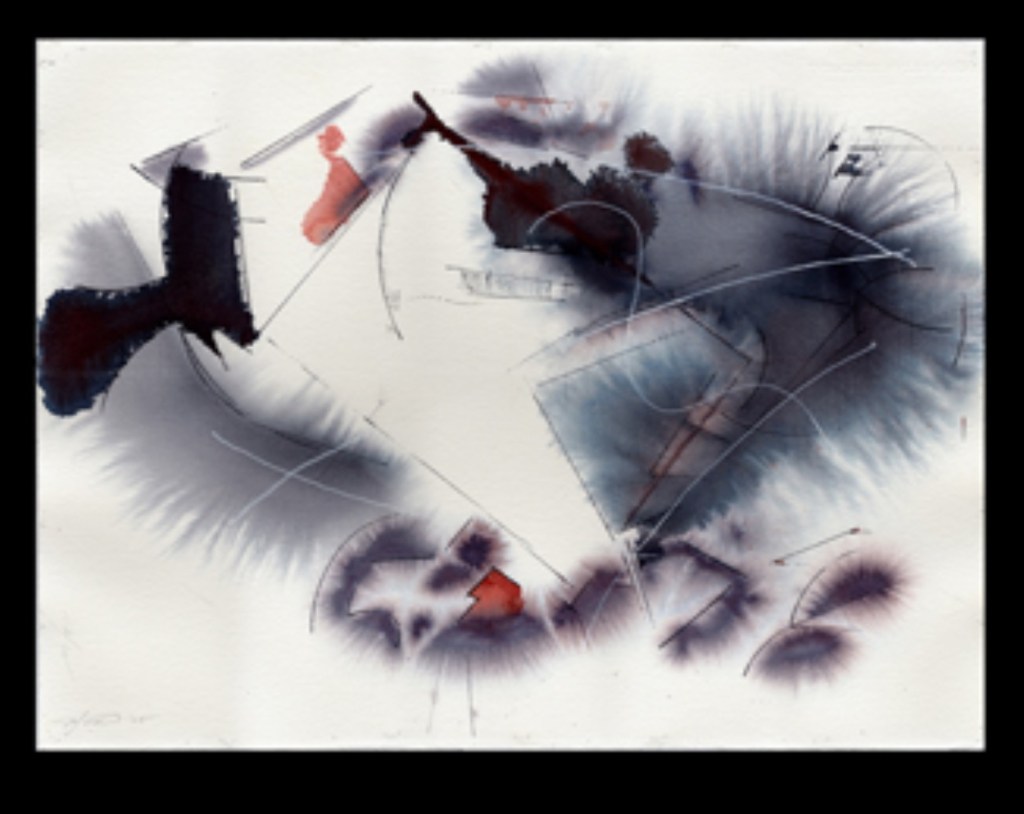
Ricardo Morin The Seventh Watch (Template Series, 5th panel) Watercolor over paper 22” x 30” 2005
Introductory Note
Ricardo Morin is a writer and researcher of the history of thought as a dynamic and evolving practice—a student of unspoken gestures, a language stronger than words, especially when interlocutors no longer listen to each other. Drawing on reflections on the cycles of life and a personal experience approaching the last, he invites readers to consider how quiet vigilance and tenderness can shape a meaningful existence. The Seventh Watch emerges from decades of living attentively, offering a humble testament to dignity through perseverance and care.
71 Years
I’ve lived seventy-one years. That alone still surprises me—not because I ever expected an early end, but because each year has asked more of me than the last. There was no dramatic fall, no single crisis to point to. Just a slow, constant shaping—of the body, of temperament, of the will.
Illness didn’t come in childhood. It arrived later, in my early twenties, during a snowbound winter in Buffalo. I was just beginning to live on my own, full of ambition and unfinished dreams. The diagnosis was mononucleosis—but it wasn’t the name that mattered. It was the way it interrupted momentum, slowed my pace, and revealed something deeper: the lifelong task of learning to live within my own limits.
That was the beginning—not of a medical history, but of a different kind of vigilance. Not directed outward, but inward. A quiet realization took root: that survival, if it was to be meaningful, required not just endurance, but restraint. A way of protecting myself from myself. That discipline wasn’t harsh—it became a kind of devotion. Not to self-denial, but to finding the clarity of a peaceful mind. To living with more care than urgency.
I don’t see illness as noble, but I do see in it a mirror—not for the pain, but for the truth it reflects. What can be tended, what must be relinquished, what deserves attention. I don’t claim wisdom from illness, but I recognize what it’s taught me to let go of: illusion, pride, and the frantic chase after things that do not last—such as the accumulation of wealth or power.
I’ve come to think of it simply as endurance—the kind illness teaches when you stop resisting and begin listening. There’s an ethical arc in this awareness—not born of dogma or belief, but shaped by experience. It bends not toward triumph, but toward tenderness.
This isn’t a story of pathology. It’s a story of attention—of refining the self without hardening it. Of discovering that maturity means knowing when to persist and when to pause. That the quiet act of sustaining one’s life—daily, attentively—is its own form of courage.
I never set out to write a testament. But seventy-one years in, I see the outlines more clearly. And in that, there is dignity.
Yet, dignity is not a reward. It arrives without announcement, without ceremony. It builds slowly—through the daily rituals of rising, of choosing what to carry and what to set down. It does not shield one from sorrow, nor make suffering easier to bear. But it gives the days a certain weight.
I’ve come to cherish that weight—not as a burden, but as proof. Proof that I’ve lived through each season not untouched, but intact. And that, even now, the task is not to escape life’s demands, but to meet them with steadiness.
What I’ve learned isn’t mine alone. Anyone who lives long enough will be asked to reckon with time—not as a thief, but as a sculptor. Illness, especially, teaches us how little control we truly have—yet how much presence we’re still capable of. It humbles and joins us. Not in sameness, but in mutual recognition.
Endurance, I’ve found, is not passive. It’s not about waiting for pain to pass. It is active, quiet, often unseen. It means choosing how to live when choice feels narrow. It means tending to life not with haste, but with attention.
There is no finish line to this work. Just the quiet act of continuing.
So I continue—not because I must, but because life, even in its reduced dimensions, still offers room for meaning. Some days that meaning is faint. Other days it is simply the act of rising, or writing a letter, or remembering the snow. But it is there. And as long as it is, I remain.
For him, inspiration didn’t strike—it settled. It arrived not with answers, but with permission to begin.
There was no ritual. No dramatic turning point. Only the canvas, the scent of oil, the shifting light across the floor. One day folding into the next, until the work became its own weather—sometimes clear, sometimes stormy, but always present.
He believed in attention, not mastery.
What moved him wasn’t how the painting was achieved at any given moment, but when deconstructed he had to reclaim it, not out of skill, but out of necessity—when the hand moved before thought, and something more honest than intention began to lead. And when it happened, it asked everything of him.
Any one watching—anyone but him—would have seen very little. A trace. A pause. A slight adjustment. But inside, something in him was listening—not to himself, but to the world, the material, the echo of a form not yet known.
He didn’t make work to be remembered, though he carried each piece like a child of his. He made it to stay alive. And when he encountered a finished painting years later, it stirred him physically. It wasn’t nostalgia. It was the smell of pigment, the sound of bristles, the grief of something nearly realized—lost, then found again.
Some days, the work moved with a kind of ease. Other days, it refused. He learned not to chase either.
He always began without knowing what he was after. A shade. A flicker of transparency. Astroke that unsettled the surface. Often the brush would stop midair, suspended while he waited for the next move to reveal itself. Sometimes nothing came. Those pieces sat untouched for weeks—a quiet unease in the corner of the room.
He lived alongside their silence.
The studio was never clean, but always ordered. Rags folded. Jars fogged with old turpentine. Walls bearing soft outlines of past canvases. The mess wasn’t careless. It was lived-in—not careless, just lived-in. Notes of Goethe’s pyramidal harmony hung besides mineral samples, sketches, color wheels, torn letters from art dealers. Not for revelation—but for proximity.
Not every piece held. Some failed completely. Others, losing urgency layer by layer, failed gradually, He kept those too—not as records, but as reminders. Where the hand had gone quiet. Where the work had ceased to ask. Yet they became platforms—spaces for later returns, for deeper entry.
His days had no fixed schedule, though a rhythm formed over the years—a long devotion, interrupted, resumed, endured.
Now, he arrived late morning from the City. The studio held the faint scent of wax and turpentine, laced with something older—dust, fabric, memory. He opened a window if weather allowed. Not for light but for air. For movement. For the slow turning of the fans like breath.
He made tea. Sometimes he played Bach, or a pianist, whose fingers pressed deeper into the keys than others. Other mornings: National Public Radio. A poet, a scientist, someone trying to say the impossible in ordinary words. He liked the trying more than the saying.
He painted standing—rarely seated. Some days he moved constantly between easel, sink, and mixing table. Other days he barely moved at all. Just watched.
Lunch was simple. Bread. Fruit. A little cheese. Sometimes eggs, lentils, soup across several days. He didn’t eat out much—not out principle, but because it broke the thread.
If tired, he would lie on the couch at the back wall. Twenty, thirty minutes. No more. And when he woke, the light had shifted again—slanted, softened, more forgiving. The canvas looked changed. As if it had waited for his absence.
Late afternoons were often the best. A second wind, free of pressure. There was a looseness in the air, born from knowing no one would knock or call. He spoke to the work then—not aloud, but inwardly. This tint? Too warm. This stroke? Too sure. Let it break. Let it breathe. Let it speak without saying.
Sometimes the medium resisted. A brush faltered. A gesture collapsed. He didn’t fight. He gave it space. If he stayed patient, it found its rhythm again.
Not everything reached completion. Some works remained open—not abandoned, simply finished enough. Others came suddenly, like music that plays without lifting the fingers.
By evening, he cleaned his tools. Never rushed. He wiped the palette. Rinsed the jars. Hung the rags to dry. It was a kind of thanks. Not to the painting. To the day.
Then lights out. Door closed. Nothing declared. Nothing completed. Yet something always moved forward.
Grief, too, remained. It lived in the room like dust—settled in corners, clinging to stretchers still bare, woven into old white sheets.
His sister’s illness came slowly, then all at once—while Adagio in G Minor played low across the studio. He painted through it. Not to escape, but because stopping would have undone him. In the silence between strokes, he could feel her breath weakening. Sometimes he imagined she could see the work from wherever she was. That each finished piece carried a word he hadn’t dared to say aloud. She would have understood. She always had.
Later, when his former lover died—alone, unexpectedly, in Berlin—he stopped painting altogether. The studio felt still in a way he couldn’t enter. Even the canvas turned away from him. When he returned, it was with a muted palette. Dry. Indifferent. The first brush stroke broke in two. He left it. And continued.
Desire, too, had quieted. Not vanished. Just softened. In youth it had been urgent, irrepressible. Now it hovered—an echo that came and went. He didn’t shame it or perform it. He lived beside it, the way one lives beside a field once burned, now slowly greening.
Grief didn’t interrupt the work. It deepened it. Not in theme—but in texture. Some of those paintings seemed familiar to others. But he knew what they held—the weight of holding steady while coming apart inside.
Even now, some colors recalled a bedside. A winter walk. The sound of someone no longer breathing. A flat grey. A blue once brilliant, now tempered between longing and restraint.
He wondered sometimes about that tension.
But when he painted, stillness returned.
Seventeen years ago, when chemotherapy ended, the days grew quieter.
There was no triumph. Just a slow return to rhythm—different now. The body had changed. So had the mind. He couldn’t paint for hours without fatigue. The gestures once fluid were heavier, more tentative.
He didn’t resist it.
The studio remained, but the center of gravity shifted. Where once he reached for a brush, now he reached for a pen. At first, just notes. Fragments. A way to hold the day together. Then came sentences. Paragraphs. Not about himself, not directly. About time. Memory. Presence. Writing became a solace. A way to shape what the body could no longer carry. A place to move, still, with care.
It wasn’t the end of painting. Just a pause. A migration. Writing required its own attention, its own patience. And he recognized in that a familiar devotion.
Sometimes, the canvas still called. It would rest untouched for weeks. Then one day, without announcement, he would begin again.
The two practices lived side by side. Some days the brush. Some days the page. No hierarchy. No regret. Only the quiet persistence of a life still unfolding.
There is no final piece. No last word.
He understands now: a life is not made of things finished, but of gestures continued—marks made in good faith, even when no one is watching. A sentence begun. A color mixed. A canvas turned to the wall—not in shame, but because it had said enough.
He no longer asks what comes next. That question no longer troubles him.
If anything remains, it will not be the name, or the archive, or even the objects themselves. It will be the integrity of attention—the way he returned, again and again, to meet the moment as it was.
Not to make something lasting. But to live, briefly, in truth.
*
Ricardo F Morin Tortolero
Bala Cynwyd, Pa., June 14, 2025
Editor:Billy Bussell Thompson
Author’s Note
This piece, like much of what I’ve made in recent years, exists because of those who have sustained me.
To David Lowenberger—whose love and steadfastness give my life its rhythm. Without him, continuity itself would falter.
To José Luis Montero, my first art teacher, whose presence early on became a compass I’ve never stopped following.
To my parents, whose quiet influence shaped my regard for form, devotion, and care.
And always, to my friend and editor, Billy Bussell Thompson, whose voice lives quietly in mine.
Writing, silence, and the art of understanding in stillness
*
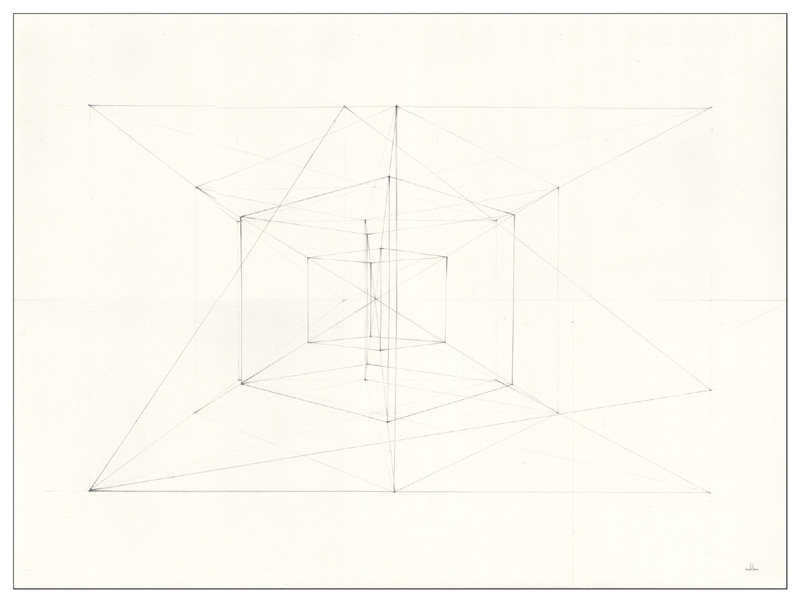
Ricardo Morín Triangulation 4 22″ x 30″ Graphite on paper 2006
To my sister Bonnie
*
Ricardo F. Morín
June 2025
Oakland Park, Florida
Author’s Note
This reflection was originally drafted before The Ethics of Perception, Part I, yet it belongs to the same inquiry into attention, understanding, and ethical relation.
There are moments when the truest form of intimacy is silence. At other times, it’s the quiet labor of reaching for the right word—however incomplete—that brings us closer. Expression, in this light, is not just a vehicle for communication, but an act of care.
To speak, to withhold, to write, to listen—each choice carries a particular weight. Intimacy lives in these gestures: not in grand declarations, but in the ethics of how we reveal ourselves—and how we receive what another dares to offer. What follows is not a theory, but a reflection on how intimacy appears in expression—and in its absence.
I. Prelude: in the pause between words
It’s hard to pinpoint the moment when something becomes intimate. It isn’t always a touch, or a glance, or even a confession. Sometimes, it’s just a pause—a shared pause—between one word and the next, when both people sense that something true is either about to be said or has just been said, without quite naming it.
Once, sitting face to face, I watched someone I cared for stare silently out the window. I said nothing either. There was no gesture, no disclosure, no clarifying words. And yet the silence didn’t feel empty—it felt full. In that stillness, something passed between us—not a message, not even an understanding, but a kind of permission:
To exist without explanation. To be present without having to perform.
That moment stayed with me not because it was dramatic, but because it was unplanned. I hadn’t expected it, and I couldn’t have recreated it. I only knew, afterward, that I had been in the presence of something rare: an intimacy that asked nothing more than to be.
And yet, not all intimacy is born in silence or in someone else’s presence. Some comes later, through writing—in that long interval between feeling and saying. Some is only possible thanks to the quiet distance that makes reflection possible.
II. What we mean when we say “intimate”
The word intimacy often evokes physical closeness: the realm of touch, proximity, lovers, secrets shared in the dark. But what if intimacy were less about closeness than about permission? The permission to be undefended. To move slowly. To be unclear—and still be trusted.
To be intimate with someone is not merely to be known, but to be seen— seen without the pressure to explain yourself quickly or justify what you feel. It’s an opening, and it’s also a risk: the risk of being misunderstood, and the deeper risk of being understood too well.
Some forms of intimacy unfold face to face. Others require distance. Some happen through dialogue. Others need a single voice, speaking on one’s own in a quiet room.
That’s where writing begins— not as performance, but as a long conversation, uninterrupted.
III. The varieties of intimacy
Intimacy shifts with context, with time, with the shape of the self we bring to another. It is not one thing— not just closeness, or tenderness, or vulnerability— but a set of ways we allow ourselves to be known, and sometimes, to know another.
There’s the intimacy of the body— perhaps the most visible and least understood. It belongs to touch, proximity, the instinctive draw toward another’s presence. But this form can deceive: physical closeness without emotional resonance is common— and easily faked. Yet when body and emotion align, there’s a wordless attunement: a hand resting on a shoulder for just the right amount of time; a breath falling into rhythm without intention.
Then there’s emotional intimacy: the slow courage to say what one feels— not just when it’s beautiful or convenient, but when it’s awkward, incomplete, or raw. This kind of intimacy isn’t given—it’s earned. It may take years, or a single night. Trust lives here—or breaks.
There’s also intellectual intimacy: what arises in conversation when ideas flow without anyone guarding their ground. It’s rare. Most social spaces reward speed, the need to shine, or the safety of politeness. But sometimes, with someone equally curious, thought expands in the presence of the other— not in agreement, but in response. There’s nothing to prove— only the pleasure of discovery. That’s intellectual intimacy. It creates a different kind of closeness— not of feeling, but of perception.
Stranger still is narrative intimacy— the kind that forms not between two people in the same room, but between the one who writes and the one who reads, separated by silence and time. It isn’t immediate— but it isn’t less real. A voice emerges from the page and seems to speak directly to you, as if it knew the contours of your mind. You feel understood—without being seen. You may never meet the person who wrote those words, but something in you shifts. You are no longer alone.
These are not rigid categories. They overlap, interrupt, evoke one another. One may deepen another. Physical presence can create emotional safety. Intellectual closeness can open into unexpected tenderness. And still, each has its own rhythm, its own grammar— and its own risks.
In that complexity, intimacy ceases to be a condition. It becomes a practice: something we learn, lose, revise, and sometimes write when no other form is possible.
IV. Writing as intimacy with oneself (and with another)
Writing, too, is a kind of intimacy— not only with others, but with oneself. Especially when it’s honest— when what’s written is not just clever or correct, but true. That kind of writing doesn’t flatter. It doesn’t argue. It reveals.
We write to bring something forth— not just for an audience, but to hear ourselves think, to see what we didn’t yet know we felt. In writing, we become witnesses to our own consciousness— both its lucidity and its evasions.
We follow a sentence not only for its logic, but for the feeling it carries. And when that feeling falters, we know we’ve lost the thread.
So we begin again, and again— trying not just to explain, but to say something that feels just.
In that sense, writing is an ethical act. It demands attention. It requires patience. It invites us to inhabit our own experience with precision— even when that experience is fragmented or unresolved.
And if we are lucky— if we are honest— something in that effort will reach someone else. Not to impress. Not to convince. But to accompany.
V. When intimacy fails or is refused
Sometimes you reach out—carefully, sincerely—and receive silence, indifference, or a response so misaligned it makes you feel naïve for having tried. Other times, the failure is subtler: a conversation that scatters just as something real begins to take shape—or a listener who hears your words, but not your meaning.
Those moments stay with us. Not because they’re dramatic, but because they remind us how precarious intimacy can be. It can’t be forced—just as humility can’t. Both require a quiet letting go—a willingness to offer something without knowing how it will be received. We can prepare the ground, make the gesture, risk the truth—but the rest depends on the other: their timing, their capacity, their willingness to meet us there.
There’s also the experience of being misunderstood—not just in fact, but in essence. You try to say something that matters, and the other person responds to what they think you said—or to a version of you that never was. It’s a blow— that mismatch between what you tried to share and what actually landed. The desire for intimacy becomes exposure without connection—a wound instead of a bridge.
Sometimes we avoid intimacy not because we don’t want it, but because we fear what it might cost. We’ve been made to feel clumsy—for caring too much, or for being too visible. Or we’ve shared something intimate, only to have it treated lightly—or analyzed without feeling. After that, we grow cautious. We speak less—or in fragments—or not at all.
It’s in the wake of such rejections—large or small—that writing ceases to be mere expression. It becomes repair. Writing allows us to recover what was lost in the moment— to name what never reached its destination, to finish the thought no one waited for, to say it again—this time without interruption, without assumptions, without fear.
And while writing cannot undo the failure of a shared moment, it can offer something else: coherence. A record. A form of truth that endures—even if it wasn’t heard.
In this way, writing becomes a quiet act of insistence—not against the world, but on behalf of the self. It’s a way of saying: What I tried to share still matters—even if it wasn’t received.
VI. The gesture that remains
In the end, intimacy is not a state but a gesture— repeated again and again— toward understanding, toward presence, toward a shared sense that may arrive… or may not.
Sometimes that gesture is a word spoken at the right moment. Sometimes it’s a silence held just long enough for the other to speak. And sometimes it’s the act of writing—solitary, patient, unfinished— offered not to a crowd, but to a single imagined reader who, one day, might need what you are now trying to say.
Writing, at its core, is a form of listening. Not only to others, but to the self that doesn’t rush, doesn’t perform, doesn’t need to persuade.
To the self that waits— that wants to be known not by what it manages to say in quick response, but by what it keeps trying to say with care.
That’s why I return to the page: not because it guarantees connection, but because it keeps the door open. Because in a world that demands speed, certainty, and charm, writing makes room for something slower and more faithful: the long, unfinished gesture of trying to reach someone— perhaps even oneself— with something resonant.
And when intimacy happens—on the page or in life— it’s never because we found the perfect words. It’s because someone stayed. Someone listened. Someone let the moment open—without rushing to close it.
That’s what I’m doing now: writing not to end something, but to leave it open— so that something of greater consequence might enter.
There’s a certain kind of person the world seems to admire—sharp-tongued, composed, deliberate. He moves through life as if he’s never doubted the sound of his own voice. His gestures are practiced, his opinions unshakable. It’s a performance of authority, and to many, it’s compelling.
But I’ve never fit that mold. I don’t hold myself like someone bracing for a fight with the world. I don’t presume to master a room. And more and more, I’ve come to believe that what makes a person is not how forcefully he presents himself, but how honestly he shows up.
Vulnerability has never been fashionable. It doesn’t draw applause or dominate the stage. But it’s where I’ve found the most truth. Not in being right, or revered, or untouchable—but in admitting how little I know, how often I’ve failed, and how much of life resists explanation.
We’re taught to act as if we’ve earned our place—through effort, through cleverness, through some innate worth. But I’ve lived long enough to see how much is assumed, how much is favored, how many doors open not because of merit but because of circumstance, appearance, proximity to power. The world flatters performance. It often mistakes loudness for depth, certainty for wisdom.
But beneath all that, we’re fallible—achingly so. We get things wrong. We hurt people. We retreat when we should have stayed, and speak when silence would have been kinder. We tell ourselves stories to survive, not always to understand.
And yet, that fallibility isn’t shameful. It’s not a flaw to be punished—it’s the most human part of us. The mistake is not in being wrong; it’s in pretending we’re not. Intimacy begins where performance ends—when we stop curating ourselves and let others see what is: our confusion, our fear, our imperfect love.
I’ve stopped wanting to impress. I want to be known. I want to know others—not through their accomplishments or their poses, but through the quiet truths they carry. I don’t need anyone to be flawless. I need them to be present, to meet me somewhere beneath the surface.
That, to me, is strength. Not the kind that commands a crowd, but the kind that sits across from others, unguarded, and says, “Me too. I don’t have it either.”
The world may never reward dishonesty with applause. But it will reward it with connection—with moments that feel real, human, and lasting. And in the end, I think that’s the only recognition that ever matters. Not the illusion of certainty or the performance of strength, but the willingness to return, again and again, to the quiet inside us—the one where we are fallible, open, and fully alive.
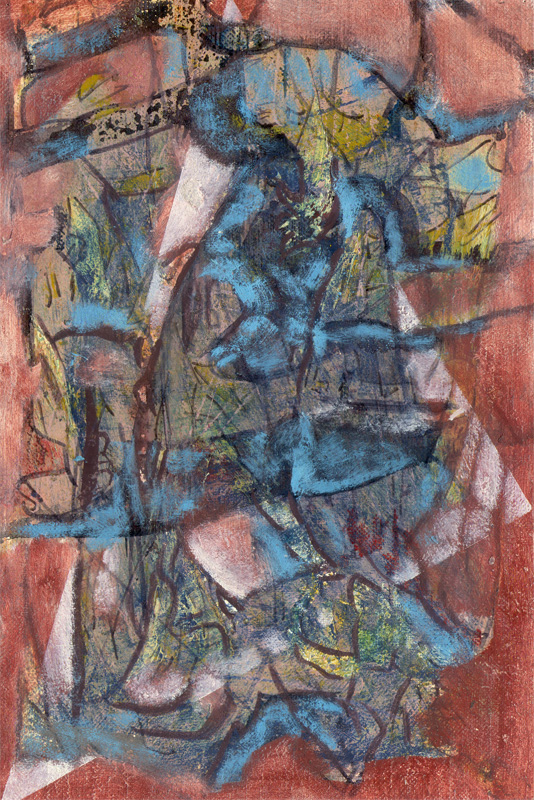
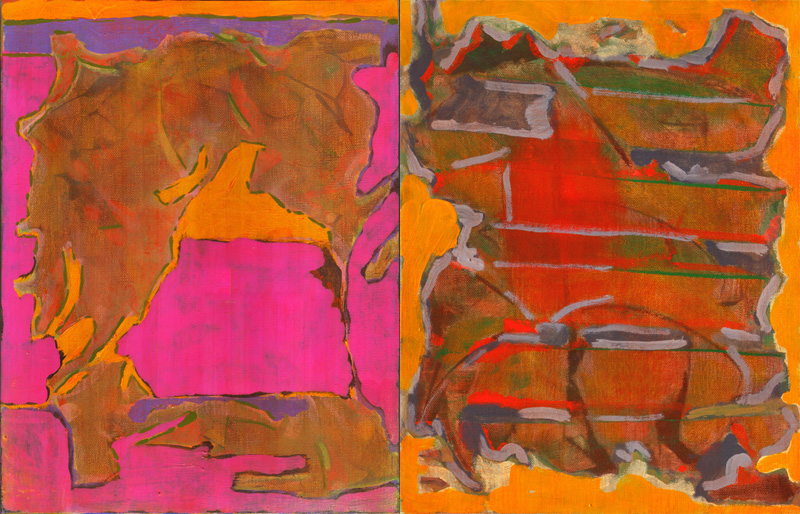
Silent Diptych by Ricardo Morín Medium: Oil On Linen Size: 18 by 28 by 3/4 inches Year: 2010
~
*
Prologue
Silent Diptych is not an illustration but a resonance—a meditation on silence, not as emptiness, but as a state of receptivity. It is the space where judgment dissolves, where human connection lingers between words, where meaning is felt rather than spoken. In its stillness, it holds what remains unresolved. Some silences are quiet. Others are filled with history.
RFMT
~
*
Our early dinner followed a matinee of “Parade”, a musical steeped in history, in indignity, in the weight of a life taken and a verdict that still hung unresolved. At the table, we spoke of Leo Frank, the Jewish man lynched in Georgia a century ago–pardoned decades later but never absolved.His true killer never pursued.
Three of us were Jewish. They understood, in ways the rest of us could only acknowledge but never quite embody, the particular pain of being made a scapegoat. The others sympathized but could not feel the same alienation—not in the marrow, not in the inherited way history imprints itself on some more than others.
It was a conversation of weight, but not of sorrow. We spoke with the clarity that comes when facts are long settled but their reverberations remain.
Then came the interruption.
The woman at the next table turned to us with a question, her voice cutting easily through our discussion.
“Where are the girls?”
I glanced at my companions, the six of us settled comfortably into the familiarity of one another.
“What girls?” I asked, not unkindly.
She blinked, as if expecting the answer to be self-evident.
“We’re already married to each other,” I said.
She turned away without another word.
There was no need to dwell on it. The moment was familiar. A minor encounter, the sort that barely registered after years of knowing exactly how the world could tilt in response to our presence.
To shift the conversation, I said, “Freud might say that all relationships are attempts to resolve unfinished business with our parents.”
Someone smirked. A fork was set down. A momentary silence, not of discomfort, but of consideration.
“Men with their fathers, women with their mothers,” I continued.
The responses were mixed. Agreement. Deflection. A shift in tone. Some spoke of failing to meet their fathers’ expectations. Some spoke of hatred. Some of detachment. Some of nothing at all.
I mentioned my father. His certainty that we, his children, would not know how to survive without him. He meant economically, of course. His generation had its own understanding of what it meant to endure.
“How many siblings do you have?” someone asked.
“Five,” I said. “Including my younger sister, who just passed away.”A pause.“She was angelic.”“Sixty-nine.”
There was sympathy, warm and immediate. A moment held just long enough.
And then, as if on cue, the conversation shifted—easily, instinctively. To theater. To Tony Awards. To the life and talent of voices long gone but forever recorded.
At the next table, the woman was laughing now, the moment between us already forgotten on her end.
And we, too, were laughing—at something lighter, something that did not ask to be examined too closely.
The moment stayed, unnoticed, but not forgotten.
~
*
Epilogue
Like the painting, the moment lingered—not demanding resolution, but waiting, quietly, to be understood. The weight of history, the subtleties of belonging, the pauses in conversation where truth is felt but not spoken. Silence, in the end, is never empty. It is the space where everything remains.
Sometimes sudden, sometimes creeping in with the years, there comes a moment when mortality ceases to be an abstraction. It is no longer a distant eventuality, an idea tucked away in the folds of daily existence, softened by distractions and routine. Instead, it steps forward, undeniable and weighty, as certain as breath and just as fleeting.
Perhaps it arrives with the quiet betrayal of the body—a stiffness upon waking that does not pass, the faltering of memory, the slight hesitation before a step once taken with ease. Or maybe it comes with loss: a friend, a sibling, a parent, a spouse, whose absence feels like a rehearsal for one’s own. The awareness sharpens and turns time into something both more precious and more fragile. We begin to measure life in what remains rather than what has passed.
And yet, even with this awareness, there is resistance. The mind flits away and grasps at plans, distractions, the comfortable illusion of continuity. We fear death, but we also refuse to fully look at it, as if acknowledgment alone might hasten its approach. We craft rituals around it, philosophies to explain it, but we rarely sit with it, silent and unadorned. It is not death itself that terrifies—it is the knowing, the certainty that it will come, whether with warning or in a moment unguarded.
But what if, instead of turning away, we let the awareness settle? Not as a burden, but as a quiet companion. If we could bear to see loss not as a theft but as an inevitable passage, one that has always been woven into the fabric of living, then death itself might lose its urgency. To know we are mortal is not to despair, but to understand the shape of what we are given. The question is not whether death will come, but whether we can carry that knowledge without fear—whether we can, at last, learn to live with it.
~
*
II. The Decline: Mind and Body
The body does not falter all at once. Its undoing is slow, measured in the smallest betrayals—steps that once felt effortless but now require consideration, a name that lingers just out of reach, the gradual dimming of senses that once shaped the world in sharp relief. At first, these changes seem like passing inconveniences, momentary lapses rather than the steady drift toward an inescapable fate. But the truth settles in with time: this is not a phase, not something to be recovered from, but the quiet unraveling of what once felt permanent.
The mind, too, shows its wear. Thought slows; memories surface in fragments, elusive and unreliable. There is irony in the awareness that remains—sharp enough to perceive the very faculties now fading. It is one thing to lose oneself unknowingly, another to watch the process unfold with lucid understanding. Here lies the deepest struggle: not merely the failing of body or mind, but the tension between resisting the inevitable and surrendering to it.
Some fight against this decline with a desperate energy and will themselves to retain what is slipping away. They train the body, challenge the mind, cling to routines as though discipline alone can hold back time. Others yield more readily and see in each loss a reminder that life is not meant to be held onto with clenched fists. Acceptance, however, does not come easily—it is not passive resignation, nor is it defeat. It is an uneasy balance between effort and surrender, between maintaining what can be kept and releasing what must go.
Suffering wears many faces. For some, it arrives as a single, catastrophic moment—a diagnosis, an accident, an unforeseen unraveling of the body’s delicate order. For others, it creeps in gradually, its presence felt in the weight of each passing year. The pain may be physical, unrelenting in its demands, or it may be the subtler ache of losing one’s sense of self, of becoming unrecognizable to one’s own reflection. Yet suffering, no matter its form, is universal. It does not measure its presence by fairness or logic. It simply is.
Against this backdrop, medicine intervenes—an effort to slow, to repair, to resist the natural course of deterioration. And yet, there is a discord in this. The body is finite, its functions destined to wane, yet we press forward with treatments, procedures, and endless prescriptions, each promising to forestall the inevitable. The line between care and prolongation blurs. To fight for life is instinctive, but at what point does the fight itself become suffering?
In the quiet moments, away from doctors and treatments, the question lingers: is decline something to battle, or is there dignity in allowing nature to take its course? And if the answer is neither absolute resistance nor passive surrender, then where, exactly, does one find the balance?
~
*
III. The Distractions That Delay Acceptance
To accept death fully would require a stillness that few can bear. The mind, restless and cunning, finds ways to avoid such stillness, to weave a life so full of movement and intention that mortality remains a distant, theoretical concern. And so, we fill our days with efforts to prolong them.
Longevity itself becomes a pursuit, an industry built on the promise that decline can be postponed, perhaps even avoided altogether. Diets, regimens, supplements, and treatments—all aimed at fortifying the body against its inevitable unraveling. Science, too, lends its hand, in offering new ways to repair, replace, and sustain. Medicine intervenes not only to heal but to extend, technology whispers of futures in which aging is optional, and ritual grants the comfort of structure to what cannot be controlled. Each of these offers something real—time, ease, a semblance of mastery over the body’s betrayals. But beneath them all is the same unspoken hope: that death, if not conquerable, might at least be postponed long enough to be forgotten.
Yet it is not only the fear of death itself that keeps us tethered to life but the weight of what remains unfinished. The obligations we have not yet fulfilled, the words left unsaid, the people who still need us—all of these create a sense that departure is premature, that to leave now would be to abandon something essential. Even in old age, when life has been long and full, there lingers the feeling that there is more to do, more to settle, more to understand. The past tugs at us with its unresolved questions; the future, though narrowing, still holds the illusion of possibility.
And so, we resist stillness. We resist the quiet where truth is most easily heard. The mind, unoccupied, might begin to accept what the body already knows. And so, we fill the hours, surround ourselves with routine, distraction, movement. Even suffering, in its strange way, can serve as a tether—something to focus on, something to endure, rather than a void to surrender to.
But what if we let the distractions fall away? If we stopped grasping for more time, more purpose, more noise? What would remain? The fear, yes—but also the possibility of peace. For all our striving, death will not be bargained with. It comes when it will, unmoved by the measures taken against it. Perhaps the final act of wisdom is not to resist, but to release—to allow the quiet to settle, to let the mind and body, at last, align in their understanding.
~
*
IV. The Weight of Suffering and Endurance
Suffering is the one certainty all sentient beings share. It is neither rare nor exceptional; it is the undercurrent of existence, woven into the fabric of life from its first breath to its last. And yet, for all its universality, suffering is deeply personal—felt in ways no other can fully understand, borne in ways that cannot be measured.
Pain takes many forms. It may be the slow tightening of the body against itself, the ache of illness, the heaviness of fatigue that never fully lifts. Or it may be the quieter pains—the loss of self as the mind falters, the loneliness of watching the world move on without you, the grief of knowing that, no matter how much one has endured, there is still more to bear. Some suffer in the open, their pain visible and acknowledged. Others carry it in silence, as though to admit its weight would be to surrender to it.
Yet suffering alone does not mark the end. There is something beyond it, something deeper: endurance. The threshold of what one can bear is not fixed; it shifts, expands, contracts. A pain once unthinkable becomes routine; a burden that seemed insurmountable is carried, day after day. And yet, there is always a limit, a moment—often unspoken, often known only in the quiet of one’s own thoughts—when endurance is no longer enough.
This is the reckoning, the moment when staying alive is no longer an act of living but of mere persistence. For some, it comes as a sudden recognition, as clear as a breaking dawn. For others, it arrives gradually, the body whispers before the mind dares to listen. It is not simply about pain, nor is it about age. It is the moment when the will to remain no longer outweighs the cost of doing so.
There is no universal measure for when this moment arrives; it is known only to the one who bears it. To endure is an instinct, a habit built into the core of existence. But to know when endurance has reached its end—that is something else entirely. It is not weakness, nor is it surrender. It is a quiet knowing, a recognition that every life carries within it the right to determine when it has been enough.
And so the question lingers: is suffering the price of life, or is there a point at which one is justified in setting the burden down? The answer is not written in doctrine, nor in medicine, nor in the opinions of those who do not bear the weight themselves. It is written in the individual, in the silent moment when one understands—this is enough.
~
*
V. The Unseen Threshold
Life does not depart all at once. It recedes, quietly at first, almost imperceptible in its withdrawal. The breath grows shallower, not in gasps but in a gradual easing, as though the body has decided to take up less space in the world. Weight diminishes, not only in flesh but in presence—the self becomes lighter, less tethered to the demands of existence. A once-restless mind drifts, thoughts untangle, as if loosening its grip on the past, the future, even the urgency of the present.
These are not signs of failure, nor of defeat. They are the body’s way of whispering that it is time. Time to ease away from effort, from the relentless task of sustaining itself. Time to let go of the struggle to remain. For all the fear that surrounds death, the body itself does not fear it. It knows when to surrender long before the mind is ready to accept.
And so comes the moment of knowing—not a grand realization, not an epiphany, but a quiet certainty. It is not measured in days or dictated by diagnosis. It is something deeper, something felt. Some fight against it and grasp at every last breath as though sheer will alone can anchor it. Others meet it as one meets sleep—reluctant at first, then trust, then finally yield to its pull.
There is dignity in this release. Not the dignity others impose, the kind measured in stoicism or restraint, but the simple dignity of relinquishing control. Of allowing the body to do what it was always meant to do: to reach its end not as a tragedy, but as a completion. To fight against this moment is to resist the natural rhythm of life itself. But to accept it—to welcome the stillness, to let breath slow without fear—that is its own kind of grace.
In the end, death is not something that must be conquered, nor something that must be endured beyond what one can bear. It is simply the last threshold, unseen until it is reached, known only to the one who crosses it. And when the time comes, there is nothing left to do but step forward—light, unburdened, and without regret.
~
*
VI. The Quiet Acceptance
To think of death without fear—to sit with it, unguarded, and allow it to be what it is—this is a rare and difficult peace. For so long, the mind has recoiled from its certainty and wrapped it in distractions, explanations, and resistance. But there comes a point when all of that falls away, when death is no longer something to be argued with or postponed, but simply recognized as the inevitable conclusion to a life that has been lived.
Fear untangles itself when death is no longer treated as an interruption, no longer seen as a theft, but rather as something as natural as breath itself. The body, in its wisdom, has already begun to let go. It is the mind that lingers and clings to meaning, to unfinished things, to the illusion that one more day, one more hour, might change something essential. But in the end, no justification is needed. One does not have to prove that it is the right time. The right time comes, whether welcomed or not, and acceptance is simply the act of ceasing to resist.
Stillness is not the same as resignation. Resignation carries a sense of defeat, of something being taken against one’s will. But true stillness—true acceptance—is something else entirely. It is an arrival, a settling into the inevitable without fear or regret. It is the moment when the mind and body, long at odds, finally move in the same direction. No more effort. No more bargaining. Only the quiet understanding that what was given has been enough.
To embrace the end is not to let go of life’s value, but to affirm it fully—by allowing it to complete itself with grace. There is nothing left to do, no more debts to settle, no more battles to fight. There is only the quiet, and the quiet is enough.
~
*
VII, In Closing
No life is lived in solitude, and no journey—especially the one toward acceptance—is walked alone. Along the way, we are shaped, guided, and held by those who have touched our hearts and left their presence within us even after they are gone. In facing mortality, we recognize not only our own, but also those who have come before us, whose lives continue to echo in memory, in love, in the quiet places where absence becomes something enduring.
Their presence lingers—not as shadows, but as light. They have taught us, challenged us, consoled us, and, in their own ways, prepared us for the path we all must take.
Death, in its harshness, strips us bare and confronts us with what is essential. Yet, it also unites us, for the love we have given and received does not fade with physical absence.
Our loved ones remain until the end; they sustain us through their memory and the love they have left within us.
To them, we offer our deepest gratitude. They are not gone. They remain, in the heart, in the soul, in the quiet acceptance of all that has been and all that will be.

 Observations On Perception