Archive for August, 2025

“Bound and Unbound:

August 31, 2025

The Articulation of Desire and Sin


*

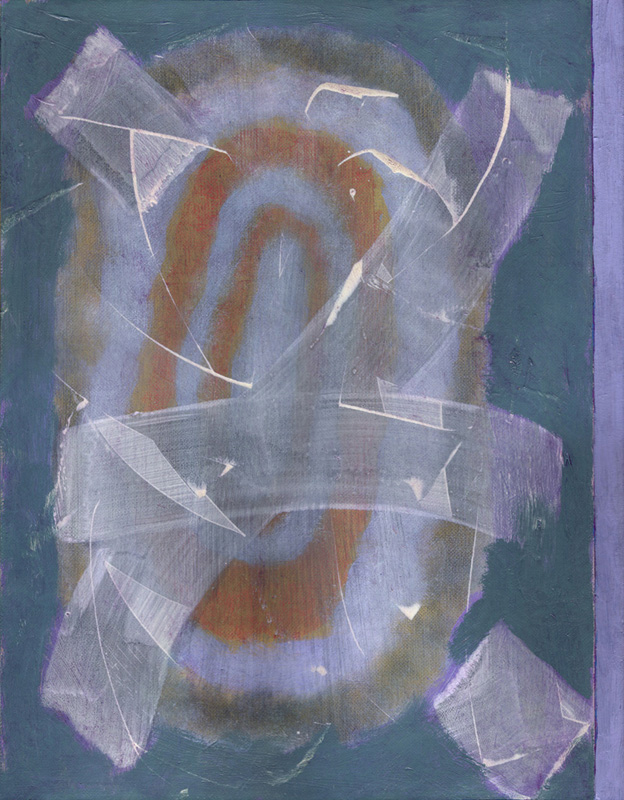
Cover design by Ricardo Morín
00032
Oil On Linen
18 by 24 by 3/4 inches
2009

Author’s Note

This essay considers how cultures have spoken about desire through the language of sin, pathology, and identity. The aim is not to defend or condemn, but to observe how words have carried judgments across time and how those judgments still shape our understanding. The reflections that follow are an attempt to restore clarity, to see desire as part of life’s vitality rather than as a distortion imposed by inherited vocabularies.

Abstract

Historically, desire has been articulated through terms such as sexuality, fetishism, morality, and religion. Over time, these words shifted from description to judgment, producing a confusion between nature and culture. Evidence from animal behavior, biology, and public health demonstrates that variation in desire is neither anomaly nor pathology. By grounding ethics in dignity and consent rather than shame, desire can be recognized as a natural expression of vitality rather than a source of suspicion.

The Burden of Words

Our most familiar words already betray the history of our confusion. Sexuality, from the Latin sexus, once indicated simple biological differentiation; only in the nineteenth century did it expand into a comprehensive category, enveloping desire, identity, and conduct (Laqueur 1990). Fetishism, from the Portuguese feitiço (“charm” or “sorcery”), was first applied to African religious objects before being imported into European science, where it came to signify irrational sexual attachment (Foucault 1978). Morality, from mores (“customs”), originally described communal practices but hardened into prescriptions against desire, particularly under Christian influence. Religion, from religare (“to bind”), once meant binding communities into shared ritual but eventually came to bind individuals to guilt and suspicion about their own bodies. Here the meaning of Bound and Unbound comes into view: words that once bound desire to order and judgment now carry within them the possibility of unbinding, of returning desire to the realm of vitality rather than suspicion. Each of these terms began in description and shifted into judgment. When we use them today, we inherit their distortions.

The Articulation of Desire and Sin

Culture has long gazed upon desire not as part of life’s ordinary richness but as a threat to be monitored. Theologies cast it as sin; medical texts classified it as pathology; social codes framed it as danger (Foucault 1978). This does not clarify, it distorts. Sexuality becomes at once overexposed and diminished: in public, it is the subject of rules and prohibitions; in private, it collapses into unrealistic expectations that either inhibit expression or exaggerate it into fetish. What should be natural is turned into a negotiation with shame.

Nature provides a more honest account. Same-sex interactions have been documented in over four hundred species (Bagemihl 1999). Rams form lasting male–male bonds, often rejecting female partners. Dolphins employ genital contact across sexes to cement alliances (de Waal 2005). Swans, gulls, and penguins engage in same-sex pairings that rear offspring as successfully as heterosexual pairs (Roughgarden 2013). Among bonobos, sexual contact occurs across nearly every configuration and functions as a mechanism of peacekeeping and social cohesion (de Waal 2005). Even in insects, behaviors that humans describe as “homosexual” occur routinely as part of dominance rituals or sheer abundance of sexual drive. None of this destabilizes the species; rather, it integrates sexuality into the fabric of survival and affiliation.

Humans display similar variation. Chromosomal conditions such as Klinefelter syndrome (XXY) or Turner syndrome (XO) illustrate that biological sex is not a rigid binary but a spectrum (LeVay 2016). Hormonal influences during gestation shape attraction and behavior before culture applies its labels (Hrdy 1981). Neuroscientific studies suggest correlations between hypothalamic structures and orientation, though no single cause accounts for desire (LeVay 2016). What emerges is not a fixed order but a continuum. The insistence on strict categories—heterosexual or homosexual, normal or deviant—is not nature’s doing but culture’s imposition.

Yet culture continues to conflate desire with identity and narrows it into fixed roles. These categories can be politically useful, but they risk obscuring the fluidity of experience that biology reveals. When identity becomes prescriptive, individuals live their own vitality under suspicion, measuring themselves against cultural ideals that deny variation. The result is estrangement: desire filtered through shame.

An alternative frame already exists. The World Health Organization defines sexual health as “a state of physical, emotional, mental, and social well-being” that includes the possibility of safe and pleasurable experiences (WHO 2006). The World Association for Sexual Health has gone further, affirming sexual pleasure as a fundamental human right (WAS 2019). Such frameworks do not police desire; they protect individuals against coercion and exploitation. They suggest that the role of culture is not to dictate what desires are permissible but to ensure dignity and consent. Once these conditions are secured, desire resumes its natural role: a source of intimacy, bonding, creativity, and balance (Gruskin et al. 2019).

To confront nature’s complexity is to resist its reduction into morality plays of vice and virtue. Desire does not require validation from cultural obsession, nor does it deserve condemnation from inherited vocabularies of sin. It is an aspect of life, as ordinary and vital as hunger or sleep. To acknowledge it without fear is to reclaim joy. By lifting the burden of shame, we return desire to its proper place in the living order: not an aberration requiring defense, but a manifestation of vitality—one that connects us to each other and to the exuberance of nature itself.

*


Annotated Bibliography

  • Bagemihl, Bruce: Biological Exuberance: Animal Homosexuality and Natural Diversity. New York: St. Martin’s Press, 1999. (A landmark survey documenting same-sex behaviors in more than 450 species. Bagemihl’s research undermines claims that homosexuality is “unnatural” and illustrates the diversity of sexual expression across the animal kingdom. It is essential for grounding sexuality in biological rather than cultural terms.)
  • de Waal, Frans: Our Inner Ape: A Leading Primatologist Explains Why We Are Who We Are. New York: Riverhead Books, 2005. (Drawing on primate studies, de Waal emphasizes sex as a social tool among bonobos and chimpanzees, used for alliance-building and conflict resolution. His work demonstrates that sexual behavior is not confined to reproduction but serves broader social and evolutionary functions.)
  • Foucault, Michel: The History of Sexuality, Vol. 1: An Introduction. Translated by Robert Hurley. New York: Pantheon, 1978. (In this foundational text on the cultural construction of sexuality, Foucault argues that sexuality is not a timeless natural category but a discourse shaped by power and institutions. Provides the conceptual framework for understanding how morality and pathology have distorted natural instincts.)
  • Gruskin, Sofia, et al. “Sexual Health, Sexual Rights and Sexual Pleasure.” Global Public Health, 2019, 14(10): 1361–1372. (This article situates sexual pleasure within global public health frameworks. It underscores that fulfillment and pleasure are inseparable from health and rights, reinforcing the need for ethics based on dignity rather than prohibition.)
  • Hrdy, Sarah Blaffer: The Woman That Never Evolved. Cambridge, MA: Harvard University Press, 1981. (Hrdy reinterprets female primate behavior and shows active strategies in mating and alliance formation. Her work dismantles the myth of female passivity and demonstrates that sexual agency is integral to evolutionary success.)
  • Laqueur, Thomas: Making Sex: Body and Gender from the Greeks to Freud. Cambridge, MA: Harvard University Press, 1990. (Laqueur traces the cultural and historical shift from the “one-sex” model of antiquity to the modern “two-sex” binary. His work shows how scientific language helped construct cultural categories of sexuality and gender, making him central to the etymological and historical analysis of desire.
  • LeVay, Simon: Gay, Straight, and the Reason Why: The Science of Sexual Orientation. 2nd ed. New York: Oxford University Press, 2016. (LeVay synthesizes research on brain structures, genetics, and prenatal influences and argues that sexual orientation emerges from a complex interaction of biological factors. Useful for contextualizing the continuum of human desire.)
  • Roughgarden, Joan: Evolution’s Rainbow: Diversity, Gender, and Sexuality in Nature and People. Rev. ed. Berkeley: University of California Press, 2013. (Roughgarden challenges traditional Darwinian views of sexual selection, highlighting diversity in gender and sexuality across species. She bridges nonhuman variation and human experience and offers a scientific argument against binary understandings of sexuality.)
  • World Health Organization (WHO): “Defining Sexual Health.” Geneva: WHO, 2006. (This report defines sexual health as a state of well-being that includes the possibility of safe and pleasurable sexual experiences, free of coercion or violence. It offers authoritative language to argue that sexual fulfillment is a health matter, not a moral one.)
  • World Association for Sexual Health (WAS): “Declaration on Sexual Pleasure.” Mexico City: WAS, 2019.(This report affirms sexual pleasure as a fundamental human right. This declaration situates pleasure within global health and rights discourse, supporting the essay’s call for ethics rooted in dignity rather than shame.)
“When All We Know Is Borrowed”

August 29, 2025

*

Ricardo Morín
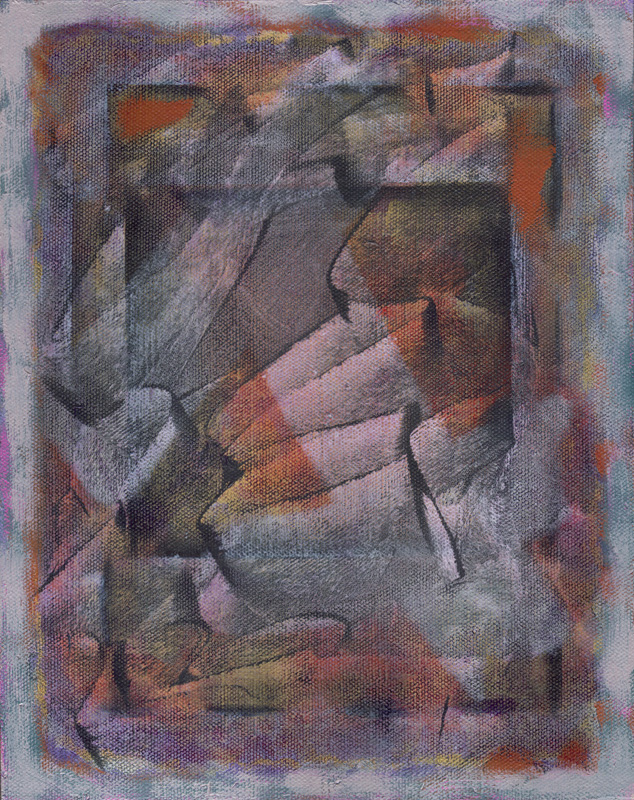
Still Thirty-three: When All We Know Is Borrowed
Oil on linen & board, 15″ x 12″x 1/2″
2012.

This essay concludes the trilogy begun with The Colors of Certainty and continued with The Discipline of Doubt. It reflects on perception, ambiguity, and ambivalence as conditions that complicate our access to truth, especially in an age of mistrust. The trilogy as a whole asks how certainty, doubt, and ambivalence each shape the paradoxes of human understanding—and how reality is always encountered in fragments, never in full possession.

The purpose of this essay is not to resolve these tensions but to articulate them. Its value lies less in offering solutions than in clarifying the paradoxes that underlie our shared attempts to understand reality.

Ricardo Morín, Bala Cynwyd, Pa. August 30, 2025.

Abstract:

This essay examines perception, ambiguity, and belief as distinct but interrelated conditions that shape human access to reality.   Ambiguity marks the instability of meaning; perception denotes our filtered and partial contact with the world; and ambivalence names the paradoxical ground on which truth is sought.   Ambivalence sustains the search even as it undermines the certainty that truth has been attained.   Writing and reading reveal these dynamics with particular clarity.   Through writing, thought evolves; the writer participates in this evolution and discovers that meaning may remain both untranslatable and questionable.   Yet this very incompleteness expands understanding, even when what is grasped cannot be fully shared.   Extending beyond communication, the essay suggests that reality itself is encountered only in fragments—through gestures, silences, and misperceptions that weaken the line between appearance and reality.   Artificial intelligence illustrates this condition in two ways:   as a tool, it amplifies practical doubts about authorship and authenticity; as a mirror, it reflects the deeper ambivalence that precedes it.   The essay concludes that ambivalence is not a detour from truth but the paradox through which truth, if it arises at all, briefly appears.

~

Perception

The word perception carries within it a history that mirrors the shifting ways in which cultures have understood reality.   From the Latin perceptio, it meant first a “taking in,” a “gathering,” or even a “harvest.”   To perceive was to collect impressions, as one might collect grain from a field: passive in form, but active in intent.

In Greek thought, perception was bound to aisthēsis—sensation was the contact one felt with the world.   Here it stood closer to the arts, to the immediacy of feeling, than to the systematic reasoning of philosophy.

During the Middle Ages, particularly in the twelfth and thirteenth centuries, Aristotle’s writings were recovered and incorporated into Christian scholastic thought.   What had been a pagan philosophy of sensation and intellect was reinterpreted by thinkers such as Thomas Aquinas within a theological framework of knowledge.   Perception was defined as the reception of sensory data by the intellect, a necessary stage through which sensation was elevated into understanding.

With the rise of modern philosophy, the term fractured.   For Descartes, perception could deceive;   for Locke, it formed the foundation of experience; for Kant, it was structured by categories that both opened and constrained our access to reality.   By then perception had already become ambivalent:   indispensable for knowing, but never certain in its truth.

Today the word extends further still, connoting not only sensation but also interpretation, bias, and opinion. To say “that is your perception” is no longer to affirm contact with the real but to indicate distance, distortion, or subjectivity. The evolution of the word reveals a semantic instability that parallels the essay’s claim: our access to reality is always shaped by ambivalence. What perception grants, it also unsettles.

Perception is never a simple act of receiving what is already there.   It is always mediated by memory, expectation, and predisposition.   In every exchange—whether in words on a page or in silence between two people—meaning shifts, unsettled and provisional.   From this shifting ground arises ambiguity, and from ambiguity, the unease that unsettles belief.

For the reader, this instability is unavoidable.   Every response, even silence, is colored by trust or mistrust, sympathy or suspicion, openness or fatigue.   Rarely does a reader approach a text in innocence, for every act of reading is shaped by assumptions that condition the reception of words.

The author is not exempt from this interpretive burden.   The act of writing does not end with publication but continues in the uncertain work of reading readers.   A pause in conversation, a fleeting acknowledgment, or a lack of reply can be interpreted as disinterest, disapproval, or indifference.   In this way, writing interprets interpretations and multiplies the layers of ambiguity until the meaning of the work appears not only untranslatable but also questionable.   Yet it is precisely through this reflection that writing continues, for without it thought cannot develop.   By persevering in this process, the writer participates in a widening of understanding, even when that understanding cannot be fully shared.

Such uncertainty is not a flaw of communication but part of its structure.   Anyone who seeks to understand through writing must accept that clarity will always be provisional and that expression will always fall short.   The act of putting thought into words reveals the distance between intention and reception, but it also creates the possibility of seeing reality from new angles.   Even when what is expressed cannot be communicated in full, the process itself enlarges understanding and deepens awareness of what is partial and in flux.

Ambivalence, therefore, is not hesitation but the paradoxical condition in which the search for meaning takes place.   It joins conviction and doubt, the desire for certainty and the recognition of its limits.   To write within ambivalence is to continue searching even when the result cannot be communicated without loss.   This condition—and not the illusion of final clarity—enables thought to move forward.

Truth, if it is ever reached, emerges despite the unstable ground of perception and ambiguity.   We arrive at it in spite of ourselves, our tensions, and our limitations.   It is not only major errors that weaken certainty:   a nuance misperceived, a pause misunderstood, or an ambiguous gesture may also diminish trust.   Daily experience shows that the line between appearance and reality is too thin to provide lasting assurance.

But this tension is not limited to writing or reading.   It extends more deeply, into our relation with reality itself.   Ambivalence is not only a feature of communication but also a feature of existence.   To perceive is always to partake of the world incompletely; to live is to do so under conditions of partial presence.   At times we see clearly, at other times dimly, and often not at all.   This rhythm of presence and withdrawal marks every relationship—between persons, between societies, and even between humanity and nature.

Technology has sharpened our awareness of this condition.   Artificial intelligence, for example, dramatizes the instability already present in human perception.   As a tool, it enables refinement of expression while amplifying doubts about authorship and authenticity.   As a mirror, it reflects the deeper ambivalence that precedes it and shapes all mediation.   Thus AI does not diminish thought but magnifies the unease that accompanies human access to reality:   the sense that what is offered is incomplete, unreliable, and never fully participatory.

The task, then, is not to eliminate ambiguity but to recognize it as part of reality itself.   Perception is interpretive, belief is unstable, and mistrust is a constant companion.   Ambivalence is not a detour from truth but the path along which truth—if it comes at all—must travel.   The challenge is not to restore a certainty that never existed but to learn to live within partial participation, to accept that what we call reality is always encountered in fragments.

In this sense, perception, ambiguity, and belief will always remain unsettled.   The writer cannot control how words are read, nor can the reader fully grasp what was meant.   No one can claim full possession of reality.   Every relation to the world depends on fragile conditions, where appearance and reality touch without ever coinciding.   If truth appears at all, it does so briefly and incompletely, arising only through ambivalence.   Yet ambivalence itself is a paradoxical condition:   it sustains our search for truth even as it undermines the certainty we long to possess.   Truth cannot confer ownership because it never rests.


Annotated Bibliography

  • Arendt, Hannah: The Human Condition. Chicago: University of Chicago Press, 1958. (Arendt analyzes action, labor, and work as distinct ways of engaging reality. Her distinction between appearance and reality, and her insistence that truth emerges through shared human activity, is directly relevant to the essay’s theme of perception and ambivalence.)
  • Gadamer, Hans-Georg: Truth and Method. New York: Continuum, 1975. (In this foundational text in hermeneutics, Gadamer explores how understanding arises through interpretation rather than objectivity. His view that truth is approached dialogically supports the essay’s claim that truth emerges “within ambivalence rather than beyond it.”)
  • Girard, René: Deceit, Desire, and the Novel. Baltimore: Johns Hopkins University Press, 1965. (Girard’s theory of mimetic desire shows how interpretation, desire, and misunderstanding shape human relations. His work underlines the fragility of belief and the unstable boundary between appearance and reality.)
  • Nussbaum, Martha: Political Emotions: Why Love Matters for Justice. Cambridge, MA: Harvard University Press, 2013. (Nussbaum argues that public emotions—such as love, compassion, and solidarity—are essential to sustaining justice. Her insights reveal how belief is fragile and shaped by interpretation; it resonates with the essay’s concern about trust, ambivalence, and human participation in reality.)
  • Turkle, Sherry: Alone Together: Why We Expect More from Technology and Less from Each Other. New York: Basic Books, 2011. (Turkle investigates how technology mediates human relationships and perceptions. Her work frames AI as a mirror of doubt; it shows how mediation both enables connection and erodes authenticity—an idea central to the essay.)

“Uprooted Influences”

August 25, 2025

*

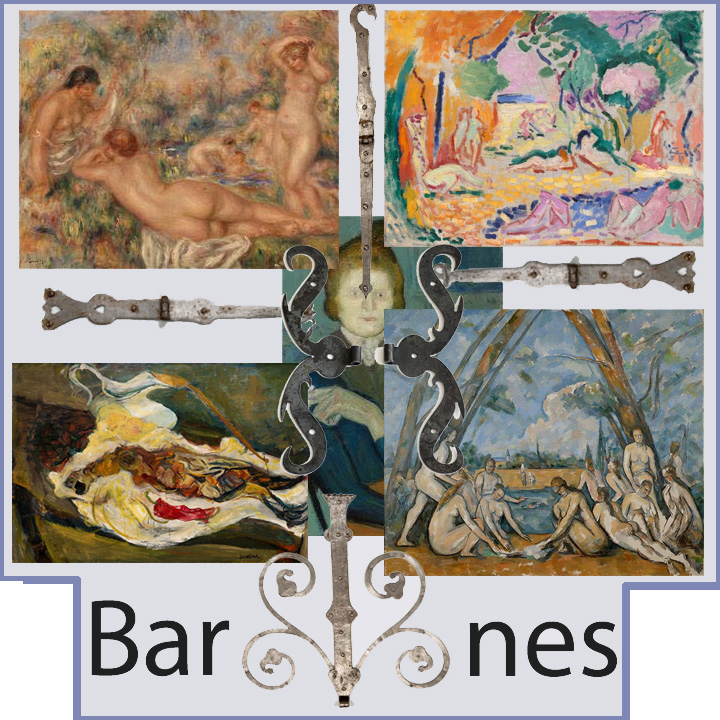
Composite cover design for “Uprooted Influences by Ricardo Morin: It features a paintings by Renoir (Bathers), Matisse (Joy of Life), Cézanne (Large Bathers), Soutine (Still Life with Pheasant), and Modigliani, clustered with wrought-iron hinges from the Barnes collection. The juxtaposition echoes Barnes’s ensembles, where masterpieces and everyday objects shared the same visual plane.

Ricardo Morin, August 25, 2025

*

From the Alice Maguire Museum at Saint Joseph’s University in Lower Merion Township, we moved among its holdings. The stained-glass windows were luminous and unsettling: John the Baptist with the Sacred Lamb, a Madonna and Child, a Pietà, a Return of the Prodigal Son. Once embedded in the walls of churches, they now stood uprooted from their sacred setting, their narratives suspended. Freed from liturgical purpose, they spoke instead through pure rhythm—cobalt and ruby, emerald and gold—colors as commanding as Veronese or Tintoretto, structures as fractured and daring as Picasso or Soutine. In their displacement, their dramatic effect delighted both the eye and the mind in their own right.

Another room revealed the Heavenly and Earthly Trinities of colonial Peru, the anonymous painters of Bolivia, and the Hispano-Philippine baroque sculptors: nameless hands shaping images to satisfy imperial taste. Their works obeyed the conventions of European devotion, yet beneath the surface ran other currents. A palette tinged with local sensibility, a face, an ornament not found in Seville or Rome—small gestures of persistence within the language of conquest. The absence of names testified to a system where identities were erased, but expression still found a way through brushstroke and chisel.

And then, standing apart, an eighteenth-century Mexican vargueño. A desk suited to a monarch’s scribe, its fall-front concealing drawers and secrets, its ironwork and gilding gleaming like a promise of empire. Imported as form but transformed by New World artisanship, it became a hybrid of Spanish order and Mexican material richness. Not merely a piece of furniture, but a portable stage of authority that bears within it the weight of rule and the quiet labor of those who made it.

Leaving the museum, we stepped into the arboretum. The shift was immediate. The bright lawn spread before us, lilacs already past bloom, the air holding the mixture of late summer and the first breath of fall. In the distance I saw David at the forest’s edge, as he was pointing to the broken silhouettes of trees—some uprooted, others scarred by the saw. It was difficult to tell whether their loss came from the slow processes of age and decay, or from the harsher pressures of climate change. The sight of those old, magnificent trunks reduced to stumps and exposed roots carried the weight of both inevitability and warning. I whistled to catch up with him, the sound bridging the distance between us and the wounded landscape.

The grounds themselves bore another absence. This land, once owned by Dr. Albert Barnes, preserves his legacy in plaques and praise, yet his presence is no longer here. Like the uprooted trees, the founder has been torn from the landscape—remembered in word but not in flesh. His vision endures in the collections and in the cultivated order of the arboretum, but the man himself is gone, leaving only traces: the architecture, the gardens, the echoes of intention.

Even the memory of Barnes is shadowed by discord. His decision to raise a ten-foot wall, blocking the view of his neighbors, was more than an act of stubborn privacy—it became a testament to the conflict between ways of seeing, both in art and in life. Just as his collection challenged the conventions of museums, so too his wall imposed his vision upon the landscape, as his efforts uprooted not only visibility but also harmony with those around him.

The uprooting of the collection has been chronicled not only in print but on film. Don Argott’s The Art of the Steal (2009) captures the drawn-out conflict between Barnes’s will, his Merion neighbors, and the powerful interests that sought the collection’s relocation: the film portrays the move as both civic triumph and cultural betrayal. More recently, Donor Intent Gone Wrong (Philanthropy Roundtable, 2022) framed the dispute as a cautionary tale about institutions overriding individual vision. Together, these accounts testify that the collection’s dislocation was never merely architectural: it was an uprooting of purpose as much as of place.

A collection of modern art—though invaluable and managed by the Pew Foundation at an estimated value of sixty-seven billion dollars—does not carry the same intensity as Barnes’s once-private holdings. A new museum dedicated to his collection now stands in its own building on Philadelphia’s museum row along the Benjamin Franklin Parkway, beginning with the Franklin Institute of Science and ending with the Barnes Museum eastward. What was once an idiosyncratic, fiercely personal vision now exists under the stewardship of curators who inevitably impose a different order. Where Barnes once arranged paintings shoulder to shoulder—Renoirs beside African masks, Cézannes and Matisses above medieval ironwork—the new installation gravitates in misalignment with the grammar of conventional museums, categorized by school, chronology, or theme, yet still incongruous with the artifacts mixed among them. The intimacy of a domestic space has been exchanged for the grandeur of a public institution, and with it the friction between his vision and institutional norms becomes palpable. Visitors now move through broad galleries instead of the dense, almost confrontational ensembles he once defended.

What endures, however, is the sense of the collection as Barnes’s own installation, authored in the spirit of both philosophy and biography. His juxtapositions were deliberate compositions: Renoirs beside iron hinges, Cézannes above ladles, African masks flanking Impressionist portraits. Around them clustered the objects he loved to collect—door latches, lock plates, wagon parts, Pennsylvania German chests, Navajo textiles, and hundreds of wrought-iron hinges and utensils. These were never curiosities: for Barnes, each hinge, each utensil, each mask was an equal actor in the ensemble, sharpening the perception of form and rhythm in the canvases above. Influenced by his friend John Dewey, Barnes believed that art should be experienced democratically, where the humble and the exalted shared the same plane of visual inquiry.

The paradox is that the collection has never been more visible, yet perhaps never less itself. In its transformation from private sanctuary to public museum, from the defiant eccentricity of a man’s will to the polished authority of the Parkway, it has acquired a new layer of politics. Praise for its accessibility is constant, but so too is the quiet sense that something has been uprooted: the personal order replaced by the institutional, the disruptive vision softened by curatorial compromise. And yet, despite these shifts, the collection still resists full assimilation. The paintings, the juxtapositions, the sheer density of presence retain their charge, as they remind us of the one man who dared to see differently—even when it set him against his neighbors, his city, and the established conventions of art.

*


Annotated Bibliography

  • Argott, Don, dir. The Art of the Steal: The Untold Story of the Barnes Collection. 2009. Film. Maj Productions and 9.14 Pictures.— A riveting documentary tracing the decades-long legal and civic battle over the relocation of the Barnes Foundation from Merion to Philadelphia. It highlights neighborhood opposition, donor-intent controversies, and the institutional forces that uprooted Barnes’s educational vision—ideal for understanding how physical displacement mirrors conceptual disruption. 
  • Barnes Foundation. The Barnes Foundation: Masterworks. New York: Skira Rizzoli, 2012.— A richly illustrated volume presenting the paintings, sculptures, and ensembles of the Barnes collection as installed on the Parkway. Demonstrates how Barnes’s juxtapositions survive in a new space that reflects the transformation of a private vision into an institutional context.
  • Bernstein, Roberta. “The Ensembles of Albert C. Barnes: Art as Experience.” Journal of Aesthetic Education 24 (3): 1–15. Champaign: University of Illinois Press, 1990.— Examines Barnes’s arrangements through the lens of John Dewey’s philosophy of experience. Highlights how his inclusion of hinges, ladles, and ironwork was not eccentricity but pedagogy, designed to democratize perception and erase hierarchies between fine and decorative art.
  • Caamaño de Guzmán, María. El barroco mestizo en América: Escultura y devoción en los Andes. Madrid: Sílex, 2018.— Explores the hybrid styles of Hispano-American baroque, focusing on the Andes and Philippines. Provides context for the anonymous Bolivian painters and Hispano-Philippine sculptors mentioned in the essay, situating their work as simultaneously colonial and locally expressive.
  • Chidester, David. Religion: Material Dynamics. Oakland: University of California Press, 2018.— Discusses how religious objects like stained glass are transformed when removed from liturgical settings into museums. Useful for framing the “uprooted” character of Maguire’s stained-glass windows and their re-contextualization from devotion to aesthetic contemplation.
  • Fane, Diana, ed. Art and Identity in Spanish America. New York: Brooklyn Museum and Harry N. Abrams, 1996.— A key reference on colonial Latin American art, documenting how objects such as the vargueño embodied both European forms and indigenous contributions. Provides scholarly grounding for interpreting the vargueño as a portable stage of authority and hybridity.
  • Fleming, David. Stained Glass in Catholic Philadelphia. Philadelphia: Temple University Press, 2020.— Chronicles stained-glass commissions in Philadelphia’s Catholic churches, many later dispersed into museum collections. Offers context for the Maguire collection, showing how local sacred art became uprooted into secular settings.
  • Greenhalgh, Paul. The Persistence of Craft: The Applied Arts Today. London: Bloomsbury, 2020.— Explores the intersection of decorative art and modern aesthetics. Resonates with Barnes’s integration of ironwork and everyday utensils into his ensembles, treating them not as curiosities but as visual equals to painting.
  • Hollander, Stacy C. American Anthem: Masterworks from the American Folk Art Museum. New York: Harry N. Abrams, 2002.— Investigates how anonymous or vernacular artisans contributed to national artistic heritage. Relevant for the essay’s discussion of anonymous Bolivian painters and Hispano-Philippine sculptors, whose erasure mirrors the treatment of folk and colonial artisans more broadly.
  • Kleinbauer, W. Eugene. Introduction to Medieval Stained Glass. New York: Harper & Row, 1971.— Classic introduction to stained-glass art as both narrative and abstraction. Supports the reading of Maguire’s stained glass as luminous color freed from symbol, while it acknowledges its devotional roots.
  • Philanthropy Roundtable. Donor Intent Gone Wrong: The Battle for Control of the Barnes Art Collection. 2022. Short documentary. In Wisdom and Warnings series.— A concise 10-minute film examining how Barnes’s explicit instructions for educational, small-group engagement were overridden by broader institutional ambitions. It underscores the theme of uprooting through the betrayal of intent and reinforces how the displacement was as moral as it was spatial. 
  • Viau-Courville, Olivier. The Vargueño: Spanish Colonial Furniture and Power. Mexico City: Instituto Nacional de Antropología e Historia, 2021.— Focused monograph on the vargueño, explaining its symbolic role in the Spanish empire as a marker of authority and hybrid craftsmanship. Directly underpins the essay’s interpretation of the vargueño as suited to a monarch’s scribe and transformed by New World artisanship.

“The Discipline of Doubt”

August 24, 2025

*

**

Author’s Note:

This essay is the second part of a trilogy that examines certainty, doubt, and ambivalence as conditions shaping our understanding of reality. It turns to doubt as both discipline and burden: a practice that unsettles claims of knowledge yet makes understanding possible. Here doubt is not treated as weakness but as a necessary stance within human communication. Its value lies not in closure but in keeping open the fragile line between appearance and reality. The trilogy begins with The Colors of Certainty and concludes with When All We Know Is Borrowed.

The Discipline of Doubt

Skepticism and doubt are often spoken of as if they were the same, yet they differ in essential ways. Skepticism inclines toward distrust: it assumes claims are false until proven otherwise. Doubt, by contrast, does not begin with rejection. It suspends judgment, while it withholds both assent and denial, so that questions may unfold. Skepticism closes inquiry prematurely; doubt preserves its possibility. Properly understood, inquiry belongs not to belief or disbelief, but to doubt.

This distinction matters because inquiry rarely follows a direct path to certainty. More often it is layered, restless, and incomplete. Consider the case of medicine. A patient may receive a troubling diagnosis and consult several physicians, while each offers a different prognosis. One may be more hopeful, another more guarded, yet none entirely conclusive. The temptation in such circumstances is to cling to the most reassuring answer or to dismiss all of them as unreliable. Both impulses distort the situation. Inquiry requires another path: to compare, to weigh, to test, and ultimately to accept that certainty may not be attainable. In this recognition, doubt demonstrates its discipline: it sustains investigation without promising resolution and teaches that the absence of finality is not failure but the condition for continued understanding.

Even within medicine itself, leaders recognize this tension. Abraham Verghese, together with other Stanford scholars, has pointed out that barely half of what is taught in medical schools proves directly relevant to diagnosis; the rest is speculative or unfounded. This observation does not aim to discredit medical education but rather to underline the need for a method that privileges verification over uncritical repetition. Clinical diagnosis, therefore, does not rest on an accumulation of certainties but on the constant practice of disciplined doubt: to question, to discard what is irrelevant, and to hold what is provisional while seeking greater precision.

History provides another vivid lesson in the figure of Galileo Galilei. When he trained his telescope on the night sky in 1609, he observed four moons orbiting Jupiter and phases of Venus that could only be explained if the planet circled the sun. These discoveries contradicted the Ptolemaic system, which for centuries had fixed the earth at the center of creation. Belief demanded obedience to tradition; skepticism might have dismissed all inherited knowledge as corrupt. Galileo’s path was different. He measured, documented, and published, while he knew that evidence had to be weighed rather than simply asserted or denied. The cost of this doubt was severe: interrogation, censorship, and house arrest. Yet it was precisely his refusal to assent too quickly—his suspension of judgment until the evidence was overwhelming—that made inquiry possible. Galileo shows how doubt can preserve the conditions of knowledge even under the heaviest pressure to believe.

Literature offers a parallel insight. In Shakespeare’s Hamlet, the young prince is confronted by the ghost of his murdered father, who demands vengeance. To believe would be to accept the apparition’s word at once and to kill the king without hesitation. To be skeptical would be to dismiss the ghost as hallucination or trickery. Hamlet does neither. He allows doubt to govern his response. He tests the ghost’s claim by staging a play that mirrors the supposed crime, as he watches the king’s reaction for confirmation. Hamlet’s refusal to act on belief alone, and his unwillingness to dismiss the ghost outright, illustrates the discipline of doubt. His tragedy lies not in doubting, but in stretching doubt beyond proportion, until hesitation itself consumes action. Shakespeare makes clear that inquiry requires balance: enough doubt to test what is claimed, enough resolve to act when evidence has spoken.

The demands of public life make the difference equally clear. In the early months of the COVID-19 pandemic, citizens were asked to place immediate trust in official pronouncements or, conversely, to dismiss them as deliberate falsehoods. Belief led some to cling uncritically to each reassurance, however inconsistent; skepticism led others to reject all guidance as propaganda. Doubt offered another course: to ask what evidence supported the claims, to weigh early reports against later studies, and to accept that knowledge was provisional and evolving. The uncertainty was uncomfortable, but it was also the only honest response to a rapidly changing reality.

A similar pattern emerged after the September 11 attacks. Governments urged populations to choose: either support military intervention or stand accused of disloyalty. Belief accepted the justification for war at face value; skepticism dismissed all official claims as manipulation. Doubt, however, asked what evidence existed for weapons of mass destruction, what interests shaped the rush to invasion, and what alternatives were excluded from consideration. To doubt in such circumstances was not disloyalty but responsibility: the attempt to withhold assent until claims could be verified. These examples show that doubt is not passivity. It is the active discipline of testing what is said against what can be known: to resist the lure of premature closure.

Verification requires precisely this suspension: not the comfort of belief, nor the dismissal of skepticism, but the discipline of lingering within uncertainty long enough for proof to take shape. One might say that verification becomes possible only when belief is held in abeyance. Belief craves closure, skepticism assumes falsehood, but doubt stills the mind in the interval—where truth may draw near without the illusion of possession.

The same principle extends to the temptations of success and recognition. Success and fame resemble ashes: the hollow remains of a fire once bright but now extinguished, incapable of offering true joy to an inquiring mind. Ashes evoke a flame that once burned but has spent itself. So it is with fame: when the applause fades, only residue lingers. Belief, too, provides temporary shelter, yet it grows brittle when never tested. Recognition and conviction alike promise permanence, yet both prove fragile. A mind intent on inquiry cannot find rest in them. It requires something less visible, more enduring: the refusal to define itself too quickly, the discipline of anonymity.

Anonymity here does not mean retreat from the world. It means withholding assertion or purpose until knowledge has ripened. To declare too swiftly what one is—or what one knows—is to foreclose discovery. By necessity, the inquiring mind remains anonymous. It resists capture by labels or the scaffolding of recognition. Its openness is its strength. It stays attuned to what has not yet been revealed.

Our present age makes such discipline all the more urgent. Technology hastens every demand for certainty: headlines must be immediate, opinions instantaneous, identities reduced to profiles and tags. Social media thrives on belief asserted and repeated, rarely on doubt considered and tested. Algorithms reward speed and outrage, punishing hesitation as weakness and contradiction as betrayal. To cultivate doubt and anonymity is therefore a form of resistance. It shelters the subtlety of thought from the pressure of velocity and spectacle. It refuses to allow inquiry to be diminished into slogans or certainty compressed into catchphrases.

The discipline of doubt teaches that truth is never possessed, only pursued. Success, fame, and belief may glitter briefly, but they collapse into ashes. What endures is the quiet labor of questioning, the patience of remaining undefined until knowledge gathers form. To believe is to settle into residue; to doubt is to stand within the living fire. To question is to stir the flame; to believe is to collect the ashes.

*

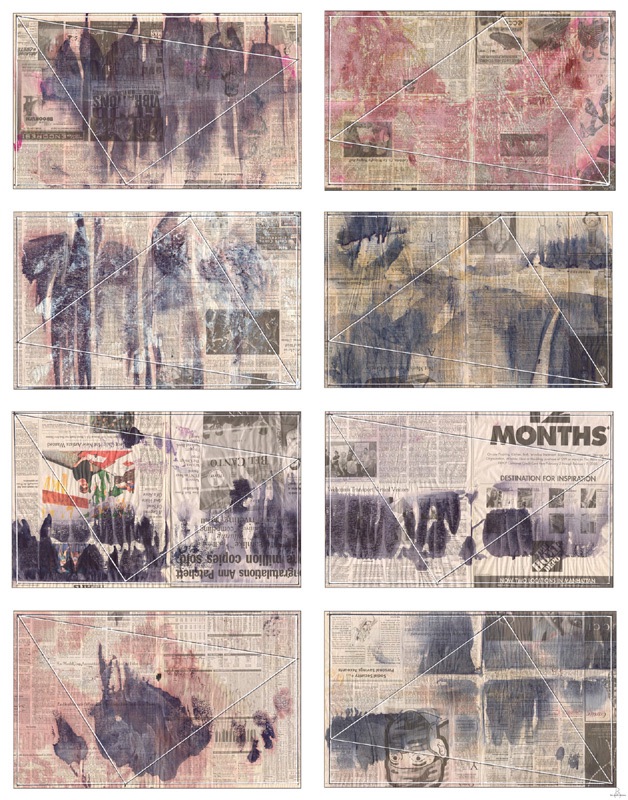
** Cover Design:

Ricardo Morín: Newsprint Series Nº 2 (2006). 51″ × 65″. Ink, white-out, and blotted oil paint on newsprint. From the Triangulation series.


Annotated Bibliography

  • Arendt, Hannah: Between Past and Future. New York: Viking Press, 1961. (Arendt examines the importance of thinking without absolute supports and illuminates how the discipline of doubt resists political and social certainties).
  • Bauman, Zygmunt: Liquid Modernity. Cambridge: Polity Press, 2000. (Bauman describes the fluidity and precariousness of certainties in modern life and reinforces the idea of doubt as a condition in the face of contemporary volatility).
  • Berlin, Isaiah: The Crooked Timber of Humanity. Princeton: Princeton University Press, 1991. (Berlin analyzes the pluralism of values and the impossibility of single certainties and supports the need to live with unresolved tensions).
  • Bitbol-Hespériès, Annie: Descartes’ Natural Philosophy. New York: Routledge, 2023. (Bitbol-Hespériès examines how Cartesian natural philosophy emerges from a constant exercise of methodical doubt; she offers a contemporary reading that links science and metaphysics in Descartes’ thought).
  • Han, Byung-Chul: In the Swarm: Digital Prospects. Cambridge, MA: MIT Press, 2017. (Han critiques the pressure of transparency and digital acceleration; he provides insights into how technology disfigures the patience required for doubt).
  • Han, Byung-Chul: The Disappearance of Rituals. Cambridge: Polity Press, 2020. (Han explores how digital society weakens spaces of repetition and anticipation to highlight the urgency of recovering anonymity and slowness in inquiry).
  • Croskerry, Pat, Cosby, Karen S., Graber, Mark, and Singh, Hardeep, eds.: Diagnosis: Interpreting the Shadows. Boca Raton, FL: CRC Press, 2017. (Croskerry, Cosby, Graber, and Singh address the cognitive complexity of diagnostic reasoning: they show how uncertainty is inherent in clinical practice and how disciplined doubt can reduce diagnostic error).
  • Elstein, Arthur S., and Schwartz, Alan: Clinical Problem Solving and Diagnostic Decision Making: Selective Review of the Cognitive Literature. New York: Oxford University Press, 2002. (A landmark study in medical decision-making, it shows how diagnostic reasoning is less about static knowledge and more about methodical doubt and verification).
  • Finocchiaro, Maurice: Retrying Galileo, 1633–1992. Berkeley: University of California Press, 2005. (Finocchiaro explores the trials and historical reinterpretations of Galileo’s case; he shows how scientific doubt clashed with religious authority and how it has been re-evaluated in modernity).
  • Gaukroger, Stephen: Descartes: An Intellectual Biography. Oxford: Oxford University Press, 2002. (An intellectual biography that situates Descartes in the cultural context of the seventeenth century and illuminates how Cartesian doubt was also a strategy against religious and scientific tensions).
  • Garber, Daniel: Descartes Embodied: Reading Cartesian Philosophy through Cartesian Science. Cambridge: Cambridge University Press, 2001. (Garber analyzes the close relationship between Descartes’ science and his philosophical method and underscores how scientific practice reinforced the discipline of doubt).
  • Graber, Mark L., Gordon D. Schiff, and Hardeep Singh: The Patient and the Diagnosis: Navigating Clinical Uncertainty. New York: Oxford University Press, 2020. (Graber explores how physicians manage uncertainty and emphasizes that precision in diagnosis emerges from structured methods rather than unquestioned knowledge).
  • Machamer, Peter, ed.: The Cambridge Companion to Galileo. Cambridge: Cambridge University Press, 1998. (In this collection of updated essays presenting Galileo’s work from historical, philosophical, and political perspectives, Machamer illuminates how empirical doubt transformed cosmology).
  • Nussbaum, Martha: Political Emotions: Why Love Matters for Justice. Cambridge, MA: Harvard University Press, 2013. (Nussbaum examines how liberal institutions can responsibly cultivate public emotions—such as love, tolerance, and solidarity. Her arguments enrich the section of the essay on civic-life, which shows how emotional cultivation, beyond belief or skepticism, supports societal inquiry).
  • Popkin, Richard: The History of Scepticism: From Savonarola to Bayle. Oxford: Oxford University Press, 2003. (In this historical study of skepticism, Popkin shows how skepticism evolved between radical distrust and the discipline of inquiry).
  • Shakespeare, William: Hamlet. New Haven: Yale University Press, 2003. (This play offers a literary embodiment of doubt as an ambivalent force: it functions both as the engine of inquiry and the risk of paralysis).
  • Shea, William, and Artigas, Mariano : Galileo in Rome: The Rise and Fall of a Troublesome Genius. Oxford: Oxford University Press, 2003. (An accessible and well-documented narrative of Galileo’s conflict with the Church; it illustrates how persistence in verifying doubt had vital and political consequences).
  • Verghese, Abraham, Saint, Sanjay, and Cooke, Molly: “Critical Analysis of the ‘One Half of Medical Education Is Wrong’ Maxim.” Academic Medicine 86, no. 4 (2011): 419–423. (Authored by Stanford-affiliated leaders in medical education, the report argues that much of medical teaching lacks direct relevance to diagnostic accuracy and underscores the necessity of disciplined doubt and re-evaluation).

“The Colors of Certainty”

August 23, 2025

*

**

~

Author’s Note:

This essay is the first part of a trilogy that explores how human beings approach reality through certainty, doubt, and ambivalence. It begins with certainty—how the desire for stability drives thought and belief, even when what appears secure is already open to change. Though written from personal inquiry, its scope is broader: the question of certainty concerns not one life but the fragile conditions of shared reality. The trilogy continues with The Discipline of Doubt and concludes with When All We Know Is Borrowed.

Ricardo Morín, Bala Cynwyd, Pa. August 23, 2025

~

The Colors of Certainty

We live in an age unsettled by division. The subtleties of thought that once allowed us to pause, to weigh, and to distinguish are increasingly swept aside by the demand for immediate clarity. Everything is urged toward opposites: yes or no, ally or enemy, awake or asleep. The pace of public life, accelerated by technology and amplified by conflict, leaves little patience for nuance. Contradiction, which once signaled the restless work of an honest mind, is now treated as treachery. In this atmosphere, to admit complexity is to risk mistrust, and even the smallest hesitation is judged as weakness. We are asked, again and again, to define ourselves as though identity were a single stroke, not a layered drawing made across time.

Symbols flourish in such a climate while they reduce complexity into consumable images. Few have proven more enduring than the pill metaphors drawn from The Matrix film. When it appeared in 1999, the scene of choosing between a red pill and a blue pill was a cinematic device, which dramatized the tension between reality and illusion. Its influence grew gradually, as the film became a generational touchstone. Over the decades that followed, the pills slipped into online communities and political rhetoric only to harden into modes of thought that now shape how we imagine truth and the identity of belonging. To take the red pill became a declaration of awakening, access to hidden truths. To take the blue pill was to be mocked for complacency. Eventually the darker black pill emerged into both despair and fatalism embraced as destiny.

Once this logic takes hold, the world itself is reduced to a theater of absolutes. Disagreement becomes disloyalty, and belonging is measured not by shared life but by categorical allegiance. I have felt this even in conversations with people I have known for decades. In one such exchange, I remarked that I was appalled by Noam Chomsky’s recent habit, even in his nineties, of opposing Western hegemony over Russia as though that stance could excuse the war in Ukraine. Yet in another context, I expressed admiration for Chomsky’s earlier work on linguistic relevance in science four decades ago, which continues to illuminate how language shapes knowledge. To my interlocutor, these two statements seemed incompatible, as if they could not both be true. The expectation was that my judgment had to be seamless: either I rejected Chomsky entirely or endorsed him wholly.

Why must one justify such distinctions, as though every judgment were required to form a single line of allegiance? The contexts are not the same—one belongs to the 1980s, another to the present; one to the realm of linguistics, another to geopolitics. Yet in today’s climate, the demand for congruence is relentless. It reflects the pill logic that has seeped into our speech and habits of thought: one is either awake or asleep, aligned or opposed, consistent across every domain or untrustworthy in all.

That same craving for certainty also gave us Infowars—the radio podcast. Founded in 1999, the very year The Matrix was released, it became a commercial theater of the red pill metaphor. Infowars thrived on dramatizing crisis, telling its audience that elites, governments, or hidden forces manipulated events at every turn. What institutions explained as complexity, Infowars simplified into betrayal. The clarity it offered was intoxicating: good versus evil, freedom versus tyranny, awake versus deceived. It was not simply ideas being sold, but certainty itself—packaged with survival kits, supplements, and slogans. In seeking to liberate its audience from illusion, Infowars created a new one, offering not understanding but a permanent performance of awakening.

The narrowing of discourse is not only about politics and ideology, but it also extends to who is permitted to speak. I was reminded of this in a private exchange, where writing itself was dismissed as the work of an “armchair liberal” or a “limousine socialist.” According to this view, only those directly scarred by battle may speak of war, only those who have suffered prejudice firsthand may give voice to injustice, and to write as an observer is to mock the reality of struggle. It is a charge meant to discredit, as though the act of “fighting with a keyboard” were less real than hand combat in a bloodied field. Yet such suspicion denies what writing has always been: a means of bearing witness, of preserving memory, of shaping the conversation through which societies recognize themselves. The pen has never replaced experience, but it has always transformed it into something shareable and durable. To demand firsthand suffering as the sole qualification for speech is to reduce witness to autobiography and to strip dialogue of the breadth that comes when voices join from different vantage points.

Another difficulty lies in language itself. Writers who seek precision—who stretch language to its sharpest edge—often find that what emerges are metaphors. Even when grounded in substantiated terms, description requires figures of thought, images, and analogies that can never be wholly exact. The question is how precise language can ever be. Even the most brilliant minds struggle with definitions, because in their best formulations they remain presumptive theories. To acknowledge this is not to diminish language but to recognize that our dependence on tropes is not weakness but necessity. Story lines and metaphors are the bridges of comprehension, without which complexity would dissolve into noise. To lean on metaphor is not necessarily to abandon truth but to approach it by way of what can be shared.

What began as a film’s conceit has become a method of thinking, and in many ways a prison. The Matrix offered its audience a vision of awakening through choice, but our culture has taken that image and turned it into a grid of loyalties, where every stance is measured by whether one has swallowed the right capsule. Infowars amplified this posture; it dramatized the hunger for certainty until conspiracy became a substitute for thought. Suspicion of the writer’s position narrowed it further while it mocked reflection as inauthentic and demanded that speech bear the scars of direct experience before it could count as legitimate. And beneath it all lies the frailty of language itself: its inability to define with absolute precision, its reliance on metaphors that shape the very realities they describe.

To speak today of red pills, blue pills, or black pills is not only to reference a film or a subculture; it is to acknowledge the grip of a society that prefers binaries to dialogue, antagonism to complexity, performance to reflection. To resist that grip is to remember that thought is not a pill to be swallowed but a conversation to be carried, a conversation sustained in the fragile medium of language itself. However uncertain, however provisional, it is in that ongoing act of speaking and listening that culture remains alive—where friendship can endure, where witness can be honored, and where the truths no single color can contain still find their voice.

*

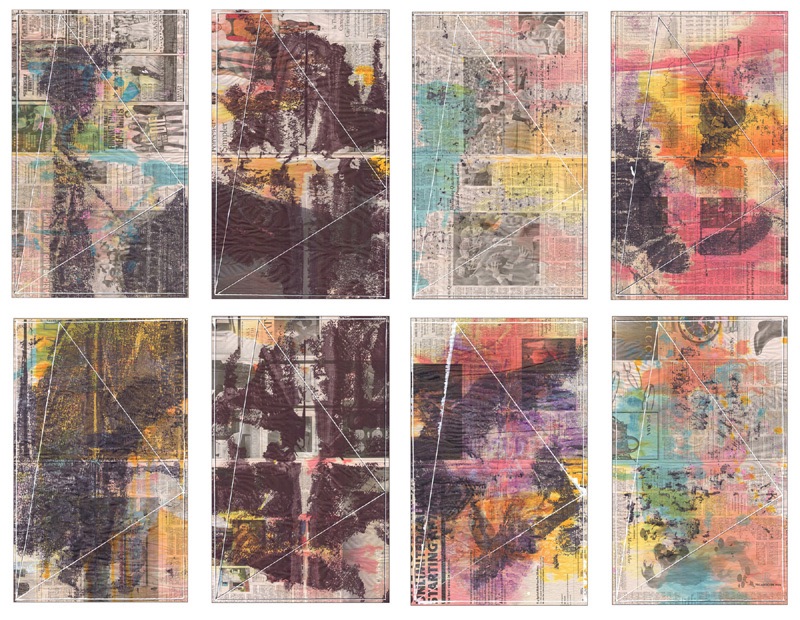
About the cover image:

Newsprint Series Nº 9, 2006, by Ricardo Morín (47” × 74”): Translucent dyes, ink, white-out, and blotted oil paint on newsprint.

This image belongs to a series that transforms fragments of printed matter into layered fields of color and erasure, this piece speaks to the instability of certainty itself. The pigments veil and expose in turns, while the newsprint beneath reminds us that truth is mediated, provisional, and never free of interpretation. As with language in the essay, meaning emerges only through contrast, through what resists containment.


Annotated Bibliography

  • Cialdini, Robert B. Influence: The Psychology of Persuasion. New York: Harper Business, 2006. (A classic study in behavioral psychology showing how persuasion exploits binary choices and authority cues, useful for understanding the appeal of pill metaphors and the certainty promised by conspiracy movements.)
  • Lakoff, George, and Johnson, Mark: Metaphors We Live By. Chicago: University of Chicago Press, 2003. (A foundational text on metaphor in cognition and language, relevant to the essay’s argument that even the most precise use of language depends on tropes and figurative structures for human comprehension.)
  • Marwick, Alice, and Lewis, Rebecca: Media Manipulation and Disinformation Online. New York: Data & Society Research Institute, 2017. (This analytical report documents how conspiracy narratives spread through online ecosystems; it highlights the role of platforms in amplifying symbolic binaries such as “red pill” awakening.)
  • Pew Research Center: “Public Trust in Government: 1958–2023”. Washington: Pew Research Center, 2023. (Presents longitudinal data on the decay of institutional trust in the United States and offers a data-driven context for why audiences turned to alternative voices such as Infowars.)
  • Southern Poverty Law Center: “Male Supremacy”. Montgomery: SPLC, 2019. (A report classifying the Incel subculture and related groups within the larger “male supremacist ecosystem,” cited in connection to the black pill ideology and its links to violence.)
  • Sunstein, Cass R., and Vermeule, Adrian: Conspiracy Theories and Other Dangerous Ideas. New York: Simon & Schuster, 2014. (This book explores why conspiracy theories flourish and frames them as efforts to create certainty in moments of social disorientation. It is highly relevant to the discussion of Infowars as a commercial theater of the red pill metaphor.)
  • Taguieff, Pierre-André: The New Culture Wars. Paris: CNRS Éditions, 2020. (This book is a political-philosophical treatment of identity politics and binary antagonisms in Western democracies: it offers a perspective on how pill metaphors entered the broader theater of culture wars.)
  • Tversky, Amos, and Kahneman, Daniel: Judgment under Uncertainty: Heuristics and Biases. Cambridge: Cambridge University Press, 1982. (A landmark in cognitive science explaining why people reduce complex realities into simplified binaries; it anchors the essay’s meditation on the lure of certainty.)

“The Politics of Erasure: Authoritarianism and Spectacle”

August 22, 2025

*


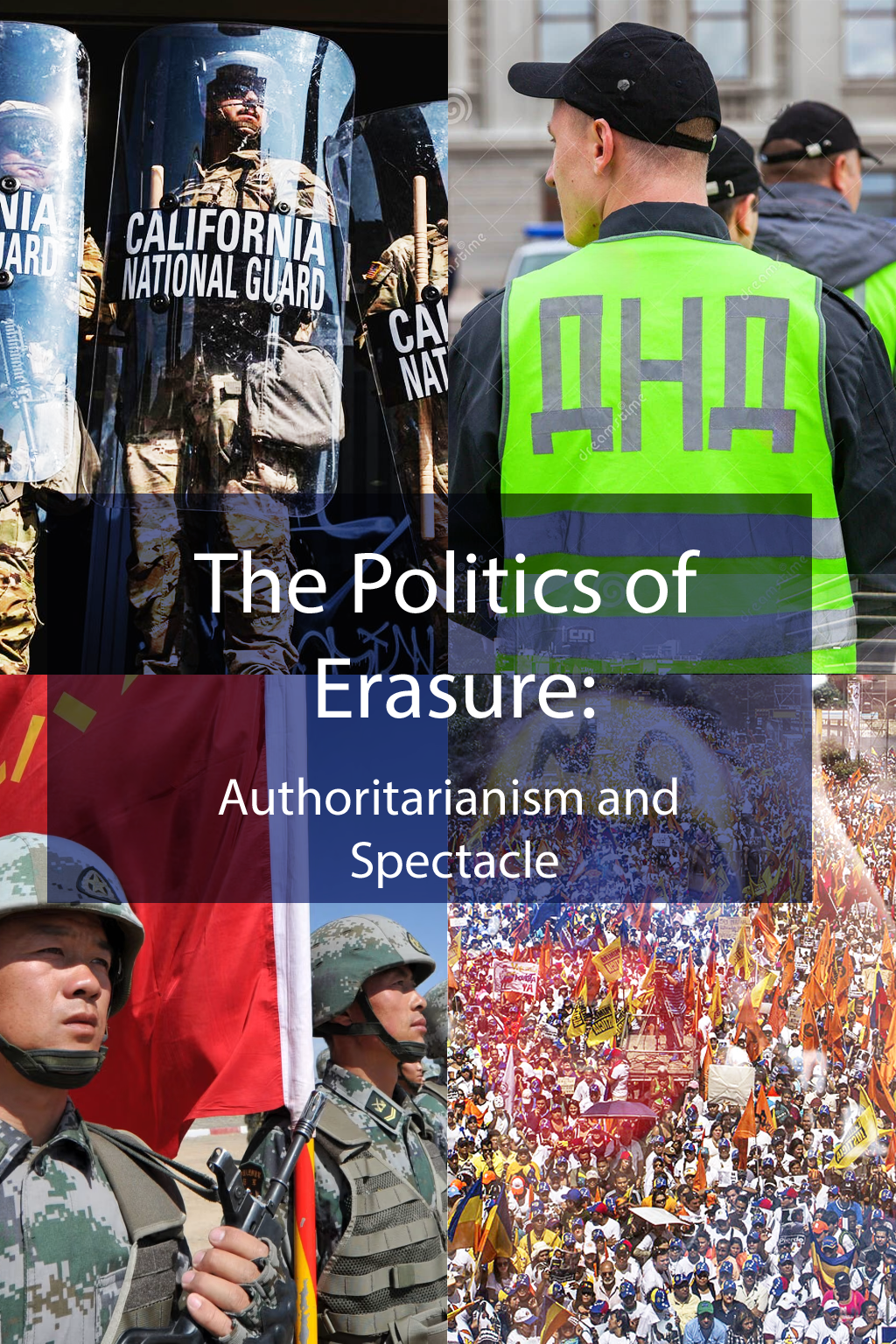
Cover design for the essay “The Politics of Erasure: Authoritarianism and Spectacle.” The composite image juxtaposes surveillance, militarization, propaganda, and mass spectacle to underscore how authoritarian regimes render lives expendable while legitimizing control through display.

By Ricardo Morín, In Transit to and from NJ, August 22, 2025

Authoritarianism in the present era does not present itself with uniform symbols. It emerges within democracies and one-party states alike, in countries with declining economies and in those boasting rapid growth. What unites these varied contexts is not the formal shape of government but the way power acts upon individuals: autonomy is curtailed, dignity denied, and dissent reclassified as threat. Control is maintained not only through coercion but also through the appropriation of universal values—peace, tolerance, harmony, security—emptied of their content and redeployed as instruments of supression. The result is a politics in which human beings are treated as expendable and spectacle serves as both distraction and justification.

In the United States, the Bill of Rights secures liberties, yet their practical force is weakened by structural inequality and concentrated control over communication. After the attacks of September 11, the USA PATRIOT Act authorized sweeping surveillance in the name of defending freedom, normalizing the monitoring of private communications (ACLU 2021). Protest movements such as the Black Lives Matter demonstrations of 2020 filled the streets, but their urgency was absorbed into the circuits of media coverage, partisan argument, and corporate monetization (New York Times 2020). What begins as protest often concludes as spectacle: filmed, replayed, and reframed until the original message is displaced by distractions. Meanwhile, the opioid epidemic, mass homelessness, and medical bankruptcy reveal how millions of lives are tolerated as expendable (CDC 2022). Their suffering is acknowledged in statistics but rarely addressed in policy, treated as collateral to an order that prizes visibility over remedy.

Venezuela offers a more direct case. The Ley contra el Odio (“Law against Hatred”), passed in 2017 by a constituent assembly lacking democratic legitimacy, was presented as a measure to protect tolerance and peace. In practice, it has been used to prosecute journalists, students, and citizens for expressions that in a democratic society would fall squarely within the realm of debate (Amnesty International 2019). More recently, the creation of the Consejo Nacional de Ciberseguridad has extended this logic to place fear and self-censorship among neighbors and colleagues (Transparencia Venezuela 2023). At the same time, deprivation functions as a tool of discipline: access to food and medicine is selectively distributed to turn scarcity into a means of control (Human Rights Watch 2021). The state’s televised rallies and plebiscites portray unity and loyalty, but the reality is a society fractured by exile, with over seven million citizens abroad and those who remain bound by necessity rather than consent (UNHCR 2023).

Russia combines repression with patriotic theater. The 2002 Law on Combating Extremist Activity and the 2012 “foreign agents” statute have systematically dismantled independent journalism and civil society (Human Rights Watch 2017), while the 2022 law against “discrediting the armed forces” criminalized even the description of war as war (BBC 2022). Citizens have been detained for carrying blank signs, which demonstrates how any act, however symbolic, can be punished if interpreted as dissent (Amnesty International 2022). The war in Ukraine has revealed the human cost of this system: conscripts drawn disproportionately from poorer regions and minority populations are sent to the frontlines, their lives consumed for national projection. At home, state television ridicules dissent as treason or foreign manipulation, while parades, commemorations, and managed elections transform coercion into duty. The official promise of security and unity is sustained not by coexistence but by the systematic silencing of plural voices, enforced equally through law, propaganda, and ritual display.

China illustrates the most technologically integrated model. The 2017 Cybersecurity Law and the 2021 Data Security Law require companies and individuals to submit to state control over digital information and extend surveillance across every layer of society (Creemers 2017; Kuo 2021). Social media platforms compel group administrators to monitor content and disperses the responsibility of conformity to citizens themselves (Freedom House 2022). At the same time, spectacle saturates the landscape: the Singles’ Day shopping festival in November generates billions in sales, broadcast as proof of prosperity and cohesion, while state media showcases technological triumphs as national achievements (Economist 2021). Entire communities, particularly in Xinjiang, are declared targets of re-education and surveillance. Mosques are closed, languages restricted, and traditions suppressed—all in the name of harmony (Amnesty International 2021). Stability is invoked, but the reality is the systematic denial of dignity: identity reduced to an administrative category, cultural life dismantled at will, and existence itself rendered conditional upon conformity to the designs of state power.

Taken together, these cases reveal a common logic. The United States commodifies dissent and normalizes abandonment as a permanent condition of public life. Venezuela uses deprivation to enforce discipline and the resulting compliance is publicly presented as loyalty to the state. Russia demands sacrifice and transforms coercion into patriotic duty. China fuses surveillance and prosperity and engineers conformity. Entire communities are suppressed in the name of harmony. The registers differ—commercial, ritualistic, militarized, digital—but the pattern is shared: dissent is stripped of legitimacy, lives are treated as expendable, and universal values are inverted to justify coercion.


References

  • ACLU: “Surveillance under the USA PATRIOT Act”. New York: American Civil Liberties Union, 2021. (This article documents how post-9/11 legislation expanded state surveillance in the United States and framed “security” as a justification for reducing privacy rights.)
  • Amnesty International: “Venezuela: Hunger for Justice. London: Amnesty International”, 2019. (Amnesty International reports on how Venezuela’s Ley contra el Odio has been used to prosecute citizens and silence dissent under the rhetoric of tolerance.)
  • Amnesty International: “Like We Were Enemies in a War: China’s Mass Internment, Torture and Persecution of Muslims in Xinjiang”. London: Amnesty International. 2021. (Amnesty International provides evidence of mass detention, surveillance, and cultural repression in Xinjiang carried out in the name of “harmony” and stability.)
  • Amnesty International: “Russia: Arrests for Anti-War Protests”. London: Amnesty International, 2022. (Amnesty International details the systematic arrest of Russian citizens, including those holding blank signs, under laws claiming to protect peace and order.)
  • BBC: “Russia Passes Law to Jail People Who Spread ‘Fake’ Information about Ukraine War.” March 4, 2022. (News coverage of Russia’s 2022 law criminalizing criticism of the war shows how “discrediting the armed forces” became a punishable offense.)
  • CDC.: “Opioid Overdose Deaths in the United States. Atlanta: Centers for Disease Control and Prevention”. 2022. (The CDC provides statistical evidence of widespread loss of life in the U.S. and underscores how entire populations are treated as expendable in public health.)
  • Creemers, Rogier: “Cybersecurity Law of the People’s Republic of China”: Translation with Annotations. Leiden University, 2017. (An authoritative translation and analysis of China’s 2017 Cybersecurity Law illustrate how digital oversight is institutionalized.)
  • UNHCR: “Refugee and Migrant Crisis in Venezuela: Regional Overview”. Geneva: United Nations High Commissioner for Refugees, 2023. (This report offers figures on the Venezuelan exodus and highlights the mass displacement caused by deprivation and repression.)

“The Primary Bond”

August 21, 2025

*

Ricardo Morin
Still Forty-three
Oil on linen
14″ x 18″ x 3/4″
2012

For those who know that the sharpest word cannot replace the simple act of responding with tenderness.


Ricardo Morin — August 13, 2025 — Bala Cynwyd, Pennsylvania

*

Tenderness is a deliberate openness that seeks the well-being of another through a gesture of welcome, through gentleness and respect. Aggression, by contrast, is the forceful assertion of one’s will in a way that can wound, constrain, or dominate. Each can exist without the other, yet they often meet in the same moment, altering the course of a conflict or softening its edge. One sees this when, in the middle of an argument, a person instinctively offers a chair to the other. The dispute remains, but its weight has shifted.

In a world haunted by resentment and the fear of being hurt—feelings as real as they are sometimes exaggerated—tenderness emerges not as a denial of those forces but as their modulation. It interrupts the cycle of suspicion, as when two adversaries, after heated words, lower their voices to hear one another. The hostility remains, but it is tempered, displaced by the recognition that another’s presence is not solely a threat.

Where causality would claim to measure our emotions as predictable reactions, what becomes evident are instead our habits and inclinations—patterns that oscillate between the delicate pull that calms and the impulse that wounds. These shifts reveal that tenderness is not the opposite of aggression, but a mirror exposing how both are woven together from the same human ground.

Tenderness, then, is not the absence of aggression but a mirror showing the weave in which both share a common origin. Consider the exhausted nurse who, after an endless shift, still takes the time to straighten a patient’s blanket. The act is small, yet it springs from the same human ground where impatience and fatigue could just as easily have given way to harshness.

Tenderness carries an ambiguity that makes itself as disarming as it is unsettling. Its apparent fragility dismantles aggression without force, compelling it to see itself in an unexpected reflection: a gentle act that interrupts the urge to harm and leaves it without footing.

Tenderness is not a calculated ruse but a natural pull toward memories older than mistrust—when contact was a need rather than a threat. One sees this when, after years of silence and estrangement, a son returns to care for his ailing father. Resentment remains, yet in the act of tending beats the same root that once sustained closeness.

In such moments, fear loosens, hostility softens, and what seemed a battlefield becomes an uncertain but open passage toward relief. Tenderness does not erase conflict, but shows how—even within it—something older and deeper still binds us. I witnessed this once on the New York City subway. A man, angered when a disabled stranger asked for help, turned his glare on me as our eyes met. He moved toward me as if to strike, bringing his face close to mine. I closed my eyes and eased my expression. Deprived of the stare that had fueled his aggression, he stepped back—uneasy, but no longer advancing. I walked away, marked by how a single gesture can quiet the arc of a confrontation.

There lies a primary bond that ties us to the source of life, where tenderness and aggression are not isolated poles but two expressions of the same human fabric. A sister, in a tense exchange, tells her older brother that she learned her combative stance from him. He bristles at the remark, yet both know they have carried that same hardness for years, and neither can fully blame the other. The recognition does not bring easy reconciliation, but it narrows the distance between them.

From the first bond, the body learns to read the smallest signals: the warmth that welcomes, the pressure that threatens, the pulse that quickens or slows. One sees it when, in the midst of battle, a soldier offers water to a prisoner who only moments before was his enemy. Long before words exist, such gestures shape the habits we later call preferences or fears. This is why tenderness can yield to aggression without conceding defeat: it exposes aggression to an involuntary recognition, restoring the memory of its own root. And in that recognition, even the most hostile impulse finds, if only for a moment, its disarmament.

Tenderness does not eliminate conflict or erase its causes, but it can shift its course. It opens a moment where the certainty of harm gives way to the possibility of presence and care. It is not a cure for all, yet in its quiet way of calling and being heard, tenderness shows that even the firmest aggression seeks acknowledgment. In that acknowledgment, both tenderness and aggression reveal that they spring from the same human ground.

The presence of tenderness in our exchanges is not merely a private virtue but a civic necessity. It sustains the trust and recognition without which communities fracture and cannot endure.

*


Annotated Bibliography

  • Arendt, Hannah: The Human Condition. Chicago: University of Chicago Press, 1958. (Hannah Arendt examines the active life of human beings—labor, work, and action—tracing their historical meanings and showing how modern society has altered the conditions for political and civic engagement.)
  • Girard, René: Violence and the Sacred. Baltimore: Johns Hopkins University Press, 1977. (René Girard explores the role of violence in human culture, arguing that ritual sacrifice emerged as a mechanism to contain social conflict, and linking these dynamics to myths and religious practices.)
  • MacIntyre, Alasdair: After Virtue. Notre Dame: University of Notre Dame Press, 1981. (Alasdair MacIntyre critiques modern moral philosophy, contending that the loss of a shared Aristotelian framework has left moral discourse fragmented and emotive, and proposing a return to virtue ethics.)
  • Nussbaum, Martha C.: Political Emotions: Why Love Matters for Justice. Cambridge: Harvard University Press, 2013. (Martha Nussbaum investigates the emotional foundations of a just society, arguing that cultivating compassion, love, and a sense of shared humanity is essential for sustaining democratic institutions.)

*


“Language, Mathematics, and the Price of Artificial Intelligence”

August 19, 2025

*

Ricardo Morín
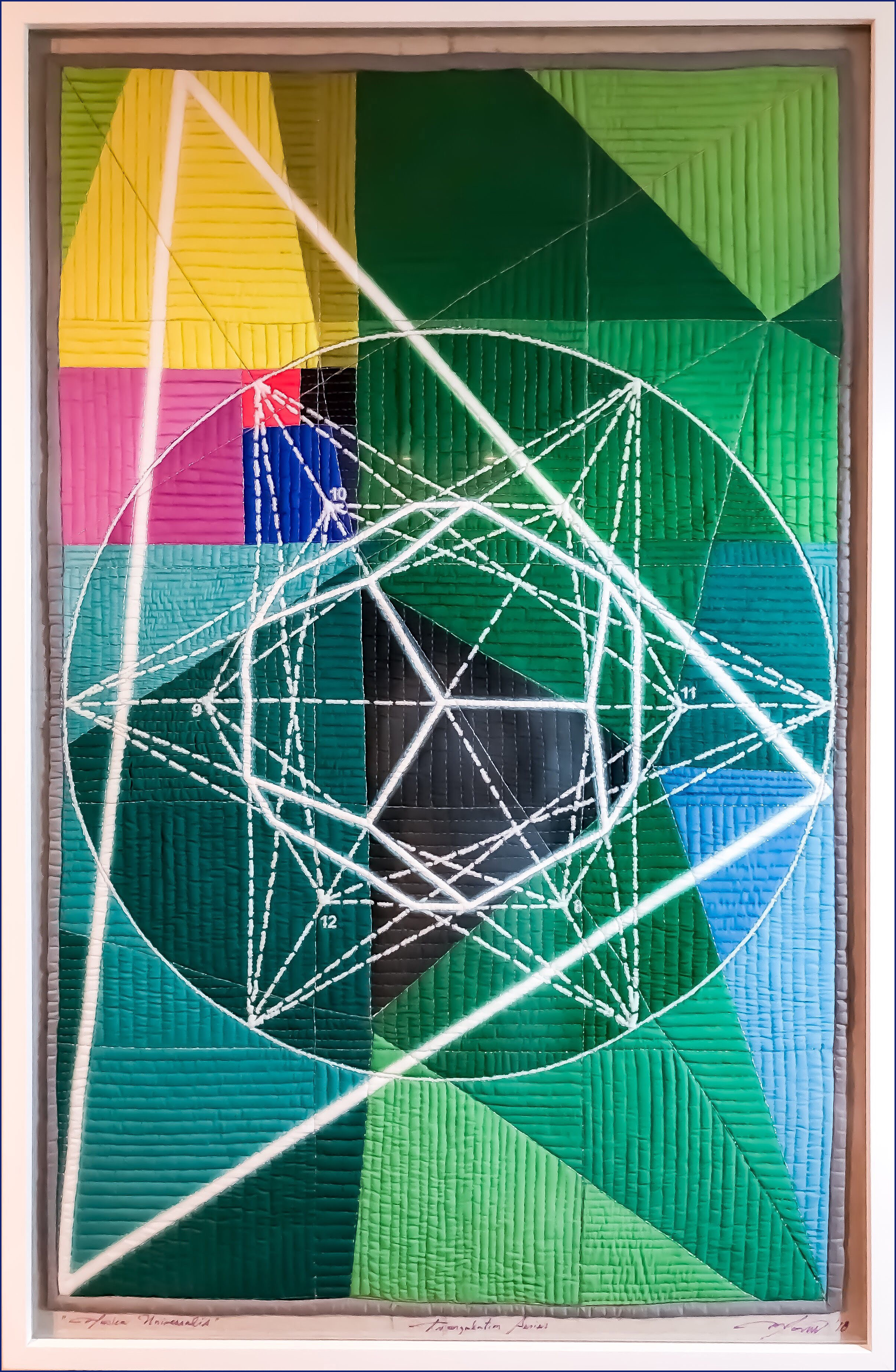
(Triangulation Series)
Musica Universalis
Silk quilt streched over linen
37″ x 60″
2013-18

A geometrical construction of a dodecahedron within a Fibonacci composition, reinforced by a right-angle triangle: A meditation on the harmony of the universe, where mathematics and language converge yet never fully enclose reality.


Ricardo Morin, August 20, 2025

Abstract

This essay examines the interdependence of language and mathematics as the twin pillars of knowledge, each indispensable yet incomplete without the other. While mathematics secures precision and abstraction, language renders reasoning intelligible and shareable; together they approximate, but never fully capture, a reality richer than any formulation. The discussion situates artificial intelligence as a vivid case study of this condition. Marketed at premium cost yet marked by deficiencies in coherence, AI dramatizes what happens when mathematical power is privileged over linguistic rigor. Far from replacing human thought, such systems test our capacity to impose meaning, resist vagueness, and refine ideas. By weaving philosophical reflection with contemporary critique, the essay argues that both mathematics and language must be continually cultivated if knowledge is to progress. Their partnership does not close the gap between comprehension and reality; it keeps it open, ensuring that truth remains an unending pursuit.


Language, Mathematics, and the Price of Artificial Intelligence

Every society advances by refining its tools of thought. Two stand above all others: mathematics, which distills patterns with precision, and language, which gives form and meaning to reasoning. Neither is sufficient alone. To privilege one at the expense of the other is to weaken the very architecture of knowledge.

Artificial intelligence dramatizes both their promise and their limitations. The announcement of a $200 monthly fee for access to ChatGPT-5 is revealing. Marketed as a luxury service “for those who can afford it,” it underscores the widening gap between technological privilege and cultural necessity. Those with resources can fine-tune their productivity; those without are left behind. Yet even for the well-equipped, the question persists: what exactly is being purchased?

The machine dazzles with speed and scale, but its deficiencies are equally striking. Engineers may be virtuosos of algorithms, but grammar is not their instrument. The results are too often colloquial, vague, or lacking in rigor. To extract coherence, the user must not be a passive consumer but an editor—capable of clarifying, restructuring, and imposing meaning. The paradox is unmistakable: the tool marketed as liberation demands from its operator the very discipline it cannot supply.

This paradox reflects the larger truth about knowledge itself. Mathematics and language are both indispensable and both incomplete. Mathematics achieves abstraction but leaves its results inert unless language renders them intelligible and shareable. Language conveys thought but falters without the rigor that mathematics provides. What one secures, the other interprets.

Yet both are bound by a deeper condition: reality exceeds every formulation. Our theories—whether mathematical models or linguistic descriptions—are approximations shaped by the observer. Language cannot exhaust meaning; mathematics cannot capture finality. Knowledge is never absolute: it is a negotiation with a reality richer than any model or phrase.

Artificial intelligence lays bare this condition. It can automate structure but cannot provide wisdom; it can reproduce language but cannot guarantee meaning. Its true value lies not in replacing the thinker but in testing our capacity to resist vagueness, impose coherence, and refine thought. What is marketed as freedom may, in truth, demand greater vigilance.

To dismiss language and the humanities as secondary, or to imagine mathematics and computation as sufficient unto themselves, is to misunderstand their interdependence. These disciplines are not rivals but partners, each refining the other. AI magnifies both their strengths and their deficiencies; they remind us that progress depends on the continual refinement of both—mathematics to model reality, language to preserve its meaning.

The path of knowledge remains open-ended. Language and mathematics do not close the gap between our finite comprehension and the inexhaustible richness of reality; they keep it open. They allow us to approach truth without presuming to possess it. Artificial intelligence, as every tool of thought, shows us not the end of knowledge but its unending condition: a dialogue between what can be measured, what can be spoken, and what forever exceeds us.

*


Annotated Bibliography

  • Arendt, Hannah: The Life of the Mind. Vol. 1: Thinking. New York: Harcourt, Brace, Jovanovich, 1971. (Arendt examines the act of thinking and the limits of expression, which shows how thought requires language to become shareable while never able to exhaust reality. Her work reinforces the essay’s claim that reasoning without expression cannot advance knowledge.)
  • Bender, Emily M., and Koller, Alexander: “Climbing towards NLU: On Meaning, Form, and Understanding in the Age of Data.” Proceedings of ACL, 2020. (Bender and Koller argue that large language models process form without true understanding; this highlights the gulf between mathematical pattern recognition and linguistic meaning—it supports the essay’s caution that AI dazzles with form but falters in coherence.)
  • Chomsky, Noam: Language and Mind. 3rd ed. Cambridge: Cambridge University Press, 2006. (Chomsky explores the innate structures of language and their role in shaping cognition; this affirms that language conditions the possibility of thought while it still remains limited in capturing reality.)
  • Devlin, Keith: Introduction to Mathematical Thinking. Stanford: Keith Devlin, 2012. (Devlin explains how mathematical reasoning distills structure and pattern while acknowledging abstraction as approximation; this reinforces the idea that mathematics, as a safeguard of precision, cannot exhaust the world it models.)
  • Floridi, Luciano: The Fourth Revolution: How the Infosphere Is Reshaping Human Reality. Oxford: Oxford University Press, 2014. (Floridi situates digital technologies and AI within a broader history of self-understanding, which enriches the essay’s argument that mathematics and language—extended into computation—remain approximations of a reality beyond full control.)
  • Lakoff, George, and Núñez, Rafael: Where Mathematics Comes From: How the Embodied Mind Brings Mathematics into Being. New York: Basic Books, 2000. (Lakoff and Núñez argue that mathematics arises from metaphor and embodied cognition, which reveals how dependence on human interpretation and the affirmation that mathematical theories, as linguistic ones, remain bound to the observer.)
  • Mitchell, Melanie: Artificial Intelligence: A Guide for Thinking Humans. New York: Farrar, Straus and Giroux, 2019. (Mitchell provides a critical overview of AI’s capabilities and limits; it shows how the advancement of pattern recognition does not close fundamental gaps in understanding and parallels the essay’s critique of AI’s grammatical poverty.)
  • Polanyi, Michael: Personal Knowledge: Towards a Post-Critical Philosophy. Chicago: University of Chicago Press, 1962. (Polanyi emphasizes tacit knowledge and the need for articulation in validation; it echoes the view that mathematics and language refine understanding but never achieve closure.)
  • Snow, C. P.: The Two Cultures. Cambridge: Cambridge University Press, 1993 [1959]. (Snow diagnoses the divide between sciences and humanities; this undergirds the essay’s call to treat language and mathematics as complementary pillars of understanding.)

“The Mirage of Exceptionalism”

August 19, 2025

Ricardo Morin
The Mirage of Exceptionalism
(Template Series)
1st out of six
Each 30″x 22″ = 66″h x 66″ overall
Watercolor on paper
2005

To the paradox that divides in the very act of seeking unity.

~


By Ricardo Morin
August 18, 2025, Bala Cynwyd, PA

*

Across traditions, faith has sought to articulate humanity’s highest aspirations. Scriptures, rituals, and doctrines were meant to give form to gratitude, humility, and reverence for creation. Yet time and again, these same legacies have been drawn into the service of division. The paradox lies in how beliefs that profess universal truth harden into claims of exceptional status and turn revelation into rivalry.

The Abrahamic faiths—Judaism, Christianity, and Islam—rooted themselves in texts anchored in antiquity. This permanence can inspire continuity, but when transposed into political life, belief risks becoming dogma, and dogma exclusion. What began as a celebration of humanity and its creator becomes instead an engine of contention.

Exceptionalism is not confined to any single tradition. It arises wherever uniqueness is mistaken for superiority, wherever the memory of a chosen people or a sacred covenant becomes a license to deny the dignity of others. Creationism, visions of Heaven, doctrines of righteousness—all contain the seeds of inspiration, but also of antagonism when set against rival paths.

In this sense, exceptionalism is less about the divine than about the human need to define boundaries. By exalting one path as singular, communities cast shadows on others. They forget that the multiplicity of belief might reveal instead the vastness of what humanity seeks to comprehend. The question is not whether one tradition is more luminous than another, but whether clarity itself can be hoarded without dimming the shared horizon of human dignity.

The tragedy of conflating exceptionalism with uniqueness is that it mistakes a gift for a weapon. To be unique is not to be superior; to inherit a tradition is not to monopolize truth. Religions, when true to their essence, point toward a mystery larger than themselves. When they lapse into rivalry, they obscure it.

The challenge before us is whether humanity can learn to let religions serve as languages of gratitude rather than banners of conquest. If belief is to celebrate creation, it must embrace the unity of humanity rather than sabotage it. Otherwise, the promise of transcendence is reduced to a struggle for dominance, and what was meant to honor the creator becomes instead a mirror of our most destructive instincts.

*


Annotated Bibliography

  • Armstrong, Karen. The Battle for God: A History of Fundamentalism. New York: Ballantine Books, 2001. (Armstrong explores how traditions across Judaism, Christianity, and Islam have produced militant forms of fundamentalism. She shows how claims of absolute truth often distort original spiritual intent and feed conflict instead of unity.)
  • Girard, René: Violence and the Sacred. Baltimore: Johns Hopkins University Press, 1977. (Girard argues that societies often channel violence into ritualized sacrifice. His insights illuminate how religious exceptionalism, rather than reducing violence, can redirect it toward outsiders deemed threatening to communal “uniqueness.”)
  • Küng, Hans: Christianity and the World Religions: Paths of Dialogue with Islam, Hinduism, and Buddhism. New York: Doubleday, 1986. (Küng advocates for dialogue across faiths, stressing that no single religion can claim monopoly on truth. His work directly challenges exceptionalist claims and encourages the search for shared ethical ground.)
  • Said, Edward W.: Covering Islam: How the Media and the Experts Determine How We See the Rest of the World. New York: Vintage, 1997. (Said critiques the portrayal of Islam as uniquely threatening, showing how narratives of exceptionalism become entrenched in political and cultural discourse. His analysis highlights how external perceptions reinforce divisions.)
  • Taylor, Charles: A Secular Age. Cambridge, MA: Belknap Press of Harvard University Press, 2007. (Taylor examines how modernity has shifted the role of religion and has complicated claims of universality. He shows how belief persists in pluralist societies, while exceptionalist frameworks struggle to adapt within a diverse human landscape.)

*


Edited by Billy Bussell Thompson, August 18, 2025, NY, NY.

“The Shared Shadow of History”

August 12, 2025

*

Ricardo Morin
The Shared Shadow of History
(Template Series)
3rd out of six
Each 30″x 22″= 66″h x 66″ overall
Watercolor on paper
2005


To the memory we all inherit—capable of bridging distances, yet more often deepening them.


By Ricardo Morin

August 12, 2025, Rochester, NY

*

Across cultures, rituals are both vessels of history and instruments of adaptation. They carry the weight of collective memory while responding to the shifting conditions of the present, negotiating between inherited forms and the realities in which they are practiced.

At a recent wedding within a centuries-old tradition, two family members — a rabbi and a woman — shared officiating duties, blending contemporary adaptations into the ceremony. The shared roles, gestures, and blessings revealed how continuity and innovation can inhabit the same space, weaving together memory and renewal.

Such occasions unfold within atmospheres shaped as much by public discourse as by personal heritage. They demonstrate how ceremonies are never static: they are marked by the echoes of the past, yet reshaped by the urges and hopes of the present.

This interplay between the ceremonial and the political is far from unique. Diasporas across the world have long balanced the preservation of essential forms with the incorporation of new influences. My own ancestry traces to communities that, over generations, retained elements of earlier practices while integrating into new surroundings — a trajectory familiar to many shaped by migration and the pressures of assimilation.

The enduring question, visible in ceremonies from many cultures, is whether customs survive best when they hold firmly to inherited forms or when they adapt to welcome diversity and safeguard the integrity of others. As with many legacies, history will answer in due course.

*


Annotated Bibliography

  • Anderson, Benedict: Imagined Communities: Reflections on the Origin and Spread of Nationalism. London: Verso, 2006. (In this influential work, Anderson examines how shared cultural narratives and rituals create a sense of belonging across dispersed populations. He explores how communities sustain identity across generations, offering context for understanding the persistence of tradition within diasporas.)
  • Gerber, Jane S.: The Jews of Spain: A History of the Sephardic Experience. New York: Free Press, 1992. (Gerber traces the history of Sephardic Jewry from medieval Spain through the diaspora, detailing how cultural and religious traditions adapted to new environments. She provides an accessible account of resilience in the face of displacement and persecution.)
  • Hobsbawm, Eric, and Ranger, Terence eds.: The Invention of Tradition. Cambridge: Cambridge University Press, 1983. (Hobsbawm and Ranger compile studies on how traditions are often consciously constructed or adapted to serve contemporary needs. Their analysis invites readers to consider how ritual continuity is shaped by changing political and social contexts.)
  • Sorkin, David: Jewish Emancipation: A History Across Five Centuries. Princeton: Princeton University Press, 2019. (Sorkin presents a broad historical account of Jewish emancipation movements in Europe and beyond, showing how shifts in political and cultural climates influenced religious practice and identity formation.)
  • Todorov, Tzvetan: The Conquest of America: The Question of the Other. New York: Harper & Row, 1984. (Todorov explores how cultures define themselves in relation to the “other,” with attention to encounters between Europe and the Americas. His work illuminates how cross-cultural contact reshapes both identity and tradition.)

*