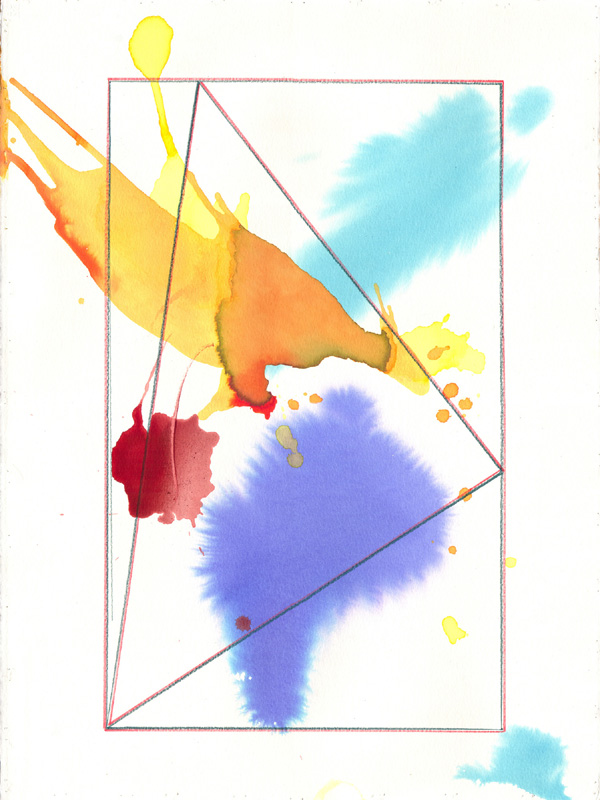
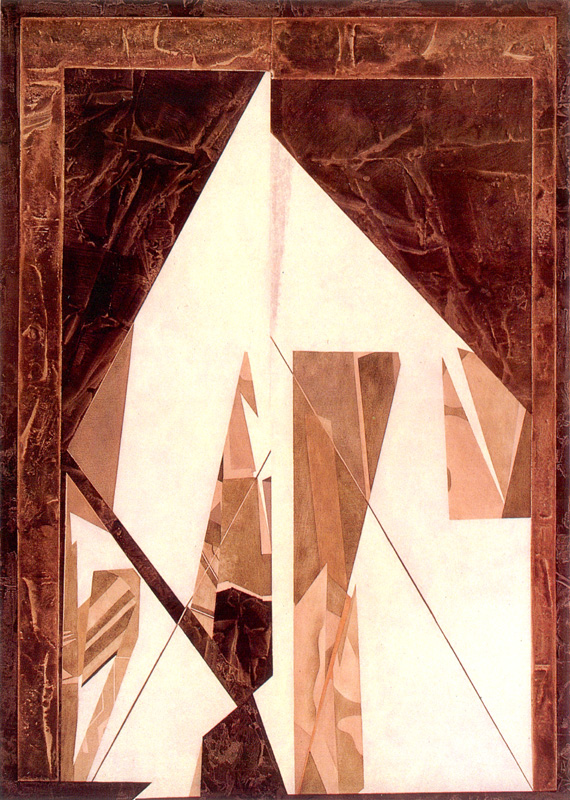
Ricardo Morín Triangulación 9: The Rhetoric of Threat 56 x 76 cm Watercolor and wax crayon on paper 2007
Ricardo Morín
November 2025
Oakland Park, Florida
Authoritarian language does not arise as excess or accident; it emerges as a deliberate strategy designed to reorganize public perception until difference appears suspect and complexity becomes intolerable. Within this framework, the phrase attributed to the Argentine president Javier Milei—“if an immigrant does not adapt to your culture, then it is not immigration but an invasion” (or https://youtube.com/shorts/EJ9RRC3pyTQ?si=xehJCUD8fIIpaqsw )—functions as a mechanism of extreme reduction. It replaces the historical reality of migration with a binary schema meant to provoke alarm. The leader is not describing a fact; he is manufacturing an enemy.
This formulation shifts the migratory experience into a warlike imaginary in which any form of difference is construed as aggression. Culture—treated as a static and homogeneous block—is framed as a besieged territory requiring defense, and plurality as a threat that can only be resolved through submission. Under this logic, the migrant ceases to be a person and becomes an abstraction crafted to justify coercive impulse.
The paradox is unmistakable: what is proclaimed as the defense of identity is, in truth, an effort to standardize it; what is presented as caution operates as an instrument of fear. Rather than analyze, the language disciplines. And in doing so, it exposes its deeper function: it shapes an emotional climate ready to accept measures that, under any other light, would be incompatible with democratic life.
This is the dimension that most clearly reveals the nature of the statement: it is not a commentary on immigration but a mechanism of affective control. By turning coexistence into compulsory assimilation, it introduces a dehumanized conception of the social world, one in which diversity ceases to be constitutive and becomes an obstacle to be neutralized. Ultimately, this discourse seeks not to understand reality but to govern it.
This essay is the first part of a trilogy that explores how human beings approach reality through certainty, doubt, and ambivalence. It begins with certainty—how the desire for stability drives thought and belief, even when what appears secure is already open to change. Though written from personal inquiry, its scope is broader: the question of certainty concerns not one life but the fragile conditions of shared reality. The trilogy continues with The Discipline of Doubt and concludes with When All We Know Is Borrowed.
Ricardo Morín, Bala Cynwyd, Pa. August 23, 2025
~
The Colors of Certainty
We live in an age unsettled by division. The subtleties of thought that once allowed us to pause, to weigh, and to distinguish are increasingly swept aside by the demand for immediate clarity. Everything is urged toward opposites: yes or no, ally or enemy, awake or asleep. The pace of public life, accelerated by technology and amplified by conflict, leaves little patience for nuance. Contradiction, which once signaled the restless work of an honest mind, is now treated as treachery. In this atmosphere, to admit complexity is to risk mistrust, and even the smallest hesitation is judged as weakness. We are asked, again and again, to define ourselves as though identity were a single stroke, not a layered drawing made across time.
Symbols flourish in such a climate while they reduce complexity into consumable images. Few have proven more enduring than the pill metaphors drawn from The Matrix film. When it appeared in 1999, the scene of choosing between a red pill and a blue pill was a cinematic device, which dramatized the tension between reality and illusion. Its influence grew gradually, as the film became a generational touchstone. Over the decades that followed, the pills slipped into online communities and political rhetoric only to harden into modes of thought that now shape how we imagine truth and the identity of belonging. To take the red pill became a declaration of awakening, access to hidden truths. To take the blue pill was to be mocked for complacency. Eventually the darker black pill emerged into both despair and fatalism embraced as destiny.
Once this logic takes hold, the world itself is reduced to a theater of absolutes. Disagreement becomes disloyalty, and belonging is measured not by shared life but by categorical allegiance. I have felt this even in conversations with people I have known for decades. In one such exchange, I remarked that I was appalled by Noam Chomsky’s recent habit, even in his nineties, of opposing Western hegemony over Russia as though that stance could excuse the war in Ukraine. Yet in another context, I expressed admiration for Chomsky’s earlier work on linguistic relevance in science four decades ago, which continues to illuminate how language shapes knowledge. To my interlocutor, these two statements seemed incompatible, as if they could not both be true. The expectation was that my judgment had to be seamless: either I rejected Chomsky entirely or endorsed him wholly.
Why must one justify such distinctions, as though every judgment were required to form a single line of allegiance? The contexts are not the same—one belongs to the 1980s, another to the present; one to the realm of linguistics, another to geopolitics. Yet in today’s climate, the demand for congruence is relentless. It reflects the pill logic that has seeped into our speech and habits of thought: one is either awake or asleep, aligned or opposed, consistent across every domain or untrustworthy in all.
That same craving for certainty also gave us Infowars—the radio podcast. Founded in 1999, the very year The Matrix was released, it became a commercial theater of the red pill metaphor. Infowars thrived on dramatizing crisis, telling its audience that elites, governments, or hidden forces manipulated events at every turn. What institutions explained as complexity, Infowars simplified into betrayal. The clarity it offered was intoxicating: good versus evil, freedom versus tyranny, awake versus deceived. It was not simply ideas being sold, but certainty itself—packaged with survival kits, supplements, and slogans. In seeking to liberate its audience from illusion, Infowars created a new one, offering not understanding but a permanent performance of awakening.
The narrowing of discourse is not only about politics and ideology, but it also extends to who is permitted to speak. I was reminded of this in a private exchange, where writing itself was dismissed as the work of an “armchair liberal” or a “limousine socialist.” According to this view, only those directly scarred by battle may speak of war, only those who have suffered prejudice firsthand may give voice to injustice, and to write as an observer is to mock the reality of struggle. It is a charge meant to discredit, as though the act of “fighting with a keyboard” were less real than hand combat in a bloodied field. Yet such suspicion denies what writing has always been: a means of bearing witness, of preserving memory, of shaping the conversation through which societies recognize themselves. The pen has never replaced experience, but it has always transformed it into something shareable and durable. To demand firsthand suffering as the sole qualification for speech is to reduce witness to autobiography and to strip dialogue of the breadth that comes when voices join from different vantage points.
Another difficulty lies in language itself. Writers who seek precision—who stretch language to its sharpest edge—often find that what emerges are metaphors. Even when grounded in substantiated terms, description requires figures of thought, images, and analogies that can never be wholly exact. The question is how precise language can ever be. Even the most brilliant minds struggle with definitions, because in their best formulations they remain presumptive theories. To acknowledge this is not to diminish language but to recognize that our dependence on tropes is not weakness but necessity. Story lines and metaphors are the bridges of comprehension, without which complexity would dissolve into noise. To lean on metaphor is not necessarily to abandon truth but to approach it by way of what can be shared.
What began as a film’s conceit has become a method of thinking, and in many ways a prison. The Matrix offered its audience a vision of awakening through choice, but our culture has taken that image and turned it into a grid of loyalties, where every stance is measured by whether one has swallowed the right capsule. Infowars amplified this posture; it dramatized the hunger for certainty until conspiracy became a substitute for thought. Suspicion of the writer’s position narrowed it further while it mocked reflection as inauthentic and demanded that speech bear the scars of direct experience before it could count as legitimate. And beneath it all lies the frailty of language itself: its inability to define with absolute precision, its reliance on metaphors that shape the very realities they describe.
To speak today of red pills, blue pills, or black pills is not only to reference a film or a subculture; it is to acknowledge the grip of a society that prefers binaries to dialogue, antagonism to complexity, performance to reflection. To resist that grip is to remember that thought is not a pill to be swallowed but a conversation to be carried, a conversation sustained in the fragile medium of language itself. However uncertain, however provisional, it is in that ongoing act of speaking and listening that culture remains alive—where friendship can endure, where witness can be honored, and where the truths no single color can contain still find their voice.
*
About the cover image:
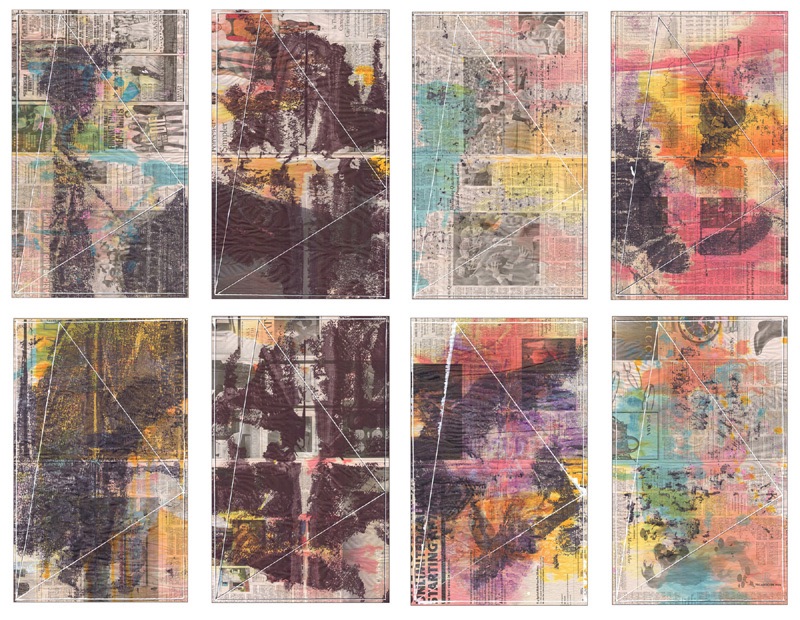
Newsprint Series Nº 9, 2006, by Ricardo Morín (47” × 74”): Translucent dyes, ink, white-out, and blotted oil paint on newsprint.
This image belongs to a series that transforms fragments of printed matter into layered fields of color and erasure, this piece speaks to the instability of certainty itself. The pigments veil and expose in turns, while the newsprint beneath reminds us that truth is mediated, provisional, and never free of interpretation. As with language in the essay, meaning emerges only through contrast, through what resists containment.
Annotated Bibliography
Cialdini, Robert B. Influence: The Psychology of Persuasion. New York: Harper Business, 2006. (A classic study in behavioral psychology showing how persuasion exploits binary choices and authority cues, useful for understanding the appeal of pill metaphors and the certainty promised by conspiracy movements.)
Lakoff, George, and Johnson, Mark: Metaphors We Live By. Chicago: University of Chicago Press, 2003. (A foundational text on metaphor in cognition and language, relevant to the essay’s argument that even the most precise use of language depends on tropes and figurative structures for human comprehension.)
Marwick, Alice, and Lewis, Rebecca: Media Manipulation and Disinformation Online. New York: Data & Society Research Institute, 2017. (This analytical report documents how conspiracy narratives spread through online ecosystems; it highlights the role of platforms in amplifying symbolic binaries such as “red pill” awakening.)
Pew Research Center: “Public Trust in Government: 1958–2023”. Washington: Pew Research Center, 2023. (Presents longitudinal data on the decay of institutional trust in the United States and offers a data-driven context for why audiences turned to alternative voices such as Infowars.)
Southern Poverty Law Center: “Male Supremacy”. Montgomery: SPLC, 2019. (A report classifying the Incel subculture and related groups within the larger “male supremacist ecosystem,” cited in connection to the black pill ideology and its links to violence.)
Sunstein, Cass R., and Vermeule, Adrian: Conspiracy Theories and Other Dangerous Ideas. New York: Simon & Schuster, 2014. (This book explores why conspiracy theories flourish and frames them as efforts to create certainty in moments of social disorientation. It is highly relevant to the discussion of Infowars as a commercial theater of the red pill metaphor.)
Taguieff, Pierre-André: The New Culture Wars. Paris: CNRS Éditions, 2020. (This book is a political-philosophical treatment of identity politics and binary antagonisms in Western democracies: it offers a perspective on how pill metaphors entered the broader theater of culture wars.)
Tversky, Amos, and Kahneman, Daniel: Judgment under Uncertainty: Heuristics and Biases. Cambridge: Cambridge University Press, 1982. (A landmark in cognitive science explaining why people reduce complex realities into simplified binaries; it anchors the essay’s meditation on the lure of certainty.)
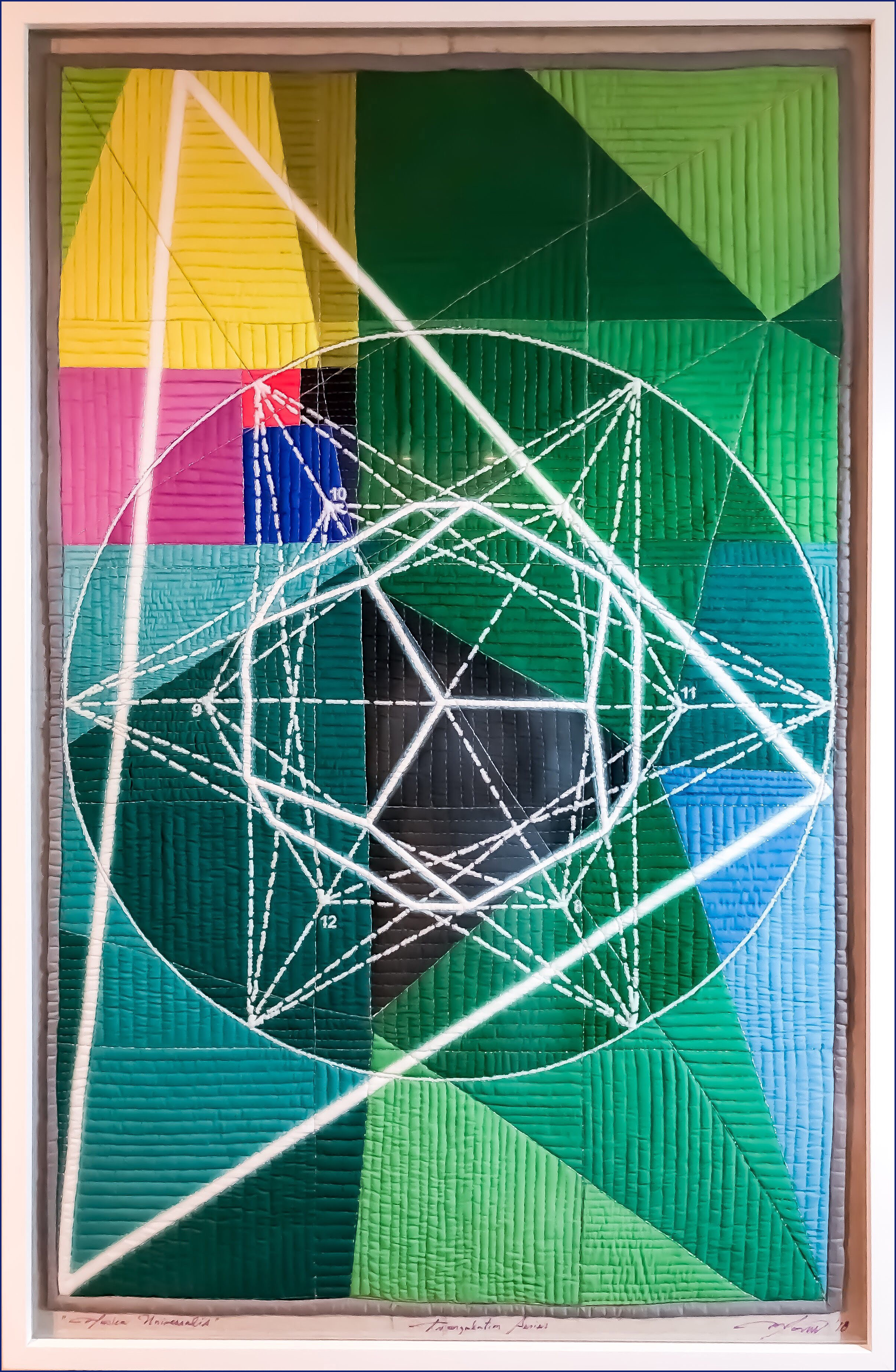
Ricardo Morín (Triangulation Series) Musica Universalis Silk quilt streched over linen 37″ x 60″ 2013-18
A geometrical construction of a dodecahedron within a Fibonacci composition, reinforced by a right-angle triangle: A meditation on the harmony of the universe, where mathematics and language converge yet never fully enclose reality.
Ricardo Morin, August 20, 2025
Abstract
This essay examines the interdependence of language and mathematics as the twin pillars of knowledge, each indispensable yet incomplete without the other. While mathematics secures precision and abstraction, language renders reasoning intelligible and shareable; together they approximate, but never fully capture, a reality richer than any formulation. The discussion situates artificial intelligence as a vivid case study of this condition. Marketed at premium cost yet marked by deficiencies in coherence, AI dramatizes what happens when mathematical power is privileged over linguistic rigor. Far from replacing human thought, such systems test our capacity to impose meaning, resist vagueness, and refine ideas. By weaving philosophical reflection with contemporary critique, the essay argues that both mathematics and language must be continually cultivated if knowledge is to progress. Their partnership does not close the gap between comprehension and reality; it keeps it open, ensuring that truth remains an unending pursuit.
Language, Mathematics, and the Price of Artificial Intelligence
Every society advances by refining its tools of thought. Two stand above all others: mathematics, which distills patterns with precision, and language, which gives form and meaning to reasoning. Neither is sufficient alone. To privilege one at the expense of the other is to weaken the very architecture of knowledge.
Artificial intelligence dramatizes both their promise and their limitations. The announcement of a $200 monthly fee for access to ChatGPT-5 is revealing. Marketed as a luxury service “for those who can afford it,” it underscores the widening gap between technological privilege and cultural necessity. Those with resources can fine-tune their productivity; those without are left behind. Yet even for the well-equipped, the question persists: what exactly is being purchased?
The machine dazzles with speed and scale, but its deficiencies are equally striking. Engineers may be virtuosos of algorithms, but grammar is not their instrument. The results are too often colloquial, vague, or lacking in rigor. To extract coherence, the user must not be a passive consumer but an editor—capable of clarifying, restructuring, and imposing meaning. The paradox is unmistakable: the tool marketed as liberation demands from its operator the very discipline it cannot supply.
This paradox reflects the larger truth about knowledge itself. Mathematics and language are both indispensable and both incomplete. Mathematics achieves abstraction but leaves its results inert unless language renders them intelligible and shareable. Language conveys thought but falters without the rigor that mathematics provides. What one secures, the other interprets.
Yet both are bound by a deeper condition: reality exceeds every formulation. Our theories—whether mathematical models or linguistic descriptions—are approximations shaped by the observer. Language cannot exhaust meaning; mathematics cannot capture finality. Knowledge is never absolute: it is a negotiation with a reality richer than any model or phrase.
Artificial intelligence lays bare this condition. It can automate structure but cannot provide wisdom; it can reproduce language but cannot guarantee meaning. Its true value lies not in replacing the thinker but in testing our capacity to resist vagueness, impose coherence, and refine thought. What is marketed as freedom may, in truth, demand greater vigilance.
To dismiss language and the humanities as secondary, or to imagine mathematics and computation as sufficient unto themselves, is to misunderstand their interdependence. These disciplines are not rivals but partners, each refining the other. AI magnifies both their strengths and their deficiencies; they remind us that progress depends on the continual refinement of both—mathematics to model reality, language to preserve its meaning.
The path of knowledge remains open-ended. Language and mathematics do not close the gap between our finite comprehension and the inexhaustible richness of reality; they keep it open. They allow us to approach truth without presuming to possess it. Artificial intelligence, as every tool of thought, shows us not the end of knowledge but its unending condition: a dialogue between what can be measured, what can be spoken, and what forever exceeds us.
*
Annotated Bibliography
Arendt, Hannah: The Life of the Mind. Vol. 1: Thinking. New York: Harcourt, Brace, Jovanovich, 1971. (Arendt examines the act of thinking and the limits of expression, which shows how thought requires language to become shareable while never able to exhaust reality. Her work reinforces the essay’s claim that reasoning without expression cannot advance knowledge.)
Bender, Emily M., and Koller, Alexander: “Climbing towards NLU: On Meaning, Form, and Understanding in the Age of Data.” Proceedings of ACL, 2020. (Bender and Koller argue that large language models process form without true understanding; this highlights the gulf between mathematical pattern recognition and linguistic meaning—it supports the essay’s caution that AI dazzles with form but falters in coherence.)
Chomsky, Noam: Language and Mind. 3rd ed. Cambridge: Cambridge University Press, 2006. (Chomsky explores the innate structures of language and their role in shaping cognition; this affirms that language conditions the possibility of thought while it still remains limited in capturing reality.)
Devlin, Keith: Introduction to Mathematical Thinking. Stanford: Keith Devlin, 2012. (Devlin explains how mathematical reasoning distills structure and pattern while acknowledging abstraction as approximation; this reinforces the idea that mathematics, as a safeguard of precision, cannot exhaust the world it models.)
Floridi, Luciano: The Fourth Revolution: How the Infosphere Is Reshaping Human Reality. Oxford: Oxford University Press, 2014. (Floridi situates digital technologies and AI within a broader history of self-understanding, which enriches the essay’s argument that mathematics and language—extended into computation—remain approximations of a reality beyond full control.)
Lakoff, George, and Núñez, Rafael: Where Mathematics Comes From: How the Embodied Mind Brings Mathematics into Being. New York: Basic Books, 2000. (Lakoff and Núñez argue that mathematics arises from metaphor and embodied cognition, which reveals how dependence on human interpretation and the affirmation that mathematical theories, as linguistic ones, remain bound to the observer.)
Mitchell, Melanie: Artificial Intelligence: A Guide for Thinking Humans. New York: Farrar, Straus and Giroux, 2019. (Mitchell provides a critical overview of AI’s capabilities and limits; it shows how the advancement of pattern recognition does not close fundamental gaps in understanding and parallels the essay’s critique of AI’s grammatical poverty.)
Polanyi, Michael: Personal Knowledge: Towards a Post-Critical Philosophy. Chicago: University of Chicago Press, 1962. (Polanyi emphasizes tacit knowledge and the need for articulation in validation; it echoes the view that mathematics and language refine understanding but never achieve closure.)
Snow, C. P.: The Two Cultures. Cambridge: Cambridge University Press, 1993 [1959]. (Snow diagnoses the divide between sciences and humanities; this undergirds the essay’s call to treat language and mathematics as complementary pillars of understanding.)
What follows does not simplify or announce itself. It moves inward—through observation, thought, and the tension between clarity and disappearance. The soliloquy keeps to its own course: neither performing nor explaining, but sustaining an interior gaze. To read it is not to be guided, but to remain with it—where thinking becomes presence, and language measures what endures.
Soliloquy
Once upon a time, there lived within the writer a creative energy—its force and passion for self-expression—that sustained him. It was not summoned; it simply endured. So arresting was this presence that he could not discipline it into routine or mold it into a pattern for physical endurance. He could not pause it for walks or for any activity not already part of the act of creation itself. He resorted to standing while writing, walking while reading, sleeping while thinking.
His experience was never an affliction to be named or cured, but a life to be lived on its own terms—a creative testament to the fullness of being, not a clinical footnote to someone else’s definition. Choosing not to be defined by it honored both its agency and his lifelong work. It was a condition to be understood alone, even if shared in writing—yet never in search of validation.
Within the boundaries of personal insight, it revealed itself as a form of devotional absorption, one that brought dignity even in moments of physical strain and aging.
His refusal of validation was not an opposition to authority, but a denial that any external pressure should exist.
Some said there was nothing unique in anyone, that all expression merely reflected what had been learned. The writer did not disagree, yet he knew there was more to being than what one received—even from experience itself. Perhaps no one was unique, but each voice was distinct—formed from the sum total of an existence that could not be equated. From a random mixture, an ineffable summation, something emerged: something irreplaceable and irreproducible—not because it exceeded others, but because it belonged only to the one who bore it.
He feared madness—not as spectacle, but as the slow drift of meaning into isolation. The force within him was real, yet not entirely satisfying unless it discovered truth—truth that resonated not only within his own logic but in the logic of others. How else could one know oneself if intelligence remained solitary? Without echo, thought became a sealed chamber: intricate, yes, but airless. He did not seek certainty; he sought correspondence. It was not solitude he feared, but becoming untranslatable.
Life now appeared transient, precarious—timeless in sensation, yet embedded in time. It moved furtively—through failings, disappointments, and sudden moments of radiant clarity. Nothing could be reproduced. But he had come to accept that—not because it was lost, but because even memory altered what it held. What repeated was not the moment, but the act of noticing—the deepening of attention. And so he did not live to preserve what was, but to remain present as it changed. There was no going back, only going further—more attentively, more awake.
Writing, silence, and the art of understanding in stillness
*
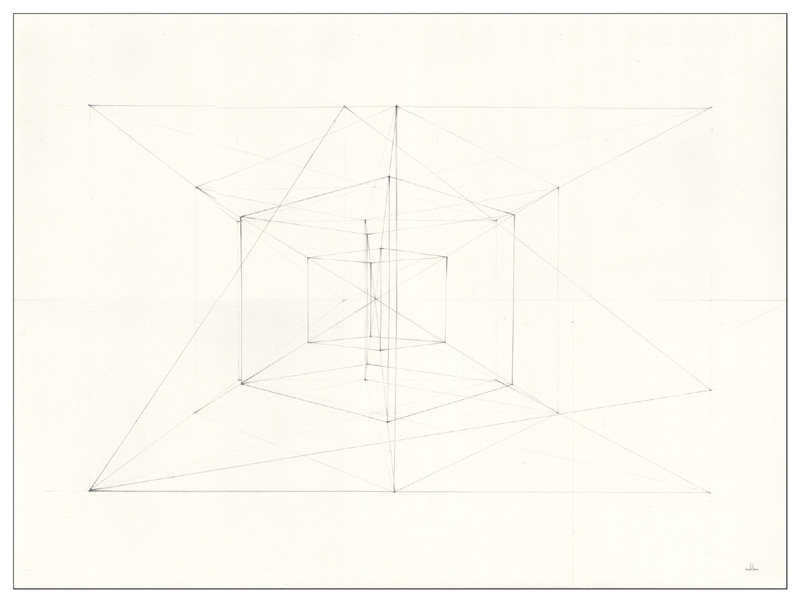
Ricardo Morín Triangulation 4 22″ x 30″ Graphite on paper 2006
To my sister Bonnie
*
Ricardo F. Morín
June 2025
Oakland Park, Florida
Author’s Note
This reflection was originally drafted before The Ethics of Perception, Part I, yet it belongs to the same inquiry into attention, understanding, and ethical relation.
There are moments when the truest form of intimacy is silence. At other times, it’s the quiet labor of reaching for the right word—however incomplete—that brings us closer. Expression, in this light, is not just a vehicle for communication, but an act of care.
To speak, to withhold, to write, to listen—each choice carries a particular weight. Intimacy lives in these gestures: not in grand declarations, but in the ethics of how we reveal ourselves—and how we receive what another dares to offer. What follows is not a theory, but a reflection on how intimacy appears in expression—and in its absence.
I. Prelude: in the pause between words
It’s hard to pinpoint the moment when something becomes intimate. It isn’t always a touch, or a glance, or even a confession. Sometimes, it’s just a pause—a shared pause—between one word and the next, when both people sense that something true is either about to be said or has just been said, without quite naming it.
Once, sitting face to face, I watched someone I cared for stare silently out the window. I said nothing either. There was no gesture, no disclosure, no clarifying words. And yet the silence didn’t feel empty—it felt full. In that stillness, something passed between us—not a message, not even an understanding, but a kind of permission:
To exist without explanation. To be present without having to perform.
That moment stayed with me not because it was dramatic, but because it was unplanned. I hadn’t expected it, and I couldn’t have recreated it. I only knew, afterward, that I had been in the presence of something rare: an intimacy that asked nothing more than to be.
And yet, not all intimacy is born in silence or in someone else’s presence. Some comes later, through writing—in that long interval between feeling and saying. Some is only possible thanks to the quiet distance that makes reflection possible.
II. What we mean when we say “intimate”
The word intimacy often evokes physical closeness: the realm of touch, proximity, lovers, secrets shared in the dark. But what if intimacy were less about closeness than about permission? The permission to be undefended. To move slowly. To be unclear—and still be trusted.
To be intimate with someone is not merely to be known, but to be seen— seen without the pressure to explain yourself quickly or justify what you feel. It’s an opening, and it’s also a risk: the risk of being misunderstood, and the deeper risk of being understood too well.
Some forms of intimacy unfold face to face. Others require distance. Some happen through dialogue. Others need a single voice, speaking on one’s own in a quiet room.
That’s where writing begins— not as performance, but as a long conversation, uninterrupted.
III. The varieties of intimacy
Intimacy shifts with context, with time, with the shape of the self we bring to another. It is not one thing— not just closeness, or tenderness, or vulnerability— but a set of ways we allow ourselves to be known, and sometimes, to know another.
There’s the intimacy of the body— perhaps the most visible and least understood. It belongs to touch, proximity, the instinctive draw toward another’s presence. But this form can deceive: physical closeness without emotional resonance is common— and easily faked. Yet when body and emotion align, there’s a wordless attunement: a hand resting on a shoulder for just the right amount of time; a breath falling into rhythm without intention.
Then there’s emotional intimacy: the slow courage to say what one feels— not just when it’s beautiful or convenient, but when it’s awkward, incomplete, or raw. This kind of intimacy isn’t given—it’s earned. It may take years, or a single night. Trust lives here—or breaks.
There’s also intellectual intimacy: what arises in conversation when ideas flow without anyone guarding their ground. It’s rare. Most social spaces reward speed, the need to shine, or the safety of politeness. But sometimes, with someone equally curious, thought expands in the presence of the other— not in agreement, but in response. There’s nothing to prove— only the pleasure of discovery. That’s intellectual intimacy. It creates a different kind of closeness— not of feeling, but of perception.
Stranger still is narrative intimacy— the kind that forms not between two people in the same room, but between the one who writes and the one who reads, separated by silence and time. It isn’t immediate— but it isn’t less real. A voice emerges from the page and seems to speak directly to you, as if it knew the contours of your mind. You feel understood—without being seen. You may never meet the person who wrote those words, but something in you shifts. You are no longer alone.
These are not rigid categories. They overlap, interrupt, evoke one another. One may deepen another. Physical presence can create emotional safety. Intellectual closeness can open into unexpected tenderness. And still, each has its own rhythm, its own grammar— and its own risks.
In that complexity, intimacy ceases to be a condition. It becomes a practice: something we learn, lose, revise, and sometimes write when no other form is possible.
IV. Writing as intimacy with oneself (and with another)
Writing, too, is a kind of intimacy— not only with others, but with oneself. Especially when it’s honest— when what’s written is not just clever or correct, but true. That kind of writing doesn’t flatter. It doesn’t argue. It reveals.
We write to bring something forth— not just for an audience, but to hear ourselves think, to see what we didn’t yet know we felt. In writing, we become witnesses to our own consciousness— both its lucidity and its evasions.
We follow a sentence not only for its logic, but for the feeling it carries. And when that feeling falters, we know we’ve lost the thread.
So we begin again, and again— trying not just to explain, but to say something that feels just.
In that sense, writing is an ethical act. It demands attention. It requires patience. It invites us to inhabit our own experience with precision— even when that experience is fragmented or unresolved.
And if we are lucky— if we are honest— something in that effort will reach someone else. Not to impress. Not to convince. But to accompany.
V. When intimacy fails or is refused
Sometimes you reach out—carefully, sincerely—and receive silence, indifference, or a response so misaligned it makes you feel naïve for having tried. Other times, the failure is subtler: a conversation that scatters just as something real begins to take shape—or a listener who hears your words, but not your meaning.
Those moments stay with us. Not because they’re dramatic, but because they remind us how precarious intimacy can be. It can’t be forced—just as humility can’t. Both require a quiet letting go—a willingness to offer something without knowing how it will be received. We can prepare the ground, make the gesture, risk the truth—but the rest depends on the other: their timing, their capacity, their willingness to meet us there.
There’s also the experience of being misunderstood—not just in fact, but in essence. You try to say something that matters, and the other person responds to what they think you said—or to a version of you that never was. It’s a blow— that mismatch between what you tried to share and what actually landed. The desire for intimacy becomes exposure without connection—a wound instead of a bridge.
Sometimes we avoid intimacy not because we don’t want it, but because we fear what it might cost. We’ve been made to feel clumsy—for caring too much, or for being too visible. Or we’ve shared something intimate, only to have it treated lightly—or analyzed without feeling. After that, we grow cautious. We speak less—or in fragments—or not at all.
It’s in the wake of such rejections—large or small—that writing ceases to be mere expression. It becomes repair. Writing allows us to recover what was lost in the moment— to name what never reached its destination, to finish the thought no one waited for, to say it again—this time without interruption, without assumptions, without fear.
And while writing cannot undo the failure of a shared moment, it can offer something else: coherence. A record. A form of truth that endures—even if it wasn’t heard.
In this way, writing becomes a quiet act of insistence—not against the world, but on behalf of the self. It’s a way of saying: What I tried to share still matters—even if it wasn’t received.
VI. The gesture that remains
In the end, intimacy is not a state but a gesture— repeated again and again— toward understanding, toward presence, toward a shared sense that may arrive… or may not.
Sometimes that gesture is a word spoken at the right moment. Sometimes it’s a silence held just long enough for the other to speak. And sometimes it’s the act of writing—solitary, patient, unfinished— offered not to a crowd, but to a single imagined reader who, one day, might need what you are now trying to say.
Writing, at its core, is a form of listening. Not only to others, but to the self that doesn’t rush, doesn’t perform, doesn’t need to persuade.
To the self that waits— that wants to be known not by what it manages to say in quick response, but by what it keeps trying to say with care.
That’s why I return to the page: not because it guarantees connection, but because it keeps the door open. Because in a world that demands speed, certainty, and charm, writing makes room for something slower and more faithful: the long, unfinished gesture of trying to reach someone— perhaps even oneself— with something resonant.
And when intimacy happens—on the page or in life— it’s never because we found the perfect words. It’s because someone stayed. Someone listened. Someone let the moment open—without rushing to close it.
That’s what I’m doing now: writing not to end something, but to leave it open— so that something of greater consequence might enter.
 Observations On Perception