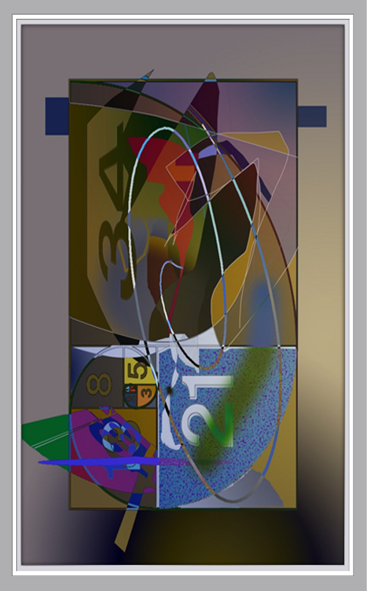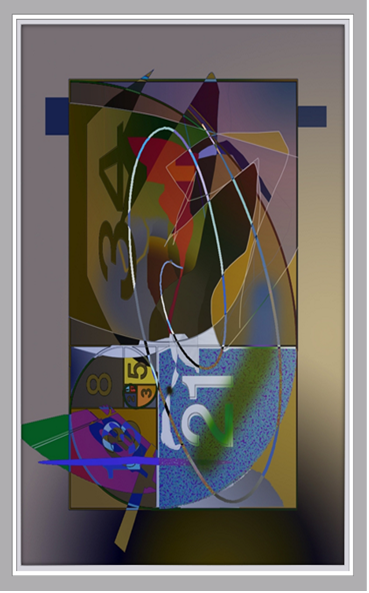
Ricardo F. Morín Viability Watercolor frottage and white corrector on drafting vellum 20″x30″ 2005
*
The question is often posed as to why certain corrupt regimes become objects of political action while others, no less compromised, do not. At first glance, this appears to demand a comparative moral explanation. In fact, it does not. The difficulty lies not in the absence of information, but in the assumption that such actions are guided by a coherent and generalizable system of principles.
What can be observed is not the application of a principle across cases, but decisions taken one case at a time. Political action does not follow a rule that can be applied in advance to different regimes. For that reason, comparisons between Venezuela, Saudi Arabia, Russia, or Argentina obscure more than they clarify. They assume a standard of decision-making that is not, in practice, a guiding action.
The actions examined here are those taken by Donald Trump in his capacity as a political actor. His name is introduced not to explain behavior through personality or intention, but to locate responsibility. The analysis proceeds from observable decisions and the circumstances in which those decisions were taken, rather than from suppositions about character, motive, or disposition.
The more relevant question is therefore not why some regimes are confronted and others ignored, but under what circumstances a country presents few obstacles to action, and which immediate interests align to make that action feasible. This reframing shifts the analysis away from moral judgment and toward observable circumstances.
Understood in these terms, the issue admits a response—not as a rule, but as an account of how decisions are made in specific cases. There is no way to infer, from the level of corruption alone, whether action will occur. There is, however, a way to explain why, in particular circumstances, action proceeds.
In the Venezuelan case, several conditions converge.
First, immediate external resistance is limited. Venezuela lacks allies willing to impose material, military, or economic consequences in response to pressure or limited intervention.
Second, state institutions do not act in a coordinated manner. Administrative agencies, security forces, and political authorities do not reliably operate under a single command, reducing the ability to mount a unified response and making external action easier to pursue.
Third, Venezuela can be publicly described as an exceptional case—marked by collapse, criminal conduct, and administrative failure—which allows actions to be presented to domestic audiences without invoking a general principle that would need to apply elsewhere.
Fourth, economic interests operate through short-term negotiation rather than long-term alignment. Venezuelan oil, under sanctions and administrative disorder, can be folded into ad hoc bargaining without requiring stable commitments or enduring partnerships.
Finally, pressure on Venezuela does not trigger immediate disruption to major markets or strategic balances. Unlike cases involving Saudi Arabia or Russia, action does not risk cascading economic or military responses.
None of these factors amounts to a moral explanation or a guiding doctrine. Taken together, they describe when an administration acts through foreign policy: not because corruption is greater, but because resistance is limited, interests converge quickly, and a domestic account of the action can be sustained—conditions absent in many cases of equally severe corruption.
This does not explain the world. It explains a decision.
“Geometric Allegory,” digital painting 2023 by Ricardo Morin (American visual artist born in Venezuela–1954)
*
To my parents
*
Acknowledgements
~
I wish to acknowledge Billy Bussell Thompson for his meticulous editorial guidance. His feedback sharpened the structure, precision, and internal discipline of this work.
Preface
“Unmasking Disappointment” follows a line of inquiry present throughout my work: the examination of identity, memory, and the relations that emerge when life unfolds across cultural boundaries. Although I have lived outside Venezuela for more than five decades and became a naturalized citizen of the United States twenty-four years ago, my relationship to the country of my birth remains a persistent point of reference. The distance between these conditions—belonging and removal—forms the backdrop against which this narrative takes shape.
This work belongs to a broader autobiographical project that gathers experiences, observations, and questions accumulated over time. While personal in origin, it does not proceed as confession or memoir. Its method is sequential rather than expressive: individual exposure is situated within historical forces and political structures that have shaped Venezuelan life across generations. The intention is not to reconcile these tensions, but to render them visible through recurrence, record, and consequence.
“Series I” introduces the first thematic clusters of this inquiry. The episodes assembled here do not advance a single thesis, nor do they aim at resolution. They trace points of friction where private experience intersects with public power, and where political narratives exert pressure on ordinary life. Across these encounters, patterns emerge—not as abstractions, but as conditions that alter how authority is exercised, how responsibility is displaced, and how agency is constrained.
The chapters that follow examine the pressures produced by systemic inequality and trace contemporary Venezuelan conditions back to their historical formation. Autocratic rule and popular consent appear not as opposing forces, but as elements that increasingly entangle and weaken one another. Within this entanglement, truth does not disappear; it becomes less evenly accessible and more readily displaced by narrative.
When public discourse is shaped by propaganda and misinformation, authoritarian structures gain resilience. Recovering truth under such conditions does not resolve political conflict, but it clarifies the limits within which political life operates. Agency emerges not as an ideal, but as a condition sustained—or undermined—through practice and consequence.
This work does not propose deterministic explanations or simple remedies. It proceeds by accumulation, drawing attention to patterns that persist despite changing circumstances. What it asks of the reader is not agreement, but attention: to evidence, to sequence, and to the conditions under which political freedom may be meaningfully exercised.
Writing from Bala Cynwyd, Pennsylvania, and Fort Lauderdale, Florida, I remain aware of the distance between the environments in which this work is composed and the conditions it examines. That distance does not confer authority; it imposes responsibility.
Ricardo Federico Morín Bala Cynwyd, Pennsylvania, January 21, 2025
*
Table of Contents
*
Chapter I —A Written Language.
Chapter II —Our Recklessness.
Chapter III —Point of View.
Chapter IV —A Dialogue.
Chapter V —Abstract.
Chapter VI —Chronicles of Hugo Chávez (§§ I-XVII).
Chapter VII —The Allegorical Mode.
Chapter VIII —The Ideal Government and the Power of Virtue.
Chapter IX — First Sign: On Political and Social Resentment.
Chapter X — Second Sign: The Solid Pillar of Power; The Military Forces.
Chapter XI — Third Sign: The Asymmetry of Political Parties.
Chapter XII — Fourth Sign: Autocracy (§§ 1-9);Venezuela (§§ 10-23); The Asymmetry of Sanctions (§§ 24-32).
Chapter XIII – Fifth Sign: The Pawned Republic.
Chapter XIV — First Issue: Partisanship, Non-partisanship, and Antipartisanship.
Chapter XV — Second Issue: On Partial Truths and Repressive Anarchy.
Chapter XVI — Third Issue: The Clarion of Democracy.
Chapter XVII — Fourth Issue: On Human Rights.
Chapter XVIII — Fifth Issue: On the Nature of Violence.
Chapter XIX — Sixth Issue: On the Persistence of Injustice.
Chapter XX — The Ultimate Issue: Constitutional Form and Its Hollowing.
Appendix: Author’s Note, Prefatory Note. A). Venezuelan Constitutions [1811-1999], Branches, and Departments of Government. B) Evolution of Political Parties: 1840-2024. C) Laws Enacted by the Asamblea Nacional. D) Clarificatory Note on Domestic Coercion, Foreign Presence, and Intervention.
Bibliography.
~
*
Chapter I
*
A Written Language
~
Stability is often sought where it cannot be secured. Experience has shown this repeatedly. Even careful intentions tend to draw one into uncertain terrain, where understanding lags behind consequence. At the desk, as late-afternoon light reaches the page, writing assumes a practical function: it becomes a means of ordering what would otherwise remain unsettled. The act does not resolve vulnerability, but it records it. Whether time alters such conditions remains uncertain; what can be done is to give them form.
What follows moves from the conditions of writing to the conditions it must confront.
*
Chapter II
*
Our Recklessness
~
“Our painful struggle to deal with the politics of climate change is surely also a product of the strange standoff between science and political thinking.” — Hannah Arendt: The Human Condition: Being and Time [1958], Kindle Book, 159.
*
1
The COVID pandemic and the 2023 Canadian wildfires, among other recent events, have made visible conditions that were already in place. These events did not introduce new vulnerabilities as much as they revealed the extent to which existing systems depend on economic incentives and political habits that privilege extraction over preservation. During the period when smoke from the fires reached the northeastern United States, daylight in parts of Pennsylvania was visibly altered and registered the reach of events unfolding at a considerable distance. Such occurrences do not stand apart from prevailing economic arrangements; they coincide with a model that treats natural conditions as commodities and absorbs their degradation as an external cost.
2
The fires in California in 2025, like those that spread across Canada in 2023, do not present themselves as isolated occurrences. They form part of a sequence shaped by environmental neglect, political inertia, and sustained industrial expansion. Conditions such as desertification, resource scarcity, and population displacement no longer appear solely as projected outcomes; they are increasingly registered as present circumstances. Scientific assessments indicate that these patterns are likely to intensify in the absence of structural change. [1][2][3] What is brought into view, over time, is not a singular failure but a system that continues to operate according to priorities that favor immediate yield over long-term continuity.
3
The question of balance does not arise solely as a technical problem. It emerges within a moral and political field shaped by prevailing economic assumptions. The treatment of nature—and more recently of artificial intelligence—as a commodity reflects a trajectory in which matters of shared survival are increasingly translated into market terms. Under such conditions, considerations that once belonged to collective responsibility are recast as variables within systems of calculation.
4
Such patterns place increasing strain on conditions necessary for collective survival. Responses to these conditions vary and range from indifference to urgency, though urgency does not invariably produce clarity. What becomes apparent, across repeated instances, is a tendency for crisis to recur without sustained adjustment. This recurrence parallels the political histories examined in the chapters that follow, where warning and consequence frequently fail to align.
Conversations with my editor, Billy Bussell Thompson, have accompanied the development of this work over time. His attention to research method and to the structure of argument has contributed to the clarification of its scope and direction. These exchanges, often conducted at a distance and without ceremony, formed part of the process through which the present narrative took shape. After an extended period of uncertainty regarding how to approach the subject of Hugo Chávez, the contours of Unmasking Disappointment gradually emerged.
2
Hugo Chávez entered national political life as a leader whose authority was exercised in opposition to political liberalism.[1] While his public discourse emphasized alignment with the poor, the material benefits of power accumulated within a narrow circle. [2] Over the course of his tenure, democratic institutions in Venezuela experienced progressive weakening, and governance assumed increasingly authoritarian forms. These developments become more legible when situated within the historical record and examined through documented practice rather than rhetorical claim.
3
The events that followed Chávez’s rule are marked by disorder and unresolved consequence. Their persistence draws attention to questions of historical accountability and collective responsibility that remain unsettled. Examining the record of autocratic leadership—its ambitions as well as its failures—provides a means of approaching the problem of justice in Venezuela without presuming resolution. Through this examination, enduring tensions come into view as conditions to be understood rather than conclusions to be reached.
~
Endnotes—Chapter III
[1]The term caudillo originates in Spanish and has historically been used to describe a leader who exercises concentrated political and military authority. In the Venezuelan context, the term carries particular resonance and refers to figures associated with the post-independence period of the nineteenth century. Such leaders tended to consolidate power through a combination of personal authority, allegiance from armed factions, and the promise—whether substantive or rhetorical—of maintaining order under conditions of instability. While some were regarded as defenders of local or national causes, others became associated with practices that facilitated authoritarian governance and weakened institutional structures. The concept of the caudillo continues to function within Venezuelan political culture as a descriptive category applied to leadership forms that combine popular support with concentrated power.
A series of conversations between BBT and the author accompanied the examination of Venezuelan politics and history developed in this section. These exchanges formed a transitional space in which reflection gave way to historical inquiry, allowing questions of interpretation, responsibility, and record to be addressed through dialogue rather than exposition.
1
—RFM: “My writing has been concerned with the evolution of Venezuela’s political landscape, with particular attention to the emergence of authoritarian forms of rule. The focus has been less on abstract doctrine than on how specific policies translated into everyday conditions for ordinary Venezuelans.”
2
—BBT: “Examining how authoritarian leadership shapes political conditions is necessary, though the term itself is often contested and applied unevenly. In Chávez’s case, the use of propaganda was not exceptional in form, but it was consistently employed as an instrument of governance. How did official narratives during his tenure circulate, and what effects did they have on public perception over time?”
3
—RFM: “Propaganda is not unique to Chávez; it functions as a recurring instrument across political systems. In Venezuela, official media regularly attributed economic hardship to external interference rather than to domestic policy decisions. At the same time, material conditions deteriorated, with shortages emerging from economic mismanagement and later compounded by external restrictions. Opposition groups also circulated counter-narratives, which in turn elicited responses from the State. These exchanges unfolded within a historical context shaped by civil conflict and Cold War alignments, and produced a fragmented informational environment. Within that environment, responsibility for economic decline was frequently displaced, while public perception was managed through repetition rather than resolution. The social and economic reforms invoked in justification did not, over time, yield the reductions in poverty and inequality that had been promised.”
4
—BBT: “To render Venezuela’s political conditions with some accuracy, attention must be given to how ordinary citizens encountered these dynamics in daily life. How were such conditions navigated in practice, particularly where political discourse intersected with immediate economic necessity?”
5
—RFM: “The economic collapse that followed the decline of the oil-based model intensified poverty and placed sustained pressure on public services. Examined in sequence, this period shows how colonial legacies and authoritarian practices converged in the formation of Chavismo. Episodes such as the 1989 riots known as El Caracazo registered widespread disaffection with established parties and democratic institutions. Under such conditions, the demands of securing basic necessities frequently outweighed engagement with abstract political principles.”
6
—BBT: “Clarity in narrative depends in part on recognizing the assumptions that guide interpretation. When these assumptions are made explicit and examined, the account becomes less directive and more accessible, allowing readers to follow the record without being steered toward a predetermined position.”
7
—RFM: “No narrative proceeds without interpretation, including this one. Writing provides a means of approaching Venezuela’s history—its colonial formation, episodes of authoritarian rule, and periods of political disruption—without foreclosing alternative readings. A coherent account need not be exhaustive; it remains open insofar as it attends to implication and consequence rather than resolution.”
8
—BBT: “The exchange itself underscores the importance of careful narration when approaching Venezuela’s political and social record. Attending to multiple viewpoints does not resolve complexity, but it allows a more coherent account to emerge without reducing that history to a single explanatory frame.”
The exchange marked a transition from reflective inquiry to historical record.
~
*
Chapter V
*
Abstract
*
1
This section examines the sequence through which the political project articulated under Hugo Chávez assumed autocratic form. Rather than attributing this outcome to a single cause, the inquiry proceeds by tracing how leadership decisions unfolded within a convergence of historical conditions, institutional arrangements, economic pressures, and geopolitical alignments. The account does not begin from conclusion, but from record.
2 Attention remains on how authority was exercised and how its effects registered within Venezuelan society. Historical circumstance, institutional design, and external influence are examined not to simplify the record, but to make visible the interdependencies through which power consolidated over time. What emerges is not an explanatory thesis, but a configuration whose coherence can be assessed only through sustained attention to sequence and consequence.
Venezuela’s transition and Ukraine’s survival now constitute a single test: whether power can be constrained without illusion, and whether the United States can act coherently even when its president cannot perceive coherence himself.
This text does not argue for a policy or predict an outcome. It marks the threshold at which coherence ceases to be discretionary and becomes a condition of survival.
The United States cannot act in one theater in a way that invalidates the principles it claims to defend in another. If sovereignty, territorial integrity, institutional continuity, and legal accountability are treated as binding in Ukraine, they cannot become flexible, provisional, or strategically inconvenient in Venezuela. And the reverse must also hold: if those principles are treated as binding in Venezuela, they cannot be relaxed, reinterpreted, or selectively applied in Ukraine. Once that line is crossed in either direction, coherence collapses—not only rhetorically, but structurally. Power ceases to stabilize outcomes and instead begins to manage decay.
This is not a moral claim; it is a functional one. Modern power does not fail because it lacks force, but because it loses internal consistency. When the same instruments—sanctions, indictments, military pressure, diplomatic recognition—are applied according to circumstance rather than principle, they no longer constrain adversaries. They instruct them. Russia and China do not need to prevail militarily if they can demonstrate that legality itself is selective, contingent, and subject to reinterpretation by whoever holds advantage in the moment.
For this reason, no transition can rest on personalization. Trust between leaders is not a substitute for verification, nor can rapport replace institutions. This vulnerability is well known in personality-driven diplomacy and has been particularly visible under Donald Trump in his repeated misreading of Vladimir Putin. Yet the deeper danger is not psychological; it is procedural. Policy that depends on who speaks to whom cannot survive stress. Only policy that remains legible when personalities are removed can endure.
Nor can outcomes be declared before institutions exist to carry them. Territorial control without civilian authority is not stability. Elections conducted without enforceable security guarantees are not legitimacy. Resource access without escrow, audit, and legal review is not recovery, but extraction under a different name. When the United States accepts results without structures, it postpones collapse rather than preventing it.
Equally corrosive is legal improvisation. Law applied after action—indictments justified retroactively, sanctions reshaped to accommodate faits accomplis—does not constrain power; it performs it. Once legality becomes explanatory rather than directive, it loses its disciplining force. Adversaries learn that rules are narrative instruments, not boundaries.
Finally, there can be no tolerance for proxy preservation. A transition that leaves intact militias, shadow financiers, or coercive intermediaries is not a transition at all. It is a redistribution of risk that guarantees future rupture. External backers may be delayed, constrained, or audited, but they cannot be placated through ambiguity without undermining the entire process.
The test is stark and unforgiving. If an action taken in either Venezuela or Ukraine could not be defended, word for word, if taken in the other—or if a compromise tolerated in one would be condemned if replicated in the other—then the axiom has already been broken.
What must therefore remain true, in both places at once, is this: power must submit to the same standard it invokes—without exception, without personalization, and without retreat into expediency disguised as realism.
*
Authority Where Legitimacy Has Not Yet Converged
*
This section does not assess democratic legitimacy or political merit. It observes how authority is presently constituted and enforced when coherence is under stress.
A question posed during a press conference—regarding the opposition coalition led by María Corina Machado and the electoral victory of Edmundo González Urrutia—elicited a dismissive response from President Donald Trump. Asked why a transitional leadership would not center on that coalition, he replied that there was “no respect for her,” implying an absence of authority within the country.
Taken at face value, the remark appears personal. Read diagnostically, it exposes a more consequential distinction: legitimacy does not presently translate into authority inside Venezuela. The same distinction—between legitimacy and enforceable authority—has shaped Ukraine’s resistance to Russian invasion, where legitimacy was established internally but had to be defended materially against external aggression.
Electoral victory, international recognition, and moral credibility confer legitimacy. They do not, by themselves, confer enforceable power. Authority, as it exists on the ground, flows from the capacity to compel compliance—whether through control of coercive institutions, resource chokepoints, or the operational machinery of the state. In Ukraine, that authority is exercised defensively to preserve an already legitimate sovereign order against external aggression. In Venezuela, it persists independently of electoral outcome, sustained by institutions and mechanisms detached from legitimacy.
In this sense, the question raised by Trump’s remark is not whether Machado’s coalition is legitimate, but what presently lends authority within the country—and who is capable of enforcing decisions, preventing fragmentation, or compelling compliance. The answer is neither rhetorical nor normative. It is about how authority is currently constituted and exercised under present conditions.
Recent commentary surrounding U.S. engagement with Venezuelan actors has made this distinction operational rather than abstract. The marginalization of María Corina Machado has not turned on questions of democratic legitimacy, electoral mandate, or international recognition. It has turned on her unwillingness to participate in transactional arrangements with the existing technocratic and financial strata that currently exercise control within the State. In contrast, figures such as the Vice President Delcy Rodríguez are treated as viable interlocutors precisely because they command enforceable authority through continuity with those mechanisms—coercive, financial, and administrative—that persist independent of legitimacy. Criminality, in this logic, is not disqualifying. It is evidence of control. What is being selected for is not moral credibility, but negotiability under pressure.
This distinction matters because transitions that confuse legitimacy with authority tend to collapse into disorder or entrenchment. Authority negotiated without legitimacy produces repression. Legitimacy asserted without authority produces paralysis. Durable transition requires that the two converge—but they do not begin from the same place, nor do they converge through the same means.
In Ukraine, legitimacy and authority are aligned but strained by external aggression; in Venezuela, authority persists in the absence of legitimacy. Treating these conditions as morally or procedurally equivalent obscures the obligations they impose. When support is conditioned more heavily where legitimacy is intact than where it is absent, coherence gives way to ethical imbalance.
Trump’s comment does not clarify U.S. strategy. It does, however, expose the fault line along which policy now risks fracturing: whether authority is assessed and transformed in relation to legitimacy, or accommodated independently of it in the name of order. The choice is not neutral. It determines whether power reinforces or undermines the principles it invokes.
The distinction between legitimacy and authority does not negate the requirement of coherence. It sharpens it. When coherence is abandoned selectively, collapse is no longer an accident of transition but a consequence of duplicity.
There are lives that seem to recapitulate the destiny of a nation, as if history, in search of renewal, gathers its scattered promises into one mortal form. María Corina Machado stands within that rare order of beings in whom blood, memory, and conviction converge—not as privilege, but as burden. She was not merely born into Venezuela’s republican lineage; she was summoned by it. The call that first thundered through the assembly halls of Caracas in 1811—when its independence was declared and its first republican constitution conceived—still vibrates beneath her name.
Her ancestry reaches into the first pulse of the Republic. From the Rodríguez del Toros, who set their signatures beneath the Act of Independence, to the Zuloaga engineers who electrified a nation, hers is a genealogy woven into the civic arteries of Venezuela. It is a lineage that chose service over title, innovation over indulgence, and fidelity to the law over the ease of silence. In that tradition, the notion of freedom is not an abstraction—it is inheritance, obligation, and vocation. It is the thread that binds a people to their conscience.
When the institutions that once defined Venezuela began to crumble, when legality became theater and words lost their weight, Machado stepped into the void with the gravity of someone aware that retreat was impossible. Her defiance was not theatrical—it was ancestral. Every gesture, every refusal to submit, bore the quiet authority of history fulfilled. She spoke as one who understood that to preserve dignity in times of humiliation is the purest form of resistance. There is, in her manner of being, that rare synthesis of intellect and steadfastness that defines the moral personality of a nation at its best—lucid, unbending, and human.
Yet today, her adversary is not one but many. Before her stands not only a narco-state that has hollowed out Venezuela’s sovereignty, but a fractured opposition—an archipelago of parties and personalities bound less by principle than by convenience. Factionalized, transient, and transactional, these groups have transformed plurality into pretext and compromise into commerce. Many have learned to live off the dictatorship they denounce. They negotiate freedoms for themselves even as the country sinks deeper into captivity. Against that duplicity, Machado’s presence has become a moral indictment: her clarity exposes their corruption; her endurance, their opportunism.
Around this internal disarray, the world circles in watchful appetite. Venezuela’s vast natural wealth—its oil, gas, gold, and rare minerals—has become the prize of criminal networks and multinational investors alike. Russia, China, Iran, and the United States, each cloaked in rhetoric of salvation, compete not to free the country but to secure a share of its exhaustion. Behind the diplomatic masks of assistance lies the same calculation: that chaos can be profitable, that a nation weakened by hunger and fear can be managed more easily than one restored to its sovereignty. This, for twenty-five years, has been Venezuela’s condition—a field of material, moral, and human extraction; its people scattered, its institutions despoiled, its memory pawned to the highest bidder.
In such a landscape, María Corina Machado stands as both witness and counterpoint. Her struggle has never been for power but for coherence—for the recovery of a civic language capable of naming what has been lost. To speak of law, truth, and justice amid pervasive corruption is to resurrect meaning itself. Her voice has become the thread that gathers the nation’s scattered conscience, reminding Venezuelans that dignity cannot be negotiated, and that no foreign savior will restore what only citizens can redeem.
To see her walk through the streets, welcomed not by luxury but by faith, is to glimpse a country remembering itself. She has become, willingly or not, the mirror through which Venezuelans rediscover their own moral architecture: decency, courage, compassion, and an unextinguished appetite for truth. In her endurance, the long-interrupted dialogue between people and Republic resumes.
The Nobel Peace Prize, bestowed upon her, is therefore not a coronation but a recognition—an acknowledgment that her struggle transcends the moment and becomes emblematic of the human spirit’s refusal to yield to despair. In awarding her, the world affirms that Venezuela’s republican dream—born in fire, preserved in conscience—still breathes through one of its daughters. It is the dream of a nation that believes peace must be built not upon submission, but upon moral clarity; not upon silence, but upon the unwavering voice of the citizen.
What María Corina Machado represents is more than opposition to tyranny. She is the embodiment of continuity—of the idea that a Republic, like a soul, survives so long as there remains one person willing to bear its weight with dignity. Her ascent is not accidental—it is the return of an ancient promise. In her composure, Venezuela recognizes itself once more: wounded yet unbroken, luminous in defiance, faithful to the destiny inscribed in its first act of freedom.
Although the awarding of the Nobel Peace Prize (2025) to María Corina Machado brings joy and honor to those who still believe in the possibility of a democratic Venezuela, it also reveals a far more complex reality; one that demands reflection.
The international press has yet to grasp the dream surrounding the supposed liberation of Venezuela from a narco-state. Venezuelans continue to wait indefinitely for liberation. Beneath this hope lies a deeper bondage: the nation’s territory continues to be bound to multinational interests (Chinese, Russian, American, and others) driven not by ideology but by competition between investors and criminal networks. For all of them, a prolonged conflict in Venezuela is convenient; it serves as a bridge to a regional metamorphosis and justifies the expropriation of the natural resources of the country; it aims at consolidating hemispheric dominance by the multinational interests. The situation in Venezuela is therefore not only political but also structural; it is an experiment in which sovereignty is traded for access and resistance itself becomes a form of captivity.
The crisis in Venezuela reveals a moral conflict in modern politics: how suffering can both be exploited and perpetuated when comprehension yields to fantasy. The dream of liberation has become one of the nation’s most persistent fantasies. Behind the language of emancipation lies a silent convergence of global interests; each one sustains the very conflict it claims to oppose. In Venezuela, disorder legitimizes intervention and chaos provides the pretext for extraction. In this sense, Venezuela is not merely a nation in distress but also a stage upon which the grammar of domination continues to be enacted through the vocabulary of deliverance
The challenge is no longer to imagine freedom as an external rescue but to comprehend how dependence disguises itself as salvation. Only comprehension (the act of seeing beyond grievance and beyond consolation) can pierce the veil of liberation and restore meaning to the very idea of freedom.
Cover design for the essay “The Politics of Erasure: Authoritarianism and Spectacle.” The composite image juxtaposes surveillance, militarization, propaganda, and mass spectacle to underscore how authoritarian regimes render lives expendable while legitimizing control through display.
By Ricardo Morín, In Transit to and from NJ, August 22, 2025
Authoritarianism in the present era does not present itself with uniform symbols. It emerges within democracies and one-party states alike, in countries with declining economies and in those boasting rapid growth. What unites these varied contexts is not the formal shape of government but the way power acts upon individuals: autonomy is curtailed, dignity denied, and dissent reclassified as threat. Control is maintained not only through coercion but also through the appropriation of universal values—peace, tolerance, harmony, security—emptied of their content and redeployed as instruments of supression. The result is a politics in which human beings are treated as expendable and spectacle serves as both distraction and justification.
In the United States, the Bill of Rights secures liberties, yet their practical force is weakened by structural inequality and concentrated control over communication. After the attacks of September 11, the USA PATRIOT Act authorized sweeping surveillance in the name of defending freedom, normalizing the monitoring of private communications (ACLU 2021). Protest movements such as the Black Lives Matter demonstrations of 2020 filled the streets, but their urgency was absorbed into the circuits of media coverage, partisan argument, and corporate monetization (New York Times 2020). What begins as protest often concludes as spectacle: filmed, replayed, and reframed until the original message is displaced by distractions. Meanwhile, the opioid epidemic, mass homelessness, and medical bankruptcy reveal how millions of lives are tolerated as expendable (CDC 2022). Their suffering is acknowledged in statistics but rarely addressed in policy, treated as collateral to an order that prizes visibility over remedy.
Venezuela offers a more direct case. The Ley contra el Odio (“Law against Hatred”), passed in 2017 by a constituent assembly lacking democratic legitimacy, was presented as a measure to protect tolerance and peace. In practice, it has been used to prosecute journalists, students, and citizens for expressions that in a democratic society would fall squarely within the realm of debate (Amnesty International 2019). More recently, the creation of the Consejo Nacional de Ciberseguridad has extended this logic to place fear and self-censorship among neighbors and colleagues (Transparencia Venezuela 2023). At the same time, deprivation functions as a tool of discipline: access to food and medicine is selectively distributed to turn scarcity into a means of control (Human Rights Watch 2021). The state’s televised rallies and plebiscites portray unity and loyalty, but the reality is a society fractured by exile, with over seven million citizens abroad and those who remain bound by necessity rather than consent (UNHCR 2023).
Russia combines repression with patriotic theater. The 2002 Law on Combating Extremist Activity and the 2012 “foreign agents” statute have systematically dismantled independent journalism and civil society (Human Rights Watch 2017), while the 2022 law against “discrediting the armed forces” criminalized even the description of war as war (BBC 2022). Citizens have been detained for carrying blank signs, which demonstrates how any act, however symbolic, can be punished if interpreted as dissent (Amnesty International 2022). The war in Ukraine has revealed the human cost of this system: conscripts drawn disproportionately from poorer regions and minority populations are sent to the frontlines, their lives consumed for national projection. At home, state television ridicules dissent as treason or foreign manipulation, while parades, commemorations, and managed elections transform coercion into duty. The official promise of security and unity is sustained not by coexistence but by the systematic silencing of plural voices, enforced equally through law, propaganda, and ritual display.
China illustrates the most technologically integrated model. The 2017 Cybersecurity Law and the 2021 Data Security Law require companies and individuals to submit to state control over digital information and extend surveillance across every layer of society (Creemers 2017; Kuo 2021). Social media platforms compel group administrators to monitor content and disperses the responsibility of conformity to citizens themselves (Freedom House 2022). At the same time, spectacle saturates the landscape: the Singles’ Day shopping festival in November generates billions in sales, broadcast as proof of prosperity and cohesion, while state media showcases technological triumphs as national achievements (Economist 2021). Entire communities, particularly in Xinjiang, are declared targets of re-education and surveillance. Mosques are closed, languages restricted, and traditions suppressed—all in the name of harmony (Amnesty International 2021). Stability is invoked, but the reality is the systematic denial of dignity: identity reduced to an administrative category, cultural life dismantled at will, and existence itself rendered conditional upon conformity to the designs of state power.
Taken together, these cases reveal a common logic. The United States commodifies dissent and normalizes abandonment as a permanent condition of public life. Venezuela uses deprivation to enforce discipline and the resulting compliance is publicly presented as loyalty to the state. Russia demands sacrifice and transforms coercion into patriotic duty. China fuses surveillance and prosperity and engineers conformity. Entire communities are suppressed in the name of harmony. The registers differ—commercial, ritualistic, militarized, digital—but the pattern is shared: dissent is stripped of legitimacy, lives are treated as expendable, and universal values are inverted to justify coercion.
References
ACLU: “Surveillance under the USA PATRIOT Act”. New York: American Civil Liberties Union, 2021. (This article documents how post-9/11 legislation expanded state surveillance in the United States and framed “security” as a justification for reducing privacy rights.)
Amnesty International: “Venezuela: Hunger for Justice. London: Amnesty International”, 2019. (Amnesty International reports on how Venezuela’s Ley contra el Odio has been used to prosecute citizens and silence dissent under the rhetoric of tolerance.)
Amnesty International: “Like We Were Enemies in a War: China’s Mass Internment, Torture and Persecution of Muslims in Xinjiang”. London: Amnesty International. 2021. (Amnesty International provides evidence of mass detention, surveillance, and cultural repression in Xinjiang carried out in the name of “harmony” and stability.)
Amnesty International: “Russia: Arrests for Anti-War Protests”. London: Amnesty International, 2022. (Amnesty International details the systematic arrest of Russian citizens, including those holding blank signs, under laws claiming to protect peace and order.)
BBC: “Russia Passes Law to Jail People Who Spread ‘Fake’ Information about Ukraine War.” March 4, 2022. (News coverage of Russia’s 2022 law criminalizing criticism of the war shows how “discrediting the armed forces” became a punishable offense.)
CDC.: “Opioid Overdose Deaths in the United States. Atlanta: Centers for Disease Control and Prevention”. 2022. (The CDC provides statistical evidence of widespread loss of life in the U.S. and underscores how entire populations are treated as expendable in public health.)
Creemers, Rogier: “Cybersecurity Law of the People’s Republic of China”: Translation with Annotations. Leiden University, 2017. (An authoritative translation and analysis of China’s 2017 Cybersecurity Law illustrate how digital oversight is institutionalized.)
UNHCR: “Refugee and Migrant Crisis in Venezuela: Regional Overview”. Geneva: United Nations High Commissioner for Refugees, 2023. (This report offers figures on the Venezuelan exodus and highlights the mass displacement caused by deprivation and repression.)
To my brother Alberto, whose persistence sustained this reflection and made these pages possible.
*
By Ricardo Morin
July 29, 2025
Abstract
This essay examines the fragmentation of Venezuelan national identity amid a prolonged crisis of State failure. It argues that the collapse of institutional sovereignty, the entrenchment of foreign authoritarian influence, and the marginalization of native citizens from civic and economic life have not only hollowed out the republic but have also fractured the symbolic cohesion necessary for shared civic identity. Through a reasoned analysis of foreign entanglement, cultural displacement, and the moral cost of dispossession, the essay contends that Venezuelan identity has become a contested act of memory and resistance. The argument proceeds not from political activism but from a civic and ethical perspective on national dissolution.
Section I: Losing the Nation: Identity in a Failed State
National identity is not an abstraction. It is a lived sense of coherence that binds individuals to a shared history, a common language, and a civic project. In functional States, this identity is sustained by stable institutions of governance, the continuity of law, and the everyday experience of participation in a protected civic order. When a State collapses—through authoritarian control, institutional decay, and the disfigurement of sovereignty—its people do not merely lose services or rights. They begin to lose their place in the world.
As Michel Agier observes, “when institutions that once guaranteed rights, protection, and civic recognition collapse—such as courts, elections, or access to public services—citizens can become internally exiled: physically present, but stripped of belonging”—of any sense of inclusion.
This disintegration is not caused solely by economic collapse or political repression. It has been compounded by the regime’s calculated alignment with foreign authoritarian powers, which have embedded external interests deep within the nation’s economy and territorial administration. Through negotiated dependencies—whether in extractive industries, infrastructure, surveillance, or military cooperation—the Venezuelan State has relinquished control over strategic industries and assets. In doing so, it has not only compromised national sovereignty; it has reordered the social and cultural hierarchy of belonging.
As Louisa Loveluck has documented, these foreign enclaves operate as “parallel structures of control and privilege,” where loyalty to external powers displaces the traditional role of State industries such as in oil and mining resources (Loveluck, “Foreign Control and Local Collapse in Venezuela’s Border Zones,” The Washington Post, 2019).
According to David Smilde, this delegation of sovereign functions to authoritarian allies has transformed the State apparatus into an instrument of regime survival rather than a vehicle of national representation (Smilde, “The Military and Authoritarian Resilience in Venezuela,” Latin American Politics and Society, 2020).
The result is a deep psychological rupture. Arjun Appadurai describes this condition as a form of “identity disanchoring,” in which cultural detachment renders citizens unable to recognize themselves in their historical present (Modernity at Large, 1996).
When a nation’s institutions no longer reflect its people, and when its future is shaped by foreign imperatives, Venezuelanness becomes less a civic reality and more a memory under siege. What is lost is not only territorial—it is existential. Hannah Arendt warned of this condition with stark clarity: the loss of the right to have rights begins when one no longer belongs to a political community capable of guaranteeing them security (The Origins of Totalitarianism, 1951).
Section II: Authoritarian Alliances and Economic Infiltration
Venezuela’s transformation into a failed State has not occurred in isolation. Its authoritarian trajectory has been reinforced by a calculated strategy of international alignment with other regimes operating outside the norms of democratic accountability. These alliances—chiefly with Cuba, Russia, China, Iran, and Turkey—have provided the Maduro regime not only with political legitimacy and technical support, but have also enabled the gradual outsourcing of national functions and resources to foreign control (cf. Ellis 2018, 49–56).
These alliances are transactional: the Venezuelan State forfeits sovereignty in exchange for survival. Chinese loans secured by oil reserves, Russian stakes in energy infrastructure, Cuban intelligence operations embedded in the military and civil apparatus, and Iranian ventures in mining and logistics have together displaced native Venezuelans from critical sectors of the economy (cf. Trinkunas 2015, 3–6; Levitsky and Ziblatt 2018, 197–198).
In parallel, private and informal business networks—often tied to these foreign interests—have taken root in local markets, at times displacing or outperforming historical domestic producers. This economic infiltration has a dual effect. It distorts the allocation of national resources, diverting wealth and opportunity away from the general population toward a narrow class of regime beneficiaries and their foreign patrons (cf. Corrales 2020, 212–215). And it reconfigures the geography of power: entire regions, especially those rich in oil, minerals, or strategic positions, have come under the functional control of external actors or militias under foreign protection (cf. Romero 2021, 88–91).
In such contexts, Venezuelans do not merely feel excluded from their economy; they experience it as something alien—managed, exploited, and secured by those whose loyalties lie elsewhere. The result is a corrosive alienation. A population that once saw itself as a beneficiary of a national project now confronts the reality of an extractive system in which their labor, land, and culture are no longer valued on their own terms. The economy ceases to be a platform for collective progress and becomes a zone of foreign extraction, protected by repression and organized through impunity (cf. Loveluck and Dehghan 2020; López Maya 2022).
In this environment, the question of identity becomes inseparable from the loss of agency. To be Venezuelan under such conditions is to be subordinated within one’s own country.
Section III: Cultural and Social Displacement
The dissolution of identity in a failed State extends beyond political and economic structures; it reaches into the cultural and social fabric of everyday life. In Venezuela, the displacement of native citizens is not always physical—though mass emigration has marked the national experience. The institutions, customs, and even public spaces that once embodied a shared civic identity are being emptied out, repurposed, or replaced by structures that no longer reflect Venezuelan values or priorities [cf. Salas 2019, 45–47].
Public education, for instance—once a source of national pride and social mobility—has been systematically dismantled. In its place, ideological indoctrination and partisan loyalty have become criteria for access and advancement [cf. Human Rights Watch 2021]. The result is not only the degradation of knowledge and opportunity but even the politicization of childhood itself. Similarly, cultural production—formerly diverse, expressive, and regionally vibrant—has withered under censorship, economic collapse, and the withdrawal of public support for the arts [cf. Ávila 2020, 119–124].
What remains is either trivialized as propaganda or silenced altogether. The result is a cultural silence, where shared narratives are undermined and the cultural life of the nation is reduced to slogans and spectacle. Meanwhile, the influx of foreign interests and their social infrastructure—contract workers, commercial complexes, private security, parallel institutions—has introduced new cultural norms and loyalties into local environments, particularly in border areas and resource-rich zones [cf. Rodríguez and Ortega 2023].
These changes are often subtle: signage in unfamiliar languages, imported goods replacing local ones, new patterns of exclusion in access to services or employment. But over time, they alter the character of a place, displacing not only people but the meanings those places once held. This form of displacement is disorienting because it operates within everyday life. It renders Venezuelans strangers in their own markets, their own schools, their own land. It unravels the mutual recognition that makes coexistence possible.
When communities no longer share a common point of reference—whether legal, linguistic, or moral—they lose the cohesion needed to sustain identity as something lived and affirmed. The rupture is not dramatic; it is slow, cumulative, and deeply damaging [cf. Arendt 1951, 302–306]. In such a context, cultural resilience becomes increasingly difficult to sustain. Identity, once reinforced by public participation and pride in collective achievement, begins to retreat into nostalgia or fracture along lines of class, exile, or ideological survival. It becomes reactive rather than generative—something to defend rather than to build.
Section IV: Dignity and the Struggle to Belong
“Venezuela: Freedom in the World 2024” by Freedom House offers updated empirical data and analytical context regarding the decline of political rights and civil liberties in Venezuela, with particular attention to authoritarian consolidation and State control.
At the heart of national identity lies the human need for dignity: the certainty that one’s life is acknowledged, one’s labor valued, and one’s voice able to contribute to a shared future. In today’s Venezuela, that dignity has been systematically undermined. The collapse of institutions, the degradation of public life, and the influence of foreign entanglements distorting the national economy have created a climate in which the average citizen no longer feels seen or protected by their country. This is not merely a political failure, but a fracture in the ethical foundation of the nation. As Emmanuel Levinas warned, “dignity is not a legal category but the response of the face of the other, who calls and obliges us” (Levinas 1982).
When a government no longer rules on behalf of its people, but rather to ensure its own permanence and serve external patrons, civic inclusion becomes conditional. Loyalty is demanded, not earned. Dissent is criminalized, not heard. Citizenship, far from offering protection, becomes a liability. In such a system, dignity is not merely denied—it is redefined through fear, dependency, and silence. Here, Hannah Arendt’s warning comes to pass: “the loss of human rights begins when the right to have rights is lost” (Arendt 1951).
This leaves Venezuelans—both within and beyond the country—suspended between dispossession and resistance. Many continue to fight for what remains: organizing locally, teaching despite educational collapse, feeding neighbors in the absence of public services, safeguarding memory in the face of propaganda. These acts are heroic, but they also respond to abandonment. They attest to the resilience of the people, but also to the void where the State should be.
For those in exile, the loss is often twofold: the loss of a physical home and the loss of a living context. Cultural reference points no longer match daily experience. One’s accent becomes a marker of displacement. The passport becomes a barrier more than a right. And yet, exile can also sharpen awareness of what has been lost—and what must be preserved. Thus, identity persists not through affirmation of a functioning nation, but through refusal to forget one. In the words of Edward Said, “exile is not simply a condition of loss, but a critical way of being in the world” (Said 2000).
Even so, dignity requires more than memory. It requires restoration: of institutions, of justice, of a civic space where Venezuelans may once again participate as equals. Until such restoration is possible, the struggle to belong will continue to define Venezuelan identity—not as a static inheritance, but as a sustained refusal to surrender what remains of the nation’s moral core.
Section V: A Word for the Dispossessed
To speak of dispossession is to name not only what has been taken but also what continues to be denied: the right to shape one’s future within a framework of justice, belonging, and shared meaning. In Venezuela, dispossession has unfolded through a deliberate dismantling of sovereignty—first by internal corruption, then by foreign entanglement. What remains is a scattered people, a fragmented territory, and an identity under immense pressure. As Achille Mbembe has noted, “dispossession acts not only upon bodies but also upon the collective imaginaries that sustain life in common” (Mbembe 2016).
And yet, dispossession is not the end of identity. The absence of a functional State does not erase a nation’s moral memory. The language, traditions, civic values, and aspirations that once shaped Venezuelan life have not vanished: they have been driven underground, carried into exile, or preserved in the hearts of those who remember. “Language is the house of being,” said Heidegger, and where it is kept alive, a form of belonging endures (Heidegger 1959).
The task now is not only to resist, but to rebuild: to articulate a vision of Venezuelanness that rejects both cynicism and forgetfulness.
This cannot be done through nostalgia alone. Nor can it be deferred to future generations without commitment. It begins with the refusal to normalize what is not normal: the foreign occupation of national resources, the criminalization of dissent, the denial of opportunity, the devaluation of citizenship. It continues in the quiet labor of preserving language, history, and dignity wherever that remains possible—whether in classrooms, in exile, or through the written word. And it gains strength through solidarity: among those who stayed, those who left, and those who bear both destinies.
Under these conditions, Venezuelan identity is not a fixed inheritance but an act of resistance. It is the assertion that dignity is not negotiable, and that a people cannot be permanently replaced by alliances of convenience and control. The recovery of the nation will take time and may require forms not yet imagined. But it will depend, above all, on the preservation of civic spirit—one that knows what has been lost and refuses to let it be forgotten.
Epilogue *
As Venezuela’s history unfolds in waves, the struggle between unity and fragmentation, idealism and authority, repeats itself—not only in the corridors of power but also in the private lives of those who live with its consequences. Power, in its many forms, tests the very fabric of the nation, yet the quest for balance remains elusive. Venezuela remains gripped by a profound humanitarian crisis, with millions deprived of basic healthcare and nutrition, according to the “World Report 2024” by Human Rights Watch. [1] The country now has the highest rate of undernourishment in South America, with 66% of its population in need of humanitarian aid and 65% having irreversibly lost their means of livelihood. Despite repeated promises of reform and amnesty, entrenched power structures have prevented meaningful change and perpetuated what is widely regarded as an authoritarian and corrupt regime. External interventions, primarily diplomatic and economic sanctions, have been frequent, yet they have failed to compel any substantive transformation.
Political theory once held that the spread of democracy would secure peace among nations. [2] The ordeal for Venezuelans suggests the converse: peace recedes where democracy is hollowed into the temporality of chaos. Although such theories do not directly address the persistence of autocracies, the Venezuelan case highlights how regimes strengthened by internal control and by strategic autocratic alliances with external powers can withstand both internal unrest and external pressure.
In Venezuela, theoretical insights find concrete expression in how democratic institutions—elections, legislatures, and courts—are repurposed to entrench authoritarian control. Through staged electoral processes, constrained legislatures, and politicized judiciaries, these regimes suppress dissent, manage perception, and deflect external accountability. Legitimacy transforms from a mandate of the people into a mechanism for the endurance of autocratic power.
While the path forward remains uncertain, the crisis is no longer merely political—it is systemic, embedded in the very fabric of Venezuela’s history. The resolution of this crisis requires more than political turnover or external intervention; it requires an acknowledgment of the historical inheritance that has shaped the nation’s mistrust and dysfunction. The foundations of governance have long been built on conflicting forces, and any potential for change begins with an awareness of this legacy. A coordinated strategy that integrates economic support, diplomatic engagement, and grassroots democratic movements may provide short-term relief, but it cannot resolve what is ingrained. True transformation requires a cultural reckoning—an internal shift in consciousness that confronts the very forces that have enabled autocratic rule. Yet without a profound internal unity—a cultural awakening capable of overcoming centuries of inherent contradictions—the possibility of such transformation may remain distant, though not extinguished.
[2] Azar Gat, “The Democratic Peace Theory Reframed,” World Politics (Baltimore: The Johns Hopkins University Press, Vol. 58, No. 1, October 2005, 73-100.https://www.jstor.org/stable/40060125
Améry, Jean: At the Mind’s Limits: Contemplations by a Survivor on Auschwitz and Its Realities. Bloomington: Indiana University Press, 1980. (A philosophical and existential reflection on suffering, exile, and the loss of belonging. The essay draws on his idea that there is no greater violence than being stripped of a place in the world to return to, which becomes a moral axis in the Venezuela of the exodus.)
Appadurai, Arjun: Modernity at Large: Cultural Dimensions of Globalization. Minneapolis: University of Minnesota Press, 1996. (Appadurai introduces the concept of “identity disanchoring” to describe the cultural unmooring brought about by globalization, which disrupts symbolic continuity between past and present. He is cited to explain the subjective rupture in contexts of cultural loss and displacement.)
Arendt, Hannah: The Origins of Totalitarianism. New York: Harcourt Brace, 1951. (Foundational study on rootlessness, denationalization, and the right to have rights. Her conceptualization of stateless refugees directly informs the argument about the loss of belonging as a form of ontological expulsion.)
Ávila, Rafael: La cultura sitiada: Arte, política y silencio en Venezuela. Caracas: Editorial Alfa, 2020. (Ávila examines how censorship, economic precariousness, and institutional control have drastically reduced independent artistic production in Venezuela. He is cited to support the claim that cultural diversity has been replaced by an expression conditioned by power and subsistence.)
Corrales, Javier: Autocracy Rising: How Venezuela’s Authoritarian Leaders Consolidated Power. Washington, DC: Brookings Institution Press, 2020. (Corrales explains how regime elites have concentrated economic control through informal networks, enabling foreign-backed oligarchies to displace domestic economic actors. Used to support the claim that foreign patrons and loyalists now dominate Venezuelan resource flows.)
Ellis, R. Evan: Transnational Organized Crime in Latin America and the Caribbean. Lanham, MD: Lexington Books, 2018. (Ellisprovides a comprehensive mapping of how foreign actors—especially from Cuba, Russia, and China—embed themselves in the Venezuelan state. Cited to explain the strategic outsourcing of sovereignty to non-democratic allies.)
Gessen, Masha: Surviving Autocracy. New York: Riverhead Books, 2020. (Though centered on the United States, this book articulates general patterns of autocratic behavior—such as the distortion of language, the hollowing of institutions, and the disorientation of those governed—which also apply to the Venezuelan case.)
Heidegger, Martin: Unterwegs zur Sprache. Pfullingen: Neske, 1959. (Includes the well-known phrase “Language is the house of being,” which is cited to emphasize the relationship between linguistic continuity and existential belonging.)
Human Rights Watch: “Venezuela’s Humanitarian Emergency: Large-Scale UN Response Needed to Address Health and Food Crisis.” New York: Human Rights Watch, 2019. (H.R.W. detailed report linking the collapse of public services with violations of basic rights and national dignity, highlighting how the humanitarian crisis contributes to the dissolution of identity.)
Levinas, Emmanuel: Totalité et infini: Essai sur l’extériorité. The Hague: Martinus Nijhoff, 1961. (Levinas’s ethics of alterity, centered on responsibility toward the irreducible other, underlies the essay’s argument for a politics founded on dignity, not on state identity or calculated reciprocity.)
Levitsky, Steven, and Ziblatt, Daniel: How Democracies Die. Nueva York: Crown Publishing Group, 2018. (Levitsky and Ziblatt offer a framework for understanding democratic degradation via institutional capture and foreign alignment. It is referenced to underline the transactional nature of Venezuela’s external alliances.)
López Maya, Margarita: “Economía extractiva y soberanía en disputa: el Arco Minero del Orinoco.” Revista Venezolana de Ciencia Política 45 (2022): 34–49. (López Maya analyzes how mining zones have become semi-autonomous territories controlled by militias and foreign interests, supporting the essay’s argument on geographic alienation and economic fragmentation.)
Loveluck, Louisa: “The Collapse of a Nation: Venezuela’s Descent into Authoritarianism.” The Washington Post, July 2020. (Journalistic synthesis of Venezuela’s structural collapse, including firsthand accounts of economic alienation and the psychological cost of state abandonment.)
Loveluck, Louisa, and Dehghan, Saeed Kamali: “Venezuela Hands Over Control of Key Assets to Foreign Backers.” The Washington Post, 2020. (Loveluck’s and Dehghan’s investigative report documents the privatization and foreign management of strategic Venezuelan sectors. Their report is cited to demonstrate how national industries have been subordinated to external control.)
Mbembe, Achille. Politiques de l’inimitié. Paris: La Découverte, 2016. (Mbembe explores the politics of enmity and the mechanisms of dispossession in late modernity. Quoted to highlight how structural violence targets both material life and the collective imagination.)
Rodríguez, Luis, y Ortega, Daniela: Colonización contemporánea: transformaciones culturales en las zonas extractivas de Venezuela. Mérida: Editorial de la Universidad de los Andes, 2023. (An ethnographic study on the sociocultural effects of foreign investment in mining and border regions, including the introduction of new hierarchies, codes of coexistence, and parallel organizational forms. It is cited to support the argument about the transformation of cultural norms and community loyalties.)
Romero, Carlos A.: “Geopolítica, militarización y relaciones internacionales del chavismo.” Nueva Sociedad 293 (2021): 82–94. (Romero traces how foreign alliances have militarized border zones and reinforced internal authoritarianism. Used to support the claim that power has shifted toward actors whose loyalties lie beyond Venezuela.)
Roth, Kenneth: The Fight for Rights: Human Dignity and the Struggle Against Authoritarianism. New York: W. W. Norton, 2022. (Roth examines the moral and civic foundations of dignity, providing context for the argument that Venezuelan identity must now be preserved through resistance rather than state recognition.)
Said, Edward W.: Reflections on Exile and Other Essays. Cambridge, MA: Harvard University Press, 2000. (Said explores the experience of exile as an existential and critical condition, beyond mere uprootedness. Cited to support the idea that Venezuelan identity in the diaspora endures not through the affirmation of a functioning nation, but through the refusal to forget.)
Salas, Miguel: Arquitectura y desposesión: Espacios públicos y crisis urbana en Venezuela. Caracas: Editorial Punto Cero, 2019. (Salas examines the transformation of public architecture and space in the context of political and social collapse in Venezuela. Cited to support the idea that shared civic structures are being stripped of their symbolic and communal function.)
Schmitt, Carl: The Concept of the Political. Chicago: University of Chicago Press, 1996. (Theoretical reference on sovereignty, useful for understanding how the Venezuelan regime defines enemies and allies not through legality but through loyalty, thereby reshaping the very meaning of citizenship.)
Shklar, Judith: American Citizenship: The Quest for Inclusion. Cambridge, MA: Harvard University Press, 1991. (Shklar examines how political and social exclusion has shaped the meaning of citizenship in the United States. The essay takes up her premise that to be a citizen implies not only legal rights, but effective belonging and recognized dignity.)
Smilde, David: “Participation, Politics, and Culture in Twenty-First Century Venezuela.” Latin American Research Review 52, no. 1 (2017): 157–65. (Analyzes the cultural impact of political polarization and exclusion in Venezuela, and how identity is formed in contested civic spaces.)
Trinkunas, Harold A.: “Venezuela’s Defense Sector and Civil-Military Relations.” Washington: Brookings Institution Working Paper, 2015. (Trinkunas examines the entrenchment of Cuban and Russian influence in the Venezuelan military. Cited to explain the redefinition of sovereignty under foreign advisory presence.)
Ricardo MorínAscension, CGI, 2005 by Ricardo Morín
Introduction
Power, in its rawest form, bends and distorts. It reflects the body depicted in Ascension as it strains against the scaffolding of control—and embodies the turbulent forces we inhabit.[1] These elements frame a reflection not only on Venezuela’s struggles but on the universal gravity of power that entraps us all. I wonder if blaming these forces oversimplifies a system thriving on collective complicity. Can self-compassion hold us accountable without succumbing to guilt—when despair paralyzes?
Positioned between The Stream of Emery, a fable of renewal, and Unmasking Disappointment, an upcoming essay on historical reckoning, this story continues a journey through entanglement, responsibility, and the enduring search for self-liberation.[2]
~
THE FETTERS OF POWER
I
While my husband drove from Fort Lauderdale to Orlando, I had a conversation with my friend BBT. It was one of those unsettling conversations that reveals how vast forces can overwhelm us. He spoke of power, not as a tool, nor even as a desire, but as the primal force that pushes humanity toward authoritarian oligarchies. Greed, according to him, is secondary, a symptom of something deeper: the irresistible gravity of power itself.
II
I thought of Michel Foucault and his theories on power, and for a moment, I felt a flash of clarity. But the more I tried to articulate his ideas, the more inadequate they seemed. The weight of reality crushes academic musings as the world descends into ruin. We fail to recognize ourselves as creatures trapped by our own errors.
III
Then, I remembered my cousin Ivelisse’s voice, trembling while holding back tears, as she recounted Nicolás Maduro’s inauguration, January 10. For her, it was not just a political event; it was a symbol of our fall, of our dissolution as a people. Her despair was mine, and ours was Venezuela’s—a nation habitually entrusting faith in saviors who never arrive.
IV
Across the world, power and greed—legitimized by crime or not—justify the rise of tyranny. And we, in our confusion, have no answers in the face of these tides of unchecked ambition.
V
BBT, ever pragmatic, said simply: “Just enjoy yourself.” His advice both stung and comforted me. But how could I? How could I enjoy anything when the world feels so fragile?Every thought circles back to the same questions: What can I do to counteract these forces? How can I make sense of this struggle?
VI
Still, I cling to one belief: that one day, a collective awakening will emerge, a rising tide of awareness. If there is to be a better world, it will not come from saviors or struggles for power, but from an alignment of minds and hearts. My role, if I have one, is to contribute to that legacy—not for fame or ambition, but for peace.
VII
Peace is what I seek, not only for myself but for others: a legacy that transcends my own life, one that serves as a quiet resistance to the forces of greed and power. Only then, perhaps, will I find the simplicity BBT spoke of—not as surrender, but as understanding.
Postscript
It is easy to lose sight of the deeper currents that drive us, particularly when we are immersed in the tides of ambition, power, and cynicism. In moments of crisis, these forces surge, often obscuring our judgment and steering us off course. Yet, amidst their overwhelming presence, one truth remains: surrendering to love sustains us.
Ultimately, what really matters is love.It alone sustains us above all else.It can anchor us against the forces that threaten to lead us astray.
Perhaps with that recognition is where peace begins—not in the world outside or its lack of validation, but in the quiet acceptance of what we can change, and what we cannot.