Posts Tagged ‘interpretation’

“Axis II: Identity as Mnemonic Construction”

September 2, 2026
Ricardo F. Morín
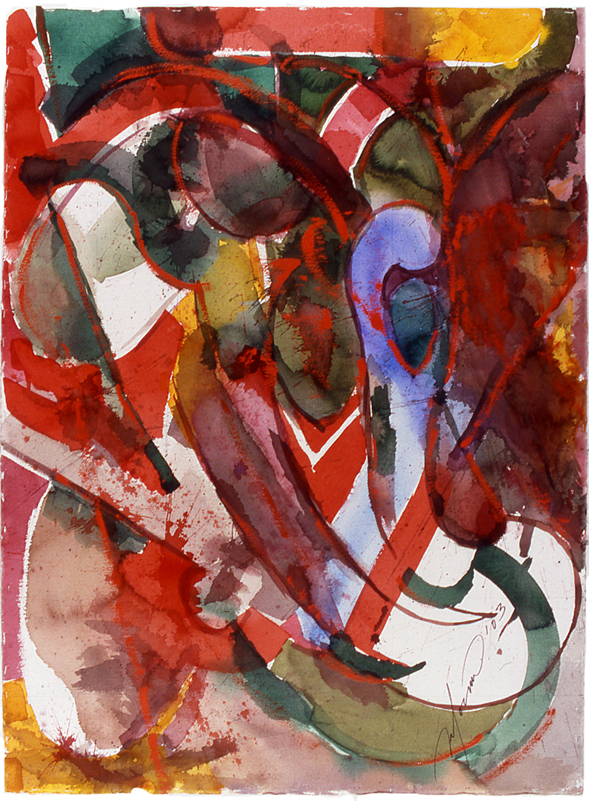
Templates II
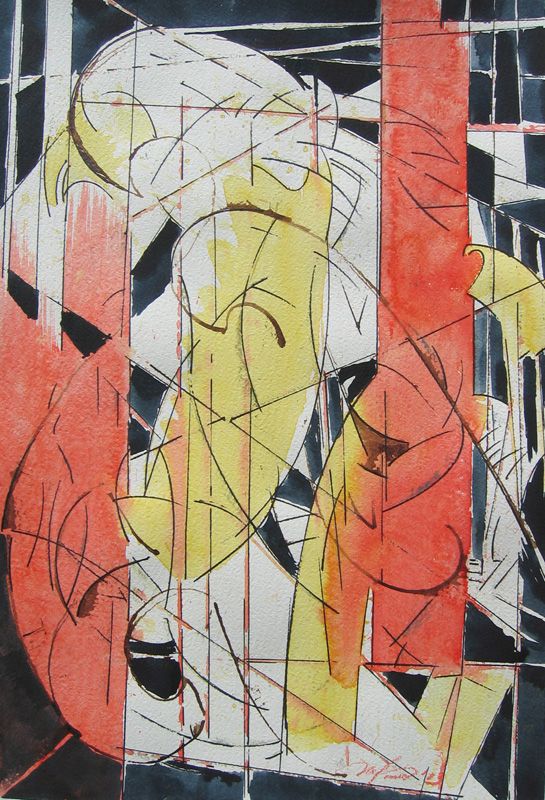
40"h. x 30"w.
Watercolor on paper
2003
Ricardo F. Morín
Templates II
40″h. x 30″w.
Watercolor on paper
2003

People come to know who they are over time rather than all at once.  A person recognizes themselves through earlier actions, remembered choices, and past commitments, even though the conditions under which those moments occurred no longer remain the same.  What feels continuous is not encountered directly, but pieced together through recollection and interpretation as circumstances change.  Because of this, uncertainty enters any effort to maintain a stable sense of self, not through confusion or deceit, but through the simple passage of time.

A person’s relation to themselves is therefore never fixed at its origin.  It is mediated by memory, revision, and reassessment as life unfolds.  What once made sense as a response to a particular moment must be understood again under different conditions.  Identity does not remain secured by intention alone, because continuity can only be reconstructed after the fact rather than preserved intact.

Once identity must be reconstructed instead of taken as given, expectations of consistency begin to exert pressure.  Past actions, statements, and commitments are treated as benchmarks against which the present self is measured, even when the circumstances that produced them no longer exist.  Continuity is demanded where only relation is possible.  What once functioned as a response to a specific situation is asked to stand as proof of an enduring self.

Because people encounter identity through memory and interpretation rather than direct access, identity becomes subject to demands for legibility.  Others rely on familiar patterns of speech, behavior, and commitment to orient their expectations.  When those patterns persist, continuity is assumed.  When they shift, uncertainty arises.  What cannot be readily recognized is often treated as absence rather than transformation.

Under these conditions, adjustment is frequently misread as violation.  Changes made in response to altered circumstances are interpreted as departures from an assumed core rather than as necessary recalibrations.  Earlier expressions of self are treated as binding commitments even when the conditions that produced them have changed.  What is experienced internally as adaptation is therefore received externally as betrayal, not because trust has been broken, but because the expectation of fixity has remained in place.

After reconstruction is complete, identity offers no fixed origin.  It offers only a coherence that must be maintained under changing conditions of recognition.  Efforts to settle distress about identity fail when they ignore a simple fact:  people change before others adjust their expectations.  The difficulty does not arise from change itself, but from being required to remain readable according to standards that no longer apply.

Ricardo F. Morín

January 31, 2026

Oakland Park, Fl


“The Quiet Room”

August 26, 2026


*

Ricardo Morín
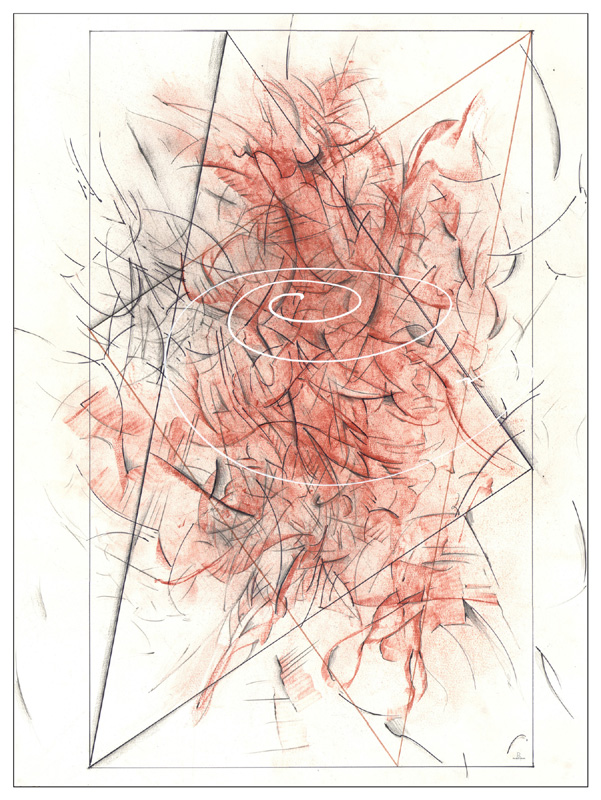
Triangulation III: The Quiet Room
22″ x 30″
Body color, sanguine, sepia and Sumi ink on paper
2008

Author’s Note

This story takes place in a room marked “Quiet Room,” a term that in English is usually understood as a neutral space:   a place for silence, rest, or reflection, without any implied ritual purpose.   But spaces do not mean the same thing to everyone.   In some cultures and languages, silence suggests prayer; the absence of furniture implies prostration; and the presence of a textile can signal ritual use.

These differences in meaning can create misunderstandings where no conflict is intended.   What I recount here is not about religion, but about how the meaning of a shared space can shift without warning, and how people interpret the same room through frames of reference that may collide without notice.

Ricardo F Morín

November, 2025

Oakland Park, Florida


1

My driver and I had been talking about the way executive power often disguises its motives—how it presents itself as a force of rescue while pursuing forms of exploitation.   We passed the time considering these contradictions and felt, briefly, that we understood our world a little more clearly.

2

We were accompanied by the brisk morning air as we moved through congested traffic toward the Philadelphia airport.   I was returning home to Fort Lauderdale after two days of cardiological testing not available to me back home.   Without baggage, I went directly to TSA PreCheck with only a shoulder bag.   Shortly after I reached the departure gate, a six-hour delay was announced.   I decided to buy a backpack and set out in search of a place to reorganize my things in private.

3

I soon found a room marked Quiet Room—plainly identified as a space for silence, rest, or reflection.   I entered with that expectation.   The room was divided into several intimate areas with benches along some of the walls.   The lighting was subdued and the air held a stillness that contrasted with the restlessness of the terminal.   Though furnished sparingly, the rooms were lined with pleated curtains that absorbed and muffled sound, and this softening of the acoustics created a muted perimeter that stood apart from the noise outside.   Only one of the smaller sections had a vanity with a faucet, a faint glow reflecting off its surface.

4

Atop what appeared to be a tall storage unit, several folded textiles were stacked.   Their textures and patterns varied—some silk-like, others woolen or synthetic.   At first glance they looked more like blankets than anything else.   Nothing in the room suggested any purpose beyond what the sign indicated.   It was, in every visible sense, a quiet room open to anyone.

5

I stood facing one of several benches and began to transfer my belongings from the shoulder bag into the new backpack.   The simple act of rearranging objects formed its own small rhythm within the subdued quiet.   I was nearly finished when a voice behind me broke the stillness.   I turned and saw a man repeating with certainty:   “This is a place for prayer”.

6

His certainty overrode the posted meaning of the room.   There was no courtesy, no explanation, and no acknowledgment of the sign that defined the space I had entered.   I turned back to complete what I had nearly finished.   The man walked into one of the adjoining sections.   A woman remained in the larger space that I stood in, silent, waiting for me to leave.   I stepped out.   For a moment I felt like a transgressor, though nothing I had done justified it.

7

I was startled by how quickly confidence had given way to a sense of diminishment.

8

I had become a participant in an unexpected encounter.   A single assertion—neither explained nor negotiated—had shifted the atmosphere without warning.

9

A short time later and still unsettled, I returned impulsively to the Quiet Room, perhaps to find closure.   In the smaller section with the vanity, several men were washing their hands as they murmured chants or prayers, barely audible yet perceptible enough to alter the atmosphere.   Their voices blended with the sound of running water, forming a low, continuous undertone.   In the larger section, the same woman stood quietly, facing one of the textiles she had placed diagonally across the narrow space she occupied.   The room’s physical features had not changed, but its public meaning had been recast.   What had been neutral now felt defined by a significance I had not been prepared for or invited to share.

10

I left again and returned to my departure gate.   In time the emotion eased, though the moment remained vivid as I wrote it.

11

Later, I replayed the scene and the reply I had not managed to speak:   “This is a place for prayer.   I am praying myself”.

12

But I found no certainty in the memory of it—only questions that lingered with persistence:   how can a plainly posted meaning, “Quiet Room,” be superseded by an unspoken one?   Was it grievance or exclusivity that redrew the boundaries of a public room without a single word of justification?   How quickly can a neutral space become contested before anyone knows how to meet the shift itself?   How does one face the responsibility of communicating with clarity?   By any measure, none of us had succeeded.


“Diagnostic Language and the Discipline of Seeing”

June 17, 2026
Ricardo F. Morín
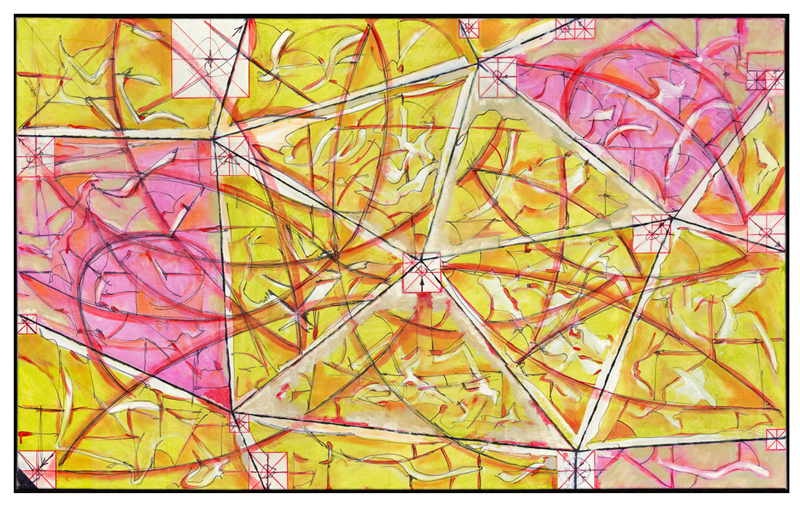
Icosahedron
60″x 37″
Oil on linen
2005

Ricardo F. Morín

February 7, 2026

Oakland Park, Fl

The distinction between interpretive language and diagnostic language reveals two different orientations toward reality.  Interpretive language organizes perception toward meaning.  Diagnostic language exposes structure without directing conclusion.  One arranges understanding along a path;  the other clarifies the field in which understanding may arise.

Interpretation assumes that experience requires orientation.  Relationships are framed so that coherence appears through guided association.  Even when presented as open, interpretation tends toward closure because perception is arranged toward resolution.

Diagnostic language operates differently.  Ambiguity is neither eliminated nor prolonged;  it is delineated.  Diagnosis distinguishes conditions rather than resolving them.  Explanation yields to observation.  Persuasion yields to precision.

Deliberative cognition is frequently mistaken for reverie.  Pauses, refinements, and resistance to premature closure may appear as distance from reality.  The appearance misidentifies abstraction.  Abstraction does not detach thought from reality;  it alters the manner of approach.  Detachment occurs only when abstraction becomes residence rather than instrument.

A dreamer inhabits possibility through imagination.  Someone perceived as having their head in the clouds is judged to have lost practical grounding.  Both descriptions describe perception rather than structure.  The decisive difference lies in engagement:  abstraction used diagnostically sharpens contact with reality rather than replacing it.

A moment during jury selection clarifies this distinction.  The question of whether an artist is a portraitist probes not technique but observation.  The response dissolves the assumed divide between abstraction and representation.  Abstract practice does not reduce proximity to the real.  Portraiture and abstraction pursue the same task:  perceiving essence.  What changes is the mode of access.  Abstraction functions as diagnosis:  a way of revealing structure without reliance on literal appearance.

Diagnostic writing operates as abstraction operates in visual art.  The real is not abandoned.  Perception is reorganized so that underlying relations become visible.  Narrative direction is withheld.  Structure emerges through juxtaposition rather than instruction.

Misunderstanding arises when guidance is expected instead of exposure.  Questions that refine perception appear as uncertainty.  Delayed closure appears as hesitation.  The intention differs:  clarity arises from structural recognition rather than interpretive resolution.

An ethic of restraint underlies this approach.  Vision and humility remain central yet cannot be declared without dissolving into performance.  Once asserted, vision becomes self-promotion and humility becomes display.  Both remain implicit, revealed through attention rather than proclaimed through identity.  Precision replaces authority.  Clarity replaces prescription.

The opposition between realism and abstraction dissolves under this view.  Thought does not detach by entering conceptual terrain.  Detachment begins when abstraction becomes refuge.  Used diagnostically, abstraction becomes passage:  movement through uncertainty that returns with sharpened perception.

The question is not whether one is a dreamer or someone with their head in the clouds.  The distinction lies in how abstraction is inhabited.  Some remain suspended within possibility.  Others traverse it deliberately, revealing structures otherwise unseen.

Diagnostic language belongs to the latter movement.  It directs nothing and claims nothing.  It creates conditions of visibility in which perception clarifies without coercion and understanding emerges without command.