*
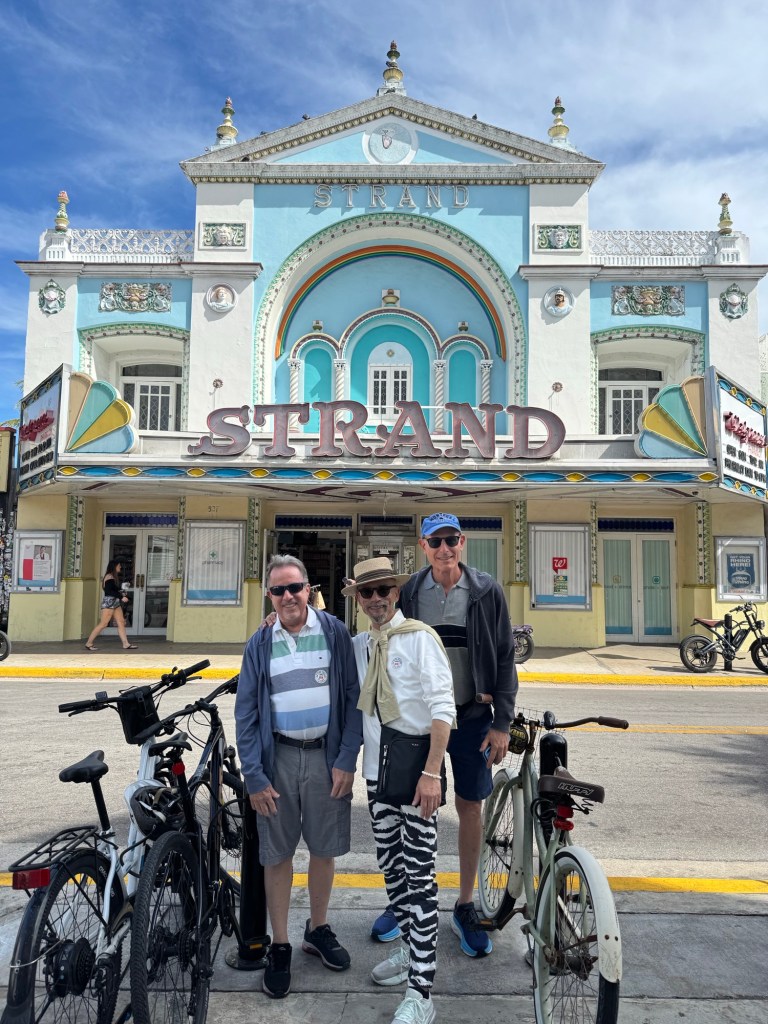
In front of the Strand—opened as a movie theater in 1921, later a nightclub, then a Ripley’s Believe It or Not! museum, and now a Walgreens. Its façade shows how histories persist without reconciling. Ricardo Morín stands at center, flanked by Sandy and Michael; the photo was taken by his husband, David.
Preface
“Key West: In Microcosms” is a brief study in layered histories—fragments that coexist without reaching resolution. These histories remain in motion, marked by transitions rather than conclusions. My purpose is not to impose a thesis but to record what becomes visible when one pays sustained attention to a place shaped by successive inheritances. To describe Key West is to observe how meaning accumulates, how forms endure beyond their origins, and how a city reveals the unfinished nature of its own narrative.
Ricardo F. Morín
November 14, 2025
In transit between Monroe and Broward Counties, Florida
1
To understand Key West, one should consider its layers of history.
2
Its earliest history comes from the indigenous people who had arrived in the Keys long before the Europeans.
3
Different from the Spanish colonizers, the indigenous peoples (mainly the Calusa and the Tequesta) laid their dead visibly on the ground of the coastal landscape.
4
When the Spanish reached there, they named it Cayo Hueso from the exposed human remains (huesos); the later English colonizers may have mistaken ‘hueso’ for West—to fit their own conventions.
5
In the following centuries, Spanish claims blended with British ones until the 1821 Adams–Onís Treaty transferred Florida to the United States.
6
In March, 1822, U.S. naval forces under Matthew C. Perry raised the American flag over Key West and brought it under American control.
7
Beginning in the 1820s, Key West was the point where ships carrying enslaved Africans foundered. American officials held them under supervision before sending them on to Cuba or (from the 1830s onward) to Liberia.
8
From the 1820s through the mid-nineteenth century, a regulated wrecking system—run by local courts and licensed crews—formed Key West’s early prosperity. Through these mechanisms, Key West entered the country’s commercial system, tied to its courts and markets rather than standing apart.
9
In 1832, John James Audubon sketched and studied the birds of Key West. His work tied the city to a broader American identity that stretched from its southern edge to the country’s most remote territories.
10
In the twentieth century, naval installations (a submarine station, a Navy Yard, and a Naval Air Station), immigration routes (the flow of Cuban, Bahamian, and other Antillean laborers), and wartime expansions (the two World War–era build-ups of military and federal presence) reshaped Key West and established its modern identity.
11
By the late twentieth century, Key West held the marks of those who had governed from it and those who had written within it.
12
Two legacies stand out in this setting.
13
Truman’s legacy reflects the projection of American decision-making that shaped the postwar world and the ethos of American politics.
14
A second legacy is literary: Hemingway’s evolution as a writer influenced American prose. His compressed style, stripped to its bare essentials, emphasized directness and conveyed emotional complexity through what remained unspoken: A Clean, Well-Lighted Place (1933); The Gambler, the Nun, and the Radio (1933); A Natural History of the Dead (1933); Homage to Switzerland (1933); The Short Happy Life of Francis Macomber (1936); and The Snows of Kilimanjaro (1936).
15
In the twenty-first century, commercial interests highlight Key West much like other towns shaped by tourism, cultivating a soft myth of decadence to mark it as distinct.
16
Visitors arrive to rest, to lose weight, or to adopt temporary eccentric habits, and Key West accommodates these patterns with ease.
17
The atmosphere appears spontaneous, but it reflects routines shaped over generations.
18
Key West has only recently established a public home for its LGBT community, yet its presence remains fragile, dependent on federal and private funding whose continuity is far from assured.
19
More resonant yet is the presence of Sadako Sasaki’s origami crane at the Little White House (originally made for Truman), which places the suffering of a Hiroshima child within the home of a president who authorized the atomic bomb.
20
Viewed as a whole, Key West’s record shows how public narratives coexist with histories still unresolved, and it reminds us that every society carries meanings that seem irreconcilable for as long as our understanding remains incomplete.
 Observations On Perception