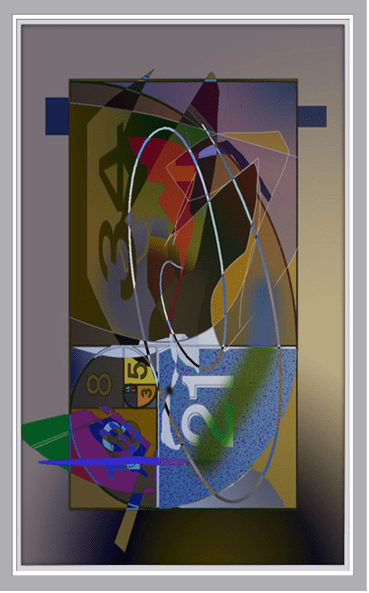
Silence III by Ricardo Morín 22″ × 30″ Watercolor, graphite, gesso, acrylic on paper 2010
IX. The Commission
In the days that followed she did very little, and it was in doing very little that she began to see.
She had not known how much of her life had been occupied with being somewhere. Now there was nowhere she was expected, and the hours, released from appointment, came back to her with things in them she had not put there: a word, a glance across a hall, a man at a window with nothing to put into a silence. She did not go looking for these. They arrived, as the light arrived in the apartment in the mornings, from the direction of his tower, and lay upon things until she noticed them.
She noticed, for instance, that she had kept Nexys’s glance at the gala as though it were the first fact of something, and that she did not know, now, what it had been the first fact of. She had thought, that night, that she had seen something in him. It occurred to her, turning it over on the fourth or fifth morning, that he might rather have seen something in her, and that the flicker she had kept was his recognition and not her discovery. The thought did not distress her. It interested her, as a painting interests one on the second visit, when one sees that the figure one took for the subject is looking out of the frame at something one had not thought to look at.
The commission reported on a Thursday. She had not meant to watch. She told herself she would watch only to know what was said, and she sat down before the screen in the posture she used for watching her own appearances, a little forward, one hand at her throat, and recognized the posture, and did not change it.
The chairman spoke. The figures were given. The word was used, several times, in ways that made it sound like a thing that had been mislaid and found. And then the chairman turned, with a gesture she knew because she had once suggested it to Nexys, and introduced someone who would speak to what the promise had always meant.
She had expected the footage. She had expected her own face, and had prepared for it as one prepares for cold water. It was not her face.
The woman was younger: not by much, but by enough. She was dark where Astra was dark, and composed where Astra was composed, and she was not, in any feature Astra could have named, like her. The caption gave her name as Astrid.
Astra heard the name as one hears a word one has repeated too often, so that it comes apart into sound. Then the woman began to read.
It was the statement. It had been altered, very slightly, to fit another mouth: the promise was still larger than any one man, and would still, at last, be kept, but the person who had helped to bring the truth to light was now one who had stood “beside those who sold the dream, and could not bear to watch it betrayed.” Astra listened to the alteration with professional attention and found it right. Then she stopped attending to the words, because she could attend to nothing but the voice.
The delay before the key word. The soft ending. The breath taken not where the sentence needed it but where the listener would need it, half a beat before the listener knew. The young woman had all of it. She had not been taught it from footage; or if she had, she had been taught it so thoroughly that it no longer looked taught. It looked like candor. It looked, Astra thought, with a sensation for which she had no name, exactly as she had always supposed it looked from the other side of the screen, where she had never once sat to see.
She sat there now. And she believed it.
That was what she could not get past. Not that it had been done, or done well, or done without her; but that for the length of a sentence, perhaps two, sitting forward with her hand at her throat, she had believed the woman on the screen meant what she said; had been moved by it; had felt the old warm motion toward the promise; and had felt it from the place where she had always supposed the crowd felt it, and where she had never, in all her years of producing that motion in others, once stood.
The broadcast ended. The screen showed the weather. She sat for a long time without moving, and the light from his tower, which had come on at dusk as it always did, lay across the floor between her chair and the window.
The woman in the café had said that she was the only one who needed to believe. She had taken it as a judgment on her sincerity. She wondered now whether it had been something plainer: a description of where she had always stood, which was where belief was made and never where it was received. She could not tell whether that was the whole of it. She knew only that she had stood, for two sentences, among those who received it, and had found something there waiting for her, warm, ready-made, and not her own.
She thought she would like to see the young woman. She did not know what she would say. She was not sure, examining the wish, that she wished to say anything; it seemed rather that she wished to look, from close by and in an ordinary light, at the face that had done this to her, and to learn whether, at that distance, it would look like anyone she knew.
X. Astrid
The message came from Astrid herself, three days after the broadcast, and was so plainly worded that Astra read it twice for the trick in it and found none. She would be in the public garden by the river on Sunday morning, early, before the paths filled. If Astra wished to come, she would be glad.
Astra went. She arrived before the hour, as she had never arrived anywhere, and walked the gravel paths while the gardeners were still at work. The light was the ordinary light she had wished for: grey, even, without direction, falling on the benches and the backs of the gardeners and the surface of the river with no preference among them.
Astrid was on a bench near the water with a paper cup in her hands. She rose when she saw Astra, not quickly. In the plain light she was younger than on the screen, and less finished; there was a small scar at her hairline that the broadcast had not shown, and her coat was good but not new.
“You came,” she said, and then, as if hearing herself, smiled. “That isn’t what I meant to say first. I’d rehearsed something better.”
“So had I,” said Astra. It was not true until she said it, and then she found that it had been.
They sat. For a time neither spoke, and Astra was aware of being looked at, closely, by someone who knew precisely what she was looking at; and it was the first time this had happened to her in such a light, with no screen between.
“I watched you for years,” Astrid said at last. “Before any of this. I was fourteen the first time. You were on a screen in a shop window, talking about the ledger that no one owns, and I stood in the street until the shop closed.” She turned the cup in her hands. “I’m not telling you that so you’ll feel anything. It’s why they found me. I’d learned you without meaning to. They only had to finish it.”
“And you let them.”
“I needed the work.” She said it as the woman in the café had named a distance. “And I wanted to see whether I could. You’ll understand that.”
Astra did.
“Do you want to know what was hardest?” Astrid asked. Astra said nothing, and Astrid, who had learned her, seemed to take the silence correctly, as yes. “Not the voice. The voice is only music; anyone can learn music. It was something you do with your eyes.” She looked away briefly, to the side, toward the river, and back. “Just before the important word. Every time. As if you were checking whether someone had come into the room. I had to learn not to do it. They said it read as doubt.”
Astra sat very still.
She had watched herself, she supposed, a thousand times. She had studied her appearances as she studied everything, for their effect; she had corrected her hands, her posture, the angle of her chin. She had never seen that. She thought of the gala, of Nexys’s eyes finding hers across the hall, of what had passed between them that she had kept as the first fact; and she understood, on the bench in the even light, that he had seen it long before. Perhaps others had: the crowd, with its patient look; the late man at the table, with his physician’s interest. It was possible that anyone who had watched her closely had seen her look aside before the word, as though someone might come in, and that only she, who had made the word, had never once been placed to see it.
“Did it?” she said. “Read as doubt?”
Astrid considered her with the frank attention of a craftsman. “Not to most people. To most people it read as sincerity. That’s what made it dangerous. Doubt that looks like sincerity is the most convincing thing there is.” She paused. “They didn’t want convincing. They wanted calm.”
A gardener passed with a barrow. Both women watched him go, and Astra noticed, as he went, that Astrid’s eyes moved to the side, toward the path behind them, quickly, before she spoke again; and that Astrid caught herself doing it; and that something in her face closed.
Astra did not remark on it. She could not have said whether it was the trace of a habit learned and not quite unlearned, or something of Astrid’s own, older than the lessons, which the lessons had failed to remove. She found she could not tell. She found, too, that she had no right to ask, and that it was the first time in a long while she had recognized such a limit as belonging to another person and not to the situation.
“Why did you write to me?”
Astrid looked at the water. “Because you’re the only person who would know what I was doing while I did it.” A small movement of her shoulders. “It’s lonely, otherwise. You’ll know that too.”
They sat a while longer. There seemed to be nothing further either of them needed to say, and Astra, who had spent her life in rooms where silence was a move, discovered that here it was not; it was only the time two people take to finish sitting together.
When they rose, Astrid held out her hand, and Astra took it, and for a moment they stood as they would have stood for a photograph, and both of them knew it, and neither turned toward a camera, because there was none.
Astra walked home along the river. She did not look at the water, though it was there the whole way, grey and plain and willing to show her anything. She was thinking of a glance to the side before an important word, and of how many years a thing can be visible on one’s own face to everyone but oneself; and she was thinking that she would have to look, sooner or later, and that she was not yet ready, and that this, at least, she could see.
XI. The Tower
She went to see him because he had asked, and because she found, examining the reasons she might have given for not going, that each of them was a sentence she would have spoken to an audience.
The tower admitted her without question. The doorman knew her; the elevator knew her floor; the glass of the lobby, where his name was cut, had been cleaned that morning, and the name stood in it as clearly as ever. On the wall beside the elevators a new portrait had been hung, large, a little idealized, in the manner of portraits commissioned for institutions, and beneath it a small plate gave his name and two dates. The first was the year the city’s first tower had risen. The second was this year. She looked at the second date for some time. He was not dead. She understood that the plate did not mean he was dead.
He received her in the office. Nothing in it had been moved: the dark wood, the cold metal, the angles that admitted no doubt. The screen on the desk was lit and showed the price, which had recovered nearly half of what it had lost. He rose this time. He came round the desk and took both her hands and looked at her with an expression of open warmth. It was the expression he used for donors.
“You came back,” he said.
“You asked me to.”
“I did. I hoped.” He released her hands and went to the window. “Look at it. Nothing has changed.”
She looked. Nothing had. The towers stood in their silver order, and the avenues ran with light, and below them the people moved with the ease of those who believe themselves looked after; and from this height the doorways and the debris could not be seen at all.
He talked. He talked well; he had always talked well. He told her that the commission was in good hands, that several of its members had been his friends for twenty years, that the reform would be named, as was only fitting, for the founder, and he smiled at the word as he said it, as if it were a garment someone had given him that fit better than he had expected. He told her he had been consulted at every stage. He told her the mediator was an able man. He did not tell her when he had first met the mediator, and she found she did not need to be told; she was watching his hands, which rested on the sill and did not drum.
“You knew,” she said. “Before the gala.”
He did not turn. “I knew it was coming. Someone was always going to come. A man who builds a thing like this and imagines he’ll be allowed to keep it is a fool, and I am not a fool.” He paused. “I chose how it would end. That’s all anyone can choose. I chose that my name would stay on the glass.”
“And me?”
Now he turned, and his face held something she had seen once before, across a hall, and kept. “You were going anyway,” he said. “I saw it long before you did. You used to look aside before you said the word: every time, for years, as if you were expecting someone. I used to watch for it. I thought someone would notice, and it would be over.” He shook his head. “No one ever did. They thought it was sincerity.”
“Someone did,” she said, and did not say who.
He waited, and when she said nothing further he took it, as he had always taken her silences, for agreement; and she let him, and noticed that she let him, and that it no longer felt like a move.
“It went perfectly,” he said. “Considering.”
She heard the word fall. It did not ring false this time. It did not ring at all; it lay where it fell, as a coin lies on carpet, and she understood that he meant it, and that he would go on meaning it, in this office, with the screen on the desk showing him a number that recovered by the day, beneath a portrait whose second date he had not yet gone down to read.
She stayed a little longer, because leaving at once would have been a kind of speech. They spoke of nothing: of a dinner years ago, of a city abroad where they had once been photographed together. He was charming. He had always been charming. When she rose to go he kissed her hand, which he had never done, and she understood that it was a gesture from a part he had begun to play, the founder, gracious and retired, and that he would play it well and for a long time, and that the playing would spare him from ever standing at the window long enough to see the doorways.
In the elevator she did not look at the steel.
In the lobby the light was going. As she passed the portrait, the tower’s lights came on, all at once, floor upon floor above her, at the hour they always came on; and she thought of him upstairs at the window, watching them come on, and believing, as she was almost certain he would, that he had switched them on himself.
XII. The Window
It was evening when she reached the apartment, and she did not turn on the lamps at once. She sat in the chair facing the window, as she had sat to watch the commission, and let the room go dark around her while the city came up outside it, tower by tower, until the glass held nothing but the city: entire, luminous, composed, as it had offered itself to her from the balcony, as it offered itself to anyone who could afford the height.
She found that she was waiting, and did not know for what, and did not try to know.
When at last she rose and turned on the lamp beside the chair, the window changed. It did so all at once, as such windows do: the city withdrew behind the glass, still there but faint, and in its place the room appeared, the chair, the lamp, the table where she had set down the device on the first night, and a woman standing in the middle of it.
She had seen her reflection in that window a thousand times. She had used it, at night, before going out, to check the line of a dress. She had never stood before it with nothing to check.
She looked at the woman. The woman was not young and not old; she was composed; she was, Astra supposed, what people meant when they said she was beautiful, and the word did not seem to attach to anything in particular. She held herself as Astra held herself, a little forward, as if about to be addressed. Astra watched her for a long time. It was not difficult. It was only unfamiliar, like the light in the garden, which had preferred nothing.
Then, because there was no one else in the room, and because she had spent her life saying things aloud before she knew she believed them, she began to say something to the woman in the glass, she did not afterward know what; and before the word that mattered, she saw the woman’s eyes go aside.
It was very quick. It was, as Astrid had said, as if someone might have come into the room. Nobody had. She saw the glance, and saw the eyes come back, and the face around them settle again into what it had been. She did not know what it had been looking for. It might have been doubt, as they had said. It might have been the habit of a performer listening for her audience, or of someone keeping watch on a door she did not mean to open. It occurred to her that it might have been looking for her, and the thought stayed, and she did not try to make it the only one.
She did not finish the sentence she had begun. She thought of the stars, which she had once seen above the city and then said, and found that she could no longer tell how much of the seeing had been for the sake of the saying. Something else spoke then, in her own voice, though not the one she used on screens: the voice she would have used to tell a stranger the time. It did not tell her what she must do. It did not tell her that she was forgiven, or free, or that anything would now be otherwise. It did not explain her to herself.
It said her name.
It was not loud. It was not the name as the crowd had said it, nor as Nexys had said it. It was said as one says the name of someone in the same room, plainly, to establish that she is there.
“Yes,” she said.
Outside, faint behind her reflection, the towers kept their silver order, and the avenues ran with light, and nothing in the city had changed or would change because a woman in one of its windows had answered to her name. She knew that. She did not look past the glass to confirm it. She stood where she was and let the woman in the glass look at her for as long as it lasted, and found that she could stand there, which was not the same as being at peace there.
The lamp burned beside her. She did not turn it off.
Ricardo F. Morín Concession Computer-generated image (CGI) 2026
When a state exists not to advance the prosperity of its inhabitants but to administer their dependence, government does not guarantee the exercise of freedom: it rations it, and that rationing sustains those in power. Common resources, whether land, mineral wealth, or labor, are not protected on everyone’s behalf; they are held for the benefit of their custodian. What is called collective protection is the public form of private appropriation.
Free enterprise then appears as a threat rather than a possibility. Investment that competes, property acquired without political favor, and individuals who work for themselves establish a measure of independence from the distribution. A ruler whose power depends on dispensing favors cannot tolerate that independence. His hostility to the market is defended on doctrinal grounds, but it serves a precise purpose: to ensure that prosperity remains subject to his control.
That is why producers are so often invoked and so rarely encountered. The handful of people who persevere despite the restrictions are praised, and the praise itself confirms their rarity. Where property and the autonomy of those who produce are at the mercy of power, praise serves as a farewell.
A transfer of power does not by itself alter this administration. Those who oppose the ruler often oppose the person rather than the role: they aspire to the same office, with the same powers, to distribute the same favors among the same multitudes. The transition is conceived as a change of hands, and that change leaves the distribution intact.
In Venezuela, the economy has long depended on oil. When the revenues from that common resource are subject to the ruler’s discretion, prosperity is administered as a concession, and the concession can be withdrawn. Those who leave know this. The departure of millions is not an argument: it is a record of what remaining demanded.
There is talk of justice while the poor are worse off than before. There is talk of revolution while crime permeates every part of public life. The vocabulary of decency outlives decency itself, and the surviving words parody what they name. The system’s name conceals the subordination of its promises to a single purpose: that those who govern remain.
In 1947, my father wrote a doctoral dissertation in political science entitled “Human Capital.” I had not read it before his death in 1997. What I knew of his convictions I learned from his conduct: from the patience he showed in his dealings with the state as he waited for the right moment to present his defense.
Once, when I was seven, I heard him tell his real estate agent that if freedom and property were ever threatened by a populist system, one would have to sacrifice one’s life. He said it in my presence, without addressing me. In time, I understood that he was not speaking of what he had accumulated. He was speaking of the possibility of losing what cannot be accumulated: the dignity of not owing one’s existence to those who govern. For him, life on those terms was no life at all. He died before what he feared came to pass.
Recognizing the threat is not enough to escape it. Those who live under tutelage, without the conviction that sustained my father, may understand their predicament and doubt their ability to change it. Exhaustion then precedes resignation: the will retreats because action seems futile. Anger finds release in complaint, and complaint serves to justify inaction. Their resentment has a cause and leads nowhere. They seek what they can obtain now because their future has been administered by others; they avoid further sacrifices because they have seen the fruits of earlier ones confiscated. Responsibility persists, but the repeated experience of being unable to discharge it feeds the conviction that they have none.
There is a point at which deprivation narrows even the sense of what one can demand. The body goes hungry, the mind concentrates on immediate need, and protest asks the custodian for a larger handout. Abjection takes hold when that custodian is recognized as the rightful owner of what he distributes. The will survives, but it acts within limits it does not question. Power no longer needs to compel each surrender: those who depend on it have learned to yield in advance.
My father rejected more than the regime he feared: he rejected the disposition to accept one’s own existence as a concession. That disposition is not confined to any one social group or class. The ruler demands it of others; those who benefit accept it while their advantage lasts; opponents perpetuate it when they aspire to administer the same distribution. Their positions neither confer the same power nor impose the same responsibility. The distribution endures as long as the right to grant concessions is contested only to decide who will hold it.
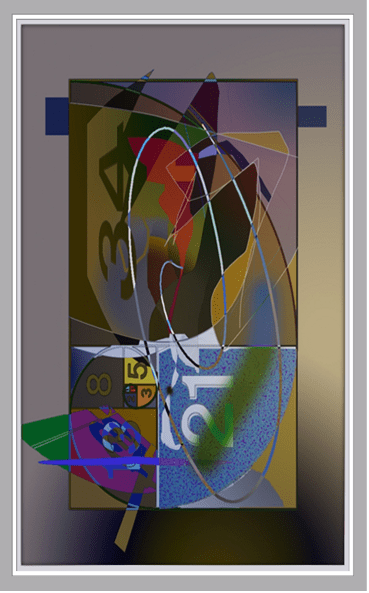
“Geometric Allegory” digital painting (2023) by Ricardo Morin (American visual artist, born in Venezuela, 1954)
Scope and Use
This entry forms part of the constitutional corpus presented in the Appendix, comprising the twenty-five constitutions of Venezuela and organized for consultation rather than sequential reading. Comparison proceeds by means of permanent rubric codes whose identities remain constant across the corpus; absent rubrics signify constitutional silence, while retired rubrics are not reassigned. Citations are anchored first on the article number and follow the CIDEP recension linked at the close of the entry. The full corpus definition, methodology, and citation convention are set forth in the Scope and Use note heading the 19th-Century Constitutions, which opens in the installment of “Unmasking Disappointment: Series XI”.
Ricardo F. Morín
October 11, 2026
In transit.
21) The Constitution of 1945
The 1945 Constitución de los Estados Unidos de Venezuela [Constitution of the United States of Venezuela] was sanctioned by the Congreso de los Estados Unidos de Venezuela [Congress of the United States of Venezuela] in Caracas on 23 April 1945 as a reform of the Constitution of 16 July 1936. President Isaías Medina Angarita promulgated the reformed text on 5 May 1945, the date of its publication in the Gaceta Oficial de los Estados Unidos de Venezuela [Official Gazette of the United States of Venezuela]. (CIDEP 1947, Art. 253; Fundación Empresas Polar, “Constituciones de Venezuela”; Biblioteca Virtual Miguel de Cervantes, bibliographical record for the Constitution of 1945).
DOC-PRE—Preamble
(modern Latinate English translation by the author from the CIDEP recension)
“The Congress of the United States of Venezuela, in the name of Almighty God and in exercise of the authority conferred upon it by Article 126 of the Federal Pact in force, decrees this Constitution.”
(CIDEP 1945, p. 4, preamble).
FND-TER—Territory
The Venezuelan Nation is the union of Venezuelans in a political pact named Estados Unidos de Venezuela [United States of Venezuela]. It is permanently and irrevocably independent of foreign domination or protection. Its territory is that of the Capitanía General de Venezuela [Captaincy General of Venezuela] before the political transformation of 1810, with treaty modifications, and may not be alienated to a foreign power, even temporarily. (Arts. 1–2; cont., 1936, Arts. 1–2).
The territory comprises States, the Distrito Federal [Federal District], Territorios Federales [Federal Territories], and Dependencias Federales [Federal Dependencies]. The twenty States are Anzoátegui, Apure, Aragua, Barinas, Bolívar, Carabobo, Cojedes, Falcón, Guárico, Lara, Mérida, Miranda, Monagas, Nueva Esparta, Portuguesa, Sucre, Táchira, Trujillo, Yaracuy, and Zulia. Art. 4 prints “Barinas”. Boundaries derive from the Law of 28 April 1856, federal territorial changes, the Constitution of 5 August 1909, and subsequent agreements; neighbouring States may alter their common frontier by legislative agreement. (Arts. 3–5; cf. 1936, Art. 4: “Zamora”).
A special law organizes the Distrito Federal [Federal District], protects federal political action, and preserves municipal economic and administrative autonomy. The departments are printed as “Libertador y Vargas”; the former includes Caracas, El Recreo, El Valle, La Vega, Antímano, and “Macarao”, and the latter La Guaira, Maiquetia, Macuto, Caraballeda, Carayaca, Naiguatá, and Caruao. (Art. 6; cf. 1936, Art. 6: “the Departments Libertad and Vargas […] El Recreo, El Valle, La Vega, Antímano and Maracao”).
Caracas is the capital and federal seat, subject to Art. 104(23)(b), (24). Amazonas and Delta Amacuro remain federal territories under special laws. Changes in their boundaries, or those of the Federal District, with neighbouring States require executive agreements approved by Congress and the respective legislatures. (Arts. 7–8; cont., 1936, Arts. 7–8; corresponding powers in Art. 100(23)(b), (24)).
Territorial statehood requires the population base for one deputy and demonstrated capacity to finance public services. The Venezuelan Antillean islands, except Margarita and Coche in Nueva Esparta, are federal dependencies directly administered by the executive and may become territories. The Corte Federal y de Casación [Federal and Cassation Court] decides boundary controversies. (Arts. 9–11; cont., 1936, Arts. 9–11).
POW-LEG—Congress
The Congreso de los Estados Unidos de Venezuela [Congress of the United States of Venezuela] comprises a Senate and Chamber of Deputies. Members serve four years, half being renewed every two years. Where the number of deputies is odd, renewal must allow each deputy to complete his term. (Art. 55; cf. 1936, Art. 54: “When the number of Deputies is odd, the majority shall be renewed.”).
Deputies are elected directly under federal electoral legislation in each State and the Federal District, one per 35,000 inhabitants and another for an excess of at least 15,000, with at least one per State. An equal number of alternates fills vacancies in election order. Territories reaching the population base also elect deputies. Indigenous people described as “indígenas no reducidos” are excluded from that base. (Arts. 56, 58; cf. 1936, Art. 55: “the Municipalidades [Municipalities] of each State, assembled in an Assembly, shall elect one Deputy for every thirty-five thousand inhabitants”).
A deputy must be Venezuelan by birth, have completed twenty-five years, and be native to the represented State or Federal District or have resided there for at least four years. Children of Venezuelans born abroad are considered native to the place where their birth is registered under Venezuelan civil legislation. (Art. 57; cf. 1936, Art. 56(3): “at least the three years immediately preceding the election”).
The Chamber of Deputies may censure ministers, without obliging the President to remove them before the Court finds legal grounds for trial. Each state legislature elects two principal senators and two alternates from outside its membership. The Senate authorizes Pantheon honours twenty-five years after death, national officials’ acceptance of foreign gifts, offices, honours, or rewards, and promotions from colonel or naval captain; statute may assign further powers. (Arts. 59–60, 62; cont., 1936, Arts. 58–59, 61).
A senator must be Venezuelan by birth, over thirty, and native to the represented State or resident there for at least four years. The rule assigning a Venezuelan child born abroad to the place of registration also applies. (Art. 61; cf. 1936, Art. 60(2): “at least the three years immediately preceding the election”).
The Chambers meet annually in the capital on 19 April or the nearest possible day, for ninety days without extension. Extraordinary sessions concern the subjects of the convocation and connected legislation. Opening requires two-thirds; subsequent sittings require an absolute majority. Sessions are public unless otherwise resolved. Each Chamber regulates proceedings, order, membership, and resignations; both sit in one place and open and close together. (Arts. 63–67; cont., 1936, Arts. 62–66).
Public employment is incompatible with membership during sessions. Statute fixes remuneration, with increases deferred to the next term. Immunity runs from thirty days before 19 April to thirty days after sessions and extends to extraordinary sessions; the Chambers may not waive it. Members are not responsible for opinions expressed in the Chambers and may not contract with the executive or pursue another’s claims before it. State legislatures replenish senatorial alternates; state constitutions and the Federal District organic law govern deputy vacancies. (Arts. 68–73; cont., 1936, Arts. 67–72, for the summarized rules).
In the provision excluding the immunity period from procedural time limits, the recension prints “respective proceso”. (Art. 70(2); cf. 1936, Art. 69(2): “the respective proceeding”).
The Chambers meet jointly when constitutionally or legally required or upon an accepted invitation. Co-legislative acts are laws; joint or exclusive acts are agreements. The Senate president presides over Congress and the Chamber president serves as its vice-president. Congress elects designated officials, considers presidential resignation and the annual message, approves or rejects ministerial accounts and additional credits, and admits qualifying territories as States. (Arts. 74–77; cont., 1936, Arts. 73–76).
The Chambers legislate on national taxation, debt, offices, currency, treaties, contracts, weights and measures, budgets, the census, territorial administration, representation, solidarity institutions, pensions, war and peace, armed forces, aviation, amnesty, communications, resources, and other federal matters. Investigative commissions may demand information and documents from national, state, municipal, and judicial authorities. (Arts. 78(1–22), 79; cont., 1936, Arts. 77(1–22), 78, for the enumerated competences).
Congress may authorize the President temporarily to exercise determinate and precise extraordinary powers to protect national economic and financial life when public necessity or convenience requires. (Art. 78(23); new; 1936, Art. 77, which contains no corresponding extraordinary-powers ordinal).
Three members of either Chamber may initiate a bill; the executive also has initiative. Art. 80 prints “Ministerio a cuyo Despacho”. An admitted bill receives three readings in each Chamber at intervals of at least one day. Disagreements pass to joint Congress for majority decision; rejected projects wait until a subsequent year, while pending projects may continue in immediately following extraordinary sessions called for that purpose. The legislative formula names Congress; only laws repeal laws, and partial amendments require publication of the complete amended law. (Arts. 80–86; cf. 1936, Art. 79: “the Minister to whose Department the subject of the bill belongs”).
The enacted text is made in two unaltered copies, signed by the congressional president, vice-president, and secretaries. The president of the originating Chamber sends one to the President of the Republic, who must promulgate it within ten working days of receipt. Promulgation consists of publication with the Ejecútese [Let it be executed] in the official gazette. (Art. 87; cf. 1936, Art. 86: “one of those copies shall be sent to the President of the Republic so that he may countersign it together with the respective Minister or Ministers and cause it to be published”).
Within the promulgation period the President may return objections. Partial objections receive two readings in each Chamber; an objection to the whole receives one. Agreement to rejection archives the bill; insistence or acceptance of amendments requires promulgation within five days. Inter-chamber disagreement is resolved jointly by two-thirds of those present, failing which the bill is archived. After sessions close, an unexecuted law and objections must be published within the ten-day period and presented within the first three days of the next ordinary meeting. (Arts. 89–90; new; 1936, Arts. 86–88, which contain no corresponding presidential-objection procedure).
If the Chambers insist upon a measure objected to as unconstitutional, the President may refer it through the lawful organ to the Corte Federal y de Casación [Federal and Cassation Court]. The Court decides within ten days; a finding that it is not unconstitutional requires promulgation within five days after judgment. (Art. 91; new; 1936, Arts. 86–88, which contain no corresponding referral before promulgation).
A discrepancy between original and printed law requires corrected republication. A law takes effect on its stated date or upon gazette publication. Legislative authority is not delegable. (Arts. 88, 92–93; cont., 1936, Arts. 87–89).
Legislation is non-retroactive except when imposing a lesser penalty. Procedural laws apply immediately to pending cases, but already received criminal evidence is assessed under the former law insofar as favourable to the accused. This article ends without the reservation concerning Art. 32 printed in its antecedent. (Art. 94; cf. 1936, Art. 90: “The provisions of Article 32 of this Constitution are reserved.”).
ECO-HAC—Treasury
Federal fiscal competence embraces currency, customs, the specified national taxes, and the proceeds of saltworks, pearls, mines, and vacant lands. Taxation requires law; expenditure requires a budget appropriation or a prior additional credit, with personal civil liability for unauthorized payment. Congress authorizes loans and alienation of national private immovables, preserves the gold standard and statutory metallic backing, and appropriates pension funds in aggregate. (Arts. 15(11), (13), (17–18), 48, 78(1–2), (4), (7), (9), (14); cont., 1936, Arts. 15(11), (13), (17–18), 47, 77(1–2), (4), (7), (9), (14)).
The Situado Constitucional [constitutional revenue allocation] equals twenty per cent of the preceding calendar year’s revenue and is distributed among States, the Federal District, and Territories according to population. States also receive stamped-paper tax and permitted legislative levies, subject to national and municipal reservations and the listed restrictions on transit, consumption, personal-service, and livestock taxation. (Art. 17(3); cont., 1936, Art. 17(4), for the revenue and distribution rules).
States and municipalities may not borrow abroad; Art. 24 now refers their contracts to “Artículo 50”. Public-interest contracts may not pass to foreign governments or be made with or transferred to companies not legally domiciled in Venezuela. A clause submitting unresolved controversies to Venezuelan courts and excluding foreign claims is incorporated even when unstated. (Arts. 24, 50; cf. 1936, Art. 24: “Article 4 of this Constitution”).
The executive negotiates congressionally decreed loans, administers revenue through the responsible minister, and may decree additional credits in Council when funds remain after ordinary expenditure is secured. Their investment must be specified. Art. 104(29) provides for the extraordinary economic and financial powers conferred by Congress. The Minister of Finance presents the budget within thirty days of installation. (Arts. 104(12), (19), (28–29), 113; cf. 1936, Art. 100(28): “provided that the Tesoro Nacional [National Treasury] has funds with which to cover the Additional Credit, without prejudice to ordinary disbursements”).
POW-EXE—Executive
Sovereignty resides in the people and is exercised through public powers. Art. 41 prints “peticiones así”; Art. 42 prints “facultadas” in the definition of the limits of public authority. Usurped authority and decisions compelled by subversive force are null; officials incur individual responsibility for excess of power and offences. Public power is distributed among federal, state, and municipal orders, with the federal order divided into legislative, executive, and judicial branches. (Arts. 41–44, 51; cf. 1936, Arts. 40–41: “and petitions thus […] the definition of powers and faculties”).
A second remunerated public appointment entails resignation from the first, subject to the specified alternate, academic, hospital, occasional judicial, teaching, and charitable exceptions. Foreign gifts, offices, honours, and rewards require Senate consent. Statute regulates the oath on entering national office. (Arts. 46, 49, 53; cont., 1936, Arts. 45, 48, 52).
Residual federal administration belongs to the President acting with ministers. The executive ordinarily functions in the Federal District and acts through statutory federal agents, with state assistance. Presidential qualifications are Venezuelan birth, thirty completed years, lay status, and civil and political rights. Art. 54 retains the commencement formula “a contar del 19 de abril de 1936” for the five-year constitutional period. (Arts. 54, 95–98; cont., 1936, Arts. 53, 91–94, for these rules and the printed commencement date).
The President serves five years and may not be elected for the immediately following term; the same exclusion applies to one who served throughout the preceding term’s last year and relatives within the fourth degree of consanguinity or second of affinity. Joint Congress elects within the first fifteen days of the term at a session announced at least five days beforehand in the gazette. (Arts. 99–100; cont., 1936, Arts. 95–96).
The President swears before Congress or, if necessary, the Court. The outgoing President remains as Encargado del Poder Ejecutivo Federal [Person in Charge of the Federal Executive Power] until the successor takes office. Failure to swear within a month after Congress closes constitutes a permanent vacancy. A designated minister fills temporary absence; Congress elects for the unexpired term on permanent vacancy, with ministerial interim succession. Absence within national territory is not itself a temporary vacancy. (Arts. 101–103, 107; cont., 1936, Arts. 97–99, 103).
The President promulgates and exercises the objection powers of Arts. 89–91. When entrusting the presidency temporarily to a minister, he retains command and direction of war; the minister exercises the listed additional powers in agreement with him. The printed wording is “de acuerdo con él las Atribuciones”. (Art. 104(8–9); cf. 1936, Art. 100(9): “shall exercise in accordance with the powers 1, 6, 7, 17, 18, 23, 25 and 26 of this same Article”).
Presidential powers include ministerial appointment and removal, armed command, foreign representation, federal-entity administration, enforcement and regulation of laws, the census, public-service organization in legislative recess, prosecution requests, appointments, extraordinary congressional convocation, war pursuant to congressional decree, treaty and contract negotiation, exclusion or expulsion of foreigners under the stated rules, emergency measures, official visits, intervention in interstate armed conflict, delegated state powers, pardons, navigation patents, nationality instruments, and land and mining titles. (Art. 104(1–7), (10–11), (13–18), (20–27), (30–32); cont., 1936, Art. 100(1–7), (10–27), (31–33), for the summarized powers, subject to the separate provisions on legislation and finance).
The President reports annually within ten days of ordinary sessions, and on 19 April in the final year, subject to delayed installation. Ministers are the prescribed legal organs, countersign decrees other than their own appointments, and bear personal and joint responsibility; presidential orders do not excuse them. They must be Venezuelan by birth, over thirty, lay, and in possession of rights. They render annual reasoned reports and accounts, may speak in the Chambers, and must attend when called. (Arts. 105–106, 108–115; cont., 1936, Arts. 101–102, 104–111).
The presidential enumeration contains no counterparts to the antecedent’s separate ordinals on the Art. 32(2) confiscation measures and the Art. 32(6) measures concerning persons adhering to the named doctrines. (Art. 104; cf. 1936, Art. 100(29–30): “Decree in Consejo de Ministros [Council of Ministers] the measures necessary for attainment of the object referred to in the last paragraph of subsection 2 of Article 32, according to the authorization given by Congreso [Congress] […] exercise the power conferred upon him by the last paragraph of subsection 6 of Article 32 of this Constitution”).
POW-JUD—Judiciary
Federal competence comprises the administration of justice and the Ministerio Público [Public Ministry] throughout national territory. Statute organizes courts so as to guarantee independence from other powers and establishes a judicial career. Judicial authority resides in the Corte Federal y de Casación [Federal and Cassation Court] and statutory courts. Judges are appointed for the constitutional term and removable only in legal cases; judicial officials remain responsible under law. (Arts. 15(7), 122–125; cf. 1936, Arts. 15(7), 119: “The law may attribute the functions of Tribunales Federales [Federal Tribunals] to the Tribunales de los Estados [Tribunals of the States] in the cases it indicates […] all federal Judges shall be appointed for the constitutional period”).
The Court comprises ten Venezuelan-born lawyers over thirty, serving five years with holdover until successors enter. Statute determines chamber composition. Congress elects members separately by absolute majority within fifteen days of meeting, together with ten numbered alternates; the Court fills temporary or case-specific absences. New alternates take the last places, while statute governs an alternate’s refusal to serve. (Arts. 126–127; cf. 1936, Arts. 121–122: “seven Members […] seven Alternate Members”).
The Court hears charges against the enumerated high officials and diplomatic causes, cassation, prize cases, public-authority controversies, and jurisdictional disputes between courts unless another authority is assigned. It grants recognition of foreign judgments, hears damages and monetary claims against the Nation, and determines federal boundaries and other statutory federal matters. (Art. 128(1–8), (13–16); cf. 1936, Art. 123(8): “jurisdictional conflicts arising between judicial employees or officials of different States”).
The Court annuls unconstitutional laws and public acts, resolves conflicts of laws, and hears the specified national contract and concession controversies. A thirteen-month limit applies to administrative nullity for illegality or abuse where constitutional principles, guarantees, or rights are not violated; illegality remains available as a defence. Art. 128(11) prints “Parágrafo 3, Número 4 del Artículo 17”; Art. 128(12) prints “por al Ejecutivo Federal”. (Art. 128(9–12); cf. 1936, Art. 123(11–12): “paragraph 4, number 4 of Article 17 […] by the Ejecutivo Federal [Federal Executive]”).
For charges against the officials covered by Art. 128(1–2), the Court decides whether proceedings lie. An affirmative decision suspends the official; common offences pass to the ordinary court, while political offences remain before the Court through final judgment. The Court presents an annual report to Congress and indicates proposed legislative reforms. (Arts. 129–130; cont., 1936, Arts. 124–125).
The Ministerio Público [Public Ministry] acts as the executive’s organ before the judiciary. It is entrusted to the Procurador General de la Nación [Procurator General of the Nation] and statutory agents and auxiliaries; Art. 117 prints “respectivo Ley Orgánica”. The Procurator must be Venezuelan by birth, over thirty, lay, a lawyer, and in possession of civil and political rights. Congress elects him for the constitutional term within thirty days, with five numbered alternates called by the executive. (Arts. 116–118; cf. 1936, Arts. 112–115: “before the Poder Judicial [Judicial Power] and before that of the States […] one or more lawyers of his free choice”).
The Ministerio Público [Public Ministry] supervises correct application of law in criminal proceedings and matters involving the national fisc, public order, or morals, and generally the administration of justice. The Procurator furnishes legal opinions, prosecutes federal officials, represents national rights in litigation under executive instructions, and performs statutory duties. Art. 120(3) calls his function before the Court “Ministerio Público”. Liability follows the ministerial rule. (Arts. 119–121; cf. 1936, Art. 116(4): “exercise, before the Corte Federal y de Casación [Federal and Cassation Court], the Ministerio fiscal [fiscal ministry]”).
POW-SUB—Subnational Government
States recognize reciprocal autonomy and political equality, retain undelegated sovereignty, and must preserve national unity and independence. Their government is republican, federal, democratic, elective, representative, responsible, and alternating; municipal districts possess economic and administrative autonomy. States execute federal law, enact constitutions, choose their powers, and may delegate specified powers to the President. State laws may prescribe qualifications and terms for legislative and municipal members, but their elections and those of national legislators follow federal electoral law. (Arts. 12–14, 16–17; cf. 1936, Art. 17(1): “Deputies to the Congreso Nacional [National Congress] shall be elected as prescribed in Article 55 of this Constitution.”).
The state-competence article comprises constitutional organization, election of public powers, revenue, and residual autonomy. It contains no separate grant of state judicial administration. (Art. 17; cf. 1936, Art. 17(3): “Administer Justice in accordance with the law through their Tribunals, within their respective territories”).
Municipalities organize local police, supplies, cemeteries, ornamentation, civil architecture, lighting, aqueducts, urban tramways, and other local services. Literacy and sanitation functions are subject to federal legislation and inspection. They administer ejidos [municipal common lands] and their own lands, alienable only for construction, and organize revenue. Art. 18(3) prints “Parágrafo 30, Número 3 del Artículo 17”. Agricultural, livestock, and edible-fish products are subject only to the specified retail-commerce charges. (Art. 18; cf. 1936, Art. 18(3): “paragraph 4, number 3 of Article 17”).
States and municipalities give full faith to federal public and judicial acts and to other state and municipal public acts. National officials and forces may operate within States, with jurisdiction confined to their duties and no distinct privilege. Art. 20 prints “respective Estado”. (Arts. 19–20; cf. 1936, Art. 20: “the respective State”).
The federal government may establish facilities needed for administration in state territory. States prohibit hostile foreign levies and internal disturbances, may not wage war against one another, and must support federal restoration of peace. Foreign borrowing is barred to States and municipalities. Two or more States may unite while retaining the right to recover autonomy, with notice to the federal executive, Congress, and other States. (Arts. 21–25; cont., 1936, Arts. 21–25, for these rules; Art. 24’s changed contract reference is recorded under ECO-HAC).
CON-AMD—Amending the Constitution
Total or partial reform proceeds in ordinary congressional sessions upon the request of three-quarters of state legislatures meeting ordinarily, on points receiving the prescribed concurrence. Amendments follow the legislative procedure and are sent to state legislatures for ratification. Either congressional Chamber may initiate reform, requiring ratification by two-thirds of state legislatures in ordinary sessions. Congress counts the final votes; the amended Constitution takes effect upon gazette publication. (Arts. 131–136; cont., 1936, Arts. 126–131, for the procedure and thresholds).
The commencement formula reads “entrará en vigencia al mismo día de su publicación”. (Art. 136; cf. 1936, Art. 131: “shall enter into force on the same day as its publication”).
CIV-SUF—Suffrage
Venezuelan men over twenty-one who can read and write, and are not interdicted or criminally disqualified from political rights, may elect and be elected within constitutional and statutory qualifications. Venezuelan women meeting the same conditions receive active and passive suffrage for the formation of municipal councils. (Art. 32(14); cf. 1936, Art. 32(14): “Venezuelan males, over twenty-one years of age, who can read and write”).
Venezuelans without distinction of sex are eligible for appointive public office, provided they are not interdicted or politically disqualified by criminal sentence and satisfy statutory conditions. (Art. 33; new; 1936, Art. 32(14), which contains no corresponding general rule for appointive office without distinction of sex).
Federal law governs the specified state, municipal, and congressional elections. Deputies are directly elected; state legislatures elect senators. The age, birth, residence, and population conditions are set out under POW-LEG. (Arts. 17(1), 56–58, 60–61; cf. 1936, Art. 55: “the Municipalidades [Municipalities] of each State, assembled in an Assembly, shall elect”).
CIV-CIT—Citizenship
Venezuelan nationality is held by birth or acquired through naturalization. All persons born in the Republic and children of Venezuelan parents wherever born are Venezuelans by birth. (Arts. 27–28; cont., 1936, Arts. 27–28).
Naturalization comprises qualifying adult children born abroad to naturalized parents, natives of Spain or the Ibero-American republics who establish residence and express the requisite will, holders of naturalization certificates, and foreign wives of Venezuelans during marriage and upon accepted declaration within the year following dissolution. Declarations go through registration or diplomatic and consular channels; nationality is not acquired until the prescribed gazette publication. (Arts. 29–30; cont., 1936, Arts. 29–30).
RTS-GAR—Rights
Venezuelans must defend the country and obey constitutional law and lawful public acts; service against Venezuela constitutes treason. Statute determines foreigners’ duties and rights, which may not exceed Venezuelans’. Foreign participation in political activities entails the stated liabilities and possible detention, confinement, or expulsion. Public indemnity is limited to acts of legitimate authorities acting officially. (Arts. 31, 38–40; cont., 1936, Arts. 31, 37–39).
Life is inviolable and the death penalty prohibited. Correspondence and private papers receive judicial safeguards, with business inspection under law. The home is protected subject to criminal, judicial, and sanitary exceptions. Forced military recruitment is abolished, slavery is prohibited, enslaved persons entering the country become free, and lawful liberty is guaranteed. (Art. 32(1), (3–5); cont., 1936, Art. 32(1), (3–5)).
Property is inviolable but subject to statutory taxes, restrictions, and obligations for public or social interest, including limitations on acquisition, transfer, use, and enjoyment. Expropriation of property or a right requires public or social utility, prior indemnity, and adversarial proceedings. Confiscation is confined to foreigners in international conflict with their country; the article contains no corresponding confiscation of officials’ estates. (Art. 32(2); cf. 1936, Art. 32(2): “as a measure of general interest to restore to the Tesoro Nacional [National Treasury] the sums extracted by public officials”).
Freedom of expression remains subject to penalties for insult, calumny, defamation, outrage, or incitement to crime. Anonymity, war propaganda, and propaganda directed to subverting political or social order are prohibited. The paragraph contains no express prohibition of the communist or anarchist doctrines named in the antecedent. (Art. 32(6); cf. 1936, Art. 32(6): “Communist and anarchist doctrines are considered contrary to the independence, political form and social peace of the Nation.”).
Freedom of movement and transfer of goods is subject to legal formalities and public-order or national-interest limits. Work and industry are free; monopolies are barred subject to the specified temporary intellectual-property and infrastructure privileges. Labour protection includes weekly rest, annual paid leave, technical instruction, profit participation, savings, rural measures, and European immigration. The federal power may reserve industries for public services or national defence and credit; Art. 32(9) also permits extraordinary measures regulating production, circulation, and consumption. Professions requiring a title remain subject to law. (Art. 32(7–10); cf. 1936, Art. 32(9): “reserve to itself the exercise of specified industries in order to ensure public services and the defence and credit of the Nation”).
The Constitution guarantees unarmed assembly, lawful association, petition with timely answer, and accusation of officials. Freedom of teaching is accompanied by compulsory moral and civic education and a school in each locality with at least thirty school-age pupils. Equality includes common laws and duties, no hereditary honours or offices outlasting service, and the official forms citizen and you, except diplomatic usage. (Art. 32(11–13), (15), (18); cont., 1936, Art. 32(11–13), (15), (18)).
Security guarantees cover civil debt, natural judges and pre-existing law, reasoned arrest following preliminary information except flagrancy, a thirty-day investigative limit, no incommunicado detention or compelled self-incrimination, release when grounds fail or bail is lawful, notice and hearing, a twenty-year maximum, no infamous or perpetual penalties, no second prosecution for the same acts, and release of political detainees upon restoration of order except those serving imposed sentences. The natural-judge clause contains no reservation of guarantee 2. (Art. 32(17); cf. 1936, Art. 32(17)(b): “except as established in guarantee 2 of this Article”).
Unenumerated rights remain reserved to Venezuelans; the enumeration now refers to the two preceding articles. Legislation and regulations impairing guaranteed rights are null, as declared by the Court. Officials issuing or executing violations are punishable, subject to the emergency exception in the following article. (Arts. 34–36; cf. 1936, Art. 33: “any other rights which may belong to citizens and are not included therein”).
The President in Council may restrict or suspend guarantees for war, its danger, epidemic, calamity, or the stated requirements of national defence, peace, security, institutions, or government. Life, the prohibition of slavery, and freedom from infamous penalties are excepted. The decree specifies grounds, guarantees, and territory, and ends with its causes. Public powers retain their functions and prerogatives. Arrest, confinement, or expulsion of persons opposing peace is permitted, with cessation of measures except foreign expulsion the executive elects to maintain. (Art. 37; cont., 1936, Art. 36).
REG-MIL—The Military
Army, navy, and military aviation are federal matters. State and municipal forces are confined to police and prison guards unless federally ordered. Population supplies the military contingent under compulsory-service law; armaments belong to the Nation. Civil and military authority cannot coincide except in the President, commander-in-chief. Armed force is obedient and non-deliberative, requisitions pass through civil authorities, and troops remain quartered on election days except for public-order commissions. (Arts. 15(8), 32(5)(a), 45, 47; cont., 1936, Arts. 15(8), 32(5)(a), 44, 46, for these rules).
The sentence concerning citizen militias and volunteers prints “También podrían formar parte del Ejército Nacional”. (Art. 15(8); cf. 1936, Art. 15(8): “Citizen militias and those enlisted as volunteers may also form part of the Ejército Nacional [National Army]”).
The Senate consents to specified promotions; Congress decrees war, addresses peace, and legislates for forces, civil aviation, ports, and coasts. The President commands, directs war, declares congressionally decreed war, and may exercise the enumerated wartime powers, including letters of marque and reprisals, while interposing in armed conflicts between States. (Arts. 62(3), 78(15–18), (20), 104(2–3), (18), (23), (25); cont., 1936, Arts. 61(3), 77(15–18), (20), 100(2–3), (18), (23), (25)).
REG-REL—Religion
Religious freedom is subject to executive inspection of worship and the Republic’s Patronato Eclesiástico [Ecclesiastical Patronage], exercised according to the Law of 28 July 1824. The President, ministers, and Procurator must be of lay status. (Arts. 32(16), 52, 98, 110, 117; cont., 1936, Arts. 32(16), 51, 94, 106, 113).
ECO-INF—Infrastructure
Federal matters include national civil, commercial, criminal, and procedural legislation, guarantees, elections, banking, registration, naturalization, expropriation, intellectual property, immigration and colonization, agrarian law, human, animal, and plant sanitation, agriculture, resources, labour, and social provision. The list also covers weights, enforcement, education, statistics, transport, ports, communications, national roads and railways, resources, and national public works. Art. 15(4) expressly includes social expropriation, agrarian legislation, and plant sanitation. (Art. 15(4–6), (9–10), (12), (14–16), (18–20); cf. 1936, Art. 15(4): “expropriation for public utility […] human and veterinary sanitation”).
Elementary primary instruction is compulsory and official instruction free. The approved census governs population-based acts. Navigation without special works may not be burdened by taxes or privileges. Urban tramways and traction cables remain municipal. Saltworks are inalienable, mining grants temporary, and vacant-land concessions favour occupants; island vacant lands may not be alienated. National works do not exclude state or municipal works. Specified privately financed infrastructure may receive temporary privileges without guaranteed proceeds or public subsidy. (Arts. 15(9–10), (12), (16), (18–19), 18(1), 21, 32(8); cont., 1936, Arts. 15(9–10), (12), (16), (18–19), 18(1), 21, 32(8)).
CON-FIN—Final Provisions
Official acts and documents cite calendar time and the years of Independence from 19 April 1810 and Federation from 20 February 1859. (Art. 26; cont., 1936, Art. 26).
Existing state, Federal District, and territorial courts continue under their organic laws until the national judicial organization law and installation of new officials. Congress appoints the three new Court members and alternates upon the corresponding organic-law reform. Current legislators and alternates complete the terms for which they were elected. (Arts. 137–139; cf. 1936, Transitory Arts. 132–133: “Public functions whose duration exceeds five years […] are reduced to the stated term of five years […] the Procurador General de la Nación [Procurator General of the Nation] […] shall be appointed by Congreso [Congress] for the first time upon promulgation of this Constitution”).
The final article repeals the Constitution enacted on 7 July 1931 and executed and published on 9 July 1931. The closing prints 16 July 1936, year 127 of Independence and 78 of Federation. The execution order prints 20 July 1936 and E. López Contreras, followed by ministerial countersignatures. (Art. 140; closing and execution formulas, pp. 26–27; cont., 1936, Art. 134; closing and execution formulas, pp. 26–27, for the repeal and printed dates).
Recension
Centro para la Integración y el Derecho Público [Centre for Integration and Public Law] (CIDEP).
The 1947 Constitución de los Estados Unidos de Venezuela [Constitution of the United States of Venezuela] was sanctioned by the Asamblea Nacional Constituyente [National Constituent Assembly] at the Palacio Legislativo Federal [Federal Legislative Palace], Caracas, on 5 July 1947. The constitutional closing bears the signature of Andrés Eloy Blanco as President of the Assembly. The execution order at the Palacio Federal [Federal Palace], Caracas, bears the same date and the signatures of Rómulo Betancourt and the other members of the Junta Revolucionaria de Gobierno [Revolutionary Government Junta], the body then exercising executive power. (CIDEP 1947, pp. 39–40, closing and execution formulas).
DOC-PRE—Preamble
(modern Latinate English translation by the author from the CIDEP recension)
“The Venezuelan Nation is the association of all Venezuelans in a pact of political organization under the name United States of Venezuela. It is forever irrevocably free and independent of all foreign domination or protection.
“The Venezuelan Nation proclaims as the primordial reason for its existence the spiritual, political and economic liberty of man, founded upon human dignity, social justice and the equitable participation of the whole people in the enjoyment of the national wealth.
“From that fundamental reason the Nation derives its functions of defence, law and culture, for the attainment of its essential purposes, contained principally in the harmony, well-being and social and individual security of Venezuelans and of all who dwell within its territory and under its law; the affirmation of its own nationality, in sustained concord with fraternal cooperation in the concert of nations for purposes of peace and progress and with mutual respect for sovereignty; the upholding of Democracy as the sole and irrenounceable system for governing its internal conduct, and peaceful collaboration in the design of fostering that same system in the government and relations of all the peoples of the earth.
“The Venezuelan Nation repudiates war, conquest and the abuse of economic power as instruments of international policy; reaffirms its will to resolve all its conflicts and controversies with other States by the peaceful means established in the pacts and treaties to which it is a party; supports the principle of the self-determination of peoples; and recognizes International Law as the appropriate rule for guaranteeing the rights of man and of nations in the terms and purposes of the present Declaration.
“The Venezuelan Nation roots the fulfilment of its destiny and the realization of its purposes in the integrity of its territory, in the potential of its economy, in its respect for liberty, in the consecration of work as the supreme virtue and supreme title to human betterment, and in the patrimony of moral and historical authority won by Venezuelans, led by Simón Bolívar, in the emancipatory enterprise of the American Continent.”
(CIDEP 1947, p. 4, Preliminary Declaration).
FND-TER—Territory
National territory remains that of the Capitanía General de Venezuela [Captaincy General of Venezuela] before 1810, with treaty modifications, and may not be alienated to a foreign power even temporarily. Foreign nations may acquire premises for their diplomatic representation in the capital under statute and reciprocity, with national sovereignty over the soil reserved. (Art. 1; cf. 1945, Art. 2: “This territory may never, in whole or in part, be ceded, transferred, leased, or in any manner alienated to a foreign power, even for a limited time.”).
National territory comprises States, the Federal District, Territories, and Dependencies. States are divided into municipal districts and these into municipalities. The twenty States retain the names listed in 1945. A special law is to specify existing boundaries according to the Law of 28 April 1856 and subsequent changes. Contiguous States may merge while retaining the right to recover autonomy, or alter their frontier by legislative agreement. (Arts. 2–4; cf. 1945, Arts. 5, 25: “The general boundaries of each of the States are those currently determined […] States may unite, two or more, to form a single State”).
A special law organizes the Federal District while preserving municipal economic and administrative autonomy. Caracas is the capital and national seat. Art. 6 prints its relocation and official-visit reference as “Artículo 189”; Art. 188 refers to Art. 198(18)(b), (31), where the relocation and official-visit powers are enumerated. Amazonas and Delta Amacuro remain federal territories; boundary agreements require congressional and state legislative approval. (Arts. 5–7, 188, 198(18)(b), (31); cf. 1945, Art. 7: “paragraph b), power 23 of Article 104 and power 24 of the same Article”).
A territory may request statehood at fifty thousand inhabitants; Congress may elevate all or part of it under law. Maritime islands other than Margarita, Coche, and Cubagua, which constitute Nueva Esparta, are federal dependencies under national executive administration, with statutory conditions for territorial status. The Corte Suprema de Justicia [Supreme Court of Justice] decides boundary disputes. (Arts. 8–10; cf. 1945, Arts. 9–10: “To have at least the population base required for the election of one Deputy […] except the islands of Margarita and Coche”).
POW-LEG—Congress
National constitutional terms last five years. Congress comprises the Cámara de Diputados [Chamber of Deputies] and Cámara de Senadores [Chamber of Senators]. (Arts. 140–141; cf. 1945, Art. 55: “They shall hold office for four years and shall be renewed by halves every two years.”).
Congressional ineligibility covers the listed senior executive, judicial, fiscal, territorial, and autonomous-institute officials, generally through three months after leaving office; relatives of the President within the second degree of blood or affinity; other remunerated officials within the stated nomination and thirty-day electoral periods, subject to exceptions; and specified public contractors or business agents. (Art. 142; new; 1945, Arts. 57, 61, which contain no corresponding catalogue of office-based electoral disqualifications).
Deputies and senators may become ministers or heads of diplomatic missions and return to their Chambers upon leaving those offices. They may not contract with the Nation, States, or municipalities, in their own or another’s name, or pursue third-party claims before them. (Arts. 143–144; cf. 1945, Arts. 68, 72: “The exercise of any public office is incompatible with the office of Senator or Deputy during sessions […] may not conclude any contract with the Ejecutivo Federal [Federal Executive]”).
The opinion provision prints “Los Diputados y Senadores no serán en ningún tiempo, por las opiniones que emitan en el ejercicio de sus funciones.” (Art. 145; cf. 1945, Art. 71: “The members of the Cámaras [Chambers] are not responsible for the opinions they express therein.”).
Immunity lasts throughout the mandate. Flagrancy and other alleged offences must be reported immediately to the Chamber, which decides prosecution and suspension by two-thirds and directs the procedure within five days. A final judgment removing the grounds permits return. Chambers may stay proceedings and order release for the protected period but must permit continuation when the member expressly requests it. In recess the Permanent Commission acts by two-thirds of its entire membership, subject to subsequent Chamber ratification. (Arts. 146–148; cf. 1945, Art. 70: “from thirty days before 19 April until thirty days after the conclusion of sessions […] the Cámaras [Chambers] may not, in any case, surrender their members so that their immunity may be violated”).
Law fixes monthly remuneration throughout the term; increases take effect only after renewal of the Chambers. Law also determines how permanent vacancies are filled once alternate lists are exhausted. (Arts. 149–150; cf. 1945, Arts. 69, 73: “emoluments which may not be increased except for the immediately following period […] the corresponding Asamblea Legislativa [Legislative Assembly] shall fill the vacancy”).
Deputies are elected by universal, direct, secret vote, one per forty thousand inhabitants and one for an excess of at least twenty thousand, with a minimum of two per constituency. The Territories elect two in total. Law provides alternates and may add minority-representation seats. Electors meeting Art. 82 may be deputies; naturalized Venezuelans must also be domiciled in the country and have held naturalization for at least eight years. (Arts. 151–152; cf. 1945, Arts. 56–57: “one Deputy for every thirty-five thousand inhabitants and one more for any excess not below fifteen thousand […] Venezuelan by birth”).
The Chamber of Deputies initiates consideration of the budget and other national tax bills. A ministerial censure motion is considered at least forty-eight hours after deposit and takes effect upon two-thirds of deputies present; the Chamber also decides whether removal follows. The President executes removal and orders prosecution where responsibility has arisen. (Art. 153; cf. 1945, Art. 59(1): “the President of the Republic shall not be obliged to remove them until the Corte Federal y de Casación [Federal and Cassation Court] declares that there is legal cause to submit them to trial”).
Each State and the Federal District elect two principal senators and two alternates by universal, direct, secret vote. Additional senators representing minorities are allocated through a national quotient, with no more than two for a party or group under that system. Senators must be Venezuelan by birth, over thirty, qualified under Art. 82, and outside Art. 142’s disqualifications. (Arts. 154–155; cf. 1945, Arts. 60–61: “the Asamblea Legislativa [Legislative Assembly] of each State shall elect, from outside its own membership, two Principal Senators and two Alternates […] native to the State he represents or resident therein for at least four years”).
The Senate grants Pantheon honours to illustrious Venezuelans or foreigners of eminent service twenty-five years after death; approves military and aviation promotions from colonel and naval promotions from naval captain; and authorizes national, state, or municipal employees to accept foreign offices, honours, or rewards. (Art. 156; cf. 1945, Art. 62(1–2): “to illustrious Venezuelans […] to national employees”).
The Chambers meet on 19 April or the nearest possible day, for ninety days, extendible for up to ninety more by two-thirds of Congress at either Chamber’s or the executive’s initiative. The Permanent Commission calls extraordinary sessions on its own initiative or at the request of the executive or a quarter of Congress. Their agenda includes the specified connected and emergency matters. Opening requires two-thirds and later sittings an absolute majority; both Chambers sit and open or close together. (Arts. 157–160; cf. 1945, Art. 63: “They shall sit for ninety days, which may not be extended.”).
Each Chamber regulates its debates, police, membership, resignations, and exclusive decisions, removes impediments, investigates with compulsory official information, and may summon and interpellate ministers. (Art. 161; cf. 1945, Art. 114: “The Ministers have the right to speak in the Cámaras [Chambers] and shall be obliged to attend them when called to give information.”).
The Chambers approve qualifying treaties, emergency and common-defence measures, peace arrangements, taxes, budgets, debt, population bases, designated contracts and alienation of national immovables, temporary precise economic and financial powers, the census, amnesty, national organization, autonomous institutes, pensions, solidarity institutions, and other national legislation. Ordinary administration, mining, and vacant-land contracts receive the stated exceptions. (Art. 162; cf. 1945, Art. 78(15): “Decree war and require the Executive to negotiate peace”).
The Chambers meet jointly when required or upon accepted invitation. Their presiding officers must be Venezuelan by birth and become President and Vice-President of Congress. Joint Congress elects designated officials, proclaims the popularly elected President and receives the legal promise, considers resignation, messages, reports, accounts, additional credits, statehood, amendment votes, presidential foreign travel, and its rules. (Arts. 163–165; cf. 1945, Arts. 76–77, 100: “Congreso [Congress] shall be presided over by the President of the Senado [Senate] […] the Cámaras [Chambers] assembled in Congreso [Congress] shall elect the President of the Estados Unidos de Venezuela [United States of Venezuela]”).
Three members may initiate a bill in either Chamber; executive and Permanent Commission initiative and the budget exception are reserved. Admitted projects go to the appropriate standing committee unless immediate first reading is ordered. Three readings in each Chamber are separated by at least two days. Disagreements pass to joint Congress for majority decision. (Arts. 166–168; cf. 1945, Arts. 80–83: “three readings at intervals of at least one day”).
Rejected bills wait until later years. Pending bills may continue in immediate extraordinary sessions if two-thirds of Congress declares urgency, or in the following ordinary session by the specified Chamber majority. Ministers speak without voting; Court magistrates may speak on procedural and judicial-organization bills. Enacted texts are duplicated without alteration and signed by the congressional officers; the President of Congress transmits the copy for promulgation. (Arts. 169–172; cf. 1945, Arts. 84, 87: “if the Ejecutivo Federal [Federal Executive] convokes them for that purpose […] by the President of the Cámara [Chamber] in which discussion of the law began”).
Within ten days the President promulgates or recommends reconsideration for technical or national-convenience reasons. A request to lift sanction receives one congressional discussion; proposed textual changes receive two in each Chamber. The President must promulgate the returned act within five days. Upon omission, the President of Congress orders promulgation, without prejudice to responsibility. If the ten days end after the session, the President may request its extension. (Arts. 173–174; cf. 1945, Arts. 89–91: “In the event of total or partial disagreement between the two Cámaras [Chambers], Congreso [Congress] shall resolve by a majority of two-thirds of the members present […] may refer that act to the Corte Federal y de Casación [Federal and Cassation Court]”).
The law formula names the Congress of the United States of Venezuela. Promulgation is gazette publication with the Ejecútese [Let it be executed]; discrepancies require republication. Laws take effect on their stated date or publication, and are repealed by laws. Legislative authority remains non-delegable. Non-retroactivity, the lesser-penalty exception, and the favourable-evidence rule in pending criminal proceedings continue. (Arts. 170, 175–177, 180–181; cont., 1945, Arts. 85–86, 88, 92–94, for these rules).
A partial reform may not be expanded after first reading unless replaced with a broader new project. Upon enactment, the law is reprinted as one text, renumbered when necessary, dated and signed anew, identifying amended articles and repealing the former law in full. (Arts. 178–179; cf. 1945, Art. 86: “in the case of partial reform it must be printed in full with the modifications it has undergone”).
During recess the Comisión Permanente del Congreso Nacional [Permanent Commission of the National Congress] comprises the congressional President and Vice-President and twenty-one other members, with alternates and proportional minority representation. It is elected during the final fifteen days, installs within twenty days with two-thirds, and continues until the next ordinary sessions. It supervises constitutional observance, reports irregularities, reviews and initiates bills, handles immunity, convokes extraordinary sessions, cooperates on the budget, authorizes services, credits, and presidential travel, gives opinions, and reports annually. Art. 185 first specifies installation with two-thirds of its “miembros”, then prints “mayoría absoluta de ellas” for subsequent sittings; the feminine plural “ellas” is the printed reading, while “miembros” is masculine plural. (Arts. 182–186; new; 1945, Arts. 63–79, which contain no corresponding permanent congressional commission).
ECO-HAC—Treasury
National fiscal competence includes currency, banking, customs, specified taxes, and resource administration. The Hacienda Nacional [National Treasury] comprises national assets, revenue, and debts under executive direction. Taxation is organized upon justice, equality, progression, and proportion to economic capacity, with the stated living-standard, purchasing-power, and production purposes; exemptions require law. (Arts. 138(7–12), 162(4–6), 231–232; cf. 1945, Arts. 15(11), (13), (17–18), 32(18)(a): “all shall be subject to the same duties, services and contributions, exemptions from which may not be granted except where the law permits”).
Taxation requires statutory authority, and expenditure requires appropriation or a prior additional credit; persons effecting or ordering unauthorized payments are civilly responsible. Personal-service taxes, specified pre-consumption agricultural and livestock charges, and taxes on navigable waters without special works are barred. Tax commencement, increases, or reductions require expiry of a stated period, subject to extraordinary executive powers. Congress may not order expenditure outside the budget by separate laws or agreements. (Arts. 233–237; cf. 1945, Arts. 48, 78(9): “those who infringe this provision shall be civilly responsible to the Tesoro Nacional [National Treasury] for the sums whose payment they have effected”).
The Situado Constitucional [constitutional revenue allocation] is at least twenty-five per cent of the preceding calendar year’s revenue. Thirty per cent is distributed equally among States, the Federal District, and Territories, and seventy per cent by population. Each State assigns at least twenty per cent of its share to the entities printed as “Distritos Municipalidades”, under the same formula. Law coordinates budgets and national direction and control of investment, reserving Art. 247. (Art. 238; cf. 1945, Art. 17(3): “equivalent to twenty per cent of total revenue […] proportionately to their population”).
Special laws may create autonomous scientific, charitable, financial, or industrial institutes with separate legal personality and patrimony; in recess, organic decrees require Permanent Commission authorization. Institutes submit annual budgets and reports. National borrowing requires express congressional authorization for urgent needs or public works. (Arts. 239–240; cf. 1945, Arts. 78(2), 104(12): “Decree loans upon the Crédito Nacional [National Credit] […] negotiate […] the loans which Congreso [Congress] decrees”).
The autonomous Contraloría General de la Nación [Office of the Comptroller General of the Nation] audits national receipts, expenditure, property, accounts, and autonomous institutes, without excluding executive fiscal inspection. It investigates and reports irregularities; officials must supply information. Congress elects the Contralor [Comptroller] and Subcontralor [Deputy Comptroller] within thirty days in the first year, with three alternates for the latter. Presidential qualifications, the constitutional term, and civil and criminal responsibility apply. The institution assists Congress and reports annually; special law may extend its audit to States and municipalities. (Arts. 241–247; new; 1945, Arts. 48, 77(4), 113, which contain no corresponding constitutional organization of the Contraloría).
Public-interest contracts may not be made with foreign governments or transferred to them, or made with or transferred to non-domiciled companies. Contracts with autonomous foreign official or semi-official legal persons require legislative authorization, or urgent Permanent Commission authorization in recess. The Venezuelan-court and no-foreign-claims clause is incorporated where appropriate to the contract’s nature. (Arts. 107–108; cf. 1945, Art. 50: “in all of them the following clause shall be considered incorporated, even if it is not expressed”).
Congress controls specified contracts, disposal of national private immovables, and temporary precise economic powers. Additional credits require prior congressional or Permanent Commission authorization and available funds after ordinary needs. Finance presents the budget to the Deputies within five days of installation, with the stated detail and security exception, in consultation with ministers and with Permanent Commission cooperation. (Arts. 162(8–9), 184(7–8), 198(6), (12–14), (23–24), (30), 208; cf. 1945, Arts. 104(28), 113: “Decree, in Consejo de Ministros [Council of Ministers], Additional Credits […] within the first thirty days of the installation of the Cámaras Legislativas [Legislative Chambers]”).
POW-EXE—Executive
The people exercise sovereignty by suffrage and public powers. Authority is confined to constitutional and legal competence, usurped acts are null, and excess entails personal responsibility. Municipal, state, and national powers follow republican, federal, popular, representative, alternating, and responsible government. National legislative, executive, and judicial organs have distinct functions and collaborate with each other and other public powers. (Arts. 79, 84, 86–88, 137; cf. 1945, Arts. 13, 41, 51: “republican, federal, democratic, elective, representative, responsible and alternating […] exercises it through the Poderes Públicos [Public Powers]”).
Officials swear before office and provide sworn declarations of assets where law requires. A public-service statute governs entry, promotion, transfer, suspension, and retirement; employees serve the Nation and no political faction. A second paid public post entails resignation from the first, with the enumerated exceptions. Foreign offices, honours, or rewards require Senate authorization. (Arts. 89–92; cf. 1945, Arts. 46, 49, 53: “except in respect of alternates […] and posts in Academies, Hospitals, occasional Courts, teaching or charitable Institutes”).
Residual national government and administration belong to the President acting with ministers through lawful organs and subordinate employees. The President represents the Nation and heads the national executive. Eligibility requires Venezuelan birth, the electoral qualifications of Art. 82, lay status, and age over thirty. (Arts. 187–191; cf. 1945, Arts. 95, 98: “to have completed thirty years”).
The five-year President is elected by universal, direct, secret vote at least three months before the 19 April commencement, on a date fixed by Congress in the preceding year. A relative majority elects. Immediate re-election is barred, as is election of a person who occupied the presidency throughout the preceding term’s final year and the specified fourth-degree blood or second-degree affinity relatives. (Arts. 140, 192–193; cf. 1945, Art. 100: “Within the first fifteen days of each constitutional period, the Cámaras [Chambers] assembled in Congreso [Congress] shall elect the President”).
On 19 April the outgoing President transfers power after the elected President’s promise before Congress, or oath before the Court if necessary. If the elected President cannot assume office on that date, the outgoing President yields to the President of the Supreme Court as Encargado del Poder Ejecutivo Nacional [Person in Charge of the National Executive Power] until the elected President can act. (Art. 194; cf. 1945, Art. 101: “the former President shall continue in the exercise of power under the name of Encargado del Poder Ejecutivo Federal [Person in Charge of the Federal Executive Power]”).
A permanent vacancy is provisionally filled by the President of Congress, then its Vice-President, then the Supreme Court President. Extraordinary Congress must act within thirty days of convocation: popular election follows a vacancy in the first half of the term; Congress elects the replacement in the second half. Where popular election is required, Congress also elects the interim officeholder. (Art. 195; cf. 1945, Art. 102: “Congreso [Congress] shall fill the office […] for the time remaining in the respective period”).
A designated minister fills temporary absence. After ninety days, Congress decides whether provisional government continues and elects an acting President, or proceeds to a new President. Presidential absence from national territory requires congressional or Permanent Commission authorization, including for six months after leaving office. (Arts. 196–197; cf. 1945, Arts. 102–103: “Temporary absences of the President of the Republic shall be supplied by the Minister whom he designates […] his absence from the Capital shall not be considered a temporary absence, provided that he does not leave the territory of the Republic”).
The Nation cooperates in international common security under the Constitution and pacts. Treaties require Congress unless they execute existing obligations, apply recognized principles, concern ordinary relations, or exercise express legal powers. The Permanent Commission may authorize urgent provisional execution, subject to subsequent legislative decision. All agreements are reported to the Chambers. Peaceful-settlement clauses are required under the stated conditions. The President directs relations and treaty action and takes emergency defensive measures with urgent congressional convocation. (Arts. 104–106, 198(2–8); cf. 1945, Arts. 78(5), 104(20): “without the requirement of their approval they shall not be valid, nor may they be ratified or exchanged […] in international treaties the following clause shall be stipulated”).
Presidential functions include enforcement, promulgation and regulation without altering legislative purpose, requests for extraordinary sessions, appointment and removal of ministers, territorial administration, the Federal District governorship, appointments subject to administrative-career statutes, navigation patents, naturalization, the census, prosecution requests, pardons, official visits, designation of the temporary substitute, and other constitutional or statutory powers. (Art. 198(1), (9–11), (19–22), (25–29), (31–33); cf. 1945, Art. 104(16–17): “appoint and remove […] national employees whose designation is not attributed to another official […] convoke Congreso [Congress] extraordinarily”).
The President presents a concise annual political and administrative message within ten days of ordinary sessions, stating the year’s principal action and government projects; in the last year it is presented on installation day. Responsibility remains joint with ministers for administration and personal for treason and common offences. (Arts. 199–200; cf. 1945, Art. 105: “a Message in which he shall give account of the acts of his administration and of the state of the Republic”).
Law organizes ministries. Ministers must be Venezuelan by birth, over thirty, lay, and possess civil and political rights. They countersign presidential acts and bear personal responsibility despite written orders. Council members collaborate in government; responsibility attaches unless an adverse vote is recorded. Annual reports and accounts are due within ten days; in the final year they pass to the Permanent Commission if Congress is not installed. Ministers speak and answer summons and interpellations in the Chambers and Commission. (Arts. 201–204, 206–209; cf. 1945, Arts. 112–114: “responsibility is joint for all Ministers who have voted affirmatively […] they shall leave them in the possession of the President of the Corte Federal y de Casación [Federal and Cassation Court]”).
The Council’s meeting provision prints “El Consejo de Ministros de reunirá”. The ministerial responsibility article reads “Los Ministros son penal y civilmente responsables por los hechos ilícitos que se les hagan.” (Arts. 205, 210; cf. 1945, Arts. 111, 115: “The President of the Republic shall convoke the Consejo de Ministros [Council of Ministers] when the matter to be considered requires it or when he deems it convenient […] for the unlawful acts in which they incur”).
POW-JUD—Judiciary
National competence includes justice, the Ministerio Público [Public Ministry], and prisons. Judicial power is independent and comprises the Supreme Court and statutory courts. Law regulates organization, jurisdiction, appointment, and judicial careers, and may establish a Consejo Supremo de la Magistratura [Supreme Council of the Magistracy] with legislative, executive, and judicial representatives for independence, efficacy, and discipline. Art. 213 prints “Carrera Administrativa”. Authorities must support judgments; judges are responsible, removable during the term only by final decision in legal cases, and barred from legal practice and incompatible paid office, subject to enumerated exceptions. (Arts. 138(4), 211–217; cf. 1945, Arts. 122–125: “shall establish the judicial career […] they may not be removed from their offices except in the cases determined by law”).
The Corte Suprema de Justicia [Supreme Court of Justice] comprises ten lawyers meeting presidential qualifications. Congress may increase the number by special law upon the Court’s proposal. Within the first fifteen days of ordinary sessions at the beginning of the term, Congress elects members separately by absolute majority and ten alternates in order. The Court fills temporary or case-specific absences; replacement alternates occupy vacant places. (Arts. 218–219; cf. 1945, Arts. 126–127: “ten Members who must be Venezuelans by birth, over thirty years of age and lawyers of the Republic […] they shall occupy the last places on the list”).
Autonomous chambers exercise full jurisdiction within their competence. The Court hears charges against the enumerated senior officials, including the Fiscal, Procurator, Contralor [Comptroller], and governors; diplomatic offences in public service; cassation, deciding the merits after cassation for infringement of law; prize cases on appeal; public-power disputes; and judicial competence conflicts. (Art. 220(1–6); cf. 1945, Art. 128(5–6): “Hear the appeal in Cassation and the others whose decision the law attributes to it, in the form and terms determined by law […] hear prize cases”).
The Court annuls unconstitutional national or state laws, municipal ordinances, and public acts; resolves conflicts of laws; and hears the specified contentious-administrative contract, concession, damages, and monetary claims. Thirteen months limits non-constitutional administrative annulment, but illegality remains available as a defence. Foreign judgments may receive executory force. The mineral and land provisions retain the stated statutory reservations of executive decision without judicial recourse. (Art. 220(7–13); cf. 1945, Art. 128(12), (14): “in contentious proceedings”).
The Court determines whether proceedings lie against the officials in Art. 220(1). An affirmative decision suspends the official; common offences pass to the competent court and political offences remain through final judgment. It reports annually to Congress and indicates proposed legislative reforms. (Arts. 221–222; cont., 1945, Arts. 129–130, for the procedure and annual reporting).
The Ministerio Público [Public Ministry] is entrusted to the Fiscal General de la Nación [Prosecutor General of the Nation] and statutory auxiliaries. Congress elects the Fiscal within thirty days of the first constitutional year for the whole term, with five alternates called by the executive. He must be Venezuelan by birth, over thirty, lay, a lawyer, and possess civil and political rights. The office supervises lawful criminal and fiscally or publicly interested proceedings and the administration of justice, prosecutes national employees, and acts before the Supreme Court in the designated causes. Responsibility follows law. (Arts. 223–227; cf. 1945, Arts. 116–117: “The Ministerio Público [Public Ministry] is the organ of the Ejecutivo Federal [Federal Executive] before the Poder Judicial [Judicial Power] […] shall be entrusted to the Procurador General de la Nación [Procurator General of the Nation]”).
The Procuraduría General de la Nación [Office of the Procurator General of the Nation] separately represents national rights in litigation under law and executive instructions and furnishes legal opinions to the President, ministers, Chambers, and Supreme Court. The Procurator has the stated birth, age, lay, professional, and rights qualifications; Congress elects him for the term within thirty days with five alternates. Liability follows the ministerial rule. (Arts. 228–230; cf. 1945, Art. 120(1–4): “Give the legal opinions requested of him […] promote […] accusation against federal employees […] exercise […] the Ministerio Público [Public Ministry] […] represent and sustain […] the rights of the Nation”).
POW-SUB—Subnational Government
Municipal councils exercise power in state districts, the Federal District, and Territories, with economic and administrative autonomy and legal personality; the Federal District may have a special departmental arrangement. Acts and officials are subject to judicial control rather than national or state intervention. Fiscal competence and receipts are protected, and payment for unassumed national or state services requires a lawful contract. (Arts. 109–111; cf. 1945, Arts. 6, 14: “completely autonomous and independent of the Poder Federal [Federal Power] in matters relating to its economic and administrative regime”).
Municipal competence includes local services and credit institutions, social assistance, measures against abandonment, vagrancy, alcoholism, illiteracy, and prostitution, urbanism, and revenue. Revenue includes industry, commerce, vehicle, urban-property and spectacle charges, municipal property and service proceeds, fines, and the constitutional allocation. Art. 112(2) prints its national-competence reference as “numeral 18 del Artículo 138”. Congress may assign further revenue matters; national and state reservations and Art. 127 restrictions apply. (Arts. 112–113, 117; cf. 1945, Art. 18(1): “The hygiene service shall be performed subject to federal laws and regulations on sanitation and under the inspection of the federal sanitary service.”).
Councils are elected by universal, direct, secret vote. Each elects its president from its members as the executive organ of its decisions. Councillor service is obligatory and incompatible with paid executive office, subject to the stated incidental, academic, teaching, and assistance exceptions. (Arts. 114–116; cf. 1945, Art. 17(1): “the Constitutions and laws of the States may establish the conditions required […] to be a Member of a Concejo Municipal [Municipal Council]”).
The Nation provides a cadastre and endowment of ejidos [municipal common lands] and assists recovery of improperly occupied municipal land. Ejidos are inalienable and imprescriptible, except for construction under municipal ordinance formalities. (Arts. 118–119; cf. 1945, Art. 18(2): “Administer their common lands and own lands, without being able to alienate them except for construction”).
States retain equal political standing, autonomy, residual competence, and duties to national independence and unity. They may alter names and divisions, enact constitutions, organize and elect powers, administer property and revenue within national reservations, contract internal loans whose annual obligations do not exceed ten per cent of ordinary revenue, promote production and supplies, restrain speculation, and build local roads and works subject to technical approval. (Arts. 120–121; cf. 1945, Art. 17(1–4): “Elect their Poderes Públicos [Public Powers] according to their Constitutions and laws, without prejudice to […] delegation to the President of the Republic of specified powers”).
States recognize other public acts, accommodate national agents within their service jurisdiction, refrain from interstate war, prohibit hostile levies, and permit national installations. They may not borrow abroad, establish customs or reserved taxes, tax transit, maintain forces other than municipal police, discriminate against outside goods, tax goods before local circulation, or tax livestock and its products. (Arts. 122–127; cf. 1945, Arts. 15(8), 17(3), 19–24: “their police and prison guards, except those which they organize by order of the Gobierno Federal [Federal Government]”).
An elected Legislative Assembly legislates and controls state administration. Art. 128 prints “se reunirá extraordinariamente” for its annual meeting on 1 June or the nearest possible date. Universal, direct, secret voting chooses its members; executive office is incompatible throughout the term, subject to the stated exceptions. Two-thirds may disapprove the Governor’s administration with removal; the Assembly considers the state budget and enacts state laws. (Arts. 128–131; cf. 1945, Art. 17(1): “the corresponding period for which elections shall be held”).
The Governor and secretaries exercise state executive power. The Governor is a Venezuelan-born adult of lay status enjoying civil and political rights and acts as national agent for national law and orders. He appoints staff under career rules, reports and accounts annually, presents the budget, and designates a secretary for temporary absence. Transitory VII provides a plebiscite within two years on presidential appointment or universal, direct, secret election. It prints “si deberán ser por voto” and “incorporada al título”. Pending the vote, the President in Council appoints and removes, subject to legislative removal under Art. 131(2). (Arts. 132–136; Transitory VII; cf. 1945, Art. 17(2): “Elect their Poderes Públicos [Public Powers] according to their Constitutions and laws”).
National competence comprises the enumerated international, legal, fiscal, military, social, resource, communication, and administrative matters. Two-thirds of the Chambers may assign specified national matters to States or municipalities to promote administrative decentralization. Congress may also legislate on police organization through the ordinary legislative procedure. (Arts. 138–139; cf. 1945, Art. 15(20): “any other matter which this Constitution attributes to one of the Powers constituting the Gobierno Federal [Federal Government]”).
CON-AMD—Amending the Constitution
Total or partial reform may originate in state legislatures or either Chamber. State initiative requires two-thirds of the legislatures in ordinary sessions, each acting by an absolute majority of its entire membership. Congress declares it admissible, follows the ordinary legislative procedure, and submits adopted changes for ratification under the same state procedure. (Arts. 248–249; cf. 1945, Art. 131: “when requested by three-quarters of the Asambleas Legislativas [Legislative Assemblies] of the States assembled in ordinary sessions”).
Congressional initiative requires a quarter of a Chamber’s entire membership and the ordinary legislative procedure. Adopted changes go to state legislatures in the following year’s ordinary sessions; two-thirds must ratify, each by an absolute majority of its full membership. Amendments are confined to points receiving the required concurrence. Congress counts the final votes; the amended text takes effect on gazette publication. (Arts. 250–252; cf. 1945, Arts. 134–136: “Congreso [Congress] may also take the initiative in either Cámara [Chamber] […] ratified by two-thirds of the Asambleas Legislativas [Legislative Assemblies] of the States in their ordinary sessions”).
CIV-SUF—Suffrage
Suffrage is a Venezuelan right and public function, potentially extended by law to foreigners resident continuously for more than ten years for municipal elections. All Venezuelan men and women over eighteen may vote unless definitively interdicted or criminally disqualified. Eligibility for public office requires literacy, age over twenty-one, and the specified constitutional and statutory qualifications. Law regulates proportional minority representation and seeks to prevent party predominance in electoral bodies. (Arts. 44, 79–83; cf. 1945, Art. 32(14): “Venezuelan males, over twenty-one years of age, who can read and write […] Venezuelan women […] enjoy active and passive suffrage for the formation of Concejos Municipales [Municipal Councils]”).
Active members of the armed forces may not vote. Municipal councils, state legislatures, deputies, senators, and the President are elected by universal, direct, secret suffrage under their respective provisions. Naturalized Venezuelans meeting the additional domicile and eight-year conditions may become deputies; senators and the President must be Venezuelan by birth. (Arts. 99, 114, 129, 151–155, 192; cf. 1945, Arts. 57, 60, 100: “To be a Deputy it is required to be Venezuelan by birth […] the Asamblea Legislativa [Legislative Assembly] of each State shall elect […] the Cámaras [Chambers] assembled in Congreso [Congress] shall elect”).
CIV-CIT—Citizenship
Birth nationality covers birth in Venezuela, except children of non-domiciled and non-resident foreigners or persons in another State’s official service; birth aboard Venezuelan ships or aircraft outside another State’s territorial domain, with the same exceptions; foreign birth to Venezuelan parents in Venezuela’s official service; and foreign birth to two Venezuelan parents where the birth country does not confer nationality. The paragraphs provide domicile or declarations upon majority for the excepted cases, additional rules for children of a Venezuelan parent born abroad, and diplomatic or consular birth registration. (Art. 11; cf. 1945, Art. 28: “All those born in the territory of the Republic […] children of Venezuelan parents, whatever their place of birth”).
Naturalization covers a foreign wife who loses her prior nationality through marriage; qualifying adult foreign-born children of naturalized parents; domiciled natives of Spain or Latin American States expressing the requisite will; and certificate holders. Effective treaty reciprocity permits the stated Spanish and Latin American applicants to acquire Venezuelan nationality without changing or losing their original nationality. (Art. 12; cf. 1945, Art. 29(4): “The foreign woman married to a Venezuelan, while the marriage subsists”).
Dissolution does not affect spouses’ or children’s nationality. A Venezuelan wife retains hers unless she expresses the contrary and thereby acquires her husband’s nationality. Statute regulates declarations and certificates; treaties may address multiple nationality, reserving the reciprocity rule of Art. 12. (Arts. 13–16; cf. 1945, Arts. 29(4), 30: “when it is dissolved and during the following year, she expresses and has accepted her will to continue being Venezuelan […] nationality shall not be considered acquired until the stated publication occurs”).
Nationality is lost upon full voluntary acquisition of another, subject to Art. 12’s exception, or revocation of naturalization under law. Art. 18 prints “La recuperación en los casos que determine la Ley.” Statute regulates nullity for defects in naturalization. (Arts. 17–19; new; 1945, Arts. 27–30, which contain no corresponding general articles on loss, recovery, and nullity).
Persons presently holding Venezuelan and another nationality have five years to choose; after statutory notification and failure to choose, Venezuelan nationality is presumed preferred. For minors the period begins at majority under Venezuelan law. (Transitory XVII; new; 1945, Arts. 27–30, which contain no corresponding transitional election between nationalities).
RTS-GAR—Rights
Venezuelans must defend the country and obey lawful authority; service against Venezuela, or its allies in international armed conflict, constitutes treason. Foreign residents must obey, receive rights and duties not exceeding Venezuelans’, and may face statutory security or sanitary restrictions. Confiscation applies only to foreigners in conflict with their country. Naturalized Venezuelans have political rights subject to statutory restrictions. Lawful liberty and the restriction of public indemnity to legitimate official action are retained. (Arts. 20–24; cf. 1945, Arts. 31, 38: “They may not undertake to serve against Venezuela […] the rights and duties of foreigners are determined by law”).
Unenumerated rights and duties of inhabitants remain reserved. Laws, decrees, ordinances, resolutions, or regulations impairing guaranteed rights are null, as declared by the Supreme Court. Officials violating guarantees are punishable subject to the specified emergency provisions. Criminal actions for violations of individual guarantees prescribe after six years; for officials the period begins after departure from public office. (Arts. 25–28; cf. 1945, Arts. 34–36: “any other rights which may correspond to Venezuelans […] except measures directed to the defence of the Republic or the preservation or restoration of peace”).
Life and personal liberty and security are guaranteed to all inhabitants. The death penalty, forced recruitment, incommunicado detention, compelled self-incrimination, special tribunals, punishment without notice and hearing, non-criminal civil imprisonment, penalties over twenty years, infamous or perpetual penalties, torture and physical suffering, detention beyond sentence, and repeated trial for the same acts are barred. Mandatory military service remains statutory. The self-incrimination provision includes the printed phrase “persona con quien haga vida material”. (Arts. 29–30; cf. 1945, Art. 32(17)(e), (h): “nor against the spouse […] nor be condemned to a custodial penalty exceeding twenty years or to infamous penalties”).
Except for flagrancy, detention requires preliminary information of a punishable offence carrying confinement and a reasoned written order. The preliminary investigation may not exceed thirty days after judicial detention. In the specified insult, defamation, contempt, and official-offence cases, the accused remains at the venue but is detained only under final sentence. Release follows destruction of grounds or lawful bail; bail processing is free of tax. (Art. 30(2–3); cf. 1945, Art. 32(17)(c), (f): “The preliminary investigation may in no case extend beyond thirty days after detention […] after sufficient bail has been provided”).
Administrative detention is excepted from Art. 30(2), but arrest may not exceed fifteen days and requires written reasons beyond forty-eight hours. Law regulates repeat offenders. Habeas corpus is available to the detainee or another person on his behalf where no ordinary judicial remedy exists, under a brief statutory procedure. (Arts. 31–32; new; 1945, Art. 32(17), which contains no corresponding administrative-arrest limits or express habeas corpus provision).
Political asylum is recognized subject to law, international law, and treaties. Movement, domicile, departure, return, and movement of goods are subject to law; nationals may not be discretionarily excluded from entry. (Arts. 33–34; cf. 1945, Art. 32(7): “observing legal formalities […] subject to the limitations required by public order and the interests of the Nation”).
Home entry is confined to prevention of consummation of crime, lawful judicial decisions, and sanitary or fiscal visits with prior notice. Oral, written, and other correspondence is inviolable subject to judicial seizure with legal formalities and protection of unrelated private matter; accounts remain subject to lawful inspection. (Arts. 35–36; cf. 1945, Art. 32(4): “to prevent the perpetration or consummation of an offence […] it shall also be subject to sanitary visits according to law”).
Thought may be expressed through speech, writing, print, radio, or other publicity without prior censorship. Statutory penalties cover public-morals offences, insult, defamation, contempt, and incitement. Anonymity, war propaganda, and propaganda provoking disobedience of law are prohibited, without curtailing analysis or criticism of legal precepts. (Art. 37; cf. 1945, Art. 32(6): “nor any propaganda of war or directed to subverting the political or social order”).
No one is compelled to declare religious belief or political ideology except as law provides. Religious belief cannot excuse legal obedience or obstruct another’s rights. Lawful unarmed association, assembly, manifestation, and union organization are protected, as are petition with timely response and accusation of officials. Equality prohibits racial discrimination and hereditary distinction; civil identification must not disclose distinctions of filiation, birth, or parents’ civil status. (Arts. 39–43, 45–46; cf. 1945, Art. 32(11), (18): “freedom of association, which remains subject to the restrictions and prohibitions established by law […] all shall be judged by the same laws”).
The State protects the family regardless of origin and maternity regardless of civil status, assists abandoned mothers, and provides for an unattachable family patrimony. Protection of the child extends from conception through development, with parental identification, support and education, special juvenile laws, prevention of exploitation, subsidiary state assistance, a code, and an organizing body. The State seeks removal of the social causes of prostitution and rehabilitation of those affected. (Arts. 47–50; new; 1945, Arts. 31–37, which contain no corresponding family-and-child-protection chapter).
All inhabitants have a right to health protection and protection against social risks and resulting need. The State provides disease prevention and treatment, progressively establishes broad and efficient social security, and promotes inexpensive housing for economically disadvantaged classes. (Arts. 51–52; cf. 1945, Art. 15(4): “human, animal and plant sanitation […] work and social provision”).
Education is a right and an essential state function. The State supplies institutions and services; education is integral and directed to personal development, democratic citizenship, national culture, and human solidarity. Private teaching and institutions are free within statutory direction and inspection, with encouragement when compliant. The State may reserve teacher training, requires demonstrated teaching competence, and guarantees suitable professional conditions. Primary education is compulsory; official education is free in every cycle, with assistance for those lacking means according to vocation and aptitude. (Arts. 53–58; cf. 1945, Arts. 15(9), 32(15): “Elementary primary instruction is compulsory, and instruction in official institutes shall be free […] the moral and civic education of the child is compulsory”).
The State safeguards artistic and historical wealth. Professions requiring qualifications are regulated; law determines state-issued titles and may require professionals to render national service. (Arts. 59–60; cf. 1945, Art. 32(10): “Professions requiring a title may not be exercised without possessing it and satisfying the formalities required by law.”).
Work is a duty and right; the State seeks subsistence through work without injury to liberty or dignity, and protects employment stability and material, moral, and intellectual conditions, with technical teaching. Art. 62 prints “estabilidad en le trabajo”. (Arts. 61–62; cf. 1945, Art. 32(8): “to provide for the improvement of their physical, moral and intellectual condition”).
Labour legislation provides a maximum eight-hour day and seven-hour night, subject to stated exceptions and possible reduction; paid weekly rest; equal pay without distinction of sex, nationality, or race; a minimum living wage; annual paid leave; occupational-risk responsibility; notice, severance, seniority benefits, and retirement; and protection of union officers’ employment except for fully justified termination. (Art. 63(1–7); cf. 1945, Art. 32(8): “Weekly rest, preferably on Sundays […] annual remunerated holidays”).
Further guarantees comprise collective agreements including a union clause, conciliation, strike subject to public-service exceptions, protection of minors and women including paid maternity rest, profit participation, savings, liability of beneficiaries and intermediaries or contractors, protected wages, and non-waiver of favourable legal provisions. The State promotes a family wage through institutions. (Art. 63(8–15); Art. 64; cf. 1945, Art. 32(8): “The Nation shall favour a system of participation by employees and workers in the profits of enterprises and shall encourage saving among them.”).
Property is guaranteed subject to its social function and statutory contributions and restrictions. Authors, inventors, and mark creators receive the stated exclusive rights. Resources are conserved; expropriation requires public utility or social interest, final judgment, and payment, with secured deferred payment permitted for agrarian reform and urban expansion. Land and forests must be maintained in socially useful production under law. (Arts. 65–68; cf. 1945, Art. 32(2): “through prior indemnification and adversarial proceedings”).
The State undertakes agrarian transformation, credit organization, rural improvement, and provision of land and productive means to qualifying peasants and associations. Art. 69 prints “acción planificadas y sistemática, orientado”. Lands acquired for hydrocarbon or combustible-mineral exploitation revert to national ownership without indemnity when the concession ends. Cooperatives receive support. Special legislation addresses incorporation of Indigenous people into national life with regard to cultural and economic conditions. (Arts. 69–72; cf. 1945, Art. 32(8): “The State shall endeavour to settle the day labourer in the countryside, shall attend to his rural education and shall ensure preference to the Venezuelan worker in colonization and use of national lands.”).
Lawful commerce, industry, and gainful activity are free within constitutional, sanitary, and security limits. The State protects private initiative, may reserve public-interest industries or services, and may plan and regulate production, circulation, and consumption for national development. Export limits require national interests. The Consejo de Economía Nacional [National Economic Council] represents capital, labour, liberal professions, and the State under law. (Arts. 73–75; cf. 1945, Art. 32(8–9): “representatives of the producing and consuming population, of capital and labour, and of the liberal professions […] in extraordinary circumstances”).
The President in Council may restrict or suspend guarantees for war, imminent danger of war, or grave circumstances affecting national economic or social life, except life and the protections in Art. 30(9). Grounds, guarantees, and territory must be specified; measures are confined to what security and restoration of normality require, submitted to Congress or its Permanent Commission within ten days, and revoked when their causes cease. (Art. 76; cf. 1945, Art. 37: “with the exception, in every case, of those relating to the inviolability of life, the prohibition of slavery and non-condemnation to infamous penalties”).
Without general restriction or suspension, the President in Council may order preventive detention upon serious grounds of participation in plans for a coup or violent overthrow. The measures must be submitted to Congress or its Permanent Commission within ten days for approval or rejection and cease with their causes. Approved measures continuing after sixty days go to the Supreme Court, which considers law, state security, and public order. (Art. 77; cf. 1945, Art. 37: “national or foreign individuals opposed to the restoration or preservation of peace may be arrested, confined or expelled”).
Restriction of guarantees does not affect the functioning or lawful prerogatives of national public powers. (Art. 78; cont., 1945, Art. 37, for this institutional safeguard).
REG-MIL—The Military
The Fuerzas Armadas Nacionales [National Armed Forces] are apolitical, essentially professional, obedient, and non-deliberative, organized for national defence, internal stability, and constitutional compliance. Peacetime requisitions pass through civil authorities. Statute organizes forces and missions; military forces have the specific defence mission and only the stated occasional public-order functions. Population determines the service contingent. (Arts. 93–96; cf. 1945, Arts. 15(8), 47: “Armed force may not deliberate […] it is passive and obedient.”).
States and municipalities maintain only municipal police. All armaments belong to the Nation under ministerial control. Active members may neither vote nor join or act in political organizations. On voting days forces remain on permanent service and leave barracks only for public order and free voting. Ranks, honours, and pensions are acquired and forfeited only under law. (Arts. 97–101; cf. 1945, Arts. 15(8), 47: “their police and prison guards […] on voting days troops shall remain quartered and may leave barracks only for public-order commissions”).
The President is supreme hierarchical authority and commands through lawful departments and officials. The Consejo Supremo de la Defensa Nacional [Supreme Council of National Defence], comprising the President, designated ministers, and military officials, directs and coordinates defence. The Senate authorizes designated promotions. Presidential powers include force levels, military operations, combined command representation, interstate intervention, and the specified emergency measures for territory, States, shipping, and other lawful military action. (Arts. 102–103, 156(2), 198(15–18); cf. 1945, Arts. 45, 104(2), (23): “shall always be Commander-in-Chief of the Ejército Nacional [National Army] […] command the Ejército Nacional [National Army] and the Armada Nacional [National Navy] personally or through the person or persons he designates”).
REG-REL—Religion
Freedom of conscience and worship is guaranteed, worship remaining subject to executive inspection under law. Religious or political declarations cannot be compelled except by law; belief may not excuse disobedience or deny others’ rights. The Republic exercises the Patronato Eclesiástico [Ecclesiastical Patronage] according to law and may conclude agreements regulating Church–State relations. (Arts. 38–40, 85; cf. 1945, Arts. 32(16), 52: “religious freedom […] reserving always the right of Patronato Eclesiástico [Ecclesiastical Patronage] […] in accordance with the Law of 28 July 1824”).
Lay status is required for governors, the President, ministers, the Fiscal, and Procurator, and through the presidential qualifications for Supreme Court magistrates, the Contralor [Comptroller], and Subcontralor [Deputy Comptroller]. (Arts. 133, 191, 202, 218, 224, 228, 245; cf. 1945, Arts. 98, 110, 117, 126: “to be of lay status […] Venezuelans by birth, over thirty years of age and lawyers of the Republic”).
ECO-INF—Infrastructure
The Constitution assigns national resource conservation and administration, agrarian development, statistics, engineering, architecture and urbanism standards, public works, communications, education, health coordination, animal and plant sanitation, agriculture, social provision, and transport. Municipalities retain local services and urbanism; States undertake local roads and works with national technical approval where required. National installations remain permitted in state territory. (Arts. 66, 69–75, 112, 118, 121(6–7), 126, 138(12), (14–24); cf. 1945, Art. 15(19): “public works which are necessary, without restricting the right of States and Municipalidades [Municipalities] to undertake on their own account those they deem appropriate”).
Saltworks remain inalienable, mining concessions may not be indefinite, and vacant-land dispositions favour occupants. National roads, railways, and traction cables are national matters, with the stated urban exceptions. Health services may be nationalized by law for collective interest; autonomous public institutes may have separate patrimony. Navigation taxation remains confined by the rule on special works. (Art. 138(12), (17), (19); Arts. 235, 239; cf. 1945, Art. 15(18): “mining concessions shall be temporary […] vacant lands existing on maritime, river and lake islands may not be alienated”).
CON-FIN—Final Provisions
The Constituent Assembly’s mandate continues until recess. Its commission comprises its President, two Vice-Presidents, and twenty-two further members with equal alternates, elected secretly from political lists for proportional representation. It exercises applicable congressional-commission powers until the new Chambers install; the Assembly may reconvene legislatively under Art. 158. (Transitory I; new; 1945, Transitory Arts. 137–139, which contain no corresponding Constituent Assembly continuation).
Presidential, congressional, and state legislative elections occur within ninety days after the Electoral Statute, on the electoral authority’s date. Congress installs thirty days after general proclamation; state legislatures on 1 January 1948 or the nearest possible date. Councils install by 1 June 1948, with the Federal District and Territories following the legislative timetable. Governors account for 18 October 1945 through 15 December 1947. Initial assembly and council sizes are specified; state legislatures and councils serve until 1 June 1950. (Transitory II–VI; cf. 1945, Art. 139: “The mandate of the present Senators and Deputies and of their Alternates shall last for the entire period for which they were elected.”).
The governor-selection plebiscite and interim appointment rule are recorded under POW-SUB. The first national mandates end on 19 April 1952 although exercise begins upon oath. The Constituent Assembly is to determine the interim executive’s reorganization by special decree. (Transitory VII–IX; cf. 1945, Art. 54: “five years for the President of the Republic, five years for the Corte Federal y de Casación [Federal and Cassation Court], counting from 19 April 1936”).
The Procurator performs the Fiscal’s functions until implementing legislation. The Assembly elects an interim Procurator and alternates, an interim Supreme Court, and corresponding Contralor [Comptroller] officers until Congress provides definitive appointments. Existing judicial laws continue, with the stated triplicate candidate lists, executive appointments within five days, and regional procedures for lower judges and other judicial officials. (Transitory X–XIII; cf. 1945, Arts. 137–138: “shall continue functioning and be governed by their respective Organic Laws […] the three new Members of the Corte Federal y de Casación [Federal and Cassation Court] and their Alternates shall be appointed by the Congreso Nacional [National Congress]”).
The new Situado distribution is effective from 1 July of the present year under the Assembly’s budget. States continue collecting stamped-paper tax until reform of the fiscal-stamp law. (Transitory XIV, XVI; cf. 1945, Art. 17(3): “the stamped-paper tax”).
Pending legislation, criminal courts of first instance hear habeas corpus. Within twenty-four hours of a complaint they request grounds of detention and then order trial where warranted, the proper administrative resolution, or immediate release, without prejudice to proceedings against officials for abuse. (Transitory XV; new; 1945, Art. 32(17), which contains no corresponding transitional habeas corpus procedure).
The five-year nationality election is recorded under CIV-CIT. During recess, Constituent Assembly members retain the protections of Arts. 143–146 but receive no allowances except commission members. Existing law continues until modified or repealed by public authority or expressly or impliedly displaced by this Constitution. (Transitory XVII–XIX; new; 1945, Transitory Arts. 137–139, which contain no corresponding provisions on those matters).
The final provision repeals the Constitution of 16 July 1936, reformed on 23 April 1945, executed and published on 20 July 1936 and 5 May 1945 respectively. Those reform and publication dates are the dates stated by this article. (Art. 253; cf. 1945, Art. 140: “The Constitution enacted on 7 July 1931 and ordered to be executed by the Poder Ejecutivo [Executive Power] and published in the Gaceta Oficial [Official Gazette] […] on 9 July of the same year is repealed.”).
The constitutional closing is dated 5 July 1947, year 138 of Independence and 89 of Federation, at the Federal Legislative Palace in Caracas. Andrés Eloy Blanco signs as President, Jesús González C. and Augusto Malavé Villalba as Vice-Presidents, and Miguel Toro Alayón as secretary, with the listed representatives. The execution order bears the same date and the Junta Revolucionaria de Gobierno [Revolutionary Government Junta] as holder of executive power: Rómulo Betancourt, Carlos Delgado Chalbaud, Raúl Leoni, Mario R. Vargas C., Gonzalo Barrios, Luis B. Prieto F., and Edmundo Fernández, followed by ministerial countersignatures. (Closing and execution formulas, pp. 39–40; cf. 1945, Closing and execution formulas, pp. 26–27: “on the sixteenth day of July nineteen hundred and thirty-six […] on the twentieth day of July nineteen hundred and thirty-six”).
Recension
Centro para la Integración y el Derecho Público [Centre for Integration and Public Law] (CIDEP).
Ricardo F. Morín Before One’s Turn Computer-generated image (CGI) 2026 An imagined ceremonial sand drawing in the process of erasure.
Some images are made to end. A figure is drawn in sand while it is spoken of and smoothed away when the speaking is done; a design is painted on the body for the length of a ceremony and washed off before the next day’s work. The image belongs to its occasion: it exists for those who are present, at the moment they are permitted to be present, and its disappearance is part of its form rather than a loss. Nothing needs to guard it afterward, because there is no afterward in which it could be seen.
Where knowledge is given this way, seeing is itself a sequence. What a person may look at depends on what that person has already been shown, and on whether the community judges them ready for what comes next. An image’s meaning cannot be separated from its place in that order: the same design seen too early is not the same knowledge received sooner, but a different thing, and the order that would have given it sense has been skipped. A community holds its knowledge in the timing of its disclosures as much as in what they contain.
A durable surface changes the terms on which such an image exists. Moved to board, canvas or metal, the design no longer ends with its occasion; it stays available to anyone at any hour, including people who stand in no relation to the sequence that once governed it. Permanence does not have to be sold to have this effect. Once the image outlasts the ceremony, its restriction depends on keeping the object out of view, and an object kept out of view is already a different arrangement from an image that left nothing behind. Exchange, exhibition and reproduction extend the reach of what permanence has opened; they do not originate it.
The eye that receives such an object comes from outside the order. It may look with admiration, with scholarly attention or with the interest of ownership, and these differ in conscience while sharing a position: none of them was admitted to the image through the stages that gave it its sense. What reaches that eye is the surface of a knowledge without its sequence, complete in form and empty of the permission that was once its content. The looking cannot be returned like a stolen thing. Once something has been seen out of order, no later prohibition restores the condition of its not having been seen.
Those who make the images know this. Designs are dotted over, simplified, partly withheld, so that what circulates shows where a knowledge is while keeping its substance back. Concealment then happens inside the visible object itself: the painting carries the secret only as evidence that it is being withheld. This answers the exposure without undoing it. The community keeps what it declines to show, yet the order of seeing now includes an object anyone may look at, and every initiate grows up in a world where that object exists.
What erodes is not the knowledge as content, which can be kept, but the sequence’s authority to be the only way it reaches anyone. A generation can still be taught in stages, but it is taught alongside images that answer to no stage. The difference between what has been given and what has only been glimpsed must now be maintained by the community against a surface that does not honour it. That labour falls entirely on those who hold the knowledge, and it has no point at which it is finished.
Ricardo F. Morín Extraction Computer-generated image (CGI) 2026
Ricardo F. Morín
October 12, 2026
On October 12, 2026, the Associated Press identified Elon Musk as the largest known donor in the American midterm elections, reporting contributions exceeding $276 million since July to organizations supporting Republican candidates. Reuters placed his spending across the election cycle at approximately $366 million. This renewed financing follows his intervention in federal administration through the Department of Government Efficiency, or DOGE. His White House service ended in May 2025, and a public rupture with Trump followed in June; the October reporting records their subsequent reconciliation. The sequence brings electoral finance and the exercise of public authority into a common field of inquiry: the person helping to finance continued Republican control also has a direct interest in the scrutiny that Congress may exercise over his previous conduct and his businesses. [1]
The commercial relationship with government predates DOGE. NASA’s award to SpaceX in April 2021 for a lunar landing system, initially valued at $2.89 billion, provides one documented example. Such a contract purchases a specified service and carries obligations on both sides. Its existence establishes a substantial interest in federal decisions; it does not establish an improper award. The commercial stakes became explicit on June 5, 2025, when Trump threatened to terminate federal contracts and subsidies benefiting Musk’s companies. The relationship exposed Musk to executive pressure as well as giving him opportunities for influence. The constitutional concern becomes more acute when a contractor’s chief executive also acquires influence over the administration responsible for public expenditure and helps finance the political majority positioned to examine that administration. [2]
A government becomes extractive insofar as public resources and powers are redirected toward restricted interests while the population bears the resulting costs and loses effective means of correction. Money is one resource. Administrative knowledge, access to confidential information, and the capacity to enforce obligations are others. Extraction can therefore occur through the appropriation of advantages and through the weakening of institutions capable of questioning those advantages. The term identifies a relationship among beneficiaries, burdens, and accountability. Waste alone does not establish that relationship, and a reduction in expenditure does not by itself establish extraction. [3]
The conjunction of Musk’s electoral wealth, commercial interests, and administrative intervention created an unusual concentration of influence. His participation brought a prominent beneficiary of federal contracting into an initiative intended to reshape the federal apparatus. The resulting arrangement gave particular force to a familiar temptation: treating access to political leadership as sufficient warrant to determine which public capacities remain necessary. Commercial success supplied prestige to the intervention. The authority to alter government still depended on public law.
The executive order of January 20, 2025, renamed the United States Digital Service, located the United States DOGE Service within the Executive Office of the President, and provided for DOGE teams inside federal agencies. The order sought extensive access to agency records and systems, subject to law and data protections. A further order on February 11 gave agency DOGE team leaders a role in hiring decisions and directed preparations for large reductions in the workforce. These were mechanisms for intervention across government, with agency heads retaining responsibilities that the orders expressly acknowledged. [4]
Musk’s own position remained difficult to reconcile with the administration’s public presentation of his role. In a sworn declaration filed on February 17, 2025, White House official Joshua Fisher described him as a special government employee and senior presidential adviser, with no independent authority to make government decisions and no position as DOGE administrator. Two days later, Trump publicly described Musk as the person he had put in charge. The discrepancy exposed a problem of attribution: the public was presented with a director of administrative transformation, while the government’s legal account assigned him an advisory function. [5]
That discrepancy matters because accountability depends on identifying who decided, under which authority, and subject to which obligation. Informal influence becomes particularly consequential when it can initiate action without assuming a comparably identifiable responsibility for the result. The presence of an adviser does not dissolve the duties of the officials who receive his advice. The president, agency heads, and Congress retain distinct responsibilities for the actions they authorize, execute, or enact. Musk’s prominence cannot absorb those responsibilities or relieve other participants of them.
The constitutional structure gives Congress legislative and appropriations powers and charges the president with faithful execution of the laws. Administrative discretion operates within that distribution. The distinction acquired concrete importance on August 5, 2025, when the Government Accountability Office concluded that the National Institutes of Health had violated the Impoundment Control Act by withholding funds from obligation and expenditure. GAO addressed the administration’s compliance with enacted appropriations; it did not decide whether the underlying research policies were desirable. The finding concerned HHS and NIH actions within the wider executive program and does not establish Musk’s personal direction of them. [6]
The constitutional injury arises when executive preference displaces a legislative decision without the process that gives a change in the law its authority. A program may be revised, its funding reduced, or its functions reorganized through lawful means. Administrative obstruction can produce comparable practical effects while avoiding the same public deliberation and attribution of responsibility. An institution may continue to exist in statute after it has lost the personnel, procedures, or resources needed to perform its duties. Citizens then retain a legal entitlement to governmental action whose practical means have been impaired.
The language of efficiency can conceal this displacement when expenditure becomes the sole measure of performance. An agency has an operating cost because it performs a function. A reduction in that cost acquires meaning in relation to the function preserved, the obligations fulfilled, and the losses prevented. If the reduction disables those activities, the saving recorded in one account may reappear as a larger burden elsewhere. Political credit for the immediate reduction and public responsibility for the eventual loss can fall on different people.
The Internal Revenue Service provides a measurable example of this problem. In March 2026, the Treasury Inspector General for Tax Administration reported that workforce reductions in 2025 had initially produced limited compensation savings because many departing employees remained on paid resignation arrangements through September. The report also cited a Congressional Budget Office estimate that a subsequent $11.7 billion funding rescission would reduce federal revenues by $38.6 billion over 2026–2035. That figure is a projection concerning a congressional funding decision, not an observed total of losses caused personally by Musk. It nevertheless identifies the inadequacy of treating a smaller collection budget as an equivalent improvement in public finances. [7]
Where weakened enforcement allows obligations to go uncollected, the advantage accrues to those who escape payment, while the fiscal consequences pass into public borrowing, taxation, or reduced provision. The law may continue to prescribe the same liabilities. Unequal capacity to enforce them can alter their practical incidence. This is one mechanism through which administrative diminution can serve extraction: a public institution loses the means to secure what the public is legally owed.
At USAID, Musk’s participation was explicit. On February 3, 2025, he publicly announced that work was underway to close the agency and said that Trump agreed. A week later, USAID’s inspector general warned that staffing reductions and the foreign-assistance pause had degraded the agency’s ability to distribute and safeguard humanitarian assistance. The warning concerned $8.2 billion in obligated but undisbursed funds. An intervention presented as protection against waste was weakening the controls required to protect resources already committed. [8]
The consequences extended beyond the initial interruption. A GAO report published on September 30, 2026, recorded the termination of approximately 6,780 of 7,510 USAID awards between January 2025 and March 2026. The State Department had assumed responsibility for the remaining programs, but GAO found incomplete information about awards and staffing, together with inadequate documented guidance for decisions. These findings establish impaired public stewardship without identifying a corresponding private gain. Their relevance to extraction lies in the erosion of controls through which public resources are protected and their diversion can be detected. [9]
Information itself became a further point of vulnerability. In a January 16, 2026, court filing, the government disclosed that a DOGE employee at the Social Security Administration had signed a voter-data agreement with a political advocacy group outside the agency’s review procedures. The group sought evidence of voter fraud and the reversal of election results in certain states. The filing expressly stated that SSA had not found evidence that its data had been shared with that group. It separately disclosed DOGE personnel’s use of an unapproved external service to share data that the agency could not fully identify. This record documents failures of control and undisclosed political contacts; it does not establish that Musk personally ordered those activities. [10]
The distinction is consequential. Public custody of information entails limits on its use. A citizen’s submission of personal records for the administration of benefits does not confer a general entitlement to employ those records for partisan objectives. When access expands while the institution responsible for the records cannot fully account for their disposition, possession and accountability begin to separate. The threatened extraction consists in converting information held for a defined public purpose into a resource available to other interests.
Michael Lewis’s Blockers: Rebels in the Deep State approaches the administrative rupture through public servants whose work brought them into conflict with DOGE. The book’s subjects include officials concerned with the protection of taxpayer information and the observance of institutional rules. Its title preserves the designation applied to people regarded as impediments. [11] The designation exposes a political judgment: a limit on action can be represented as a defect in the person responsible for observing it. Once that substitution occurs, the removal of the official can appear to solve the problem without answering the objection.
Public service does not confer immunity from criticism, and professional continuity does not guarantee competence. The relevant distinction concerns the grounds on which an objection is examined. A requirement to protect records, document expenditure, or comply with an appropriation can be tested against evidence and law. The classification of the official as an obstacle changes the subject of examination. Institutional knowledge then loses authority precisely where it could disclose the costs or limits of the proposed action.
The new electoral financing gives this administrative history a continuing political significance. Reuters’s October 12 report noted that House Democrats had called for investigations into Musk’s federal contracts and his work at DOGE. Control of Congress therefore bears directly on the prospect of scrutiny. [1] The contributions establish the scale of his support; they do not establish a particular agreement to suppress an investigation. The structural concern is that the party benefiting from the money can acquire an electoral incentive to limit scrutiny of its benefactor, even without an explicit agreement.
The 2025 rupture demonstrates that the political alliance was contingent; the new donations restore electoral support without conferring public authority. In 2025, Musk’s access to the presidency accompanied his intervention in federal administration. In 2026, renewed financing may help preserve the congressional majority positioned to scrutinize that earlier intervention. The connection is between past administrative influence and the present conditions of accountability. Musk’s position combines the capacity to support that majority with a direct interest in the conduct it may examine.
Extraction becomes harder to detect and contest as the capacity for correction diminishes. Money lost through a particular decision may be counted. The loss of staff able to reconstruct that decision, records capable of identifying its beneficiaries, and procedures able to contest it can outlast the original transaction. Public institutions then become less capable of detecting the next injury. The persistence of audits, disclosure, and litigation demonstrates that correction remains possible; the failures those processes reveal establish the damage against which correction now operates.
Musk helped accelerate this development through his financial scale, his access to the presidency, and his participation in administrative dismantling. The government that enabled the intervention bears its own responsibility. The resulting constitutional danger lies in the increasing distance between public authority and effective public correction. Elections and statutes may remain in place while the institutions needed to give them practical force are depleted. A government can continue to act in the name of the people as the people’s capacity to hold its beneficiaries accountable recedes.
[6] United States Constitution, Article I, §§ 1 and 9, and Article II, § 3; transcription maintained by the National Archives. https://www.archives.gov/founding-docs/constitution-transcriptGovernment Accountability Office, B-337203, August 5, 2025, “Department of Health and Human Services—National Institutes of Health—Application of Impoundment Control Act to Availability of Funds for Grants.” The decision addresses impoundment and distinguishes that question from the separate litigation concerning particular grant terminations. https://www.gao.gov/products/b-337203
[7] Treasury Inspector General for Tax Administration, “Snapshot: The IRS’s Inflation Reduction Act Spending Through September 30, 2025,” report 2026-IE-R003, March 25, 2026. See the discussion of deferred resignations and the report’s account of CBO’s January 2026 estimate for the additional $11.7 billion rescission. The projected $38.6 billion revenue reduction covers 2026–2035; it is not an estimate of the effects of DOGE alone. https://www.tigta.gov/reports/inspection-evaluation/snapshot-the-irss-inflation-reduction-act-spending-through-september-30-2025/
[8] Reuters, “Musk says USAID to be shut down in government cost-cutting drive,” February 3, 2025. https://www.reuters.com/world/us/musk-give-update-reform-effort-amid-questions-about-his-power-2025-02-03/USAID Office of Inspector General, “Oversight of USAID-Funded Humanitarian Assistance Programming Impacted by Staffing Reductions and Pause on Foreign Assistance,” February 10, 2025. The $8.2 billion figure identifies obligated but undisbursed funds exposed to the identified oversight risks; it is not a finding that those funds were lost or stolen. https://oig.usaid.gov/node/7439
[9] Government Accountability Office, “Foreign Assistance: Agencies Made Broad Changes, but State Lacked Guidance for Decisions,” GAO-26-108607, September 30, 2026. The termination count covers January 2025 through March 2026. The report records State’s assumption of the remaining USAID programs and distinguishes the termination of awards from the absence of reliable information about retained responsibilities. https://www.gao.gov/products/gao-26-108607
[10] United States Department of Justice, “Notice of Corrections to the Record,” AFSCME et al. v. Social Security Administration et al., No. 1:25-cv-00596-ELH, document 197, January 16, 2026, §§ V–VI and footnote 1, pp. 4–6. The filing acknowledges the unapproved agreement and external data-sharing practices while expressly stating that SSA had not seen evidence of a transfer of SSA data to the advocacy group. These are dated disclosures in litigation, not a final judicial determination of every participant’s conduct. https://storage.courtlistener.com/recap/gov.uscourts.mdd.577321/gov.uscourts.mdd.577321.197.0.pdf
[11] Michael Lewis, Blockers: Rebels in the Deep State, published October 6, 2026. The description of the book’s subjects follows the joint announcement from W. W. Norton and Pushkin Industries, June 4, 2026. The institutional interpretation developed in the essay is independent of that publisher’s description. https://www.pushkin.fm/news/norton-pushkin-publish-michael-lewis-blockers-rebels-in-the-deep-state
Silence III by Ricardo Morín 22″ × 30″ Watercolor, graphite, gesso, acrylic on paper 2010
I. The City of Glass and Silver
From the balcony the city offered itself to Astra as it offered itself to everyone who could afford the height: entire, luminous, composed, as if it had been arranged that afternoon for her inspection and would be put away again once she went in. The towers stood in their silver order. The avenues ran with light. At this hour, which was neither evening nor night but the long twilight the city had learned to keep, the skyline burned so steadily that the stars, she had once remarked at a dinner, seemed ashamed to show themselves; and the remark had been repeated, and admired, and printed under her name, so that it had long ago ceased to feel like something she had seen.
She had seen it, though. That was the peculiarity of the evening, if it was a peculiarity at all: she found herself seeing again what she had already said.
Below, the people moved through the streets with the ease of those who believe themselves looked after. She had known them for years only in this way, as a motion of light at a great distance, and she had known what they wanted because she had been paid, in one form or another, to tell them. Bitcoin had been the word for it. She had said the word in rooms like the one behind her and on screens that carried her face into rooms she would never enter, and she had said it well: freedom without permission, wealth without a master, the old hierarchies dissolved in a ledger that no one owned. She had believed it in the way one believes a part one performs nightly, which is to say with a conviction that never required her to look at it.
What was new, and she turned the observation over with something nearer to curiosity than to alarm, was not that the promise had grown thin. She had always known that a promise, sold widely enough, must thin. It was rather that she could now hear it thinning: a faint flatness beneath the melody, a note held a fraction too long, the kind of fault one notices first in a performance one has given oneself.
The air carried its usual perfume. It was expensive, and it was stale, and she had never before allowed the two words to stand together.
Nexys had built the city, or had let it be said so often that the difference no longer signified. His name was in the glass. Her own name, with its suggestion of stars, had pleased him for its sound; but it was her lineage he had wanted, she had always understood that, a family history of men who had governed by not being questioned. He had looked at her once, early, across a table, with the frank interest of a man appraising a foundation. She had admired the frankness. She had taken it for a kind of honesty, and perhaps it had been one.
She would not have said, had anyone asked her on the balcony, that anything had changed. Nobody asked. The wind moved her hair and she let it, because the long lenses in the opposite towers liked her hair moved by wind, and because she had long since stopped distinguishing between the things she did for them and the things she did.
Yet there were, in the streets she had only lately begun to look at directly, figures the light did not flatter: people sitting where no one sat, in the doorways of shops that sold nothing they could buy. There were the exchanges beneath the exchanges, where promises changed hands in place of work. She had known of them as one knows of weather in a distant province. She knew of them now as she knew the faces at her own receptions, and the comparison, which she had not invited, declined to leave.
What she noticed most, and noticed without wishing to, was the way she was looked at. For years the look of the crowd had been admiration, and she had worn it as she wore the city’s twilight, as a light that happened to fall on her. Lately it had altered. It was more patient than hostility: the look, as it seemed to her, that one gives a figure on a stage when one has begun to guess the ending.
She went in. The room was warm; the glass closed behind her without a sound; and the city remained exactly as composed as before, which she found, on reflection, that she had expected.
II. The Spectacle
The hall had been lit for him, as all the halls were. Light fell in measured quantities upon the marble and returned from it upon the faces, and the faces turned, as they had been arranged to turn, toward the doors.
Astra stood near the center and apart from it. She had mastered long ago the art of being at once the occasion’s ornament and its witness, and she practiced it now with the old ease and a new attention. She heard the voices rise and fall in their devotion. She felt the gaze of the room upon her and measured it, as she had always measured it, for the quality of its regard. It had once been bright. It had once asked nothing but to be allowed to admire. Tonight it asked something she could not at first name, and then, with a small inward start, could: it was waiting.
Not for her rise. That had happened.
Nexys arrived in the manner of a man who had rehearsed spontaneity: a pause at the threshold, a smile released by degrees, a hand lifted toward the cameras as though he had only that moment noticed them. The applause swelled to receive him. And then, across the room, his eyes found hers, and there passed between them something that no one else present could have seen.
It was not admiration, and it was not command. She could not have said what it was. It was gone before she could try.
He came to her through the crowd. “You look magnificent,” he said, and let his eyes stay a moment longer than the compliment required. “As always.”
“Is everything in order?”
“It will be perfect.” He glanced aside, not at anyone, merely aside. “It always is.”
Perfect. The word fell between them like a coin on glass and rang, she thought, a little false; and she was struck less by the falseness than by the fact that she had heard it. She had used the word herself a thousand times. She had never listened to it.
She moved on, and the crowd parted, and she let it. Speeches were made. She heard herself praised in a sentence she recognized as one she had written, months before, for another occasion. She smiled where smiling was expected. She was conscious through all of it of Nexys at her shoulder, and of a distance between them that he would not acknowledge and that she, she found, felt no wish to measure aloud.
Later she stood at the window where the noise thinned. The city below was indifferent to the hall, as cities are, its lights continuing without reference to anyone’s applause, and she thought how much of what she had called her world was held together by nothing firmer than an agreement to keep looking at it.
She heard his step and did not turn.
“Enjoying the performance?” There was mockery in it, and under the mockery something more brittle, as if the question had been meant to come out lighter than it did.
She took her time. “You always said this was your world.”
“It is.”
“Maybe it never was.”
He did not answer. She had known him to answer everything; she had known him to answer things not yet said; and now he stood beside her in a silence he had not chosen, and she watched him discover that he had nothing to put into it. He went back to the room. The applause went on behind her without interruption.
She did not feel, then, that she had won anything. She felt, rather, that she had said something before she knew she believed it, and that the saying had informed her that she did.
III. The Office
The message came in the morning, among the others that had gathered on her screen in the night like callers who had not been told she was out. Meet me at the office. We need to discuss the next steps. There was no charm in it. She had received a great many messages from Nexys and had read in each the small ornaments with which he dressed an order, and she noticed their absence as one notices a room from which a familiar piece of furniture has been removed.
The office was his in every line: dark wood, cold metal, angles that admitted no doubt. He sat behind the desk with a screen lighting his face from below, and his fingers moved on the polished surface in a rhythm he did not seem to hear. He did not rise. He indicated the chair.
“Sit.”
She sat. She had learned long ago that words were instruments, and that the most effective of them were the ones kept back; she had learned it, she reflected with a detachment that surprised her, chiefly from him.
“You saw it,” he said. “Last night. The way they looked.”
“Yes.”
“The way they’ve turned.”
She did not correct the word. It was not quite the word, but it was near enough, and she was interested to find that he had felt it too: that the look she had supposed was hers alone to notice had been noticed from the other side.
He pushed a folder across the desk. Inside were plans, measures, the language of order: the murmur would be met before it rose, the doubt answered before it spread. She turned the pages and saw that they were good, as his plans were always good, and that they were addressed to a crowd that no longer existed in the form for which they had been drawn.
“They won’t work,” she said.
He brought the flat of his hand down on the desk, and the sound went round the room and came back. “You think you understand this better than I do? I made them believe. I made all of it. And you,” and there he stopped.
She watched him stop. She watched the thought arrive in him, and saw that it had come to him from her face and not from anything she had done; and she understood, a moment after he did, what he had seen there.
“You’re not in this anymore,” he said slowly. “Are you?”
It would have been easy to deny. She had denied larger things in that chair. What surprised her was that the answer that came to her was neither denial nor confession but simply the truest sentence available, and that she had not composed it.
“I don’t think I ever was,” she said. “Not in the way you meant.”
She rose. He said something behind her, and then something louder, and she heard the words without following them, as one hears rain against a window in a room where one is reading. The elevator received her. The doors met with their soft sound, and in their polished steel she saw her own face, composed, admirable, exactly as it had always been; and it occurred to her, descending, that she had never yet looked at it as a stranger would.
IV. The Café
She did not go home. She could not have said where she meant to go; it was only that the elevator had delivered her to the street rather than to the car that waited beneath the building, and that she had let it.
The city she walked into was not the one she had looked at from the balcony. It was the same city, she reminded herself, and the reminder did not help. From above, the streets had been a motion of light; at their own level they were narrow, and wet, and full of people who were not moving at all. The towers, seen from beneath, were not silver but grey, and their glass gave back not the sky but the street, so that wherever she looked she saw the doorways and the debris and, now and then, a woman in a good coat walking among them who was herself.
Nobody looked at her. She had been looked at for so long that she could not at first identify the sensation, and when she did she found that it was not relief.
Her screen lit in her pocket twice. The first message was his, and she did not open it; whatever he had written would be addressed to the woman who had sat across his desk that morning, and she did not yet know whether that woman was the one now walking. The second came from a number she did not know. It named a corner and nothing else, and because she had nowhere she meant to go, she went.
The café stood at a corner where two streets met at an angle the city’s planners had evidently not intended. It was dim, and it smelled of old coffee and older smoke, and it had the air, which she recognized from certain rooms of her childhood, of a place in which time was permitted to stand still. A neon sign in the window made a pale stain on the table nearest it, and at that table, with her back to the door, sat a woman Astra knew.
She knew her in the way one knows the furniture of an institution. The woman had stood for years at the edge of Nexys’s occasions, never at the center, always nearby: a face that applauded at the proper moments, that held doors, that wrote down what was said. Astra had never learned her name. It came to her, standing in the doorway, that she had never needed to, and the thought was not comfortable.
“You’re late,” the woman said, without turning.
Astra sat down across from her. It did not occur to her until she had done so that she had not been invited, or rather that she had been invited in a manner so assured that the invitation had preceded her decision to come in.
“I wasn’t aware we had an appointment.”
“No,” the woman agreed. “You wouldn’t have been.” She looked at Astra with an interest that was frank without being friendly, the interest of someone confirming a description. “I thought you might run. People do, at about this point. They go abroad for a while, and come back, and find that nothing they left has changed, and are grateful.”
“What point is this?”
The woman considered the question as if it had been a real one. “The point at which you begin to see the room you’ve been standing in.”
Astra said nothing. She had been taught, and had taught others, that silence in a negotiation belongs to whoever can bear it longer; but she was conscious that this was not a negotiation, or not one whose terms she understood, and that her silence was less a tactic than a want of anything to say.
“You think you’re the first,” the woman went on, more gently. “Everyone who wakes up thinks so. It’s the one vanity we’re all allowed.” She turned her cup a quarter turn on its saucer. “I watched you sell it, you know. Year after year. I used to think you were the only one in those rooms who believed it.”
“And now?”
“Now I think you were the only one who needed to.”
It was said without malice, and it was the absence of malice that made it difficult to receive. Astra looked at the woman’s hands, which were not young, and at the cuff of her coat, which had been mended with care, and she heard in what she was being told something she could not at once dismiss: that the belief had been for her and not for them; that the crowd might have been content with the performance, and only the performer had required it to be true.
“Why are you telling me this?”
“Because you’ll want to do something,” the woman said. “People do, at this point. And I would rather you did it knowing what you are.”
“And what am I?”
The woman almost smiled. “That’s the question, isn’t it?”
She reached into her coat and laid a small object on the table between them: a device, dark, smooth, without markings, no larger than a cigarette case. She did not push it toward Astra. She left it exactly in the middle, where it belonged to neither of them.
“There are others,” she said. “Not many. Not the ones you would expect. When you use that, they’ll know you’re ready. What they do then is not up to me, and it won’t be up to you.”
“And you?”
“I’m too far in.” She said it plainly, as one names a distance. “I’ve stood beside him for eleven years. You can’t stand anywhere that long and pretend the ground isn’t yours.”
Astra heard the sentence, and heard beneath it that it was addressed to her as much as spoken of its speaker; and she did not, for the moment, let herself follow where it led.
She looked at the device. It was a small thing, and she was aware of wanting it to be larger: to be, in some visible way, equal to the occasion. It was not. It sat on the table in the stain of the neon as the woman’s cup sat, or the sugar bowl, and the fact that it was an object among objects seemed to her, obscurely, the most serious thing about it.
She took it. It was colder than she had expected, and lighter.
“I’m ready,” she said, and heard as she said it that the words had come out in the voice she used on screens.
The woman heard it too. Astra saw her hear it. Something passed across her face that was not disappointment, since disappointment would have required expectation, but was perhaps its more patient relative.
“Then go,” the woman said. “You’re not alone in this. That’s the good news.” She lifted her cup. “It’s also the other kind.”
Outside, the rain had begun, and the neon lay broken on the wet pavement in pieces that did not quite fit together. Astra stood under the awning with the device in her pocket beside the screen she had not answered, two small weights of nearly the same size, and it occurred to her that she could not, without taking them out, have said with certainty which was which.
V. The Gathering
She pressed it that night, alone, in the apartment that looked across at Nexys’s tower, and nothing happened. She had not known what she expected: a light, a sound, some acknowledgment proportionate to the step. The device lay in her palm exactly as before. It was only after she had set it down on the glass of the table, and gone to the window, and come back, that she found on her screen a message from the number that had named the corner, consisting of an address and an hour and nothing else.
What struck her, reading it, was not its brevity but its tone, which was one she knew. It was the tone of a summons that does not trouble to persuade, and she had last heard it that morning.
The address was in the old financial district: an unmarked building between a shuttered bank and a shop that repaired watches. She was admitted by a young man who did not ask her name. He led her down a corridor and into a long room where a dozen people sat at a table under lamps that had been placed, she noticed at once, so as to leave the head of the table in shadow.
She noticed it because she had placed such lamps herself.
Everyone looked up. She had been looked at in many rooms, and she knew the varieties; this was not admiration, nor the patient waiting of the gala, but assessment of a plainer kind, the look given to a delivery to see whether it has arrived intact. She bore it. She found that she was measuring the room as it measured her, and that the measurement came to her with a disagreeable ease, as if her eyes had been trained for precisely this.
The man at the head of the table rose. He was tall and broad, his face mostly in the shadow the lamps had been arranged to keep. “We’ve been waiting for you,” he said.
Twice in one day she had been told she was expected. She wondered whether there remained a room in the city she could enter as a surprise.
“You understand what’s at stake.” It was not a question, and she did not treat it as one.
She sat where he indicated, and he spoke. He spoke well, and at length, of fear: that the system ran on it, that power accumulated required more of it to keep, that fear could carry only so much before it gave way, and that when it gave way everything would come down with it. The room listened as rooms listen to a voice they have heard before. Astra listened too, and was aware, about halfway through, of the pleasure of hearing a speech well made, the professional pleasure, and then of where she had learned to feel it.
He paused where Nexys paused. He lowered his voice where Nexys lowered his. It was not imitation; she was almost sure he had never heard Nexys speak except as everyone had, on screens. It was simply that there were, it appeared, only so many ways of holding a room, and he had found the same one.
A woman beside her leaned close. “You think you’re ready for this?” she whispered, though not softly enough, so that it was a whisper meant to be overheard; and Astra recognized that too.
“I don’t think anyone is,” she said, to the table, and saw several of them approve the answer, and was dismayed to find that she had chosen it because she knew they would.
“What do we do now?” someone asked, and the man at the head of the table smiled.
“Now we wait. The moment will show itself.”
She thought that she had heard Nexys say very nearly that, years ago, before the city’s first great launch, and that it had been true then because he had arranged the moment in advance.
The door opened. A man came in late, took the chair opposite hers without apology, and sat for some time regarding the company with an expression she could not read: not contempt, not interest, but something like the attention of a physician at a bedside where the case is already known. At last his eyes came to her.
“You don’t know what you’re getting into,” he said.
“I’m not afraid.”
“No,” he said. “You will be.” And then, after a moment, more quietly, as if correcting a phrase: “Of what you’ll see.”
She took it for a threat, as everyone at the table seemed to take it. The room drew together; the man at its head said something sharp; the meeting went on.
When she left it was nearly morning. The street was empty. She looked back at the building, which had no sign, and at the bank beside it, whose sign had been taken down, and at the watchmaker’s, whose window was full of clocks that did not agree, and she understood, without wishing to, that she had spent the night in a room built on the same plan as the one she had left: only smaller, and darker, and lit by someone who had studied the same light.
VI. The Signal
The next message came four days later and said only: It’s time.
She had spent the four days as she had spent years: at a luncheon, at a fitting, at a screening where she was photographed beside a minister whose name she could not afterward recall. She had answered none of Nexys’s messages. She had noticed that they stopped on the second day, and she had not been able to decide which she found harder to bear, the messages or their absence.
The room this time was not the long room but one beneath it, where the lamps had been replaced by screens, and where the people from the table sat each before a screen of their own, so that the light on their faces came from below, as it had come on Nexys’s at his desk. She saw that and let it go. She was learning to let a great deal go, and was not sure the learning did her credit.
The man from the head of the table held out his hand, and she understood what for. She took the device from her pocket. She had carried it for four days, and her hand had grown used to it, and she was surprised by a reluctance to surrender it that had nothing to do with its purpose.
He set it on the table and asked for her hand. The device woke to her thumb and to no one else’s, and she saw that whatever was in it had been drawn from places where her name was the key: archives she could open because she had stood beside Nexys, and which no one at that table could have reached without her. He connected it to something, and the screens changed.
She had never been told what was in it, and she did not ask now, because she saw. Columns, names, dates, the accounts behind the accounts: the record of who had bought before the words she spoke and who had sold after them, and of how a market said to belong to no one had been steered, from beneath, by very few hands. Her own name was there. Not as a buyer. As a date: each of her appearances set down beside the movement that followed it, with the regularity of a tide table.
She had known. Not every figure, not the arithmetic, but the shape; she had known the shape as one knows the shape of a room in the dark, and she had never turned on the light because she had never needed to cross it.
“Now,” the man said, and someone pressed a key, and the records went out: not to any authority, nor to the press, but onto the exchanges’ own feeds, where those who traded would read them in the same columns as the price.
Nothing happened in the room. It was the second time in a week that a thing she had done produced nothing she could see, and she was beginning to understand that this was how such things happened. The screens went on showing their columns. Then, one by one, they began to show other things: the price, falling; then the exchanges, where the numbers moved too fast to be read; then, after an hour, the streets.
She watched the streets. She watched people gather at the windows of the exchanges beneath the exchanges, the ones she had known of as weather in a distant province, and she watched them stand there with the patience she had seen at the gala, which she had taken for the patience of people waiting for an ending they had guessed. Some of them were holding screens. On some of those screens, small and bright, was her own face, from an old appearance, saying the word.
Across the room, the man who had come late was not watching the screens. He was watching her.
She felt it as one feels a draft, and turned, and met his look, and he did not look away. There was nothing in his face she could have called triumph, or pity. It was the physician’s attention again: the case was proceeding as expected, and he was interested in the patient’s eyes.
Of what you’ll see. She heard it as though he had said it a second time, and heard in it only the threat.
Toward evening a fire was reported in the district of the old markets, and then another; the screens showed them small and orange and silent. The lights in the room faltered once, as lights do when a city draws more than it was built to give, and in that instant every screen went dark, each a pane of black glass, and in each of them she saw the room: the bent heads, the man at the head of the table, herself among them. Then the light returned, and the numbers with it, and she could not have said whether the face she had seen in the nearest screen had looked like hers.
They stayed through the night. Toward morning most of the others had gone, slipping out by twos, and she found herself alone in the room with the man from the head of the table. He sat before the screens with his hands flat on the table.
“It’s going faster than we planned,” he said.
“Did you plan it?”
He took her meaning, or a meaning, and answered it. “We planned to hold it when it fell.” He said it without emphasis, as a man states the next item on an agenda. “Someone has to. If we don’t, he will, or someone like him. That was always the point.”
She waited, and he heard what he had said in her waiting.
“You think that makes us the same,” he said.
“I didn’t say anything.”
“No.” He looked back at the screens. “You don’t need to, do you? You never did. It’s what made you so good at it.”
She did not answer. She was thinking, with a calm she did not trust, that he was right, and that what he had named was not her silence but what her silence had always been for: it let others finish the sentence, and own it, while she kept the face of someone who had never spoken it.
Through the one high window the sky was going grey over the old markets, where the smoke stood straight up in the windless air, and she thought, without any particular feeling, that it was the first time in years she had seen the city at an hour when it was not lit for anyone.
VII. The Mediator
Within a week the city had begun to describe what had happened, and the description was not the event.
She followed it on the screens, as everyone did. The fall was called, in the commentary, a correction; the record, a disclosure; the fires, regrettable. A commission was named. Its members were persons she had sat beside at dinners. By the ninth day the price had recovered a third of what it had lost, and the voices that announced this did so in a tone she knew to the syllable, because she had trained it into half of them: the tone of calm restored, which is always a little warmer than the calm it replaces.
Nexys did not appear. His absence was explained, and then explained again, and the explanations did not agree, and nobody seemed to mind.
The summons, when it came, came from the man at the head of the table, and it named not the building by the watchmaker’s but a hotel she knew, a quiet one, used for arrangements that were not to be seen being arranged.
He was there, in a sitting room on a high floor, and he was not alone. Across from him sat a man she had never seen, whose clothes were too good for the room and whose watch had the dull gleam of things that need not shine. He rose when she came in, which the other did not, and she registered the courtesy as one registers a signature.
“A mediator,” he said, before anyone could introduce him, and smiled as if the word were a small joke between them that she would come in time to enjoy. “We seem to have interests in common.”
She sat. She looked at the man from the head of the table, and he looked at the carpet, and she understood the shape of the meeting before a word of it was spoken, as she had understood the shape of the ledger.
The mediator spoke well too. Everyone, it seemed to her lately, spoke well. He spoke of the disorder of the past week as a thing that had served its purpose, and of a transition, orderly and managed, that would preserve what was valuable and correct what had been, he allowed, excessive. He did not mention Nexys. He did not need to; Nexys was in the room as a vacancy is in a room, shaping the furniture around it.
“And if we refuse,” she said.
He tilted his head, with what looked like real interest. “You misunderstand me. I’m not offering anything. I’m describing what has already happened, so that you can decide how you would like to be standing when it’s announced.”
He drew a folded paper from his jacket and laid it on the low table, and she thought of the device on the café table, set exactly between two people so as to belong to neither. This one he pushed, gently, toward her.
It was a statement. It was to be read by her, on the evening the commission reported, and it explained that she had helped to bring the truth to light because she had always believed in the promise and could not bear to see it betrayed; that the promise was larger than any one man; that it would now, at last, be kept.
She read it twice. It was very good. It was better than she would have written it. It had her rhythms, the slight delay before a key word, the way she let a sentence end on something softer than the listener expected; and it had, in the third paragraph, a phrase she had used once, years before, at a dinner, about the stars, slightly altered, so that it now seemed to be about the city’s future.
She looked up and found the mediator watching her with pleasure, the pleasure of a craftsman whose work is being examined by the only person able to appreciate it.
“Who wrote this?”
“Does it matter? It’s yours.” He opened his hands. “If you would rather not read it, there’s a great deal of footage. You’ve said most of it before.”
She heard, then, what she was being told. Her voice was not hers. It had been studied, and learned, and could be spoken without her; she had made it to be repeated, and it had been.
“You won,” the mediator said, kindly. “You simply haven’t recognized what winning looks like.”
She looked at the man from the head of the table. He met her eyes now, and she saw in his face not shame but relief, the relief of a man who has been offered better terms than he feared, and who would, she understood, sit on the commission.
“It’s finished, Astra,” he said.
She stood. Nobody stopped her. The mediator rose again, with the same courtesy, and did not take back the paper; he left it on the table, where it remained between the two men, folded, as she went out.
In the corridor there was a long mirror, of the kind hotels hang to make their corridors seem wider than they are, and she passed it without looking, and was aware of having done so.
VIII. The Vendor
It had rained while she was inside, and stopped, and the street before the hotel lay polished under its lamps. She did not take a car. She walked, as she had walked on the morning she left Nexys’s office, and the city let her, as it had then; but it was a different letting. Then it had not noticed her. Now, she thought, it had noticed, and had concluded that it need not.
The screens in the windows of the closed shops showed the chairman of the commission, then the recovered price, then, for a moment, her own face, from an old appearance, with the sound turned off. She watched her mouth shape a word she could no longer hear, and walked on before it finished.
At a corner near the old markets, where the smell of smoke still hung in the wet air, a man was cooking meat on a grill beneath a sheet of plastic strung between two posts. He was old, and he had the face of someone who had seen a good many things begin and had not been surprised when they ended. He turned the skewers without looking at them.
“Late to be walking,” he said.
She stopped. She thought of saying something. There were sentences available to her; there were always sentences. She could have asked him what one does when one learns that the fight was never one’s own; she could have made the question sound as though she had only just thought of it. She found that each of them, before it reached her lips, had the slight delay before its key word and the soft ending, and she let them go.
He held out a skewer. She had not asked for it. She took it, and its heat in the cold air startled her, and she ate standing, as she had not eaten in years.
He watched her eat. He did not watch as the crowd had watched, nor as the late man had watched, with the physician’s interest; he watched as a man watches a customer, to see whether the food is good. It came to her, slowly, that he did not know who she was. The screens behind him faced the street, and her face had passed across them twice while she stood there, and he had not once looked round.
“You look like someone deciding something,” he said.
She considered it. She could not have said what she was deciding; she was not sure she was deciding anything, or that there remained anything her deciding would touch. “Do I?”
“I’ve seen it.” He shrugged. “People stop here at this hour, they’ve got that look. Mostly they eat and go home.”
“And the others?”
“The others eat and go somewhere else.” He turned the meat. “You can’t tell which from the outside.”
She took out her screen. The messages from Nexys were there, unopened, from the first two days, and she opened the last of them. It said: Come back. Nothing has changed. She read it twice, and heard in it not his voice but the voice of the woman in the café, saying that people go abroad for a while, and come back, and find that nothing they left has changed, and are grateful. She put the screen away without answering, and was conscious that this, too, was not an answer.
She paid him. He took the money and gave her change with the same neutral attention, and when she thanked him he nodded as he would have nodded to anyone. She stood a moment longer than she needed to under the edge of his plastic sheet, because she was aware of something she did not wish to lose: the sensation of having been seen by someone who had no idea what he was looking at. She found that she wanted, more than she had wanted anything in a long time, to know what he had seen.
The grill hissed. The screens behind him changed to the weather. She went on, not toward the towers and not away from them, and the street received her as it would have received anyone.
Ricardo F. Morín What Is Good Sense? Computer-generated image (CGI) 2026
Common sense consists of conclusions reached well before the occasion that calls for them: held in reserve, transmitted without examination, and applied whenever a new occasion resembles one already known. Its convenience is not imaginary, since it spares the effort of looking. And so it is that men and women of every condition carry it nonchalantly, and with it views of a purely stereotypical nature, accepted as norms of conduct because no one recalls having examined them. Under its influence, people meet one another already sorted: each is received as an instance of a collective phenomenon, a mirrored image of others presumed alike, and each answers from within a place assigned in advance. What takes place between them is less an encounter than an exchange between categories, in which the category arrives before the person and occupies the place where the person would have appeared.
The comparison of civilizations offers its most familiar form. Between any Latin and any Anglo-Saxon culture, common sense draws a border and declares two isolated worlds: Italians are like that, the English otherwise. The human condition is thereby redistributed into collective classifications dependent upon physical aspect or historical attainment. Words such as Hellenized, Latinized, Anglicized, Africanized, or Indigenized describe the passage of language and custom across centuries. Applied to an individual, they may say something true of speech or formation, yet they claim nothing about who that individual is: the claim begins when a description of many is carried over to a single person and settles in advance what that person will be found to be. What results is a sectarianism, banal and insular, which mistakes the boundary for what it encloses.
What the category erases is the particular: this face, this voice, this circumstance, which resemble others in part and never in whole. It is there that good sense begins, as a form of perception before it is a form of judgment. A painter knows the difference between drawing what is seen and drawing what is known: the eye registers the actual geometry of a face, its asymmetries and its accidents, while the hand reaches for the generic face it has drawn a hundred times. Yet the eye that registers those accidents has itself been formed by the hundred faces before it: what it retains sharpens its seeing, provided that each new face is allowed to correct what was retained. The generic face belongs to common sense, whereas the actual face is available only to attention.
What is retained from one encounter may serve the next or may stand in its place. The difference lies in whether the earlier conclusion remains open to correction by the person now present, or is applied as though that person had already been seen. Whereas common sense is held as a possession, good sense is exercised as an act, performed on each occasion or not performed at all: no one has it as one has a temperament or an education, and its absence leaves no trace, since common sense supplies an answer in the place where looking would have been.
Consequently, the line between the two does not run between groups of people: it separates neither the learned from the unlettered nor the critic from the crowd, but crosses each person from one moment to the next. A woman at a market stall who lets the stranger’s fatigue, rather than his accent, govern how she answers him has looked. The same woman, describing his country to her neighbors an hour later, may draw on the reserve. Nor are those who denounce classification exempt, since the crowd they denounce is itself a category, drawn from the same reserve as the stereotypes they oppose.
Good sense does not exempt its own conclusions. A clear perception, once kept beyond the reach of examination, hardens into a rule, and the rule passes into the reserve from which the next stereotypes are drawn: what was seen yesterday is applied tomorrow to someone who was never seen at all.
Ricardo F. Morín Breaking Away Computer-generated image (CGI) 2026
Laws are written in the language of peace, but peace does not follow from them alone. A statute specifies the conduct it requires: it forbids violence, protects the vulnerable, and assigns duties to those who govern. Sanctions can restrain conduct where ethical conviction is absent, and the law can give the injured a means of redress. Yet the application of the law depends on people who obey, evade, or manipulate it. Where its administration serves the interests it was meant to restrain, the distance between what is written and what is done widens.
The same distance appears among nations. The Convention on the Prevention and Punishment of the Crime of Genocide was adopted in 1948, and genocide has been committed since. Slavery and forced labor are prohibited under international law, yet both persist throughout the world. In the United Nations Security Council, the five permanent members hold veto power, which has been used to block draft resolutions concerning mass atrocities. The institution’s procedures follow their regular course: sessions are held, reports are submitted, and resolutions are numbered. What those procedures were established to prevent continues alongside them. Where economic or strategic interests prevail, the obligation to act yields, and that capitulation is recorded in the same orderly form as everything else.
Political doctrines can conceal this distance and justify arrangements that cause harm. A democracy proclaims the equality of its citizens and tolerates their exclusion. Capitalism invokes the promise of reward for effort as its justification, while ownership confers advantages that effort alone cannot secure. Communism promises the abolition of classes and installs a class that administers the rest of society. Fascism promises national unity and greatness; submission to its rulers is demanded as proof of loyalty to the nation. The doctrines differ, as does the worth of what they profess. A promise may be betrayed, or it may make subordination acceptable. Left, center, and right accuse one another and seldom examine the loyalties that govern their own judgment. When accusation replaces examination, political debate is caught in a vortex of accusation and counteraccusation: the exchange continues, but the loyalties governing judgment remain fixed.
Silence in the face of injustice has different sources. A person worn down by the demands of survival may recognize injustice yet lack the strength or means to oppose it. A person with the means to act may be so absorbed in entertainment that unease at injustice is dulled before it gives rise to judgment. Exhaustion and indifference can produce the same public silence, though they entail different responsibilities. Those who benefit from that silence have no need to distinguish its causes.
Meanwhile, common goods pass into private hands, and some cell lines developed from human tissue are patented and sold. A patent does not establish that the person whose tissue made the research possible understood or consented to the commercial use of that material. Where consent is bypassed, appropriation extends to the substance of the body itself. Here, the law both limits conduct and assigns control. Compliance with a rule does not establish the ethical legitimacy of what it authorizes.
Each person acquires attachments before the capacity to judge them has developed: a nation, a region, a sect, a sacred text, a party, the loyalties an institution cultivates through its propaganda. These attachments give a person a place to stand and others to stand with. When loyalty overrides judgment, belonging to the group serves as a measure of another person’s worth. The outsider then appears as a rival, an inferior, or someone whose fate is of no concern. The sense of superiority that follows does not feel like an affront to another person’s humanity. It feels like belonging. Reformers and leaders may remain bound by the same loyalties as those they lead, and exploitation persists when fidelity to an institution excuses its conduct.
The division within the person and the division among nations are connected through the institutions people sustain. The fear a person carries into a negotiation, the greed that weighs a contract against a life, the envy that measures one nation by another’s wealth: these enter public life through decisions, contracts, and policies. An institution can restrain these dispositions or give them enduring force. Its rules can preserve an advantage beyond the lifetimes of those who secured it. The power to sustain or alter those rules is unevenly distributed, and responsibility varies accordingly. The impasse sustained by this vortex of political accusation recurs in the person whose judgment remains bound by loyalty.
To recognize this correspondence is to lose the assurance that the disorder belongs entirely elsewhere. Recognition offers no guarantee of repair. It locates the division in both the institution and the person and reveals how each sustains that division in the other. The deadlock in the Council is present in you, and yours is present there.
We do not cease to be selfish by denying our selfishness, nor do we cease to be violent by pretending that we are not. The contradiction between what we are and what we admit to being persists even when we evade it.
Awareness without selection brings its own illumination. Perceiving that clarity is like touching the tail of a comet.
The distance that separates us from ourselves enters into our contemplation of the distance that separates us from the stars. This inner distance obscures our perception of the world and conditions the meaning of our relationship with it.
“Geometric Allegory” digital painting (2023) by Ricardo Morin (American visual artist, born in Venezuela, 1954)
*
Scope and Use
This entry forms part of the constitutional corpus presented in the Appendix, comprising the twenty-five constitutions of Venezuela and organized for consultation rather than sequential reading. Comparison proceeds by means of permanent rubric codes whose identities remain constant across the corpus; absent rubrics signify constitutional silence, while retired rubrics are not reassigned. Citations are anchored first on the article number and follow the CIDEP recension linked at the close of the entry. The full corpus definition, methodology, and citation convention are set forth in the Scope and Use note heading the 19th-Century Constitutions, which opens in the installment of “Unmasking Disappointment: Series XI”.
Ricardo F. Morín October 12, 2026 Bala Cynwyd, Pennsylvania
19) The Constitution of 1931
The 1931 Constitución de los Estados Unidos de Venezuela [Constitution of the United States of Venezuela] was declared sanctioned by the congressional agreement dated 7 July 1931 at the Palacio Federal Legislativo [Federal Legislative Palace], Caracas. The constitutional closing bears the same date; the execution order at the Palacio Federal [Federal Palace], Caracas, bears 9 July 1931 and the signature of Pedro Itriago Chacín, identifying Acting President Pedro Itriago Chacín. (CIDEP 1931, pp. 3, 23–24, agreement, closing and execution formulas).
(modern Latinate English translation by the author from the CIDEP recension)
“The Congreso de los Estados Unidos de Venezuela [Congress of the United States of Venezuela], in the name of Almighty God, and in exercise of the authority conferred upon it by Article 126 of the Federal Pact in force, decrees the present Constitution.”
(CIDEP 1931, p. 3, preamble).
FND-TER—Territory
The Nación venezolana [Venezuelan Nation] consists of all Venezuelans under a political pact named Estados Unidos de Venezuela [United States of Venezuela] and is permanently and irrevocably independent of foreign domination or protection. Its territory is that of the Capitanía General de Venezuela [Captaincy General of Venezuela] before the political transformation of 1810, with treaty modifications; it cannot be ceded, transferred, leased, or otherwise alienated to a foreign power, even temporarily. (Arts. 1–2; cont., 1929, Arts. 1–2).
National territory comprises the Estados [States], Distrito Federal [Federal District], Territorios Federales [Federal Territories], and Dependencias Federales [Federal Dependencies]. The twenty Estados [States] are Anzoátegui, Apure, Aragua, Bolívar, Carabobo, Cojedes, Falcón, Guárico, Lara, Mérida, Miranda, Monagas, Nueva Esparta, Portuguesa, Sucre, Táchira, Trujillo, Yaracuy, Zamora, and Zulia. (Arts. 3–4; cont., 1929, Arts. 3–4).
State boundaries derive from those assigned to the former provinces by the Law of 28 April 1856, subject to the creation of federal entities, the constitutional date printed as 5 July 1909, and the 1917 Aragua–Carabobo agreement. Neighbouring Estados [States] may alter their common boundary by agreements approved by their legislatures, with reciprocal compensation or territorial cession. (Art. 5; cf. 1929, Art. 5: “the National Constitution of 5 August 1909”).
A special law organizes the Distrito Federal [Federal District], comprising Libertador and Vargas. The text places Caracas and El Recreo, El Valle, La Vega, Antímano, Macarao, and Macuto in Libertador. The law determines municipal powers so that federal political action is not obstructed. (Art. 6; cf. 1929, Art. 6: “El Recreo, El Valle, La Vega, Antímano, Maracao and Macuto”).
Caracas is the capital and seat of federal government, subject to the temporary relocation and official-visit provisions numbered 25(b) and 26 of Art. 100. (Arts. 7, 100(25)(b), 100(26); cont., 1929, Arts. 7, 100(23)(b), 100(24)).
Amazonas and Delta Amacuro are Territorios Federales [Federal Territories] governed by special laws. Changes to their boundaries, or those of the Distrito Federal [Federal District], with neighbouring Estados [States] require agreements between the federal and state executives approved by the Congreso [Congress] and the respective Asambleas Legislativas [Legislative Assemblies]. (Art. 8; cont., 1929, Art. 8).
A Territorio Federal [Federal Territory] may become a State if it has the population required for one deputy and demonstrates to the Congreso [Congress] its capacity to maintain and finance every branch of public service. Venezuelan Caribbean islands other than Margarita and Coche, which constitute Nueva Esparta, are Dependencias Federales [Federal Dependencies] directly governed by the Ejecutivo Federal [federal executive] until elevated by law to Territorios Federales [Federal Territories]. (Arts. 9–10; cont., 1929, Arts. 9–10).
The Corte Federal y de Casación [Federal and Cassation Court] decides boundary disputes between Estados [States] and those involving the Distrito Federal [Federal District] or Territorios Federales [Federal Territories], according to statutory procedure. (Arts. 11, 120(16); cont., 1929, Arts. 11, 120(16)).
POW-LEG—Congress
The Congreso de los Estados Unidos de Venezuela [Congress of the United States of Venezuela] exercises legislative power through the Cámara de Diputados [Chamber of Deputies] and Cámara del Senado [Senate]. Diputados [Deputies] and senators serve three years. (Art. 55; cont., 1929, Art. 55).
Each State elects deputies directly under its electoral law: one for every 35,000 inhabitants and one more for an excess of 15,000; a State below the base elects one. An equal number of Suplentes [Alternates] fills vacancies in election order. A deputy must be Venezuelan by birth and have completed twenty-one years. The Distrito Federal [Federal District] and qualifying Territorios Federales [Federal Territories] also elect deputies directly; indígenas no reducidos [unreduced Indigenous people] are excluded from the population base. (Arts. 56–58; cont., 1929, Arts. 56–58).
The Cámara de Diputados [Chamber of Deputies] may censure ministers whose acts warrant it in the Chamber’s judgment; the Presidente de la República [president] need not remove them unless the Corte Federal y de Casación [Federal and Cassation Court] declares legal grounds for trial. The law may assign further powers. (Art. 59; cont., 1929, Art. 59).
Each state Asamblea Legislativa [Legislative Assembly] elects two principal senators and two alternates from outside its membership. Alternates fill vacancies in election order. Senadores [Senators] must be Venezuelan by birth and over thirty. (Arts. 60–61; cont., 1929, Arts. 60–61).
The Cámara del Senado [Senate] may authorize burial in the Panteón Nacional [National Pantheon] for illustrious Venezuelans twenty-five years after death; consent to national officials accepting foreign gifts, offices, honours, or rewards; and consent to military promotions from Coronel [Colonel] and naval promotions from Capitán de Navío [Naval Captain], inclusive. (Art. 62(1–3); cont., 1929, Art. 62(1–3)).
The Cámara del Senado [Senate] also exercises the powers assigned to it by law. (Art. 62(4); new; 1929, Art. 62: no corresponding provision).
The Cámaras Legislativas [Chambers] meet annually in the capital on 19 April or the nearest possible day, without prior convocation, for ninety days without extension. Every day and hour is available within that period. Extraordinary sessions are confined to the subjects in the executive convocation and connected legislation requiring amendment. (Art. 63; cont., 1929, Art. 63).
Two-thirds of the membership opens each Chamber; without that number, those present form a Comisión Preparatoria [Preparatory Commission] to secure attendance. Subsequent sessions require an absolute majority. Sessions are public unless the Chamber resolves otherwise. (Arts. 64–65; cont., 1929, Arts. 64–65).
Each Chamber regulates its procedure and debates, maintains order in its building, disciplines disorder, removes impediments to its functions, executes its exclusive resolutions, qualifies its members, and hears their resignations. Both Cámaras Legislativas [Chambers] sit in the same town and open and close together; suspension or relocation requires the other’s consent, with disagreement resolved in joint session. (Arts. 66–67; cont., 1929, Arts. 66–67).
Public employment is incompatible with legislative membership during sessions. Remuneration is fixed by law and cannot be increased before the following term. (Arts. 68–69; cont., 1929, Arts. 68–69).
Legislative inmunidad [immunity] lasts from thirty days before 19 April until thirty days after sessions end. Members cannot be imprisoned, arrested, confined, detained, or obstructed in their functions, even for offences committed during that interval. Where a charge carries a penalty restricting personal liberty, the sumario [preliminary criminal investigation] is stayed while investigative steps proceed; the ordinary limit on its duration does not apply. The protected period is excluded from judicial time limits, and the Cámaras Legislativas [Chambers] cannot waive members’ immunity. (Art. 70; cont., 1929, Art. 70).
Art. 70(2) also exempts members from answering claims and prints the phrase “resolver juramentos ni posiciones”. (Art. 70(2); cf. 1929, Art. 70(2): “take an oath or answer judicial interrogatories”).
Members are not responsible for opinions expressed in their Cámaras Legislativas [Chambers] and cannot contract with the Ejecutivo Federal [federal executive] on their own or another’s behalf or pursue another person’s claims before it. (Arts. 71–72; cont., 1929, Arts. 71–72).
The Asamblea Legislativa [state legislature] fills senatorial vacancies for the remainder of the term when death or another permanent vacancy exhausts or reduces the list described as the list of senators. State constitutions and the Organic Law of the Distrito Federal [Federal District] govern vacancies in the Cámara de Diputados [Chamber of Deputies]. (Art. 73; cf. 1929, Art. 73: “the list of the alternates of senators for a State”).
The Cámaras Legislativas [Chambers] meet jointly when the Constitution or laws require it, or upon an invitation accepted by the other Chamber. Their co-legislative acts are Leyes [Laws]; joint acts and acts within a Chamber’s exclusive competence are Acuerdos [Resolutions]. The Cámara del Senado [Senate]’s presiding officer presides over Congreso [Congress], with the Cámara de Diputados [Chamber of Deputies]’ presiding officer as Vicepresidente del Congreso [Vice-President of Congress]. (Arts. 74–76; cont., 1929, Arts. 74–76).
In joint session Congreso [Congress] conducts assigned elections, considers presidential resignation, examines the annual presidential message and ministerial reports and accounts, admits qualifying territories as Estados [States], and reviews Créditos Adicionales [additional appropriations] under the provision numbered Art. 100(31). Approval of Créditos Adicionales [additional appropriations] is expressed as “si se hubieren acordado con los límites indicados en la Atribución 31 del Artículo 100”. (Art. 77; cf. 1929, Art. 77(6): “in accordance with the indicated procedures”).
The Cámaras Legislativas [Chambers] decree national taxes and loans, regulate national debt, create and suppress federal offices, legislate on federal administration and currency, authorize disposal of national immovable property, enact the national budget, examine the census, establish territorial administration, and adjust the population base for deputies. They legislate on pensions and military retirement benefits, decree war, require peace negotiations, regulate military recruitment and replacement, grant amnistías [amnesties], and legislate on ports, coasts, and the other matters assigned to federal competence. Art. 78(4) prints “podrá autorizarse la circulación forzosa”; Art. 78(18) includes “Construcción Pública”. (Art. 78(1–4, 6–7, 9–19); cf. 1929, Art. 78(4, 18): “in no case and for no reason may compulsory circulation be decreed or authorized […] Public Instruction”).
Treaties and diplomatic conventions require legislative approval before ratification or exchange. The timing of the Ejecútese [Let it be executed] on the approving law is expressed as “queda confinado a la discreción del Ejecutivo Federal” in accordance with international usage and the conduct of foreign relations. Official publication follows ratification and exchange. (Art. 78(5); cf. 1929, Art. 78(5): “The approving law enacted by Congreso [Congress] shall not receive the ‘Let it be executed’ until it is established that the treaty has been accepted by the other party.”).
The Cámaras Legislativas [Chambers] standardize national weights and measures under the system printed as “sistema métrico nacional”. (Art. 78(8); cf. 1929, Art. 78(8): “according to the metric decimal system”).
A bill may originate in either Chamber upon introduction by at least three members, or through the competent minister on behalf of the executive. After admission it receives three debates separated by at least one day, followed by the same procedure in the other Chamber and return to the originating Chamber with any amendments. (Arts. 79–81; cont., 1929, Arts. 79–81).
Art. 82 prints the condition “Si la Cámara iniciadora admitiere las alteraciones” before allowing that Chamber to insist on its bill with written reasons. If agreement is not reached, Congreso [Congress] jointly discusses the disputed and connected articles and decides by majority, with authority to adopt different wording. (Art. 82; cf. 1929, Art. 82: “If the originating Chamber does not accept the alterations”).
Rejected bills cannot be resubmitted before the following year’s sessions. Pending bills require fresh presentation and the full debate procedure in a later year. A law amending another is enacted in full and repeals the previous law entirely; repeal follows the formalities for enactment. (Arts. 83–84, 86–87; cont., 1929, Arts. 83–84, 86–87).
Laws use the formula naming Congreso [Congress] followed by “Decrees”. Enacted texts are prepared in duplicate without alteration, signed and dated by congressional officers, and sent for presidential and ministerial countersignature and official publication. Printing errors require corrected republication or certified errata. A law takes effect on its stated date or, failing that, upon official publication. Legislative power cannot be delegated. (Arts. 85, 88–91; cont., 1929, Arts. 85, 88–91).
Legislation is not retroactive except when it imposes a lesser penalty. Procedural laws apply immediately to pending proceedings; previously taken evidence in criminal cases is assessed under the earlier law insofar as that benefits the accused. (Art. 92; cont., 1929, Art. 92).
ECO-HAC—Treasury
Taxes require legal authorization, and national expenditure requires a budget appropriation or a previously decreed Crédito Adicional [Additional Appropriation]. Officials who infringe this rule are civilly liable to the Tesoro Nacional [National Treasury] for the sums paid. Congreso [Congress] legislates on national taxes, credit, debt, currency, property disposal, and the budget; no specific expenditure may be ordered outside the budget by a special law or resolution. (Arts. 48, 78(1–3), 78(4) (currency competence), 78(7, 9); cont., 1929, Arts. 48, 78(1–3), 78(4) (currency competence), 78(7, 9)).
Compulsory circulation of banknotes or paper representations of value is prohibited, and the gold standard is retained. Federal competence includes currency, customs, the territorial tax collected at customs, stamp and other specified national taxes, saltworks, tierras baldías [ungranted public lands], pearl fisheries, and mines. Exports remain free of taxation. The banknote provision reads “podrá autorizarse la circulación forzosa”. (Arts. 15(12, 14, 17–18), 78(4); cf. 1929, Art. 78(4): “in no case and for no reason may compulsory circulation be decreed or authorized”).
Estados [States] retain ownership of saltworks, tierras baldías [ungranted public lands], their products, pearl fisheries, and mines within their jurisdiction, while the Ejecutivo Federal [federal executive] administers them. Saltworks are inalienable, mining concessions temporary, and tierras baldías [public lands] may be sold, leased, or granted, with statutory preference for occupants. Island tierras baldías [public lands] cannot be alienated or transferred indirectly through use concessions. The revenues enter the Tesoro Nacional [National Treasury]. (Art. 15(18); cont., 1929, Art. 15(18)).
The Situado Constitucional [Constitutional Allocation] equals twelve per cent of national revenue received in the previous calendar year and is distributed among Estados [States], the Distrito Federal [Federal District], and Territorios Federales [Federal Territories] in proportion to population. State revenues also include stamped-paper, consumption, and other lawful taxes. Estados [States] cannot establish customs or levy the prohibited import, export, transit, federal, or municipal taxes, discriminate against outside products, tax goods before consumption, or impose taxes payable in personal labour or its monetary equivalent. The transit clause in Art. 17(4)(3)(b) prints “cualquiera que sea su procedencia, que pase para otro Estado”. (Art. 17(4); cf. 1929, Art. 17(4)(3)(b): “nor goods, whatever their provenance, passing to another State”).
The prohibition on requiring federal assistance in collecting state taxes refers to “administración local federal” in the 1931 recension. (Art. 17(4)(3)(d); cf. 1929, Art. 17(4)(3)(d): “the federal fiscal administration”).
Municipalidades [Municipalities] organize their revenues under the state-tax restrictions and the prohibition on licence taxes upon agriculture, livestock raising, and fishing for edible fish. Estados [States] and Municipalidades [Municipalities] cannot borrow abroad; public-interest contracts cannot be transferred to foreign governments or made with companies not legally domiciled in Venezuela, and contractual disputes belong to Venezuelan courts without foreign claims. For national and state licence taxes on those industries, Art. 18(3) reads “Estas industrias podrán tampoco ser gravadas con patentes Nacionales ni de los Estados”. (Arts. 18(3), 24, 50; cf. 1929, Art. 18(3): “Nor may these industries be taxed”).
Additional appropriations require the Presidente de la República [president] in the Consejo de Ministros [Council of Ministers] to establish an insufficient budget chapter or an unforeseen expense and available funds without impairing ordinary expenditure, which has priority. Congreso [Congress] examines them under the clause “con los límites indicados”. The minister responsible for “la Administración General de las Cuentas de la Nación” submits annually “el Presupuesto General de Rentas y Gastos Públicos”, prepared in consultation with the other ministers; ministers account for the funds they administer. Civil pensions and military retirement and survivor benefits are regulated by general laws and funded in aggregate budget allocations. (Arts. 77(6), 78(13), 100(31), 109; cf. 1929, Arts. 77(6), 109: “in accordance with the indicated procedures […] General Administration of the Revenues of the Nation […] the Draft Law of the General Budget of Public Revenues and Expenditures”).
POW-EXE—Executive
Sovereignty resides in the people and is exercised through the public powers. Public power is distributed among the federal, state, and municipal levels; federal power comprises legislative, executive, and judicial branches. Defined powers limit each authority; excess constitutes usurpation, and the law determines the nullity of acts exceeding competence. Decisions obtained through force or a subversive popular assembly are null. (Arts. 40–43, 51; cont., 1929, Arts. 40–43, 51).
Federal administration not constitutionally assigned elsewhere belongs to the Poder Ejecutivo Federal [Federal Executive Power], exercised by the Presidente de los Estados Unidos de Venezuela [President of the United States of Venezuela] through federal employees and agents, with state assistance where constitutionally permitted. (Arts. 93–94; cont., 1929, Arts. 93–94).
The Presidente de la República [president] must be Venezuelan by birth, over thirty, and in possession of civil and political rights. Between the age and rights requirements, the recension prints the words “de estado”. (Art. 95; cf. 1929, Art. 95: “of estado seglar [lay status]”).
Congreso [Congress] elects the Presidente de la República [president] within the first fifteen days of its installation in the year beginning the constitutional term, with at least five days’ published notice. The Presidente de la República [president] takes the oath before Congreso [Congress], or before the Corte Federal y de Casación [Federal and Cassation Court] when unable to do so before Congreso [Congress]. (Arts. 96, 99; cont., 1929, Arts. 96, 99).
A designated minister fills temporary presidential absences. Congreso [Congress] fills a permanent vacancy for the rest of the term and is summoned extraordinarily if necessary. Until the Presidente electo [elected president] takes office, the minister already acting continues; if none is acting, the Gabinete [Cabinet] elects a minister by majority. Absence from the capital within the Republic does not constitute temporary absence from office; the Presidente de la República [president] may send instructions to ministers and receive foreign diplomatic ministers elsewhere in the country. (Arts. 97–98, 100(4); cont., 1929, Arts. 97–98, 100(2)).
Federal constitutional periods run for seven years from 19 April 1929. Presidential service lasts from the oath until 19 April of the final year, when executive power passes to the member or alternate designated by the Corte Federal y de Casación [Federal and Cassation Court], who remains until the successor elected by Congreso [Congress] takes office. (Arts. 54, 103, 120(17); cont., 1929, Arts. 54, 103, 120(17)).
The Presidente de la República [president] is always Comandante en Jefe del Ejército Nacional [Commander-in-Chief of the National Army]. Presidential powers include commanding the Ejército [Army], Aviación [Aviation], and Armada [Navy] personally or through appointees, fixing the strength of the land and sea forces, regulating that command, and directing war. (Arts. 45, 100(2–3); cf. 1929, Art. 128: “Congreso [Congress] shall elect, for the current constitutional period, a Comandante en Jefe del Ejército Nacional [Commander-in-Chief of the National Army]”).
The Presidente de la República [president] may entrust the presidency temporarily to a minister and resume it within the term. The Presidente de la República [president] retains command and direction of war under powers 2 and 3; the acting minister must exercise powers 1, 6, 7, 19, 20, 25, 27, and 28 in agreement with him. These concern ministers, the Distrito Federal [Federal District] and territories, extraordinary congressional sessions, declaration of war, emergency powers, armed conflict between Estados [States], and functions delegated by state constitutions. (Art. 100(8); cf. 1929, Arts. 100(6), 128: “with whom the Presidente de la República [President of the Republic] shall exercise in agreement powers 1, 4, 17, 18, 23, 25 and 27 of Article 100 of the Constitution”).
The Presidente de la República [president] appoints and removes ministers, receives foreign diplomatic ministers, signs official letters to heads of state, and administers the Distrito Federal [Federal District] and Territorios Federales [Federal Territories]. (Art. 100(1, 4–7); cont., 1929, Art. 100(1–5)).
The Presidente de la República [president] orders execution and publication of the Constitution and laws; issues implementing decrees and regulations in the Consejo de Ministros [Council of Ministers] without altering their spirit, purpose, or reason; negotiates authorized loans; regulates health, postal, telegraph, and telephone services; and orders the census and submits it to Congreso [Congress]. (Art. 100(9–13); cont., 1929, Art. 100(7–11)).
Through the competent ministers the Presidente de la República [president] issues navigation licences and nationality certificates, appoints and removes national officials whose selection belongs to no other authority, and administers national revenues. With the prescribed Gabinete [Cabinet] or Council approval, the Presidente de la República [president] creates and funds necessary services during legislative recess, orders the Ministerio Público Federal [Federal Public Ministry] to prosecute officials, and convenes Congreso [Congress] extraordinarily. The Presidente de la República [president] declares war when Congreso [Congress] has decreed it. (Art. 100(14–21); cont., 1929, Art. 100(12–19)).
The Presidente de la República [president] conducts diplomatic negotiations personally or through the competent minister and concludes treaties through chosen plenipotentiaries with Council approval and subsequent legislative approval. Treaties cannot impair Arts. 37–39 and must provide for settlement of differences over interpretation or execution by peaceful means recognized in international law. (Art. 100(22); cf. 1929, Art. 100(20): “shall be decided by arbitration”).
The Presidente de la República [president] concludes authorized national-interest contracts through the competent ministers with Council approval and submits them to Congreso [Congress]; may prohibit foreign entry and expel foreigners in legally permitted cases; and, during war, exercises the specified emergency powers, including requesting state assistance, relocating federal powers, ordering treason prosecutions, reorganizing rebel-held Estados [States], issuing patentes de corso [letters of marque], and authorizing reprisals. (Art. 100(23–25); cont., 1929, Art. 100(21–23)).
Official visits with ministers to Estados [States] or territories require regulation of current administration in Caracas. Art. 100(26) states “el Poder Ejecutivo Federal será el sitio donde se hallare el Presidente”. The Presidente de la República [president] may end armed conflict between Estados [States] after good offices fail, grant indultos [pardons], and issue public-land and mining-concession titles. Art. 100(28) names the delegated powers as “las acciones que éstos le delegaren”. (Art. 100(26–30); cf. 1929, Art. 100(24, 26): “the seat of the Poder Ejecutivo Federal [Federal Executive Power] shall be the place where the Presidente [president] is located […] the functions which they delegate to him”).
The Presidente de la República [president] accounts annually to Congreso [Congress] for administrative acts and the state of the Republic, personally or through a minister, within the first ten days of ordinary sessions. Presidential responsibility is limited to treason against the Nation and ordinary offences. (Arts. 101 (first paragraph), 102; cont., 1929, Arts. 101 (first paragraph), 102).
The final paragraph of Art. 101 requires presentation of the annual message on 19 April, or its signed deposit with the Encargado de la Presidencia [acting president] if Congreso [Congress] has not assembled, in the year identified by its printed reference to “Artículo 10”. (Art. 101 (final paragraph); cf. 1929, Art. 101 (final paragraph): “In the year referred to in Article 103”).
Ministros del Despacho [Ministers] are the legally required presidential organs; the law determines their departments and duties. Presidential decrees require the competent ministerial countersignature, except appointment of ministers and the acting-presidency arrangement numbered Art. 100(8). A freely appointed and removable governor is the presidential organ in the Distrito Federal [Federal District]. (Arts. 104–105; cont., 1929, Arts. 104–105).
Ministros del Despacho [Ministers] must be Venezuelan by birth, over thirty, and possess civil and political rights. Decisions are made in Gabinete [Cabinet] when the Constitution or law requires it or the Presidente de la República [president] convenes it; otherwise the competent ministers countersign or order execution. Ministros del Despacho [Ministers] remain personally responsible notwithstanding written presidential orders, with joint responsibility for Gabinete [Cabinet] decisions. (Arts. 106–108; cont., 1929, Arts. 106–108).
Ministros del Despacho [Ministers] submit reasoned and documented reports and accounts within the first ten days of annual sessions, and in the final presidential year on 19 April or by deposit with the Encargado de la Presidencia [acting president] for later transmission. They have the right to speak in the Cámaras Legislativas [Chambers] and must attend when summoned. (Arts. 109 (first and final paragraphs), 110; cont., 1929, Arts. 109 (first and final paragraphs), 110).
The prohibition on holding two paid public offices excepts the preceding article on combined civil and military authority. Otherwise acceptance of a second office vacates the first, with exceptions for inactive alternates and employment in academies, hospitals, incidental courts, and teaching institutions. (Art. 46; cf. 1929, Art. 46: “No individual may hold more than one paid public office at the same time.”).
Officials bear individual responsibility for exceeding constitutional powers or violating the law governing their office, subject to the presidential rule in Art. 102, and are punishable for other offences. Acceptance of foreign gifts, offices, honours, or rewards requires Cámara del Senado [Senate] authorization. The law governs the oath taken upon entering national public employment. (Arts. 44, 49, 53; cont., 1929, Arts. 44, 49, 53).
POW-JUD—Judiciary
Judicial power resides in the Corte Federal y de Casación [Federal and Cassation Court] and the other courts established by law. Federal judges are appointed for a fixed period and may be removed during it only in cases determined by law. (Arts. 116–117; cont., 1929, Arts. 116–117).
The Corte Federal y de Casación [Court] has seven Vocales [Members], Venezuelan by birth, over thirty, and lawyers of the Republic, serving seven years and remaining until replaced. It acts in Salas [Divisions] constituted by law. Congreso [Congress] elects each member separately by absolute majority within the first thirty days of sessions in the opening year of the period, together with seven numbered alternates. Alternates fill temporary and permanent vacancies in order; the Corte Federal y de Casación [Court] fills incidental absences, and Congreso [Congress] replenishes the list. (Arts. 118–119; cont., 1929, Arts. 118–119).
The Corte Federal y de Casación [Court] hears accusations against the Presidente de la República [president] or Encargado de la Presidencia [acting president], ministers, the Procurador General [Procurator General], the Distrito Federal [Federal District] governor, its own members, Presidentes de los Estados [state presidents], and designated senior state officials. It hears the specified cases concerning diplomatic officials, recursos de casación [appeals in cassation] and other assigned appeals, causas de presas [prize cases], intergovernmental disputes, and conflicts of judicial competence where no other competent authority exists. (Art. 120(1–8); cont., 1929, Art. 120(1–8)).
The Corte Federal y de Casación [Court] annuls national or state laws conflicting with the Constitution, limiting nullity to the conflicting provisions unless their connection requires invalidation of the whole law. It resolves conflicts between laws or their provisions and annuls acts violating state rights or autonomy and the prescribed restrictions on state and municipal taxation. (Art. 120(9–11); cont., 1929, Art. 120(9–11)).
The Corte Federal y de Casación [Court] annuls executive regulations altering the spirit, reason, or purpose of laws and the acts within Arts. 42–43 issued by national or Distrito Federal [Federal District] authorities or senior state officials. Ministerial resolutions concerning execution, interpretation, or lapse of a federal contract require contentious proceedings under the following provision. (Art. 120(12); cont., 1929, Art. 120(12)).
An action seeking nullity of an administrative act for illegality or abuse of power expires thirteen months after publication of the act. Illegality may always be pleaded as a defence. (Art. 120(12), second paragraph; new; 1929, Art. 120(12): no corresponding provision).
In contentious proceedings the Corte Federal y de Casación [Court] decides disputes concerning federal contracts, mining concessions, public-land grants, and refusal of titles claimed as due, except matters reserved by the applicable law to executive decision without judicial recourse. It also hears claims for damages and other monetary claims against the Nation, and boundary disputes. (Art. 120(13, 15–16); cont., 1929, Art. 120(13, 15–16)).
The Corte Federal y de Casación [Court] gives foreign judgments enforceable effect under statutory conditions, subject to the printed reservation concerning “dictados públicos”. (Art. 120(14); cf. 1929, Art. 120(14): “subject to the provisions of public treaties”).
The Corte Federal y de Casación [Court] designates the member or alternate who exercises the executive at the constitutional transition, and performs its other legally assigned federal functions. For accusations against officials within Art. 120(1–2), it first decides whether grounds for proceedings exist; an affirmative decision suspends the accused from office. Ordinary offences pass to the competent ordinary court; political offences remain before the Corte Federal y de Casación [Court] through final judgment. The Corte Federal y de Casación [Court] submits an annual report and proposed legal reforms to Congreso [Congress]. (Arts. 120(17–18), 121–122; cont., 1929, Arts. 120(17–18), 121–122).
The Ministerio Público Federal [Federal Public Ministry] represents the Ejecutivo Federal [federal executive] before federal and, when necessary, state courts. It is headed by the Procurador General de la Nación [Procurator General of the Nation], freely appointed and removed by the Presidente de la República [president], with subordinate appointments regulated by law. Its duties include securing lawful adjudication in the specified cases, providing legal opinions, conducting the fiscal ministry in proceedings against designated officials, and defending the Nation in litigation under executive instructions. (Arts. 111–115; cont., 1929, Arts. 111–115).
At the executive’s request the Procurador General [Procurator General] initiates accusations against federal officials who give grounds for prosecution. (Art. 114(3); cf. 1929, Art. 114(3): “accusation against officials who give grounds for prosecution”).
Federal judicial competence extends to the Corte Federal y de Casación [Court], ordinary courts in the Distrito Federal [Federal District] and Territorios Federales [Federal Territories], and federal courts acting in the Estados [States] in the listed national, military, land, mining, salt, and tax matters and other statutory cases. (Art. 15(7); cf. 1929, Art. 15(7): “The law may assign to the courts of the Estados [States] the functions of federal courts.”).
POW-SUB—Subnational Government
The Estados [States] recognize one another’s autonomy and political equality and retain sovereignty not delegated. They must preserve national independence, integrity, and unity, and may neither ally with foreign powers, seek their protection, nor cede them territory. (Art. 12; cf. 1929, Art. 12: “the sovereignty not delegated in this Constitution”).
The Union and each State have republican, federal, democratic, elective, representative, responsible, and alternating government. Districts enjoy municipal autonomy in administration, subject to constitutional restrictions; during foreign or civil war the state executive may also assume district administration under the constitutional provision. (Arts. 13–14; cont., 1929, Arts. 13–14).
Estados [States] reserve to federal competence international relations; national symbols and honours; protection of national interests and peace; the listed civil, commercial, penal, procedural, economic, health, natural-resource, labour, intellectual-property, registry, migration, and guarantees legislation; weights and measures; supervision of national law; the census; and organization of the Distrito Federal [Federal District], territories, and dependencies. They must execute federal laws and lawful federal orders in those matters. (Arts. 15(1–6, 10–11, 20), 16; cont., 1929, Arts. 15(1–6, 10–11, 20), 16).
Estados [States] adopt their constitutions and organic laws and elect their public powers. The 1931 text permits delegation of specified powers to the Presidente de la República [president] through state constitutions and laws. (Art. 17(1–2); cf. 1929, Art. 17(2): “in the Constitutions of those Estados [States] which so decide”).
Estados [States] administer civil and criminal justice except matters reserved to federal judges; their judgments are reviewable only through the legally prescribed recourses to the Corte Federal y de Casación [Federal and Cassation Court]. Municipalidades [Municipalities] organize police, supplies, cemeteries, ornamentation, civil architecture, lighting, waterworks, urban tramways, and similar services; their sanitary service follows federal law and inspection. They administer ejidos [municipal common lands] and their own land, which may be alienated only for construction. The sanitary-inspection clause reads “bajo la inspección del servicio sanitario federal”. (Arts. 17(3), 18(1–2); cf. 1929, Art. 18(1): “under the supreme supervision of the federal sanitary service”).
The residual reservation of state rights describes the Estados [States] as “entidades económicas”. (Art. 17(5); cf. 1929, Art. 17(5): “autonomous entities”).
Estados [States] and Municipalidades [Municipalities] recognize and execute the public and judicial acts of other federal entities. Federal judges, public-ministry officials, administrative employees, tax officers, and designated forces may serve within the Estados [States]; their jurisdiction is confined to their functions, without personal privilege or incompatible state duties. Federal works may be constructed in state territory. (Arts. 19–21; cont., 1929, Arts. 19–21).
Estados [States] cannot permit recruitment directed against foreign independence or domestic peace, wage war against one another, or abandon neutrality in interstate disputes unless required to act by the federal government. Two or more Estados [States] may unite while retaining the right to recover autonomy, with notice to the Ejecutivo Federal [federal executive], Congreso [Congress], and the other Estados [States]. (Arts. 22–23, 25; cont., 1929, Arts. 22–23, 25).
Official documents use the calendar date and the eras of Independence, counted from 19 April 1810, and Federation, counted from 20 February 1859. Existing state constitutions remain in force until repealed by the Estados [States]. (Arts. 26, 129; cont., 1929, Arts. 26, 131).
CON-AMD—Amending the Constitution
Congreso [Congress] declares total or partial constitutional reform in ordinary sessions upon requests from three-quarters of Asambleas Legislativas [state legislatures] in ordinary sessions; amendments and additions concern the points on which a majority of Estados [States] agree. They follow the legislative procedure and are submitted to the Asambleas Legislativas [state legislatures] for ratification. (Arts. 123–125; cont., 1929, Arts. 123–125).
Congreso [Congress] may itself initiate amendments and additions, which require ratification by two-thirds of Asambleas Legislativas [state legislatures]. Whether the initiative originates with the Estados [States] or the Cámaras Legislativas [Chambers], the final state vote returns to Congreso [Congress] for scrutiny. (Arts. 126–127; cont., 1929, Arts. 126–127).
CIV-SUF—Suffrage
Venezuelans over twenty-one, not subject to interdiction or a penal conviction involving political disqualification, are electors and eligible for public office, subject to constitutional restrictions and statutory requirements of competence or capacity. (Art. 32(12); cont., 1929, Art. 32(12)).
State constitutions must provide direct and secret voting for Concejos Municipales [municipal councils], Asambleas Legislativas [state legislatures], and congressional deputies on the basis of the Censo electoral [electoral register] under federal law.Diputados [Deputies] are directly elected under Arts. 56 and 58; senators are elected by Asambleas Legislativas [state legislatures] from outside their membership. Congreso [Congress] elects the Presidente de la República [president] and members of the Corte Federal y de Casación [Federal and Cassation Court]. (Arts. 17(1), 56, 58, 60, 96, 119; cont., 1929, Arts. 17(1), 56, 58, 60, 96, 119).
CIV-CIT—Citizenship
Venezuelan nationality is held by birth or acquired by naturalización [naturalization]. Birth nationality includes persons born in the Republic and children of Venezuelan parents wherever born. Naturalization includes adult children born abroad of a naturalized Venezuelan father or mother who establish domicile in Venezuela and declare their intention to be Venezuelan; persons born in Ibero-American republics who reside in Venezuela and declare their intention; recipients of naturalización [naturalization] certificates; and foreign women married to Venezuelans during marriage or, upon declaration within the year following dissolution, after that dissolution. (Arts. 27–29; cont., 1929, Arts. 27–29).
The prescribed declarations are made before the principal registrar of the domicile, entered in the protocol, and transmitted for official publication after statutory formalities. Nationality is not acquired before publication. Venezuelans must defend the Nation, obey the Constitution, laws, and lawful public orders, and may not undertake service against Venezuela. Foreigners’ rights and duties are determined by law and cannot exceed Venezuelans’ rights and duties. (Arts. 30–31, 37; cont., 1929, Arts. 30–31, 37).
Foreigners taking part in Venezuelan political conflicts incur the same responsibilities as Venezuelans and the measures specified in Art. 36(3). Nationals and foreigners cannot claim public compensation for damage, loss, or expropriations not caused by legitimate authorities acting officially. (Arts. 38–39; cf. 1929, Art. 38: “number V of Article 36”).
RTS-GAR—Rights
Life is inviolable and the death penalty cannot be established or applied. Property is subject to lawful taxation and taking for public-utility works only through juicio contradictorio [adversarial proceedings] and prior compensation. Owners must observe statutory public-health and conservation obligations for the community’s benefit. The conservation provision names “bosques y sábanas”. (Art. 32(1–2); cf. 1929, Art. 32(2): “forests and waters”).
Postal and telegraphic correspondence and private papers are inviolable; seizure requires a competent judicial order and statutory formalities, preserving the secrecy of private matters unrelated to the case. Entry into the home is limited to preventing offences, executing lawful judicial decisions, and sanitary visits authorized by law. (Art. 32(3–4); cont., 1929, Art. 32(3–4)).
Personal liberty includes abolition of forcible military recruitment, with service governed by law; perpetual prohibition of slavery and freedom for enslaved persons entering the Republic; and freedom to do what harms no other person, with no obligation or prohibition except as established by law. (Art. 32(5); cont., 1929, Art. 32(5)).
Freedom of thought extends to speech, writing, and print, subject to statutory punishment for insult, calumny, defamation, or incitement to offend. Communist propaganda remains prohibited. (Art. 32(6); cf. 1929, Art. 32(6): “insult, calumny, defamation, outrage or incitement to offend”).
Freedom of movement includes travel without a passport, change of domicile under legal formalities, departure and return with property. Work and industry are free subject to public order and good morals; monopolies are prohibited. Statutory privilegios temporales [temporary privileges] may cover intellectual property, inventions, trademarks, and the listed transport and communications concessions financed by concessionaires without guaranteed returns or public subsidy. (Art. 32(7–8); cont., 1929, Art. 32(7–8)).
Unarmed public or private assembly is free from official coercion; association remains subject to statutory restrictions. Petitioners are entitled to a timely response, and citizens may accuse officials before competent courts for breach of duty. Teaching is free. (Art. 32(9–11, 13); cont., 1929, Art. 32(9–11, 13)).
Individual security prohibits imprisonment for non-criminal debt, specially constituted tribunals, detention without preliminary evidence and a reasoned written order except in flagrante delicto, and incommunicado detention. The preliminary investigation cannot continue for more than thirty days after detention. (Art. 32(15)(a–d); cont., 1929, Art. 32(15)(a–d)).
No person may be compelled to swear or submit to criminal interrogation against himself, his ascendants, or relatives within the fourth degree of consanguinity or second of affinity. (Art. 32(15)(e); cf. 1929, Art. 32(15)(e): “nor against the spouse”).
Detention must cease when a final judicial decision removes its basis or sufficient lawful bail is given. Criminal punishment requires personal notice of the charge and a hearing. Penalties restricting personal liberty cannot exceed twenty years; infamous and perpetual penalties are prohibited. No person may be tried twice for the same offence. (Art. 32(15)(f–i); cont., 1929, Art. 32(15)(f–i)).
Equality requires common laws and protection, equal duties and contributions, and exemptions only where law permits. Hereditary distinctions, nobility titles, and remuneration continuing beyond service are prohibited. Official forms of address are citizen and usted, except diplomatic forms. The enumeration does not deny other rights. Laws and municipal ordinances impairing guaranteed rights are null, as declared by the Corte Federal y de Casación [Court]; officials responsible for violating guarantees are punishable, subject to the stated emergency exception. (Arts. 32(16), 33–35; cont., 1929, Arts. 32(16), 33–35).
In foreign or civil war, or imminent danger of either, the Presidente de la República [president] in the Consejo de Ministros [Council of Ministers] declares the circumstances and suspends guarantees nationally or in a specified area until peace is restored. Life remains inviolable, infamous punishments prohibited, and confiscation barred except reciprocal wartime reprisals against enemy nationals. Arrest, confinement, and expulsion measures against persons opposed to peace end with their causes, except that foreign expulsions may remain. (Art. 36; cont., 1929, Art. 36).
REG-MIL—The Military
Ejército [Army], Armada [Navy], and Aviación Militar [Military Aviation] are federal matters.Estados [States] and Municipalidades [Municipalities] may maintain only police and prison guards unless otherwise ordered federally. Ejército [Army] contingents are apportioned by population; legislation regulates citizen militias and may provide contractual enlistment. All war materiel in or entering the country belongs to the Nation. (Art. 15(8); cont., 1929, Art. 15(8)).
Civil and military authority cannot be exercised by the same official except the Presidente de la República [president], who is always Comandante en Jefe del Ejército Nacional [Commander-in-Chief of the National Army], or a civil official assigned military functions under law in wartime. The Presidente de la República [president] commands the Ejército [Army], Aviación [Aviation], and Armada [Navy] and directs war. (Arts. 45, 100(2–3); cf. 1929, Arts. 45, 128: “except the Presidente de la República [President of the Republic], or in case of war”).
Armed forces are non-deliberative, passive, and obedient; they may demand assistance only through civil authorities under law and remain quartered during electoral periods. Commanders who infringe these rules are punishable. Estados [States] cannot organize recruitment against foreign independence or internal peace, or wage war upon one another. The Cámara del Senado [Senate] approves specified senior promotions; Congreso [Congress] legislates on military recruitment, replacement, pensions, ports, and coasts and decrees war. (Arts. 22–23, 47, 62(3), 78(13–15, 17); cont., 1929, Arts. 22–23, 47, 62(3), 78(13–15, 17)).
The Presidente de la República [president] elected on 19 June of the current year assumes office upon taking the oath and serves the remainder of the constitutional term. Until that inauguration, military command remains with the Comandante en Jefe del Ejército Nacional [Commander-in-Chief of the National Army]. (Art. 128 (first paragraph); cf. 1929, Arts. 128–129: “The election of the Presidente de la República [President of the Republic] and that of the Commander-in-Chief of the Ejército [Army] for the period from 1929 to 1936”).
REG-REL—Religion
Religious freedom remains subject to supreme executive supervision of worship under the laws and preservation of Patronato Eclesiástico [ecclesiastical patronage]. (Art. 32(14); cont., 1929, Art. 32(14)).
The Nation exercises Patronato Eclesiástico [Ecclesiastical Patronage] under the law dated in the recension 28 July 1928. (Art. 52; cf. 1929, Art. 52: “the law of 28 July 1824”).
The presidential qualification is printed as “de estado” between the age and civil-and-political-rights requirements. (Art. 95; cf. 1929, Art. 95: “of estado seglar [lay status]”).
ECO-INF—Infrastructure
Federal competence covers air, maritime, and river navigation, docks and landing works, postal, telegraph, telephone, and wireless services, national roads crossing federal-entity boundaries, aerial haulage cables, and railways. Urban tramways and haulage cables remain municipal matters. Navigation on waterways requiring no special works cannot be restricted by taxes or privileges. Federal public works do not preclude state or municipal works. The railway clause reads “y que estén dentro de los límites de un Estado”. (Art. 15(13, 15–16, 19); cf. 1929, Art. 15(16): “even when situated within the boundaries of a State”).
Federal works in state territory include forts, docks, warehouses, shipyards, penitentiaries, and quarantine stations. Municipal services include lighting, waterworks, civil architecture, and urban tramways. Congressional approval is required for the specified railway, aerial-cable, communications, immigration, and other national-interest contracts, except mining concessions and public-land titles issued under their laws. (Arts. 18(1) (lighting, waterworks, civil architecture, and urban tramways), 21, 78(6); cont., 1929, Arts. 18(1) (lighting, waterworks, civil architecture, and urban tramways), 21, 78(6)).
Congreso [Congress] legislates on navigation, docks, postal and communications services, railways, national roads and mechanically propelled traffic, tierras baldías [public lands], saltworks, pearl fisheries, and mines. The Presidente de la República [president] regulates the enumerated communications and health services and issues navigation, public-land, and mining titles. Temporary transport and communications privileges remain subject to the constitutional financing restrictions. The legislative list also contains “Construcción Pública”. (Arts. 32(8), 78(18), 100(12, 14, 30); cf. 1929, Art. 78(18): “Public Instruction”).
Federal law governs public instruction; primary instruction is compulsory and instruction in official institutions is free. (Art. 15(9); cf. 1929, Art. 15(9): “Elementary primary instruction is compulsory”).
The Estados [States] and Municipalidades [Municipalities] cooperate in national census and statistical work under law. Official acts requiring a population base use the most recent census approved by Congreso [Congress], for the Nation, Estados [States], Distrito Federal [Federal District], and Territorios Federales [Federal Territories]. The census is conducted at the intervals established by law. (Art. 15(10); cont., 1929, Art. 15(10)).
CON-FIN—Final Provisions
The Presidente de la República [president] elected on 19 June 1931 assumes office on taking the oath and serves the remainder of the constitutional period; military command remains with the Commander-in-Chief until that inauguration. The period beginning on 19 April 1929 continues for the legislative and judicial branches. Existing state constitutions remain in force until repealed. (Arts. 128–129; cf. 1929, Arts. 128–131: “the current officials shall continue to serve until the end of the period for which they were elected”).
The Constitution is promulgated once congressional scrutiny establishes state ratification and takes effect upon publication in the Gaceta Oficial [Official Gazette]. (Art. 130; cf. 1929, Art. 132: “with the ‘Let it be executed’ of the Encargado del Poder Ejecutivo [Acting Head of the Executive Power]”).
The Constitution drafted on 29 May 1929, ordered complied with by the Acting Head of the Executive and published that day, is repealed. The 1931 constitutional closing bears 7 July; its execution formula bears 9 July and the signature P. ITRIAGO-CHACIN. (Art. 131; closing and execution formulas; cf. 1929, Art. 133: “The Constitution issued on 23 May 1928 is repealed”).
Sanctioning Agreement
The agreement declares the Constitution sanctioned, directs its signature by the members of Congreso [Congress] and the presentation of an authentic copy to the Encargado del Poder Ejecutivo [Acting Head of the Executive Power] for execution, and orders publication of the agreement with the Constitution. Its introductory recital records ratification with the printed word “únicamente”. (CIDEP 1931, p. 3, agreement, introductory recital and Arts. 1–2).
Recension
Centro para la Integración y el Derecho Público [Centre for Integration and Public Law] (CIDEP).
The 1936 Constitución de los Estados Unidos de Venezuela [Constitution of the United States of Venezuela] was declared sanctioned by the congressional agreement dated 16 July 1936 at the Palacio Federal Legislativo [Federal Legislative Palace], Caracas. The constitutional closing bears that date; President Eleazar López Contreras ordered its execution at the Palacio Federal [Federal Palace], Caracas, on 20 July 1936. (CIDEP 1936, pp. 3, 26–27, agreement, closing and execution formulas).
(modern Latinate English translation by the author from the CIDEP recension)
“The Congreso de los Estados Unidos de Venezuela [Congress of the United States of Venezuela], in the name of Almighty God, and in exercise of the authority conferred upon it by Article 126 of the Federal Pact in force, decrees this Constitution.”
(CIDEP 1936, p. 4, preamble).
FND-TER—Territory
The Nación Venezolana [Venezuelan Nation] consists of all Venezuelans in a political pact named the Estados Unidos de Venezuela [United States of Venezuela] and remains permanently and irrevocably free from foreign domination or protection. National territory comprises Estados [States], the Distrito Federal [Federal District], Territorios Federales [Federal Territories], and Dependencias Federales [Federal Dependencies]; the twenty Estados [States] are Anzoátegui, Apure, Aragua, Bolívar, Carabobo, Cojedes, Falcón, Guárico, Lara, Mérida, Miranda, Monagas, Nueva Esparta, Portuguesa, Sucre, Táchira, Trujillo, Yaracuy, Zamora, and Zulia. (Arts. 1, 3–4; cont., 1931, Arts. 1, 3–4).
Territory remains that of the Capitanía General de Venezuela [Captaincy General of Venezuela] before 1810, as modified by treaties. The prohibition on alienation to a foreign power, even temporarily, applies to the whole territory or any part. (Art. 2; cf. 1931, Art. 2: “This territory may never be ceded, transferred, leased or otherwise alienated”).
State boundaries derive from the 1856 provincial law, subsequent federal entities, the Constitution dated 5 August 1909, and later boundaries declared or agreed between Estados [States]. Neighbouring Estados [States] may make reciprocal territorial compensation or cessions and restore previous cessions by agreements approved by their legislatures. (Art. 5; cf. 1931, Art. 5: “and those agreed in 1917 between the Estados [States] of Aragua and Carabobo”).
The Distrito Federal [Federal District] comprises the departments printed as Libertad and Vargas. The first includes Caracas, El Recreo, El Valle, La Vega, Antímano, and Maracao; Vargas includes La Guaira, Maiquetia, Macuto, Caraballeda, Carayaca, Naiguatá, and Caruao. A special law preserves federal political action; the municipality is autonomous in economic and administrative affairs, subject to Art. 18(3). (Art. 6; cf. 1931, Art. 6: “The Distrito Federal [Federal District] shall be organized by special law and shall comprise the Departments of Libertador and Vargas.”).
Caracas is the capital and federal seat, subject to temporary relocation and official visits, referenced as Art. 100(23)(b) and (24). Amazonas and Delta Amacuro remain Territorios Federales [Federal Territories] organized by special laws; boundary agreements with neighbouring Estados [States] require federal and state legislative approval. (Arts. 7–8; cont., 1931, Arts. 7–8).
Existing and future Territorios Federales [Federal Territories] may become Estados [States] upon attaining the deputy population base and demonstrating financial and administrative capacity to Congreso [Congress]. Venezuelan Caribbean islands other than Margarita and Coche remain Dependencias Federales [Federal Dependencies] under direct Ejecutivo Federal [federal executive] government and may be elevated to Territorios Federales [Federal Territories]. The Corte Federal y de Casación [Court] adjudicates boundary disputes. (Arts. 9–11; cf. 1931, Art. 9: “and the others created in accordance with the following Article”).
POW-LEG—Congress
Congreso [Congress] remains bicameral. Senadores [Senators] and deputies serve four years, with half renewed every two years. The first renewal occurs upon approval of the Constitution, determined by Asambleas Legislativas [state legislatures] for senators and assemblies of Concejos Municipales [municipal councils] in the state capitals for deputies; where the number of deputies is odd, the majority is renewed. (Art. 54; cf. 1931, Art. 55: “They shall serve for three years.”).
Municipalidades [Municipalities] assembled within each State elect deputies, one per 35,000 inhabitants and one additional deputy for an excess of 15,000; a State below the base elects one. An equal number of alternates fills vacancies in election order. The Distrito Federal [Federal District] and qualifying Territorios Federales [Federal Territories] elect under the same article, excluding indígenas no reducidos [unreduced Indigenous people] from the population base. (Arts. 55, 57; cf. 1931, Arts. 56, 58: “each State shall elect by direct vote”).
Diputados [Deputies] must be Venezuelan by birth, have completed twenty-five years, and be native to the electing State or Distrito Federal [Federal District] or have resided there during the three immediately preceding years. (Art. 56; cf. 1931, Art. 57: “to be Venezuelan by birth and to have completed twenty-one years”).
The Cámara de Diputados [Chamber of Deputies] retains ministerial censure, without obligatory removal until the Corte Federal y de Casación [Court] finds grounds for trial, and other statutory powers. Each Asamblea Legislativa [state legislature] elects two principal senators and two alternates from outside its own membership. (Arts. 58–59; cont., 1931, Arts. 59–60).
Senadores [Senators] must be Venezuelan by birth and over thirty, and must be native to the represented State or have resided there for the three immediately preceding years. (Art. 60; cf. 1931, Art. 61: “to be Venezuelan by birth and over thirty years of age”).
The Cámara del Senado [Senate] retains powers concerning the Panteón Nacional [National Pantheon], foreign gifts and offices, specified military and naval promotions, and other statutory matters. Annual ordinary sessions begin on 19 April or the nearest possible day and last ninety days without extension; extraordinary sessions remain confined to the convocation and connected legislation. Opening and subsequent quorums remain two-thirds and an absolute majority. (Arts. 61–63; cont., 1931, Arts. 62–64).
Sessions are public unless secrecy is resolved. The Cámaras Legislativas [Chambers] regulate their debates, premises, discipline, members’ qualifications and resignations, and execution of exclusive resolutions. Public employment remains incompatible during sessions, and remuneration increases operate only in the next term. (Arts. 64–65, 67–68; cont., 1931, Arts. 65–66, 68–69).
The Cámaras Legislativas [Chambers] sit in the same town, open and close together, and require the other’s consent to relocate. Art. 66 refers to suspension before the ninety days fixed by Art. 62; disagreements are resolved in Congreso [Congress]. (Art. 66; cf. 1931, Art. 67: “neither of the two may suspend its sessions or change its residence without the consent of the other”).
Legislative immunity retains its annual interval and protections against detention and obstruction, and applies when members are summoned to extraordinary sessions. Members cannot be compelled to appear in judicial proceedings in any form or for any reason, or to take an oath during the protected period; judicial time limits exclude it. The Cámaras Legislativas [Chambers] cannot waive the immunity. (Art. 69; cf. 1931, Art. 70(2): “be obliged to answer claims”).
Members remain free from responsibility for opinions expressed in their Cámaras Legislativas [Chambers] and cannot contract with the Ejecutivo Federal [federal executive] for themselves or others or pursue third-party claims before it. (Arts. 70–71; cont., 1931, Arts. 71–72).
The corresponding Asamblea Legislativa [state legislature] fills a depleted list of senatorial alternates for the remainder of the term. State constitutions and the Distrito Federal [Federal District]’s organic law determine deputy replacements. (Art. 72; cf. 1931, Art. 73: “the list of senators for a State”).
The Cámaras Legislativas [Chambers] meet jointly as constitutionally or legally required or upon an accepted invitation. Co-legislative acts remain laws; joint and exclusive acts remain resolutions. The Cámara del Senado [Senate]’s presiding officer heads Congreso [Congress], assisted by the Cámara de Diputados [Chamber of Deputies]’ presiding officer as Vicepresidente del Congreso [Vice-President of Congress]. (Arts. 73–75; cont., 1931, Arts. 74–76).
Congreso [Congress] makes assigned elections and appointments, examines the presidential message and ministerial accounts, admits qualifying territories as Estados [States], and reviews Créditos Adicionales [additional appropriations] against supporting documents and constitutional procedure. It may consider the resignation of the Presidente de la República [president] or of the person exercising presidential functions. The approval clause in Art. 76(6) reads “con los trámites que esta Constitución establece”. (Art. 76; cf. 1931, Art. 77(2, 6): “consider the resignation of the Presidente de los Estados Unidos de Venezuela [President of the United States of Venezuela] […] within the indicated limits”).
The co-legislative Cámaras Legislativas [Chambers] decree national taxes and loans, regulate debt and federal offices, enact the budget, provide territorial administration, adjust the deputy population base, legislate on pensions and the specified national matters, decree war, regulate armed-force recruitment and replacement, grant amnistías [amnesties], and legislate on ports and coasts. Art. 77(21) includes National Education, the Ejército Nacional [National Army] and Armada [Navy], and road traffic propelled mechanically or by animal power. (Art. 77(1–3, 9, 11–12, 14–15, 17, 19–22); cf. 1931, Art. 78(18): “Public Construction […] mechanically propelled vehicles”).
Congreso [Congress] examines whether statutory formalities were observed in taking the national census. It standardizes weights and measures under the metric decimal system. (Art. 77(8, 10); cf. 1931, Art. 78(10): “examine, and approve if it finds it duly conducted, the National Census”).
Treaties and international or diplomatic conventions require legislative approval before ratification or exchange; official publication follows both. Congreso [Congress] also approves or rejects national-interest contracts, including immigration and colonization contracts, except mining and public-land contracts or titles. (Art. 77(5–6); cf. 1931, Art. 78(6): “immigration and the other matters of national interest”).
Congreso [Congress] legislates to foster institutions of social solidarity and on civil aviation, and approves or rejects peace treaties negotiated by the executive. (Art. 77(13, 16, 18); cf. 1931, Arts. 15(4), 78(5, 14, 18): “Approve or reject treaties and diplomatic conventions”).
The Cámaras Legislativas [Chambers] may appoint investigative commissions. National, state, and municipal administrative authorities and judicial authorities must provide the information and documents the commissions request. (Art. 78; new; 1931, Arts. 66, 78: no corresponding provision).
Bills originate with at least three members of either Chamber or the executive through the competent minister. Admission follows reading, with three debates separated by at least one day; the other Chamber follows the same process and returns an approved bill with its amendments. (Arts. 79–81; cont., 1931, Arts. 79–81).
If the originating Chamber does not accept amendments, it may insist on its text with written reasons; unresolved differences are debated jointly in Congreso [Congress] and decided by majority, with authority to agree on another formulation. (Art. 82; cf. 1931, Art. 82: “If the originating Chamber accepts the alterations”).
Rejected bills cannot be resubmitted until a later year. Bills pending at the close of ordinary sessions may continue in immediately following extraordinary sessions when the executive convokes them for that purpose. (Art. 83 and sole paragraph; cf. 1931, Arts. 83–84: “may not be discussed again except upon fresh presentation in the following year’s sessions or later”).
Only laws repeal laws. Reform may be total or partial; after partial reform the law must be printed in full with its modifications. (Art. 85; cf. 1931, Arts. 86–87: “the previous law shall be repealed in all its parts”).
The legislative formula names Congreso [Congress] followed by “Decrees”. Enacted texts are prepared in duplicate without alteration, signed by congressional officers, and sent for presidential and ministerial countersignature and publication. Laws take effect on their specified date or upon publication. Legislative power is not delegable. (Arts. 84, 86, 88–89; cont., 1931, Arts. 85, 88, 90–91).
An evident discrepancy between the original law and its printed version requires corrected republication in the Gaceta Oficial [Official Gazette]. (Art. 87; cf. 1931, Art. 89: “or the corresponding errata notice shall be inserted in it”).
The prohibition on retroactive legislation and the rules for immediate procedural application and favourable treatment of earlier evidence continue, subject to the express reservation of Art. 32. (Art. 90; cf. 1931, Art. 92: “No legislative provision shall have retroactive effect except when it imposes a lesser penalty.”).
ECO-HAC—Treasury
Taxation requires law; national expenditure requires a congressional budget appropriation or a previously decreed Crédito Adicional [additional appropriation]. Officials remain civilly liable for payments contrary to this rule. Congreso [Congress] controls national taxes, loans, debt, the budget, and the enumerated national fiscal matters. Expenditure outside the budget cannot be ordered by special law or resolution. (Arts. 15(11, 13, 17–18), 47, 77(1–3, 9), 77(21) (organization of the Hacienda Nacional [National Treasury]); cont., 1931, Arts. 15(12, 14, 17–18), 48, 78(1–3, 9), 78(18) (organization of the Hacienda Nacional [National Treasury])).
The currency provision prohibits banknotes not backed by the metallic cover or reserve prescribed by law, and maintains the gold standard. The prohibition uses the wording “podrá decretarse ni autorizarse la circulación de billetes de banco”. (Art. 77(4); cf. 1931, Art. 78(4): “in no case and for no reason may the compulsory circulation of banknotes be authorized”).
Exports are free subject to limitations required by public order or national interests; other customs matters are governed by national laws. Import and foreign-transit duties, together with the territorial tax while retained, accrue to the Tesoro Nacional [National Treasury]. (Art. 15(13); cf. 1931, Art. 15(14): “Exports are free and no tax may be established upon them.”).
Estados [States] retain ownership of saltworks, tierras baldías [public lands], their products, pearl fisheries, and mines in their jurisdiction, under federal administration. Saltworks remain inalienable, concessions temporary, and public-land sales, leases, and grants subject to statutory rules and occupant preference. Island tierras baldías [public lands] cannot be alienated directly or indirectly; the revenues accrue to the Tesoro Nacional [National Treasury]. (Art. 15(18); cont., 1931, Art. 15(18)).
The Situado Constitucional [Constitutional Allocation] equals twenty per cent of national revenue for the preceding calendar year, distributed by population among Estados [States], the Distrito Federal [Federal District], and Territorios Federales [Federal Territories]. State revenue includes stamped-paper taxes and other taxes and contributions established by their legislatures. (Art. 17(4); cf. 1931, Art. 17(4): “equivalent to twelve per cent of total revenue receipts”).
The restrictions on state customs, import, export, transit, federal, and municipal taxation and discrimination against outside products continue. Estados [States] cannot tax goods before consumption or impose personal-labour taxes or monetary equivalents. They may require fiscal data and reports from the federal administration, although they cannot require it to collect their taxes. No tax or contribution may be imposed on livestock on the hoof or its products or by-products. The collection clause names “administración fiscal federal”; the transit clause includes “ni las cosas, cualquiera que sea su procedencia, que pasen para otro Estado”. (Art. 17(4)(3)(a–f); cf. 1931, Art. 17(4)(3)(b, d): “whatever its provenance, passing to another State […] federal local administration”).
Agricultural, livestock, and edible-fish products may bear municipal retail-trade taxes, but neither special taxes nor unequal retail taxation. Municipal revenue remains subject to the stated restrictions; the Distrito Federal [Federal District]’s municipality determines its revenue system autonomously within those limits. Art. 18(3) cites “parágrafo 4, número 3 del Artículo 17”. (Arts. 6, 18(3); cf. 1931, Art. 18(3): “not to establish licence taxes on agriculture, livestock raising or fishing for edible fish […] paragraph 3, number 4 of Article 17”).
Estados [States] and Municipalidades [Municipalities] cannot borrow abroad. National, state, municipal, and other public-interest contracts cannot be transferred to foreign governments or made with companies not legally domiciled in Venezuela, and must submit unresolved disputes to Venezuelan courts without foreign claims. Art. 24 refers contracts made by Estados [States] and Municipalidades [Municipalities] to the printed “Artículo 4”; Art. 49 contains the public-interest contract provisions stated here. (Arts. 24, 49; cf. 1931, Art. 24: “Article 50”).
Congreso [Congress] must authorize disposal of immovables in the Nation’s private patrimony, under penalty of nullity. Public-land titles may cover gratuitous grants, sale, or lease. (Arts. 77(7), 100(33); cf. 1931, Arts. 78(7), 100(30): “Authorize the Executive Power to alienate immovable property belonging to the Nation.”).
Additional appropriations retain the requirements of insufficiency or unforeseen expenditure, available funds, and priority for ordinary expenditure. The use of the appropriation must be specified; Congreso [Congress] examines it with supporting documents. Art. 76(6) requires approval “con los trámites que esta Constitución establece”. (Arts. 76(6), 100(28); cf. 1931, Arts. 77(6), 100(31): “within the indicated limits […] without prejudice to ordinary expenditure, which shall take precedence over extraordinary expenditure”).
Within thirty days after the Cámaras Legislativas [Chambers] assemble, the Ministro de Hacienda [Minister of Finance] presents the draft general revenue and expenditure budget, prepared in consultation with the other ministers and accompanied by an explanatory statement. Ministros del Despacho [Ministers] separately account for administered funds. Statutory pensions and retirement benefits continue to be funded through aggregate budget allocations. (Arts. 77(14), 109; cf. 1931, Arts. 78(13), 109: “shall present in due time to Congreso [Congress] each year”).
Art. 32(2) authorizes an extraordinary recovery to the Tesoro Nacional [National Treasury] from the property and estates of the listed senior federal officials for specified public and property offences, upon congressional decision and state ratification under the article. Art. 100(29) refers to the last paragraph of Art. 32(2) and to congressional authorization. (Arts. 32(2), 100(29); cf. 1931, Art. 36(2): “No confiscations of property shall be decreed or carried out, except solely as a measure of reprisals in international war”).
POW-EXE—Executive
Sovereignty resides in the people and is exercised through the public powers. An armed force or gathering claiming popular authority and petitioning in that capacity commits sedition or rebellion. Defined competence continues to limit public power, which is divided among federal, state, and municipal authorities and, federally, legislative, executive, and judicial branches. (Arts. 40–41, 50; cf. 1931, Arts. 40–41, 51: “Sovereignty resides in the people, who exercise it through the public powers.”).
Usurped authority is ineffective and its acts are null; decisions obtained by force or a subversive popular gathering are also null. The exercise of public power entails individual responsibility for excess of competence or breach of the governing law, and officials remain liable for other offences. (Arts. 42–43; cf. 1931, Arts. 42–44: “The law shall determine everything concerning the nullity of acts executed through excess of powers.”).
Federal administration not assigned elsewhere belongs to the Presidente de la República [president] in union with the ministers, who are his organs. Executive functions cannot be exercised outside the Distrito Federal [Federal District] except under the temporary-relocation and official-visit provisions of Art. 100(23–24). Administration operates through federal agents designated by law or the constitutive acts of official bodies, with constitutionally permitted state assistance. (Arts. 91–93; cf. 1931, Arts. 93–94: “is exercised by a Magistrate called Presidente de los Estados Unidos de Venezuela [President of the United States of Venezuela]”).
The Presidente de la República [president] must be Venezuelan by birth, have completed thirty years, be of estado seglar [lay status], and possess civil and political rights. (Art. 94; cf. 1931, Art. 95: “over thirty years of age, of status and in possession of all his civil and political rights”).
The presidential term is five years, with no re-election for the immediately following constitutional period. Ineligible for that period are also anyone who exercised the presidency throughout the last year of the preceding period and relatives of either person within the fourth degree of consanguinity or second of affinity. (Arts. 53, 95; cf. 1931, Art. 54: “shall last seven years”).
The Cámaras Legislativas [Chambers] jointly elect the Presidente de la República [president] within the first fifteen days of each constitutional period, after at least five days’ notice published in the Gaceta Oficial [Official Gazette]. (Art. 96; cf. 1931, Art. 96: “Within the first fifteen days of its installation, in the year in which the respective period begins”).
The Presidente de la República [president] takes the oath before Congreso [Congress] or, if prevented, before the Corte Federal y de Casación [Court]. Until the elected successor takes office, the Presidente saliente [outgoing president] continues as Encargado del Poder Ejecutivo Federal [Acting Head of the Federal Executive]. If one month passes after congressional sessions close without the Presidente electo [elected president] taking the oath before the Corte Federal y de Casación [Court], a permanent vacancy is deemed to exist. The Presidente saliente [outgoing president] otherwise continues with the same powers and responsibilities. (Arts. 97, 103; cf. 1931, Arts. 103, 120(17): “shall deliver the Executive Power to the member of the Corte Federal y de Casación [Federal and Cassation Court] whom it designates”).
Temporary absences are filled by a designated minister. Congreso [Congress] elects a replacement for a permanent vacancy for the remainder of the period; extraordinary sessions must be summoned immediately when needed. Where the vacancy occurs after inauguration, the minister already acting, or one chosen by Gabinete [Cabinet] majority, serves until the replacement takes office. (Art. 98; cf. 1931, Art. 97: “If Congreso [Congress] is not assembled in ordinary sessions, it shall be summoned to extraordinary sessions”).
Presidential absence from the capital within the Republic does not constitute a temporary vacancy, and instructions may be sent to ministers for decisions issued in the capital. (Art. 99; cf. 1931, Art. 98: “He may also exercise, at any place in the Republic where he is located, power 4 of Article 100.”).
The Presidente de la República [president] appoints and removes ministers, directs war, receives foreign diplomatic ministers, and signs official letters to heads of state. He remains Comandante en Jefe del Ejército Nacional [Commander-in-Chief of the National Army]. (Arts. 44, 100(1, 3–5); cont., 1931, Arts. 45, 100(1, 3–5)).
The Presidente de la República [president] commands the Ejército Nacional [National Army] and Armada [Navy] personally or through appointees and fixes their strength. (Art. 100(2); cf. 1931, Art. 100(2): “Command the Ejército [Army], Aviación [Aviation] and Armada [Navy]”).
The Presidente de la República [president] exercises superior civil and political authority in the Distrito Federal [Federal District] through a freely appointed and removable governor, and administers Territorios Federales [Federal Territories] and Dependencias Federales [Federal Dependencies]. (Art. 100(6–7); cf. 1931, Art. 100(6–7): “Administer the Distrito Federal [Federal District] according to law”).
The Presidente de la República [president] may entrust the presidency temporarily to a minister and resume it during the term, retaining military command and direction of war under powers 2 and 3. For the acting minister, the recension prints “deberá ejercer de acuerdo con las atribuciones 1, 6, 7, 17, 18, 23, 25 y 26”. (Art. 100(9); cf. 1931, Art. 100(8): “the Ministro Encargado de la Presidencia [minister acting as president] must exercise in agreement with him powers 1, 6, 7, 19, 20, 25, 27 and 28”).
The Presidente de la República [president] issues the execution order and publishes the Constitution and laws, ensures their observance, and determines when a treaty-approving law receives its execution order, in accordance with international usage and foreign-relations considerations. Implementing regulations may be amended or replaced without altering the law’s spirit, purpose, or reason; the new regulation must be published in full with repeal of its predecessor. (Art. 100(8, 10–11); cf. 1931, Arts. 78(5), 100(9–10): “issue, in the Consejo de Ministros [Council of Ministers], decrees and regulations for better execution of the laws”).
With the prescribed ministerial or Gabinete [Cabinet] participation, the Presidente de la República [president] negotiates authorized loans, orders and submits the census, and creates and funds necessary public services during legislative recess, also suppressing or modifying existing services. He directs prosecutions through the Ministerio Público Federal [Federal Public Ministry], appoints and removes the relevant national officials, convenes Congreso [Congress] extraordinarily, declares war after congressional authorization, and administers national revenues. (Art. 100(12–19); cf. 1931, Art. 100(11, 13, 16–21): “the creation and funding of new public services necessary during the recess of the Cámaras Legislativas [Chambers]”).
Diplomatic negotiations are conducted through the Ministro de Relaciones Exteriores [Minister of Foreign Relations]; treaties are concluded through chosen plenipotentiaries with Council approval and submitted for legislative approval or rejection. Treaties retain the peaceful-settlement clause for disputes over interpretation or execution. Authorized national-interest contracts are concluded through ministers with Council approval and submitted to Congreso [Congress]. (Art. 100(20–21); cf. 1931, Art. 100(22–23): “conduct diplomatic negotiations personally or through the competent minister”).
The Presidente de la República [president] may prohibit foreign entry or order expulsion in cases permitted by international law, the Constitution, or national legislation. He may restrict or suspend guarantees under Art. 36 and exercise the listed wartime powers while the war lasts, including requesting and granting assistance to Estados [States], relocation, treason prosecutions, reorganization of rebel-held Estados [States], patentes de corso [letters of marque], and reprisals. (Art. 100(22–23); cf. 1931, Art. 100(24–25): “Request from the Estados [States] the assistance necessary for national defence or that of the institutions”).
Official visits with ministers relocate the executive seat and require regulation of routine administration in Caracas. The Presidente de la República [president] may end interstate armed conflict after good offices fail, exercise functions delegated by state constitutions, and grant indultos [pardons]. Art. 100(24) reads “el asiento del Poder Ejecutivo Federal será el sitio en donde se hallare el Presidente”; Art. 100(26) reads “las funciones que éstos le delegaren”. (Art. 100(24–27); cf. 1931, Art. 100(26, 28): “the Poder Ejecutivo Federal [Federal Executive Power] shall be the place where the Presidente [president] is located […] the actions which they delegate to him”).
The Presidente de la República [president] orders the issue, through the competent ministers, of navigation licences and nationality certificates. (Art. 100(31–32); cont., 1931, Art. 100(14–15)).
The Presidente de la República [president] directs measures under Art. 32(2), as authorized by Congreso [Congress], and the exclusion or expulsion measures under the last paragraph of Art. 32(6). Public-land titles include gratuitous grants, sale, or lease, alongside mining concessions. (Art. 100(29–30, 33); cf. 1931, Art. 100(24, 30): “Prohibit, when considered expedient, the entry of foreigners into national territory and expel them”).
The Presidente de la República [president] presents an annual account of administration and the Republic within the first ten days of ordinary sessions, personally or through a minister. In the final year it is presented on 19 April or, if the Cámaras Legislativas [Chambers] have not assembled, on their first meeting day. (Art. 101; cf. 1931, Art. 101 (final paragraph): “the Presidente saliente [outgoing president] shall leave it, signed, with the Encargado de la Presidencia [acting president]”).
The Presidente de la República [president] is jointly responsible with ministers for administrative acts, in addition to personal responsibility for treason and ordinary offences. (Art. 102; cf. 1931, Art. 102: “is responsible only for treason against the Nation and ordinary offences”).
The law determines ministers’ functions and departments. Presidential decrees require the competent ministerial countersignature under penalty of ineffectiveness, except the decree appointing the ministers themselves. The Distrito Federal [Federal District] governor remains the Presidente de la República [president]’s legal administrative organ there. (Arts. 104–105; cf. 1931, Art. 105: “except when he exercises powers 1 and 8 of Article 100”).
Ministros del Despacho [Ministers] must be Venezuelan by birth, over thirty, of estado seglar [lay status], and possess civil and political rights. The Presidente de la República [president] convenes the Council when the subject requires it or he considers it appropriate. Ministros del Despacho [Ministers] remain personally responsible despite presidential orders; joint responsibility for Gabinete [Cabinet] acts applies to ministers who voted affirmatively. Ministros del Despacho [Ministers] are subject to criminal and civil responsibility for unlawful acts. (Arts. 106–108, 111; cf. 1931, Arts. 106–108: “This responsibility is joint for all ministers in respect of presidential acts decided in Gabinete [Cabinet].”).
Ministros del Despacho [Ministers] submit annual documented reports and accounts within the first ten days of sessions and retain their right to speak and duty to attend when summoned. In the final year they present reports on 19 April or leave them with the Presidente de la Corte Federal y de Casación [president of the Federal and Cassation Court] for transmission to Congreso [Congress]. (Arts. 109–110; cf. 1931, Art. 109 (final paragraph): “with the Encargado de la Presidencia de la República [acting president of the Republic]”).
Holding more than one remunerated public office remains prohibited, with exceptions for inactive alternates and posts in academies, hospitals, incidental courts, and teaching or charitable institutions. Acceptance of a second paid office vacates the first. Foreign gifts, offices, honours, or rewards require Cámara del Senado [Senate] authorization; the law regulates national officials’ oaths. (Arts. 45, 48, 52; cf. 1931, Art. 46: “except as provided in the preceding Article”).
POW-JUD—Judiciary
Judicial power resides in the Corte Federal y de Casación [Federal and Cassation Court] and the other statutory courts. Federal judges are appointed for the constitutional period and removable only as the law permits. Judicial officials are responsible under law. (Arts. 118–120; cf. 1931, Arts. 116–117: “shall be appointed for a specified period”).
The Corte Federal y de Casación [Court] retains seven members, Venezuelan by birth, over thirty, and lawyers of the Republic, serving five years from the constitutional period beginning on 19 April 1936 and remaining until successors take office. Its divisions and their membership are governed by law. (Arts. 53, 121; cf. 1931, Arts. 54, 118: “shall serve for seven years”).
Congreso [Congress] elects Corte Federal y de Casación [Court] members individually by at least an absolute majority within fifteen days after assembling, and elects seven numbered alternates in the same sitting. Alternates fill permanent vacancies; the Corte Federal y de Casación [Court] provides for temporary and case-specific absences. Congreso [Congress] fills vacancies on the list of alternates, placing the newly appointed alternates last on that list; refusal to fill a vacancy is treated as a temporary or case-specific absence. (Art. 122; cf. 1931, Art. 119: “shall fill the permanent or temporary vacancies of the principal members”).
The Corte Federal y de Casación [Court] hears accusations against the Presidente de la República [president] or Encargado de la Presidencia [acting president], ministers, the Procurador General [Procurator General], the Distrito Federal [Federal District] governor, its members, Presidentes de los Estados [state presidents] and designated senior state officials, and governors of Territorios Federales [Federal Territories]. It retains the specified diplomatic, cassation, prize, intergovernmental, and competence jurisdiction. (Art. 123(1–8); cf. 1931, Art. 120(2): “against the Presidents of the Estados [States] and other senior officials of those Estados [States] designated by their laws”).
Constitutional review extends to municipal laws as well as national and state laws; nullity is limited to the conflicting provisions unless their connection requires invalidating the whole. The Corte Federal y de Casación [Court] resolves conflicts between laws and annuls acts violating state rights, autonomy, fiscal restrictions, or, generally, the Constitution, together with the specified usurpation and coercion acts under Art. 42. The fiscal reference in Art. 123(11) reads “parágrafo 4, número 4 del Artículo 17”. (Art. 123(9–11); cf. 1931, Art. 120(9, 11): “national laws or those of the Estados [States] […] paragraph 3, number 4 of Article 17”).
An action to annul an administrative act for illegality or abuse of power expires after thirteen months only if no constitutional principle, guarantee, or right has been violated. Illegality remains available as a defence. A ministerial resolution challenged as null requires the contentious procedure in the following provision. (Art. 123(11); cf. 1931, Art. 120(12): “expires thirteen months from the date of publication of that act”).
In contentious proceedings the Corte Federal y de Casación [Court] decides questions between the Nation and private persons arising from or in connection with federal contracts and mining or public-land concessions, except matters reserved by the applicable law to executive decision without judicial recourse. It gives foreign judgments enforceable effect when appropriate, hears damages and other monetary claims against the Nation, settles boundaries between federal entities, and performs other assigned federal functions. (Art. 123(12–16); cf. 1931, Art. 120(13): “between the Nation and contractors or concessionaires”).
The Presidente saliente [outgoing president] continues as Encargado del Poder Ejecutivo Federal [Acting Head of the Federal Executive] until the elected successor takes office. (Arts. 97, 103, 123; cf. 1931, Art. 120(17): “Designate on 19 April of the year in which each federal constitutional period begins the member of the same Corte Federal y de Casación [Court] who is to take charge of the Executive Power”).
For accusations within the first two enumerated judicial powers, the Corte Federal y de Casación [Court] decides whether grounds for proceedings exist; an affirmative decision suspends the official during trial. Ordinary crimes go to the competent ordinary court, while political crimes remain before the Corte Federal y de Casación [Court] through final judgment. The Corte Federal y de Casación [Court] submits an annual report and recommended legislative reforms. (Arts. 124–125; cont., 1931, Arts. 121–122).
The Ministerio Público Federal [Federal Public Ministry] remains the executive’s organ before the judiciary and state courts when necessary. (Art. 112; cont., 1931, Art. 111).
The Procurador General [Procurator General] must be Venezuelan by birth, of estado seglar [lay status], over thirty, a lawyer of the Republic, and possess civil and political rights. Congreso [Congress] appoints him within its first thirty days in the opening year of the constitutional period for the whole period, together with five numbered alternates of the same qualifications, called by the executive in election order. He has under his direction one or more lawyers of his free choice and the other employees of his office. (Arts. 113–115; cf. 1931, Arts. 112–113: “The Procurador General de la Nación [Procurator General of the Nation] is freely appointed and removed by the President”).
The Procurador General [Procurator General] ensures lawful adjudication in the specified criminal, fiscal, public-order, and morals cases; provides legal opinions to Congreso [Congress], the Presidente de la República [president], ministers, and the Corte Federal y de Casación [Court]; promotes accusations against federal officials on his own initiative or at executive request; acts as fiscal ministry in the specified judicial proceedings; and defends national rights in litigation under executive instructions. He and his substitutes are responsible on the same terms as ministers. (Arts. 116–117; cf. 1931, Art. 114(3): “at the request of the Ejecutivo Federal [Federal Executive]”).
Federal judicial competence includes the Corte Federal y de Casación [Court] under the Constitution and its organic law, ordinary courts in the Distrito Federal [Federal District], territories, and dependencies, and federal courts acting in the Estados [States] in the enumerated cases. The law may confer federal judicial functions on state courts in specified cases. (Art. 15(7); cf. 1931, Art. 15(7): “the ordinary courts in the Distrito Federal [Federal District] and in the Territorios Federales [Federal Territories]”).
POW-SUB—Subnational Government
The Estados [States] reciprocally recognize their autonomy and political equality and retain sovereignty not delegated in this Constitution. They must preserve national independence and integrity, cannot secede, seek foreign protection, or cede territory to foreign powers, and must defend the Federation. Federal and state government remains republican, federal, democratic, elective, representative, responsible, and alternating. (Arts. 12–13; cf. 1931, Art. 12: “retain in full the sovereignty not delegated”).
Municipalidades [Municipalities] enjoy full economic and administrative autonomy from federal and state political power, subject only to constitutional restrictions. The Distrito Federal [Federal District]’s municipality receives the same autonomy and may establish its revenue system within the constitutional limits. (Arts. 6, 14; cf. 1931, Art. 14: “in case of foreign or internal war the Executive Power of the State may also assume administration of the Districts”).
Estados [States] enact their constitutions and organic laws; Concejos Municipales [municipal councils] and Asambleas Legislativas [state legislatures] are selected under federal electoral laws, while deputies are elected under Art. 55. Estados [States] may retain or change their names. They elect their public authorities under their constitutions and laws and may delegate specified functions to the Presidente de la República [president] through their constitutions. State courts administer civil, commercial, and criminal justice except matters reserved federally, subject to statutory review by the Corte Federal y de Casación [Court]. (Art. 17(1–3); cf. 1931, Art. 17(1–2): “direct and secret voting […] in the Constitutions and Laws of those Estados [States] which so decide”).
Estados [States] organize their revenues, including the twenty-per-cent Situado Constitucional [Constitutional Allocation] and the other permitted taxes, subject to the restrictions detailed under ECO-HAC. They retain the other rights of autonomous entities reserved under Art. 12. (Art. 17(4); cf. 1931, Art. 17(5): “their category of economic entities”).
Municipal functions include police, supplies, cemeteries, ornamentation, civil architecture, lighting, waterworks, urban tramways, and other municipal services. Municipalidades [Municipalities] also organize vigilance and measures against illiteracy under federal instruction rules. Public-health services remain subject to federal law and inspection. Municipal common lands and other municipal lands are administered without alienation except for construction; municipal taxes follow Art. 18(3). (Art. 18; cf. 1931, Art. 18(1): “and the other services of a municipal character”).
Estados [States] must execute federal constitutional, legislative, and lawful administrative provisions within federal competence. Estados [States] and Municipalidades [Municipalities] recognize and execute other competent authorities’ public and judicial acts. They cannot permit recruitment directed against foreign peace, liberty, or independence or the Republic’s internal peace, wage war upon one another, or borrow abroad. Two or more Estados [States] may unite while retaining the liberty to recover their autonomy, with notice to the executive, Congreso [Congress], and the other Estados [States]. (Arts. 16, 19, 22–23, 24 (foreign borrowing), 25; cont., 1931, Arts. 16, 19, 22–25).
The federal government may maintain necessary federal officials and employees and Ejército Nacional [National Army] officers, soldiers, and employees in state territory. Their jurisdiction remains confined to their duties, without personal privilege; Estados [States] cannot impose duties incompatible with federal service. (Art. 20; cf. 1931, Art. 20: “the federal judges, the representatives or agents of the Ministerio Público Federal [Federal Public Ministry]”).
Public acts and official documents bear the calendar date and the years of Independence from 19 April 1810 and Federation from 20 February 1859. Dependencias Federales [Federal Dependencies] are included among the entities named. (Art. 26; cf. 1931, Art. 26: “of the Distrito Federal [Federal District], Territorios Federales [Federal Territories], Municipalidades [Municipalities]”).
Federal competence also includes international relations, national symbols and honours, protection of national interests and public peace, weights and measures, supervision of national law, and the organization of the Distrito Federal [Federal District], territories, and dependencies. Estados [States] and Municipalidades [Municipalities] cannot conduct political or diplomatic relations with foreign nations. Other matters assigned by the Constitution to a federal power also fall within federal competence. (Art. 15(1–3, 5–6, 15, 20); cont., 1931, Art. 15(1–3, 5–6, 11, 20)).
CON-AMD—Amending the Constitution
Total or partial reform is declared by Congreso [Congress] in ordinary sessions upon requests from three-quarters of the Asambleas Legislativas de los Estados [state Legislative Assemblies] meeting ordinarily, and only on points supported by a majority of Estados [States]. Amendments follow the legislative enactment procedure and are submitted to the state assemblies for ratification. (Arts. 126–128; cont., 1931, Arts. 123–125).
Either Chamber may initiate total or partial reform; ratification requires two-thirds of the Asambleas Legislativas de los Estados [state Legislative Assemblies] in ordinary sessions. State votes return to Congreso [Congress] for scrutiny. Once scrutiny establishes lawful ratification, the amended Constitution takes effect upon publication in the Gaceta Oficial [Official Gazette]. (Arts. 129–131; cf. 1931, Arts. 126–127: “upon ratification by two-thirds of the Asambleas Legislativas [Legislative Assemblies] of the Estados [States]”).
CIV-SUF—Suffrage
Electors and persons eligible for office are Venezuelan males over twenty-one who can read and write and are not under interdiction or a criminal sentence carrying political disqualification, subject to constitutional restrictions and statutory qualifications for particular offices. (Art. 32(14); cf. 1931, Art. 32(12): “all Venezuelans over twenty-one years of age”).
Federal law governs elections. Municipal councils and Asambleas Legislativas [state legislatures] are selected under federal electoral legislation; assemblies of Municipalidades [Municipalities] elect congressional deputies, while Asambleas Legislativas [state legislatures] elect senators from outside their membership. Diputados [Deputies] must have completed twenty-five years and senators must be over thirty; both offices acquire the stated native-origin or three-year residence requirement. (Arts. 15(4), 17(1), 54–57, 59–60; cf. 1931, Arts. 17(1), 56–58, 60–61: “direct and secret voting”).
Congreso [Congress] elects the Presidente de la República [president] and the members of the Corte Federal y de Casación [Court]. (Arts. 96, 122; cont., 1931, Arts. 96, 119).
Congreso [Congress] also elects the Procurador General [Procurator General] and five alternates for the constitutional period. (Art. 114; cf. 1931, Art. 113: “is freely appointed and removed by the President”).
CIV-CIT—Citizenship
Venezuelan nationality is held by birth or acquired by naturalización [naturalization]. Birth nationality covers all persons born in the Republic and children of Venezuelan parents wherever born. Naturalization continues to include adult children born abroad of a naturalized Venezuelan father or mother who establish domicile in Venezuela and declare their intention to be Venezuelan and persons obtaining certificates under law. (Arts. 27–29(1, 3); cont., 1931, Arts. 27–29(1, 3)).
Persons born in Spain or the Ibero-American republics may acquire nationality after residence, declaration of intention, and compliance with the applicable law. A foreign woman married to a Venezuelan is Venezuelan during marriage; continuation after dissolution requires a declaration within the following year and its acceptance. (Art. 29(2, 4); cf. 1931, Art. 29(2, 4): “Those born or to be born in the Ibero-American republics”).
The principal registrar records declarations and forwards them with the requisite documents for executive examination and publication if conforming to law. Declarations made abroad pass through diplomatic or consular representatives to the Ministro de Relaciones Exteriores [Minister of Foreign Relations] for registration and publication. Nationality is not acquired before publication. (Art. 30; cf. 1931, Art. 30: “shall send a copy of them to the Ejecutivo Federal [Federal Executive] for publication”).
Venezuelans must defend the Nation and obey its Constitution, laws, and lawful public orders; undertaking service against Venezuela is punishable as treason. Foreigners’ rights and duties are determined by law and cannot exceed those of Venezuelans. Nationals and foreigners cannot claim public compensation for losses not caused by legitimate authorities acting officially. (Arts. 31, 37, 39; cont., 1931, Arts. 31, 37, 39).
Foreigners, whether domiciled or not, who take part in Venezuelan political contests or activities incur the same responsibilities as Venezuelans and may be detained, confined, or expelled. (Art. 38; cf. 1931, Art. 38: “who take part in Venezuelan political contests”).
RTS-GAR—Rights
Life is inviolable, and the death penalty cannot be established or applied. (Art. 32(1); cont., 1931, Art. 32(1)).
Property is inviolable, subject to lawful contributions and expropriation for public or social utility through juicio contradictorio [adversarial proceedings] and prior compensation. Owners must observe public-health, forest-and-water conservation, and comparable community obligations. Law may restrict acquisition or transfer of specified property in the national interest. The Nation favours small and medium rural property and may expropriate unused private lands, with legal process and prior compensation, for division or alienation under law. (Art. 32(2); cf. 1931, Art. 32(2): “to be taken for works of public utility, through juicio contradictorio [adversarial proceedings] and prior compensation”).
Confiscation remains prohibited except for reciprocal reprisals against enemy nationals in international war and the extraordinary recovery of public funds. The latter applies to presidents of the Republic, ministers, and governors of the Distrito Federal [Federal District] and Territorios Federales [Federal Territories] who, in Congreso [Congress]’s judgment, committed offences against public affairs and property. Congreso [Congress] decides by absolute majority in ordinary or extraordinary sessions, with approval by two-thirds of the Asambleas Legislativas de los Estados [state Legislative Assemblies] in the same manner. (Art. 32(2); cf. 1931, Art. 36(2): “except solely as measures of reprisals in international war”).
Extraordinary recovery encompasses the official’s entire property and estate under a special law and applies retroactively to the listed officials who served during the two preceding presidential periods. Private claims against the affected person or estate are met from a prudential share fixed by Congreso [Congress] and determined under the special statutory procedure. State legislatures may incorporate this measure into their constitutions for Presidentes de los Estados [state presidents] and secretaries general. (Art. 32(2); new; 1931, Arts. 32(2), 36(2), 92: no corresponding provision).
Correspondence in all its forms and private papers are inviolable; judicial seizure requires legal formalities and preservation of private matters unrelated to the case. Merchants’ and industrialists’ books and documents are subject to statutory or regulatory inspection and fiscal supervision. (Art. 32(3); cf. 1931, Art. 32(3): “postal and telegraphic correspondence and the other private papers”).
The home is inviolable except for prevention of offences, execution of lawful judicial decisions, and statutory sanitary visits. Personal liberty abolishes forcible military recruitment, with service governed by law; it prohibits slavery permanently, frees enslaved persons entering the Republic, and protects conduct not harmful to others within the law. (Art. 32(4–5); cont., 1931, Art. 32(4–5)).
Expression through speech, writing, print, and other publicity is protected subject to the listed offences, including outrage. Anonymity, war propaganda, and propaganda directed against the political or social order are prohibited. Communist and anarchist doctrines are declared contrary to independence, the political form, and social peace; persons proclaiming, propagating, or practising them are classified as traitors and punished under law. (Art. 32(6); cf. 1931, Art. 32(6): “Communist propaganda is also prohibited.”).
Whether or not guarantees are suspended, the Ejecutivo Federal [federal executive] may prevent entry or expel persons affiliated with those doctrines when it considers their presence dangerous or prejudicial to public order or social tranquillity. The period is six months to one year for nationals and indefinite for foreigners. Art. 35 includes these measures in its exception to punishment for official violations of guarantees. (Arts. 32(6), 35, 100(30); cf. 1931, Arts. 35–36: “in the cases provided for in the following Article”).
Movement, change of domicile, departure, and return are subject to legal formalities; bringing property into or out of the country is subject to public-order and national-interest limitations. (Art. 32(7); cf. 1931, Art. 32(7): “the liberty to travel without a passport”).
Work and industry remain free, with monopolies prohibited and statutory privilegios temporales [temporary privileges] for intellectual property, inventions, trademarks, and the enumerated transport, hydraulic-power, and communications enterprises at concessionaires’ expense, without public subsidies or guaranteed returns. Public interest and good morals limit work and industry; federal power may tax specified commodities and reserve industries to secure public services, national defence, and national credit. Professions requiring a title cannot be practised without it and the prescribed formalities. (Art. 32(8–10); cf. 1931, Art. 32(8): “subject to the prohibitions and limitations required by public order and good morals”).
Labour legislation must provide special protection to workers, improve their physical, moral, and intellectual condition, and regulate urban and rural employment with regard to social protection and national economic interests. A Consejo de Economía Nacional [National Economy Council] represents producers, consumers, capital, labour, and the liberal professions, with organization and functions determined by the executive. Weekly rest, preferably on Sundays, and paid annual holidays apply without distinction between manual, intellectual, and technical work; the Nation promotes workers’ technical education. (Art. 32(8); cf. 1931, Arts. 15(4), 32(8): “the freedom of work and industries”).
The Nation promotes European immigration and agricultural colonies in cooperation with Estados [States] and Municipalidades [Municipalities]. Agricultural work receives special executive regulation; the State seeks to establish labourers in the countryside, provide rural education, and ensure Venezuelan workers’ preference in colonization and use of national lands. It favours employee and worker participation in enterprise profits and promotes their savings. (Art. 32(8); cf. 1931, Art. 15(4): “immigration”).
Unarmed public or private assembly is protected when it does not compromise public order, and its exercise is regulated by law. Association remains subject to statutory restrictions and prohibitions. Petitioners retain a right to timely response and citizens may accuse officials before competent courts. (Art. 32(11–13); cf. 1931, Art. 32(9): “the freedom of assembly without arms, publicly or privately”).
Teaching remains free. Children’s moral and civic education is compulsory, directed towards national advancement and human solidarity. Every locality with a school population of at least thirty pupils must have at least one school. (Art. 32(15); cf. 1931, Art. 32(13): “the freedom of teaching”).
Individual security continues to prohibit imprisonment for non-criminal debt, special tribunals, unlawful detention, incommunicado detention, and compelled self-incrimination. The natural-judge and pre-existing-law rule reserves Art. 32(2). A preliminary investigation may not exceed thirty days after detention. The protected relatives within the stated degrees are retained, and the spouse is included. (Art. 32(17)(a–e); cf. 1931, Art. 32(15)(e): “nor against his ascendants, his relatives within the fourth degree of consanguinity or second of affinity”).
Detention must cease when its grounds have been removed by final judicial decision or lawful sufficient bail is given. Criminal punishment requires personal notice and a hearing; penalties restricting liberty cannot exceed twenty years, and infamous or perpetual penalties are prohibited. (Art. 32(17)(f–h); cont., 1931, Art. 32(15)(f–h)).
No person may be tried again for the same punishable acts that occasioned previous proceedings. Political detention must cease when order is restored, except in execution of a sentence already imposed. (Art. 32(17)(i–j); cf. 1931, Art. 32(15)(i): “nor be tried a second time for the same punishable act”).
Equality continues to require common laws, equal protection, duties, and contributions, with only statutory exemptions; hereditary distinctions, nobility titles, and remuneration extending beyond service remain prohibited. Official address remains citizen and usted, subject to diplomatic usage. Unenumerated rights are preserved. Federal and state laws, state constitutions, municipal ordinances, and regulations impairing guarantees are null, as declared by the Corte Federal y de Casación [Court]. (Arts. 32(18), 33–34; cf. 1931, Art. 34: “nor municipal ordinances”).
The Presidente de la República [president] in the Consejo de Ministros [Council of Ministers] may restrict or suspend guarantees in war, danger of war, epidemic, public calamity, or other circumstances requiring defence of national peace, security, institutions, or form of government. The decree must state its reasons, affected guarantees, and territorial extent and be repealed when its causes cease. Life, the prohibition of slavery, and protection against infamous penalties remain excepted; public institutions continue functioning and their members retain legal prerogatives. (Art. 36; cf. 1931, Art. 36: “or there exists imminent danger that either may occur”).
Persons opposed to restoration or preservation of peace may be arrested, confined, or expelled; those measures cease with their causes, except for the stated discretion concerning foreign expulsions. (Art. 36 (final paragraph); cf. 1931, Art. 36(3): “which the Ejecutivo Federal [Federal Executive] may decline to reverse if it does not consider it expedient”).
REG-MIL—The Military
Ejército [Army], Armada [Navy], and Aviación Militar [Military Aviation] remain federal matters; Estados [States] and Municipalidades [Municipalities] may maintain only police and prison guards unless otherwise federally ordered. Population-based contingents serve under the Ley de Servicio Militar Obligatorio [Law of Compulsory Military Service]; citizen militias and voluntary enlistees may form part of the Ejército Nacional [National Army] under law. War materiel in or entering the country belongs to the Nation. Forcible recruitment remains prohibited under the personal-liberty guarantee, with service governed by law. (Arts. 15(8), 32(5)(a); cf. 1931, Art. 15(8): “The law shall regulate the formation of citizen militias”).
Civil and military authority cannot be combined in one official except the Presidente de la República [president], who remains Comandante en Jefe del Ejército Nacional [Commander-in-Chief of the National Army]. The Presidente de la República [president] commands the Ejército [Army] and Armada [Navy] and fixes their strength, personally or through appointees, and directs war. (Arts. 44, 100(2–3); cf. 1931, Art. 45: “or in case of war, when military functions are assigned to a civil employee according to law”).
The armed forces remain non-deliberative, passive, and obedient and must request assistance through civil authorities under law. Troops remain quartered on voting days, with an exception for public-order assignments; offending commanders are punishable. (Art. 46; cf. 1931, Art. 47: “During electoral periods the troops shall remain quartered.”).
Estados [States] cannot permit recruitment directed against foreign independence or internal peace and cannot wage war upon one another. The Cámara del Senado [Senate] consents to promotions from Coronel [Colonel] and Capitán de Navío [Naval Captain]; Congreso [Congress] decrees war and legislates on military recruitment and replacement, retirement benefits, ports, and coasts. The executive declares war after the congressional decree and exercises constitutionally specified wartime powers. The legislative list in Art. 77(21) names “Ejército y Armada Nacionales”. (Arts. 22–23, 61(3), 77(14–15, 17, 20–21), 100(18, 23); cf. 1931, Art. 78(18): “Legislate concerning the Electoral Register, Public Construction, organization of the Hacienda Nacional [National Treasury], air, maritime, and river navigation, docks, post, telegraphs, wireless communications, railways, national roads and traffic upon them by mechanically propelled vehicles, tierras baldías [ungranted public lands], saltworks, pearl fisheries, and mines”).
A Presidente de la República [president] temporarily entrusting the presidency to a minister retains military command and direction of war. The acting-minister clause is recorded under POW-EXE, Art. 100(9). (Art. 100(9); cont., 1931, Art. 100(8)).
REG-REL—Religion
Religious freedom remains subject to supreme executive inspection of worship under law, preserving the Republic’s Patronato Eclesiástico [ecclesiastical patronage]. (Art. 32(16); cont., 1931, Art. 32(14)).
The Republic exercises Patronato Eclesiástico [ecclesiastical patronage] under the Law of 28 July 1824. Lay status is explicit among the qualifications of the Presidente de la República [president], ministers, and Procurador General [Procurator General]. (Arts. 51, 94(3), 106, 113; cf. 1931, Arts. 52, 95, 106, 112–113: “the law of 28 July 1928”).
ECO-INF—Infrastructure
Federal legislative competence encompasses the listed civil, commercial, criminal, procedural, banking, credit, social-provision, health, conservation, labour, intellectual-property, registration, expropriation, immigration, and nationality matters. Elections, veterinary health, agriculture and livestock development, and exploitation of natural resources are listed within that enumeration. (Art. 15(4); cf. 1931, Art. 15(4): “social provision, public health, conservation and development of forests, waters and the other natural riches of the country”).
Federal law governs public instruction; elementary primary instruction is compulsory and instruction in official institutes free. Federal competence includes the census and statistics under law; population-based official acts use the latest congressionally approved census. The census is conducted at statutory intervals. (Art. 15(9–10); cf. 1931, Art. 15(9): “Primary instruction is compulsory”).
Federal competence includes terrestrial transport and air, maritime, river, and lake navigation, together with docks and landing works. Taxes or privileges cannot restrict navigation on waterways that required no special works. Postal, telegraph, telephone, and wireless communications remain federal matters. (Art. 15(12, 14); cf. 1931, Art. 15(13): “everything concerning air, maritime and river navigation”).
National roads are those crossing the boundaries of a State, the Distrito Federal [Federal District], or a Territorio Federal [Federal Territory]; federal competence also covers aerial haulage cables and railways even within a State. Urban tramways and haulage cables remain municipal matters. Necessary federal public works do not limit state or municipal works. Federal works in state territory include aerodromes alongside forts, docks, warehouses, shipyards, penitentiaries, and quarantine stations. (Arts. 15(16, 19), 21; cf. 1931, Arts. 15(16), 21: “forts, docks, warehouses, shipyards, penitentiaries, quarantine stations”).
Congreso [Congress] approves the specified railway, aerial-cable, communications, immigration, colonization, and national-interest contracts, except mining and public-land contracts or titles. It legislates on civil aviation and the enumerated national transport, communications, resource, and education matters, including road traffic propelled mechanically or by animal power. Temporary privileges for concession-financed enterprises include hydraulic power. (Arts. 32(8), 77(6, 18, 21); cf. 1931, Arts. 32(8), 78(6, 18): “mechanically propelled vehicles”).
Public-interest contracts cannot be transferred to foreign governments or concluded with or transferred to companies not legally domiciled in Venezuela; unresolved disputes belong to competent Venezuelan courts under national law, without foreign claims. (Art. 49; cont., 1931, Art. 50).
CON-FIN—Final Provisions
Public offices whose duration exceeded five years under the Constitution of 9 July 1931 are reduced to five years counted from 19 April 1936. The presidential and judicial periods are five years; the legislative renewal is governed separately by Art. 54. (Arts. 53–54, 132; cf. 1931, Art. 54: “shall last seven years”).
Upon promulgation Congreso [Congress] makes the first appointment of the Procurador General [Procurator General] and his alternates under the new arrangement, for the constitutional period. (Art. 133; cf. 1931, Art. 113: “The Procurador General de la Nación [Procurator General of the Nation] is freely appointed and removed by the President”).
The Constitution issued on 7 July 1931, ordered complied with and published on 9 July 1931, is repealed. The 1936 agreement and constitutional closing bear 16 July; the execution formula bears 20 July and President Eleazar López Contreras’s signature. Art. 131 makes the lawfully ratified amended Constitution effective upon official publication. (Arts. 131, 134; prefatory agreement, closing and execution formulas; cf. 1931, Art. 131: “The Constitution drafted on 29 May 1929 is repealed”).
Sanctioning Agreement
The agreement records the following ratification counts for the proposed amendments and additions. The article numbers in this table identify the proposals enumerated in the agreement.Proposed articleRatifying state Legislative Assemblies518171418 (addition)1333143518371854185514561657186118761896189918101181301813318All other proposed amendments and additions19 of 20
The third consideration calls the Art. 18 proposal “la adición propuesta”. Operative Art. 1 declares the Constitution sanctioned with the proposed amendments and additions except “la enmienda contenida en el Artículo 18 propuesto”, which it orders suppressed. It declares the request of the Asamblea Legislativa [Legislative Assembly] of Zamora concerning Art. 4 inadmissible because it was not among the amendments and additions submitted. The agreement does not reproduce the wording of the suppressed proposal. (CIDEP 1936, p. 3, considerations and agreement, Art. 1).
Recension
Centro para la Integración y el Derecho Público [Centre for Integration and Public Law] (CIDEP).