*
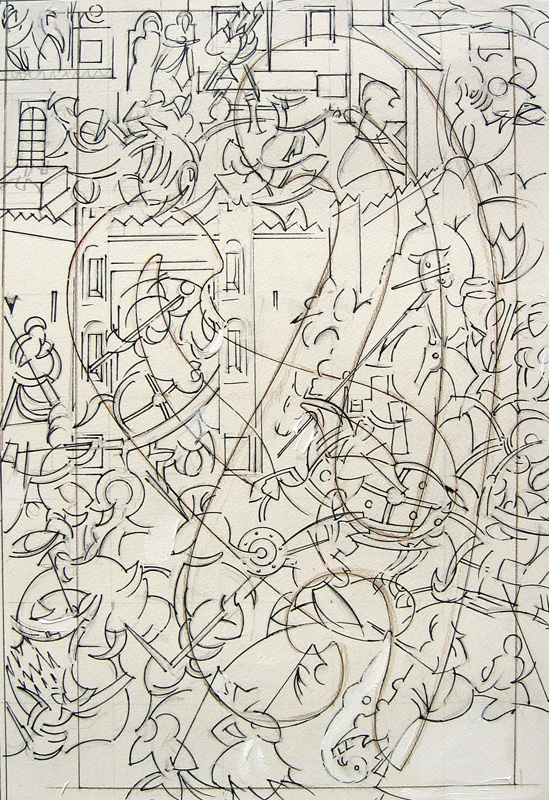
Persian One
19” x 28”
Graphite, sanguine and Sumi ink on watercolor paper
2003
People act before they fully know what their actions will bring about. Decisions are made with limited information, divided attention, and signals whose importance cannot be fully assessed at the moment of choice. A person commits to a course of action without being able to see all the conditions that action will set in motion. Only later do the effects of that action make clear what mattered and what could have been altered.
Because action proceeds under uncertainty, error does not appear at the moment of decision. At the time of choice, available information remains partial, situations remain ambiguous, and attention remains finite. Action therefore binds the agent to consequences whose full implications cannot be known in advance. What later appears obvious was not fully visible when the action began.
Responsibility begins to take shape as consequences disclose relations that action itself has revealed. Effects expose dependencies, constraints, and vulnerabilities that were previously unnoticed or underestimated. What emerges after the fact is not merely additional information, but a shift in relevance. Elements that once seemed secondary acquire weight, while assumptions that once guided action lose authority. Recognition follows commitment rather than preceding it.
As understanding develops after action, foresight is often overestimated in retrospect. Later awareness projects coherence backward onto moments that were shaped by uncertainty. Signs that appear decisive after consequences unfold are treated as though they had been unmistakable beforehand. This compression creates the impression that error resulted from neglect, rather than from the limits of perception under action.
Practices that depend on anticipation—such as planning, prediction, precaution, and control—assume a level of foresight that action itself cannot provide. These practices stabilize expectations, yet they remain vulnerable to the fact that relevance is often disclosed only through outcome. When results diverge from intention, the gap reflects not a failure of responsibility, but the temporal structure within which responsibility operates.
Responsibility matures through recognition rather than certainty. It develops as people acknowledge how their actions have bound conditions that now require response. What responsibility sustains is not the illusion of complete control, but the capacity to remain answerable to consequences that exceed prior understanding. Responsibility therefore does not end at the moment of decision; it continues as recognition adjusts agency to what action has revealed.
Responsibility does not arise from foresight that precedes action, but from recognition that follows commitment, as agency responds to consequences that could not be fully anticipated.
Ricardo F. Morín
31 de enero de 2026
Oakland Park, Fl

