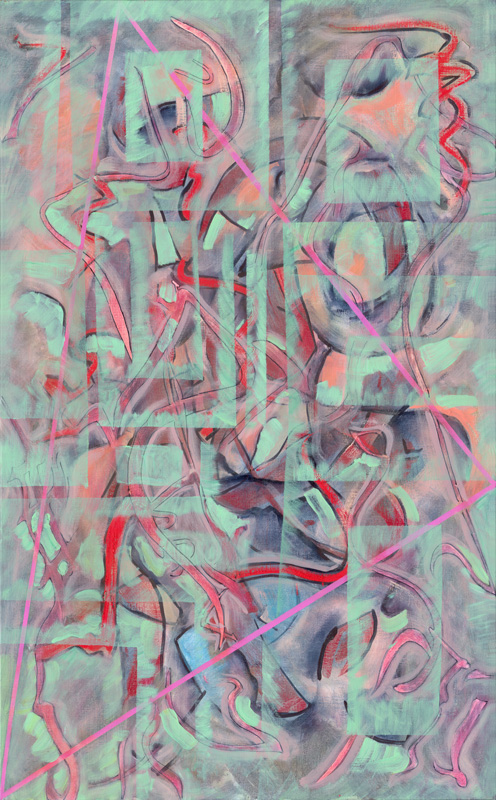
Triangulation Series Nº 7
37″ x 60″ x 2″
Oil on linen
2006
An elderly man stands beside a piece of luggage near the edge of a wide sidewalk at a public bus stop. A younger man notices him from a distance, and as he approaches, his attention remains fixed upon the older man rather than upon the bus stop itself. The older man perceives the stare as calculating, purposeful, and determined. There is room to pass. Instead, he changes course and strikes the older man with enough force to displace him from his position, then continues walking without explanation or apology. No dispute precedes the contact, and no serious injury follows.
The change of course makes the contact appear directed, though the encounter reveals little of what prompted it. Contempt, irritation, resentment, or the wish to impose upon someone may be imagined. None becomes certain merely because it would make the action intelligible. The younger man’s attention can be followed as far as the contact; his motive cannot be followed with the same assurance.
The older man was noticed before he was struck. Whatever the younger man perceived was sufficient to direct an approach, yet being noticed does not establish how much of a person has been acknowledged. Attention may be exact about where an act will arrive while remaining indifferent to the life upon which it intrudes.
Ordinarily, one passes a stranger without requiring an account of his presence. The man waiting beside his luggage need not explain where he is going or why he has stopped there. Almost nothing about him has to become known for the simple accommodation of passing without contact to occur.
Someone who would make that accommodation elsewhere may withhold it from a person expected to offer little resistance or to impose no consequence. Restraint weakens selectively, and another’s vulnerability can become an opportunity to act. Whether age or an expectation of impunity influenced the younger man’s choice remains unknown. Even if resentment were established, the question would remain why it found this particular recipient who is a total stranger.
The younger man had only to pass. Those charged with protecting a population face circumstances in which leaving the source of danger undisturbed may expose others to further injury. They may have to use force, and those awaiting their decision may have urgent reasons to demand it.
A government defending its territory, one invading another country, and one acting upon a danger it anticipates do not confront the same circumstances or bear the same responsibility. The suffering that follows cannot erase responsibility for how a war began. Neither can responsibility for its beginning settle every judgment concerning its subsequent conduct.
Those making the next decision must confront what remains dangerous, what has changed, and what another action could accomplish. People still exposed to attack may require defense long after the initial injury, while a brief operation may inflict harm for which no adequate ground ever existed. Neither the duration of a war nor the depth of the loss already suffered can settle what should happen next.
For those who have endured an attack, however, the first injury may remain more immediate than the changing circumstances through which a response proceeds. A danger recedes, an objective is reached, or further action creates risks absent at the beginning, while what happened continues to demand an answer. Asked what another strike would accomplish, a leader can return to the losses already sustained. The answer may be entirely sincere and still leave the question unanswered.
Grief may preserve a fidelity to the dead that no change in circumstances can satisfy. Political action nevertheless proceeds among the living. The demand that a loss receive an answer can persist after a particular response has ceased to serve the protection for which it was undertaken. At that point, reconsideration may be experienced as disloyalty even when the conditions of protection require it.
Those who receive the force may meanwhile become known chiefly through where they live or the people with whom they are associated. The person who directed an attack, the person who supported it, and the person who happened to live where it originated can be brought within the same field of action, though they do not bear the same responsibility. No one need deny that each has a history or a capacity to suffer. Those facts can be acknowledged and then set aside as having no bearing upon what is to be done.
The people exposed to an operation may be known to those directing it only through briefings, surveillance, casualty reports, and the observations passed through a chain of command. These can disclose what those deciding cannot see for themselves. Through a report, someone far from danger may learn what those enduring it have no means of bringing before him themselves. The distance between them can be reduced by the very procedures through which the decision is made.
Yet the reports may continue to arrive after the decision to proceed has ceased to admit reconsideration. Someone can register a loss accurately and still receive it only as something to be entered before the next authorization. The people affected remain visible in the record, while what becomes known about them is denied any bearing upon continuation. The information has arrived; the grounds of action have been protected from it.
Someone entrusted with the safety of others may knowingly cause harm while believing that refusing to act would cause more. The conflict may be real, and a clearer account of the consequences may not resolve it. But when those acting become certain that their responsibility supplies its own justification, the people who will bear the harm can appear only as a cost already accepted. Those who question the harm may then be treated as though they were opposing the protection itself.
An official may possess the authority to order an action and the means to carry it through, while those who will bear its consequences have little power to contest either. He can make the decision prevail without answering what he owes them. The question of justice remains, even when he acts with a sincere intention to protect others.
The older man was close enough to be deliberately approached. A distant population may be described in exhaustive detail. Neither proximity nor information establishes how another’s presence has entered a decision. Attention may narrow to what facilitates an act; an understanding of the suffering it will cause may also remain clear while the act proceeds. The failure can occur within attention itself.
A person may understand an injury, condemn its infliction, and nevertheless permit a comparable injury against someone placed outside the protection of that judgment. What is understood remains intact while its reach contracts. An account of the person’s fear, grievance, or conviction may make his conduct more intelligible without resolving how he accommodates what he condemns.
The younger man continues on his way without explaining himself. The absence of an explanation leaves a question about him; it does not make the force of the encounter disappear. What prompted him might become clearer if more were known, but he owed the older man the ordinary restraint that would have left him standing where he was.
The other remains someone whose life exceeds the terms under which he has been encountered. Grievance, threat, procedure, and necessity can each restrict what is permitted to matter about him. The person has not become fully known. The decision to act as though nothing further about him could matter may nevertheless already have been made.
Ricardo F. Morín
October 6. 2026
Bala Cynwyd, Pennsylvania
Author’s Note:
The conditions described here were examined earlier, through the structure of language rather than through particular encounters, in “The Grammar of Conflict”.

