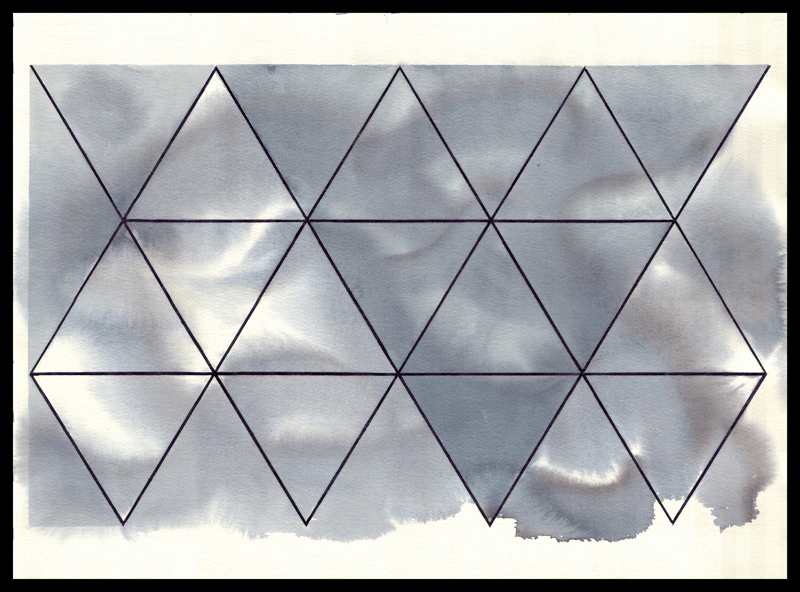
22″ × 30″
Watercolor, graphite, gesso, acrylic on paper
2010
I. The City of Glass and Silver
From the balcony the city offered itself to Astra as it offered itself to everyone who could afford the height: entire, luminous, composed, as if it had been arranged that afternoon for her inspection and would be put away again once she went in. The towers stood in their silver order. The avenues ran with light. At this hour, which was neither evening nor night but the long twilight the city had learned to keep, the skyline burned so steadily that the stars, she had once remarked at a dinner, seemed ashamed to show themselves; and the remark had been repeated, and admired, and printed under her name, so that it had long ago ceased to feel like something she had seen.
She had seen it, though. That was the peculiarity of the evening, if it was a peculiarity at all: she found herself seeing again what she had already said.
Below, the people moved through the streets with the ease of those who believe themselves looked after. She had known them for years only in this way, as a motion of light at a great distance, and she had known what they wanted because she had been paid, in one form or another, to tell them. Bitcoin had been the word for it. She had said the word in rooms like the one behind her and on screens that carried her face into rooms she would never enter, and she had said it well: freedom without permission, wealth without a master, the old hierarchies dissolved in a ledger that no one owned. She had believed it in the way one believes a part one performs nightly, which is to say with a conviction that never required her to look at it.
What was new, and she turned the observation over with something nearer to curiosity than to alarm, was not that the promise had grown thin. She had always known that a promise, sold widely enough, must thin. It was rather that she could now hear it thinning: a faint flatness beneath the melody, a note held a fraction too long, the kind of fault one notices first in a performance one has given oneself.
The air carried its usual perfume. It was expensive, and it was stale, and she had never before allowed the two words to stand together.
Nexys had built the city, or had let it be said so often that the difference no longer signified. His name was in the glass. Her own name, with its suggestion of stars, had pleased him for its sound; but it was her lineage he had wanted, she had always understood that, a family history of men who had governed by not being questioned. He had looked at her once, early, across a table, with the frank interest of a man appraising a foundation. She had admired the frankness. She had taken it for a kind of honesty, and perhaps it had been one.
She would not have said, had anyone asked her on the balcony, that anything had changed. Nobody asked. The wind moved her hair and she let it, because the long lenses in the opposite towers liked her hair moved by wind, and because she had long since stopped distinguishing between the things she did for them and the things she did.
Yet there were, in the streets she had only lately begun to look at directly, figures the light did not flatter: people sitting where no one sat, in the doorways of shops that sold nothing they could buy. There were the exchanges beneath the exchanges, where promises changed hands in place of work. She had known of them as one knows of weather in a distant province. She knew of them now as she knew the faces at her own receptions, and the comparison, which she had not invited, declined to leave.
What she noticed most, and noticed without wishing to, was the way she was looked at. For years the look of the crowd had been admiration, and she had worn it as she wore the city’s twilight, as a light that happened to fall on her. Lately it had altered. It was more patient than hostility: the look, as it seemed to her, that one gives a figure on a stage when one has begun to guess the ending.
She went in. The room was warm; the glass closed behind her without a sound; and the city remained exactly as composed as before, which she found, on reflection, that she had expected.
II. The Spectacle
The hall had been lit for him, as all the halls were. Light fell in measured quantities upon the marble and returned from it upon the faces, and the faces turned, as they had been arranged to turn, toward the doors.
Astra stood near the center and apart from it. She had mastered long ago the art of being at once the occasion’s ornament and its witness, and she practiced it now with the old ease and a new attention. She heard the voices rise and fall in their devotion. She felt the gaze of the room upon her and measured it, as she had always measured it, for the quality of its regard. It had once been bright. It had once asked nothing but to be allowed to admire. Tonight it asked something she could not at first name, and then, with a small inward start, could: it was waiting.
Not for her rise. That had happened.
Nexys arrived in the manner of a man who had rehearsed spontaneity: a pause at the threshold, a smile released by degrees, a hand lifted toward the cameras as though he had only that moment noticed them. The applause swelled to receive him. And then, across the room, his eyes found hers, and there passed between them something that no one else present could have seen.
It was not admiration, and it was not command. She could not have said what it was. It was gone before she could try.
He came to her through the crowd. “You look magnificent,” he said, and let his eyes stay a moment longer than the compliment required. “As always.”
“Is everything in order?”
“It will be perfect.” He glanced aside, not at anyone, merely aside. “It always is.”
Perfect. The word fell between them like a coin on glass and rang, she thought, a little false; and she was struck less by the falseness than by the fact that she had heard it. She had used the word herself a thousand times. She had never listened to it.
She moved on, and the crowd parted, and she let it. Speeches were made. She heard herself praised in a sentence she recognized as one she had written, months before, for another occasion. She smiled where smiling was expected. She was conscious through all of it of Nexys at her shoulder, and of a distance between them that he would not acknowledge and that she, she found, felt no wish to measure aloud.
Later she stood at the window where the noise thinned. The city below was indifferent to the hall, as cities are, its lights continuing without reference to anyone’s applause, and she thought how much of what she had called her world was held together by nothing firmer than an agreement to keep looking at it.
She heard his step and did not turn.
“Enjoying the performance?” There was mockery in it, and under the mockery something more brittle, as if the question had been meant to come out lighter than it did.
She took her time. “You always said this was your world.”
“It is.”
“Maybe it never was.”
He did not answer. She had known him to answer everything; she had known him to answer things not yet said; and now he stood beside her in a silence he had not chosen, and she watched him discover that he had nothing to put into it. He went back to the room. The applause went on behind her without interruption.
She did not feel, then, that she had won anything. She felt, rather, that she had said something before she knew she believed it, and that the saying had informed her that she did.
III. The Office
The message came in the morning, among the others that had gathered on her screen in the night like callers who had not been told she was out. Meet me at the office. We need to discuss the next steps. There was no charm in it. She had received a great many messages from Nexys and had read in each the small ornaments with which he dressed an order, and she noticed their absence as one notices a room from which a familiar piece of furniture has been removed.
The office was his in every line: dark wood, cold metal, angles that admitted no doubt. He sat behind the desk with a screen lighting his face from below, and his fingers moved on the polished surface in a rhythm he did not seem to hear. He did not rise. He indicated the chair.
“Sit.”
She sat. She had learned long ago that words were instruments, and that the most effective of them were the ones kept back; she had learned it, she reflected with a detachment that surprised her, chiefly from him.
“You saw it,” he said. “Last night. The way they looked.”
“Yes.”
“The way they’ve turned.”
She did not correct the word. It was not quite the word, but it was near enough, and she was interested to find that he had felt it too: that the look she had supposed was hers alone to notice had been noticed from the other side.
He pushed a folder across the desk. Inside were plans, measures, the language of order: the murmur would be met before it rose, the doubt answered before it spread. She turned the pages and saw that they were good, as his plans were always good, and that they were addressed to a crowd that no longer existed in the form for which they had been drawn.
“They won’t work,” she said.
He brought the flat of his hand down on the desk, and the sound went round the room and came back. “You think you understand this better than I do? I made them believe. I made all of it. And you,” and there he stopped.
She watched him stop. She watched the thought arrive in him, and saw that it had come to him from her face and not from anything she had done; and she understood, a moment after he did, what he had seen there.
“You’re not in this anymore,” he said slowly. “Are you?”
It would have been easy to deny. She had denied larger things in that chair. What surprised her was that the answer that came to her was neither denial nor confession but simply the truest sentence available, and that she had not composed it.
“I don’t think I ever was,” she said. “Not in the way you meant.”
She rose. He said something behind her, and then something louder, and she heard the words without following them, as one hears rain against a window in a room where one is reading. The elevator received her. The doors met with their soft sound, and in their polished steel she saw her own face, composed, admirable, exactly as it had always been; and it occurred to her, descending, that she had never yet looked at it as a stranger would.
IV. The Café
She did not go home. She could not have said where she meant to go; it was only that the elevator had delivered her to the street rather than to the car that waited beneath the building, and that she had let it.
The city she walked into was not the one she had looked at from the balcony. It was the same city, she reminded herself, and the reminder did not help. From above, the streets had been a motion of light; at their own level they were narrow, and wet, and full of people who were not moving at all. The towers, seen from beneath, were not silver but grey, and their glass gave back not the sky but the street, so that wherever she looked she saw the doorways and the debris and, now and then, a woman in a good coat walking among them who was herself.
Nobody looked at her. She had been looked at for so long that she could not at first identify the sensation, and when she did she found that it was not relief.
Her screen lit in her pocket twice. The first message was his, and she did not open it; whatever he had written would be addressed to the woman who had sat across his desk that morning, and she did not yet know whether that woman was the one now walking. The second came from a number she did not know. It named a corner and nothing else, and because she had nowhere she meant to go, she went.
The café stood at a corner where two streets met at an angle the city’s planners had evidently not intended. It was dim, and it smelled of old coffee and older smoke, and it had the air, which she recognized from certain rooms of her childhood, of a place in which time was permitted to stand still. A neon sign in the window made a pale stain on the table nearest it, and at that table, with her back to the door, sat a woman Astra knew.
She knew her in the way one knows the furniture of an institution. The woman had stood for years at the edge of Nexys’s occasions, never at the center, always nearby: a face that applauded at the proper moments, that held doors, that wrote down what was said. Astra had never learned her name. It came to her, standing in the doorway, that she had never needed to, and the thought was not comfortable.
“You’re late,” the woman said, without turning.
Astra sat down across from her. It did not occur to her until she had done so that she had not been invited, or rather that she had been invited in a manner so assured that the invitation had preceded her decision to come in.
“I wasn’t aware we had an appointment.”
“No,” the woman agreed. “You wouldn’t have been.” She looked at Astra with an interest that was frank without being friendly, the interest of someone confirming a description. “I thought you might run. People do, at about this point. They go abroad for a while, and come back, and find that nothing they left has changed, and are grateful.”
“What point is this?”
The woman considered the question as if it had been a real one. “The point at which you begin to see the room you’ve been standing in.”
Astra said nothing. She had been taught, and had taught others, that silence in a negotiation belongs to whoever can bear it longer; but she was conscious that this was not a negotiation, or not one whose terms she understood, and that her silence was less a tactic than a want of anything to say.
“You think you’re the first,” the woman went on, more gently. “Everyone who wakes up thinks so. It’s the one vanity we’re all allowed.” She turned her cup a quarter turn on its saucer. “I watched you sell it, you know. Year after year. I used to think you were the only one in those rooms who believed it.”
“And now?”
“Now I think you were the only one who needed to.”
It was said without malice, and it was the absence of malice that made it difficult to receive. Astra looked at the woman’s hands, which were not young, and at the cuff of her coat, which had been mended with care, and she heard in what she was being told something she could not at once dismiss: that the belief had been for her and not for them; that the crowd might have been content with the performance, and only the performer had required it to be true.
“Why are you telling me this?”
“Because you’ll want to do something,” the woman said. “People do, at this point. And I would rather you did it knowing what you are.”
“And what am I?”
The woman almost smiled. “That’s the question, isn’t it?”
She reached into her coat and laid a small object on the table between them: a device, dark, smooth, without markings, no larger than a cigarette case. She did not push it toward Astra. She left it exactly in the middle, where it belonged to neither of them.
“There are others,” she said. “Not many. Not the ones you would expect. When you use that, they’ll know you’re ready. What they do then is not up to me, and it won’t be up to you.”
“And you?”
“I’m too far in.” She said it plainly, as one names a distance. “I’ve stood beside him for eleven years. You can’t stand anywhere that long and pretend the ground isn’t yours.”
Astra heard the sentence, and heard beneath it that it was addressed to her as much as spoken of its speaker; and she did not, for the moment, let herself follow where it led.
She looked at the device. It was a small thing, and she was aware of wanting it to be larger: to be, in some visible way, equal to the occasion. It was not. It sat on the table in the stain of the neon as the woman’s cup sat, or the sugar bowl, and the fact that it was an object among objects seemed to her, obscurely, the most serious thing about it.
She took it. It was colder than she had expected, and lighter.
“I’m ready,” she said, and heard as she said it that the words had come out in the voice she used on screens.
The woman heard it too. Astra saw her hear it. Something passed across her face that was not disappointment, since disappointment would have required expectation, but was perhaps its more patient relative.
“Then go,” the woman said. “You’re not alone in this. That’s the good news.” She lifted her cup. “It’s also the other kind.”
Outside, the rain had begun, and the neon lay broken on the wet pavement in pieces that did not quite fit together. Astra stood under the awning with the device in her pocket beside the screen she had not answered, two small weights of nearly the same size, and it occurred to her that she could not, without taking them out, have said with certainty which was which.
V. The Gathering
She pressed it that night, alone, in the apartment that looked across at Nexys’s tower, and nothing happened. She had not known what she expected: a light, a sound, some acknowledgment proportionate to the step. The device lay in her palm exactly as before. It was only after she had set it down on the glass of the table, and gone to the window, and come back, that she found on her screen a message from the number that had named the corner, consisting of an address and an hour and nothing else.
What struck her, reading it, was not its brevity but its tone, which was one she knew. It was the tone of a summons that does not trouble to persuade, and she had last heard it that morning.
The address was in the old financial district: an unmarked building between a shuttered bank and a shop that repaired watches. She was admitted by a young man who did not ask her name. He led her down a corridor and into a long room where a dozen people sat at a table under lamps that had been placed, she noticed at once, so as to leave the head of the table in shadow.
She noticed it because she had placed such lamps herself.
Everyone looked up. She had been looked at in many rooms, and she knew the varieties; this was not admiration, nor the patient waiting of the gala, but assessment of a plainer kind, the look given to a delivery to see whether it has arrived intact. She bore it. She found that she was measuring the room as it measured her, and that the measurement came to her with a disagreeable ease, as if her eyes had been trained for precisely this.
The man at the head of the table rose. He was tall and broad, his face mostly in the shadow the lamps had been arranged to keep. “We’ve been waiting for you,” he said.
Twice in one day she had been told she was expected. She wondered whether there remained a room in the city she could enter as a surprise.
“You understand what’s at stake.” It was not a question, and she did not treat it as one.
She sat where he indicated, and he spoke. He spoke well, and at length, of fear: that the system ran on it, that power accumulated required more of it to keep, that fear could carry only so much before it gave way, and that when it gave way everything would come down with it. The room listened as rooms listen to a voice they have heard before. Astra listened too, and was aware, about halfway through, of the pleasure of hearing a speech well made, the professional pleasure, and then of where she had learned to feel it.
He paused where Nexys paused. He lowered his voice where Nexys lowered his. It was not imitation; she was almost sure he had never heard Nexys speak except as everyone had, on screens. It was simply that there were, it appeared, only so many ways of holding a room, and he had found the same one.
A woman beside her leaned close. “You think you’re ready for this?” she whispered, though not softly enough, so that it was a whisper meant to be overheard; and Astra recognized that too.
“I don’t think anyone is,” she said, to the table, and saw several of them approve the answer, and was dismayed to find that she had chosen it because she knew they would.
“What do we do now?” someone asked, and the man at the head of the table smiled.
“Now we wait. The moment will show itself.”
She thought that she had heard Nexys say very nearly that, years ago, before the city’s first great launch, and that it had been true then because he had arranged the moment in advance.
The door opened. A man came in late, took the chair opposite hers without apology, and sat for some time regarding the company with an expression she could not read: not contempt, not interest, but something like the attention of a physician at a bedside where the case is already known. At last his eyes came to her.
“You don’t know what you’re getting into,” he said.
“I’m not afraid.”
“No,” he said. “You will be.” And then, after a moment, more quietly, as if correcting a phrase: “Of what you’ll see.”
She took it for a threat, as everyone at the table seemed to take it. The room drew together; the man at its head said something sharp; the meeting went on.
When she left it was nearly morning. The street was empty. She looked back at the building, which had no sign, and at the bank beside it, whose sign had been taken down, and at the watchmaker’s, whose window was full of clocks that did not agree, and she understood, without wishing to, that she had spent the night in a room built on the same plan as the one she had left: only smaller, and darker, and lit by someone who had studied the same light.
VI. The Signal
The next message came four days later and said only: It’s time.
She had spent the four days as she had spent years: at a luncheon, at a fitting, at a screening where she was photographed beside a minister whose name she could not afterward recall. She had answered none of Nexys’s messages. She had noticed that they stopped on the second day, and she had not been able to decide which she found harder to bear, the messages or their absence.
The room this time was not the long room but one beneath it, where the lamps had been replaced by screens, and where the people from the table sat each before a screen of their own, so that the light on their faces came from below, as it had come on Nexys’s at his desk. She saw that and let it go. She was learning to let a great deal go, and was not sure the learning did her credit.
The man from the head of the table held out his hand, and she understood what for. She took the device from her pocket. She had carried it for four days, and her hand had grown used to it, and she was surprised by a reluctance to surrender it that had nothing to do with its purpose.
He set it on the table and asked for her hand. The device woke to her thumb and to no one else’s, and she saw that whatever was in it had been drawn from places where her name was the key: archives she could open because she had stood beside Nexys, and which no one at that table could have reached without her. He connected it to something, and the screens changed.
She had never been told what was in it, and she did not ask now, because she saw. Columns, names, dates, the accounts behind the accounts: the record of who had bought before the words she spoke and who had sold after them, and of how a market said to belong to no one had been steered, from beneath, by very few hands. Her own name was there. Not as a buyer. As a date: each of her appearances set down beside the movement that followed it, with the regularity of a tide table.
She had known. Not every figure, not the arithmetic, but the shape; she had known the shape as one knows the shape of a room in the dark, and she had never turned on the light because she had never needed to cross it.
“Now,” the man said, and someone pressed a key, and the records went out: not to any authority, nor to the press, but onto the exchanges’ own feeds, where those who traded would read them in the same columns as the price.
Nothing happened in the room. It was the second time in a week that a thing she had done produced nothing she could see, and she was beginning to understand that this was how such things happened. The screens went on showing their columns. Then, one by one, they began to show other things: the price, falling; then the exchanges, where the numbers moved too fast to be read; then, after an hour, the streets.
She watched the streets. She watched people gather at the windows of the exchanges beneath the exchanges, the ones she had known of as weather in a distant province, and she watched them stand there with the patience she had seen at the gala, which she had taken for the patience of people waiting for an ending they had guessed. Some of them were holding screens. On some of those screens, small and bright, was her own face, from an old appearance, saying the word.
Across the room, the man who had come late was not watching the screens. He was watching her.
She felt it as one feels a draft, and turned, and met his look, and he did not look away. There was nothing in his face she could have called triumph, or pity. It was the physician’s attention again: the case was proceeding as expected, and he was interested in the patient’s eyes.
Of what you’ll see. She heard it as though he had said it a second time, and heard in it only the threat.
Toward evening a fire was reported in the district of the old markets, and then another; the screens showed them small and orange and silent. The lights in the room faltered once, as lights do when a city draws more than it was built to give, and in that instant every screen went dark, each a pane of black glass, and in each of them she saw the room: the bent heads, the man at the head of the table, herself among them. Then the light returned, and the numbers with it, and she could not have said whether the face she had seen in the nearest screen had looked like hers.
They stayed through the night. Toward morning most of the others had gone, slipping out by twos, and she found herself alone in the room with the man from the head of the table. He sat before the screens with his hands flat on the table.
“It’s going faster than we planned,” he said.
“Did you plan it?”
He took her meaning, or a meaning, and answered it. “We planned to hold it when it fell.” He said it without emphasis, as a man states the next item on an agenda. “Someone has to. If we don’t, he will, or someone like him. That was always the point.”
She waited, and he heard what he had said in her waiting.
“You think that makes us the same,” he said.
“I didn’t say anything.”
“No.” He looked back at the screens. “You don’t need to, do you? You never did. It’s what made you so good at it.”
She did not answer. She was thinking, with a calm she did not trust, that he was right, and that what he had named was not her silence but what her silence had always been for: it let others finish the sentence, and own it, while she kept the face of someone who had never spoken it.
Through the one high window the sky was going grey over the old markets, where the smoke stood straight up in the windless air, and she thought, without any particular feeling, that it was the first time in years she had seen the city at an hour when it was not lit for anyone.
VII. The Mediator
Within a week the city had begun to describe what had happened, and the description was not the event.
She followed it on the screens, as everyone did. The fall was called, in the commentary, a correction; the record, a disclosure; the fires, regrettable. A commission was named. Its members were persons she had sat beside at dinners. By the ninth day the price had recovered a third of what it had lost, and the voices that announced this did so in a tone she knew to the syllable, because she had trained it into half of them: the tone of calm restored, which is always a little warmer than the calm it replaces.
Nexys did not appear. His absence was explained, and then explained again, and the explanations did not agree, and nobody seemed to mind.
The summons, when it came, came from the man at the head of the table, and it named not the building by the watchmaker’s but a hotel she knew, a quiet one, used for arrangements that were not to be seen being arranged.
He was there, in a sitting room on a high floor, and he was not alone. Across from him sat a man she had never seen, whose clothes were too good for the room and whose watch had the dull gleam of things that need not shine. He rose when she came in, which the other did not, and she registered the courtesy as one registers a signature.
“A mediator,” he said, before anyone could introduce him, and smiled as if the word were a small joke between them that she would come in time to enjoy. “We seem to have interests in common.”
She sat. She looked at the man from the head of the table, and he looked at the carpet, and she understood the shape of the meeting before a word of it was spoken, as she had understood the shape of the ledger.
The mediator spoke well too. Everyone, it seemed to her lately, spoke well. He spoke of the disorder of the past week as a thing that had served its purpose, and of a transition, orderly and managed, that would preserve what was valuable and correct what had been, he allowed, excessive. He did not mention Nexys. He did not need to; Nexys was in the room as a vacancy is in a room, shaping the furniture around it.
“And if we refuse,” she said.
He tilted his head, with what looked like real interest. “You misunderstand me. I’m not offering anything. I’m describing what has already happened, so that you can decide how you would like to be standing when it’s announced.”
He drew a folded paper from his jacket and laid it on the low table, and she thought of the device on the café table, set exactly between two people so as to belong to neither. This one he pushed, gently, toward her.
It was a statement. It was to be read by her, on the evening the commission reported, and it explained that she had helped to bring the truth to light because she had always believed in the promise and could not bear to see it betrayed; that the promise was larger than any one man; that it would now, at last, be kept.
She read it twice. It was very good. It was better than she would have written it. It had her rhythms, the slight delay before a key word, the way she let a sentence end on something softer than the listener expected; and it had, in the third paragraph, a phrase she had used once, years before, at a dinner, about the stars, slightly altered, so that it now seemed to be about the city’s future.
She looked up and found the mediator watching her with pleasure, the pleasure of a craftsman whose work is being examined by the only person able to appreciate it.
“Who wrote this?”
“Does it matter? It’s yours.” He opened his hands. “If you would rather not read it, there’s a great deal of footage. You’ve said most of it before.”
She heard, then, what she was being told. Her voice was not hers. It had been studied, and learned, and could be spoken without her; she had made it to be repeated, and it had been.
“You won,” the mediator said, kindly. “You simply haven’t recognized what winning looks like.”
She looked at the man from the head of the table. He met her eyes now, and she saw in his face not shame but relief, the relief of a man who has been offered better terms than he feared, and who would, she understood, sit on the commission.
“It’s finished, Astra,” he said.
She stood. Nobody stopped her. The mediator rose again, with the same courtesy, and did not take back the paper; he left it on the table, where it remained between the two men, folded, as she went out.
In the corridor there was a long mirror, of the kind hotels hang to make their corridors seem wider than they are, and she passed it without looking, and was aware of having done so.
VIII. The Vendor
It had rained while she was inside, and stopped, and the street before the hotel lay polished under its lamps. She did not take a car. She walked, as she had walked on the morning she left Nexys’s office, and the city let her, as it had then; but it was a different letting. Then it had not noticed her. Now, she thought, it had noticed, and had concluded that it need not.
The screens in the windows of the closed shops showed the chairman of the commission, then the recovered price, then, for a moment, her own face, from an old appearance, with the sound turned off. She watched her mouth shape a word she could no longer hear, and walked on before it finished.
At a corner near the old markets, where the smell of smoke still hung in the wet air, a man was cooking meat on a grill beneath a sheet of plastic strung between two posts. He was old, and he had the face of someone who had seen a good many things begin and had not been surprised when they ended. He turned the skewers without looking at them.
“Late to be walking,” he said.
She stopped. She thought of saying something. There were sentences available to her; there were always sentences. She could have asked him what one does when one learns that the fight was never one’s own; she could have made the question sound as though she had only just thought of it. She found that each of them, before it reached her lips, had the slight delay before its key word and the soft ending, and she let them go.
He held out a skewer. She had not asked for it. She took it, and its heat in the cold air startled her, and she ate standing, as she had not eaten in years.
He watched her eat. He did not watch as the crowd had watched, nor as the late man had watched, with the physician’s interest; he watched as a man watches a customer, to see whether the food is good. It came to her, slowly, that he did not know who she was. The screens behind him faced the street, and her face had passed across them twice while she stood there, and he had not once looked round.
“You look like someone deciding something,” he said.
She considered it. She could not have said what she was deciding; she was not sure she was deciding anything, or that there remained anything her deciding would touch. “Do I?”
“I’ve seen it.” He shrugged. “People stop here at this hour, they’ve got that look. Mostly they eat and go home.”
“And the others?”
“The others eat and go somewhere else.” He turned the meat. “You can’t tell which from the outside.”
She took out her screen. The messages from Nexys were there, unopened, from the first two days, and she opened the last of them. It said: Come back. Nothing has changed. She read it twice, and heard in it not his voice but the voice of the woman in the café, saying that people go abroad for a while, and come back, and find that nothing they left has changed, and are grateful. She put the screen away without answering, and was conscious that this, too, was not an answer.
She paid him. He took the money and gave her change with the same neutral attention, and when she thanked him he nodded as he would have nodded to anyone. She stood a moment longer than she needed to under the edge of his plastic sheet, because she was aware of something she did not wish to lose: the sensation of having been seen by someone who had no idea what he was looking at. She found that she wanted, more than she had wanted anything in a long time, to know what he had seen.
The grill hissed. The screens behind him changed to the weather. She went on, not toward the towers and not away from them, and the street received her as it would have received anyone.
…to be continued on October 21, 2026
Ricardo F. Morin
October 15, 2026
Oakland Park, Florida

