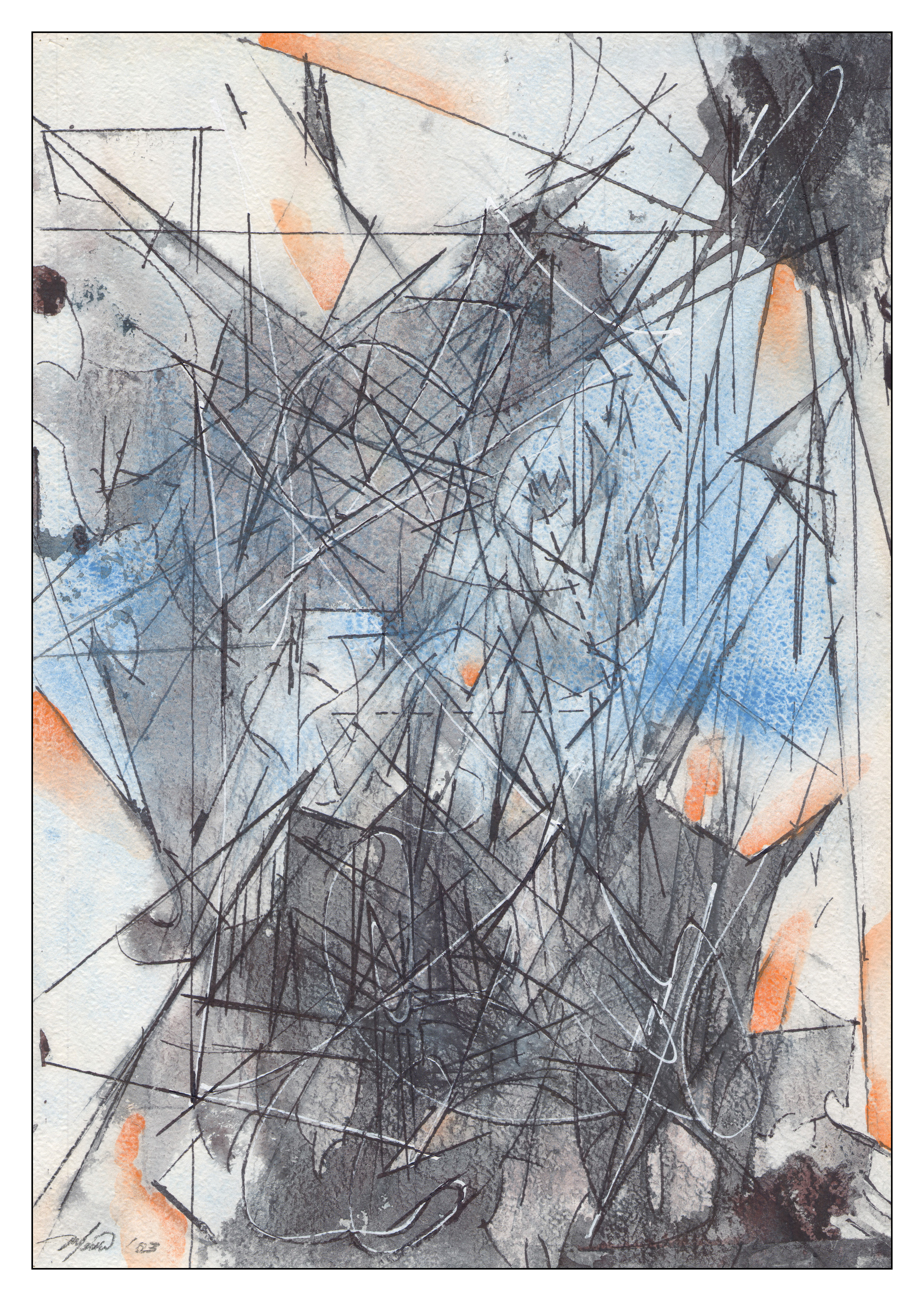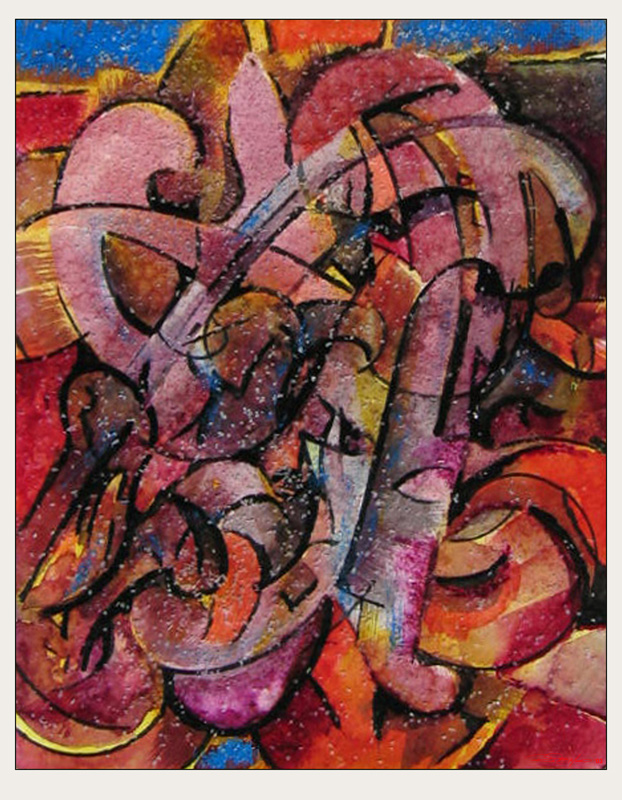
Ricardo F. Morín. Self-Portrait, 1988. Mixed media: collage, charcoal, and ink pen. 30 × 48 inches.
The traditions and rituals through which we identify ourselves should remain open to questioning, particularly when they concern guilt, repentance, and forgiveness. An inquiry into the meaning of fasting on Yom Kippur led me to ask how a practice of atonement relates to the conduct of daily life. The question can be asked of any such practice, within or outside a religion: does observing it deepen our attention to others, or can the observance take the place of that attention? Why should reflection occupy a separate place in a life whose every relationship already calls for awareness?
The difficulty begins when we treat living and examining how we live as separate activities. We act, withdraw, assess, and seek release from what we have done. Looking back is necessary because our understanding is incomplete and consequences often become apparent only later. But the limits of what we can know at any moment do not remove our responsibility to pay attention while acting. How we speak, decide, listen, or withhold a response already matters to other people. Reflection belongs within those acts, while we can still influence what happens, as well as afterwards, when we consider the consequences.
The observance that prompted this inquiry explicitly guards against allowing ritual to replace responsibility towards another person. Mishnah Yoma 8:9 (https://www.sefaria.org/Mishnah_Yoma.8.9) states that Yom Kippur does not atone for wrongs committed against another person until the wronged person has been appeased. The teaching requires us to address the person we have injured; observing the day alone cannot fulfil that obligation. The question of how reflection belongs within living nevertheless remains. Addressing an injury is a responsibility that follows wrongdoing. Attention to another person is already required within the relationship before any injury occurs.
A day devoted to repentance may renew an awareness that continues throughout the year. The distinction that concerns me is between reflecting from time to time and making reflection part of everything we do. An observance can support attention throughout daily life. Speaking, working, eating, and living with others already involve choices through which we acknowledge or disregard their circumstances. Where reflection is separated from daily conduct, sincerity in observing a ritual does not resolve the separation.
Questioning a ritual can be difficult because the practice may express commitments we hold deeply. A person may observe it out of religious conviction, loyalty to family customs, or a wish to be recognised as a member of a religious community. Belief in a teaching, loyalty to one’s family, and recognition by others are distinct considerations, even when they lead to the same observance. If questioning the practice feels like betraying one’s family or risking a community’s acceptance, defending the practice may take precedence over examining it. Careful examination can also express a serious commitment to understanding one’s faith. The reasons for valuing a ritual therefore need to be distinguished from the question of how observing it affects our conduct towards others.
Fasting may help someone concentrate by interrupting familiar habits. Even so, why should deprivation have a privileged role in making us more aware? Whatever attention a fast encourages must continue within daily life. When deprivation is understood as punishment, attention may shift from daily conduct to the intensity of one’s own suffering. My suffering does not, by itself, repair suffering I have caused. I may become absorbed in how much I can endure and pay less attention to the person affected by my conduct. The effort to become worthy again can then displace the work of understanding another person’s experience and making whatever repair is possible.
The preoccupation with recovering one’s own moral worth becomes especially restrictive when a wrong action is taken as proof of a defective human nature. Recognising our limitations can make us more receptive to correction. But a belief in our own defectiveness can keep us occupied with whether we are guilty, purified, forgiven, or restored. Our relation to others does not begin with an injury for which we must answer. When I listen to another person, I may discover how much my assumptions have left out. When we make a decision together, I need to consider the other person’s circumstances as well as my own. The other person’s reality precedes my judgment of how well I have responded to it. Responsibility develops within the relationship and includes answering for harm when harm occurs. A satisfactory judgment of myself does not bring my responsibility within the relationship to an end.
Confession can interrupt denial by acknowledging an injury we have concealed or refused to face. Naming the injury can make an honest conversation with the person affected possible. An apology may relieve the person who offers it while leaving the injured person’s loss or distrust unresolved. In admitting what I did, I show a willingness to answer for my conduct. The admission alone cannot establish that I have fulfilled my responsibility.
No one owes me forgiveness so that I may consider my moral account settled. Forgiveness may change a relationship profoundly, allowing affection or trust to become possible again. But forgiveness does not erase the consequences of what happened. Trust may need to be rebuilt, a loss may remain irreparable, and the injured person may still need to maintain boundaries within the relationship. My responsibility continues even if I am not forgiven. Nor can I demand that reconciliation take the form I desire.
To live consciously does not require us to sit in constant judgment of ourselves. Constant self-judgment would reproduce the self-absorption that can make penitence an obstacle to understanding others. Attention to others requires a willingness to notice, to listen, and to reconsider a judgment. Our intentions do not fully explain what our actions mean to someone else. Continuing attention means allowing what we learn from another person to influence how we proceed, even when that knowledge unsettles our understanding of ourselves. We will sometimes fail to pay attention. Recognising a failure can help us respond more adequately without turning the acknowledgment into a ceremony of self-condemnation.
The separation of reflection from daily conduct can arise within the most familiar relationships. We may presume that familiarity tells us what another person needs, or that good intentions spare us from reconsidering a decision. Confidence in our own understanding can then replace attention to a person whose needs or views may have changed. Confession, forgiveness, and observance belong within our relationships, but none can account for everything those relationships require of us. The daily acts of listening, choosing together, and responding to change have an ethical significance of their own, whether or not an injury ever occurs.
I cannot conceive of reflection as an interval after which one returns to living relieved of its demands. Reflection belongs to our participation in one another’s lives, through which we continually develop and revise our understanding. A ritual’s importance to our religious commitments or family customs does not settle the question of how observing it affects our conduct towards others. Another person’s reality remains before us after the words have been spoken and the appointed day has ended.
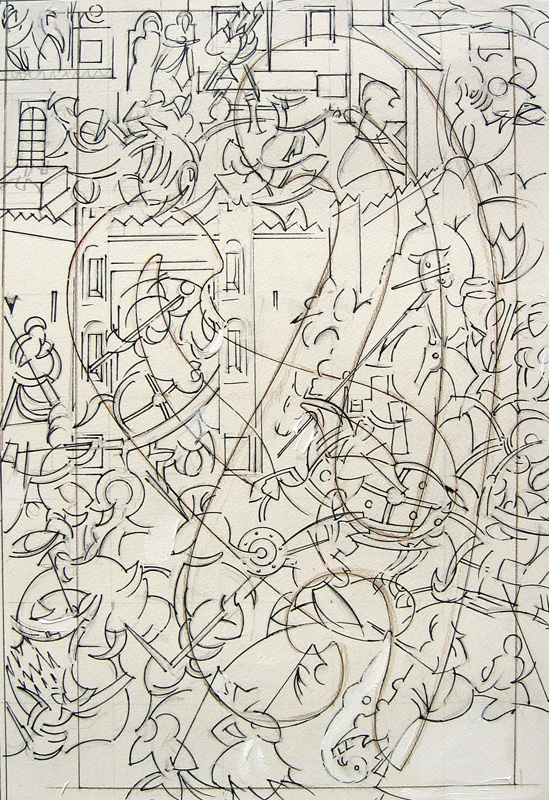
Ricardo F. Morín Interpretation after Gothic Church Interior, Dutch School, 17th century. Acrylic on board Approximately 12 × 18 inches 1978
The mind can conceive explanations that exceed what it can establish. The difficulty begins when it grants those explanations an authority that the available reasons do not justify. A conviction then acquires the standing of knowledge without satisfying the conditions that would warrant that recognition.
Theology, astrology, and science do not justify their claims in the same way. Theological arguments may appeal to revelation, tradition, religious experience, or philosophical reasoning. Astrological predictions assert relationships between celestial patterns and human affairs that require empirical support. Scientific explanations acquire credibility through evidence, testing, and comparison with alternatives, while remaining subject to correction. These differences matter: openness to examination does not make all claims equally credible, and the inability to disprove a claim does not establish its truth.
The fact that the mind conceives an explanation does not establish that its object is imaginary. The question is what warrants accepting it and what could require its revision. When every possible outcome is interpreted as confirmation, experience ceases to distinguish between the belief and its alternatives. If no outcome can count against it, its apparent agreement with everything that happens cannot by itself establish its validity.
Astrology illustrates how this problem can affect agency. An accepted prediction may influence decisions, discourage attempts, and narrow the possibilities a person is willing to pursue. When those choices help produce the anticipated outcome, the person may attribute it to destiny, overlooking the contribution of the expectation itself. The prediction need not come true to impose a limitation: a belief about what must happen can restrict what a person attempts to make happen.
Reflection requires the discipline of keeping conclusions open to examination and revising them when the evidence warrants it. That discipline extends to convictions that provide comfort, coherence, or direction. It requires neither perpetual indecision nor equal doubt about everything, but confidence proportionate to justification.
The endurance of an assertion does not by itself establish its truth, and its openness to revision does not mean that it must eventually prove false. The mind compromises its capacity for discernment when it ceases to examine the convictions that guide its decisions.
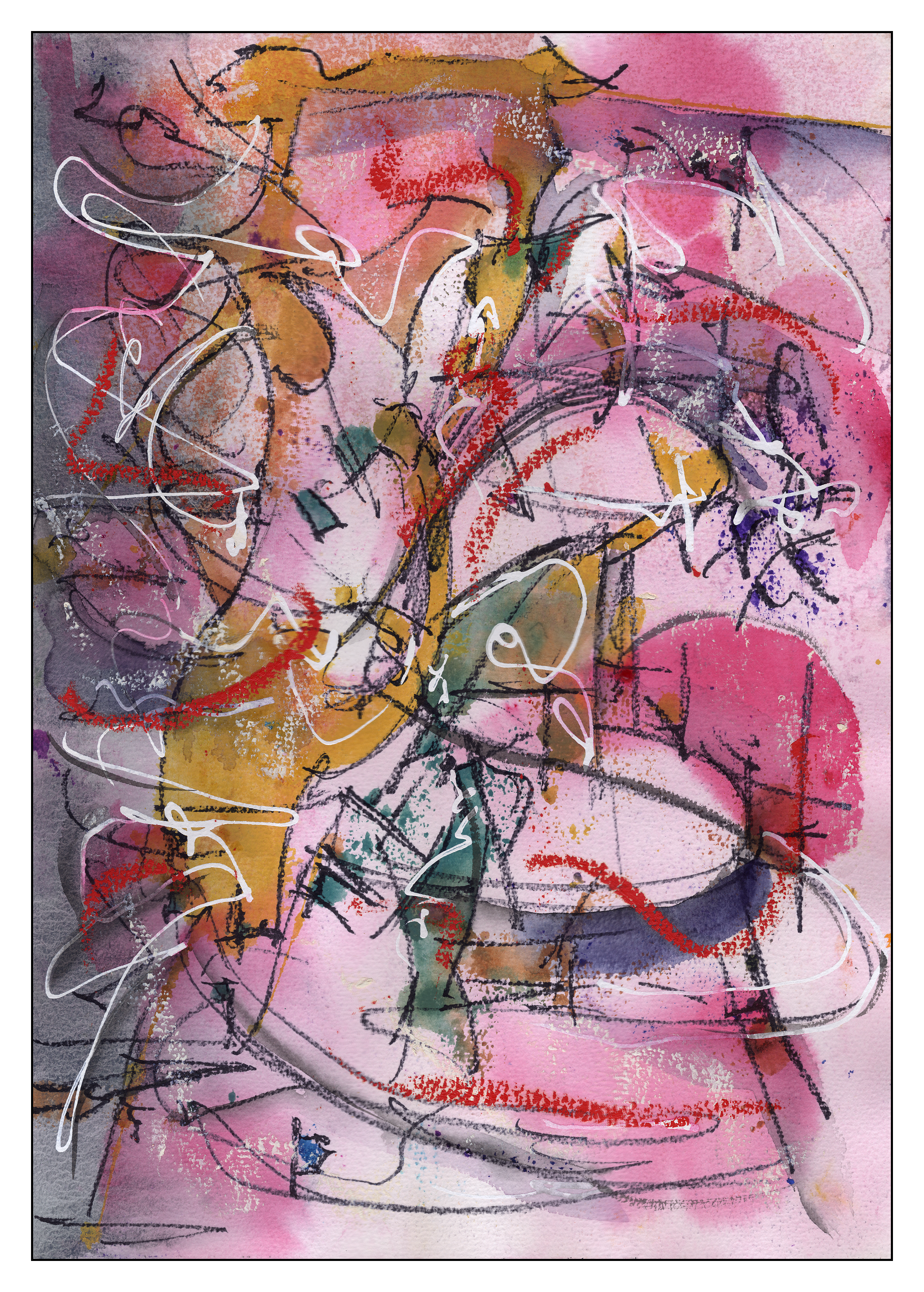
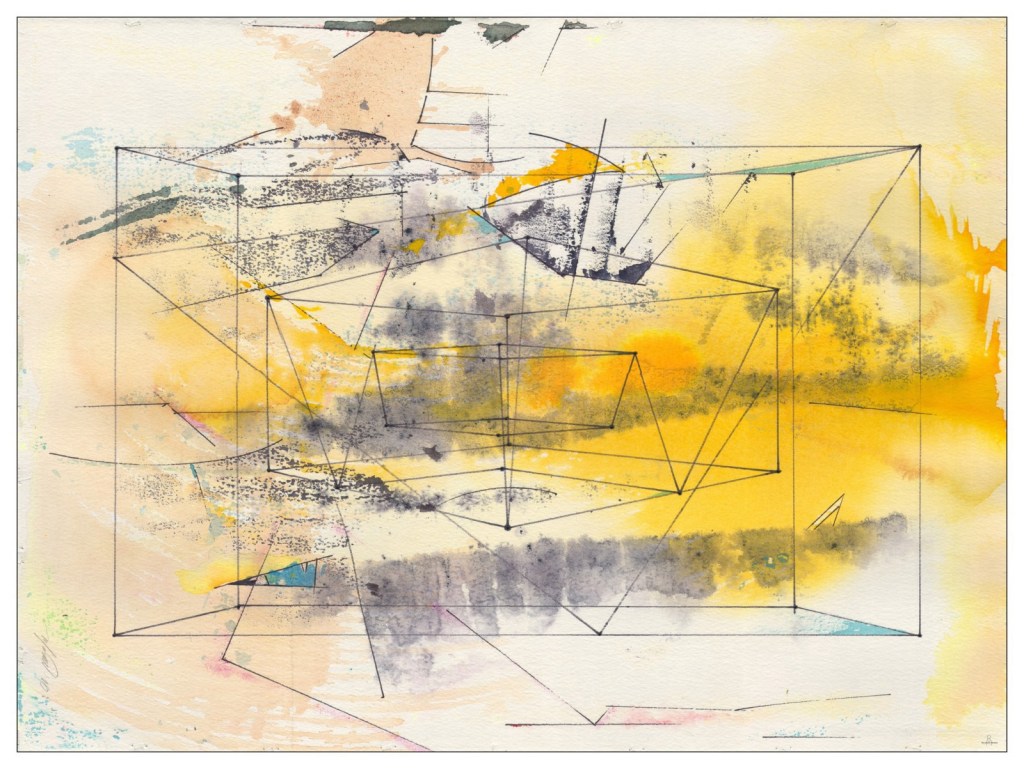
“Geometric Allegory” digital painting 2023 by Ricardo Morin (American visual artist born in Venezuela–1954)
*
Scope and Use
This entry forms part of the constitutional corpus presented in the Appendix, comprising the twenty-five constitutions of Venezuela and organized for consultation rather than sequential reading. Comparison proceeds by means of permanent rubric codes whose identities remain constant across the corpus; absent rubrics signify constitutional silence, while retired rubrics are not reassigned. Citations are anchored first on the article number and follow the CIDEP recension linked at the close of the entry. The full corpus definition, methodology, and citation convention are set forth in the Scope and Use note heading the 19th-Century Constitutions, which opens in the installment of “Unmasking Disappointment: Series XI”.
Ricardo F. Morín
Sept 20, 2026
Bala Cynwyd, Pennsylvania
*
13). The Constitution of 1909
The 1909 Constitución de los Estados Unidos de Venezuela [Constitution of the United States of Venezuela] was ratified by the Asambleas Legislativas de los Estados [State Legislative Assemblies], declared sanctioned by the Congreso [Congress] in Caracas on 4 August 1909, and promulgated in the same city on 5 August, under the presidency of Juan Vicente Gómez.
DOC-PRE—Preamble:
The charter designated its introductory formula as the Prólogo [Prologue]:
“The Congress of the United States of Venezuela, in the name of Almighty God, by authority of the Peoples of the Republic, and in exercise of the faculty conferred upon it by Article 130 of the Constitution, decrees the following: Constitution.”
The 1909 formula mentions the authority of the Peoples of the Republic and the exercise of the faculty conferred by Article 130. The 1904 formula identified the Congress as Constituyente [Constituent] and did not cite an article of the preceding Constitution (cf. 1904, formula of sanction: “THE CONSTITUENT CONGRESS OF THE UNITED STATES OF VENEZUELA, IN THE NAME OF ALMIGHTY GOD AND BY AUTHORITY OF THE PEOPLES OF VENEZUELA, DECREES THE FOLLOWING: CONSTITUTION”).
FND-TER—Territory:
The Constitution declared that the Venezuelan Nation was the union of all Venezuelans under one covenant of political association for their common utility (Title I, Art. 1; new). It declared the Nation forever and irrevocably free and independent of every foreign power or “denomination,” according to the word reproduced in the CIDEP recension, and prohibited any authority, Congress, or power from altering its republican, federal, democratic, elective, representative, alternating, and responsible form (Art. 2; new).
The territory comprised everything denominated the Capitanía General de Venezuela [Captaincy General of Venezuela] before the political transformation of 1810, with the modifications resulting from public treaties, and was divided for its better administration into Estados [States], Secciones [Sections], Distritos [Districts], Municipios [Municipalities], and Territorios Federales [Federal Territories] (Art. 3; cf. 1904, Title I, Art. 1: “The Territory of the United States of Venezuela is the same as that which, in the year 1810, corresponded to the Captaincy General of Venezuela, with the modifications resulting from Public Treaties.”).
The Secciones [Sections] that had formed the Pacto de Unión de 1864 [Covenant of Union of 1864] resumed their sovereignty and united to constitute twenty States enumerated and denominated by the charter (Art. 4; cf. 1904, Title I, Arts. 2–3, which organized thirteen States from Districts). Their boundaries were governed by those assigned to the former Provinces by the Law of 28 April 1856; boundary controversies were submitted to the arbitral tribunal prescribed by Article 144 (Art. 5; cf. 1904, Title I, Art. 3, § 2, and Title VIII, Art. 126). The States could unite without relinquishing the faculty to recover their separate character and, while united, retained their rights of representation in the Consejo de Gobierno [Council of Government] and the Corte Federal y de Casación [Federal and Cassation Court] (Arts. 6–8; new in relation to the territorial organization of 1904).
The Territorios Federales Amazonas y Delta Amacuro [Amazonas and Delta Amacuro Federal Territories] could acquire the category of States if they attained the population basis required to elect one Deputy and demonstrated the capacity to attend to public services and their expenditures (Art. 9; cf. 1904, Title I, Art. 4: “The Federal Territories may attain the category of State provided that they satisfy the following conditions: 1. To have at least one hundred thousand inhabitants; and 2. To demonstrate before Congress that they possess the capacity to attend to the public service in all its branches and to meet the expenditures that it requires.”). The Distrito Federal [Federal District] comprised the city of Caracas, its outlying parishes, and the Departamento Vargas [Vargas Department]; Caracas was the seat of the General Powers, although the Executive could establish its transitory residence at another place within the District (Art. 10; cf. 1904, Title I, Art. 5).
The national territory could not be alienated, leased, or ceded in any manner to a foreign power (Art. 11; cf. 1904, Title I, Art. 6: “The territory of the Nation may not be alienated in any manner to a foreign power.”).
POW-LEG—Congress:
The Legislative Power resided in a bicameral Congreso de los Estados Unidos de Venezuela [Congress of the United States of Venezuela], composed of a Cámara del Senado [Chamber of the Senate] and a Cámara de Diputados [Chamber of Deputies] (Title V, Sec. I, Art. 35; cont. 1904, Title V, Sec. I, Art. 30: “The Legislative Power is exercised by an Assembly denominated the Congress of the United States of Venezuela, composed of two Chambers, one of Senators and the other of Deputies.”).
Each State directly elected one Diputado [Deputy] for every thirty-five thousand inhabitants and one additional Deputy for an excess of fifteen thousand, with at least one Deputy for each State; it elected an equal number of Suplentes [Alternates]. The Deputies served four years and were renewed in their entirety (Arts. 36–38; cf. 1904, Title V, Sec. II, Art. 31: “To form the Chamber of Deputies, each State shall elect by direct vote and in conformity with its Election Law one Deputy for every forty thousand inhabitants, and one additional Deputy for an excess of twenty thousand. […] The Deputies shall serve six years in their functions.”). Each Asamblea Legislativa Estatal [State Legislative Assembly] elected from outside its membership two principal Senators and two Alternates, likewise for four years (Arts. 40–41; cf. 1904, Title V, Sec. III, Art. 35: “To form this Chamber, the Legislative Assembly of each State shall elect from outside its membership two Principal Senators and two Alternates […] The Senators shall serve six years in their functions.”).
Both Chambers judged the qualifications of their members, adopted their regulations, exercised disciplinary authority, enjoyed immunity during the period fixed around their sessions, and observed the prescribed incompatibilities (Arts. 43–56; cont. 1904, Title V, Sec. IV, Arts. 38–51). When assembled as Congreso [Congress], they examined the presidential message and ministerial accounts and elected the President of the Republic, the Consejo de Gobierno [Council of Government], and the Corte Federal y de Casación [Federal and Cassation Court]. When acting separately as co-legislative bodies, they sanctioned national legislation and exercised the powers respecting taxation, currency, debt, loans, census, sanitation, treaties, national contracts, weights and measures, military organization, Federal Territories, and declarations of war (Arts. 57–58; cf. 1904, Title V, Sec. V, Arts. 52–53).
Bills received three readings in each Chamber. Once sanctioned, they were communicated to the President for execution and publication; the Minister of the respective branch could also initiate designated codes after prior publication of the bill in the press (Arts. 59–72; cf. 1904, Title V, Sec. VI, Arts. 54–67).
ECO-TES—Treasury:
The Congreso [Congress] decreed national taxes, determined all matters pertaining to the national debt and its interest, decreed loans upon the credit of the Nation, and sanctioned the Presupuesto General de Rentas y Gastos Públicos [General Budget of Public Revenues and Expenditures] (Title V, Art. 57, nums. 6, 10, 11, and 15; cont. 1904, Title V, Art. 52, nums. 5, 9, 10, and 14: “To decree national taxes”; “To determine all matters pertaining to the National Debt and its interest”; “To decree loans upon the credit of the Nation”; “To sanction the General Budget of Public Revenues and Expenditures”). The Ministros del Despacho [Ministers of the Departments] presented annually the General Budget and the general account of the preceding year (Title VI, Art. 103; cf. 1904, Title VI, Art. 86, which required biennial accounts).
No expenditure could be made from the Tesoro Nacional [National Treasury] without an express congressional appropriation in the General Budget or an additional credit approved by the Consejo de Gobierno [Council of Government]. Officials acting in contravention incurred civil liability to the Treasury; ordinary expenditures had precedence over extraordinary expenditures, and every additional credit had to be submitted to Congress for approval (Title VIII, Art. 134; cf. 1904, Title VIII, Art. 116: “No expenditure shall be made from the National Treasury for which Congress has not expressly appropriated an amount in the General Budget of Public Expenditures […] In every disbursement, ordinary expenditures shall have precedence over extraordinary expenditures.”).
Neither the Legislative Power nor any authority of the Republic could issue paper currency, declare banknotes or other paper-represented values to be legal tender, or authorize the coinage of silver or nickel currency without prior congressional authorization conferred through the ordinary legislative procedure (Art. 135; cont. 1904, Title VIII, Art. 117). Exports remained free from duties throughout Venezuela (Art. 133; cf. 1904, Title II, Art. 7, Basis 10: “Not to impose contributions upon national products destined for exportation.”).
POW-EXE—Executive:
The Administración General de la Unión [General Administration of the Union] belonged to the Ejecutivo Nacional [National Executive] in every matter not attributed to another authority. The Executive was exercised by the Presidente de los Estados Unidos de Venezuela [President of the United States of Venezuela], with the Ministros del Despacho [Ministers of the Departments] as his organs and with the Consejo de Gobierno [Council of Government] in the powers expressly conferred upon that body (Title VI, Arts. 73–74; cf. 1904, Title VI, Arts. 68–69: “[…] the Federal Executive […] is exercised by a Magistrate denominated the President of the United States of Venezuela, in union with the Ministers of the Departments, who are his organs.”).
Within the first fifteen days after their installation, the Chambers assembled as Congreso [Congress] elected the President directly, in a public and permanent session and by secret ballot; the citizen obtaining an absolute majority of the members present was elected (Arts. 75–77; cf. 1904, Title VI, Arts. 70–72: “There shall be an Electoral Body composed of fourteen members of the National Congress, elected by it […]”). The Constitution of 1909 does not contain the Cuerpo Electoral [Electoral Body] prescribed by Articles 70–72 of 1904.
The President was required to be Venezuelan by birth, of secular status, more than thirty years of age, and in possession of his civil and political rights (Art. 78; cf. 1904, Title VI, Art. 73: “The President of the United States of Venezuela shall be Venezuelan by birth and more than thirty years of age […]”). Temporary or absolute absences were supplied by the Vocal [Member] presiding over the Consejo de Gobierno [Council of Government]. If an absolute vacancy occurred during the first two years of the term, the Councillor exercising the presidency convened Congress to elect the citizen who would complete the term (Art. 79; cf. 1904, Title VI, Art. 74, which prescribed First and Second Vice Presidents).
The President’s exclusive powers included appointing and removing the Ministers; administering the Federal District and the Federal Territories; directing war and commanding the Army and Navy; executing and publishing the Constitution, laws, and decrees; issuing regulations without altering the spirit or rationale of the law; organizing the Army and the National Militia; negotiating loans decreed by Congress; supervising national revenues; regulating posts, telegraphs, and telephones; and exercising the other enumerated functions (Art. 80; cf. 1904, Title VI, Arts. 75 and 80).
With the consultative vote of the Consejo de Gobierno [Council of Government], the President convened Congress extraordinarily, declared a war decreed by Congress, directed the prescribed proceedings of the Procurador General de la Nación [Procurator General of the Nation], administered public lands, mines, saltworks, and the distilled-spirits revenue, directed diplomatic negotiations, concluded national contracts, and could exclude or expel designated foreigners (Art. 81). With the deliberative vote of the Council, he exercised the extraordinary powers applicable during foreign war, internal commotion, or armed rebellion; employed the public force to terminate armed collisions between States or suppress rebellions; and granted amnesties and pardons (Art. 82; cf. 1904, Title VI, Art. 80, nums. 8, 9, and 11).
The President presented an annual message to Congress (Art. 83; cont. 1904, Title VI, Art. 76). He could not be reelected for the immediately succeeding term, even if he had not completed the term for which he was elected. Neither could a citizen who had exercised the presidency during the last year of the preceding term, nor a relative of either citizen within the fourth degree of consanguinity or the second degree of affinity, be elected for the immediately succeeding term (Art. 84; cf. 1904, Title VI, Art. 77: “The President of the United States of Venezuela may not be reelected for the immediately succeeding term.”). His salary was fixed by law and could not be increased except for the succeeding term (Art. 85; cont. 1904, Title VI, Art. 78).
The President ceased exercising his functions on 19 April of the final year of the term; on that date, the President of the Corte Federal y de Casación [Federal and Cassation Court] assumed the Executive until the newly elected President took office (Art. 86; cf. 1904, Title VIII, Art. 133: “[…] precisely on 23 May, the President […] shall cease […] and the Minister of Interior Relations shall enter upon the exercise of the Presidency […]”). The President was responsible for treason against the Fatherland and ordinary crimes (Art. 87; cont. 1904, Title VI, Art. 79).
The charter established a Consejo de Gobierno [Council of Government] composed of ten Vocales [Members], elected by Congress every four years to represent ten regional groupings. The Council rendered the consultative and deliberative votes required for presidential powers, authorized additional credits, and could report upon legislation and administration (Arts. 88–97). The Constitution of 1904 does not contain a Consejo de Gobierno [Council of Government]. The Ministros del Despacho [Ministers of the Departments] were the President’s sole and necessary legal organs, countersigned his acts, incurred personal responsibility for them and joint responsibility for matters resolved in the Consejo de Ministros [Council of Ministers], and presented annual reports and accounts to Congress (Arts. 98–105; cf. 1904, Title VI, Arts. 81–88).
POW-JUD—Judicial Power:
The Judicial Power resided in the Corte Federal y de Casación [Federal and Cassation Court] and in the other tribunals and courts established by law. Judicial officials were responsible for treason against the Fatherland, bribery or corruption, violation of the Constitution and laws, and ordinary crimes (Title VII, Arts. 106–107; cont. 1904, Title VII, Arts. 89–90).
The Corte Federal y de Casación [Federal and Cassation Court] was the Supreme Tribunal of the Federation and the States. It was composed of seven Vocales [Members] elected by Congress every four years; the groupings of States and the Federal District presented two candidates, and those not elected became Alternates (Arts. 108–111; cf. 1904, Title VII, Arts. 91–94: “The Federal and Cassation Court […] shall be composed of seven Members […]”, whose members served six years). The Members were required to be Venezuelan by birth, more than thirty years of age, and attorneys of the Republic (Art. 108, sole paragraph; cont. 1904, Title VII, Art. 91, sole §).
The Court heard constitutional accusations against the President, Councillors of Government, Ministers, the Procurador General [Procurator General], the Governor of the Federal District, and its own members; proceedings against senior State officials; diplomatic causes; civil suits in which the Nation was defendant; cassation proceedings; prize causes; jurisdictional controversies; the constitutionality of laws; the nullity of acts contrary to the Constitution or State autonomy; controversies arising from presidential contracts; the recognition of foreign judgments; and the other matters attributed by the Constitution and laws (Art. 112; cf. 1904, Title VII, Art. 95). It presented annually to Congress an account of its work and a report upon impediments to the uniformity of civil, criminal, and commercial legislation (Art. 113; cf. 1904, Title VII, Art. 96, which required a biennial account). Its Members could not accept employment dependent upon the Executive while exercising their functions, and their remuneration was fixed by law (Arts. 114–115; cont. 1904, Title VII, Arts. 97–98).
The Ministerio Público [Public Ministry] was entrusted to the Procurador General de la Nación [Procurator General of the Nation], who was required to be Venezuelan by birth, more than thirty years of age, and an attorney, and who served two years with two Alternates (Arts. 116–118; cont. 1904, Title VII, Arts. 99–101). The Procurator promoted the execution of laws, issued legal opinions, supervised federal officials, instituted the prescribed accusations, exercised the Ministerio Fiscal [Fiscal Ministry], and defended the interests of the Nation (Art. 119; cont. 1904, Title VII, Art. 102).
Recensional note: the CIDEP reproduction of Article 109 omits the Sixth Grouping and enumerates six groupings for a Court of seven Members. The same recension proceeds from Article 130 to Article 132. This corpus records both lacunae without supplying text.
POW-SUB—Subnational Government:
The States of the Union were autonomous and equal as political entities and retained the sovereignty not delegated by the Constitution, subject to the obligations of the Bases de la Unión [Bases of the Union] (Title II, Art. 12; cont. 1904, Title II, Art. 7: “The States forming the Venezuelan Union are autonomous and equal as political entities and retain in its plenitude the sovereignty not delegated by this Constitution […]”). Every matter not expressly attributed to the General Administration of the Nation belonged to the States; their constitutional terms were to endure four years from 20 February 1910 (Title VIII, Art. 120; cf. 1904, Title VIII, Art. 103: “[…] the constitutional terms of their Public Powers shall be three years, counted from 1 January 1905.”).
The State tribunals were independent, subject to no review other than that of the Corte Federal y de Casación [Federal and Cassation Court] in the cases permitted by law (Art. 122; cont. 1904, Title VIII, Art. 105). Every act of the Legislative Chambers or the Federal Executive that violated rights guaranteed to the States or attacked their autonomy was to be declared null by the Court (Art. 123; cont. 1904, Title VIII, Art. 106).
The Federal Government could not maintain within the States resident officials vested with jurisdiction or authority other than the express exceptions for the Treasury, Public Instruction, administration of mines, public lands, saltworks, and the distilled-spirits revenue, and military services at frontiers, fortresses, parks, naval stations, and authorized ports (Art. 129; cont. 1904, Title VIII, Art. 112). Any citizen could accuse national or State officials before the tribunals or authorities designated by law (Art. 132; cont. 1904, Title VIII, Art. 115). For the civil and political acts of the States, the governing population was that determined by the latest census approved by Congress (Art. 151; cont. 1904, Title VIII, Art. 134).
CON-AMD—Amendment of the Constitution:
The Constitution admitted amendments and additions, but Congress could decree them only in ordinary sessions, upon the request of three-fourths of the State Legislative Assemblies meeting in ordinary session and upon the points on which a majority of the States concurred. They could not enter into force until after the renewal of the Public Powers that had requested or sanctioned them (Title VIII, Art. 145; cf. 1904, Title VIII, Art. 127: “This Constitution is susceptible of amendments or additions; but neither may be decreed by the National Congress except in ordinary sessions and when requested by three-fourths of the Legislative Assemblies of the States in ordinary sessions.”).
The amendments followed the ordinary legislative procedure; once approved by Congress, its President remitted them to the Legislative Assemblies for definitive ratification. Congress could also initiate amendment, but it required ratification by three-fourths of the Assemblies. Irrespective of the origin of the initiative, the definitive vote returned to Congress for canvass (Arts. 146–149; cont. 1904, Title VIII, Arts. 128–131).
CIV-SUF—Suffrage:
All Venezuelans more than twenty-one years of age who satisfied the constitutional and legal conditions were electors and eligible for public office (Title III, Art. 15; cont. 1904, Title III, Art. 10: “Venezuelans more than twenty-one years of age are electors and eligible, subject only to the conditions expressed in this Constitution and the laws.”). Freedom of suffrage appeared among the guaranteed rights (Art. 23, num. 11; cont. 1904, Title III, Art. 17, num. 11).
The Bases de la Unión [Bases of the Union] required direct vote for the Concejos Municipales [Municipal Councils], the Asambleas Legislativas [Legislative Assemblies], and the Cámara de Diputados [Chamber of Deputies], and indirect or delegated vote for the other officials of popular election; both forms were to be secret and based upon the electoral census (Title II, Art. 12, num. 19; cf. 1904, Title II, Art. 7, num. 19: “[…] the direct vote, and for their other officials of popular election, the direct or delegated vote […]”). During electoral periods, the National Public Force and the forces of the States remained quartered during popular elections (Title VIII, Art. 137; cont. 1904, Title VIII, Art. 119).
CIV-CIT—Citizenship:
The Constitution distinguished between Venezuelans by birth and by naturalization (Title III, Art. 13; cont. 1904, Title III, Art. 8: “Venezuelans are such by birth or by naturalization.”). Venezuelans by birth were those born in Venezuela and the children of Venezuelan parents, irrespective of their place of birth. Venezuelans by naturalization were the children of a Venezuelan father or mother by naturalization, born outside the Republic, who established domicile in the country and manifested their will; persons born in the Hispanic-American Republics who established residence and declared their will; foreigners who obtained letters of naturalization; and a foreign woman married to a Venezuelan under the prescribed conditions (Art. 13; cf. 1904, Title III, Art. 8).
The declaration of will was made before the Registrador Principal [Principal Registrar] of the applicant’s domicile and transmitted to the Executive for publication in the Gaceta Oficial [Official Gazette] (Art. 14; cont. 1904, Title III, Art. 9: “The declaration of the will to be Venezuelan must be made before the Principal Registrar […] who […] shall send a copy of it to the National Executive for publication in the Official Gazette.”). Venezuelans were required to serve the Nation in conformity with law and enjoyed equal rights throughout the territory of the Republic (Arts. 16–17; cont. 1904, Title III, Arts. 11–12).
The rights of citizenship were suspended for undertaking to serve against Venezuela; for a sentence carrying interdiction or disqualification; for an official’s acceptance of offices, honors, or rewards from a foreign government without authorization from the Senate; and for judicial interdiction (Art. 18; new). The rights and duties of foreigners were remitted to law, subject to the provisions respecting political participation, indemnities, and treaties (Arts. 19–22; cont. 1904, Title III, Arts. 13–16).
RTS-GAR—Rights:
The Nation guaranteed the inviolability of life and abolished capital punishment, irrespective of the law establishing it or the authority ordering it (Title III, Art. 23, num. 1; cf. 1904, Title III, Art. 17, num. 1: “The inviolability of life, capital punishment being abolished.”). It protected property, subject to legislative contributions, judicial decision, and taking for public utility after prior indemnification and adversarial proceedings (Art. 23, num. 2; cont. 1904, Title III, Art. 17, num. 2).
The charter guaranteed correspondence and private papers, the domestic home, personal liberty, expression and the press, transit, industry, assembly and association, petition, suffrage, education, religion, individual security, and equality (Art. 23, nums. 3–15). The text of 1909 provided that, in causes relating to expression, the accused could not be detained before final judgment; included the right to depart from the Republic and return with one’s property; subjected industry to public order and good morals and prohibited games of chance, raffles, and lotteries; prohibited a second trial for the same offense; and declared infamous punishments abolished (cf. 1904, Title III, Art. 17, nums. 6–8 and 14).
The enumeration did not prevent the States from recognizing other rights and did not deny other rights that might belong to citizens (Arts. 24–25; cf. 1904, Title III, Art. 18: “The preceding enumeration does not restrict the faculty of the States to accord other rights to their inhabitants.”; new in relation to the general clause of Art. 25). A person who issued, signed, executed, or ordered the execution of decrees or resolutions violating the guaranteed rights was culpable under law and was required to indemnify the injured party (Art. 26; cf. 1904, Title III, Art. 20). Regulatory laws that impaired those rights were unconstitutional and without effect (Art. 27; cont. 1904, Title III, Art. 21).
REG-MIL—The Armed Force:
The Congreso [Congress] fixed annually the number of naval and land forces, issued Army ordinances and the law for the formation and replacement of the forces, determined the manner of conferring military grades and promotions, conferred grades from Lieutenant Colonel upward, and decided upon the admission of foreigners into the service of the Republic (Title V, Art. 57, nums. 23–27). The power respecting admission of foreigners belonged to Congress under Article 57, num. 23, of 1909 and to the Executive under Article 80, num. 21, of 1904. The President directed war, commanded the Army and Navy, and organized the Army and the National Militia (Title VI, Art. 80, nums. 6 and 10; cf. 1904, Title VI, Arts. 75, num. 6, and 80, num. 4).
During foreign war, internal commotion, or armed rebellion, and after a declaration that public order was disturbed, the President exercised the enumerated extraordinary powers with the deliberative vote of the Consejo de Gobierno [Council of Government] (Art. 82; cf. 1904, Title VI, Art. 80, num. 8). The Fuerza Pública Nacional [National Public Force] was divided into naval and land forces and was composed of citizen militias; it could be increased in time of war. Military and civil authority could not be exercised simultaneously by the same person or corporation except during disturbances of public order. During elections, the National Public Force and the State forces remained quartered. The armed force could not deliberate, was passive and obedient, and could require assistance only through the civil authorities (Title VIII, Arts. 124–127, 137, and 140; cont. 1904, Title VIII, Arts. 107–110, 119, and 122).
The Constitution of 1909 does not contain the office of Comandante en Jefe del Ejército Nacional [Commander in Chief of the National Army]. Article 43 of the Estatuto Constitucional Provisorio [Provisional Constitutional Statute] of 19 April 1914 regulated that office for the provisional period. Article 57, num. 2, of the June 1914 Constitution authorized Congress to appoint that officer annually.
REG-REL—Religion:
Religious liberty could not impair the Republic’s derecho de Patronato [right of Patronage], which was to be exercised in conformity with law, and the Federal Executive retained supreme inspection over every established or future form of worship (Title III, Art. 23, num. 13; cf. 1904, Title III, Art. 17, num. 13: “Religious liberty in conformity with the laws and under the supreme inspection of the President of the Republic.”). The Nation was to exercise the Patronato Eclesiástico [Ecclesiastical Patronage] in conformity with the Law of 28 July 1824 (Title VIII, Art. 128; cont. 1904, Title VIII, Art. 111).
ECO-INF—Infrastructure:
The States ceded to the Federal Government the territory necessary for fortresses, wharves, warehouses, shipyards, penitentiaries, and other works indispensable to the administration (Title II, Art. 12, num. 7; cont. 1904, Title II, Art. 7, num. 7: “To cede to the Government of the Federation the territory necessary to erect fortresses, wharves, warehouses, shipyards, penitentiaries, and other works indispensable to the general administration.”). They reserved to the Federal Power legislative and executive jurisdiction over maritime, coastal, and river navigation, wharves, and national roads; roads passing beyond the boundaries of one State and leading to another State, the Federal District, or the Federal Territories were national roads (Art. 12, num. 9; cont. 1904, Title II, Art. 7, num. 9).
The President regulated federal posts, telegraphs, and telephones and could create or abolish stations or offices when urgently required, reporting to Congress (Title VI, Art. 80, num. 14; cont. 1904, Title VI, Art. 80, num. 17). Congress legislated respecting the Federal District and the Federal Territories, sanitation, statistics, and works encompassed within the general powers of the Federal Power (Title V, Art. 57, nums. 4, 12, 16, and 21).
CON-FIN—Final Provisions:
The Constitution was to be promulgated and enter into force when Congress, after canvassing the votes of the State Legislative Assemblies, ascertained ratification of the amendments and additions (Title VIII, Art. 153; new). It opened a provisional period until 19 April 1910 for preparation of the definitive organization of the Republic (Art. 154; new). During that period, Congress was to elect a Provisional President under the formalities established for the office, and the Provisional President could issue the measures, decrees, and regulations necessary for political and administrative organization (Transitory Provisions, Arts. 155–156; new).
The constitutional terms of the Federal Power were to endure four years from 19 April 1910 (Art. 150; cf. 1904, Title VIII, Art. 132: “The constitutional terms of the Federal Power shall endure six years, counted from 23 May 1905.”). The date of Independence was to be computed from 19 April 1810 (Art. 152; cf. 1904, Title VIII, Art. 135: “[…] the date of Independence from 5 July 1811 […]”). The Final Provision repealed the Constitution of 27 April 1904 (Art. 157; new). The charter was given at the Palacio Federal Legislativo [Federal Legislative Palace] in Caracas on 4 August 1909 and ordered executed on 5 August by J. V. Gómez and the Minister of Interior Relations.
Note: the original text of the 1909 Constitution may be consulted in the CIDEP Recopilación de Leyes y Decretos de Venezuela [Compilation of the Laws and Decrees of Venezuela]: https://cidep.online/files/constituciones/1909.pdf
*
14). The Constitution of 1914
The 1914 Constitución de los Estados Unidos de Venezuela [Constitution of the United States of Venezuela] was ratified by the Asambleas de Plenipotenciarios de los Distritos de los Estados [Assemblies of Plenipotentiaries of the Districts of the States], declared sanctioned by the Congreso de Diputados Plenipotenciarios [Congress of Plenipotentiary Deputies] in Caracas on 13 June 1914, and promulgated in the same city on 19 June, under the provisional presidency of Victorino Márquez Bustillos. It was preceded by the Estatuto Constitucional Provisorio [Provisional Constitutional Statute] of 19 April 1914.
DOC-PRE—Preamble:
The charter opened with a formula of sanction by the Congreso de Diputados Plenipotenciarios [Congress of Plenipotentiary Deputies]:
“The Congress of Plenipotentiary Deputies of the States forming the Venezuelan Union, in exercise of the power conferred upon it by the Assemblies of Plenipotentiary Deputies of the Districts of the States, in the name of Almighty God, decrees the present: Constitution.”
The 1914 formula mentions the power conferred by the Assemblies of Plenipotentiary Deputies of the Districts of the States. The 1909 formula mentioned the authority of the Peoples of the Republic and the faculty conferred by Article 130 of that Constitution (cf. 1909, Prólogo [Prologue]: “The Congress of the United States of Venezuela, in the name of Almighty God, by authority of the Peoples of the Republic, and in exercise of the faculty conferred upon it by Article 130 of the Constitution, decrees the following: Constitution.”).
FND-TER—Territory:
The territory comprised everything denominated the Capitanía General de Venezuela [Captaincy General of Venezuela] before the political transformation of 1810, with the modifications resulting from public treaties, and consisted of the territories of the States, the Distrito Federal [Federal District], the Territorios Federales Amazonas y Delta Amacuro [Amazonas and Delta Amacuro Federal Territories], and the Venezuelan islands in the Caribbean Sea (Title I, Art. 1; cf. 1909, Title I, Art. 3: “The territory of Venezuela comprises everything denominated the Captaincy General of Venezuela before the political transformation of 1810, with the modifications resulting from Public Treaties. For its better administration, it is divided into States, Sections, Districts, Municipalities, and Federal Territories.”).
The general boundaries of each State were those then existing, determined by the Law of 28 April 1856, subject to the modifications established by the Constitution of 1909 (Art. 2; cf. 1909, Title I, Art. 5). Boundary controversies were submitted by the Cámara del Senado [Chamber of the Senate], upon the request of one or more of the respective States, to a tribunal of arbitrators exercising equitable powers and freely appointed by the Federal Executive (Art. 3; cf. 1909, Title I, Art. 5, sole paragraph, and Title VIII, Art. 144).
The Distrito Federal [Federal District] comprised the city of Caracas, its outlying parishes, and the Departamento Vargas [Vargas Department]; Caracas was the capital and seat of the General Powers, although the Executive could establish its transitory residence elsewhere within the Federal District (Arts. 4 and 6; cont. 1909, Title I, Art. 10). The Amazonas and Delta Amacuro Territories could attain the category of States upon satisfying the prescribed population and administrative-capacity conditions. The Venezuelan islands of the Caribbean Sea depended directly upon the Federal Executive until they could be constituted as one or more Territories (Art. 5; cf. 1909, Title I, Art. 9).
The national territory could not be alienated, leased, or ceded in any manner to a foreign power (Art. 7; cont. 1909, Title I, Art. 11: “The territory of the Nation may not be alienated, leased, or ceded in any manner to a foreign power.”).
POW-LEG—Congress:
The Legislative Power resided in the Congreso de los Estados Unidos de Venezuela [Congress of the United States of Venezuela], composed of a Cámara de Diputados [Chamber of Deputies] and a Cámara del Senado [Chamber of the Senate] (Title V, Art. 34; cont. 1909, Title V, Art. 35: “The Legislative Power is exercised by an Assembly denominated the Congress of the United States of Venezuela, composed of two Chambers, one of Senators and the other of Deputies.”).
Each State directly elected one Diputado [Deputy] for every thirty-five thousand inhabitants and one additional Deputy for an excess of fifteen thousand, with at least one Deputy for each State and an equal number of Alternates. The Deputies served three years and were renewed in their entirety (Arts. 35–37; cf. 1909, Title V, Art. 36: “[…] one for every thirty-five thousand inhabitants, and one additional Deputy for an excess of fifteen thousand […] The Deputies shall serve four years in their functions and shall be renewed in their entirety.”). Each Asamblea Legislativa [Legislative Assembly] elected two principal Senators and two Alternates for three years, with the Senate renewed in its entirety (Arts. 39–40; cf. 1909, Title V, Art. 40: “[…] two Principal Senators, and two Alternates […] The Senators shall serve four years in their functions.”).
The Chambers judged the qualifications of their members, adopted their regulations, maintained the order of their sessions, enjoyed immunity, and observed the constitutional incompatibilities (Arts. 42–53; cont. 1909, Title V, Arts. 43–56). When assembled as Congreso [Congress], they conducted the constitutional elections, examined the presidential message and ministerial accounts, could appoint annually a Comandante en Jefe del Ejército Nacional [Commander in Chief of the National Army], and could elevate Territories to the category of States (Arts. 54–57; cf. 1909, Title V, Art. 57). When acting separately as co-legislative bodies, they exercised legislative powers respecting taxation, currency, debt, loans, sanitation, census, treaties, contracts and concessions, the budget, militia, war, ports, and coasts (Art. 58; cf. 1909, Title V, Art. 57).
Laws and decrees could be initiated in either Chamber and also by the competent Minister after prior publication of the bill. They received three readings in each Chamber and, once sanctioned, were remitted to the President for execution and publication (Arts. 59–71; cont. 1909, Title V, Arts. 59–72).
ECO-TES—Treasury:
The Chambers, acting as co-legislative bodies, decreed national taxes and authorized their collection for each fiscal year, determined the national debt and its interest, decreed loans, and sanctioned the Presupuesto General de Rentas y Gastos Públicos [General Budget of Public Revenues and Expenditures] (Title V, Art. 58, nums. 2, 6, 7, and 11; cf. 1909, Title V, Art. 57, nums. 6, 10, 11, and 15). The President negotiated the decreed loans and administered public lands, mines, saltworks, and the distilled-spirits revenue (Title VI, Art. 79, nums. 9 and 18; cf. 1909, Title VI, Arts. 80, num. 12, and 81, num. 4). The Ministros del Despacho [Ministers of the Departments] presented annually the draft General Budget, the Cuenta General de Rentas y Gastos [General Account of Revenues and Expenditures], and the accounts of their departments (Art. 89; cf. 1909, Title VI, Art. 103).
No expenditure could be made from the Tesoro Nacional [National Treasury] without an express congressional appropriation or a Crédito Adicional [Additional Credit] approved by the Consejo de Ministros [Council of Ministers] and authorized by Executive Decree. Officials acting in contravention incurred civil liability; ordinary expenditures had precedence over extraordinary expenditures, and every credit had to be submitted to Congress at its next meeting (Title VIII, Art. 118). Article 118 of 1914 required the affirmative vote of the Council of Ministers; Article 134 of 1909 required the affirmative vote of the Consejo de Gobierno [Council of Government] (cf. 1909, Title VIII, Art. 134: “No expenditure shall be made from the National Treasury […] unless an additional credit has been accorded with the affirmative vote of the Council of Government.”).
Neither the Legislative Power, the Executive Power, nor any authority could issue paper currency, declare banknotes or other paper-represented values to be legal tender, or authorize silver or nickel currency without prior legislative authorization (Art. 119; cf. 1909, Title VIII, Art. 135). Exports remained free from duties (Art. 117; cont. 1909, Title VIII, Art. 133).
POW-EXE—Executive:
The Administración General de la Unión [General Administration of the Union] belonged to the Ejecutivo Federal [Federal Executive], exercised by the Presidente de los Estados Unidos de Venezuela [President of the United States of Venezuela] with the Ministros del Despacho [Ministers of the Departments] as his organs (Title VI, Arts. 72–73; cf. 1909, Title VI, Arts. 73–74). Within the first fifteen days after their installation, the Chambers assembled as Congreso [Congress] elected the President by secret ballot in a public and permanent session (Arts. 74–76; cont. 1909, Title VI, Arts. 75–77).
Temporary absences were supplied by the Minister designated by the President. Upon an absolute vacancy, the President of the Corte Federal y de Casación [Federal and Cassation Court] assumed the Executive and immediately convened Congress to elect the citizen who would complete the term (Art. 77; cf. 1909, Title VI, Arts. 79 and 86: “Temporary or absolute absences […] shall be supplied by the Member presiding over the Council of Government.”). The President was required to be Venezuelan by birth, of secular status, more than thirty years of age, and in possession of his civil and political rights (Art. 78; cont. 1909, Title VI, Art. 78).
The Constitution conferred upon him the execution of the Constitution and laws; appointment and removal of Ministers and officials; administration of the Federal District and the Territories; negotiation of loans, treaties, and contracts; administration of public lands, mines, saltworks, and the distilled-spirits revenue; direction and organization of the armed force; regulation of communications; and the other enumerated powers (Art. 79; cf. 1909, Title VI, Arts. 80–82). The Constitution of 1914 does not contain the Consejo de Gobierno [Council of Government] regulated by Articles 88–97 of 1909. The powers that Articles 81–82 of 1909 subjected to the consultative or deliberative vote of that Council appear among the presidential powers in Article 79 of 1914.
During foreign war, internal commotion, or armed rebellion, and after a declaration that public order was disturbed, the President exercised the extraordinary powers of Article 79 until the restoration of peace (Art. 79, num. 23; cf. 1909, Title VI, Art. 82). The military, extraordinary, pacificatory, and amnesty powers in numbers 22–25 were exercised in conformity with the determination of Congress when it appointed a Comandante en Jefe [Commander in Chief] (Art. 79, sole paragraph; no equivalent provision identified in the Constitution of 1909).
The President presented an annual message to Congress, received the salary established by law, was responsible for treason and ordinary crimes, and ceased in office on 19 April of the final year of the term, when the President of the Court assumed the Executive provisionally (Arts. 80–83; cont. 1909, Title VI, Arts. 83, 85–87). The charter of 1914 does not contain the prohibition upon immediate presidential reelection or the familial disqualifications established by Article 84 of 1909.
The Ministros del Despacho [Ministers of the Departments] were the President’s sole and necessary legal organs, countersigned his acts, incurred personal responsibility and, with respect to matters resolved in the Consejo de Ministros [Council of Ministers], joint responsibility; presented annual reports and accounts; and were responsible for treason, constitutional or legal violation, expenditures exceeding appropriations, bribery, embezzlement, and ordinary crimes (Arts. 84–91; cf. 1909, Title VI, Arts. 98–105).
POW-JUD—Judicial Power:
The Judicial Power resided in the Corte Federal y de Casación [Federal and Cassation Court] and the other tribunals established by law; judicial officials were responsible for treason, bribery, constitutional or legal violation, and ordinary crimes (Title VII, Arts. 92–93; cont. 1909, Title VII, Arts. 106–107).
The Court was the Supreme Tribunal of the Federation and the States and was composed of seven Vocales [Members] elected by Congress. The term of the Members was seven years in 1914 and four years in 1909. The Members were required to be Venezuelan by birth, of secular status, more than thirty years of age, and attorneys (Arts. 94–97; cf. 1909, Title VII, Art. 108: “The Federal and Cassation Court […] shall be composed of seven Members elected by Congress every four years […]”). The groupings of States and the Federal District presented the candidates, and those not elected became Alternates (Arts. 95–96; cf. 1909, Title VII, Arts. 109–110).
The Court heard accusations against the President, Ministers, the Procurador General [Procurator General], the Governor of the Federal District, and its own members; proceedings against State officials; diplomatic causes; claims against the Nation; cassation proceedings; prize causes; jurisdictional controversies; the constitutionality and collision of laws; the nullity of acts contrary to the Constitution or State autonomy; contractual controversies; recognition of foreign judgments; proceedings for nullity of titles to mines, public lands, and municipal lands; and controversies arising from a refusal to issue those titles (Art. 98; cf. 1909, Title VII, Art. 112). It presented an annual report to Congress; its Members could not accept employment dependent upon the Executive while exercising office, and their remuneration was fixed by law (Arts. 99–101; cont. 1909, Title VII, Arts. 113–115).
The Ministerio Público [Public Ministry] was entrusted to the Procurador General [Procurator General], who was required to be Venezuelan by birth, more than thirty years of age, and an attorney. The Procurator’s term was three years in 1914 and two years in 1909; two Alternates supplied his absences (Arts. 102–104; cf. 1909, Title VII, Arts. 116–118). His functions comprised promoting the execution of laws, issuing legal opinions, supervising federal employees, instituting accusations, exercising the Ministerio Fiscal [Fiscal Ministry], and representing the Nation judicially (Art. 105; cont. 1909, Title VII, Art. 119).
POW-SUB—Subnational Government:
The twenty States of the Union reciprocally recognized their autonomy, were equal as political entities, and retained the sovereignty not delegated to the Nation, subject to the Bases de la Unión [Bases of the Union] (Title II, Art. 19; cf. 1909, Title II, Art. 12: “The States forming the Venezuelan Union are autonomous and equal as political entities: they retain in its plenitude the sovereignty not delegated by this Constitution […]”). Two or more States could unite to form one State and subsequently recover their separate character; while united, they retained their rights of representation in the Senate and of presenting Members for the Court (Arts. 20–21; cont. 1909, Title I, Arts. 6–7).
Every matter not expressly attributed to the General Administration of the Nation belonged to the States, whose constitutional terms were to endure three years from 20 February 1915 (Title VIII, Art. 106; cf. 1909, Title VIII, Art. 120: “[…] the constitutional terms of their Public Powers shall endure four years, counted from 20 February 1910.”). The State tribunals were independent, subject only to review by the Court in the cases permitted by law (Art. 108; cont. 1909, Title VIII, Art. 122).
The Federal Government could not maintain in the States resident officials vested with jurisdiction or authority other than the exceptions respecting the Treasury, Public Instruction, posts, telegraphs, telephones, sanitation, administration of mines, public lands, saltworks, and distilled spirits, and military establishments (Art. 113; cf. 1909, Title VIII, Art. 129). Any citizen could accuse national or State officials before the authorities designated by law (Art. 116; cont. 1909, Title VIII, Art. 132).
CON-AMD—Amendment of the Constitution:
Amendments and additions could be decreed only in ordinary sessions of Congress, upon the request of three-fourths of the Legislative Assemblies meeting in ordinary session and upon the points on which a majority of the States concurred (Title VIII, Art. 130). Article 130 of 1914 does not contain the requirement to await renewal of the Public Powers; Article 145 of 1909 contained that requirement (cf. 1909, Title VIII, Art. 145: “[…] amendments or additions shall never be made except upon the points on which a majority of the States concur, nor may they be put into force until after the renewal of the Public Powers of the Nation that requested or sanctioned them.”).
Amendments followed the legislative procedure; the President of Congress submitted them to the State Assemblies for ratification; Congress could initiate them, subject to ratification by three-fourths; and the definitive vote returned to Congress for canvass (Arts. 131–134; cont. 1909, Title VIII, Arts. 146–149).
Recensional note: in the CIDEP reproduction of Article 130, the words “or of additions; but neither shall be decreed” appear twice consecutively. They appear once in this summary.
CIV-SUF—Suffrage:
Venezuelans more than twenty-one years of age who satisfied the constitutional conditions were electors and eligible (Title I, Art. 12; cf. 1909, Title III, Art. 15: “All Venezuelans more than twenty-one years of age are electors and eligible, subject only to the conditions expressed in this Constitution and the laws.”). Freedom of suffrage appeared among the guarantees, subject only to the Constitution and laws (Title III, Art. 22, num. 11; cont. 1909, Title III, Art. 23, num. 11).
All Venezuelans enjoying the rights of citizenship could elect and be elected to public offices (Title VIII, Art. 123; new). During voting, members of the Fuerza Pública Nacional [National Public Force] who were on duty remained quartered (Art. 124). Article 124 of 1914 mentions members of the National Public Force who were on duty and does not mention the State forces; Article 137 of 1909 mentioned the National Public Force and the forces of the States (cf. 1909, Title VIII, Art. 137: “During electoral periods, the National Public Force and those of the States shall remain quartered for the duration of the popular elections.”).
CIV-CIT—Citizenship:
The Constitution of 1914 employed the categories nationality of origin and acquired nationality; the Constitution of 1909 employed the categories birth and naturalization (Title I, Art. 10; cf. 1909, Title III, Art. 13: “Venezuelans are such by birth or by naturalization.”). Venezuelans by birth were those born in the territory and the children of Venezuelan parents. Nationality was acquired by adult children of a Venezuelan father or mother by naturalization, born abroad, who established domicile and manifested their will; by persons born in Hispanic-American Republics who satisfied the enumerated conditions; by persons who obtained letters of naturalization; and by a foreign woman married to a Venezuelan under the prescribed conditions (Art. 10; cf. 1909, Title III, Art. 13).
The declaration was made before the Registrador Principal [Principal Registrar] and did not produce effect until the Executive ordered and completed its publication in the Gaceta Oficial [Official Gazette] (Art. 11; cf. 1909, Title III, Art. 14: “[…] shall send a copy of it to the National Executive for publication in the Official Gazette.”). Venezuelans were required to serve the Nation and enjoyed equal rights and duties in the Union (Arts. 12–14; cf. 1909, Title III, Arts. 15–17). The four causes of suspension enumerated in Article 18 of 1909 also appear in Article 24 of 1914; the latter also mentions gifts from foreign governments among the acceptances prohibited to officials. The rights and duties of foreigners were remitted to law, could not exceed those of Venezuelans, and were subject to the constitutional provisions respecting political participation, indemnification, and treaties (Arts. 15–18; cf. 1909, Title III, Arts. 19–22).
RTS-GAR—Rights:
The charter guaranteed the inviolability of life and abolished capital punishment irrespective of its source (Title III, Art. 22, num. 1; cont. 1909, Title III, Art. 23, num. 1). It protected property, subject to legislative contributions, judicial decision, sanitary measures prescribed by law, and taking for public utility after adversarial proceedings and indemnification (Art. 22, num. 2; cf. 1909, Title III, Art. 23, num. 2: “[…] it shall be subject only to contributions decreed by the Legislative Authority, to judicial decision, and to taking for works of public utility, after prior indemnification and adversarial proceedings.”).
It also guaranteed postal and telegraphic correspondence and private papers, the home, personal liberty, expression and the press, transit, industry, assembly and association, petition, suffrage, education, religion, individual security, and equality (Art. 22, nums. 3–15; cf. 1909, Title III, Art. 23, nums. 3–15). Article 22 of 1914 authorized entry into the home for sanitary reasons; permitted bail securing release in the specified causes relating to expression; declared the grant of monopolies abolished; subjected freedom of association to the exceptions of the cited laws; fixed thirty days as the maximum duration of the preliminary investigation; and fixed twenty years as the maximum corporal punishment. Article 23 of 1909 did not contain the sanitary provisions or the maximum duration of the preliminary investigation; provided that an accused person in a cause relating to expression could not be detained before final judgment; prohibited games of chance, raffles, and lotteries; did not cite laws restricting association; and fixed fifteen years as the maximum corporal punishment.
The enumeration did not deny other rights of citizens (Art. 23; cont. 1909, Title III, Art. 25). The Constitution of 1914 does not contain a provision equivalent to Article 24 of 1909, which permitted the States to accord other rights to their inhabitants. A person who violated guaranteed rights by decree, order, or resolution was culpable and was to be punished (Art. 25). Article 25 of 1914 does not contain the sentence respecting indemnification included in Article 26 of 1909 (cf. 1909, Title III, Art. 26: “The culpable person shall indemnify the injured party for the prejudice caused.”). Laws that impaired rights in regulating their exercise were unconstitutional and without effect (Art. 26; cont. 1909, Title III, Art. 27).
REG-MIL—The Armed Force:
The Chambers assembled as Congreso [Congress] could appoint annually, if they considered it appropriate and within the first fifteen days after their installation, a Comandante en Jefe del Ejército Nacional [Commander in Chief of the National Army] and determine his functions (Title V, Art. 57, num. 2). The Constitution of 1909 does not contain that office; Article 43 of the Estatuto Constitucional Provisorio [Provisional Constitutional Statute] regulated it for the provisional period beginning on 19 April 1914. As co-legislative bodies, the Chambers legislated respecting the militia, issued Army ordinances and the law for formation and replacement of the naval and land forces, decided upon foreigners in the service of the Republic, and decreed war (Art. 58, nums. 8, 16, 18–20; cf. 1909, Title V, Art. 57, nums. 23 and 26–28).
The President declared a war decreed by Congress, directed military operations, commanded the Army and Navy, organized the Army and Militia, and fixed annually the number of the forces (Title VI, Art. 79, nums. 17 and 22; cf. 1909, Title VI, Arts. 80, nums. 6 and 10, and 81, num. 2). He exercised the extraordinary powers during war, commotion, or rebellion and could employ the public force to terminate armed collisions between States or rebellions (Art. 79, nums. 23–24; cf. 1909, Title VI, Art. 82). When Congress appointed the Commander in Chief, powers 22–25 were exercised in conformity with its determination (Art. 79, sole paragraph). Article 138 prescribed for the transitory period that the Provisional President exercise those powers in agreement with the Commander in Chief.
The Fuerza Pública Nacional [National Public Force] was divided into naval and land forces and was composed of citizen militias; the contingent could be increased in time of war. Military and civil authority could not coincide except during disturbances of public order; all elements of war belonged to the Nation; members on duty remained quartered during voting; and the armed force was passive, obedient, and non-deliberative, without authority to make requisitions or demand assistance except through the civil authority (Title VIII, Arts. 109–111, 115, and 124–125; cf. 1909, Title VIII, Arts. 124–127, 137, and 140).
REG-REL—Religion:
The Constitution guaranteed religious liberty in conformity with law and under the Federal Executive’s supreme inspection of every form of worship (Title III, Art. 22, num. 13; cf. 1909, Title III, Art. 23, num. 13: “Religious liberty, without impairment for any reason of the right of Patronage possessed by the Republic, which shall continue to be exercised in the manner prescribed by law, it being likewise understood that the Federal Executive shall exercise supreme inspection over every form of worship established or to be established in the country.”). The Nation continued to exercise the Patronato Eclesiástico [Ecclesiastical Patronage] in conformity with the Law of 28 July 1824 (Title VIII, Art. 112; cont. 1909, Title VIII, Art. 128).
ECO-INF—Infrastructure:
The States ceded to the Federal Government the territory necessary for fortresses, wharves, warehouses, shipyards, penitentiaries, lines of communication, quarantine stations, national buildings, and other works indispensable to the General Administration (Title II, Art. 19, num. 7). Article 19 of 1914 mentions lines of communication, quarantine stations, and national buildings; those elements do not appear in the enumeration in Article 12 of 1909 (cf. 1909, Title II, Art. 12, num. 7: “[…] fortresses, wharves, warehouses, shipyards, penitentiaries, and other works indispensable to the administration.”).
Article 19, num. 9, reserved to the Federal Power legislative and executive jurisdiction over posts, telegraphs, telephones, navigation, wharves, and national roads, and denominated as national roads those traversing a State, a Territory, or the Federal District and passing beyond its boundaries (cf. 1909, Title II, Art. 12, num. 9). The President regulated public or private posts, telegraphs, and telephones and could create or abolish federal stations (Title VI, Art. 79, num. 10; cf. 1909, Title VI, Art. 80, num. 14). Congress legislated respecting the security of maritime ports and coasts (Title V, Art. 58, num. 21; no equivalent provision identified in the Constitution of 1909).
CON-FIN—Final Provisions:
The Constitution was to be promulgated and enter into force when the Congreso de Diputados Plenipotenciarios [Congress of Plenipotentiary Deputies], after canvassing the district votes, ascertained ratification by at least two-thirds of the Asambleas de Plenipotenciarios [Assemblies of Plenipotentiaries]. The votes were to be inserted at the foot of the text (Title VIII, Arts. 135–136; cf. 1909, Title VIII, Art. 153: “The present Constitution shall be promulgated and shall enter into force as soon as the National Congress, having canvassed the votes of the Legislative Assemblies of the States, finds that they have ratified the amendments and additions.”).
The constitutional terms of the Executive and Judicial branches of the Federal Power were to endure seven years from 19 April 1915 (Art. 128; cf. 1909, Title VIII, Art. 150: “The constitutional terms of the Federal Power shall endure four years and shall be counted from 19 April 1910.”). The legislative and State terms were three years (Title V, Arts. 35 and 39; Title VIII, Art. 106). The governing population was that determined by the latest census approved by Congress, and official dates computed Independence from 19 April 1810 and the Federation from 20 February 1859 (Arts. 127 and 129; cont. 1909, Title VIII, Arts. 151–152).
The Disposiciones Transitorias [Transitory Provisions] retained the Provisional President, the Provisional Vice Presidents, the Members of the Court, and the Procurator until their successors took office; retained the Commander in Chief until the constitutional President took office; authorized the Provisional President to issue the measures required to institute the new organization; and required the Provisional President and the Commander to render an account to the succeeding Congress (Arts. 137–140; new). The Disposición Final [Final Provision] repealed the Estatuto Constitucional Provisorio [Provisional Constitutional Statute] of 19 April 1914 (Art. 141; new). The charter was given at the Palacio Federal Legislativo [Federal Legislative Palace] on 13 June 1914 and ordered executed on 19 June by Provisional President Victorino Márquez Bustillos and the Ministers of the Departments.
Note: the original text of the 1914 Constitution and the Estatuto Constitucional Provisorio [Provisional Constitutional Statute] of 19 April 1914 may be consulted in the CIDEP Recopilación de Leyes y Decretos de Venezuela [Compilation of the Laws and Decrees of Venezuela]: https://cidep.online/files/constituciones/1914.pdf
“Geometric Allegory” digital painting 2023 by Ricardo Morin (American visual artist born in Venezuela–1954)
*
Scope and Use
This entry forms part of the constitutional corpus presented in the Appendix, comprising the twenty-five constitutions of Venezuela and organized for consultation rather than sequential reading. Comparison proceeds by means of permanent rubric codes whose identities remain constant across the corpus; absent rubrics signify constitutional silence, while retired rubrics are not reassigned. Citations are anchored first on the article number and follow the CIDEP recension linked at the close of each entry. The full corpus definition, methodology, and citation convention are set forth in the Scope and Use note heading the 19th-Century Constitutions, which opens in the installment of “Unmasking Disappointment: Series XI.”
Ricardo F. Morín
September, 2026
Bala Cynwyd, Pennsylvania
*
11). The 1901 Constitution
The 1901 Constitución de los Estados Unidos de Venezuela [Constitution of the United States of Venezuela] was enacted by the Asamblea Nacional Constituyente [National Constituent Assembly] in Caracas on 26 March 1901. The Ejecutivo Federal [Federal Executive], presided over by Cipriano Castro, directed its observance through the Cúmplase [order of execution] issued at the Palacio Federal [Federal Palace] on 29 March. Article 153 repealed the Constitution of 21 June 1893.
DOC-PRE—Preamble:
“The National Constituent Assembly, in the name of Almighty God and by the authority of the People of Venezuela, decrees:” (Preamble; cf. 1893, Preamble: “We, the representatives of the people of Venezuela, assembled by virtue of the convocation contained in the Executive Decree of 1 January of the present year, in Constituent Assembly, invoking the favor and inspiration of the Supreme Legislator of the Universe, decree the following.”).
FND-TER—Territory:
The Constitution declared that the territory of the Estados Unidos de Venezuela [United States of Venezuela] was the same as that which had corresponded in 1810 to the Capitanía General de Venezuela [Captaincy General of Venezuela], subject to the modifications resulting from public treaties (Art. 1; cf. 1893, Art. 3: “The territory of the United States of Venezuela is the same as that which in the year 1810 corresponded to the Captaincy General of Venezuela.”). It reconstituted as States the twenty entities that the Constitution of 1864 had declared independent and united, and determined their boundaries by reference to the provincial division of 1856, as modified by the creation of the Distrito Federal [Federal District] and the Territorios Federales [Federal Territories] (Arts. 2–3; cf. 1893, Arts. 1–2: “The States Los Andes, Bermúdez, Bolívar, Carabobo, Falcón, Lara, Miranda, Zamora, and Zulia continue united in forming the Nation under the denomination United States of Venezuela.”).
The States could unite and subsequently reassume their prior condition through a petition from two-thirds of the Concejos Municipales [Municipal Councils], agreement by the respective Asambleas Legislativas [Legislative Assemblies], and a declaration by the Congreso Nacional [National Congress], with effect deferred until the succeeding period (Art. 4; cf. 1893, Art. 4: “The States […] reserve the power to unite two or more to form a single State.”). The national territory could not be alienated in any manner to a foreign power (Art. 5; cf. 1893, Art. 13, base 4: “Not to alienate to a foreign Power any part of their territory.”).
POW-LEG—Congress:
The Poder Legislativo [Legislative Power] was exercised by the Congreso de los Estados Unidos de Venezuela [Congress of the United States of Venezuela], composed of a Cámara del Senado [Senate] and a Cámara de Diputados [Chamber of Deputies] (Art. 31; cont. 1893, Art. 18: “The Congress of the United States of Venezuela shall consist of two Chambers, one of Senators and the other of Deputies.”).
Each State elected one Deputy for every forty thousand inhabitants and one additional Deputy for an excess of twenty thousand; a State whose population did not reach forty thousand elected one. Deputies served throughout the constitutional period (Art. 32; cf. 1893, Arts. 20 and 24: “Each State shall elect one for every thirty-five thousand inhabitants and another for an excess of not less than fifteen thousand”; “Deputies shall serve in their offices for four years.”). The Asamblea Legislativa [Legislative Assembly] of each State elected two principal Senators and two alternates; Senators served six years and one-half were renewed every three years (Art. 36; cf. 1893, Arts. 26 and 29: “Three principal Senators and three alternates”; “They shall serve in their offices for four years and shall be renewed in their entirety.”).
The Chambers convened annually on 20 February for eighty non-extendable days. The Constitution regulated quorum, sessions, immunity, incompatibilities, the powers of Congreso [Congress], and the formation of laws (Arts. 39–69; cf. 1893, Arts. 30–59: “The Legislative Chambers shall convene each year […] on 20 February […] The sessions shall last seventy days, extendable to ninety.”).
ECO-TES—Treasury:
The Congreso [Congress] could decree national taxes, determine all matters relating to the Deuda Nacional [National Debt] and its interest, authorize loans upon the credit of the Nation, and enact annually the Presupuesto General de Rentas y Gastos Públicos [General Budget of Public Revenues and Expenditures] (Art. 54, nos. 2, 9, 10, and 18; cont. 1893, Art. 44, nos. 2, 9, 10, and 17: “To decree national taxes”; “To determine exclusively all matters relating to the National Debt and its interest”; “To authorize loans upon the credit of the Nation”; “To prepare the general budget of public revenues and expenditures.”).
The Ejecutivo Federal [Federal Executive] was required to negotiate loans in accordance with the enactments of Congreso [Congress], supervise the collection of national revenues, and administer the public lands, mines, and salt works of the States (Art. 89, nos. 8, 9, and 19; cf. 1893, Art. 76, nos. 5, 15, and 16: “To administer the public lands, mines, and salt works of the States, in accordance with law”; “To negotiate the loans decreed by Congress”; “To supervise and oversee the collection of national revenues.”).
No expenditure could be made from the Tesoro Nacional [National Treasury] without an express appropriation by Congreso [Congress] in the budget; those who violated the rule incurred civil liability for the amounts paid, and ordinary expenditures took precedence over extraordinary expenditures (Art. 129; cont. 1893, Art. 138: “No expenditure shall be made from the National Treasury for which Congress has not expressly appropriated a sum.”). The issuance of paper money, the compulsory circulation of banknotes, and the importation of currency other than gold were prohibited; the governmental minting or importation of silver or nickel required legislative authorization and was subject to limits per inhabitant (Art. 130; cf. 1893, Art. 13, base 36, which obligated the States “not to coin money or issue paper money.”). Collection offices and payment offices were required to remain separate (Art. 131; cont. 1893, Art. 139: “The offices for the collection of national revenues and those for payment shall always remain separate.”).
POW-EXE—Executive:
The Administración General de la Nación [General Administration of the Nation] not assigned to another authority belonged to the Ejecutivo Federal [Federal Executive], exercised by a magistrate styled Presidente de los Estados Unidos de Venezuela [President of the United States of Venezuela], together with the Ministros del Despacho [Ministers of the Cabinet], who were his organs (Art. 70; cf. 1893, Art. 60: “Everything relating to the General Administration of the Nation that is not assigned to another authority […] belongs to the competence of the National Executive.”). Its functions could not be exercised outside the Distrito Federal [Federal District], except for the constitutional provision permitting the transfer of the public powers during a foreign war (Art. 71; cf. 1893, Art. 61: “The functions of the National Executive cannot be exercised outside the Federal District.”).
The President was required to be Venezuelan by birth and at least thirty years of age. He served for six years, could not be reelected for the immediately succeeding period, and neither a person who had exercised the Presidency during the final year of the preceding period nor specified relatives of either could be elected (Arts. 72–73; cf. 1893, Arts. 63 and 73: “To be elected, one must be Venezuelan by birth and have attained thirty years of age”; “He may not be elected for the succeeding period.”). Presidential vacancies were supplied by a First and a Second Vice President and, in the absence of both, by the President of the Corte Federal [Federal Court], under the electoral rules governing an absolute vacancy (Arts. 75–77; cf. 1893, Arts. 70–72: “The temporary or absolute absences of the President of the Republic shall be supplied by the citizen presiding over the Council of Government.”).
The presidential election was no longer direct. The Concejos Municipales [Municipal Councils] voted for the President and Vice Presidents; each Asamblea Legislativa [Legislative Assembly] canvassed those votes and declared the candidates of the State; the Senado [Senate] conducted the general canvass; and, if no absolute majority existed or the vote was tied, the Chambers constituted themselves as a Cuerpo Electoral [Electoral Body] to perfect the election through the votes of the state delegations (Arts. 82–88; cf. 1893, Arts. 63–69: “The election of the President of the United States of Venezuela shall be made by the citizens of all the States and of the Federal District by direct and secret vote.”).
The President possessed exclusive powers of appointment, diplomatic representation, direction of war, command of the Army, and temporary departure from the capital (Art. 79). The Ejecutivo Federal [Federal Executive] executed the laws, issued regulations, organized the Army and militia, conducted foreign relations, administered the enumerated revenues and resources, exercised the powers of war and restoration of constitutional order, and concluded contracts of national interest subject to legislative approval (Art. 89). The Ministros del Despacho [Ministers of the Cabinet] were the legal, sole, and necessary organs of the President; their countersignature was a requisite for the efficacy of presidential acts, and a written presidential order did not extinguish their personal responsibility (Arts. 90–98; cont. 1893, Arts. 90–99: “The Ministers are the legal, sole, and necessary organs of the President […] and without this requisite the acts shall have no effect”; “Their personal responsibility is not relieved by the order of the President.”).
POW-JUD—Judiciary:
The Poder Judicial [Judicial Power] resided in the Corte Federal [Federal Court], the Corte de Casación [Court of Cassation], and the other courts and tribunals established by law (Art. 99; cont. 1893, Art. 100: “The Judicial Power of the United States of Venezuela resides in the Federal High Court, the Court of Cassation, and such other courts and tribunals as the Law shall establish.”). The Constitution retained two separate high courts. The Asambleas Legislativas [Legislative Assemblies] proposed candidates, the Senado [Senate] conducted the election according to groupings of States, and the members served six years (Arts. 101–110; cf. 1893, Arts. 102–115: “The Federal High Court shall be composed of nine Justices”; “The Court of Cassation […] shall be composed of nine Justices.”).
The Corte Federal [Federal Court] possessed jurisdiction, among other matters, over constitutional accusations against the President, Ministers, the Procurador General de la Nación [Attorney General of the Nation], the Governor of the Distrito Federal [Federal District], and its own members; federal controversies; conflicts of laws; the nullity of acts contrary to the Constitution; controversies arising from contracts of the Nation; and the recognition of foreign judgments (Art. 106). The Corte de Casación [Court of Cassation] heard proceedings against high state officials, appeals in cassation, and conflicts of judicial competence (Art. 110).
The Ministerio Público [Public Ministry] was entrusted to the Procurador General de la Nación [Attorney General of the Nation], elected by the Cámara de Diputados [Chamber of Deputies] for two years. He was charged with promoting the execution of the laws, supervising the performance of federal officials, instituting accusations, exercising the prosecutorial ministry, and representing the Nation in judicial proceedings (Arts. 111–114; cf. 1893, Art. 25, no. 2: “To elect every two years […] the Attorney General of the Nation and two alternates”; the antecedent charter contained no equivalent autonomous section).
POW-SUB—Subnational Government:
The States forming the Union were autonomous and equal as political entities and assumed the obligations of the Bases de la Unión [Bases of the Union] (Art. 6; cont. 1893, Art. 13: “The States forming the Venezuelan Union are autonomous and equal as political entities.”). They were required to organize themselves according to the principles of popular, elective, federal, representative, alternating, and responsible government; recognize municipal autonomy; comply with the Constitution, laws, and legitimate acts of the national powers; abstain from political relations with foreign powers; organize state justice under uniform substantive and procedural legislation; and submit their controversies to the federal tribunals (Art. 6, bases 1–30).
Residual competence remained in the States: “Everything not expressly assigned by this Constitution to the General Administration of the Nation belongs to the competence of the States.” (Art. 115; cont. 1893, Art. 116: “Everything not expressly assigned by this Constitution to the General Administration of the Nation belongs to the competence of the States.”). The States determined in their constitutions the duration and qualifications of their high officials.
CON-AMD—Amending the Constitution:
The Constitution admitted amendments or additions, but the Congreso Nacional [National Congress] could enact them only in ordinary sessions and upon the request of three-fourths of the Asambleas Legislativas [Legislative Assemblies] of the States, themselves meeting in ordinary sessions. They could not enter into force until after the renewal of the public powers that had requested or enacted them (Art. 141; cont. 1893, Art. 151: “This Constitution may be amended or supplemented […] but neither may be put into force until after the renewal of the Public Powers of the Nation that requested or enacted them.”).
Amendments and additions followed the ordinary legislative procedure; once adopted by the national legislature, they were remitted to the Asambleas Legislativas [Legislative Assemblies] for definitive ratification. Congreso [Congress] could also initiate them, but they required ratification by three-fourths of the Assemblies and took effect only in the succeeding period. In every case the definitive vote returned to the Congreso Nacional [National Congress] for canvass and promulgation (Arts. 142–145; cont. 1893, Arts. 152–155: “Constitutional amendments or additions shall be made through the same procedure established for the enactment of laws”; “The definitive vote of the States shall always return to the National Congress.”).
CIV-SUF—Suffrage:
Venezuelans over twenty-one years of age were electors and eligible for public office, subject to the conditions established by the Constitution and laws (Art. 10; cf. 1893, Art. 6: “Venezuelan males over twenty-one years of age are eligible for office.”). Among the guaranteed rights, suffrage belonged exclusively to Venezuelan males over twenty-one, except those under interdiction declared by a final judgment (Art. 17, no. 11; cf. 1893, Art. 14, no. 11: “Freedom of suffrage, subject to no restriction other than being under twenty-one years of age.”).
The Bases de la Unión [Bases of the Union] required direct and secret voting for the Concejos Municipales [Municipal Councils], Asambleas Legislativas [Legislative Assemblies], and Cámara de Diputados [Chamber of Deputies], and permitted either direct or delegated voting for the remaining popularly elected officials (Art. 6, base 21; cf. 1893, Art. 13, base 24: “To establish direct and secret suffrage in popular elections.”). The Presidency, however, was elected through the indirect sequence of Articles 82–88.
CIV-CIT—Nationality:
Venezuelans were such either by birth or by naturalization (Art. 8; cont. 1893, Art. 5: “Venezuelans are such either by birth or by naturalization.”). The Constitution defined both categories and required that a declaration of intention be made before the Registrador Principal [Principal Registrar] of the State of domicile, entered into the protocol, and published in the Gaceta Oficial [Official Gazette] (Arts. 8–9; cf. 1893, Art. 5, which contained no autonomous registration procedure: “They are Venezuelans by naturalization […] who have established their residence within the territory of the Republic and declared their intention to be Venezuelans.”).
All Venezuelans had the duty to serve the Nation and enjoyed equal rights and bore equal duties throughout the territory (Arts. 11–12; cont. 1893, Arts. 7–8: “All Venezuelans have the duty to serve the Nation”; “They shall enjoy […] the same rights and shall bear the same duties.”). Foreigners enjoyed the civil rights of nationals but incurred the responsibilities of Venezuelans if they participated in political conflicts. Neither nationals nor foreigners could demand indemnification for damages, injuries, or expropriations not effected by legitimate authorities acting in their public capacity, and the Government could not conclude treaties that impaired those principles (Arts. 13–16; cf. 1893, Arts. 9–12: “Foreigners enjoy all the civil rights enjoyed by nationals”; “The law shall determine the rights and duties corresponding to foreigners who are not domiciled.”).
RTS-GAR—Rights:
The Nation guaranteed the inviolability of life and abolished capital punishment; protected property, correspondence, private papers, and the home; and recognized personal liberty, the proscription of slavery, freedom of thought, movement, industry, assembly, association, petition, suffrage, education, and religion, together with individual security and equality (Art. 17; cf. 1893, Art. 14: “The Nation guarantees to Venezuelans the effective enjoyment of the following rights.”).
The 1901 formulation introduced material changes. In freedom of expression it required a final judgment before detention for calumny or insult; in freedom of movement it inserted the limitation “in time of peace”; in individual security it increased the maximum corporal sentence from ten to fifteen years and reformulated the guarantees governing deprivation of liberty for political causes (Art. 17, nos. 6, 7, and 14; cf. 1893, Art. 14, nos. 6, 7, and 14: “The accused may not be detained or imprisoned […] except after the competent Tribunal has rendered the judgment condemning him”; “Nor be sentenced to corporal punishment for more than ten years.”).
The enumeration did not prevent the States from recognizing additional rights. Those who violated the guarantees outside the cases of exception incurred responsibility, and laws impairing the rights were to be declared unconstitutional and without effect (Arts. 18–20; cont. 1893, Arts. 15–17: “The preceding enumeration does not restrict the power of the States to grant other rights to their inhabitants”; “Laws that do so shall be held unconstitutional and shall have no effect.”).
REG-MIL—The Military:
The Fuerza Pública Nacional [National Public Force] was divided into naval and land forces and composed of the citizen militias organized according to law. Each State furnished a contingent proportionate to its population, which could be increased in time of war (Arts. 120–122; cf. 1893, Arts. 125–127: “The National Public Force is divided into naval and land forces and shall be composed of the citizen militias organized by the States.”). Military and civil authority could not be exercised simultaneously by the same person or corporation (Art. 123; cont. 1893, Art. 129: “Military and civil authority shall never be exercised simultaneously by the same person or corporation.”).
During electoral periods, the national public force and the forces of the States were required to remain quartered (Art. 132; cont. 1893, Art. 140: “The national public force or that of the States shall remain quartered during the period of popular elections.”). The armed force could not deliberate; it was passive and obedient and could demand assistance only from the civil authorities in the manner established by law (Art. 137; cont. 1893, Art. 145: “The armed force cannot deliberate; it is passive and obedient.”).
REG-REL—Religion:
The Constitution guaranteed libertad religiosa [freedom of religion] without further qualification (Art. 17, no. 13; cont. 1893, Art. 14, no. 13: “Freedom of religion.”). The Nation, possessing the derecho de patronato eclesiástico [right of ecclesiastical patronage], was to exercise it in accordance with the law of 28 July 1824 (Art. 124; cf. 1893, Art. 130: “It shall exercise it as determined by the law governing the matter.”).
ECO-INF—Infrastructure:
The States were required to cede to the Government of the Nation the territory necessary for forts, wharves, warehouses, shipyards, and buildings indispensable to the Administración General [General Administration] (Art. 6, base 8; cf. 1893, Art. 13, base 7: “The territory necessary to erect forts, warehouses, construction shipyards, and other buildings indispensable to the General Administration.”). They reserved to the Poder Federal [Federal Power] legislative and executive jurisdiction over maritime, coastal, and river navigation, wharves, and national roads, defined by their passage among States, the Distrito Federal [Federal District], or a Territorio Federal [Federal Territory] (Art. 6, base 10; cf. 1893, Art. 13, bases 9–10: “All legislative and executive jurisdiction concerning maritime, coastal, and river navigation and national roads.”).
The Congreso [Congress] regulated the habilitation and security of ports and coasts, the geographical chart, statistics, the census, the posts, and national telegraphs (Art. 54, nos. 3, 11, and 24; cf. 1893, Art. 44, nos. 3, 4, and 11: “To determine all matters relating to the habilitation and security of maritime and river ports and coasts”; “To create and organize the offices of national posts and telegraphs.”). The Ejecutivo Federal [Federal Executive] regulated the federal posts, telegraphs, and telephones and could urgently create or suppress stations or offices, subject to a report to the legislature at its next meeting (Art. 89, no. 13; new as to the constitutional mention of the telephone).
CON-FIN—Final Provisions:
The constitutional periods lasted six years, and the first began on 20 February 1902 (Art. 146; new). At the conclusion of each period, precisely on 20 February, the President ceased to exercise his functions and the President of the Corte Federal [Federal Court], or the person acting in his place, assumed the Presidency to effect the transfer of power (Art. 147; new).
The Constitution established the census approved by Congreso [Congress] as the population basis for the civil and political life of the States; retained the official computation of Independence from 5 July 1811 and of the Federation from 20 February 1859; ordered its promulgation following the Cúmplase [order of execution] of the Ejecutivo Federal [Federal Executive]; regulated electoral dates; and repealed the Constitution of 21 June 1893 (Arts. 149–153; cf. 1893, Arts. 157–162: “The population basis shall be that determined by the latest Census of the Republic approved by Congress”; “This Constitution shall enter into force on the day of its promulgation.”).
The 1904 Constitución de los Estados Unidos de Venezuela [Constitution of the United States of Venezuela] was enacted by the Congreso Constituyente [Constituent Congress] in Caracas on 27 April 1904. The Ejecutivo Federal [Federal Executive], presided over by Cipriano Castro, issued the Cúmplase [order of execution] on the same date. Article 137 repealed the Constitution of 29 March 1901.
DOC-PRE—Preamble:
“The Constituent Congress of the United States of Venezuela, in the name of Almighty God and by the authority of the Peoples of Venezuela, decrees the following Constitution.” (Preamble; cf. 1901, Preamble: “The National Constituent Assembly, in the name of Almighty God and by the authority of the People of Venezuela, decrees.”).
FND-TER—Territory:
The national territory continued to be defined as that which had corresponded in 1810 to the Capitanía General de Venezuela [Captaincy General of Venezuela], subject to the modifications resulting from public treaties (Art. 1; cont. 1901, Art. 1: “The territory of the United States of Venezuela is the same as that which in the year 1810 corresponded to the Captaincy General of Venezuela, subject to the modifications resulting from public Treaties.”).
The Constitution replaced the 1901 enumeration of twenty States with a division of the territory into Districts and Federal Territories, grouped the Districts into thirteen States, and enumerated the district composition of each (Arts. 2–3; cf. 1901, Arts. 2–4: “The States Apure, Aragua, Bolívar […] which the Constitution of 28 March 1864 declared independent and united, form the Nation.”). The enumerated boundary controversies and those subsequently arising among Districts were to be resolved by the arbitral tribunal prescribed in Article 126.
It recognized Amazonas, Cristóbal Colón, Colón, Delta-Amacuro, and Yuruari as Territorios Federales [Federal Territories] and permitted them to attain statehood if they possessed one hundred thousand inhabitants and demonstrated the capacity to sustain their public services (Art. 4; cf. 1901, Arts. 4 and 6, base 9: “The Federal Territories Yuruary, Colón, Amazonas, and Delta Amacuro.”). It organized the Distrito Federal [Federal District] from the Departments Libertador, Vargas, Guaicaipuro, and Sucre and the island of Margarita, and established the Department Libertador as the seat of the general powers, subject to temporary relocation within the District by the Poder Ejecutivo [Executive Power] (Art. 5; cf. 1901, Art. 6, base 7: “The city of Caracas, which shall be the Capital of the Union, and the parishes El Valle, La Vega, Antímano, Macarao, La Guaira, Maiquetía, and Macuto.”). The territory of the Nation could not be alienated in any manner to a foreign power (Art. 6; cont. 1901, Art. 5: “The national territory may not be alienated in any manner to a foreign power.”).
POW-LEG—Congress:
The Poder Legislativo [Legislative Power] remained vested in the Congreso de los Estados Unidos de Venezuela [Congress of the United States of Venezuela], composed of a Chamber of Senators and a Chamber of Deputies (Art. 30; cont. 1901, Art. 31: “The Legislative Power is exercised by an Assembly denominated the Congress of the United States of Venezuela, composed of two Chambers.”).
Each State directly elected one Deputy for every forty thousand inhabitants and one additional Deputy for an excess of twenty thousand, and Deputies served six years. The requirement that a Deputy be a native or domiciliary of the electing State was eliminated and replaced by Venezuelan nationality by birth and a minimum age of twenty-one (Arts. 31–33; cf. 1901, Arts. 32–34: “To be Venezuelan, a native of the State that elects him or domiciled therein, and to have attained twenty-five years of age.”). Each Asamblea Legislativa [Legislative Assembly] elected two principal Senators and two alternates; Senators served six years, but renewal of one-half every three years was no longer prescribed (Arts. 35–36; cf. 1901, Arts. 36–37: “The Senators shall serve in their functions for six years and shall be renewed by one-half every three years.”).
The Chambers passed from annual sessions beginning on 20 February and lasting eighty days to biennial sessions beginning on 23 May and lasting ninety non-extendable days (Art. 38; cf. 1901, Art. 39: “The Legislative Chambers shall meet each year […] on 20 February […] The sessions shall last eighty non-extendable days.”). The Constitution retained bicameral organization and the regimes governing quorum, immunity, incompatibilities, and legislative procedure, subject to the modifications contained in Articles 38–67.
The powers of Congreso [Congress] were concentrated in eighteen paragraphs. They included receiving presidential resignations, examining ministerial accounts, organizing the Distrito Federal [Federal District] and the Territorios Federales [Federal Territories], decreeing taxes, enacting codes, regulating the currency, national debt, and public credit, approving treaties and contracts of national interest, enacting the budget, electing the Cuerpo Electoral [Electoral Body], and electing the Corte Federal y de Casación [Federal Court and Court of Cassation] (Art. 52; cf. 1901, Art. 54: “The Congress of the United States of Venezuela has the following powers,” distributed among thirty-two paragraphs).
ECO-TES—Treasury:
The Congreso [Congress] retained the powers to decree national taxes, determine matters relating to the Deuda Nacional [National Debt], authorize loans, and enact the Presupuesto General de Rentas y Gastos Públicos [General Budget of Public Revenues and Expenditures] (Art. 52, nos. 5, 9, 10, and 14; cont. 1901, Art. 54, nos. 2, 9, 10, and 18: “To decree national taxes”; “To determine exclusively all matters relating to the national debt and its interest”; “To authorize loans upon the credit of the Nation”; “To debate and enact the General Budget of Public Revenues and Expenditures.”).
The Ejecutivo Federal [Federal Executive] negotiated the loans authorized by Congreso [Congress], supervised the collection of revenues, and administered public lands, mines, salt works, and the tobacco and spirits revenues (Art. 80, nos. 12–14; cf. 1901, Art. 89, nos. 8, 9, and 19: “To negotiate loans authorized by Congress”; “To supervise and oversee the collection of national revenues”; “To administer the public lands, mines, and salt works of the States.”). The Ministers presented reasoned and documented reports every two years, together with the general budget and the accounts for the preceding two years (Art. 86; cf. 1901, Art. 96: “The Ministers shall render account to the Chambers each year.”).
No expenditure could be made from the Tesoro Nacional [National Treasury] without an express appropriation by Congreso [Congress]; violators incurred civil liability, and ordinary expenditures took precedence over extraordinary expenditures (Art. 116; cont. 1901, Art. 129: “No expenditure shall be made from the National Treasury for which Congress has not expressly appropriated a sum.”). The prohibition of paper money and compulsory circulation of banknotes, the requirement of congressional authorization for acceptance of silver or nickel currency, and the separation of collection from payment offices persisted (Arts. 117–118; cf. 1901, Arts. 130–131: “It may not issue […] paper money or declare any class of Bank Notes to be of compulsory circulation”; “The offices for collection […] and those for payment shall always remain separate.”).
POW-EXE—Executive:
The Administración General de la Nación [General Administration of the Nation] not assigned to another authority belonged to the Ejecutivo Federal [Federal Executive], exercised by the Presidente de los Estados Unidos de Venezuela [President of the United States of Venezuela] in union with the Ministros del Despacho [Ministers of the Cabinet] (Arts. 68–69; cont. 1901, Arts. 70–71: “Everything relating to the General Administration of the Nation […] belongs to the competence of the Federal Executive”; “The functions of the National Executive cannot be exercised outside the Federal District.”).
The Constitution abandoned the electoral sequence initiated in the Concejos Municipales [Municipal Councils]. During the first fifteen days of its session, Congreso [Congress] elected a Cuerpo Electoral [Electoral Body] of fourteen members of Congress, one from each political entity and an additional Deputy for the Distrito Federal [Federal District]. That body elected the President and two Vice Presidents by an absolute majority of its entire membership (Arts. 70–72; cf. 1901, Arts. 82–88: “The Municipal Councils of each State shall assemble and vote for President, First Vice President, and Second Vice President”; “The general canvass shall be conducted by the Senate of the Republic.”).
The President was required to be Venezuelan by birth and over thirty years of age, took the legal oath before Congreso [Congress], and could not be reelected for the immediately succeeding period (Arts. 73 and 77; cont. 1901, Arts. 72–74: “To be President of the Republic, one must be Venezuelan by birth and have attained thirty years of age”; “He may not be reelected for the immediately succeeding constitutional period.”). Presidential vacancies were supplied by the First and Second Vice Presidents; if the Second Vice President assumed office upon the absolute absence of the first two officeholders, he was required to convene the Senado [Senate] to elect a substitute (Art. 74; cf. 1901, Arts. 75–77: “The temporary or absolute absences of the President […] shall be supplied by a First Vice President and those of the latter by a Second Vice President”; in the absence of both, “by the President of the Federal Court.”).
The President appointed and removed Ministers, received foreign public ministers, administered the Distrito Federal [Federal District] and Territorios Federales [Federal Territories], directed war and the Army, and could absent himself temporarily from the capital or from the exercise of office (Art. 75). He was required to present Congreso [Congress] with a concise message concerning his acts, the condition of the Republic, and advisable legislative reforms (Art. 76; cf. 1901, Art. 79, no. 7, and Art. 96: “To address to the Congress of the Union […] a concise message concerning the political and administrative course of the country.”).
The Ejecutivo Federal [Federal Executive] executed the Constitution and laws, issued regulations, convened Congreso [Congress], organized the Army and militia, exercised powers of war and internal disturbance, directed the Procurador General de la Nación [Attorney General of the Nation] to seek nullity and responsibility, granted amnesties and pardons, negotiated loans, administered revenues and resources, conducted diplomacy, concluded treaties and contracts, regulated communications, and exercised the remaining enumerated functions (Art. 80; cf. 1901, Art. 89: “The following are powers of the Federal Executive.”).
The redistribution encompassed powers of particular consequence. In 1901 it belonged to Congreso [Congress] “to decree war and require the Federal Executive to negotiate peace,” and the Executive could declare war only after Congress had decreed it (1901, Arts. 54, no. 15, and 89, no. 18). In 1904 the enumeration of congressional powers omitted that competence, and Article 80, no. 6, conferred upon the Ejecutivo Federal [Federal Executive] the power “to declare war.” Likewise, amnesty, which in 1901 belonged to Congreso [Congress] (Art. 54, no. 21), passed to the Executive together with the pardon (1904, Art. 80, no. 11: “To grant amnesties and pardons.”). The admission of foreigners into the service of the Republic also passed from congressional to executive competence (1901, Art. 54, no. 22; 1904, Art. 80, no. 21).
The Ministros del Despacho [Ministers of the Cabinet] remained the legal, sole, and necessary organs of the President. Their countersignatures conditioned the efficacy of presidential acts; a presidential order did not relieve their responsibility; and they answered for treason, constitutional or legal violation, expenditures beyond the budget, bribery, misappropriation, and common crimes (Arts. 81–88; cont. 1901, Arts. 90–98: “The Ministers are the legal, sole, and necessary organs of the President”; “Their personal responsibility is not relieved by order of the President.”).
POW-JUD—Judiciary:
The Poder Judicial [Judicial Power] resided in the Corte Federal y de Casación [Federal Court and Court of Cassation] and the other tribunals and courts established by law (Art. 89; cf. 1901, Art. 99: “The Judicial Power of the Republic resides in the Federal Court, the Court of Cassation, and the other Courts and Tribunals.”). The reform united the two high courts of 1901 into a single Tribunal Supremo de la Federación y de los Estados [Supreme Tribunal of the Federation and the States], composed of seven Justices elected by Congreso [Congress] for six years and eligible for reelection (Arts. 91–94; cf. 1901, Arts. 101–110).
The Corte Federal y de Casación [Federal Court and Court of Cassation] accumulated the constitutional, federal, and cassation jurisdictions formerly distributed between two courts. It heard accusations against high federal and state officials; diplomatic proceedings, civil actions against the Nation, and prize cases; appeals in cassation; political controversies and judicial conflicts; the nullity of laws and acts contrary to the Constitution; controversies arising from presidential contracts; and the recognition of foreign judgments (Art. 95; cf. 1901, Arts. 106 and 110: “The following are powers of the Federal Court”; “The Court of Cassation has the following powers.”).
The Court was required to report every two years to Congreso [Congress] concerning its work and obstacles to uniformity in civil, criminal, and commercial legislation. Its Justices could not accept offices dependent upon the Ejecutivo Federal [Federal Executive] while exercising their functions, and their salaries were fixed by law (Arts. 96–98).
The Ministerio Público [Public Ministry] remained entrusted to the Procurador General de la Nación [Attorney General of the Nation], elected for two years and eligible for reelection. He was required to be Venezuelan by birth, over thirty years of age, and an attorney of the Republic; he promoted the execution of laws, rendered legal opinions, supervised federal officials, instituted accusations upon presidential direction, exercised the prosecutorial ministry, and represented the Nation (Arts. 99–102; cont. 1901, Arts. 111–114: “The Public Ministry is entrusted to the Attorney General of the Nation.”).
POW-SUB—Subnational Government:
The States were declared autonomous and equal as political entities and, for the first time in this immediate constitutional chain, the Constitution stated that they “retain in their entirety the sovereignty not delegated by this Constitution.” (Art. 7; cf. 1901, Art. 6: “The States forming the Venezuelan Union are autonomous and equal as political entities.”). The clause coexisted with a federal reorganization that grouped the Districts into thirteen States and subjected numerous functions to federal jurisdiction.
The Bases de la Unión [Bases of the Union] obligated the States to adopt constitutions conforming to the Pacto Fundamental [Fundamental Compact]; recognize district autonomy; obey legitimate acts of national power; abstain from foreign relations; cede territory for federal works; leave the Territories under national administration; reserve specified jurisdictions to the Poder Federal [Federal Power]; maintain uniform civil, commercial, criminal, and procedural legislation; participate in forming the Corte Federal y de Casación [Federal Court and Court of Cassation]; adopt common electoral rules; provide education and military contingents; submit interstate controversies to the Court; and accept the constitutional revenue regime (Art. 7, bases 1–29; cf. 1901, Art. 6, bases 1–30: “The States forming the Venezuelan Union are autonomous and equal as political entities, and bind themselves.”).
Competence not expressly assigned to the Administración General de la Nación [General Administration of the Nation] remained in the States. Their constitutions were required to establish three-year periods for their public powers beginning on 1 January 1905 (Art. 103; cf. 1901, Art. 115: “Everything not expressly assigned to the General Administration of the Nation […] belongs to the competence of the States.”).
State tribunals remained independent (Art. 105; cont. 1901, Art. 117: “The Tribunals of Justice in the States are independent.”). The Corte Federal y de Casación [Federal Court and Court of Cassation] was required to nullify acts of the Chambers or the Ejecutivo Federal [Federal Executive] that violated the rights or autonomy of the States (Art. 106; cont. 1901, Art. 119: “Every act of the Legislative Chambers or the Federal Executive that violates the rights guaranteed to the States or attacks their autonomy shall be declared null.”). The National Government could maintain within the States only those resident officials exercising jurisdiction who were expressly excepted by Article 112 (cf. 1901, Art. 125: “The National Government shall have no resident officials within the States exercising jurisdiction or authority other than officials of the States themselves.”). District boundary controversies were entrusted to arbitrators arbitradores [authorized to decide in equity] freely appointed by the Ejecutivo Federal [Federal Executive] (Art. 126; new).
CON-AMD—Amending the Constitution:
The Constitution could be amended or supplemented, but the Congreso Nacional [National Congress] could enact neither except in ordinary sessions and upon the request of three-fourths of the state Asambleas Legislativas [Legislative Assemblies] meeting in ordinary sessions (Art. 127; cf. 1901, Art. 141: “Neither may be put into force until after the renewal of the Public Powers of the Nation that requested or enacted them.”). The 1904 reform removed from this article the mandatory postponement until renewal of the requesting or enacting powers.
Amendments followed the procedure for the formation of laws. Once adopted by Congreso [Congress], they were remitted to the Asambleas Legislativas [Legislative Assemblies] for definitive ratification. Congress could also initiate them, always subject to ratification by three-fourths of the Assemblies, and the definitive vote was required to return to Congress for canvass and promulgation (Arts. 128–131; cont. 1901, Arts. 142–145: “Constitutional amendments or additions shall be made through the same procedure established for the enactment of laws”; “The definitive vote of the States shall always return to the National Congress,” except for the disappearance of the rule deferring effectiveness until the succeeding period).
CIV-SUF—Suffrage:
Venezuelans over twenty-one years of age were electors and eligible for office, subject to the conditions established by the Constitution and laws (Art. 10; cont. 1901, Art. 10: “Venezuelans over twenty-one years of age are electors and eligible for public office.”). The Constitution guaranteed freedom of suffrage under those general restrictions (Art. 17, no. 11; cf. 1901, Art. 17, no. 11, which expressly reserved it to “Venezuelan males over twenty-one years of age” and excepted those under judicial interdiction).
The Bases de la Unión [Bases of the Union] retained direct voting for the Concejos Municipales [Municipal Councils], Asambleas Legislativas [Legislative Assemblies], and Cámara de Diputados [Chamber of Deputies], and direct or delegated voting for other popular officials, always secret and founded on the electoral census (Art. 7, base 19; cont. 1901, Art. 6, base 21: “To adopt […] direct voting, and for their remaining popularly elected officials direct or delegated voting; in both cases it shall be secret.”). Deputies were directly elected (Arts. 31 and 33). The President and Vice Presidents, however, were elected by the Cuerpo Electoral [Electoral Body] designated by Congreso [Congress] (Arts. 70–72; cf. 1901, Arts. 82–88: “The general canvass shall be conducted by the Senate of the Republic.”).
The national public force and the forces of the States were required to remain quartered during popular elections (Art. 119; cont. 1901, Art. 132: “The national public force, or that of the States, shall remain quartered during the period of popular elections.”).
CIV-CIT—Nationality:
Venezuelans were such by birth or naturalization. Venezuelans by birth comprised all persons born in the territory and children of Venezuelan parents regardless of place of birth. Naturalized Venezuelans comprised persons born in the Spanish American republics who acquired domicile and declared their intention; persons who obtained letters of naturalization; persons acquiring nationality under special laws; and foreign women married to Venezuelans while the bond subsisted, subject to the prescribed condition thereafter (Art. 8; cf. 1901, Art. 8: “Venezuelans are such either by birth or by naturalization,” followed by a narrower enumeration and distinctions relating to parentage and diplomatic missions).
The declaration of intention was made before the Registrador Principal [Principal Registrar], entered in the protocol, and remitted to the Ejecutivo Nacional [National Executive] for publication in the Gaceta Oficial [Official Gazette] (Art. 9; cont. 1901, Art. 9: “The declaration of intention to be Venezuelan shall be made before the Principal Registrar.”). The duty of service, territorial equality of rights and duties, responsibility of foreigners who participated in political conflicts, exclusion of indemnification for acts not performed by legitimate authorities, and prohibition of treaties contrary to those principles persisted (Arts. 11–16; cf. 1901, Arts. 11–16: “All Venezuelans have the duty to serve the Nation”; “Foreigners, if they participate in political conflicts, shall be subject to the same responsibilities as Venezuelans.”).
RTS-GAR—Rights:
The Constitution guaranteed life and abolished capital punishment; protected property, correspondence, and the home; recognized personal liberty and freedom of thought, movement, industry, assembly, association, petition, suffrage, education, and religion; and established guarantees of individual security and equality (Art. 17; cf. 1901, Art. 17: “The Nation guarantees to Venezuelans the effective enjoyment of the following rights.”).
The reformulation was not merely verbal. In expression it removed the prohibition against detaining the accused before a final judgment. In movement it omitted the express freedom to depart from the Republic, return, and transport property. In individual security it eliminated, among other express guarantees, the prohibition against quartering soldiers in a home, the three-day limit on police detention, the particular regime governing detention for political causes and separation from persons accused or convicted of common crimes, the prohibition against a second trial for the same act, and the prohibition of torture (Art. 17, nos. 6, 7, and 14; cf. 1901, Art. 17, nos. 6, 7, and 14: “Arrests by the police [may not] exceed three days”; “Nor be tried a second time for the same act, nor subjected to any form of torture.”).
The enumeration did not restrict the States from recognizing additional rights (Art. 18; cont. 1901, Art. 18: “The preceding enumeration does not restrict the power of the States to grant other rights to their inhabitants.”). The rights could be suspended only in the cases and under the formalities governing the exceptional powers of the Ejecutivo Federal [Federal Executive] (Art. 19; cf. 1901, Arts. 19 and 89: “Those who, outside the case of Article 89, issue […] decrees […] that violate any of the rights […] are guilty.”). Officials who violated guarantees outside those cases incurred responsibility, and laws impairing the rights were to be declared unconstitutional (Arts. 20–21; cont. 1901, Arts. 19–20: “The rights […] shall not be impaired or injured by laws regulating their exercise.”).
REG-MIL—The Military:
The Fuerza Pública Nacional [National Public Force] was divided into naval and land forces and composed of the citizen militias. Each State furnished a contingent proportionate to its population, which could be increased in time of war (Arts. 107–109; cont. 1901, Arts. 120–122: “The National Public Force is divided into naval and land forces and shall be composed of the citizen militias”; “In time of war, the contingent may be increased.”).
Military and civil authority could not be exercised simultaneously by the same person or corporation, but the 1904 Constitution introduced the exception “in cases of disturbance of the public order.” (Art. 110; cf. 1901, Art. 123: “Military and civil authority shall never be exercised simultaneously by the same person or corporation.”).
All instruments of war belonged to the Nation (Art. 114; cf. 1901, Art. 126: “All instruments of war existing within the territory of the Republic upon the promulgation of this Constitution belong to the National Government.”). During elections, the national and state forces remained quartered (Art. 119; cont. 1901, Art. 132: “The national public force, or that of the States, shall remain quartered during the period of popular elections.”). The armed force could not deliberate; it was passive and obedient and could demand assistance only from the civil authorities according to law (Art. 122; cont. 1901, Art. 137: “The armed force cannot deliberate; it is passive and obedient.”).
REG-REL—Religion:
Libertad religiosa [freedom of religion] became subject to the laws and the “supreme supervision of the President of the Republic.” (Art. 17, no. 13; cf. 1901, Art. 17, no. 13: “Freedom of religion.”). The Ejecutivo Federal [Federal Executive] could prohibit and prevent the entry of foreigners specially devoted to the service of any cult or religion, regardless of their order or rank (Art. 80, no. 23; new).
The Nation retained the derecho de Patronato Eclesiástico [right of Ecclesiastical Patronage] and was to exercise it under the law of 28 July 1824 (Art. 111; cont. 1901, Art. 124: “The Nation, being in possession of the right of ecclesiastical patronage, shall exercise it as determined by the law of 28 July 1824.”).
ECO-INF—Infrastructure:
The States were required to cede to the Government of the Federation the territory necessary for forts, wharves, warehouses, shipyards, penitentiaries, and other works indispensable to the general administration (Art. 7, base 7; cf. 1901, Art. 6, base 8: “The territory necessary to erect forts, wharves, warehouses, construction shipyards, and other buildings indispensable to the General Administration,” without reference to penitentiaries). They reserved to the Poder Federal [Federal Power] legislative and executive jurisdiction over maritime, coastal, and river navigation, wharves, and national roads, and permitted restrictions only where navigation had required special works (Art. 7, base 9; cf. 1901, Art. 6, base 10: “All legislative and executive jurisdiction concerning maritime, coastal, and river navigation, wharves, and national roads.”).
The Ejecutivo Federal [Federal Executive] regulated the federal posts, telegraphs, and telephones; it could urgently create or suppress stations or offices and report to Congreso [Congress] at its next meeting (Art. 80, no. 17; cont. 1901, Art. 89, no. 13: “To regulate the Federal Posts, Telegraphs, and Telephones.”). It issued navigation patents to national vessels (Art. 80, no. 19; cont. 1901, Art. 89, no. 2: “To issue navigation patents to national vessels.”). The States could not establish customs houses, for only national customs houses could exist (Art. 7, base 13; cont. 1901, Art. 6, base 14: “Not to establish Customs Houses for the collection of import duties, for there shall be only national ones.”).
CON-FIN—Final Provisions:
The Constitution retained the residual competence of the States but fixed three-year constitutional periods for their public powers beginning on 1 January 1905 (Art. 103; cf. 1901, Art. 115: “Everything not expressly assigned to the General Administration of the Nation […] belongs to the competence of the States.”). It prohibited every magistrate, authority, or corporation from exercising functions not expressly assigned by the Constitution and laws (Art. 104; cont. 1901, Art. 116: “Every Magistrate, authority, or corporation is prohibited from exercising any function not expressly assigned to it.”).
The general provisions regulated state judicial independence; nullity of acts injuring state autonomy; the public force; ecclesiastical patronage; federal officials resident within the States; instruments of war; official responsibility; budgetary appropriation; currency; separation of collection and payment; electoral quartering; international arbitration; incompatibilities; military discipline; oaths; public-interest contracts; the Derecho de Gentes [Law of Nations]; and arbitration of district boundaries (Arts. 105–126; cf. 1901, Arts. 117–140: “The Tribunals of Justice in the States are independent”; “No contract of public interest […] may be transferred, in whole or in part, to a foreign government”; “The Law of Nations supplements the national legislation.”).
Contracts of public interest could not be transferred, in whole or in part, to a foreign government. They were deemed to incorporate a clause submitting their controversies to Venezuelan tribunals and excluding foreign claims; corporations formed to perform them were required to be Venezuelan and legally domiciled in the country (Art. 124; cf. 1901, Art. 139: “They shall be decided by the competent Tribunals of Venezuela in conformity with its laws, and under no circumstance […] may they give rise to foreign claims.”).
The Derecho de Gentes [Law of Nations] formed part of national legislation but could not be invoked against the Constitution and laws (Art. 125; cf. 1901, Art. 140: “The Law of Nations supplements the national legislation; but it may never be invoked against the provisions of this Constitution and the individual rights it guarantees.”). The 1904 text omitted the express 1901 provisions concerning civil war, humanitarian practices, and legislative instructions for the Army.
The constitutional periods of the Poder Federal [Federal Power] lasted six years beginning on 23 May 1905. Upon the conclusion of each period on that date, the President ceased to exercise his functions and the Ministro de Relaciones Interiores [Minister of Interior Relations] assumed the Presidency for the transmission of power (Arts. 132–133; cf. 1901, Arts. 146–147: “The constitutional periods shall last six years, and the first shall begin to run on 20 February 1902”; “The President of the Federal Court […] shall enter upon the exercise of the Presidency of the Republic.”).
The Constitution retained the latest approved census as the population basis for the civil and political life of the States and the official dates of Independence and the Federation; ordered immediate promulgation following the Cúmplase [order of execution] of the Ejecutivo Federal [Federal Executive]; and repealed the Constitution of 29 March 1901 (Arts. 134–137; cf. 1901, Arts. 149–153: “The population basis shall be that determined by the latest Census of the Republic approved by Congress”; “The Constitution of 21 June 1893 is repealed.”).
Ricardo F. Morín Temporal Asymmetry Watercolor, Sumi ink, and white correction fluid on paper 14″ x 20″ 2003
1. Executive action can proceed at a velocity that exceeds the corrective capacity of institutions designed to respond through deliberation. When authority is exercised through emergency powers, discretionary enforcement, personnel replacement, and budgetary reprogramming, the effects accumulate faster than legislative or judicial review can operate.
2. This imbalance is not a defect of constitutional design but a consequence of procedural sequencing. Institutions intended to constrain power operate through review, authorization, and correction, all of which require time.
3. The distinction that matters is not between reversible and irreversible action, but between formal reversibility and practical unwinding. While most executive measures can be altered in theory, implementation generates path dependency that resists rapid correction.
4. Agencies reorganized, funding streams redirected, and compliance norms altered do not return automatically to prior states. Reversal requires coordination, political capital, and sustained institutional effort.
5. This temporal imbalance becomes critical in the period preceding midterm elections. Elections recalibrate authority prospectively rather than retroactively and constrain continuation rather than undoing prior action.
6. Oversight restored after an election can halt expansion, condition funding, and reassert procedural review, but it cannot recover time already expended or effects already propagated.
7. Concerns about large-scale international intervention follow the same logic. Declarations can be issued rapidly, while sustained commitments depend on appropriations, logistics, and institutional cooperation.
8. The systemic danger is cumulative rather than terminal. Accelerated executive action becomes normalized through repetition and lowers institutional resistance over time.
9. The question is not whether institutions survive intact, but whether institutions re-enter the process in time to condition subsequent decisions.
10. Timing determines scope. When institutional response lags behind executive action, elections arrive as boundaries on future movement rather than resets of the past.
Ricardo F. Morín Persian One 19” x 28” Graphite, sanguine and Sumi ink on watercolor paper 2003
People act before they fully know what their actions will bring about. Decisions are made with limited information, divided attention, and signals whose importance cannot be fully assessed at the moment of choice. A person commits to a course of action without being able to see all the conditions that action will set in motion. Only later do the effects of that action make clear what mattered and what could have been altered.
Because action proceeds under uncertainty, error does not appear at the moment of decision. At the time of choice, available information remains partial, situations remain ambiguous, and attention remains finite. Action therefore binds the agent to consequences whose full implications cannot be known in advance. What later appears obvious was not fully visible when the action began.
Responsibility begins to take shape as consequences disclose relations that action itself has revealed. Effects expose dependencies, constraints, and vulnerabilities that were previously unnoticed or underestimated. What emerges after the fact is not merely additional information, but a shift in relevance. Elements that once seemed secondary acquire weight, while assumptions that once guided action lose authority. Recognition follows commitment rather than preceding it.
As understanding develops after action, foresight is often overestimated in retrospect. Later awareness projects coherence backward onto moments that were shaped by uncertainty. Signs that appear decisive after consequences unfold are treated as though they had been unmistakable beforehand. This compression creates the impression that error resulted from neglect, rather than from the limits of perception under action.
Practices that depend on anticipation—such as planning, prediction, precaution, and control—assume a level of foresight that action itself cannot provide. These practices stabilize expectations, yet they remain vulnerable to the fact that relevance is often disclosed only through outcome. When results diverge from intention, the gap reflects not a failure of responsibility, but the temporal structure within which responsibility operates.
Responsibility matures through recognition rather than certainty. It develops as people acknowledge how their actions have bound conditions that now require response. What responsibility sustains is not the illusion of complete control, but the capacity to remain answerable to consequences that exceed prior understanding. Responsibility therefore does not end at the moment of decision; it continues as recognition adjusts agency to what action has revealed.
Responsibility does not arise from foresight that precedes action, but from recognition that follows commitment, as agency responds to consequences that could not be fully anticipated.
In front of the Strand—opened as a movie theater in 1921, later a nightclub, then a Ripley’s Believe It or Not! museum, and now a Walgreens. Its façade shows how histories persist without reconciling. Ricardo Morín stands at center, flanked by Sandy and Michael; the photo was taken by his husband, David.
Preface
“Key West: In Microcosms” is a brief study in layered histories—fragments that coexist without reaching resolution. These histories remain in motion, marked by transitions rather than conclusions. My purpose is not to impose a thesis but to record what becomes visible when one pays sustained attention to a place shaped by successive inheritances. To describe Key West is to observe how meaning accumulates, how forms endure beyond their origins, and how a city reveals the unfinished nature of its own narrative.
Ricardo F. Morín
November 14, 2025
In transit between Monroe and Broward Counties, Florida
1
To understand Key West, one should consider its layers of history.
2
Its earliest history comes from the indigenous people who had arrived in the Keys long before the Europeans.
3
Different from the Spanish colonizers, the indigenous peoples (mainly the Calusa and the Tequesta) laid their dead visibly on the ground of the coastal landscape.
4
When the Spanish reached there, they named it Cayo Hueso from the exposed human remains (huesos); the later English colonizers may have mistaken ‘hueso’ for West—to fit their own conventions.
5
In the following centuries, Spanish claims blended with British ones until the 1821 Adams–Onís Treaty transferred Florida to the United States.
6
In March, 1822, U.S. naval forces under Matthew C. Perry raised the American flag over Key West and brought it under American control.
7
Beginning in the 1820s, Key West was the point where ships carrying enslaved Africans foundered. American officials held them under supervision before sending them on to Cuba or (from the 1830s onward) to Liberia.
8
From the 1820s through the mid-nineteenth century, a regulated wrecking system—run by local courts and licensed crews—formed Key West’s early prosperity. Through these mechanisms, Key West entered the country’s commercial system, tied to its courts and markets rather than standing apart.
9
In 1832, John James Audubon sketched and studied the birds of Key West. His work tied the city to a broader American identity that stretched from its southern edge to the country’s most remote territories.
10
In the twentieth century, naval installations (a submarine station, a Navy Yard, and a Naval Air Station), immigration routes (the flow of Cuban, Bahamian, and other Antillean laborers), and wartime expansions (the two World War–era build-ups of military and federal presence) reshaped Key West and established its modern identity.
11
By the late twentieth century, Key West held the marks of those who had governed from it and those who had written within it.
12
Two legacies stand out in this setting.
13
Truman’s legacy reflects the projection of American decision-making that shaped the postwar world and the ethos of American politics.
14
A second legacy is literary: Hemingway’s evolution as a writer influenced American prose. His compressed style, stripped to its bare essentials, emphasized directness and conveyed emotional complexity through what remained unspoken: A Clean, Well-Lighted Place (1933); The Gambler, the Nun, and the Radio (1933); A Natural History of the Dead (1933); Homage to Switzerland (1933); TheShort Happy Life of Francis Macomber (1936);and The Snows of Kilimanjaro (1936).
15
In the twenty-first century, commercial interests highlight Key West much like other towns shaped by tourism, cultivating a soft myth of decadence to mark it as distinct.
16
Visitors arrive to rest, to lose weight, or to adopt temporary eccentric habits, and Key West accommodates these patterns with ease.
17
The atmosphere appears spontaneous, but it reflects routines shaped over generations.
18
Key West has only recently established a public home for its LGBT community, yet its presence remains fragile, dependent on federal and private funding whose continuity is far from assured.
19
More resonant yet is the presence of Sadako Sasaki’s origami crane at the Little White House (originally made for Truman), which places the suffering of a Hiroshima child within the home of a president who authorized the atomic bomb.
20
Viewed as a whole, Key West’s record shows how public narratives coexist with histories still unresolved, and it reminds us that every society carries meanings that seem irreconcilable for as long as our understanding remains incomplete.
Ricardo F. Morín Infinity Strata 14″ x 20″ Watercolors, charcoal, dyes, oil and white-out on paper 2005
People learn about the past through what others tell them. Parents recount earlier times, teachers explain events in sequence, officials issue statements, and communities preserve stories that explain what happened and why it mattered. These accounts do not present the past in full. They select certain events, connect them to one another, and give them weight, while leaving other events aside. Over time, these explanations become familiar ways of understanding where things came from.
As circumstances change, people return to these same accounts to make sense of new situations. Without discovering new facts, speakers may emphasize different events, draw new connections, or describe the same outcomes in a different light. An episode once mentioned briefly may later be treated as decisive. An outcome once described as accidental may later be explained as necessary. What changes is not what occurred, but how people organize and invoke it.
The people who recount the past do so from their own positions. Each account reflects what its speaker can see, remember, and explain. No one holds the entire picture. Authority does not arise because any single account is complete or neutral. Authority arises when multiple accounts begin to overlap. When different people, speaking from different positions, refer to the same events in similar ways, their accounts reinforce one another. What gains standing is not a privileged viewpoint, but a pattern of references that becomes easier to repeat, teach, and rely upon.
Because of this, continuity is not discovered in the past; it is assembled after the fact. People draw lines between events that were not experienced as connected at the time. Periods receive names, turning points are identified, and beginnings are assigned only after later developments make such arrangements appear sensible. The coherence that history presents reflects how events are organized in retrospect, not how they were lived as they unfolded.
Historical authority does not grow from adding more facts alone. It grows from stabilizing a way of arranging those facts. Once a particular ordering becomes familiar, it serves as a reference point. Other explanations are not dismissed because they lack information, but because they do not fit the prevailing way of connecting events. Authority attaches to the arrangement that holds together, not to the archive itself.
As the principles used to organize the past shift, authority shifts quietly with them. The same dates, names, and events remain visible, yet their relationships and implications change. Because the surface details persist, the deeper reorganization often goes unnoticed. What changes is not the record, but the logic through which the record is made intelligible.
History therefore does not offer a fixed account of what occurred. It offers a way of making sense of what occurred that holds long enough to guide understanding and action in the present. That coherence remains contingent on the conditions that sustain it. When those conditions change, historical accounts do not disappear; they reorganize. Authority persists not because the past has been settled, but because a particular ordering continues to function.
History acquires authority not by fixing the past, but by stabilizing an arrangement of events that can endure long enough to orient judgment, even as the principles that produce that arrangement continue to change.
Ricardo F. Morín Furrows That Do Not Hold 14 x 20 inches Water color, dyes, oil sticks, white-out pen, and charcoal pencil 2008
Author’s Note
This essay appears in English under the title Furrows That Do Not Hold, which does not translate the original Spanish title but restates the condition it describes. The choice is not stylistic. It reflects the limits of how English prose carries figurative density without altering diagnostic function.
In English, a literal rendering of the image tends to register as proverb, allegory, or parable. Such a register introduces interpretive expectations the essay does not intend to activate. To preserve an observational and unsentimental tone, the English title names the condition in operational terms rather than reproducing the image.
In Spanish, the essay appears under the title Arar el mar sin cosechaalguna.In that linguistic context, the image can sustain historical gravity—including biblical cadence—without becoming moral instruction or rhetorical emblem. The phrase names a condition directly: real labor, a medium that does not retain marks, and the structural absence of yield.
This asymmetry is not incidental. It reflects the problem the essay examines: the limits of transmission across contexts. Meaning does not pass intact between generations any more than it does between languages. What can be preserved is not form, but function, when conditions permit reception.
Ricardo F. Morín
Oakland Park, Fl
Dec. 19, 2025
I.
Work continues. It is visible, organized, and often diligent. Tasks are performed, systems maintained, language refined, and processes repeated. The difficulty is not the absence of effort, nor even its misdirection, but the absence of accumulation—understood here as the condition that allows externally generated knowledge to be received, retained, and re-entered as orientation rather than reenacted as effort. What is done does not remain available for re-entry; the work does not carry forward.
This condition is easily mistaken for exhaustion or indifference. It is neither. The signs of engagement are everywhere. Activity increases. Responsiveness improves. Output multiplies. What disappears is continuity.
In such environments, motion replaces inheritance. The value of action lies in its execution rather than in what it leaves behind. Work proceeds as if each instance were sufficient unto itself. The past is not rejected; it is simply not retained in a form that can be re-entered.
II.
Experience is not a substance that can be passed intact from one holder to another. It is formed under pressure: through duration, consequence, and constraint. When detached from those conditions, it arrives flattened. What once clarified limits now appears as commentary. What once compelled adjustment now reads as preference.
Attempts to transmit experience as instruction often fail because they precede necessity. The recipient encounters the lesson without the conditions that gave it force. The knowledge arrives before the situation that would make it intelligible. What is offered in advance of need appears optional, even when it is exact.
This failure is not cognitive. It is temporal. Experience cannot be received on demand because it does not function as information (it cannot be accumulated in advance of necessity). It functions as orientation, and orientation requires circumstance.
III.
Autonomy is essential to judgment. Without it, action collapses into obedience. Yet autonomy becomes obstructive when it refuses inheritance. Agency hardens into the assumption that value must be self-generated in order to be legitimate. What comes from elsewhere is treated with suspicion, not because it lacks relevance, but because accepting it appears to compromise independence.
Under this posture, reception is mistaken for dependence—the refusal of accumulation as orientation from elsewhere. Learning from prior experience feels like concession rather than orientation. The capacity to receive is replaced by the obligation to originate. Knowledge must appear new in order to count.
The result is not freedom, but isolation from accumulated sense. Experience remains available, but unreadable. It circulates as language without uptake, gesture without consequence.
IV.
Where transmission falters, novelty becomes proof of validity. What appears new is granted authority by contrast alone. The question of whether a condition has already been encountered is displaced by the pressure to demonstrate originality.
Reinvention follows not because prior solutions failed, but because their success left no visible trace (no accumulated precedent). What worked quietly does not announce itself as precedent. The wheel is reshaped to display initiative, not to improve function.
This is a categorical error. Effort persists, but the tool is mismatched to the medium. Methods designed for accumulation are applied where marks do not hold. Raking the sea fails not because nothing is done, but because the medium erases furrows as soon as they are made.
V.
In such conditions, motion substitutes for progress. Systems reward speed, output, and responsiveness. Pause appears as inefficiency. Return appears as delay. Depth is displaced by throughput.
Iteration is mistaken for understanding. Repetition becomes evidence of engagement. The absence of yield is attributed to insufficient effort rather than misalignment. The response is to intensify motion rather than to reconsider posture.
Progress is measured by displacement rather than retention (rather than accumulation). What matters is that something happens, not that it remains available for use. The future is constantly entered, but never furnished.
VI.
The sea persists. It does not resist effort, nor does it respond to insistence. It remains indifferent to force. Furrows disappear not in defiance, but in indifference. The labor is real; the absence of harvest is structural.
Exhaustion accumulates privately while systems remain unchanged. Each attempt begins again. What was learned is learned again. The cost is borne individually; the benefit does not carry forward.
This condition is not decline, decay, or loss of intelligence. It is not moral failure or generational fault. It is the predictable result of environments that reward autonomy without reception, novelty without continuity, and motion without accumulation.
Ricardo F. Morín Templates III 8” x 10” Watercolor and ink on paper 2003
People rarely experience events alone. What someone sees, hears, or notices is soon spoken about, compared, or questioned by others. An experience becomes an account when it is told, and once it is told, it enters a space where other accounts already exist. From that moment on, perception is no longer singular. It becomes intelligible only in relation to what others perceived, remembered, or expected under different conditions.
When a person gives an account of what they witnessed, that account does not preserve the experience intact. It places the experience alongside other perceptions that do not fully coincide with it. Differences of position, attention, memory, language, and expectation shape what each person noticed and how it was understood. Even when people attend to the same event, emphasis and significance do not align completely. Testimony therefore moves within a plural field where meaning arises through comparison rather than through preservation.
Within this field, agreement is provisional rather than assured. Accounts may overlap at certain points while diverging at others. No single account can absorb the rest without remainder. Testimony does not naturally settle into a single meaning because perception itself is distributed across distinct vantage points that cannot be merged without loss.
In such conditions, misunderstanding does not signal bad faith. It persists even when everyone involved intends to be accurate. Divergence arises not from deception or carelessness, but from the fact that each account reflects a different relation to the same event. Attempts to clarify one account by reference to another often increase awareness of difference rather than resolving it, as explanation introduces distinctions that were not previously visible.
As plural accounts accumulate, pressure grows to secure agreement. Shared meaning begins to be treated as a requirement rather than as a result. Consensus is taken as a stand‑in for accuracy, and what many affirm is assumed to be what most closely reflects what occurred. Yet numerical agreement does not eliminate perceptual difference. It stabilizes one interpretation long enough for coordination to proceed.
Under this pressure, testimony is often reshaped to favor legibility over fidelity. Accounts are simplified, aligned, or muted so they can fit within an accepted framework of understanding. What resists integration is set aside as confusion or irrelevance. The field of testimony narrows not because differences have been resolved, but because they have been excluded.
What testimony provides, then, is not direct access to events, but a negotiated surface across which perceptions are compared and provisionally aligned. The stability produced by this process is practical rather than final. It allows people to act together, even as unresolved differences remain. Testimony stays open to revision not because sincerity is lacking, but because perception cannot escape the plurality through which it becomes shared.
When shared meaning is demanded from plural perception, agreement can be reached, but convergence cannot be guaranteed. Testimony coordinates perspectives without dissolving the differences that make coordination necessary.