*
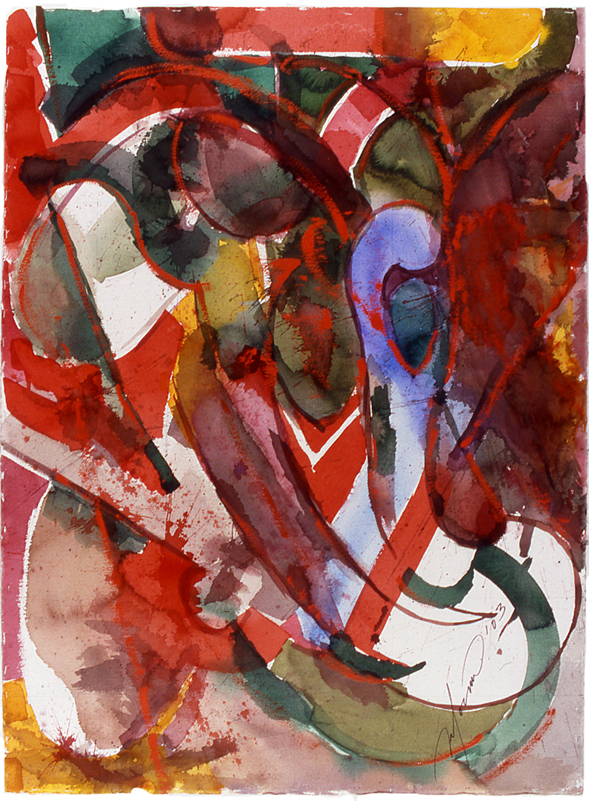
Templates II
40″h. x 30″w.
Watercolor on paper
2003
People come to know who they are over time rather than all at once. A person recognizes themselves through earlier actions, remembered choices, and past commitments, even though the conditions under which those moments occurred no longer remain the same. What feels continuous is not encountered directly, but pieced together through recollection and interpretation as circumstances change. Because of this, uncertainty enters any effort to maintain a stable sense of self, not through confusion or deceit, but through the simple passage of time.
A person’s relation to themselves is therefore never fixed at its origin. It is mediated by memory, revision, and reassessment as life unfolds. What once made sense as a response to a particular moment must be understood again under different conditions. Identity does not remain secured by intention alone, because continuity can only be reconstructed after the fact rather than preserved intact.
Once identity must be reconstructed instead of taken as given, expectations of consistency begin to exert pressure. Past actions, statements, and commitments are treated as benchmarks against which the present self is measured, even when the circumstances that produced them no longer exist. Continuity is demanded where only relation is possible. What once functioned as a response to a specific situation is asked to stand as proof of an enduring self.
Because people encounter identity through memory and interpretation rather than direct access, identity becomes subject to demands for legibility. Others rely on familiar patterns of speech, behavior, and commitment to orient their expectations. When those patterns persist, continuity is assumed. When they shift, uncertainty arises. What cannot be readily recognized is often treated as absence rather than transformation.
Under these conditions, adjustment is frequently misread as violation. Changes made in response to altered circumstances are interpreted as departures from an assumed core rather than as necessary recalibrations. Earlier expressions of self are treated as binding commitments even when the conditions that produced them have changed. What is experienced internally as adaptation is therefore received externally as betrayal, not because trust has been broken, but because the expectation of fixity has remained in place.
After reconstruction is complete, identity offers no fixed origin. It offers only a coherence that must be maintained under changing conditions of recognition. Efforts to settle distress about identity fail when they ignore a simple fact: people change before others adjust their expectations. The difficulty does not arise from change itself, but from being required to remain readable according to standards that no longer apply.
Ricardo F. Morín
January 31, 2026
Oakland Park, Fl

