*
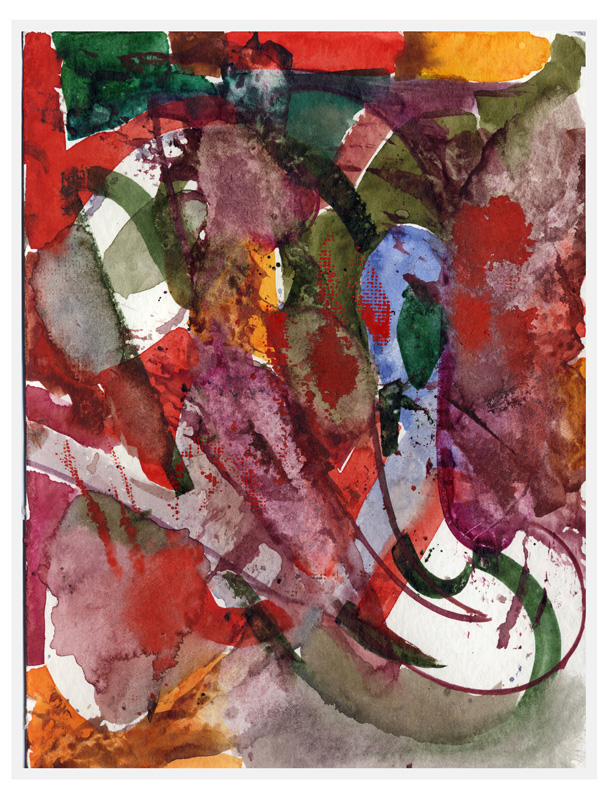
Templates
8” x 10”
Watercolors on paper
2003
Ricardo F. Morín
January 31, 2026
Oakland Park, Fl.
People rely on memory because past experience cannot be returned to directly. What has already happened can only be approached again through recollection. Over time, memories are revisited under conditions that differ from those in which the original experience occurred. What once made sense in one moment must be made sense of again in another, and the standards used to judge it shift with present circumstances. As this happens, uncertainty enters the effort to rely on memory, not because people are careless, but because time alters the conditions under which understanding takes place.
In this respect, memory does not function differently from truth. Both remain exposed to time. What once appeared settled must be reconsidered as circumstances change, and neither memory nor truth remains fully governable by intention. What resists control is not honesty, but the displacement that time introduces between experience and its recall.
- Memory as Justification
When direct access to experience is no longer possible, memory often takes its place as a source of explanation. People account for their decisions by referring to what they remember rather than to what can still be examined. Recollection is treated as evidence of continuity even when the conditions that produced it no longer exist. In this way, memory is asked to stabilize choices whose original context cannot be recovered.
As experiences recede further into the past, they are often invoked with greater confidence. This confidence does not arise because the memory has remained intact, but because distance shields it from challenge. What memory provides in such cases is not access to what happened, but a narrative sufficient to support judgment in the present.
- Memory and Certainty
As experience becomes less accessible, certainty often increases rather than declines. Events that can no longer be tested against their original conditions become insulated from correction. Recollection hardens into conviction because comparison is no longer possible. Memory appears stable not because it is accurate, but because its sources cannot be revisited.
In this way, confidence attaches not to fidelity, but to distance. The past feels settled because it cannot be reentered. Certainty arises not from closeness to what occurred, but from the absence of any remaining means to contest what is remembered.
- Memory and Repetition
As memories are repeated, they gain durability without preserving experience itself. Retelling does not restore original conditions; it refines what can be easily conveyed. Details that resist articulation fall away, while elements that can be narrated coherently are retained and reinforced. Through repetition, memory becomes less a trace of what occurred and more a stable account of what can be said.
What endures is not the experience itself, but a version shaped by its ability to be repeated without friction. After mediation is complete, the past yields no new facts, only new arrangements of what is already known.

