*
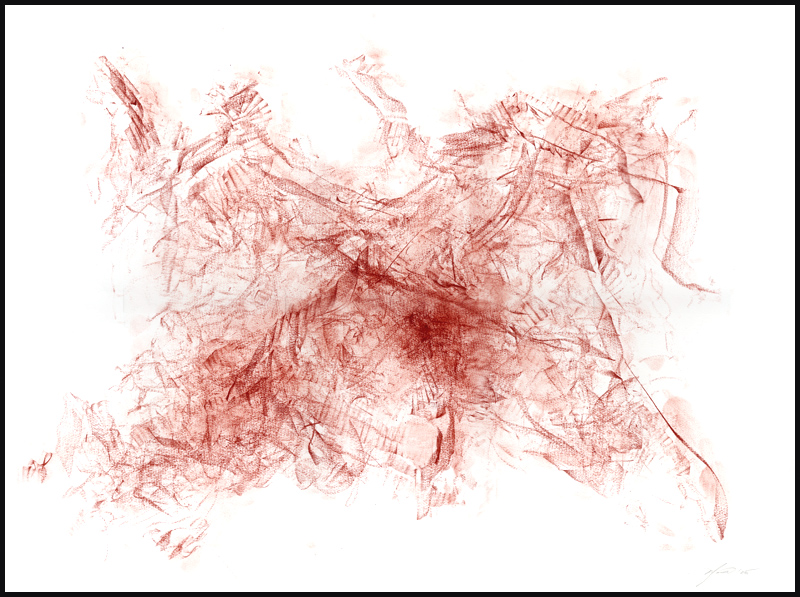
Infinity 3
30″x 22″
Sanguine on paper
2005
Two forms may be distinguished by their construction: an open curve, continuous along its course and capable of extension without closure, and a Möbius strip, formed by joining the ends of a band after a half-turn. The curve admits extension without return; the strip sustains a single continuous side through its return upon itself. Both are continuous. What differs is how continuity is held.
The open curve admits passage without requiring completion. It holds at each point without reference to return. The strip, received through its self-return, presents its course as already complete. Its coherence is apprehended through the relation that binds it to itself.
The curve may be followed without asking where it ends. A path along the strip’s interior may return indefinitely without meeting its single edge. The strip’s finite extent does not impose a final circuit. In both cases, continuity suffices.
The difference appears when attention shifts from what is given to how it is maintained. Along the curve, continuity is enacted in following. The path holds only insofar as no interruption occurs. The strip, received as a whole, appears to contain that continuity without requiring its course to be traced.
The strip’s return can thus sustain the invocation of infinity. An inexhaustible passage is received as already given within a finite form. The continuity that sustains this appearance remains implicit. The open curve offers no comparable assurance of completion. Its further extension must be followed, and its coherence depends on the unbroken relation along its course.
So long as the strip is received as given, the distinction holds. Infinity appears as already in place, and continuity remains absorbed within that appearance. The curve, by contrast, makes continuity operative without naming it.
The shift begins when what is given can no longer hold on its own. The strip’s apparent completeness no longer suffices. What appeared as a field without end must now be traced through the relation that sustains it.
The curve always depended on continuity, though it did not name it. Tracing the strip discloses the same dependence. What appeared as infinity is no longer primary. Its appearance depends on the continuity that had remained implicit.
The curve remains open, and the strip retains its return. Continuity is not confined to extension or return. It is what allows either to hold.
The appearance of infinity depends on continuity, but continuity does not require that appearance. It holds wherever relation is unbroken, including along a finite course.
Receiving accepts what appears without first requiring an explanation of what sustains it. Tracing follows the relations that sustain what appears and examines whether its coherence holds. Each entails a distinct discipline. Neither excludes the other.
The two modes remain distinct, yet not separate. The continuity that sustains the appearance in one is examined in the other. Their common ground does not make their requirements interchangeable.
In the invoking mode, virtue lies in receiving without imposing closure, in allowing what appears to remain unforced by premature explanation. The task is not to verify, but to receive without distortion.
In the diagnostic mode, virtue lies in sustaining relation without allowing coherence to be assumed. What appears must be traced, not to reduce it, but to prevent it from holding without what sustains it. Here the task is not merely to remain open, but to maintain relation.
Neither mode dispenses with the relation that sustains what appears. In receiving, that relation may remain implicit. In tracing, it must be maintained without substituting an imposed order for what was given.
The modes do not resolve into one another. Receptivity does not establish coherence, and tracing does not by itself prevent distortion. Passage between them requires attention to what each preserves and what each may alter.
Virtue does not belong to one mode alone. It appears wherever the proper condition of each is maintained without excess. In one, by not forcing completion. In the other, by not allowing what appears to hold without relation.
What differs is not what is given, but how it is held.
Ricardo F. Morin, October 6, 2026, Bala Cynwyd, Pennsylvania

