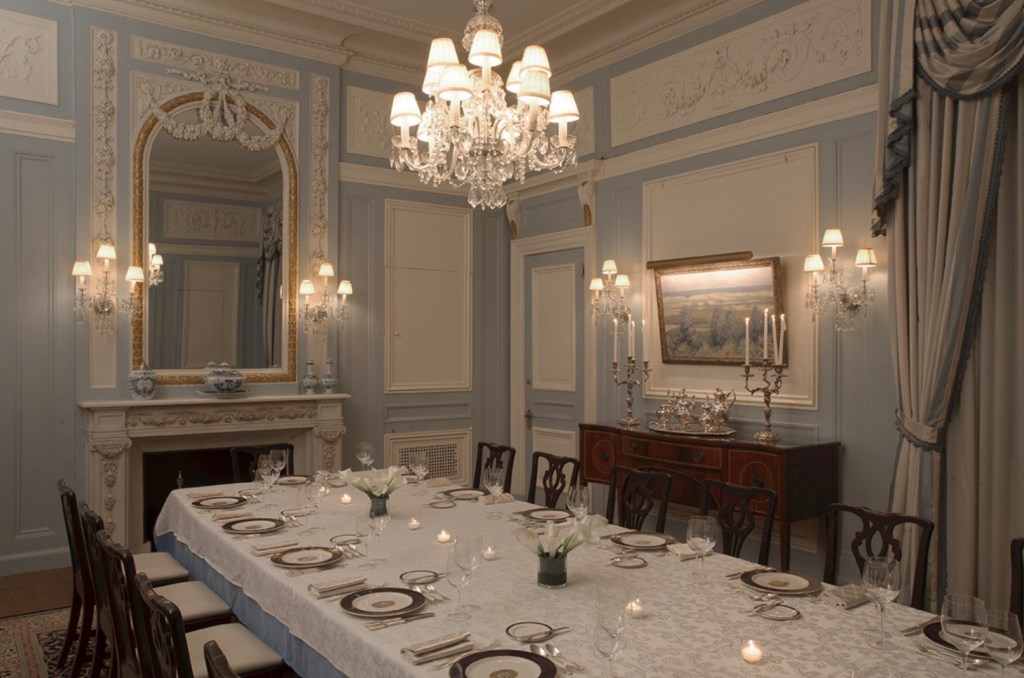
The Wedgwood Dining Room at the Lotos Club, New York, with its neoclassical decoration in the Georgian Revival tradition
I have often wondered how securely our sense of belonging rests on the welcome we receive from others. Shared interests and affection can make a gathering feel like an extension of home. Yet an evening may unsettle that feeling without any visible breach of courtesy. I remember one such evening in New York, at a dinner given to celebrate the marriage of two friends.
In June 2013, after the Supreme Court struck down the provision of the Defense of Marriage Act that denied federal recognition to same-sex marriages, our friends John and Ted married in a small private ceremony at their residence in Washington, D.C. They had lived together for more than sixteen years, nearly as long as David and I had been together. Their decision to marry had left little time to bring together their closest friends and relatives from New York and elsewhere. They therefore arranged a dinner at the Lotos Club, where John, an author, and Ted, a musicologist, had been members for some time.
The club stands at 5 East 66th Street. A group of young writers, journalists, and critics founded it in 1870 and took its name from Tennyson’s poem “The Lotos-Eaters,” which recalls the episode in the Odyssey in which those who taste the fruit lose all wish to return home. The founders intended the name to suggest rest and harmony.
Over drinks and hors d’oeuvres, the conversation was everything one could wish. The guests included Ted’s older brother, a financial adviser, and his wife, an English illustrator of flora and fauna; a church organist; someone who worked for a music foundation; an architect; and two actors, one retired and the other still working in his seventies. We spoke of a recent film premiere and of the long road that had brought our hosts to this celebration. I felt the warmth of being among people who had come, as I had, to honor a happiness long deferred.
In the Georgian dining room, the conversation wandered through familiar grievances: an education that no longer served, a new generation unprepared to compete with other countries, a presidency that seemed to pass between two families. I listened quietly. Then the discussion turned to immigrants, and the tone hardened. The people under discussion seemed to belong somewhere far from the table.
At last I found the courage to speak. I said that Hispanics were hardly foreign to this country, that Spaniards had reached its shores nearly a century before the English settled at Jamestown, and that the country depended on the labor of Mexicans and Central Americans, with or without legal status. The table received this with courtesy. No one quite disagreed; the conversation simply closed over what I had said and went on.
Everyone remained most affable, and I felt even more out of place.
As we were leaving, someone mentioned that the club had occupied the building only since 1947. The French Renaissance Revival house had been built in 1900 for Margaret Vanderbilt Shepard’s daughter and son-in-law. I stepped out onto East 66th Street and looked back at the façade.
Ted will turn seventy on September 7, 2027, and we have been invited to celebrate with him in the same house. The intervening years have made that conversation harder for me to dismiss as a passing discomfort. I do not know what will be said at that table. I shall return with affection for our hosts, remembering a distinction that unsettled me that evening: some immigrants were assumed to belong, while the presence of others remained in question.
Ricardo F. Morín
October 15, 2026
In transit

