*
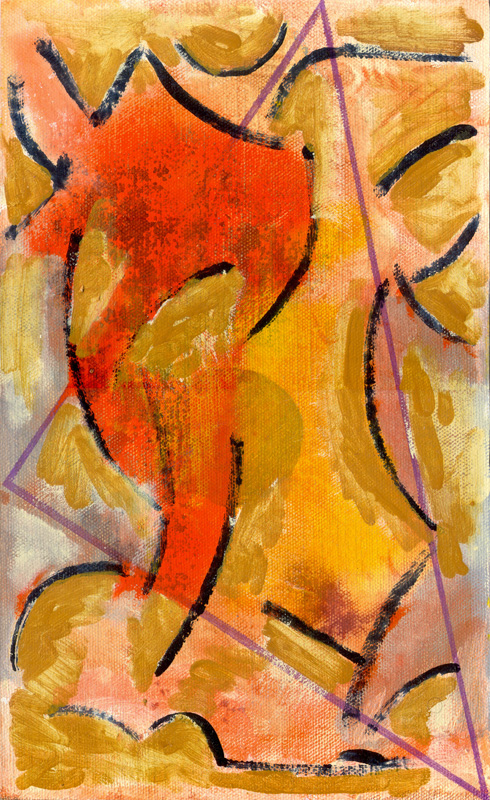
10″ × 16½″
Oil on linen
2009
*
At a recent gathering in the building where David and I live, I became so absorbed in conversations with our neighbors that nearly three hours passed before I thought of taking any photographs. By then, the buffet and barbecue were being put away, and the tables I had helped arrange were being cleared.
During the party, a neighbor who had written a book about living with Parkinson’s disease called me over. She introduced me to a friend, a biographer and published author, and then asked about a Floridian friend of mine who also has Parkinson’s. I had bought her book for him, and she wanted to know what had become of it.
“I don’t think he remembers the book anymore,” I said. “He still has many moments of lucidity, though. He’s brilliant. In some people, motor and cognitive abilities seem to deteriorate together.”
She began telling us about a recent consultation with her specialist. At one point, I interrupted her.
“I believe memory is overrated. Everyone interprets what they remember anew each time.”
All three of us laughed, partly because I had said it so abruptly.
My remark led us from memory to writing, and to Kafka’s instruction that much of his unpublished work be destroyed. None of us could say exactly why, but we wondered whether he feared that unfinished or fragmentary works would be misread and allowed to shape how readers understood the books he had chosen to publish.
“We don’t control our destiny,” I said. “Why bother with legacies?”
Before we parted, I said, “It is better to embrace what we can do now than to let the future distract us.”
Only later did I wonder whether anything from that conversation would outlast the evening, and who might carry it forward. I did not yet see that my own presence there already owed something to another person’s life.
A neighbor who died two years ago had once reminded me how important it was to engage and mingle within the community. She had even put my name forward as a possible volunteer for the social committee. I came to understand that her counsel had been earned through life. She knew that staying among others required deliberate effort.
Her suggestion also unsettled me: why did I spend so much of my time writing, a solitary habit that could itself become a form of withdrawal? Was I attending to life through writing, or replacing proximity with reflection?
I had not fully understood her at the time. Yet there I was, helping arrange a communal gathering and moving from one conversation to the next until the evening had nearly escaped my notice. I was acting on her counsel whether or not I had consciously meant to follow it. Her words had entered my life without either of us arranging for them to do so.
Another neighbor once told me that she was afraid of losing her memory. From the outside, it was difficult to see the change she had already begun to recognize in herself. She remained aware enough to fear its progression. She had died only sixteen days before I began writing this.
My claim that memory is overrated may sound callous beside such fear. I did not mean that losing memory is inconsequential, or that the terror of feeling one’s past recede can be explained away. I meant that a person cannot be measured solely by the uninterrupted possession of memory. My Floridian friend remains brilliant even when recollection fails him. Memory does not return experience to us intact; every act of remembering interprets the past from the position of the present.
The neighbor who called me over at the party had illustrated this without meaning to. Although she lives with Parkinson’s, she remembered my friend, the book she had written, and the gesture by which I had tried to connect their experiences. The person whose memory and movement might be judged by others was the person remembering someone else.
Age shows itself unevenly throughout the building. One woman, now eighty-five, appears decades younger in both appearance and spirit. She has spoken publicly about the commitment she has sustained throughout her life to helping young entrepreneurs in the arts. Her youthful presence comes not only from how she looks but from where she directs her attention: toward work still beginning and people whose futures remain before them.
During our conversation, I told her that my sister had died in February 2025. Her death had devastated me not only because I had lost her, but because I could no longer define myself through concern for her well-being. She told me that her brother had died two years earlier and that she had felt the same way: “Grief wanes,” she said, “but sorrow never does.” In each case, the death had also altered how each of us understood who we were.
Her words prompted me to mention an idea I then associated with quantum physics; I now think I had in mind something closer to what some physicists, drawing on Einstein’s relativity, have called the block universe. It is one interpretation among others, according to which past, present, and future do not come into existence one after another but coexist within a single spacetime, while what we experience as time passing may be less a physical fact than a habit of perception. I wondered, without insisting on it, whether those we have lost might still occupy that same continuum within a temporal order that our experience does not allow us to perceive in its entirety. I did not know what to do with that thought then, and I am not sure I know now.
Another neighbor, now ninety-three and widowed only a few years ago, has made room in her life for companionship again. After reading my diagnostic essays on mathematics, linguistics, and artificial intelligence, she wrote:
“They make me think in ways I haven’t thought before and consider ideas I hadn’t considered before. Thank you for sharing them with me.”
Her message conveyed more than appreciation. At ninety-three, she remained willing to let unfamiliar ideas alter the boundaries of what she had previously considered. Her new companionship and her response to the essays revealed two forms of the same receptivity: an openness to affection not presumed finished, and to thought not presumed complete.
The eighty-five-year-old neighbor and the ninety-three-year-old remain open to what may still occur. That openness does not erase what either woman has lost. Their vitality reveals one form survival may take when fortune permits it.
Only a few days before the gathering, I crossed paths with another woman whose wit and classical beauty I had long admired. Two years ago, she had served as a witness during a neighborhood election. She said little, but whenever she spoke, one understood that she was a serious person of substance. I found her intimidating and feared that whatever I might say would not measure up.
During our recent encounter near the elevator, she looked at me with a depth of sorrow whose cause I had no right to presume. Her appearance had changed, and her skin no longer possessed the luminosity I remembered. Yet the dignity with which she met my gaze was as present as the sorrow in her eyes.
I felt the old intimidation, now joined by regret. I had admired her without taking the opportunity to know her. The alteration of her beauty was not mine to examine. What belonged to me was the distance I had allowed to remain between recognition and acquaintance.
The illnesses and bereavements of my neighbors cannot be arranged into a consoling argument about resilience. Fortune has not treated them equally, and their lives do not exist to furnish instruction for mine. Still, encounters have consequences: what passes between people can remain active long after the occasion itself has disappeared.
I cannot settle my uncertainty about writing merely by declaring it another form of attention. This essay may show that I listened; it may also be another interval in which I write about my neighbors instead of sitting with them. The email from my ninety-three-year-old neighbor complicates that division. Words written in solitude had entered a relationship and returned to me through another person’s thought. The exchange does not settle the question, but it prevents me from treating solitude and relation as simple opposites.
Writing cannot restore those who have died or arrest what age and illness alter. At most, it can register the changes their lives have produced in mine. Whether that registration becomes engagement or retreat depends on what I do when the page ends.
Kafka had tried to decide what the future would not receive. My neighbor had simply advised me to remain among others. Two years after her death, I had spent the evening doing exactly that, no longer the person I had been before my sister died.
By the time I understood what the evening had disclosed, the buffet and barbecue had been put away. The tables had been cleared, but the conversations remained.
Ricardo F. Morín
September 1, 2026
Bala Cynwyd, Pennsylvania

