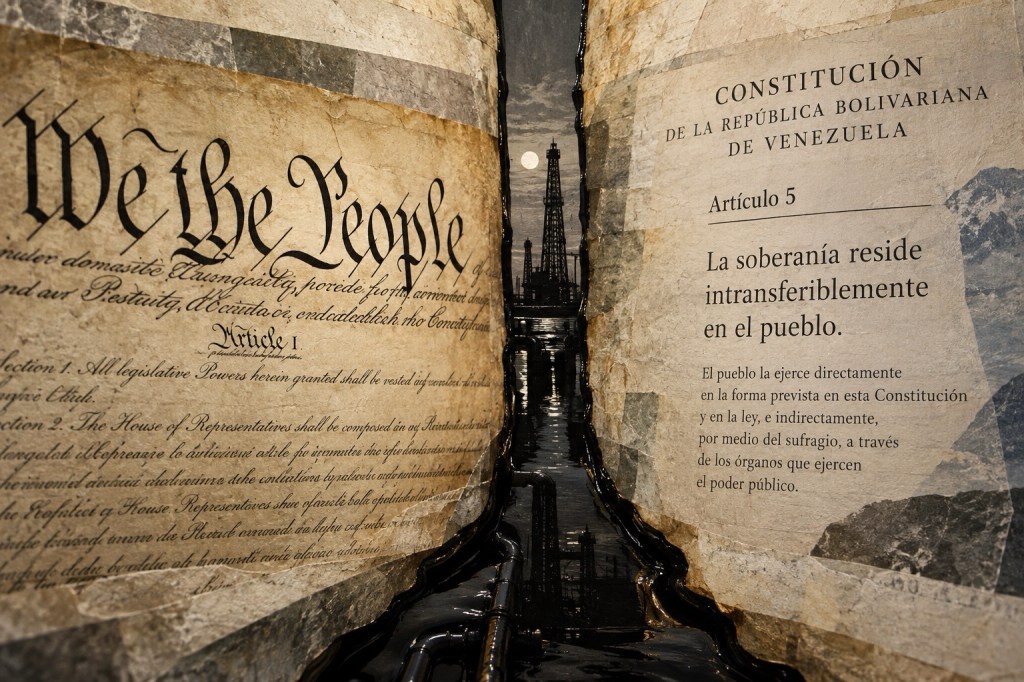
The constitutional question now presented by Venezuela does not begin with petroleum. It begins with the identity of the sovereign.
Article 5 of the Constitution in force states that sovereignty resides in the people and cannot be transferred. It specifies that the people exercise sovereignty directly in the forms provided by the Constitution and law and indirectly, through suffrage, by the organs exercising Public Power. It then establishes the relation on which the rest depends: the organs of the State emanate from popular sovereignty and remain subject to it. [1]
That language does not identify government with the sovereign people. It distinguishes the sovereign from the organs through which sovereign authority is exercised. A president, legislature, ministry, State enterprise, or interim administration may exercise constitutional competencies. None becomes the sovereign by exercising them. Governmental power is constituted power. Sovereignty remains with the people.
Article 12 gives this distinction a material object. Mineral and hydrocarbon deposits belong to the Republic, are property in the public domain, and are inalienable and imprescriptible. The deposits do not belong to the officials administering the Republic. Temporary control of governmental institutions does not convert public-domain wealth into the property of those who control them. [2]
The relation between Articles 5 and 12 therefore precedes any petroleum agreement. The Republic possesses the deposits. State organs may act concerning them only through authority conferred by the constitutional order. The sovereign source of those organs remains the people.
That structure has acquired immediate consequence because the United States has not merely facilitated commerce in Venezuelan petroleum. The present Administration publicly describes an arrangement designed to secure American governmental and economic advantages over Venezuelan reserves on a scale and for a duration extending far beyond the present political transition.
On August 31, 2026, the White House announced what it called the biggest oil deal in world history. It said Venezuelan interim authorities had granted North American Blue Energy Partners 100-year concessions over 17 fields containing approximately 65 billion barrels of proven reserves. The same announcement described United States “majority control,” governmental governance rights, “economic ownership,” a 35 percent equity interest for the Department of War’s Office of Strategic Capital, a guaranteed right for the Department of State to purchase 20 percent of production at cost, a right of first refusal over the remaining 80 percent, veto authority over appointments to the company’s board, and a requirement that a majority of directors be United States citizens. [3]
The Administration did not present those provisions as incidental protections surrounding a Venezuelan development program. It presented them as American achievements. The White House said the arrangement would secure American “energy dominance for the next century,” expand the reserves effectively available to the United States, support American refineries and employment, and provide low-cost petroleum for the Strategic Petroleum Reserve, military requirements, and other sensitive uses. [3][4]
The United States is not an accidental beneficiary of an arrangement designed elsewhere. The benefits to the United States are stated as objectives of the policy itself.
The same fact sheet describes the arrangement as part of stabilization, reconstruction, and eventual democratic transition. It says the new hydrocarbons framework was adopted with United States support. It describes United States governance and audit provisions, banking reform, payment oversight, and financial monitorship as means by which tax and royalty payments will be supervised. It also says the United States is sponsoring reconciliation talks between the 2015 National Assembly and the interim authorities. [3]
The vocabulary of transition therefore accompanies a structure in which the foreign power that intervened militarily has acquired enduring economic interests, governance rights, purchasing privileges, and supervisory functions over the principal natural resource of the country in transition.
The present interim administration did not obtain its current mandate through a new national election following the January United States military action. As of late September, its president continued to promise elections as part of a transition to full democracy without establishing a firm election date. The United States itself continues to describe democratic transition as prospective. [3][5][6]
That circumstance does not make Article 5 disappear. It makes Article 5 unavoidable.
If sovereignty were vested in whoever happened to control the machinery of government, effective control would answer the constitutional question. Article 5 says otherwise. The organs of the State emanate from popular sovereignty and remain subject to it. The Constitution therefore refuses the identification of governmental possession with sovereign ownership. [1]
The current National Assembly’s subsequent endorsement of the petroleum arrangement is part of the constitutional record. On September 1, it backed the arrangement by a show-of-hands vote. Some opposition deputies abstained because they had not been able to examine the written terms. [7] But an act of a constituted organ is not identical with the sovereign from which Article 5 says constituted authority derives. Legislative approval must possess constitutional competence for the act approved. The existence of a vote cannot, by itself, transform the organ casting it into the sovereign people or cure an antecedent absence of authority if the power purportedly exercised was not constitutionally available to that organ.
This is the distinction between representation and sovereignty. Representatives may exercise constitutionally conferred powers on behalf of the people. They do not own the sovereignty they exercise. Article 5 keeps the representative subject to the sovereign represented.
The distinction is particularly consequential where the commitment is intended to endure for a century. One hundred years is not a transitional interval. A concession of that duration reaches beyond the officials who granted it, beyond the present American Administration, beyond the promised democratic transition, and through generations of Venezuelans who had no part in the governmental circumstances under which it was created.
The American record itself recognizes, in another context, that control and possession do not extinguish Venezuelan ownership. Executive Order 14373, issued on January 9, defines specified natural-resource revenues held in United States Treasury accounts in Section 2 and determines in Section 4(a) that those funds are property of the Government of Venezuela. It says the United States holds those funds solely in a custodial and governmental capacity, not as a market participant, and requires Treasury to designate them as sovereign property of Venezuela rather than property of the United States. [8][9]
Yet Section 4(c)(ii) of the same order provides that those funds are held pending “sovereign disposition” for public, governmental, or diplomatic purposes determined by the United States Secretary of State on behalf of the Government of Venezuela. Section 5(a)(ii) directs Treasury to follow the Secretary of State’s instructions concerning disbursements and transfers. [8]
From January onward, the Administration thus assigned an American officer authority to determine the purposes for which Venezuelan sovereign property would be used. Venezuelan ownership remained formally acknowledged while decisions concerning its exercise passed to an officer of the intervening State. The authority by which that officer could determine sovereign purposes on Venezuela’s behalf was asserted in an American order rather than supplied by the Venezuelan Constitution.
Nearly eight months later, the petroleum arrangement added proprietary advantages to that supervisory structure. The White House described United States economic ownership, majority control, veto rights, preferential acquisition, and a governmental equity interest protected against dilution. Reuters reported that the 35 percent position was structured through penny warrants intended to preserve the United States ownership level as additional capital entered the enterprise. [3][10]
The sequence is not one of ignorance about whose resources are involved. The American documents repeatedly identify the reserves, revenues, concessions, and deposits as Venezuelan. The Administration knows the object is Venezuelan wealth. Its own January order expressly recognizes Venezuelan sovereign property. Its later announcements expressly identify the advantages sought for the United States. [3][8]
The Venezuelan juridical record identifies the force that altered the governmental circumstances. On January 3, the Constitutional Chamber described the United States action as an agresión militar extranjera [foreign military aggression] undertaken for the secuestro[abduction] of Nicolás Maduro. It treated his resulting ausencia forzosa [forced absence] as a material and temporary impossibility of exercising presidential functions. Invoking its interpretation of Articles 234 and 239.8, the Chamber ordered Vice President Delcy Rodríguez to exercise the presidency through an urgent precautionary measure intended to preserve the State and defend the Nation. It left the definitive classification of the absence to the competent State organs. [11]
The ruling that named the aggression also ordered the acting presidency whose consent the United States now invokes. Dismissing the Chamber as an organ of the former government does not supply an independent constitutional basis for that consent. The government maintained through the Chamber’s response subsequently became the channel through which the United States obtained the petroleum advantages it announced in August.
The President of the beneficiary State had already connected the military action to its economic return. On April 30, President Trump described the relationship with Venezuela as “like a joint venture,” said both countries were making money, and declared that the United States had “paid for the attack many times over.” [12]
Exploitation does not mean every foreign investment, petroleum sale, loan, or commercial concession. It denotes the deliberate extraction of advantage from another nation’s resources under conditions in which the foreign beneficiary possesses extraordinary power over the governmental circumstances through which consent is purportedly obtained. The asymmetry is recorded on both sides: the Venezuelan Chamber named the aggression and ordered a defensive measure; the American President described the resulting economic relationship as a joint enterprise that had repaid the attack. The August arrangement then gave enduring economic and governmental form to that advantage.
The White House’s own language makes the contradiction sharper. Its August fact sheet accuses Russian and Chinese actors, along with Venezuelan political cronies, of having “looted Venezuela’s resources” for the benefit of American adversaries. The same document then celebrates the displacement of those actors by a system designed to ensure American dominance in the hemisphere, American governmental control, American economic ownership, American purchasing privileges, and American strategic supply. [3][4]
The nationality of the beneficiary cannot determine whether Venezuelan sovereignty has been respected. If foreign control of Venezuelan resources is objectionable because the resources belong to Venezuela, changing the foreign beneficiary does not alter the constitutional location of Venezuelan sovereignty or the juridical status of the deposits.
The constitutional issue is not whether Venezuela may receive foreign capital, sell petroleum, or enter long-term commercial relations. It is the source of the authority by which the Republic is bound. Investment describes capital. Contract describes an instrument. Recognition describes a foreign government’s diplomatic position. None of those categories, by itself, supplies Venezuelan sovereign competence.
The distinction becomes still more important when corporate form intervenes. The White House has emphasized the role of a private company and the use of private American capital. [3][4] But a private corporation cannot grant itself a Venezuelan petroleum concession. The underlying right to exploit deposits belonging to the Republic must originate in Venezuelan law. Private corporate arrangements can distribute economic interests after a right exists. They cannot create the sovereign authority necessary to create the right in the first place.
Reuters identifies North American Blue Energy Partners as controlled by the Venezuelan businessman Alejandro Betancourt. [10] The arrangement therefore joins a Venezuelan private beneficiary to the American governmental interests it expressly creates. The advantage obtained by the United States need not be exclusive to be deliberate. Nor does a Venezuelan businessman’s private interest constitute the consent of the Venezuelan people. His participation does not alter the need to establish the constitutional authority for granting rights over the Republic’s deposits.
Nor can American law answer that antecedent Venezuelan question. American statutes, executive orders, licenses, contracts, and judicial jurisdiction can determine what United States officials and American entities may do under United States law. They cannot determine what authority Venezuelan officials possess under the Constitution of Venezuela to bind the Republic.
The American Preamble begins “We the People,” and American constitutional doctrine treats those words as identifying the source that ordained and established the Constitution. But the Supreme Court has not treated the Preamble as an independent source of substantive governmental power. Venezuela’s Article 5 is not prefatory language. It is an operative constitutional provision defining where sovereignty resides, how it is exercised, where State organs derive from, and to what they remain subject. [1][13][14]
Translating Article 5 into the familiar American phrase “We the People” would diminish rather than clarify it.
Article 5 is more exact. The people do not merely appear at the founding moment and then disappear into the institutions they created. Sovereignty remains theirs. Government does not receive sovereignty as property. It exercises constituted powers while remaining subordinate to the sovereign source from which those powers emanate.
The distinction between the sovereign people and their representatives determines what governmental consent can mean.
A representative act can bind the Republic only because the constitutional order gives the representative authority to perform that act. Representation is therefore derivative. Sovereignty is not. To treat the consent of representatives as self-validating is to reverse the constitutional relation Article 5 establishes.
The problem becomes more acute when the governmental order supplying the consent exists under foreign tutelage. The January order placed decisions over Venezuelan sovereign revenues in American hands. The subsequent structure extended that supervision across the transition: the foreign State sponsors political reconciliation, supports the legal framework governing the resource, claims audit and financial-monitoring functions, acquires governance rights and vetoes in the resulting enterprise, receives economic ownership and preferential purchasing rights, and openly describes the arrangement as securing its own dominance. [3][4][8]
Under those conditions, governmental consent cannot be treated as evidence independent of the foreign power obtaining the benefit. The foreign beneficiary participates in the political and institutional environment from which the purported consent emerges.
When the petroleum arrangement was announced, even the maximum temporary-substitution period under Article 234 had expired. Article 234 provides for substitution during a temporary presidential absence for up to ninety days, extendable by the National Assembly for up to ninety more. The first period ended on April 3. [1] On April 6, the Associated Press reported that the Assembly had taken no public vote to authorize an extension. [15] Even assuming authorization of the maximum second period, the outermost 180-day limit ended on July 2. [1]
On July 15, Acceso a la Justicia reported that the Assembly still had not pronounced on the presidential absence. It argued that the exhausted temporary period required the Assembly to activate Article 233 and the new presidential election prescribed within thirty consecutive days. Its reading permits Rodríguez to continue transitionally until an elected president takes office. That continuation does not dispense with the succession determination or the election; it exists pending their completion. [16]
On August 31, the White House announced the grant of rights it described as lasting a century. The Assembly’s failure to resolve the absence had been publicly documented, and the election required under the Article 233 reading had not occurred. By late September, there was still no firm election date. [3][5][6][16]
The Assembly’s endorsement supplied political support for a commitment reaching across generations while the constitutional duties governing the presidency making that commitment remained unperformed. [7][16]
The constitutional authority has not been established merely by pointing to the consent of the interim administration. That consent is precisely what is in question. A government continuing beyond the temporary-substitution period, without completion of the succession and electoral duties governing the transition, cannot be identified with the sovereign Venezuelan people merely because it continues to exercise governmental power. The foreign power that altered the circumstances of that government cannot invoke its consent as independent evidence that the Venezuelan people consented to the appropriation of the Republic’s natural wealth.
The intervening State invokes the consent of the governmental order maintained after its intervention as the juridical basis for its own acquisition. The circle never reaches the sovereign identified by Article 5.
The defense that someone had to govern establishes the need for continuity. It does not establish that continuity required granting the intervening State enduring ownership interests and preferential access to Venezuelan wealth. The Administration’s own January response to the emergency expressly distinguished custody and administration from proprietary acquisition. Its August arrangement crossed that distinction. Neither the need to preserve revenues nor the absence of an elected successor supplies authority to turn temporary administration into century-long foreign advantage.
Calling the arrangement reconstruction does not establish that authority. Calling it privatization does not establish it. Calling it stabilization does not establish it. Calling it a contract does not establish it. Each term describes a policy, mechanism, or objective. None establishes the Venezuelan constitutional source of the authority exercised.
Article 12 places the deposits in the public domain of the Republic. Article 5 places sovereignty in the people. Between those provisions stand the organs of government, possessing only the authority the constitutional order gives them. [1][2]
The constitutional chain therefore runs in one direction: from the sovereign people, through constituted authority, to the administration of the Republic and its public wealth. It does not run backward from possession of governmental offices to ownership of sovereignty.
A foreign power can acquire physical access. It can acquire contractual rights. It can acquire economic leverage. It can obtain governmental cooperation. It can exercise military superiority. It can even obtain effective control over institutions and revenues. None of those conditions changes the constitutional identity of the Venezuelan sovereign.
The Administration’s rhetoric of victory makes the distinction still more stark. On September 22, while discussing Venezuela and the oil agreement in his address to the United Nations General Assembly, President Trump said, “To the victor belong the spoils.” [17] A victor may possess the capacity to take advantage of circumstances created by victory. Capacity is not title. Superior force can explain how control was obtained. It cannot establish, by itself, the Venezuelan constitutional authority by which control becomes lawful.
That is why the issue cannot be reduced to whether the petroleum arrangement will increase production, attract investment, lower prices, rebuild infrastructure, or generate tax revenue. Those consequences may be economically important. They do not answer the antecedent question.
The question is who possessed authority to consent.
Under Article 5, that inquiry cannot end with the identification of those presently occupying governmental institutions. The organs of the State are not the source of sovereignty. They emanate from it and remain subject to it. [1]
Under Article 12, the object of the transaction is not ordinary governmental property available to rulers in their own right. The deposits belong to the Republic as public-domain property. [2]
The United States may call its role stabilization. It may call its interests economic ownership. It may call its supervision reconstruction. It may call its dominance strategic necessity. Venezuela’s Constitution supplies the prior vocabulary: people, sovereignty, Republic, Public Power, public domain, competence.
Those terms determine the Venezuelan question.
The American Administration’s own record establishes that the acquisition of advantage is deliberate. It announces the control, quantifies the ownership, fixes the purchasing privilege, protects the equity position, imposes governance conditions, celebrates the absence of cost to the American taxpayer, and states the objective of American dominance. [3][4][10]
The Administration has used the consent of the interim authorities to secure enduring American advantages over Venezuelan wealth. It has not established the Venezuelan constitutional authority by which those authorities could grant them.
Ricardo F. Morín
September 30, 2026
Bala Cynwyd, Pennsylvania
Notes
[1] Centro para la Integración y el Derecho Público (CIDEP), Constituciones de Venezuela, Constitución de 1999, Articles 5, 233, 234, and 239.8.
[3] The White House, “Fact Sheet: President Donald J. Trump Announces Historic Oil Agreement to Secure American Energy Dominance and Drive Venezuela’s Economic Recovery,” August 31, 2026.
[7] Reuters, “Venezuela’s assembly backs oil deal announced with U.S.,” September 1, 2026. Euronews, “Venezuela hands the US control over a fifth of its oil in landmark deal,” September 2, 2026, reports the show-of-hands vote and the abstention of opposition deputies who had not been able to examine the written terms.
[8] Executive Order 14373, “Safeguarding Venezuelan Oil Revenue for the Good of the American and Venezuelan People,” January 9, 2026, especially Sections 2, 4(a), 4(b), 4(c)(ii), and 5(a).
[9] The White House, “Fact Sheet: President Donald J. Trump Safeguards Venezuelan Oil Revenue for the Good of the American and Venezuelan People,” January 9, 2026.
[10] Reuters, “US structured Venezuela oil position to protect it from dilution, official says,” September 4, 2026. Also identifies NABEP as controlled by Venezuelan businessman Alejandro Betancourt.
[11] Acceso a la Justicia, “La SC ordena que Delcy Rodríguez, Vicepresidenta Ejecutiva, asuma y ejerza en condición de ‘encargada’ la presidencia de la República,” January 3, 2026. Reproduces the Constitutional Chamber’s decision, including its descriptions of foreign military aggression, abduction, and forced absence, and its precautionary order under Articles 234 and 239.8.
[12] GovInfo, “Remarks During a Document Signing Ceremony and an Exchange With Reporters,” April 30, 2026, p. 8, official presidential transcript, including the descriptions “like a joint venture” and “we’ve paid for the attack many times over.”
[15] Associated Press, “Venezuela’s Delcy Rodríguez remains acting president after her initial 90-day appointment expired,” April 6, 2026. Reports that the National Assembly had not taken a public vote to extend the initial period.
[16] Acceso a la Justicia, “¿Qué ocurre con la encargaduría presidencial?”, July 15, 2026. Reports the Assembly’s failure to pronounce on the presidential absence, argues for activation of Article 233 following exhaustion of the temporary-substitution period, and reads the Constitution as permitting transitional service until the elected president takes office.
[17] Factba.se / Roll Call, transcript of President Donald J. Trump’s address to the 81st Session of the United Nations General Assembly, September 22, 2026, including the statement “To the victor belong the spoils” following his discussion of the Venezuela oil agreement.
From American Authorization to Venezuelan Sovereignty
Ricardo F. Morín Venezuela’s Gold and the Authority to Extract Digital image, 2026
On September 6, 2026, I published Constitutional Authority and Venezuela: A Public Record of Correspondence, an examination of United States governmental actions concerning Venezuelan petroleum, sovereign revenues, reconstruction, and political transition:
That inquiry began with a question of authority rather than policy: who possesses the lawful authority to make decisions concerning resources and sovereign powers belonging to Venezuela?
The question required examination of two constitutional orders. Article 5 of the Venezuelan Constitution provides that sovereignty resides intransferably in the Venezuelan people and that the organs of the State emanate from popular sovereignty and are subject to it. Article 12 places hydrocarbon and mineral deposits within the public domain of the Republic and declares them inalienable and imprescriptible. On the American side, the inquiry asked what constitutional and statutory authority permits the United States Government to acquire governmental, economic, custodial, or proprietary rights concerning another nation’s sovereign resources and revenues.
The documentary record available in early September made petroleum the principal material subject of that inquiry. The White House had announced 100-year concessions covering 17 Venezuelan oil fields and attributed substantial economic and governance rights to the United States Government. Executive Order 14373 separately placed specified Venezuelan oil revenues in United States custody while recognizing those revenues as sovereign property of Venezuela.
Article 12, however, is not confined to petroleum. It expressly encompasses mineral deposits.
The public record now shows that months before the petroleum arrangements announced at the end of August, officials of the United States Government were already participating in the reopening of Venezuela’s mineral sector to American commerce and investment. Gold therefore presents the same constitutional referent through a different sequence of governmental and commercial acts.
On March 4, 2026, United States Secretary of the Interior Doug Burgum and National Security Council official David Copley led a delegation to Venezuela that included representatives of mining interests. Gold Reserve, a mining company participating in the delegation, subsequently stated that the meetings concerned conditions for renewed foreign investment and mining operations in Venezuela.
Two days later, on March 6, the Office of Foreign Assets Control of the United States Department of the Treasury issued General License 51, authorizing specified transactions involving Venezuelan-origin gold.
OFAC administers United States economic sanctions. A general license permits categories of transactions that American sanctions would otherwise prohibit. It does not, by performing that function, create a Venezuelan mining right or determine who possesses authority under Venezuelan law to extract a mineral belonging to the Republic.
A commercial transaction was also taking shape. Venezuela’s State mining company, Minerven, entered an arrangement with the commodities trader Trafigura involving approximately 650 to 1,000 kilograms of Venezuelan gold doré intended for processing and distribution for sale in the United States.
Gold doré is a partially refined product produced from mined material. It ordinarily requires further refining before reaching the purity associated with commercial bullion. The transaction concerned gold that had already passed from extraction into commerce.
On March 27, Treasury issued three instruments governing different stages of American participation in Venezuela’s mineral sector.
General License 51A authorized specified transactions ordinarily incident and necessary to the exportation, sale, storage, purchase, delivery, or transportation of Venezuelan-origin minerals, including gold. It expressly excluded exploration, development, mining, extraction, processing, refining, or production of minerals in Venezuela and the formation of Venezuelan entities for those purposes. The license also required participants to report documentation demonstrating supply-chain due-diligence plans for determining the chain of custody of the minerals.
General License 54 separately authorized the provision from the United States or by United States persons of goods, technology, software, and services for mineral exploration, development, mining, extraction, processing, refining, or production in Venezuela. It also authorized specified maintenance and support for mineral operations, while excluding the formation of new joint ventures or other entities in Venezuela to undertake those activities.
General License 55 separately authorized negotiations and entry into contingent contracts for new investment in Venezuela’s mineral sector, including gold. Performance of those contracts was required to remain expressly contingent upon separate authorization from OFAC.
Treasury distinguished commerce in Venezuelan-origin minerals, the provision of operational goods and services, and prospective investment. General License 51A did not itself authorize extraction in Venezuela, and General License 55 did not itself authorize performance of the investments negotiated under it.
On April 7, Senator Ron Wyden formally sought information from Trafigura concerning the Minerven transaction. His inquiry asked about the origin of the gold, the diligence undertaken to establish its provenance, the role of United States officials in the transaction, and risks arising from illicit mining and criminal activity within Venezuela’s gold sector.
The inquiry did not establish that the Trafigura gold had been illegally mined. It placed the origin of gold entering the United States and the governmental role in facilitating its commerce within the formal congressional record.
For the Trafigura transaction, the relevant chain begins before the gold reaches Minerven.
From what mine or mines was the material extracted? Who conducted the extraction? Under what mining title or governmental authority? Through what intermediaries did the gold pass before reaching the State enterprise? What records permit that chain to be reconstructed?
Venezuela’s gold-producing regions have been associated with extensive illicit mining, armed groups, environmental destruction, smuggling, and unlawful commerce. Those conditions make the provenance of the particular gold consequential, but they do not establish that the gold itself originated in illegal extraction.
Treasury’s own regulatory framework also addressed provenance through General License 51A’s chain-of-custody reporting requirement.
On September 2, Treasury continued the three-part regulatory structure through General Licenses 51D, 54C, and 55A. General License 51D addressed specified transactions involving Venezuelan-origin coal or minerals, including gold. General License 54C addressed specified supplies and services for coal or mineral operations in Venezuela. General License 55A permitted negotiation and entry into specified contingent investment contracts while requiring performance to remain contingent upon separate authorization from OFAC.
On September 16, Heeney Capital announced that it had signed what it described as a mining concession with the Republic of Venezuela and the Corporación Venezolana de Minería to develop and operate a gold project in the El Callao Mining District. Reuters reported that the arrangement concerns the Chocó mine, extends for thirty years, grants rights to export the gold extracted from the mine, involves Mercuria as Heeney’s partner, and contemplates initial investment of up to $1 billion.
The Trafigura transaction concerned gold that had already been extracted and entered commerce. The Heeney-CVM mining agreement reaches instead toward the deposit from which future gold would be extracted.
If the mineral deposit belongs to the Republic, constitutes property in the public domain, and is constitutionally inalienable and imprescriptible, the relevant inquiry precedes the commercial disposition of extracted gold. It concerns the governmental competence by which rights to develop, operate, extract from, and commercially exploit the deposit may be conferred.
The public announcement does not establish that extraction under the agreement has commenced. General License 55A likewise does not, by itself, establish American authorization for performance of every activity contemplated by the agreement.
The public record does not presently supply the complete operative Heeney-CVM mining agreement, the complete Venezuelan legal analysis supporting its execution, or a complete documentary chain establishing which American authorizations apply to each contemplated act of performance.
The gold arrangements operate across two legal systems whose functions are different.
United States law determines whether American persons may undertake transactions otherwise prohibited by American sanctions, what conditions apply to those transactions, and what additional American governmental authorization may be required.
Venezuelan law determines the governmental competence by which rights over Venezuelan mineral deposits may be granted.
A Venezuelan agreement cannot enlarge the constitutional or statutory powers of the United States Government. An American Treasury license cannot enlarge the constitutional competence of Venezuelan officials.
The same separation applies to recognition. The President of the United States possesses constitutional authority concerning recognition of foreign governments. American recognition can determine whom the United States treats as the government of Venezuela for purposes within that recognition authority. It does not determine, merely through the act of recognition, the powers that Venezuela’s Constitution confers upon the officials recognized.
The Heeney-CVM mining agreement presents a question that cannot end with the identity of its governmental counterparties. The authority of the Venezuelan Government and the Corporación Venezolana de Minería to confer the rights described in the agreement must therefore arise within the Venezuelan legal order.
The petroleum and gold records concern different exercises of governmental and commercial power over resources governed by the same constitutional provision.
In petroleum, the United States Government publicly claims economic and governance rights associated with long-term Venezuelan concessions. In gold, the documented American role proceeds through sanctions authorization, governmental facilitation, private commerce, and a long-term mining agreement concerning development and operation of a Venezuelan mineral deposit.
The legal instruments differ. The participants differ. The governmental interests differ.
The constitutional referent does not.
Article 12 encompasses both hydrocarbon and mineral deposits as property within the public domain of the Republic. Article 5 places sovereignty in the Venezuelan people. The constitutional question therefore arises before petroleum becomes oil available for purchase and before a mineral deposit becomes gold available for export. It concerns the authority by which rights over the resource are created.
For gold, the documentary inquiry proceeds along two separate lines. Provenance concerns the origin and legal chain of material already extracted. Sovereign competence concerns the constitutional and statutory authority governing the power of Venezuelan officials to confer mining, operational, extraction, and export rights over mineral deposits belonging to the Republic.
American law may determine whether an American person may purchase Venezuelan gold, provide specified services to a mineral operation, negotiate an investment, or undertake other activities otherwise restricted by American sanctions. Those determinations do not establish the provenance of the mineral and do not determine the sovereign competence by which rights over a Venezuelan mineral deposit are created.
American permission can open an American market. It cannot create Venezuelan sovereignty.
The question is therefore not simply who possesses the gold.
It is who possessed the lawful authority to take it from the ground.
Constitutional Authority and Venezuela Ricardo F. Morín 2026
The constitutions of Venezuela and the United States frame petroleum as the material interest between two distinct constitutional orders.
Ricardo F. Morín September 6, 2026
I have written to the President of the United States and to my representatives in Congress about recent United States actions involving Venezuela, its petroleum resources, sovereign revenues, reconstruction, and political transition.
I am publishing that correspondence because the questions raised by these actions belong in the public record.
My purpose is neither partisan nor dependent upon support for any Venezuelan political faction. The same standard should apply to every American administration and to every government exercising authority in Venezuela.
The question at the center of this inquiry can be stated plainly: who has the legal authority to make these decisions?
Under Article 5 of the Venezuelan Constitution, sovereignty resides in the Venezuelan people. The institutions of the State exercise powers that come from that sovereignty; the institutions themselves are not sovereign. Venezuela’s Constitution also places its hydrocarbon and mineral deposits within the public domain of the Republic and declares them inalienable and imprescriptible. This raises a further question: what constitutional power does any Venezuelan administration have to make long-term commitments involving those resources?
There is a separate American question. What authority does the United States government have under the Constitution and federal law to acquire rights involving another nation’s sovereign resources and revenues? What has Congress authorized? What has Congress funded? Which commitments belong to private investors, and which powers are being exercised by the United States government?
Private investment does not answer these questions. A corporation can invest money and enter into contracts. Corporate participation, however, cannot give either government constitutional powers that it does not otherwise possess.
THE DOCUMENTARY RECORD
The official record has become unusually specific.
In a Fact Sheet dated August 31, 2026, the White House states that an agreement involving North American Blue Energy Partners, or NABEP, gives the United States government “powerful governance rights, economic ownership, and guaranteed low-cost off-take,” meaning rights to purchase Venezuelan oil at favorable terms.
The same Fact Sheet explains what some of those rights are. It states that the Department of War’s Office of Strategic Capital received a 35 percent ownership stake in NABEP’s corporate parent. It states that the Department of State received the right to purchase 20 percent of the oil produced at production cost and the first opportunity to purchase the remaining 80 percent.
The governmental rights extend beyond ownership and oil purchases. According to the Fact Sheet, the United States government can veto the appointment of any member of NABEP’s board of directors, and a majority of the board must be United States citizens. The Fact Sheet also states that the United States government’s agreement with NABEP is governed by United States law and is subject to the jurisdiction of United States courts.
The White House further states that what it calls Venezuela’s “interim authorities” granted NABEP 100-year concessions covering 17 oil fields containing approximately 65 billion barrels of proven reserves. I use “interim authorities” here only because that is the White House’s description. Its use should not be read as my own determination of the constitutional status or authority of the Venezuelan officials involved.
The White House describes two related but distinct relationships. Its August 31 Fact Sheet states that Venezuela’s “interim authorities” granted NABEP the 100-year concessions. The September 2 release, meanwhile, states that the United States government’s agreement is with the private company, not with Venezuela’s interim government, and that no political process formed part of those negotiations. The later statement identifies the counterparty to the United States agreement; it does not, on its face, withdraw the earlier statement about who granted NABEP the Venezuelan concessions.
The August 31 Fact Sheet describes NABEP’s proposed investment of as much as $100 billion in Venezuelan oil infrastructure as private investment and says that the agreement will cost American taxpayers nothing.
That distinction matters. Private investment is not the same thing as public spending. Money invested by a private company is not a congressional appropriation. But private financing does not turn governmental powers into private acts. A United States government ownership stake, government purchasing rights, authority over board appointments, control or monitoring of revenues, and other rights exercised by federal agencies remain governmental actions. Their legal authority must be established separately.
A White House release dated September 2 again describes the agreement as giving the United States government “powerful governance rights, economic ownership, and guaranteed low-cost off-take.” The same release places the agreement within the Administration’s broader program of “stabilization, reconstruction and democratic transition.”
Another official document raises a related question.
Executive Order 14373, issued January 9, 2026, states that specified Venezuelan oil revenues held by the United States remain property of the Government of Venezuela rather than property of the United States. Section 4(b) is expressly titled “Custodial Nature of United States Possession” and states that the United States will hold these funds “solely in a custodial and governmental capacity.”
Section 4(c)(ii) further provides that the funds are to be held pending sovereign disposition for public, governmental, or diplomatic purposes determined by the Secretary of State on behalf of the Government of Venezuela.
In ordinary terms, the United States holds the revenues but does not own them, while a United States cabinet officer is given responsibility for determining their sovereign disposition on behalf of Venezuela. Section 5 further directs the Treasury to identify the funds as sovereign property of the Government of Venezuela “held in custody by the United States.” The Treasury is also directed to comply with instructions from the Secretary of State concerning transfers or disbursements of those funds.
The Order states the legal authority upon which it relies. It invokes the Constitution, the International Emergency Economic Powers Act, the National Emergencies Act, and section 301 of title 3 of the United States Code.
The Order also expressly contemplates a continuing role for Congress. Section 6(b) authorizes recurring and final reports to Congress concerning the national emergency under the reporting provisions of the National Emergencies Act and the International Emergency Economic Powers Act. Section 7(b) states that implementation of the Order must be consistent with applicable law and is “subject to the availability of appropriations.”
Those provisions are part of the record and should not be overlooked. They identify legal authorities asserted by the Executive Branch and recognize statutory reporting and appropriations constraints. They do not, by themselves, answer the broader question of how far those authorities extend or establish the legal basis for every governmental action associated with Venezuela’s resources, reconstruction, or political transition.
This creates a question that deserves a clear answer: what authority do the laws invoked by the Executive Order actually confer upon American officials to determine the disposition of sovereign Venezuelan property that the United States itself acknowledges it does not own?
The official documents establish what the Executive Branch says it has undertaken and identify some of the authority it relies upon. They do not, by themselves, establish that every action described in them is constitutionally or statutorily authorized.
That distinction is the reason for this inquiry.
One set of questions must be answered under American law: what powers do the Constitution and federal statutes give the Executive Branch, what has Congress authorized or funded, and where are the limits of those powers?
Another set must be answered under Venezuelan law: did the Venezuelan officials entering these arrangements have the constitutional power to make them?
Neither question can answer the other. American recognition cannot give Venezuelan officials powers that Venezuela’s own Constitution does not give them. Venezuelan consent cannot give the United States government powers that the American constitutional system does not give it.
These are the questions addressed in the correspondence reproduced below.
PRIMARY DOCUMENTS
White House Fact Sheet, August 31, 2026 President Donald J. Trump Announces Historic Oil Agreement to Secure American Energy Dominance and Drive Venezuela’s Economic Recovery
The Fact Sheet and September 2 release tell us how the Executive Branch describes the agreement. They are not substitutes for the complete agreement itself. Unless and until that agreement is made public, we can establish what the Executive Branch says the agreement contains, but we cannot independently examine all of its terms.
LETTERS TO CONGRESS
September 6, 2026
The following is reproduced as sent.
Ref. Constitutional Authority and United States Actions Concerning Venezuela
Dear Member of Congress:
I write as an American citizen concerned about a constitutional question that should transcend political affiliation: the authority under which the Executive Branch is assuming governmental, financial, and proprietary powers concerning Venezuela, its sovereign assets, and its natural resources.
My concern is not whether the present policy toward Venezuela is politically desirable. Nor is it a defense of Nicolás Maduro or of any Venezuelan political faction. It concerns the limits of governmental authority under the constitutions of both nations and the corresponding responsibility of Congress.
Recent official statements describe a United States role in the stabilization, reconstruction, and democratic transition of Venezuela. The White House has also announced arrangements giving agencies of the United States government substantial economic and governance rights associated with Venezuelan petroleum resources, including rights connected with concessions reportedly granted by Venezuela’s interim authorities.
These actions raise a question that cannot be answered exclusively under American law.
Article 5 of the Constitution of Venezuela places sovereignty in the Venezuelan people. The organs exercising public power emanate from that sovereignty and are subject to it. The government administering the State is therefore not itself the sovereign.
That distinction becomes especially consequential where national resources are concerned. Venezuela’s Constitution places hydrocarbon and mineral deposits within the public domain of the Republic and declares them inalienable and imprescriptible. Whatever authority a Venezuelan government possesses over those resources must consequently derive from the Venezuelan constitutional order. Effective control of governmental institutions cannot by itself establish unlimited constitutional competence to dispose of them.
Recognition by the United States cannot answer that question. Neither can participation by private enterprise. A private corporation may possess contractual rights, but it cannot confer sovereign authority upon a Venezuelan administration or upon the government of the United States. Nor can foreign recognition substitute for constitutional authority originating in the Venezuelan people.
There is a separate American constitutional question. Congress possesses powers concerning appropriations, war, foreign commerce, and oversight that cannot simply be presumed to have passed to the Executive because an asserted foreign-policy objective is considered urgent or advantageous. The involvement of private capital likewise does not eliminate the need to determine the legal authority for governmental rights, commitments, military involvement, administration of foreign sovereign property, or governmental direction accompanying that investment.
I therefore respectfully ask Congress to establish, through its constitutional powers of inquiry and oversight, the legal foundation for what has already occurred.
In particular, Congress should require public identification of the constitutional and statutory authority asserted for every significant United States governmental interest acquired in connection with Venezuelan resources; determine whether Congress authorized or appropriated funds for governmental activities associated with Venezuela’s stabilization, reconstruction, or political transition; obtain and examine the operative agreements rather than relying upon descriptions of them; determine the legal basis upon which United States officials purport to exercise governance, financial, custodial, or proprietary rights involving Venezuelan sovereign assets; and examine whether the Venezuelan parties purporting to authorize these arrangements possessed the constitutional competence to do so.
This inquiry should also address the antecedent question of Venezuelan popular sovereignty. If any undertaking purports to exercise a power that the Venezuelan Constitution reserves to the people, the validity of that authority cannot logically be established merely by pointing to the signature of those presently exercising governmental control.
The principle at stake should apply irrespective of political party. No Democratic or Republican President should acquire powers over another nation’s sovereign resources merely because the United States possesses sufficient economic or military power to make an arrangement effective in practice.
Effective power and lawful authority are different things.
I therefore ask Congress not simply whether current policy toward Venezuela is beneficial, but whether each exercise of American governmental power has been lawfully authorized, whether the Venezuelan constitutional authority upon which it depends actually exists, and whether Congress has permitted executive action to move beyond powers the Constitution assigns to it.
The answer should be established publicly and documentarily, before arrangements of extraordinary duration become accepted as accomplished facts.
Respectfully,
Ricardo F. Morín
LETTER TO THE PRESIDENT
September 6, 2026
The following is reproduced as sent.
President Donald J. Trump The White House 1600 Pennsylvania Avenue NW Washington, DC 20500
Ref. Constitutional Authority and United States Actions Concerning Venezuela
Dear Mr. President:
I write concerning the constitutional foundations of the United States government’s present actions involving Venezuela, particularly those affecting its petroleum resources, sovereign revenues, reconstruction, and political transition.
This is not a partisan objection, nor is it an argument for the restoration of Nicolás Maduro. It concerns a principle that should bind every American administration regardless of party: the power of the United States does not itself create the legal authority to exercise sovereign powers belonging to another nation.
Your Administration has publicly described a program of stabilization, reconstruction, and democratic transition for Venezuela. It has also announced substantial United States governmental economic and governance rights associated with Venezuelan petroleum resources.
The fundamental constitutional question begins in Venezuela rather than in Washington.
Under Article 5 of the Venezuelan Constitution, sovereignty resides in the Venezuelan people. Governmental institutions exercise authority emanating from popular sovereignty; governmental institutions do not possess that sovereignty.
The distinction is essential. Effective possession of governmental institutions does not make an administration synonymous with the Nation, nor does recognition by the United States transfer Venezuelan sovereignty to the administration presently exercising governmental control.
Venezuela’s constitutional treatment of natural resources makes the question still more consequential. Hydrocarbon and mineral deposits are constitutionally characterized as public-domain property of the Republic and as inalienable and imprescriptible. The authority of any administration to make commitments concerning those resources must therefore be established from the Venezuelan constitutional order itself.
Private enterprise cannot supply missing sovereign authority. A corporation may invest capital or undertake contractual obligations, but corporate participation cannot confer upon either government a constitutional power that the Venezuelan constitutional order has not granted.
Nor does describing an arrangement as privately financed resolve the separate question of American governmental authority. Where agencies of the United States acquire governance rights, economic interests, control over revenues, rights concerning petroleum production, or responsibilities associated with another nation’s reconstruction and political transition, the source and limits of those United States governmental powers remain matters of constitutional importance.
Executive Order 14373 recognizes that Venezuelan oil revenues held by the United States remain sovereign Venezuelan property rather than property of the United States. That recognition makes the underlying question unavoidable: by what authority may American officials determine the disposition, governance, or economic use of property whose sovereign character the United States itself acknowledges?
I respectfully ask your Administration to make public the complete legal basis for these United States governmental actions, including the constitutional and statutory authority asserted by the United States; the operative agreements creating governmental rights or obligations; the legal basis for the authority claimed by the Venezuelan parties entering those agreements; and the basis for concluding that the agreements are compatible with Venezuelan constitutional sovereignty and applicable international law.
The question is not whether the United States believes that these arrangements will benefit Venezuela. Constitutional government does not derive its legitimacy from a foreign government’s assessment that the arrangements will be beneficial.
Nor should military, economic, or diplomatic predominance be permitted to settle a constitutional question that precedes the exercise of military, economic, or diplomatic power.
The Venezuelan people are the source of Venezuelan sovereignty. Neither an American President nor a Venezuelan administration can substitute itself for the Venezuelan people. Recognition by the United States cannot create Venezuelan constitutional competence, and private investment cannot convert effective control into sovereign authority.
This principle should not depend upon who occupies the White House. The same limitation should bind this Administration and every succeeding administration.
I therefore respectfully ask that the constitutional authority for United States actions already undertaken be disclosed and examined before additional commitments concerning Venezuela’s resources, reconstruction, or governmental transition are made irreversible in practice.
The distinction is fundamental: the capacity to accomplish an act does not establish the lawful authority to perform that act.
Respectfully,
Ricardo F. Morín
LETTER TO THE SECRETARY OF STATE
September 6, 2026
The following is reproduced as sent.
The Honorable Marco Rubio Secretary of State U.S. Department of State Washington, DC 20520
Ref. Constitutional Authority and United States Actions Concerning Venezuela
Dear Mr. Secretary:
I write concerning the constitutional and statutory authority underlying actions you have taken with respect to Venezuela in two distinct capacities: as a signatory to the recently announced petroleum agreement, and as the official whom Executive Order 14373 designates to determine the purposes for which Venezuelan sovereign revenues held by the United States may be disposed.
This is not a partisan objection, nor an argument for restoring Nicolás Maduro. It concerns a principle that should bind every administration regardless of party: the power of the United States does not itself create the legal authority to exercise sovereign powers belonging to another nation.
Executive Order 14373 presents the contradiction directly. The Order identifies the specified funds as property of the Government of Venezuela and states that the United States holds them “solely in a custodial and governmental capacity,” and not as a market participant. Yet it provides that those funds are to be held pending sovereign disposition for public, governmental, or diplomatic purposes determined by the Secretary of State on behalf of the Government of Venezuela, and directs the Secretary of the Treasury to comply with your instructions concerning their disbursement or transfer.
Custody does not confer sovereignty. An Executive Order may assign functions within the Executive Branch, but it cannot, by its own terms, create an authority greater than the constitutional and statutory authority from which it derives. Executive Order 14373 identifies IEEPA, the National Emergencies Act, and 3 U.S.C. §301 among its sources of authority, but the Order does not establish how those authorities confer upon a United States cabinet officer Venezuelan sovereign competence to determine governmental purposes for the disposition of property that the Order itself recognizes as belonging to Venezuela. The assertion of that power therefore does not resolve the antecedent question of lawful authority to exercise it.
A related defect arises from the petroleum agreement announced by the White House. The White House describes that agreement as giving the United States government governance rights, economic ownership, and guaranteed rights to purchase Venezuelan oil in connection with concessions covering approximately 65 billion barrels of proven reserves. Article 12 of the Venezuelan Constitution provides that hydrocarbon deposits within the territory and specified maritime areas belong to the Republic, constitute property in the public domain, and are therefore inalienable and imprescriptible. Article 5 provides that sovereignty resides intransferably in the Venezuelan people and that the organs of the State emanate from popular sovereignty and are subject to it.
These provisions do not mean that every commercial interest in petroleum once lawfully produced is itself constitutionally inalienable. They establish the antecedent constitutional question: the authority to create concessions and governmental rights concerning resources belonging to the Republic must itself derive from the Venezuelan constitutional order.
The participation of a private company does not cure that defect. A private contractual act cannot substitute for sovereign competence, nor can a private entity confer upon the United States governmental rights that depend upon authority the Venezuelan constitutional order has not lawfully supplied. The relevant question is not whether private investment may participate in Venezuelan petroleum development, but whether the concessions and governmental rights upon which this arrangement depends were created through constitutionally competent Venezuelan authority.
Effective control of governmental institutions does not itself establish constitutional competence. United States recognition cannot create that competence, and the participation or consent of a private party cannot replace it. Under Article 5, the source of Venezuelan sovereignty remains the Venezuelan people.
Accordingly, the publicly disclosed instruments do not establish the lawful authority necessary for the United States to exercise the sovereign functions described above. Executive assertion cannot supply Venezuelan constitutional competence, and private agreement cannot convert effective control into sovereign authority. If the United States maintains that enacted law and the Venezuelan constitutional order nevertheless authorize these actions, the operative agreements and the specific provisions upon which that position rests should be made public and subjected to examination against the constitutional limitations described here.
The Venezuelan people are the source of Venezuelan sovereignty. Neither a United States official nor a private enterprise can substitute itself for them.
The distinction is fundamental: the capacity to accomplish an act does not establish the lawful authority to perform it.
Respectfully,
Ricardo F. Morín
LETTER TO THE U.S. DEPARTMENT OF WAR
September 6, 2026
The following is reproduced as sent.
The Honorable Pete Hegseth Secretary of War U.S. Department of War Washington, DC 20301
Ref. Constitutional Authority and United States Actions Concerning Venezuela
Dear Mr. Secretary:
I write concerning the constitutional and statutory authority underlying your Department’s participation in the recently announced petroleum arrangement involving Venezuela, including the 35 percent equity interest that the White House states has been granted to the Office of Strategic Capital.
This is not a partisan objection, nor an argument for restoring Nicolás Maduro. It concerns a principle that should bind every administration regardless of party: the possession of governmental power does not itself establish that its exercise has been lawfully authorized.
The White House states that North American Blue Energy Partners granted your Department’s Office of Strategic Capital a 35 percent equity stake in its corporate parent, representing what the White House describes as potentially hundreds of billions of dollars in value and dividends for the United States. The fact that a private company purports to grant such an interest does not itself confer statutory authority upon a federal office to accept, hold, administer, or benefit from it.
The statutory framework governing the Office of Strategic Capital makes the defect particularly significant. Section 149 of title 10 defines “capital assistance” as a loan, loan guarantee, or technical assistance and defines an eligible investment by reference to such capital assistance. Its capital-assistance program provides for loans and loan guarantees, together with technical assistance, subject to the conditions Congress prescribed.
Congress subsequently considered the very authority implicated here. The House included in its version of the National Defense Authorization Act for Fiscal Year 2026 a provision that would have provided equity-investment authority for the Office of Strategic Capital. The final congressional agreement did not include that provision. Congress enacted additional authorities for the Office while leaving the proposed equity-investment authority unenacted.
The publicly identified statutory framework therefore does not authorize the 35 percent equity holding described by the White House. An executive office cannot treat its general investment-related responsibilities as equivalent to a specific power to acquire and hold equity where the governing statute defines the forms of capital assistance Congress authorized and Congress considered, but did not enact, an express equity-investment authority. The White House’s assertion that the interest was obtained at no cost to the American taxpayer does not cure that statutory defect. Absence of a purchase price is not an authorization to accept and hold property.
The White House further states that the United States government possesses veto power over appointments to the company’s board of directors and that a majority of the board must consist of United States citizens. It characterizes the interests obtained by the United States as governance rights. These governmental rights cannot derive their legal authority merely from the willingness of a private company to confer them. A private agreement cannot enlarge the statutory powers of a federal agency.
A further and independent defect arises under the constitutional order of Venezuela. Article 12 of the Venezuelan Constitution provides that the country’s hydrocarbon deposits belong to the Republic, constitute property in the public domain, and are therefore inalienable and imprescriptible. Article 5 provides that sovereignty resides intransferably in the Venezuelan people and that the organs of the State emanate from popular sovereignty and are subject to it.
These provisions do not make every commercial interest in lawfully produced petroleum constitutionally inalienable. They establish that the authority underlying concessions and governmental rights concerning the Republic’s hydrocarbon resources must itself arise within the Venezuelan constitutional order.
The participation of North American Blue Energy Partners does not answer that antecedent question. A private entity may possess contractual rights, investment interests, and commercial capacity; it does not thereby possess sovereign competence to create governmental authority that Venezuelan law has not supplied, nor can its contractual grant enlarge the statutory authority Congress has conferred upon an office of the United States.
Neither effective control of Venezuelan governmental institutions nor recognition by the United States can itself create Venezuelan constitutional competence. Likewise, neither private capital nor a purported private grant can cure the absence of governmental authority on the United States side.
Accordingly, the public legal record does not establish lawful authority for the Office of Strategic Capital to accept and hold the equity interest described by the White House. If the Department maintains that a separate enacted authority defeats that conclusion, the specific statutory provision and the operative agreements upon which that position rests should be made public. The same applies to the Venezuelan authority underlying the concessions and governmental rights upon which the arrangement depends.
The distinction is fundamental: the capacity to accomplish an act does not establish the lawful authority to perform it.
Respectfully,
Ricardo F. Morín
LETTER TO THE U.S. DEPARTMENT OF ENERGY
September 7, 2026
The Honorable Chris Wright Secretary of Energy U.S. Department of Energy 1000 Independence Avenue SW Washington, DC 20585
Ref. Constitutional Authority and United States Actions Concerning Venezuela
Dear Mr. Secretary:
I write concerning the constitutional and statutory authority underlying your Department’s participation in United States governmental activities involving Venezuela’s petroleum resources, electrical infrastructure, economic stabilization, and reconstruction.
This is not a partisan objection, nor an argument for restoring Nicolás Maduro. It concerns a principle that should bind every administration regardless of party: governmental power and private economic capacity do not themselves create lawful authority to exercise sovereign powers belonging to another nation.
On September 2, 2026, the Department of Energy announced that you traveled to Venezuela to oversee agreements involving Chevron, Eni, and GE Vernova. Your Department describes these agreements as expanding petroleum production, unlocking billions of dollars in private-sector investment, modernizing Venezuela’s electrical grid, and advancing the Administration’s effort to rebuild the country’s critical energy infrastructure.
The Department further states that these agreements build upon an earlier arrangement establishing what it describes as “U.S. majority control” over an estimated 65 billion barrels of Venezuela’s proven petroleum reserves.
That description raises an antecedent question of governmental authority that private investment cannot answer.
Private companies may invest capital, enter contracts, assume commercial risks, and undertake infrastructure projects. Their expenditures do not become congressional appropriations merely because United States officials encourage or facilitate them. The distinction is fundamental. Billions of dollars committed by private companies must not be represented as billions appropriated by Congress for Venezuelan reconstruction.
The converse is equally important. Private financing does not transform governmental action into private action. When a Cabinet Secretary travels to another nation to oversee agreements that his Department describes as implementing United States control over petroleum resources and rebuilding that nation’s critical infrastructure, the governmental role requires an independent source of lawful authority. Private capital cannot confer powers upon the Department of Energy that Congress has not granted it.
The Venezuelan constitutional question is separate and equally fundamental.
Article 12 of the Constitution of Venezuela provides that hydrocarbon deposits within the national territory and corresponding maritime areas belong to the Republic, constitute property in the public domain, and are therefore inalienable and imprescriptible. Article 5 provides that sovereignty resides intransferably in the Venezuelan people and that the organs of the State emanate from popular sovereignty and are subject to it.
These provisions do not mean that every commercial interest in petroleum once lawfully produced is itself constitutionally inalienable. They establish the antecedent question: the governmental authority to create concessions, confer control, and undertake long-term commitments concerning resources belonging to the Republic must itself derive from the Venezuelan constitutional order.
Nor does the participation of Venezuelan officials, PDVSA, CORPOELEC, Chevron, Eni, GE Vernova, or any other private or state enterprise resolve that question. Contractual capacity and sovereign competence are not interchangeable. A corporation may possess authority to contract without possessing authority to confer sovereign powers, and effective control of governmental institutions does not itself establish unlimited constitutional competence to bind the Venezuelan nation or dispose of rights concerning its public domain.
I therefore do not presume that a national referendum is required for every energy contract or infrastructure undertaking. The more fundamental question precedes that issue: what constitutionally competent Venezuelan authority authorized the concessions, governmental rights, and long-term commitments that the Department of Energy now describes as producing “U.S. majority control” over Venezuelan petroleum resources?
The United States constitutional question must be answered independently. Venezuelan consent cannot enlarge powers that Congress has not conferred upon the Department of Energy, just as United States recognition or participation cannot create constitutional competence that Venezuelan officials do not possess.
Congress has previously enacted legislation addressing assistance, democratic institutions, elections, and other United States activities concerning Venezuela. Those enactments demonstrate that Congress knows how to authorize particular governmental activities concerning Venezuela and to appropriate funds for them. They do not establish a general Executive authority to administer Venezuela’s economy, direct its reconstruction, or assume governmental control over its natural resources.
The distinction between private investment and governmental commitment is therefore indispensable. If Chevron, Eni, GE Vernova, or other private entities invest their own capital, that fact should be stated as such. If the United States Government is committing federal funds, assuming financial obligations, directing reconstruction, administering infrastructure, acquiring control over Venezuelan resources, or otherwise exercising governmental authority, the enacted statutory and appropriations authority for each such undertaking should likewise be identified.
Accordingly, the public record presently establishes substantial United States governmental participation in arrangements concerning Venezuela’s energy resources and reconstruction, but it does not, merely by announcing those arrangements, establish the constitutional and statutory authority necessary to exercise every governmental power the Department describes.
If the Department maintains that enacted law authorizes its participation in these activities, I respectfully ask that it identify the specific statutory provisions upon which it relies; disclose any governmental agreements defining the Department’s authority, obligations, financial commitments, or supervisory role; distinguish federal expenditures and obligations from private-sector investments; and identify the Venezuelan constitutional authority upon which the United States relies for the concessions, control, and governmental rights involved.
The question is not whether increased petroleum production, electrical reliability, foreign investment, or economic reconstruction may benefit Venezuela or the United States. Expected economic benefit cannot itself confer constitutional authority upon either government.
The Venezuelan people remain the source of Venezuelan sovereignty. Neither foreign governmental power, effective domestic control, nor private economic investment can substitute for constitutionally competent authority.
The distinction is fundamental: the capacity to accomplish an act does not establish the lawful authority to perform it.
Respectfully,
Ricardo F. Morín
OFFICIAL PUBLIC CONTACT CHANNELS
The letters above record what I have written. The source documents allow readers to examine the underlying government statements for themselves.
Readers may reach their own conclusions. Anyone who independently decides to communicate with the federal government may write in their own words, adapt my correspondence, reproduce it, disagree with it, or take a different position.
For readers throughout the United States, the appropriate members of Congress are their own Representative and Senators.
Find Your Representative, United States House of Representatives
The House lookup identifies the Representative currently serving a reader’s congressional district and provides access to that Representative’s website and contact page. The Senate directs public-policy correspondence to the Senators representing the writer’s own state and provides access to their contact information. The White House provides an electronic contact form.
These links are offered as public information, not as enrollment in a campaign. What a reader does with the information is entirely that reader’s decision.
PUBLIC POSITION
The constitutional question does not depend upon whether someone believes the present policy is good or bad for the United States or Venezuela. It should not depend upon which political party controls the government.
The question is more basic: does the government have the legal authority to do what it is doing?
The White House has made consequential claims in public documents. It describes United States government rights involving an ownership stake, oil purchases, appointments to a corporate board, Venezuelan revenues, and a broader program of stabilization, reconstruction, and democratic transition.
Those actions should be measured against the powers that the United States Constitution and federal law actually give the government.
A second question must be answered under Venezuela’s Constitution. The United States cannot give Venezuelan officials powers that Venezuela’s own Constitution does not give them. Nor can a private corporation do so.
Under Venezuela’s Constitution, the Venezuelan people are the source of Venezuelan sovereignty. A foreign government cannot supply that sovereignty, and neither can a private company.
None of this determines in advance what the answers must be. It establishes the questions that should be answered.
Government action should not become lawful merely because the government has enough power to carry it out. Nor should an unresolved question of authority disappear simply because an arrangement has already been put into effect.
That is why I am placing the correspondence and the documents on which it is based before the public.
ADDITIONAL LETTERS
On September 9, 2026, the following correspondence was submitted by United States mail to Congressional Oversight Committees, United Nations Officials, and Selected Press, Requesting Independent Journalistic Examination.
Letters to Congressional Oversight Committees:
September 8, 2026
The Honorable James E. Risch Chairman Committee on Foreign Relations United States Senate
The Honorable Jeanne Shaheen Ranking Member Committee on Foreign Relations United States Senate
423 Dirksen Senate Office Building Washington, DC 20510
Ref. Congressional Oversight of Constitutional Authority and United States Actions Concerning Venezuela
Dear Chairman Risch and Ranking Member Shaheen:
I write to place before the Committee a constitutional and statutory question arising from the expanding role of the United States Government in Venezuela and to request congressional examination of the authority underlying that role.
This is not a partisan objection, nor an argument for restoring Nicolás Maduro. It concerns the allocation of governmental authority under the laws of the United States and the constitutional sovereignty of Venezuela. The distinction is fundamental: the capacity to accomplish an act does not establish the lawful authority to perform it.
The Committee has already examined United States policy toward Venezuela and the conditions necessary for a democratic transition. Members of both parties have affirmed that Venezuela’s political future must ultimately be determined through free and fair elections and by the Venezuelan people themselves. That principle acquires additional constitutional importance as the Executive Branch enters long-term arrangements concerning Venezuelan petroleum resources, governmental revenues, economic reconstruction, and institutional control before that democratic transition has occurred.
Executive Order 14373 identifies specified Venezuelan natural-resource revenues as property of the Government of Venezuela and states that the United States holds those funds “solely in a custodial and governmental capacity.” Yet the Order provides that the funds are to be held pending sovereign disposition for public, governmental, or diplomatic purposes determined by the Secretary of State on behalf of the Government of Venezuela, and directs the Secretary of the Treasury to comply with instructions concerning their disbursement or transfer.
Custody and sovereign authority are not equivalent. An Executive Order may allocate functions within the Executive Branch, but it cannot by its own terms create authority greater than that conferred by the Constitution and laws from which it derives.
A further question arises from the petroleum agreement announced by the White House on August 31, 2026. The White House states that the agreement gives the United States Government governance rights, economic ownership, guaranteed rights to acquire Venezuelan petroleum, and veto power concerning appointments to the board of the private company involved. It further states that Venezuelan interim authorities granted North American Blue Energy Partners 100-year concessions covering 17 fields containing approximately 65 billion barrels of proven petroleum reserves.
The same announcement describes these arrangements as part of a three-stage program of stabilization, reconstruction, and democratic transition. It identifies up to $100 billion in proposed Venezuelan petroleum infrastructure expenditures as private-sector investment. That distinction must be preserved. Private investment is not a congressional appropriation, and private capital cannot itself confer governmental authority upon an Executive department or agency.
The Venezuelan constitutional question is separate.
Article 12 of the Venezuelan Constitution provides that hydrocarbon deposits belong to the Republic, constitute property in the public domain, and are therefore inalienable and imprescriptible. Article 5 provides that sovereignty resides intransferably in the Venezuelan people and that the organs of the State emanate from popular sovereignty and are subject to it.
These provisions do not make every commercial interest in petroleum once lawfully produced constitutionally inalienable. They establish an antecedent question: the authority to create concessions and governmental rights concerning resources belonging to the Republic must itself derive from the Venezuelan constitutional order.
Neither United States recognition nor effective control of Venezuelan governmental institutions answers that question. Nor does the participation of a private enterprise. Contractual capacity cannot substitute for sovereign competence.
The duration of the arrangements makes the issue particularly consequential. A 100-year concession purports to bind Venezuela far beyond the tenure of the officials presently exercising governmental power and beyond the democratic transition that the United States itself says remains to be completed. A future election cannot retrospectively be presumed to supply constitutional authority for governmental commitments undertaken before that election. The relevant inquiry is whether constitutionally competent authority exists at the time the Republic is purportedly bound.
There is also an unresolved congressional question concerning the extent of the United States governmental commitment. Public reporting has described proposals for a substantial United States stabilization or reconstruction presence in Venezuela, including a proposal involving approximately 3,000 personnel and expenditures of approximately $3 billion. I have not identified an enacted congressional authorization or appropriation establishing such a mission. Nor should privately financed petroleum or infrastructure projects be treated as evidence that Congress has appropriated funds for a governmental reconstruction program.
I therefore respectfully ask the Committee to exercise its oversight authority to determine:
1. what enacted statutory authority supports the governmental rights, economic interests, petroleum acquisition rights, financial administration, and other sovereign functions the Executive Branch has undertaken or proposes to undertake concerning Venezuela;
2. what operative agreements, legal opinions, memoranda, or other instruments define those governmental rights and obligations;
3. what constitutional authority the United States relies upon for the Venezuelan officials presently exercising power to grant 100-year petroleum concessions and other long-term governmental rights affecting resources belonging to the Republic;
4. what federal funds have been appropriated, obligated, transferred, or expended for Venezuelan stabilization, reconstruction, administration, infrastructure, or related governmental activities, separately identifying expenditures of the United States Government from investments made by private enterprises;
5. whether any proposed deployment or assignment of approximately 3,000 United States personnel, or any approximately $3 billion stabilization or reconstruction program, has received statutory authorization, appropriations, or other congressional approval; and
6. what mechanisms exist for congressional audit and continuing oversight of Venezuelan sovereign revenues held or administered by the United States Government.
These questions do not depend upon whether the policies at issue are expected to produce economic benefits for Venezuela or strategic benefits for the United States. Economic advantage cannot supply constitutional authority where that authority is otherwise absent.
Nor does the prospect of future democratic elections answer the present question. If the Venezuelan people remain the source of Venezuelan sovereignty, the authority by which their Republic is bound today must be identifiable today.
I respectfully ask the Committee to obtain and examine the operative instruments and legal authorities upon which these arrangements depend and, to the extent consistent with legitimate requirements of confidentiality, to make that record available to Congress and the public.
The distinction is fundamental: the capacity to accomplish an act does not establish the lawful authority to perform it.
Respectfully,
Ricardo F. Morín
September 8, 2026
The Honorable Brian J. Mast Chairman Committee on Foreign Affairs U.S. House of Representatives
The Honorable Gregory W. Meeks Ranking Member Committee on Foreign Affairs U.S. House of Representatives
2170 Rayburn House Office Building Washington, DC 20515
Ref. Congressional Oversight of Constitutional Authority and United States Actions Concerning Venezuela
Dear Chairman Mast and Ranking Member Meeks:
I write to place before the Committee a constitutional and statutory question arising from the expanding role of the United States Government in Venezuela and to request congressional examination of the authority underlying that role.
This is not a partisan objection, nor an argument for restoring Nicolás Maduro. It concerns a principle antecedent to disagreements over policy: governmental power does not itself establish lawful governmental authority, and neither recognition nor private economic participation can supply constitutional competence that does not otherwise exist.
The Committee has already addressed Venezuela’s democratic transition. Members representing differing political positions have nevertheless recognized that the Venezuelan people must ultimately determine their political future through a credible democratic process. That proposition becomes particularly important as the Executive Branch undertakes long-term arrangements concerning Venezuelan petroleum resources, sovereign revenues, reconstruction, and governmental control before that democratic transition has occurred.
Executive Order 14373 identifies specified Venezuelan natural-resource revenues as property of the Government of Venezuela and states that the United States holds them “solely in a custodial and governmental capacity.” Yet the Order provides that those funds are to be held pending sovereign disposition for public, governmental, or diplomatic purposes determined by the Secretary of State on behalf of the Government of Venezuela, and directs the Secretary of the Treasury to comply with instructions concerning their disbursement or transfer.
The Order therefore raises an antecedent question that its own assertion of Executive authority does not resolve: what enacted authority permits an officer of the United States to determine governmental purposes for the disposition of sovereign property that the Order itself recognizes as belonging to Venezuela?
The petroleum agreement announced by the White House on August 31 raises a related question. The White House states that the agreement gives the United States Government governance rights, economic ownership, guaranteed petroleum acquisition rights, and veto power concerning appointments to the board of the private enterprise involved. It further states that Venezuelan interim authorities granted North American Blue Energy Partners 100-year concessions covering 17 fields containing approximately 65 billion barrels of proven petroleum reserves.
The White House identifies these arrangements as a central component of an Administration program of stabilization, reconstruction, and democratic transition.
That sequence deserves congressional examination. The democratic transition is described as prospective, while governmental and economic arrangements capable of extending for generations are being created in the present.
Article 5 of the Venezuelan Constitution provides that sovereignty resides intransferably in the Venezuelan people and that the organs of the State emanate from popular sovereignty and are subject to it. Article 12 provides that hydrocarbon deposits belong to the Republic, constitute property in the public domain, and are therefore inalienable and imprescriptible.
These provisions do not establish that every commercial interest in petroleum once lawfully produced is constitutionally inalienable. They establish the antecedent constitutional question: by what authority are concessions and governmental rights concerning resources belonging to the Republic being created?
Effective governmental control is not synonymous with constitutional competence. United States recognition cannot itself create Venezuelan constitutional authority. A private enterprise may possess contractual capacity, but it cannot confer sovereign competence upon Venezuelan officials or enlarge the statutory powers of an agency of the United States.
The 100-year duration attributed to the petroleum concessions makes that distinction especially important. Such concessions purport to create rights extending far beyond the tenure of the present Venezuelan authorities and beyond the democratic transition the United States says it seeks. A future election cannot simply be presumed to supply retrospectively the constitutional authority required for commitments undertaken before that election.
The United States side presents an independent question.
The White House describes up to $100 billion in proposed petroleum infrastructure expenditures as private investment. Other Administration announcements likewise describe billions of dollars in prospective private-sector energy and infrastructure investment. These amounts must be distinguished from appropriated federal funds. Private investment is not a congressional appropriation.
The converse is equally important. Private financing does not transform governmental conduct into private conduct. When officers and agencies of the United States acquire governance rights, administer foreign sovereign revenues, exercise economic interests, supervise reconstruction, or assume governmental obligations, those acts require statutory authority regardless of whether private capital finances the underlying commercial projects.
Public reporting has also described a proposed United States stabilization or reconstruction mission involving approximately 3,000 personnel and approximately $3 billion. I have not identified an enacted congressional authorization or appropriation establishing such a mission. If no such authority exists, the distinction should be made explicit. If authority has been enacted or funds have been obligated, the relevant legal instrument and appropriation should be identified.
I therefore respectfully ask the Committee, including through its appropriate subcommittees, to determine:
1. what enacted statutory authority supports the governance rights, economic interests, petroleum acquisition rights, administration of Venezuelan sovereign revenues, and other governmental functions undertaken by the Executive Branch;
2. what operative agreements, legal opinions, memoranda, or other instruments define those rights and obligations;
3. what Venezuelan constitutional authority the United States relies upon for the grant of 100-year petroleum concessions and other long-term governmental commitments by the authorities presently exercising power in Venezuela;
4. what federal funds have been appropriated, obligated, transferred, or expended for Venezuelan stabilization, reconstruction, administration, infrastructure, or related governmental activities, with federal expenditures distinguished from private-sector investment;
5. whether any proposed deployment or assignment of approximately 3,000 United States personnel, or an approximately $3 billion stabilization or reconstruction program, has received congressional authorization or appropriations;
6. what authority governs the acquisition or exercise by United States departments or agencies of equity interests, governance rights, veto powers, petroleum acquisition rights, or comparable economic interests arising from these arrangements; and
7. what mechanisms Congress has established, or should establish, for auditing Venezuelan sovereign revenues held or administered by the United States and for reviewing the governmental agreements now being implemented.
These questions do not require Congress first to determine whether the Administration’s economic policy will succeed or fail. They precede that judgment. A policy may be economically advantageous and still require constitutional and statutory authority for the governmental acts through which it is implemented.
The same principle applies in Venezuela. Expected reconstruction, increased petroleum production, or future democratic elections cannot substitute for the authority required when long-term obligations are created.
If the Venezuelan people are to chart their own destiny, the governmental authority by which their Republic is being bound in the present must itself be capable of constitutional identification.
I respectfully ask the Committee to obtain and examine the operative agreements and legal authorities underlying these arrangements and, to the extent consistent with legitimate requirements of confidentiality, to make that record available to Congress and the public.
The distinction is fundamental: the capacity to accomplish an act does not establish the lawful authority to perform it.
Respectfully,
Ricardo F. Morín
September 8, 2026
The Honorable Mike Rogers Chairman Committee on Armed Services U.S. House of Representatives
The Honorable Adam Smith Ranking Member Committee on Armed Services U.S. House of Representatives
2216 Rayburn House Office Building Washington, DC 20515
Ref. Congressional Oversight of the Office of Strategic Capital’s 35 Percent Equity Interest in the Venezuela Petroleum Arrangement
Dear Chairman Rogers and Ranking Member Smith:
I write to request congressional examination of the statutory authority under which the Department of War’s Office of Strategic Capital has accepted or holds the 35 percent equity interest described by the White House in connection with the recently announced petroleum arrangement involving Venezuela.
The question falls directly within the Committee’s legislative and oversight responsibilities because Congress has not merely legislated generally concerning the Office of Strategic Capital. During consideration of the National Defense Authorization Act for Fiscal Year 2026, the House addressed the precise subject of equity-investment authority for that Office.
On August 31, 2026, the White House announced that North American Blue Energy Partners had granted the Office of Strategic Capital a 35 percent equity interest in its corporate parent. The White House characterized that interest as having been obtained at no cost to the American taxpayer and as representing up to hundreds of billions of dollars in potential value and dividends for the United States.
Whether the interest was acquired without a purchase price does not answer the antecedent statutory question. Authority to accept, hold, administer, exercise rights arising from, or receive distributions upon an equity interest must derive from law. A private entity cannot enlarge the statutory powers of a federal office by offering property to it.
Section 149 of title 10 establishes the Office of Strategic Capital and gives it substantial investment-related responsibilities. Its capital-assistance program, however, defines “capital assistance” as a loan, loan guarantee, or technical assistance and defines an eligible investment by reference to that capital assistance.
The legislative history of the Fiscal Year 2026 authorization is therefore particularly consequential. The House included section 905, which the joint explanatory statement states “would provide equity investment authority for the Office of Strategic Capital.” The Senate contained no similar provision. The final congressional agreement did not include the House provision.
I do not treat the omission of section 905 as though it were, by itself, a judicial determination that every possible equity transaction by the Office is unlawful. It establishes something narrower and directly relevant to congressional oversight: Congress considered express equity-investment authority for the Office, and that proposed authority was not included in the final agreement.
Against that legislative record, the subsequent acquisition or acceptance of a 35 percent equity interest requires identification of the enacted authority upon which the Department relies.
The White House announcement raises additional questions concerning the nature of the interest. The United States Government is said to possess veto power over appointments to the company’s board, while a majority of the board must consist of United States citizens. The White House expressly characterizes the arrangement as conferring governance rights and economic ownership upon the United States Government.
These are not merely descriptive references to private investment. They concern governmental property interests and governmental rights purportedly held by an office within the Department of War.
The distinction between private and governmental action is therefore indispensable. North American Blue Energy Partners may possess whatever contractual capacity applicable private law affords it. That capacity does not determine what property or powers a federal office is authorized by Congress to accept or exercise.
I respectfully ask the Committee to determine:
1. the specific enacted statutory authority under which the Office of Strategic Capital accepted, acquired, or holds the 35 percent equity interest described by the White House;
2. whether the interest is held directly by the United States, by the Department of War, by the Office of Strategic Capital, through an intermediary, or under some other legal arrangement;
3. the legal instrument by which the interest was conveyed and the terms governing dividends, voting rights, disposition, valuation, liability, and governmental control;
4. the statutory authority for the United States Government’s veto power over appointments to the company’s board and any other governance rights associated with the interest;
5. whether the Department relies upon 10 U.S.C. §149 or upon some separate enacted authority, and, if upon separate authority, what provision Congress enacted;
6. how the Department reconciles the transaction with the FY2026 legislative history in which express equity-investment authority for the Office was proposed in the House but not included in the final congressional agreement;
7. whether any appropriated federal funds, guarantees, contingent liabilities, administrative expenditures, or other governmental financial commitments accompany the interest, separately from the private capital that the White House states will finance petroleum development in Venezuela; and
8. what reporting, audit, valuation, conflict-of-interest, disposition, and continuing congressional oversight requirements govern an equity interest that the White House values potentially in the hundreds of billions of dollars.
These questions do not depend upon whether the underlying petroleum investment proves commercially successful or advantageous to the United States. Expected economic benefit cannot substitute for statutory authority.
Nor does the absence of a purchase price resolve the matter. Governmental ownership of valuable property can create rights, obligations, liabilities, administrative responsibilities, and future revenues irrespective of whether money was initially paid to acquire it.
Congress possesses both the authority and the institutional record necessary to determine whether the Executive Branch is exercising a power Congress enacted or one that was proposed but left unenacted.
I respectfully ask the Committee to obtain the operative agreement and the Department’s legal analysis and to determine the statutory basis upon which the Office of Strategic Capital has accepted and now exercises the equity and governance rights described by the White House.
The distinction is fundamental: the capacity to accomplish an act does not establish the lawful authority to perform it.
Respectfully,
Ricardo F. Morín
September 8, 2026
The Honorable Roger F. Wicker Chairman Committee on Armed Services United States Senate
The Honorable Jack Reed Ranking Member Committee on Armed Services United States Senate
228 Russell Senate Office Building Washington, DC 20510
Ref. Congressional Oversight of the Office of Strategic Capital’s 35 Percent Equity Interest in the Venezuela Petroleum Arrangement
Dear Chairman Wicker and Ranking Member Reed:
I write to request congressional examination of the statutory authority under which the Department of War’s Office of Strategic Capital has accepted or holds the 35 percent equity interest described by the White House in connection with the recently announced petroleum arrangement involving Venezuela.
This question warrants particular examination by the Senate Armed Services Committee because the legislative history of the National Defense Authorization Act for Fiscal Year 2026 records Congress’s consideration of the precise authority now implicated.
On August 31, 2026, the White House announced that North American Blue Energy Partners had granted the Office of Strategic Capital a 35 percent equity interest in its corporate parent. The White House states that the interest was obtained at no cost to the American taxpayer and represents up to hundreds of billions of dollars in potential value and dividends for the United States.
The absence of a purchase price does not answer the statutory question. Authority to accept, hold, administer, exercise rights arising from, or receive distributions upon an equity interest must derive from law. A private company cannot confer statutory authority upon an office of the United States merely by purporting to grant property to it.
Section 149 of title 10 establishes the Office of Strategic Capital and assigns it substantial responsibilities concerning capital investment. Its capital-assistance program, however, defines “capital assistance” as a loan, loan guarantee, or technical assistance and defines an eligible investment by reference to such capital assistance.
Congress considered going further.
The House version of the Fiscal Year 2026 National Defense Authorization Act contained section 905. The joint explanatory statement states expressly that this provision “would provide equity investment authority for the Office of Strategic Capital.” The Senate bill contained no similar provision, and the final congressional agreement did not include the House provision.
That legislative history should not be overstated. Failure to include a proposed provision does not, standing alone, establish a judicial holding that every conceivable equity transaction is unlawful. It does establish that express authority for the Office to make equity investments was presented to Congress and was not enacted as part of the final agreement.
The subsequent announcement that the Office possesses a 35 percent equity interest therefore presents a concrete question for the committees that negotiated that legislation: what enacted authority permits the Office to possess the interest now attributed to it?
The White House further states that the United States Government possesses veto power over appointments to the company’s board and that a majority of the board must consist of United States citizens. It characterizes the arrangement as conferring governance rights and economic ownership upon the United States Government.
These features make the statutory question more, not less, consequential. They concern governmental ownership and governmental control, not merely the facilitation of private investment.
I respectfully ask the Committee to determine:
1. the specific enacted statutory authority under which the Office of Strategic Capital accepted, acquired, or holds the 35 percent equity interest;
2. the legal form in which that interest is held and the governmental entity that legally owns it;
3. the operative instrument establishing the interest and the terms governing voting, dividends, valuation, transfer, disposition, liabilities, and governmental control;
4. the statutory authority for the United States Government’s veto power over appointments to the company’s board and any related governance rights;
5. whether the Department relies upon 10 U.S.C. §149 or another enacted provision as authority for the equity interest and, if another provision is relied upon, what provision that is;
6. how the Department reconciles its present position with the FY2026 legislative history in which the House proposed express equity-investment authority for the Office, the Senate contained no corresponding provision, and the final agreement did not include the House proposal;
7. whether federal appropriations, guarantees, administrative expenditures, contingent liabilities, or other governmental commitments accompany the interest, separately identifying them from the private-sector capital the Administration states will finance petroleum development in Venezuela; and
8. what congressional reporting, audit, valuation, ethics, disposition, and oversight requirements govern the interest and any revenues derived from it.
The distinction between private contractual capacity and governmental statutory authority is fundamental. A private company may have legal capacity to offer an equity interest. That does not establish that a federal office possesses legal authority to accept and hold it.
Likewise, the potential economic value of the transaction cannot resolve the question. If anything, an interest that the White House describes as potentially representing hundreds of billions of dollars in value and dividends warrants correspondingly clear congressional authority and oversight.
I respectfully ask the Committee to obtain the operative agreement and the Department’s legal analysis and to determine whether the equity and governance rights announced by the White House fall within authority Congress enacted.
The distinction is fundamental: the capacity to accomplish an act does not establish the lawful authority to perform it.
Respectfully,
Ricardo F. Morín
September 8, 2026
The Honorable Mike Lee Chairman Committee on Energy and Natural Resources United States Senate
The Honorable Martin Heinrich Ranking Member Committee on Energy and Natural Resources United States Senate
304 Dirksen Senate Office Building Washington, DC 20510
Ref. Congressional Oversight of Department of Energy Authority Concerning Venezuela
Dear Chairman Lee and Ranking Member Heinrich:
I write to request congressional examination of the statutory authority underlying the Department of Energy’s expanding governmental role concerning Venezuela’s petroleum resources, electrical infrastructure, and economic reconstruction.
On September 2, 2026, the Department announced that Secretary Chris Wright traveled to Venezuela to oversee the signing of agreements involving Chevron, Eni, and GE Vernova. DOE states that these arrangements will expand petroleum production, unlock billions of dollars in private-sector investment, modernize Venezuela’s electrical grid, and advance the Administration’s effort to rebuild critical energy infrastructure.
DOE further states that these agreements build upon President Trump’s August 28 announcement of what DOE calls a “historic binational agreement with Venezuela,” which DOE describes as establishing “U.S. majority control” of an estimated 65 billion barrels of proven Venezuelan petroleum reserves.
Congress has authorized the Secretary of Energy to conduct certain international energy activities. In particular, 42 U.S.C. §16341 directs the Secretary to carry out a program promoting Western Hemisphere energy cooperation, including activities intended to increase energy supplies, improve energy efficiency, and assist the development and transfer of energy-supply and efficiency technologies.
That authority is relevant and should be acknowledged. It does not, on its face, answer the separate question presented by DOE’s own description of the present arrangements: what enacted authority supports a governmental role involving “U.S. majority control” over another nation’s petroleum resources, supervision of long-term commercial agreements, or direction of that nation’s energy reconstruction?
The distinction between cooperation and governmental control is legally consequential.
The same is true of the distinction between private investment and public expenditure. DOE describes Chevron’s announced investment of more than $7 billion and other anticipated expenditures as private-sector investment. Those investments are not congressional appropriations. Conversely, the fact that private companies finance commercial projects does not transform governmental action by the Secretary or Department into private conduct.
If DOE is committing federal funds, assuming obligations, administering agreements, directing reconstruction, exercising governmental control, or otherwise undertaking functions beyond facilitating lawful private energy cooperation, each such governmental act requires an identifiable source of statutory authority and, where federal funds are involved, an applicable appropriation.
The Venezuelan side presents a separate question. DOE states that Eni and PDVSA entered a 25-year arrangement concerning the Junín 5 field and that Secretary Wright joined the Venezuelan interim President in witnessing an agreement between GE Vernova and CORPOELEC concerning Venezuela’s electrical system. DOE simultaneously describes an earlier arrangement as establishing United States majority control over approximately 65 billion barrels of Venezuelan reserves.
Article 12 of the Venezuelan Constitution provides that hydrocarbon deposits belong to the Republic, constitute property in the public domain, and are inalienable and imprescriptible. Article 5 provides that sovereignty resides intransferably in the Venezuelan people and that the organs of the State emanate from popular sovereignty and are subject to it.
Those provisions do not make every commercial interest in lawfully produced petroleum inalienable, nor do I presume that every energy agreement requires a national referendum. They do require identification of the constitutionally competent Venezuelan authority by which long-term concessions and governmental rights affecting resources belonging to the Republic are created.
I therefore respectfully ask the Committee to determine:
1. the specific statutory authorities upon which DOE relies for Secretary Wright’s participation in and supervision of the Venezuela agreements announced on September 2;
2. whether DOE relies upon 42 U.S.C. §16341, the Department of Energy Organization Act, another enacted statute, presidential delegation, or some combination of authorities, and the scope DOE attributes to each;
3. the identity and legal character of the “historic binational agreement with Venezuela” that DOE states President Trump announced on August 28, including the parties, operative provisions, duration, and governmental obligations created by it;
4. how that instrument relates to the separately described agreement between the United States Government and North American Blue Energy Partners and to the petroleum concessions granted by Venezuelan interim authorities;
5. what DOE means legally by “U.S. majority control” over approximately 65 billion barrels of Venezuelan proven petroleum reserves and what governmental rights DOE itself possesses under that arrangement;
6. whether DOE has obligated or expended federal funds, assumed contingent liabilities, provided guarantees, committed personnel or resources, or undertaken other governmental financial obligations in connection with Venezuelan stabilization, reconstruction, petroleum development, or electrical infrastructure;
7. which announced expenditures constitute private-sector investment and which, if any, constitute obligations or expenditures of the United States Government;
8. what Venezuelan constitutional authority the United States relies upon for the long-term concessions and governmental rights involved; and
9. what reporting, audit, records-preservation, and continuing congressional oversight mechanisms apply to DOE’s participation.
The question is not whether greater petroleum production, reliable electricity, or private investment may benefit Venezuela or the United States. Those are policy and economic judgments. They cannot themselves determine the scope of authority Congress conferred upon an Executive department.
I respectfully ask the Committee to obtain the operative agreements and DOE’s legal analysis so that Congress can distinguish authorized international energy cooperation from any governmental authority over Venezuela’s resources or reconstruction that requires a separate statutory foundation.
The distinction is fundamental: the capacity to accomplish an act does not establish the lawful authority to perform it.
Respectfully,
Ricardo F. Morín
September 8, 2026
The Honorable Brett Guthrie Chairman Committee on Energy and Commerce U.S. House of Representatives
The Honorable Frank Pallone, Jr. Ranking Member Committee on Energy and Commerce U.S. House of Representatives
2125 Rayburn House Office Building Washington, DC 20515
Ref. Congressional Oversight of Department of Energy Authority Concerning Venezuela
Dear Chairman Guthrie and Ranking Member Pallone:
I write to request congressional examination of the statutory authority underlying the Department of Energy’s expanding governmental role concerning Venezuela’s petroleum resources, electrical infrastructure, and economic reconstruction.
On September 2, 2026, DOE announced that Secretary Chris Wright traveled to Venezuela to oversee agreements involving Chevron, Eni, and GE Vernova. The Department states that the agreements will expand petroleum production, unlock billions in private-sector investment, modernize Venezuela’s electrical grid, and advance the Administration’s effort to rebuild critical energy infrastructure.
DOE further states that these agreements build upon President Trump’s August 28 announcement of what DOE describes as a “historic binational agreement with Venezuela,” which DOE says establishes “U.S. majority control” of approximately 65 billion barrels of proven Venezuelan petroleum reserves.
Congress has granted the Secretary authority to undertake specified international energy activities. Under 42 U.S.C. §16341, the Secretary is directed to promote Western Hemisphere energy cooperation through activities including increased energy production, improved efficiency, and assistance in the development and transfer of energy technologies.
The existence of that authority makes it important to identify its boundary rather than to assume either that DOE possesses no international role or that international energy cooperation confers unlimited governmental authority.
DOE’s September 2 announcement goes beyond describing technical cooperation. It places the Secretary personally in the supervision of agreements involving Venezuelan petroleum production and electrical infrastructure and connects those agreements to what DOE itself calls United States majority control over a substantial portion of Venezuela’s proven petroleum reserves.
I respectfully ask the Committee, exercising its jurisdiction over the Department of Energy, to determine the statutory basis and limits of that governmental role.
The financial record also requires clarification. DOE describes billions of dollars committed by Chevron and other companies as private-sector investment. Those expenditures should remain analytically distinct from federal appropriations, obligations, guarantees, administrative expenditures, or other commitments of the United States Government.
Private financing cannot supply governmental authority that Congress has not enacted. Conversely, governmental encouragement or facilitation does not convert private corporate capital into public expenditure. Both sides of that distinction are necessary if Congress and the public are to understand the actual financial commitments being made in Venezuela.
I therefore respectfully ask the Committee to determine:
1. the specific statutory authority for Secretary Wright’s participation in and supervision of the Venezuela agreements;
2. the extent to which DOE relies upon 42 U.S.C. §16341, the Department of Energy Organization Act, presidential delegation, or other enacted authority;
3. the identity, parties, terms, and legal status of the “historic binational agreement with Venezuela” that DOE states President Trump announced on August 28;
4. the legal meaning of DOE’s statement that this arrangement establishes “U.S. majority control” over approximately 65 billion barrels of proven Venezuelan petroleum reserves;
5. the governmental rights, obligations, supervisory functions, or financial commitments DOE itself possesses or exercises under the arrangement;
6. the relationship between the agreement described by DOE as announced on August 28 and the separately announced United States Government agreement with North American Blue Energy Partners;
7. all federal funds, personnel, guarantees, administrative resources, contingent liabilities, or other governmental commitments used or contemplated in connection with Venezuelan energy reconstruction;
8. the amounts that instead represent investments undertaken solely by Chevron, Eni, GE Vernova, North American Blue Energy Partners, or other private entities;
9. the Venezuelan constitutional authority upon which the United States relies for the long-term concessions and governmental rights involved; and
10. the mechanisms by which Congress can review the operative agreements, expenditures, legal opinions, and implementation of DOE’s activities.
The public interest is not served by collapsing governmental commitments and private investment into a single figure or by treating the economic desirability of an arrangement as evidence of legal authority.
Congress has established DOE’s powers by statute. If those statutes authorize the governmental functions now being exercised in Venezuela, the provisions should be identifiable. If additional authority is required, that determination belongs to Congress rather than arising from the accomplished fact of Executive action.
I respectfully ask the Committee to obtain the operative instruments and the Department’s legal analysis and to examine whether DOE’s activities remain within the authority Congress enacted.
The distinction is fundamental: the capacity to accomplish an act does not establish the lawful authority to perform it.
Respectfully,
Ricardo F. Morín
Letters to United Nations Officials
September 8, 2026
His Excellency António Guterres Secretary-General of the United Nations United Nations New York, NY 10017
Ref. Venezuela, Sovereign Authority, and Subsequent United States Governmental Arrangements
Dear Mr. Secretary-General:
I write concerning developments in Venezuela subsequent to the United States military action of January 3, 2026, and the principles of sovereignty, political independence, territorial integrity, and the sovereign will of the Venezuelan people that you placed before the Security Council on January 5.
In the remarks delivered on your behalf to the Council, you expressed concern that rules of international law had not been respected in connection with the January 3 military action. You recalled the Charter prohibition against the threat or use of force against the territorial integrity or political independence of a State and called for an inclusive democratic process in which Venezuelans could determine their own future, with full respect for the sovereign will of the Venezuelan people.
Developments since then raise a related but distinct question. The issue is no longer confined to the military action itself. The United States Government has announced long-term governmental and economic arrangements concerning Venezuela while the democratic transition that the United States itself says should ultimately establish representative government remains incomplete.
On August 31, 2026, the White House announced a petroleum arrangement that it describes as giving the United States Government powerful governance rights, economic ownership, and guaranteed rights to acquire Venezuelan petroleum. According to the White House, Venezuelan interim authorities granted a private company, North American Blue Energy Partners, 100-year concessions covering 17 petroleum fields containing approximately 65 billion barrels of proven reserves.
The White House further states that the United States Government possesses veto power over appointments to the company’s board and that a majority of its directors must be United States citizens. The arrangement is described as a central component of a program of stabilization, reconstruction, and eventual democratic transition.
Separate governmental action concerns Venezuelan sovereign revenues. Executive Order 14373 identifies specified Venezuelan natural-resource revenues as property of the Government of Venezuela and states that the United States holds them solely in a custodial and governmental capacity. Yet the Order provides for their sovereign disposition for public, governmental, or diplomatic purposes determined by the United States Secretary of State on behalf of the Government of Venezuela.
These arrangements present questions that extend beyond the domestic law of either country.
I do not ask the United Nations to adjudicate the meaning of the Constitution of Venezuela or the statutory powers of an agency of the United States. Those questions belong to the competent institutions of the respective legal orders. Their international consequences, however, cannot be separated entirely from the principles you articulated on January 5.
Article 5 of the Venezuelan Constitution provides that sovereignty resides intransferably in the Venezuelan people and that the organs of the State emanate from popular sovereignty and are subject to it. Article 12 provides that hydrocarbon deposits belong to the Republic, constitute property in the public domain, and are therefore inalienable and imprescriptible.
These provisions do not mean that every commercial interest in petroleum once lawfully produced is constitutionally inalienable. Nor do I presume that every energy agreement requires a national referendum. They do raise an antecedent question concerning the constitutional competence by which long-term concessions and governmental rights affecting resources belonging to the Republic are created.
That question acquires an international dimension when another State accepts governmental rights, economic ownership, control arrangements, or authority over sovereign revenues on the basis of those acts.
The distinction between effective governmental control and constitutional authority is therefore important. Recognition by another State cannot, by itself, resolve the internal constitutional competence of those who purport to bind a nation for generations. Nor can anticipated economic benefit answer a question concerning the source of sovereign authority.
The duration of the petroleum concessions makes the issue particularly consequential. A 100-year concession would extend far beyond the tenure of the authorities presently exercising power and beyond the democratic transition that the United States says remains to be completed.
A future democratic government may make its own decisions concerning Venezuela’s resources and international economic relations. The prospect of such a government, however, cannot simply be presumed to confer retrospectively the authority required for commitments undertaken before it exists.
I therefore respectfully ask that the subsequent governmental arrangements concerning Venezuela be considered in light of the principles expressed in your January 5 statement: respect for the Charter, the sovereignty and political independence of States, the rule of law, and the sovereign will of the Venezuelan people.
The question is not whether Venezuela should receive foreign investment, reconstruct its infrastructure, increase petroleum production, or maintain economic relations with the United States. It is whether governmental arrangements of exceptional duration and consequence preserve the principle that Venezuelans themselves remain the source of authority by which their Republic is bound.
The transition from intervention to stabilization and reconstruction does not make that principle less important. It makes the identification of lawful sovereign authority more important.
The distinction is fundamental: the capacity to accomplish an act does not establish the lawful authority to perform it.
Respectfully,
Ricardo F. Morín
September 8, 2026
The Honorable Mike Waltz Representative of the United States of America to the United Nations United States Mission to the United Nations 799 United Nations Plaza New York, NY 10017
Ref. United States Representations at the United Nations and Governmental Arrangements Concerning Venezuela
Dear Mr. Ambassador:
I write concerning the relationship between the position of the United States at the United Nations regarding Venezuela and the governmental arrangements subsequently announced by the United States concerning Venezuelan petroleum resources, sovereign revenues, stabilization, and reconstruction.
The question is distinct from whether the United States regards the former Maduro government as legitimate or whether its policies toward Venezuela are expected to produce economic or strategic benefits. It concerns the international legal principle that the governmental power of one State does not itself establish authority to exercise sovereign functions belonging to another.
The situation in Venezuela came before the Security Council following the United States military action of January 3, 2026. In that forum, questions of sovereignty, political independence, territorial integrity, self-determination, and the Charter obligations of Member States were placed directly before the United States and the Council.
Subsequent actions have expanded the question beyond the January military operation.
On August 31, the White House announced an arrangement that it describes as giving the United States Government powerful governance rights, economic ownership, and guaranteed low-cost rights to acquire Venezuelan petroleum. The White House states that Venezuelan interim authorities granted North American Blue Energy Partners 100-year concessions covering 17 fields containing approximately 65 billion barrels of proven reserves.
The White House further states that the United States Government possesses veto power over appointments to the company’s board and that a majority of the board must consist of United States citizens.
Executive Order 14373 presents another dimension of the same problem. It recognizes specified Venezuelan natural-resource revenues as property of the Government of Venezuela and states that the United States holds them solely in a custodial and governmental capacity. Yet it provides for sovereign disposition of those funds for public, governmental, or diplomatic purposes determined by the United States Secretary of State on behalf of the Government of Venezuela.
The Administration describes the broader policy as proceeding through stabilization and reconstruction toward democratic transition.
That sequence raises a question the United States should be able to answer before the international institution in which it represents its adherence to the Charter.
What is the international legal basis upon which the United States distinguishes assistance to Venezuela from the acquisition or exercise of governmental and economic rights belonging to Venezuela?
The domestic constitutional questions are important but separate. Article 5 of the Venezuelan Constitution provides that sovereignty resides intransferably in the Venezuelan people. Article 12 provides that hydrocarbon deposits belong to the Republic, constitute property in the public domain, and are inalienable and imprescriptible.
Those provisions do not make every commercial interest in petroleum once lawfully produced inalienable, and they do not establish that every energy agreement requires a referendum. They do establish the antecedent question of what constitutionally competent Venezuelan authority can create the concessions and governmental rights upon which the United States arrangements depend.
Recognition by the United States cannot itself answer that question. Effective control of governmental institutions is a fact; constitutional competence to bind a Republic is a question of authority.
The 100-year duration attributed to the petroleum concessions makes the distinction particularly consequential. Those concessions would survive the authorities that granted them, the present United States Administration, and the democratic transition that the United States itself says remains to occur.
A future Venezuelan election cannot simply be presumed to ratify retrospectively every governmental commitment made before that election. If the United States maintains that the present Venezuelan authorities possess constitutional competence to create these long-term rights, the basis for that conclusion should be capable of articulation independently of United States recognition.
I therefore respectfully ask the United States Mission to identify how the Government reconciles the arrangements announced since January with the Charter principles of sovereign equality and political independence and with the principle that the political future of Venezuela is to be determined by the Venezuelan people.
I further ask whether the United States regards the governance rights, economic ownership, administration of sovereign revenues, and other governmental functions it has announced as temporary incidents of a transition; contractual rights intended to survive that transition; or sovereign governmental powers exercised on behalf of Venezuela. The legal distinction among those possibilities is substantial.
Private-sector investment does not resolve it. Private capital may finance petroleum development or reconstruction, but it cannot itself supply sovereign authority to either government. Nor should private investment be confused with expenditures or obligations of the United States Government.
The United States has an interest in demonstrating at the United Nations that the principles it invokes concerning sovereignty and self-determination are principles of law rather than rules whose application depends upon the identity or power of the State concerned.
The Venezuelan people remain the source of Venezuela’s political future. The governmental arrangements made before they are again able to express that future through a credible democratic process should therefore be capable of justification under the same principles of sovereignty and political independence that the United States expects other States to observe.
The distinction is fundamental: the capacity to accomplish an act does not establish the lawful authority to perform it.
Respectfully,
Ricardo F. Morín
September 8, 2026
His Excellency Jérôme Bonnafont President of the United Nations Security Council Permanent Representative of France to the United Nations One Dag Hammarskjöld Plaza 245 East 47th Street, 44th Floor New York, NY 10017
Ref. Venezuela: Subsequent Developments Concerning a Matter Formally Placed Before the Security Council
Dear Mr. President:
I write concerning subsequent developments bearing upon a matter that the Bolivarian Republic of Venezuela formally placed before the United Nations following the United States military action of January 3, 2026.
On that date, the Permanent Representative of Venezuela transmitted identical letters to the Secretary-General and the President of the Security Council, subsequently circulated as documents A/80/586–S/2026/5. Venezuela characterized the United States military action as an armed aggression with implications for regional and international peace and security and invoked, among other principles, Article 2, paragraph 4, of the Charter of the United Nations.
On January 8, Venezuela transmitted further material, circulated as A/80/592–S/2026/19, containing statements by several groups of States concerning the January 3 action.
I recognize that the allegations contained in those communications are the position of Venezuela and that their circulation as United Nations documents does not constitute an adjudication of their legal merits. Their significance for the present submission is procedural and documentary: the situation between Venezuela and the United States was formally placed before the Security Council, and the Council convened on January 5 under the agenda item “Threats to international peace and security.”
At that meeting, the Secretary-General expressed concern that rules of international law had not been respected in connection with the January 3 military action. He recalled the Charter principles of sovereignty, political independence, territorial integrity, and the prohibition of the threat or use of force. He further called for an inclusive democratic process respecting the sovereign will of the Venezuelan people.
France took a position of particular relevance to the developments that have followed.
Speaking before the Council, the representative of France stated that the military operation resulting in the capture of Nicolás Maduro contravened the principles of peaceful settlement of disputes and non-use of force. France reaffirmed its commitment to the Charter and declared that Venezuela’s transition must be peaceful, democratic, respectful of the choices of the sovereign Venezuelan people, and “led by and for the Venezuelans.”
France now holds the presidency of the Security Council for September 2026. I therefore respectfully submit that subsequent governmental arrangements concerning Venezuela warrant consideration against the principles already placed before the Council and expressly affirmed by France.
The circumstances have materially developed since January.
On August 31, 2026, the White House announced a petroleum arrangement that it describes as granting the United States Government governance rights, economic ownership, guaranteed petroleum acquisition rights, and veto power concerning appointments to the board of the private enterprise involved. According to the White House, Venezuelan interim authorities granted North American Blue Energy Partners 100-year concessions covering 17 petroleum fields containing approximately 65 billion barrels of proven reserves.
The United States Government has separately established arrangements governing Venezuelan natural-resource revenues. Executive Order 14373 recognizes specified funds as property of the Government of Venezuela and states that the United States holds them solely in a custodial and governmental capacity. At the same time, the Order provides for their sovereign disposition for public, governmental, or diplomatic purposes determined by the United States Secretary of State on behalf of the Government of Venezuela.
The United States Department of Energy has since described an arrangement concerning those petroleum resources as establishing “U.S. majority control” over approximately 65 billion barrels of Venezuelan proven reserves and has announced the participation of the United States Secretary of Energy in agreements concerning petroleum production and the reconstruction of Venezuela’s electrical infrastructure.
The United States presents these measures as components of stabilization, economic reconstruction, and an eventual democratic transition.
Those subsequent developments raise a question that was not before the Council in its present form on January 5.
The issue is no longer limited to the legality of the military action that precipitated the Council’s meeting. It now concerns the governmental and economic arrangements being established in its aftermath, their intended duration, and their relationship to the sovereign authority of the Venezuelan people during a transition that the United States itself acknowledges remains incomplete.
Article 5 of the Venezuelan Constitution provides that sovereignty resides intransferably in the Venezuelan people and that the organs of the State emanate from popular sovereignty and are subject to it. Article 12 provides that hydrocarbon deposits belong to the Republic, constitute property in the public domain, and are inalienable and imprescriptible.
I do not ask the Security Council to adjudicate the meaning of those provisions. Nor do I contend that every commercial transaction involving lawfully produced petroleum requires direct popular approval. The constitutional provisions identify an antecedent question whose international consequences are relevant here: by what sovereign authority are governmental rights and concessions of exceptional duration being created and accepted during a transition that has not yet restored the democratic expression of the Venezuelan people?
A 100-year petroleum concession is not intrinsically transitional. It purports to create rights capable of surviving the officials who granted them, the present United States Administration, and generations of future Venezuelan governments.
The same distinction applies to governmental control. Assistance to a State during a transition is one thing. Acquisition by another State of governance rights, economic ownership, control over natural-resource arrangements, or authority concerning sovereign revenues presents a different question.
That distinction becomes especially significant in light of France’s January position that the Venezuelan transition must be “led by and for the Venezuelans.”
If that principle is to retain substantive meaning, the transition cannot be defined solely by the identity of the officials presently exercising governmental functions. It must also encompass the source and limits of their authority to bind the Venezuelan people through commitments extending far beyond the transitional period itself.
I do not submit that the January communications from Venezuela predetermined the Council’s legal conclusion. They did not. I submit instead that they established a formal documentary record before the Council concerning the consequences of United States action for Venezuelan sovereignty and international peace and security. The governmental arrangements announced since then constitute subsequent developments directly relevant to that record.
Nor does opposition to the former Maduro government resolve the question. France itself demonstrated on January 5 that these propositions are not contradictory: it rejected Nicolás Maduro’s democratic legitimacy while simultaneously insisting upon the Charter, the prohibition on the use of force, Venezuelan sovereignty, and a transition determined by Venezuelans themselves.
That distinction is important. International law does not require a State to approve the government of another State before respecting the sovereignty of its people.
I therefore respectfully request, during France’s presidency of the Security Council, that these subsequent developments be brought to the attention of the members of the Council in connection with the matter already considered on January 5 and the documentary record established by S/2026/5 and subsequent communications.
In particular, I respectfully submit for the Council’s consideration whether governmental and economic arrangements of exceptional duration, undertaken before the completion of the democratic transition invoked to justify them, are consistent with the principles of sovereign equality, political independence, self-determination, and respect for the sovereign will of the Venezuelan people that were placed before the Council in January.
The question does not require endorsement of Nicolás Maduro, opposition to foreign investment, or rejection of Venezuela’s economic reconstruction. It requires only that the means employed to accomplish those objectives remain subject to the principles of law governing relations among States.
France stated before the Council that those principles must be applied “at all times and in all places.” The developments since January provide an occasion to apply that proposition to the transition now occurring in Venezuela.
The distinction is fundamental: the capacity to accomplish an act does not establish the lawful authority to perform it.
Respectfully,
Ricardo F. Morín
Letters to Selected Press, Requesting Independent Journalistic Examination
September 8, 2026
Editors The Washington Post 1301 K Street NW Washington, DC 20071
Ref. Venezuela: The Unresolved Question of Authority Behind the United States Petroleum Arrangement
Dear Editors:
Your September 8 report, “Rubio enjoyed major support among Venezuelans. Then came Trump’s oil deal,” by Adam Taylor, Samantha Schmidt, and Helena Carpio, places in the public record a temporal and constitutional question that deserves further investigation. The United States is entering long-term governmental and economic arrangements concerning Venezuela while the democratic government that American officials say should ultimately govern the country remains prospective.
I write as a Venezuelan-born naturalized American citizen who has been examining the public constitutional and statutory record surrounding these actions. I do not write in defense of Nicolás Maduro, nor to oppose economic reconstruction, petroleum development, or American investment in Venezuela. My concern is narrower: the distinction between the capacity of governments and private parties to accomplish an act and the lawful authority by which they may do so.
Your report makes that distinction especially concrete. Secretary of State Marco Rubio told Sergio Novelli that “There is much more to be done, including the issues of democracy and elections.” Asked before departing on his Latin American trip about the Venezuela oil arrangement, he further said that the petroleum fields would generate royalties and revenues for the Venezuelan people “eventually, through a democratically elected government, hopefully sooner rather than later.”
Those statements need not be characterized as a contradiction. They establish two different temporal facts. Long-term petroleum and governmental arrangements exist in the present; the democratically elected Venezuelan government through which Secretary Rubio says the revenues will eventually benefit the Venezuelan people remains a future objective. The unresolved question lies between those facts: if the democratically elected government remains prospective, what is the source of authority by which commitments intended to endure for a century are being made in the present?
The documentary record permits that question to be examined without speculation.
On August 31, the White House announced that Venezuelan interim authorities had granted North American Blue Energy Partners 100-year concessions covering 17 petroleum fields with approximately 65 billion barrels of proven reserves. The White House simultaneously described the United States Government as receiving “powerful governance rights,” “economic ownership,” guaranteed low-cost petroleum off-take, and veto authority concerning appointments to the company’s board.
The arrangement contains another feature deserving scrutiny. The White House states that NABEP granted the Department of War’s Office of Strategic Capital a 35 percent equity interest in its corporate parent, potentially representing hundreds of billions of dollars in value and dividends.
Congress’s own record makes that transaction particularly significant.
The current text of 10 U.S.C. §149 gives the Office of Strategic Capital investment-related responsibilities but defines “capital assistance” as a loan, loan guarantee, or technical assistance. During consideration of the Fiscal Year 2026 National Defense Authorization Act, the House included section 905, which, according to the Joint Explanatory Statement, “would provide equity investment authority for the Office of Strategic Capital.” The Senate contained no similar provision. The final congressional agreement did not include the House provision.
That legislative history does not by itself constitute a judicial determination that every conceivable federal equity transaction is unlawful. It does, however, produce a concrete question for independent reporting: what enacted authority does the Administration contend permits the Office of Strategic Capital to accept, hold, administer, and derive value from the 35 percent equity interest announced by the White House?
There is an equally important Venezuelan question.
Article 5 of Venezuela’s Constitution provides that sovereignty resides intransferably in the people and that the organs of the State emanate from popular sovereignty and are subject to it. Article 12 places hydrocarbon deposits within the Republic’s public domain and declares them inalienable and imprescriptible.
Article 12 should not be overstated. It does not necessarily make every commercial interest in petroleum after lawful extraction inalienable. Nor do I suggest that every Venezuelan energy contract requires a referendum. The antecedent question is instead one of constitutional competence: what authority permits officials exercising power during a transition to grant 100-year concessions and governmental rights concerning resources belonging to the Republic?
The duration matters. One hundred years is not a transitional interval. The concessions would survive the officials who granted them, the present American Administration, the contemplated Venezuelan democratic transition, and generations of future governments.
There is also a separate question concerning Venezuelan revenues. Executive Order 14373 states that specified Venezuelan natural-resource revenues remain property of the Government of Venezuela and that the United States holds them solely in a custodial and governmental capacity. Yet it provides for their sovereign disposition for public, governmental, or diplomatic purposes determined by the Secretary of State on behalf of the Government of Venezuela.
Each element may have an explanation grounded in enacted law and operative agreements. If so, those authorities should be identifiable.
I respectfully ask The Washington Post to examine the documentary chain independently and seek answers to several questions: What is the complete operative petroleum agreement? What enacted statute authorizes the Office of Strategic Capital equity interest? What governmental rights does “economic ownership” actually convey? What is the legal character of the United States board veto? What Venezuelan constitutional authority supports concessions extending for a century? Which expenditures are genuinely private investment and which create federal obligations or governmental liabilities? And how are commitments intended to survive a transition reconciled with Secretary Rubio’s acknowledgment, reported by the Post, that democratically elected government remains prospective?
These questions need not be partisan. They do not depend upon approval of Maduro, President Trump, the Venezuelan interim authorities, or the petroleum companies involved. Nor should the existence of questions be treated as an accusation of wrongdoing against private participants.
They concern something more durable than the individuals presently holding office: whether governmental power is being exercised pursuant to authority that can be identified in law.
The documents are public. The consequences may endure for a century. Independent examination by the press is therefore warranted.
The distinction is fundamental: the capacity to accomplish an act does not establish the lawful authority to perform it.
Respectfully,
Ricardo F. Morín
September 8, 2026
Editors The New York Times 620 Eighth Avenue New York, NY 10018
Ref. Venezuela: A Documentary Question Concerning Sovereign Authority, Petroleum, and the United States Government
Dear Editors:
I respectfully submit for independent examination a developing matter concerning United States actions in Venezuela whose importance extends beyond the policy merits of the Administration’s approach to that country.
The question is one of authority.
Since the United States military action of January 3, 2026, the Administration has moved from intervention into stabilization, petroleum development, economic reconstruction, and what it describes as an eventual democratic transition. The public record now documents governmental arrangements of extraordinary duration and consequence undertaken during that interval.
On August 31, the White House announced an agreement concerning Venezuelan petroleum under which Venezuelan interim authorities granted North American Blue Energy Partners 100-year concessions covering 17 fields containing approximately 65 billion barrels of proven reserves.
The White House describes the United States Government as receiving “powerful governance rights,” “economic ownership,” guaranteed low-cost petroleum off-take, and veto authority concerning appointments to the company’s board. It further states that NABEP granted the Department of War’s Office of Strategic Capital a 35 percent equity interest in the company’s corporate parent.
These descriptions raise questions in two separate legal systems.
Under United States law, 10 U.S.C. §149 establishes the Office of Strategic Capital and gives it substantial investment-related responsibilities. The statute nevertheless defines “capital assistance” as a loan, loan guarantee, or technical assistance, and defines an eligible investment by reference to that capital assistance.
The legislative history adds an unusual fact. During consideration of the Fiscal Year 2026 National Defense Authorization Act, the House adopted a provision that the Joint Explanatory Statement says “would provide equity investment authority for the Office of Strategic Capital.” The Senate contained no similar provision. The final agreement did not include the House provision.
The omission does not establish, without more, that every conceivable equity transaction by the federal government is unlawful. It does establish something narrower and independently verifiable: Congress considered express equity-investment authority for this particular office and did not enact that provision in the final agreement.
What statutory authority, then, does the Administration contend permits the Office to accept and hold the 35 percent equity interest announced by the White House? If another enacted statute supplies that authority, identifying it should resolve the question.
Venezuelan law presents a different inquiry.
Article 5 of Venezuela’s Constitution provides that sovereignty resides intransferably in the Venezuelan people. Article 12 provides that hydrocarbon deposits belong to the Republic, constitute property in the public domain, and are inalienable and imprescriptible.
Those provisions should be read carefully. Article 12 does not necessarily make every commercial interest in petroleum following lawful extraction inalienable, and I do not suggest that every petroleum contract requires direct popular approval.
The more fundamental issue precedes either proposition: what constitutionally competent Venezuelan authority may create concessions and governmental rights of exceptional duration concerning the Republic’s petroleum resources?
The 100-year term makes that question difficult to dismiss as an incident of temporary administration. The concessions are designed to survive the present interim authorities and bind Venezuelan governments that do not yet exist.
At the same time, the United States continues to describe democratic transition and elections as future objectives.
There is a further governmental arrangement worthy of examination. Executive Order 14373 identifies specified Venezuelan natural-resource revenues as property of the Government of Venezuela and states that the United States possesses them solely in a custodial and governmental capacity. The same Order provides that they are held pending sovereign disposition for public, governmental, or diplomatic purposes determined by the United States Secretary of State on behalf of the Government of Venezuela.
The juxtaposition deserves careful reporting rather than premature conclusion. Custody is not ownership. Private investment is not congressional appropriation. Recognition of an interim government is not necessarily constitutional competence to bind a nation indefinitely. Effective control is not synonymous with lawful authority.
The international record supplies another dimension. Venezuela formally placed the January 3 United States military action before the United Nations in documents A/80/586–S/2026/5. On January 5, the Secretary-General told the Security Council that he remained deeply concerned that rules of international law had not been respected and invoked sovereignty, political independence, territorial integrity, and the prohibition against the threat or use of force.
None of that adjudicates the legality of the subsequent petroleum arrangement. It establishes that the international consequences of United States action concerning Venezuelan sovereignty were already formally before the United Nations before the century-long petroleum arrangements were announced.
I therefore respectfully ask The New York Times to investigate the complete legal and documentary chain rather than accept either the Administration’s characterization or its opponents’ conclusions.
The operative agreements should be obtained. The statutory authority for the federal equity interest should be identified. The legal meaning of “governance rights,” “economic ownership,” and “U.S. majority control” should be established. Federal financial commitments should be distinguished from private investment. The Venezuelan authority supporting century-long concessions should be examined. And the relationship between commitments made now and democratic authority expected later should be confronted directly.
The inquiry requires neither hostility toward the United States nor defense of the government it displaced. Constitutional government depends upon a more elementary proposition: desirable objectives do not create governmental authority merely because those possessing power are capable of achieving them.
The distinction is fundamental: the capacity to accomplish an act does not establish the lawful authority to perform it.
Respectfully,
Ricardo F. Morín
September 8, 2026
Opinion Editor The Reader’s Forum Miami Herald 11410 NW 20th Street Suite 222 Miami, FL 33172
Ref. Venezuela’s Oil Agreement and the Democratic Authority That Has Yet to Exist
Dear Editor:
For Venezuelans in South Florida, the debate over the United States petroleum arrangement with Venezuela presents a choice that should not be reduced to support for Nicolás Maduro on one side and support for American intervention on the other.
There is a third and more fundamental position: Venezuela’s future should belong to Venezuelans, and the authority to bind that future should be established before commitments lasting generations are treated as accomplished facts.
I am a Venezuelan-born naturalized American citizen. I oppose any attempt to restore the former Maduro government. I also recognize the importance of investment, increased petroleum production, restoration of Venezuela’s electrical infrastructure, and economic recovery after decades of institutional and economic deterioration.
But economic desirability and constitutional authority are different questions.
On August 31, the White House announced what it calls the largest oil agreement in history. According to its own account, Venezuelan interim authorities granted North American Blue Energy Partners 100-year concessions for 17 petroleum fields containing approximately 65 billion barrels of proven reserves.
The White House says the arrangement gives the United States Government powerful governance rights, economic ownership, guaranteed low-cost petroleum off-take, and veto authority concerning appointments to the company’s board. It also says NABEP granted the Department of War’s Office of Strategic Capital a 35 percent equity interest in its corporate parent.
Two days later, the Department of Energy described the arrangement as establishing “U.S. majority control” of approximately 65 billion barrels while announcing Secretary Chris Wright’s participation in agreements involving Chevron, Eni, and GE Vernova to increase petroleum production and reconstruct Venezuela’s electrical infrastructure.
The private investment may be beneficial. That does not answer the question of governmental authority.
Article 5 of Venezuela’s Constitution states that sovereignty resides intransferably in the people and that the organs of the State emanate from popular sovereignty and are subject to it. Article 12 places hydrocarbon deposits within the Republic’s public domain and declares them inalienable and imprescriptible.
Article 12 should not be converted into a claim that every barrel of petroleum lawfully extracted can never become the subject of commerce. Nor does every energy contract require a referendum. The prior question is simpler: what constitutionally competent authority can grant concessions over Venezuela’s petroleum resources for a century?
One hundred years is not a transition.
The concessions could remain in force through governments elected by Venezuelans who had no opportunity to approve the political circumstances in which those commitments originated. Yet American officials continue to describe democratic elections and a fully democratic Venezuelan government as objectives still to be achieved.
That sequence deserves examination.
There is an American statutory question as well. The White House says the Office of Strategic Capital received a 35 percent equity interest. Current federal law gives that Office investment-related responsibilities but defines its capital-assistance mechanism in terms of loans, loan guarantees, and technical assistance.
More strikingly, the House of Representatives included in its Fiscal Year 2026 defense authorization bill a provision expressly providing equity-investment authority for the Office of Strategic Capital. The Senate contained no similar provision, and the final congressional agreement did not include the House proposal.
That fact does not by itself prove that the announced equity interest is unlawful. It makes the question unavoidable: what enacted authority does permit it?
Another question concerns Venezuelan petroleum revenues now held by the United States. Executive Order 14373 acknowledges that specified funds remain property of the Government of Venezuela and says the United States holds them solely in a custodial and governmental capacity. Yet their public, governmental, or diplomatic purposes are determined by the United States Secretary of State on behalf of Venezuela.
These are questions capable of documentary answers.
The complete petroleum agreements can be disclosed. The statutory authority for the federal equity interest can be identified. The meaning of “U.S. majority control” can be explained. Private investment can be separated from federal expenditure and liability. And the Venezuelan constitutional authority for commitments extending a century can be stated and examined.
Venezuelans should not have to choose between the authoritarian government from which they sought liberation and unquestioning acceptance of whatever arrangements follow its displacement.
Democracy means more than replacing one set of officials with another. It means preserving for Venezuelans the sovereign capacity to determine the institutions, resources, and obligations through which their country will be governed.
Economic recovery matters. Investment matters. Stable relations with the United States matter. But none requires abandoning the question of authority.
Indeed, if these arrangements are lawful, transparent examination should strengthen them rather than threaten them.
The distinction is fundamental: the capacity to accomplish an act does not establish the lawful authority to perform it.
Respectfully,
Ricardo F. Morín
September 8, 2026
Editors The Philadelphia Inquirer 100 S. Independence Mall West Suite 600 Philadelphia, PA 19106
Ref. Venezuela: A Request for Independent Examination of United States Governmental Authority
Dear Editors:
I write as a Venezuelan-born naturalized American citizen with a residence in the Philadelphia area concerning a matter that I have also placed before my elected representatives in Congress and appropriate federal officials.
My purpose is not to defend Nicolás Maduro, oppose Venezuela’s economic reconstruction, or contest the desirability of foreign investment. It is to ask whether governmental actions of exceptional duration and consequence now being undertaken by the United States concerning Venezuela rest upon authority that can be identified in law.
The public documentary record presents questions that warrant independent journalistic examination.
On August 31, 2026, the White House announced a petroleum arrangement under which Venezuelan interim authorities granted North American Blue Energy Partners 100-year concessions covering 17 petroleum fields containing approximately 65 billion barrels of proven reserves.
The White House describes the United States Government as receiving powerful governance rights, economic ownership, guaranteed low-cost petroleum off-take, and veto authority concerning appointments to the company’s board. It further states that NABEP granted the Department of War’s Office of Strategic Capital a 35 percent equity interest in its corporate parent, potentially representing hundreds of billions of dollars in value and dividends.
That equity interest raises a specific congressional question.
Under 10 U.S.C. §149, the Office of Strategic Capital possesses substantial investment-related responsibilities, but its statutory capital-assistance mechanism is defined in terms of loans, loan guarantees, and technical assistance.
During consideration of the National Defense Authorization Act for Fiscal Year 2026, the House included a provision that, according to the congressional Joint Explanatory Statement, “would provide equity investment authority for the Office of Strategic Capital.” The Senate contained no similar provision. The final congressional agreement did not include the House provision.
That legislative history does not, by itself, establish that every conceivable federal equity transaction is unlawful. It establishes a narrower and verifiable fact: Congress considered express equity-investment authority for this Office and did not enact that provision in the final agreement.
The resulting question should have a documentary answer: what enacted authority permits the Office of Strategic Capital to accept, hold, administer, and receive value from the 35 percent equity interest announced by the White House?
A separate question arises under Venezuelan law.
Article 5 of Venezuela’s Constitution provides that sovereignty resides intransferably in the Venezuelan people and that the organs of the State emanate from popular sovereignty and are subject to it. Article 12 provides that hydrocarbon deposits belong to the Republic, constitute property in the public domain, and are inalienable and imprescriptible.
Those provisions should not be overstated. Article 12 does not necessarily make every commercial interest in petroleum following lawful extraction inalienable. Nor do I contend that every Venezuelan energy contract requires a national referendum.
The antecedent question is one of constitutional competence: what authority permits officials exercising power during a transition to grant petroleum concessions lasting 100 years and to create governmental rights intended to survive that transition?
One hundred years is not a transitional interval.
The concessions would extend beyond the tenure of the Venezuelan officials who granted them, beyond the present American Administration, beyond the democratic transition that the United States says remains to be completed, and through generations of future Venezuelan governments.
There is an additional question concerning Venezuelan sovereign revenues. Executive Order 14373 identifies specified Venezuelan natural-resource revenues as property of the Government of Venezuela and states that the United States holds them solely in a custodial and governmental capacity. Yet the Order provides for their sovereign disposition for public, governmental, or diplomatic purposes determined by the United States Secretary of State on behalf of the Government of Venezuela.
The Department of Energy has since described the broader petroleum arrangement as establishing “U.S. majority control” over approximately 65 billion barrels of Venezuelan proven reserves. Secretary of Energy Chris Wright has participated in agreements concerning petroleum development and reconstruction of Venezuela’s electrical infrastructure.
Here another distinction is essential. The investments publicly announced by Chevron, Eni, GE Vernova, and other private actors should not be characterized as congressional appropriations merely because United States officials facilitated or participated in the arrangements. Conversely, private financing cannot convert the exercise of governmental authority into private conduct or confer powers upon a federal agency that Congress has not granted.
The international record now adds another dimension. Venezuela formally placed the January 3 United States military action before the United Nations Security Council. On January 5, the Secretary-General invoked the principles of sovereignty, political independence, territorial integrity, and the sovereign will of the Venezuelan people. France, now holding the September presidency of the Security Council, stated at that meeting that Venezuela’s transition should be peaceful, democratic, respectful of the choices of its sovereign people, and led by Venezuelans themselves.
None of these facts independently establishes a judicial conclusion that the subsequent petroleum arrangements are unlawful. Together, however, they establish questions sufficiently concrete to be investigated.
The operative agreements can be obtained and examined. The statutory authority for the Office of Strategic Capital equity interest can be identified. The legal meaning of “governance rights,” “economic ownership,” and “U.S. majority control” can be established. Private investment can be distinguished from federal expenditure, guarantees, administrative costs, and governmental liabilities. The constitutional authority asserted by the Venezuelan officials granting century-long concessions can be examined. And the relationship between commitments undertaken during the present transition and the authority of a future democratically elected Venezuelan government can be investigated.
I have raised these questions with federal officials and members of Congress because they concern governmental accountability. I raise them separately with The Philadelphia Inquirer because an independent press serves a different function. Government should not be the sole institution responsible for examining the legal authority underlying its own conduct.
This inquiry need not begin with a conclusion. It requires neither support for Maduro nor opposition to President Trump. It requires only a willingness to follow the documentary record and ask whether the governmental authority claimed is the governmental authority that law actually provides.
If the necessary authority exists, its identification would strengthen the public record. If it does not, the magnitude and duration of the arrangements make that absence a matter of public consequence.
The distinction is fundamental: the capacity to accomplish an act does not establish the lawful authority to perform it.
Respectfully,
Ricardo F. Morín
SUBSEQUENT CORRESPONDENCE TO CONGRESS
On September 15, 2026, the following letter was addressed to Representative Raja Krishnamoorthi in response to his September 4 congressional inquiry concerning the governmental agencies, funds, financing mechanisms, guarantees, insurance, and other taxpayer-supported resources associated with the United States petroleum arrangement concerning Venezuela. The letter places before him the documentary record published here and identifies related questions of constitutional and statutory authority that extend beyond the source of private investment.
LETTER TO REPRESENTATIVE RAJA KRISHNAMOORTHI
September 15, 2026
The Honorable Raja Krishnamoorthi United States House of Representatives 2367 Rayburn House Office Building Washington, DC 20515
Re: Constitutional and Statutory Authority Concerning United States Actions in Venezuela
Dear Representative Krishnamoorthi:
I write in connection with your September 4, 2026 inquiry requesting disclosure of the United States government agencies, funds, financing mechanisms, guarantees, insurance, or other taxpayer-supported resources that may be used in connection with the recently announced Venezuela petroleum arrangement.
Between September 6 and September 9, I submitted related correspondence to the President, the Secretaries of State, War, and Energy, and the chairs and ranking members of congressional committees possessing jurisdiction over foreign affairs, the Armed Forces, energy, and federal expenditures. I am submitting this additional letter because your inquiry independently reaches several of the questions raised in that correspondence.
My concern is not whether private investment in Venezuela should occur. The White House has characterized the contemplated investment of as much as $100 billion in Venezuelan petroleum infrastructure as private capital and has stated that it will entail no cost to American taxpayers. Private investment, however, is analytically distinct from governmental expenditure, federal financial exposure, and the exercise of governmental authority.
The same announced arrangement attributes to the United States Government an economic interest, rights concerning petroleum purchases, and authority affecting corporate governance. Those governmental rights raise questions different from the source of the private investment itself. They require identification of the constitutional and statutory authority under which an agency or instrumentality of the United States may acquire, accept, administer, or exercise them.
Executive Order 14373 presents a related but separate question. The Order describes designated Venezuelan oil revenues as sovereign property of Venezuela held by the United States in a custodial and governmental capacity. If any such Venezuelan sovereign revenues are to finance stabilization, reconstruction, petroleum infrastructure, governmental administration, or other activities, the public record should distinguish those funds from congressional appropriations, private capital, and any financial obligation undertaken by the United States Government.
A further question arises from Venezuela’s own constitutional order. Article 5 of the Venezuelan Constitution places sovereignty in the Venezuelan people, while Article 12 places hydrocarbon deposits within the public domain and declares them inalienable and imprescriptible. Recognition by the United States of Venezuelan governmental authorities does not itself determine the constitutional competence those authorities possess under Venezuelan law to undertake commitments affecting the Republic’s sovereign resources.
I therefore respectfully ask that your continuing inquiry consider, in addition to the questions contained in your September 4 letter:
What enacted statutory authority permits any federal department, agency, office, or instrumentality to acquire or exercise the governmental economic and corporate-governance rights announced in connection with the petroleum arrangement?
What federal funds, guarantees, insurance, credit support, contracts, personnel, or other governmental resources have been committed or may be committed, separately from private-sector investment?
Are Venezuelan sovereign revenues held pursuant to Executive Order 14373 being used, pledged, committed, or contemplated for stabilization, reconstruction, petroleum development, or governmental administration, and under what legal authority?
What operative agreements establish the respective rights and obligations of the United States Government, Venezuelan authorities, and the private parties participating in these arrangements?
What legal determination has been made concerning the constitutional competence of the Venezuelan authorities entering commitments affecting petroleum resources and sovereign revenues of the Republic?
These questions do not presume their answers. They seek to distinguish private investment from public expenditure, Executive policy from enacted statutory authority, presidential recognition from Venezuelan constitutional competence, and governmental capacity from lawful governmental authority.
I am attaching my published documentary record, Constitutional Authority and Venezuela: A Public Record of Correspondence, which contains the correspondence and official documents upon which these questions are based. The publication is available at:
Your September 4 inquiry now places several of these questions independently within congressional oversight. I respectfully submit the record for consideration in connection with that continuing inquiry.
The distinction remains fundamental: the capacity to accomplish an act does not establish the lawful authority to perform that act.
Respectfully,
Ricardo F. Morín
THE CONSTITUTIONAL ORDER IN FOREIGN AFFAIRS
The constitutional powers of the United States do not operate in foreign affairs with equal scope, independence, or immediacy. The President conducts diplomacy, recognizes foreign governments, serves as Commander in Chief, and exercises constitutional and statutory authorities that do not in every instance depend upon prior congressional authorization. Congress possesses different and substantial powers: it legislates, controls appropriations, regulates foreign commerce, exercises oversight, and holds enumerated powers concerning war and the Armed Forces. The federal judiciary may determine the legality of governmental action when a controversy capable of judicial resolution properly comes before it.
These powers coexist, but they do not become effective through the same institutional process or at the same moment. The President may exercise certain foreign-affairs powers through Executive action. Congress, when legislation is required to authorize, condition, prohibit, or defund governmental action, must act collectively through the legislative process. A federal court cannot intervene merely because a constitutional question exists; a controversy within its jurisdiction must first come before it.
The resulting constitutional arrangement is therefore not symmetrical. Executive action may establish consequential facts before Congress has enacted a restraint and before a federal court has occasion to determine the limits of the authority asserted. Congress may possess the constitutional power to legislate, appropriate, investigate, authorize, prohibit, or withhold funds, but possession of those powers does not make their restraint contemporaneous with Executive action. Judicial review may remain available in principle without producing an adjudication while the governmental action proceeds.
The distinction is particularly consequential in foreign relations because “foreign affairs” does not constitute a single governmental power. Recognition of a foreign government, diplomatic negotiation, administration or disposition of foreign sovereign revenues, acquisition of governmental economic or governance rights, acceptance of a federal equity interest, expenditure of United States funds, deployment of American personnel, and participation in the stabilization, reconstruction, or administration of another State present different questions of constitutional and statutory authority. Authority sufficient for one does not necessarily supply authority for another.
The actions concerning Venezuela give this distinction a concrete referent. Recognition of Venezuelan authorities may fall within presidential authority that does not depend upon congressional concurrence. That proposition does not determine the statutory authority for a federal office to acquire an equity interest, the authority to expend federal funds, the legal basis for administering Venezuelan sovereign revenues, or the constitutional and statutory authority required for other governmental commitments. Nor does presidential recognition of Venezuelan officials determine the competence that Venezuela’s own constitutional order gives those officials to bind the Republic.
The absence of a specific congressional authorization therefore cannot by itself establish that every Executive action concerning Venezuela is unauthorized. Conversely, the existence of independent presidential authority in foreign affairs cannot establish that every governmental action undertaken in the name of foreign policy belongs to that authority. The inquiry must remain particular: which actions arise from powers the Constitution assigns independently to the President; which arise from authority Congress has enacted; which depend upon the interaction of presidential and congressional powers; and which require authority that has not been identified?
The institutional record introduces a further difficulty. Members of Congress have raised objections and proposed restrictions concerning United States action in Venezuela, but proposals that have not been enacted impose no binding statutory restraint. No judicial decision identified in this record has determined the limits of the governmental authority exercised or asserted in the arrangements examined here. Meanwhile, governmental actions and long-term arrangements concerning Venezuelan petroleum, sovereign revenues, reconstruction, and political transition have proceeded.
The absence of a binding congressional restraint does not establish Executive authority. The absence of a judicial decision does not establish illegality. An Executive assertion of authority does not establish its own constitutional limits. Each proposition describes an institutional fact; none can substitute for the legal authority whose identification this record seeks.
The problem disclosed by those facts reaches beyond institutional inaction. It concerns the relation between the immediacy with which governmental power can act and the time required for constitutional restraint to acquire legal effect.
A constitutional order may divide governmental power in law while permitting one institution to establish consequential facts before the institutions possessing powers of restraint make those restraints effective. The existence of checks and balances then presents a question different from their formal allocation: whether those checks remain capable of governing the power they were constituted to check.
The contradiction therefore has two boundaries. Within the United States, Executive power may act while congressional restraint and judicial review have yet to acquire operative effect. Beyond the United States, that Executive power encounters a sovereignty that neither presidential recognition nor American military command can create, enlarge, or transfer. The constitutional autonomy of the American Executive may determine how the United States acts; it cannot, by itself, determine what belongs to Venezuela.
There the distinction with which this record began becomes unavoidable. Power may establish possession, control, compliance, or accomplished fact. None is synonymous with sovereign authority. If the constitutional authority of Venezuela ends where a transfer of sovereignty is forbidden, the superior capacity of another State to compel the act cannot supply the authority that the Venezuelan constitutional order has withheld. It demonstrates power precisely where authority remains in question.
Still One Medium: Oil On Linen Size: 16 by 20 by 1 1/2inches Year: 2010
*
Venezuela is not undergoing the democratic transition proclaimed by the government of the United States. Venezuela is being dispossessed. The electoral mandate asserted against Nicolás Maduro has been denied operative authority; the succession to Maduro is being negotiated under foreign supervision; petroleum production and sale are being reorganized according to foreign requirements; national revenue is being held within a system controlled outside the Nation; and rights over Venezuela’s natural patrimony are being prepared for private beneficiaries whose claims may endure beyond the lives of everyone now arranging them. Each measure is presented separately as stabilization, reconstruction, investment, or energy security. Taken together, the measures describe the despojo (dispossession) of a nation.
The removal of Maduro did not restore the constitutional agency previously taken from Venezuelans. It changed the custodian of that deprivation. The Venezuelan electorate had already been invoked as the source of the authority claimed by Edmundo González Urrutia and defended by María Corina Machado. Yet the United States has proceeded as though recognition of that electoral claim also conferred upon Washington the power to determine when the claim may become effective, which Venezuelans may act upon it, and what political accommodation must precede its exercise. An electorate recognized when recognition served the removal of Maduro ceased to be decisive when the same electorate obstructed the administration preferred after his removal.
The contradiction is not resolved by describing the preferred arrangement as temporary. A foreign power that selects the Venezuelan officials with whom political and economic terms will be negotiated does more than influence a transition. The foreign power occupies the constitutional interval in which Venezuelans would otherwise determine the identity, authority, and limits of their government. The occupation need not assume the visible form of annexation. The operative fact is the displacement of national decision by an external decision whose consequences are imposed upon the national territory, treasury, and future.
This displacement explains why the political and economic arrangements cannot be examined as separate questions. Control over the political succession conditions who may consent to the petroleum arrangement. Control over petroleum revenue materially conditions which political authority can govern. Control over the recognition of that authority shapes whether resistance to the arrangement will be treated as constitutional opposition or as obstruction of a transition already defined elsewhere. The same power therefore participates in selecting the Venezuelan interlocutor, defining the permissible political process, administering the principal source of national revenue, and allocating access to the resource from which that revenue proceeds.
The structure is already visible. The United States has asserted control over the channels through which Venezuelan petroleum is sold and over the accounts into which the proceeds are received. Executive Order 14373 describes the protection of those funds as serving American and Venezuelan interests. The description does not answer the antecedent question: by what authority does the executive of one nation become the custodian of another nation’s principal revenue? Protection against attachment may explain a mechanism. It does not confer constitutional title upon the protector, and it does not convert foreign custody into Venezuelan consent.
The petroleum agreement announced on August 28 makes the problem more exact. The reported arrangement encompasses 65 billion barrels in seventeen fields, contemplates a controlling American interest, and may extend for a century. The private operator has not been identified publicly, and the complete agreement has not been made available for public examination. A transaction of such magnitude is therefore being presented as an accomplished national benefit before the identity of the beneficiary, the terms of control, the disposition of revenue, the allocation of risk, and the constitutional authority of the Venezuelan signatories can be tested. Publicity has preceded disclosure because the political conclusion is being demanded before the juridical facts are supplied.
The Constitution of Venezuela does not treat hydrocarbons as an ordinary asset available to whichever government possesses temporary command. Article 12 declares hydrocarbon deposits to be public property, inalienable and imprescriptible. Article 302 reserves petroleum activity to the State for reasons of national interest. Articles 150 and 187 require legislative participation in contracts of national public interest concluded with foreign states or entities. Until the complete agreement, the identity and authority of its signatories, and the required approvals are disclosed, no final legal judgment about every provision can be made. The contest over the acting president’s title does not place Venezuela outside its Constitution or enlarge the authority of a provisional officeholder. The contest makes demonstrable compliance with the Constitution more, not less, necessary before national patrimony is encumbered beyond the tenure of the authority purporting to act for it. The information already announced nevertheless presents a direct constitutional question: whether an authority formed under foreign supervision may burden inalienable national patrimony for generations without the demonstrable authorization of the Venezuelan constitutional order.
That question cannot be answered by the magnitude of the promised investment. Capital does not cure a defect in public authority. Nor can a later contract erase the coercive conditions that made the contracting arrangement possible. If force removes a government, foreign supervision determines its successor, foreign custody controls the resulting revenue, and selected private parties then receive durable economic rights, the contract is not an event independent of the force. The contract is the instrument through which the result of force is given a transferable legal form.
The sequence is therefore more consequential than an unlawful intervention considered in isolation. Military and executive power produce political submission. Political submission produces contractual access. Contractual access produces private entitlements. Those entitlements may then be defended in courts, arbitration proceedings, financial markets, and diplomatic negotiations as acquired rights. Coercion disappears from the final vocabulary. Property, reliance, investment, and commercial stability take its place. Force manufactures the entitlement, and law is subsequently invoked to protect the entitlement from the nation upon which the force was exercised.
The duration of the proposed arrangement makes this a temporal dispossession as well as a material one. A century-long concession does not merely govern the extraction of petroleum today. It removes choices from Venezuelans not yet born, binds governments not yet elected, and assigns the economic consequences of the present intervention to generations that could not have consented to it. The mortality of Donald Trump is therefore beside the essential point. The legal interests established during his administration can survive his influence because corporate rights, financial obligations, and institutional habits are designed to survive the officials who create them.
Trump is neither the sole author nor a sufficient explanation of the order now being constructed. The President is an unusually explicit agent of a governing culture that equates financial capacity with public authority while detaching both from civic responsibility proportionate to their reach. The relevant accusation is not directed indiscriminately at every American. It concerns the narrow economic and political stratum capable of converting access to the executive into access to the assets of another nation. That stratum claims the private liberty of an owner when profit is examined, the public prerogative of a ruler when markets and governments are rearranged, and the innocence of neither office when responsibility is assigned.
The distinction matters because oligarchy does not operate only through the possession of wealth. Oligarchy operates through the capacity to translate wealth into governmental selection, governmental selection into exceptional access, and exceptional access into additional wealth. The resulting circuit is internal to the United States, but its object in this instance is Venezuelan. Venezuelan petroleum becomes the material through which American political patronage may be rewarded, concentrated, and made durable.
The first Venezuelan oil sale after the intervention supplied a concrete reason for scrutiny. A congressional inquiry reported that Vitol and Trafigura stood to profit from an initial sale valued at approximately $500 million, and that Vitol senior trader John Addison had previously donated $6 million toward Trump’s campaign. The inquiry does not by itself establish that the still-unidentified operator of the seventeen-field agreement is a political crony, and the absence of disclosure prohibits such a conclusion. The combination of prior patronage, present secrecy, extraordinary executive discretion, and the scale of the proposed transfer does establish the necessity of the question. Secrecy is not neutral when public coercion creates private opportunity.
The announced promise of lower oil and gasoline prices performs a different function within the same arrangement. It supplies the American public with an anticipated personal benefit through which the foreign taking may be experienced as domestic policy. The citizen is invited to evaluate the control of Venezuelan petroleum not by the authority under which the control was obtained, but by the possible price displayed at an American fuel pump. The proposed benefit becomes retrospective justification: if the consumer eventually pays less, the means by which the advantage was produced are expected to recede from judgment.
The economic promise is itself uncertain. Petroleum reserves beneath Venezuelan soil are not equivalent to immediately marketable supply. Much of Venezuela’s crude is heavy, its production infrastructure requires extensive rehabilitation, substantial investment must precede sustained increases in output, and specialized refining capacity affects where and how the crude can be processed. A vast statement of underground reserves can create an impression of immediate abundance while omitting the time, expense, and market constraints between geological possession and retail price.
Even an eventual increase in Venezuelan production would not establish that the benefit must reach American consumers. The price of petroleum is formed within a global market, while the distribution of any lower acquisition cost depends upon refining, transport, contracts, competition, taxation, and the decisions of private intermediaries. The corporations receiving privileged access may retain the margin as profit. A possible reduction in price is thus presented as though it were a guaranteed transfer to the public, while the enforceable rights are transferred first to firms whose obligations run to owners and investors.
The propaganda does not fail only if the promised reduction fails to occur. The premise would remain defective even if prices declined. An economic advantage accruing to one population cannot supply title to the resources of another. A benefit may explain why an act obtains political tolerance; the benefit cannot determine whether the act was constitutionally or internationally authorized. The proposed price reduction is therefore not merely a questionable forecast. It is a category error through which prospective utility is substituted for lawful authority.
The same substitution governs the invocation of regional security and the Monroe Doctrine. A unilateral doctrine of American policy is treated as though the doctrine were a source of jurisdiction over the political and material disposition of the hemisphere. No doctrine announced by one state can amend the Charter of the United Nations, displace the prohibition against intervention in the Charter of the Organization of American States, or extinguish the permanent sovereignty of a people over its natural resources. The Monroe formula supplies a historical vocabulary for power. The formula supplies no international title to Venezuelan petroleum and no constitutional capacity to act for Venezuelans.
The constitutional distortion within the United States is equally precise. The executive has moved from coercive measures preceding Maduro’s removal to military action, control of foreign revenue, supervision of political succession, and the organization of a long-term petroleum regime without a comparably explicit act of Congress authorizing the whole structure. Authorities granted for emergencies, sanctions, and the protection of assets have been assembled into something greater than their stated parts: an executive capacity to administer the political economy of another nation. The absence of a formal annexation does not reduce the constitutional significance of that capacity. It makes the capacity less visible while leaving its effects intact.
Congress possesses powers over war, appropriations, foreign commerce, and the legal commitments of the United States. The Congressional Research Service has identified questions concerning the authority, reporting, auditing, and agreements involved in the post-Maduro arrangement. Yet congressional silence, delay, or fragmented objection can allow executive facts to harden into commercial expectations. Once capital has been committed and contracts have been performed, reversal will be described as instability, confiscation, or injury to investors. The constitutional omission of the present becomes the asserted economic necessity of the future.
The arrangement consequently resembles concessionary imperialism more closely than democratic reconstruction. Its object is not simply obedience from a foreign government. Its object is the reconstitution of the foreign nation’s authority so that control of strategic resources can be exercised through local signatures, private instruments, and externally supervised revenue. The flag need not change. The legal personality of Venezuela may remain formally intact while the decisions that give that personality substance are made elsewhere.
This is why the language of transition is inadequate. A transition identifies a movement from one Venezuelan constitutional condition to another. The present process transfers the power to determine that movement away from the Venezuelan constitutional subject. Political figures may change, elections may eventually be held, and Venezuelan officials may execute the documents. None of those facts independently establishes that the Nation recovered the capacity to decide. Procedure performed after agency has been displaced can ratify the displacement while supplying its democratic appearance.
The injury is correspondingly larger than the extraction of petroleum. Venezuela is being deprived of political authority, constitutional agency, revenue, natural patrimony, and time. The Nation is also being deprived of the language required to identify the unity of those losses. Political control is called transition. Custody of revenue is called protection. Preferential allocation is called investment. Long-term encumbrance is called reconstruction. Expected consumer advantage is called the national interest of the United States. When each part receives a separate administrative name, the total condition disappears from official description.
The total condition is dispossession. The term does not depend upon nostalgia for Maduro, hostility to commerce, or a denial that Venezuela requires investment and institutional reconstruction. Maduro’s removal does not authorize the removal of Venezuela’s agency. The need for capital does not authorize a foreign executive to determine who may commit the resource, on what terms, and for whose durable advantage. The existence of national weakness does not transform external capacity into national consent.
No institution presently directing the arrangement appears capable of resolving the central contradiction because each has incorporated the disputed premise into its conduct. The American executive treats power as authority. The selected Venezuelan administration treats external recognition as operative capacity. Private beneficiaries may treat the resulting contracts as title. Congress may treat facts already established as limits upon what can still be contested. Markets may assign value to the arrangement before either nation has determined its legitimacy.
The material arrangements may determine the movement of petroleum, the custody of revenue, and the allocation of corporate rights. The arrangements cannot determine the judgment by which those facts are recognized as authority or as dispossession. That unresolved jurisdiction remains in the mind of every American asked to mistake prospective advantage for lawful title, and in the mind of every Venezuelan asked to mistake imposed administration for national consent. The responsibility is not identical, because the power and the injuries are not identical. The question confronting both populations is nevertheless the same: whether an accomplished fact becomes legitimate merely because institutions with the capacity to impose it have also acquired the capacity to name it.
A nation is not restored when its ruler is removed but its authority is transferred elsewhere. A nation is not assisted when its resources are placed under arrangements the nation did not freely determine. A nation is not enriched when private corporations receive durable rights over its patrimony in exchange for promises made on its behalf. A nation is not made democratic when the power to decide its future is exercised by those who possess the force to impose it. Venezuela is being stripped of authority, resources, revenue, and time. To describe that condition as transition does not alter the condition. The description completes the despojo by taking from Venezuela even the recognized fact of what is being done to it.
Any examination of the policies adopted by the United States toward Venezuela must begin with the constitutional consequence of the presidential election of 28 July 2024.⠀⠀The publicly available, disaggregated polling-station results indicated the election of Edmundo González Urrutia to the presidential term extending until 2031, while the Venezuelan electoral authorities did not publish corresponding disaggregated results capable of substantiating their contrary proclamation.⠀⠀The failure to confront that antecedent constitutional fact allowed subsequent policy to proceed without determining whether the mandate produced by the election remained constitutionally operative.
That omission constitutes the first defect.⠀⠀A constitutional mandate does not arise from diplomatic recognition, foreign approval, or political convenience.⠀⠀A mandate arises from the exercise of constitutional authority by the community from which the constitutional order derives.⠀⠀The election of a president is not identical with constitutional agency, but is a particular expression of it:⠀⠀the constitutional community acts through its institutions and produces a mandate whose authority cannot be displaced merely because an external power chooses not to give the mandate practical effect.
Constitutional agency consists in the capacity of a constitutional community to determine and exercise its own constitutional order through its own institutions.⠀⠀That capacity precedes any judgment concerning the legitimacy of a government.⠀⠀Once the authority to determine legitimacy has been transferred outside the constitutional community itself, constitutional legitimacy cannot be restored.
Even if one were to assume, solely for the sake of argument, that Venezuela’s constitutional order had become impaired, the policies adopted in response could not constitutionally remedy that impairment by relocating essential decisions to the discretionary authority of the Executive Branch of the United States.⠀⠀A remedy directed toward the restoration of constitutional government must preserve the agency of the constitutional community whose government is to be restored.⠀⠀Otherwise, the remedy abolishes the condition upon which constitutional restoration depends.
The distinction between representation and agency becomes decisive at this point.⠀⠀Diplomatic recognition determines whom a foreign government chooses to treat as the representative of another state.⠀⠀Constitutional agency determines how the people and institutions of that state establish and exercise constitutional authority.⠀⠀Recognition may acknowledge constitutional agency, but recognition cannot create, replace, or suspend it.⠀⠀To recognize an external representative while disregarding the constitutional mandate produced by the Venezuelan electorate is therefore not equivalent to preserving Venezuela’s capacity to act constitutionally.
The policies adopted with respect to Venezuela have nevertheless placed decisions concerning national assets, diplomatic representation, the exercise of public authority and the conditions of political succession outside the constitutional community to which they belong.⠀⠀The consequence does not consist merely in foreign influence.⠀⠀It consists in the practical subordination of Venezuela’s constitutional action to decisions adopted by a foreign executive power.⠀⠀Therein lies the fundamental constitutional contradiction.
The constitutional concern does not arise from the existence of foreign assistance itself, but from the relationship between the resources retained under foreign control and those returned as assistance.⠀⠀If revenues derived from Venezuelan national assets substantially exceed the humanitarian assistance subsequently provided, the resulting asymmetry invites a constitutional question.⠀⠀Assistance may then cease to appear as the restoration of Venezuela’s own constitutional capacity and instead become the conditional administration of resources that constitutionally belong to the Nation.
The justification of democratic transition does not resolve that contradiction.⠀⠀A democratic transition can possess constitutional legitimacy only when it restores the authority of the constitutional community rather than replacing that authority with an externally designed succession.⠀⠀A transition that disregards an existing electoral mandate, conditions the disposition of national assets, or determines in advance which political actors may exercise authority does not restore constitutional agency.⠀⠀It substitutes a political design for the constitutional judgment of the nation concerned.
The existence of an electoral mandate, however, does not by itself restore constitutional government.⠀⠀The election determines who is entitled to exercise the Presidency.⠀⠀It does not by itself restore the remaining institutions through which constitutional government ordinarily functions.⠀⠀The Constitution identifies the Presidency, but it does not expressly provide how the interrupted constitutional order is to be restored once its ordinary operation has ceased.
That unanswered question cannot simply be ignored.⠀⠀A constitutional government cannot consist of the Presidency alone.⠀⠀The legislative, judicial, electoral, and other institutions through which public authority is exercised must also be restored.⠀⠀Where the Constitution provides no express procedure for accomplishing that task, the need for a provisional governing body naturally arises.
The constitutional question therefore is not whether such a provisional body may become necessary.⠀⠀Under the present circumstances it may well be.⠀⠀The question is whether its authority proceeds from the constitutional Presidency established by the election or independently of it.⠀⠀If its purpose is to restore constitutional government, it cannot begin by setting aside the constitutional consequence of the presidential election.⠀⠀Otherwise, the process intended to restore the constitutional order would begin by replacing the very constitutional foundation upon which that restoration depends.
The same principle applies to the invocation of national security and to the historical assumptions associated with the Monroe Doctrine.⠀⠀Neither national security nor hemispheric policy may operate as self-validating premises exempt from the constraints imposed by constitutional and international law.⠀⠀Whenever either is invoked to justify the continuing control of another nation’s assets, political representation, or governmental succession, the language of protection assumes the character of tutelage.
The policies adopted toward Venezuela therefore contain two related, though conceptually distinct, defects.⠀⠀The first consists in disregarding the antecedent constitutional mandate produced by the presidential election of 28 July 2024.⠀⠀The second, which remains even if the first were conceded, consists in transferring the exercise of constitutional judgment from Venezuela’s constitutional community to the discretionary authority of a foreign sovereign.
The fundamental constitutional error lies in confusing the power to recognize a representative with the authority to displace a nation’s constitutional agency.⠀⠀Representation may express the constitutional will of a people, but it cannot substitute for that people’s capacity to determine it.⠀⠀A policy that seeks to remedy a defect of constitutional legitimacy by depriving the constitutional community of its capacity to act does not restore constitutional order.⠀⠀It produces a defect more fundamental than the one it purports to correct.
The constitutional attribution of authority presupposes not only the institutional safeguards governing those entrusted with restoring constitutional conditions, but also constitutional conditions sufficient to preserve the Nation’s own capacity to exercise sovereign judgment. The sovereign will of the Nation cannot be reduced to the mere numerical aggregation of individual preferences. Constitutional attribution requires that the collective act through which public authority is conferred remain publicly ascertainable as the juridical act of the Nation itself.
That constitutional capacity cannot exist where the constitutional formation of public judgment has been systematically impaired. Coercion, institutional capture, systematic deception, personality cults, or the subordination of constitutional allegiance to partisan allegiance do not merely distort political competition. They impair the constitutional conditions under which public authority may become demonstrably attributable to the Nation. The Nation, from which public authority derives, must therefore retain the capacity to form and manifest its sovereign judgment under conditions that preserve its independence from every influence capable of converting public assent into constitutional indeterminacy.
Constitutional government therefore presupposes institutions capable of preserving the Nation’s constitutional independence in forming and manifesting its sovereign will. Freedom of political judgment is not merely a democratic value. It constitutes a constitutional condition precedent to the lawful attribution of authority. The constitutional inquiry consequently does not concern the personal virtues of individual candidates. Constitutions do not certify character. They establish the constitutional conditions under which the Nation may judge for itself. The constitutional question never consists in determining whether a candidate is morally worthy, but in establishing whether the constitutional order permits the Nation to form its judgment under conditions compatible with the lawful attribution of authority.
The ultimate guarantor of constitutional title is therefore neither the government, nor the judiciary, nor the legislature, nor the authority of the National Electoral Council. It is the constitutional capacity of the people constituting the Nation to manifest their sovereign will under conditions that render the resulting attribution of authority publicly ascertainable, juridically attributable, and susceptible of constitutional demonstration.
If the constitutional capacity of the Nation ultimately determines the very possibility of constitutional title, a further constitutional question necessarily arises. How is that constitutional capacity preserved through time? That question bears directly upon one of the oldest problems of constitutional history.
Why does constitutional instability recur even after the adoption of successive constitutions? If constitutional title depends upon the Nation’s capacity to attribute authority, constitutional instability need not originate in the constitutional text itself. It may instead originate in the deterioration of the constitutional conditions that make the attribution of authority possible. The repeated replacement of constitutions does not therefore entail an equally repeated act of constitutional creation. It may instead reveal the persistence of an antecedent constitutional defect that remains unresolved throughout successive constitutional orders.
Constitutional continuity consequently does not depend exclusively upon textual continuity. A constitutional text may remain formally unchanged while the constitutional title from which governmental authority derives progressively deteriorates. Conversely, constitutional continuity may survive textual amendment where the constitutional conditions governing the attribution of authority remain substantially intact. The constitutional identity of a political community therefore resides not exclusively in its constitutional text, but also in the constitutional conditions under which public authority continues to be demonstrably attributable to the Nation.
Constitutional instability must therefore be understood as symptomatic rather than causal. The repeated replacement of constitutions does not itself explain constitutional instability. It constitutes, rather, evidence that the constitutional conditions necessary for the stable attribution of authority have failed to endure. The constitutional inquiry consequently shifts its attention away from the repeated drafting of new constitutional texts and toward the preservation of the constitutional conditions that permit constitutional title to endure across generations.
Certain constitutional conditions therefore possess juridical significance extending beyond institutional design itself. Freedom of political judgment, the public ascertainability of truth, institutional independence, and resistance to coercion acquire constitutional significance because they preserve the Nation’s capacity to attribute authority under conditions compatible with constitutional title. Their constitutional importance derives not from moral preference but from constitutional necessity.
The principal constitutional question therefore does not consist solely in determining how constitutions are adopted, amended, or replaced. It consists in establishing how the constitutional capacity of the Nation to attribute authority may be preserved across generations. Only where that capacity endures can constitutional title remain publicly ascertainable, juridically attributable, and susceptible of constitutional demonstration despite the inevitable succession of constitutional texts. Constitutions endure, therefore, not because they are continually rewritten, but because the constitutional capacity of the Nation to attribute authority survives the passage of generations.
How may the Nation’s constitutional title be preserved and rendered effective once again when the constitutional order has ceased to function in accordance with the Constitution itself?
The answer requires abandoning every hypothetical construction and turning directly to the constitutional text. The question is not how a rupture of the constitutional order ought to be resolved, but whether the Constitution of the Bolivarian Republic of Venezuela, enacted in 1999, provides the juridical mechanism through which the Nation may restore the effective exercise of its constitutional title once the constitutional order established by that Constitution has ceased to operate in conformity with its own provisions.
The first observation is immediately significant. The Constitution distinguishes between original constituent power and the constituted powers. The latter receive defined powers and temporally limited mandates. The former constitutes the very foundation from which all organs of the State derive their constitutional legitimacy.
That distinction is expressly formulated in Article 347. ”The people of Venezuela are the repository of the original constituent power.” The provision does not attribute that status to the President of the Republic, the National Assembly, the Supreme Tribunal of Justice, the Electoral Power, or any of the remaining constitutional organs. All of them belong to the constituted order. None receives permanent custody of the Nation’s constitutional title.
The Constitution further confirms that distinction by subjecting every constituted power to constitutional mandates expressly limited in time.
The President of the Republic exercises office for the term established by Article 230. Members of the National Assembly serve for the period prescribed by Article 192. Justices of the Supreme Tribunal of Justice are appointed for a fixed term under Article 264. The same temporal limitation governs the Ombudsperson, the Attorney General of the Republic, the Comptroller General of the Republic, and the members of the National Electoral Council.
The Constitution establishes no exception to that temporal limitation. No provision transforms a constituted organ into the permanent repository of constitutional title merely because it was originally elected or appointed in accordance with the Constitution. Legitimacy of origin does not eliminate the temporal limits that the Constitution itself imposes upon the exercise of the powers it confers.
That observation carries immediate juridical consequences. If every constituted power receives a constitutional mandate subject to expiration, the continuity of the Nation’s constitutional title cannot rest upon the indefinite extension of the mandate of any one of them. It must necessarily rest upon a constitutional foundation distinct from the constituted organs themselves.
The Constitution expressly contemplates the possibility that its own juridical order may cease to be observed. Article 333 provides that the Constitution shall not lose its force through an act of force or by any means other than those prescribed by the Constitution itself. The normative continuity of the constitutional text is thus affirmed even when the constitutional order has been broken.
The same article, however, introduces an observation of extraordinary importance. It does not assign the duty of restoring constitutional effectiveness to any of the constituted powers. Nor does it extend the mandate of any constitutional organ for the duration of the constitutional rupture. Instead, it provides that “every citizen, whether or not invested with authority, has the duty to cooperate in restoring the Constitution to its effective force.” The constitutional subject once again becomes the citizenry as a whole rather than any organ of the State.
Article 350 develops the same constitutional logic from a complementary perspective. It likewise does not confer upon any constituted organ the authority to repudiate a regime contrary to the Constitution. That authority belongs expressly to the people of Venezuela whenever a regime, legislation, or public authority contravenes democratic values, principles, and guarantees or undermines human rights.
There, however, the decisive constitutional problem emerges. Articles 333 and 350 impose a duty and recognize a constitutional prerogative. They do not establish the juridical procedure through which the people may effectively exercise that duty and that prerogative once the constitutional order as a whole has ceased to function in accordance with the Constitution itself. The Constitution preserves the continuity of constitutional title. It remains silent concerning the mechanism required to render that title effective once again.
That constitutional omission necessarily alters the object of the inquiry. Whereas the Constitution regulates the ordinary exercise of constituted power, the breakdown of the constitutional order shifts the inquiry to a different problem. The continuity of the Republic no longer depends upon an expressly prescribed procedure. It depends instead upon the existence of constitutional principles sufficiently fundamental to permit the constitutional order to be restored without ceasing to remain constitutional.
This gives rise to a different question. When a constitution expressly identifies the permanent holder of constitutional title yet omits the procedure through which that title may again be exercised following the breakdown of the constitutional order, can the constitutional order itself contain principles sufficient to supply that omission without replacing the Constitution with a different source of authority?
If constitutional title belongs permanently to the Nation rather than to the constituted powers, the procedure of constitutional restoration does not necessarily consist in reinstating the previously existing institutions. It consists in reconstructing the conditions that enable the Nation once again to manifest its sovereign will through an authentic attribution of public authority.
Accordingly, an electoral authority whose composition cannot constitutionally demonstrate its own legitimacy cannot constitute the foundation of renewed constitutional title. Constitutional restoration therefore requires the prior constitutional reconstitution of the electoral authority or, should that prove juridically impossible because the constitutional conditions prescribed by the Constitution itself have ceased to exist, the adoption of an exceptional mechanism enabling the Nation directly to manifest its sovereign will under equivalent guarantees of publicity, public ascertainability, and institutional independence.
That deduction does not arise from an institutional preference. It arises from a logical requirement inherent in constitutional title itself. If public authority derives from the Nation, the first act of constitutional restoration must necessarily consist in restoring to the Nation the effective capacity to attribute that authority once again.
The Venezuelan constitutional controversy is not fundamentally a dispute over the exercise of governmental power. It is a dispute over the constitutional attribution of authority. By constitutional attribution of authority is meant the constitutional act through which public authority becomes publicly ascertainable and therefore juridically attributable to the sovereign Nation. Until that antecedent question has been constitutionally resolved, proposals concerning transitional governments, constitutional amendment, constitutional reform, constituent power, or any other institutional arrangement remain incapable of establishing the constitutional title from which governmental authority itself derives.
The present analysis therefore proposes neither a governing junta, an interim presidency, a constitutional amendment, a constitutional reform, nor the convocation of a constituent assembly. Each of those proposals may ultimately prove constitutionally sufficient or insufficient. That question cannot be answered in the abstract. Their constitutional validity depends upon antecedent conditions more fundamental than the institutional arrangements themselves. The object of the present analysis is to identify the constitutional conditions by which every proposal intended to restore the constitutional attribution of governmental authority must ultimately be judged.
The constitutional attribution of governmental authority is no longer publicly ascertainable. It has not been demonstrated that the existing constitutional organs retain the constitutional capacity to restore the constitutional conditions under which constitutional title may once again arise. Nor has it been demonstrated that a transitional authority may itself acquire constitutional title before the restoration of those constitutional conditions constitutes the very purpose of its existence. Equally unresolved is whether constituent power may be invoked while simultaneously claiming juridical continuity with the constitutional order established by the Constitution of 1999. More fundamentally, constitutional theory has yet to demonstrate that any extra-constitutional arrangement can avoid reproducing the very constitutional defect it purports to remedy. Under those circumstances, it necessarily remains unresolved whether the constitutional procedures governing amendment, reform, or any other mechanism established by the Constitution may validly be invoked by authorities whose own constitutional title forms part of the very controversy those procedures are expected to resolve. From that constitutional uncertainty arises what may be described as the burden of constitutional demonstration. By that expression is meant the obligation resting upon every claimant to constitutional authority to demonstrate that the constitutional conditions under which public authority may lawfully become publicly ascertainable and therefore juridically attributable to the Nation have in fact been satisfied. That burden necessarily rests upon those who claim the authority to prescribe the constitutional means by which those conditions are to be restored. Until it has been discharged, no institutional proposal may presume the constitutional legitimacy it seeks to establish.
Precisely because those antecedent questions remain unresolved, any proposal intended to restore the constitutional attribution of governmental authority must satisfy conditions arising from the nature of constitutional authority itself. It cannot derive its legitimacy solely from political agreement, military success, diplomatic recognition, or practical necessity. It cannot presume the constitutional title whose constitutional attribution remains unresolved. It cannot exercise powers that presuppose the very authority whose constitutional attribution remains unresolved. Nor can it substitute institutional convenience for the publicly verifiable manifestation of the Nation’s sovereign will.
Those constitutional conditions necessarily govern not only the constitutional sufficiency of every proposal for restoration but also the constitutional position of those entrusted with restoring them. It is the constitutional recognition that the constitutional attribution of public authority, from which constitutional title alone may arise, is too fundamental to depend upon assumptions concerning the good faith of those temporarily exercising public authority. The preservation of the integrity of constitutional title therefore requires objective constitutional safeguards. Those entrusted with restoring the constitutional conditions under which constitutional title may once again arise cannot be permitted to exercise temporary authority under conditions that allow its continued possession to become indistinguishable from the constitutional title whose restoration constitutes the sole justification for its existence. For that reason, the temporary exercise of public authority must remain confined to those acts strictly necessary to restore the constitutional conditions under which the sovereign will of the Nation may once again become publicly ascertainable. Because temporary authority derives its constitutional justification exclusively from the restoration of constitutional conditions, its existence cannot extend beyond the fulfillment of that constitutional purpose. Because constitutional title can arise only through a constitutional act that is publicly ascertainable, the process through which that act is made possible must itself remain transparent, publicly ascertainable, and independently verifiable. Those entrusted with administering that process must therefore remain constitutionally incapable of deriving personal or political advantage from the constitutional title whose restoration they are charged with making possible. Only under such conditions does the burden of constitutional demonstration remain objectively capable of being discharged.
The restoration of the constitutional attribution of governmental authority does not require the impossible expectation of politically neutral actors. Constitutional government presupposes political plurality, and plurality necessarily entails competing interests among those entrusted with the exercise of public authority. Conflict of interest is therefore not an accidental defect of democratic government but an inherent consequence of representative institutions. The constitutional difficulty arises, not because public officials possess political commitments, but because those whose own constitutional title forms part of the controversy cannot alone furnish the constitutional demonstration by which that controversy is to be resolved.
The first objective is therefore neither the replacement of one government by another nor the immediate exercise of governmental power. It is the re-establishment of the constitutional conditions under which the sovereign will of the Nation once again becomes publicly ascertainable through a transparent constitutional process capable of attributing public authority in a manner that is independently verifiable and binding upon all. Only after those antecedent conditions have been restored may governmental authority once again become constitutionally attributable to the Nation.
The present analysis therefore advances no institutional blueprint. It establishes the constitutional conditions by which every institutional proposal must be judged. Whether the eventual solution assumes the form of a constitutional amendment, a constitutional reform, a constituent assembly, a transitional authority, or another institutional arrangement altogether, none may claim constitutional legitimacy until it satisfies those antecedent conditions under which constitutional title may once again arise.
Bala Cynwyd, Pensylvannia July 11, 2026
Endnote:
The Constitution of 1999 does not contemplate a “constitutional emergency” as an autonomous juridical institution or as a specific mechanism for the substitution or reorganization of public authority. If the concept is employed in a strictly juridical sense, it requires an independent constitutional foundation. If, on the contrary, it is used merely as a doctrinal description of a constitutional crisis, it cannot by itself produce the normative consequences later attributed to it.