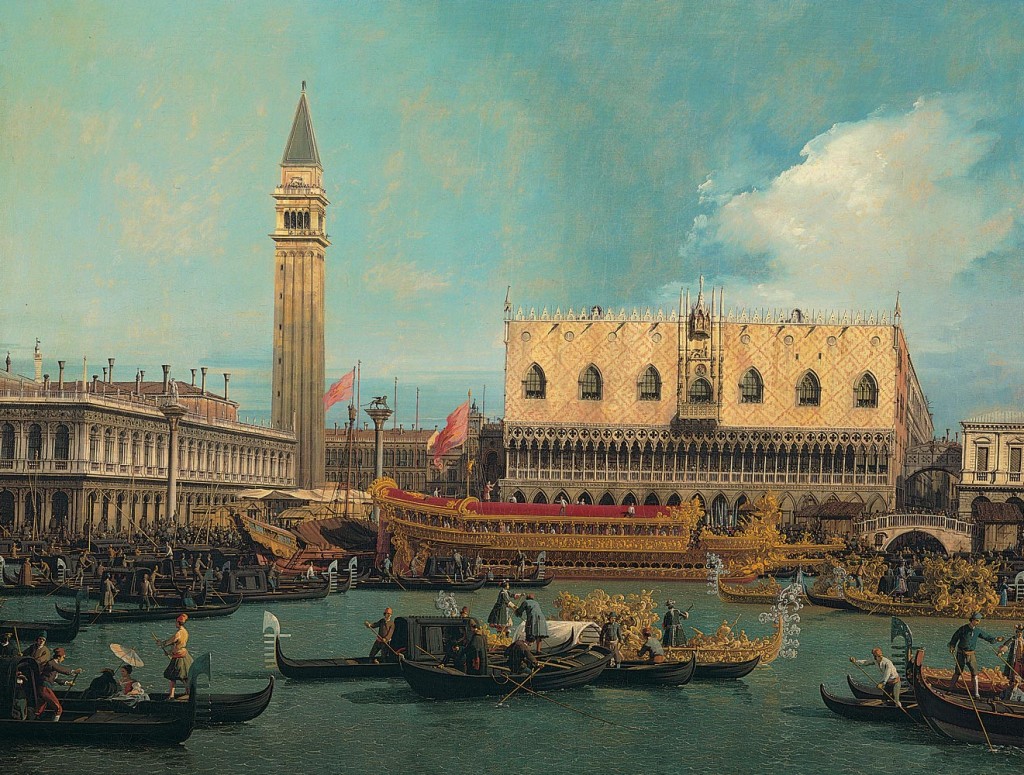
Before visiting Venice, I recalled the familiar but disputed account that linked my country’s name to Amerigo Vespucci’s comparison of Indigenous pile dwellings near Lake Maracaibo with the Italian city. An alternative explanation traces Venezuela to an Indigenous place-name recorded as Veneciuela by Martín Fernández de Enciso in 1519. The story of Little Venice was among the associations I brought to the journey.
My own encounter with Venice came after years of familiarity with its representations. I knew the city through the paintings of Canaletto and Francesco Guardi, the atmospheric views of J. M. W. Turner, and the writings of Goethe, Nietzsche, and Thomas Mann. Piranesi’s engravings of antiquity belonged to my wider image of Italy. Venice had been Poe’s “star-beloved Elysium of the sea,” Dickens’s city of a dream, and Herzen’s “madness of genius”; Mann had described it as “half legend, half snare for strangers.” These representations had shaped my expectations before I arrived.
I came to see that part of Venice’s appeal lay in its fragility. The monuments, bridges, and canals of La Serenissima testified to the perseverance and skill required to sustain the city through the centuries.
As a painter, I wanted to study at close range the works of Antonio Vivarini, Pisanello, Giovanni Bellini, Vittore Carpaccio, Jacopo Bassano, Titian, Palma il Vecchio, Tintoretto, Lorenzo Lotto, Paolo Veronese, and Giambattista Tiepolo. I was drawn to the Venetian school’s handling of paint, to its bittersweet range of color, and to the way color deepened the atmosphere and suffused the human figure. These were qualities I wanted to examine directly.
The architecture offered another field of observation. Byzantine, Islamic, and Gothic influences appeared alongside the classical language of Andrea Palladio and the Baroque of Baldassare Longhena. Palladio’s buildings and The Four Books of Architecture disseminated his interpretation of classical architecture beyond Venice and influenced generations of architects. A short visit could provide only a partial acquaintance with these traditions.
Because of my mother’s physical limitations, we had planned a three-day stay at an unhurried pace. We stayed at the Hotel Amadeus, near the Grand Canal and Santa Lucia railway station, from which we would continue to Rome. Autumn brought fewer tourists, and young people still gathered outdoors, on bridges and in the squares.
At Caffè Florian in Piazza San Marco, an establishment dating from the eighteenth century, we stopped for refreshments and listened to an orchestra playing outside. It was the most expensive snack we had ever had, but the music and setting made the occasion memorable.
We walked through the streets and narrow alleyways, looking at the façades and the more intimate spaces between them. We also took a vaporetto to the Giardini di Castello, at the eastern end of the city, to visit the 48th International Art Exhibition of the Venice Biennale in 1999. Among the national pavilions was Venezuela’s.
Later, before our departure from Rome to Venezuela, my mother asked me to stand beside her while we waited. We faced a mirrored wall, and she said: “This way we will always remember each other.”
Ricardo F. Morín, October 12, 2026. In transit.

