*
*
Ricardo F. Morín
November 21, 2026
Oakland Park, Florida
An election settles who may govern only because each side has already conceded something to the other before the count begins. The winners concede that those they defeat remain entitled to oppose them and to return. The losers concede that those who defeat them are entitled to govern. Neither concession is written on the ballot, and neither can be compelled by the count. Spain votes on November 29. On October 5, the day the election was called, Vox’s leader, Santiago Abascal, urged Spaniards to avoid voting by mail. On October 11, he accused the government of trying to alter the electoral roll to steal the election.1 A month later, on the eve of the official campaign, Abascal described the government itself as a “criminal mafia.”2 A voter listening to Abascal has been invited to suspect theft before the count begins.
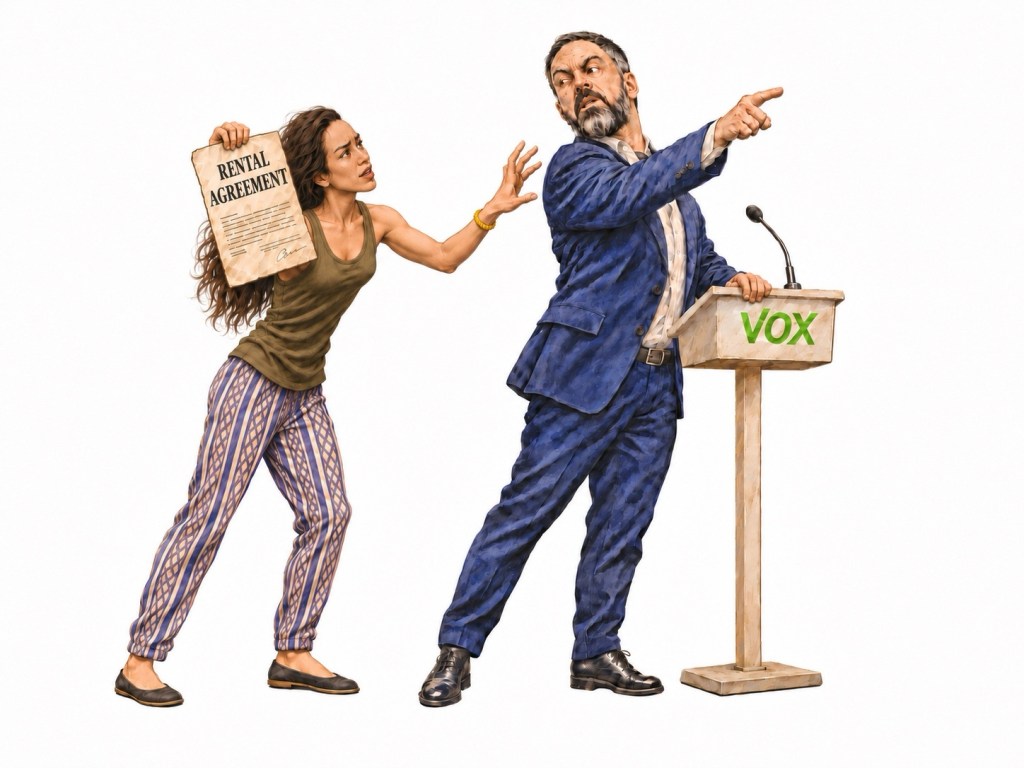
When I wrote about Spain in August 2025, I placed considerable weight on the political legacy of Franco’s rule.3 Among those who listen to Abascal today are citizens who feel no attachment to Franco and have sound reasons for wanting a different government. What has happened to a family’s ability to decide how it will live? An adult daughter may have a job and still be unable to rent a home near her work. She stays with her parents. If their lease ends, all three may have to leave, although their combined income was enough to pay the old rent. The same shortage that kept the daughter from setting up a household of her own can now prevent the family from staying together.4
How did a country that once built more homes than its growing population required arrive at such a shortage? Construction fell sharply after the property crash of 2008. As the economy recovered, people moved to cities where they could find work, and smaller households needed more dwellings for the same number of people. New construction took years to recover. Spain had long directed much of its housing assistance toward home ownership, so families priced out of the private rental market had few publicly supported homes to turn to. For the daughter looking for a place near her job, a dwelling left vacant elsewhere after the boom offers little help.5
Spain’s housing plan called for the national government and the regions to contribute funds. In May their housing ministers unanimously agreed on how to distribute the money.6 They could agree to share that expense and still disagree about what a landlord owed a tenant whose lease was ending. Under Pedro Sánchez’s housing decree, tenants with a qualifying lease who were up to date with their rent and had paid on time for the preceding eight months could request an extension, one year at a time, for up to two additional years. The decree also limited annual rent increases through the end of 2027. Separate provisions addressed vulnerable households already facing eviction with nowhere else to live.
The Popular Party argued for building more homes. The daughter has reason to ask the Popular Party what would bring the rent on those new homes within reach of her wages. Her parents need to know this month whether they can stay. The difficulty for any government promising more homes is that preparing land and approving construction involve regional and municipal authorities as well as the national government.7
Who can afford to wait while more homes are built? An owner with income from many properties may be able to leave one apartment empty until someone pays the asking rent. A family whose lease is ending may have only weeks to find another home near work and school. The difference in how long each can wait helps determine whose terms prevail. Consider, however, an owner who lets a single apartment and depends on the rent to meet her own expenses. She can no more afford a long vacancy than the family can afford a long search. If the law requires her to renew the lease or compensate the tenant, she may reasonably ask why so much of the cost of keeping the family housed should fall to her. How much of that cost should the public bear?8 Vox argued that the government’s measures would lead owners to withdraw homes from the rental market. That was a prediction voters could examine. Even a tenant persuaded by it could ask what Vox would do for a family whose lease was about to expire.
The Basque Nationalist Party’s two votes show how a party could support tenant protection and still dispute a particular obligation placed on owners. On October 2 it supported the housing package and opposed the separate decree on automatic lease renewal. Congress rejected both. After calling an early election, the government issued two new decrees on October 6. On November 12 the standing committee of Congress upheld the housing package, which included both temporary lease extensions and protection for vulnerable households facing eviction. It rejected the separate decree on automatic renewal.9
How would a voter understand the Basque party’s decision if a government spokesman described its vote against automatic renewal as a vote to abandon tenants? The voter would have to know about the protection the party supported to judge that accusation. An opposition spokesman could be equally selective by dismissing the upheld decree on the ground that it built no homes. Parents who could stay another year by requesting an extension would have good reason to question that account. In either telling, a speaker could win the family’s sympathy by leaving out the very fact that might lead them to grant an opponent a hearing.
The parents need to know whether they qualify for an extension and whether the landlord can show a genuine need to occupy the home personally or to house a family member. Their daughter has a different question. She can ask the ministry what funds it has released, her regional government which homes it has financed, and her municipality which sites are ready to build on. When will someone earning what she earns be able to apply for a home near her work?
A voter who believes the government has failed to provide affordable homes has grounds to vote it out. What grounds does that failure provide for calling the government itself criminal?
The charge draws its force from a case in which the judges did establish criminal conduct. The Supreme Court found that former transport minister José Luis Ábalos, his adviser Koldo García and businessman Víctor de Aldama had formed a criminal organization to profit from pandemic mask contracts.10 Ábalos had also served as the Socialist Party’s secretary of organization. The phrase “criminal organization” belonged to the court, and the court applied it to three men whose conduct the judges had examined. Extended to a government, the same words perform a different operation. Voters may ask what the prime minister knew, which safeguards failed and how he answered for the conduct of a minister he appointed. They may vote to remove him on the strength of his answers and still concede his right to govern if he retains the support of Parliament. Can a listener who accepts Abascal’s charge still make that concession? In that listener’s eyes, the very presence of the prime minister in office counts as an offense. On those terms, the government’s return to office can be explained only as a further crime. Abascal’s earlier warning about postal ballots and his accusation about the electoral roll then stand ready to explain how the supposed theft was carried out.
Surveys disagree about whether the right will command a majority, yet they agree that Vox will return to Congress considerably stronger than the party voters sent there three years ago.11 If the governing parties retain office, will Vox recognize their right to govern? If the Popular Party takes office with Vox’s support, will the new prime minister defend his opponents’ right to return? The Popular Party’s leader, Alberto Núñez Feijóo, points to his party’s regional coalitions with Vox as evidence of a working relationship.12 Harmony between partners says nothing about how they will treat those outside the partnership. A Popular Party prime minister who depended on Vox would have to defend the opposition’s standing from his first day in office. He might find that hardest when challenging his partner meant disturbing a coalition that was working well.
Suppose the daughter hears Abascal speak about the cost of housing. Her anger has a sufficient cause in the distance between her wages and the rent she is asked to pay. If Abascal is the only politician who gives her a hearing, she has reason to listen to him in return. She may even agree that a proposed law would lead some owners to withdraw their homes from the rental market. What has she learned by then about his charge that Spain’s government is a “criminal mafia”? Her experience gives her authority to speak about the rent. It supplies no evidence for that accusation. If she leaves the meeting surer of whom to blame, Abascal has gained something from the encounter whatever she decides on election day. While the audience weighs the accusation, one question about the rent goes unasked. What would Abascal do for tenants whose landlord can afford to leave an apartment empty longer than they can afford to look for another home? That is the answer the daughter would have wanted to bring home.
Now suppose she votes against the parties that go on to govern. When she or her parents turn to that government for help, what difference should her vote make to the answer they receive?
The question facing Spain can arise in any European democracy. A distinction drawn during the campaign, between those said to speak for Spain and those accused of betraying it, can outlast the campaign and guide ordinary decisions: which communities receive public investment, whose grievances receive a hearing, how ministers respond to citizens who organize against their policies. In each of those decisions, the citizen who voted against the governing parties retains the same claim on the government’s care and protection as the citizen who helped bring it to office. The daughter is free to oppose the government throughout its term only if she can do so without putting her family’s claim to that protection at risk. Whether she can exercise that freedom depends on a concession that no ballot records.
Notes
- Maldita.es, election claims and postal voting; RTVE, Abascal’s remarks in Estepona, October 11, 2026.
- RTVE, Abascal’s remarks in Huesca, November 12, 2026.
- Ricardo F. Morín, “The New Face of Old Tyranny,” August 1, 2025.
- European Commission, Spain country fact sheet on housing supply and household formation; Bank of Spain, 2025 annual report on access to housing.
- Bank of Spain, construction and affordability after 2008; OECD, housing policy and social rentals in Spain.
- Official State Gazette, 2026–2030 State Housing Plan; Council of Ministers, April 21 financing commitments; El País, May 21 agreement on regional distribution.
- Official State Gazette, Royal Decree-Law 29/2026, final provisions five and six on lease extensions and annual rent adjustments; El País, the parties’ reasons in the October housing debate; Bank of Spain, 2025 annual report on access to housing.
- Official State Gazette, lease renewal and compensation terms.
- Official State Gazette, Royal Decree-Law 29/2026, final provisions five and six on lease extensions and annual rent adjustments; EFE, the two October 2 votes on the housing decrees; Official State Gazette, decree calling the general election; Official State Gazette, November 12 resolution upholding the housing decree; RTVE, the two November housing votes.
- Supreme Court, June 22 judgment in the mask procurement case against José Luis Ábalos, Koldo García and Víctor de Aldama; RTVE, the Supreme Court judgment.
- RTVE, Centre for Sociological Research pre-election survey, November 12; DatosRTVE, polling average updated November 18.
- AS, Feijóo on the four regional coalitions.

