Before we traveled to Europe, Jurek Pankratz asked whether I could afford to accompany him. We had become intimate during a period when it was not safe for me to live in the university dormitories at the State University of New York at Buffalo. With the homeowner’s approval, he had welcomed me into the room he rented in a private home.
My intention all along had been to join the painting atelier at the Internationale Sommerakademie für Bildende Kunst Salzburg (International Summer Academy of Fine Arts Salzburg) in the summer of 1979, but no places remained available. I chose the stage-design seminars instead, since they would also give Jurek and me the opportunity to attend theatrical performances in Salzburg.
The academy brought us into contact with distinguished figures in theatrical design, directing, and architecture, including the director August Everding. Jurek was among the architects attending a workshop led by the Austrian architect Hans Hollein, whom I remember particularly for his work in museum design. Hollein also served on the jury for the stage-design competition.
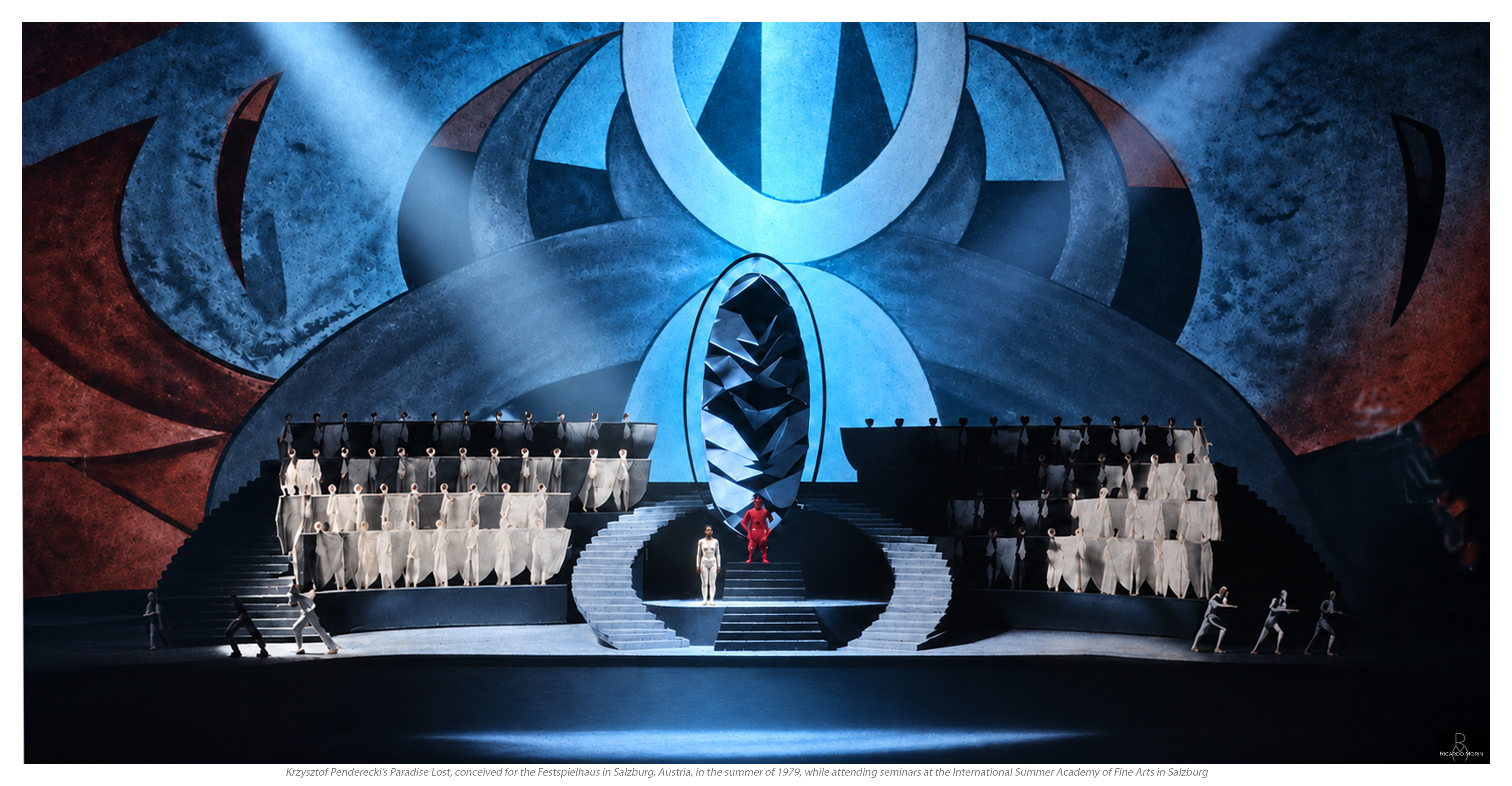
The stage-design seminars were led by Günther Schneider-Siemssen. I participated in an international competition among those attending the seminars, developing a set design for Krzysztof Penderecki’s Paradise Lost, intended for the Festspielhaus.
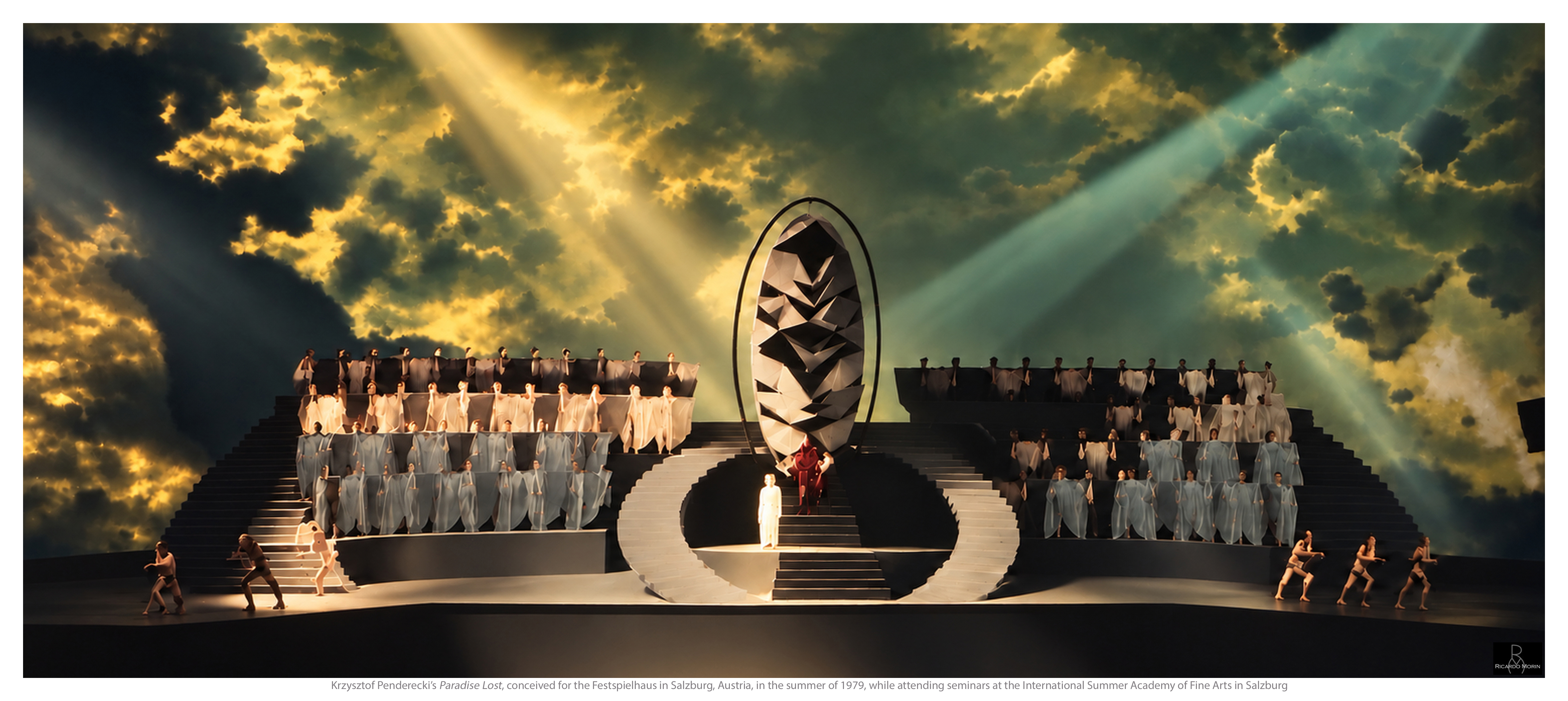
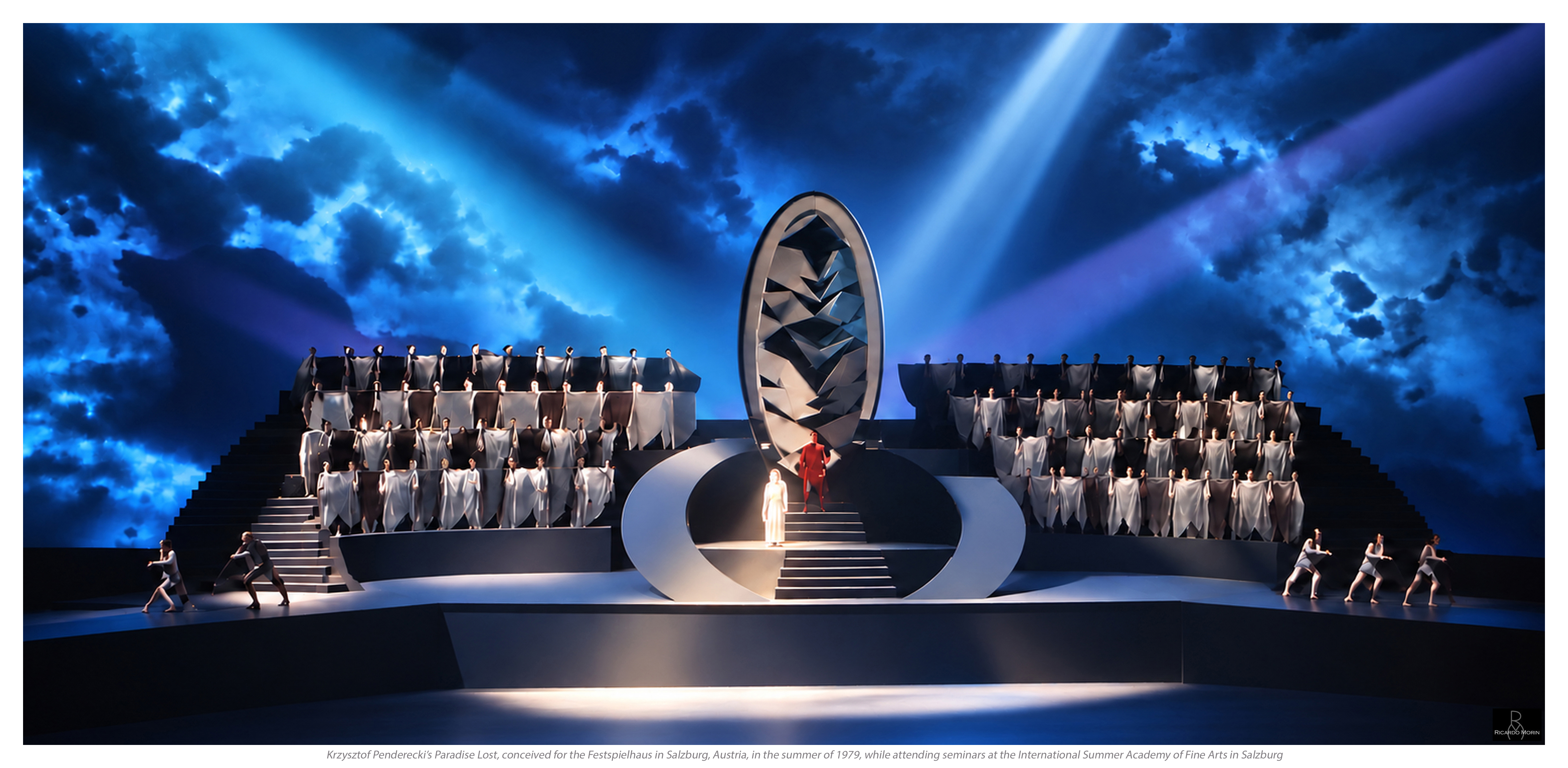
Ricardo F. Morín. Paradise Lost, by Krzysztof Penderecki. Competition set-design maquette with three cyclorama variations, Salzburg, 1979. Recent digital reconstructions from photographs of the original maquette.
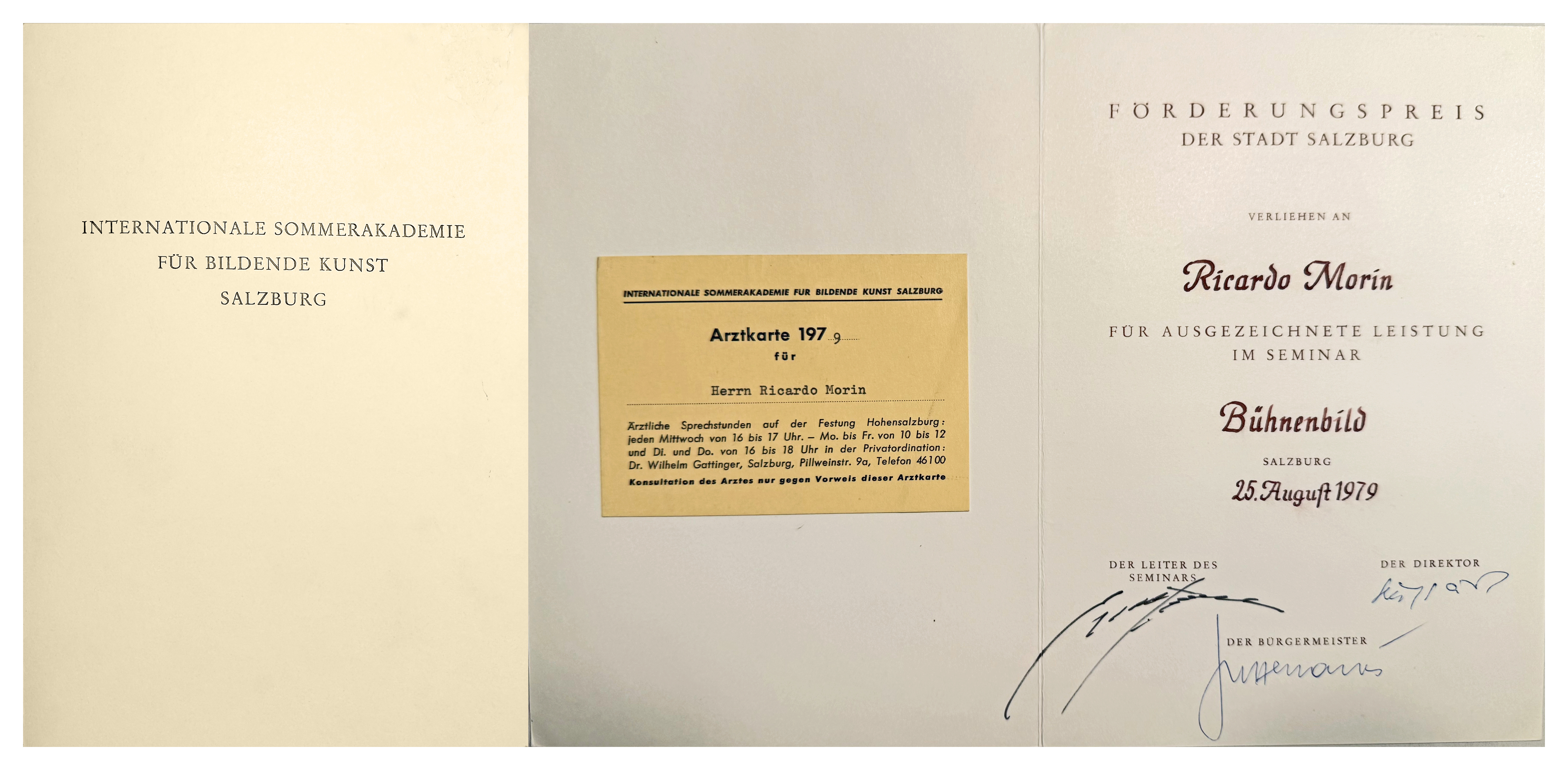
I had the opportunity to meet Penderecki himself, who approved of my design. I received the Förderungspreis der Stadt Salzburg, the City of Salzburg’s encouragement award. Some participants expressed dissatisfaction with the decision; I did not respond. The certificate, dated August 25, 1979, recognizes outstanding achievement in the stage-design seminar: “für ausgezeichnete Leistung im Seminar Bühnenbild.”
I did not attend the award ceremony. Jurek and I were preparing to travel to Nuremberg and fly back to the United States. When I arrived later, Günther Schneider-Siemssen was upset by my absence from the ceremony. Later, I requested a letter of recommendation from Schneider-Siemssen, which became instrumental in my acceptance into the graduate design program at Yale University.
During my first semester at Yale, Ming Cho Lee, the head of the department, publicly described my work as less consistent than Schneider-Siemssen’s. At the time, I doubted that he would subsequently recommend me.
Three years later, I presented my master’s thesis project, a design for Giuseppe Verdi’s Don Carlo. I had designed a black box formed by periaktoi extending the full height of the proscenium. As the panels revolved, brilliant stripes of color appeared between them. Color identified each scene. The chromatic austerity of the surrounding black surfaces drew on the paintings of Ad Reinhardt.
During the review, Ming criticized my design as too austere and suggested introducing geometric reliefs. I replied that I had to follow what I believed in. Professors Jennifer Tipton and Michael Yeargan smiled as I spoke.
Professor Jane Greenwood observed that I had a firm point of view and that the minimal set and my historically accurate costume designs would support one another. I did not understand her remarks as an attempt to diminish Ming’s judgment.
My thesis project received unanimous approval from the board of professors in the design department.
Before those years at Yale, Jurek and I had returned from Salzburg to Buffalo and rented a small apartment next to the university. I was completing my senior year, and Jurek was completing his master’s program. I applied to Yale, and Jurek obtained a Fulbright through the University of Pennsylvania to undertake research in Austria on the Austrian Secession movement.
After our return to Buffalo, the university reported my Austrian award. On December 6, 1979, the UB Reporter published “Morin wins Austrian award”, reporting that I had won first place in the international stage-design competition in Salzburg. In my course on Roman civilization, the professor asked me to stand before a classroom of two hundred students, who applauded.

