“The Politics of Erasure: Authoritarianism and Spectacle”

August 22, 2025

*


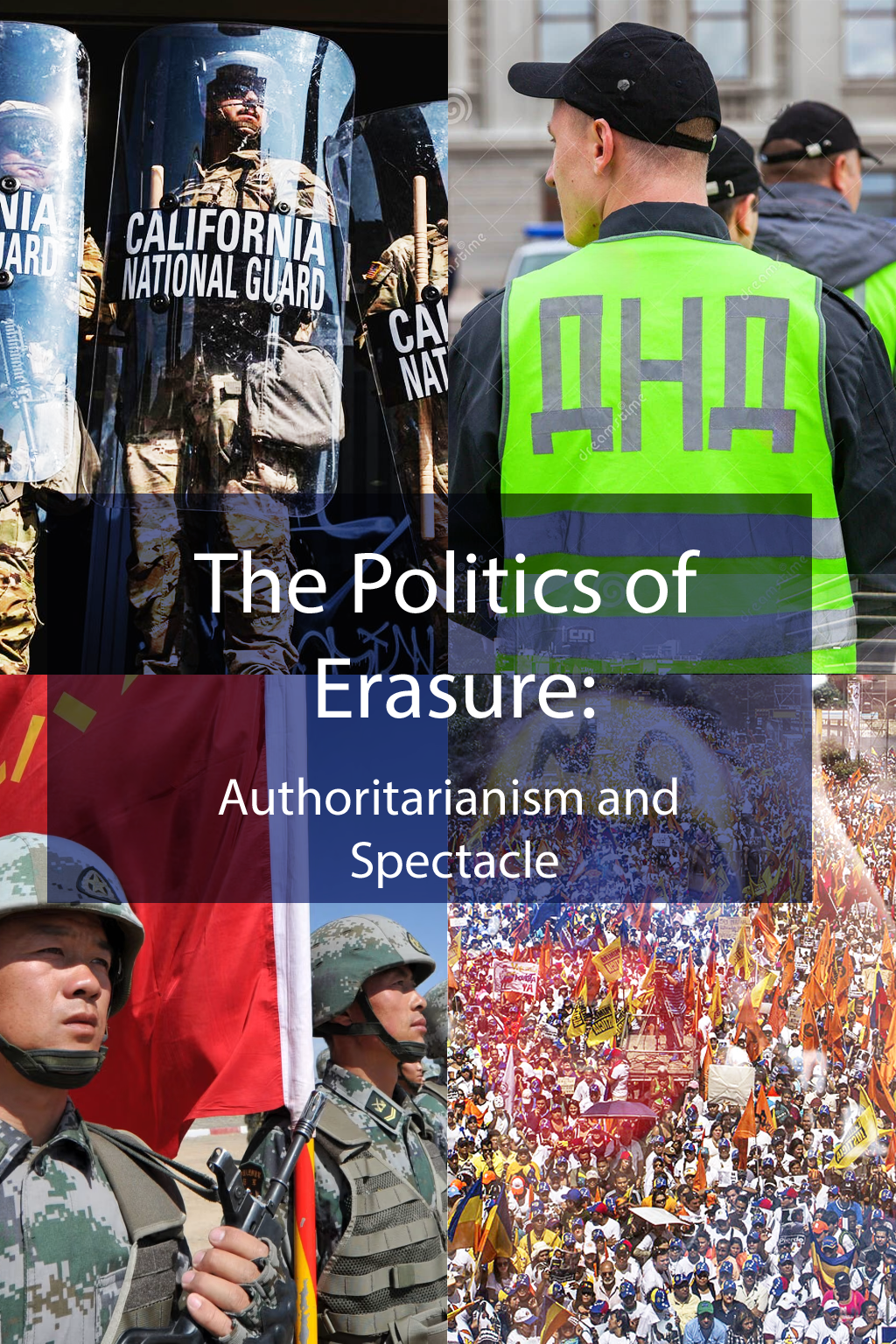
Cover design for the essay “The Politics of Erasure: Authoritarianism and Spectacle.” The composite image juxtaposes surveillance, militarization, propaganda, and mass spectacle to underscore how authoritarian regimes render lives expendable while legitimizing control through display.

By Ricardo Morín, In Transit to and from NJ, August 22, 2025

Authoritarianism in the present era does not present itself with uniform symbols. It emerges within democracies and one-party states alike, in countries with declining economies and in those boasting rapid growth. What unites these varied contexts is not the formal shape of government but the way power acts upon individuals: autonomy is curtailed, dignity denied, and dissent reclassified as threat. Control is maintained not only through coercion but also through the appropriation of universal values—peace, tolerance, harmony, security—emptied of their content and redeployed as instruments of supression. The result is a politics in which human beings are treated as expendable and spectacle serves as both distraction and justification.

In the United States, the Bill of Rights secures liberties, yet their practical force is weakened by structural inequality and concentrated control over communication. After the attacks of September 11, the USA PATRIOT Act authorized sweeping surveillance in the name of defending freedom, normalizing the monitoring of private communications (ACLU 2021). Protest movements such as the Black Lives Matter demonstrations of 2020 filled the streets, but their urgency was absorbed into the circuits of media coverage, partisan argument, and corporate monetization (New York Times 2020). What begins as protest often concludes as spectacle: filmed, replayed, and reframed until the original message is displaced by distractions. Meanwhile, the opioid epidemic, mass homelessness, and medical bankruptcy reveal how millions of lives are tolerated as expendable (CDC 2022). Their suffering is acknowledged in statistics but rarely addressed in policy, treated as collateral to an order that prizes visibility over remedy.

Venezuela offers a more direct case. The Ley contra el Odio (“Law against Hatred”), passed in 2017 by a constituent assembly lacking democratic legitimacy, was presented as a measure to protect tolerance and peace. In practice, it has been used to prosecute journalists, students, and citizens for expressions that in a democratic society would fall squarely within the realm of debate (Amnesty International 2019). More recently, the creation of the Consejo Nacional de Ciberseguridad has extended this logic to place fear and self-censorship among neighbors and colleagues (Transparencia Venezuela 2023). At the same time, deprivation functions as a tool of discipline: access to food and medicine is selectively distributed to turn scarcity into a means of control (Human Rights Watch 2021). The state’s televised rallies and plebiscites portray unity and loyalty, but the reality is a society fractured by exile, with over seven million citizens abroad and those who remain bound by necessity rather than consent (UNHCR 2023).

Russia combines repression with patriotic theater. The 2002 Law on Combating Extremist Activity and the 2012 “foreign agents” statute have systematically dismantled independent journalism and civil society (Human Rights Watch 2017), while the 2022 law against “discrediting the armed forces” criminalized even the description of war as war (BBC 2022). Citizens have been detained for carrying blank signs, which demonstrates how any act, however symbolic, can be punished if interpreted as dissent (Amnesty International 2022). The war in Ukraine has revealed the human cost of this system: conscripts drawn disproportionately from poorer regions and minority populations are sent to the frontlines, their lives consumed for national projection. At home, state television ridicules dissent as treason or foreign manipulation, while parades, commemorations, and managed elections transform coercion into duty. The official promise of security and unity is sustained not by coexistence but by the systematic silencing of plural voices, enforced equally through law, propaganda, and ritual display.

China illustrates the most technologically integrated model. The 2017 Cybersecurity Law and the 2021 Data Security Law require companies and individuals to submit to state control over digital information and extend surveillance across every layer of society (Creemers 2017; Kuo 2021). Social media platforms compel group administrators to monitor content and disperses the responsibility of conformity to citizens themselves (Freedom House 2022). At the same time, spectacle saturates the landscape: the Singles’ Day shopping festival in November generates billions in sales, broadcast as proof of prosperity and cohesion, while state media showcases technological triumphs as national achievements (Economist 2021). Entire communities, particularly in Xinjiang, are declared targets of re-education and surveillance. Mosques are closed, languages restricted, and traditions suppressed—all in the name of harmony (Amnesty International 2021). Stability is invoked, but the reality is the systematic denial of dignity: identity reduced to an administrative category, cultural life dismantled at will, and existence itself rendered conditional upon conformity to the designs of state power.

Taken together, these cases reveal a common logic. The United States commodifies dissent and normalizes abandonment as a permanent condition of public life. Venezuela uses deprivation to enforce discipline and the resulting compliance is publicly presented as loyalty to the state. Russia demands sacrifice and transforms coercion into patriotic duty. China fuses surveillance and prosperity and engineers conformity. Entire communities are suppressed in the name of harmony. The registers differ—commercial, ritualistic, militarized, digital—but the pattern is shared: dissent is stripped of legitimacy, lives are treated as expendable, and universal values are inverted to justify coercion.


References

  • ACLU: “Surveillance under the USA PATRIOT Act”. New York: American Civil Liberties Union, 2021. (This article documents how post-9/11 legislation expanded state surveillance in the United States and framed “security” as a justification for reducing privacy rights.)
  • Amnesty International: “Venezuela: Hunger for Justice. London: Amnesty International”, 2019. (Amnesty International reports on how Venezuela’s Ley contra el Odio has been used to prosecute citizens and silence dissent under the rhetoric of tolerance.)
  • Amnesty International: “Like We Were Enemies in a War: China’s Mass Internment, Torture and Persecution of Muslims in Xinjiang”. London: Amnesty International. 2021. (Amnesty International provides evidence of mass detention, surveillance, and cultural repression in Xinjiang carried out in the name of “harmony” and stability.)
  • Amnesty International: “Russia: Arrests for Anti-War Protests”. London: Amnesty International, 2022. (Amnesty International details the systematic arrest of Russian citizens, including those holding blank signs, under laws claiming to protect peace and order.)
  • BBC: “Russia Passes Law to Jail People Who Spread ‘Fake’ Information about Ukraine War.” March 4, 2022. (News coverage of Russia’s 2022 law criminalizing criticism of the war shows how “discrediting the armed forces” became a punishable offense.)
  • CDC.: “Opioid Overdose Deaths in the United States. Atlanta: Centers for Disease Control and Prevention”. 2022. (The CDC provides statistical evidence of widespread loss of life in the U.S. and underscores how entire populations are treated as expendable in public health.)
  • Creemers, Rogier: “Cybersecurity Law of the People’s Republic of China”: Translation with Annotations. Leiden University, 2017. (An authoritative translation and analysis of China’s 2017 Cybersecurity Law illustrate how digital oversight is institutionalized.)
  • UNHCR: “Refugee and Migrant Crisis in Venezuela: Regional Overview”. Geneva: United Nations High Commissioner for Refugees, 2023. (This report offers figures on the Venezuelan exodus and highlights the mass displacement caused by deprivation and repression.)
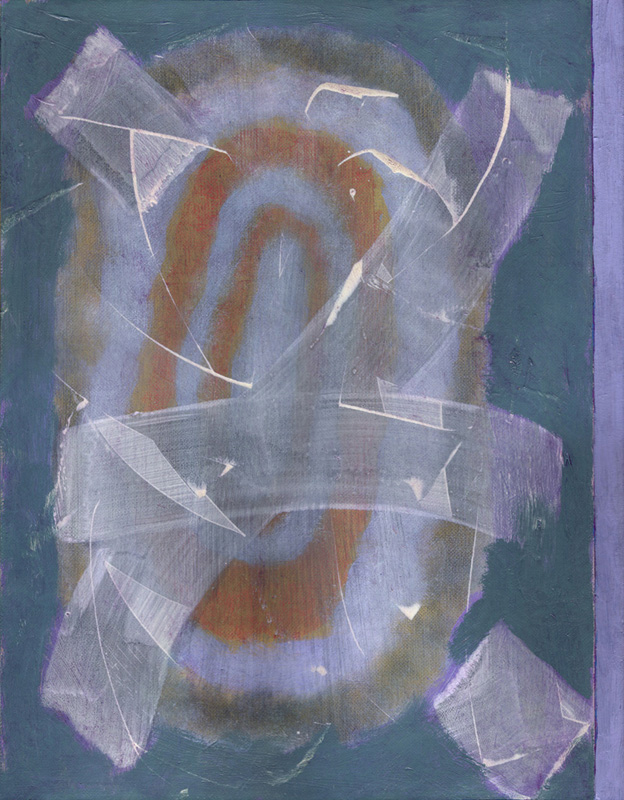
“The Primary Bond”

August 21, 2025

*

Ricardo Morin
Still Forty-three
Oil on linen
14″ x 18″ x 3/4″
2012

For those who know that the sharpest word cannot replace the simple act of responding with tenderness.


Ricardo Morin — August 13, 2025 — Bala Cynwyd, Pennsylvania

*

Tenderness is a deliberate openness that seeks the well-being of another through a gesture of welcome, through gentleness and respect. Aggression, by contrast, is the forceful assertion of one’s will in a way that can wound, constrain, or dominate. Each can exist without the other, yet they often meet in the same moment, altering the course of a conflict or softening its edge. One sees this when, in the middle of an argument, a person instinctively offers a chair to the other. The dispute remains, but its weight has shifted.

In a world haunted by resentment and the fear of being hurt—feelings as real as they are sometimes exaggerated—tenderness emerges not as a denial of those forces but as their modulation. It interrupts the cycle of suspicion, as when two adversaries, after heated words, lower their voices to hear one another. The hostility remains, but it is tempered, displaced by the recognition that another’s presence is not solely a threat.

Where causality would claim to measure our emotions as predictable reactions, what becomes evident are instead our habits and inclinations—patterns that oscillate between the delicate pull that calms and the impulse that wounds. These shifts reveal that tenderness is not the opposite of aggression, but a mirror exposing how both are woven together from the same human ground.

Tenderness, then, is not the absence of aggression but a mirror showing the weave in which both share a common origin. Consider the exhausted nurse who, after an endless shift, still takes the time to straighten a patient’s blanket. The act is small, yet it springs from the same human ground where impatience and fatigue could just as easily have given way to harshness.

Tenderness carries an ambiguity that makes itself as disarming as it is unsettling. Its apparent fragility dismantles aggression without force, compelling it to see itself in an unexpected reflection: a gentle act that interrupts the urge to harm and leaves it without footing.

Tenderness is not a calculated ruse but a natural pull toward memories older than mistrust—when contact was a need rather than a threat. One sees this when, after years of silence and estrangement, a son returns to care for his ailing father. Resentment remains, yet in the act of tending beats the same root that once sustained closeness.

In such moments, fear loosens, hostility softens, and what seemed a battlefield becomes an uncertain but open passage toward relief. Tenderness does not erase conflict, but shows how—even within it—something older and deeper still binds us. I witnessed this once on the New York City subway. A man, angered when a disabled stranger asked for help, turned his glare on me as our eyes met. He moved toward me as if to strike, bringing his face close to mine. I closed my eyes and eased my expression. Deprived of the stare that had fueled his aggression, he stepped back—uneasy, but no longer advancing. I walked away, marked by how a single gesture can quiet the arc of a confrontation.

There lies a primary bond that ties us to the source of life, where tenderness and aggression are not isolated poles but two expressions of the same human fabric. A sister, in a tense exchange, tells her older brother that she learned her combative stance from him. He bristles at the remark, yet both know they have carried that same hardness for years, and neither can fully blame the other. The recognition does not bring easy reconciliation, but it narrows the distance between them.

From the first bond, the body learns to read the smallest signals: the warmth that welcomes, the pressure that threatens, the pulse that quickens or slows. One sees it when, in the midst of battle, a soldier offers water to a prisoner who only moments before was his enemy. Long before words exist, such gestures shape the habits we later call preferences or fears. This is why tenderness can yield to aggression without conceding defeat: it exposes aggression to an involuntary recognition, restoring the memory of its own root. And in that recognition, even the most hostile impulse finds, if only for a moment, its disarmament.

Tenderness does not eliminate conflict or erase its causes, but it can shift its course. It opens a moment where the certainty of harm gives way to the possibility of presence and care. It is not a cure for all, yet in its quiet way of calling and being heard, tenderness shows that even the firmest aggression seeks acknowledgment. In that acknowledgment, both tenderness and aggression reveal that they spring from the same human ground.

The presence of tenderness in our exchanges is not merely a private virtue but a civic necessity. It sustains the trust and recognition without which communities fracture and cannot endure.

*


Annotated Bibliography

  • Arendt, Hannah: The Human Condition. Chicago: University of Chicago Press, 1958. (Hannah Arendt examines the active life of human beings—labor, work, and action—tracing their historical meanings and showing how modern society has altered the conditions for political and civic engagement.)
  • Girard, René: Violence and the Sacred. Baltimore: Johns Hopkins University Press, 1977. (René Girard explores the role of violence in human culture, arguing that ritual sacrifice emerged as a mechanism to contain social conflict, and linking these dynamics to myths and religious practices.)
  • MacIntyre, Alasdair: After Virtue. Notre Dame: University of Notre Dame Press, 1981. (Alasdair MacIntyre critiques modern moral philosophy, contending that the loss of a shared Aristotelian framework has left moral discourse fragmented and emotive, and proposing a return to virtue ethics.)
  • Nussbaum, Martha C.: Political Emotions: Why Love Matters for Justice. Cambridge: Harvard University Press, 2013. (Martha Nussbaum investigates the emotional foundations of a just society, arguing that cultivating compassion, love, and a sense of shared humanity is essential for sustaining democratic institutions.)

*


“Language, Mathematics, and the Price of Artificial Intelligence”

August 19, 2025

*

Ricardo Morín
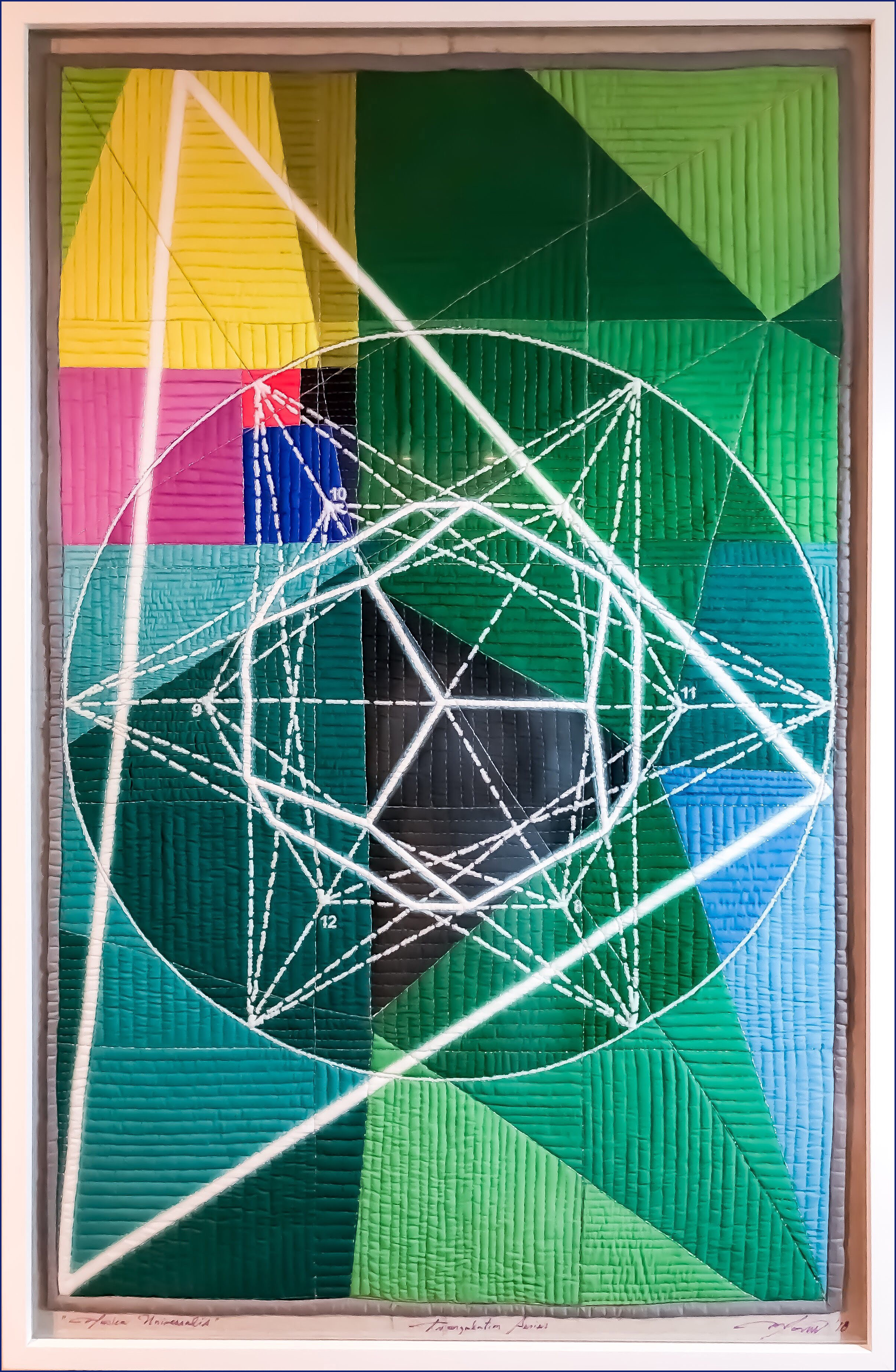
(Triangulation Series)
Musica Universalis
Silk quilt streched over linen
37″ x 60″
2013-18

A geometrical construction of a dodecahedron within a Fibonacci composition, reinforced by a right-angle triangle: A meditation on the harmony of the universe, where mathematics and language converge yet never fully enclose reality.


Ricardo Morin, August 20, 2025

Abstract

This essay examines the interdependence of language and mathematics as the twin pillars of knowledge, each indispensable yet incomplete without the other. While mathematics secures precision and abstraction, language renders reasoning intelligible and shareable; together they approximate, but never fully capture, a reality richer than any formulation. The discussion situates artificial intelligence as a vivid case study of this condition. Marketed at premium cost yet marked by deficiencies in coherence, AI dramatizes what happens when mathematical power is privileged over linguistic rigor. Far from replacing human thought, such systems test our capacity to impose meaning, resist vagueness, and refine ideas. By weaving philosophical reflection with contemporary critique, the essay argues that both mathematics and language must be continually cultivated if knowledge is to progress. Their partnership does not close the gap between comprehension and reality; it keeps it open, ensuring that truth remains an unending pursuit.


Language, Mathematics, and the Price of Artificial Intelligence

Every society advances by refining its tools of thought. Two stand above all others: mathematics, which distills patterns with precision, and language, which gives form and meaning to reasoning. Neither is sufficient alone. To privilege one at the expense of the other is to weaken the very architecture of knowledge.

Artificial intelligence dramatizes both their promise and their limitations. The announcement of a $200 monthly fee for access to ChatGPT-5 is revealing. Marketed as a luxury service “for those who can afford it,” it underscores the widening gap between technological privilege and cultural necessity. Those with resources can fine-tune their productivity; those without are left behind. Yet even for the well-equipped, the question persists: what exactly is being purchased?

The machine dazzles with speed and scale, but its deficiencies are equally striking. Engineers may be virtuosos of algorithms, but grammar is not their instrument. The results are too often colloquial, vague, or lacking in rigor. To extract coherence, the user must not be a passive consumer but an editor—capable of clarifying, restructuring, and imposing meaning. The paradox is unmistakable: the tool marketed as liberation demands from its operator the very discipline it cannot supply.

This paradox reflects the larger truth about knowledge itself. Mathematics and language are both indispensable and both incomplete. Mathematics achieves abstraction but leaves its results inert unless language renders them intelligible and shareable. Language conveys thought but falters without the rigor that mathematics provides. What one secures, the other interprets.

Yet both are bound by a deeper condition: reality exceeds every formulation. Our theories—whether mathematical models or linguistic descriptions—are approximations shaped by the observer. Language cannot exhaust meaning; mathematics cannot capture finality. Knowledge is never absolute: it is a negotiation with a reality richer than any model or phrase.

Artificial intelligence lays bare this condition. It can automate structure but cannot provide wisdom; it can reproduce language but cannot guarantee meaning. Its true value lies not in replacing the thinker but in testing our capacity to resist vagueness, impose coherence, and refine thought. What is marketed as freedom may, in truth, demand greater vigilance.

To dismiss language and the humanities as secondary, or to imagine mathematics and computation as sufficient unto themselves, is to misunderstand their interdependence. These disciplines are not rivals but partners, each refining the other. AI magnifies both their strengths and their deficiencies; they remind us that progress depends on the continual refinement of both—mathematics to model reality, language to preserve its meaning.

The path of knowledge remains open-ended. Language and mathematics do not close the gap between our finite comprehension and the inexhaustible richness of reality; they keep it open. They allow us to approach truth without presuming to possess it. Artificial intelligence, as every tool of thought, shows us not the end of knowledge but its unending condition: a dialogue between what can be measured, what can be spoken, and what forever exceeds us.

*


Annotated Bibliography

  • Arendt, Hannah: The Life of the Mind. Vol. 1: Thinking. New York: Harcourt, Brace, Jovanovich, 1971. (Arendt examines the act of thinking and the limits of expression, which shows how thought requires language to become shareable while never able to exhaust reality. Her work reinforces the essay’s claim that reasoning without expression cannot advance knowledge.)
  • Bender, Emily M., and Koller, Alexander: “Climbing towards NLU: On Meaning, Form, and Understanding in the Age of Data.” Proceedings of ACL, 2020. (Bender and Koller argue that large language models process form without true understanding; this highlights the gulf between mathematical pattern recognition and linguistic meaning—it supports the essay’s caution that AI dazzles with form but falters in coherence.)
  • Chomsky, Noam: Language and Mind. 3rd ed. Cambridge: Cambridge University Press, 2006. (Chomsky explores the innate structures of language and their role in shaping cognition; this affirms that language conditions the possibility of thought while it still remains limited in capturing reality.)
  • Devlin, Keith: Introduction to Mathematical Thinking. Stanford: Keith Devlin, 2012. (Devlin explains how mathematical reasoning distills structure and pattern while acknowledging abstraction as approximation; this reinforces the idea that mathematics, as a safeguard of precision, cannot exhaust the world it models.)
  • Floridi, Luciano: The Fourth Revolution: How the Infosphere Is Reshaping Human Reality. Oxford: Oxford University Press, 2014. (Floridi situates digital technologies and AI within a broader history of self-understanding, which enriches the essay’s argument that mathematics and language—extended into computation—remain approximations of a reality beyond full control.)
  • Lakoff, George, and Núñez, Rafael: Where Mathematics Comes From: How the Embodied Mind Brings Mathematics into Being. New York: Basic Books, 2000. (Lakoff and Núñez argue that mathematics arises from metaphor and embodied cognition, which reveals how dependence on human interpretation and the affirmation that mathematical theories, as linguistic ones, remain bound to the observer.)
  • Mitchell, Melanie: Artificial Intelligence: A Guide for Thinking Humans. New York: Farrar, Straus and Giroux, 2019. (Mitchell provides a critical overview of AI’s capabilities and limits; it shows how the advancement of pattern recognition does not close fundamental gaps in understanding and parallels the essay’s critique of AI’s grammatical poverty.)
  • Polanyi, Michael: Personal Knowledge: Towards a Post-Critical Philosophy. Chicago: University of Chicago Press, 1962. (Polanyi emphasizes tacit knowledge and the need for articulation in validation; it echoes the view that mathematics and language refine understanding but never achieve closure.)
  • Snow, C. P.: The Two Cultures. Cambridge: Cambridge University Press, 1993 [1959]. (Snow diagnoses the divide between sciences and humanities; this undergirds the essay’s call to treat language and mathematics as complementary pillars of understanding.)

“The Mirage of Exceptionalism”

August 19, 2025

Ricardo Morin
The Mirage of Exceptionalism
(Template Series)
1st out of six
Each 30″x 22″ = 66″h x 66″ overall
Watercolor on paper
2005

To the paradox that divides in the very act of seeking unity.

~


By Ricardo Morin
August 18, 2025, Bala Cynwyd, PA

*

Across traditions, faith has sought to articulate humanity’s highest aspirations. Scriptures, rituals, and doctrines were meant to give form to gratitude, humility, and reverence for creation. Yet time and again, these same legacies have been drawn into the service of division. The paradox lies in how beliefs that profess universal truth harden into claims of exceptional status and turn revelation into rivalry.

The Abrahamic faiths—Judaism, Christianity, and Islam—rooted themselves in texts anchored in antiquity. This permanence can inspire continuity, but when transposed into political life, belief risks becoming dogma, and dogma exclusion. What began as a celebration of humanity and its creator becomes instead an engine of contention.

Exceptionalism is not confined to any single tradition. It arises wherever uniqueness is mistaken for superiority, wherever the memory of a chosen people or a sacred covenant becomes a license to deny the dignity of others. Creationism, visions of Heaven, doctrines of righteousness—all contain the seeds of inspiration, but also of antagonism when set against rival paths.

In this sense, exceptionalism is less about the divine than about the human need to define boundaries. By exalting one path as singular, communities cast shadows on others. They forget that the multiplicity of belief might reveal instead the vastness of what humanity seeks to comprehend. The question is not whether one tradition is more luminous than another, but whether clarity itself can be hoarded without dimming the shared horizon of human dignity.

The tragedy of conflating exceptionalism with uniqueness is that it mistakes a gift for a weapon. To be unique is not to be superior; to inherit a tradition is not to monopolize truth. Religions, when true to their essence, point toward a mystery larger than themselves. When they lapse into rivalry, they obscure it.

The challenge before us is whether humanity can learn to let religions serve as languages of gratitude rather than banners of conquest. If belief is to celebrate creation, it must embrace the unity of humanity rather than sabotage it. Otherwise, the promise of transcendence is reduced to a struggle for dominance, and what was meant to honor the creator becomes instead a mirror of our most destructive instincts.

*


Annotated Bibliography

  • Armstrong, Karen. The Battle for God: A History of Fundamentalism. New York: Ballantine Books, 2001. (Armstrong explores how traditions across Judaism, Christianity, and Islam have produced militant forms of fundamentalism. She shows how claims of absolute truth often distort original spiritual intent and feed conflict instead of unity.)
  • Girard, René: Violence and the Sacred. Baltimore: Johns Hopkins University Press, 1977. (Girard argues that societies often channel violence into ritualized sacrifice. His insights illuminate how religious exceptionalism, rather than reducing violence, can redirect it toward outsiders deemed threatening to communal “uniqueness.”)
  • Küng, Hans: Christianity and the World Religions: Paths of Dialogue with Islam, Hinduism, and Buddhism. New York: Doubleday, 1986. (Küng advocates for dialogue across faiths, stressing that no single religion can claim monopoly on truth. His work directly challenges exceptionalist claims and encourages the search for shared ethical ground.)
  • Said, Edward W.: Covering Islam: How the Media and the Experts Determine How We See the Rest of the World. New York: Vintage, 1997. (Said critiques the portrayal of Islam as uniquely threatening, showing how narratives of exceptionalism become entrenched in political and cultural discourse. His analysis highlights how external perceptions reinforce divisions.)
  • Taylor, Charles: A Secular Age. Cambridge, MA: Belknap Press of Harvard University Press, 2007. (Taylor examines how modernity has shifted the role of religion and has complicated claims of universality. He shows how belief persists in pluralist societies, while exceptionalist frameworks struggle to adapt within a diverse human landscape.)

*


Edited by Billy Bussell Thompson, August 18, 2025, NY, NY.

“The Shared Shadow of History”

August 12, 2025

*

Ricardo Morin
The Shared Shadow of History
(Template Series)
3rd out of six
Each 30″x 22″= 66″h x 66″ overall
Watercolor on paper
2005


To the memory we all inherit—capable of bridging distances, yet more often deepening them.


By Ricardo Morin

August 12, 2025, Rochester, NY

*

Across cultures, rituals are both vessels of history and instruments of adaptation. They carry the weight of collective memory while responding to the shifting conditions of the present, negotiating between inherited forms and the realities in which they are practiced.

At a recent wedding within a centuries-old tradition, two family members — a rabbi and a woman — shared officiating duties, blending contemporary adaptations into the ceremony. The shared roles, gestures, and blessings revealed how continuity and innovation can inhabit the same space, weaving together memory and renewal.

Such occasions unfold within atmospheres shaped as much by public discourse as by personal heritage. They demonstrate how ceremonies are never static: they are marked by the echoes of the past, yet reshaped by the urges and hopes of the present.

This interplay between the ceremonial and the political is far from unique. Diasporas across the world have long balanced the preservation of essential forms with the incorporation of new influences. My own ancestry traces to communities that, over generations, retained elements of earlier practices while integrating into new surroundings — a trajectory familiar to many shaped by migration and the pressures of assimilation.

The enduring question, visible in ceremonies from many cultures, is whether customs survive best when they hold firmly to inherited forms or when they adapt to welcome diversity and safeguard the integrity of others. As with many legacies, history will answer in due course.

*


Annotated Bibliography

  • Anderson, Benedict: Imagined Communities: Reflections on the Origin and Spread of Nationalism. London: Verso, 2006. (In this influential work, Anderson examines how shared cultural narratives and rituals create a sense of belonging across dispersed populations. He explores how communities sustain identity across generations, offering context for understanding the persistence of tradition within diasporas.)
  • Gerber, Jane S.: The Jews of Spain: A History of the Sephardic Experience. New York: Free Press, 1992. (Gerber traces the history of Sephardic Jewry from medieval Spain through the diaspora, detailing how cultural and religious traditions adapted to new environments. She provides an accessible account of resilience in the face of displacement and persecution.)
  • Hobsbawm, Eric, and Ranger, Terence eds.: The Invention of Tradition. Cambridge: Cambridge University Press, 1983. (Hobsbawm and Ranger compile studies on how traditions are often consciously constructed or adapted to serve contemporary needs. Their analysis invites readers to consider how ritual continuity is shaped by changing political and social contexts.)
  • Sorkin, David: Jewish Emancipation: A History Across Five Centuries. Princeton: Princeton University Press, 2019. (Sorkin presents a broad historical account of Jewish emancipation movements in Europe and beyond, showing how shifts in political and cultural climates influenced religious practice and identity formation.)
  • Todorov, Tzvetan: The Conquest of America: The Question of the Other. New York: Harper & Row, 1984. (Todorov explores how cultures define themselves in relation to the “other,” with attention to encounters between Europe and the Americas. His work illuminates how cross-cultural contact reshapes both identity and tradition.)

*


“The Constitution Within”

August 10, 2025

*

Ricardo Morin
The Constitution Within
GCI
2025

*

Politics (from the Greek politikós, “of, by, or relating to citizens”) is the practice and theory of influencing people at the civic or individual level.

*

By Ricardo Morin

August 10, 2025.

~

From their earliest formulations, constitutional frameworks have been more than foundational legal agreements; they have stood as declarations of political philosophy, and defined how power should be organized, how it should be restrained, and to whom it must be answerable. Contemporary governance, to a large extent, continues those experiments, shaped over centuries of trial and adaptation. Yet these forms can endure in appearance while being emptied of substance. In more than a few States today, constitutions proclaim liberty while they narrow its scope, define rights in ways that exclude, and preserve the interests of a governing elite. Partisanship exploits the perceived limitations and vulnerabilities of others as grounds for exclusion; self-righteousness becomes a tool for domination, silences opposition, and suppresses dissent. The worth of a constitutional framework, therefore, is measured not only by its letter but by the ethical integrity of those who sustain it. Without ethics, politics loses its meaning; without civic virtue, the law ceases to serve peace and becomes an instrument of dominion.

The separation of powers, vigorously defended by Montesquieu, rests on the conviction that liberty survives when power is compelled to check power. This principle is distorted when institutions are subordinated to partisan or personal interests. In recent years, several States have formally preserved an independent judiciary while, in practice, subjected it to appointment processes controlled by the Executive or the ruling party. Such hollowing-out is not merely a technical failure; it reflects a political culture in which ambition, fear, or indifference among citizens permits the disfigurement of the very mechanisms designed to protect them. It also reveals how institutional strength and civic responsibility are bound together in ways that cannot be separated.

Historical constitutions continue to shape how political communities imagine authority. They bequeath principles that, at their best, offer adaptable frameworks for meeting new challenges without renouncing their essential core: that the legitimacy of a Government rests not on the strength of its rulers but on the solidity of the structures that limit them.

Yet these structures endure only when citizens reject duplicity and sectarianism. Divisions of ideology must not harden into exclusive loyalty to one’s own group at the expense of a shared civic framework. They endure only when citizens resist the idolatry of power, because authority loses its legitimacy once it is treated as sacred or unquestionable. And they endure only when citizens repudiate the cult of personality, in which a leader is raised above criticism through image-making, propaganda, and personal loyalty.

The durability of constitutional order, then, does not lie solely in written texts or institutional arrangements. It rests equally on the civic ethic of those who inhabit them. When ambition, fear, or indifference allow citizens to tolerate duplicity or surrender to sectarian loyalty, the limits on power become fragile. Conversely, when vigilance and responsibility prevail, constitutions retain their strength as both shield and compass—guarding against arbitrary rule while orienting political life toward justice and restraint.

True reform is not solely institutional but also internal: a revolution in the individual and collective sphere, in which each person accepts the responsibility to act with integrity, openness, and commitment to the common good, in harmony with oneself and with others. Only through the alignment of institutional structures with civic responsibility can any Constitution preserve its meaning and endure as a safeguard against arbitrary power.

*


Annotated Bibliography

~

  • Ginsburg, Tom, and Aziz Z. Huq.; How to Save a Constitutional Democracy. Chicago: University of Chicago Press, 2019. (Ginsburg and Aziz examine the legal and institutional pathways through which democracies weaken, from court-packing to the erosion of independent oversight. They draw on comparative examples from the United States, Hungary, and elsewhere to show how constitutional mechanisms can be used to consolidate power while preserving a façade of legality.)
  • Landau, David: “Abusive Constitutionalism.” UC Davis Law Review 47 (1), 2013: 189–260. (Landau develops the concept of “abusive constitutionalism” to describe how incumbents exploit constitutional change to entrench their rule. Uses Latin American and other global cases to illustrate how amendments and reinterpretations weaken checks and balances, alter electoral systems, and undermine judicial independence.)
  • Levitsky, Steven, and Way, Lucan A.: Competitive Authoritarianism: Hybrid Regimes after the Cold War. Cambridge: Cambridge University Press, 2010. (Levitsky and Way analyze regimes that preserve the formal institutions of democracy but manipulate them to ensure ruling-party dominance. They introduce the concept of “competitive authoritarianism” as a framework for understanding how constitutional norms are hollowed out while democratic forms are maintained.)
  • Levitsky, Steven, and Ziblatt, Daniel: How Democracies Die. New York: Crown, 2018. (Levitsky and Ziblatt argue that modern democracies often decline through the gradual decline of norms rather than coups. The book shows how leaders exploit constitutional ambiguities, stack courts, and weaponize law to suppress opposition, eroding both civic trust and institutional integrity.)

~


“The Woman at the Glass Shop”

August 6, 2025
Photo 0f Catarina (Kitty) O’Bryan-Erlacher by Ricardo Morin.
 Kitty is holding the book Steuben Glass: An American Tradition in Crystal by Mary Jean Madigan.
This appears to be the revised and expanded edition, as indicated in the lower left corner of the cover

*

For Kitty O’Bryan-Erlacher, whose friendly grace, profound clarity, and genial wit made a brief moment feel like a lasting gift.

Ricardo Morin — Corning, New York, August 2025

In transit to our cousin Shayna’s wedding to Johnny, we passed through Corning, New York, and spent a few unhurried hours browsing the shops along West Market Street. The sky had the muted softness of a Monday unbothered by haste. On a quiet corner, we came upon the Erlacher Steuben Glass Shop—a space luminous with its own kind of luster.

Inside, we found what would become the wedding gift: a round crystal plate titled Vesta Plate (1993) by Peter Drobny (born 1958). It was displayed simply but with taste, as museum art waiting patiently to be understood. Alongside it stood two glass vases—bold and elegant: one translucent ultramarine, the other an opaque, intense lavender. We decided they too should come with us.

The shop, we learned, was founded in 1960. Its steward now is Catarina (“Kitty”) O’Brian-Erlacher, born in 1938—a woman of 87, with a deep well of charm, intellect, and quiet fortitude. Her husband, Mr. Roland (Max) Erlacher (1933, Vienna – July 2022), had arrived from Vienna in 1957 to work for Steuben Glass (founded in 1903 by Frederick Carder). There, in Corning, he met Kitty. Their story became the store’s story—one of craft, beauty, and the steady guardianship of glass as both object and art.

When I first approached Kitty, I mistook her for a fellow client. We began talking easily, without expectation. Art turned into astrology; numerology followed. I was caught in the kind of exchange that slows time—until my husband, David, interrupted, suggesting I was perhaps being too talkative. I teased, calling him “the boss.” Kitty, smiling, said, “You’re very smart.” I replied, “We should aim to be smarter,” and turned the compliment back to her. She graciously demurred.

As it happened, the cost of our three selections (including one from the Vitrix Hot Glass Studio and another from the Corning Museum of Glass) would, in Kitty’s words, “cover the shop’s needs for the entire month of August.” That small admission made our brief encounter feel suddenly momentous. The wrapping of the pieces—particularly the Vesta Plate—proved difficult. The oversized plate resisted all the available box sizes. Instinctively, I offered help and reassembled one of her boxes to fit the plate precisely. Kitty, watching with both amusement and admiration, called it brilliant.

She then brought out a reference book on her husband’s work. The exuberance of his designs, rooted in the lineage of Art Nouveau, seemed to fill the room with light. But when she spoke of him, words failed. Her eyes grew teary, and all she could manage was, “He was the kindest man.” I paused, gave her a long, knowing glance, and offered only silence in return—more interested in cheering her up than inviting grief.

When David and I finally parted from her, I lingered a moment amid the quiet exchange of goodbyes. Then, slowing my pace as we crossed the threshold, I turned and said softly, “God bless you, dear.”

*


“The Seventh Watch”

August 6, 2025

*


Ricardo Morin
The Seventh Watch
(Template Series, 5th panel)
Watercolor over paper
22” x 30”
2005

Introductory Note

Ricardo Morin is a writer and researcher of the history of thought as a dynamic and evolving practice—a student of unspoken gestures, a language stronger than words, especially when interlocutors no longer listen to each other. Drawing on reflections on the cycles of life and a personal experience approaching the last, he invites readers to consider how quiet vigilance and tenderness can shape a meaningful existence. The Seventh Watch emerges from decades of living attentively, offering a humble testament to dignity through perseverance and care.

71 Years

I’ve lived seventy-one years. That alone still surprises me—not because I ever expected an early end, but because each year has asked more of me than the last. There was no dramatic fall, no single crisis to point to. Just a slow, constant shaping—of the body, of temperament, of the will.

Illness didn’t come in childhood. It arrived later, in my early twenties, during a snowbound winter in Buffalo. I was just beginning to live on my own, full of ambition and unfinished dreams. The diagnosis was mononucleosis—but it wasn’t the name that mattered. It was the way it interrupted momentum, slowed my pace, and revealed something deeper: the lifelong task of learning to live within my own limits.

That was the beginning—not of a medical history, but of a different kind of vigilance. Not directed outward, but inward. A quiet realization took root: that survival, if it was to be meaningful, required not just endurance, but restraint. A way of protecting myself from myself. That discipline wasn’t harsh—it became a kind of devotion. Not to self-denial, but to finding the clarity of a peaceful mind. To living with more care than urgency.

I don’t see illness as noble, but I do see in it a mirror—not for the pain, but for the truth it reflects. What can be tended, what must be relinquished, what deserves attention. I don’t claim wisdom from illness, but I recognize what it’s taught me to let go of: illusion, pride, and the frantic chase after things that do not last—such as the accumulation of wealth or power.

I’ve come to think of it simply as endurance—the kind illness teaches when you stop resisting and begin listening. There’s an ethical arc in this awareness—not born of dogma or belief, but shaped by experience. It bends not toward triumph, but toward tenderness.

This isn’t a story of pathology. It’s a story of attention—of refining the self without hardening it. Of discovering that maturity means knowing when to persist and when to pause. That the quiet act of sustaining one’s life—daily, attentively—is its own form of courage.

I never set out to write a testament. But seventy-one years in, I see the outlines more clearly. And in that, there is dignity.

Yet, dignity is not a reward. It arrives without announcement, without ceremony. It builds slowly—through the daily rituals of rising, of choosing what to carry and what to set down. It does not shield one from sorrow, nor make suffering easier to bear. But it gives the days a certain weight.

I’ve come to cherish that weight—not as a burden, but as proof. Proof that I’ve lived through each season not untouched, but intact. And that, even now, the task is not to escape life’s demands, but to meet them with steadiness.

What I’ve learned isn’t mine alone. Anyone who lives long enough will be asked to reckon with time—not as a thief, but as a sculptor. Illness, especially, teaches us how little control we truly have—yet how much presence we’re still capable of. It humbles and joins us. Not in sameness, but in mutual recognition.

Endurance, I’ve found, is not passive. It’s not about waiting for pain to pass. It is active, quiet, often unseen. It means choosing how to live when choice feels narrow. It means tending to life not with haste, but with attention.

There is no finish line to this work. Just the quiet act of continuing.

So I continue—not because I must, but because life, even in its reduced dimensions, still offers room for meaning. Some days that meaning is faint. Other days it is simply the act of rising, or writing a letter, or remembering the snow. But it is there. And as long as it is, I remain.

*


“A Festering Wound”

August 6, 2025

*

Elders and chiefs from the 21 First Nation signatories of the Robinson Huron Treaty at the June 17, 2023, announcement of the proposed settlement. Standing at left: Gimaa Craig Nootchtai (Atikameksheng Anishnawbek); centre: Gimaa Dean Sayers. Photograph by Jenny Lamothe. Courtesy of SooToday / Anishinabek News.

Introduction

The 2023 Robinson Huron Treaty settlement announcement—captured in a widely circulated image of leaders and Elders assembled in solidarity—marks a moment of continuity in Indigenous governance once silenced by colonial displacement. I write not as a member of these communities, nor as a Canadian citizen, but as an observer who engages with testimony and documented evidence. Beneath the natural serenity of Parry Sound lies a wound deepened by continued neglect, one that requires not only recognition but structural change.

The Truth and Reconciliation Commission’s 94 Calls to Action, issued in 2015, outlined a comprehensive plan across justice, health, and education. Nearly a decade later, the Yellowhead Institute reports that only 13 of the 94 have been completed—and none in 2023. This inaction reveals the gap between commitment and execution, showing how reconciliation remains more rhetorical than structural.

It is telling that the tensions between First Nation tribes and Canadian institutions reveal how a country that celebrates cultural diversity can remain in conflict with its Indigenous peoples.


By Ricardo Morin, August 6, 2025; Isabella Island, Parry Sound, Ontario, Canada.

*

The boat across Parry Sound glides over still water, southward to Isabella Island. The surrounding beauty—dense pines, scattered rock formations, and open sky—stands in sharp contrast to what my cousin Marc reveals once we disembark: that beneath this serene northern Ontario landscape lies a persistent story of abuse, erasure, and systemic abandonment. Marc, a seasoned youth justice specialist in Ontario’s legal system, has spent over thirty years advising police departments and courts on indictments involving minors. His experience covers nearly every youth murder case in the province, but his most wrenching insights, he says, do not come from what the law sees—but from what it omits.

This omission is not accidental. The First Nations peoples of this region—the Anishinaabeg, including the Ojibway, Odawa, and Potawatomi—have lived for generations under policies that turned colonial violence into institutional neglect. Residential schools, operated primarily by churches and endorsed by the Canadian government, aimed to assimilate Indigenous children by forcibly removing them from their families and culture. Physical and sexual abuse, malnutrition, and psychological trauma were widespread. The Truth and Reconciliation Commission of Canada, which published its final report in 2015, called this system “cultural genocide.” Yet despite official acknowledgment, its legacy remains embedded in law enforcement, education, housing, and incarceration.

As Marc recounts, the present-day effects are not merely residual—they are cumulative. Indigenous communities in the Parry Sound district, he explains, are often subjected to outright racist harassment. He described instances where Indigenous people have been kidnapped by white residents, driven miles from their communities, and abandoned in the freezing wilderness—half-dressed, humiliated, and physically endangered; some have died. These are not rare stories. They are carried in silence, in mistrust, in patterns of disappearance and criminalization. “Depression and petty crimes,” Marc continues, “lead Indigenous youth to prison. But it is Indigenous women who suffer most.”

Today, nearly 70 percent of Ontario’s incarcerated female population is Indigenous—a figure that defies proportionality and demands scrutiny. The equivalent male figure is 20 percent, itself shockingly high. What accounts for the extreme overrepresentation of Indigenous women? Neutral data suggest a convergence of risk factors: intergenerational trauma, poverty, lack of access to healthcare, disrupted education, and systemic police bias. Indigenous women are also the most frequent targets of domestic and sexual violence, often left unprotected by a justice system that fails to recognize their vulnerability until it criminalizes their survival. They are far more likely to be imprisoned for crimes rooted in trauma—substance-related offenses, minor thefts, or breaches of conditional release. In these cases, incarceration substitutes for care; silence substitutes for accountability.

Legal frameworks fail to acknowledge this chain of causation. Where the justice system claims impartiality, it often operates as a mechanism of historical amnesia. Political neutrality becomes moral indifference. The courtroom speaks in terms of individual guilt, severed from social context. What justice omits is precisely what history insists upon: that a wound, left untreated, does not heal—it deepens.

Resistance has not been absent. Local First Nations have organized to reclaim land rights, restore language, and establish health services rooted in traditional knowledge. Movements as Idle No More and the work of leaders such as Cindy Blackstock and Tanya Talaga have elevated the national conscience. Yet the machinery of redress moves slowly. Reports are written, apologies are issued, commissions are concluded. Meanwhile, communities remain under-resourced, youth remain vulnerable, and women continue to disappear—sometimes into institutions, sometimes into obscurity.

This essay does not indict any single actor. It seeks to illuminate what institutions routinely fail to see: that harm is not only historical but structured; that healing is not only personal but political; and that justice, without history, risks becoming an empty performance.

The waters of Parry Sound appear peaceful, yet they conceal the contradiction of a nation that pledges reconciliation while leaving it incomplete. Between 2015 and 2023, only 13 of the Truth and Reconciliation Commission’s 94 Calls to Action were implemented—none in the last year. Such inaction does not erase testimony; it amplifies the wound. I cannot claim to speak for First Nations, but I can bear witness to the record, to the words of those who live these realities, and to the silence that persists when promises remain unmet. Healing requires more than acknowledgment; it requires accountability and the structural change that Indigenous voices have long demanded. The role of an outsider, if it has any legitimacy, is not to dictate, but to listen, to learn, and to make visible what is already being said.


Appendix: Sources and Monitoring Data

  • Truth and Reconciliation Commission of Canada, Final Report: Volume 5: The Legacy. Montreal & Kingston: McGill‑Queen’s University Press, 2015. (This report includes 94 Calls to Action across justice, education, health, etc.)

*


Footnotes

[1]. Office of the Correctional Investigator, “Annual Report, 2020–2021.” Ottawa: Office of the Correctional Investigator, 2021. (This report documents that Indigenous women represent over 50% of federally incarcerated women in Canada. It contrasts this alarming rise with the still-high but less sharply increasing incarceration of Indigenous men.)

[2]. Truth and Reconciliation Commission of Canada, Final Report, Volume 5: The Legacy. Montreal and Kingston: McGill-Queen’s University Press, 2015. (This volume establishes a historical continuum between residential school trauma and present-day legal inequities. Drawing on survivor testimony, it details the systemic removal of children, cultural suppression, and intergenerational psychological effects.)

[3]. Statistics Canada, “Women in Canada: A Gender-based Statistical Report.” Ottawa: Government of Canada, 2020. (This statistical overview highlights gender-specific incarceration trends and emphasizes the overrepresentation of Indigenous women in custody, often for administrative or non-violent infractions.)

[4]. Public Safety Canada, “Risk Assessment and Indigenous Offenders.” Ottawa: Government of Canada, 2016. (This government report analyzes how standard risk assessment tools disproportionately assign higher security levels to Indigenous offenders—especially women—owing to trauma-linked factors that are misread as criminogenic.)

[5]. Parliamentary Budget Officer, “Costing Restorative Justice Programs.” Ottawa: Office of the Parliamentary Budget Officer, 2020. (This study notes the disparity in funding and access to restorative justice programs, which shows how Indigenous women receive fewer diversionary options than men or youth and reflects systemic neglect.)

[6]. Department of Justice Canada, “Indigenous Overrepresentation in the Criminal Justice System.” Ottawa: Government of Canada, 2018. (This policy brief provides statistical data on pretrial detention, bail denial, and sentencing outcomes; it underscores administrative causes of Indigenous overrepresentation in prison, particularly among women.)

[7]. Tanya Talaga: Seven Fallen Feathers: Racism, Death, and Hard Truths in a Northern City. Toronto: House of Anansi Press, 2017. (Through the investigation of seven Indigenous youth deaths in Thunder Bay, this book exposes a pattern of institutional failure and systemic racism within policing, education, and the Canadian justice system.)

[8]. Idle No More, “About the Movement.” Saskatoon: Idle No More, 2012–present. https://idlenomore.ca/about-the-movement/. (This official web page traces the origins, aims, and activities of the Idle No More movement, which arose in defense of Indigenous sovereignty and the environment. It emphasizes the vital leadership role of Indigenous women in mobilization and education.)


“Questions That Hold Their Answers”

August 3, 2025

*


Ricardo Morin
Sonata Series
Each 30″x 22″= 60″h x 66″ overall
Watercolor on paper
2003

By Ricardo Morin

August 3, 2025

The Whittington chime, though rooted in the specific historical and ecclesiastical context of St. Mary-le-Bow in London, speaks in a language far broader than its origins. Every fifteen minutes, its melody punctuates the passage of time—not with dominance or insistence, but with a sequence of tones that seem to lean toward attentiveness rather than control. It does not call; it invites. Its fourfold phrasing unfolds with the day and carves it gently into intervals of awareness.

The hour does not ask to be heard.

It leans, it yields, it breathes.

In four phrases, time steps into its own shadow—

Not to rule, but to be received.

The first phrase is sparse and anticipatory. It announces nothing—yet it creates space for something to begin. The second phrase, slightly more confident, suggests that the shape of what’s coming may already be present in what has been. The third phrase swells with fullness, as though recognizing that something unspoken has come to form. And the fourth does not repeat or resolve—it releases. A soft culmination, an unforced closure. Nothing more is needed.

Four phrases like footprints.

Not forward, but inward.

The last does not complete the first—

It simply continues without demand.

Time is neither summoned nor announced—it is welcomed in silence. The melody performs a quiet orienting function. It makes no claims, prescribes no doctrine, and excludes no one. It requires attention, not belief. It passes through space and enters those who allow it, and in doing so, it reveals time not as a line to be followed, but as a vessel to be filled.

There is no message, only rhythm.

No doctrine, only form.

Not a path to walk,

But a shape to inhabit.

This surrender—this subtle willingness to listen—is not weakness, nor is it a form of passivity. It is a kind of interior readiness, a posture of faith in what does not insist upon itself. As one hears the chime at a distance—through open window, across an empty street, or at the center of a sleepless night—it becomes clear that regularity is not rigidity. It is a form of grounding, a pulse that reminds us of something more than measurement: the possibility that rhythm itself is a form of remembering.

Some things endure not because they hold us fast—

But because they return.

Each return is a soft petition:

Are you listening now?

To be transformed by time, the vessel must remain open. And openness is not emptiness in the deficient sense, but the fullness of a receptivity that listens before it responds. There are patterns here, but they do not bind. They unfold. Each phrase in the chime allows what came before to echo—faintly, without repetition—and then continues without imitation. It does not search for novelty, nor does it cling to what has passed.

It simply arrives.

An echo does not ask for an answer.

It waits until the shape of silence

Begins to sing it back.

In this way, the melody becomes an offering. And if there is meaning to be found in its intervals, it is not imposed from without. It is disclosed in the act of listening. Each person who hears it becomes part of its form, not by adding to it, but by receiving it. And in receiving, they are also shaped.

Some questions do not seek reply.

They seek a place to rest.

They carry their answers folded within—

Waiting only to be heard.

We often think of arrival as the end of something—as the completion of a search. But perhaps it is not the final step that matters most. Perhaps what matters is the quiet unfolding that prepares us to meet it. The chime does not deliver anything. It accompanies. It affirms that movement can be gentle, that order can serve grace, and that meaning is not attained, but awakened …

… —gently, without insistence.

It arrives, and we recognize it—

Not because we were waiting,

But because we were listening.

*