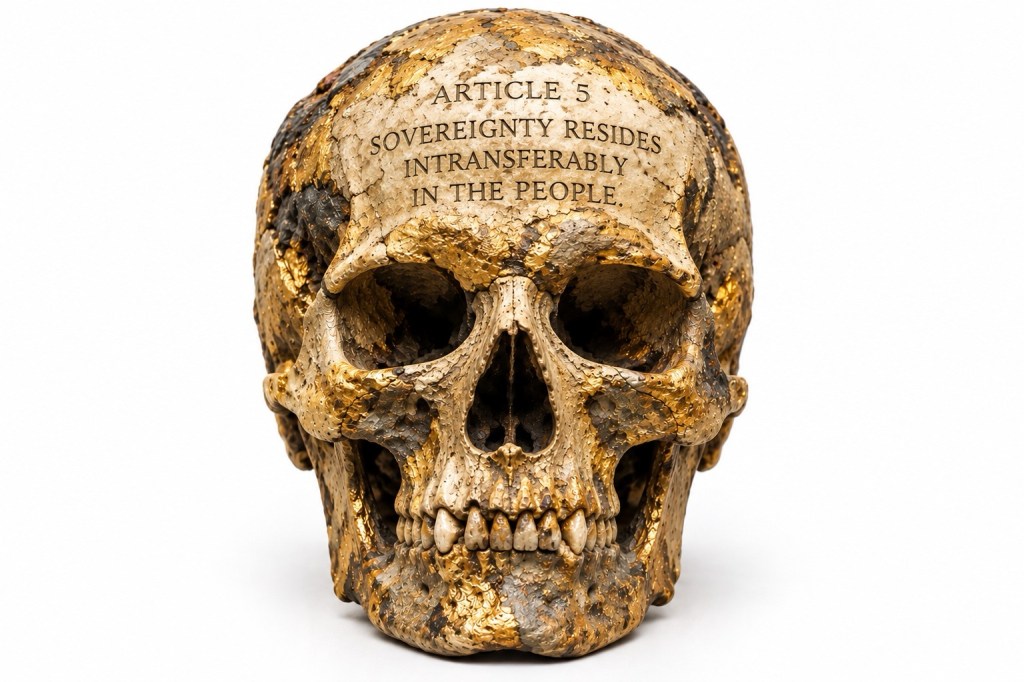
Untitled
18 × 12.434 inches
2003
The constitutional question now presented by Venezuela does not begin with petroleum. It begins with the identity of the sovereign.
Article 5 of the Constitution in force states that sovereignty resides in the people and cannot be transferred. It specifies that the people exercise sovereignty directly in the forms provided by the Constitution and law and indirectly, through suffrage, by the organs exercising Public Power. It then establishes the relation on which the rest depends: the organs of the State emanate from popular sovereignty and remain subject to it. [1]
That language does not identify government with the sovereign people. It distinguishes the sovereign from the organs through which sovereign authority is exercised. A president, legislature, ministry, State enterprise, or interim administration may exercise constitutional competencies. None becomes the sovereign by exercising them. Governmental power is constituted power. Sovereignty remains with the people.
Article 12 gives this distinction a material object. Mineral and hydrocarbon deposits belong to the Republic, are property in the public domain, and are inalienable and imprescriptible. The deposits do not belong to the officials administering the Republic. Temporary control of governmental institutions does not convert public-domain wealth into the property of those who control them. [2]
The relation between Articles 5 and 12 therefore precedes any petroleum agreement. The Republic possesses the deposits. State organs may act concerning them only through authority conferred by the constitutional order. The sovereign source of those organs remains the people.
That structure has acquired immediate consequence because the United States has not merely facilitated commerce in Venezuelan petroleum. The present Administration publicly describes an arrangement designed to secure American governmental and economic advantages over Venezuelan reserves on a scale and for a duration extending far beyond the present political transition.
On August 31, 2026, the White House announced what it called the biggest oil deal in world history. It said Venezuelan interim authorities had granted North American Blue Energy Partners 100-year concessions over 17 fields containing approximately 65 billion barrels of proven reserves. The same announcement described United States “majority control,” governmental governance rights, “economic ownership,” a 35 percent equity interest for the Department of War’s Office of Strategic Capital, a guaranteed right for the Department of State to purchase 20 percent of production at cost, a right of first refusal over the remaining 80 percent, veto authority over appointments to the company’s board, and a requirement that a majority of directors be United States citizens. [3]
The Administration did not present those provisions as incidental protections surrounding a Venezuelan development program. It presented them as American achievements. The White House said the arrangement would secure American “energy dominance for the next century,” expand the reserves effectively available to the United States, support American refineries and employment, and provide low-cost petroleum for the Strategic Petroleum Reserve, military requirements, and other sensitive uses. [3] [4]
The United States is not an accidental beneficiary of an arrangement designed elsewhere. The benefits to the United States are stated as objectives of the policy itself.
The same fact sheet describes the arrangement as part of stabilization, reconstruction, and eventual democratic transition. It says the new hydrocarbons framework was adopted with United States support. It describes United States governance and audit provisions, banking reform, payment oversight, and financial monitorship as means by which tax and royalty payments will be supervised. It also says the United States is sponsoring reconciliation talks between the 2015 National Assembly and the interim authorities. [3]
The vocabulary of transition therefore accompanies a structure in which the foreign power that intervened militarily has acquired enduring economic interests, governance rights, purchasing privileges, and supervisory functions over the principal natural resource of the country in transition.
The present interim administration did not obtain its current mandate through a new national election following the January United States military action. As of late September, its president continued to promise elections as part of a transition to full democracy without establishing a firm election date. The United States itself continues to describe democratic transition as prospective. [3] [5] [6]
That circumstance does not make Article 5 disappear. It makes Article 5 unavoidable.
If sovereignty were vested in whoever happened to control the machinery of government, effective control would answer the constitutional question. Article 5 says otherwise. The organs of the State emanate from popular sovereignty and remain subject to it. The Constitution therefore refuses the identification of governmental possession with sovereign ownership. [1]
The current National Assembly’s subsequent endorsement of the petroleum arrangement is part of the constitutional record. On September 1, it backed the arrangement by a show-of-hands vote. Some opposition deputies abstained because they had not been able to examine the written terms. [7] But an act of a constituted organ is not identical with the sovereign from which Article 5 says constituted authority derives. Legislative approval must possess constitutional competence for the act approved. The existence of a vote cannot, by itself, transform the organ casting it into the sovereign people or cure an antecedent absence of authority if the power purportedly exercised was not constitutionally available to that organ.
This is the distinction between representation and sovereignty. Representatives may exercise constitutionally conferred powers on behalf of the people. They do not own the sovereignty they exercise. Article 5 keeps the representative subject to the sovereign represented.
The distinction is particularly consequential where the commitment is intended to endure for a century. One hundred years is not a transitional interval. A concession of that duration reaches beyond the officials who granted it, beyond the present American Administration, beyond the promised democratic transition, and through generations of Venezuelans who had no part in the governmental circumstances under which it was created.
The American record itself recognizes, in another context, that control and possession do not extinguish Venezuelan ownership. Executive Order 14373, issued on January 9, defines specified natural-resource revenues held in United States Treasury accounts in Section 2 and determines in Section 4(a) that those funds are property of the Government of Venezuela. It says the United States holds those funds solely in a custodial and governmental capacity, not as a market participant, and requires Treasury to designate them as sovereign property of Venezuela rather than property of the United States. [8] [9]
Yet Section 4(c)(ii) of the same order provides that those funds are held pending “sovereign disposition” for public, governmental, or diplomatic purposes determined by the United States Secretary of State on behalf of the Government of Venezuela. Section 5(a)(ii) directs Treasury to follow the Secretary of State’s instructions concerning disbursements and transfers. [8]
From January onward, the Administration thus assigned an American officer authority to determine the purposes for which Venezuelan sovereign property would be used. Venezuelan ownership remained formally acknowledged while decisions concerning its exercise passed to an officer of the intervening State. The authority by which that officer could determine sovereign purposes on Venezuela’s behalf was asserted in an American order rather than supplied by the Venezuelan Constitution.
Nearly eight months later, the petroleum arrangement added proprietary advantages to that supervisory structure. The White House described United States economic ownership, majority control, veto rights, preferential acquisition, and a governmental equity interest protected against dilution. Reuters reported that the 35 percent position was structured through penny warrants intended to preserve the United States ownership level as additional capital entered the enterprise. [3] [10]
The sequence is not one of ignorance about whose resources are involved. The American documents repeatedly identify the reserves, revenues, concessions, and deposits as Venezuelan. The Administration knows the object is Venezuelan wealth. Its own January order expressly recognizes Venezuelan sovereign property. Its later announcements expressly identify the advantages sought for the United States. [3] [8]
The Venezuelan juridical record identifies the force that altered the governmental circumstances. On January 3, the Constitutional Chamber described the United States action as an agresión militar extranjera [foreign military aggression] undertaken for the secuestro[abduction] of Nicolás Maduro. It treated his resulting ausencia forzosa [forced absence] as a material and temporary impossibility of exercising presidential functions. Invoking its interpretation of Articles 234 and 239.8, the Chamber ordered Vice President Delcy Rodríguez to exercise the presidency through an urgent precautionary measure intended to preserve the State and defend the Nation. It left the definitive classification of the absence to the competent State organs. [11]
The ruling that named the aggression also ordered the acting presidency whose consent the United States now invokes. Dismissing the Chamber as an organ of the former government does not supply an independent constitutional basis for that consent. The government maintained through the Chamber’s response subsequently became the channel through which the United States obtained the petroleum advantages it announced in August.
The President of the beneficiary State had already connected the military action to its economic return. On April 30, President Trump described the relationship with Venezuela as “like a joint venture,” said both countries were making money, and declared that the United States had “paid for the attack many times over.” [12]
Exploitation does not mean every foreign investment, petroleum sale, loan, or commercial concession. It denotes the deliberate extraction of advantage from another nation’s resources under conditions in which the foreign beneficiary possesses extraordinary power over the governmental circumstances through which consent is purportedly obtained. The asymmetry is recorded on both sides: the Venezuelan Chamber named the aggression and ordered a defensive measure; the American President described the resulting economic relationship as a joint enterprise that had repaid the attack. The August arrangement then gave enduring economic and governmental form to that advantage.
The White House’s own language makes the contradiction sharper. Its August fact sheet accuses Russian and Chinese actors, along with Venezuelan political cronies, of having “looted Venezuela’s resources” for the benefit of American adversaries. The same document then celebrates the displacement of those actors by a system designed to ensure American dominance in the hemisphere, American governmental control, American economic ownership, American purchasing privileges, and American strategic supply. [3] [4]
The nationality of the beneficiary cannot determine whether Venezuelan sovereignty has been respected. If foreign control of Venezuelan resources is objectionable because the resources belong to Venezuela, changing the foreign beneficiary does not alter the constitutional location of Venezuelan sovereignty or the juridical status of the deposits.
The constitutional issue is not whether Venezuela may receive foreign capital, sell petroleum, or enter long-term commercial relations. It is the source of the authority by which the Republic is bound. Investment describes capital. Contract describes an instrument. Recognition describes a foreign government’s diplomatic position. None of those categories, by itself, supplies Venezuelan sovereign competence.
The distinction becomes still more important when corporate form intervenes. The White House has emphasized the role of a private company and the use of private American capital. [3] [4] But a private corporation cannot grant itself a Venezuelan petroleum concession. The underlying right to exploit deposits belonging to the Republic must originate in Venezuelan law. Private corporate arrangements can distribute economic interests after a right exists. They cannot create the sovereign authority necessary to create the right in the first place.
Reuters identifies North American Blue Energy Partners as controlled by the Venezuelan businessman Alejandro Betancourt. [10] The arrangement therefore joins a Venezuelan private beneficiary to the American governmental interests it expressly creates. The advantage obtained by the United States need not be exclusive to be deliberate. Nor does a Venezuelan businessman’s private interest constitute the consent of the Venezuelan people. His participation does not alter the need to establish the constitutional authority for granting rights over the Republic’s deposits.
Nor can American law answer that antecedent Venezuelan question. American statutes, executive orders, licenses, contracts, and judicial jurisdiction can determine what United States officials and American entities may do under United States law. They cannot determine what authority Venezuelan officials possess under the Constitution of Venezuela to bind the Republic.
The American Preamble begins “We the People,” and American constitutional doctrine treats those words as identifying the source that ordained and established the Constitution. But the Supreme Court has not treated the Preamble as an independent source of substantive governmental power. Venezuela’s Article 5 is not prefatory language. It is an operative constitutional provision defining where sovereignty resides, how it is exercised, where State organs derive from, and to what they remain subject. [1] [13] [14]
Translating Article 5 into the familiar American phrase “We the People” would diminish rather than clarify it.
Article 5 is more exact. The people do not merely appear at the founding moment and then disappear into the institutions they created. Sovereignty remains theirs. Government does not receive sovereignty as property. It exercises constituted powers while remaining subordinate to the sovereign source from which those powers emanate.
The distinction between the sovereign people and their representatives determines what governmental consent can mean.
A representative act can bind the Republic only because the constitutional order gives the representative authority to perform that act. Representation is therefore derivative. Sovereignty is not. To treat the consent of representatives as self-validating is to reverse the constitutional relation Article 5 establishes.
The problem becomes more acute when the governmental order supplying the consent exists under foreign tutelage. The January order placed decisions over Venezuelan sovereign revenues in American hands. The subsequent structure extended that supervision across the transition: the foreign State sponsors political reconciliation, supports the legal framework governing the resource, claims audit and financial-monitoring functions, acquires governance rights and vetoes in the resulting enterprise, receives economic ownership and preferential purchasing rights, and openly describes the arrangement as securing its own dominance. [3] [4] [8]
Under those conditions, governmental consent cannot be treated as evidence independent of the foreign power obtaining the benefit. The foreign beneficiary participates in the political and institutional environment from which the purported consent emerges.
When the petroleum arrangement was announced, even the maximum temporary-substitution period under Article 234 had expired. Article 234 provides for substitution during a temporary presidential absence for up to ninety days, extendable by the National Assembly for up to ninety more. The first period ended on April 3. [1] On April 6, the Associated Press reported that the Assembly had taken no public vote to authorize an extension. [15] Even assuming authorization of the maximum second period, the outermost 180-day limit ended on July 2. [1]
On July 15, Acceso a la Justicia reported that the Assembly still had not pronounced on the presidential absence. It argued that the exhausted temporary period required the Assembly to activate Article 233 and the new presidential election prescribed within thirty consecutive days. Its reading permits Rodríguez to continue transitionally until an elected president takes office. That continuation does not dispense with the succession determination or the election; it exists pending their completion. [16]
On August 31, the White House announced the grant of rights it described as lasting a century. The Assembly’s failure to resolve the absence had been publicly documented, and the election required under the Article 233 reading had not occurred. By late September, there was still no firm election date. [3] [5] [6] [16]
The Assembly’s endorsement supplied political support for a commitment reaching across generations while the constitutional duties governing the presidency making that commitment remained unperformed. [7] [16]
The constitutional authority has not been established merely by pointing to the consent of the interim administration. That consent is precisely what is in question. A government continuing beyond the temporary-substitution period, without completion of the succession and electoral duties governing the transition, cannot be identified with the sovereign Venezuelan people merely because it continues to exercise governmental power. The foreign power that altered the circumstances of that government cannot invoke its consent as independent evidence that the Venezuelan people consented to the appropriation of the Republic’s natural wealth.
The intervening State invokes the consent of the governmental order maintained after its intervention as the juridical basis for its own acquisition. The circle never reaches the sovereign identified by Article 5.
The defense that someone had to govern establishes the need for continuity. It does not establish that continuity required granting the intervening State enduring ownership interests and preferential access to Venezuelan wealth. The Administration’s own January response to the emergency expressly distinguished custody and administration from proprietary acquisition. Its August arrangement crossed that distinction. Neither the need to preserve revenues nor the absence of an elected successor supplies authority to turn temporary administration into century-long foreign advantage.
Calling the arrangement reconstruction does not establish that authority. Calling it privatization does not establish it. Calling it stabilization does not establish it. Calling it a contract does not establish it. Each term describes a policy, mechanism, or objective. None establishes the Venezuelan constitutional source of the authority exercised.
Article 12 places the deposits in the public domain of the Republic. Article 5 places sovereignty in the people. Between those provisions stand the organs of government, possessing only the authority the constitutional order gives them. [1] [2]
The constitutional chain therefore runs in one direction: from the sovereign people, through constituted authority, to the administration of the Republic and its public wealth. It does not run backward from possession of governmental offices to ownership of sovereignty.
A foreign power can acquire physical access. It can acquire contractual rights. It can acquire economic leverage. It can obtain governmental cooperation. It can exercise military superiority. It can even obtain effective control over institutions and revenues. None of those conditions changes the constitutional identity of the Venezuelan sovereign.
The Administration’s rhetoric of victory makes the distinction still more stark. On September 22, while discussing Venezuela and the oil agreement in his address to the United Nations General Assembly, President Trump said, “To the victor belong the spoils.” [17] A victor may possess the capacity to take advantage of circumstances created by victory. Capacity is not title. Superior force can explain how control was obtained. It cannot establish, by itself, the Venezuelan constitutional authority by which control becomes lawful.
That is why the issue cannot be reduced to whether the petroleum arrangement will increase production, attract investment, lower prices, rebuild infrastructure, or generate tax revenue. Those consequences may be economically important. They do not answer the antecedent question.
The question is who possessed authority to consent.
Under Article 5, that inquiry cannot end with the identification of those presently occupying governmental institutions. The organs of the State are not the source of sovereignty. They emanate from it and remain subject to it. [1]
Under Article 12, the object of the transaction is not ordinary governmental property available to rulers in their own right. The deposits belong to the Republic as public-domain property. [2]
The United States may call its role stabilization. It may call its interests economic ownership. It may call its supervision reconstruction. It may call its dominance strategic necessity. Venezuela’s Constitution supplies the prior vocabulary: people, sovereignty, Republic, Public Power, public domain, competence.
Those terms determine the Venezuelan question.
The American Administration’s own record establishes that the acquisition of advantage is deliberate. It announces the control, quantifies the ownership, fixes the purchasing privilege, protects the equity position, imposes governance conditions, celebrates the absence of cost to the American taxpayer, and states the objective of American dominance. [3] [4] [10]
The Administration has used the consent of the interim authorities to secure enduring American advantages over Venezuelan wealth. It has not established the Venezuelan constitutional authority by which those authorities could grant them.
Ricardo F. Morín
September 30, 2026
Bala Cynwyd, Pennsylvania
Notes
[1] Centro para la Integración y el Derecho Público (CIDEP), Constituciones de Venezuela, Constitución de 1999, Articles 5, 233, 234, and 239.8.
[2] Centro para la Integración y el Derecho Público (CIDEP), Constituciones de Venezuela, Constitución de 1999, Article 12.
[3] The White House, “Fact Sheet: President Donald J. Trump Announces Historic Oil Agreement to Secure American Energy Dominance and Drive Venezuela’s Economic Recovery,” August 31, 2026.
[4] The White House, “President Trump Secures the Biggest Oil Deal in World History,” September 2, 2026.
[5] Reuters, “Venezuela’s Rodriguez promises elections in transition to ‘full democracy’,” September 23, 2026.
https://www.reuters.com/world/americas/venezuelas-rodriguez-promises-elections-2026-09-23
[6] Reuters, “Venezuela president returns from US visit with no deals, no firm election date,” September 26, 2026.
[7] Reuters, “Venezuela’s assembly backs oil deal announced with U.S.,” September 1, 2026. Euronews, “Venezuela hands the US control over a fifth of its oil in landmark deal,” September 2, 2026, reports the show-of-hands vote and the abstention of opposition deputies who had not been able to examine the written terms.
[8] Executive Order 14373, “Safeguarding Venezuelan Oil Revenue for the Good of the American and Venezuelan People,” January 9, 2026, especially Sections 2, 4(a), 4(b), 4(c)(ii), and 5(a).
[9] The White House, “Fact Sheet: President Donald J. Trump Safeguards Venezuelan Oil Revenue for the Good of the American and Venezuelan People,” January 9, 2026.
[10] Reuters, “US structured Venezuela oil position to protect it from dilution, official says,” September 4, 2026. Also identifies NABEP as controlled by Venezuelan businessman Alejandro Betancourt.
[11] Acceso a la Justicia, “La SC ordena que Delcy Rodríguez, Vicepresidenta Ejecutiva, asuma y ejerza en condición de ‘encargada’ la presidencia de la República,” January 3, 2026. Reproduces the Constitutional Chamber’s decision, including its descriptions of foreign military aggression, abduction, and forced absence, and its precautionary order under Articles 234 and 239.8.
https://accesoalajusticia.org/la-sc-ordena-que-delcy-rodriguez-presidencia-de-la-republica
[12] GovInfo, “Remarks During a Document Signing Ceremony and an Exchange With Reporters,” April 30, 2026, p. 8, official presidential transcript, including the descriptions “like a joint venture” and “we’ve paid for the attack many times over.”
[13] Congress.gov, Constitution Annotated, “Overview of the Preamble.”
https://constitution.congress.gov/browse/essay/pre-1/ALDE_00001231
[14] Congress.gov, Constitution Annotated, “Historical Background on the Preamble.”
https://constitution.congress.gov/browse/essay/pre-2/ALDE_00001234
[15] Associated Press, “Venezuela’s Delcy Rodríguez remains acting president after her initial 90-day appointment expired,” April 6, 2026. Reports that the National Assembly had not taken a public vote to extend the initial period.
[16] Acceso a la Justicia, “¿Qué ocurre con la encargaduría presidencial?”, July 15, 2026. Reports the Assembly’s failure to pronounce on the presidential absence, argues for activation of Article 233 following exhaustion of the temporary-substitution period, and reads the Constitution as permitting transitional service until the elected president takes office.
https://accesoalajusticia.org/que-ocurre-con-la-encargaduria-presidencial
[17] Factba.se / Roll Call, transcript of President Donald J. Trump’s address to the 81st Session of the United Nations General Assembly, September 22, 2026, including the statement “To the victor belong the spoils” following his discussion of the Venezuela oil agreement.