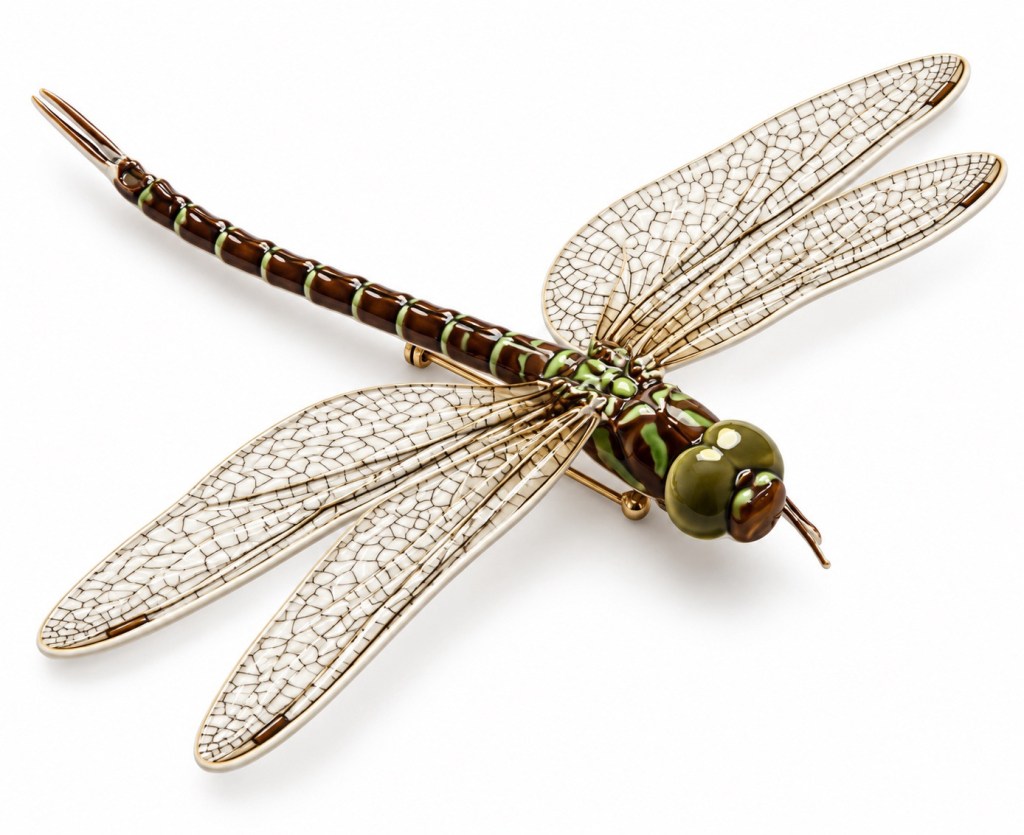
Dragonfly. Porcelain brooch recreated from Ricardo F. Morín’s photograph. Computer-generated image (CGI), 2026.
October 24, 2026
Oakland Park, Florida
*
Part One: The Father’s House
1. The House with the Walled Pool
The house at El Almendral stood on open land between two roads. One of them went into town and carried carts, bicycles, and a bus that passed twice a day; the other went to Arenales and carried trucks that never slowed. From the gate a child could hear both at once, and Karl, before he knew the names of either, had learned to tell them apart by the way their sounds arrived: the near road in fragments, the far road as a single long breath that rose and fell and did not end. His father had bought the land for its nearness to everything and its belonging to nothing. Karl did not know this yet. He knew only that the land ran farther than he could walk before someone called him back, and that in the middle of it, behind a wall higher than his father, there was water.
The wall was whitewashed every year before the rains. Inside it the pool lay so still in the mornings that it seemed to hold a second sky, and the wall’s height made that sky smaller and more private than the one overhead, as if the house kept a portion of the weather for itself. The gate in the wall was iron and was kept locked. Only the adults had keys. To be admitted was to be granted something, and Karl understood early that the granting had an order to it: his father first, when he was home; then his mother; then Johnathan, who was a year older and could already swim; then himself; and last Ruth, who was a year younger and was carried in.
Johnathan went into the water the way he went into everything, without looking at it first. He would climb onto the edge, stand for a moment with his arms held slightly away from his body, and drop. Karl watched him from the steps, where the water reached his chest, and noticed that his brother never checked whether anyone was watching, and that someone always was. Their father, from the chair under the almond tree, would call out a word of approval in his large voice, and the word would cross the water and strike the wall and come back. Karl tried the edge once, climbed onto it and stood with his arms held away from his body as he had seen, and found that the water from above looked deeper than it was from inside, and darker, and that he could not make himself fall into it. He climbed down. His father said nothing. Karl remembered the silence longer than any word of approval, and could not have said whether it had been disappointment or tact.
On Sundays the relatives came. They came from Arenales on the far road and from the valley on the near one, and the house received them according to rules Karl absorbed without being taught. His father’s people arrived first and stayed longest. His grandfather, the bandmaster, was a small upright man who had led the military band in the capital and who walked as though a march were playing just out of hearing; he hummed waltzes of his own composition and tapped their measure on the table with two fingers, and Karl’s father, who resembled him in nothing, listened to him with a deference Karl saw him show no one else. There were aunts in numbers Karl could not keep straight, and uncles who were lawyers and spoke to his father about cases, and a grandmother who did not speak much and missed nothing. His mother’s people were fewer. An uncle who kept a grocery came with his wife and brought things from the shop wrapped in brown paper. An aunt came sometimes and sat close to his mother and spoke to her in a low voice. His mother’s parents did not come. Karl understood that they were dead, and that this was a fact of a different kind from the fact that his father’s parents were alive: it belonged to his mother alone, and no one else at the table seemed to have a share in it.
It was at one of these Sunday tables that Karl first heard the other name.
He must have been five. The meal had reached the slow part, after the meat and before the sweets, when the adults leaned back and the children were allowed to leave and did not. One of his father’s sisters, a woman with a quick laugh who liked to tease, reached across to Johnathan and pinched his cheek and called him Julián. She said it lightly, as though it were a pet name, and laughed. Johnathan smiled because she had laughed. But the table did not laugh with her. Karl’s mother put down her fork, and after a moment she rose and went into the house, and the screen door closed behind her with its small dry sound. The aunt’s face went red. Karl’s grandmother looked at her daughter once and then at her plate. His father went on carving what was left of the roast, slowly and with great care, as though the knife required all of his attention, and after a while he said, to no one, that the meat had been well chosen, and one of the uncles agreed, and the conversation resumed somewhere a little to the side of where it had been.
Karl watched the screen door. His mother did not come back until the sweets had been served and the relatives had begun to gather their things.
That night he asked Johnathan why their aunt had called him Julián. Johnathan, who was already half asleep, said that it was his name too. He said it without interest, as one states a fact about oneself that has never required thought: he was Johnathan Julián, the way Karl was Karl Anselm, the way Ruth was Ruth Celeste. Karl lay awake considering this. It was true that he had a second name. No one had ever gone silent at the sound of it.
He did not ask his mother. He could not have explained, then or later, what told him not to, except that the screen door had closed with that small dry sound and she had not come back for a long time.
The answer, or the first part of one, came to him some months afterwards, and by accident. His mother kept a missal on the table beside her bed, bound in white leather gone the colour of old ivory at the edges, and Karl, who could not yet read but liked the thinness of its pages and the red ribbons that marked them, was sometimes allowed to hold it if his hands were clean. One afternoon, turning it over, he let it fall open, and from between the pages a small card slid onto the bedspread. It was printed with a picture of an angel, very pale, with wings like a moth’s, and beneath the angel there was writing in his mother’s hand: a name he could not read, and below it two dates, which he could read, because he had learned his numbers before his letters. The dates were in the same month and the same year. They were eight days apart.
He was looking at the card when his mother came in. She did not take it from him at once. She sat down on the bed beside him and looked at it too, and Karl had the impression, which he would carry for the rest of his life without being able to prove it, that she was looking at it for the first time in a long while and was surprised to find it there.
“Who is it?” he asked.
“A little angel,” she said.
She took the card then, and put it back between the pages, and closed the missal, and placed it on the table, and smoothed the bedspread where it had lain. She did not say anything else. Karl did not ask anything else. He understood that the angel had a name, that the name was written in his mother’s hand, that the eight days between the two dates were the whole of whatever the angel had been, and that the matter was closed. He did not connect it with the Sunday table. That connection would take years, and when it came it would come all at once, and he would find that some part of him had known it from the afternoon of the missal and had simply declined to say so.
His father spoke of it once. It was not a conversation; it was an instruction, delivered in the car on the far road, with Johnathan asleep against the window and Ruth asleep on their mother’s lap in the front seat, and their mother herself asleep or pretending to be. Karl had asked, out of nothing, whether angels had birthdays. His father’s eyes found him in the mirror and held him there.
“Your mother has suffered enough,” he said. “You will not ask her about that.”
He did not say what “that” was. Karl had not said it either. It seemed to him, watching the trucks go by in the dark with their lights on, that his father knew exactly which question he had not asked, and that this knowledge was a kind of authority in itself: the authority of someone who could answer and chose not to. He admired it. He also felt, for the first time and without a word for it, that something had been taken from him, though he could not have said what, and that the taking had been done for his mother’s sake, and that it would be wrong to resent it.
Afterwards he watched Johnathan differently. Not with any hostility: he loved his brother with the uncomplicated loyalty of the second child, who has never known the world without someone ahead of him in it. But he noticed things. He noticed that their grandmother sometimes looked at Johnathan a moment longer than at the rest of them, as if checking him against something. He noticed that their mother, when Johnathan was ill, sat up with him through the night and would not let anyone relieve her, and that when Karl was ill she sat up with him too, but went to bed when the fever broke. He noticed that Johnathan went into the water without looking and that everyone always watched him do it, and he began to wonder whether the watching was for Johnathan or for someone standing just behind him, in the place where Johnathan had been put.
They left El Almendral the year Karl turned six. His mother was pregnant again; the new child would be born in Los Mirtos, where his father had taken a larger office and a house in town with a courtyard and no pool. On the morning they left, the furniture had already gone ahead in a truck, and the house stood open and echoing, and the gate in the wall had been left unlocked because there was no longer anything inside to keep. Karl went in alone. The water had been drained a week before. The pool was a white basin with a few dead leaves in the deep end and a stain where the water line had been, and without the water the wall seemed even higher, and the portion of sky it enclosed seemed to belong to no one at all.
He stood at the edge where Johnathan used to stand, with his arms held slightly away from his body. It was not far to the bottom. It had never been far. He understood that what had stopped him was not the depth but the darkness of the water seen from above, and that the darkness had not been in the water. Then his mother called him from the car, and he went.
2. The Admired Man
Josephine was born in Los Mirtos in the hot months, in the house with the courtyard, and two years later the family moved once more, to Nuevo Albor, where Henrich had been offered partnership in a firm whose name was known in the capital. It was in Nuevo Albor that Ludwig was born, and in Nuevo Albor that they stayed. The house there was on a street of houses like it, with a garden in front and a wall behind, and a gate that opened onto a pavement where people passed. Karl was eight. He discovered that in this city his father’s name went ahead of him into rooms.
It went ahead of him into school, where a teacher, reading the roll on the first morning, paused at his surname and looked up and asked whether he was the son of the lawyer, and when Karl said yes, said nothing further but looked at him for a moment as though recalculating something. It went ahead of him into shops, where his mother was served before women who had been waiting longer, and into church, where the priest greeted his father at the door with a warmth he did not show the families who came before or after. Karl noticed that people stood a little straighter when his father approached, and that some of them, when he had passed, let out a breath they had been holding. He did not yet know the difference between respect and fear. He knew only that both made people careful, and that his father moved through their carefulness as if it were the air of the place.
He was not a handsome man. Karl knew this the way children know such things, not as a judgment but as a fact of the landscape. His father was very large: heavy in the shoulders and heavier through the middle, with a face that seemed too small for the head that held it, and small hands that he kept clean and still. He sweated easily and carried folded handkerchiefs in every pocket. In photographs he stood a little apart from whoever was beside him, as though to give his bulk its own frame. But when he spoke, something in the room rearranged itself around him. Karl had seen it at the Sunday tables and he saw it again in Nuevo Albor, more often and among strangers: the moment when his father began to talk and the others stopped talking, not because they were told to but because they wished to hear what he would say next.
The year Karl turned nine, his father took him to court.
It was a school holiday, and his mother was occupied with Ludwig, who was teething, and Johnathan had gone with an uncle to the coast. His father said at breakfast that Karl would come with him, and said it in the tone that meant the matter was settled, and Karl put on the shoes he wore to church and followed him out to the car. The courthouse in Nuevo Albor was an old building of grey stone with a broad flight of steps in front and columns that had once been painted and were now merely stained. His father climbed the steps slowly. Halfway up he stopped and stood with one hand on the rail and the other pressing a handkerchief to his forehead, breathing with his mouth open, and Karl, who had stopped beside him, saw that his face had gone a mottled colour and that his eyes were fixed on nothing. Then a man in a dark suit came out between the columns above them and raised a hand in greeting, and his father straightened, put the handkerchief away, called the man by name, and went up the remaining steps as though they had cost him nothing at all.
Karl never spoke of that pause. He found, later, that he could not think of his father without it arriving somewhere in the thought, a small interior weather: the hand on the rail, the open mouth, and then the straightening.
Inside, the corridors were crowded and smelled of floor polish and cigarettes. People turned as his father passed. Some greeted him and some only watched. A woman in a green dress came toward them from a bench by the wall and put her hand on his father’s sleeve and said something Karl did not hear, and his father bent his head to listen and answered her quietly, and the woman’s hand stayed on his sleeve while he answered and for a moment after, and then she looked down at Karl and smiled and said that he had his father’s eyes. Karl did not think that he had. When she had gone back to her bench his father said that she was a client, in the voice he used for things that required no further comment, and Karl did not comment. He only noticed that his father did not look back at the bench, and that the woman did not take her eyes from his father until the door of the courtroom closed between them.
He understood almost nothing of the hearing. The room was high and dim, and the judge sat above it like a man at a window, and the other lawyer spoke for a long time in a voice that went up and down without arriving anywhere. Then his father rose. He did not raise his voice at first. He spoke slowly, almost gently, and Karl saw the judge lean forward to hear him, and saw the other lawyer, who had been writing, stop writing. His father’s small hands did not move. His great body was entirely still. Only the voice moved, and it moved the way the far road at El Almendral had moved, as a single long breath that rose and fell and did not end, and Karl, who did not understand the words, felt the room give itself up to it. When his father sat down there was a silence that seemed to belong to him. Karl was proud with a pride so large it frightened him. He did not know what his father had argued or whether he was right. He knew only that he had watched a man who could barely climb a flight of stairs take hold of a room and hold it, and that the man was his.
At midday they went across the square to a café where lawyers ate. The waiter brought his father’s order without being asked. Karl was thirsty, and the waiter had gone, and an old man was sweeping near the door, a porter of some kind, in a grey jacket too large for him. Karl got down from his chair and went to him and asked him, addressing him as señor, whether he might please have a glass of water, and the old man looked at him with surprise and then went behind the counter and brought one, and Karl thanked him and carried it back to the table with both hands.
His father had watched all of this without expression. When Karl sat down he said nothing for a while. Then he said that Karl knew how to ask for anything respectfully, and with humility, and that this was not something one could teach. He said it was a gift. Karl, who had not thought of it as anything, felt himself examined and found adequate, and the feeling was so rare and so warm that he could not look at his father while it lasted. After a moment his father added that a man must also know when not to ask, and when to take what was his without asking anyone. Karl did not understand this second part. He put it away, as he had learned to put things away, beside the hand on the rail and the woman’s hand on the sleeve, to be looked at later.
It was not the only lesson his father gave him that year, nor the one his body remembered best.
In the spring Karl and Johnathan went down to the river below the city with two boys from the next street, without permission and against an explicit rule, and stayed until dark. Their father was waiting in the garden when they came back. He did not ask where they had been. He took off his belt in front of the gate, where the neighbours could see, and beat them both, Johnathan first and then Karl, steadily and without speaking, and Karl did not cry, not because he was brave but because he had decided in the moment before the first stroke that he would not give his father that, and the decision held. Johnathan cried. Afterwards their mother took them in and washed the marks and said nothing about their father, and nothing in his defence, and nothing against him.
Three hours later Henrich came to Karl’s room. Karl was lying on his bed in the dark with his face to the wall. His father sat down on the edge of the bed, which sank under him, and was silent for a long time, and then put his hand on the back of Karl’s neck and left it there. The hand was small and warm and slightly damp. He asked whether Karl would like to go with him in the morning to the bakery on the square, the one with the sugared bread, and Karl said yes into the wall, and his father said good, and sat a while longer, and went out.
Karl lay awake. He found that he did not hate his father, and that he could not make himself, and that the hand on his neck had been as real as the belt. He tried to set the two side by side and could not: each, when he thought of it, pushed the other out of sight. The next morning at the bakery his father bought him two pieces of the sugared bread instead of one and watched him eat them with an attention so complete that Karl could feel it on his skin, and neither of them mentioned the river, or the gate, or the neighbours who had watched.
He would be asked many times in later years, by people who loved him and by people who wished only to understand, how he could speak of his father with such evident tenderness. He never found an answer that satisfied them. The truest thing he could have said was that his father had wanted him to be strong, and had valued in him the things that were not strong, and had never seen the contradiction; and that Karl, for his part, had always been permitted to go his own way, to choose his friends without regard to whose sons they were, to fail and try again without anyone watching too closely, so long as he chose intelligently. It was a kind of freedom. It was given by the same hand that held the belt. Karl had never been able to separate the gift from the hand, and had long ago stopped trying, and when he thought of his father now he saw him as he had seen him on the courthouse steps: a man of great force, stopped halfway, with one hand on the rail, waiting for someone to appear above him so that he could straighten and go on.
3. The Mother’s Evasions
In Nuevo Albor his mother went out in the evenings.
She did not go far. The card tables were in the houses of neighbours, three or four streets away, in rooms with the shutters closed against the street and the lamps lit early, and later in a club near the cathedral that called itself social and served coffee and small glasses of anise to women who played until midnight. Jennifer dressed for these evenings as she did not dress for anything else. Karl, at eleven, would sit on the edge of her bed while she stood at the mirror, and watch her draw the line of her eyebrows with a pencil and press her lips together on a folded tissue and fasten at her throat a brooch shaped like a dragonfly, and he understood that the woman who was being prepared at the mirror was not quite the woman who had stood at the stove that afternoon, and that she was being prepared for people who were not her family. When she was ready she would look at him in the glass, not turning, and ask whether she would do. He always said yes. She always smiled at the answer as if it had told her something she had suspected.
Once he was sent to fetch her. Ludwig had a fever and the maid could not bring it down, and his father was away in Arenales, and Johnathan, who was older, refused to go, saying that she would be angry. Karl went. The house was the house of the woman who sold lottery tickets on the corner by the market, a widow with a loud laugh, and the door was opened by a girl who looked at him without curiosity and let him in. The room was full of smoke and very quiet. There were two tables, and at each of them four women sat with cards fanned close against their chests and their faces held in an expression Karl had never seen on his mother: a stillness that was not calm, a watchfulness that seemed to have nothing to do with anyone in the room. Coins lay in small heaps by their elbows. His mother saw him in the doorway and her face did not change. She laid down her cards, face downward, and said a word to the others, and rose, and came to him, and asked what had happened, and when he told her she nodded and took her bag from the back of the chair and came. On the walk home she held his hand, which she had not done in years, and said nothing about the room, and he understood that she was grateful to him for not having spoken in it.
She was gone in other directions too, and those were harder to see.
There was a priest who came to the house on Tuesdays, Father Benigno, a thin man with long hands and a nervous laugh, who had been her confessor since Los Mirtos and who now had a parish on the far side of Nuevo Albor. And there was another, Father Cayetano, older and heavier, who did not come to the house but whom she visited at the rectory of the cathedral. Both of them suffered from their backs. Karl knew this because his mother said so, as she said that she had learned in her girlhood, from the nuns who raised her, how to relieve such pains with her hands. On Tuesdays the door of the small room off the patio, which was called the sewing room though no one sewed in it, was closed for an hour after Father Benigno arrived. Karl, passing it once, heard through the door the priest’s low voice and then his mother’s laugh, short and quiet, and then nothing. He did not stop. He went on to the garden and sat on the wall and considered the closed door for a long time, and could not find what it was in the sound of her laugh that had made him go on walking.
His father knew of the Tuesdays. Karl was certain of this, because his father knew everything that happened in the house, and because once, at dinner, his father asked whether Father Benigno’s back was improving, and asked it in an ordinary voice, and his mother answered in an ordinary voice that it was much better, and his father said that he was glad to hear it. That was all. Karl, who had seen his father lock the house against shadows and question the maid about a man seen at the gate, could not understand how the same man could ask about a priest’s back as if it were the weather. It seemed to him that his father’s jealousy had a shape, and that the shape had a gap in it exactly the size of a cassock, and he did not know whether the gap was trust or contempt or some third thing he had no name for.
There was also the Thursday circle.
It met in the house of a retired schoolmistress who had travelled in the East, and its members read aloud from books about the soul’s progress through many lives and the masters who watched over it from places with names Karl could not pronounce. His mother brought the books home. They stood on the shelf in her room beside the white missal, and she did not seem to find the neighbourhood strange. She believed that she saw things. She said this simply, without pride, as she might have said that she had good eyesight: that she sometimes knew before the telephone rang who would be speaking, that she had dreamt her mother’s death before the news of it came, that there were people whose colours she could see around them like heat above a road. Women came to the house to consult her. They came by recommendation, discreetly, in the afternoons, and sat with her in the sewing room, and went away comforted or frightened, Karl could not tell which. Once a séance was held in the house of the schoolmistress, and his mother came home from it pale and silent and went straight to bed, and the next morning would say only that it had been very beautiful.
His father said, in Karl’s hearing, that she was not in her right mind.
He said it to one of the uncles, on a Sunday, on the patio, with a glass in his hand, and he said it not angrily but with a kind of weary humour, as a man might describe a hopeless habit in a dog he was fond of. The uncle laughed. Karl, who was sitting on the steps below them with a book he was not reading, felt the laugh go through him like cold water.
Yet his father had his own rites. Karl had seen him, more than once, at night, standing in the dark of the hall before the front door with a glass of water in his hand, saying something under his breath, before setting the glass on the floor behind the door, where in the morning it would still be, untouched, until the maid took it away. He had seen, in the drawer of his father’s desk, a small cloth bag tied with red thread, and a list of names in his father’s hand with lines drawn through some of them. When a case was going badly a client would sometimes come to the house, not to the office, an old man from the countryside or a woman with a basket, and his father would receive them in the study with the door closed, and afterwards there would be the smell of something burnt. Karl never asked what these things were. He understood that they were not to be spoken of in front of his mother, as the Thursday circle was not to be spoken of in front of his father, and that each of his parents believed in a hidden order of the world and believed the other’s hidden order to be a madness.
At night, through the wall between his room and theirs, he heard them use the words they had for each other. His mother said that his father suffered from a sense of his own inferiority, and that every woman he took was only a way of proving to himself that he was not what he knew himself to be. His father said that she was cold, and the word he used was a clinical one, and he said it as if reading from a report. Karl lay in the dark and listened, and found that the words explained nothing. They were too small for what they were meant to hold. They were like the coins at his mother’s elbow at the card table: tokens in a game whose real stakes were somewhere else.
When Karl was thirteen, his mother was elected to the assembly of the state.
It happened quickly, and almost without his father noticing until it was done. A third priest had entered her life, not a confessor but a politician: Monsignor Ibarra, who sat in the national senate for a party of nationalists that many people in Nuevo Albor admired and many others would not name aloud, because its founders had been men of the old dictatorship. The monsignor had heard her speak at a charity luncheon and had told her she was wasted. He came to the house twice. He spoke to her of duty and of the women of the republic, who had no voice in the assembly, and of the example she could give. She listened to him as Karl had never seen her listen to anyone. Within a few months her name was on a list, and within a few more it was printed in the newspaper beneath a photograph in which she wore the dragonfly brooch and looked directly into the camera, and the caption said that she was the first woman ever to sit in the legislature of the state.
Karl cut out the photograph and kept it in a book. He had never seen her look at anyone the way she looked into that camera.
His father did not shout. That was the strange thing, and Karl remembered it precisely because it was strange. Henrich read the newspaper at breakfast, and folded it, and laid it beside his plate, and finished his coffee. Then he asked Jennifer to come into the study, and closed the door, and they were there a long time. When she came out her face was composed and very white. That evening Karl saw her sitting at the dining table with a sheet of paper and a pen, writing slowly, and when she had finished she sat looking at what she had written without moving, and then signed it. The next week the newspaper reported, in a short paragraph on an inside page, that the deputy had resigned her seat for reasons of family.
Only years later, from one of his uncles, did Karl learn the reasons his father had given in the study. The old dictatorship had imprisoned two of Henrich’s uncles and ruined the practice of a third; his father had grown up in the shadow of what those men had done to his family, and had sworn as a young man never to touch politics, and he would not have his wife sit in an assembly on the list of their heirs. It was a reason. Karl could see that it was a reason. He could also see that his father had not given it in public, and had not given it to his children, and that what the children had seen was only the closed door of the study and their mother’s white face.
She opened a shop the following year, a narrow place on the street behind the cathedral that sold fabrics and perfumes and small things from abroad. She went to it every morning and came back in the evening with her feet aching and a look Karl had not seen on her before, tired and almost content. His father said that the wife of a lawyer did not stand behind a counter. He said it more than once, and in front of guests, and each time Jennifer smiled and said nothing and went to the shop the next morning anyway, and Karl began to understand that her silences were not all of one kind.
It was in the shop, one afternoon when he was fifteen, that she said the thing he would remember longest.
He had come with Johnathan after school, and they were sitting on the stools by the counter while she folded lengths of cloth, and Johnathan, who had grown that year into a stiff and serious boy with opinions, asked her outright why she did not leave their father if she was so unhappy, and why, if she was not unhappy, she went out every night. He asked it badly, as an accusation. Karl wished he had not asked it at all. But he wanted, too, to hear the answer, and he was ashamed of wanting it.
Jennifer did not stop folding. She smoothed the cloth with the flat of her hand, and turned it, and folded it again, and laid it on the pile.
“Everyone in this family,” she said, “expects me to behave like a saint.”
She said it without bitterness, almost lightly, the way she had once said that the angel in the missal was a little angel. Then she asked whether they had eaten, and sent Johnathan across the street for bread, and the question was not answered, and was not asked again. Karl sat on the stool and watched her hands moving over the cloth. It occurred to him that she had not said she was a saint, nor that she was not one. She had said only what was expected of her, and that she resented it, and he found that he could not decide whether she had answered his brother’s question or had simply shown them, once more and with great precision, the door that she would not open.
4. The Morning by the Fender
Karl was sixteen, and in the habit of waking before the house.
He had taken it up at twelve without deciding to. Something in him had begun to prefer the hour before the others rose, when the rooms belonged to no one and he could move through them as if he were their only witness. He would go down barefoot to the kitchen, drink a glass of water standing at the sink, and go out by the back door into the yard, where the light came up grey over the wall and the dogs from the neighbouring houses began, one by one, to bark at nothing. It was the only part of the day in which he did not feel himself observed. He did not ask himself why he needed such a part. He needed it, and took it, and returned to his bed before the maid came in to light the stove.
The garage stood at the side of the house, open at the front, a concrete floor under a tin roof, and in it the long American sedan his father had bought the year Ludwig was born, dark blue, with a front fender that had been crumpled in some old collision no one in the family would admit to and that his father had never had repaired. Karl had always supposed this was thrift. Later he wondered whether his father simply liked to have about him a thing that had been damaged and went on working.
That morning he came round the corner of the house and saw that someone was lying on the floor of the garage.
For a moment he did not know her. She lay on her side against the front wheel with her knees drawn up and her arms folded close against her chest, and her head rested on her handbag, which she had placed on the concrete beside the crumpled fender as one might place a pillow, and her shoes stood together a little way off, side by side, neatly, as though she had taken them off at the door of a room. She was wearing the green dress she wore to the club. The dragonfly brooch was still at her throat. Her face, in the grey light, looked very young and very tired, and her mouth was slightly open, and Karl saw on the concrete beneath her cheek a small dark mark where the dew had gathered or where she had wept, he could not tell which.
He stood without moving. A dog barked two houses away and was answered by another. He understood, slowly, the way one understands a sentence in a language one is still learning, that the front door had been locked from inside and the bolt drawn, which it never was, and that his father had drawn it, and that his mother had come home some time in the night and found herself shut out of her own house and had not knocked, or had knocked and not been answered, and had come round to the garage and lain down on the concrete by the car because there was nowhere else to go that would not be a scandal.
He did not know where she had been. He would never know. He knew only where she was now.
He went to her and crouched and touched her shoulder. She woke at once, without start, as if she had not been deeply asleep, and looked at him. He saw her see him and understand that it was he and not his father, and he saw something leave her face that had been there even while she slept.
“What time is it?” she said.
He told her. She nodded, and sat up, and put a hand to her hair. He gave her his arm and she rose stiffly, and stood for a moment with one hand on the fender to steady herself, and looked down at the bag and the shoes as though they belonged to someone else. Then she bent and picked them up.
The maid kept a key to the kitchen door under a pot of geraniums by the step. Karl took it out and opened the door and stood aside, and his mother went in ahead of him, barefoot, carrying her shoes, and crossed the kitchen and went down the passage toward the stairs without a sound. At the foot of the stairs she turned and looked back at him. She did not thank him. She did not ask him to say nothing. She looked at him with an expression he could not read and would spend years trying to read, an expression in which there might have been shame, or gratitude, or the knowledge that he had now seen something that could not be unseen and that she would have to live in his sight from now on, and then she went up.
He put the key back under the geraniums. He went out to the garage and stood where she had lain. The dark mark on the concrete was already drying at its edges. He looked at the crumpled fender, and put his hand on it, and found the metal cold and wet with dew, and he stood there with his hand on it until the maid came down and the stove was lit and the smell of coffee came out into the yard.
At breakfast his father read the newspaper.
His mother came down late, bathed and dressed, with her hair done and her face made up, and sat in her place and poured herself coffee. The children ate. Josephine, who was ten, chattered about a girl at school; Ludwig, who was eight, spilled his milk and was scolded by the maid; Ruth ate in silence, as she had for years now; Johnathan read a book propped against the sugar bowl. Karl watched his parents. He had never watched them so closely, and he felt that they knew it, and that neither of them would look at him.
After a while his father lowered the newspaper.
“You came in late,” he said.
His mother lifted her cup.
“I came in early,” she said. “It was you who were late in opening.”
His father looked at her for a moment over the top of the folded page. Then he raised the newspaper again, and the conversation was over, and Josephine went on with the story of the girl at school, and no one else at the table seemed to have heard anything at all. Karl looked round at his brothers and sisters and could not tell whether they had not heard or had heard and decided, as he had once decided at the Sunday table, that the matter was closed. He wondered which of them, if any, had lain awake in the night and heard the bolt drawn.
It was a Tuesday.
At four o’clock Father Benigno came to the gate with his long hands and his nervous laugh, and his father, who had come home early from the office, opened it to him himself, and shook his hand, and asked after his back, and stood talking with him pleasantly on the path for some minutes before the priest went in and the door of the sewing room closed. Karl watched this from the window of his room. He watched his father come back down the path toward the house with his slow heavy step, pausing to snap a dead flower from a bush and drop it, and go into the study, and close that door too.
It was then, at the window, that he first set the two things side by side and held them there. A man who would lock his wife out of her own house for the hours she spent at a card table, and leave her to sleep on concrete like a dog. And the same man, the same afternoon, opening the gate with his own hand to a priest who would spend an hour with her behind a closed door. Karl tried to find the principle that joined them, the rule by which his father’s jealousy decided what it would see. He could not find it. He found only the gap he had noticed before, the gap the size of a cassock, and he understood now that it was not an oversight. His father was a man who saw everything. If there was something he did not see, it was because he had chosen not to, and Karl did not know what kind of man chose not to see a thing like that, or what he gained by it, or what it cost him, or whom.
He did not speak of the morning to anyone. Not to Johnathan, who would have judged; not to Ruth, who had grown so silent; not to the younger ones, who were too young. He carried it alone, and found that it was heavy in a way he had not expected, and that its weight was not only pity for his mother, though there was that, but something closer to complicity: the sense that by letting her in through the kitchen and putting the key back under the geraniums he had joined the household’s great agreement not to know, and had done it so easily that he could not remember having chosen.
5. The Clients
What Karl knew of his father’s women he learned the way a city learns the course of an underground river: not by seeing it, but by noticing where the ground was soft.
The first softness was a word. He was twelve, in the schoolyard, and a boy whose father kept a hardware shop near the courthouse said, in the middle of a quarrel about nothing, that everyone knew where Karl’s father parked his car in the afternoons. The boy said it with the special malice of children repeating what they have heard at their own dinner tables, and the others laughed, and Karl hit him, and was sent home. His father asked why he had been fighting. Karl said the boy had insulted the family. His father looked at him for a long moment and did not ask what the insult had been, and Karl understood from the not asking that his father already knew, or could guess, and that the guessing did not trouble him.
After that Karl began, without meaning to, to notice where the car was parked.
It was not difficult. Nuevo Albor was not large, and the long blue sedan with its crumpled fender was known in every street of the centre. Karl saw it on the Calle del Pilar, outside a narrow building with green shutters, at three in the afternoon on a weekday when his father was supposed to be in chambers. He saw it there again, months later, and again the following year. He learned, without asking anyone, that a woman lived on the second floor of the building, a Señora Varela, whose divorce his father had won some years before and who had come out of it with an income and no husband and, it was said, very little family. He saw her once at Mass, a handsome woman in her forties who sat alone near the back and left before the final blessing. She did not look at Karl’s mother. Karl’s mother did not look at her. Karl, kneeling between Ruth and Josephine, looked at both of them in turn and felt that he was the only person in the church who was looking at anything.
Señora Varela lasted. Others did not.
The summer he was seventeen, his father found him work in the firm, filing papers in a back room and carrying folders up and down the stairs between the partners’ offices. It was meant as an education, and it was one. Karl learned the names of the judges and the habits of the clerks and the way a case was assembled out of a thousand documents, most of them useless. He also learned the rhythm of his father’s door. It closed for clients and opened when they left, and Karl, at his table in the corridor, saw who came and went. Most were men. Some were women, and among the women there were some who came more than once, and some who stayed longer than their business could explain, and one, a girl not much older than Karl himself, with a cheap bright dress and a dispute over a dead father’s land, who came out of his father’s office one afternoon with her face flushed and one hand at the neck of her blouse, fastening a button, and walked past Karl’s table without seeing him.
The secretary, a grey woman named Doña Elvira who had been with the firm for twenty years, did not look up from her typewriter. Karl watched her not look up. He saw that it required no effort from her, that she had performed this not looking so many times that it had worn a groove in her, and he understood that the whole building knew, and had always known, and had arranged itself around the knowledge as water arranges itself around a stone.
He did not see the girl again. He looked for her name in the files and found that her case had been settled, quickly and in her favour, and that no fee had been charged.
It was in that same summer that he understood the second part of what his father had said to him in the café across from the courthouse, eight years before. A man must also know when not to ask, and when to take what is his without asking anyone. He had put the sentence away as a child, and taken it out from time to time, and turned it over, and never found what it was for. Now he found it. He was sitting at his table in the corridor with a folder open in front of him and he heard his father’s voice through the door, not the courtroom voice but a lower one, the voice he had used at Karl’s bedside after the belt, warm and patient and almost tender, speaking to a woman Karl could not see. He could not make out the words. He did not need to. He knew the voice, and knew what it could do to a room, and he sat very still and understood that his father had been describing himself.
Karl did not judge him. He tried, sitting there, and found that he could not quite do it, and was disturbed by his failure. He saw that the women were not all deceived; that some of them came of their own will and went away with what they had wanted, an income, a settlement, an afternoon; that others, like the girl in the bright dress, had been persuaded of something by a voice they had no defence against, and had paid for their case in a coin no ledger would record. He saw that his father chose them. He chose the ones who could be moved, who were alone or frightened or in need, the malleable ones, and he chose them, it seemed to Karl, partly for the pleasure of the moving: for the proof, renewed each time, that the voice still worked. Karl thought of his mother’s word for it, the one he had heard through the wall. She had said it was a way of proving to himself that he was not what he knew himself to be. He had thought the words too small. He still thought so. But he began to see what they had been trying to hold.
He kept a kind of ledger himself, in his head. He was careful in it, as he had begun to be careful in everything. There were the things he knew: the car on the Calle del Pilar, Señora Varela at Mass, the girl at the button of her blouse, the voice through the door. There were the things he had been told: by the boy in the schoolyard, by remarks overheard at the club where his mother played, by the way certain women in the city spoke his father’s name. And there were the things he only suspected, which were many more, and which he kept apart from the others with a scruple he could not have justified to anyone, because to let them mingle with what he knew would have been to do to his father what the town did, and he would not.
The last entry in that ledger came at a funeral, and it was not a woman.
His grandfather the bandmaster died in the winter of Karl’s eighteenth year, in the capital, in his sleep, with a half-finished waltz on the piano. The family went up to the capital for the burial. It was cold for that country, and the cemetery was on a hill above the city, and the band he had led for twenty years played at the graveside, badly, because half of them were weeping. Karl stood between Johnathan and his father. Across the open grave, among the cousins and their families, there was a man Karl did not know, perhaps thirty-five years old, in a dark suit that fit him well, standing beside one of his father’s older cousins as a son stands beside a father. He was not handsome. He was broad in the shoulders and heavier than he should have been, and his face was too small for his head, and his hands, folded in front of him over his hat, were small and clean and very still.
Karl looked at the hands for a long time. Then he looked at his father’s.
His father did not look across the grave. He looked at the coffin, and at the priest, and at the band, and once at the sky, and once at Karl’s mother, but not across. And the man across the grave did not look at anything else. He stood with his small hands folded over his hat and looked at Henrich for the whole of the burial, steadily, without expression, as one might look at a house one had been born in and had never been allowed to enter.
It was his father’s eldest brother, the pharmacist, who told him, two days later, in the back of the pharmacy in Arenales, among the smell of camphor and the jars with their Latin labels. Karl had not asked. He had only said that he had seen a man at the funeral whom he did not know. His uncle was silent for a while, rearranging bottles that did not need rearranging. Then he said that when he and Henrich had been students in the capital, lodged in the house of another uncle, Henrich had been young and difficult and the housekeeper had been young and alone, and a child had come of it, and the family had arranged things as families did. A cousin had taken the boy and given him his own surname and raised him as his son. The boy had been told, eventually. Henrich had never spoken of him and, as far as anyone knew, had never once spoken to him.
“Your grandfather made me responsible for your father, in those years,” the pharmacist said. “He said Henrich could not be disciplined. He was right.” He put down the last of the bottles. “I have sometimes thought I failed at it. But I don’t know that anyone could have done better. It runs in the blood.”
Karl asked what ran in the blood. His uncle looked at him over the counter with an expression that was not unkind, and said that Karl was young, and that there was time, and that he would hear about the rest of it from others, as everyone in the family did, sooner or later, one piece at a time. Then a customer came in, and the conversation ended.
On the bus back to Nuevo Albor Karl sat by the window and watched the hills go by and thought about the man’s hands, and about his own, which were long and thin like his mother’s, and about Johnathan’s, which were not. He thought about the ledger in his head, and found that he did not know which column to enter this in: known, told, or suspected. He had seen the man. He had been told the story. And yet it was the suspicion that weighed most, the one his uncle had left unspoken behind the words about blood, the suspicion that his father was not the beginning of anything but only its latest form, and that the river Karl had been tracing under the soft ground of the city had been flowing for a very long time before any of them were born.
6. The Fights
The fights had no beginnings. That was what Karl remembered most clearly about them, long after the details had blurred: that he could never find the moment when an ordinary evening turned. There would be dinner, and the clink of cutlery, and his father telling a story about a judge, and his mother listening with her face arranged, and then, without any passage between, there would be the other thing. A plate in the air. The sound of it against the wall of the hall, which was tiled, so that the china did not merely break but burst, and the pieces skittered across the floor into the corners, where the maid would find them for days afterwards.
His father threw things. That was simply a fact, and Karl did not dispute it then or later. He threw plates and glasses and once a whole tureen of soup, which struck the doorframe and fell and spread across the floor of the dining room in a slow yellow tide that the children watched in silence, their feet drawn up onto the rungs of their chairs. He threw food from the table with the flat of his hand, the meat and the rice and the bread, as if the meal itself had offended him. He did it with a terrible abandon, his great body heaving up from the chair, his small face dark, and Karl, watching, could never reconcile the man who did it with the man who had held a courtroom still with his voice. It was the same man. He knew that. It was the same voice, even, gone ragged and enormous, shouting things that did not seem to be about anything that had been said.
His mother did not throw things. She stood, and went pale, and said things in a low voice that cut deeper than anything his father shouted, and when the shouting reached a certain pitch she would leave the room and go up the stairs, and his father would follow, and the fight would go on above their heads, in the rooms they could not see. Once, at the top of the stairs, Karl heard her say quite clearly that she prayed every night to God that he would die. She said it without raising her voice. She said it as though she were stating a preference for one kind of weather over another. And Karl, at the foot of the stairs with Ruth’s hand in his, understood that she meant it, and that she had meant it for a long time, and that his father had heard it before.
The children had their places in these evenings. Johnathan would go to his room and shut the door and turn up his radio. Josephine would cry, loudly, until someone took her away. Ludwig was too small to understand and was usually already asleep. Ruth would go very still. Karl would stay. He did not know why he stayed. He told himself, later, that it was to protect the others, or to protect his mother, but he knew that this was not the whole truth. He stayed because he needed to see. Something in him could not bear to have the thing happen out of his sight, as if by watching he could keep it within some limit, or at least know where the limit was.
What he could never discover was the reason. The fights seemed to be about money, or about the card tables, or about a woman, or about a dinner his mother had failed to arrange for a client, or about nothing at all. He would lie awake afterwards trying to trace the thread back to its knot and find only more thread. It seemed to him that his parents were fighting about something neither of them could name, and that the plates and the soup and the words at the top of the stairs were only the shapes it took when it came up through the floor of the house.
*
Forty years later, in the same house, Karl stood with his youngest brother in front of a door.
The house was empty now. Their mother had been dead eight months, and their father much longer, and the house in Nuevo Albor, which had passed through the courts and the divorce and the long settlement and had come back at last to the five of them, was to be sold. Ludwig had come to meet him there. He had the keys; he had always had the keys. It was Ludwig who had stayed in Nuevo Albor, Ludwig who had sat with their mother through the end, Ludwig who had kept the house aired and the garden cut through all the years when the rest of them were elsewhere. He was a heavy, quiet man now, past forty, with their father’s build and their mother’s way of listening, and he had walked Karl through the rooms without comment, opening the shutters one by one, letting the light fall on the bare floors where their furniture had stood.
The door was the door of the small bedroom at the end of the upper passage. It had been their mother’s room, in the last years before she left: the room she had moved into when she would no longer sleep in the same bed as their father. The door was painted white, and had been painted many times, and under the paint, at the height of a man’s chest, there was a long vertical scar in the wood, a clean deep split perhaps three inches long, which successive coats of paint had softened but not filled.
Ludwig touched it.
“I always wondered about this,” he said. “Mamá said the movers did it. Johnathan told me once it was something to do with Papá, but he wouldn’t say what.” He looked at Karl. “You know.”
It was not a question. Karl stood looking at the scar and felt the old reluctance rise in him, the reluctance of the Sunday table and the screen door and the bolt drawn at night: the family’s long habit of letting things close. He had come back to Nuevo Albor partly to break that habit. He had told himself so on the plane. And now, standing in front of the door with his brother’s hand on it, he found that the habit was not something he could simply decide to break. It was in him, as it was in all of them, like the shape of their hands.
“Yes,” he said. “I know.”
Ludwig waited. He was good at waiting; he had learned it at their mother’s bedside.
“You were four,” Karl said. “Maybe five. It was a weekday, I think, because Papá had come from the office and was still in his suit. They had been fighting since dinner. Our mother came up here and locked herself in, and he followed her and pounded on the door, and she wouldn’t open it. Then she went out onto the balcony.” He nodded toward the window at the end of the room, where a narrow iron balcony looked out over the street. “She stood out there and screamed for the neighbours. Not words, at first. Just screaming. Then words: help me, someone help me, he is going to kill me. I remember the lights going on across the street, one window and then another. Nobody came. I remember that too. All the lights went on, and nobody came.”
He stopped. Ludwig said nothing.
“He went downstairs. We thought it was over. Johnathan and I were in the passage, and Ruth, and Josephine was crying somewhere. And then he came back up with the sword.”
“What sword?”
“The general’s sword. Our great-grandfather’s, from the federal wars. It used to hang in the study over the desk. You won’t remember it; it went to one of the cousins after the divorce. He came up the stairs with it in his hand, not running, just walking, slowly, the way he walked up the courthouse steps, and he came to this door and drove it in.” Karl laid two fingers on the scar. “Here. Straight through the wood. I can still hear it. It made a sound like someone biting into an apple.”
Ludwig’s face did not change, but he took his hand from the door.
“He was pulling it out to do it again,” Karl said. “And we got in front of him. Johnathan and I, and Ruth behind us. I don’t remember deciding to. I just remember being there, between him and the door, with my back against it, and Johnathan beside me, and Papá standing in front of us with the sword in his hand and his face the colour of a bruise, breathing the way he breathed on the stairs. For a moment I thought he didn’t know who we were. Then he dropped the sword on the floor, and I thought it was over again, and then he turned on us instead.”
“He hit you.”
“He beat us. All three. With his hands, and then with his belt. Right here in the passage, until he was too tired to go on. Then he went downstairs and shut himself in the study, and after a while our mother opened the door and came out and saw us, and put us to bed, and none of us said anything. And in the morning there was breakfast, and he read the newspaper, and the sword was back on the wall.”
The room was very quiet. Outside, a car passed in the street, and then another.
Ludwig went to the window and stood looking out at the balcony, at the narrow iron rail, at the houses across the street with their shutters closed against the afternoon. He stood there a long time. Karl watched his back and could not tell what he was thinking, and felt, as he had felt all his life with this brother, that there was a whole country in him that no one had ever visited.
“I remember a sound,” Ludwig said at last, without turning. “I’ve always remembered it. I didn’t know what it was. I thought I’d dreamt it.” He was silent again. “Johnathan tells it differently.”
Karl felt something tighten in him.
“Tells what?”
“He told me, years ago. Not about the sword, he never mentioned a sword. But he said there was a night when Papá went for Mamá and he stopped him. He said he stood in front of the door by himself. He said you were hiding in your room.” Ludwig turned from the window then, and looked at Karl, not accusingly, but with the patient attention of a man who has spent years listening to people describe the same events in incompatible ways and has given up expecting them to agree. “I don’t know which of you is right. I was asleep. Or I thought I was.”
Karl opened his mouth to answer and found that he had nothing to say that would not sound like a defence. He had been there. He knew he had been there; he could feel the door against his back. But he also knew, standing in the empty room with the scar under his fingers, that Johnathan could feel it too, that his brother had told the story so many times that it was now as solid in him as it was in Karl, and that there was no court in which the matter could be tried, no witness who had not been a child, no record but the wood.
“And Ruth?” he said. “Did Johnathan say Ruth was there?”
Ludwig shook his head slowly.
“He didn’t mention Ruth at all.”
Karl looked at the scar. He thought of his sister behind him in the passage, very still, the way she had gone still at all their fights, and of how she had not cried when their father turned on them, and of how she had been the last of the three to be beaten and the first to stand up afterward. He had always remembered her as being there. He had never asked himself why Johnathan had forgotten her, or why their father, in the morning, had looked at all of them over his newspaper except Ruth. He asked himself now, and the question opened onto something so dark that he stepped back from the door as if it had moved.
“Come on,” Ludwig said gently. “There’s the rest of the house.”
And Karl, who had come back to Nuevo Albor to say the unsayable, followed his brother down the passage and said nothing, and despised himself a little for it, and understood that the rest would have to be said in a different room, on a different day, to someone who would not want to hear it.
7. The Disclosure
Josephine arrived from Buenos Aires three days later, for the signing.
The sale required all five signatures before the notary, and Josephine had delayed her journey until the last possible week, as she delayed everything that brought her back to Nuevo Albor. She had not lived in the country for twenty-five years. She came now with the air of a woman visiting a city she had once loved and could no longer forgive: elegant, tired, quick to notice what had decayed. She was staying at the old hotel on the square, across from the courthouse, and it was there that Karl went to see her on the evening before the signing, because he had told himself on the plane that he would, and because he had failed with Ludwig and could not bear to fail twice.
They sat in the bar of the hotel, which had once been grand and was now merely large, under a ceiling fan that turned without conviction. Josephine ordered a gin. She asked about his flight, and about Toronto, and about the house, and whether Ludwig had kept it decently, and Karl answered each question and felt the conversation moving, as their conversations always moved, along the surface of things toward a point where one of them would say something that could not be taken back. He had always been the one who held back. Tonight he did not intend to.
“I want to tell you something about Mamá,” he said. “And about Papá. And about Ruth.”
Josephine put down her glass. Her face did not change, but something behind it went very still, and Karl recognised the stillness. It was Ruth’s.
“What about Ruth?”
He had rehearsed this. He had rehearsed it for years, in many forms, in rooms in Toronto with the snow coming down outside, and none of the forms had survived contact with his sister’s face. He found that he could only say it plainly.
“He abused her,” he said. “From when she was very small. For years. And Mamá knew.”
The fan turned. A waiter crossed the room and went out by the far door. Josephine looked at him and did not speak, and Karl, who had expected anger or tears or disbelief, saw none of them. He saw only that she was waiting, as Ludwig had waited, for him to go on. He did not know whether she was waiting because she did not believe him or because she did.
“How do you know?” she said at last.
It was the right question. It was the question he had asked himself every day for thirty years, and he had tried to answer it honestly, and the honest answer was not a simple one.
“I didn’t see it,” he said. “I want to be clear about that. I never saw anything that I could swear to. I saw things around it. I saw him coming out of her room at night, more than once, when I was twelve or thirteen and used to wake early. He would come out and close her door very quietly behind him and stand in the passage, and once he saw me, and he didn’t say anything, he just looked at me, and then he said I should go back to bed, and I went. I saw her stop talking. You remember. She stopped talking at table when she was nine or ten and never really started again. I saw that he looked at all of us in the mornings except her. I saw the way she would go still when he came into a room. I saw all of that, and I didn’t understand it, or I understood it and didn’t let myself know. I don’t know which. I’ve never known which.”
Josephine’s hand lay flat on the table beside her glass. She did not move it.
“That isn’t knowing,” she said.
“No. That isn’t knowing.” He held her eyes. “The knowing came from Mamá.”
He told her then about the afternoon in the lawyer’s office, in the weeks after their mother had filed for divorce. Karl was twenty-one and home from the university, and their mother had asked him to come with her to the office of the lawyer she had engaged, because she did not want to go alone, and they had sat together in the waiting room on a hard bench under a framed diploma, and while they waited she had told him. She had not lowered her voice. She had spoken the way she spoke in the shop, folding cloth: evenly, as if the facts were lengths of fabric to be measured and laid on a pile. She had said that the lawyer would ask her what grounds she meant to argue and that she would give him the women, because the women were enough and everyone knew about them. She had said that she would not give him Ruth. Karl had asked what she meant. And their mother had turned and looked at him on the bench, and said that she had known since Ruth was small what their father was doing, and that she had known what it would cost to speak of it in that country, in those years, to a court full of men who drank with him, and that she had decided long ago that it would cost Ruth more than it would cost him. Then the lawyer’s door had opened, and she had stood up and smoothed her skirt and gone in, and Karl had sat on the bench alone under the diploma for an hour, and when she came out she had asked him whether he would like to have lunch.
“She never said it again,” Karl said. “I tried, later, two or three times. She would look at me as if she didn’t know what I was talking about. Once she said I must have dreamt it. By the end, of course, she didn’t remember anything. But she said it, Josephine. She said it to me on that bench, in that office, and I have carried it every day since.”
His sister looked down at her hand on the table. She turned it over, slowly, and looked at the palm, as if something might be written there.
“Twenty years,” she said.
“Yes.”
“She knew for twenty years and she stayed with him.”
“Yes.”
“And when she left, she left over the women.”
“She left over everything. But the women were what she gave the court.”
Josephine lifted her eyes, and Karl saw in them at last what he had been waiting for, and it was not what he had expected. It was not grief, and it was not disbelief. It was anger, cold and complete, and it was directed at him.
“Why are you telling me this?” she said.
“Because it’s true.”
“That isn’t a reason. A great many things are true.” She leaned toward him across the little table. “Mamá is dead. Papá is dead. Ruth is alive, and has a life, and has never said one word about any of this to me or to anyone, as far as I know. Has she said anything to you?”
Karl was silent.
“Has she asked you to tell it?”
“No.”
“Then it isn’t yours.” Josephine’s voice did not rise; it went lower, and harder, until it was almost their mother’s. “It’s hers. And it was Mamá’s, and she decided what to do with it, and maybe she decided wrong, God knows she decided wrong about a great many things, but she decided. You weren’t there when she decided. You were a child. You don’t know what it was to be a woman in that house, married to that man, in that country. You don’t know what she was protecting. You weren’t the one she was protecting.”
“I know what she wasn’t protecting.”
“You know what you saw from the passage at five in the morning.” Josephine sat back. “You always do this, Karl. You always have. You stand in the doorway and you watch, and you make sense of it, and then you come and explain it to the rest of us as if you were the only one who was ever in the room. And somehow, every time, it comes out that Papá was a great man with flaws and Mamá was a woman who failed him. You’ve always had a soft place for him. Everybody knew it.”
“That isn’t true.”
“Isn’t it?” She picked up her glass and drank and put it down. “Ruth went with him, you know. In the divorce. She stood up in court and spoke for him. She chose him. She went to live with him in that flat with his new wife, who was her own age, and she went to work in his office, and she stayed with him until he died. If what you’re saying is true, I don’t understand that. And if I don’t understand it, I’m not sure you do either.”
Karl had no answer. He had never had an answer to that. It was the thing in the story that would not lie down: that Ruth, of all of them, had gone with their father, and had stood beside him in the court where their mother was asking to be free of him, and had chosen, as far as anyone could see, the man who had done this thing to her over the mother who had let it be done. He had turned it over for years and found no side of it that did not cut.
“I don’t understand it,” he said. “I don’t think I’m meant to.”
Josephine looked at him for a long moment. Then she signalled to the waiter for the bill, and paid it before Karl could reach for his wallet, and stood, and gathered her bag and her wrap.
“I’ll see you at the notary’s,” she said. “Ten o’clock.” At the door of the bar she stopped and turned back. “Don’t tell Ruth you told me,” she said. “Don’t tell anyone. If you have any respect for her at all.”
She went out. Karl sat on under the fan. The bar was empty now except for the waiter, who was stacking chairs at the far end with exaggerated care, as if to suggest without saying so that it was time. Through the tall windows Karl could see the square, and the courthouse across it, grey in the lamplight, with its broad flight of steps going up between the stained columns.
He sat looking at the steps for a long time.
He saw a heavy man stopped halfway up them with his hand on the rail. He saw a small card fall from between the pages of a white missal, and a screen door closing with a small dry sound. He saw a bolt drawn across a front door at night, and a woman asleep on concrete with her shoes placed neatly beside her, and a priest’s hand at a gate. He saw a girl of nine at the breakfast table eating in silence while her father read the newspaper and looked at everyone but her. He saw his mother folding cloth. He saw a sword hanging on a study wall in the morning, put back where it belonged. He saw three children in a passage with their backs against a door, and he saw, now, which of them had been standing furthest back, and why she had not cried.
The waiter came and asked, very politely, whether the señor would be wanting anything further.
Karl said no. He thanked him. He went out across the square in the warm dark, past the courthouse steps, toward the street where the house stood empty with its shutters open, and he did not look up at the window of the small room at the end of the upper passage, though he knew without looking that Ludwig would have closed it.
Part Two: The Inheritors
8. The Petition
The notary’s office was on the second floor of a building behind the cathedral, in the street where their mother’s shop had once stood. The shop was a pharmacy now. Karl passed it at a quarter to ten and did not stop.
They were all there before him except Ruth. Johnathan sat at the head of the notary’s long table as if it were his own, which in a sense it was, since he had prepared most of the documents; he was grey now, and heavy, and wore the dark suit and the small precise movements of a man who had spent forty years in courtrooms, and when Karl came in he half rose and shook his hand across the table with the brief firm courtesy he gave opposing counsel. Josephine sat by the window in dark glasses and did not take them off. Ludwig sat beside her, his large hands folded on the table, and gave Karl a look that asked nothing and promised nothing. The notary, a young woman with an old woman’s spectacles, arranged papers. A clock on the wall ticked with great self-importance.
Ruth came at five past ten.
Karl had not seen her in four years. She came in without apology, a small upright woman in a grey dress with her hair drawn back, carrying a leather folder under her arm, and she greeted each of them in turn: Johnathan with a nod, Ludwig with a hand on his shoulder, Josephine with a kiss on the cheek that Josephine received without moving. She came to Karl last. She kissed him too, and her cheek was cool, and she said that he looked tired, and asked whether Toronto was very cold. Karl said that it was. He searched her face for some sign that Josephine had broken her own injunction and found none, and found also that he did not know what such a sign would look like, because Ruth’s face had been arranged for so long that he could no longer tell where the arrangement ended.
She sat down across from him. She opened her folder and took out a pen.
The notary began to read.
She read the description of the property, its boundaries and its dimensions and its registry number, and then she read its history, because the law required that the chain of title be recited before the chain could be extended. She read that the house had been acquired by Henrich and Jennifer jointly in the year the family came to Nuevo Albor. She read that it had been made the subject of a petition for the division of marital property. She read the date of the petition, and the date of the injunction that had frozen the estate, and the date of the decree of divorce four years later, and the date of the final settlement six years after that, by which the house had passed to Jennifer alone. She read the date of Jennifer’s death, and the names of the five heirs, and their dates of birth, and their places of residence: Nuevo Albor, Toronto, Buenos Aires, Nuevo Albor, Nuevo Albor. She read it all in a level voice, without inflection, the way one reads a list of stations.
Karl listened to the dates going by and felt each one open beneath him.
*
The petition had come in the autumn of his twenty-first year.
No one in the family had believed she would do it. She had threatened it so often, in so many fights, at the top of so many stairs, that the word had worn smooth with use and meant nothing. Then one morning she had gone out to the shop as usual and had not gone to the shop. She had gone to the office of a lawyer on the far side of the city, a man named Quintero who was known to dislike Henrich and to be unafraid of him, and she had signed the papers, and Quintero had filed them that afternoon. Henrich learned of it from a clerk at the courthouse who stopped him on the steps.
Karl was at the university in Arenales and heard of it by telephone from Ludwig, who was thirteen and frightened and could not explain what had happened except that Papá had come home in the middle of the day and broken every window on the ground floor of the house with a chair. Karl came home on the night bus. When he arrived in the morning the glass had been swept up and the windows boarded, and his father was in the study with the door shut, and his mother was at the shop, where she had gone as usual, and the maid was crying in the kitchen.
The fury lasted months. It did not take the form Karl expected. There were no more plates; the plates seemed to belong to a different marriage, one that had still believed it would continue. This was colder. His father spoke to his mother only through the children or not at all, and when he passed her in a room he looked through her as if she were a pane of glass. He talked in the evenings, in the study, on the telephone, in a low and patient voice, and Karl learned afterwards that he had been talking to judges and clerks and the men who drank with him at the club, preparing the ground. Divorce in that country meant the division of property, and his father did not intend to divide anything. He had moved estates out of the reach of wives before, on behalf of husbands who paid him well, and he knew every passage by which a house or a farm or a bank account could be made to disappear.
But his mother knew them too. She had sat at his table for twenty-five years and listened to him tell stories about his cases, and she had not been listening only with her face arranged. Before Henrich could move, Quintero had the estate frozen. Every property, every account, every share in the firm. Karl saw his father read the injunction at breakfast. He read it twice. Then he laid it down beside his plate, as he had laid down the newspaper with his wife’s photograph in it years before, and he looked across the table at the place where she would have been sitting if she had still eaten breakfast with them, and Karl saw on his face something he had never seen there before, and it was not anger. It was surprise.
The first hearing was in the winter. Karl went because his mother asked him to, and sat with her and Quintero on the bench outside the courtroom, under the stained columns, while his father stood at the far end of the corridor with his own lawyers and did not look at them. When the hearing was over, it had gone badly for his father; Karl did not follow the law of it, but he saw the judge’s face and Quintero’s, and he saw his father come out of the courtroom with his small face dark and his breath coming hard.
They went out onto the steps together, Karl and his mother and Quintero, into the cold bright air. Quintero was a thin man, not young, and he went down the steps ahead of them with his briefcase in one hand, talking over his shoulder about the next filing.
Karl heard his father’s step behind them. He knew it as he knew his own heartbeat: the slow heavy tread, the pause, the breath. He turned. His father had come out between the columns and was coming down the steps toward them, not slowly now, with a speed Karl had never seen in him, and his eyes were on Quintero’s back. Karl understood what was going to happen a moment before it happened. He saw his father’s small hands come up. He saw them reach for the lawyer’s shoulders at the place where the steps were steepest.
He did not decide to move, any more than he had decided at the door with the sword. He was simply there, between his father and the lawyer, with his own hands on his father’s chest, and his father’s weight came against him like a wall falling, and they went down together onto the stone, and Quintero, turning at the sound, dropped his briefcase and stood staring.
People came running from the doors. Someone pulled his father up. Someone else helped Karl. His father stood on the steps with two clerks holding his arms, breathing in great tearing gasps, his face mottled as it had been on the day he stopped halfway with his hand on the rail, and he looked at Karl. It was not a look of anger. It was the look he had given him across the passage at dawn, outside Ruth’s door, when he had told him to go back to bed. It said that Karl had seen something, and that his father knew it, and that this knowledge would now lie between them.
Nothing was written down. Quintero did not bring charges. The clerks who had held Henrich’s arms went back inside and, within the week, could not remember what they had seen. Karl’s knee was swollen for a month.
*
Ruth was twenty when the case came to trial. She had been living at home through all of it, keeping to her room, coming down to meals and going up again, and no one had asked her what she thought, because no one ever asked Ruth what she thought. Karl had assumed, insofar as he assumed anything about her, that she would stay out of it, as Josephine and Ludwig were too young to be in it and Johnathan was too careful.
She was called by their father’s lawyers on the third day.
Karl was in the courtroom. He sat behind his mother and watched his sister go up to the witness stand in a dark blue dress he had never seen before, and take the oath in a clear small voice, and sit down, and fold her hands. She did not look at their mother. She did not look at Karl. She looked at the lawyer who was questioning her, and answered him in the same clear small voice, and what she said was that their mother had been absent from the house most evenings for years; that she had gone to card tables and to clubs and to the houses of women who held séances; that she had received priests in a closed room in the afternoons; that she had neglected the younger children and left them to the maid; and that their father had been patient with all of it, and had provided for all of them, and had never once in her hearing spoken ill of their mother.
It was all true. Karl sat and listened to it and could not find one sentence that was false. That was what made it unbearable. Every fact was true, and every fact had been chosen, and the choosing made a portrait of their mother that was as false as anything he had ever heard, and he could not have stood up in that room and said where the falseness lay.
His mother sat very straight and did not move. Once, when Ruth spoke of the priests, Karl saw her hands close on the edge of the table, and open again.
His father, at the other table, watched Ruth throughout. He did not take his eyes from her. It was the first time in Karl’s memory that he had seen his father look at Ruth for any length of time, and Karl watched him watching her, and saw on his face an expression of such tenderness and such pride that he had to look away.
Ruth stepped down. She walked back along the aisle between the benches and passed the table where their mother sat, and for one moment, as she passed, their eyes met. Karl saw it. He saw nothing pass between them, nothing at all, not reproach on one side or apology on the other, but only a long level look of recognition, the look of two people who share a secret and have agreed, without words, that it will be kept. Then Ruth went on and sat down on the bench behind their father, and did not look up again until the court rose.
The decree was issued four years later. The year after that, Henrich married a woman of twenty-five who had been a student in his firm, and took a flat on the other side of the city with a terrace and a view of the mountains, and before the marriage he had her sign an agreement, drafted in his own hand, by which she renounced any claim to anything he owned. Ruth moved into the flat with them. She was twenty-five too.
*
“Señor Karl.”
The notary was holding out a pen to him. The reading was over. The others had signed; he saw the four signatures in a column on the page, Johnathan’s large and confident, Josephine’s quick and slanting, Ludwig’s careful, Ruth’s very small and very neat, like a line of print. The notary was waiting. Across the table, Ruth was capping her pen and putting it back in her folder, and Karl looked at her hands, which were small and still, and then at her face, which was turned toward the window, toward the street where their mother’s shop had been, and he could not tell what she was looking at, or whether she was looking at anything at all.
He took the pen and signed.
9. Johnathan’s Brief
Johnathan took him to lunch at the café across from the courthouse.
It was his choice, and Karl understood it as a choice. Johnathan had eaten there most days of his working life, as their father had before him; the waiter brought his order without being asked, as a waiter had once brought their father’s, and when Karl looked toward the door he half expected to see an old porter in a grey jacket too large for him, sweeping. There was no porter. There was a boy with a telephone, leaning on the doorframe, who did not look up.
They talked at first about the sale, and about the buyers, a young couple from the capital who meant to knock down the back wall and put in glass, and about the division of the proceeds, which Johnathan had calculated to the last cent and explained with evident pleasure in the arithmetic. Karl let him explain. He had always liked to watch his brother handle numbers; it was the one thing Johnathan did without the faint stiffness that came over him in everything else, as if figures were the only company in which he could be entirely sure of his reception.
When the coffee came, Karl said, “I want to ask you about the settlement.”
Johnathan stirred his coffee. He stirred it for some time.
“Which part of it?”
“The part where Mamá dismissed Quintero and gave the case to you.”
*
Karl had been in Toronto when it happened. He had gone there the year after the decree, to study and then to stay, and he had followed the long last act of his parents’ marriage the way one follows a war in a distant country: in letters, and in telephone calls on bad lines, and in the silences between them.
The decree had settled the marriage but not the property. The property was another case, and it went on for six more years, and through all of them Quintero had fought it with a patience Karl could only marvel at from a distance. He had kept the estate frozen. He had traced, one by one, the passages by which their father had tried to move things out of reach: a farm in the valley put in the name of a client who owed him favours, a block of shares transferred to a company that existed only on paper, an account in the capital that turned out to have been opened in the name of a cousin. Quintero found them all. Year by year he brought them back into the light and laid them before the court, and year by year the court, slowly, grudgingly, against all the habits of its members, found for their mother.
In the spring of the sixth year the judge issued a ruling that gave Jennifer half of everything. Half the house, half the farm, half the shares in the firm, half the accounts. Quintero wrote to Karl about it himself. It was the only letter Karl ever received from him, a single page in a dry upright hand, and Karl kept it for years. Quintero said that in thirty years of practice he had never won a case against Henrich, and that he had now won this one, and that he would like Karl to know it, because Karl had once stood between him and the bottom of the courthouse steps and he had not forgotten.
Three weeks later his mother dismissed him.
She did it by letter, Karl learned afterwards, a short letter of thanks with a cheque enclosed, and Quintero sent the cheque back. She gave the case to Johnathan. Johnathan had qualified only two years before, late, after a long uncertain time in which he had started and abandoned two other careers and come back to the law as if returning to a house he had sworn never to enter again. He had no experience of property. He had never argued a case of any size. And within four months of taking over his mother’s brief, he had negotiated a settlement with his father by which Jennifer received the house in Nuevo Albor and a modest income for life, and Henrich kept the farm and the shares and the accounts and everything else that Quintero had spent six years dragging back into the light.
Karl heard of it from his mother on the telephone. She told him in the same even voice she had used on the bench in the lawyer’s waiting room. She said that it was finished. She said that she was tired, that she had been tired for years, that she did not want to spend the rest of her life in courtrooms waiting to see what a judge would give her. She said that Johnathan had been very good, very patient, that he had understood. She said that she had the house, and that was enough, and that she was going to think now only about herself and her own future. Karl asked her why she had dismissed Quintero, who had won. There was a silence on the line, full of the hiss of distance.
“Because he had won,” she said. “Do you understand? He had won, and your father would never have accepted it. He would have appealed, and appealed again, and gone on until one of us was dead. Johnathan could talk to him. Quintero could only beat him.”
Karl said that he understood. He did not. He hung up the telephone and sat by the window of his room in Toronto, watching the snow fall on the street, and tried to imagine his mother handing her eldest son the six years of Quintero’s work and watching him give most of it back, and he could not make the picture hold still. It shifted every time he looked at it. Sometimes he saw a woman so exhausted that she would surrender anything for an ending. Sometimes he saw a woman who could not bear, after all, to defeat the man she had married, and who had found in her son a way of losing that did not look like losing. And sometimes he saw Johnathan, at the table across from their father, with his careful voice and his love of figures, discovering for the first time that he could hold a room.
The following year, on a visit home, Karl went to the firm to collect some papers and saw his brother’s name on a door in the corridor where he had once filed folders as a boy. It was painted in gold, in the same lettering as their father’s, two doors down. Doña Elvira, very old now, still sat at her typewriter in the corridor, and she looked up at Karl when he paused before the door, and then looked down again without a word, and he saw that she had worn a new groove.
*
“She asked me,” Johnathan said.
He had put down his spoon. He was looking not at Karl but at the window, at the courthouse across the square, at the steps.
“She came to my flat one evening and sat on my sofa and asked me. She said she couldn’t go on. She said Quintero would fight until the end of the world and she would be dead before she saw a peso of it. She said Papá would never give in to Quintero but he might give in to me.” He turned the cup on its saucer, a quarter turn, and another. “I told her I wasn’t ready. I told her she should keep Quintero. She cried. I had never seen her cry, Karl, not once, not even at the fights. She sat on my sofa and cried, and asked me again. What was I supposed to do?”
“You could have refused.”
“And left her with nothing but six more years of hearings?” Johnathan’s voice did not rise; it went flatter, more precise, the voice he used in court. “You weren’t here. You were in Canada, looking at the snow. I was here. I saw what it was doing to her. She couldn’t sleep. She’d stopped going to the shop. She’d started saying strange things, about Papá burning her poems, about voices. I got her the house. I got her an income she could live on. I got her out. Quintero would have got her half of everything, in theory, in ten years, if she was still alive and still sane to spend it.”
“And you got a door with your name on it.”
The words were out before Karl could stop them. He saw them land. Johnathan’s face did not change, but he went very still, and Karl saw in the stillness something he had seen in all of them at one time or another, in Ruth and in Josephine and in himself, the family’s way of going still when struck.
“Papá offered me a place in the firm a year later,” Johnathan said evenly. “I had no other offers. I was thirty-three years old and I had wasted ten years and I had a wife and a child coming. I took it. I don’t apologise for it.” He finished his coffee and set the cup down precisely in the centre of its saucer. “I know what you think. I’ve always known. You think I sold her out. You think I sat across the table from him and gave him what he wanted so that he would give me what I wanted. Josephine thinks the same. She hasn’t spoken to me properly in twenty years.”
“I don’t know what I think,” Karl said, and found as he said it that it was true. “I’ve tried for years to decide and I can’t. That’s why I’m asking you.”
Johnathan looked at him for a long moment. Then something in his face eased, a very little, the way their father’s face had eased on the night of the belt when he came and sat on the edge of the bed.
“Then I’ll tell you something I’ve never told anyone,” he said. “When I went to see Papá to begin the negotiation, I went to the flat. The one on the other side of the city, with the terrace. His wife let me in. And Ruth was there. She was sitting at the dining table with papers spread in front of her, his papers, the case files, Quintero’s filings. She had been working on them. For him. She looked up when I came in and said good afternoon, as if I were a client. And Papá came out of the study and saw me looking at her, and he said, ‘Your sister has been a great help to me.’” Johnathan paused. “I sat down at that table across from both of them. Across from Papá and Ruth. And I negotiated our mother’s settlement with the two of them, and Ruth took notes.”
Karl said nothing. The waiter came and went. Across the square, a clerk came out between the stained columns of the courthouse and went down the steps, slowly, holding the rail.
“I’ve never understood her,” Johnathan said. “Ruth. I don’t think anyone has. I don’t think Mamá did.” He signalled for the bill. “And I’ll tell you something else, since we’re telling things. You’ve been asking people questions since you got here. Ludwig told me. You asked him about that night with Papá and the door. I know what you think happened. I’ve heard your version, at one table or another, for thirty years.” He took his wallet from his jacket. “I was there. I was at the door. I don’t remember you there, Karl. I’m sorry, but I don’t. I remember being alone.”
“I was there.”
“Maybe you were.” Johnathan laid money on the table. “Maybe we both were and neither of us can see the other. It was dark. We were children. Does it matter now?”
Karl wanted to say that it mattered more than anything. He wanted to say that if two brothers could stand side by side against the same door and each remember himself alone, then nothing either of them remembered could be trusted, and that this was the whole of what he had come back to Nuevo Albor to find out. He did not say it. He looked at his brother across the table, at the grey hair and the heavy shoulders and the dark suit and the precise hands, and he saw, with a shock that went through him like cold, how much Johnathan had come to resemble their father: not in any single feature, but in the way he occupied a chair, as if it had been set there for him.
And he wondered, for the first time, whether Johnathan, looking back across the table, saw the same thing in him.
They went out together into the square. At the foot of the courthouse steps Johnathan stopped and shook his hand, briefly and firmly, the courtesy he gave opposing counsel, and said he would see him at dinner at Ludwig’s on Thursday, and went up the steps between the columns without pausing, as their father never had, and did not look back.
10. The Mother’s Late Attachments
Ludwig lived on the edge of the city, in a newer district where the streets had been laid out before anyone had decided what to put on them, so that his house stood among empty lots and half-built walls with a view, beyond them, of the hills. He had built it himself, or had it built, room by room over twenty years as money allowed, and it had the look of a house that had been added to rather than designed: a kitchen that opened onto a covered terrace, a terrace that opened onto a garden of fruit trees, and at the end of the garden a small separate room where, for the last three years of her life, their mother had slept.
They were all there on the Thursday. Ludwig’s wife had cooked; Ludwig’s sons, grown men now, carried dishes in from the kitchen and went out again to eat in front of the television, leaving the five of them alone at the long table on the terrace under a string of bare bulbs that drew moths from the dark. Johnathan had brought wine. Josephine had brought nothing and drank Johnathan’s wine steadily without comment. Ruth sat at the end of the table nearest the garden, with her back to the small room, and ate little, and listened.
Karl had dreaded the evening. He had thought it would be an evening of silences, after the bar and the café and the door. It was not. Something in the occasion, the house sold, the papers signed, the last thing that bound them in common disposed of, loosened them all, and by the second bottle they were telling stories about their mother, and laughing, and the laughter was the old laughter of the Sunday tables, quick and nervous and a little too loud.
It was Johnathan who began it. He said, apropos of nothing, “Do you remember the accordion man?”
Josephine groaned. Ludwig laughed. Karl remembered.
*
He had been sixteen, the year of the fender. His mother had been forty-three. There was a family two streets away who gave parties on Saturday nights, a loud cheerful family with a patio and coloured lanterns, and his mother went to these parties as she went to the card tables, dressed and made up and wearing the dragonfly brooch, and sometimes she took Karl with her, because his father would not go and she did not like to walk home alone.
At these parties there was a man who played the accordion. He sold mattresses during the week, from a showroom near the market, and on Saturdays he played: a slight, merry man with a small moustache and very clean white shirts, who sat on a kitchen chair in the corner of the patio with the instrument on his knee and played waltzes and boleros and the old songs from the valley, and sang in a light true voice, and never seemed to tire. Everyone liked him. Karl’s mother liked him more than everyone.
Karl watched her like him. He watched her stand near the corner where the accordion was, with a glass in her hand, and sway a little to the music, and laugh at the man’s jokes between songs, and lean down to speak in his ear. He watched her ask him for particular songs and watched him play them, smiling at her with a sweet uncomplicated smile that seemed to Karl to have nothing in it of what his mother was looking for. He watched her dance alone in front of him, once, late, when most of the guests had gone, with her eyes half closed and her arms held a little away from her body, and he saw the man look past her shoulder toward the gate of the patio, where another man, younger, in a leather jacket, had been waiting all evening without coming in.
On the walk home his mother held his arm and hummed one of the songs and said that the accordion man was a wonderful person, so gentle, so sensitive, that it was a pity he had never married, that he only needed the right woman to bring him out of himself.
Karl said nothing. He walked beside her through the dark streets with her hand on his arm and felt his face burning, and could not have said with whom he was embarrassed: with her, for not seeing what everyone at the party saw; with the accordion man, for being seen; or with himself, for seeing it so clearly, and for knowing, without being able to say why, that his mother’s blindness on this one subject was not like her other blindnesses, and that it touched him somewhere he did not want to look.
*
“She was going to save him,” Johnathan said. “She said so. She told me once that God had sent him to her so that she could show him what a real woman was.”
“She never said that.” Josephine set down her glass. “You make things up, Johnathan. You always did.”
“She said it to me in the kitchen. I was seventeen. I remember exactly.”
“You remember what you want to remember.”
There was a little silence, in which Karl was aware of the night beyond the bulbs and the moths beating against them, and of the word remember going round the table like a coin that no one would pick up.
Then Ludwig said, quietly, “She said it about the dancer too.”
“What dancer?” said Josephine.
“You weren’t here,” Ludwig said, without reproach. “It was after the second divorce. She was sixty-eight, sixty-nine. There was a man who had been a great dancer, a principal, famous in his day; he’d danced in Europe, in the big houses. He came back to Nuevo Albor when he retired and opened a school above the bakery on the square, and taught little girls to do pliés. She went to his adult class. She said it was for her back.” Ludwig turned his glass slowly on the table. “She went three times a week for a year. She took him cakes. She sent him cards. She told me she could feel how lonely he was, how much he needed someone who understood art. She said she was sure, if he could only see her clearly, he would change.”
“Change,” said Josephine.
“He had lived with the same man for thirty years. Everybody knew it. He was very kind to her. He let her come to class and eat her cakes and talk to him after, and he never once let her think he was interested, and she never once believed him.” Ludwig looked up. “When he died she went to the funeral and sat in the front row, as if she were the widow. The man he’d lived with sat behind her. I took her home. She cried all the way.”
No one laughed. The moths beat against the bulbs. Karl looked down at his plate and felt the old heat rise in his face, the heat of the walk home from the patio, and he waited for it to pass, and it did not.
*
There had been others, between the accordion and the dancer, and those were harder to make into stories at a table.
In the years before the petition, and for some years after it, his mother’s attention had turned to young men. Not her own contemporaries, who bored her, nor older men, who reminded her of what she had married, but young men in their twenties, students, Karl’s own age and sometimes younger. She met them everywhere: at the club, at the shop, at the Thursday circle, which had begun to attract the young. And she met them through Karl.
He was at the university in Arenales then, sharing rooms with three other students above a printer’s shop near the faculty. His mother began to visit. She came on the bus once a month, ostensibly to bring him food and money and to see that he was eating properly, and she would arrive in the late afternoon in her good dress with a basket over her arm, and stay through the evening, and sit among his friends in the cramped front room drinking the cheap wine they bought from the corner, and talk to them as no one’s mother had ever talked to them. About art. About the soul’s progress through many lives. About the colours she could see around each of them, like heat above a road. She sat close to them on the broken sofa. She touched their hands when she spoke. She would choose one, each visit, and give him all her attention, and the one she chose would sit very still under it, flattered or frightened, and the others would watch, and Karl would watch them watching.
One of his roommates, a boy from the coast named Tomás who studied architecture and drew all day in a notebook, said to Karl one night after she had gone, without malice, almost admiringly, that his mother was surrealist. He used the word as a painter might. He meant, Karl understood, that she was like something in a painting by one of the Spaniards or the Frenchmen they had all been reading about that year: a clock melting over a branch, a woman with a drawer in her chest, an image that obeyed the logic of a dream. The others laughed and took up the word. After that, among his friends, she was always the surrealist. Ahí viene la surrealista, they would say, when they heard her step on the stairs.
Karl laughed with them. He did not know what else to do. He laughed, and was ashamed of laughing, and was ashamed of her, and was ashamed of being ashamed, and underneath all of it was something else, something he could not reach: a feeling, when he watched her lean toward Tomás on the broken sofa and touch his wrist, that she was looking for something in these young men that she had not found in his father and would not find in them, and that he, Karl, knew what it was, and could not have named it if his life had depended on it.
Some of the boys were flattered and some were repelled. One of them, a law student from the capital, older than the rest, did not return to the flat after a visit in which she had sat with him alone on the stairs for an hour. Another, the youngest, came to Karl a week after one of her visits and asked, stammering, whether his mother would mind if he wrote to her. Karl said he did not know. He never asked her. He never learned whether the boy wrote.
*
“And then she married the tutor,” Josephine said.
She said it with something like defiance, as if it were the answer to an argument no one had made.
The tutor had come after the decree. Their mother had decided, in the year the divorce was granted, that she would study law. She was fifty-two. She had left school at sixteen. To enter the faculty at Nuevo Albor she needed to pass the examinations in mathematics and sciences that every school-leaver took, and she had forgotten everything, if she had ever known it, and so she engaged a tutor: a mathematics teacher from one of the public schools, a quiet serious man fifteen years younger than she, with spectacles and a gentle manner and a widowed mother he supported on a teacher’s pay.
He came to the house three evenings a week. He sat with her at the dining table where the plates had once been thrown, and taught her algebra, patiently, with a pencil and a pad of squared paper, and she learned it. She learned it slowly and with great effort and a fierce determination that none of her children had ever seen in her, and when she passed the examinations he wept. She fell in love with him, or decided she had, and he with her, or allowed himself to be persuaded; and he decided, at thirty-five, to sit the examinations too, and enter the faculty with her, and study law at her side. They entered in the same year. They sat in the same lecture halls among students young enough to be her grandchildren. And two years before they graduated, in a small ceremony in the chapel of the faculty with none of her children present but Ludwig, they married.
“He was good to her,” Josephine said. “For a while. He was the only one who ever took her seriously.”
“He took her money seriously,” Johnathan said.
“She didn’t have any money. You saw to that.”
The silence this time was of a different kind. Johnathan’s face went still. Josephine did not look away from him. Ludwig began to say something and stopped. Karl, between them, looked from one to the other and felt the table tilt beneath them all, as the floor of the dining room had tilted when the tureen hit the doorframe and the soup spread slowly toward their feet.
It was Ruth who spoke. She had said almost nothing all evening. She spoke now from the end of the table, with her back to the small room where their mother had slept, in the same clear small voice she had used in the witness box more than thirty years before.
“She married him,” Ruth said, “because he was the first man who ever taught her something without asking for anything in return. At least at the beginning.” She looked down at her plate. “That’s all. It isn’t complicated.”
No one answered her. After a moment Ludwig’s wife came out with coffee, and the conversation moved, as their conversations always moved, a little to the side of where it had been, and the moths went on beating against the bulbs.
Karl watched his sister drink her coffee. He thought about what she had said: the first man who ever taught her something without asking for anything in return. He thought about who she had been measuring the tutor against when she said it. And he understood that Ruth had just told them something, in front of all of them, under the bare bulbs, in a voice so level that no one had heard it, and that she had done it on purpose, and that she knew he was the only one who would.
11. The Degree and the Firm
Their mother’s papers were in the small room at the end of Ludwig’s garden, in six cardboard boxes stacked against the wall beneath the window, where Ludwig had put them after the clinic and had not opened them since. He had asked whether one of them would go through the boxes before they all dispersed again. Josephine had said that she would. On Saturday morning Karl found her already there, sitting on the narrow bed where their mother had died, with the first box open on the floor between her feet and its contents spread across the coverlet.
She did not look up when he came in. She was holding a photograph.
It showed their mother in a black gown and a square black cap with a tassel, standing on the steps of the faculty at Nuevo Albor in bright sunlight, holding a rolled diploma tied with a ribbon in one hand and, in the other, pinned against her breast, a medal on a blue cord. She was sixty-two. Her hair under the cap was white and carefully set. She was not smiling, exactly; she was looking straight into the camera with an expression Karl had seen only once before, in a newspaper photograph he had cut out at thirteen and kept in a book. It was the look of a woman who has been told all her life that a certain room is not for her and has just walked into it.
“Look at her,” Josephine said.
Karl looked. He sat down on the floor with his back against the wall and took the next box onto his knees and opened it.
*
She had graduated the year Karl turned thirty-five. He had not been there. He had been in Toronto, and could not afford the journey, or told himself that he could not; and she had sent him the photograph with a note on the back in her large confident hand, the hand of the card in the white missal, saying that she had done it, that she had done it at last, that no one could take it from her now. He had put the photograph on his desk. He had been proud of her, with a pride so mixed with other things that he could not have separated its strands: astonishment, and something close to disbelief, and a small cold question he did not like to look at.
The question was how. She had left school at sixteen. She had needed a tutor to teach her algebra at fifty-two. She had sat in the lecture halls of the faculty for seven years, among students who could have been her grandchildren, and Karl had heard from Ludwig that she struggled, that she failed examinations and sat them again, that there were subjects she could not seem to master however long she studied. And then, in her last two years, the failures had stopped. She passed everything. She passed some subjects with distinction. She graduated with a medal.
He had wondered. He had not asked. It was the family’s way.
*
In the second box, beneath a bundle of her old lecture notes tied with string, he found the letter.
It was on the letterhead of the state legislature, a sheet of heavy cream paper folded in three, and it was addressed to the dean of the faculty of law. It was dated in the spring of her fifth year. It was signed by a deputy whose name Karl did not recognise, a member of the party of nationalists, the party of Monsignor Ibarra, who had been dead for fifteen years by then. The letter was short. It recalled to the dean that Señora Jennifer had been the first woman ever elected to the assembly of the state, and that she had resigned her seat under painful circumstances, and that the party had not forgotten her service. It expressed the deputy’s confidence that the faculty would take into account the unusual difficulties faced by a woman of her years in completing her studies, and would extend to her every consideration. It closed with an assurance of the deputy’s high esteem and his continued interest in the affairs of the faculty, whose budget was then before the assembly.
Karl read it twice. Then he held it out to Josephine without a word.
She read it. He watched her face. He saw her read it to the end and then go back to the beginning, as he had, and read it again, slowly, and he saw the colour come into her cheeks.
“So?” she said.
“So I think we know how she passed.”
“You think you know.” Josephine folded the letter along its old creases. “A letter asking for consideration. That’s all it is. Every student in this country with a cousin in the government has a letter like this in a drawer. It doesn’t mean she didn’t do the work.”
“I didn’t say she didn’t do the work.”
“You didn’t have to.” She laid the letter on the coverlet beside the photograph. “You’ve been doing it all week, Karl. Every box we open, every story anyone tells, you find the place where it gives way. Papá had his faults but he was a great man. Mamá had her moments but she was a fraud. That’s your story. It’s always been your story.”
Karl did not answer. He put his hand into the box again and brought out a bundle of pamphlets held together with a rubber band that had perished and stuck to the paper.
*
She had gone to Geneva the year before her final examinations. Karl remembered the postcard: a view of the lake with the great fountain throwing its plume against the mountains, and on the back, in the large confident hand, that she was here to study the rights of women at the source, among the nations. She had gone to the offices of the United Nations by the lake, with a letter of introduction from the faculty, and spent a week in their library and their reading rooms, and come home with a suitcase full of documents. She had spoken of it afterwards as the great journey of her life. She had spoken of it, Ludwig said, more often than she spoke of her children.
These were the documents. Karl took the perished band off as carefully as he could and spread them on the floor. Resolutions of the General Assembly. Reports of a commission on the status of women. A convention on the elimination of discrimination, in three languages, with the signatures of the nations listed at the back. They were the kind of thing one could pick up by the armful from any rack in any public office, and he had expected them to be untouched. They were not. They had been read. Passages were underlined in pencil, heavily, sometimes twice. In the margins, in his mother’s hand, there were notes: a word, a date, a question mark, an exclamation. On the convention, beside an article on the equality of women before the law in matters of marriage and its dissolution, she had written a single word in capitals and underlined it three times. The word was SÍ.
Josephine had come down off the bed and was kneeling beside him on the floor. She turned the pages of the convention slowly, looking at the underlinings, at the notes.
“There,” she said quietly. “Look. Look at that.”
Karl looked. He saw the underlinings, and the word in capitals, and the exclamation marks in the margins. He saw that she had read these pages with passion. He also saw that the notes stopped, abruptly, a third of the way through each document, and that the remaining pages were clean, uncut in one case, as if her passion had a limit and the limit came early. He saw that there was nothing else in the box: no essay, no thesis, no article, no letter to any newspaper, no record of any case she had taken for any woman who had needed what these pages described. The pamphlets were the whole of it. The journey to Geneva was the whole of it.
“She cared about this,” Josephine said. “You can see she cared.”
“Yes,” said Karl. “I can see she cared.”
He did not say the rest, and Josephine heard him not saying it, and they knelt side by side on the floor of the room where their mother had died, with her pamphlets spread between them, each seeing in the same pencilled margins exactly what they had come to see.
*
The firm was the strangest chapter, and the one none of them had ever been able to tell.
When their mother qualified, she did not open an office of her own, nor seek a place with any of the firms in Nuevo Albor that might have taken a woman of her years on the strength of her medal and her deputy’s letter. She went to her former husband’s firm. She went with her new husband, the tutor, who had qualified with her. And Henrich, who had sat across the table from her through six years of litigation, who had broken every window on the ground floor of their house with a chair when she filed her petition, gave them an office.
Karl saw it on a visit home, the year after her graduation. It was at the end of the corridor where he had filed folders as a boy, a small room with one window onto an airshaft, and on the door, in the same gold lettering as Henrich’s and Johnathan’s, was her name. The tutor’s office was beside it. Two doors down was Johnathan’s. Beyond that, the large corner room with windows on two sides that had been their father’s for thirty years. And across the corridor, at a desk outside their father’s door, where Doña Elvira had once sat at her typewriter, sat Ruth.
Karl stood at the end of the corridor and looked down its length at the doors. Henrich. Johnathan. Jennifer. Ruth at her desk, typing, her head bent, her small hands moving over the keys. He had the sensation he sometimes had in dreams, of walking into a room where all the dead and living of his life were gathered as if for a photograph, each in a place that made no sense and yet seemed to have been assigned.
His mother explained it to him in her small office with the window onto the airshaft. She said that she had earned it. She said that she had given that man twenty-five years and five children and her seat in the assembly and her shop and her health, and she had been paid back in a settlement that left him everything, and that the least he owed her now was a door with her name on it in his own building. She said she was not ashamed. She said it was justice, of a kind. She said she meant to practise in the defence of minors, of children whose parents failed them, and that she would do it under his roof so that he would have to watch.
Karl looked through the open door of her office, across the corridor, at Ruth typing at her desk outside their father’s door.
His mother saw where he was looking. She stopped speaking. For a moment neither of them said anything, and the sound of Ruth’s typewriter came across the corridor, steady and even, like rain.
Then his mother said, “Would you like some coffee?” and rose to get it, and the moment passed, and was never mentioned, and Karl sat in the small office with the window onto the airshaft and wondered whether the woman who had come back to this corridor to defend the children of other people had chosen it in spite of what she knew, or because of it, or without letting herself know that there was any connection at all.
*
The second marriage did not survive long in that corridor. The tutor left; he went back to teaching, and to his widowed mother, and was not seen at the firm again. Karl never learned why. His mother would only say that he had been a disappointment, like every man she had known, and that she had been a fool. Josephine said he had been driven out. Johnathan said he had taken what he came for. Ludwig said nothing.
And in the spring after he left, their mother, at a lunch in the old hotel on the square to which she had invited all of them who were in the country, rose from her chair at the end of the meal with a glass in her hand and announced that she had something to tell them. She said that she had been thinking a great deal. She said that she had come to understand that leaving their father had been a mistake. She said that she had been wrong to divorce him, and that she wished she had not, and that she wanted her children to know it.
Karl had been there. He had flown down for a funeral and stayed on. He remembered the silence at the table, longer than the silence after the aunt had said Julián, longer than the silence after the injunction. He remembered Johnathan setting down his fork. He remembered Ludwig reaching across to take their mother’s hand, gently, as one takes the hand of someone who has begun to say strange things. He remembered Ruth, at the far end of the table, not moving at all.
And he remembered that their mother, having said it, sat down again and picked up her glass and drank, and looked around the table at the five of them with an expression of great serenity, as though she had at last laid something down; and that it was the first time Karl had wondered whether her mind was beginning to go.
*
Josephine was putting the pamphlets back into the box, one by one, smoothing each before she laid it down.
“She was the first woman in the assembly,” she said, without looking at him. “She went to Geneva. She took a law degree at sixty-two. She defended children. Whatever else you think, Karl, she did those things. They’re true.”
“They’re true,” Karl said.
“Then why can’t you let them be enough?”
He looked at the letter on the coverlet, on its cream paper, with the deputy’s signature and the budget before the assembly. He looked at the photograph beside it, the white hair under the black cap, the medal on its blue cord, the face of a woman who has just walked into a room she was told was not for her.
“I don’t know,” he said. “I don’t know why they can’t.”
Josephine put the lid on the box and pressed it down with both hands, and held it there, as if something inside might otherwise get out.
12. Josephine
On the night before she flew back to Buenos Aires, Josephine asked him to come to her room.
She said it at the door of Ludwig’s house as they were leaving, in a low voice, so that the others would not hear: not the bar, her room, at nine. Karl went. The hotel corridor was long and dim and smelled of floor polish, like the corridors of the courthouse across the square, and her room at the end of it was larger than he expected and almost bare, with a high ceiling and tall shuttered windows and her suitcase already packed and closed on the rack at the foot of the bed. She had ordered a bottle of wine and two glasses. She poured them both before he had sat down.
“I owe you something,” she said, “after the other night. I wasn’t fair to you.”
“You were angry.”
“I’m still angry. That isn’t the same as being fair.” She sat down in the armchair by the window and held her glass in both hands. “You told me what you know. I’m going to tell you what I know. Then you can do what you like with both.”
*
She was the fourth child, born in Los Mirtos in the hot months, two years before the family came to Nuevo Albor. She had grown up, she said, knowing that she had not been expected.
“He told me so. Did you know that? When I was seven or eight. I had done something, broken something, I don’t remember, and he was angry, and he said that he had never wanted a fourth, that three was a family and four was a burden, and that Mamá had insisted. He said it at the table. You were there. Johnathan was there. Nobody said anything.” She drank. “You don’t remember.”
Karl searched his memory and found nothing: a table, a raised voice, a plate perhaps, but nothing he could hold. He said so.
“No. You wouldn’t. It wasn’t the kind of thing you watched for.” She said it without bitterness, as a fact. “You were always watching him and Mamá. You were watching for the big things, the plates and the doors. You never watched what he did to the small ones. He called me the extra one. For years. La sobrante. Not in front of guests, only at home, and only when Mamá wasn’t in the room. I used to think it was my name.”
She set down her glass on the sill.
“So when you tell me he was a great man with flaws, Karl, you have to understand that I never met the great man. I only ever met the flaws. You had a father who took you to court and bought you sugared bread. I had a father who told me I shouldn’t have been born. Those are both true. They’re just not the same father.”
Karl said nothing. He thought of the café across from the courthouse and the glass of water carried back to the table with both hands, and his father’s voice telling him that he knew how to ask for anything with humility, and that this was a gift. He thought of the warmth that had gone through him, the sense of being examined and found adequate. He had kept that warmth for forty years. It had never occurred to him to wonder what it had cost the others that he had been the one found adequate.
*
She had left the country in the winter of her twentieth year.
Karl knew the outline of it; they all did. It was the year of the devaluation and the curfews, when the army had come into the streets of Arenales and then into the streets of Nuevo Albor, and people had begun to disappear from their houses at night. Josephine had been at the university in the capital, studying letters and running a small theatre company with friends in the basement of a church. The company had put on a play by a foreign writer, a play about a king who would not die, and someone in the audience had decided that the king was meant to be someone in particular. Two of the actors had been taken from their flat. Josephine had come home to Nuevo Albor on the night bus and stayed in her room for a week and then, one morning, was gone. A month later a letter came from Buenos Aires.
What the family had told each other afterwards, in the way families tell each other things, by implication and repetition until implication hardens into fact, was that she had taken their mother’s money. The estate was frozen; Quintero had seen to that. But their mother had her savings from the shop, kept in an envelope in the drawer of the dresser beneath the white missal, and her jewellery, which was not much but was hers. And when Josephine left, the envelope was empty and the jewellery was gone, all of it except the dragonfly brooch, which their mother had been wearing.
“I didn’t take it,” Josephine said. “She gave it to me.”
Karl looked at her.
“She came into my room the night before I left. I hadn’t told anyone I was going; I hadn’t decided. She came in and sat on the bed and put the envelope in my lap and the jewellery in a handkerchief on top of it, and she said, go. She said, there is nothing for you here. She said, I stayed, and look at me. Go.” Josephine’s voice did not change, but her hands had found each other in her lap and were holding on. “I said I couldn’t take it. It was all she had. She said she had a house and a husband who would have to keep her whether he liked it or not, and that I had a body the army would put in a ditch. She said it like that. Then she kissed me and went out, and I lay awake all night with the envelope on my chest, and in the morning I took the first bus to the border.”
“Why didn’t you ever say so?”
“Who would I have said it to?” Josephine looked at him. “Papá? He told everyone I’d robbed her. He told it at the club. It was the best story he had that year; it proved everything he’d ever said about me. Johnathan believed him. Ruth believed whatever Papá believed. Ludwig was a child. And you were in Arenales, and then you were in Canada, and when you came home you looked at me exactly the way you’ve been looking at me all week, as if I were a document you were trying to authenticate.” She shook her head. “And Mamá never said. Not once. She let them all think I’d taken it. I asked her why, years later, on the telephone, and she said it was better that way. She said if Papá had known she’d given it, he would have found a way to make her pay for it. So she let me pay instead.”
“And the end?” Karl said. “When she had nothing?”
It was the question he had not meant to ask. It was the question that had been under all the others. Josephine heard it, and he saw her hear it, and he saw her decide to answer it.
“I wasn’t here,” she said. “That’s the truth and I won’t dress it up. By the end she had nothing but the house, standing empty with its roof leaking, and the doctors and the nurses took everything else; Ludwig had to sell the shop’s lease and the last of her bonds. I sent what I could. It wasn’t much. I had a husband who was ill and a press that never made any money and two children at school. I didn’t come back. I told myself I couldn’t afford the flight, and that was true, and it was also true that I couldn’t bear to see her in that room at the end of Ludwig’s garden not knowing who I was.” She was silent a moment. “I sent her poems instead.”
*
It had begun, she said, with a telephone call in the year after their father’s death. Their mother had been seventy-one, and no longer practising, and frightened of the way her days had begun to slip from her. She had said on the telephone that she used to write poems, when she was a girl at the convent and in the first years of her marriage, notebooks full of them, and that their father had burned them all one night in the garden at El Almendral in a rage she could no longer remember the cause of.
“I don’t know if it was true,” Josephine said. “I’ve never known. Johnathan says she made it up. Ruth says Papá never burned anything in his life except his clients’ enemies’ names. Maybe he burned them. Maybe she burned them herself and forgot. Maybe there were never any notebooks. It doesn’t matter. She believed it. And I said to her, then write them again. Write what you remember. Write new ones. Send them to me.”
And she had. For three years, until her hands would no longer hold a pen, their mother had sent poems to Buenos Aires, a few lines at a time, on airmail paper, in the large confident hand that grew smaller and less certain with each letter. Some of them she said were the old ones, remembered. Some were new. Josephine had typed them and edited them very lightly and printed them on the press she ran with her husband, fifty copies, bound in grey card, and sent one to each of her brothers and sisters.
“You got one,” she said. “I know you did. I have the receipt from the post office.”
Karl had got one. He remembered the grey card envelope arriving in Toronto in the snow, and the slim book inside, and the title on the cover, Lo que el fuego no quiso, What the Fire Refused. He remembered putting it on a shelf. He had meant to read it. He had read the first page, standing at the shelf, and then the telephone had rung, and he had put it back, and he had never taken it down again. He did not know why. He knew only that he had been afraid of it in some way he could not explain, as he had been afraid of the dark water seen from the edge of the pool.
Josephine was watching him. She saw that he had not read it. She did not say so. She got up and went to her suitcase and opened it and took out, from beneath the folded clothes, a copy of the grey book, worn at the corners, with slips of paper marking pages. She held it out to him.
“Page thirty-one,” she said. “Read it tonight. Not here. I don’t want to watch you read it.”
*
He read it in his own room, at the guesthouse near the cathedral, at two in the morning, sitting on the edge of the bed with the lamp on.
On page thirty-one there were two poems. The first was not their mother’s. A note at the top in small type, Josephine’s note as editor, said that it had been written by the editor at the age of sixteen and found among the author’s papers, where she had kept it for thirty-five years, and that it was included here because the poem that followed was the author’s reply to it. The poem was short and awkward, a girl’s poem, all birds and wings and open sky, and Karl read it and felt the old embarrassment rise in him, the embarrassment of the Sunday tables and the walk home from the patio, and then, at the last two lines, felt it stop:
If I fly they will say I stole the wind.
If I stay they will say I was born for the cage.
Below it was their mother’s answer. It was dated, in the editor’s note, in the month and year that Josephine had turned sixteen. Karl did the arithmetic without meaning to. It was four years before the curfews. It was four years before the envelope and the handkerchief and the night bus to the border.
Fly, then, little thief.
Take the wind and do not give it back.
I gave mine to a house with a high wall
and learned too late that walls are only stone,
that I could have climbed them any night I chose
and did not choose.
Choose.
Karl read it three times. Then he turned off the lamp and sat in the dark.
He thought of the white wall around the pool at El Almendral, whitewashed every year before the rains, and of the portion of sky it enclosed, which had seemed to belong to no one. He thought of his mother asleep on the concrete by the fender with her shoes placed neatly beside her. He thought of an envelope in a dresser drawer beneath a white missal, and of the hand that had taken it out, and he understood that he had believed for thirty years, without ever examining the belief, that the hand was Josephine’s. He had never once asked. He had heard their father tell it at the club and had let it harden in him like everything else, and he, who prided himself on keeping the known apart from the told, had filed it under known.
And yet. He sat in the dark and made himself go on. The poem was dated four years before the flight; it proved that their mother had wished her daughter gone, not that she had given her the envelope. Josephine’s account was Josephine’s. Their mother had never confirmed it, and could not now. Their father had told a different story, and their father had lied about many things, and had also, Karl knew, sometimes told the truth. The poem did not settle it. Nothing would settle it. There was only the girl’s two lines and the woman’s seven, side by side on page thirty-one, and the space between them, which was the space in which his sister had lived her whole life.
He did not sleep. At six he went down through the empty town to the square and stood across from the hotel and watched the doors. At a quarter past seven Josephine came out with her suitcase and a porter carrying her bag, and the porter hailed a taxi, and she stood on the pavement in her dark glasses waiting for it, very straight, very elegant, a woman who had stolen the wind or been given it, and Karl stood across the square and did not go to her.
The taxi came. She got in. Just before the door closed she turned her head and looked across the square, directly at him, as though she had known all along that he would be there. She did not wave. She lifted one hand from her lap, a little, and let it fall.
He was still holding the grey book. He had not thought to give it back.
13. Ruth
Ruth’s invitation came on a card, by hand, left at the desk of the guesthouse: lunch on Sunday, one o’clock, at the flat. She did not say which flat. She did not need to.
It was on the far side of the city, on the slope that rose toward the hills, in a building of the kind that had been fashionable in the years after the divorce: white concrete, deep balconies, a lobby with a mirrored wall and a porter in a booth. Karl gave his name. The porter telephoned up and listened and put down the receiver and said that the señorita was expecting him, eighth floor, and Karl went up in a lift lined with brown wood that smelled faintly of his father’s cologne, or seemed to, and knew as he stood in it that the smell was in him and not in the lift.
Ruth opened the door before he knocked.
She was wearing a grey dress, as she had at the notary’s, and an apron over it, and her hair was drawn back. She kissed him on the cheek. She took his jacket and hung it in a cupboard by the door, beside a heavy dark overcoat that Karl recognised with a shock that went through his whole body: it was their father’s. It hung there as if its owner had just come in and would want it again in the morning.
“Come through,” Ruth said. “It’s nearly ready.”
*
The flat was large and full of light. The main room opened onto the terrace their father had chosen it for, and beyond the terrace the city fell away in a long slope of roofs toward the plain, and above the roofs, on the other side, the hills stood blue in the noon haze. Karl stood at the glass doors and looked out. He had been here once before, years ago, on a visit home, when his father was still well and his father’s second wife still lived here, and he had stood in this same place and been offered a drink and had felt himself examined by a woman his own age who called his father by his first name. The second wife had gone long since. The flat was Ruth’s now, and it was entirely and visibly their father’s.
His chair was by the window, a great leather armchair worn pale at the arms. His books were on the shelves, the law reports in their red bindings, the old histories of the federal wars, a row of novels he had read in his youth and never opened again. His desk stood in the corner with the blotter squared and the pens laid out beside it, and on the desk, in a silver frame, there was a photograph of him at the height of his career, heavy and handsome in his way, at a lectern, mid-sentence, one small hand raised. On the wall above the desk was a framed diploma from the university in Arenales: highest honours, a thesis on the liberal foundations of human rights.
Nothing had been moved. Karl understood this without being told. The room had been kept.
Ruth brought the food to the table by the glass doors and they sat down across from each other. She had made the dish their mother used to make on Sundays at El Almendral, rice and black beans and the shredded beef that took all morning, and Karl, tasting it, was so moved that he could not speak for a moment, and Ruth watched him with an expression of mild interest, as if she had been curious to see what it would do.
“She taught me,” Ruth said. “In this kitchen. When she was living here.”
Karl put down his fork.
*
He had known, of course. They all knew. But knowing a thing in outline and sitting in the room where it happened are different kinds of knowledge, and he found that he had never let himself picture it.
In the year after their father’s death, when their mother’s forgetting had begun to be something more than forgetting, it was Ruth who had taken her in. Not Johnathan, who had a wife and children and a practice. Not Ludwig, not yet; he had been building the rooms of his house one by one and there was no room yet for her. Not Josephine, in Buenos Aires. Not Karl, in Toronto. Ruth had come to the house in Nuevo Albor one afternoon and packed a suitcase and brought their mother here, to this flat, to the rooms where the man she had divorced had lived with the woman he married after her, and had put her in the second bedroom, and had cared for her there for four years.
She told it simply, between mouthfuls, as one might describe the arrangements of an ordinary household. She had bathed their mother and dressed her and cut her food. She had sat with her in the evenings on the terrace and named the hills for her when she forgot them. She had sorted her pills into a box with the days of the week on the lids. She had taken her to the doctor in the lift lined with brown wood and held her arm crossing the lobby with the mirrored wall, where their mother would stop, every time, and look at the old woman in the mirror and ask who she was.
“She liked it here,” Ruth said. “In the beginning. She would sit in his chair. She said it was the most comfortable chair in the city and that he had always kept the best things for himself.” Ruth touched her napkin to her lips. “Sometimes she thought he was still alive. She would ask me when he was coming home. I would say, soon. She would say, good, I have something to tell him. I never found out what.”
Karl looked at the chair by the window, worn pale at the arms. He thought of their mother sitting in it, small and white-haired, waiting for a man who had been dead a year to come home so she could tell him something. He thought of the lunch at the hotel when she had stood with a glass in her hand and said that the divorce had been a mistake.
“Why here?” he said. “Why did you bring her here?”
Ruth looked at him as if the question were curious.
“Where else would I have brought her? This is where I live.”
“But it was his.”
“Yes,” said Ruth. “It was his.” She did not elaborate.
*
After the meal she made coffee and they took it out onto the terrace. There were plants in pots along the balustrade, geraniums and a lemon tree and some herbs in a long trough, all very well kept. Ruth sat in a canvas chair in the shade of the awning and Karl stood at the balustrade, looking down eight floors at the street, at the porter’s booth, at a man walking a dog.
He had come intending to say something. He did not know what. He had told himself on the way, in the taxi, that he would not raise it, that Josephine was right, that it was Ruth’s and not his; and he had told himself in the next breath that he had come back to Nuevo Albor precisely to raise it, that a whole family had built its life on not raising it, and that if he did not now, with his sister in front of him on the terrace of their father’s flat, he never would. He had gone back and forth between these two positions all the way up the hill, and arrived at the door no nearer to either.
Now, at the balustrade, with his back to her, he began.
“Ruth.”
“Josephine telephoned me,” Ruth said. “From the airport. Before her flight.”
Karl turned. His sister sat in the canvas chair with her coffee cup on her knee, perfectly composed, looking at him.
“She didn’t tell me what you’d said to her. She said she had promised you she wouldn’t, though I don’t think that’s true. She said you’d been asking everyone questions. She said you meant well.” Ruth drank a little of her coffee. “She said I should be gentle with you.”
Karl found that he could not speak.
“I don’t know what you know,” Ruth said. “Or what you think you know. I don’t want to know. Whatever it is, it’s yours, Karl. You saw what you saw. You put it together the way you put things together. You always did that, even when you were small. You’d stand in a doorway and watch, and afterwards you’d have a story about what had happened, and it would be a good story, and sometimes it would even be true. But it was always yours.” She set her cup down on the tiles beside her chair. “I have mine. I don’t need anyone to tell it for me. I don’t need anyone to tell it at all.”
The man with the dog had gone round the corner. A car passed in the street below. Karl stood at the balustrade with his hands on the warm stone.
“Everyone in this family has a version,” Ruth said. “Johnathan has his. Josephine has hers. You have yours. Ludwig doesn’t tell his, but he has one. Mamá had about a dozen, and changed them depending on who she was talking to.” For the first time something moved in her face, a very small thing, at the corner of the mouth, that might have been the beginning of a smile. “I’m the only one who doesn’t need one. That’s what none of you have ever understood.”
“Ruth,” Karl said. “I only want to know whether you’re all right.”
It was not what he had meant to say. It was what came. And for a moment, looking at him from the canvas chair, his sister seemed almost surprised.
“I’m all right,” she said. “I’ve been all right for a long time.”
He did not know whether to believe her. He did not know whether she believed herself. He looked at her, at her small still hands folded in her lap, at the grey dress and the drawn-back hair and the face that had been arranged so long that he could no longer see where the arrangement ended, and he understood that she had told him the truth, or a truth, or the only truth she was prepared to let out of her keeping, and that he would never know which.
*
One more thing happened before he left.
He had gone back into the main room for his jacket, and Ruth had gone into the kitchen with the cups, and he found himself alone for a moment in front of the desk in the corner with the photograph in its silver frame. Beside the photograph there was something he had not noticed before: a small object, set on the blotter at the exact centre, like a paperweight. It was a dragonfly brooch. Its enamel was chipped at one wing.
He did not touch it. He stood looking at it until he heard Ruth’s step behind him.
“She gave it to me,” Ruth said. “Near the end, when she was still here. She took it off and pinned it on my dress and said I should have it, because I was the one who stayed.” She came and stood beside him. “Then the next day she forgot she’d given it and accused me of stealing it. She told the doctor. She told Ludwig on the telephone. I let her think I’d taken it.” Ruth looked down at the brooch on their father’s blotter. “It didn’t seem to matter. It was the kind of thing she always believed about her daughters.”
Karl turned to her. She was not looking at him. She was looking at the brooch.
“Mamá said something else, in that last year,” Ruth said. “Only once. She was sitting in his chair, in the evening, and I was cutting her food, and she looked up at me and said, forgive me. Just that. Forgive me. I asked her for what. She looked at me as though she didn’t know who I was, and then she looked out at the hills, and she didn’t say anything else.”
“What did you say?”
Ruth was silent for a long moment.
“I said there was nothing to forgive,” she said. “I don’t know if it was true. I don’t know if she knew who she was talking to. I don’t know if she meant Papá, or the divorce, or Josephine, or the brooch, or something else.” She lifted her eyes to Karl’s at last. “I said it anyway. Someone had to say it to her, and I was the one there.”
She handed him his jacket. She walked him to the door. She kissed him on the cheek, and her cheek was cool, and she said that he should come again before he went back to Canada, and that he should eat more, he was too thin. Then the door closed.
In the street he crossed to the far pavement and looked up. Eight floors above him, on the terrace, a small figure in a grey dress was moving along the balustrade with a watering can, tending the geraniums and the lemon tree and the herbs in their long trough, one pot after another, carefully, without hurry. She did not look down. Karl stood watching her until she had finished and gone in, and the terrace was empty, and the glass doors reflected only the hills and the sky.
14. The Old Man
The cemetery in Nuevo Albor lay on the flat ground beyond the river, where the city’s dead had been carried for two hundred years, and their father’s grave was in the newer part of it, near the wall, under a slab of grey granite that Johnathan had chosen and Ruth had approved. Karl went there on the Monday, alone, in a taxi that waited for him at the gate with its engine running.
He had not been since the burial. He found the grave without difficulty; he had a good memory for places. The slab was clean. Someone had swept it, and set a jar of water at its head, and in the jar there were white flowers, not yet wilted, three or four days old. Karl stood looking at them. He did not need to ask who had brought them.
The inscription gave their father’s full name, and his dates, and beneath them a single line: Abogado. Lawyer. Nothing else. Karl read it and thought that it was exactly right, and exactly wrong, and that it was the kind of thing their father would have chosen himself, if he had been asked, and perhaps he had.
He stood by the grave for a long time. The sun was hot on the back of his neck. Beyond the wall a truck went by on the road to the capital, one long breath that rose and fell, and Karl found himself, without deciding to, back in the flat on the hill, in the last year, when his father was seventy-three and had begun, slowly and then all at once, to come apart.
*
It had begun in court.
Ludwig telephoned Karl in Toronto with the news, because Ludwig was the one who telephoned. Their father had been arguing a case before the appellate bench in Arenales, a case he had argued many times before in one form or another, an inheritance, a farm, a family at war with itself. He had risen to speak. He had begun as he always began, slowly, almost gently, and the judges had leaned forward to hear him. And then, in the middle of a sentence, he had stopped. He had stood at the lectern with his small hand raised and his mouth open, looking at the bench, and nothing had come. Not a word. He had stood like that for almost a minute, Ludwig said, while the judges waited and the clerks stared and the opposing counsel half rose from his seat. Then he had lowered his hand and sat down, and Johnathan, who was beside him, had asked the court for an adjournment.
The doctors in the capital gave it a name. It was a rare thing, a degeneration of the front of the brain, the part that governed speech and judgment and the restraint of impulse, and it would go on. There was no treatment. There would be good days and bad ones, and then there would be only bad ones, and then there would be none.
Karl came home. He took a leave from his work and flew down and moved into the guesthouse near the cathedral, the same guesthouse where he was staying now, and went every day up the hill to the flat with the terrace. He told himself he would stay a month. He stayed eleven.
*
His father’s wife did not want him there.
She was not unkind, at first; she was correct. She was forty-one by then, a handsome composed woman who had given sixteen years to a man more than thirty years older and was beginning to see, with great clarity, what she would and would not get for them. The agreement she had signed before the marriage, in their father’s own hand, left her nothing. She had asked him, Karl learned afterwards, many times in recent years to tear it up. He had refused. And now he was ill, and his mind was going, and there were doctors to be consulted and papers to be signed and decisions to be made about his care and his affairs, and she did not wish his son from Canada to be present while they were made.
She would not let Karl see the doctors’ reports. She would tell the porter that the señor was resting and was not to be disturbed. She would take their father to appointments without telling Karl when they were, and change the locks on the study, and on one occasion, when Karl had arranged for a specialist to come from the capital, she sent him away at the door. Ruth, who still lived in the flat and worked at the firm and came home every evening at seven, said nothing to her about any of it. She said nothing to Karl about it either. She moved between them in the corridors of the flat like someone crossing a room where two people were having an argument in a language she did not speak.
And their father, in the middle of it all, came apart.
*
It did not happen as Karl had imagined it would. He had imagined a slow dimming, a man growing quiet and vague and gentle. It was not like that. The disease did not dim their father; it uncovered him. It took away, one by one, the restraints he had spent seventy years building, and what lay beneath them came out into the light.
He raged. He had always raged, but now there was no reason at all, not even the shadow of one: a glass set down too near his hand, a door closed too loudly, a word he could not find. He threw his food again, as he had in the dining room of the old house, and the second wife would stand in the doorway with her arms folded and watch, and Karl would get down on his knees and pick up the rice. He said things to the nurse that made her leave and not come back. He said things to his wife, in front of Karl and Ruth, about her body and what he had paid for it, that made her go white and walk out of the room. He wept, suddenly and helplessly, at nothing, at a song on the radio, at the hills.
And he lived, more and more, in the past, or in a present that was made of the past. He believed that he was still married to Jennifer. He would ask for her at breakfast, and when his wife said that Jennifer was not here, he would say that she was at the card tables again and that he would lock the door on her, and laugh. He believed that his enemies were working against him: he would have Ruth bring him a glass of water at night and set it behind the front door of the flat, and he would stand before it in the dark, as Karl had seen him stand in the hall of the old house forty years before, murmuring under his breath. He believed that he was due in court. He would dress in his dark suit in the mornings and stand by the door with his briefcase and ask why the car had not come.
And sometimes, without warning, he was himself. He would look up from his chair by the window with clear eyes and know exactly where he was and who Karl was and what had happened to him, and he would say something dry and precise and devastating about the doctors, or the government, or the law, and for a few minutes it would be as if nothing had happened. Then the clarity would go out of his face like a light going out in a window, and he would be gone again.
Karl learned to wait for those minutes. He learned to recognise them coming. And as the months went by he understood that he had come back to Nuevo Albor not only to care for his father but to wait for one of those minutes, and to use it.
*
It came in the eighth month, on a night in the rains.
The second wife had gone to her sister’s in the capital for the weekend. Ruth was at the firm late, preparing for a hearing. Karl was alone in the flat with his father, and his father had been bad all day, raging and weeping and asking for Jennifer, and then, at about nine, had grown quiet in his chair by the window and fallen asleep. Karl sat across from him with a book he was not reading and watched the rain on the glass doors.
At ten his father woke, and looked at him, and Karl saw at once that he was there.
“Karl,” his father said. “You’re still here.”
“I’m still here.”
“You should go home. You have a life in Canada.” His father shifted in the chair. His voice was thin, but it was his voice. “I’m not going to get better. You know that.”
“I know.”
They sat for a while. The rain came down. Karl felt his heart beating in his chest so hard that he thought his father must hear it.
“Papá,” he said. “I want to ask you about Ruth.”
His father looked at him. Nothing changed in his face. He looked at Karl with the same clear eyes, and Karl, holding them, made himself go on.
“I want to ask you what you did to her. When she was a child. I saw you come out of her room. I was twelve. You saw me. You told me to go back to bed.” He heard his own voice shaking and could not stop it. “Mamá told me. On the bench, at Quintero’s, the year she filed. She said she’d known since Ruth was small. I’ve carried it for twenty years. I need you to tell me.”
His father did not answer. He looked at Karl for a long time. Then he looked away, out at the rain, at the dark shapes of the hills.
“Your mother,” he said, “was a liar. She believed in spirits. She said she could see colours around people. She would have said anything.”
“She wasn’t lying about this.”
“You don’t know that.”
“I saw you.”
“You saw a man come out of his daughter’s room at night.” His father’s voice rose a little, and steadied. “A father goes into his daughter’s room. She has a fever. She has a nightmare. She calls out. What did you see? You saw a door. You were a child. You were always watching, Karl, always in doorways, always making stories. You made one about me. You’ve been telling it to yourself for twenty years. That doesn’t make it true.”
It was the courtroom voice. Karl heard it and knew it. It was the voice that had held the room in Nuevo Albor when he was nine, the voice that moved and did not end; thin now, cracked, but still the voice, still doing what it had always done. And Karl felt it working on him. He felt, sitting across from his father in the rainy dark, the old sense of being examined and found wanting, and the old longing to be found adequate instead, and he understood with horror that even now, even here, some part of him wanted his father to win.
“Then tell me it isn’t true,” he said. “Look at me and tell me.”
His father turned from the window and looked at him.
And Karl saw the clarity begin to go. He saw it happen. It went out of his father’s eyes slowly, like water draining from a basin, and what was left behind was not the courtroom and not the voice but something else, something that looked at Karl without recognition and then, slowly, with a dawning and terrible fury.
“Who let you in here?” his father said.
“Papá.”
“Who are you? Get out of my house.” He was struggling to rise from the chair, his great body heaving, his small face going dark. “Get out. I’ll have you thrown down the stairs. I know who you are. You’re Quintero’s man. You’re one of hers. Get out.”
He got halfway out of the chair and swung at Karl with one hand, wildly, and missed, and lost his balance, and Karl caught him. He held his father’s weight against him, as he had on the courthouse steps, and lowered him back into the chair, and his father struck at him again, weakly, with the flat of his small hand, on the shoulder and the side of the head, and then stopped, and sat breathing hard with his mouth open, looking at nothing.
Then, in a different voice, almost a child’s, he said, “She was the only one who never left me.”
Karl knelt by the chair. He did not know which man had said it. He did not know whether it was a confession or a denial or neither, whether it was the father speaking or the disease, whether the disease had uncovered something or invented it, whether there was any difference. He knelt there with his father’s hand lying slack on the arm of the chair beside his face, and he waited for the clarity to come back, and it did not come back that night.
Ruth came home at midnight and found them like that. She did not ask what had happened. She helped Karl get their father to bed. She thanked him, very politely, and said that he should go back to the guesthouse and sleep. At the door, as he was going, she put her hand for a moment on his arm, and took it away, and said nothing, and closed the door.
*
The clarity came back three weeks later, on a bright morning, for perhaps a quarter of an hour.
Karl was sitting with his father on the terrace. His father had been looking at the hills. He turned to Karl and said his name, and Karl saw that he was there, and waited, and did not know what he would say if the night of the rain was mentioned, and it was not mentioned. His father looked at him for a while with an expression Karl could not read.
“You should go back to Canada,” his father said. “Go. There is nothing for you here.”
Karl said that he would stay.
“No.” His father shook his head. “You’ve done enough. More than the others. More than I deserve, probably.” He said it simply, without irony. “Go home. Live. I don’t want you here at the end. I don’t want you to see it.”
Then he looked back at the hills, and after a while the clarity went, and he asked Karl whether the car had come.
Karl left a month later. He went because his father had asked him to, and because the second wife had made it impossible to stay, and because he was exhausted in a way he had not known it was possible to be, and because he could not bear to wait any longer for a quarter of an hour that might never come again. On his last morning his father did not know him. Karl kissed him on the forehead anyway and went down in the lift lined with brown wood and got into the taxi for the airport.
Four months later his father had a stroke in the night, and was taken to the hospital in Nuevo Albor, and lived for nine days without waking, and died. Ruth was with him. Karl flew down for the burial and stood by the grave in the heat and watched the coffin lowered, and afterwards, at the house, accepted the condolences of men who had feared his father and women who had loved him and clerks who could not remember what they had seen on the courthouse steps.
*
Now, standing by the granite slab with the taxi waiting at the gate, Karl thought of the words on the terrace. Go. There is nothing for you here. He had carried them for years as his father’s last gift to him, the gift of release. He had never told them to anyone.
And he thought of Josephine in the hotel room, two nights ago, telling him what their mother had said on the edge of her bed with the envelope in her lap. Go. There is nothing for you here. I stayed, and look at me.
The same words. The same seven words, from both of them, to two of their children, in two different decades, in two different rooms. He did not know if either had known the other said them. He did not know whether it meant anything, or whether it was only what parents in that country said to children they could not keep, the way they said good morning. He stood by the grave and turned the two sentences over and set them side by side and could not make them lie flat.
The flowers in the jar were white, and very fresh. He bent and straightened one that had leaned against the rim. Then he went back across the cemetery to the gate, where the taxi was waiting with its engine running, and got in, and did not look back.
15. Ludwig
Ludwig came for him on the Tuesday in a pickup truck with the name of his business painted on the doors, a dealer in pumps and irrigation pipe for the farms of the valley, and drove him out of the city on the old road toward the hills.
He did not say where they were going. Karl did not ask. They drove for an hour through cane and then through coffee, on a road that grew narrower and worse, and Ludwig drove it the way he did everything, without hurry and without wasted motion, his large hands loose on the wheel. He talked about the business, a little, and about his sons, one of whom wanted to study abroad and the other of whom wanted to stay and take over the pumps. He talked about the rains, which had been late. He did not talk about the door, or the notary’s, or the dinner on the terrace, or anything that had passed between Karl and the others that week, though Karl was certain he knew all of it. Ludwig always knew. People told him things, as they had told their mother things in the sewing room, and he kept them.
At the top of a rise he pulled off the road and stopped.
Below them a valley opened, green and deep, with a river at the bottom of it and the ruins of a mill beside the river, and on the far slope, among old trees, the roofless walls of a house. Ludwig switched off the engine. The silence came in through the open windows, and with it the sound of the river, very faint, and of birds.
“Valle de las Albercas,” Ludwig said. “That was Mamá’s father’s house. The estate. Where she was born.”
Karl looked at the roofless walls. He had never seen them. He had heard the name all his life, as one hears the name of a country in a story, and had never once thought to come.
“She asked me to bring her,” Ludwig said. “In the second year she was with us. She had a good week, she was clear, she knew who I was, and she said she wanted to see it before she forgot it. So I brought her. We sat here, where we’re sitting. She looked at it for a long time and told me things.” He was silent a moment. “About her father. The other family he kept, in the town, the children who were never allowed to come to the house. About her mother dying when she was eleven and her father a year after, and the priest who came and took her to the nuns. About the man she married before Papá, the foreigner, who went out one morning a week after the wedding and never came back. I didn’t know any of it. I don’t think any of us did.”
“I knew some,” Karl said. “From the uncles. Not that.”
“She said she’d never told anyone. Not even Papá, not all of it.” Ludwig looked at the far slope. “Then on the way home she asked me who I was. She’d forgotten again by the time we got to the bottom of the hill.”
They sat in the truck and looked at the house. Karl thought of a girl of eleven being led away from those walls by a priest. He thought of the convent, and the six years, and the hands that had learned there how to ease a priest’s back. He thought of a bride waiting in a rented room for a husband who did not return. He thought of a woman on a hard bench in a lawyer’s waiting room, telling her son in an even voice that she had known since Ruth was small, and that she had decided it would cost Ruth more than it cost him. He had always thought of that decision as a failure of courage. Looking at the roofless house, for the first time, he wondered what it would mean to have learned so early, and so thoroughly, that everything you had could be taken away in a single morning, and that the only safety was silence.
He did not say this to Ludwig. Ludwig, he suspected, had thought it long ago.
*
On the way back Ludwig talked about the three years.
He talked about them the way he had talked about the pumps: plainly, practically, as a series of problems and the measures taken to meet them. When Ruth could no longer manage alone, when their mother had begun to wander from the flat at night and had been found twice by the porter in the lobby in her nightgown, asking the mirror who it was, Ludwig had come for her. He had finished the room at the end of the garden that month, the last room he built, and had built it, Karl understood now, for her, though Ludwig did not say so. He had moved her there with her clothes and her pills and her white missal and the photograph in cap and gown. He had hired a nurse for the nights. He had done the days himself, and his wife, and his sons when they were home.
He had fed her. He had bathed her, when she would let him, and when she would not he had let her be dirty for a day and tried again. He had sat with her in the garden under the fruit trees in the afternoons and let her talk, because she talked a great deal in that last time, about everything and nothing, about people who were dead and people who had never existed, and he had found that if he did not correct her, if he simply listened, she was calmer. He had learned the songs she liked and sung them to her badly. He had read to her from the missal, which she could no longer read herself, and from the grey book of her poems, which she did not recognise as her own and praised extravagantly, saying that whoever had written them must have suffered a great deal.
“That was the only time I nearly lost my temper,” Ludwig said. “She was reading one of her own poems, the one about the wall, and she said, ‘This woman was a fool. She should have climbed it.’ And I said, ‘Mamá, you wrote that.’ And she looked at me as if I’d said something cruel, and cried for an hour.” He shook his head. “I never corrected her again.”
Karl watched his brother’s hands on the wheel. He thought of his own visits in those three years: two, or was it three, a week each, flying down from Toronto with presents she did not understand, sitting by the bed in the garden room for an afternoon, holding her hand while she asked him politely whether he had come about the pumps. He thought of how he had gone back to Toronto each time feeling that he had done something, and how little it had been.
“I should have come more,” he said.
Ludwig shrugged, very slightly.
“You came when you could. Josephine couldn’t come at all. Johnathan came on Sundays and sat for an hour and talked to her about the firm. Ruth came on Wednesdays.” He drove for a while in silence. “It doesn’t matter who came. Someone had to stay. I was the youngest. There was no one behind me to leave it to.”
*
In the garden room, when they got back, Ludwig took a notebook from the drawer of the table beside the bed and handed it to Karl.
It was an ordinary school exercise book with a blue cover, of the kind sold in every stationer’s in the country, and when Karl opened it he found that it was the first of several; Ludwig took out the others and laid them on the bed, eleven of them in all. They were filled with Ludwig’s careful handwriting, the handwriting that had signed the deed at the notary’s, and they were a record. Every day of the three years had an entry. The date. What she had eaten, and how much. What medicines she had taken, and when. Whether she had slept. Whether she had known him. And then, in a line or two at the end of each entry, what she had said.
Karl turned the pages. He read at random.
Ate half the rice. Slept from two until six. Knew me in the morning, not after lunch. Said: the dragonflies are back.
Ate nothing. Nurse says restless all night. Did not know me. Said: Henrich, close the shutters, the neighbours are watching.
Ate well. Sang the boleros. Knew me all day. Said: where is Karl. I said Canada. She said: always so far.
Ate soup. Asked for her mother. Said: they took me away in a cart with the priest and I could hear the river the whole way.
Did not eat. Cried. Said: I should have told. I should have told. I asked what. She did not answer.
Karl stopped at that one. He read it again. I should have told. He looked up at Ludwig, who was standing by the window with his back to the room, looking out at the garden.
“Did she ever say what?” Karl asked.
“No.”
“Did you ask again?”
“Once. She looked at me as though I were a stranger and asked if I’d come to read the meter.” Ludwig turned from the window. “I wrote down what she said. Only what she said. I didn’t write what I thought it meant. That wasn’t my business.” He looked at the notebook in Karl’s hands. “I know you’d have written it differently. You’d have put it all together. You’d have made it make sense.”
“I don’t know that it makes sense.”
“No.” Ludwig’s voice was gentle. “I don’t think it does either. That’s why I didn’t try.”
*
Karl read on, through the evening, while Ludwig went in and out of the room and his wife brought coffee and then food and then took the plates away untouched. He read through the second year and into the third. The entries grew shorter. She ate less. She knew him less often. She said fewer things, and the things she said grew stranger, fragments of songs and prayers and old quarrels, names Karl did not recognise and names he did.
In the last months, a new name began to appear.
Did not know me. Called me Julián. Held my hand.
Called me Julián again. Asked if I was warm enough. Said: you were so small, they wouldn’t let me hold you long.
Julián all day. Happy. Stroked my face. Said: my first boy. My first boy came back.
Karl looked up. Ludwig was sitting in the chair at the foot of the bed, his large hands folded, watching him read.
“She thought you were Julián,” Karl said.
“For the last four months.” Ludwig nodded slowly. “I didn’t know who Julián was, at first. I asked Ruth. Ruth told me. The baby, before Johnathan. The eight days.” He was silent a moment. “I let her think it. It made her happy. It was the only thing that did, by the end. She’d hold my hand and tell me I’d come back, and I’d say yes, Mamá, I’ve come back.”
Karl thought of a small card falling from a white missal onto a bedspread at El Almendral, an angel with wings like a moth’s, and two dates eight days apart in his mother’s hand. He thought of the Sunday table and the aunt’s red face and the screen door closing with its small dry sound. He thought of Johnathan, who had carried the dead boy’s name as his second name all his life without ever thinking about it, standing at the edge of the walled pool with his arms held slightly away from his body. Johnathan had been given the place. And at the end, it was not Johnathan whom their mother had mistaken for her first son, but the last of them, the one who had stayed.
He turned to the final notebook, to the final page.
The entry was very short.
Did not wake. Breathing changed at four. I held her hand. At ten past six she stopped. The birds were starting. I opened the window.
Below it, in the same careful hand, the date. Nothing else.
Karl closed the notebook. He laid it on the bed with the others. He sat for a long time without speaking, and Ludwig sat with him, and through the window of the garden room the fruit trees moved a little in the dark, and somewhere in the house one of Ludwig’s sons was laughing at the television.
“Can I have them?” Karl said at last. “Copies, I mean. Not the originals.”
Ludwig considered this.
“What for?”
Karl did not answer at once. He knew what for. He had known since the first page. He had come back to Nuevo Albor to find out what had happened in his family, and here, in eleven blue exercise books, was the only account of any part of it that no one had shaped: no version, no story, no case for the defence or the prosecution, only what she ate and whether she slept and what she said. He wanted it the way he had wanted, at nine, to carry the glass of water back to his father’s table with both hands. He wanted it in order to make it into something. And he saw, looking at his brother’s patient face, that this was precisely the thing Ludwig had refused to do, and that the refusal was the whole of what the notebooks were.
“I don’t know,” he said. “To keep.”
Ludwig looked at him for a moment longer. Then he gathered up the notebooks, all eleven, and squared them into a stack, and put them back in the drawer of the table beside the bed, and closed it.
“They’re here,” he said. “When you want to read them, come and read them. That’s what they’re for.”
He rose and went to the window and pulled it closed, and drew the curtain across it, as he had closed the window of the small room at the end of the upper passage in the old house, as he closed every window behind them. Then he turned off the lamp and stood aside at the door for Karl to go out first, into the garden, under the fruit trees, toward the lit house.
16. The Journey and Forgiveness
His flight was on the Thursday, at noon, from the airport on the plain below the city. Ludwig drove him. He had offered at the door of the garden room, on the night of the notebooks, and Karl had accepted without protest, because there was no one else he would rather have had beside him for that last hour and because he understood that it was, in Ludwig’s way, the only form of leave-taking his brother knew.
They left early. The road went down out of the city through the old districts and then through the new ones, the half-built walls and the empty lots, and then out onto the plain, where the cane grew to the edge of the asphalt on both sides and the hills stood behind them, blue, getting smaller. Ludwig drove with the windows open. He did not talk. Karl sat with his bag at his feet, and in the bag, among his clothes, the grey book with the slips of paper marking its pages, which he had not given back.
He was thinking of a train.
*
It had been the year after their father’s death, before the forgetting began in earnest. Their mother was seventy-one. She had said on the telephone, in the voice she had used all her life for wishes she did not expect to be granted, that before she died she would like to see Europe. Not the places everyone went. She did not want Paris or Rome. She wanted to see Vienna, where the waltzes came from, and Prague, and the river at Budapest. She had wanted it since she was a girl at the convent, she said, looking at pictures in a book the nuns kept in the library. She had never told anyone.
Karl had taken her. He had flown from Toronto to meet her in Vienna, and she had come from Nuevo Albor alone, her first time on an aeroplane across an ocean, in a new coat and the dragonfly brooch, and he had found her waiting in the arrivals hall with her handbag held in front of her in both hands, very small, very upright, looking at the crowd with the expression of a woman who has walked into a room she was told was not for her. When she saw him her face opened.
They had twelve days. She was clear for almost all of them. She walked more than he would have believed possible, slowly, on his arm, through the streets of the old city and the palaces and the gardens; she stood in the great cathedral with her head back looking up into the dark of the vaults, and lit a candle, and would not tell him for whom. In the evenings they went to concerts, and she sat with her eyes closed and her hands still in her lap, and once, at a waltz, Karl saw her lips moving, and understood that she was humming, and that the waltz was not the one the orchestra was playing but one of his grandfather’s, the bandmaster’s, which she had heard tapped out on a Sunday table forty years before.
In Prague, on the old stone bridge, she stopped before one of the statues, a saint with a halo of stars, and asked him who it was. Karl did not know. A guide nearby, overhearing, told them in careful English that this was the saint who had been thrown from the bridge into the river by a king, because he would not reveal what the queen had told him in confession. He was the patron, the guide said, of secrets kept. People touched the bronze plaque beneath him for luck. It was polished bright by a thousand hands.
His mother listened to this without expression. When the guide had gone, she put out her hand and laid it flat on the bright bronze and held it there for a long moment, with her eyes closed. Then she took Karl’s arm again and they walked on, and she said nothing about it, and Karl did not ask. He thought of it often afterwards. He was never able to decide whether she had touched the plaque for luck, or in recognition, or in some kind of plea.
And on the train from Prague to Budapest, in the afternoon of the ninth day, she told him about the first husband.
They had a compartment to themselves. The train ran beside the river for a long way, and the light lay across the water and the fields, and his mother sat by the window looking out. Karl had been reading. He looked up and found that she was looking not at the landscape but at the glass itself, at their two reflections laid over the moving fields, faint and transparent, an old woman and a middle-aged man, with the river running through them.
“He was Hungarian,” she said. “The first one. Before your father. Did you know that?”
Karl said that he did not.
“I met him in a town in the hills above Arenales. I was a secretary. He had come from here after the war, with nothing, and he spoke very little Castilian, and he was beautiful.” She was still looking at the glass. “We were married in the morning, in the church, with two witnesses I didn’t know. Eight days later he went out to buy cigarettes and never came back. I waited in that room for a month. Then I went to a lawyer. The lawyer was your father.”
She was silent for a while. The river went by, and the fields.
“I used to think,” she said, “that if I ever came here I would look for him. In the faces. That I would know him, even old.” She smiled a little, at her reflection. “I won’t. I wouldn’t know him. I don’t remember his face. I remember the room, and the waiting, and the sound of the street. That’s all.”
Karl reached across and took her hand. She let him. They sat like that, with the train rocking under them, and after a while she said, still to the glass, “I would like to keep this. I would like to remember this moment, exactly this one, when I don’t remember anything else.”
“You will,” Karl said.
She turned from the window and looked at him, and he saw that she knew he could not promise it, and that she was grateful to him for saying it anyway.
In Budapest they walked by the river in the evening. On the last morning, at the airport, she held his face in both her hands and kissed him on the forehead and said that he had given her the only thing she had ever asked anyone for and been given. Then she went through the gate, very small, very upright, in her new coat, and did not look back.
Seven years later she called Ludwig Julián and held his hand and died. Karl did not know whether she had kept the moment on the train. He had read every entry in the eleven blue notebooks that touched the last months, and nowhere did she mention a train, or a river, or a man she could not remember, or her son’s hand. He had told himself on the night of the notebooks that it did not mean she had lost it. He had told himself that some things are kept in a place where no one can write them down.
*
The airport rose out of the cane, low and white, with the hills behind it gone blue and small.
Ludwig parked and took Karl’s bag from the back of the truck and carried it inside himself, though Karl could easily have carried it. They stood together in the departures hall under the high slow fans while the queue for the check-in desk moved forward. There was half an hour. Neither of them knew what to do with it.
“You’ll come back,” Ludwig said. It was not a question.
“I’ll come back.”
“The notebooks will be there.”
“I know.”
They stood in silence. A family went by, a grandmother and a mother and three small children, all of them carrying something, and the smallest child, a girl, was crying because she had dropped a toy and no one would stop for it. Karl watched them go through the barrier. He thought of his own family, the five of them, scattered once more to their cities, Johnathan to his door with the gold lettering, Ruth to her terrace and her geraniums, Josephine to her press in Buenos Aires, Ludwig to his pumps and his garden room with the drawer that held the notebooks, and himself to the snow. He had come back to Nuevo Albor to find out what had happened. He had found out a great deal. He had found out that none of them agreed about any of it, and that each of them had a version, and that each version was true in its facts and false in its choosing, as Ruth’s testimony had been true and false in the witness box more than thirty years ago. He had found out that his own version was no different.
Or he had found out something like that. He was not sure. He was not sure he had found out anything at all, except that the questions he had brought with him were the same questions he was taking away, only heavier.
“And Josephine?” Ludwig said.
Karl looked at him.
“You saw her before she left,” Ludwig said. “Twice. She told me. She said you’d been to her room. She said she’d given you the book.” He nodded toward the bag at Karl’s feet. “She didn’t tell me what was said. But she was upset. More than I’ve seen her in years. And she telephoned Ruth from the airport, which she never does.” He paused. “What will you do about Josephine?”
Karl was silent for a long moment. He thought of his sister in the hotel bar under the fan, cold and furious, telling him that what he knew was not his to tell. He thought of her in the armchair by the window of her room, telling him about la sobrante, the extra one, and the envelope in her lap, and the night bus to the border. He thought of the girl’s two lines on page thirty-one, and the woman’s seven, and the space between them. He thought of the dragonfly brooch on their father’s blotter, and of their mother accusing first one daughter and then the other of theft.
And he heard himself say, in a voice that sounded to him very calm and very reasonable, the voice of a man who has thought about a thing for a long time and come to a conclusion:
“I’m fully aware that she’s suffering. She can’t see past what she needs to believe about Mamá, and about Papá, and about me. It isn’t her fault. It’s what was done to her.” He paused. “I can only forgive her.”
Ludwig looked at him.
He looked at him for a long time, with the patient attention of a man who had spent three years writing down what a dying woman said without deciding what it meant. His face did not change. But Karl, meeting his brother’s eyes, felt something in the reasonable voice he had just used falter and go thin, as their father’s voice had gone thin in the chair by the window on the night of the rain.
“She said almost the same about you,” Ludwig said. “On the telephone. The night before she left.”
The fans turned. The queue moved forward. A voice above them announced a flight in two languages.
“What did she say?”
Ludwig picked up Karl’s bag and held it out to him.
“That’s hers,” he said gently. “Ask her.”
*
The plane rose over the plain in a long slow curve, and the cane fell away below it, green and endless, divided by the straight dark lines of the irrigation channels that Ludwig’s pumps fed. Karl had the window. He watched the city come up on the slope beyond the plain, the old districts and the new, the cathedral, the square, the grey courthouse with its steps too small now to see. He looked for the building on the hill with the deep balconies and thought he found it, and then was not sure. He looked for the house with the empty rooms and the scar in the door of the small room at the end of the upper passage, which the young couple from the capital would paint over, or replace, and could not find it. He looked for the cemetery beyond the river and found it, a grey rectangle in the green, and could not pick out the grave.
Then the plane turned, and the hills came into the window, and beyond the hills, somewhere, a valley with a river and a roofless house among old trees, and then cloud.
He took the grey book out of his bag. He did not open it. He held it on his knee, closed, with its slips of paper marking the pages, and looked at the window, where the cloud had made a dull white surface like a wall freshly whitewashed before the rains. In it, faintly, he could see his own face, laid over the white, transparent, a man past fifty with his mother’s long thin hands and something of his father in the set of his shoulders, looking back at him with an expression he could not read.
He thought of his mother on the train, looking not at the landscape but at the glass. He thought of a boy standing at the edge of a walled pool with his arms held slightly away from his body, looking down into water that seemed darker from above than it was. He had understood, at six, on the morning they left El Almendral, that the darkness had not been in the water. He had thought that understanding was the end of something. He saw now that it had only been the first of many edges, and that he had stood at every one of them since, in doorways and at tables and on courthouse steps, watching, and had told himself that the watching was a kind of courage, and had never once been sure whether it was courage or only the most refined form of the family’s long refusal to fall.
Josephine would say one thing. Johnathan would say another. Ruth would say nothing, and her nothing would be the hardest version of all to answer. Ludwig would write it down. And Karl, who had come home to say the unsayable, and had said it, to one sister in a bar and to a dying father in the rain, and had been told by both of them in their different ways that it was not his to say, sat with the closed book on his knee and his face in the white window and could not have told anyone, if they had asked him, which of the five of them had seen most truly, or whether seeing was the point, or what it would have been to love them all without needing to.
The plane went on into the cloud. After a while the wall in the window thinned and broke, and there was blue above it, very high, and below, far below, the shine of open water. He did not know which water. He did not try to name it. He sat and looked at it for a long time, until the light changed, and he could no longer see his face in the glass.

