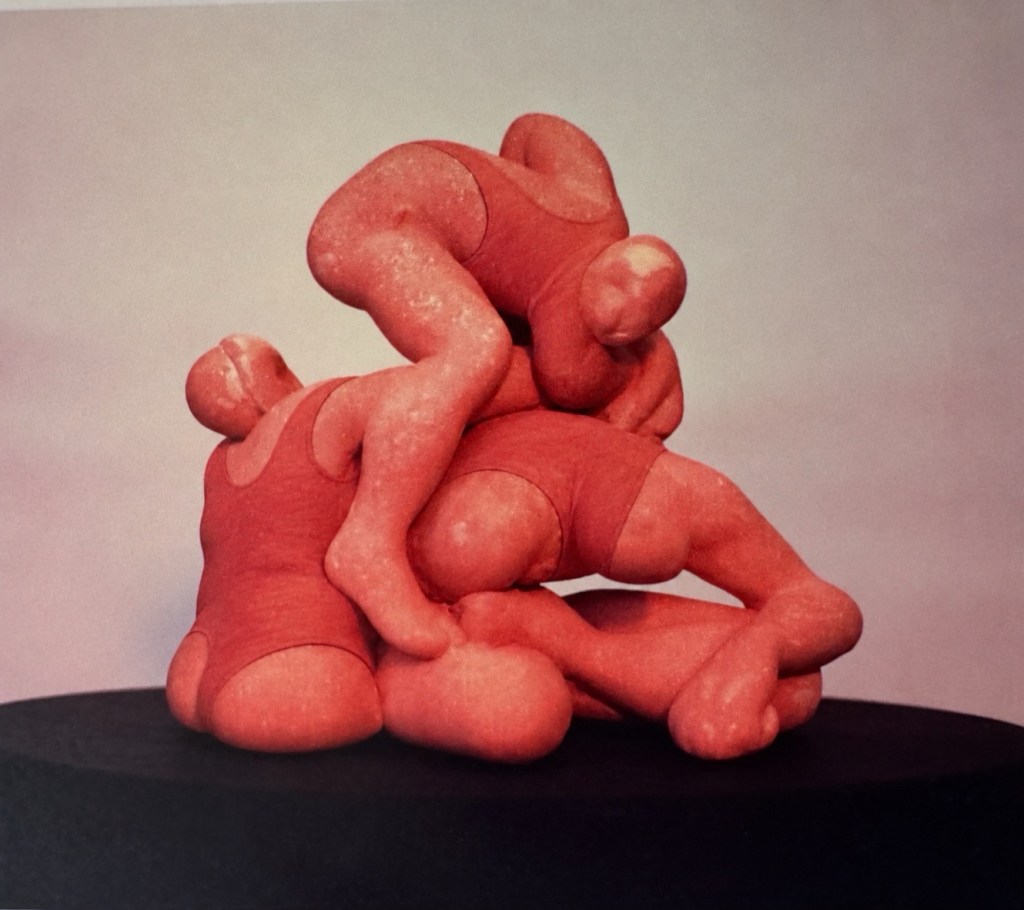
Ricardo Morín, Wrestlers, 2026. CGI after the artist’s original clay sculpture of 1975. 12 × 9 in., excluding the oval pedestal.
The Cybertruck makes its material character unusually conspicuous. Along its side, a rising windshield meets a pronounced roof crest before the upper outline descends toward the rear. Broad stainless-steel planes extend beneath this angular profile, interrupted by dark wheel surrounds and panel boundaries. Reflections change abruptly at the folds; across the larger surfaces, they spread with comparatively little modulation from curvature. The circular wheels provide a contrasting geometry, but the dominant impression of the body remains the repetition of flatness and sharp transition. Its conspicuousness concentrates attention on a small number of insistently reiterated features.
Tesla’s Q4 and FY 2024 Update, released on 29 January 2025, describes the steel’s contribution to structural stiffness and the bending process developed to manufacture its exterior. These are engineering achievements with ascertainable purposes. [1] Their technical significance leaves the perceptual relationship among the surfaces unresolved. The eye encounters extensive planes and emphatic boundaries; an account of material strength does not introduce further differentiation into those surfaces. Knowledge of their construction can inform attention without determining the quality of the encounter. The reasons for producing a form cannot substitute for the experience of encountering it.
Departure from convention acquires aesthetic significance through what the departure makes perceptible. In her account of Cubism for the Metropolitan Museum of Art, Sabine Rewald describes the fragmentation of familiar objects, the compression of pictorial depth, and the combination of contrasting viewpoints within a composition. [2] These operations altered the visible relations through which a subject could be apprehended. Recognition persisted while the means of recognition became unstable. The encounter demanded renewed attention to how objects were represented and perceived. Angularity participated in that transformation; angularity alone did not constitute it.
Arte Povera likewise gave unconventional materials a specific artistic function. The Museum of Modern Art’s account identifies the use of soil, rags, and other ordinary substances with an effort to develop a sculptural language that challenged the commercialization of art. [3] Their material poverty concerned their standing within artistic hierarchies, rather than demonstrating an absence of artistic sensibility. The economic relation changes when an exposed industrial surface becomes a distinction through which a manufactured commodity acquires desirability. Resemblance between materials does not preserve the purposes for which they are employed. The appearance of artistic departure can become a recognizable attribute detached from the perceptual discovery that gave the departure significance.
Drabness can consequently coexist with conspicuousness. An object may distinguish itself sharply from its surroundings while offering relatively little variation within its dominant gesture. Scale, brightness, and strangeness can secure immediate attention without sustaining a comparably differentiated encounter. Elaborate references can produce a similar limitation when their recognition exhausts what they offer. The initial impression promises an experience that continued attention finds little opportunity to develop.
Mystified drabness arises when the promise acquires greater authority than the encounter. Exposed material becomes evidence of authenticity; conspicuous difference becomes evidence of innovation; historical quotation becomes evidence of cultural depth. Each attribute may contribute to an accomplished work. The substitution occurs when recognition of the attribute is accepted as sufficient evidence of that accomplishment. Taste approaches its own antithesis as the identification of approved signs displaces the exercise of discrimination.
The language through which these attributes acquire authority can reproduce the same condition. A preliminary formulation of this argument attributed the Cybertruck’s appearance to the use of the wrong mathematics. That formulation gave an aesthetic judgment the apparent precision of a technical finding. Yet it identified neither an erroneous calculation nor a geometric relationship whose correction would establish the perceptual quality of the form. Its certainty supplied what its terms left unexamined. Recognition of mathematical authority can secure assent before the reader asks what has actually been demonstrated.
The substitution becomes consequential when such a judgment circulates independently of its grounds. The charge of employing the wrong mathematics can be detached and repeated while retaining the appearance of an explanation. An account of proportion, surface, scale, and transition requires the relationships under consideration to remain available for examination. Where attention acquires commercial value, the brevity and apparent completeness of the declaration can become advantages: the claim offers a conclusion that can be recognized and transmitted with little accompanying context. The same compression that facilitates circulation can conceal the work the judgment has omitted.
Firmness remains compatible with discrimination when its reach is supported by what the reader can examine. Demonstration gives emphasis its substance. The substitution occurs when the force of the sentence is accepted in place of that work. Whether conveyed through language or embodied in an object, the sign of accomplishment can become easier to circulate than the relationships through which accomplishment would be established.
Architecture gives this substitution an encompassing physical setting. A Disneyland aesthetic emerges where historical and cultural symbols are simplified into immediately recognizable effects. Picturesque façades, ornamental quotations, and theatrical sequences solicit the imagination through associations already selected and arranged for consumption. History supplies atmosphere; cultural difference supplies decorative variety. The circumstances that gave the borrowed forms their significance recede behind the impressions they can be made to deliver.
The invitation to imagine is itself commodified. Participation is directed toward identifying the allusion, receiving its promised mood, and moving to the next impression. The tensions, ambiguities, and accumulated experience through which a symbol acquires depth become obstacles to immediate legibility. Their removal makes the encounter easier to package and repeat. Different façades promise different worlds while reproducing the same abbreviated relation to their subjects. Symbolic abundance conceals the poverty of that relation, and the succession of effects distracts from how little remains to be encountered beyond them.
Mathematical complexity can sustain the same condition through another visual vocabulary. Elaborate geometry offers an immediately legible sign of technical distinction, just as a picturesque façade offers a sign of historical continuity. Neither establishes how entrances, thresholds, daylight, acoustics, and gathering places support the life conducted within a building. When the image supplies the principal measure of achievement, the continuing experience of occupation becomes subordinate to the impression prepared for recognition. Theatrical historicism and geometric spectacle can thus converge in their treatment of the inhabitant as the recipient of an effect.
In Vienna during the late nineteenth and early twentieth centuries, the search for an architecture responsive to contemporary life prompted a reconsideration of historical styles, the role of ornament, and the organization of inhabited spaces. The different responses to these questions show how sensibility could operate through both ornament and restraint. The Vienna Secession’s architectural history records how Joseph Maria Olbrich coordinated geometric volumes, symbolic ornament, and exhibition space in its building. The institution’s continuing use of those spaces also demonstrates their capacity to accommodate changing artistic activity. [4] Adolf Loos pursued another relationship between restraint and experience. In her study for the National Gallery of Victoria, curator Amanda Dunsmore describes his attention to timber, marble, and brass, together with his preference for interiors that inhabitants could adapt to their own tastes. His opposition to prescribed decoration coexisted with concern for comfort and individual use. [5] Ornament and its suppression therefore provide insufficient grounds for distinguishing sensibility from impoverishment. The distinction emerges through the relationships a work sustains among its materials, its spaces, and those who encounter it.
The resources through which such relationships acquire physical presence are consequential. The Secession’s building history records that the City of Vienna provided the site and that patrons, including the industrialist Karl Wittgenstein, contributed to construction funding. Proceeds from the association’s inaugural exhibition supplied the remaining funds. [4] Its institutional departure depended on arrangements that enabled an alternative to acquire a physical presence. The imagination that conceives a different environment must negotiate access to the means of realizing it.
Those means remain profoundly unequal. The World Inequality Report 2026 estimates that the wealthiest tenth of the global population owns three-quarters of its wealth, while the poorest half owns two per cent. [6] These figures do not establish an aesthetic consequence by themselves. Their relevance lies in the unequal resources available to commission buildings, secure premises, maintain workshops, and sustain work whose value may take time to become recognized. The capacity to imagine another environment and the capacity to bring it into existence are distributed differently.
Greater access to expression has not removed this disparity. In its published overview of the 2026 report Re|Shaping Policies for Creativity, UNESCO describes expanded access to creative tools, markets, and audiences alongside persistent insecurity in creators’ livelihoods. [7] Individual distinction can become highly visible while the means of sustaining independent practice remain fragile. The circulation of an image, a declaration, or an unconventional appearance establishes its visibility; the resources required to develop and sustain the practice behind it remain a separate concern.
Dress, possessions, and private surroundings offer immediate fields of choice. These choices can preserve and develop sensibility, but their availability does not confer comparable influence over the spaces beyond them. Where individuality finds its most accessible expression through purchasable distinctions, the market can accommodate dissatisfaction without surrendering control over the conditions that occasion it. The capacity to select among available signs of difference can expand while the capacity to determine shared conditions remains restricted.
Countercultural activity persists within this interval. Its existence demonstrates that sensibility has not disappeared. Its visibility cannot establish that the resources, institutions, and collective continuity required for a broader transformation have assembled. Dissatisfaction, creative invention, and the power to alter shared conditions remain distinct. The distance between them gives the present uncertainty its substance. [8]
Notes
[1] Tesla. Q4 and FY 2024 Update, 29 January 2025, printed p. 15, Cybertruck: Advancements in Vehicle Technology and Architecture.
https://ir.tesla.com/_flysystem/s3/sec/000162828025002993/tsla-20250129-gen.pdf
[2] Sabine Rewald. Cubism. The Metropolitan Museum of Art, Heilbrunn Timeline of Art History, October 2004.
https://www.metmuseum.org/essays/cubism
[3] The Museum of Modern Art. Arte Povera.
https://www.moma.org/collection/terms/arte-povera
[4] Vienna Secession. Building: architectural design, history, and financing.
https://secession.at/building
[5] Amanda Dunsmore, National Gallery of Victoria. Adolf Loos Table lamp, 30 April 2020.
https://www.ngv.vic.gov.au/essay/adolf-loos-table-lamp/
[6]World Inequality Report 2026. Executive summary, discussion of global wealth distribution.
https://wir2026.wid.world/insight/executive-summary/
[7] UNESCO. Re|Shaping Policies for Creativity, 2026 edition, official overview, Main findings.
https://www.unesco.org/en/reshaping-creativity-reports
[8] Ricardo Morín, The Acts of Individual Talent, 2 October 2009. An earlier examination of aesthetic experience, critical authority, and commerce. https://observationsonthenatureofperception.com/2009/10/02/the-acts-of-individual-talent/

