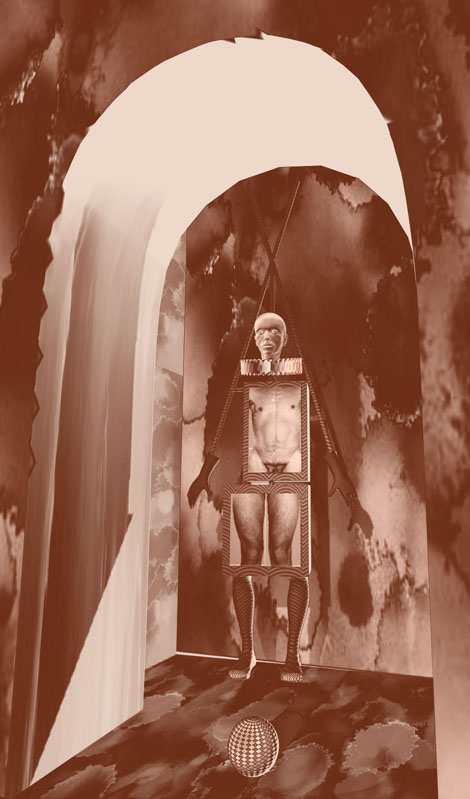
Ascension 2
CGI
2005
Author’s Note
This essay examines the political conditions surrounding the final months of the presidency of Hugo Chávez. Rather than revisiting the episode as a matter of historical controversy, the analysis focuses on the structural dynamics that became visible during that transition. The objective is diagnostic. The essay proposes that when political authority becomes inseparable from a single leader, succession may cease to appear as an institutional process and instead emerge through the management of information surrounding the leader’s condition.
Ricardo F. Morín
March 4, 2026
Oakland Park, F
The death of Hugo Chávez did not simply mark the end of a presidency. It exposed the fragility of a political order that had come to depend heavily on the authority of a single figure whose influence extended far beyond the borders of his own country. The ambiguity surrounding the final phase of Chávez’s life revealed how closely the stability of that system had become tied to the fate of one leader. To understand why that moment produced such uncertainty, it is necessary to place it within the longer evolution of revolutionary politics in Latin America during the twentieth century.
During the early decades after the Cuban Revolution, the government led by Fidel Castro promoted a strategy aimed at transforming Latin America through insurgent movements. Across the region guerrilla organizations and clandestine networks attempted to replicate the revolutionary experience of Cuba and to challenge existing political systems.
Venezuela itself became one of the early arenas where these tensions appeared. During the presidency of Rómulo Betancourt, the young democratic government faced a series of military uprisings and insurgent movements that sought to destabilize the constitutional order. Episodes such as the Barcelonazo in 1961, the Carupanazo in 1962, and the Porteñazo in 1962 formed part of that turbulent decade. Although these attempts failed to overturn the Venezuelan State, they revealed the extent to which revolutionary movements inspired by the Cuban example had begun to influence political struggles throughout Latin America.
Over the following decades the strategy of those movements changed. Guerrilla campaigns rarely succeeded in seizing power. Many organizations therefore abandoned armed struggle and entered electoral politics. Former militants reorganized as political parties and pursued their objectives through institutions rather than insurgency.
Leaders such as Gustavo Petro in Colombia and José Mujica in Uruguay illustrate how figures once associated with insurgent movements later obtained power through elections. The ideological ambitions of these movements remained, but their methods adapted to new political conditions.
Hugo Chávez represented another variation of this transformation. Chávez emerged from the Venezuelan military rather than from a guerrilla organization, yet he adopted many of the revolutionary narratives that had circulated in Latin America since the Cold War. After winning the presidency in 1998, he reorganized the Venezuelan State and established close cooperation with the Cuban government.
During the early twenty first century that cooperation expanded into regional frameworks such as the Bolivarian Alliance for the Peoples of Our America, the Union of South American Nations, and the Community of Latin American and Caribbean States. These organizations coordinated diplomatic initiatives among participating governments and promoted the idea that Latin America could operate independently of the United States. Commentators such as Noam Chomsky described this aspiration as part of a broader movement toward a multipolar world.
The Venezuelan State financed much of this cooperation. Revenue from petroleum exports allowed the government in Caracas to provide subsidized energy agreements and financial assistance to partner States. These resources strengthened the regional network associated with the Bolivarian project.
Within this political structure the health of Chávez acquired strategic importance. Chávez was diagnosed with cancer in 2011 and traveled repeatedly to Cuba for treatment. In December 2012 he underwent another surgery in Havana and then disappeared from public view.
After that moment Venezuelan authorities released only intermittent statements about his condition. No verified images of the president appeared for extended periods. Officials asked citizens to assume that the president continued to govern even though the public could no longer observe him performing the duties of the office.
When a population cannot observe its head of State, public reality becomes difficult to verify. Statements replace appearances, and narratives replace observable authority. Under those conditions uncertainty expands because citizens cannot distinguish between political communication and factual information.
Questions about the chronology of Chávez’s death emerged from that uncertainty. The Venezuelan government announced in March 2013 that the president had died from complications related to cancer. Critics questioned whether that announcement corresponded to the actual moment of death. They pointed to the long absence of the president from public life and the limited information that officials released about his medical condition.
Events that followed the announcement reinforced suspicion. Authorities initially declared that Chávez’s body would be embalmed and displayed permanently. Shortly afterward officials abandoned that plan. The government also released no autopsy report or detailed medical record that could clarify the exact circumstances of the president’s death.
Whether the official chronology reflects the full sequence of events remains disputed. What can be observed with certainty is the political environment that surrounded the transition.
When a governing coalition depends heavily on the authority of a single leader, succession threatens the stability of the entire system. In that situation the leader’s illness becomes a political problem rather than a purely medical one. Those who control the State therefore face an incentive to regulate how information about the leader’s condition reaches the public.
The Venezuelan transition of 2013 illustrates the phenomenon described here as concealed succession. The disappearance of Chávez from public life, the limited disclosure about his illness, and the uncertainty surrounding the announcement of his death together produced a political situation in which the transfer of authority could not occur openly.
Seen across several decades, the end of the Chávez presidency also clarifies the evolution of revolutionary movements in Latin America. Armed insurgencies of the 1960s gradually transformed into political parties that competed in elections. Some of those parties later formed governments and created regional frameworks through which they coordinated policy. In the twenty first century those networks increasingly interact with a wider geopolitical environment in which emerging powers encourage alternative centers of influence.
This development forms a continuous trajectory rather than a rupture. Guerrilla organizations became political parties, political parties formed governments, and those governments created regional frameworks that extended their influence. The illness and death of Hugo Chávez exposed how strongly that architecture depended on the authority of a single leader whose position linked several of these layers at once.
When political authority becomes inseparable from the physical presence of a single leader, succession cannot occur transparently. The continuity of the system becomes tied to the management of information surrounding that leader’s condition. In such circumstances the transfer of power no longer appears as an institutional process. It emerges instead through the regulation of visibility and the control of public knowledge. What appeared in Venezuela during the final months of Chávez’s presidency therefore reveals a structural principle of personalized political systems: when the survival of a regime depends on one figure, succession must first be concealed before it can be resolved.

