
Posts Tagged ‘scenography’

“Mozart and the Rest of Us”

November 12, 2026

A Borrowed Mantle.  Ricardo F. Morín.  CGI, 2026.

Early in my second year at Yale, I designed a set for The Marriage of Figaro.  Ming Cho Lee commended its manageable scale and observed that the geometric motif of the interior had the same rhythm as the melodies.  He said I had a natural flair for opera design.  Years later, during a visit to San Francisco, the prospect of hearing Figaro again recalled that observation:  an architectural interior could participate in music, giving its movement a visible form.

We had come to California for wine country, art, and a reunion with an old friend.  Illness in his household had changed the visit we had imagined.  Other plans shifted with the weather and our interests.  Discovering Figaro on the opera’s schedule gave the journey an unexpected destination.  We rearranged dinner and went to the War Memorial Opera House.

At six thirty we attended the introductory lecture.  The speaker traced the comedy through its theatrical ancestry, from ingenious servants and obstructive masters to Beaumarchais, Mozart, and Da Ponte.  Concealed listeners, disguises, and inconvenient arrivals had traveled through generations of theater.  In Mozart, those devices acquired a musical life in which a character’s attempt to master a situation could be heard alongside the feelings that made mastery impossible.

The production placed the household in the young American republic.  The Count was building an unfinished Palladian manor recalling Jefferson’s Monticello.  Portions stood solidly onstage while others remained drawings.  The architecture offered an image of order still under construction, with doors through which its inhabitants would introduce every possible complication.

Once the performance began, that unfinished house became a place of musical encounters.  The geometry I remembered discussing as a student had practical consequences here.  An entrance interrupted an intention; a hiding place prolonged a misunderstanding; the distance between characters could become an opportunity or an impediment.  Erhard Rom’s architecture accommodated the movement, while Mozart gave each encounter its changing emotional measure.  The pleasure lay in following both at once.

The characters inhabited their desires with an earnestness that made them funny.  Figaro wanted to marry Susanna.  Susanna had to protect that possibility from the Count, whose appetite disturbed the arrangements of everyone around him.  The Countess endured the humiliation of a marriage whose earlier happiness remained painfully available to memory.  Infatuation, jealousy, and womanizing kept the household occupied, but the voices gave these familiar conditions an intimacy that the account of a plot could scarcely convey.  We could enjoy the foolishness without becoming indifferent to those caught in it.

In 2026, the nation’s two hundred and fiftieth anniversary, the American setting brought another household to mind.  I thought of a president weakening the constitutional restraints he was entrusted to uphold, of authority exercised in the people’s name while evading the obligations of “We the People.”  The unfinished manor gave those thoughts somewhere to settle.  A country could announce its principles and spend generations accommodating conduct that contradicted them.

The Count’s difficulty was smaller in scale and immediately recognizable.  Having relinquished a privilege, he regretted the concession when Susanna became the object of his desire.  His enlightened opinion of himself survived the contradiction.  Everyone else had to manage its consequences.

Yet hearing him within Mozart’s comedy prevented that recognition from settling into a comfortable verdict.  His authority became ridiculous, his desires exposed him, and the other characters were hardly free of vanity or misjudgment.  Their voices carried intentions that crossed and obstructed one another.  I could recognize an abuse of power and still take pleasure in the human confusion through which it was disclosed.  The music kept that pleasure alive where indignation alone would have brought my attention to a halt.

The opera house itself had entered the evening’s associations.  Its long gestation had carried a civic ambition through prosperous years into the Depression, when the building finally opened in 1932 with Tosca.  The delay interested me as another misalignment between intention and accomplishment.  Plans could be defended, disagreements prolonged, and decisions deferred until an achievement arrived at the least reassuring moment.

I wondered what the inaugural audience had received from an evening that celebrated a new opera house through a work of coercion, deception, and destruction.  The uncertainty outside could not have been settled by the performance.  I had been inclined to regard entertainment in such circumstances as distraction and appeasement.  Still, people had gathered to listen.  Sitting in the same house, I could feel the attraction of that temporary release.  The beauty before us made room for pleasure without requiring the world beyond the auditorium to become less troubling.

I was experiencing the relief myself.  Mozart’s music engaged the very feelings that made the story poignant, yet gave those feelings a form in which joy remained possible.  The attraction was inseparable from what the music allowed us to recognize.

During the second act, exposure repeatedly approached without completing its work.  One explanation displaced another; a successful evasion created the need for a further invention.  The characters tried to preserve their accounts of what had happened while the voices and orchestra drew their competing purposes into an increasingly absorbing relationship.  Each complication demanded more of them and offered more to us.

By the end, seven voices had joined.

Their differences remained audible within the ensemble.  No agreement among the characters could have produced the coherence we were hearing.  Suspicion, resistance, and the effort to escape discovery continued, but their musical concurrence carried us into a dimension in which the pleasure exceeded the predicament.  The poignancy of their story, and of our own, receded.  We were listening with the sheer joy that had accompanied the evening, now enlarged by the combined voices.

Meanwhile, the warmth in the auditorium had become difficult to tolerate.  The ventilation seemed unable to provide the circulation we needed.  After roughly two and a half hours in the building, we were fanning ourselves with the magazine outlining the production.  The pages describing the scenery and its elaborate workings had become our simplest means of moving the air.

Our bodies were responding poorly even while the performance continued to give pleasure.  We realized we were beginning to fall asleep from sluggishness.  It was frustrating to feel attention slipping when we wanted to listen, and the prospect of another two hours in the same warmth had become untenable.

During the second intermission, we decided to return to the hotel and sleep properly.

The decision left the evening unfinished for us.  We knew the exposure, the plea, and the forgiveness that lay ahead, but we would not hear them unfold.  The Count would have to seek forgiveness without us.

What we carried away had already exceeded the discomfort that sent us out.  The doors, the disguises, the unfinished American house, and our own uneasy associations had all acquired their movement within Mozart’s music.  Even our departure could not reduce the evening to its inconvenience.  We had been uncomfortable, and we had been filled with joy.

Ricardo F. Morin

November 11, 2026

San Francisco, California

“A House Askew”

October 31, 2026

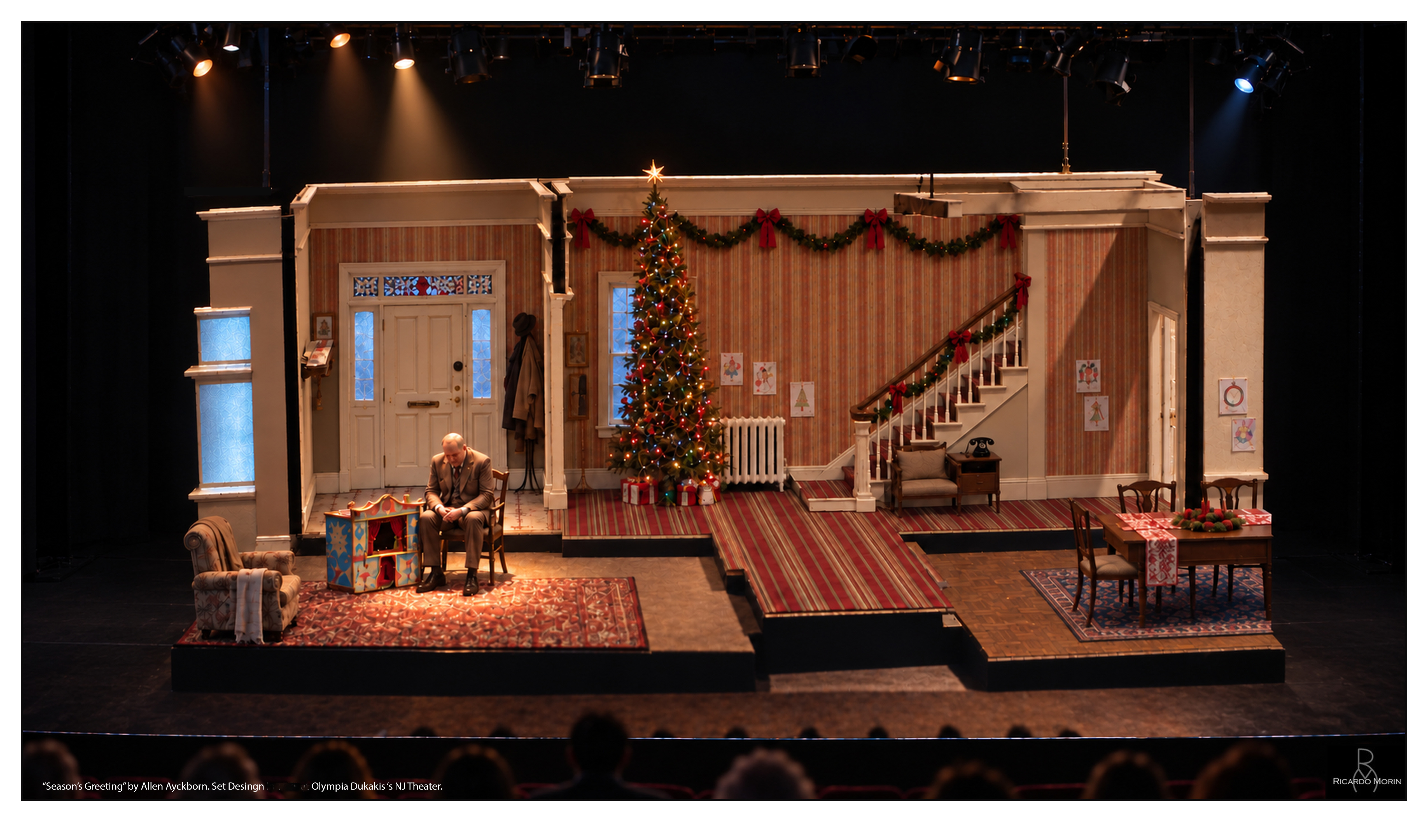
Ricardo F. Morín. Set design for “Season’s Greetings” by Alan Ayckbourn. Image based on the original maquette, 2026.

The play asked for a house, and the set designer, considering it, had resolved early that the house would not pretend.    Ayckbourn’s family gathers over a Christmas in which nothing that matters is said and everything that matters is overheard, and the rooms in which this happens must be seen at once, the hall beside the sitting room beside the dining room, so that the audience may watch a guest arrive in one while he is being discussed in another.    The theater offered no proscenium to frame them. Its audience sat in tiers fanning out before a raised stage, masked at the sides by legs, under a ceiling high enough to hold the lighting grid; whatever the house was to show or to withhold, the set design itself would have to decide, since no frame would decide it on its behalf.    The set designer had laid the rooms side by side across the width of the stage, the whole turned slightly askew to the audience rather than presented head on, each on its own floor, the floors and the walls sliced, so that the house stood complete for those who lived in it and frankly incomplete for those who watched.    It was not to be a room for a camera.    It was to be a house that confessed its making and then, having confessed, asked to be forgotten, so that what remained in view was the life within it.

The director was young, and their first conversation was informal, conducted in that atmosphere of general goodwill in which two people can agree about a play without discovering whether they agree about anything in it.    He spoke of his point of view; the set designer listened and found nothing in it to oppose, which he would later recognize as the first of several occasions on which the absence of disagreement had been mistaken, on both sides, for its opposite.

It was in the set designer’s studio, before the drawings went to the shop, that the difference declared itself.    The director studied the layout, the sliced floors and the sliced walls, and proposed, with the enthusiasm of someone who believes he is completing a thought, that the walls be shown as if a giant had bitten them.    The set designer regarded him calmly.    He could not, he said, see a surrealist set for this play; it would read as a Mickey Mouse set.    Whether the young man took offense he never learned, and the question stayed with him longer than the answer would have.    What he understood at once was the nature of the proposal:    the director had read the cut as a gesture asking to be made louder, where it had been meant as a convention the audience accepts in the first minute and does not think of again.    Days remained before the work would begin.    The director yielded to the set design, and his yielding, the set designer perceived, was not the same thing as his agreement.

The presentation to the artistic director took place in her theater, and it was there that he met Olympia Dukakis for the first time.    Before the drawings had been fully opened she spoke, with a candor he had not expected, of a review of her last production in the local paper, which had charged her with pandering to her audience.    The charge had embarrassed her, and she did not conceal it.    He told her he shared her displeasure, and he meant it; it seemed to him, in that moment, a small and natural sympathy between two people who wished the theater to ask more of its audience than it was being asked.    She approved the set design.    Neither of them remarked that what she had approved stood, in every sliced floor and every sliced wall, as the very alternative to what the critic had described.    The set design had been drawn before he heard of the review, and it had not been made as an answer to it.    But it entered the theater carrying that meaning, and the meaning, unspoken, waited.

The week of construction passed with the set rising on the stage, and for the whole of it the artistic director labored toward an understanding of the slicing of floors and walls that the maquette had not given her.    He watched the understanding arrive by degrees as the object took its physical shape, and he watched, with a less comfortable attention, that her coming to see the set design brought her no nearer to the man who had made it.    She understood more each day and wished to hear less.    That the two movements could proceed together, comprehension advancing while attention withdrew, was something he noted without yet being able to account for.

Toward the end of that week, as the props were being finished, the set designer stood among the production staff showing how a puppet theater he had designed for one of the characters was to be assembled.    Olympia asked whether it would be complete by the first dress rehearsal.    “By hook or by crook,” he said, and lifted his eyes from the prop toward her, in time to find her repeating the phrase in an imitation of his voice, for the amusement of those around them.    He did not smile.    He looked at her and went on looking, with the quiet attention of a man waiting to learn which of two glances would give way; and it was hers that turned aside first.

The technical rehearsals supplied the account.    The lighting designer had spoken to no one, not to the set designer, not to the director, not to the artistic director.    She had held the drawings of the set design from the start, and nothing in the layout or its demands should have found her unprepared; yet she came with no plot drawn for the working set and hung her instruments by eye, on the spot.    The set designer came to understand it as the habit of one who works season after season in the same house: she had settled into expectations of convenience that belonged to the theater and to no set in particular, and she brought them to a set that answered to none of them.    When at last she lit the house she lit it from the front, evenly, as one lights a room in which everything must be seen.    The set design had asked for the opposite.    It had asked that each area be isolated in its own light, so that the hall and the sitting room and the dining room might remain separate worlds, and that the understructure of the platforms fall away into darkness, leaving each floor to stand as its own room.    Under the even light everything was shown with the same emphasis, and what had been meant to recede rose to meet the eye.    Nor did the lighting designer confine herself to the light.    The set design called for an L-shaped beam suspended along the perimeter of the dining room.    Before it could be hung, the lighting designer told Olympia that it would make her work more difficult, and Olympia conceded to dismiss it without further consultation.    When the set designer recommended that the areas be isolated, they were surprised.       When, later, he told Olympia he was surprised she had not considered punk, whose dissonance would have sounded beneath the festive surface what the set design had built into it, rather than the Christmas ballads of Sinatra she had persuaded the sound designer to use, she answered at once:    “I knew you were going to say that!”    The first recommendation had surprised them; the second had been expected.    In the difference between the two he read, as clearly as if it had been said, that they were no longer on the same page and had perhaps never been, and that she had been anticipating his judgment for some time before he offered any.

The set design stood on the stage as he had drawn it, faithful in everything but the beam it had been denied, and the production was moving, in its light and in its music, toward precisely what the newspaper had described.    Between the two the set held up its quiet alternative, and the artistic director, who had told him of the review on the day they met, seemed to find in his presence the reproach she had found in the critic’s words.    He had made no reproach of the kind she heard.    He had agreed with her.    But he understood, with the peculiar helplessness of one who is misread by circumstance rather than by intention, that nothing he could say would correct the impression, since every explanation would only confirm that there was something to explain.    Whatever she felt, he knew it had not come from any intention of his; whether his manner had lent it a shape he had not meant, he could not tell.    It came, he thought, from the sequence of things: from her candor at their first meeting, from his sympathy, from a set design that embodied what she had said she wanted, and from a production that, as he saw it, was failing to meet it.

He was not, he understood, a welcome participant, and he ceased to attend to them.    The withdrawal was quiet and, in its way, complete.    The set design remained where it had been built, and no one who had the means to answer it answered it.

What remains is the maquette, and an image made from it, in which the house is lit as it was meant to be lit:    a warm pool falling on a solitary figure beside a puppet theater, the tree glowing at the center, a cooler light over the dining room, the dark risers vanishing beneath floors that seem to float.    It shows the set design as it was conceived, and it shows what the rehearsals withheld.    The production has passed, and with it the light that misread the house.    The house itself, in the form in which it was first imagined, has outlasted them.

Ricardo F Morin

October 25, 2026

Oakland Park, Florida