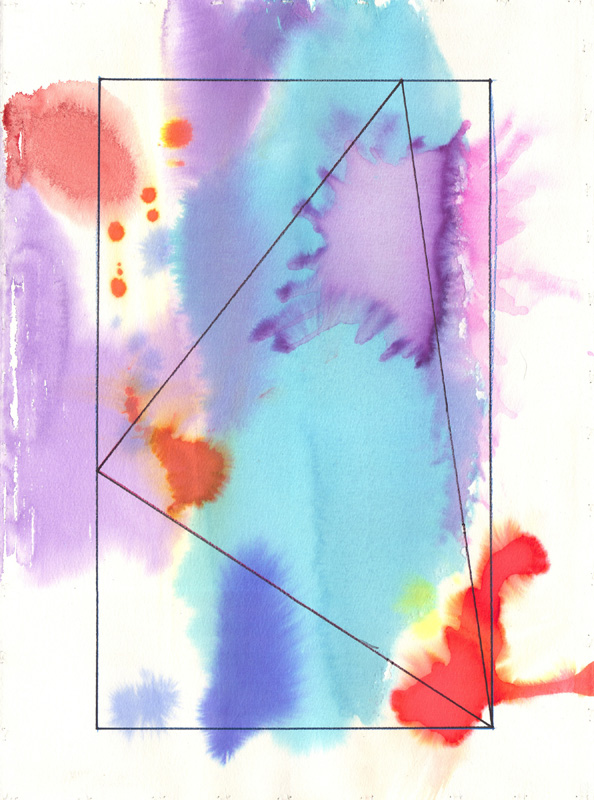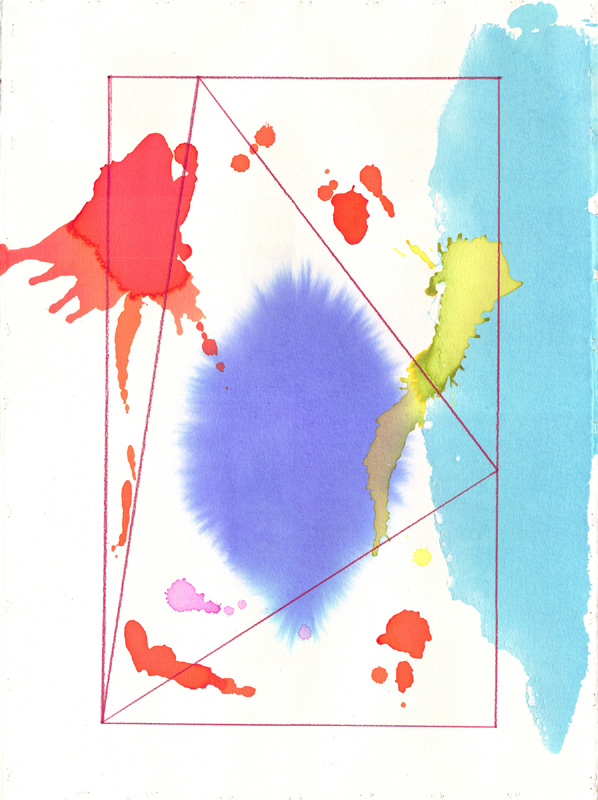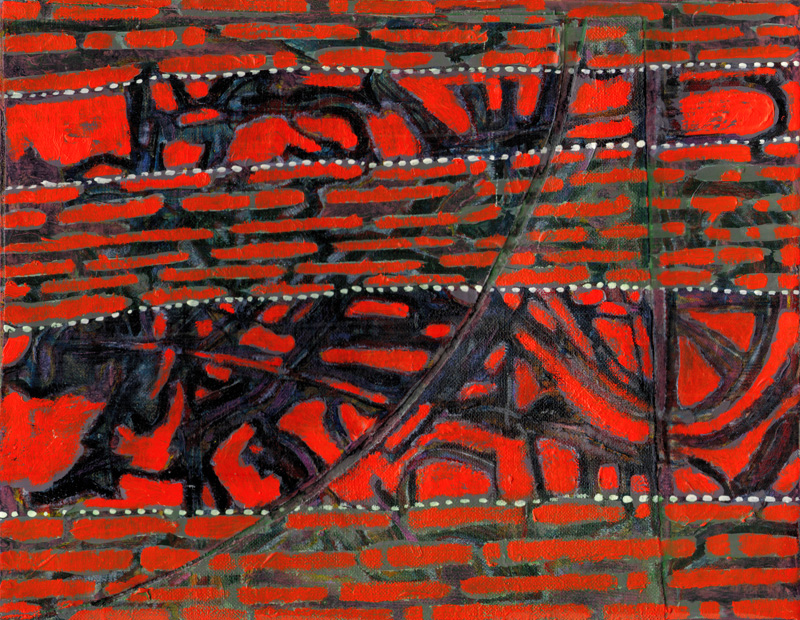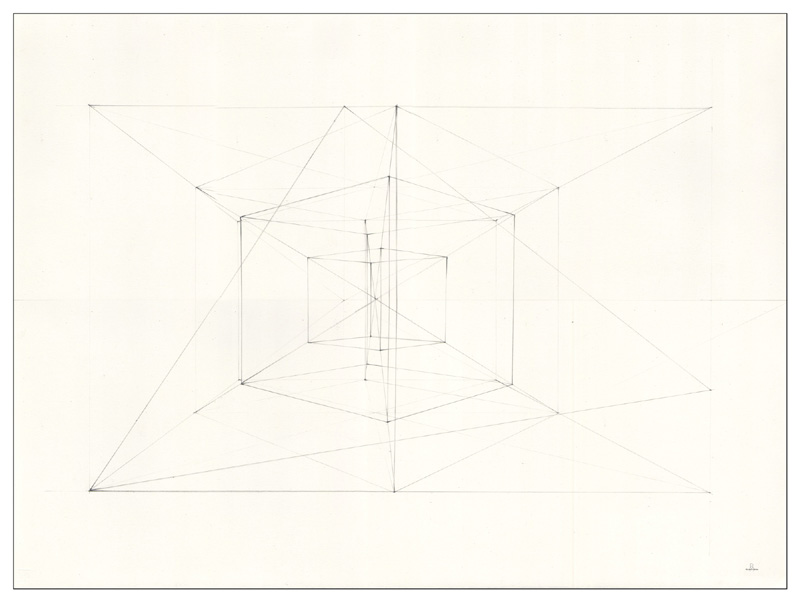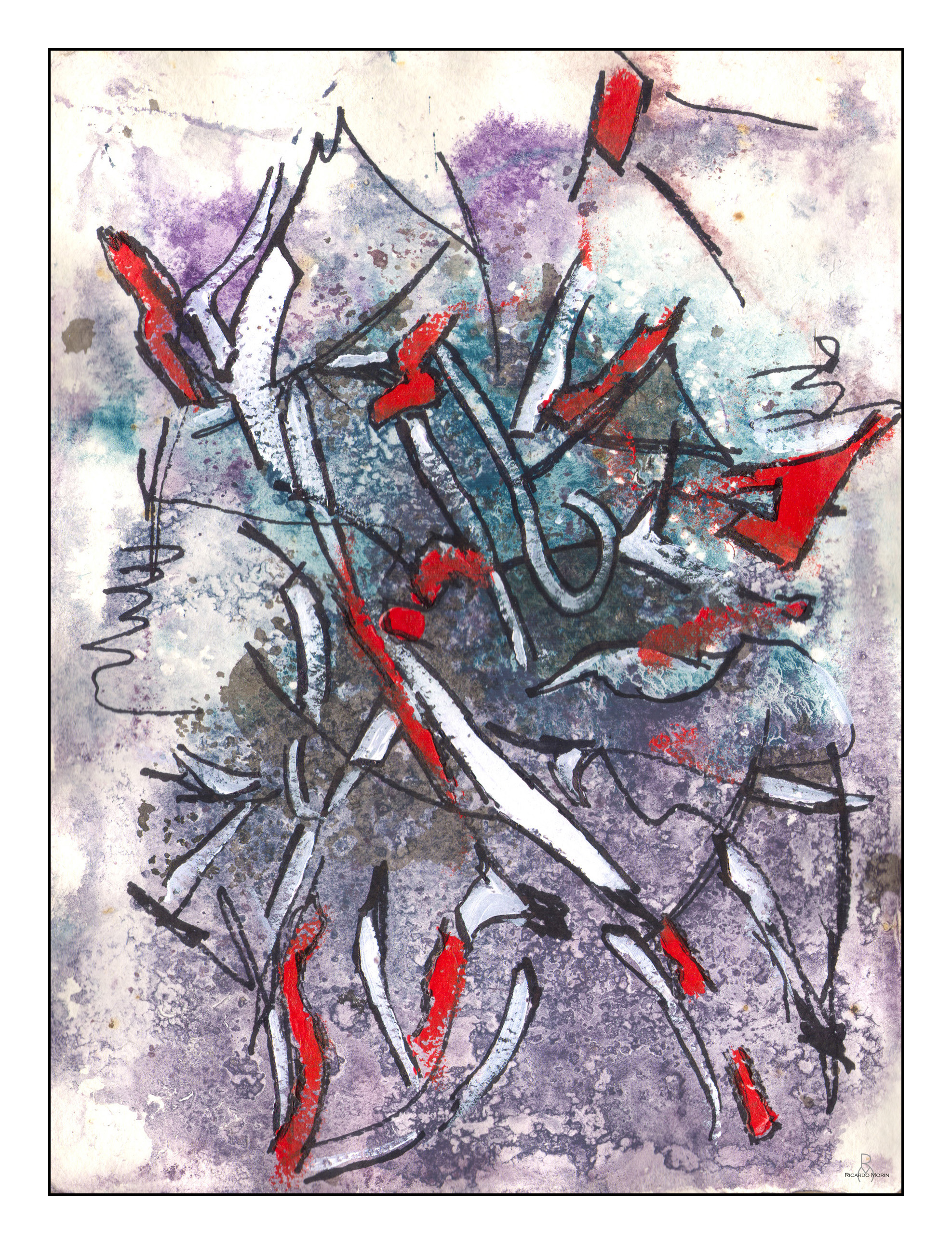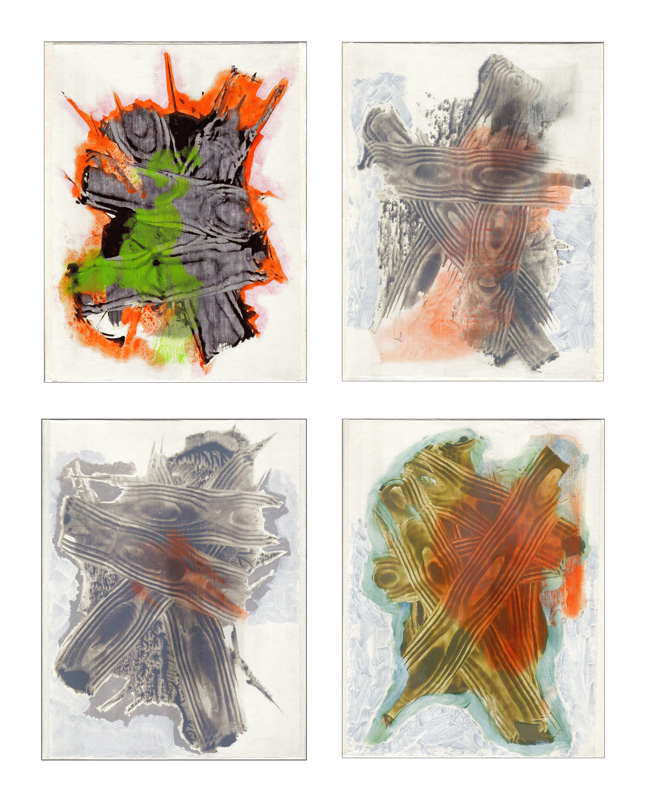
“CIVIC AGENCY”

December 9, 2025

*

Ricardo Morín
Teratological Topographies Series One: CIVIC AGENCY
Oil On Linen
Quadtych: Each panel: 14 by 18 by 3/4 inches
2009

Ricardo F. Morín

November, 2025

Oakland Park, Florida

Billy Bussell Thompson, Editor, NY, NY

This essay examines conditions frequently distorted by ideology, moral inheritance, or historical narrative.   Questions of sovereignty, occupation, revolution, exile, and national identity are often debated through claims that appeal to absolutes—religious entitlement, historical grievance, or revolutionary legitimacy.   These claims differ in language but share the same structure:   they place a single idea over civic realities of people whose lives are structured by such narratives.

To address what is obscured by these narratives, the essay turns to a structural factor that cuts across these differences:   civic agency, understood as the capacity of people to shape the conditions of civic life through their participation, representation, and lawful processes.   When civic agency is removed—whether through external control, internal authoritarianism, or deterrence directed at displaced populations; the form of the constraint may change, but the civic effect remains constant.

This essay does not compare political histories.   It examines how State power, in its various configurations, regulates civic life.   It considers how ideology obscures this regulation and how populations experience the consequences of decisions in which they have little or no role.   The goal is not to reduce political conflict but to call attention to the structures that determine whether freedom is possible or remains beyond reach.

This essay will argue that the most reliable way to understand situations that appear politically incompatible—such as Palestinian statelessness and Cuban authoritarian sovereignty—is to examine the structural absence of the civic agency that defines both.   Although the forms of constraint differ, the civic condition comes together:   the State, whether external or internal, restricts the capacity of the population to shape its own civic life.   By analyzing how State regulation limits participation, suppresses representation, or fragments jurisdiction, this essay will show how civic agency becomes the central measure of freedom.   It will further examine how ideological narratives, policies of deterrence, and migratory pressures hide this structural reality.   The aim is not to adjudicate political claims but to bring to light the conditions under which civic life can be formed, protected, or denied.


1

Every attempt to understand political life must begin with the recognition that populations do not experience freedom as an abstraction; they experience it through the structures regulating their civic existence.   These structures determine how decisions are made, how authority is exercised, and whether or not people can participate in shaping the conditions for their own lives.   Civic agency is therefore not an ideal but a condition that either exists or not.   When it is absent, freedom appears as a formal claim rather than a lived condition.

2

Civic agency consists of three components:   participation, representation, and lawful process.   Participation allows individuals and communities to influence public decisions.   Representation provides continuity between the governed and the governing body.   Lawful processes ensure that authority is exercised within defined limits.   When any of these components is removed, the people lose their capacity to shape the civic environment they inhabit.   This loss may occur by external regulation, internal authoritarianism, or policies reducing civic life to a set of restrictions that diminishes a shared domain.

3

The absence of civic agency can take different forms.   A population may be governed by institutions that do not recognize the communities’ sovereignty and thus leave civic agency subject to regulations that the people have no significant role in its shaping.   Alternatively, a people may inhabit a sovereign State that suppresses political pluralism, restricts lawful dissent, and monopolizes institutional authority.   In both cases, the civic condition is suppressed:   the people are without the ability to influence the rules that govern them.

4

The Palestinian case illustrates the first form.   Multiple authorities regulate movement, territory, and public life without providing unified jurisdiction or sovereign protection.   Decisions made by external States define daily existence and leave the population without consistent civic rights or a stable institutional framework.   The absence of sovereignty is not only territorial but civic; this absence takes away the mechanisms by which participation and representation are possible.

5

The situation with Cuba represents the second form.   Although the State possesses sovereignty, it concentrates political authority within a single institutional apparatus and restricts lawful avenues for dissent, competition, or structural reform.   Citizens live under a system that maintains political continuity by restricting avenues for participation.   Sovereignty prevails; civic agency is limited.

6

Palestine and Cuba differ, of course, in history, structure, and origin; yet they align in one respect:   the State, whether external or internal, restricts participation in ways that make civic agency unattainable.   The absence of agency is the common element that marks the civic condition beneath political narratives.   This absence also provides a framework through which populations that experience different forms of constraint are to be understood without conflation.

7

Ideological narratives frequently align with existing distributions of power.   Religious entitlement asserts that land is secured by divine mandate rather than civic protection.   Revolutionary rhetoric proclaims that political authority is justified by historical struggle rather than accountability.   Both forms of narrative elevate an absolute over the civic realities of the population.   They replace agency with allegiance, and they interpret restriction as necessity, and not as a failure of representation.

8

Migration provides a third lens through which the limits of civic agency become visible.  People leave their countries when the structures regulating their lives collapse or become uninhabitable.  They seek stability, protection, and the ability to rebuild civic participation in new surroundings.   Yet policies of deterrence in host States often mirror the pressures that displaced them.   The new States restrict the migrants’ movements, their access to social institutions, and narrow the possibilities of belonging to a civic order.   These policies do not reproduce the original dilemma, but host States reintroduce the experience of living under rules that they cannot influence.

9

For many asylum seekers, these restrictive measures narrow the distance between the pressures that forced their departure and the pressures they encounter upon their arrival, a shift that makes stability hard to distinguish from exclusion.  European examples such as Denmark and the United Kingdom reveal how deterrence is used to discourage asylum without acknowledging the civic vacancy it creates.  The United States employs similar policies at its borders and presents deterrence as an instrument of order, which leaves migrants suspended between exclusion and unresolved civic status.

10

The structural argument is not that these situations are equivalent, but that the absence of civic agency creates a civic condition transcending political differences.   Populations ruled without participation, governed without representation, or confined within systems that restrict lawful processes experience freedom as external to their civic environment.   This condition cannot be explained by ideology because ideology addresses identity, justification, or legitimacy—not agency.

11

Understanding civic agency clarifies the difference between political claims and civic realities.   Sovereignty does not guarantee freedom; revolution does not guarantee participation; religious entitlement does not guarantee protection.   Civic agency exists only when people can shape the conditions that guide them.   When this becomes impossible, the people do not inhabit a civic order but a regulated space.

12

When civic agency becomes the measure through which political life is understood, ideological narratives lose their authority, and the structure of constraint becomes visible.  This visibility does not resolve conflict but reveals the conditions under which freedom can either emerge or remain unapproachable.   Civic agency is where the possibility of civic life begins and where its absence becomes structurally apparent.

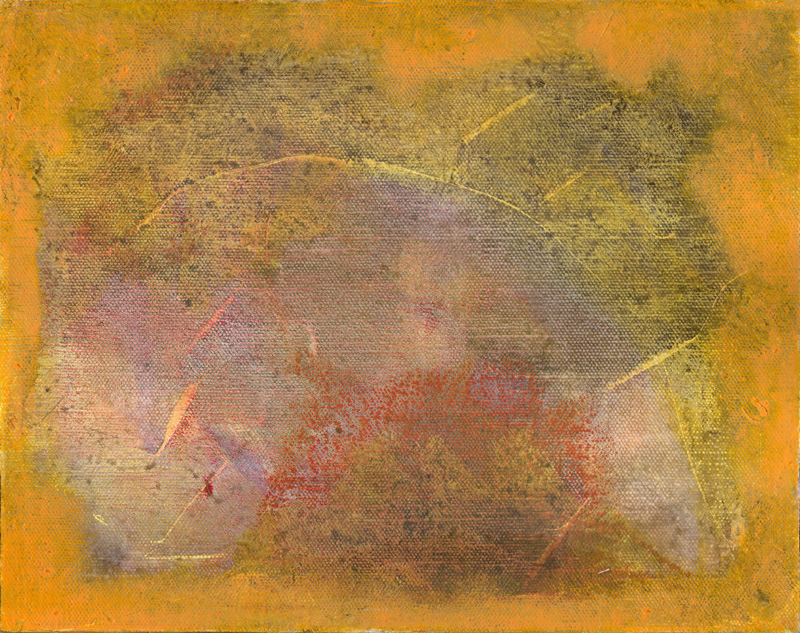
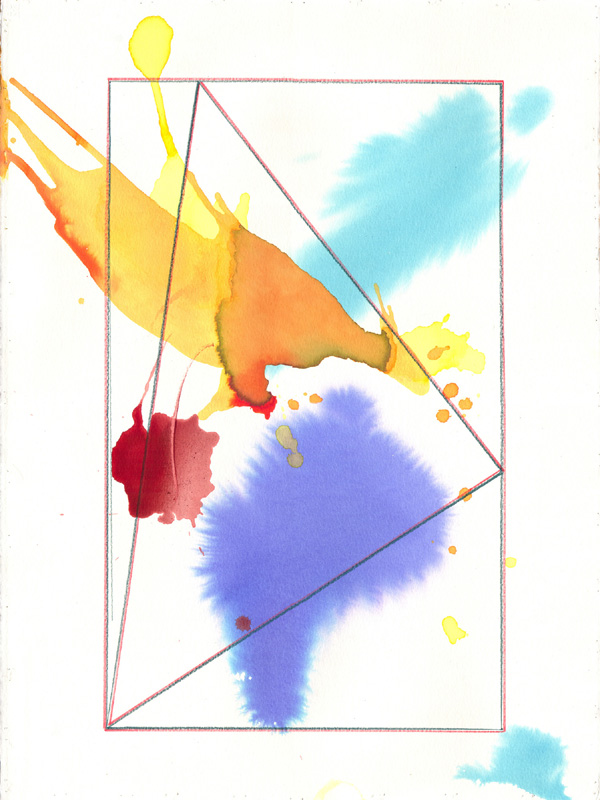
“River Grass”

December 7, 2025

Ricardo Morin
Landscape II: River Grass
18” x 24”
Sepia on newsprint 
2003

Ricardo F Morin

Dec. 6, 2025

Naples. Florida

*

This diptych, “River Grass” and “Naples in the Morning,” brings together a reflection on continuity and a brief observation of everyday life.  Two scenes—one sustained, the other fleeting—register how experience, silence, and attention shape presence.  The first part, “River Grass,” does not present an argument, a confession, or a theory.  It offers an observation shaped over time by proximity rather than distance.   The focus is not on individual psychology or relational conflict, but on patterns that take form across generations and persist quietly within everyday life.

What follows avoids moral explanation and narrative resolution.   It attends instead to continuity—how restraint, generosity, and presence may be transmitted not through instruction or memory, but through posture, habit, and orientation.   The intention is to describe without adjudicating, and to clarify without assigning cause where cause cannot be cleanly isolated.   What is traced here represents one possible orientation among many, shaped by inheritance but not exhaustive of its effects—an invitation not to mistake the channel for the ocean.


Orientation of “River Grass”

What follows attends to what persists when lives are shaped by continuity rather than interruption.

Not all inheritance arrives as memory.   Some is conveyed without story, without date, without language.   It enters through atmosphere rather than narrative—through cadence, restraint, posture, and a preference for continuity over display.   In such cases, history is not recalled; it is carried.

This form of inheritance does not announce itself as trauma.   It leaves no single scene to revisit, no episode that can be isolated and explained.   Instead, it appears as a way of moving through the world:   measured, attentive, resistant to excess.   The past exerts influence not by instruction but by shaping what feels permissible, sustainable, or necessary.

Under these conditions, restraint is not experienced as loss.  It functions as orientation.  Accommodation does not signal submission but competence.   Stability reflects not the absence of desire but the quiet placement of desire among other priorities.   What is transmitted is not fear but caution—an ethic of endurance refined over time.

Because no event is foregrounded, little invites interpretation.   The absence of visible distress encourages the assumption of ease.   Life appears ordered, generous, and intact.   Yet the inheritance remains active and structures conduct without requiring acknowledgment.   It persists not as memory but as form.

Such inheritance often resists recognition precisely because it has succeeded.   The past has not repeated itself.   Continuity has been preserved.   What remains is a posture oriented toward sustaining that continuity—a vigilance so normalized that it passes as temperament rather than history.

Restraint, in this context, does not operate as inhibition or denial.   It functions as a stabilizing orientation—an internal calibration shaped over time.   Action is guided less by expression than by proportion and durability.   What governs choice is not moral judgment but coherence.

Such restraint often coexists with clarity and decisiveness.   Boundaries are maintained without conflict; decisions are made without excess emphasis.   What is avoided is not agency but surplus.   Expression is moderated not through fear of consequence, but through an internal sense of sufficiency.

Accommodation here is frequently misread.   It does not arise from compliance or uncertainty, but from an assessment of impact.   Space yielded to others reflects confidence in structure rather than retreat from position.   Presence remains intact even when it is not foregrounded.

This orientation produces a stability that can appear effortless.   Friction is minimized.   Demands are rare.   The absence of insistence is readily mistaken for ease or contentment.   Yet the restraint at work is active, not passive—and continuously shapes what is articulated, deferred, or left unspoken.

Over time, restraint becomes difficult to distinguish from identity.   It ceases to register as a choice among alternatives and hardens into posture.   The question of expression recedes, replaced by an emphasis on responsibility, proportion, and non-disruption.

Generosity shaped by inherited restraint rarely announces itself.   It does not seek recognition or reciprocation, nor does it depend on visibility for validation.   It appears instead as availability, as the quiet removal of obstacles, as the willingness to yield space without narrative or sacrifice.

In this form, giving is non-transactional.   No balance is tracked; no return anticipated.   What is offered is steadiness rather than favor.   Support unfolds without appeal, often unnoticed, absorbed into ordinary conduct.   The absence of demand is integral rather than incidental.

Because it imposes no weight, such generosity leaves little trace.   Others encounter freedom without sensing its source.   Autonomy is enabled without attribution.   The one who gives remains present yet unmarked.

Over time, the habit of making room for others becomes more practiced than the habit of entering it.   Attention turns outward and refines responsiveness while narrowing self-directed articulation.   What persists is not loss, but redirection.

This configuration resists conventional readings of imbalance.   No grievance emerges; no conflict announces asymmetry.   Generosity remains intact, even exemplary.   What shifts subtly is internal emphasis: presence exercised through allowance rather than assertion.

Desire, within this orientation, is neither denied nor suppressed.   It is repositioned.   Its legitimacy is not questioned, but its urgency is diminished.   What is set aside is not longing itself, but the expectation that longing must organize life.

Desire is acknowledged yet rarely centered.   Expression is permitted elsewhere more readily than inwardly claimed.   Attention gravitates toward what preserves stability rather than what intensifies experience.   Satisfaction arises from coherence rather than culmination.

This produces no vacancy.   Life remains engaged and responsive.   What diminishes is insistence.   Continuity comes to matter more than appetite; durability more than immediacy.

Because this arrangement is not framed as renunciation, it escapes notice.   No moral language surrounds it.   Nothing is named as sacrifice.   Desire persists at a distance—observed, managed, deferred without struggle.

Over time, identity becomes shaped less by pursuit than by maintenance.   Expression gives way to stewardship.   Meaning accrues not through arrival, but through the avoidance of rupture.

Patterns organized around restraint and continuity are often mistaken for moral attainment.   Composure is read as wisdom; accommodation as maturity; silence as depth.   Because no disturbance arises, the orientation escapes examination.   What functions smoothly is presumed complete.

This misreading is reinforced by social frameworks that reward stability over inquiry.   Absence of conflict is taken as evidence of balance.   Generosity without demand is praised rather than interrogated.   Its costs remain obscured precisely because they impose nothing on others.

Virtue, in this setting, becomes indistinguishable from habit.   Adaptive orientation solidifies into character, and character into expectation.   Reliability is affirmed repeatedly, deepening its hold.

The result is not deception but omission.   The steadiness is genuine.   What goes unrecognized is how fully such an arrangement organizes life around preservation rather than presence.   The question of displacement remains unasked, not refused.

Misreading occurs through success.   Relations endure.   Structures hold.   No obvious harm appears.   And so the deeper configuration—quiet, durable, historically shaped—continues beneath the language of virtue.

At a certain threshold, continuity shifts from supporting means to governing end.   Life becomes organized not around fulfillment, but around preservation.   What matters most is that nothing essential is exposed to rupture, whether through excess demand or through untested assertion.

Fulfillment is not rejected, but subordinated.   Satisfaction arises from duration rather than intensity.   Time is oriented toward extension, not culmination.   What is valued is the capacity to carry forward intact.

This proves effective.   The past does not recur.   Stability holds.   Loss is contained rather than amplified.   Inherited imperatives are honored not through recollection, but through conduct.

Yet when continuity occupies this position, the range of permissible movement narrows.   Change must justify itself in advance.   Desire must demonstrate durability before enactment.   Expression yields to maintenance.

The future is approached as responsibility rather than as open terrain.   Meaning accumulates through safeguarding what is essential rather than through the exploration of possibilities.   Success becomes synonymous with the preservation of continuity.

Presence, in its final form here, does not organize itself around position or priority.   It functions laterally and sustains structure without becoming its focus.   Life is held together through attentiveness rather than through claims to authority or justification.   The course of life proceeds without pressure to arrive at an explanation that secures its coherence.

This mode of presence resists visibility.  It does not seek recognition or assert precedence.   Its efficacy lies in what remains intact rather than in what is achieved.  Others move freely, often unaware of the support permitting such freedom.

To remain outside the center is not withdrawal.   Engagement continues—measured, responsive, intact.   What is avoided is domination, not participation.  Influence is exercised through stability rather than direction.

The image implied by the title takes form.   A river that advances without force, reshaping terrain through the sustained persistence of its course.  Motion without spectacle.  Endurance without inscription.  The course is maintained by flowing around obstruction rather than confronting it.

What remains is continuity itself—quietly sustained, seldom noticed, and difficult to name.


*

“Naples in the Morning”

I sat across from my husband at a breakfast place in Naples, Florida.  Diagonally behind him sat a young couple.  The woman was small—almost childlike in scale—next to her husband, who stood well over six feet.

None of us had ordered yet.  She carefully arranged her silverware and napkin, aligning them with deliberate precision, almost ritualistic.   Her hair fell forward, parted to either side of her face like curtains drawn closed.  When she lifted her chin, her facial features—Asian in appearance—came briefly into view.  Despite her slightness, her posture suggested control rather than fragility.

When our glances crossed, she held my gaze longer than expected, nearly staring.  She then lowered her head, hiding again behind her hair.   Moments later, she lifted it once more and made the sign of the cross—forehead, chest, shoulder to shoulder—before turning fully back toward her husband.   No words were exchanged.

When the food arrived, she resumed the same careful demeanor.   She sliced her omelet into small, uniform squares, placed the knife down, and paused.  Each piece was lifted individually, slowly, with unbroken repetition, as if rehearsed.  The sequence carried the quality of performance.   Though she remained oriented toward her husband, her torso shifted intermittently, angling slightly in my direction.

When they finished and moved toward the register, she rose first and walked ahead, chin lowered, hair once again masking her surroundings.  He followed—tall, broad, moving through the room with visible ease.  His stride was expansive, unguarded.

They left without speaking.


“Geographies of Survival”

December 2, 2025

*

Ricardo Morín
Still Thirty-seven: Geographies of Survival
Oil on linen & board
15″ x 12″ x 1/2″
2012

Ricardo F. Morín

November 2025

Oakland Park, Florida

This essay examines how human groups respond to instability when the conditions that once sustained them begin to fail.  Its focus is not on specific crises, events, or regions, but on the structural pressures that compel populations either to relocate or to defend their ground.   I approach the subject without moral interpretation and without attributing virtue or fault to the choices communities make under duress.  The aim is simply to describe the grammars of behavior that arise when survival becomes uncertain and to trace how identity, claims to legitimacy, and patterns of continuity reorganize themselves under those pressures.  The essay does not propose solutions or anticipate outcomes; it observes the patterns that emerge when stability dissolves and the land itself ceases to offer guarantees.

Geographies of Survival explores two fundamental responses to instability: migration and entrenchment.   When climate disruption, scarcity, or civic breakdown exceed a community’s capacity to endure, populations seek stability either through movement or through defending their position.   Migration reorganizes identity through adaptation to new conditions; entrenchment intensifies identity to preserve continuity in place.   These responses arise from the same pressures and function as parallel strategies for survival rather than opposing moral positions.   The essay examines how claims to legitimacy, patterns of identification, and the search for continuity are reshaped by these pressures, and how the friction between movement and resistance reflects structural forces rather than cultural incompatibility.   Its purpose is to illuminate the conditions under which these survival grammars emerge and the ways they transform the meaning of land, stability, and collective life.


1

Migration is often described as the movement of people from one place to another, but this description obscures the deeper forces at work.   Migration is not merely geography in motion; it is also the expression of a survival grammar that becomes visible whenever a community faces conditions it can no longer absorb.  Climate shifts, failing economies, collapsing states, and persisting insecurities create pressures that exceed the capacity of existing structures.   Under these pressures, a population confronts a choice so fundamental that it precedes ideology:  to move or to entrench.

2

These are not parallel options.   They are opposing responses built from the same materials—fear, instability, and the search for continuity.   Migration seeks stability by relocating; entrenchment seeks stability by confronting the agents of instability directly.   Neither response is superior.   Neither is voluntary.   Both emerge from conditions that compress judgment, narrow possibility, and force communities to defend themselves against forces too large to negotiate.

3

Migration begins when a group concludes that the geography that sustained it can no longer guarantee survival.   The land fails, or institutions collapse, or the future narrows.   Movement becomes the only remaining form of protection.   Yet movement does not dissolve identity—it reorganizes it.   A migrating population must redefine its internal coherence in relation to unfamiliar surroundings.   Identity becomes adaptive not by preference but by necessity.   Adaptation is not reinvention; it is survival.

4

Entrenchment moves in the opposite direction.   When a group chooses to remain in place, it must defend what movement would surrender:   territory, memory, continuity, and the stability that comes from rootedness.   Entrenchment therefore intensifies identification rather than loosening it.   Boundaries become rigid.   Narratives harden.   Conflict becomes a strategy rather than an interruption.   A community that fights to remain where it is must believe that displacement would erase it.   Confrontation becomes a method of preservation.

5

Cultural confrontation arises most sharply when a migrating population settles on land that another group interprets as an extension of its own continuity.   To the migrant community, the land represents safety, possibility, or relief from pressures that made departure unavoidable.   To the entrenched community, the same land represents memory, inheritance, and the boundary that protects its historical coherence.   Each group sees the other as the agent of potential erasure:   migrants perceive exclusion and hostility; entrenched populations perceive encroachment and loss.   Conflict escalates not because either group seeks domination, but because each interprets survival through a different grammar—adaptation for one, preservation for the other.

6

Policies adopted in countries such as Denmark and the United Kingdom illustrate how entrenched societies respond when migration is perceived as a threat. For many asylum seekers, these deterrent measures narrow the distance between the pressures that forced them to leave and the pressures they encounter upon arrival, a condition that makes stability difficult to distinguish from exclusion.   Governments frequently defend entrenched policies by arguing that the resources needed to support asylum seekers are limited, and that extending those resources further would risk weakening existing systems of welfare, housing, and public order.

7

These responses of movement and entrenchment seem incompatible, yet they describe a single reality:   populations under pressure behave according to the survival strategies available to them, not according to idealized accounts of culture or volition.   When migrants and entrenched populations come into contact, each sees the other through the lens of its own pressures.   Migrants see protection; the entrenched see threat.   Migrants carry adaptation; the entrenched carry defense.   Each posture misreads the other because each is responding to different forms of danger.

8

Climate change intensifies these divergent responses, not by determining them but by tightening the conditions under which communities must choose.   Climate does not produce conflict by itself; it alters the margins within which stability is possible.   Regions once predictable become irregular; resources once continuous become intermittent.   As these margins narrow, some populations interpret movement as the only viable safeguard, while others interpret remaining in place as the only defensible continuity.   The same pressure exposes different vulnerabilities, and each community responds according to its own history, capacity, and thresholds of endurance—rather than to climate alone.

9

The friction between these grammars—movement and entrenchment—should not be mistaken for a clash of civilizations.   It is a collision between two interpretations of threat.   One group treats survival as relocation; the other treats survival as resistance.   Both postures emerge from instability; both use identity as a tool shaped by circumstance rather than as a fixed inheritance.   Identity becomes an instrument of continuity, shaped by conditions that leave little room for negotiation or reflection.

10

The world often interprets these collisions through moral, ideological, or geopolitical frames, but such interpretations obscure the deeper movement:   instability reorganizes identity faster than identity reorganizes the world.   When geography shifts, populations adapt.   When populations adapt, meanings shift.   Collective life becomes contested not because cultures are inherently antagonistic, but because survival pressures force groups into patterns they would not otherwise choose.

11

If there is a universal character to the present century, it is this: the pressures that produce migration are the same pressures that produce conflict among those who refuse to migrate.   To understand one without the other is to misunderstand both.   Movement and entrenchment are not opposites but consequences—expressions of the structural instability that now shapes every region, every culture, every claim to continuity.

12

The question that follows is neither predictive nor ideological.   It is simply the next step in the logic of this analysis:   What forms of stability become possible when migration and entrenchment are understood not as opposing moral positions but as parallel responses to the same changing world?   The answer is not yet visible, but the conditions that will shape it already are.


“The Rhetoric of Threat”

December 1, 2025

*

Ricardo Morín
Triangulación 9: The Rhetoric of Threat
56 x 76 cm
Watercolor and wax crayon on paper
2007

Ricardo Morín

November 2025

Oakland Park, Florida

Authoritarian language does not arise as excess or accident; it emerges as a deliberate strategy designed to reorganize public perception until difference appears suspect and complexity becomes intolerable.   Within this framework, the phrase attributed to the Argentine president Javier Milei—“if an immigrant does not adapt to your culture, then it is not immigration but an invasion” (or https://youtube.com/shorts/EJ9RRC3pyTQ?si=xehJCUD8fIIpaqsw )—functions as a mechanism of extreme reduction.   It replaces the historical reality of migration with a binary schema meant to provoke alarm.  The leader is not describing a fact; he is manufacturing an enemy.

This formulation shifts the migratory experience into a warlike imaginary in which any form of difference is construed as aggression.   Culture—treated as a static and homogeneous block—is framed as a besieged territory requiring defense, and plurality as a threat that can only be resolved through submission.   Under this logic, the migrant ceases to be a person and becomes an abstraction crafted to justify coercive impulse.

The paradox is unmistakable:   what is proclaimed as the defense of identity is, in truth, an effort to standardize it; what is presented as caution operates as an instrument of fear.  Rather than analyze, the language disciplines.   And in doing so, it exposes its deeper function:     it shapes an emotional climate ready to accept measures that, under any other light, would be incompatible with democratic life.

This is the dimension that most clearly reveals the nature of the statement:   it is not a commentary on immigration but a mechanism of affective control.   By turning coexistence into compulsory assimilation, it introduces a dehumanized conception of the social world, one in which diversity ceases to be constitutive and becomes an obstacle to be neutralized.   Ultimately, this discourse seeks not to understand reality but to govern it.


“Stirrings”

November 30, 2025

*

Ricardo Morín
Triangulation 6: Stirrings—Remociones
22″ x 30″
Watercolor and ink
2006

Ricardo Morin

November 2025

Oakland Park, Florida

Stirrings is a four-part haiku cycle that traces the quiet movement from openness to pain, from endurance to renewal.   Each poem enters the body—breath, joints, thought, sweetness—to reveal how life continues in fleeting moments of air, light, and vitality.   The sequence is presented in parallel English and Castilian Spanish.


I

heart thrown wide

breath cradled in blood—

the world stirs the air

*

corazón abierto

el aliento en la sangre—

el mundo agita el aire

II

joints drawn tight

thought held within pain—

the day lifts its light

*

articulaciones tensas

el pensamiento en el dolor—

el día alza su luz

III

may I be love

through the deepening lows—

to rise once again

*

que yo sea amor

en estos hondos descensos—

para alzarme otra vez

IV

sweet peaches warm

their juice the taste of life—

as if death forgot

*

melocotones tibios

su jugo el sabor de la vida—

como si la muerte olvidara

“Lens of Procedural Incoherence”

November 30, 2025

*

Ricardo Morín
Triangulation 8: Lens of Procedural Incoherence
22″ x 30″
Watercolor and wax pencil on paper
2007

Ricardo Morín

November 2025

Oakland Park, Florida

This essay examines procedural incoherence in U.S. foreign policy by tracing how the criteria governing the use of force, the classification of conflict, and the articulation of self-defense diverge from their stated principles across three distinct contexts: the Trinidad maritime strike, the war involving Ukraine and Russia, and the conflict involving Israel, Palestine, and adjacent states. Rather than comparing outcomes or moral claims, the analysis isolates how procedural standards shift across comparable situations, producing reclassification after the fact, reversals in applied criteria, and asymmetrical recognition of sovereignty. Read together, these cases reveal how procedural language adapts to political contingency, weakening the stability of legal meaning and diminishing interpretive clarity in international affairs.


1

The Washington Post report titled “‘Kill them all’: Hegseth’s battlefield rhetoric shaped Trump-era strike” (https://www.washingtonpost.com/national-security/2025/11/28/hegseth-kill-them-all-survivors-boat-strike/) describes a U.S. military operation near Trinidad in which a small vessel believed to be transporting narcotics was struck after being misidentified.   Defense Secretary Pete Hegseth issued a spoken directive “to kill everybody,” and the strike killed most individuals on board.   When surveillance identified two survivors clinging to debris, a second strike was ordered that killed them as well.   Subsequent explanations to Congress presented the follow-on strike as an effort to remove a navigational hazard, even though the presence of survivors had already been confirmed.   The Office of Legal Counsel (OLC), whose opinion later justified the actions as part of an armed conflict with designated narcoterrorist groups, introduced a legal classification that departed from the facts presented in the initial reports.   These elements create a single set of materials from which procedural coherence can be examined.

2

The procedural irregularity becomes visible once the chain of actions is placed in order:   an unverified assumption about the vessel’s identity, a directive that treated all occupants as combatants, a second strike executed after survivors were identified, and a later legal justification grounded in a classification that recast the operation as part of an armed conflict.   Each step relied on a different principle—assumption, directive, reinterpretation, and reclassification.   The divergence among these principles reveals how procedure shifted to accommodate the desired framing rather than guiding the action itself.   This shift does not imply motive; it demonstrates how administrative language can detach from the criteria that normally govern the use of force.

3

A similar procedural disjunction appears when U.S. positions regarding Ukraine and Russia are placed alongside the Trinidad case.  The United States publicly condemns Russia’s attacks on Ukrainian civilians and cites violations of distinction, proportionality, and accountability under the laws of armed conflict.   Yet discussions about scaling back support for Ukraine have introduced a reversal in which the procedural commitments used to justify condemnation of Russia are not consistently applied when considering the implications of reducing assistance to a State defending its sovereignty.  The shift from emphasizing legal norms to weighing political costs illustrates how procedures can be reshaped by circumstances, even when the stated principles remain unchanged.  The inconsistency does not rest in the declarations themselves but in the procedural reversals that appear when support for Ukraine becomes entangled with broader strategic calculations.

4

The conflict involving Israel, Palestine, and neighboring states such as Iran, Lebanon, and Yemen reveals another form of procedural divergence.   The United States affirms Israel’s right to self-defense and stops short of recognizing Palestine’s claim to self-determination in equal procedural terms.  The same criteria invoked to justify one party’s actions do not extend to the other party’s pursuit of sovereignty, even though both claims arise within a single territorial and political circumstance.   This asymmetry becomes more pronounced when regional attacks are considered:  the procedures invoked to justify Israeli strikes in response to threats from Iran, Lebanon, or Yemen differ from those applied to Palestinian actions, despite operating within an interconnected region where the consequences of one engagement affect all others.  The divergence reflects a procedural evasiveness that stabilizes one position while it leaves another without an articulated pathway toward recognition or resolution.

5

When the three circumstances—the Trinidad strike, the shifting position toward Ukraine and Russia, and the procedural asymmetry in the Israeli-Palestinian conflict—are examined together, their differences do not obscure the common pattern.   In each case, established procedures that ordinarily govern the use of force or the recognition of sovereignty diverge from the principles publicly invoked.   In Trinidad, the divergence takes the form of reclassification after the fact.   In Ukraine, it appears as a reversal in how the principles of civilian protection and territorial integrity are applied.   In Israel and Palestine, it emerges as a partial application of the right to self-defense without a corresponding recognition of the procedural requirements associated with sovereignty.   The alignment across cases arises from the way procedures shift to accommodate political needs rather than guiding action according to a stable set of criteria.

6

This alignment does not rest on the equivalence of the conflicts but on the consistency of the procedural departures.   Each case shows how the same vocabulary—armed conflict, self-defense, sovereignty, and civilian protection—operates differently when applied to different actors.   The procedures attached to these terms change according to circumstance rather than principle.   As a result, the meaning of each term becomes unstable.   What counts as an armed conflict in Trinidad, a sovereign defense in Ukraine, or a legitimate use of force in Gaza depends not on a uniform procedural standard but on the political frame selected in each instance.

7

When procedural standards governing the use of force, the recognition of sovereignty, and the classification of conflict are applied inconsistently, their meaning becomes unstable. Procedures cease to function as governing criteria and instead operate as instruments of post-hoc justification or strategic accommodation. This instability does not arise from disagreement over principles but from their variable procedural application. The result is a foreign policy environment in which legal and institutional commitments lose interpretive reliability, complicating accountability and weakening the coherence on which international relations depend.

8

The examination of these cases through a single lens does not equate them; it identifies the procedural incoherence that appears when the principles governing the use of force, recognition of sovereignty, and classification of conflict do not align with the actions taken.   The result is a field of international affairs in which the stated basis for action varies according to circumstance, and in which procedural language adapts to political needs rather than providing a stable standard for decision-making.   The inferences that follow are left to the reader, who can judge how the departure from procedural coherence shapes the credibility of U.S. conduct abroad.


“The Masquerade of Small Government”

November 27, 2025

*

Ricardo Morín
Silent Quadtych: The Masquerade of Small Government
Each Panel: 22’ x 30”
Watercolor, graphite, gesso, acrylic on paper
2010

Ricardo F. Morín

November, 2025

Oakland Park, Florida

The idea of shrinking government in the United States has recurred across administrations, yet the national deficit persists and the central obligations of public life (Social Security, Medicare, rising healthcare costs, and the long-term fiscal imbalance) remain structurally unresolved.   Initiatives framed as efficiency programs often divert attention from these enduring commitments.   This essay examines the distance between the performance of reform and the realities that persist beneath that performance, and asks what remains concealed when a portrayal of reform is presented as transformation—particularly the corporate interests that benefit when regulatory and oversight functions are reduced.


1

The recent closure of the Department of Government Efficiency (DOGE) reveals more than an administrative shortfall.   The initiative began with the extravagant promise of saving several trillion dollars, yet concluded with an unverifiable claim equivalent to roughly three percent of the federal budget.  The disparity is not a technical miscalculation but a symbolic one.  The disparity exposes a political pattern in which sweeping reform is announced, performance is staged, and the result is a gesture that bears little relation to the scale of the aspiration.   What had appeared to be a disciplined restructuring of government became instead an example of how ambition can detach from feasibility.

2

The language of efficiency has long exerted a nearly irresistible appeal.   That language suggests a vision of governance freed from excess, guided by prudence, and aligned with fiscal virtue.   Yet efficiency functions as a metaphor rather than a principle.   The metaphor conceals assumptions about what government should do, what citizens require, and what modern complexity demands.   One assumption is that public obligations can be met with fewer instruments; another is that smaller institutions inherently serve the public better.   Both assumptions overlook the fact that intricate societies require robust capacity, and that such capacity necessarily entails cost.

3

When such programs collide with the operational realities of administration, their limits become evident.   Federal agencies exist because the responsibilities they discharge cannot be managed by private initiative alone.   These agencies coordinate infrastructure, regulate markets, monitor systemic risks, and mediate conflicts among large and often competing interests.   Attempts to severely curtail these functions rarely yield the projected savings, because the underlying needs do not disappear.   Reformers confront a simple truth:   indispensable functions cannot be eliminated without consequence.

4

What emerges instead is appearance without substance.   The promise of cutting government satisfies a cultural demand for acts that signal restraint, even if the result satisfies little else.   That promise affirms a narrative in which bureaucracy is imagined as the obstacle to national well-being and institutional reduction as the remedy.   Yet an appearance of reform often substitutes for substantive reform.   Procedural actions are elevated to the status of outcomes, and the declaration of change is treated as proof that change has occurred.

5

Behind this representation stands a deeper strategy.   When government is weakened, the scope of public oversight contracts.   Such contraction reallocates authority rather than removing it.   In the absence of robust public institutions, nongovernmental power centers (corporations, high-wealth individuals, and other privately controlled entities operating without electoral accountability) assume a wider sphere of influence, operating with fewer obligations and almost no transparency.   The rhetoric of shrinking the State therefore conceals a different movement entirely:   the expansion of discretion outside the channels of democratic accountability.

6

This expansion is most visible in the consolidation of wealth.   When regulatory and investigative capacities narrow, the constraints on large fortunes diminish.  Concentrated capital extends its reach across industries, infrastructure, data, and information systems.  Efforts to limit the scope of government therefore operate as a shield under which private power accumulates with minimal resistance.   What is framed as the removal of constraints becomes, in practice, the removal of limits on private authority from public scrutiny.

7

Such conditions foster the autocratic temptation.   When wealth operates beyond institutional counterweights, the boundary between influence and authority begins to fade.   Private actors acquire the ability to shape policy, steer public discourse, and redefine norms without democratic mandate.   The critique of ‘big government’ becomes a means of creating conditions in which private actors function as informal sovereigns—powerful, unelected, and increasingly indispensable to the ordinary functioning of civic life.

8

It is no coincidence that this rhetoric often appears in the language of populism.   Appeals to public frustrations convert structural imbalances into cultural grievances.   Bureaucracy is framed as the adversary, even when the real impediment to civic dignity lies in the widening distance between concentrated power and the public interest.   What presents itself as a defense of the people frequently advances interests far removed from those it claims to champion.

9

These dynamics reflect a recurring pattern:   the appeal of concentrated wealth, the weakening of public constraints, and the claim that progress can be invoked without being shared.   The call to shrink government fits within this broader pattern.   That call functions as a contemporary iteration of a familiar strategy in which reformist rhetoric obscures the concentration of advantage.   The pattern endures because its surface language is persuasive while its underlying mechanisms remain concealed.

10

If an effective path forward exists, it does not lie in diminishing institutions but in strengthening the mechanisms through which they remain accountable to a diverse society.   The measure of the State is not its size but its integrity—its ability to respond to complexity without ceding its responsibilities to private authority.  What weakens when institutions are diminished is not efficiency but democracy itself.  Defending the public sphere requires clarifying what is lost when reform devolves into appearance alone, when efficiency becomes a language intended to conceal power rather than distribute it.


“The Crossroad”

November 25, 2025

*

Ricardo Morin
Series ID: The Crossroad
Oil On Linen
14 by 18 by 3/4 inches
2009

Preface

This reflection approaches a subject whose contours continue to shift.  Its purpose is descriptive rather than conclusive:  to observe the language, geography, and patterns of recognition that shape how this area of Western Asia is referenced today.   The inquiry does not presume a fixed framework; it notes developments that may clarify, over time, how the region is understood.


The term “Middle East” emerged from Western strategic vocabulary and has been applied for more than a century to a portion of Western Asia that occupies a space between Europe, Africa, and the broader Asian continent.   The designation did not originate from the internal characteristics of the area; it offered an external classification for a geography that did not align neatly with categories such as “Oriental,” “European,” or “African”.  The reflection that follows describes current adjustments in how this geography is perceived and does not seek to assign cause, consequence, or judgment.

The physical terrain identified by that term predates the name by millennia.   It consists of land and sea routes that link three continents and create points of passage between the Mediterranean basin, the Indian Ocean, and adjacent inland regions.   Empires expanded across these routes at different periods.   Commercial networks relied on them.   Religious and linguistic traditions developed near them and spread outward from them.   Over time, the area accumulated symbolic associations connected to its position rather than to any single narrative.   These associations appear in historical records, scriptural references, diplomatic terminology, and administrative documents.

Political conditions in Western Asia have altered in the past decade. Syria, once described as a fragmented state, now functions with a measure of stability under authorities who previously operated outside established state structures.   Their participation in regional discussions reflects an adjustment in diplomatic practice.   Similar adjustments are visible elsewhere in the region, where governments coordinate on matters of trade, security, and infrastructure through channels that do not correspond to earlier Cold War arrangements.  Oil-producing states in the Gulf have increased their global presence through investment and development initiatives that extend beyond their immediate surroundings.

These developments occur alongside demographic shifts, economic disparities, and regional security concerns that intersect at this geographic juncture.  The area often registers these pressures because it remains a corridor through which goods, populations, and strategic interests move.  Its visibility in global reporting reflects this position.   Multiple explanatory frameworks—historical, religious, ideological, and strategic—are applied to the same geography by observers with distinct vantage points.  These frameworks coexist with the operational considerations that shape policy decisions, including territory, transit routes, energy networks, and external dependencies.

References to religious identity, civilizational memory, or inherited political narratives appear in public discourse both within and outside the region.  These references coexist with material concerns related to governance, trade, and stability.  Their coexistence does not resolve the question of how the region should be described; it indicates that the geography accommodates multiple layers of meaning at once.   The persistence of these layers demonstrates the extent to which external projections, internal dynamics, and physical location all contribute to the region’s ongoing visibility.

As the term “Middle East” is reconsidered, older geographic designations—such as Western Asia or Eastern Mediterranean—appear with greater frequency.   Whether these terms will replace or simply accompany the older one remains uncertain.   The geography itself remains constant, while the categories used to describe it continue to shift.  This raises a straightforward question:   when the projections applied to this ancient crossroad recede, which features of the region become most visible, and how do those features influence the language used to describe it?


“The Ethics of Perception, Part I”

November 20, 2025

Ricardo Morín
Triangulation 4: The Ethics of Perception
22″ x 30″
Graphite on paper
2006

Ricardo F. Morín

October 2025

Oakland Park, Fl

Introduction

Perception often seems immediate and uncomplicated.    We see, we hear, we react.    Yet between that first contact with the world and the choices we make in response, something slower and more fragile takes place:    the formation of meaning.    In that interval—between what appears and what we assert—not only understanding is at stake, but ethics as well.

This essay begins with a simple question:    what changes when understanding matters more than assertion?    In a culture that prioritizes reaction, utility, and certainty, pausing to perceive can seem inefficient.    Yet it is precisely this pause that allows experience to take shape without force and keeps the relationship between consciousness and the shared world in proportion.

The Ethics of Perception does not propose rules or moral systems.    It examines how sustained attention—able to receive before imposing—can restore coherence between inner life and external reality.    From this basic gesture, ethics ceases to operate as an external norm and becomes a way of being in relation.

Perception

Perception may be understood as the emergent outcome of mechanisms collectively designated as intelligence in the abstract.    These mechanisms do not operate solely as interior cognitive functions, nor are they reducible to external systems, conventions, or instruments.    Perception arises at the continuous interface between interior awareness and exterior structure, where sensory intake, pattern recognition, and interpretive ordering converge through sustained attunement.

Such a relation does not presume opposition between internal and external domains.    Cognitive processes and environmental conditions function as co-present and mutually generative forces.    Disruptions frequently described as pathological more accurately reflect misalignment within this reciprocal relation rather than intrinsic deficiency in any constituent mechanism.    When normative frameworks privilege particular modes of perceptual attunement, divergence is reclassified as deviation and difference is rendered as dysfunction.

Models grounded in categorization or spectral positioning provide descriptive utility but often presuppose hierarchical centers.    An account oriented toward attunement redirects emphasis away from comparative placement and toward relational orientation.    Perceptual coherence depends less on position within a classificatory schema than on sensitivity to the ongoing exchange between interior processing and exterior configuration.

Claims of authority over perceptual normality weaken under recognition of ubiquity.    If the interaction between cognitive mechanism and environmental structure constitutes a universal condition rather than an exceptional trait, no institution, metric, or discipline retains exclusive legitimacy to define deviation.    Evaluation becomes contextual, norms provisional, and classification descriptive rather than prescriptive.

Within this framework, perception is not measured by conformity, efficiency, or accommodation to dominant systems.    Perception denotes the sustained capacity to remain aligned with the dynamic interaction of interior awareness and exterior articulation without collapsing one domain into the other.    Such an understanding accommodates analytical abstraction, scientific modeling, artistic discernment, contemplative depth, and systemic reasoning without elevating any singular mode of intelligence above others.

Considered in this light, perception resists enclosure within diagnostic, cultural, or hierarchical boundaries.    What persists is not a ranked spectrum of cognitive worth but a field of relational variance governed by emergence, attunement, and reciprocal presence.


Understanding begins with seeing the world as it is, before any claim or assertion shapes its meaning.    My disposition turns toward perceiving, attending, and responding rather than toward struggle or untested impulse.    This orientation works as a discipline through which clarity and proportion take form.    Thought, in this sense, does not impose significance; it receives it through the living exchange of experience.    Perceiving gathers the immediate presence of the world, and understanding shapes that presence into sense.    Both arise from the same motion of awareness, where observation ripens into comprehension.    Philosophy then ceases to be an act of mastery and becomes a way of seeing that restores balance between mind and existence.

Philosophy has long been driven by the impulse to assert rather than to understand.    From antiquity to modern times, thinkers built systems meant to secure certainty and protect thought from doubt.    Nietzsche inherited that impulse and inverted it by turning volition into affirmation.    His view freed reason from dogma yet confined it within self-assertion.    Understanding, by contrast, grows from recognizing that meaning arises in relation.    The act of grasping does not depend on force but on perception.    When thought observes instead of imposing, the world reveals its own coherence.    Ethics springs from that revelation, because to understand is already to enter into relation with what is seen.    Comprehension is therefore not passive; it is active participation in the unfolding of reality.

Perception becomes ethical when it recognizes that every act of seeing carries responsibility.    To perceive is to acknowledge what stands before us—not as an object to be mastered but as a presence that coexists with our own.    Awareness is never neutral; it bears the weight of how we attend, interpret, and respond.    When perception remains steady, recognition deepens into connection.    A single moment makes this visible:    watching an elderly person struggle with opening a door, the mind perceives first, then understands, and then responds—not out of impulse, but out of the recognition of a shared human condition.    Art enacts this same movement.    The painter, the writer, and the musician do not invent the world; they meet it through form.    Each creative gesture records a dialogue between inner and outer experience, where understanding becomes recognition of relation.    The moral value of art lies not in a message but in the quality of attention it sustains.    To live perceptively is to practice restraint and openness together:    restraint keeps volition from overpowering what is seen, and openness lets the world speak through its details.    In that steady practice, ethics ceases to be rule and becomes a way of living attentively within relation.

Modern life tempts the mind to react before it perceives.    The speed of information, the immediacy of communication, and the constant surge of stimuli fragment awareness.    In that climate, unexamined volition regains its force; it asserts, selects, and consumes out of bias rather than understanding.    What vanishes is the interval between experience and reflection—the pause in which perception matures into thought.    Ethical life, understood as living with awareness of relation, re-emerges when that interval is restored.    A culture that values perception above reaction can recover the sense of proportion that technology and ideology often distort.    The task is not to reject innovation but to exercise discernment within it.    Every act of attention becomes resistance to distraction, and every moment of silence reclaims the depth that noise obscures.    When perception reaches the point of recognizing another consciousness as equal in its claim to reality, understanding acquires moral weight.    Such recognition requires patience—the willingness to see without appropriation and to remain present without possession.

All philosophy begins as a gesture toward harmony.    The mind seeks to know its bond with the world yet often confuses harmony with control.    When understanding replaces conquest, thought rediscovers its natural proportion.    The world is not a stage for self-assertion but a field of correspondence where awareness meets what it perceives.    To think ethically is to think in relation.    The act of grasping restores continuity between inner and outer life and shows that knowing itself is participation.    Each meeting with reality—each moment of seeing, listening, or remembering—becomes an occasion to act with measure.    The reflective mind neither retreats from the world nor dominates it.    It stands within experience as both witness and participant, and lets perception reach its human fullness:    the ability to recognize what lies beyond oneself and to respond without domination.    When thought arises from attention instead of struggle, it reconciles intelligence with presence and restores the quiet balance that modern life has displaced.    In that reconciliation, philosophy fulfills its oldest task—to bring awareness into harmony with existence.


“Governing by Exception: The American Executive”

November 18, 2025

*

Ricardo Morín
Untitled #3: Governing by Exception
10″x12″
Watercolor
2003

By Ricardo F. Morín

October 10, 2025

Bala Cynwyd, Pa

Power unexamined becomes its own justification—Anonymous civic maxim.

Prologue

Governance is the moral discipline of order—the effort to keep authority aligned with conscience so that power remains a function of justice, not an instrument of self-interest.  Government enacts that discipline:   necessary, fallible, and ever in danger of mistaking permanence for legitimacy.


1

Political history rarely unfolds as a straight line.  It accumulates as a palimpsest in which new regimes—imperial, republican, authoritarian, and democratic—write their doctrines over the residues of previous orders.   Institutions and laws rarely vanish; they survive as layers of precedent and practice that later governments reinterpret to serve new purposes.   The present political moment in the United States should be examined within that structure of accumulation.  What appears to be a radical break with constitutional tradition is, in fact, the latest rewriting of an existing template.   The mechanisms that once safeguarded the republic now expand the reach of executive power; these mechanisms reveal how continuity and rupture coexist in the same act.

2

During the first half year of the Trump administration’s return to office, the political system of the United States has entered a state of controlled dislocation.  Executive directives have overridden congressional appropriations, suspended statutory programs, and reorganized entire departments under provisional authority.   A government shutdown, declared an administrative necessity, has become a method for restructuring the State.   Mass dismissals, selective funding freezes, and the redefinition of agency mandates have become coordinated tools for concentrating authority in the executive branch.  These are not isolated disputes between branches of government.  These actions reveal a coherent strategy of reconfiguration, executed through administrative acts that appear lawful but are designed to disfigure the balance of powers from within.

3

The guiding principle of this transformation is the normalization of exception.   Powers that earlier generations considered temporary—emergency measures to be used only under extreme threat—have become ordinary instruments of governance.  The invocation of the Insurrection Act, intended for rebellion or lawless obstruction, now functions as justification for domestic military deployment in states governed by political opposition.  The use of this authority is framed as a response to rising crime, even when verified data show a national decline.   In this inversion of logic, the declaration of emergency precedes its necessity.   The government generates the crisis it claims to confront and allows coercive measures to appear both inevitable and legitimate. What dissolves in this process is not only institutional restraint but the moral discipline of order—the very principle that once bound authority to conscience: i.e. the active faculty of perception through which recognition becomes responsibility and seeing acquires ethical weight.

4

This redefinition of authority as authoritarianism is reinforced by judicial doctrine.   The Supreme Court’s 2024 decision in Trump v. United States established that a president enjoys absolute immunity for “core official acts” and presumptive immunity for all other actions undertaken in an official capacity.  This ruling altered the meaning of accountability.  It placed the office of the president above ordinary legal scrutiny by presuming legality wherever official duty could be claimed.   The decision inverted the constitutional order that once defined the presidency as a position constrained by law.  Under this new interpretation, legality flows from function rather than from statute.   The Court did not invent executive supremacy; it legalized its evolution.   By insulating the executive office from the consequences of its acts, the judiciary, perhaps unintentionally, became an instrument of the very transformation it was designed to prevent.

5

Measured against the triad of government powers—legislative, executive, and judicial—the present equilibrium reveals a pronounced distortion.   Each branch retains its formal outline, yet its interior authority has thinned. Congress’s control of the purse has been undermined by impoundment and selective disbursement.   Administrative agencies have been hollowed out through abrupt firings and structural reorganizations.   The judiciary, bound by its own doctrines of deference and immunity, finds itself unable to intervene effectively.   What remains of institutional balance depends less on constitutional principle than on administrative inertia.  The machinery of government continues to function, but its continuity now rests on habit rather than on law.

6

This condition does not yet constitute overt dictatorship.  It represents a subtler phenomenon—a system that operates through legal forms but concentrates power in practice.   Authority remains constitutional in appearance while using those same procedures to entrench unilateral control.  The pattern can be recognized not through proclamations but through measurable actions:   decrees replacing legislation, “temporary” orders renewed without expiration, funds withheld from political adversaries, and federal troops dispatched to jurisdictions where disorder has not been empirically established.   Each measure, taken alone, seems limited and justified.   Together they form an architecture of exception—an invisible framework that reorganizes power without declaring revolution. Beneath this architecture lies the decline of the moral discipline of order, where legality endures but conscience recedes.

7

A forensic approach must therefore focus not on accusation but on diagnosis.  The purpose is to identify where practice diverges from principle, and where legal continuity conceals political mutation.  The question is not whether democracy has vanished, but how far the republic has drifted from its own operational norms.   This drift can be measured empirically through ordinary data:  the number of appropriations ignored or delayed, the duration and scope of emergency declarations, the ratio of confirmed officials to acting appointees, and the frequency with which presidential immunity is invoked to block review.   Each indicator marks a step away from the rule of shared power that defines constitutional democracy.

8

The concept of the republic, in its classical and Enlightenment sense, presupposed a balance between power and virtue:   the rule of law safeguarded by citizens free from dependence.   In contemporary practice, that idea has been reduced to a partisan label.   The republicanism that once demanded civic responsibility now coexists with mechanisms—PAC financing (Political Action Committee: An organization that raises and spends money to elect political candidates), factional loyalty, corporate influence—that transform governance into an instrument of private interest.   Thus the very word that once signified restraint now conceals its opposite:   a system where representation serves its sponsors more faithfully than its citizens.

9

History suggests that constitutional systems rarely collapse through open defiance.  They decline through adaptation.   The Roman Republic did not abolish its institutions; it gradually converted them into imperial offices.   Modern democracies follow similar paths when crisis is used to justify the consolidation of power.  Executive authority expands, legislative restraint weakens, and judicial caution hardens into complicity.  The American case fits this pattern.   The existing framework of the Constitution remains in place, yet its meaning shifts incrementally through interpretation, precedent, and administrative habit.  The transformation proceeds without formal amendment because each deviation is defended as continuity.

10

The metrics of decline are structural rather than moral.   When legality depends on will—the self-legitimating impulse of power once detached from moral accountability—and will is shielded from scrutiny, the architecture of restraint loses coherence.   Here the moral discipline of governance yields to the self-justifying logic of power.   What follows is not anarchy but organized dislocation—a condition in which institutions operate as before yet serve opposite purposes; in truth it is anarchy disguised as its own absence.   Procedures are observed; substance is inverted.   The outward appearance of democracy persists, while its inner logic is replaced by a system that governs through perpetual exception.

11

The task for observers and citizens alike is not to forecast collapse but to recognize mutation.  Political systems rarely announce their turning points; they disguise themselves as routine.  The test of civic intelligence is the capacity to detect when law becomes vocabulary, when oversight becomes performance, and when the state of exception ceases to be temporary.   The republic continues to function, but it functions under altered premises.   The preservation of legality therefore depends not only on the design of institutions but also on the vigilance of those who interpret them. Justice endures only where institutions remember that they exist to limit power, defend the vulnerable, and preserve the moral foundation from which authority derives its right to act.

12

The endurance of the republic will therefore depend not on the spectacle of its elections but on the recovery of its first obligation:   to keep authority answerable to the moral idea from which it draws its right to act.   Justice endures only where institutions remember that they exist to limit power, defend the vulnerable, and preserve the moral discipline of order through which freedom remains lawful and law remains human.   When that memory fades, what remains is administration without soul—a government still standing, but no longer governing.