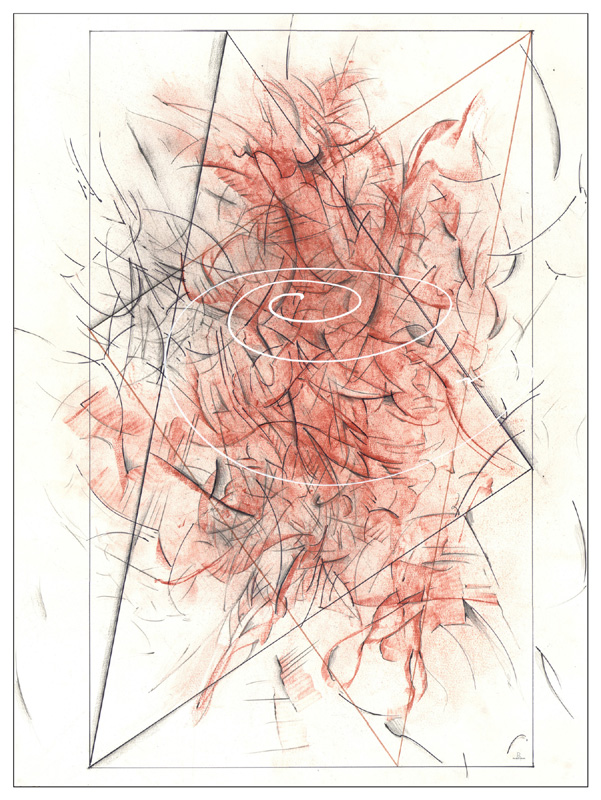
Untitled 013 22″ x 30″ Watercolors, charcoal, oil, white-out and ink on paper 2006
*
*
PREFATORY THRESHOLD
This text speaks from before knowing. It does not begin from opposition or certainty, but from attention. It was written without an imagined adversary and without the expectation that clarity must arrive through force. What follows is not an effort to prevail, but an effort to remain intact in the face of reduction. It resists haste not as a stylistic preference, but as an ethical necessity. If it asks anything of the reader, it is only this: to allow thought to unfold without being pressed into position too quickly, and without mistaking firmness for hardness. What follows was written to be answerable to itself before it was released to others.
AUTHOR’S NOTE
i. Certain explanatory habits persist across cultures with remarkable resilience. Among them is the tendency to attribute intellectual capacity to lineage, proximity to power, or inherited authority, while treating social order as evidence of cognitive superiority. This tendency presents itself as realism. It often claims to see through idealism, sentiment, or abstraction, offering instead a hierarchy of who thinks and who merely follows. Yet this posture rests on a conceptual shortcut: it conflates intelligence with authority, competence with legitimacy, and institutional efficiency with civic authorship.
ii. Such reasoning is not confined to any one society or political system. It appears wherever technical success is mistaken for intellectual depth, and wherever constraint on expression is interpreted as proof of cultural immaturity rather than as a condition requiring separate examination. In these contexts, intelligence is presumed to reside in visible centers of power or wealth, while its broader social distribution remains unexamined. The result is a recurring fallacy: the reduction of intellectual life to pedigree, affiliation, or command, rather than to the slow, cumulative reproduction of cognitive capacity across a society.
iii. The pages that follow proceed from the premise that this fallacy can be examined without polemic and without recourse to moral ranking. They do so by separating what is often collapsed: intellectual maturity, civic agency, and political structure. By attending carefully to population-level indicators and institutional continuity, the analysis seeks to clarify how intelligence circulates, how it is reproduced, and under what conditions it adapts. The aim is not to correct opinion, but to render certain assumptions untenable once their terms are made explicit.
Ricardo F Morín
Dec. 23, 2025
Kissimmee, Fl
1. Claims about the intellectual character of societies often circulate without reference to how such claims could be tested. They rely instead on surface indicators—visible wealth, administrative order, or the presence of foreign professionals—and treat these as sufficient evidence of cognitive hierarchy. In this way, intelligence is inferred from outcomes rather than examined as a social condition. What remains unasked is whether intellectual capacity is narrowly concentrated or broadly reproduced, whether it is episodic or sustained, and whether it belongs to a few visible actors or to the structure of society itself.
2. To address this gap, it is necessary first to separate questions that are routinely collapsed. Intellectual maturity refers to the distribution of learned capacity within a population: literacy, analytical competence, and the ability to engage with complex systems over time. Civic agency concerns the extent to which members of a society participate in the authorship of political norms and decisions. Political structure describes how authority is organized and exercised. None of these can be inferred reliably from the others. A society may display high levels of cognitive competence while limiting political participation, just as a system may permit formal participation without cultivating broad intellectual depth.
3. Once these distinctions are held, the inquiry can proceed on empirical rather than impressionistic grounds. The question is no longer who appears to govern effectively or who occupies visible positions of expertise, but how intellectual capacity is reproduced across a population. This shifts attention to measurable features: population composition, access to education, continuity of learning across generations, and the dispersion of professional competence. These indicators do not capture the full texture of intellectual life, but they do establish whether intelligence functions as a social norm or as a specialized exception.
4. Population structure is the first of these features. The proportion of citizens to non-citizens, the permanence of residency, and the pathways through which individuals are incorporated into social institutions all bear directly on claims of intellectual self-reliance. Where a society depends heavily on transient or externally sourced populations for skilled labor, intellectual capacity may be present without being socially reproduced. Conversely, where the majority of the population passes through shared educational and civic institutions, cognitive competence is more likely to become a generalized condition rather than a segmented one.
5. Education, in this sense, is not treated as an index of prestige or international ranking, but as a mechanism of continuity. What matters is not the existence of elite institutions, but whether learning is organized as a public system through which successive cohorts acquire comparable capacities. When educational access is uneven, discontinuous, or stratified by origin, intellectual life tends to cluster. When it is broadly accessible and institutionally stable, cognitive competence diffuses across social strata, becoming an ordinary feature of the society rather than an exceptional attribute of a few.
6. Comparable learning assessments, while necessarily limited, provide a further point of orientation. Their value lies less in absolute ranking than in the dispersion of results. A system in which high performance is confined to a narrow segment differs fundamentally from one in which competence is widely distributed and low performance is comparatively rare. When variance is low and outcomes cluster toward shared standards, intellectual capacity functions as a collective baseline. When variance is high, intelligence appears as an unevenly allocated resource, often reinforcing existing social or institutional divisions.
7. Workforce composition extends this analysis beyond schooling into adult social life. The question here is whether professional and technical competence emerges predominantly from within the society or is supplied from outside it. Where expertise is internally generated, careers form predictable trajectories that link education, training, and institutional participation over time. Where expertise is externally concentrated, knowledge circulates instrumentally, often detached from long-term social integration. In such cases, intellectual capacity may sustain systems effectively without becoming a shared social inheritance.
8. When these elements are considered together—population structure, educational continuity, learning dispersion, and workforce formation—a clearer picture of intellectual life emerges. The issue is no longer whether intelligence is present, but whether it is socially anchored. An intellectually self-reliant society is one in which cognitive competence persists independently of particular individuals or external inflows, because it is reproduced through ordinary institutional pathways. Where such anchoring is absent, intellectual life may remain visible and effective, yet it functions as an adjunct to the system rather than as a property of the society itself.
9. Political constraint enters the analysis at this point as a separate consideration. Limits on civic agency shape how intellectual life is expressed, not whether it exists. Where participation in political authorship is restricted, individuals and institutions adjust by directing intellectual effort toward domains that remain accessible: administration, technical problem-solving, economic organization, and academic inquiry. This adjustment does not diminish cognitive capacity, but it alters the pathways through which intelligence circulates, favoring modes of expression that are compatible with institutional stability and personal security.
10. Such adaptation should not be mistaken for intellectual passivity. It reflects an awareness of boundaries rather than their absence. Where civic agency is constrained, intellectual life often assumes a transactional character, advancing through alignment, reformulation, and indirect influence rather than open contestation. This mode of circulation allows intelligence to remain active and cumulative while avoiding unnecessary exposure. The presence of constraint, therefore, does not negate intellectual maturity; it defines the conditions under which that maturity is exercised and sustained.
11. These considerations allow the analysis to move from general structure to a specific empirical case without altering its terms. Singapore presents a society in which intellectual maturity is not confined to visible elites or foreign enclaves, but is reproduced internally across the population through stable educational pathways, shared linguistic frameworks, and predictable institutional trajectories. The presence of political constraint does not obscure this pattern; it clarifies it. Intellectual life remains socially anchored and cumulative, even as its public expression is shaped by the limits placed on civic authorship.
12. A different configuration appears where intellectual capacity is not socially reproduced at scale but assembled through external concentration. In Qatar and Dubai, technical and professional competence is highly visible and often effective, yet it is demographically segmented and institutionally detachable. Expertise enters these systems largely through contractual or expatriate pathways, circulates instrumentally, and exits without forming a cumulative social inheritance. In such contexts, intellectual life supports governance and economic performance, but it does not become a generalized condition of the citizenry, nor does it generate expectations of civic authorship.
13. The contrast between these formations is therefore not a matter of cultural refinement or comparative intelligence. It turns on whether intellectual maturity is embedded in the ordinary reproduction of society or appended to it as a functional resource. Where intelligence is socially distributed, it persists even under political constraint and shapes expectations across generations. Where it is externally concentrated, it remains contingent on continued importation and administrative management. Treating these configurations as variations of the same model obscures the structural conditions under which intellectual life either takes root or remains peripheral to the society that hosts it.
14. It is at this juncture that the neocolonial fallacy becomes fully visible. By attributing intellectual capacity to foreign origin, visible authority, or inherited command, it misreads structural dependence as cognitive superiority and social reproduction as mere execution. The fallacy persists because it draws its confidence from outcomes rather than from processes, mistaking managed efficiency for intellectual depth and treating constraint as evidence of immaturity. Once the distinction between socially reproduced intelligence and externally concentrated expertise is held, this mode of reasoning loses its explanatory force, not through rebuttal, but through exposure of the assumptions on which it relies.
15. Once these distinctions are maintained, certain claims no longer remain available. Assertions that equate order with intelligence, or that locate intellectual capacity primarily in foreign provenance, cease to function as descriptions and can only persist as gestures of authority. What remains is a bounded field in which societies may be examined without recourse to pedigree or presumption: by the ways intelligence is reproduced, constrained, or assembled, and by the limits such arrangements place on civic authorship. Beyond that boundary, comparison gives way to classification, and the fallacy that initiated the inquiry no longer governs how the facts may be read.
16. At that point, the inquiry closes of its own accord. When intellectual life is examined as a function of social reproduction rather than lineage or command, the terms that sustain neocolonial comparison no longer apply. What remains is not a hierarchy to be defended or overturned, but a set of conditions that delimit what can plausibly be said about intelligence, authority, and society. The analysis does not ask for agreement; it leaves behind a narrower field in which claims must now stand or fall by the structures they invoke, rather than by the confidence with which they are asserted.
EPILOGIC THRESHOLD
This text speaks from after having seen. Nothing that has been examined here requires assent. But some ways of speaking no longer remain neutral once their conditions have been made visible. After attending to how intelligence is reproduced, constrained, or assembled, certain reductions cannot be returned to without cost. What remains is not a conclusion to defend, but a narrower field in which claims now stand exposed to the structures they rely upon. If the text leaves anything behind, it is this responsibility: not to undo with ease what required care to see.
OECD (Organisation for Economic Co-operation and Development). 2019. PISA 2018 Results: Country Profiles—Singapore, Qatar, United Arab Emirates. Paris: OECD. https://gpseducation.oecd.org/.
Ricardo F. Morín Templates II 40″h. x 30″w. Watercolor on paper 2003
People come to know who they are over time rather than all at once. A person recognizes themselves through earlier actions, remembered choices, and past commitments, even though the conditions under which those moments occurred no longer remain the same. What feels continuous is not encountered directly, but pieced together through recollection and interpretation as circumstances change. Because of this, uncertainty enters any effort to maintain a stable sense of self, not through confusion or deceit, but through the simple passage of time.
A person’s relation to themselves is therefore never fixed at its origin. It is mediated by memory, revision, and reassessment as life unfolds. What once made sense as a response to a particular moment must be understood again under different conditions. Identity does not remain secured by intention alone, because continuity can only be reconstructed after the fact rather than preserved intact.
Once identity must be reconstructed instead of taken as given, expectations of consistency begin to exert pressure. Past actions, statements, and commitments are treated as benchmarks against which the present self is measured, even when the circumstances that produced them no longer exist. Continuity is demanded where only relation is possible. What once functioned as a response to a specific situation is asked to stand as proof of an enduring self.
Because people encounter identity through memory and interpretation rather than direct access, identity becomes subject to demands for legibility. Others rely on familiar patterns of speech, behavior, and commitment to orient their expectations. When those patterns persist, continuity is assumed. When they shift, uncertainty arises. What cannot be readily recognized is often treated as absence rather than transformation.
Under these conditions, adjustment is frequently misread as violation. Changes made in response to altered circumstances are interpreted as departures from an assumed core rather than as necessary recalibrations. Earlier expressions of self are treated as binding commitments even when the conditions that produced them have changed. What is experienced internally as adaptation is therefore received externally as betrayal, not because trust has been broken, but because the expectation of fixity has remained in place.
After reconstruction is complete, identity offers no fixed origin. It offers only a coherence that must be maintained under changing conditions of recognition. Efforts to settle distress about identity fail when they ignore a simple fact: people change before others adjust their expectations. The difficulty does not arise from change itself, but from being required to remain readable according to standards that no longer apply.
At a recent gathering in the building where David and I live, I became so absorbed in conversations with our neighbors that nearly three hours passed before I thought of taking any photographs. By then, the buffet and barbecue were being put away, and the tables I had helped arrange were being cleared.
During the party, a neighbor who had written a book about living with Parkinson’s disease called me over. She introduced me to a friend, a biographer and published author, and then asked about a Floridian friend of mine who also has Parkinson’s. I had bought her book for him, and she wanted to know what had become of it.
“I don’t think he remembers the book anymore,” I said. “He still has many moments of lucidity, though. He’s brilliant. In some people, motor and cognitive abilities seem to deteriorate together.”
She began telling us about a recent consultation with her specialist. At one point, I interrupted her.
“I believe memory is overrated. Everyone interprets what they remember anew each time.”
All three of us laughed, partly because I had said it so abruptly.
My remark led us from memory to writing, and to Kafka’s instruction that much of his unpublished work be destroyed. None of us could say exactly why, but we wondered whether he feared that unfinished or fragmentary works would be misread and allowed to shape how readers understood the books he had chosen to publish.
“We don’t control our destiny,” I said. “Why bother with legacies?”
Before we parted, I said, “It is better to embrace what we can do now than to let the future distract us.”
Only later did I wonder whether anything from that conversation would outlast the evening, and who might carry it forward. I did not yet see that my own presence there already owed something to another person’s life.
A neighbor who died two years ago had once reminded me how important it was to engage and mingle within the community. She had even put my name forward as a possible volunteer for the social committee. I came to understand that her counsel had been earned through life. She knew that staying among others required deliberate effort.
Her suggestion also unsettled me: why did I spend so much of my time writing, a solitary habit that could itself become a form of withdrawal? Was I attending to life through writing, or replacing proximity with reflection?
I had not fully understood her at the time. Yet there I was, helping arrange a communal gathering and moving from one conversation to the next until the evening had nearly escaped my notice. I was acting on her counsel whether or not I had consciously meant to follow it. Her words had entered my life without either of us arranging for them to do so.
Another neighbor once told me that she was afraid of losing her memory. From the outside, it was difficult to see the change she had already begun to recognize in herself. She remained aware enough to fear its progression. She had died only sixteen days before I began writing this.
My claim that memory is overrated may sound callous beside such fear. I did not mean that losing memory is inconsequential, or that the terror of feeling one’s past recede can be explained away. I meant that a person cannot be measured solely by the uninterrupted possession of memory. My Floridian friend remains brilliant even when recollection fails him. Memory does not return experience to us intact; every act of remembering interprets the past from the position of the present.
The neighbor who called me over at the party had illustrated this without meaning to. Although she lives with Parkinson’s, she remembered my friend, the book she had written, and the gesture by which I had tried to connect their experiences. The person whose memory and movement might be judged by others was the person remembering someone else.
Age shows itself unevenly throughout the building. One woman, now eighty-five, appears decades younger in both appearance and spirit. She has spoken publicly about the commitment she has sustained throughout her life to helping young entrepreneurs in the arts. Her youthful presence comes not only from how she looks but from where she directs her attention: toward work still beginning and people whose futures remain before them.
During our conversation, I told her that my sister had died in February 2025. Her death had devastated me not only because I had lost her, but because I could no longer define myself through concern for her well-being. She told me that her brother had died two years earlier and that she had felt the same way: “Grief wanes,” she said, “but sorrow never does.” In each case, the death had also altered how each of us understood who we were.
Her words prompted me to mention an idea I then associated with quantum physics; I now think I had in mind something closer to what some physicists, drawing on Einstein’s relativity, have called the block universe. It is one interpretation among others, according to which past, present, and future do not come into existence one after another but coexist within a single spacetime, while what we experience as time passing may be less a physical fact than a habit of perception. I wondered, without insisting on it, whether those we have lost might still occupy that same continuum within a temporal order that our experience does not allow us to perceive in its entirety. I did not know what to do with that thought then, and I am not sure I know now.
Another neighbor, now ninety-three and widowed only a few years ago, has made room in her life for companionship again. After reading my diagnostic essays on mathematics, linguistics, and artificial intelligence, she wrote:
“They make me think in ways I haven’t thought before and consider ideas I hadn’t considered before. Thank you for sharing them with me.”
Her message conveyed more than appreciation. At ninety-three, she remained willing to let unfamiliar ideas alter the boundaries of what she had previously considered. Her new companionship and her response to the essays revealed two forms of the same receptivity: an openness to affection not presumed finished, and to thought not presumed complete.
The eighty-five-year-old neighbor and the ninety-three-year-old remain open to what may still occur. That openness does not erase what either woman has lost. Their vitality reveals one form survival may take when fortune permits it.
Only a few days before the gathering, I crossed paths with another woman whose wit and classical beauty I had long admired. Two years ago, she had served as a witness during a neighborhood election. She said little, but whenever she spoke, one understood that she was a serious person of substance. I found her intimidating and feared that whatever I might say would not measure up.
During our recent encounter near the elevator, she looked at me with a depth of sorrow whose cause I had no right to presume. Her appearance had changed, and her skin no longer possessed the luminosity I remembered. Yet the dignity with which she met my gaze was as present as the sorrow in her eyes.
I felt the old intimidation, now joined by regret. I had admired her without taking the opportunity to know her. The alteration of her beauty was not mine to examine. What belonged to me was the distance I had allowed to remain between recognition and acquaintance.
The illnesses and bereavements of my neighbors cannot be arranged into a consoling argument about resilience. Fortune has not treated them equally, and their lives do not exist to furnish instruction for mine. Still, encounters have consequences: what passes between people can remain active long after the occasion itself has disappeared.
I cannot settle my uncertainty about writing merely by declaring it another form of attention. This essay may show that I listened; it may also be another interval in which I write about my neighbors instead of sitting with them. The email from my ninety-three-year-old neighbor complicates that division. Words written in solitude had entered a relationship and returned to me through another person’s thought. The exchange does not settle the question, but it prevents me from treating solitude and relation as simple opposites.
Writing cannot restore those who have died or arrest what age and illness alter. At most, it can register the changes their lives have produced in mine. Whether that registration becomes engagement or retreat depends on what I do when the page ends.
Kafka had tried to decide what the future would not receive. My neighbor had simply advised me to remain among others. Two years after her death, I had spent the evening doing exactly that, no longer the person I had been before my sister died.
By the time I understood what the evening had disclosed, the buffet and barbecue had been put away. The tables had been cleared, but the conversations remained.
“Geometric Allegory” digital painting 2023 by Ricardo Morin (American visual artist born in Venezuela–1954)
*
Scope and Use
This entry forms part of the constitutional corpus presented in the Appendix, which gathers the twenty-five constitutions of Venezuela and is arranged for consultation rather than continuous reading. Collation proceeds by means of permanent rubric codes whose identity remains constant throughout the corpus; absent rubrics signify constitutional silence, while withdrawn rubrics are not reassigned. Citations are anchored first in the article number and follow the CIDEP recension linked at the close of the entry. The complete definition of the corpus, its methodology, and its citation convention appear in the Scope and Use note that heads the Constitutions of the Nineteenth Century, opening in the instalment “Unmasking Disillusion: Series XI”: https://observacionessobrelanaturalezade.com/2026/06/15/desenmascarar-la-desilusion-serie-xi/
Translation Convention
Institutional and technical names are given first in italicized Latinate Castilian and followed by their contemporary Latinate English equivalents in brackets. All constitutional quotations appear in italic type between quotation marks and are rendered in contemporary Latinate English, faithfully preserving the substance and distinctions of the original charters. Comparative references are restricted to 1874 against 1864 and 1881 against 1874. The apparatus retains the classifications cont., cf., and new.
Ricardo F. Morín
August 31, 2026
Bala Cynwyd, Pennsylvania
* *
7). The Constitución de 1874
The Constitución de 1874 [Constitution of 1874], formally the Constitución de los Estados Unidos de Venezuela [Constitution of the United States of Venezuela], was decreed by the Congreso de los Estados Unidos de Venezuela [Congress of the United States of Venezuela] at Caracas on 23 May 1874 and ordered executed by Presidente [President] Antonio Guzmán Blanco on 27 May 1874.
DOC-PRE—Preámbulo[Preamble]
“The Congress of the United States of Venezuela, under the invocation of the Supreme Author and Legislator of the Universe, and by authority of the people of Venezuela, manifested in the petitions addressed to it by the Legislatures of the twenty States composing the Venezuelan Union, requesting the reform of the Constitution of 1864 decreed by the Constituent Assembly of the States, and in conformity with its Article 122; decrees:”
FND-TER—Territorio[Territory]
The Constitución de 1874 [Constitution of 1874] declared that the Estados [States] which the Constitution of March 1864 had declared independent and united to form the Federación Venezolana [Venezuelan Federation], and which were then denominated Apure, Bolívar, Barquisimeto, Barcelona, Carabobo, Cumaná, Cojedes, Falcón, Guzmán Blanco, Guárico, Guayana, Guzmán, Maturín, Nueva Esparta, Portuguesa, Táchira, Trujillo, Yaracuy, Zamora, and Zulia, undertook to continue forming an independent and sovereign Nación [Nation] under the denomination Estados Unidos de Venezuela [United States of Venezuela] (Tít. I, Sec. I, Art. 1; cf. 1864, Tít. I, Sec. I, Art. 1: “The Provinces of Apure, Aragua, Barcelona, Barinas, Barquisimeto, Carabobo, Caracas, Cojedes, Coro, Cumaná, Guárico, Guayana, Maracaibo, Maturín, Mérida, Margarita, Portuguesa, Táchira, Trujillo, and Yaracuy declare themselves independent States and unite to form a free and sovereign Nation under the name ‘UNITED STATES OF VENEZUELA’.”).
The limits of each Estado [State] were those which the Law of 28 April 1856 had assigned to the Provincias [Provinces], that law having fixed the last territorial division (Art. 2; cont. 1864, Tít. I, Sec. I, Art. 2).
The limits of the Estados Unidos [United States] composing the Federación Venezolana [Venezuelan Federation] were those that in 1810 corresponded to the former Capitanía General de Venezuela [Captaincy General of Venezuela] (Art. 3; cont. 1864, Tít. I, Sec. I, Art. 3).
The political entities expressed in Article 1 reserved the faculty of two or more uniting to form a single Estado [State], while always retaining the liberty to recover their character as an Estado [State]; in either case notice was given to the Ejecutivo Nacional [National Executive], the Congreso [Congress], and the other Estados de la Unión [States of the Union] (Art. 4; cont. 1864, Tít. I, Sec. I, Art. 4).
The Estados [States] that had exercised the faculty conferred by the preceding article retained their votes for the Presidencia de los Estados Unidos [Presidency of the United States], the appointment of Senadores [Senators], and the presentation of Vocales [Justices] for the Alta Corte Federal [High Federal Court] (Art. 5; cont. 1864, Tít. I, Sec. I, Art. 5).
POW-LEG—Congreso[Congress]
The Constitución de 1874 [Constitution of 1874] provided that the Legislatura Nacional [National Legislature] comprise two Cámaras [Chambers], one of Senadores [Senators] and the other of Diputados [Deputies] (Tít. IV, Sec. I, Art. 18; cont. 1864, Tít. IV, Sec. I, Art. 18).
The Estados [States] determined the manner of appointing Senadores [Senators] and Diputados [Deputies] (Art. 19; cont. 1864, Art. 19).
Each Estado [State] appointed Diputados [Deputies] by popular election in conformity with Article 13, no. 23, at the ratio of one for every twenty-five thousand inhabitants and one additional Deputy for every excess exceeding twelve thousand, with an equal number of substitutes elected in the same manner (Tít. IV, Sec. II, Art. 20; cf. 1864, Art. 20).
The Diputados [Deputies] served for two years and were renewed in their entirety (Art. 21; cont. 1864, Art. 21).
The Cámara de Diputados [Chamber of Deputies] examined the annual account presented by the Presidente de los Estados Unidos de Venezuela [President of the United States of Venezuela], passed votes of censure upon the Ministros del Despacho [Ministers of State], and heard accusations against the person charged with the Ejecutivo Nacional [National Executive], the Ministers and other national employees, and the high public functionaries of the Estados [States], in the cases stated by Article 22 (Art. 22; cf. 1864, Art. 22: “To hear accusations against the person charged with the National Executive for treason against the Fatherland or for common offences, and against the Ministers and other national employees for infringement of the laws and for malperformance of their functions, in conformity with Article 82 of this Constitution.”).
When a Diputado [Deputy], corporation, or individual proposed an accusation, the Cámara [Chamber] appointed, by secret ballot, a commission of three Deputies; the commission delivered its opinion within the third day; and the Chamber decided by an absolute majority of the members present, the accusing Deputy abstaining from the vote (Art. 23; cont. 1864, Art. 23).
The declaration that there was ground to proceed suspended the accused by operation of law and disqualified him from exercising any public office during the trial (Art. 24; cont. 1864, Art. 24).
Each Estado [State] elected two principal Senadores [Senators] and two substitutes to fill vacancies (Tít. IV, Sec. III, Art. 25; cont. 1864, Art. 25).
To be a Senador [Senator], a person was required to be Venezuelan by birth and thirty years of age (Art. 26; cont. 1864, Art. 26).
The Senadores [Senators] served for two years (Art. 27; cf. 1864, Art. 27: “The Senators shall remain in their offices for four years and one half shall be renewed. When for any reason they are appointed in their entirety, one shall be elected for two years.”).
The Senado [Senate] conducted and resolved the trials initiated in the Cámara de Diputados [Chamber of Deputies] (Art. 28; cont. 1864, Art. 28).
If a trial had not concluded during the sessions, the Senado [Senate] remained assembled for that purpose alone until the cause was terminated; in such a case the Senadores [Senators] received no allowances (Art. 29; cont. 1864, Art. 29).
The Legislatura [Legislature] assembled annually in the capital of the Estados Unidos [United States] on 20 February, or on the earliest possible day thereafter, without awaiting convocation; its sessions lasted seventy days and could be prolonged to ninety (Tít. IV, Sec. IV, Art. 30; cont. 1864, Art. 30).
The Cámaras [Chambers] opened their sessions with at least two thirds of their members; in the absence of that number, those present met as a preparatory commission and adopted measures to secure the attendance of the absentees (Art. 31; cont. 1864, Art. 31).
Once the sessions had opened, the Cámaras [Chambers] could continue with two thirds of those who had installed them, provided that the number did not fall below one half of the total membership appointed (Art. 32; cont. 1864, Art. 32).
The Cámaras [Chambers] functioned separately, but assembled as Congreso [Congress] when the Constitución [Constitution] or the law so determined, or when one Chamber judged it necessary; if the invited Chamber concurred, it fixed the day and hour of the meeting (Art. 33; cont. 1864, Art. 33).
The sessions were public, and secret whenever the Cámara [Chamber] so resolved (Art. 34; cont. 1864, Art. 34).
The Cámaras [Chambers] possessed the rights enumerated in Article 35 concerning their rules, discipline, internal police, correction of spectators, removal of obstacles to the exercise of their functions, execution of their exclusive resolutions, qualification of their members, and hearing of resignations (Art. 35; cont. 1864, Art. 35).
Neither Cámara [Chamber] could suspend its sessions or change its seat without the consent of the other; in case of disagreement, the Chambers assembled and the determination of the majority was executed (Art. 36; cont. 1864, Art. 36).
The exercise of any public function was incompatible, during the sessions, with the office of Senador [Senator] or Diputado [Deputy]; the law fixed their indemnities, which could not be increased during the constitutional period in which they were established (Art. 37; cont. 1864, Art. 37).
The Senadores [Senators] and Diputados [Deputies] enjoyed immunity from 20 January of each year until thirty days after the sessions had ended; immunity consisted in the suspension of every proceeding, whatever its origin or nature. When a member committed an act deserving corporal punishment, the investigation continued through the conclusion of the preliminary inquiry and remained in that state for the duration of the immunity (Art. 38; cont. 1864, Art. 38).
The Congreso [Congress] was presided over by the Presidente del Senado [President of the Senate], while the Presidente de la Cámara de Diputados [President of the Chamber of Deputies] served as Vice-President (Art. 39; cont. 1864, Art. 39).
Members of the Cámaras [Chambers] were not responsible for the opinions or speeches they delivered therein (Art. 40; cont. 1864, Art. 40).
The Senadores [Senators] and Diputados [Deputies] could not accept offices or commissions from the Ejecutivo Nacional [National Executive] until one year after the conclusion of the period for which they had been appointed; the offices of Ministros del Despacho [Ministers of State], diplomatic employment, and military commands in time of war were excepted, acceptance of any such office vacating the seat occupied in the Chamber (Art. 41; cont. 1864, Art. 41).
The Senadores [Senators] and Diputados [Deputies] could not enter into contracts with the Gobierno General [General Government] or prosecute the claims of others before it (Art. 42; cont. 1864, Art. 42).
The Legislatura Nacional [National Legislature] possessed the attributions enumerated in Article 43, including the resolution of controversies among the Estados [States]; erection and organization of the Distrito Federal [Federal District]; organization of the Aduanas [Customs Houses], ports, posts, national codes, currency, national symbols, national employments, public debt, loans, census and statistics, Armed Force, war, treaties, public-works contracts, budgets, public prosperity, weights and measures, amnesties, territories, procedures and penalties for trials before the Senado [Senate], population basis for the Diputados [Deputies], admission of foreigners to public service, presidential elections, military retirements and pensions, responsibility of national and State employees, and military ranks or promotions (Art. 43; cf. 1864, Art. 43, no. 14: “To prescribe the rules for the formation and replacement of the forces expressed in the preceding number”; Art. 43, no. 28: “To enact the law governing the responsibility of all national employees.”).
In addition to the preceding enumeration, the Legislatura Nacional [National Legislature] could enact such laws of general character as were necessary (Art. 44; cont. 1864, Art. 44).
Laws and decrees of the Legislatura Nacional [National Legislature] could be initiated by members of either Cámara [Chamber], in the manner prescribed by their rules (Tít. IV, Sec. VI, Art. 45; cont. 1864, Art. 45).
Upon presentation, a bill was considered for admission; once admitted, it received three debates, with an interval of at least one day between each, under the rules established for debate (Art. 46; cont. 1864, Art. 46).
Bills approved in the Cámara [Chamber] in which they had originated passed to the other Chamber for the purposes of Article 46; if not rejected, they were returned to the Chamber of origin with the alterations they had undergone (Art. 47; cont. 1864, Art. 47).
If the Cámara [Chamber] of origin did not accept the alterations, it could insist and transmit its written reasons to the other Chamber; the Chambers could also assemble as Congreso [Congress] and constitute themselves as a general commission to seek agreement, and if none was attained, the bill became void when the Chamber of origin so decided separately (Art. 48; cont. 1864, Art. 48).
When bills passed from one Cámara [Chamber] to the other, the days upon which they had been debated were stated (Art. 49; cont. 1864, Art. 49).
A law reforming another was drafted in its entirety, and the anterior law was repealed in all its parts (Art. 50; cont. 1864, Art. 50).
Laws employed the formula “The Congress of the United States of Venezuela decrees.” (Art. 51; cf. 1864, Art. 51: the formula was “The Congress of the United States of Venezuela. Decree.”).
Bills rejected in one Legislatura [Legislature] could not be presented anew except in another (Art. 52; cont. 1864, Art. 52).
Bills pending in a Cámara [Chamber] at the close of the sessions underwent the same three debates in succeeding Legislatures (Art. 53; cont. 1864, Art. 53).
Laws were repealed with the same formalities by which they were enacted (Art. 54; cont. 1864, Art. 54).
When the Ministros del Despacho [Ministers of State] had maintained before a Cámara [Chamber] that a bill was unconstitutional and it nevertheless became law, the Ejecutivo de la Unión [Executive of the Union] could submit it to the Nación [Nation], represented in the Legislaturas de los Estados [State Legislatures] (Art. 55; cont. 1864, Art. 55).
In such a case, each Estado [State] represented one vote, expressed by the majority of the members attending its Legislatura [Legislature], and transmitted the result to the Corte Federal [Federal Court] with the formula “I Confirm” or “I Object” (Art. 56; cont. 1864, Art. 56).
If a majority of the Estados [States] concurred with the Ejecutivo [Executive], the Corte [Court] ordered the law suspended and reported to the Congreso [Congress], transmitting the entire record (Art. 57; cont. 1864, Art. 57).
Laws entered into observance only after publication with the prescribed solemnity (Art. 58; cont. 1864, Art. 58).
The faculty conferred for the sanctioning of a law was not delegable (Art. 59; cont. 1864, Art. 59).
No legislative provision had retroactive effect, except in judicial procedure and when imposing a lesser penalty (Art. 60; cont. 1864, Art. 60).
ECO-HAC—Hacienda[Public Finance]
The Constitución de 1874 [Constitution of 1874] conferred upon the Legislatura Nacional [National Legislature] the faculty of organizing all matters relating to the Aduanas [Customs Houses], whose revenues formed the Tesoro de la Unión [Treasury of the Union] until replaced by others (Tít. IV, Sec. V, Art. 43, no. 3; cont. 1864, Tít. IV, Sec. V, Art. 43, no. 3).
The Estados [States] having no mines in operation received from national revenues the sum of sixteen thousand venezolanos, which was fixed in the annual budget of public expenditures and delivered in anticipated quarters (Tít. II, Art. 13, no. 17; cf. 1864, Tít. II, Art. 13, no. 17: “To reserve from national revenues, for the benefit of the States having no mines in operation, the sum of twenty thousand pesos…”).
The Legislatura Nacional [National Legislature] determined all matters relating to the national debt and contracted loans upon the credit of the Nación [Nation] (Art. 43, nos. 10–11; cont. 1864, Art. 43, nos. 10–11).
The Legislatura Nacional [National Legislature] annually formed the budgets of public expenditures (Art. 43, no. 18; cont. 1864, Art. 43, no. 18).
The Presidente de la Unión [President of the Union] supervised the collection of national revenues (Tít. V, Sec. II, Art. 72, no. 3; cont. 1864, Tít. V, Sec. II, Art. 72, no. 3).
The Presidente [President] appointed empleados de hacienda [Treasury employees] whose appointment was not attributed to other functionaries, Venezuelan birth being required for those offices (Art. 72, no. 10; cont. 1864, Art. 72, no. 10).
In foreign war, the Presidente [President] could demand contributions in advance or negotiate decreed loans whenever ordinary revenues were insufficient (Art. 72, no. 15.2; cont. 1864, Art. 72, no. 15.2).
Within the first five sessions of each year, the Ministros del Despacho [Ministers of State] presented to the Legislatura Nacional [National Legislature] the budget of public expenditures and the general account of the preceding year (Tít. V, Sec. III, Art. 80; cont. 1864, Tít. V, Sec. III, Art. 80).
The Congreso [Congress] could not increase the taxes burdening exports or constitute further mortgages upon them; once the existing obligations were satisfied by payment, compensation, or substitution, the exportation of national products was forever free (Tít. VII, Art. 103; cont. 1864, Tít. VII, Art. 103).
No expenditure could be made from the Tesoro Nacional [National Treasury] unless the Congreso [Congress] had expressly appropriated a sum in the annual budget; those contravening this provision were civilly responsible to the National Treasury for the sums paid. In every expenditure from the public treasury, ordinary expenditures were preferred to extraordinary ones (Art. 108; cont. 1864, Art. 108).
Offices collecting national contributions and offices making payments remained separate; the former could make no payments other than the salaries of their own employees (Art. 109; cont. 1864, Art. 109).
When for any reason the budget corresponding to a fiscal period was not enacted, the budget of the immediately preceding period continued in force (Art. 110; cont. 1864, Art. 110).
POW-EXE—Ejecutivo[Executive]
The Constitución de 1874 [Constitution of 1874] entrusted the general administration of the Nación [Nation] to a magistrate bearing the title Presidente de los Estados Unidos de Venezuela [President of the United States of Venezuela] (Tít. V, Sec. I, Art. 61; cont. 1864, Tít. V, Sec. I, Art. 61).
To be Presidente [President], a person was required to be Venezuelan by birth and thirty years of age (Art. 62; cont. 1864, Art. 62).
The Presidente [President] was elected by the citizens of all Estados [States] through direct and public ballot, each State possessing one vote constituted by the relative majority of its electors (Arts. 63–66; cf. 1864, Arts. 63–65: “The election of the President shall be made by the citizens of all the States through direct and secret ballot, in such a manner that each State possesses one vote, which shall be that of the relative majority of its electors.”).
Temporary absences of the Presidente [President] were supplied by one of the Ministros del Despacho [Ministers of State], selected by a majority vote of his colleagues. Absolute vacancies arising from death, resignation, removal, or cessation in command upon termination of the period were supplied by the Presidente de la Alta Corte Federal [President of the High Federal Court], who was required to convoke new elections unless the vacancy occurred within the final six months of the constitutional period. Whoever supplied the President was required to possess the constitutional qualifications for the office (Arts. 67–68; cf. 1864, Arts. 67 and 69).
The Presidente [President] served for two years, counted from 20 February. The outgoing President, or the person replacing him in an absolute vacancy, could not be elected for either the period immediately succeeding the one then ending or the period following it; the same prohibition applied to the relatives of either within the fourth civil degree of consanguinity or affinity (Arts. 69–70; cf. 1864, Arts. 68 and 70: the presidential period was four years, and the prohibition extended only to the immediately succeeding period and did not encompass relatives).
The Constitución [Constitution] enumerated the attributions of the Presidente [President], including preservation of the Nación [Nation] from external attack; execution of the laws and decrees of the Legislatura Nacional [National Legislature]; supervision of national revenues; administration of terrenos baldíos [public lands] according to law; convocation of the Legislature; appointment of diplomatic representatives and Treasury employees; direction of diplomatic negotiations and treaties; conclusion of national contracts subject to legislative approval; appointment and removal of the Ministros [Ministers]; granting of cartas de nacionalidad [letters of nationality]; issuance of patentes de navegación [navigation patents]; declaration of war following a decree of the Congreso [Congress]; exercise of the extraordinary faculties prescribed for foreign war and armed insurrection; direction of military operations; granting of pardons; defence of the Distrito Federal [Federal District]; and performance of the other functions attributed by national law (Tít. V, Sec. II, Arts. 72–73; cont. 1864, Tít. V, Sec. II, Arts. 72–73).
POW-JUD—Poder Judicial[Judicial Power]
The Constitución de 1874 [Constitution of 1874] vested national judicial authority in the Alta Corte Federal [High Federal Court], whose organization, composition, and jurisdiction were regulated in Title VI (Tít. VI, Arts. 85–89; cf. 1864, Tít. VI, Arts. 85–89).
The Alta Corte Federal [High Federal Court] comprised five Vocales [Justices], who were required to be Venezuelan by birth or to have ten years of naturalization, and to be thirty years of age (Art. 85; cont. 1864, Art. 85).
The Legislatura [Legislature] of each Estado [State] presented candidates for the Corte [Court], and the Congreso [Congress] declared elected the candidate receiving the greatest number of votes in each of the five electoral groups established by the Constitution; ties were resolved by Congress, which also filled vacancies when the States had not transmitted their presentations (Art. 86; cf. 1864, Art. 86, which did not provide for Congress to fill such vacancies).
The law determined the respective functions of the Vocales [Justices] of the Corte [Court] and its other employees (Art. 87; cont. 1864, Art. 87).
The Vocales [Justices] and their respective substitutes served for two years; neither the principals nor the substitutes in exercise could accept offices appointed by the Ejecutivo [Executive] during that period, even after resigning their judicial office (Art. 88; cf. 1864, Art. 88: “The Justices and their respective substitutes […] shall remain in their offices for four years…”).
The competence of the Alta Corte Federal [High Federal Court] comprised civil and criminal causes involving diplomatic employees in the cases permitted by the law of nations; causes against the Ministros del Despacho [Ministers of State] and diplomatic agents; causes against high functionaries of the Estados [States] in conformity with Article 13, no. 24; civil causes in which the Nación [Nation] was defendant when so determined by law; controversies of jurisdiction among employees of different States; matters voluntarily submitted by the States; declaration of the law in force when national laws collided with one another or with State laws; controversies arising from contracts or negotiations concluded by the Presidente de la Unión [President of the Union]; prize causes; and the other attributions prescribed by law (Art. 89; cf. 1864, Art. 89, no. 5, which conditioned causes against high State functionaries upon the laws of the respective States).
The Constitución de 1874 [Constitution of 1874] reserved to the Estados [States] everything not expressly attributed by the Constitution to the Administración General de la Nación [General Administration of the Nation] (Tít. VII, Art. 90; cont. 1864, Tít. VII, Art. 90).
The courts of justice of the Estados [States] were declared independent; causes initiated under their own procedure and concerning matters within their exclusive competence terminated within the respective States without submission to examination by any external authority (Art. 91; cont. 1864, Art. 91).
Every act of the Congreso Nacional [National Congress] or the Ejecutivo Nacional [National Executive] that violated the rights guaranteed to the Estados [States] by the Constitution, or attacked their independence, was to be declared void by the Alta Corte Federal [High Federal Court] whenever requested by a majority of the State Legislatures (Art. 92; cont. 1864, Art. 92).
The Gobierno Nacional [National Government] could maintain within the Estados [States] no other resident employees exercising jurisdiction or authority than those of the States themselves, except Treasury employees and personnel assigned to national fortresses, parks established by law, naval stations, and enabled ports, whose jurisdiction was confined to their respective offices and installations (Art. 99; cont. 1864, Art. 99).
The Gobierno Nacional [National Government] could not station forces or military commanders exercising command within an Estado [State] without the permission of that State’s government (Art. 100; cont. 1864, Art. 100).
Neither the Ejecutivo Nacional [National Executive] nor the Ejecutivos de los Estados [State Executives] could intervene by Armed Force in the domestic conflicts of a State; they were permitted only to offer their good offices toward a peaceful resolution (Art. 101; cont. 1864, Art. 101).
CON-AMD—Reforma de la Constitución[Constitutional Amendment]
The Constitución de 1874 [Constitution of 1874] authorized the Legislatura Nacional [National Legislature] to reform the Constitution in whole or in part whenever requested by a majority of the Legislaturas de los Estados [State Legislatures]; no reform could extend beyond the points comprised in the State petitions (Tít. VII, Art. 122; cont. 1864, Tít. VII, Art. 122).
CIV-SUF—Sufragio[Suffrage]
The Constitución de 1874 [Constitution of 1874] provided that Senadores [Senators] and Diputados [Deputies] be elected in the manner determined by the Estados [States] (Tít. IV, Arts. 19, 25; cont. 1864, Tít. IV, Arts. 19, 25).
The Diputados [Deputies] were elected by popular vote at the ratio of one for every twenty-five thousand inhabitants and one additional Deputy for every excess exceeding twelve thousand, with an equal number of substitutes elected in the same manner (Art. 20; cf. 1864, Art. 20).
The Constitución [Constitution] required the Estados [States] to establish in their constitutions direct, public, written, and signed suffrage for popular elections, with a registration period of thirty days and a voting period of eight days, including the final two Sundays (Tít. II, Art. 13, no. 23; cf. 1864, Tít. II, Art. 13, no. 23: “To establish direct and secret suffrage in popular elections.”).
The Presidente de los Estados Unidos de Venezuela [President of the United States of Venezuela] was elected by the citizens of all Estados [States] through direct and public ballot, each State possessing one vote constituted by the relative majority of its electors (Tít. V, Arts. 63–66; cf. 1864, Tít. V, Art. 63: “The election of the President shall be made by the citizens of all the States through direct and secret ballot.”).
The Constitución [Constitution] guaranteed liberty of suffrage in popular elections, without restriction other than minority below eighteen years of age (Tít. III, Art. 14, no. 11; cont. 1864, Tít. III, Art. 14, no. 11).
CIV-CIT—Ciudadanía[Citizenship]
The Constitución de 1874 [Constitution of 1874] defined as Venezuelans all persons born in the territory of Venezuela, whatever the nationality of their parents; children of a Venezuelan father or mother born in another territory who established domicile in the country and manifested the will to be Venezuelan; foreigners who had obtained a carta de nacionalidad [letter of nationality]; and persons born in any of the Spanish American Republics or the Spanish Antilles who established residence in the territory of the Unión [Union] and desired to be Venezuelan (Tít. I, Sec. II, Art. 6; cont. 1864, Tít. I, Sec. II, Art. 6).
Venezuelans who established domicile and acquired nationality in a foreign country did not lose their character as Venezuelans (Art. 7; cont. 1864, Art. 7).
Venezuelan men above twenty-one years of age were eligible for public offices, subject to the exceptions established by the Constitución [Constitution] (Art. 8; cont. 1864, Art. 8).
All Venezuelans were bound to serve the Nación [Nation] in the manner prescribed by law, with the sacrifice of their property and life if necessary for its defence (Art. 9; cont. 1864, Art. 9).
Venezuelans present in the territory of any Estado [State] possessed therein the same rights and duties as those domiciled in that State (Art. 10; cont. 1864, Art. 10).
The law determined the rights corresponding to the condition of foreigner (Art. 11; cont. 1864, Art. 11).
RTS-GAR—Derechos[Rights]
The Constitución de 1874 [Constitution of 1874] guaranteed Venezuelans the inviolability of life and abolished capital punishment, whatever law might establish it (Tít. III, Art. 14, no. 1; cont. 1864, Tít. III, Art. 14, no. 1).
It guaranteed property with all its rights, subject only to contributions established by the legislative authority, judicial decision, and taking for public works following indemnification and an adversarial proceeding (Art. 14, no. 2; cont. 1864, Art. 14, no. 2).
It guaranteed the inviolability and secrecy of correspondence and other papers; the inviolability of the domestic home, except to prevent the perpetration of an offence in conformity with law; liberty of thought expressed by word or through the press, without restriction; liberty of transit, domicile, departure from the Republic, and return thereto; liberty of industry; liberty of unarmed meeting and association; liberty of petition and the right to obtain a resolution; liberty of instruction; religious liberty, with public worship outside temples reserved to the Roman Catholic and Apostolic Religion; personal security; and equality before the law (Art. 14, nos. 3–15; cont. 1864, Art. 14, nos. 3–15).
Under the guarantee of personal liberty, the Constitución [Constitution] abolished forced recruitment, proscribed slavery forever, declared free the slaves who entered Venezuelan territory, and recognized the right of each person to do whatever did not prejudice another (Art. 14, no. 5; cont. 1864, Art. 14, no. 5).
The Constitución [Constitution] provided that the enumeration of guarantees did not restrict the faculty of the Estados [States] to accord other guarantees to their inhabitants (Art. 15; cont. 1864, Art. 15).
The laws of the Estados [States] prescribed penalties for infringers of those guarantees and established the procedures for making them effective (Art. 16; cont. 1864, Art. 16).
Persons who issued, signed, executed, or ordered the execution of decrees, orders, or resolutions violating any guarantee accorded to Venezuelans were declared culpable and punished according to law, and any citizen was competent to accuse them (Art. 17; cont. 1864, Art. 17).
REG-MIL—La fuerza armada[The Armed Force]
The Constitución de 1874 [Constitution of 1874] provided that the fuerza pública nacional [National Public Force] was divided into naval and land forces and composed of the Milicia Ciudadana [Citizen Militia] organized by the Estados [States] under their laws (Tít. VII, Art. 93; cont. 1864, Tít. VII, Art. 93).
The force under charge of the Unión [Union] was formed from volunteers and a proportional contingent supplied by each Estado [State], which called to service the citizens obliged to render it under its laws (Art. 94; cont. 1864, Art. 94).
In time of war, the contingent could be augmented by bodies of the Milicia Ciudadana [Citizen Militia] to the number of men required by the Gobierno Nacional [National Government] (Art. 95; cont. 1864, Art. 95).
The Gobierno Nacional [National Government] could change the commanders of the fuerza pública [Public Force] furnished by the Estados [States] in the cases and with the formalities prescribed by national military law, the States then providing replacements (Art. 96; cont. 1864, Art. 96).
Military and civil authority could never be exercised by the same person or corporation (Art. 97; cont. 1864, Art. 97).
During national and State electoral periods, the fuerza pública [Public Force] was to be disarmed in the manner prescribed by law (Art. 111; cont. 1864, Art. 111).
The fuerza armada [Armed Force] could not deliberate; it was declared passive and obedient. No armed body could make requisitions or demand assistance of any kind except through the civil authorities and in the manner prescribed by law (Art. 116; cont. 1864, Art. 116).
REG-REL—Religión[Religion]
The Constitución de 1874 [Constitution of 1874] invoked the Supreme Author and Legislator of the Universe in its Preámbulo [Preamble], decreed by the Congreso de los Estados Unidos de Venezuela [Congress of the United States of Venezuela] under the authority of the people of Venezuela (Preamble; cont. 1864, Preamble).
The Constitución [Constitution] guaranteed religious liberty, but provided that only the Roman Catholic and Apostolic Religion could exercise public worship outside temples (Tít. III, Art. 14, no. 13; cont. 1864, Tít. III, Art. 14, no. 13).
The Nación [Nation], being in possession of the right of ecclesiastical patronage, was to exercise it in the manner prescribed by law (Tít. VII, Art. 98; cont. 1864, Tít. VII, Art. 98).
REG-SLA—Esclavitud[Slavery]
The Constitución de 1874 [Constitution of 1874] proscribed slavery forever and declared free the slaves who entered the territory of Venezuela (Tít. III, Art. 14, no. 5.2–3; cont. 1864, Tít. III, Art. 14, no. 5.2–3).
ECO-INF—Infraestructura[Infrastructure]
The Constitución de 1874 [Constitution of 1874] empowered the Legislatura Nacional [National Legislature] to resolve all matters relating to the enabling and security of ports and maritime coasts; create and organize the national posts and establish charges upon the carriage of correspondence; promote measures conducive to the prosperity of the country and the advancement of the sciences and arts; fix and unify national weights and measures; and approve or reject, before execution, contracts concerning national public works concluded by the Presidente de la Unión [President of the Union] (Tít. IV, Sec. V, Art. 43, nos. 4–5, 17, 19–20; cont. 1864, Tít. IV, Sec. V, Art. 43, nos. 4–5, 17, 19–20).
The Constitución [Constitution] authorized the Legislatura Nacional [National Legislature] to establish temporarily, under the denomination territorios [territories], regions that were unpopulated or inhabited by uncivilized Indigenous peoples, which depended directly upon the Ejecutivo Nacional [National Executive] (Art. 43, no. 22; cont. 1864, Art. 43, no. 22).
The Nación [Nation] and the Estados [States] were to promote immigration and the colonization of foreigners in conformity with their respective laws (Tít. VII, Art. 117; cont. 1864, Tít. VII, Art. 117).
CON-FIN—Disposiciones finales[Final Provisions]
The Constitución de 1874 [Constitution of 1874] provided that the laws and dispositions of the governments of the Estados [States] remained in force until the new State Legislatures brought them into harmony with the Constitution, which was to occur within four months (Tít. VII, Art. 121; cont. 1864, Tít. VII, Art. 121).
The Constitución [Constitution] could be reformed in whole or in part by the Legislatura Nacional [National Legislature] at the request of a majority of the Legislaturas de los Estados [State Legislatures], without any reform extending beyond the points comprised in those petitions (Art. 122; cont. 1864, Art. 122).
The Constitución [Constitution] entered into force upon its official publication in each Estado [State]. Public acts and official documents were to date the Federación [Federation] from 20 February 1859 and the Law from 28 March 1864 (Art. 123; cf. 1864, Art. 123).
The sole transitory provision established that the new constitutional period for the offices of the Administración General de la República [General Administration of the Republic] would begin on 20 February 1877, upon expiration of the current period, while the periods of State employees would begin when the periods then in force terminated under the respective State constitutions (Tít. VIII, Art. 124; new; cf. 1864: constitutional silence).
The Constitución [Constitution] was given and signed in the Palacio de Sesiones del Cuerpo Legislativo Federal [Palace of Sessions of the Federal Legislative Body] at Caracas on 23 May 1874 by the officers and members of the Congreso [Congress], and was ordered executed and observed in the Palacio Federal [Federal Palace] at Caracas on 27 May 1874 by Presidente [President] Antonio Guzmán Blanco and his Ministros [Ministers].
Note
The original text of the Constitución de 1874 [Constitution of 1874] may be consulted in the CIDEP (Recopilación de Leyes y Decretos de Venezuela [Compilation of the Laws and Decrees of Venezuela]): https://cidep.online/files/constituciones/1874.pdf
* *
8). TheConstitution of 1881
The Constitución de 1881 [Constitution of 1881], formally the Constitución de los Estados Unidos de Venezuela [Constitution of the United States of Venezuela], was sanctioned by the Congreso de los Estados Unidos de Venezuela [Congress of the United States of Venezuela] at Caracas on 4 April 1881 and ordered executed by Presidente [President] Antonio Guzmán Blanco on 27 April 1881. It declared as the Constitution of the United States of Venezuela the text requested by the Legislatures of the twenty States of the Federación Venezolana [Venezuelan Federation] and organized those States into nine great political entities.
DOC-PRE—Preámbulo[Preamble]
“The Congress of the United States of Venezuela, having considered and scrutinized the petitions addressed by means of their Legislatures by the twenty States composing the Venezuelan Federation, requesting the reform of the Constitution of 1874, in complete conformity with the Project submitted by Congress for their consideration, and with each and every modification proposed by the Illustrious American, President of the Republic, in the Message he addressed to the State Legislatures on 15 October 1880, without essential difference upon the general points of the reform; and having present, moreover, the will expressed by the Sections concerning their own grouping, decrees:”
“Sole Article. The Constitution of the United States of Venezuela requested by the Legislatures of the twenty States of the Venezuelan Federation is hereby declared, in the following terms:”
“CONSTITUTION OF THE UNITED STATES OF VENEZUELA.”
FND-TER—Territorio[Territory]
The Constitución de 1881 [Constitution of 1881] constituted as nine great political entities the twenty Estados [States] that had remained independent and united since the Constitution of 28 March 1864, preserving their union as a single free, sovereign, and independent Nación [Nation] under the denomination Estados Unidos de Venezuela [United States of Venezuela] (Art. 1; cf. 1874, Art. 1). The territorial organization comprised the Estados [States] of Oriente, Guzmán Blanco, Carabobo, Sur de Occidente, Norte de Occidente, Los Andes, Bolívar, Zulia, and Falcón, formed by grouping the former twenty States (Art. 1; new; cf. 1874: no corresponding grouping).
The limits of the great Estados [States] continued to be determined by the territorial division established by the Law of 28 April 1856 until reformed (Art. 2; cont. 1874, Art. 2). The exterior limits of the República [Republic] remained those that in 1810 corresponded to the former Capitanía General de Venezuela [Captaincy General of Venezuela] (Art. 3; cont. 1874, Art. 3).
The grouped Estados [States] were denominated Secciones [Sections] and declared equal among themselves. Their constitutions were to accord with the federative principles established by the national Constitution, while sovereignty not expressly delegated continued to reside in the constituent States, subject only to the limitations arising from the compact of association (Art. 4; cf. 1874, Art. 12: “The States forming the Venezuelan Union reciprocally recognize their autonomies, declare themselves equal as political entities, and retain in all its plenitude their sovereignty not expressly delegated by this Constitution.”).
POW-LEG—Congreso[Congress]
The Constitución de 1881 [Constitution of 1881] retained a bicameral Legislatura Nacional [National Legislature], composed of a Cámara de Senadores [Chamber of Senators] and a Cámara de Diputados [Chamber of Deputies] (Art. 18; cont. 1874, Art. 18). The Estados [States] determined the manner of electing the Deputies, while the Senators were elected by the respective State Legislatures (Arts. 19, 25; cf. 1874, Arts. 19, 25). Each State elected three principal Senators and an equal number of substitutes, and the senatorial period was extended from two to four years (Arts. 25–27; cf. 1874, Arts. 25–27).
Representation in the Cámara de Diputados [Chamber of Deputies] was modified to one Diputado [Deputy] for every thirty-five thousand inhabitants, with one additional Deputy for every remainder not below fifteen thousand, and an equal number of substitutes (Art. 20; cf. 1874, Art. 20: “…one for every twenty-five thousand inhabitants, and another for every excess exceeding twelve thousand.”). The Deputies continued to be elected by direct popular vote, but their period was increased from two to four years (Arts. 20–21; cf. 1874, Arts. 20–21).
The Cámara de Diputados [Chamber of Deputies] retained the faculty of examining the annual account of the Presidente [President], censuring the Ministros del Despacho [Ministers of State], and hearing accusations against the Ejecutivo [Executive], the Ministers, national employees, and high functionaries of the Estados [States] for the causes determined in Article 22 (Art. 22; cont. 1874, Art. 22). The accusation procedures, declaration that there was ground to proceed, suspension of the accused, and disqualification during trial remained substantially unchanged (Arts. 23–24; cont. 1874, Arts. 23–24).
The Senado [Senate] continued to conduct and resolve trials initiated in the Cámara de Diputados [Chamber of Deputies] (Art. 28; cont. 1874, Art. 28). If a trial had not concluded during the sessions, the Senate remained assembled for that purpose alone until the cause was terminated; the 1874 provision denying allowances to the Senators in such a case no longer appeared (Art. 29; cf. 1874, Art. 29).
The Legislatura Nacional [National Legislature] assembled annually in the capital on 20 February, or on the earliest possible day thereafter, without prior convocation. The sessions were reduced from seventy to sixty days and remained prolongable to ninety, in the judgment of the majority (Art. 30; cf. 1874, Art. 30).
The quorum requirements, separate functioning of the Cámaras [Chambers], public or secret sessions, internal faculties, presidency of the Congreso [Congress], and nonresponsibility for opinions and speeches remained substantially unchanged (Arts. 31–36, 39–40; cont. 1874, Arts. 31–36, 39–40).
The Constitución [Constitution] provided that any increase in legislative indemnities would not enter into force until the succeeding period, after complete renewal of the Chambers that had sanctioned it (Art. 37; cf. 1874, Art. 37; deferred-operation rule, new).
The Senadores [Senators] and Diputados [Deputies] enjoyed immunity from 20 January of each year until thirty days after the sessions ended; immunity consisted in the suspension of every civil or criminal proceeding, whatever its origin or nature (Art. 38; cf. 1874, Art. 38).
The Senadores [Senators] and Diputados [Deputies] who accepted from the Ejecutivo Nacional [National Executive] any office or commission thereby vacated their seat in the corresponding Cámara [Chamber] by operation of law (Art. 41; cf. 1874, Art. 41).
The Senadores [Senators] and Diputados [Deputies] could not contract with the Gobierno General [General Government] or prosecute the claims of others before it (Art. 42; cont. 1874, Art. 42).
The Legislatura Nacional [National Legislature] retained the attributions relating to controversies among the Estados [States], the Distrito Federal [Federal District], the Customs Houses, ports, posts, national codes, currency, national symbols, national offices, public debt, loans, the Armed Force, war, treaties, public works, budgets, public prosperity, weights and measures, amnesties, territories, trials before the Senado [Senate], representation in the Cámara de Diputados [Chamber of Deputies], military retirements and pensions, responsibility of public employees, and military ranks or promotions (Art. 43; cf. 1874, Art. 43).
Article 43 reduced from ten to three square miles the maximum extent of the Distrito Federal [Federal District]; replaced the formation of the census with the perfection of the census then in force; restored the reference to replacement of the Armed Force; provided that contracts concerning national public works be concluded by the Presidente [President] with the approval of the Consejo Federal [Federal Council]; suppressed the attribution to enact the law of presidential elections; and attributed to the Congreso [Congress] the election of the Federal Council and convocation of the substitutes of the Senators and Deputies elected to compose it (Art. 43, nos. 2, 12–14, 17, and 29; cf. 1874, Art. 43; Art. 43, no. 29, new; cf. 1874: constitutional silence).
The Congreso [Congress] retained the faculty of enacting necessary laws of general character, provided that they did not conflict with the Constitución [Constitution] (Art. 44; cf. 1874, Art. 44: “In addition to the preceding enumeration, the National Legislature may enact such laws of general character as are necessary.”).
The initiative of laws and decrees remained with the members of either Cámara [Chamber], but the respective bills were required to conform to the provisions established for the Parlamento de Venezuela [Parliament of Venezuela] (Art. 45; cf. 1874, Art. 45).
Upon presentation, a bill was to be read and considered for admission; once admitted, it received three debates separated by at least one day (Art. 46; cf. 1874, Art. 46, which did not expressly require the initial reading). If the originating Chamber did not accept alterations made by the other and no agreement was reached, the bill became void once the originating Chamber separately ratified its insistence (Art. 48; cf. 1874, Art. 48, which referred to a separate decision without expressly requiring ratification of the insistence).
The remaining rules concerning bicameral consideration, statement of the days of debate, integral redrafting of a reformed law, the legislative formula, rejected and pending bills, repeal, publication, nondelegability of the faculty to sanction laws, and the prohibition of retroactive legislation except in judicial procedure or when a lesser penalty was imposed remained substantially unchanged (Arts. 47, 49–54, 58–60; cont. 1874, Arts. 47, 49–54, 58–60).
When the Ministros del Despacho [Ministers of State] had maintained that a bill was unconstitutional and it had nevertheless been sanctioned as law, the Ejecutivo [Executive], with the affirmative vote of the Consejo Federal [Federal Council], suspended its execution and requested the vote of the State Legislatures. If a majority of the Legislatures concurred with the Executive, the Alta Corte Federal [High Federal Court] confirmed the suspension and the Executive reported to the succeeding Congreso [Congress] (Arts. 55–57; cf. 1874, Arts. 55–57).
ECO-HAC—Hacienda[Public Finance]
The Constitución de 1881 [Constitution of 1881] retained the provision under which the revenues of the Aduanas [Customs Houses] formed the Tesoro de la Unión [Treasury of the Union] until replaced by others, and established a system for distributing certain revenues between the Federación [Federation] and the Estados [States] (Arts. 13, nos. 32–33; 43, no. 3; cf. 1874, Arts. 13, nos. 16–17; 43, no. 3).
The Estados [States] ceded to the Gobierno Federal [Federal Government] the administration of mines, terrenos baldíos [public lands], and saltworks. Two thirds of the revenues arising from transit duties, mines, public lands, and saltworks belonged to the States and were distributed in proportion to their population; the remaining third was reserved to the Poder Federal [Federal Power] for the advancement of the country (Art. 13, nos. 15 and 32–33; cf. 1874, Art. 13, nos. 16–17).
The Congreso [Congress] continued to exercise authority over the national debt, loans, annual appropriations, administration of the Customs Houses, and organization of the Tesoro Nacional [National Treasury] (Art. 43, nos. 3, 10–11, and 18; cont. 1874, Art. 43, nos. 3, 10–11, and 18).
No expenditure could be made from the Tesoro Nacional [National Treasury] unless the Congreso [Congress] had expressly appropriated a sum in the annual budget, and those contravening the provision were civilly responsible to the National Treasury for the sums paid. Ordinary expenditures continued to be preferred to extraordinary ones (Art. 105; cont. 1874, Art. 108).
Offices collecting national contributions and offices making payments remained separate, and the former could make no payments other than the salaries of their own employees (Art. 106; cont. 1874, Art. 109). If the budget corresponding to a fiscal period was not enacted, the budget of the immediately preceding period continued in force (Art. 107; cont. 1874, Art. 110).
Exportation was declared free in Venezuela, and the imposition of duties burdening it was prohibited (Art. 101; cf. 1874, Art. 103).
POW-EXE—Ejecutivo[Executive]
The Constitución de 1881 [Constitution of 1881] established a Consejo Federal [Federal Council] composed of one Senador [Senator] and one Diputado [Deputy] from each Estado [State], together with one Deputy for the Distrito Federal [Federal District], elected by the Congreso [Congress] for two-year periods (Art. 61; new). From among its members, the Federal Council elected the Presidente de los Estados Unidos de Venezuela [President of the United States of Venezuela] and the member who was to supply his temporary or absolute absences; a presidential election falling upon a person who did not belong to the Federal Council was void (Arts. 62–64; new).
The Presidente de los Estados Unidos de Venezuela [President of the United States of Venezuela] and the members of the Consejo Federal [Federal Council] served for two years. Neither the President nor the members of the Council could be reelected for the immediately succeeding period, although the Councillors resumed their legislative seats upon completion of their functions in the Council (Art. 63; cf. 1874, Arts. 69–70, which barred the outgoing President and the person replacing him in an absolute vacancy from election for either of the two succeeding periods).
The Presidente [President] appointed and removed the Ministros del Despacho [Ministers of State]; presided over the Gabinete [Cabinet]; received diplomatic representatives; signed official communications addressed to foreign sovereigns or presidents; ordered execution of the laws and decrees of the Legislatura Nacional [National Legislature]; promulgated resolutions and decrees approved by the Consejo Federal [Federal Council]; organized the Distrito Federal [Federal District]; issued patentes de navegación [navigation patents]; reported annually to the Congreso [Congress] on the exercise of the faculties conferred by Article 66; and performed the other functions attributed by national law (Art. 65; cf. 1874, Art. 72).
With the deliberative vote of the Consejo Federal [Federal Council], the Presidente [President] preserved the Nación [Nation] from external attack; administered public lands, mines, and saltworks; convoked the Congreso [Congress]; appointed diplomatic and consular employees; directed treaty negotiations; concluded contracts of national interest; appointed and removed Treasury employees; declared war following authorization by Congress; exercised the extraordinary faculties prescribed for foreign war; restored constitutional order after an armed rebellion; intervened to terminate an armed collision between Estados [States]; directed war and organized the national force; granted pardons; and defended the Distrito Federal [Federal District] (Art. 66; cf. 1874, Art. 72).
The Presidente [President] continued to be assisted by the Ministros del Despacho [Ministers of State], whose number, functions, duties, and Secretarías [Departments] were determined by law (Art. 67; cont. 1874, Art. 74). To be a Minister, a person was required to be twenty-five years of age and Venezuelan by birth or to possess five years of nationality (Art. 68; cont. 1874, Art. 75).
The Ministros [Ministers] were the natural and necessary organs of the Presidente [President]. All presidential acts were to be subscribed by them in order to be fulfilled or executed by authorities, employees, or private persons (Art. 69; cont. 1874, Art. 76). The personal responsibility of the Ministers was not saved by an order of the President, even when received in writing (Art. 70; cont. 1874, Art. 77).
Decisions foreign to the internal administration of the Secretarías [Departments] were resolved in Consejo de Ministros [Council of Ministers], and ministerial responsibility was collective and solidary (Art. 71; cf. 1874, Art. 78: “The decision of all matters other than the internal administration of the Departments shall be resolved in Council of Ministers; and responsibility is collective.”).
The Ministros [Ministers] were to report annually to the Cámaras [Chambers] concerning what had been accomplished or projected in their respective branches and to furnish the written or verbal information required of them. They could reserve only that which it was not expedient to publish concerning diplomatic negotiations; the 1874 reservation relating to war no longer appeared (Art. 72; cf. 1874, Art. 79).
The Ministros [Ministers] were to present the budget of public expenditures and the general account of the preceding year, possessed the right to speak in the Cámaras [Chambers], and were obliged to appear when summoned (Arts. 73–74; cont. 1874, Arts. 80–81).
The Ministros [Ministers] answered for treason against the Fatherland, infringement of the Constitution or laws, misappropriation of public funds, expenditures exceeding appropriations, bribery or corrupt payment, and failure to execute decisions of the Consejo Federal [Federal Council] (Art. 75; cf. 1874, Art. 82; Art. 75, no. 6, new).
The first paragraph of Article 86 provided that the Ejecutivo Nacional [National Executive] was exercised by the Consejo Federal [Federal Council], the Presidente de los Estados Unidos de Venezuela [President of the United States of Venezuela] or the person acting in his stead, in union with the Ministros del Despacho [Ministers of State], who were its organs (Art. 86, para. 1; cf. 1874, Art. 83). Its second paragraph required the President to be Venezuelan by birth (Art. 86, para. 2; cf. 1874, Art. 62, which additionally required thirty years of age).
When the Presidente [President], with approval of the Consejo Federal [Federal Council], assumed command of the Ejército [Army] or left the Distrito Federal [Federal District] upon matters of public interest, he was replaced by the Federal Council in conformity with Article 62 (Art. 87; cf. 1874, Art. 84).
POW-JUD—Poder Judicial[Judicial Power]
The Constitución de 1881 [Constitution of 1881] retained the Alta Corte Federal [High Federal Court], modified its composition, and established a Corte de Casación [Court of Cassation] as tribunal of the Estados [States] (Arts. 76–85; cf. 1874, Arts. 85–89; Arts. 81–85, new).
The Alta Corte Federal [High Federal Court] comprised one Vocal [Justice] for each Estado de la Federación [State of the Federation], and each Justice was required to be Venezuelan by birth and thirty years of age (Art. 76; cf. 1874, Art. 85: “The High Federal Court shall be composed of five Justices…”).
The Vocales [Justices] were elected by the Congreso [Congress] from lists formed by the assembled representation of each Estado [State] (Art. 77; cf. 1874, Art. 86). The law determined the functions of the Justices and the other employees of the High Federal Court (Art. 78; cont. 1874, Art. 87).
The Vocales [Justices] and their substitutes served for four years. Neither the principals nor the substitutes in exercise could accept appointments from the Ejecutivo [Executive] without first resigning their judicial office, and infringement of this prohibition was punished by four years of disqualification from public office (Art. 79; cf. 1874, Art. 88).
The competence of the Alta Corte Federal [High Federal Court] comprised civil and criminal causes involving diplomatic employees in the cases permitted by the law of nations; causes against the Ministros del Despacho [Ministers of State] and diplomatic agents; civil causes in which the Nación [Nation] was defendant when so determined by law; controversies of jurisdiction or competence among authorities of different Estados [States]; matters voluntarily submitted by the States; determination of the law in force when national laws collided with one another or with State laws; controversies arising from contracts or negotiations concluded by the Presidente [President]; prize causes; and the other attributions determined by law (Art. 80; cf. 1874, Art. 89).
The Corte de Casación [Court of Cassation] was a tribunal of the Estados [States] and comprised one Vocal [Justice] for each State, with four-year periods (Art. 81; new). To be a Justice, a person was required to be a practising lawyer with at least six years of practice, to be Venezuelan, and to be thirty years of age (Art. 82; new).
The Legislaturas de los Estados [State Legislatures] presented lists of candidates from which the Consejo Federal [Federal Council] elected the Justice corresponding to each Estado [State]. Absolute vacancies were filled by lot from the general list of unelected candidates and temporary vacancies in conformity with law (Arts. 83–84; new).
The Corte de Casación [Court of Cassation] heard criminal causes or causes of responsibility against high functionaries of the Estados [States]; the recourse of cassation in the manner prescribed by law; reported annually to the Congreso [Congress] concerning obstacles opposed to the unity of civil and criminal legislation; and resolved conflicts of jurisdiction among judicial authorities of different States and, when applicable, among those of the same State (Art. 85; new).
The Constitución de 1881 [Constitution of 1881] grouped the twenty Estados [States] existing under the Constitution of 1874 into nine great States formed by territorial Secciones [Sections], and declared the constituent States equal among themselves (Arts. 1, 4; cf. 1874, Arts. 1, 12).
The constitutions of the Secciones [Sections] were to accord with the federative principles established by the national Constitution. Sovereignty not expressly delegated continued to reside in the constituent Estados [States], subject only to the limitations arising from the federal compact (Art. 4; cf. 1874, Art. 12).
Everything not expressly attributed by the Constitución [Constitution] to the Administración General de la Nación [General Administration of the Nation] belonged to the Estados [States] (Art. 88; cont. 1874, Art. 90).
The Estados [States] were to organize themselves according to the principles of popular, elective, federal, representative, alternative, and responsible government, and to establish their internal constitutional order in harmony with the national Constitution (Art. 13, nos. 1–2; cf. 1874, Art. 13, no. 1).
The Estados [States] bound themselves to preserve the independence and integrity of the Federación [Federation]; not to alienate territory or implore foreign protection; not to maintain political or diplomatic relations with foreign nations; not to establish Customs Houses or impose differential internal contributions; not to obstruct interstate commerce; and not to declare or make war among themselves (Art. 13, nos. 3–13 and 27–30; cf. 1874, Art. 13).
The Estados [States] were to cede the lands necessary for the Distrito Federal [Federal District] and other federal establishments; recognize federal jurisdiction over navigation, national roads, mines, public lands, saltworks, and insular territories; maintain uniform substantive civil and criminal legislation and uniform procedural laws; provide primary education and instruction in arts and trades; recognize the jurisdiction of the Corte de Casación [Court of Cassation]; establish criminal extradition as a constitutional principle; contribute contingents to the national Armed Force; preserve neutrality in controversies among States; and submit interstate controversies to the Congreso [Congress] or the Alta Corte Federal [High Federal Court] (Art. 13, nos. 6–34; cf. 1874, Art. 13).
The Estados [States] ceded to the Gobierno Federal [Federal Government] the administration of mines, public lands, and saltworks. Two thirds of the revenues arising from transit duties, mines, public lands, and saltworks were distributed among the States in proportion to their population, while the remaining third was reserved to the Poder Federal [Federal Power] for the advancement of the country (Art. 13, nos. 15 and 32–33; cf. 1874, Art. 13, nos. 16–17).
The courts of justice of the Estados [States] were declared independent, without prejudice to the recourse of cassation in the cases established by law (Art. 89; cf. 1874, Art. 91). Acts of the Congreso [Congress] or the Ejecutivo Nacional [National Executive] violating the constitutional rights or independence of the States were to be declared void by the Alta Corte Federal [High Federal Court] at the request of a majority of the State Legislatures (Art. 90; cont. 1874, Art. 92).
The Gobierno de la Federación [Government of the Federation] could maintain in the Estados [States] no other resident employees exercising jurisdiction or authority than those of the States themselves, except Treasury employees and personnel of the forces assigned to national fortresses, parks established by law, naval stations, and enabled ports. Article 97 further recognized that the existing instruments of war belonged to the Gobierno Nacional [National Government] and that the States could acquire those necessary for their internal defence (Art. 97; cf. 1874, Art. 99).
CON-AMD—Reforma de la Constitución[Constitutional Amendment]
The Constitución de 1881 [Constitution of 1881] provided that when a majority of the Legislaturas de los Estados [State Legislatures] requested constitutional reform, the Legislatura Nacional [National Legislature] was required to sanction it. The reform could not comprise points other than those upon which the State petitions concurred (Art. 118; cf. 1874, Art. 122).
CIV-SUF—Sufragio[Suffrage]
The Constitución de 1881 [Constitution of 1881] established direct and public suffrage for popular elections, grounded upon an electoral census and made obligatory. The vote was to be cast in public session of the respective electoral board, entered in the register established by law, and signed by the voter or, if he could not sign, by another citizen at his request; without this formality no vote could be deemed validly cast (Art. 13, no. 22; cf. 1874, Art. 13, no. 23).
The Constitución [Constitution] continued to guarantee liberty of suffrage in popular elections, without restriction other than minority below eighteen years of age (Art. 14, no. 11; cont. 1874, Art. 14, no. 11).
Eligibility for public offices remained confined to Venezuelan men above twenty-one years of age, subject to the exceptions established by the Constitución [Constitution] (Art. 7; cont. 1874, Art. 8).
The Presidente de los Estados Unidos de Venezuela [President of the United States of Venezuela] ceased to be elected directly by the citizens and was instead elected by the Consejo Federal [Federal Council] from among its members (Art. 62; cf. 1874, Arts. 63–66). The Senadores [Senators] were elected by the State Legislatures, while the Diputados [Deputies] continued to be elected by direct popular vote (Arts. 19–25; cf. 1874, Arts. 19–25).
CIV-CIT—Ciudadanía[Citizenship]
The Constitución de 1881 [Constitution of 1881] retained the constitutional definition of Venezuelan nationality. Venezuelans were all persons born in the territory of Venezuela, whatever the nationality of their parents; children of a Venezuelan mother or father born in another territory who established domicile in the República [Republic] and manifested the will to be Venezuelan; foreigners who had obtained a carta de nacionalidad [letter of nationality]; and persons born in any of the Spanish American Republics or the Spanish Antilles who established residence in the Republic and manifested the will to be its citizens (Art. 5; cont. 1874, Art. 6).
Venezuelans who established domicile abroad and acquired a foreign nationality did not lose their character as Venezuelans (Art. 6; cont. 1874, Art. 7).
Eligibility for public offices remained confined to Venezuelan men above twenty-one years of age, subject to the exceptions established by the Constitución [Constitution] (Art. 7; cont. 1874, Art. 8).
Every Venezuelan was bound to serve the Nación [Nation], including the sacrifice of property and life when necessary for its defence (Art. 8; cont. 1874, Art. 9).
Venezuelans throughout the Federación [Federation] enjoyed the rights and immunities inherent in their condition as citizens and were subject to the same duties as persons native to and domiciled in the Estado [State] in which they resided (Art. 9; cf. 1874, Art. 10).
Foreigners enjoyed the same civil rights as Venezuelans and equal security in their persons and property. They could employ the diplomatic channel according to public treaties and in cases permitted by law (Art. 10; new). The law determined the rights corresponding to the condition of foreigner and distinguished between foreigners domiciled in the República [Republic] and transient foreigners (Art. 11; cf. 1874, Art. 11).
RTS-GAR—Derechos[Rights]
The Constitución de 1881 [Constitution of 1881] retained the catalogue of constitutional guarantees established in 1874 and modified certain formulations (Arts. 14–17; cf. 1874, Arts. 14–17).
The Nación [Nation] guaranteed the inviolability of life through abolition of capital punishment; property; inviolability and secrecy of correspondence; inviolability of the domestic home; personal liberty; liberty of expression; liberty of transit; liberty of industry; liberty of meeting and association; the right of petition; liberty of suffrage; liberty of instruction; religious liberty; personal security; and equality before the law (Art. 14; cf. 1874, Art. 14).
Property was guaranteed with all its attributes, immunities, and privileges, subject only to contributions decreed by the legislative authority, judicial decision, and taking for public works following indemnification and an adversarial proceeding (Art. 14, no. 2; cf. 1874, Art. 14, no. 2: “Property with all its rights…”).
Personal liberty comprised abolition of forced recruitment, proscription of slavery, freedom of the slaves who entered Venezuelan territory, and the rule that no person was obliged to do what the law did not command or prevented from doing what it did not prohibit (Art. 14, no. 5; cf. 1874, Art. 14, no. 5).
Liberty to express thought by word or through the press was not subject to prior censorship; actions for calumny, insult, or prejudice to a third person nevertheless remained available under the common laws (Art. 14, no. 6; cf. 1874, Art. 14, no. 6).
The authorities could exercise no act of inspection or coercion over unarmed meetings or associations (Art. 14, no. 9; cf. 1874, Art. 14, no. 9).
Religious liberty was retained without the 1874 provision reserving to the Roman Catholic and Apostolic Religion the exercise of public worship outside temples (Art. 14, no. 13; cf. 1874, Art. 14, no. 13).
Personal security comprised protection against imprisonment for debt except in cases of fraud or offence; forced quartering of troops; special tribunals; arbitrary arrest; incommunication; compulsory self-incrimination; imprisonment without legal cause; criminal punishment without prior citation and lawful hearing; corporal punishment exceeding ten years; and imprisonment for political reasons once constitutional order had been restored (Art. 14, no. 14; cf. 1874, Art. 14, no. 14).
The enumeration of guarantees did not restrict the faculty of the Estados [States] to grant other guarantees to their inhabitants (Art. 15; cont. 1874, Art. 15). The laws of the States prescribed penalties for infringers and established procedures for making the guarantees effective (Art. 16; cont. 1874, Art. 16). Persons who issued, signed, executed, or ordered the execution of measures violating the constitutional guarantees were responsible according to law, and every citizen was competent to accuse them (Art. 17; cont. 1874, Art. 17).
REG-MIL—La fuerza armada[The Armed Force]
The Constitución de 1881 [Constitution of 1881] retained the organization of the fuerza pública nacional [National Public Force] into naval and land forces, composed of the Milicia Ciudadana [Citizen Militia] organized by the Estados [States] in conformity with their laws (Art. 91; cont. 1874, Art. 93).
The force under charge of the Federación [Federation] was formed by contingents contributed by the Estados [States] in proportion to their population; the 1874 reference to volunteers no longer appeared (Art. 92; cf. 1874, Art. 94). In time of war, the contingents could be augmented by bodies of the Citizen Militia to the number required by the Gobierno Nacional [National Government] (Art. 93; cont. 1874, Art. 95).
The Gobierno Nacional [National Government] could change the commanders of State contingents in the cases and under the procedures prescribed by national military law, the Estados [States] then providing the necessary replacements (Art. 94; cont. 1874, Art. 96). Civil and military authority could not be exercised simultaneously by the same person or corporation (Art. 95; cont. 1874, Art. 97).
The Gobierno Nacional [National Government] could not station forces or military commanders exercising command within an Estado [State] without the consent of that State’s government (Art. 98; cont. 1874, Art. 100). Neither the Ejecutivo Nacional [National Executive] nor the Ejecutivos de los Estados [State Executives] could intervene by Armed Force in the domestic conflicts of a State; they could only offer their good offices toward a peaceful resolution (Art. 99; cont. 1874, Art. 101).
During electoral periods, the national fuerza pública [Public Force] and that of the Estados [States] were to remain rigorously quartered while popular elections were conducted (Art. 108; cf. 1874, Art. 111: “During the electoral periods of the Nation and the States, the Public Force shall be disarmed; and the respective laws shall determine the manner of effecting it.”).
The fuerza armada [Armed Force] could not deliberate; it was passive and obedient. No armed body could make requisitions or demand assistance except through the civil authorities and in the manner prescribed by law (Art. 113; cont. 1874, Art. 116).
REG-REL—Religión[Religion]
The introductory text of the Constitución de 1881 [Constitution of 1881] did not reproduce the invocation of the Supreme Author and Legislator of the Universe contained in the Preámbulo [Preamble] of 1874 (cf. 1874, Preamble).
The Constitución [Constitution] retained religious liberty and eliminated the 1874 provision reserving to the Roman Catholic and Apostolic Religion the exercise of public worship outside temples (Art. 14, no. 13; cf. 1874, Art. 14, no. 13).
The Nación [Nation] continued to exercise the right of ecclesiastical patronage in the manner prescribed by law (Art. 96; cont. 1874, Art. 98).
REG-SLA—Esclavitud[Slavery]
The Constitución de 1881 [Constitution of 1881] proscribed slavery forever and declared free the slaves who entered the territory of Venezuela (Art. 14, no. 5.2–3; cont. 1874, Art. 14, no. 5.2–3).
ECO-INF—Infraestructura[Infrastructure]
The Constitución de 1881 [Constitution of 1881] reserved to the powers of the Federación [Federation] specified competences over national infrastructure and communications (Arts. 13, 43; cf. 1874, Art. 43).
The Estados [States] reserved to the powers of the Federación [Federation] legislative and executive jurisdiction over maritime, coastal, and river navigation and over caminos nacionales [national roads], understood as those exceeding the limits of one State and leading to the frontiers of another and to the Distrito Federal [Federal District] (Art. 13, no. 9; new).
The Estados [States] ceded to the Federación [Federation] the land necessary for the Distrito Federal [Federal District] and for the erection of fortifications, storehouses, shipyards, penitentiaries, and the other buildings indispensable to the Administración General [General Administration] (Art. 13, nos. 6–7; cf. 1874, Art. 13, no. 3).
The Congreso [Congress] retained the faculty of enabling and securing the ports and maritime coasts of the República [Republic], organizing the national posts, establishing postal charges, and approving contracts concerning national public works (Art. 43, nos. 3–5 and 17; cf. 1874, Art. 43, nos. 3–5 and 17).
The Congreso [Congress] could enact measures conducive to the prosperity of the country and the advancement of the sciences and arts (Art. 43, no. 19; cont. 1874, Art. 43, no. 19). The Nación [Nation] and the Estados [States] were to promote immigration and the colonization of foreigners in conformity with their respective laws (Art. 114; cont. 1874, Art. 117).
CON-FIN—Disposiciones finales[Final Provisions]
The Constitución de 1881 [Constitution of 1881] entered into force upon its official promulgation in each Estado [State]. Public acts and official documents were to continue dating the Federación [Federation] from 20 February 1859 and the Law from 28 March 1864 (Art. 119; cont. 1874, Art. 123).
The newly constituted great Estados [States] were to elect Diputados Seccionales [Sectional Deputies] to compose Asambleas Constituyentes [Constituent Assemblies] charged with sanctioning local constitutions in accord with the principles of the federal Constitution and the laws applicable throughout the territory of each grouping (Art. 120; new; cf. 1874: constitutional silence).
Once the great Estados [States] had been constituted, each was to elect its Presidente [President] and the Diputados [Deputies] and Senadores [Senators] of the Legislatura Nacional [National Legislature], so that the Legislature might be installed on 20 February 1882, elect the Consejo Federal [Federal Council] from its own body, and the Council elect the Presidente de los Estados Unidos de Venezuela [President of the United States of Venezuela] (Art. 121; new; cf. 1874: constitutional silence).
The new constitutional period for the offices of the Administración General de la República [General Administration of the Republic] would begin on 20 February 1882, when the current period terminated (Art. 122; cf. 1874, Tít. VIII, Art. 124).
For all acts of the civil and political life of the Estados de la Federación [States of the Federation], the population basis continued to be that determined by the census approved on 6 June 1874 until reformed (Art. 123; new; cf. 1874: constitutional silence).
The Constitución [Constitution] expressly repealed the federal Constitution sanctioned in 1874 (Art. 124; new; cf. 1874: constitutional silence).
The Constitución [Constitution] was given and signed in the Palacio de las Sesiones del Cuerpo Legislativo Federal [Palace of Sessions of the Federal Legislative Body] at Caracas on 4 April 1881 by the members of the Congreso [Congress], and was ordered executed and observed on 27 April 1881 by Presidente [President] Antonio Guzmán Blanco and his Ministros [Ministers].
Note
The original text of the Constitución de 1881 [Constitution of 1881] may be consulted in the CIDEP (Recopilación de Leyes y Decretos de Venezuela [Compilation of the Laws and Decrees of Venezuela]): https://cidep.online/files/constituciones/1881.pdf
New York Series, Nº 4 12″ x 18″ Oil on canvas 1992
American executive power has protected a petroleum intermediary from the practical reach of foreign criminal process, extinguished the domestic consequences of admitted offenses through clemency, negotiated control over Venezuelan petroleum, and placed Venezuelan revenue under American administration. The protection of Alejandro Betancourt López, the pardon of Julio Martín Herrera Velutini, the petroleum arrangement negotiated with the de facto administration of Delcy Rodríguez, and the custody of its proceeds constitute functions within one political economy. Betancourt’s freedom of movement preserved his utility to the petroleum negotiations. The Herrera pardon removed the consequences remaining after the principal corruption charges had been abandoned. The petroleum arrangement assigned commercial and governmental interests positions in fields belonging to a nation whose constitutional government had not been restored. Administrative custody deprived Venezuelans of control over the revenue generated from their own resources. Diplomatic intervention, clemency, investment, and financial custody converge upon the conversion of public power into private advantage. The operation begins when governmental authority removes an obstacle and concludes when official nomenclature converts the resulting advantage into public necessity. Extraction now proceeds through the administrative forms of politics.
The condition exists wherever public authority ceases to operate as a trust and becomes an asset subject to intermediation. Access, licensing, nonexecution of warrants, remission of penalties, management of revenue, and control of concessions then acquire exchange value. The exchange need not appear in a contract, and the consideration need not pass to the officer who confers the benefit. A campaign committee may receive money; a commercial intermediary may receive protection; a government may receive access to petroleum; an executive may receive a claim of geopolitical success. Each participant receives a different object, but the objects circulate through the same political economy. Impunity is no longer the residue left when institutions fail to impose accountability. It becomes a commodity produced and distributed through institutions whose offices were constituted to prevent it. The law supplies the instrument, the profession supplies the intermediary, secrecy obscures the consideration, and public necessity supplies the name under which the transaction enters ordinary government.
The political position occupied by this commerce precedes the officials who now administer it. Under the governments of Hugo Chávez and Nicolás Maduro, a commercial class accumulated contracts, exchange privileges, licenses, and access through proximity to the governing party. A revolution directed against oligarchy generated an oligarchy dependent upon the state it claimed to serve. Bilateral arrangements then admitted other forms of dependence. Cuba received petroleum and institutional access through service and security agreements. China extended credit repaid through petroleum deliveries. Russian entities acquired interests in extraction projects and claims attached to the Venezuelan state.[1] The forms differed, as did the consideration offered by each foreign power, but Venezuelan resources and governmental capacity remained the means of payment. The American administration now describes its intervention as a release from that subordination while placing Venezuelan production, revenue, and concessions within an American system of control. Chavismo, its foreign creditors, and the American administration present themselves as incompatible orders. Their incompatibility has not prevented each order from treating the state as the broker of assets that the nation cannot refuse to supply.
The continuity does not establish an equivalence among Cuba, China, Russia, and the United States. It establishes the persistence of a political relation. A nation deprived of constitutional agency cannot determine the terms upon which its resources sustain another state, repay a creditor, secure a governing faction, or enrich a concessionaire. The identity of the external beneficiary changes; the incapacity of the Venezuelan nation remains. Nor does the mortality of Donald Trump provide a limit to the relation. Trump did not create the American union of wealth, access, and public authority. He occupies it without the restraints by which prior administrations sought to preserve a distinction between governmental office and private acquisition. The beneficiaries, counsel, financiers, contractors, political committees, and institutional precedents can survive the officer through whom the present arrangement was made. The durable fact is not the life of its current administrator but the social allocation of power that rendered his conduct available. Money confers access without imposing a correlative measure of civic responsibility, and the institutions capable of contesting that allocation have permitted it to govern.
Delcy Rodríguez does not hold the constitutional presidency of Venezuela. She was appointed vice president by Nicolás Maduro, whose claim to the 2024 presidency rested upon a result that the National Electoral Council did not substantiate with polling-station tally sheets. The opposition coalition published more than eighty percent of those tally sheets, and the published returns indicated that Edmundo González Urrutia had won the election.[2] Maduro’s removal by foreign force ended his de facto command; it did not validate the office from which Rodríguez derived her appointment. The Constitutional Chamber that had sustained Maduro’s claim placed Rodríguez in executive control under a temporary designation intended to preserve administrative continuity. That designation maintained control of the executive apparatus; it did not comply with the constitutional sequence governing presidential absence or submit executive authority to an election. The initial ninety-day period expired in April without the legislative determination contemplated by Article 234, while the National Assembly capable of extending or terminating that period was itself formed through elections lacking democratic legitimacy. Had Maduro’s absence been declared absolute during the first four years of the asserted presidential term, Article 233 would have required a new election within thirty consecutive days.[3] Rodríguez therefore inherited the illegitimacy of Maduro’s order rather than curing it. She commands the executive apparatus as a matter of fact; she cannot express the constitutional consent of the Venezuelan nation. Recognition by the American executive establishes a diplomatic relation with the authority in control. It does not confer Venezuelan constitutional power upon that authority or enlarge its capacity to encumber the nation’s resources.
Alejandro Betancourt’s career gives the continuity a personal form. Derwick Associates, the company he co-founded, obtained no-bid contracts during Venezuela’s electricity emergency to construct generating facilities. The contracts were reported to have a value of approximately five billion dollars and were followed by allegations of overpricing and deficient performance. Betancourt has denied wrongdoing. He has not been criminally charged in the United States, Spain, Switzerland, or Venezuela. A United States money-laundering investigation concerning funds diverted from Petróleos de Venezuela produced charges and convictions against other persons, including a relative of Betancourt, but not against Betancourt. A Spanish inquiry was provisionally closed and reopened on appeal. A Swiss investigation remained pending after two arrests in Britain during 2025 pursuant to European requests. The absence of a criminal charge preserves Betancourt’s legal status as a person not adjudged guilty. It does not alter the institutional trajectory of his commercial position. A fortune formed through contracts issued by the Chavista state passed into participation in petroleum interests joined to Russian capital and then into control of North American Blue Energy Partners, known as NABEP, a private producer whose relation to the Rodríguez administration placed Betancourt between Venezuelan petroleum and American policy.[4]
That position acquired governmental value after the removal of Maduro. Betancourt maintained access to Rodríguez while becoming an intermediary for the Trump administration’s petroleum design. NABEP’s reported production rose from approximately eighteen thousand to almost two hundred thousand barrels per day within two years.[5] The arrangement announced in August 2026 contemplated development of seventeen fields holding an estimated sixty-five billion barrels and a production objective of 1.5 million barrels per day. Rodríguez described the bilateral project as extending twenty-five years, while an American official described the private company’s development rights as extending one hundred years.[6] Reports concerning the American participation described a proposed thirty-five percent passive interest in NABEP and preferential rights to acquire twenty percent of its production at cost. A Pentagon spokesperson then stated that the Office of Strategic Capital lacked statutory authority to take equity in a private company and could provide only loans, guarantees, or technical assistance.[7] No disclosed instrument has reconciled the two durations, the reported ownership structure, or the statutory objection. A resource commitment measured in decades and billions of barrels has entered public policy before publication of its legal vehicle, allocation of revenue, conditions of control, or termination provisions. Rodríguez’s lack of constitutional authority precedes every commercial term; no duration, investment, or foreign recognition can supply the absent consent of the Venezuelan nation.
The action taken on Betancourt’s behalf was not a pardon. The distinction is constitutional and jurisdictional. A pardon may apply to an offense against the United States before or after conviction, but the presidential power extends only to federal offenses.[8] The American executive possessed no authority to forgive conduct under investigation by Swiss or Spanish authorities. American officials instead employed diplomacy, prosecutorial communication, immigration authority, and control over arrest within the United States. In February 2026, Attorney General Pam Bondi spoke with the Swiss attorney general. Deputy Attorney General Todd Blanche participated in a subsequent call and conveyed the American preference for a resolution that would leave Betancourt free to travel and would not impose imprisonment or criminal penalties. Other officials joined communications with Swiss authorities and Betancourt’s counsel.[9] The intercession did not adjudicate the allegations. It attempted to alter the practical conditions under which another jurisdiction could pursue them.
The Swiss extradition request pending in Britain was withdrawn on May 13, 2026, and British travel restrictions were lifted. The Swiss investigation, however, did not terminate. Swiss authorities extended an international warrant and asked the United States Department of Justice to arrest Betancourt when he entered American territory. The Department of Justice did not execute the request. The Department of State facilitated a one-year, multiple-entry visa, after which Betancourt traveled to the United States and Venezuela while serving as an intermediary in the petroleum negotiations.[10] No court defeated the Swiss inquiry, and no American pardon could reach it. The sequence reduced the practical reach of a foreign criminal process while the subject of that process acquired utility in an American commercial and geopolitical project. Official protection and commercial utility arose together through acts performed by officials who knew both conditions. The causal terms of that concurrence remain undisclosed.
The Herrera proceeding presents a different legal instrument. A federal grand jury charged Julio Martín Herrera Velutini, former Puerto Rico governor Wanda Vázquez Garced, and former FBI agent Mark Rossini in 2022 with conspiracy, federal-program bribery, and honest-services wire fraud. The indictment alleged that Herrera financed political support for Vázquez in return for her replacement of the Puerto Rican financial regulator whose office was examining Herrera’s bank.[11] In August 2025, the three defendants pleaded guilty to misdemeanor campaign-finance offenses after the charges carrying the principal corruption allegations were abandoned. On January 16, 2026, Trump pardoned all three. Herrera’s daughter, Isabel Herrera, had contributed $2.5 million to MAGA Inc. in December 2024 and another $1 million in July 2025. Chris Kise, who had represented Trump, acted as Herrera’s counsel and advocated for the resolution. The White House stated that the contributions had no relation to the pardons.[12] The public chronology places political generosity, professional access, prosecutorial concession, and executive clemency within the same sequence of acts. The causal relation among those acts remains within an executive record that has not been disclosed.
The Betancourt and Herrera cases are not legal equivalents. In the first, American executive action diminished the reach of a foreign investigation that remained pending. In the second, the President exercised a constitutional power to remove the federal consequences of offenses admitted in an American court. One employed diplomatic and administrative intervention; the other employed clemency. The legal effects, jurisdictions, and procedural histories differ. The cases converge at the point where official protection accompanies a private relation to governmental utility, political finance, or privileged access. Betancourt’s petroleum function did not establish innocence or guilt, but it gave the American executive an interest in his freedom of movement. The Herrera family’s contributions did not establish the reason for clemency, but they made clemency inseparable from the question of patronage. In both proceedings, executive power relieved a private exposure while the public received no evidentiary account adequate to separate governmental purpose from private advantage.
Together the cases disclose a circuit. Access to public power produces fortune; fortune secures proximity; proximity obtains protection; protection restores the access from which the sequence began. The circuit renews itself because each stage finances or enables the next. Prosecution and extradition exist to impose accountability within and across jurisdictions. The pardon exists as an exception within the constitutional order, a power of mercy capable of correcting penalties that law alone cannot correct. The three instruments do not share one juridical purpose, but their administration can converge upon one political result. Foreign process is obstructed, domestic consequences are remitted, and the protected persons return to the networks that made protection valuable. Accountability is not avoided from outside the institution. The institution is used to convert exposure into security.
The conversion requires an apparatus of intermediation. Counsel move between personal representation and executive access. Lobbyists translate a beneficiary’s interest into a claim of national policy. Advisers convert proximity to foreign authority into commercial usefulness. Officials characterize intervention in a prosecution as the correction of injustice and characterize preferential access to petroleum as reconstruction. Financial entities receive funds; political committees receive contributions; companies receive concessions; the state receives a strategic claim. No participant needs to possess the whole exchange. Each participant administers one segment under a professional title, and the segmentation prevents any office from acknowledging the result produced by their combination. Law need not be violated at each stage. Procedure may be followed, discretion may be exercised, and authority may exist in formal terms. The corruption of public purpose occurs when those lawful capacities are coordinated around a private advantage that the public cannot examine or contest.
Congressional failure belongs to this apparatus even though members of Congress have objected to the intervention, introduced war-powers resolutions, and sought records concerning Venezuelan petroleum revenue. Those acts prevent the institutional record from being described as unanimous silence. They have not produced authorization for the military action, a governing statute for the petroleum arrangement, a public accounting of the revenue, or disclosure of the commitments negotiated with the Rodríguez administration. On January 8, five Republican senators joined the Democratic caucus to advance S.J. Res. 98 by a vote of fifty-two to forty-seven. On January 14, after two of those senators reversed their positions following pressure and assurances from the administration, the Senate divided fifty to fifty on a point of order concerning the privileged status of S.J. Res. 98; Vice President JD Vance supplied the fifty-first vote, sustaining the point of order and ending the resolution’s privileged consideration.[13] The institution reached the threshold of legislative restraint and then allowed executive pressure and an executive officer’s vote to prevent it. Committee inquiries have not compelled the executive departments to disclose the petroleum arrangement’s financial structure. Congress therefore remains present as an institution whose powers have not produced a corresponding restraint. Its failure is not the absence of every dissenting voice. It is the difference between objection and institutional action. When the legislature neither governs the disposition of the resources brought under American control nor enforces its demand for an accounting, executive possession acquires the duration of policy without the authority of law.
The promised reduction of oil prices supplies the arrangement with a distributive justification. The promise does not establish that the price will fall, and a fall in price would not establish the legitimacy of the means. A production objective is not production. The market price of petroleum depends upon global supply, demand, refining capacity, transport, inventories, coordinated production by other states, and conditions not controlled by a Venezuelan concession. The announced volume may affect those conditions if investment arrives, infrastructure functions, and the fields produce according to projection. None of those contingencies converts a forecast into a public benefit already delivered.[14] Nor can a benefit to the American consumer confer Venezuelan constitutional authority upon an agreement executed by an administration derived from Maduro’s usurpation rather than Venezuelan suffrage. A lower price, if obtained, would be a market consequence. It would not ratify the prior coercion, determine ownership of the revenue, or answer why selected intermediaries acquired positions in the transaction. Cheap petroleum is not a constitutional title.
The record remains under executive control. No operative instrument publishes the terms governing the American petroleum interest, preferential purchase rights, custody of revenue, corporate beneficiaries, or termination of the arrangement.[15] The internal basis for the intervention in the Swiss process has not been disclosed. The reasons for the Herrera pardons remain within executive discretion, accompanied by a denial that campaign contributions influenced the decision. Neither an express exchange of protection for petroleum services nor an exchange of clemency for contributions has been documented. The undisclosed terms do not sever the chronological and institutional relations among the acts. Secrecy leaves causation unresolved while removing the evidence by which causation could be disproved. Public officers cannot invoke the absence of proof as exoneration when their own control of the record produces the absence.
Secrecy does not, by itself, complete the conversion. What secrecy leaves undisclosed must also be supplied by those who prefer the promised result to the evidence contained in the present act. Self-deception commences when a projected destination is permitted to rename the means employed to attain it. Tutelage becomes scaffolding because its removal is presumed; investment becomes reconstruction because its fruits are presumed to accrue to the nation; continuity under an authority devoid of constitutional title becomes transition because a future democracy is presumed to validate the present displacement. None of those denominations proceeds from the condition to which it is applied. Each imports into the present act the future from which that act seeks absolution. The citizen may, therefore, acknowledge the absence of published contracts, independent audits, lawful authorization, and enforceable limits and nevertheless treat those absences as transitory imperfections of a process whose legitimacy has already been presupposed. Propaganda acquires its durable form at that point. It no longer needs to conceal the facts. It orders them so that the person subjected to dispossession may recognize each of them and nevertheless defend dispossession as the means of recovery.
The structural character of the commerce does not dissolve personal responsibility. A structure acts through decisions made by identified persons under powers entrusted for identified purposes. An executive chooses to intercede. A prosecutor chooses whether to act upon a foreign request. A consular authority chooses whether to facilitate entry. Counsel choose which access to sell and which relation to conceal behind privilege. Legislators choose whether objection will become inquiry, compulsion, appropriation, authorization, or prohibition. Corporate officers choose whether profit will depend upon a concession whose public terms and constitutional source remain unavailable. Citizens choose whether the prospect of cheaper fuel discharges the question of how the fuel was obtained. Institutional recurrence explains how the conduct persists; it does not make the conduct impersonal. The position may await an occupant, but occupation remains an act.
The same distinction limits any accusation directed at American society. The conduct cannot be attributed to every American as an equal participant, and national character cannot be reduced to the conduct of an executive or a class. Power in the United States is distributed without equality. A minority organized through concentrated wealth exercises influence through ownership, contributions, professional access, control of investment, and proximity to administration. This governing minority derives its political capacity from a culture that treats money as evidence of competence and permits wealth to command public attention without a corresponding civic obligation. The governing minority is not external to the society that produced it, but neither is American society identical to that minority. Responsibility falls upon the beneficiaries who transact, the officers who confer, the institutions that decline restraint, and the citizens who accept the transaction as the cost of material advantage. The allocation is narrower than collective guilt and broader than the personality of Trump.
Venezuelan responsibility is subject to the same measure. The external powers did not enter an institutional vacuum of their own creation. Venezuelan officials pledged resources, granted contracts, admitted foreign security influence, encumbered petroleum production, displaced electoral authority, and presented dependence as sovereignty. Domestic beneficiaries converted political allegiance into wealth while the population bore deterioration of currency, infrastructure, wages, and public services. The American intervention did not originate that dispossession. It inherited its channels, removed selected custodians, and installed another claim upon the same national substance. Liberation would have restored the Venezuelan nation’s capacity to authorize, reject, revise, and terminate the commitments made in its name. A transfer of command from one group of intermediaries to another preserves the dispossession while changing its beneficiaries.
The commerce of impunity does not require a document naming a price. It exists when public authority supplies private security at the points where money, utility, and access converge, while institutional secrecy prevents determination of the consideration. The absence of a written bargain does not prove a sale. Neither does it return the character of public trust to a sequence arranged around private advantage. A nation is dispossessed not only when its petroleum is removed but when its constitutional capacity is displaced by persons who exchange access to that petroleum for their own continuance. The corresponding injury to the United States is the conversion of constitutional office into an instrument by which that exchange is protected and monetized. The two injuries arise from the same commerce; they do not impose an equal burden.
The consequences of this practice may persist in both countries through governments and generations, and those who will measure their duration had no part in authorizing the acts that produced them. The institutions of the United States retain constitutional powers through which later Congresses, courts, administrations, and electorates may contest the practice, although that capacity neither determines when those consequences will end nor permits the annulment of benefits already conferred. Venezuela bears both the displacement of constitutional authority and the alienation of the patrimony over which that authority should operate. A subsequent government may contest the concession; it cannot return petroleum already extracted, recreate revenue already distributed, or restore the national choices foreclosed during its operation. The mortality of the officeholder is irrelevant to the duration of the encumbrance he creates. The burdens, however, are not commensurate. A hundred-year right converts the tenure of temporary officials into a claim upon generations of Venezuelans who neither authorized the agreement nor possessed the capacity to reject it. Impunity changes faces while its commitments fall forward upon the population whose patrimony supplied the transaction and upon Venezuelans not yet born who will inherit its restrictions.
Administrative names cannot alter the constituents of the transaction. Protection has a route, intermediation has a profession, concession has a beneficiary, and silence has an institutional source. The relation among them is the commerce. Its impunity consists not only in escape from judgment but in the use of public institutions to make judgment appear inapplicable. Termination would require Americans to recover public authority from purchase and Venezuelans to recover national authority from custody. Until those capacities are restored, the unresolved condition remains in the institutions and in the decisions through which each society permits itself to be governed.
Still One Medium: Oil On Linen Size: 16 by 20 by 1 1/2inches Year: 2010
*
Venezuela is not undergoing the democratic transition proclaimed by the government of the United States. Venezuela is being dispossessed. The electoral mandate asserted against Nicolás Maduro has been denied operative authority; the succession to Maduro is being negotiated under foreign supervision; petroleum production and sale are being reorganized according to foreign requirements; national revenue is being held within a system controlled outside the Nation; and rights over Venezuela’s natural patrimony are being prepared for private beneficiaries whose claims may endure beyond the lives of everyone now arranging them. Each measure is presented separately as stabilization, reconstruction, investment, or energy security. Taken together, the measures describe the despojo (dispossession) of a nation.
The removal of Maduro did not restore the constitutional agency previously taken from Venezuelans. It changed the custodian of that deprivation. The Venezuelan electorate had already been invoked as the source of the authority claimed by Edmundo González Urrutia and defended by María Corina Machado. Yet the United States has proceeded as though recognition of that electoral claim also conferred upon Washington the power to determine when the claim may become effective, which Venezuelans may act upon it, and what political accommodation must precede its exercise. An electorate recognized when recognition served the removal of Maduro ceased to be decisive when the same electorate obstructed the administration preferred after his removal.
The contradiction is not resolved by describing the preferred arrangement as temporary. A foreign power that selects the Venezuelan officials with whom political and economic terms will be negotiated does more than influence a transition. The foreign power occupies the constitutional interval in which Venezuelans would otherwise determine the identity, authority, and limits of their government. The occupation need not assume the visible form of annexation. The operative fact is the displacement of national decision by an external decision whose consequences are imposed upon the national territory, treasury, and future.
This displacement explains why the political and economic arrangements cannot be examined as separate questions. Control over the political succession conditions who may consent to the petroleum arrangement. Control over petroleum revenue materially conditions which political authority can govern. Control over the recognition of that authority shapes whether resistance to the arrangement will be treated as constitutional opposition or as obstruction of a transition already defined elsewhere. The same power therefore participates in selecting the Venezuelan interlocutor, defining the permissible political process, administering the principal source of national revenue, and allocating access to the resource from which that revenue proceeds.
The structure is already visible. The United States has asserted control over the channels through which Venezuelan petroleum is sold and over the accounts into which the proceeds are received. Executive Order 14373 describes the protection of those funds as serving American and Venezuelan interests. The description does not answer the antecedent question: by what authority does the executive of one nation become the custodian of another nation’s principal revenue? Protection against attachment may explain a mechanism. It does not confer constitutional title upon the protector, and it does not convert foreign custody into Venezuelan consent.
The petroleum agreement announced on August 28 makes the problem more exact. The reported arrangement encompasses 65 billion barrels in seventeen fields, contemplates a controlling American interest, and may extend for a century. The private operator has not been identified publicly, and the complete agreement has not been made available for public examination. A transaction of such magnitude is therefore being presented as an accomplished national benefit before the identity of the beneficiary, the terms of control, the disposition of revenue, the allocation of risk, and the constitutional authority of the Venezuelan signatories can be tested. Publicity has preceded disclosure because the political conclusion is being demanded before the juridical facts are supplied.
The Constitution of Venezuela does not treat hydrocarbons as an ordinary asset available to whichever government possesses temporary command. Article 12 declares hydrocarbon deposits to be public property, inalienable and imprescriptible. Article 302 reserves petroleum activity to the State for reasons of national interest. Articles 150 and 187 require legislative participation in contracts of national public interest concluded with foreign states or entities. Until the complete agreement, the identity and authority of its signatories, and the required approvals are disclosed, no final legal judgment about every provision can be made. The contest over the acting president’s title does not place Venezuela outside its Constitution or enlarge the authority of a provisional officeholder. The contest makes demonstrable compliance with the Constitution more, not less, necessary before national patrimony is encumbered beyond the tenure of the authority purporting to act for it. The information already announced nevertheless presents a direct constitutional question: whether an authority formed under foreign supervision may burden inalienable national patrimony for generations without the demonstrable authorization of the Venezuelan constitutional order.
That question cannot be answered by the magnitude of the promised investment. Capital does not cure a defect in public authority. Nor can a later contract erase the coercive conditions that made the contracting arrangement possible. If force removes a government, foreign supervision determines its successor, foreign custody controls the resulting revenue, and selected private parties then receive durable economic rights, the contract is not an event independent of the force. The contract is the instrument through which the result of force is given a transferable legal form.
The sequence is therefore more consequential than an unlawful intervention considered in isolation. Military and executive power produce political submission. Political submission produces contractual access. Contractual access produces private entitlements. Those entitlements may then be defended in courts, arbitration proceedings, financial markets, and diplomatic negotiations as acquired rights. Coercion disappears from the final vocabulary. Property, reliance, investment, and commercial stability take its place. Force manufactures the entitlement, and law is subsequently invoked to protect the entitlement from the nation upon which the force was exercised.
The duration of the proposed arrangement makes this a temporal dispossession as well as a material one. A century-long concession does not merely govern the extraction of petroleum today. It removes choices from Venezuelans not yet born, binds governments not yet elected, and assigns the economic consequences of the present intervention to generations that could not have consented to it. The mortality of Donald Trump is therefore beside the essential point. The legal interests established during his administration can survive his influence because corporate rights, financial obligations, and institutional habits are designed to survive the officials who create them.
Trump is neither the sole author nor a sufficient explanation of the order now being constructed. The President is an unusually explicit agent of a governing culture that equates financial capacity with public authority while detaching both from civic responsibility proportionate to their reach. The relevant accusation is not directed indiscriminately at every American. It concerns the narrow economic and political stratum capable of converting access to the executive into access to the assets of another nation. That stratum claims the private liberty of an owner when profit is examined, the public prerogative of a ruler when markets and governments are rearranged, and the innocence of neither office when responsibility is assigned.
The distinction matters because oligarchy does not operate only through the possession of wealth. Oligarchy operates through the capacity to translate wealth into governmental selection, governmental selection into exceptional access, and exceptional access into additional wealth. The resulting circuit is internal to the United States, but its object in this instance is Venezuelan. Venezuelan petroleum becomes the material through which American political patronage may be rewarded, concentrated, and made durable.
The first Venezuelan oil sale after the intervention supplied a concrete reason for scrutiny. A congressional inquiry reported that Vitol and Trafigura stood to profit from an initial sale valued at approximately $500 million, and that Vitol senior trader John Addison had previously donated $6 million toward Trump’s campaign. The inquiry does not by itself establish that the still-unidentified operator of the seventeen-field agreement is a political crony, and the absence of disclosure prohibits such a conclusion. The combination of prior patronage, present secrecy, extraordinary executive discretion, and the scale of the proposed transfer does establish the necessity of the question. Secrecy is not neutral when public coercion creates private opportunity.
The announced promise of lower oil and gasoline prices performs a different function within the same arrangement. It supplies the American public with an anticipated personal benefit through which the foreign taking may be experienced as domestic policy. The citizen is invited to evaluate the control of Venezuelan petroleum not by the authority under which the control was obtained, but by the possible price displayed at an American fuel pump. The proposed benefit becomes retrospective justification: if the consumer eventually pays less, the means by which the advantage was produced are expected to recede from judgment.
The economic promise is itself uncertain. Petroleum reserves beneath Venezuelan soil are not equivalent to immediately marketable supply. Much of Venezuela’s crude is heavy, its production infrastructure requires extensive rehabilitation, substantial investment must precede sustained increases in output, and specialized refining capacity affects where and how the crude can be processed. A vast statement of underground reserves can create an impression of immediate abundance while omitting the time, expense, and market constraints between geological possession and retail price.
Even an eventual increase in Venezuelan production would not establish that the benefit must reach American consumers. The price of petroleum is formed within a global market, while the distribution of any lower acquisition cost depends upon refining, transport, contracts, competition, taxation, and the decisions of private intermediaries. The corporations receiving privileged access may retain the margin as profit. A possible reduction in price is thus presented as though it were a guaranteed transfer to the public, while the enforceable rights are transferred first to firms whose obligations run to owners and investors.
The propaganda does not fail only if the promised reduction fails to occur. The premise would remain defective even if prices declined. An economic advantage accruing to one population cannot supply title to the resources of another. A benefit may explain why an act obtains political tolerance; the benefit cannot determine whether the act was constitutionally or internationally authorized. The proposed price reduction is therefore not merely a questionable forecast. It is a category error through which prospective utility is substituted for lawful authority.
The same substitution governs the invocation of regional security and the Monroe Doctrine. A unilateral doctrine of American policy is treated as though the doctrine were a source of jurisdiction over the political and material disposition of the hemisphere. No doctrine announced by one state can amend the Charter of the United Nations, displace the prohibition against intervention in the Charter of the Organization of American States, or extinguish the permanent sovereignty of a people over its natural resources. The Monroe formula supplies a historical vocabulary for power. The formula supplies no international title to Venezuelan petroleum and no constitutional capacity to act for Venezuelans.
The constitutional distortion within the United States is equally precise. The executive has moved from coercive measures preceding Maduro’s removal to military action, control of foreign revenue, supervision of political succession, and the organization of a long-term petroleum regime without a comparably explicit act of Congress authorizing the whole structure. Authorities granted for emergencies, sanctions, and the protection of assets have been assembled into something greater than their stated parts: an executive capacity to administer the political economy of another nation. The absence of a formal annexation does not reduce the constitutional significance of that capacity. It makes the capacity less visible while leaving its effects intact.
Congress possesses powers over war, appropriations, foreign commerce, and the legal commitments of the United States. The Congressional Research Service has identified questions concerning the authority, reporting, auditing, and agreements involved in the post-Maduro arrangement. Yet congressional silence, delay, or fragmented objection can allow executive facts to harden into commercial expectations. Once capital has been committed and contracts have been performed, reversal will be described as instability, confiscation, or injury to investors. The constitutional omission of the present becomes the asserted economic necessity of the future.
The arrangement consequently resembles concessionary imperialism more closely than democratic reconstruction. Its object is not simply obedience from a foreign government. Its object is the reconstitution of the foreign nation’s authority so that control of strategic resources can be exercised through local signatures, private instruments, and externally supervised revenue. The flag need not change. The legal personality of Venezuela may remain formally intact while the decisions that give that personality substance are made elsewhere.
This is why the language of transition is inadequate. A transition identifies a movement from one Venezuelan constitutional condition to another. The present process transfers the power to determine that movement away from the Venezuelan constitutional subject. Political figures may change, elections may eventually be held, and Venezuelan officials may execute the documents. None of those facts independently establishes that the Nation recovered the capacity to decide. Procedure performed after agency has been displaced can ratify the displacement while supplying its democratic appearance.
The injury is correspondingly larger than the extraction of petroleum. Venezuela is being deprived of political authority, constitutional agency, revenue, natural patrimony, and time. The Nation is also being deprived of the language required to identify the unity of those losses. Political control is called transition. Custody of revenue is called protection. Preferential allocation is called investment. Long-term encumbrance is called reconstruction. Expected consumer advantage is called the national interest of the United States. When each part receives a separate administrative name, the total condition disappears from official description.
The total condition is dispossession. The term does not depend upon nostalgia for Maduro, hostility to commerce, or a denial that Venezuela requires investment and institutional reconstruction. Maduro’s removal does not authorize the removal of Venezuela’s agency. The need for capital does not authorize a foreign executive to determine who may commit the resource, on what terms, and for whose durable advantage. The existence of national weakness does not transform external capacity into national consent.
No institution presently directing the arrangement appears capable of resolving the central contradiction because each has incorporated the disputed premise into its conduct. The American executive treats power as authority. The selected Venezuelan administration treats external recognition as operative capacity. Private beneficiaries may treat the resulting contracts as title. Congress may treat facts already established as limits upon what can still be contested. Markets may assign value to the arrangement before either nation has determined its legitimacy.
The material arrangements may determine the movement of petroleum, the custody of revenue, and the allocation of corporate rights. The arrangements cannot determine the judgment by which those facts are recognized as authority or as dispossession. That unresolved jurisdiction remains in the mind of every American asked to mistake prospective advantage for lawful title, and in the mind of every Venezuelan asked to mistake imposed administration for national consent. The responsibility is not identical, because the power and the injuries are not identical. The question confronting both populations is nevertheless the same: whether an accomplished fact becomes legitimate merely because institutions with the capacity to impose it have also acquired the capacity to name it.
A nation is not restored when its ruler is removed but its authority is transferred elsewhere. A nation is not assisted when its resources are placed under arrangements the nation did not freely determine. A nation is not enriched when private corporations receive durable rights over its patrimony in exchange for promises made on its behalf. A nation is not made democratic when the power to decide its future is exercised by those who possess the force to impose it. Venezuela is being stripped of authority, resources, revenue, and time. To describe that condition as transition does not alter the condition. The description completes the despojo by taking from Venezuela even the recognized fact of what is being done to it.
Ricardo F. Morín Temple of Zeus Underwater CGI 2003
The siblings had spent many years trying to conclude matters that had survived both of their parents. Their father had died nearly three decades earlier. Their mother died years after him, and even then the responsibilities did not end. Properties remained unsold. Before those matters were completed, another loss entered the family. The middle sister died the year before. Her own property and affairs now had to be incorporated into responsibilities that had already extended across many years.
Old registries and chains of title extending into the nineteenth century carried certifications, seals, and annotations from different decades and governments.
The country itself had changed during the last three decades. Currency and property lost value before transactions could be completed. Offices closed and reopened under different regulations, sometimes even under different names.
To release properties, formalize transfers, and liquidate assets, it became necessary to gather records, certifications, and documentary chains that different offices and fiscal authorities required for review. Procedures stalled among administrative demands, fiscal obligations, and intermediaries capable of accelerating processes that otherwise could remain paralyzed for months. Files accumulated beside seals, signatures, and annotations originating from different decades.
The matters had already extended across months and years. Meanwhile the siblings aged separately on opposite sides of the Atlantic. The oldest, still practicing law in Venezuela, continued moving between courts, registries, and offices in pursuit of unresolved claims and transfers.
At the same time, land previously belonging to the family remained tied to a legal dispute after having been illegally expropriated by the State years earlier. Defending the claim required certifications, archival records, legal filings, authorizations, appeals, and countersuits. Municipal fees, taxes, and procedural costs continued accumulating while the responsibilities themselves remained unfinished.
From outside the country, it was possible to perceive only partially how procedures there changed from month to month and sometimes from day to day. Some introduced further demands. Others became unavailable altogether. Another day had already been spent moving between offices, registries, and courts.
Messages moved constantly between them through calls, forwarded emails, receipts, scanned documents, explanations, and reminders. One sibling asked whether a payment could still be completed before another increase in tax fees made the transfer even more burdensome. The reply listed offices already visited that week and certifications still missing. Before the question returned again, the exchange had shifted toward an earlier disagreement others believed had already been resolved.
The second oldest, who had left Venezuela many years earlier, explained to one sibling that reminders concerning powers of attorney were meant to prevent delays. To another, he explained that unanswered messages were beginning to be understood differently. One sibling wrote late into the night to avoid misunderstanding. Another answered briefly the next morning before returning to the offices.
A signature believed to be sufficient was later rejected for lacking an additional authentication no one had mentioned before. One office requested papers already sent weeks earlier. Another confirmed receipt but could not say when the matter would be reviewed. A delayed response no longer remained only a delay.
Some questions received partial replies. Others were acknowledged and left unanswered. A message asking whether the funds could still be sent before the end of the month received only this reply: “We are doing what we can from here.” Another asking whether the property sale documents had already been submitted received a response about summer travel plans and whether the necessary signature would still be available in time.
He remembered a childhood game in which a sentence passed from one person to another until it returned altered, sometimes accidentally and sometimes not. At the time, the changes were part of the amusement.
When he attempted to describe some of this, one sibling told him that he was philosophizing again. The remark was mild enough to avoid argument, yet the explanation did not continue after that.
A requirement completed one week returned the next with another condition attached to it.
A message revised several times before being sent remained unanswered for days. Another received only a brief acknowledgment that did not refer to what had actually been written. By the time the next reply arrived, what had gone unanswered in the earlier message had already begun shaping the exchange that followed.
Later, a message arrived saying that one of the unresolved matters had finally been completed. No one referred to what had preceded the resolution. The exchanges resumed in a calmer tone, and attention moved toward whatever remained pending.
Ricardo Morín Triangulation III: The Quiet Room 22″ x 30″ Body color, sanguine, sepia and Sumi ink on paper 2008
Author’s Note
This story takes place in a room marked “Quiet Room,” a term that in English is usually understood as a neutral space: a place for silence, rest, or reflection, without any implied ritual purpose. But spaces do not mean the same thing to everyone. In some cultures and languages, silence suggests prayer; the absence of furniture implies prostration; and the presence of a textile can signal ritual use.
These differences in meaning can create misunderstandings where no conflict is intended. What I recount here is not about religion, but about how the meaning of a shared space can shift without warning, and how people interpret the same room through frames of reference that may collide without notice.
Ricardo F Morín
November, 2025
Oakland Park, Florida
1
My driver and I had been talking about the way executive power often disguises its motives—how it presents itself as a force of rescue while pursuing forms of exploitation. We passed the time considering these contradictions and felt, briefly, that we understood our world a little more clearly.
2
We were accompanied by the brisk morning air as we moved through congested traffic toward the Philadelphia airport. I was returning home to Fort Lauderdale after two days of cardiological testing not available to me back home. Without baggage, I went directly to TSA PreCheck with only a shoulder bag. Shortly after I reached the departure gate, a six-hour delay was announced. I decided to buy a backpack and set out in search of a place to reorganize my things in private.
3
I soon found a room marked Quiet Room—plainly identified as a space for silence, rest, or reflection. I entered with that expectation. The room was divided into several intimate areas with benches along some of the walls. The lighting was subdued and the air held a stillness that contrasted with the restlessness of the terminal. Though furnished sparingly, the rooms were lined with pleated curtains that absorbed and muffled sound, and this softening of the acoustics created a muted perimeter that stood apart from the noise outside. Only one of the smaller sections had a vanity with a faucet, a faint glow reflecting off its surface.
4
Atop what appeared to be a tall storage unit, several folded textiles were stacked. Their textures and patterns varied—some silk-like, others woolen or synthetic. At first glance they looked more like blankets than anything else. Nothing in the room suggested any purpose beyond what the sign indicated. It was, in every visible sense, a quiet room open to anyone.
5
I stood facing one of several benches and began to transfer my belongings from the shoulder bag into the new backpack. The simple act of rearranging objects formed its own small rhythm within the subdued quiet. I was nearly finished when a voice behind me broke the stillness. I turned and saw a man repeating with certainty:“This is a place for prayer”.
6
His certainty overrode the posted meaning of the room. There was no courtesy, no explanation, and no acknowledgment of the sign that defined the space I had entered. I turned back to complete what I had nearly finished. The man walked into one of the adjoining sections. A woman remained in the larger space that I stood in, silent, waiting for me to leave. I stepped out. For a moment I felt like a transgressor, though nothing I had done justified it.
7
I was startled by how quickly confidence had given way to a sense of diminishment.
8
I had become a participant in an unexpected encounter. A single assertion—neither explained nor negotiated—had shifted the atmosphere without warning.
9
A short time later and still unsettled, I returned impulsively to the Quiet Room, perhaps to find closure. In the smaller section with the vanity, several men were washing their hands as they murmured chants or prayers, barely audible yet perceptible enough to alter the atmosphere. Their voices blended with the sound of running water, forming a low, continuous undertone. In the larger section, the same woman stood quietly, facing one of the textiles she had placed diagonally across the narrow space she occupied. The room’s physical features had not changed, but its public meaning had been recast. What had been neutral now felt defined by a significance I had not been prepared for or invited to share.
10
I left again and returned to my departure gate. In time the emotion eased, though the moment remained vivid as I wrote it.
11
Later, I replayed the scene and the reply I had not managed to speak:“This is a place for prayer. I am praying myself”.
12
But I found no certainty in the memory of it—only questions that lingered with persistence: how can a plainly posted meaning, “Quiet Room,” be superseded by an unspoken one? Was it grievance or exclusivity that redrew the boundaries of a public room without a single word of justification? How quickly can a neutral space become contested before anyone knows how to meet the shift itself? How does one face the responsibility of communicating with clarity? By any measure, none of us had succeeded.
Ricardo F. Morín Templates 8” x 10” Watercolors on paper 2003
Ricardo F. Morín
January 31, 2026
Oakland Park, Fl.
People rely on memory because past experience cannot be returned to directly. What has already happened can only be approached again through recollection. Over time, memories are revisited under conditions that differ from those in which the original experience occurred. What once made sense in one moment must be made sense of again in another, and the standards used to judge it shift with present circumstances. As this happens, uncertainty enters the effort to rely on memory, not because people are careless, but because time alters the conditions under which understanding takes place.
In this respect, memory does not function differently from truth. Both remain exposed to time. What once appeared settled must be reconsidered as circumstances change, and neither memory nor truth remains fully governable by intention. What resists control is not honesty, but the displacement that time introduces between experience and its recall.
Memory as Justification
When direct access to experience is no longer possible, memory often takes its place as a source of explanation. People account for their decisions by referring to what they remember rather than to what can still be examined. Recollection is treated as evidence of continuity even when the conditions that produced it no longer exist. In this way, memory is asked to stabilize choices whose original context cannot be recovered.
As experiences recede further into the past, they are often invoked with greater confidence. This confidence does not arise because the memory has remained intact, but because distance shields it from challenge. What memory provides in such cases is not access to what happened, but a narrative sufficient to support judgment in the present.
Memory and Certainty
As experience becomes less accessible, certainty often increases rather than declines. Events that can no longer be tested against their original conditions become insulated from correction. Recollection hardens into conviction because comparison is no longer possible. Memory appears stable not because it is accurate, but because its sources cannot be revisited.
In this way, confidence attaches not to fidelity, but to distance. The past feels settled because it cannot be reentered. Certainty arises not from closeness to what occurred, but from the absence of any remaining means to contest what is remembered.
Memory and Repetition
As memories are repeated, they gain durability without preserving experience itself. Retelling does not restore original conditions; it refines what can be easily conveyed. Details that resist articulation fall away, while elements that can be narrated coherently are retained and reinforced. Through repetition, memory becomes less a trace of what occurred and more a stable account of what can be said.
What endures is not the experience itself, but a version shaped by its ability to be repeated without friction. After mediation is complete, the past yields no new facts, only new arrangements of what is already known.
“Geometric Allegory” digital painting 2023 by Ricardo Morin (American visual artist born in Venezuela–1954)
*
Scope and Use
This entry forms part of the constitutional corpus presented in the Appendix, comprising the twenty-five constitutions of Venezuela and organized for consultation rather than sequential reading. Comparison proceeds by means of permanent rubric codes whose identities remain constant across the corpus; absent rubrics signify constitutional silence, while retired rubrics are not reassigned. Citations are anchored first on the article number and follow the CIDEP recension linked at the close of the entry. The full corpus definition, methodology, and citation convention are set forth in the Scope and Use note heading the 19th-Century Constitutions, which opens in the installment of “Unmasking Disappointment: Series XI”.
Translation Convention
Institutional and technical names are given first in italicized Latinate Castilian and followed by their contemporary Latinate English equivalents in brackets. All constitutional quotations appear in italic type between quotation marks and are rendered in contemporary Latinate English, faithfully preserving the substance and distinctions of the original charters. Comparative references are restricted to 1858 against 1857 and 1864 against 1858. The apparatus retains the classifications cont., cf., and new.
Ricardo F. Morín
August 23, 2026
Bala Cynwyd, Pennsylvania
* *
5). The Constitution of 1858
The Constitution of 1858 (Constitución política del Estado de Venezuela [Political Constitution of the State of Venezuela]) was sanctioned by the Convención Nacional [National Convention] at Valencia on December 24, 1858, and promulgated on December 31, 1858, by the Jefe provisional del Estado [Provisional Chief of State], Julián Castro, following the March Revolution.
DOC-PRE—Preámbulo [Preamble]
(modern Latinate English translation by the author from the CIDEP recension)
“Constitution of the Republic of Venezuela under the auspices of the Supreme Legislator of the Universe. We, the Deputies of the Provinces of Venezuela, assembled in National Convention for the purpose of forming the most perfect union, establishing justice, securing domestic tranquility, providing for the common defense, promoting the general happiness, and securing the precious gift of liberty for ourselves and our descendants, ordain and establish the present Constitution.”
FND-TER—Territorio [Territory]
The Constitution of 1858 declared the Nación venezolana [Venezuelan Nation] forever and irrevocably free and independent of every foreign power and provided that it was not and would never become the patrimony of any family or person (Title I, Art. 1; cont. 1857, Title I, Art. 1).
La Soberanía [Sovereignty] was vested essentially in the Nation (Art. 2; cf. 1857, Title I, Art. 2: “Sovereignty resides in the Nation, and the Powers established by this Constitution are delegations from it for the purpose of securing order, liberty, and every right.”).
The territorio de la República [territory of the Republic] comprised all that, before the political transformation of 1810, had been denominated the Capitanía General de Venezuela [Captaincy General of Venezuela], with all its rights and appurtenances, and was divided into Provincias [Provinces], Cantones [Cantons], and Parroquias [Parishes] (Art. 3; cf. 1857, Title I, Art. 3: “The territory of Venezuela comprises all that, before the political transformation of 1810, was denominated the Captaincy General of Venezuela and, for its better administration, shall be divided into provinces, cantons, and parishes.”).
Depopulated territories designated for colonies, together with territories occupied by Indigenous tribes, could not be separated from the provinces to which they belonged by the congresos constitucionales [constitutional congresses] and governed by special laws (Art. 4; new; cf. 1857: no corresponding provision).
No part of the national territory could pass by alienation into the dominion of another power, except through arrangements indispensable for determining the boundaries of the Republic with neighboring nations, provided that no community thereby lost its nationality (Art. 5; new; cf. 1857, Title IX, Art. 38, no. 6: “To decree the alienation, exchange, or acquisition of territory.”).
POW-LEG—Congreso [Congress]
The Constitution of 1858 vested the Poder Legislativo [Legislative Power] in a Congreso [Congress] composed of a Cámara de Diputados [Chamber of Deputies] and a Cámara del Senado [Chamber of the Senate] (Title VI, Art. 30; cont. 1857, Title V, Art. 16).
Congress assembled annually in the capital of the Republic on January 20 without need of convocation, and its sessions continued for ninety days (Art. 31; cf. 1857, Title V, Arts. 17, 19: “Congress shall assemble annually in the capital of the Republic on February 1, or on the earliest possible date thereafter, although it has not been convoked.” “The regular sessions shall continue for ninety days and may be extended for as many as thirty additional days when Congress considers it necessary.”).
A quorum of two-thirds of the members of each Cámara [Chamber] remained necessary to open the sessions, while their continuation required the attendance of one-half plus one of the total membership of each Chamber (Arts. 32–33; cf. 1857, Title VIII, Arts. 29–30).
The Chambers installed themselves, opened and closed their sessions on the same day, and resided in the same locality. A transfer to another place or a suspension exceeding two days was determined by the absolute majority of Congress in joint session (Art. 34; cf. 1857, Title VIII, Art. 31).
Each Chamber adopted its own reglamento [rules], maintained order within its place of assembly, imposed the prescribed disciplinary measures, and issued its internal resolutions without the sanction of the President or the concurrence of the other Chamber (Arts. 35–37; cont. 1857, Title VIII, Art. 32).
The Chambers assembled in Congress when required by the Constitution or the law, or whenever they considered it necessary. The Presidente del Senado [President of the Senate] presided, and the Presidente de la Cámara de Diputados [President of the Chamber of Deputies] served as Vice-President (Art. 38; cont. 1857, Title VIII, Art. 33).
The sessions were public but could be declared secret by the respective Chamber (Art. 39; cont. 1857, Title V, Art. 18).
The Senadores y Diputados [Senators and Deputies] possessed that character by the Nation and not by the Province that appointed them (Art. 40; cf. 1857, Title VIII, Art. 35: “The Senators and Deputies possess that character by the Nation and shall receive neither orders nor instructions from the electoral Assemblies or from any other corporation.”).
The President and Vice-President of the Republic, the Secretarios del Despacho [Secretaries of the Cabinet], the Ministers of the Supreme and Superior Courts, the Governors, and military officers in active service were ineligible for election as Senators or Deputies (Art. 41; new; cf. 1857: no corresponding provision).
The exercise of any other public function was incompatible with the office of Senator or Deputy during the sessions (Art. 42; cf. 1857, Title VIII, Art. 37).
Senators and Deputies enjoyed inmunidad [immunity] in their persons and property while attending the sessions and while traveling to and returning from Congress. They could not consequently be sued or subjected to civil execution, arrested, or detained except for an offence punishable by death; in other cases involving a corporal or infamous penalty, the judge transmitted the preliminary record to the respective Chamber so that it could suspend the accused and place him at the disposition of the competent judge (Art. 43; cf. 1857, Title VIII, Art. 34).
Senators and Deputies incurred no responsibility for the opinions or speeches expressed in the Chambers (Art. 44; cont. 1857, Title VIII, Art. 36).
Senators and Deputies could accept appointments as Secretaries of the Cabinet, diplomatic agents, or military commanders in time of war, but acceptance vacated their legislative office (Art. 45; cf. 1857, Title VIII, Art. 37).
The offices of Senator and Deputy were freely accepted; once accepted, a resignation required admission by the respective Chamber (Art. 46; cf. 1857, Title VIII, Art. 32, no. 2).
Senators and Deputies received the indemnización [compensation] fixed by law for the days of the sessions and viático [travel allowance] for their journey to Congress and return to their homes (Art. 47; new; cf. 1857: no corresponding provision).
Each Chamber judged the qualifications of its own members and heard their resignations (Art. 48; cont. 1857, Title VIII, Art. 32).
The Senado [Senate] consisted of two Senators from each Province, elected by the Legislaturas provinciales [provincial Legislatures] by an absolute majority of votes; the suplentes [alternates] were elected in the same manner (Title VII, Art. 49; cf. 1857, Title VII, Art. 25; Title VIII, Art. 35, sole paragraph).
Deputies serving in a provincial Legislature could not be appointed principal or alternate Senators for the Province in whose Legislature they served (Art. 50; new; cf. 1857: no corresponding provision).
Senators served for four years and were renewed by halves every two years (Art. 51; cf. 1857, Title VII, Art. 27: “The Senators shall serve in their offices for six years, with renewal conducted in the manner prescribed by Article 23 for the Deputies.”).
Eligibility for the Senate required citizenship in the exercise of its rights, thirty years of age, birth or domicile in the electing Province, and the real property, professional or industrial income, or salary prescribed by the Constitution (Art. 52; cf. 1857, Title VII, Art. 26).
The Senate perfected the election and heard the resignations of the members of the Supreme Court, consented or refused consent to the military promotions specified by the Constitution, and conducted and adjudicated proceedings instituted in the Chamber of Deputies (Art. 53; cf. 1857, Title VII, Art. 28).
When adjudicating constitutional causes, the Senate incorporated the Supreme Court of Justice with a deliberative vote; conviction required two-thirds of all persons charged with rendering the final judgment, and the governing procedure was determined by law (Arts. 54–56; cf. 1857, Title VII, Art. 28).
When a cause against the President or Vice-President remained unresolved at the end of the sessions, the Senate continued assembled solely for its determination (Art. 57; cf. 1857, Title VII, Art. 28).
The Cámara de Diputados [Chamber of Deputies] consisted of representatives elected by direct and secret vote of the citizens of the Provinces, at the proportion of one Deputy for every twenty-five thousand inhabitants and another for an excess greater than fifteen thousand, with every Province assured at least one Deputy (Title VIII, Art. 58; cf. 1857, Title VI, Art. 21: “The Chamber of Deputies shall be composed of members elected by the peoples in the proportion of one for every twenty-five thousand inhabitants and one more for a remainder not below fifteen thousand. A province that does not contain twenty-five thousand inhabitants shall nevertheless appoint one Deputy.”).
Eligibility for the Chamber of Deputies required citizenship in the exercise of its rights and twenty-five years of age (Art. 59; cf. 1857, Title VI, Art. 22).
Deputies served for four years and were renewed by halves every two years (Art. 60; cf. 1857, Title VI, Art. 23: “The Deputies shall serve in their offices for six years and shall be renewed by halves every three years.”).
The Chamber of Deputies exercised the powers prescribed by Articles 61 through 63, including examination of the annual account and the hearing of accusations in the cases determined by the Constitution (Arts. 61–63; cont. 1857, Title VI, Art. 24).
Congress exercised the powers enumerated in Article 64 (Title IX, Art. 64; cont. 1857, Title IX, Art. 38).
Congress could neither delegate its constitutional powers nor apply national funds to provincial or municipal expenditures or provincial or municipal revenues to national expenditures (Art. 65, nos. 2–3; cf. 1857, Title IX, Art. 39; Title XX, Art. 114).
Bills and legislative decrees could originate in either Chamber, except measures establishing taxes and the annual budget, which necessarily originated in the Chamber of Deputies. Every project received three readings in each Chamber, required approval by both, was subject to presidential sanction or objection, entered into force after promulgation, and could be repealed only through the same constitutional formalities (Title X, Arts. 66–78; cont. 1857, Title X, Arts. 40–51).
The requirement that the annual budget originate in the Chamber of Deputies was newly stated (Art. 66; new; cf. 1857: no corresponding provision).
ECO-HAC—Hacienda [Public Finance]
The Constitution of 1858 entrusted Congreso [Congress] with the power to contract debts upon the credit of the State; establish general taxes, duties, and contributions; supervise the application of public revenues and require an account of them from the Executive Power; and decree annual public expenditures in view of the budgets of revenue and expenditure presented by the Secretarios del Despacho [Secretaries of the Cabinet] (Title IX, Art. 64, nos. 2, 12, 14; cf. 1857, Title IX, Art. 38, nos. 2, 3, 9: “To contract debts upon the credit of the State.” “To establish general taxes and contributions, supervise the application of public revenues, and require an account of them from the Executive Power.” “To decree public expenditures in view of the budgets of revenue and expenditure presented by the Executive Power, together with an extraordinary sum for unforeseen expenditures.”).
The Constitution provided that the funds of the Tesoro Nacional [National Treasury] could not be applied to provincial or municipal expenditures, nor provincial or municipal revenues to national expenditures (Art. 65, no. 2; new; cf. 1857: no corresponding provision).
No sum could be withdrawn from the tesoro público [Public Treasury] except for purposes determined by law and in conformity with the published budgets (Title XXII, Art. 152; cf. 1857, Title XX, Art. 114: “No sum shall be withdrawn from the Public Treasury unless it is included in the general budget for the fiscal year in which the expenditure is made.”).
Las rentas municipales [municipal revenues] could not be burdened by national taxes (Art. 153; new; cf. 1857: no corresponding provision).
The Presidente de la República [President of the Republic] was charged with ensuring that the collection and application of national revenues conformed to the law (Title XI, Art. 94, no. 17; cf. 1857, Title XI, Art. 53, no. 14: “To supervise the exact administration and application of public revenues.”).
POW-EXE—Ejecutivo [Executive]
The Constitution of 1858 vested the Poder Ejecutivo [Executive Power] in a Presidente de la República [President of the Republic] (Title XI, Art. 79; cf. 1857, Title XI, Art. 52: “The Executive Power shall be entrusted to a Magistrate denominated President of the Republic.”).
The Constitution established the offices of Vicepresidente [Vice-President] and Designado [Designate], elected in the manner prescribed by the Constitution (Art. 80; cf. 1857, Title XII, Arts. 58–64).
The President and Vice-President were elected by direct and secret vote of citizens in the exercise of their political rights (Art. 81; cf. 1857, Title XII, Art. 59: “The President and Vice-President of the Republic shall be appointed by the provincial Assemblies composed of the electors chosen by the cantons.”).
Eligibility for the Presidency required Venezuelan nationality by birth and citizenship in the exercise of its rights (Art. 82; cf. 1857, Title XII, Art. 58, which additionally required the qualifications prescribed for a Senator).
A constitutional election required one candidate to receive an absolute majority of all votes cast. If no candidate received that majority, Congreso [Congress] confined the election to the three candidates who had received the greatest number of votes (Art. 83; cf. 1857, Title XII, Art. 59).
Congress elected among those candidates through the successive ballots prescribed by the Constitution. Election initially required two-thirds of the votes of the members present and, after the prescribed ballots, an absolute majority was sufficient (Art. 84; cf. 1857, Title XII, Art. 59).
The presidential election was conducted in sesión permanente [permanent session], and no member who had voted in the first ballot could withdraw without permission from Congress (Art. 85; new; cf. 1857, Title XII, Art. 59).
The President served for four years and could not be reelected until at least one constitutional period had elapsed (Art. 86; cf. 1857, Title XII, Art. 60: “The President and Vice-President of the Republic shall serve in their functions for six years, counted from February 1 of the year in which the election has been perfected.”).
The qualifications, manner of election, and duration prescribed for the President also governed the Vice-President (Art. 87; cf. 1857, Title XII, Arts. 58–60).
Persons related to the incumbent President or Vice-President within the degrees specified by the Constitution were ineligible for election to either office (Art. 88; new; cf. 1857: no corresponding provision).
The elections of the President and Vice-President were conducted two years apart; consequently, the first Vice-President elected under the Constitution served only two years (Art. 89; new; cf. 1857: no corresponding provision).
The President ceased exercising his functions on January 20 of the year in which the constitutional period terminated, and the Vice-President assumed the Executive Power until Congress installed the President-elect (Art. 90; cf. 1857, Title XII, Art. 61).
The President could not exercise the Executive Power outside the capital except when occupation by hostile forces or another grave event rendered his presence there impossible (Art. 91; new; cf. 1857: no corresponding provision).
Upon the death, resignation, removal, or incapacity of the President, the Vice-President exercised the Executive Power until the conclusion of the constitutional period (Art. 92; cf. 1857, Title XII, Arts. 63–64).
If the Vice-President exercising the Executive Power also became unavailable, the Designate replaced him until the election of a President and Vice-President. Those elections were ordered immediately whenever at least one year remained in the constitutional period (Art. 93; cf. 1857, Title XII, Art. 64).
The President exercised the powers enumerated in Article 94, including preservation of domestic order and external security; execution of the laws and decrees of Congress; convocation of Congress; supreme command of the naval and terrestrial forces; conduct of foreign relations; appointment and removal of the Secretaries of the Cabinet and other officers; supervision of national revenues; commutation of capital punishment under the conditions prescribed by the Constitution; and the other functions assigned by the Constitution and the laws (Art. 94; cf. 1857, Title XI, Art. 53).
In cases of armed domestic commotion threatening the security of the Republic or sudden foreign invasion, Congress could confer the facultades extraordinarias [extraordinary powers] enumerated by Article 95: calling into service the portion of the Milicia Nacional [National Militia] that Congress considered necessary; demanding contributions in advance or negotiating loans when ordinary revenues were insufficient; requiring a passport for travel through or departure from the Republic; and granting general or individual pardons to persons implicated in political offences (Art. 95; cf. 1857, Title XI, Art. 54).
When Congress was not assembled, the President convoked a Consejo extraordinario [Extraordinary Council] composed of the Corte Suprema de Justicia [Supreme Court of Justice], the Vice-President, and the Secretary who presented the request, under the presidency of the President of the Supreme Court. The Council could confer, by two-thirds of its votes, the powers specified in Article 95 (Art. 96; cf. 1857, Title XI, Art. 54, which assigned authorization during the recess to the Council of Government; Title XIV, Arts. 71–77, which regulated its composition and operation).
The powers enumerated by Article 95 could not be conferred for more than ninety days (Art. 97; cf. 1857, Title XI, Art. 54).
The Executive Power reported to Congress at its next meeting upon every act performed under those extraordinary powers (Art. 98; cf. 1857, Title XI, Art. 55).
The President could not leave the territory of the Republic during the constitutional period or for one year thereafter and could not command the naval or terrestrial forces in person (Art. 99; cf. 1857, Title XI, Art. 53, no. 15: “To exercise supreme command of the naval and terrestrial forces and direct them in person when necessary for the defense of the Republic, with the prior concurrence of Congress or, during its recess, of the Council of Government.”).
The dispatch of matters corresponding to the Executive Power was entrusted to the number of Secretarios del Despacho [Secretaries of the Cabinet] determined by law (Title XII, Art. 100; cf. 1857, Title XIII, Art. 65, which fixed their number at four).
Eligibility as a Secretary required the same qualifications prescribed for a Deputy (Art. 101; cont. 1857, Title XIII, Art. 66).
Every presidential act, except the appointment and removal of the Secretaries, required the countersignature of the Secretary of the corresponding department and could not be obeyed without it (Art. 102; cf. 1857, Title XIII, Art. 67).
A verbal or written presidential order did not extinguish a Secretary’s responsibility (Art. 103; cont. 1857, Title XIII, Art. 68).
The Secretaries reported annually to the Chambers within fifteen days after their installation upon the condition of their respective departments (Art. 104; cont. 1857, Title XIII, Art. 69).
The Secretaries could attend the sessions of the Chambers with a right to speak but without a vote and were required to appear when called to provide information (Art. 105; cont. 1857, Title XIII, Art. 70).
POW-JUD—Poder Judicial [Judiciary]
The Constitution of 1858 vested the Poder Judicial [Judicial Power] in a Corte Suprema [Supreme Court], Cortes Superiores [Superior Courts], and the other tribunals and courts established by law (Title XIII, Art. 106; cf. 1857, Title XV, Art. 78: “The Judicial Power is exercised by the Supreme Court of Justice, the Superior Courts, and the other tribunals and courts determined by law.”).
Criminal justice was to be administered by jurados [juries] whenever the constitutional congresses so provided (Art. 107; new; cf. 1857: no corresponding provision).
The Supreme Court was composed of no fewer than five Ministros [Ministers] (Title XIV, Art. 108; cf. 1857, Title XV, Art. 79: “The Supreme Court of Justice shall be composed of one Presiding Minister-Judge, four Minister-Judges with the special denominations and powers assigned by law, and one Fiscal Minister.”).
Eligibility as a Minister of the Supreme Court required citizenship in the exercise of its rights, forty years of age, and either six years of service as a Magistrado de Corte Superior [Magistrate of a Superior Court] or twelve years of practice as an attorney in the Republic (Art. 109; cf. 1857, Title XV, Art. 80: “To be a member of the Supreme Court, it is necessary: 1. To be Venezuelan by birth. 2. To have attained forty years of age. 3. To have served as a Magistrate of a Superior Court or practiced the profession of law for ten years.”).
The Ministers of the Supreme Court were elected through the nominations of the Legislaturas provinciales [provincial Legislatures] and the procedure prescribed by Articles 110 through 112 (Arts. 110–112; cf. 1857, Title XV, Art. 81: “The members of the Supreme Court shall be proposed in lists of three to the Executive Power by Congress in joint session.”).
The Supreme Court joined the Senate in causes against the President, the Vice-President or Designate exercising the Executive Power, the Secretaries of the Cabinet, and Ministers of the Court; decreed suspension and heard ordinary criminal causes against the Vice-President when not exercising the Executive Power, the Secretaries, and its own Ministers; heard contentious matters concerning diplomatic officers, responsibility proceedings against diplomatic and consular agents and Governors, controversies arising from executive contracts or negotiations, and questions submitted by tribunals concerning the interpretation of statutes; declared the nullity of provincial legislative acts contrary to the Constitution; perfected the election of Ministers of the Superior Courts; reported to Congress upon improvements in the administration of justice; decided controversies between Provinces or between Provinces and the National Government; and exercised the other powers assigned by law (Art. 113; cf. 1857, Title XV, Art. 82: “The Judicial Power exclusively possesses the faculty of adjudicating and applying the laws in civil and criminal matters; the Supreme Court is additionally charged, together with the powers conferred by law, with resolving judicial questions submitted to it by the Executive Power or by any other public authority or officer and reporting them to Congress at its next meeting.”).
The Ministers of the Supreme Court could not accept an office conferred by the Executive Power while serving on the Court (Art. 114; new; cf. 1857: no corresponding provision).
The Superior Courts consisted of no fewer than three Ministers (Title XV, Art. 115; new; cf. 1857: no corresponding provision).
Eligibility as a Minister of a Superior Court required Venezuelan nationality in the exercise of citizenship, thirty years of age, admission to the legal profession without suspension, and either four years of service as a judge, assessor, or auditor, or six years of legal practice (Art. 116; cf. 1857, Title XV, Art. 82, which entrusted the determination of judicial qualifications to the law).
The law organized the Superior Courts and the other tribunals and courts and determined their powers and the manner in which those powers were exercised (Art. 117; cont. 1857, Title XV, Art. 82).
Judges and Magistrates could not be suspended except by a decree declaring that proceedings should be instituted, nor removed except by a final judgment (Art. 118; cont. 1857, Title XV, Art. 84).
The Ministers of the Supreme and Superior Courts served for four years, were renewed by halves every two years, and could be reelected (Art. 119; cf. 1857, Title XV, Art. 79, which prescribed a six-year term and permitted reelection for the Supreme Court).
The office of Minister of the Supreme or Superior Courts was incompatible with the exercise of any profession or public office (Art. 120; new; cf. 1857: no corresponding provision).
Judicial decisions stated the grounds upon which they were founded (Art. 121; new; cf. 1857: no corresponding provision).
The Constitution of 1858 divided the Poder público [Public Power] into Poder Nacional [National Power] and Poder Municipal [Municipal Power] and distributed the National Power among the Legislative, Executive, and Judicial branches (Title III, Arts. 9–10; cf. 1857, Title II, Art. 6: “For purposes of administration, the Public Power is divided into Legislative, Executive, Judicial, and Municipal Powers. Each of these Powers shall exercise the functions assigned to it by the Constitution and the laws without exceeding its limits.”).
Municipal authority was exercised by the Legislaturas provinciales [provincial Legislatures] and Gobernadores [Governors], the Concejos y Jefes cantonales [Cantonal Councils and Chiefs], and the other officers and corporations established by provincial law (Title XVII, Art. 122; cf. 1857, Title XVI, Arts. 85–87).
A Legislatura provincial [provincial Legislature] was established in each Province, composed of three Deputies appointed by each Canton; a Province containing fewer than four Cantons nevertheless appointed twelve Deputies, distributed equally among them (Title XVIII, Art. 123; new; cf. 1857: no corresponding provision).
The Diputados a las Legislaturas provinciales [Deputies to the provincial Legislatures] were elected every two years by direct and secret vote of the citizens of each Canton, and persons not domiciled in the Canton remained eligible. The suplentes [alternates] were elected in the same manner and proportion as the principal Deputies (Arts. 124–125; new; cf. 1857: no corresponding provision).
The provincial Legislatures could neither be installed nor continue their sessions with fewer than two-thirds of their total membership. They assembled annually in the provincial capital on October 1, and each regular session continued for forty days (Arts. 126–127; new; cf. 1857: no corresponding provision).
The provincial Legislatures elected the Ministers of the Supreme Court, the Ministers of the Superior Court of their respective judicial district, and the principal and alternate Senators of the Province; organized the Cantons and Parishes; regulated appointments and instruction within the National Militia subject to national law; promoted immigration; created and suppressed Cantons and Parishes and determined their boundaries; established provincial taxes; enacted laws concerning urban, rural, and correctional police; promoted instruction, science, the arts, practical industrial education, means of communication, hospitals, charitable institutions, and internal improvements; and legislated upon every matter not reserved to the National Power (Art. 128; cf. 1857, Title XVI, Arts. 85–87; Title XVII, Arts. 88–89).
The provincial Legislatures could not impose contributions upon foreign import or export commerce, impair privileges granted by Congress or the Executive Power in conformity with the law, impose duties upon exclusively national corporations or officers, tax national property, or subject the residents or property of another Province to burdens different from those imposed upon their own residents and property (Art. 129; new; cf. 1857: no corresponding provision).
A Governor could object within five days to a decree or resolution of the provincial Legislature, which took effect notwithstanding the objection when the Legislature insisted upon it by an absolute majority. Provincial Deputies incurred no responsibility for their speeches or opinions and enjoyed immunity to the same extent as members of Congress (Arts. 130–132; new; cf. 1857: no corresponding provision).
The executive authority of each Province was exercised by a Gobernador [Governor] (Title XIX, Art. 133; cf. 1857, Title XVII, Art. 88: “The political administration of each province shall be entrusted to a Governor dependent upon and freely appointed by the Executive Power.”).
The superior political and administrative government and the order and security of the Province were entrusted to the Governor, to whom all employees belonging to the Province were subordinated (Art. 134; cf. 1857, Title XVII, Arts. 88–89).
Governors were agentes del Poder Nacional [agents of the National Power] and, in that capacity, executed the Constitution and laws of the Republic and the lawful orders of the Executive Power in matters within their competence (Art. 135; cf. 1857, Title XVII, Arts. 88–89).
Eligibility as a Governor required citizenship in the exercise of its rights, and Governors served for four years (Art. 136; new; cf. 1857: no corresponding provision).
Governors were elected by the absolute majority of the citizens voting in the Province through direct and secret ballot. When no candidate obtained that majority, the provincial Legislature perfected the election in the same manner in which Congress perfected the presidential election (Art. 137; cf. 1857, Title XVII, Art. 88: “The political administration of each province shall be entrusted to a Governor dependent upon and freely appointed by the Executive Power.”).
Governors could not be reelected for the immediately succeeding period (Art. 138; new; cf. 1857: no corresponding provision).
Governors convoked the provincial Legislatures extraordinarily, executed or objected to their decrees and resolutions, and exercised the other powers conferred by national or provincial law (Art. 139; cf. 1857, Title XVII, Arts. 88–89).
Temporary and absolute vacancies in the governorship were supplied by the person designated by provincial law, and the compensation of Governors was paid from provincial revenues (Arts. 140–141; new; cf. 1857: no corresponding provision).
CON-AMD—Reforma de la Constitución [Constitutional Amendment]
Any number of members could propose the amendment of one or more constitutional articles in either Chamber (Title XXIV, Art. 163; cf. 1857, Title XXII, Art. 128: “Either Chamber may initiate constitutional amendment, but each Chamber shall declare the necessity of amendment by two-thirds of the members present.”).
Before a proposed amendment could be debated, each Chamber had to declare its necessity by the vote of two-thirds of the members present (Art. 163; cont. 1857, Title XXII, Art. 128).
Once the necessity of amendment had been declared, the Chamber in which the proposal originated drafted the corresponding project. The project was published in the interim and debated with the same formalities as a statute by the succeeding Legislature (Art. 163; cf. 1857, Title XXII, Art. 129: “Once both Chambers have declared the necessity of amendment, the Chamber in which it originated shall draft the corresponding project so that it may be debated and sanctioned in the same manner as statutes by the succeeding Legislature and, in the interim, published by the press.”).
The forma de Gobierno republicana, popular representativa, responsable y alternativa [republican, popular representative, responsible, and alternative form of government] could not be altered through constitutional amendment (Art. 164; cont. 1857, Title XXII, Art. 130).
CIV-SUF—Sufragio [Suffrage]
The Constitution of 1858 declared that ciudadanos [citizens] possessed the right to elect persons for the exercise of the poderes públicos [public powers] (Title IV, Art. 11; cf. 1857, Title IV, Art. 11: “All Venezuelans enjoying the rights of citizenship may elect and be elected to public office, provided that they possess the qualifications required by the Constitution and the laws.”).
Citizenship belonged to Venezuelans over twenty years of age and to those who, without having attained that age, were or had been married (Art. 11; cf. 1857, Title IV, Art. 12: “To enjoy the rights of citizenship, it is necessary: 1. To be Venezuelan. 2. To be married or over eighteen years of age. 3. To know how to read and write; this condition, however, shall not become obligatory until 1880.”).
The derechos de ciudadano [rights of citizenship] were suspended by mental incapacity, a final sentence imposing corporal punishment for the duration of that punishment, or judicial interdiction (Art. 12; cf. 1857, Title IV, Art. 13).
The Diputados [Deputies], President, Vice-President, Governors, and members of the provincial Legislatures were elected through direct and secret voting in the manner prescribed by the Constitution (Arts. 58, 81, 124, 137; cf. 1857, Title VI, Art. 21; Title XII, Art. 59; Title XVII, Art. 88).
The Senadores [Senators] and Ministers of the Supreme Court were elected by the provincial Legislatures (Arts. 49, 110; cf. 1857, Title VII, Art. 25; Title XV, Art. 81).
CIV-CIT—Ciudadanía [Citizenship]
The Constitution of 1858 continued to distinguish nacionalidad [nationality] from ciudadanía [citizenship] (Titles II–IV; cont. 1857, Titles III–IV).
The following were venezolanos por nacimiento [Venezuelans by birth]: all persons born in the territory of Venezuela; children of a Venezuelan father or mother born in the territory of Colombia; and children of Venezuelan parents born in any foreign country (Title II, Art. 6, no. 1; cf. 1857, Title III, Arts. 7–8).
Persons born in the other Spanish-American republics were venezolanos por adopción [Venezuelans by adoption] upon proving their origin and manifesting before the authority determined by law their will to become Venezuelan (Art. 6, no. 2; new; cf. 1857, Title III, Art. 9).
Foreigners already naturalized and those obtaining a carta de naturaleza [certificate of naturalization] in conformity with the law were venezolanos por naturalización [Venezuelans by naturalization] (Art. 6, no. 3; cont. 1857, Title III, Art. 9).
Citizenship was governed by Article 11 (Title IV, Art. 11; cf. 1857, Title IV, Art. 12: “To enjoy the rights of citizenship, it is necessary: 1. To be Venezuelan. 2. To be married or over eighteen years of age. 3. To know how to read and write; this condition, however, shall not become obligatory until 1880.”).
RTS-GAR—Derechos Individuales [Individual Rights]
The Constitution of 1858 placed the guarantees of individual liberty under the title De los Derechos Individuales [Of Individual Rights] (Title V, Arts. 13–29; cf. 1857, Title XX, Art. 97: “This Constitution guarantees Venezuelans civil liberty, individual security, property, freedom of industry, and equality before the law.”).
La esclavitud [slavery] was forever abolished in Venezuela, and every enslaved person who entered its territory was declared free (Art. 13; cf. 1857, Title XX, Art. 99: “Slavery shall never be reestablished in Venezuela.”).
Every Venezuelan possessed the right to express thoughts and opinions through the press, orally, or by any other means without prior censorship, subject to the responsibility established by law when public morality or private life was injured. Proceedings concerning the press were adjudicated by jurados [juries] (Art. 14; cf. 1857, Title XX, Art. 101: “Every person possesses the liberty to publish thoughts and opinions orally, through the press, or in any other manner, without prior censorship.”).
Every Venezuelan possessed the right to associate and assemble without arms for any public or private purpose and to submit representations to the authorities (Art. 15; new; cf. 1857: no corresponding provision).
Every Venezuelan possessed the right to exercise any profession or industry, except those constituting the property of another under a privilege granted in conformity with the law, those injuring public morality or the health of the population, and those obstructing the means of communication (Art. 16; cf. 1857, Title XX, Art. 97: “This Constitution guarantees Venezuelans civil liberty, individual security, property, freedom of industry, and equality before the law.”).
Every Venezuelan possessed the right to travel through the territory of the Republic and to leave it without a passport, unless prohibited by a judicial authority in the cases determined by law (Art. 17; cf. 1857, Title XX, Art. 100: “Venezuelans possess the liberty to settle their differences through arbitrators even after proceedings have commenced, change domicile, leave the State while taking their property with them, and return to it, provided that they observe the legal formalities, and to do everything not prohibited by law.”).
No person could be withdrawn from his jueces naturales [natural judges], subjected to extraordinary commissions or tribunals, adjudicated except under laws preceding the offence or action, or sentenced without having been heard and legally convicted (Art. 18; cf. 1857, Title XX, Arts. 102, 118: “No person may be criminally adjudicated, much less punished, except under a law preceding the offence or action and after having been summoned, heard, and legally convicted.” “No Venezuelan may be withdrawn without his consent from his natural judges or adjudicated by special commissions or extraordinary tribunals.”).
No Venezuelan could be imprisoned, arrested, or detained except under an order signed by the competent authority, stating its grounds and delivered in copy to the arrested person, unless he was apprehended in flagrante delicto, in which case any person could apprehend him for immediate presentation before a judge (Art. 19; cf. 1857, Title XX, Art. 104: “No person may be deprived of liberty except in the cases and under the formalities prescribed by law.”).
In criminal matters, an order of imprisonment or arrest required prior información sumaria [preliminary information] demonstrating an act punishable by corporal penalty and substantiated indications that the person ordered arrested had committed it. That person was released under bond whenever the record disclosed that such a penalty could not be imposed (Art. 20; cf. 1857, Title XX, Art. 107: “In a criminal cause, after the accused has given a statement in answer to the charge, he shall be released under bond upon his request or that of his defender whenever the record discloses no ground for imposing a corporal penalty.”).
Every person imprisoned upon a criminal cause had to be informed, within three days after imprisonment, of the charges appearing from the preliminary record so that he could answer and defend himself (Art. 21; new; cf. 1857: no corresponding provision).
A carcelero o Alcaide [jailer or warden] could receive no person under arrest without the written order required by Article 19 and could prohibit communication only under a written judicial order, which could not extend beyond three days (Art. 22; new; cf. 1857: no corresponding provision).
A jailer or warden could employ no restraints other than those expressly prescribed in writing by the judge, who could authorize only those absolutely necessary to prevent escape or disorder within the prison (Art. 23; new; cf. 1857: no corresponding provision).
In a criminal cause, no person could be compelled to testify against himself, his ascendants, descendants, spouse, or relatives within the fourth civil degree of consanguinity and second degree of affinity (Art. 24; cf. 1857, Title XX, Art. 103: “No Venezuelan shall give testimony under oath against himself in a criminal cause; nor shall ascendants and descendants, relatives within the fourth civil degree of consanguinity and second degree of affinity, or spouses give such testimony reciprocally against one another.”).
The hogar doméstico [domestic home] and the secrecy of letters and private papers were inviolable. The home could not be entered, nor correspondence or papers opened or read, except by competent authority in the cases and under the requisites prescribed by law (Art. 25; cf. 1857, Title XX, Arts. 105, 112: “The home of every Venezuelan is inviolable; entry shall occur in the cases and manner determined by law.” “Letters and all correspondence are inviolable. The seizure of papers shall occur in the cases and under the formalities determined by law.”).
No person could be deprived of the smallest portion of his propiedad [property], nor could it be applied to any public use, without his knowledge or that of Congress. Whenever the common interest, legally demonstrated, so required, just compensation was always to be presupposed (Art. 26; cf. 1857, Title XX, Art. 108: “Property is inviolable, and only for a legally demonstrated cause of public interest may Congress compel a Venezuelan to alienate it, after just indemnification.”).
All Venezuelans were equal before the law (Art. 27; cf. 1857, Title XX, Art. 97: “This Constitution guarantees Venezuelans civil liberty, individual security, property, freedom of industry, and equality before the law.”).
The enumeration of rights did not constitute a negation of other rights belonging to individuals although not included in that Title (Art. 28; new; cf. 1857: no corresponding provision).
Foreigners in Venezuela enjoyed the same individual rights and guarantees as Venezuelans and were subject, like them, to the laws and authorities of the Republic (Art. 29; cf. 1857, Title XX, Art. 113: “Every foreigner, irrespective of nation, shall be admitted into Venezuela. As he shall be subject to the same laws of the State as Venezuelans, he shall likewise enjoy in his person and property the same guarantees as they.”).
REG-MIL—La Fuerza Militar [The Military Force]
The Constitution of 1858 divided the fuerza militar [military force] into the Ejército permanente [Permanent Army], Fuerza naval [Naval Force], and Milicia Nacional [National Militia] (Title XX, Art. 142; cf. 1857, Title XVIII, Arts. 90–91: “The legislative Chambers shall annually fix, upon proposal of the Executive Power, the permanent naval and terrestrial force.” “The Republic shall additionally possess a national militia, whose organization and service shall be determined by law.”).
The fuerza armada [armed force] was essentially obedient and could not deliberate (Art. 143; cf. 1857, Title XVIII, Art. 92: “The armed force is essentially obedient and cannot deliberate.”).
Members of the naval and terrestrial armed forces in active service were subject to leyes militares [military laws] (Art. 144; cf. 1857, Title XX, Art. 124: “No Venezuelan shall be subject to military laws except those in active service, whether in the permanent force or the national militia, quartered and paid by the State.”).
La autoridad militar [military authority] could never be united with civil authority (Art. 145; cf. 1857, Title XVIII, Art. 93: “Its military authority shall never be united with civil authority.”).
The National Militia was organized by law and remained under the command of the Gobernadores de las Provincias [Governors of the Provinces], who called it into service when ordered by the Executive Power under an act of Congress, the extraordinary powers conferred pursuant to Article 95, or the occurrence of sudden commotion within the Province, in the manner determined by law (Art. 146; cf. 1857, Title XVIII, Art. 95: “The national militia shall remain under the command of the Governor of the province, who shall call it into service when ordered by the Executive Power pursuant to an act of Congress or, during its recess, of the Council of Government under Article 54, or for action within the province in case of sudden commotion and in the manner determined by its organic law.”).
REG-REL—Religión [Religion]
The Constitution of 1858 contained no provision concerning religion (cf. 1857, Title I, Art. 4: “The State shall protect the Catholic, Apostolic, and Roman Religion, and the Government shall always sustain its Worship and Ministers in conformity with the law.”).
REG-SLA—Esclavitud [Slavery]
The Constitution of 1858 declared esclavitud [slavery] forever abolished in Venezuela and declared free every enslaved person who entered its territory (Title V, Art. 13; cf. 1857, Title XX, Art. 99: “Slavery shall never be reestablished in Venezuela.”).
ECO-INF—Infraestructura [Infrastructure]
The Constitution of 1858 entrusted Congress with the organization of the servicio nacional de postas y correos [national postal service] (Title IX, Art. 64, no. 5; new; cf. 1857: no corresponding provision).
Congress was empowered to promote through laws or contracts the navigation and canalization of rivers, the opening of roads, and other works of national utility (Art. 64, no. 16; cf. 1857, Title IX, Art. 38, no. 17: “To establish rules for contracts between the State and citizens or companies, national or foreign, concerning river navigation, the opening of roads, or other objects of general utility.”).
Congress was likewise charged with promoting public education, the progress of the sciences and arts, and institutions of practical industrial instruction (Art. 64, no. 17; cf. 1857, Title IX, Art. 38, no. 11: “To promote through laws public education, the progress of the sciences and arts, and institutions of general utility, and to grant exclusive privileges for a limited period for their encouragement and advancement.”).
The Legislaturas provinciales [provincial Legislatures] were empowered to promote instruction, the progress of the sciences and arts, institutions of practical industrial education, the opening and improvement of terrestrial and fluvial means of communication, hospitals and charitable institutions, and every matter relating to internal improvements (Art. 128, no. 10; new; cf. 1857: no corresponding provision).
CON-FIN—Disposiciones Finales [Final Provisions]
The Constitution of 1858 established the responsibility of the Presidente [President], Vicepresidente [Vice-President], and Designado [Designate] while exercising the Executive Power, together with that of the Secretarios del Despacho [Secretaries of the Cabinet] and the Ministers of the Supreme Court, in the cases prescribed by the Constitution (Title XXI, Art. 147; cf. 1857, Title XI, Art. 57: “The President of the Republic and the Vice-President charged with the Executive Power are responsible for the crime of treason against the Republic, whether committed to subject it to a foreign power or to alter the recognized and sworn form of government, and for those crimes punished by the laws with capital punishment. The Secretaries of the Cabinet shall be responsible for every act of the Executive Power that they authorize as its necessary organs.”).
For those purposes, traición [treason] consisted in attacking the constitutional form of government, taking arms in favor of external enemies, or forming a coalition with them or with nationals acting in favor of a foreign power (Art. 148; new; cf. 1857: no corresponding provision).
All other public employees remained responsible for their conduct in the exercise of their offices in conformity with the law (Art. 149; cf. 1857, Title XX, Art. 117: “Public officers are responsible for their conduct in the performance of their duties in conformity with the law.”).
Venezuelans retained the right to terminate their differences through árbitros [arbitrators] even after judicial proceedings had commenced (Title XXII, Art. 150; cf. 1857, Title XX, Art. 100: “Venezuelans possess the liberty to terminate their differences through arbitrators even after proceedings have commenced.”).
La confiscación [confiscation], toda pena cruel [every cruel punishment], and the death penalty for political offences were abolished, and the Código Criminal [Criminal Code] was required to restrict the imposition of capital punishment insofar as possible (Art. 151; cf. 1857, Title XX, Arts. 98, 109: “Capital punishment for political offences is forever abolished.” “Torture, confiscation of property, and every cruel or infamous punishment are prohibited.”).
No sum could be withdrawn from the Public Treasury except for purposes determined by law and in conformity with the budgets, which were necessarily published (Art. 152; cf. 1857, Title XX, Art. 114: “No sum shall be withdrawn from the Public Treasury unless it is included in the general budget for the fiscal year in which the expenditure is made.”).
Municipal revenues could not be burdened by national taxes (Art. 153; new; cf. 1857: no corresponding provision).
The establishment of mayorazgos [entailed estates] and every class of vinculaciones [perpetual entailments] was prohibited (Art. 154; cf. 1857, Title XX, Art. 110: “The establishment of entailed estates and every class of perpetual entailment is prohibited.”).
No public corporation or employee could exercise any function or authority not conferred by the Constitution or the law (Art. 155; new; cf. 1857: no corresponding provision).
Public officers could not issue, obey, or execute orders manifestly contrary to the Constitution or the laws, orders violating their prescribed essential forms, or orders issued by manifestly incompetent authorities (Art. 156; cf. 1857, Title XX, Art. 119: “No public officer shall issue, obey, or execute orders manifestly contrary to the Constitution or the laws, orders that in any manner violate the essential formalities prescribed by them, or orders issued by manifestly incompetent authorities.”).
Persons who issued, signed, executed, or ordered the execution of decrees, orders, or resolutions contrary to the Constitution and the laws guaranteeing individual rights were culpable and punishable under those laws (Art. 157; cf. 1857, Title XX, Art. 120: “Those who issue, sign, execute, or order the execution of decrees, orders, or resolutions contrary to the Constitution and the laws guaranteeing individual rights, together with those who execute them, are culpable and shall be punished in conformity with those laws.”).
The compensation of the President, Vice-President, Senators, Deputies, and Ministers of the Supreme Court could be neither increased nor diminished during the period for which the incumbent officers had been elected (Art. 158; new; cf. 1857: no corresponding provision).
Provincial elections preceded national elections (Art. 159; new; cf. 1857: no corresponding provision).
No public employee could enter upon the exercise of an office without first taking the juramento [oath] to sustain and defend the Constitution and faithfully and exactly discharge the duties of the office (Title XXIII, Art. 160; cf. 1857, Title XXI, Art. 125: “No employee may enter upon the exercise of his functions without first taking the oath to sustain and defend the Constitution and faithfully and exactly discharge the duties of his office.”).
The Constitution prescribed the authorities before whom the President, Vice-President, presidents of the national and provincial Chambers, presidents and members of the Supreme and Superior Courts, Secretaries of the Cabinet, Governors, and other civil and military employees took that oath (Arts. 161–162; cf. 1857, Title XXI, Arts. 126–127).
The Constitution was to be promulgated with the solemnities and formalities established by the Decree of September 24, 1830, and immediately put into execution, while every preceding law and decree remained in force insofar as it did not oppose the Constitution (Title XXV, Art. 165; cf. 1857, Transitional Provisions).
To effect the renewals prescribed by Articles 51, 60, and 119, the national Chambers at their first meeting and the Supreme and Superior Courts upon their installation determined by lot one-half of their respective members, or the greater number when the total was uneven, who would cease exercising their offices at the conclusion of the second year (Art. 165; cf. 1857, Second Transitional Provision: “The Chambers shall be renewed in their entirety in the next elections, which shall take place in 1859.”).
The Constitution was enacted in the hall of sessions of the Convención Nacional [National Convention] at Valencia on December 24, 1858, and ordered fulfilled, published, and circulated by the Jefe provisional del Estado [Provisional Chief of State], Julián Castro, on December 31, 1858.
*
Note: the original Castilian text of the Constitution of 1858 is available from the CIDEP (Recopilación de Leyes y Decretos de Venezuela [Compilation of the Laws and Decrees of Venezuela]): https://cidep.online/files/constituciones/1858.pdf
* *
6). The Constitution of 1864
The Constitution of 1864 (Constitución de los Estados Unidos de Venezuela [Constitution of the United States of Venezuela]) was decreed by the Asamblea Constituyente [Constituent Assembly] in Caracas on March 28, 1864, and ordered published and circulated by Juan Crisóstomo Falcón at Santa Ana de Coro on April 13, 1864, with ministerial countersignature at Caracas on April 22, 1864.
DOC-PRE—Preámbulo [Preamble]
(modern Latinate English translation by the author from the CIDEP recension)
“The Constituent Assembly, invoking the Supreme Author and Legislator of the Universe and acting by the authority of the people of Venezuela, decrees: CONSTITUTION OF THE UNITED STATES OF VENEZUELA.”
FND-TER—Territorio [Territory]
The Constitution of 1864 declared the provinces of Apure, Aragua, Barcelona, Barinas, Barquisimeto, Carabobo, Caracas, Cojedes, Coro, Cumaná, Guárico, Guayana, Maracaibo, Maturín, Mérida, Margarita, Portuguesa, Táchira, Trujillo, and Yaracuy to be independent Estados [States] united to form a free and sovereign Nación [Nation] under the name Estados Unidos de Venezuela [United States of Venezuela] (Title I, Sec. I, Art. 1; cf. 1858, Arts. 1–3: “The Venezuelan Nation is forever and irrevocably free and independent of every foreign power.” “Sovereignty resides essentially in the Nation.” “The territory of the Republic comprises all that, before the political transformation of 1810, was denominated the Captaincy General of Venezuela, with all its rights and appurtenances.”).
The boundaries of each State were those assigned to the provinces by the law of April 28, 1856, which had established the most recent territorial division (Art. 2; cf. 1858, Art. 3: “The territory of the Republic comprises all that, before the political transformation of 1810, was denominated the Captaincy General of Venezuela, with all its rights and appurtenances; and is divided into Provinces, Cantons, and Parishes.”).
The boundaries of the United States composing the Federación Venezolana [Venezuelan Federation] were those corresponding in 1810 to the former Capitanía General de Venezuela [Captaincy General of Venezuela] (Art. 3; cf. 1858, Art. 3: “The territory of the Republic comprises all that, before the political transformation of 1810, was denominated the Captaincy General of Venezuela, with all its rights and appurtenances.”).
Two or more States could unite to constitute a single State while retaining the liberty to recover their separate status, with notice in either case to the Ejecutivo Nacional [National Executive], Congreso [Congress], and the other States of the Unión [Union] (Art. 4; new; cf. 1858: no corresponding provision).
States exercising that faculty retained their votes in the Presidencia [Presidency] election, their representation in the Senado [Senate], and their participation in the nomination of vocales [members] of the Alta Corte Federal [Federal High Court] (Art. 5; new; cf. 1858: no corresponding provision).
POW-LEG—Legislatura Nacional [National Legislature]
The Constitution of 1864 vested the Poder Legislativo Nacional [National Legislative Power] in a Legislatura Nacional [National Legislature] composed of a Senado [Senate] and a Cámara de Diputados [Chamber of Deputies] (Title IV, Sec. I, Art. 18; cf. 1858, Art. 30: “The Legislative Power is exercised by a Congress composed of two Chambers, one of Deputies and the other of Senators.”).
The respective Estados [States] determined the manner in which Senadores [Senators] and Diputados [Deputies] were appointed (Art. 19; cf. 1858, Arts. 49, 58: “The Senate shall be composed of two Senators from each Province, elected by the provincial Legislatures.” “The Chamber of Deputies shall be composed of those elected by the citizens of the Provinces through direct and secret voting.”).
Each State elected one Deputy for every twenty-five thousand inhabitants and another for any excess greater than twelve thousand, together with an equal number of suplentes [alternates] (Art. 20; cf. 1858, Art. 58: “one for every twenty-five thousand inhabitants, and one more for an excess of fifteen thousand.”).
Deputies served for two years and were renewed in their entirety (Art. 21; cf. 1858, Art. 60: “The Deputies shall serve in their functions for four years and shall be renewed by halves every two years.”).
The Chamber of Deputies examined the President’s annual account, could adopt a voto de censura [vote of censure] against a Ministro del Despacho [Cabinet Minister] with the consequent vacation of his office, and heard accusations against the officer exercising the National Executive, Cabinet Ministers, and other empleados nacionales [national employees] in the cases prescribed by the Constitution (Art. 22; cf. 1858, Arts. 61–63).
An accusation presented by a Deputy, corporation, or individual was referred to a comisión [committee] of three Deputies chosen by secret ballot. The committee reported within three days whether formación de causa [institution of proceedings] should be declared, and the Chamber decided by the absolute majority of the members present, without the vote of the accusing Deputy (Art. 23; cf. 1858, Arts. 62–63).
A declaration of ha lugar [that proceedings should be instituted] suspended the accused from office and rendered him ineligible to exercise any public office while the trial remained pending (Art. 24; cf. 1858, Art. 63).
Each State elected two Senadores principales [principal Senators] and two alternates (Art. 25; cont. 1858, Art. 49).
Eligibility for the Senate required Venezuelan nationality by birth and thirty years of age (Art. 26; cf. 1858, Art. 52).
Senators served for four years and were renewed by halves. When the entire Senate was elected at one time, one Senator from each State was elected for two years (Art. 27; cont. 1858, Art. 51).
The Senate conducted and decided the proceedings initiated in the Chamber of Deputies (Art. 28; cont. 1858, Art. 53).
When such a proceeding had not concluded before the end of the legislative sessions, the Senate remained assembled solely for that purpose until final disposition of the causa [cause], without dietas [legislative compensation] to the Senators during that period (Art. 29; cf. 1858, Art. 57).
The National Legislature assembled annually in the capital of the United States on February 20, or on the earliest possible date thereafter, without awaiting convocation. Its sessions continued for seventy days and could be extended to no more than ninety (Art. 30; cf. 1858, Art. 31: “Congress shall assemble every year in the capital of the Republic on January 20, without need of convocation; and its sessions shall continue for ninety days.”).
Each Cámara [chamber] opened its sessions with at least two-thirds of its members. In the absence of that number, the members present constituted themselves as a Comisión preparatoria [preparatory committee] and adopted measures to secure the attendance of the absentees (Art. 31; cont. 1858, Art. 32).
Once opened, the sessions could continue with two-thirds of the members who had installed the chamber, provided that their number did not fall below one-half of all appointed members (Art. 32; cf. 1858, Art. 33).
Although the chambers ordinarily acted separately, they assembled in Congreso [Congress] whenever required by the Constitution or the law, or when one chamber proposed and the other accepted a joint meeting (Art. 33; cont. 1858, Art. 38).
Sessions were public but could be declared secret by the respective chamber (Art. 34; cont. 1858, Art. 39).
Each chamber adopted its own reglamentos [rules], disciplined their violators, maintained policía [order] within its premises, corrected disorderly spectators, removed obstacles to the exercise of its functions, executed its internal resolutions, judged the qualifications of its members, and heard their resignations (Art. 35; cf. 1858, Arts. 35–37).
Neither chamber could suspend its sessions or change its place of residence without the consent of the other. In case of disagreement, the chambers assembled jointly and the majority determined the question (Art. 36; cont. 1858, Art. 34).
The exercise of any other public function was incompatible with service as a Senator or Deputy during the legislative sessions. The law determined their indemnizaciones [compensation], which could not be increased during the constitutional period for which it had been fixed (Art. 37; cf. 1858, Arts. 42, 46).
Senators and Deputies enjoyed inmunidad [immunity] from January 20 of each year until thirty days after the conclusion of the sessions. That immunity suspended every proceeding against them, irrespective of its origin or nature; if a member committed an act punishable by a pena corporal [corporal penalty], the preliminary investigation could continue only until completion of the sumario [initial record] (Art. 38; cf. 1858, Art. 43).
Congress was presided over by the Presidente del Senado [President of the Senate], while the Presidente de la Cámara de Diputados [President of the Chamber of Deputies] served as Vicepresidente [Vice-President] (Art. 39; cont. 1858, Art. 38).
Members of the chambers incurred no responsibility for the opinions or speeches expressed in them (Art. 40; cont. 1858, Art. 44).
Senators and Deputies could not accept an empleo or comisión [commission] from the National Executive until one year after the conclusion of their respective terms. Appointments as Cabinet Ministers, empleados diplomáticos [diplomatic officers], or mandos militares [military commands] in time of war were excepted, but acceptance vacated the legislative seat (Art. 41; cf. 1858, Arts. 41–42).
Senators and Deputies could neither contract with the Gobierno general [General Government] nor prosecute the claims of other persons before it (Art. 42; new; cf. 1858: no corresponding provision).
The National Legislature adjudicated controversies between the States; erected and organized the Distrito Federal [Federal District]; organized Aduanas [customs], ports, postal offices, and the national currency; enacted the Códigos nacionales [national codes]; created and compensated national offices; regulated the public debt and national loans; provided for the census and national statistics; fixed the naval and terrestrial forces; declared war; approved or rejected treaties and national public-works contracts; adopted the annual budget; promoted national prosperity, science, and the arts; established weights and measures; granted amnesties; organized national territories; regulated proceedings before the Senate; enacted the presidential election law; and exercised the other powers enumerated by the Constitution (Arts. 43–44; cf. 1858, Art. 64).
Bills and decretos legislativos [legislative decrees] could originate with members of either chamber in the manner prescribed by their respective rules (Art. 45; cf. 1858, Art. 66).
Every admitted proyecto [bill] received three readings separated by at least one day (Art. 46; cont. 1858, Art. 66).
A bill approved by its Cámara de origen [chamber of origin] passed to the other chamber for the same proceedings. If not rejected, it returned to the chamber of origin with any alterations adopted by the second chamber (Art. 47; cf. 1858, Arts. 67–68).
When the chamber of origin rejected those alterations, it could insist upon its text and transmit its reasons in writing. The chambers could also convene jointly as a Comisión general [general committee] to seek agreement; if no agreement resulted and the chamber of origin resolved separately to terminate consideration, the bill failed (Art. 48; cf. 1858, Art. 69).
The dates of the several readings accompanied every bill transmitted from one chamber to the other (Art. 49; cont. 1858, Art. 76).
A statute amending another statute had to be redrafted in its entirety, and the former statute was repealed in all its parts (Art. 50; cont. 1858, Art. 74).
The fórmula legislativa [enactment formula] was: “El Congreso de los Estados Unidos de Venezuela. Decretan” (Art. 51; cf. 1858, Art. 75: “The Congress of Venezuela decrees.”).
A bill rejected during one Legislature could not be introduced again until another Legislature (Art. 52; cf. 1858, Art. 70).
Bills remaining pending in either chamber at the close of the sessions were subject to three new readings in the succeeding Legislature (Art. 53; new; cf. 1858: no corresponding provision).
Statutes were repealed through the same formalities required for their enactment (Art. 54; cont. 1858, Art. 77).
When the Cabinet Ministers had maintained before a chamber that a bill was unconstitutional and the bill nevertheless became law, the Executive could submit it to the Nation as represented by the Legislaturas de los Estados [Legislatures of the States] (Art. 55; new; cf. 1858: no corresponding provision).
Each State then expressed one vote, determined by the majority of the members attending its Legislature, and transmitted the result, “Confirmo” or “Objeto”, to the Federal High Court (Art. 56; new; cf. 1858: no corresponding provision).
If a majority of the States concurred with the Executive, the Federal High Court ordered suspension of the statute and reported the proceedings to Congress (Art. 57; new; cf. 1858: no corresponding provision).
Statutes entered into operation only after publication with the prescribed solemnities (Art. 58; cont. 1858, Art. 78).
The facultad de sancionar la ley [power to enact legislation] could not be delegated (Art. 59; cont. 1858, Art. 65, no. 3).
No legislative provision had retroactive effect except in matters of judicial procedure or when it imposed a lesser penalty (Art. 60; cf. 1858, Art. 18).
ECO-HAC—Hacienda Pública [Public Finance]
The States undertook to reserve from rentas nacionales [national revenues], for the benefit of States without mines in operation, twenty thousand pesos to be included in the presupuesto anual [annual budget] and paid in anticipated quarterly installments (Title II, Art. 13, no. 17; new; cf. 1858: no corresponding provision).
The Legislatura Nacional [National Legislature] organized the Aduanas [customs service], whose revenues constituted the Tesoro de la Unión [Treasury of the Union] until replaced by other sources of revenue (Title IV, Sec. V, Art. 43, no. 3; cf. 1858, Art. 64, no. 2: “To establish taxes, duties, and contributions to meet national expenditures, supervise their application, and require an account of them from the Executive Power.”).
The Legislature determined all matters concerning the deuda nacional [national debt], contracted empréstitos [loans] upon the credit of the Nation, and annually adopted the presupuesto de gastos públicos [budget of public expenditures] (Art. 43, nos. 10, 11, 18; cf. 1858, Art. 64, nos. 12, 14).
The Presidente de la Unión [President of the Union] supervised the collection of national revenues (Title V, Art. 72, no. 3; cont. 1858, Art. 94, no. 17).
In time of foreign war, the President could demand authorized contribuciones [contributions] in advance or negotiate previously decreed loans when ordinary revenues were insufficient (Art. 72, no. 15.2; cont. 1858, Art. 95, no. 2).
Within the first five sessions of each annual Legislature, the Ministros del Despacho [Cabinet Ministers] presented the proposed budget of public expenditures and the cuenta general [general account] for the preceding year (Arts. 79–80; cf. 1858, Art. 104).
El Congreso [Congress] could neither increase the taxes imposed upon exports nor constitute additional hipotecas [encumbrances] upon them. Once the existing obligations had been discharged by payment, compensation, or substitution, the exportation of national products became permanently free (Title VII, Art. 103; new; cf. 1858: no corresponding provision).
No expenditure could be made from the Tesoro nacional [National Treasury] unless Congress had expressly appropriated the corresponding sum in the annual budget. Those who contravened this requirement were civilly responsible to the Treasury for the amounts disbursed, and ordinary expenditures took precedence over extraordinary expenditures in every distribution of public funds (Art. 108; cf. 1858, Art. 152: “No sum shall be withdrawn from the Public Treasury for purposes other than those determined by law and in conformity with the budgets, which shall necessarily be published.”).
Las oficinas de recaudación [offices of collection] remained separate from las oficinas de pago [offices of payment]. Collection offices could make no payments other than the salaries of their own employees (Art. 109; new; cf. 1858: no corresponding provision).
When the budget for a período fiscal [fiscal period] was not adopted, the budget for the immediately preceding period continued in force (Art. 110; new; cf. 1858: no corresponding provision).
POW-EXE—Ejecutivo [Executive]
The Constitution of 1864 placed the Administración general de la Nación [General Administration of the Nation], insofar as it had not been assigned to another authority, under a magistrate denominated Presidente de los Estados Unidos de Venezuela [President of the United States of Venezuela] (Title V, Sec. I, Art. 61; cf. 1858, Art. 79: “The Executive Power shall be entrusted to a magistrate denominated President of the Republic.”).
Eligibility for the Presidencia [Presidency] required Venezuelan nationality by birth and thirty years of age (Art. 62; cf. 1858, Art. 82: “To be President of the Republic, it is necessary to be Venezuelan by birth and a citizen in the enjoyment of his rights.”).
The citizens of all the Estados [States] elected the President by votación directa y secreta [direct and secret ballot]. Each State possessed one vote, determined by the relative majority of its electors (Art. 63; cf. 1858, Art. 81: “The President and Vice-President shall be elected by direct and secret vote of the Venezuelans who enjoy citizenship.”).
On the eighth day of the sessions of Congreso [Congress], the Cámaras [chambers] assembled to conduct the escrutinio [canvass] of the electoral returns. If all returns had not arrived, Congress adopted measures to obtain them and could defer the canvass for as many as forty days; upon expiration of that period, the canvass proceeded with the returns received, provided that they represented no fewer than two-thirds of the States (Art. 64; cf. 1858, Art. 83).
The candidate receiving an absolute majority of the State votes was declared President. If no candidate received that majority, Congress selected between the two candidates obtaining the greatest number of votes, with each State casting one vote determined by the absolute majority of its Senadores [Senators] and Representantes [Representatives] (Art. 65; cf. 1858, Art. 84).
No member participating in the canvass could leave the session without the consent of Congress (Art. 66; cont. 1858, Art. 85).
Two Designados [Designates], elected annually by the chambers in joint session, supplied temporary or absolute vacancies in the Presidency (Art. 67; cf. 1858, Arts. 80, 93).
The President served for four years beginning on February 20 and vacated the office on that date at the conclusion of the período constitucional [constitutional period], irrespective of whether the full term had actually been served (Art. 68; cont. 1858, Art. 86).
When a falta absoluta [absolute vacancy] occurred during the first two years of a presidential period, Congress ordered a new election for a President to serve the remainder of the period (Art. 69; cf. 1858, Art. 93).
Neither the President nor a person elected to complete the presidential period under Article 69 could be elected for the immediately succeeding period (Art. 70; cont. 1858, Art. 86).
The law determined the sueldo [compensation] of the President and of persons exercising the Presidency in his place, and that compensation could not be increased or diminished during the period in which the law was enacted (Art. 71; cf. 1858, Art. 158).
The President preserved the Nación [Nation] from every external attack (Art. 72, no. 1; cf. 1858, Art. 94, no. 1).
The President executed and secured the execution of the statutes and decrees of the Legislatura Nacional [National Legislature] (Art. 72, no. 2; cont. 1858, Art. 94, no. 2).
The President supervised the collection of national revenues and administered terrenos baldíos [public lands] in conformity with the law (Art. 72, nos. 3–4; cf. 1858, Art. 94, no. 17; Art. 64, no. 15).
The President convoked the National Legislature for its regular meetings and for extraordinary meetings when required by the gravity of an event (Art. 72, no. 5; cont. 1858, Art. 94, no. 3).
The President appointed agentes diplomáticos [diplomatic officers], Cónsules generales [Consuls General], and Cónsules [Consuls], with appointments to the first two categories restricted to Venezuelans by birth (Art. 72, no. 6; cf. 1858, Art. 94, no. 9).
The President directed negociaciones diplomáticas [diplomatic negotiations] and concluded tratados [treaties] with other nations, subject to submission to the National Legislature (Art. 72, no. 7; cont. 1858, Art. 94, no. 7).
The President concluded contratos de interés nacional [contracts of national interest] in conformity with the law and submitted them to the Legislature (Art. 72, no. 8; new; cf. 1858: no corresponding provision).
The President appointed and removed Ministros del Despacho [Cabinet Ministers] (Art. 72, no. 9; cont. 1858, Art. 94, no. 8).
The President appointed empleados de Hacienda [Treasury employees] whose appointment had not been assigned to another officer. Those appointments were restricted to Venezuelans by birth (Art. 72, no. 10; cf. 1858, Art. 94, no. 14).
The President removed or suspended empleados de su libre nombramiento [employees within his free appointment] and ordered proceedings against them whenever grounds existed (Art. 72, no. 11; cf. 1858, Art. 94, nos. 15–16).
The President granted cartas de nacionalidad [certificates of nationality] in conformity with the law and issued patentes de navegación [navigation licenses] to national vessels (Art. 72, nos. 12–13; cf. 1858, Art. 94, no. 13; Art. 64, no. 7).
The President declared war in the name of the República [Republic] after Congress had decreed it (Art. 72, no. 14; cont. 1858, Art. 94, no. 6).
In time of foreign war, the President could require the States to provide assistance for the national defense; demand contributions in advance or negotiate authorized loans; arrest or expel nationals of the enemy State who opposed the defense of Venezuela; suspend garantías [guarantees] incompatible with national defense except the guarantee of life; transfer the Ejecutivo Nacional [National Executive] temporarily when grave circumstances required it; institute proceedings for traición a la Patria [treason against the Fatherland] against Venezuelans hostile to the national defense; and issue patentes de corso y represalias [letters of marque and reprisal] together with rules governing captures (Art. 72, no. 15; cf. 1858, Arts. 95–98).
In an armed insurrection against the Nation’s political institutions, the President could employ the fuerza pública [public force] and exercise the powers concerning national defense, anticipated contributions, and temporary transfer of the Executive specified by the Constitution (Art. 72, no. 16; cf. 1858, Arts. 95–98).
The President could employ the public force to terminate an armed collision between two or more States and require them to disarm and submit their controversy to the autoridades nacionales [national authorities] (Art. 72, no. 17; new; cf. 1858: no corresponding provision).
The President could direct a war or command the Ejército [Army] in person in the cases prescribed by the Constitution and could leave the capital when matters of public interest required it (Art. 72, no. 18; cf. 1858, Arts. 91, 99).
The President granted indultos generales o particulares [general or individual pardons] (Art. 72, no. 19; cf. 1858, Art. 94, no. 19).
The President defended the territory assigned to the Distrito Federal [Federal District] whenever there were substantiated fears of hostile invasion (Art. 72, no. 20; new; cf. 1858: no corresponding provision).
The President exercised the other functions conferred by national statutes (Art. 72, no. 21; cont. 1858, Art. 94).
Whenever the National Executive exercised any of the facultades extraordinarias [extraordinary powers] conferred by Article 72, it reported to Congress within the first eight days of its next meeting (Art. 73; cont. 1858, Art. 98).
The President was assisted by the Cabinet Ministers established by law, which also determined their functions and duties and organized the Secretarías [departments] (Art. 74; cont. 1858, Art. 100).
Eligibility as a Cabinet Minister required twenty-five years of age and either Venezuelan nationality by birth or five years of Venezuelan nationality (Art. 75; cf. 1858, Art. 101).
The Cabinet Ministers were the órganos naturales y precisos [natural and necessary organs] of the President. Every presidential act required ministerial countersignature, without which no authority, employee, or private person could comply with or execute it (Art. 76; cf. 1858, Art. 102).
Every ministerial act had to conform to the Constitution and the laws. A Minister’s responsibility was not extinguished by a presidential order, even when that order had been given in writing (Art. 77; cont. 1858, Art. 103).
All matters other than the internal administration of a ministry were decided in the Consejo de Ministros [Council of Ministers], whose responsibility was collective (Art. 78; new; cf. 1858: no corresponding provision).
Within the first five sessions of every annual Legislature, the Ministers reported what they had done or intended to do in their respective departments. They also supplied the written or oral information requested by the chambers, reserving only matters whose publication was incompatible with diplomatic or military negotiations (Art. 79; cf. 1858, Arts. 104–105).
Within the same period, the Ministers presented the proposed budget of public expenditures and the general account for the preceding year (Art. 80; cont. 1858, Art. 104).
The Ministers possessed the derecho de palabra [right to speak] before the chambers and were required to appear whenever called to provide information (Art. 81; cont. 1858, Art. 105).
The Ministers were responsible for treason; violation of the Constitution or laws; malversación de los fondos públicos [misappropriation of public funds]; expenditures in excess of the budget; and soborno o cohecho [bribery or corrupt payment] in matters within their offices or in appointments to public employment (Art. 82; cf. 1858, Art. 147, no. 2).
The National Executive was exercised by the President, or by the person acting in his place, together with the Cabinet Ministers as his constitutional organs (Art. 83; cf. 1858, Arts. 79, 102).
The National Executive could not exercise its functions outside the Federal District except in the case of a temporary transfer authorized during foreign war. When the President assumed command of the Army or left the Federal District under the authority of Article 72, he was replaced in the manner prescribed by Articles 67 and 102 (Art. 84; cf. 1858, Art. 91).
When a vacancy or absence of the President could not be supplied by the Designates, one of the Cabinet Ministers, elected by all the Ministers in public session, exercised the Presidency. The appropriate Designate was then called, and notice was given to the States (Title VII, Art. 102; cf. 1858, Art. 93).
POW-JUD—Poder Judicial [Judiciary]
The Alta Corte Federal [Federal High Court] consisted of five vocales [members] (Title VI, Sec. I, Art. 85; cf. 1858, Art. 108: “The Supreme Court shall be composed of no fewer than five Ministers.”).
Eligibility required Venezuelan nationality by birth or ten years of naturalization and thirty years of age (Art. 85; cf. 1858, Art. 109: “To be a Minister of the Supreme Court, it is necessary: 1. To be a citizen in the enjoyment of his rights. 2. To have attained forty years of age. 3. To have served as a Magistrate of a Superior Court for six years, or to have practiced the profession of law in the Republic for twelve years.”).
For the appointment of its members, the Legislatura de cada Estado [Legislature of each State] presented Congress with a list containing as many candidates as there were positions to be filled. Congress declared elected the candidate obtaining the greatest number of votes among the nominations submitted by each of the five secciones territoriales [territorial sections] established by the Constitution, with Congress resolving any tie (Art. 86; cf. 1858, Arts. 110–112).
The law determined the respective functions of the members and of the other empleados de la Alta Corte Federal [employees of the Federal High Court] (Art. 87; cf. 1858, Art. 113, which constitutionally enumerated the jurisdiction of the Supreme Court).
The vocales principales [principal members] and their suplentes [alternates], appointed through the same procedure, served for four years. Neither a principal member nor an alternate exercising the office could accept an appointment from the Ejecutivo [Executive] during that period, even after resigning the judicial position (Art. 88; cf. 1858, Arts. 114, 119–120).
The Federal High Court heard civil or criminal proceedings against empleados diplomáticos [diplomatic employees] in the cases permitted by the Derecho Público de las Naciones [Public Law of Nations]; proceedings that the President ordered instituted against his Ministers; causas de responsabilidad [responsibility proceedings] against Cabinet Ministers and diplomatic agents; proceedings against altos funcionarios de los Estados [senior officers of the States] when state law so provided; civil actions against the Nation in the cases determined by law; controversies of jurisdicción o competencia [jurisdiction or competence] between employees of different States; matters submitted by the States; colisión de leyes [collisions of laws] among national statutes or between national and state statutes; controversies arising from contracts or negotiations concluded by the President; causas de presas [maritime prize causes]; and the other matters assigned by law (Art. 89; cf. 1858, Art. 113).
The law created and designated any additional tribunales nacionales [national tribunals] that proved necessary (Title VII, Art. 114; cf. 1858, Arts. 106, 117).
The Estados [States] composing the Unión venezolana [Venezuelan Union] mutually recognized their autonomía [autonomy], possessed equal political status, and retained in its plenitude every sovereign power not expressly delegated by the Constitution (Title II, Art. 12; cf. 1858, Art. 128, no. 11: “To legislate upon all matters not reserved to the National Power.”).
The States undertook to organize themselves according to the principles of Gobierno Popular, Electivo, Federal Representativo, Alternativo y Responsable [Popular, Elective, Federal Representative, Alternative, and Responsible Government]; not to alienate territory to a foreign power or solicit foreign protection; cede the land required for the Distrito Federal [Federal District]; refrain from restricting the navigation of naturally navigable rivers and waters; refrain from imposing state contributions upon products already subject to national taxation before their offer for consumption; impose no duties upon goods in transit to another State; and impose no obligations upon empleados nacionales [national employees] except in their capacity as members of the State and insofar as those obligations remained compatible with national service (Art. 13, nos. 1–7; cf. 1858, Arts. 7–10, 128).
The States submitted controversies among themselves to Congreso [Congress], the Ejecutivo Nacional [National Executive], or the Alta Corte Federal [Federal High Court]; could not declare or make war upon one another; and, in the absence of a designated árbitro [arbitrator], were subject to the authority of Congress. They maintained strict neutrality in conflicts arising in other States and could neither join nor ally themselves with another Nation nor separate in a manner impairing the nationality or territory of Venezuela (Art. 13, nos. 8–10; new; cf. 1858: no corresponding provision).
The States undertook to comply with and execute the Constitution, the leyes de la Unión [laws of the Union], and the decrees and orders issued within their jurisdiction by the National Executive and the Tribunales y Juzgados de la Unión [Tribunals and Courts of the Union]; incorporate extradición criminal [criminal extradition] as a political principle in their respective constitutions; and, at the request of an interested State, keep persons receiving asilo político [political asylum] at a distance from its frontier (Art. 13, nos. 11–13; new; cf. 1858: no corresponding provision).
The States established no Aduanas [customs houses] for the collection of duties and permitted no enganches o levas [recruitment or levies] intended to attack the liberty, independence, or public order of another State or Nation (Art. 13, nos. 14–15; new; cf. 1858: no corresponding provision).
Each State retained the free administration of its productos naturales [natural products], including the independent administration of its salinas [saltworks]. The national revenues reserved twenty thousand pesos annually for States without mines in operation, and each State supplied its proportionate contingente [contingent] for the fuerza pública nacional [national public force] in peace or war (Art. 13, nos. 16–18; new; cf. 1858: no corresponding provision).
The States neither prohibited the consumption of products from other States nor burdened them with impuestos diferenciales [differential taxes]. They left the territorios Amazonas y la Goajira [territories of Amazonas and La Goajira] under the free administration of the Gobierno de la Unión [Government of the Union] until those territories could assume the status of States, respected national urban properties, parks, and fortifications, maintained a common legislación sustantiva civil y criminal [substantive civil and criminal legislation], and established direct and secret suffrage in popular elections (Art. 13, nos. 19–23; new; cf. 1858: no corresponding provision).
Every matter not expressly assigned by the Constitution to the Administración General de la Nación [General Administration of the Nation] remained within the competence of the States (Title VII, Art. 90; cf. 1858, Art. 128, no. 11).
The Tribunales de justicia de los Estados [tribunals of justice of the States] were independent. Causes commenced under state procedure and concerning matters within the exclusive competence of a State terminated within that State without examination by any external authority (Art. 91; new; cf. 1858: no corresponding provision).
Any act of Congress or the National Executive that violated the rights guaranteed to the States or impaired their independence was subject to a declaration of nullity by the Federal High Court upon petition by a majority of the Legislaturas de los Estados [Legislatures of the States] (Art. 92; cf. 1858, Art. 113, no. 8, concerning the nullity of provincial legislative acts contrary to the Constitution).
The Government of the Union could maintain no resident employees possessing jurisdiction or authority within the States other than the States’ own employees, except empleados de Hacienda [Treasury officers] and officers assigned to national fortifications, parques [arsenals], apostaderos [naval stations], and puertos habilitados [authorized ports], whose jurisdiction was confined to their respective functions and premises (Art. 99; new; cf. 1858: no corresponding provision).
The Gobierno Nacional [National Government] could not station forces or military commanders in a State without the permission of that State’s Government (Art. 100; new; cf. 1858: no corresponding provision).
Neither the National Executive nor the Ejecutivos de los Estados [Executives of the States] could intervene by force of arms in the domestic conflicts of a State. They could offer their buenos oficios [good offices] toward a pacific resolution (Art. 101; new; cf. 1858: no corresponding provision).
CON-AMD—Reforma de la Constitución [Constitutional Amendment]
The Constitution could be amended in whole or in part by the Legislatura Nacional [National Legislature] when a majority of the Legislaturas de los Estados [Legislatures of the States] requested amendment. The amendment could encompass only the points specified in the requests submitted by the States (Title VII, Art. 122; cf. 1858, Arts. 163–164).
CIV-SUF—Sufragio [Suffrage]
The Estados [States] undertook to establish sufragio directo y secreto [direct and secret suffrage] in popular elections (Title II, Art. 13, no. 23; cf. 1858, Arts. 11, 58, 81, 124, 137).
The Nación [Nation] guaranteed libertad de sufragio [liberty of suffrage] in popular elections, subject to no restriction other than minority below eighteen years of age (Title III, Art. 14, no. 11; cf. 1858, Art. 11: “The following are citizens and therefore possess the right to elect persons for the exercise of the public powers: 1. All Venezuelans over twenty years of age. 2. Those who, without having attained that age, are or have been married.”).
The Presidente de la Unión [President of the Union] was elected by the citizens of all the States through direct and secret voting, with each State possessing one vote determined by the relative majority of its electors (Title V, Art. 63; cont. 1858, Art. 81).
The Cámaras [chambers] assembled on the eighth day of the sessions of Congreso [Congress] to conduct the escrutinio [canvass] of the presidential returns. The canvass could be deferred for as many as forty days to obtain missing returns and thereafter proceeded if the returns received represented at least two-thirds of the States (Art. 64; cf. 1858, Art. 83).
The candidate receiving an absolute majority of the State votes was elected. If no candidate received that majority, Congress elected between the two candidates with the greatest number of votes, with each State expressing one congressional vote in the manner prescribed by the Constitution (Art. 65; cf. 1858, Art. 84).
No member participating in the canvass could leave the session without congressional consent (Art. 66; cont. 1858, Art. 85).
The respective States determined the manner of appointing Senadores [Senators] and Diputados [Deputies] (Title IV, Sec. I, Art. 19; cf. 1858, Arts. 49, 58).
Each State elected one Deputy for every twenty-five thousand inhabitants and another for any excess greater than twelve thousand, together with an equal number of suplentes [alternates] (Art. 20; cf. 1858, Art. 58).
Each State elected two Senadores principales [principal Senators] and two alternates (Art. 25; cont. 1858, Art. 49).
CIV-CIT—Ciudadanía [Citizenship]
The Constitution of 1864 declared venezolano [Venezuelan] every person born in the territory of Venezuela, irrespective of the nationality of the parents; children of a Venezuelan father or mother born abroad who established domicilio [domicile] in the country and expressed the will to become Venezuelan; foreigners who obtained a carta de nacionalidad [certificate of nationality]; and persons born in the Spanish-American republics or the Spanish Antilles who established residence within the Unión [Union] and expressed the will to become Venezuelan (Title I, Sec. II, Art. 6; cf. 1858, Art. 6: “The following are Venezuelans: 1. By birth, all persons born in the territory of Venezuela; the children of a Venezuelan father or mother born in the territory of Colombia; and the children of Venezuelan parents born in any foreign country. 2. By adoption, persons born in any of the other Spanish-American republics, subject only to proving their origin and manifesting before the authority determined by law their will to become Venezuelan. 3. By naturalization, foreigners already naturalized and those who obtain a certificate of naturalization in conformity with the law.”).
Venezuelans who established domicile and acquired nationality in a foreign country did not lose their Venezuelan nationality (Art. 7; new; cf. 1858: no corresponding provision).
Venezuelan males over twenty-one years of age were elegibles [eligible] for public office, subject to the exceptions established by the Constitution (Art. 8; cf. 1858, Art. 11).
Every Venezuelan was obligated to serve the Nación [Nation] in conformity with the law and to sacrifice property and life when necessary for its defense (Art. 9; new; cf. 1858: no corresponding provision).
Venezuelans present within any Estado [State] possessed the same rights and duties as persons domiciled there (Art. 10; new; cf. 1858: no corresponding provision).
The law determined the rights attached to the condición de extranjero [condition of foreign nationality] (Art. 11; cf. 1858, Art. 29: “Foreigners in Venezuela enjoy the same individual rights and guarantees as Venezuelans and are subject, like them, to the laws and authorities of the Republic.”).
RTS-GAR—Derechos y Garantías [Rights and Guarantees]
The Constitution of 1864 guaranteed Venezuelans the inviolabilidad de la vida [inviolability of life] and abolished pena capital [capital punishment] irrespective of any law purporting to establish it (Title III, Art. 14, no. 1; cf. 1858, Art. 151: “All confiscation, every cruel punishment, and the death penalty for political offences are abolished. The Criminal Code shall limit, insofar as possible, the imposition of capital punishment.”).
La propiedad [property] was guaranteed with all its rights and remained subject only to contribuciones [contributions] decreed by legislative authority, decisión judicial [judicial adjudication], and appropriation for public works after indemnización [indemnification] and a juicio contradictorio [adversarial proceeding] (Art. 14, no. 2; cf. 1858, Art. 26).
The correspondencia y demás papeles [correspondence and other papers] of every person were inviolable and secret (Art. 14, no. 3; cont. 1858, Art. 25).
The hogar doméstico [domestic home] could be entered only to prevent the perpetration of an offence and in conformity with the law (Art. 14, no. 4; cf. 1858, Art. 25).
The guarantee of libertad personal [personal liberty] abolished reclutamiento forzoso [compulsory military recruitment], permanently proscribed esclavitud [slavery], declared free every enslaved person who entered Venezuelan territory, and recognized the right of every person to do or execute anything that did not injure another (Art. 14, no. 5; cf. 1858, Arts. 13, 16–17).
The libertad del pensamiento [freedom of thought] could be exercised orally or through the prensa [press], which was subject to no restriction (Art. 14, no. 6; cf. 1858, Art. 14).
Every Venezuelan possessed the liberty to travel without a passport, change domicile subject to the formalities established by the Estados [States], leave and return to the República [Republic], and carry property out of or into the country (Art. 14, no. 7; cf. 1858, Art. 17).
The libertad de industria [freedom of industry] included ownership of discoveries and productions. The laws granted their proprietors a privilegio temporal [temporary privilege] or established indemnification when an author consented to publication (Art. 14, no. 8; cf. 1858, Art. 16; Art. 64, no. 18).
Every person possessed the libertad de reunión y asociación [liberty to assemble and associate] without arms, publicly or privately, without any right of inspection by the authorities (Art. 14, no. 9; cf. 1858, Art. 15).
Every person possessed the libertad de petición [liberty to petition] and the derecho de obtener resolución [right to obtain a resolution]. A petition could be directed to any officer, authority, or corporation; when signed by several persons, the first five answered for the authenticity of the signatures and all signatories for the truth of the facts asserted (Art. 14, no. 10; cf. 1858, Art. 15).
The libertad de sufragio [liberty of suffrage] in popular elections was subject to no restriction other than minority below eighteen years of age (Art. 14, no. 11; cf. 1858, Art. 11).
The libertad de enseñanza [freedom of education] was protected in its entire extent. The Poder público [Public Power] was obligated to establish educación primaria y de artes y oficios [primary education and instruction in arts and trades] without charge (Art. 14, no. 12; new; cf. 1858, Art. 64, no. 17, concerning the promotion of popular education and practical industrial instruction).
The libertad religiosa [religious liberty] was guaranteed, but only the Religión Católica, Apostólica y Romana [Catholic, Apostolic, and Roman Religion] could conduct public worship outside its temples (Art. 14, no. 13; new; cf. 1858: no corresponding provision).
The seguridad individual [individual security] prohibited imprisonment or arrest for debts not proceeding from fraud or offence; compulsory quartering of military personnel in private homes; trial by tribunales o comisiones especiales [special tribunals or commissions] rather than the jueces naturales [natural judges] and pre-existing laws; and arrest or imprisonment without información sumaria [preliminary information] establishing an offence punishable by a corporal penalty and a written order stating its cause, except in fraganti [in flagrante delicto] (Art. 14, no. 14.1–14.4; cf. 1858, Arts. 18–20, 25).
No person could be held incomunicado [incommunicado] for any reason or pretext; compelled to take an oath or submit to interrogation against himself, his spouse, or relatives within the prescribed degrees in a criminal cause; or continued in prison after the grounds for confinement had ceased (Art. 14, no. 14.5–14.7; cf. 1858, Arts. 20, 22, 24).
No person could receive a criminal sentence without first having been heard in conformity with law; be sentenced to a pena corporal [corporal penalty] exceeding ten years; or remain deprived of liberty for political reasons after the restoration of public order (Art. 14, no. 14.8–14.10; cf. 1858, Arts. 18, 21; Art. 151).
La igualdad [equality] required every person to be judged under the same laws and subjected to the same duties, services, and contributions. Títulos de nobleza [titles of nobility], hereditary honors or distinctions, and offices whose emoluments continued beyond actual service were prohibited, and no official form of address other than “Ciudadano” [Citizen] and “Usted” [You] could be accorded to public employees or corporations (Art. 14, no. 15; cf. 1858, Art. 27; Arts. 154, 158).
The enumeration of national guarantees did not restrict the faculty of the States to accord additional guarantees to their inhabitants (Art. 15; new; cf. 1858, Art. 28).
State laws prescribed penalties for violations of the guarantees and established the procedures necessary to make them effective (Art. 16; cf. 1858, Art. 157).
Persons who issued, signed, executed, or ordered the execution of decrees, orders, or resolutions violating any constitutional guarantee were culpable and punishable as determined by law. Every citizen was competent to accuse them (Art. 17; cf. 1858, Art. 157).
REG-MIL—La Fuerza Armada [The Armed Forces]
Every Venezuelan was obligated to serve the Nación [Nation] in conformity with the laws and to sacrifice property and life when necessary for its defense (Title I, Sec. II, Art. 9; new; cf. 1858: no corresponding provision).
The Estados [States] provided the contingents corresponding to them for the composition of the fuerza pública nacional [national public force] in peace or war (Title II, Art. 13, no. 18; cf. 1858, Art. 146).
The Legislatura Nacional [National Legislature] annually fixed the fuerza armada de mar y tierra [naval and terrestrial forces] and enacted the ordenanzas del Ejército [military ordinances] (Title IV, Sec. V, Art. 43, no. 13; cont. 1858, Art. 64, no. 8).
The Legislature established the rules for the formation and replacement of those forces (Art. 43, no. 14; cf. 1858, Art. 64, no. 9).
The national public force was divided into fuerza naval y terrestre [naval and terrestrial forces] and consisted of the milicia ciudadana [citizen militia] organized by the States under their respective laws (Title VII, Art. 93; cf. 1858, Art. 142).
The force maintained by the Unión [Union] consisted of voluntarios [volunteers] and of proportionate contingents supplied by the States through the citizens called to service under state law (Art. 94; cf. 1858, Art. 146).
In time of war, the contingents could be augmented by cuerpos de la milicia ciudadana [units of the citizen militia] until the number requested by the Gobierno Nacional [National Government] had been supplied (Art. 95; cf. 1858, Art. 146).
The National Government could replace the Jefes de la fuerza pública [commanders of the public forces] supplied by the States in the cases and through the formalities prescribed by ley militar nacional [national military law], after which replacement personnel were requested from the States (Art. 96; new; cf. 1858: no corresponding provision).
La autoridad militar y la civil [military and civil authority] could never be exercised by the same person or corporation (Art. 97; cont. 1858, Art. 145).
During national and state electoral periods, the public force was disarmed in the manner prescribed by the respective laws (Art. 111; new; cf. 1858: no corresponding provision).
The fuerza armada [armed force] could not deliberate and was passive and obedient. No cuerpo armado [armed body] could make requisitions or demand assistance of any kind except through the autoridades civiles [civil authorities] and in the manner prescribed by law (Art. 116; cf. 1858, Art. 143: “The armed force is essentially obedient and cannot deliberate.”).
REG-REL—Religión [Religion]
The Constitution guaranteed libertad religiosa [religious liberty] but reserved public worship outside the temples to the Religión Católica, Apostólica y Romana [Catholic, Apostolic, and Roman Religion] (Title III, Art. 14, no. 13; new; cf. 1858: no corresponding provision).
The Nación [Nation] exercised its right of Patronato eclesiástico [ecclesiastical patronage] in the manner determined by law (Title VII, Art. 98; new; cf. 1858: no corresponding provision).
REG-SLA—Esclavitud [Slavery]
The Constitution of 1864 permanently proscribed esclavitud [slavery] and declared free every enslaved person who entered the territory of Venezuela (Title III, Art. 14, no. 5.2–5.3; cont. 1858, Art. 13).
ECO-INF—Infraestructura [Infrastructure]
The Estados [States] undertook not to restrict by taxation or otherwise the navigation of rivers and other naturally navigable waters (Title II, Art. 13, no. 4; cf. 1858, Art. 64, no. 16).
The Legislatura Nacional [National Legislature] determined matters concerning the authorization and security of puertos y costas marítimas [ports and maritime coasts] (Title IV, Sec. V, Art. 43, no. 4; cf. 1858, Art. 64, no. 16).
The Legislature created and organized oficinas de correos nacionales [national postal offices] and established charges for the carriage of correspondence (Art. 43, no. 5; cont. 1858, Art. 64, no. 5).
The Legislature approved or rejected contratos sobre obras públicas nacionales [contracts for national public works] concluded by the Presidente de la Unión [President of the Union], without which approval the contracts could not be executed (Art. 43, no. 17; cf. 1858, Art. 64, no. 16: “To promote through laws or contracts the navigation and canalization of rivers, the opening of roads, and other works, provided that they are of national utility.”).
The Legislature promoted the prosperity of the country and its advancement in the general knowledge of the sciences and arts (Art. 43, no. 19; cf. 1858, Art. 64, no. 17).
The Nación [Nation] and the States promoted inmigración y colonización de extranjeros [immigration and foreign colonization] in conformity with their respective laws (Title VII, Art. 117; new; cf. 1858: no corresponding provision).
CON-FIN—Disposiciones Finales [Final Provisions]
Every autoridad usurpada [usurped authority] was ineffective and its acts were null. Every decision obtained through the direct or indirect coercion of the fuerza armada [armed force] or a reunión de pueblo en actitud subversiva [assembly acting in a subversive posture] was null by operation of law (Title VII, Art. 104; cf. 1858, Arts. 155–157).
Every corporación o autoridad [corporation or public authority] was prohibited from exercising any function not conferred by the Constitution or the laws (Art. 105; cont. 1858, Art. 155).
Any citizen could accuse empleados nacionales [national employees] before the Cámara de Diputados [Chamber of Deputies], their respective superiors, or the authorities designated by law (Art. 106; cf. 1858, Arts. 147–149, 157).
Los empleados de libre nombramiento del Presidente de la Unión [employees freely appointed by the President of the Union] vacated their offices at the end of each presidential period but continued to act until replaced (Art. 107; new; cf. 1858: no corresponding provision).
International tratados de comercio y amistad [treaties of commerce and friendship] were to include a clause requiring every dispute between the contracting parties to be decided without recourse to war through arbitramento [arbitration] by one or more friendly powers (Art. 112; new; cf. 1858: no corresponding provision).
No person could exercise more than one destino de nombramiento del Congreso o del Ejecutivo Nacional . Acceptance of another such office constituted resignation from the first, and empleados amovibles [removable employees] dependent upon the National Executive vacated their offices upon accepting service as a Senador [Senator] or Diputado [Deputy] (Art. 113; cf. 1858, Arts. 41–42).
Los empleados nacionales [national employees] could not accept gifts, offices, honors, or rewards from foreign nations without the permission of the Legislatura Nacional [National Legislature] (Art. 115; new; cf. 1858: no corresponding provision).
The law prescribed the manner in which national employees, upon taking possession of their offices, swore or affirmed that they would discharge their duties (Art. 118; cf. 1858, Arts. 160–162).
The Ejecutivo Nacional [National Executive] was to negotiate with the Gobiernos de América [Governments of America] concerning pactos de Alianza o de Confederación [compacts of alliance or confederation] (Art. 119; new; cf. 1858: no corresponding provision).
The Derecho de Gentes [Law of Nations] formed part of the Legislación Nacional [national legislation] and applied especially in cases of guerra civil [civil war]. Civil war could consequently be terminated by treaties among the beligerantes [belligerents], who were required to respect the humanitarian practices of Christian and civilized nations (Art. 120; new; cf. 1858: no corresponding provision).
The statutes and governmental dispositions of the States remained in force until the newly elected Legislaturas [Legislatures] brought them into conformity with the Constitution, which was required within four months (Art. 121; cf. 1858, Art. 165).
The Constitution entered into force upon its official publication in each State. From that date, actos públicos y documentos oficiales [public acts and official documents] cited the year of the Federación [Federation], calculated from February 20, 1859, together with the year of the Constitution (Art. 123; cf. 1858, Art. 165: “The present Constitution shall be promulgated with the solemnity and formalities established by the Decree of September 24, 1830; and shall immediately be put into execution, all laws and decrees remaining in force insofar as they do not oppose it.”).
The Constitution was decreed and signed in the hall of the Asamblea Constituyente [Constituent Assembly] at Caracas on March 28, 1864; ordered published and circulated by Juan Crisóstomo Falcón at Santa Ana de Coro on April 13, 1864; and countersigned by the Ministros de Estado [Ministers of State] at Caracas on April 22, 1864.
*
Note: the original Castilian text of the Constitution of 1864 is available from the CIDEP (Recopilación de Leyes y Decretos de Venezuela [Compilation of the Laws and Decrees of Venezuela]): https://cidep.online/files/constituciones/1864.pdf