2026
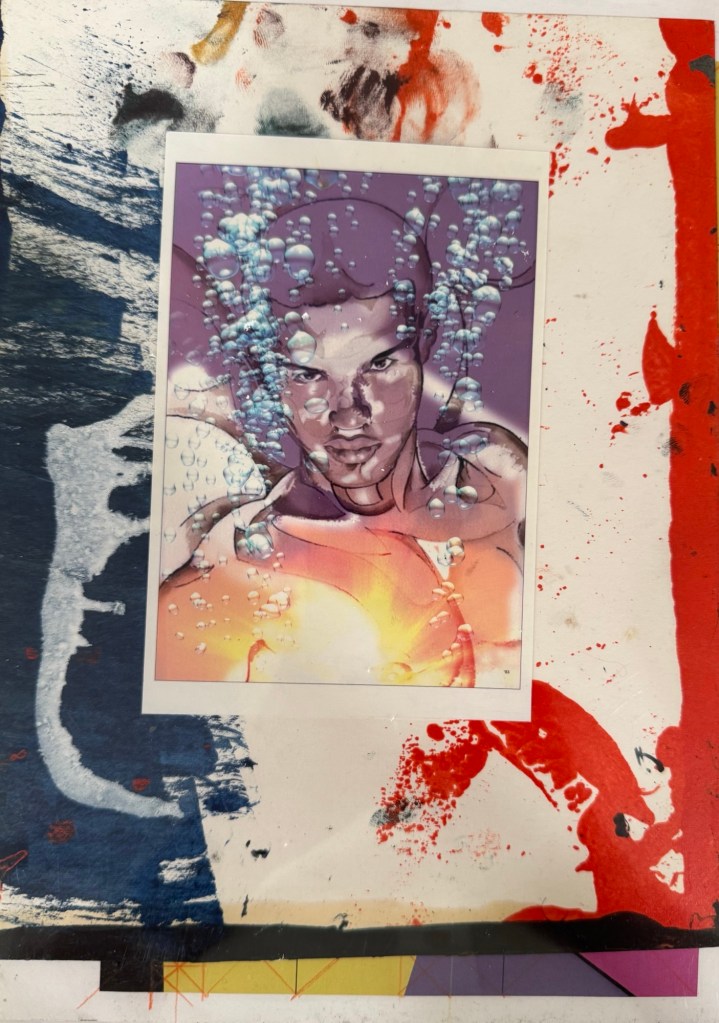
Today I placed a printed image over several scraps of paper carrying marks left by earlier processes. The arrangement was accidental. Neither the print nor the scraps had been made in anticipation of the other. I had not planned how they would meet. Once they occupied the same field, however, the image ceased to appear as it had before.
The printed image belonged to a series of portraits from 2003, which I had developed for a new edition of Samuel R. Delany’s The Motion of Light in Water: Sex and Science Fiction Writing in the East Village, 1957-1965. A photograph of Delany in his youth had served as the model (today, he is 84 years old). For the version ultimately selected, I enhanced the photographic likeness with my drawing of the portrait, allowing the photograph to remain as a transparent overlay. The result stayed close enough to its source to preserve the immediacy of a photographic image while being underpinned by the structure of the drawing.
Commissioned portraiture never formed the basis of my career. This commission nevertheless gave me an opportunity to explore variants. Even when I worked in commercial or stage design, I did not suspend my identity in order to carry out someone else’s interpretation. The purpose could determine where the work appeared or what use it served. It could not determine the temperament from which I worked.
In one of the variants, the original drawing was digitally processed as a computer-generated image. Air appeared encapsulated within rising bubbles, while light seemed to move through them as though the person had been submerged. The device allowed the title to assume a visual form: a body placed beneath the surface might permit light to be perceived in motion through water.
Delany ultimately chose the version closer to the photograph from which the series had begun. One image served the purpose for which the portraits had been commissioned; the others remained as material consequences of my own process.
In 2006, this variant was selected by Jim Furlong for Unusual Portraits, a group exhibition presented at Hudson Guild, Gallery II, in New York City. These facts belong to the history of the portrait, but they do not determine what it has now become.
In 2018, the underwater portrait was sold at auction from my residence in Massachusetts. The print that remained with me preserved the image after the work itself had left my possession. Its later incorporation into the collage therefore did not alter the exhibited portrait, but gave one of its reproductions a separate material life.
When I happened to place the print over several scraps of marked paper, I recognized that their meeting altered the image’s references to Delany. I decided that the accidental arrangement should endure and committed it to the surface.
The print remained visually dominant. Its scale, recognizable figure, concentration of color, and placement continued to distinguish it from the less structured strokes and abrasions surrounding it. The portrait still governed the surface as figure. What it no longer governed was the meaning of the surface as a whole.
Before I brought them together, the scraps carried evidence of earlier processes. The portrait referred to Delany, to the photograph from which I had drawn him, and to the title that had prompted the submerged figure and its rising bubbles. Once they met, none of these elements lost its visible character. The strokes remained strokes, the abrasions remained abrasions, and Delany’s face remained recognizable. What changed was that none of them could decide what the others meant any longer.
The scraps no longer functioned merely as remnants of something that had preceded them. The portrait no longer functioned merely as an image of Delany or as a visual expression of the title of his book. Those references remained, but the collage had become more than they could contain.
The bubbles make this easiest to see. They began in direct response to the title, giving visual form to light moving through water. They can still recall air, submersion, and refracted light, but the title no longer tells us how they must be read. They remain as sensations within the image rather than instructions for what the image must mean.
This is what I mean by flattening the image’s meaning. Flattening does not make the elements visually equal or diminish their differences. It prevents one visible order from making every other order serve its reference. The portrait remains dominant as figure without remaining sovereign as meaning.
I had not chosen the position of each mark or adjusted the spaces among them. The arrangement had appeared without my intending it. My decision concerned whether it should last, not how its parts should be organized. I decided that the relation I had encountered was worth preserving and continuing to look at.
An accident alone does not make an artwork, but artistic intention need not precede every material relation within one. Recognition may arrive after the event it recognizes. The artistic act can consist in deciding that an unplanned condition should endure.
The accidental placement therefore offered more than an arrangement. It allowed a new vocabulary to emerge. The figurative image was not absorbed into the surrounding marks, nor did the marks acquire the representational force of the portrait. Together, however, they no longer required the viewer to read them only through what each had been before.
The photograph, the drawing, the digital processing, the proposed publication, the exhibition, the sale of the portrait, the surviving print, and today’s scraps of marked paper remain present in the material or in its history. Nothing has been erased, corrected, or superseded. Yet none of those earlier conditions can determine by itself what the collage has become.
What remains is not the conclusion of a sequence, but a surface on which its different moments remain visible after ceasing to observe their former order.
Ricardo F. Morín
September 1, 2026
Bala Cynwyd, Pennsylvania

