Ricardo F. Morín
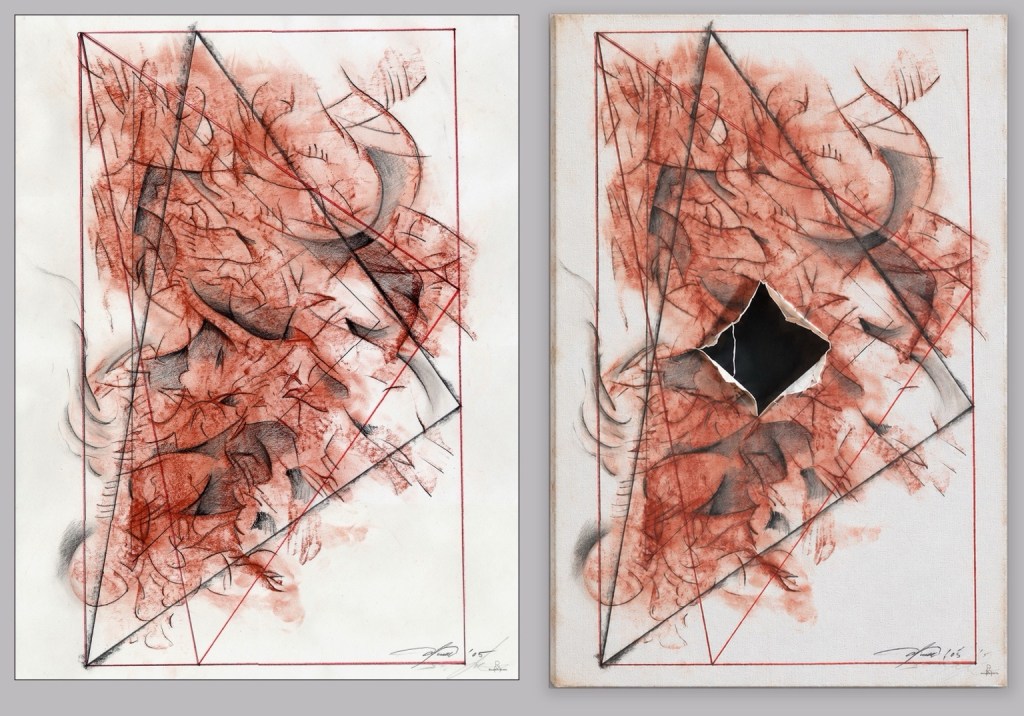
Left: Infinite Landscape, Triangulation I
22 × 30 inches
Body color, sanguine, sepia, and Sumi ink on paper
2005
Right: Reconstruction of the punctured television canvas
Digital reconstruction, 2026
In 2007, Thomas A. Walsh telephoned me unexpectedly from Los Angeles. By then, Tom was the production designer of Desperate Housewives, the ABC series for which he had designed the pilot and much of its visual world. He wanted permission to use the image from one of the postcards I had sent him as the basis for a prop.
The call did not arise from an incidental professional contact. Tom and I had known one another for many years. I had worked with him as an associate on the 1989 American national tour of Cabaret. I later served as an art director when he was production designer of two Turner television productions: MGM: When the Lion Roars, a 1992 documentary about the history of Metro-Goldwyn-Mayer, and In Search of Dr. Seuss, produced for TNT in 1994. The latter received a 1995 Emmy nomination for its art direction, and I was among those nominated.
These collaborations belonged to the formative period of my professional life in production design. Tom’s interest in me, however, extended beyond what I contributed as an associate or art director. We became close friends.
That closeness changed after I entered disability because of AIDS. The professional life within which our friendship had developed was no longer available to me, and the ordinary continuities produced by shared work gradually receded. I nevertheless continued writing to Tom every Christmas. Along with each letter, I enclosed a postcard reproducing one of my recent artworks.
The postcards became a modest annual record of the work I continued to make after illness had removed me from the professional world we had shared. They did not ask anything of him. They simply placed before him, once a year, evidence that my artistic life had continued.
At one point I offered Tom some of my paintings. He explained that his house in Los Angeles consisted largely of glass walls and afforded almost no surface upon which paintings could be hung. I understood the practical impossibility. The paintings could not enter his house, but their images continued to reach him through the postcards.
Years later, one of those images found another house.
Tom called to ask whether Desperate Housewives could use the image reproduced on one of my postcards. I agreed immediately and unconditionally. I did not ask for payment, impose restrictions, or inquire about the prominence the work would receive. A friend who had followed my work across many years had found a place for one of its images within a production he was designing. That was sufficient.
The image was Part One (Infinity Landscape, or Triangulation One), from a triptych titled Triangulations. The original was a drawing on paper and was bought at auction by one of my cousins, who lives in Kissimmee, Florida. ABC enlarged its photographic reproduction and transferred the image to canvas, transforming it into a painting that could exist as a prop within the fictional world of the series.
The result appeared in the fourth-season episode “You Can’t Judge a Book by Its Cover,” broadcast on November 11, 2007. Within the narrative, the canvas belongs to Carlos. When the work is shown, a large opening has been punched through its surface. Edie holds the damaged painting before him and remarks, “I don’t get modern art either.”
The remark treats the painting as a joke, but the image resists the joke.
Within the resulting image, however, the torn opening appears neither incidental nor passive. The diagonals produced by the damage cut across the sepia fields and meet the black lines already traversing the composition. Rather than appearing as an isolated absence, the puncture enters the network of planes, displacements, and directional forces through which the image was constructed.
What had been intended solely as damage produced an unforeseen visual relation.
I could not regard the occurrence simply as an insult. The reproduction had been fabricated for the requirements of a narrative, and the opening belonged to the action for which it had been made. Yet the resulting image exceeded that function. The puncture seemed to intensify the internal geometry rather than diminish it. An external force had acted upon the canvas, but the composition retained its order.
Around this time, I was corresponding by email with the artist William Giles, whom I knew as Will. He was the husband of Lee Bontecou, one of the most consequential American artists of the postwar period. Will and I never met in person, but for a time we exchanged thoughts about art and life, and I shared some of my poetry with him.
After the episode appeared, I told Will what had happened and shared the available images with him. I no longer possess our correspondence, and I would not attempt to reconstruct his language as though I remembered it verbatim. What remains clear is the meaning of his response.
Will did not interpret the punctured canvas as a degradation of the artwork. He related the opening to expressive and material conditions present in some of his own work. The damaged surface had not ceased to possess artistic dignity merely because another force had entered it. The puncture had become part of the condition through which the image now had to be perceived.
His response neither denied the violence done to the reproduction nor inflated a brief television appearance into a form of consecration. He looked at what had occurred as an artist. He recognized that the opening had acquired a visual function and that the image had survived the intervention without losing its coherence.
His attention moved me more profoundly than the broadcast itself.
During those years, I was struggling with the absence of recognition in the New York art world. The difficulty was not simply the scarcity of exhibitions or professional opportunities. It was the more intimate attrition produced when work sustained over decades repeatedly encounters indifference. An artist may continue without institutional confirmation, but independence does not eliminate the human need to be seen with intelligence.
Tom’s telephone call revealed that the postcards had not passed before him unnoticed. The artwork he could not hang upon the glass walls of his own house entered, through his intervention, one of the fictional houses he helped create for television.
Will received the subsequent occurrence and gave it another order of meaning. He recognized a material event within the life of an image. His understanding gave me respite because it did not depend upon institutional approval, social obligation, or the expectation of advantage. He looked carefully, and his care allowed the work to exist without having to argue for itself.
Will also spoke of Lee in a manner that remained with me. He described her as a universal force whose creative intensity manifested itself throughout their family life. The concentration she brought to preparing a meal was, in his account, continuous with the concentration through which she conceived and made her art. Creation was not an activity she entered and later abandoned. It was the manner in which her attention inhabited the world.
I understood from the tenderness of his description that he was not reducing her art to domestic life. He was saying precisely the opposite. The same generative force passed through both, without accepting the divisions through which culture ordinarily separates consequential acts from ordinary ones. A meal could receive the fullness of her invention because invention was not reserved for the studio.
Eventually, Will and I lost contact for reasons I do not know. No disagreement marked the end of the correspondence. It simply ceased, as certain human connections do, without yielding an explanation proportionate to what they once contained. His presence in my life was brief, but the compassion and intelligence of that presence remained.
The emails have disappeared. I do not know what became of the canvas fabricated for the episode after the scene was completed.
What survives of the television appearance is an image of Edie holding the pierced reproduction, the memory of Tom’s unexpected telephone call, and the recollection of Will looking at the puncture without diminishing either the artwork or me.
The television appearance was public but fleeting. The two acts of attention that surrounded it endured.
The puncture entered the history of the image. Absence acquired form. The composition received a force that had never belonged to its conception without surrendering its internal order.
Tom gave the image a place in the visible world. Will taught me how to understand what happened to it there.
Ricardo F. Morin
September 4, 2026
Bala Cynwyd, Pennsylvania
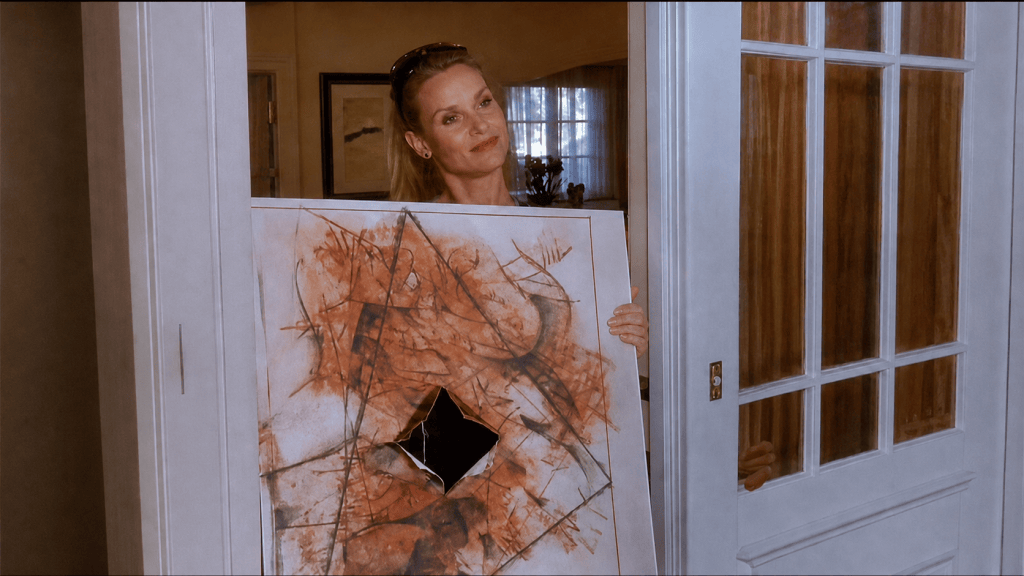
Frame from Desperate Housewives, “You Can’t Judge a Book by Its Cover,” season 4, episode 7, ABC, broadcast November 11, 2007.