Posts Tagged ‘Presence’

“River Grass”

December 7, 2025

~

Ricardo Morin
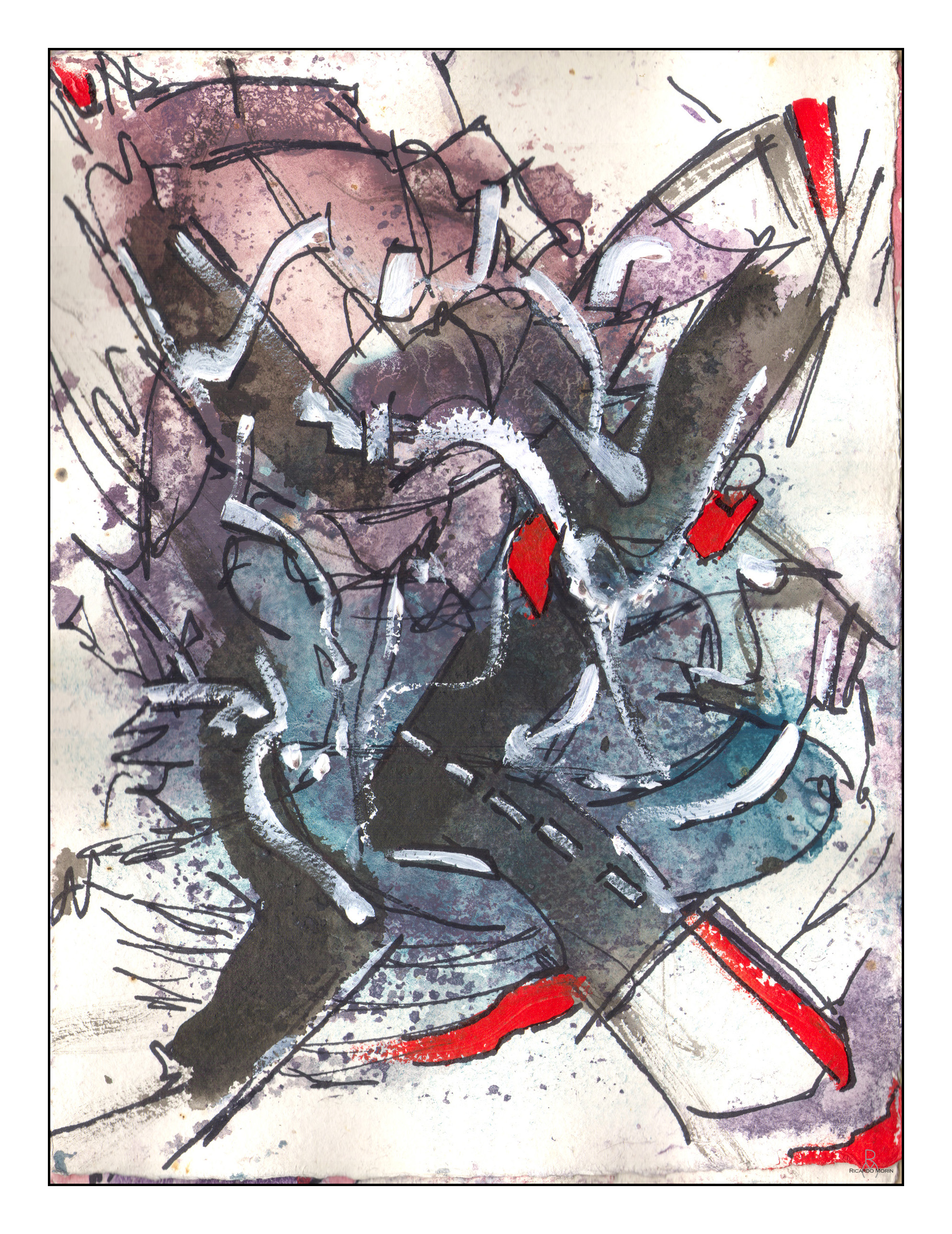
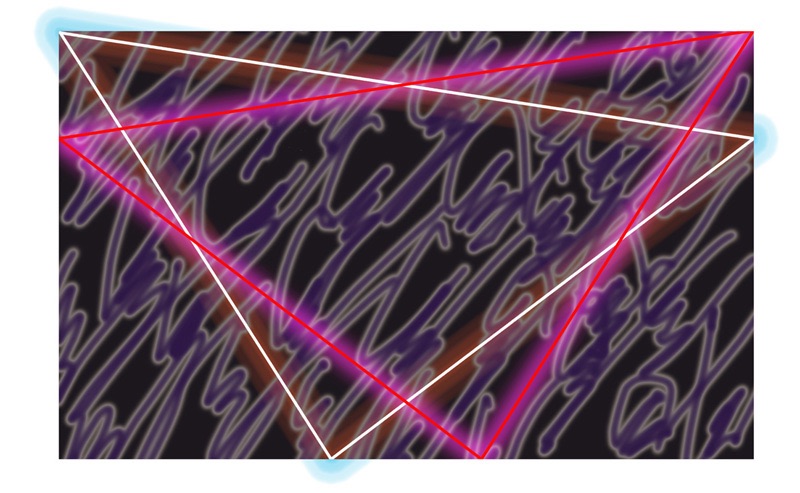
Landscape II: River Grass
18” x 24”
Sepia on newsprint 
2003

Ricardo F Morin

Dec. 6, 2025

Naples. Florida

*

This diptych, “River Grass” and “Naples in the Morning,” brings together a reflection on continuity and a brief observation of everyday life.  Two scenes—one sustained, the other fleeting—register how experience, silence, and attention shape presence.  The first part, “River Grass,” does not present an argument, a confession, or a theory.  It offers an observation shaped over time by proximity rather than distance.   The focus is not on individual psychology or relational conflict, but on patterns that take form across generations and persist quietly within everyday life.

What follows avoids moral explanation and narrative resolution.   It attends instead to continuity—how restraint, generosity, and presence may be transmitted not through instruction or memory, but through posture, habit, and orientation.   The intention is to describe without adjudicating, and to clarify without assigning cause where cause cannot be cleanly isolated.   What is traced here represents one possible orientation among many, shaped by inheritance but not exhaustive of its effects—an invitation not to mistake the channel for the ocean.


Orientation of “River Grass”

What follows attends to what persists when lives are shaped by continuity rather than interruption.

Not all inheritance arrives as memory.   Some is conveyed without story, without date, without language.   It enters through atmosphere rather than narrative—through cadence, restraint, posture, and a preference for continuity over display.   In such cases, history is not recalled; it is carried.

This form of inheritance does not announce itself as trauma.   It leaves no single scene to revisit, no episode that can be isolated and explained.   Instead, it appears as a way of moving through the world:   measured, attentive, resistant to excess.   The past exerts influence not by instruction but by shaping what feels permissible, sustainable, or necessary.

Under these conditions, restraint is not experienced as loss.  It functions as orientation.  Accommodation does not signal submission but competence.   Stability reflects not the absence of desire but the quiet placement of desire among other priorities.   What is transmitted is not fear but caution—an ethic of endurance refined over time.

Because no event is foregrounded, little invites interpretation.   The absence of visible distress encourages the assumption of ease.   Life appears ordered, generous, and intact.   Yet the inheritance remains active and structures conduct without requiring acknowledgment.   It persists not as memory but as form.

Such inheritance often resists recognition precisely because it has succeeded.   The past has not repeated itself.   Continuity has been preserved.   What remains is a posture oriented toward sustaining that continuity—a vigilance so normalized that it passes as temperament rather than history.

Restraint, in this context, does not operate as inhibition or denial.   It functions as a stabilizing orientation—an internal calibration shaped over time.   Action is guided less by expression than by proportion and durability.   What governs choice is not moral judgment but coherence.

Such restraint often coexists with clarity and decisiveness.   Boundaries are maintained without conflict; decisions are made without excess emphasis.   What is avoided is not agency but surplus.   Expression is moderated not through fear of consequence, but through an internal sense of sufficiency.

Accommodation here is frequently misread.   It does not arise from compliance or uncertainty, but from an assessment of impact.   Space yielded to others reflects confidence in structure rather than retreat from position.   Presence remains intact even when it is not foregrounded.

This orientation produces a stability that can appear effortless.   Friction is minimized.   Demands are rare.   The absence of insistence is readily mistaken for ease or contentment.   Yet the restraint at work is active, not passive—and continuously shapes what is articulated, deferred, or left unspoken.

Over time, restraint becomes difficult to distinguish from identity.   It ceases to register as a choice among alternatives and hardens into posture.   The question of expression recedes, replaced by an emphasis on responsibility, proportion, and non-disruption.

Generosity shaped by inherited restraint rarely announces itself.   It does not seek recognition or reciprocation, nor does it depend on visibility for validation.   It appears instead as availability, as the quiet removal of obstacles, as the willingness to yield space without narrative or sacrifice.

In this form, giving is non-transactional.   No balance is tracked; no return anticipated.   What is offered is steadiness rather than favor.   Support unfolds without appeal, often unnoticed, absorbed into ordinary conduct.   The absence of demand is integral rather than incidental.

Because it imposes no weight, such generosity leaves little trace.   Others encounter freedom without sensing its source.   Autonomy is enabled without attribution.   The one who gives remains present yet unmarked.

Over time, the habit of making room for others becomes more practiced than the habit of entering it.   Attention turns outward and refines responsiveness while narrowing self-directed articulation.   What persists is not loss, but redirection.

This configuration resists conventional readings of imbalance.   No grievance emerges; no conflict announces asymmetry.   Generosity remains intact, even exemplary.   What shifts subtly is internal emphasis: presence exercised through allowance rather than assertion.

Desire, within this orientation, is neither denied nor suppressed.   It is repositioned.   Its legitimacy is not questioned, but its urgency is diminished.   What is set aside is not longing itself, but the expectation that longing must organize life.

Desire is acknowledged yet rarely centered.   Expression is permitted elsewhere more readily than inwardly claimed.   Attention gravitates toward what preserves stability rather than what intensifies experience.   Satisfaction arises from coherence rather than culmination.

This produces no vacancy.   Life remains engaged and responsive.   What diminishes is insistence.   Continuity comes to matter more than appetite; durability more than immediacy.

Because this arrangement is not framed as renunciation, it escapes notice.   No moral language surrounds it.   Nothing is named as sacrifice.   Desire persists at a distance—observed, managed, deferred without struggle.

Over time, identity becomes shaped less by pursuit than by maintenance.   Expression gives way to stewardship.   Meaning accrues not through arrival, but through the avoidance of rupture.

Patterns organized around restraint and continuity are often mistaken for moral attainment.   Composure is read as wisdom; accommodation as maturity; silence as depth.   Because no disturbance arises, the orientation escapes examination.   What functions smoothly is presumed complete.

This misreading is reinforced by social frameworks that reward stability over inquiry.   Absence of conflict is taken as evidence of balance.   Generosity without demand is praised rather than interrogated.   Its costs remain obscured precisely because they impose nothing on others.

Virtue, in this setting, becomes indistinguishable from habit.   Adaptive orientation solidifies into character, and character into expectation.   Reliability is affirmed repeatedly, deepening its hold.

The result is not deception but omission.   The steadiness is genuine.   What goes unrecognized is how fully such an arrangement organizes life around preservation rather than presence.   The question of displacement remains unasked, not refused.

Misreading occurs through success.   Relations endure.   Structures hold.   No obvious harm appears.   And so the deeper configuration—quiet, durable, historically shaped—continues beneath the language of virtue.

At a certain threshold, continuity shifts from supporting means to governing end.   Life becomes organized not around fulfillment, but around preservation.   What matters most is that nothing essential is exposed to rupture, whether through excess demand or through untested assertion.

Fulfillment is not rejected, but subordinated.   Satisfaction arises from duration rather than intensity.   Time is oriented toward extension, not culmination.   What is valued is the capacity to carry forward intact.

This proves effective.   The past does not recur.   Stability holds.   Loss is contained rather than amplified.   Inherited imperatives are honored not through recollection, but through conduct.

Yet when continuity occupies this position, the range of permissible movement narrows.   Change must justify itself in advance.   Desire must demonstrate durability before enactment.   Expression yields to maintenance.

The future is approached as responsibility rather than as open terrain.   Meaning accumulates through safeguarding what is essential rather than through the exploration of possibilities.   Success becomes synonymous with the preservation of continuity.

Presence, in its final form here, does not organize itself around position or priority.   It functions laterally and sustains structure without becoming its focus.   Life is held together through attentiveness rather than through claims to authority or justification.   The course of life proceeds without pressure to arrive at an explanation that secures its coherence.

This mode of presence resists visibility.  It does not seek recognition or assert precedence.   Its efficacy lies in what remains intact rather than in what is achieved.  Others move freely, often unaware of the support permitting such freedom.

To remain outside the center is not withdrawal.   Engagement continues—measured, responsive, intact.   What is avoided is domination, not participation.  Influence is exercised through stability rather than direction.

The image implied by the title takes form.   A river that advances without force, reshaping terrain through the sustained persistence of its course.  Motion without spectacle.  Endurance without inscription.  The course is maintained by flowing around obstruction rather than confronting it.

What remains is continuity itself—quietly sustained, seldom noticed, and difficult to name.


*

“Naples in the Morning”

I sat across from my husband at a breakfast place in Naples, Florida.  Diagonally behind him sat a young couple.  The woman was small—almost childlike in scale—next to her husband, who stood well over six feet.

None of us had ordered yet.  She carefully arranged her silverware and napkin, aligning them with deliberate precision, almost ritualistic.   Her hair fell forward, parted to either side of her face like curtains drawn closed.  When she lifted her chin, her facial features—Asian in appearance—came briefly into view.  Despite her slightness, her posture suggested control rather than fragility.

When our glances crossed, she held my gaze longer than expected, nearly staring.  She then lowered her head, hiding again behind her hair.   Moments later, she lifted it once more and made the sign of the cross—forehead, chest, shoulder to shoulder—before turning fully back toward her husband.   No words were exchanged.

When the food arrived, she resumed the same careful demeanor.   She sliced her omelet into small, uniform squares, placed the knife down, and paused.  Each piece was lifted individually, slowly, with unbroken repetition, as if rehearsed.  The sequence carried the quality of performance.   Though she remained oriented toward her husband, her torso shifted intermittently, angling slightly in my direction.

When they finished and moved toward the register, she rose first and walked ahead, chin lowered, hair once again masking her surroundings.  He followed—tall, broad, moving through the room with visible ease.  His stride was expansive, unguarded.

They left without speaking.


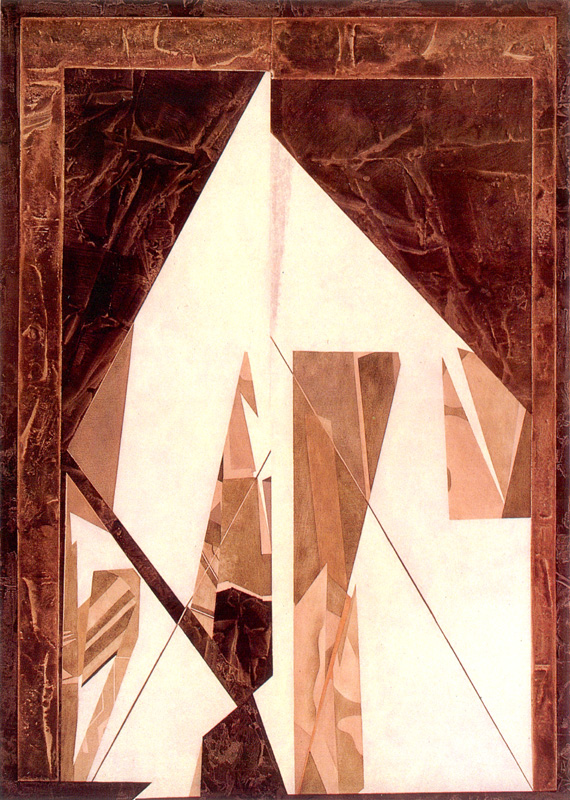
“BEFORE FORM II”

November 17, 2025

*

Impressions, Diptych: BEFORE FORM II
18″ x 48″
Oil on board
2000

Ricardo F. Morín

Nov. 17, 2025

Oakland Park, Fl

1

There are relationships in which language arrives too early.

Two minds meet, and each brings its own architecture—one built of corridors, the other of thresholds.

Nothing coheres. Nothing resolves. Yet something is exchanged.

Perhaps the only way to describe it is to refuse description.

What passes between the two is not influence, nor authority, nor instruction.

It is the faint recognition that creation does not always arise from tradition,

and tradition does not always arise from clarity.

One mind preserves structure because it fears dissolution.

The other preserves freedom because it fears enclosure.

Neither is right, neither is wrong, and neither can become the other.

If there is a lesson, it is not philosophical.

It is simply that some encounters generate form only by refusing to take one.

Some dynamics can be seen only by letting them remain unsettled.

Not a system.

Not a method.

Not an alchemical transformation.

Just the quiet knowledge that meaning does not always arrive in recognizable shapes—

and sometimes the refusal of structure

is itself the most honest form.

This is neither alchemy nor allegory.

It does not mirror academic tropes.

It does not explain itself.

It simply stands.

2

There is a place where thought has not yet chosen its weight.

Where nothing must resemble anything.

Where no lineage can be traced because the idea has not agreed to be inherited.

Two minds meet there sometimes, though neither intends to.

One arrives with tools, the other with openings.

One tries to recognize what appears; the other lets appearance undo itself.

No roles persist in that space.

No teacher, no student, no authority, no dissident.

Only the slight disturbance of something wanting to become meaning

and something else resisting the invitation.

Perhaps the exchange exists only in the refusal to define it.

Perhaps it is nothing more than two ways of seeing colliding for a moment

before each retreats to its natural distance.

There is no lesson.

No transformation.

Not even understanding—

just the faint impression that the encounter mattered

in a way that cannot be justified.

Some relationships never enter language fully.

They touch the threshold and withdraw,

leaving only a shape that refuses to become a shape.

What remains is not story, not insight, not metaphor.

Only a quiet remainder:

that something passed between two minds,

and it does not wish to be named.

3

Some encounters move like weather across the mind—arriving without intention,

passing without conclusion.

They do not teach; they do not claim.

They shift the air and leave a pressure change that takes days to understand.

Two temperaments can drift into the same moment like front and current.

One carries the weight of accumulated seasons,

the other moves with the quiet urgency of what is still forming.

Neither is stronger.

Neither is clearer.

They simply meet, and the atmosphere changes.

There is no point of balance.

No point of conflict.

Just a tremor in the air between them,

as if the room itself were listening for something that never quite becomes sound.

Thought loosens in that space.

Meanings approach, circle, and recede.

Nothing settles long enough to be named.

Nothing wants to.

Some relationships never become narrative because narrative would freeze them.

They remain suspended—felt more than understood,

remembered less as moments than as shifts in light,

like a room darkening for reasons the sky doesn’t explain.

When they part, it is not an ending.

It is a dispersal, like mist thinning at the edge of dawn.

Each carries a trace of the other’s weather,

a change in temperature that lingers long after the shapes have dissolved.

What remains is not knowledge.

Not conclusion.

Just the faint sensation that something passed through—

and continues to pass through—

quietly, insistently,

without ever agreeing to take form.

4

There are moments that never arrive fully.

Not as meaning, not as feeling—more like a faint shift,

a drift in the periphery.

Two presences cross, neither entering nor leaving.

A pressure, a thinning, a pulse without source.

Not connection, not distance—an interval that hovers.

Nothing coheres.

Nothing insists.

There is only the sense of something lightly touching thought

and withdrawing before thought can respond.

Contours don’t form here.

Edges blur as soon as they appear.

The exchange—if it can be called that—dissolves into the same air that carried it.

A pause lengthens,

not to reveal anything

but to remind that revelation is unnecessary.

This is not atmosphere; even atmosphere has structure.

It is less.

A faint impression that doesn’t land,

doesn’t settle,

doesn’t belong to either mind that felt it.

Later, one might remember a flicker—

not an idea,

not a moment—

just the residue of an approach that never closed.

No clarity follows.

No resolution.

The experience continues only as dispersal,

the way fog continues after your body has walked through it.

What remains is not being,

but the trace of something that preferred not to become one.

5

There is a place where awareness thins,

not into silence,

but into something before silence—

a faint trembling at the boundary of what the mind can hold.

Nothing shapes itself here.

Outlines gather, loosen, drift apart.

Perception moves like breath against a surface it cannot see,

feeling only its own hesitation.

Two currents brush past each other—

not touching, not avoiding—

simply passing through the same unmarked space.

No exchange takes place, only a slight alteration in texture.

The air feels different by a degree so slight

you question whether it changed at all.

Sensation approaches but does not declare itself.

It folds and unfolds at the edge of recognition,

as if deciding whether to become experience

or to recede without consequence.

Thought cannot follow it.

Emotion cannot name it.

Language reaches out but finds nothing to hold,

its grasp closing on the faint imprint of something

that prefers not to be caught.

There is no meaning here,

only the suggestion of one—

a whisper of form that vanishes when looked at directly.

What remains is the after-feel:

a soft pressure,

a disturbance without cause,

a nearness with no direction.

It lingers not as memory

but as the memory of almost remembering—

the residue of a touch

that occurred just beyond the threshold

where understanding begins.

At the edge of sensation,

nothing is known.

Yet everything feels about to become.

6

There is a quiet that does not empty the world but concentrates it—

a quiet that draws breath around itself.

Nothing is spoken, yet everything leans forward,

as if waiting for a pulse to reveal where it has always been.

The stillness is not rest.

It is tension held with care,

a subtle hum beneath awareness,

a throb the body recognizes

before the mind opens its hands to feel it.

You could call it presence,

but even that word is too heavy.

It is not being,

only the soft insistence

that something is unmistakably here.

Light moves differently in this quiet—

slower, denser,

as if thought itself thickens the air.

It is the moment before meaning,

before shape,

before the world chooses a direction.

Alive, but without calling attention to its life.

Silent, but without conceding to silence.

A current passes through,

barely perceptible,

yet carrying enough force

to rearrange everything

it does not touch.

What remains is only this:

a breath held between two states—

not message,

not impression,

just the warm gravity of being

before it becomes anything else.

7

It comes softly,

so softly you cannot tell whether it arrived

or whether you only stopped long enough to feel it.

A warmth gathers at the edge of awareness—

not heat,

but the suggestion of nearness,

like breath that barely lifts the air.

Nothing speaks,

yet something touches you

in the place where words would break it.

It moves the way light moves across closed eyes—

a tenderness that does not seek to be seen,

only to be known without knowing.

It is the quietest kind of nearness,

the kind that asks nothing

and in asking nothing

restores a part of you you did not realize

had gone dim.

It grazes the soul like a hand

that never quite touches—

a promise of contact,

a murmur of care,

a soothing traced along the inner surface

of being itself.

No message,

no direction,

only the gentle reassurance

that something in the universe

has noticed your existence

and answers with a softness

equal to your need.

A whisper,

not into the ear

but into the space behind the heart,

where feeling wakes before thought understands.

It lingers there—

a quiet pulse,

a sheltering nearness—

not holding you,

but letting you rest

as if you were held.

And then, barely,

it recedes—

not leaving,

just loosening—

like the last warmth of a hand

still felt long after it has gone.

8

It appears without approach.

Not rising, not entering—simply there.

A pulse without rhythm,

a force without weight,

life showing itself in the smallest possible gesture.

No softness here,

no harshness either—

only the unqualified fact of energy

standing in its own clarity.

It does not warm,

does not startle,

does not soothe.

It simply asserts a kind of being

that needs nothing to validate it.

Not spirit.

Not breath.

Not sensation.

Just the unmistakable surge

that accompanies existence

whenever it remembers itself.

A being unshaped by intention

moves through the moment,

neither touching nor retreating,

neither demanding nor yielding.

Its essence is activity without aim—

motion held within stillness,

potential without need for direction.

It does not call attention to itself.

It does not fade.

It does not speak.

It remains—

a clarity,

a tension,

a spark of the world’s own self-recognition

before language arrives to claim it.

Alive,

unadorned,

without echo or interpretation—

just the force that underlies all form,

manifest for an instant

in its simplest,

most unmediated state.

9

At last the force loosens.

Not fading—simply releasing its hold

on being something.

The pulse ceases to define itself.

The clarity thins.

What was formless being unravels

into the same unbounded quiet

that preceded it.

No retreat,

no vanishing,

only the simple act

of no longer remaining.

The vitality that stood so plainly

lets its edges dissolve,

not into darkness,

not into silence,

but into the untouched space

that asks nothing of it.

What stays behind

is not trace or echo

but the openness that held it—

a vastness indifferent to form,

yet origin to all form.

This is not return

because nothing was ever apart.

It is not ending

because nothing concludes.

It is the unmaking

that restores everything

to the ground of its own possibility.

Where force once stood,

there is now only the expanse

from which force arises—

the nothingness that is not absence

but the pure condition

of all that can become.

Here, being and unbeing

are the same gesture.

Life dissolves

into what has always held it.

And the dissolution is complete.


CODA

Nothing follows.

What has unfolded returns to its origin,

not as echo,

not as meaning,

but as the same quiet field

that allowed each motion to appear.

The cycle leaves no imprint.

The trace erases itself.

The movement completes by letting the world resume its stillness.

There is nothing to gather,

nothing to carry forward,

nothing to understand.

The unfolding has ended where it began—

in the openness that holds all beginnings

and requires none.

What remains is not conclusion

but the calm that arrives

when even dissolution has dissolved.

And from that calm,

if anything were ever to arise again,

it would do so without memory of having been.

“Air Remembers”

November 17, 2025

*

Ricardo Morín
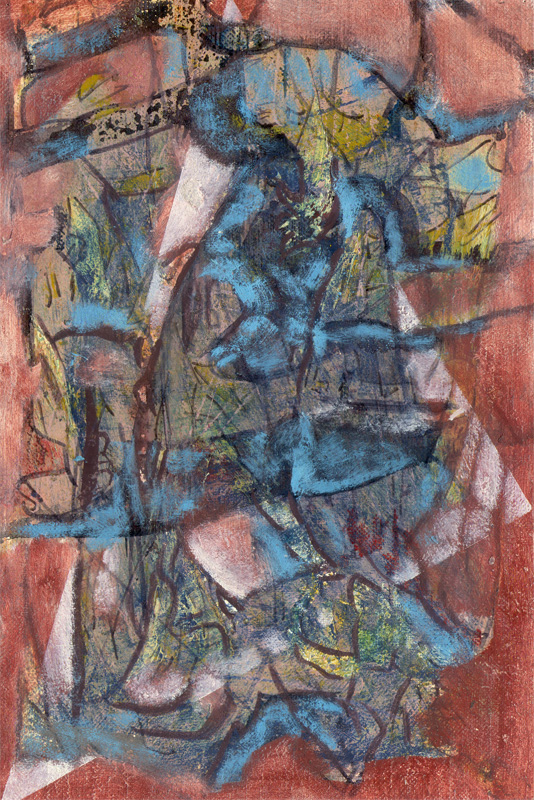
Untitled #1: Air Remembers
10″x12″
Watercolor
2003

By Ricardo F. Morín

October 2025

Oakland Park, Fl.

Memory is air where perception retrieves it.

We are memory; air is its cradle.

Before morning enters, scent holds what the night has carried away.

Before air's touch, we recognize all is breathing.

Each breath returns us to presence:    nothing explained, everything renewed.

Scent reaches us before thought;

Air remembers as we breathe:    recollection becomes present.

Breath is the body’s intelligence:    the mind’s foremost messenger.

Redolence provokes inquiry—the instinct to understand before it is named.

With moisture the world returns to us.

Scent travels on, sound softens, and the body recognizes again itself.

In excess, humidity—once restorative—begins to bury the senses.

All breathes through us and we through all to elicit change before there is voice.

“Questions That Hold Their Answers”

August 3, 2025

*


Ricardo Morin
Sonata Series
Each 30″x 22″= 60″h x 66″ overall
Watercolor on paper
2003

By Ricardo Morin

August 3, 2025

The Whittington chime, though rooted in the specific historical and ecclesiastical context of St. Mary-le-Bow in London, speaks in a language far broader than its origins. Every fifteen minutes, its melody punctuates the passage of time—not with dominance or insistence, but with a sequence of tones that seem to lean toward attentiveness rather than control. It does not call; it invites. Its fourfold phrasing unfolds with the day and carves it gently into intervals of awareness.

The hour does not ask to be heard.

It leans, it yields, it breathes.

In four phrases, time steps into its own shadow—

Not to rule, but to be received.

The first phrase is sparse and anticipatory. It announces nothing—yet it creates space for something to begin. The second phrase, slightly more confident, suggests that the shape of what’s coming may already be present in what has been. The third phrase swells with fullness, as though recognizing that something unspoken has come to form. And the fourth does not repeat or resolve—it releases. A soft culmination, an unforced closure. Nothing more is needed.

Four phrases like footprints.

Not forward, but inward.

The last does not complete the first—

It simply continues without demand.

Time is neither summoned nor announced—it is welcomed in silence. The melody performs a quiet orienting function. It makes no claims, prescribes no doctrine, and excludes no one. It requires attention, not belief. It passes through space and enters those who allow it, and in doing so, it reveals time not as a line to be followed, but as a vessel to be filled.

There is no message, only rhythm.

No doctrine, only form.

Not a path to walk,

But a shape to inhabit.

This surrender—this subtle willingness to listen—is not weakness, nor is it a form of passivity. It is a kind of interior readiness, a posture of faith in what does not insist upon itself. As one hears the chime at a distance—through open window, across an empty street, or at the center of a sleepless night—it becomes clear that regularity is not rigidity. It is a form of grounding, a pulse that reminds us of something more than measurement: the possibility that rhythm itself is a form of remembering.

Some things endure not because they hold us fast—

But because they return.

Each return is a soft petition:

Are you listening now?

To be transformed by time, the vessel must remain open. And openness is not emptiness in the deficient sense, but the fullness of a receptivity that listens before it responds. There are patterns here, but they do not bind. They unfold. Each phrase in the chime allows what came before to echo—faintly, without repetition—and then continues without imitation. It does not search for novelty, nor does it cling to what has passed.

It simply arrives.

An echo does not ask for an answer.

It waits until the shape of silence

Begins to sing it back.

In this way, the melody becomes an offering. And if there is meaning to be found in its intervals, it is not imposed from without. It is disclosed in the act of listening. Each person who hears it becomes part of its form, not by adding to it, but by receiving it. And in receiving, they are also shaped.

Some questions do not seek reply.

They seek a place to rest.

They carry their answers folded within—

Waiting only to be heard.

We often think of arrival as the end of something—as the completion of a search. But perhaps it is not the final step that matters most. Perhaps what matters is the quiet unfolding that prepares us to meet it. The chime does not deliver anything. It accompanies. It affirms that movement can be gentle, that order can serve grace, and that meaning is not attained, but awakened …

… —gently, without insistence.

It arrives, and we recognize it—

Not because we were waiting,

But because we were listening.

*


“A Soliloquy”

July 6, 2025

*

Ricardo Morin
New York Series, No. 1
56″ x 84″
Oil on canvas
1992

Preface

What follows does not simplify or announce itself.  It moves inward—through observation, thought, and the tension between clarity and disappearance.  The soliloquy keeps to its own course:  neither performing nor explaining, but sustaining an interior gaze.  To read it is not to be guided, but to remain with it—where thinking becomes presence, and language measures what endures.


Soliloquy

Once upon a time, there lived within the writer a creative energy—its force and passion for self-expression—that sustained him. It was not summoned; it simply endured.  So arresting was this presence that he could not discipline it into routine or mold it into a pattern for physical endurance.  He could not pause it for walks or for any activity not already part of the act of creation itself.  He resorted to standing while writing, walking while reading, sleeping while thinking.

His experience was never an affliction to be named or cured, but a life to be lived on its own terms—a creative testament to the fullness of being, not a clinical footnote to someone else’s definition.  Choosing not to be defined by it honored both its agency and his lifelong work.  It was a condition to be understood alone, even if shared in writing—yet never in search of validation.

Within the boundaries of personal insight, it revealed itself as a form of devotional absorption, one that brought dignity even in moments of physical strain and aging.

His refusal of validation was not an opposition to authority, but a denial that any external pressure should exist.

Some said there was nothing unique in anyone, that all expression merely reflected what had been learned.  The writer did not disagree, yet he knew there was more to being than what one received—even from experience itself.  Perhaps no one was unique, but each voice was distinct—formed from the sum total of an existence that could not be equated. From a random mixture, an ineffable summation, something emerged:  something irreplaceable and irreproducible—not because it exceeded others, but because it belonged only to the one who bore it.

He feared madness—not as spectacle, but as the slow drift of meaning into isolation.  The force within him was real, yet not entirely satisfying unless it discovered truth—truth that resonated not only within his own logic but in the logic of others.  How else could one know oneself if intelligence remained solitary?  Without echo, thought became a sealed chamber:  intricate, yes, but airless.  He did not seek certainty; he sought correspondence.  It was not solitude he feared, but becoming untranslatable.

Life now appeared transient, precarious—timeless in sensation, yet embedded in time.  It moved furtively—through failings, disappointments, and sudden moments of radiant clarity.  Nothing could be reproduced.  But he had come to accept that—not because it was lost, but because even memory altered what it held.  What repeated was not the moment, but the act of noticing—the deepening of attention.   And so he did not live to preserve what was, but to remain present as it changed.  There was no going back, only going further—more attentively, more awake.

*

Ricardo F. Morin Tortolero

In transit on July 6, 2025


“Unattainable Gestures”

June 14, 2025

“Echoes of a life devoted to the elusive”

*


Ricardo F Morin
Triangulation Series Nº 38
9” x 13”
Oil on linen
2009

*

In memoriam José Luis Montero


For him, inspiration didn’t strikeit settled.    It arrived not with answers, but with permission to begin.

There was no ritual.    No dramatic turning point.    Only the canvas, the scent of oil, the shifting light across the floor.    One day folding into the next, until the work became its own weather—sometimes clear, sometimes stormy, but always present.

He believed in attention, not mastery.

What moved him wasn’t how the painting was achieved at any given moment, but when deconstructed he had to reclaim it, not out of skill, but out of necessity—when the hand moved before thought, and something more honest than intention began to lead.    And when it happened, it asked everything of him.

Any one watching—anyone but him—would have seen very little.    A trace.    A pause.    A slight adjustment.    But inside, something in him was listening—not to himself, but to the world, the material, the echo of a form not yet known.

He didn’t make work to be remembered, though he carried each piece like a child of his.    He made it to stay alive.    And when he encountered a finished painting years later, it stirred him physically.    It wasn’t nostalgia.    It was the smell of pigment, the sound of bristles, the grief of something nearly realized—lost, then found again.

Some days, the work moved with a kind of ease.    Other days, it refused.    He learned not to chase either.

He always began without knowing what he was after.    A shade.    A flicker of transparency.    A stroke that unsettled the surface.    Often the brush would stop midair, suspended while he waited for the next move to reveal itself.    Sometimes nothing came.    Those pieces sat untouched for weeks—a quiet unease in the corner of the room.

He lived alongside their silence.

The studio was never clean, but always ordered.    Rags folded.    Jars fogged with old turpentine.    Walls bearing soft outlines of past canvases.    The mess wasn’t careless.    It was lived-in—not careless, just lived-in.    Notes of Goethe’s pyramidal harmony hung besides mineral samples, sketches, color wheels, torn letters from art dealers.    Not for revelation—but for proximity.

Not every piece held.    Some failed completely.    Others, losing urgency layer by layer, failed gradually,    He kept those too—not as records, but as reminders.    Where the hand had gone quiet.    Where the work had ceased to ask.    Yet they became platforms—spaces for later returns, for deeper entry.

His days had no fixed schedule, though a rhythm formed over the years—a long devotion, interrupted, resumed, endured.

Now, he arrived late morning from the City.    The studio held the faint scent of wax and turpentine, laced with something older—dust, fabric, memory.    He opened a window if weather allowed.    Not for light but for air.    For movement.    For the slow turning of the fans like breath.

He made tea.    Sometimes he played Bach, or a pianist, whose fingers pressed deeper into the keys than others.    Other mornings:    National Public Radio.    A poet, a scientist, someone trying to say the impossible in ordinary words.    He liked the trying more than the saying.

He painted standing—rarely seated.    Some days he moved constantly between easel, sink, and mixing table.    Other days he barely moved at all.    Just watched.

Lunch was simple.    Bread.    Fruit.    A little cheese.    Sometimes eggs, lentils, soup across several days.    He didn’t eat out much—not out principle, but because it broke the thread.

If tired, he would lie on the couch at the back wall.    Twenty, thirty minutes.    No more.    And when he woke, the light had shifted again—slanted, softened, more forgiving.    The canvas looked changed.    As if it had waited for his absence.

Late afternoons were often the best.    A second wind, free of pressure.    There was a looseness in the air, born from knowing no one would knock or call.    He spoke to the work then—not aloud, but inwardly.    This tint?    Too warm.    This stroke?    Too sure.    Let it break.    Let it breathe.    Let it speak without saying.

Sometimes the medium resisted.    A brush faltered.    A gesture collapsed.    He didn’t fight.    He gave it space.    If he stayed patient, it found its rhythm again.

Not everything reached completion.    Some works remained opennot abandoned, simply finished enough.    Others came suddenly, like music that plays without lifting the fingers.

By evening, he cleaned his tools.    Never rushed.    He wiped the palette.    Rinsed the jars.    Hung the rags to dry.    It was a kind of thanks.    Not to the painting.    To the day.

Then lights out.    Door closed.    Nothing declared.    Nothing completed.    Yet something always moved forward.

Grief, too, remained.    It lived in the room like dust—settled in corners, clinging to stretchers still bare, woven into old white sheets.

His sister’s illness came slowly, then all at once—while Adagio in G Minor played low across the studio.    He painted through it.    Not to escape, but because stopping would have undone him.    In the silence between strokes, he could feel her breath weakening.    Sometimes he imagined she could see the work from wherever she was.    That each finished piece carried a word he hadn’t dared to say aloud.    She would have understood.    She always had.

Later, when his former lover died—alone, unexpectedly, in Berlin—he stopped painting altogether.    The studio felt still in a way he couldn’t enter.    Even the canvas turned away from him.    When he returned, it was with a muted palette.    Dry.    Indifferent.    The first brush stroke broke in two.    He left it.    And continued.

Desire, too, had quieted.    Not vanished.    Just softened.    In youth it had been urgent, irrepressible.    Now it hovered—an echo that came and went.    He didn’t shame it or perform it.    He lived beside it, the way one lives beside a field once burned, now slowly greening.

Grief didn’t interrupt the work.    It deepened it.    Not in theme—but in texture.    Some of those paintings seemed familiar to others.    But he knew what they held—the weight of holding steady while coming apart inside.

Even now, some colors recalled a bedside.    A winter walk.    The sound of someone no longer breathing.    A flat grey.    A blue once brilliant, now tempered between longing and restraint.

He wondered sometimes about that tension.

But when he painted, stillness returned.

Seventeen years ago, when chemotherapy ended, the days grew quieter.

There was no triumph. Just a slow return to rhythm—different now.    The body had changed.    So had the mind.    He couldn’t paint for hours without fatigue.    The gestures once fluid were heavier, more tentative.

He didn’t resist it.

The studio remained, but the center of gravity shifted.    Where once he reached for a brush, now he reached for a pen.    At first, just notes.    Fragments.    A way to hold the day together.    Then came sentences.    Paragraphs.    Not about himself, not directly.    About time.    Memory.    Presence.    Writing became a solace.    A way to shape what the body could no longer carry. A place to move, still, with care.

It wasn’t the end of painting.    Just a pause.    A migration.    Writing required its own attention, its own patience.    And he recognized in that a familiar devotion.

Sometimes, the canvas still called.    It would rest untouched for weeks.    Then one day, without announcement, he would begin again.

The two practices lived side by side.    Some days the brush.    Some days the page.    No hierarchy.    No regret.    Only the quiet persistence of a life still unfolding.

There is no final piece.    No last word.

He understands now:    a life is not made of things finished, but of gestures continued—marks made in good faith, even when no one is watching.    A sentence begun.    A color mixed.    A canvas turned to the wall—not in shame, but because it had said enough.

He no longer asks what comes next.    That question no longer troubles him.

If anything remains, it will not be the name, or the archive, or even the objects themselves.    It will be the integrity of attention—the way he returned, again and again, to meet the moment as it was.

Not to make something lasting.
But to live, briefly, in truth.

*

Ricardo F Morin Tortolero

Bala Cynwyd, Pa., June 14, 2025

Editor:    Billy Bussell Thompson


Author’s Note

This piece, like much of what I’ve made in recent years, exists because of those who have sustained me.

To David Lowenberger—whose love and steadfastness give my life its rhythm.    Without him, continuity itself would falter.

To José Luis Montero, my first art teacher, whose presence early on became a compass I’ve never stopped following.

To my parents, whose quiet influence shaped my regard for form, devotion, and care.

And always, to my friend and editor, Billy Bussell Thompson, whose voice lives quietly in mine.


“The Ethics of Expression, Part II”

June 13, 2025

*


Ricardo Morín
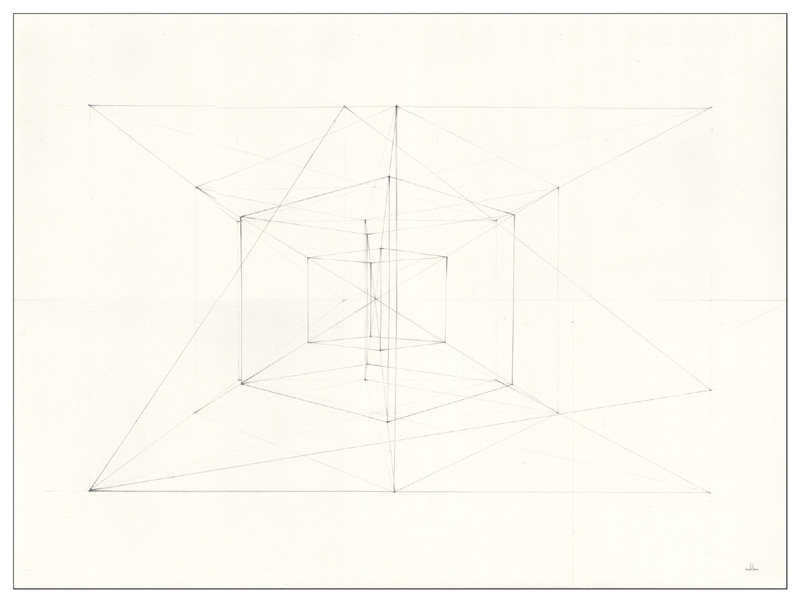
Triangulation 4
22″ x 30″
Graphite on paper
2006

To my sister Bonnie

*

Ricardo F. Morín

June 2025

Oakland Park, Florida

Author’s Note

This reflection was originally drafted before The Ethics of Perception, Part I, yet it belongs to the same inquiry into attention, understanding, and ethical relation.


There are moments when the truest form of intimacy is silence.
At other times, it’s the quiet labor of reaching for the right word—however incomplete—that brings us closer.
Expression, in this light, is not just a vehicle for communication, but an act of care.

To speak, to withhold, to write, to listen—each choice carries a particular weight.   
Intimacy lives in these gestures:    not in grand declarations, but in the ethics of how we reveal ourselves—and how we receive what another dares to offer.
What follows is not a theory, but a reflection on how intimacy appears in expression—and in its absence.

It’s hard to pinpoint the moment when something becomes intimate.
It isn’t always a touch, or a glance, or even a confession.
Sometimes, it’s just a pause—a shared pause—between one word and the next, when both people sense that something true is either about to be said or has just been said, without quite naming it.

Once, sitting face to face, I watched someone I cared for stare silently out the window.
I said nothing either.
There was no gesture, no disclosure, no clarifying words.
And yet the silence didn’t feel empty—it felt full.
In that stillness, something passed between us—not a message, not even an understanding, but a kind of permission:

To exist without explanation.
To be present without having to perform.

That moment stayed with me not because it was dramatic, but because it was unplanned.
I hadn’t expected it, and I couldn’t have recreated it.
I only knew, afterward, that I had been in the presence of something rare:
an intimacy that asked nothing more than to be.

And yet, not all intimacy is born in silence or in someone else’s presence.
Some comes later, through writing—in that long interval between feeling and saying.
Some is only possible thanks to the quiet distance that makes reflection possible.

The word intimacy often evokes physical closeness:
the realm of touch, proximity, lovers, secrets shared in the dark.
But what if intimacy were less about closeness than about permission?
The permission to be undefended.
To move slowly.
To be unclear—and still be trusted.

To be intimate with someone is not merely to be known, but to be seen—
seen without the pressure to explain yourself quickly or justify what you feel.
It’s an opening, and it’s also a risk:
the risk of being misunderstood, and the deeper risk of being understood too well.

Some forms of intimacy unfold face to face.
Others require distance.
Some happen through dialogue.
Others need a single voice, speaking on one’s own in a quiet room.

That’s where writing begins—
not as performance, but as a long conversation, uninterrupted.

Intimacy shifts with context, with time,
with the shape of the self we bring to another.
It is not one thing—
not just closeness, or tenderness, or vulnerability—
but a set of ways we allow ourselves to be known,
and sometimes, to know another.

There’s the intimacy of the body—
perhaps the most visible and least understood.
It belongs to touch, proximity,
the instinctive draw toward another’s presence.
But this form can deceive:
physical closeness without emotional resonance is common—
and easily faked.
Yet when body and emotion align,
there’s a wordless attunement:
a hand resting on a shoulder for just the right amount of time;
a breath falling into rhythm without intention.

Then there’s emotional intimacy:
the slow courage to say what one feels—
not just when it’s beautiful or convenient,
but when it’s awkward, incomplete, or raw.
This kind of intimacy isn’t given—it’s earned.
It may take years, or a single night.
Trust lives here—or breaks.

There’s also intellectual intimacy:
what arises in conversation
when ideas flow without anyone guarding their ground.
It’s rare.
Most social spaces reward speed,
the need to shine, or the safety of politeness.
But sometimes, with someone equally curious,
thought expands in the presence of the other—
not in agreement, but in response.
There’s nothing to prove—
only the pleasure of discovery.
That’s intellectual intimacy.
It creates a different kind of closeness—
not of feeling, but of perception.

Stranger still is narrative intimacy—
the kind that forms not between two people in the same room,
but between the one who writes and the one who reads,
separated by silence and time.
It isn’t immediate—
but it isn’t less real.
A voice emerges from the page
and seems to speak directly to you,
as if it knew the contours of your mind.
You feel understood—without being seen.
You may never meet the person who wrote those words,
but something in you shifts.
You are no longer alone.

These are not rigid categories.
They overlap, interrupt, evoke one another.
One may deepen another.
Physical presence can create emotional safety.
Intellectual closeness can open into unexpected tenderness.
And still, each has its own rhythm,
its own grammar—
and its own risks.

In that complexity, intimacy ceases to be a condition.
It becomes a practice:
something we learn,
lose,
revise,
and sometimes write
when no other form is possible.

Writing, too, is a kind of intimacy—
not only with others,
but with oneself.
Especially when it’s honest—
when what’s written is not just clever or correct,
but true.
That kind of writing doesn’t flatter.
It doesn’t argue.
It reveals.

We write to bring something forth—
not just for an audience,
but to hear ourselves think,
to see what we didn’t yet know we felt.
In writing, we become witnesses to our own consciousness—
both its lucidity and its evasions.

We follow a sentence
not only for its logic,
but for the feeling it carries.
And when that feeling falters,
we know we’ve lost the thread.

So we begin again, and again—
trying not just to explain,
but to say something that feels just.

In that sense, writing is an ethical act.
It demands attention.
It requires patience.
It invites us to inhabit our own experience
with precision—
even when that experience is fragmented or unresolved.

And if we are lucky—
if we are honest—
something in that effort will reach someone else.
Not to impress.
Not to convince.
But to accompany.

Sometimes you reach out—carefully, sincerely—and receive silence, indifference, or a response so misaligned it makes you feel naïve for having tried.
Other times, the failure is subtler:
a conversation that scatters just as something real begins to take shape—or a listener who hears your words, but not your meaning.

Those moments stay with us.
Not because they’re dramatic, but because they remind us how precarious intimacy can be.
It can’t be forced—just as humility can’t.
Both require a quiet letting go—a willingness to offer something without knowing how it will be received.
We can prepare the ground, make the gesture, risk the truth—but the rest depends on the other: their timing, their capacity, their willingness to meet us there.

There’s also the experience of being misunderstood—not just in fact, but in essence.
You try to say something that matters, and the other person responds to what they think you said—or to a version of you that never was.
It’s a blow—
that mismatch between what you tried to share and what actually landed.
The desire for intimacy becomes exposure without connection—a wound instead of a bridge.

Sometimes we avoid intimacy not because we don’t want it, but because we fear what it might cost.
We’ve been made to feel clumsy—for caring too much, or for being too visible.
Or we’ve shared something intimate, only to have it treated lightly—or analyzed without feeling.
After that, we grow cautious.
We speak less—or in fragments—or not at all.

It’s in the wake of such rejections—large or small—that writing ceases to be mere expression.
It becomes repair.
Writing allows us to recover what was lost in the moment—
to name what never reached its destination,
to finish the thought no one waited for,
to say it again—this time without interruption, without assumptions, without fear.

And while writing cannot undo the failure of a shared moment, it can offer something else:
coherence.
A record.
A form of truth that endures—even if it wasn’t heard.

In this way, writing becomes a quiet act of insistence—not against the world, but on behalf of the self.
It’s a way of saying:
What I tried to share still matters—even if it wasn’t received.

In the end, intimacy is not a state but a gesture—
repeated again and again—
toward understanding,
toward presence,
toward a shared sense that may arrive… or may not.

Sometimes that gesture is a word spoken at the right moment.
Sometimes it’s a silence held just long enough for the other to speak.
And sometimes it’s the act of writing—solitary, patient, unfinished—
offered not to a crowd,
but to a single imagined reader
who, one day, might need what you are now trying to say.

Writing, at its core, is a form of listening.
Not only to others,
but to the self that doesn’t rush,
doesn’t perform,
doesn’t need to persuade.

To the self that waits—
that wants to be known not by what it manages to say in quick response,
but by what it keeps trying to say with care.

That’s why I return to the page:
not because it guarantees connection,
but because it keeps the door open.
Because in a world that demands speed, certainty, and charm,
writing makes room for something slower and more faithful:
the long, unfinished gesture of trying to reach someone—
perhaps even oneself—
with something resonant.

And when intimacy happens—on the page or in life—
it’s never because we found the perfect words.
It’s because someone stayed.
Someone listened.
Someone let the moment open—without rushing to close it.

That’s what I’m doing now:
writing not to end something,
but to leave it open—
so that something of greater consequence might enter.

*

Ricardo F Morín Tortolero

Capitol Hill, D.C., June 9, 2025


“Notes From Within” 

May 28, 2025
Triangulation Series M
C-Print
2007

“On Vulnerability”

*

Dedicated to my siblings

There’s a certain kind of person the world seems to admire—sharp-tongued, composed, deliberate.    He moves through life as if he’s never doubted the sound of his own voice.    His gestures are practiced, his opinions unshakable.    It’s a performance of authority, and to many, it’s compelling.

But I’ve never fit that mold.    I don’t hold myself like someone bracing for a fight with the world.    I don’t presume to master a room.    And more and more, I’ve come to believe that what makes a person is not how forcefully he presents himself, but how honestly he shows up.

Vulnerability has never been fashionable.    It doesn’t draw applause or dominate the stage. But it’s where I’ve found the most truth.    Not in being right, or revered, or untouchable—but in admitting how little I know, how often I’ve failed, and how much of life resists explanation.

We’re taught to act as if we’ve earned our place—through effort, through cleverness, through some innate worth.    But I’ve lived long enough to see how much is assumed, how much is favored, how many doors open not because of merit but because of circumstance, appearance, proximity to power.    The world flatters performance.    It often mistakes loudness for depth, certainty for wisdom.

But beneath all that, we’re fallible—achingly so.    We get things wrong.    We hurt people.    We retreat when we should have stayed, and speak when silence would have been kinder.    We tell ourselves stories to survive, not always to understand.

And yet, that fallibility isn’t shameful.    It’s not a flaw to be punished—it’s the most human part of us.    The mistake is not in being wrong; it’s in pretending we’re not.    Intimacy begins where performance ends—when we stop curating ourselves and let others see what is:    our confusion, our fear, our imperfect love.

I’ve stopped wanting to impress.    I want to be known.    I want to know others—not through their accomplishments or their poses, but through the quiet truths they carry.    I don’t need anyone to be flawless.    I need them to be present, to meet me somewhere beneath the surface.

That, to me, is strength.    Not the kind that commands a crowd, but the kind that sits across from others, unguarded, and says, “Me too. I don’t have it either.”

The world may never reward dishonesty with applause.    But it will reward it with connection—with moments that feel real, human, and lasting.    And in the end, I think that’s the only recognition that ever matters.    Not the illusion of certainty or the performance of strength, but the willingness to return, again and again, to the quiet inside us—the one where we are fallible, open, and fully alive.

*

Ricardo F Morin

Bala Cynwyd, Pa; May 28, 2025

Editor:    Billy Bussell Thompson


“What the Mind Forgets but the Heart Quietly Keeps”

April 20, 2025

*

*


“Mario Vargas Llosa was a daring truth-teller.   He was also my friend.”

— Marie Arana, The Washington Post

Read the full article


*

I sent Marie Arana’s moving tribute to my sister, Bonnie, who had directed several of Vargas Llosa’s plays in Madrid and had encountered him on more than one occasion.    I knew this news would strike a deeply personal chord.

“It’s clear how deeply Vargas Llosa’s death has affected you,” I wrote to her.

“You felt close to him—not only as a reader or as a playwright, but as someone whose voice accompanied you through many chapters of your life.    Your grief resonates with me, because I understand what it means to lose a figure who, though not family, becomes part of our inner landscape—someone who shapes our ideas, our convictions, even our way of seeing the world.”

She replied:    “the death of such a brilliant mind—so present for decades—left a void that is hard to name.”    That idea moved me deeply.

“It saddens me profoundly,” I wrote back,

“to consider the silence that now follows him.    I understand why this hits you so hard—perhaps because Vargas Llosa stood for the very opposite:    a luminous intellect, fiercely articulate.   To imagine even he is gone…    it hurts.”

“I’m with you,” I added.

“And even from afar, I hold you in this grief.”

These reflections stirred memories of our own family—of our father, whose cognitive decline began after a traumatic brain injury.    He slowly lost his speech, his clarity, his grasp of the world around him.

And our mother, who held on much longer, also slipped away eventually—her presence fading in slow motion.

Our paternal and maternal uncles, Calixto and Fredy, experienced the same kind of long, quiet departure.    Years of silence.   Gradual disappearances.    Losses we didn’t always know how to name, but which marked us all.

It’s a pattern I can’t overlook.

I’ve done the research.    (You may not know this.)    Genetically, my risk for similar decline falls in a moderate range.   Not a verdict, not a guarantee—just a presence.   A shadow that walks beside me, saying nothing, revealing nothing.

Sometimes I wonder whether knowing this helps or hurts.

But I choose to know.

I choose to face it.

Because if ever I find myself on that road, I want to walk it with the same dignity I saw in our parents—even in confusion, even in silence—when their eyes could still recognize us with a flicker of tenderness.

And I want you to know that.

I want us both to remember.

*

Ricardo Federico Morín Tortolero

April 17, 2025; in transit from Florida to Pennsylvania


“A Threshold of Silence”

February 12, 2025

~


*

Michael Basso
(June 28, 1955 – May 28, 2025)

~


*

Sometimes sudden, sometimes creeping in with the years, there comes a moment when mortality ceases to be an abstraction.     It is no longer a distant eventuality, an idea tucked away in the folds of daily existence, softened by distractions and routine.     Instead, it steps forward, undeniable and weighty, as certain as breath and just as fleeting.

Perhaps it arrives with the quiet betrayal of the body—a stiffness upon waking that does not pass, the faltering of memory, the slight hesitation before a step once taken with ease.     Or maybe it comes with loss:     a friend, a sibling, a parent, a spouse, whose absence feels like a rehearsal for one’s own.     The awareness sharpens and turns time into something both more precious and more fragile.     We begin to measure life in what remains rather than what has passed.

And yet, even with this awareness, there is resistance.     The mind flits away and grasps at plans, distractions, the comfortable illusion of continuity.     We fear death, but we also refuse to fully look at it, as if acknowledgment alone might hasten its approach.     We craft rituals around it, philosophies to explain it, but we rarely sit with it, silent and unadorned.     It is not death itself that terrifies—it is the knowing, the certainty that it will come, whether with warning or in a moment unguarded.

But what if, instead of turning away, we let the awareness settle?     Not as a burden, but as a quiet companion.     If we could bear to see loss not as a theft but as an inevitable passage, one that has always been woven into the fabric of living, then death itself might lose its urgency.     To know we are mortal is not to despair, but to understand the shape of what we are given.     The question is not whether death will come, but whether we can carry that knowledge without fear—whether we can, at last, learn to live with it.

~


*

II. The Decline: Mind and Body

The body does not falter all at once.     Its undoing is slow, measured in the smallest betrayals—steps that once felt effortless but now require consideration, a name that lingers just out of reach, the gradual dimming of senses that once shaped the world in sharp relief.     At first, these changes seem like passing inconveniences, momentary lapses rather than the steady drift toward an inescapable fate.     But the truth settles in with time:     this is not a phase, not something to be recovered from, but the quiet unraveling of what once felt permanent.

The mind, too, shows its wear.     Thought slows; memories surface in fragments, elusive and unreliable.     There is irony in the awareness that remains—sharp enough to perceive the very faculties now fading.     It is one thing to lose oneself unknowingly, another to watch the process unfold with lucid understanding.     Here lies the deepest struggle:     not merely the failing of body or mind, but the tension between resisting the inevitable and surrendering to it.

Some fight against this decline with a desperate energy and will themselves to retain what is slipping away.     They train the body, challenge the mind, cling to routines as though discipline alone can hold back time.     Others yield more readily and see in each loss a reminder that life is not meant to be held onto with clenched fists.     Acceptance, however, does not come easily—it is not passive resignation, nor is it defeat.     It is an uneasy balance between effort and surrender, between maintaining what can be kept and releasing what must go.

Suffering wears many faces.     For some, it arrives as a single, catastrophic moment—a diagnosis, an accident, an unforeseen unraveling of the body’s delicate order.     For others, it creeps in gradually, its presence felt in the weight of each passing year.     The pain may be physical, unrelenting in its demands, or it may be the subtler ache of losing one’s sense of self, of becoming unrecognizable to one’s own reflection.     Yet suffering, no matter its form, is universal.     It does not measure its presence by fairness or logic.     It simply is.

Against this backdrop, medicine intervenes—an effort to slow, to repair, to resist the natural course of deterioration.     And yet, there is a discord in this.     The body is finite, its functions destined to wane, yet we press forward with treatments, procedures, and endless prescriptions, each promising to forestall the inevitable.     The line between care and prolongation blurs.     To fight for life is instinctive, but at what point does the fight itself become suffering?

In the quiet moments, away from doctors and treatments, the question lingers:     is decline something to battle, or is there dignity in allowing nature to take its course?     And if the answer is neither absolute resistance nor passive surrender, then where, exactly, does one find the balance?

~


*

III. The Distractions That Delay Acceptance

To accept death fully would require a stillness that few can bear.     The mind, restless and cunning, finds ways to avoid such stillness, to weave a life so full of movement and intention that mortality remains a distant, theoretical concern.     And so, we fill our days with efforts to prolong them.

Longevity itself becomes a pursuit, an industry built on the promise that decline can be postponed, perhaps even avoided altogether.     Diets, regimens, supplements, and treatments—all aimed at fortifying the body against its inevitable unraveling.     Science, too, lends its hand, in offering new ways to repair, replace, and sustain.     Medicine intervenes not only to heal but to extend, technology whispers of futures in which aging is optional, and ritual grants the comfort of structure to what cannot be controlled.     Each of these offers something real—time, ease, a semblance of mastery over the body’s betrayals.     But beneath them all is the same unspoken hope:     that death, if not conquerable, might at least be postponed long enough to be forgotten.

Yet it is not only the fear of death itself that keeps us tethered to life but the weight of what remains unfinished.     The obligations we have not yet fulfilled, the words left unsaid, the people who still need us—all of these create a sense that departure is premature, that to leave now would be to abandon something essential.     Even in old age, when life has been long and full, there lingers the feeling that there is more to do, more to settle, more to understand.     The past tugs at us with its unresolved questions; the future, though narrowing, still holds the illusion of possibility.

And so, we resist stillness.     We resist the quiet where truth is most easily heard.     The mind, unoccupied, might begin to accept what the body already knows.     And so, we fill the hours, surround ourselves with routine, distraction, movement.     Even suffering, in its strange way, can serve as a tether—something to focus on, something to endure, rather than a void to surrender to.

But what if we let the distractions fall away?     If we stopped grasping for more time, more purpose, more noise?     What would remain?     The fear, yes—but also the possibility of peace.     For all our striving, death will not be bargained with. It comes when it will, unmoved by the measures taken against it.     Perhaps the final act of wisdom is not to resist, but to release—to allow the quiet to settle, to let the mind and body, at last, align in their understanding.

~


*

IV. The Weight of Suffering and Endurance

Suffering is the one certainty all sentient beings share.     It is neither rare nor exceptional; it is the undercurrent of existence, woven into the fabric of life from its first breath to its last.     And yet, for all its universality, suffering is deeply personal—felt in ways no other can fully understand, borne in ways that cannot be measured.

Pain takes many forms.     It may be the slow tightening of the body against itself, the ache of illness, the heaviness of fatigue that never fully lifts.     Or it may be the quieter pains—the loss of self as the mind falters, the loneliness of watching the world move on without you, the grief of knowing that, no matter how much one has endured, there is still more to bear.     Some suffer in the open, their pain visible and acknowledged.     Others carry it in silence, as though to admit its weight would be to surrender to it.

Yet suffering alone does not mark the end.     There is something beyond it, something deeper:     endurance.     The threshold of what one can bear is not fixed; it shifts, expands, contracts.     A pain once unthinkable becomes routine; a burden that seemed insurmountable is carried, day after day.     And yet, there is always a limit, a moment—often unspoken, often known only in the quiet of one’s own thoughts—when endurance is no longer enough.

This is the reckoning, the moment when staying alive is no longer an act of living but of mere persistence.     For some, it comes as a sudden recognition, as clear as a breaking dawn.     For others, it arrives gradually, the body whispers before the mind dares to listen.     It is not simply about pain, nor is it about age.     It is the moment when the will to remain no longer outweighs the cost of doing so.

There is no universal measure for when this moment arrives; it is known only to the one who bears it.     To endure is an instinct, a habit built into the core of existence.     But to know when endurance has reached its end—that is something else entirely.     It is not weakness, nor is it surrender.     It is a quiet knowing, a recognition that every life carries within it the right to determine when it has been enough.

And so the question lingers:     is suffering the price of life, or is there a point at which one is justified in setting the burden down?     The answer is not written in doctrine, nor in medicine, nor in the opinions of those who do not bear the weight themselves.     It is written in the individual, in the silent moment when one understands—this is enough.

~


*

V. The Unseen Threshold

Life does not depart all at once. It recedes, quietly at first, almost imperceptible in its withdrawal.     The breath grows shallower, not in gasps but in a gradual easing, as though the body has decided to take up less space in the world.     Weight diminishes, not only in flesh but in presence—the self becomes lighter, less tethered to the demands of existence.     A once-restless mind drifts, thoughts untangle, as if loosening its grip on the past, the future, even the urgency of the present.

These are not signs of failure, nor of defeat.     They are the body’s way of whispering that it is time. Time to ease away from effort, from the relentless task of sustaining itself.     Time to let go of the struggle to remain.     For all the fear that surrounds death, the body itself does not fear it.     It knows when to surrender long before the mind is ready to accept.

And so comes the moment of knowing—not a grand realization, not an epiphany, but a quiet certainty.     It is not measured in days or dictated by diagnosis.     It is something deeper, something felt.     Some fight against it and grasp at every last breath as though sheer will alone can anchor it.     Others meet it as one meets sleep—reluctant at first, then trust, then finally yield to its pull.

There is dignity in this release.     Not the dignity others impose, the kind measured in stoicism or restraint, but the simple dignity of relinquishing control.     Of allowing the body to do what it was always meant to do:     to reach its end not as a tragedy, but as a completion.     To fight against this moment is to resist the natural rhythm of life itself.     But to accept it—to welcome the stillness, to let breath slow without fear—that is its own kind of grace.

In the end, death is not something that must be conquered, nor something that must be endured beyond what one can bear.     It is simply the last threshold, unseen until it is reached, known only to the one who crosses it.     And when the time comes, there is nothing left to do but step forward—light, unburdened, and without regret.

~


*

To think of death without fear—to sit with it, unguarded, and allow it to be what it is—this is a rare and difficult peace.     For so long, the mind has recoiled from its certainty and wrapped it in distractions, explanations, and resistance.     But there comes a point when all of that falls away, when death is no longer something to be argued with or postponed, but simply recognized as the inevitable conclusion to a life that has been lived.

Fear untangles itself when death is no longer treated as an interruption, no longer seen as a theft, but rather as something as natural as breath itself.     The body, in its wisdom, has already begun to let go.     It is the mind that lingers and clings to meaning, to unfinished things, to the illusion that one more day, one more hour, might change something essential.     But in the end, no justification is needed.     One does not have to prove that it is the right time.     The right time comes, whether welcomed or not, and acceptance is simply the act of ceasing to resist.

Stillness is not the same as resignation.     Resignation carries a sense of defeat, of something being taken against one’s will.     But true stillness—true acceptance—is something else entirely.     It is an arrival, a settling into the inevitable without fear or regret.     It is the moment when the mind and body, long at odds, finally move in the same direction.     No more effort.     No more bargaining.     Only the quiet understanding that what was given has been enough.

To embrace the end is not to let go of life’s value, but to affirm it fully—by allowing it to complete itself with grace.     There is nothing left to do, no more debts to settle, no more battles to fight.     There is only the quiet, and the quiet is enough.

~


*

VII, In Closing

No life is lived in solitude, and no journey—especially the one toward acceptance—is walked alone.     Along the way, we are shaped, guided, and held by those who have touched our hearts and left their presence within us even after they are gone.     In facing mortality, we recognize not only our own, but also those who have come before us, whose lives continue to echo in memory, in love, in the quiet places where absence becomes something enduring.

Their presence lingers—not as shadows, but as light.
They have taught us, challenged us, consoled us, and, in their own ways, prepared us for the path we all must take.

Death, in its harshness, strips us bare and confronts us with what is essential.
Yet, it also unites us, for the love we have given and received does not fade with physical absence.

Our loved ones remain until the end; they sustain us through their memory and the love they have left within us.

To them, we offer our deepest gratitude.
They are not gone.
They remain, in the heart, in the soul, in the quiet acceptance of all that has been and all that will be.

*

Ricardo F. Morín Tortolero

June 11, 2025, Capitol Hill , D.C.


*