Posts Tagged ‘Juan Vicente Gómez’

“The Burden of Repair”

November 5, 2026

*


A Nation Made to Pay. Ricardo F. Morín. CGI, 2026.

Ricardo F. Morín

November 4, 2036

Rohnert Park, Ca

In 2025, Venezuela’s National Survey of Living Conditions recorded a decline in household income poverty from 73.2 to 68.5 percent, while extreme poverty fell from 36.5 to 31.7 percent.  The improvement was real.  So was the deprivation that remained.  Nearly a third of Venezuelan households still lacked sufficient income to meet basic food requirements.  Among households supplied with water through public aqueducts, only 29 percent received it daily, while just one in ten households connected to the electrical network reported uninterrupted service.  The survey also identified approximately 1.2 million children and adolescents outside the educational system.  Greater income had not produced a corresponding restoration of public services or ordinary security.  For families required to purchase what public institutions failed to provide, an improvement in measured poverty did not necessarily mean a comparable improvement in their circumstances.1

The condition did not begin with the governments of Hugo Chávez and Nicolás Maduro, although their decisions contributed substantially to its severity.  Venezuela’s history contains repeated instances in which political authorities committed territory, public revenues, mineral rights, and future economic obligations under arrangements whose consequences endured after the governments responsible for them had departed.  Some of those arrangements were lawful settlements of disputes, others were acts of governmental discretion, and still others arose through coercion or the abuse of public authority.  Their legal character and immediate consequences differed.  The burden they imposed upon subsequent generations nevertheless reveals a persistent separation between those empowered to govern and those required to live under their decisions.

The formation of the Republic did not establish an enduring correspondence between political authority and public accountability.  Independence secured the existence of a sovereign state without immediately extending political participation to all its inhabitants or establishing institutions capable of restraining the personal exercise of power.  Military commanders repeatedly intervened in civilian government, while public offices and economic privileges were distributed through political allegiance.  These practices were challenged throughout Venezuelan history, and constitutional changes periodically curtailed them.  Yet the succession of governments did not always alter the relationship through which political authority determined the disposition of resources and obligations affecting persons excluded from the decisions themselves.

The territorial controversies of Guayana Esequiba and La Guajira arose under different historical and legal circumstances.  The arbitration of 1899 established a boundary between Venezuela and British Guiana that Venezuela subsequently challenged.  The Geneva Agreement of 1966 created a framework for resolving the controversy, which eventually reached the International Court of Justice.  The Court heard arguments on the merits in May 2026, following earlier decisions concerning its jurisdiction and provisional measures.  Guyana administers the disputed territory and maintains the validity of the arbitral award; Venezuela contests that validity.  The dispute has continued across the succession of governments in both countries, while the inhabitants of the territory have remained subject to the political and economic consequences of its disputed status.2

La Guajira followed a different course.  Spanish arbitration in 1891, Swiss arbitration in 1922, and the López de Mesa–Gil Borges Treaty of 1941 established the terrestrial boundary between Venezuela and Colombia.  Most of the peninsula remained within Colombia, while its eastern portion remained Venezuelan.  The settlement of the land boundary did not resolve the separate maritime controversy in the Gulf of Venezuela.  Nor does the Venezuelan perception of territorial loss establish, by itself, that the decisions were unlawful or procured through improper diplomacy.  The settlement nevertheless divided a territory inhabited by communities whose existence preceded the formation of either republic.  The Wayuu people continued to live across a boundary negotiated between two states whose jurisdiction they were thereafter required to recognize.3

International boundaries require stability, and a territorial settlement cannot remain permanently provisional merely because succeeding generations disagree with its terms.  A government exercising lawful authority must be able to bind the state it represents.  The difficulty arises when the capacity to undertake such obligations exceeds the means available to the affected population to examine the decision, influence its terms, or hold its authors accountable.  In that circumstance, the permanence necessary to international relations also permits the consequences of governmental error to survive the persons responsible for it.

The debt crisis of 1902 and 1903 exposed the problem more directly in the disposition of public revenue.  Britain, Germany, and Italy blockaded Venezuelan ports to enforce claims against the government of Cipriano Castro.  The subsequent Washington agreements assigned thirty percent of the customs revenues collected at La Guaira and Puerto Cabello to the settlement of foreign claims.  The Hague arbitration then granted preferential treatment to the blockading powers.  Domestic fiscal failures had helped produce the crisis, while foreign governments used military coercion to secure favorable treatment for their creditors.  The resulting obligations were satisfied through revenues collected from future commerce.  Goods entering the ports continued to generate duties, but a predetermined portion of those receipts was committed to claims arising from decisions made before their collection.  The settlement secured repayment without restoring to the Venezuelan population the revenue already assigned.4

Petroleum offered another means of financing the state and distributing political advantage.  Under Juan Vicente Gómez, officials awarded concessions to politically connected individuals, many of whom subsequently transferred their rights to foreign companies.  The expansion of production transformed the national economy, creating employment, public revenue, and commercial opportunities on a scale previously unavailable.  Those benefits were substantial.  Yet the right to obtain a concession could depend upon proximity to the ruler rather than the economic contribution of the intermediary.  Officials conferred private advantages through rights over resources belonging to the nation.  The concessionaire could transfer the commercial value of the privilege while the state retained responsibility for the institutional and economic conditions under which the industry developed.5

The extension of political participation followed a separate and uneven course.  Venezuelan women obtained a restricted municipal franchise in 1945, universal electoral participation under the statute governing the Constituent Assembly election of 1946, and constitutional recognition of their electoral rights in 1947.  More than a century had elapsed since independence before the Republic formally admitted women to political participation on equal terms.  In November 1948, the military overthrew the elected government of Rómulo Gallegos, interrupting the constitutional experiment within which those rights had been secured.  Their recognition had enlarged the electorate without yet establishing institutions capable of preserving the constitutional order against the intervention of those controlling the armed forces.6

The restoration of civilian government in 1958 demonstrated that the earlier failures were neither inevitable nor universally accepted.  Venezuela subsequently sustained electoral institutions for approximately four decades.  Petroleum reforms and nationalization in 1976 increased state control over an industry previously dominated by foreign concessionaires.  Public education expanded, infrastructure developed, and political participation was more widely established.  These achievements altered the country materially and institutionally.  They did not eliminate the dependence of public finances upon petroleum revenues or the capacity of political parties to distribute economic opportunities through access to government.  The public ownership of an industry established the legal proprietor of its resources; it did not determine how faithfully those controlling the state would administer the proceeds.7

Executive authority expanded substantially during the governments of Chávez and Maduro, extending over productive activity, public contracts, foreign exchange, and the distribution of economic advantages.  The deterioration of petroleum operations, insufficient investment and maintenance, fiscal dependence, monetary instability, and administrative controls weakened the economy before the most extensive American petroleum sanctions were imposed.  These failures diminished the country’s productive capacity and its ability to withstand later restrictions.  Venezuelan officials controlled the institutions through which those decisions were made.  Their responsibility cannot be transferred to foreign governments merely because subsequent external measures aggravated the consequences.

The deterioration altered the conditions under which Venezuelans sustained their households.  A government that restricts access to foreign currency, impairs production, or fails to maintain essential services does not confine the consequences to the institutions administering those policies.  A business deprived of necessary imports may reduce employment.  A hospital without functioning equipment transfers additional expense to patients.  Interruptions in electricity or water require families to reorganize domestic responsibilities and, where possible, purchase alternatives.  The cost is incurred outside the public accounts in which the original decisions were recorded.  Those capable of obtaining private services or foreign currency can protect themselves more effectively than people dependent upon wages, pensions, and public provision.

American sanctions introduced further restrictions upon this weakened economy.  In 2021, the United States Government Accountability Office concluded that sanctions, particularly those imposed upon the state petroleum company in 2019, likely contributed to the steeper economic contraction by restricting petroleum revenue.  The agency also identified mismanagement and declining petroleum prices among the causes of the deterioration.  The findings assigned neither government exclusive responsibility for the resulting condition.  Venezuelan officials had impaired the country’s productive capacity before the principal petroleum sanctions, while the United States subsequently imposed measures whose economic consequences extended beyond the officials they were intended to constrain.  Humanitarian exemptions permitted specified transactions, but restrictions upon banking, commercial services, and international payments continued to complicate humanitarian activity.8

The government in Caracas sought alternative commercial relationships through which petroleum and other resources could continue to generate revenue.  China had already extended extensive credit supported by future petroleum deliveries.  Russian companies held interests in the energy sector, while Turkey established a substantial trade in Venezuelan gold.  Their participation differed considerably.  Chinese lending involved financial obligations secured through production; Russian relationships included investment and strategic cooperation; Turkish transactions principally concerned the purchase, refining, and trading of gold.  Several arrangements predated the sanctions that later increased Venezuela’s dependence upon alternative channels.  Their common consequence was to make the country’s access to international markets increasingly dependent upon financial and commercial intermediaries whose terms were negotiated under conditions of unequal bargaining power.

A purchaser willing to acquire petroleum under sanctions could require discounts or payment arrangements unavailable in an unrestricted market.  A creditor repaid through future deliveries obtained a claim upon production before that production could be sold freely.  An intermediary facilitating a transaction retained compensation from its proceeds.  None of these arrangements was necessarily illegitimate.  Their economic effects depended upon the terms accepted and the alternatives available.  Venezuela’s government could continue receiving revenue while the amount retained for public purposes diminished through financing costs, discounts, or commissions.  The difference affected the resources available for services and public investment, although the loss attributable to any particular transaction depended upon its actual terms.

The gold trade exposed further difficulties.  The Organisation for Economic Co-operation and Development documented serious risks of corruption, illicit financing, human rights abuses, and environmental harm in Venezuelan gold supply chains.  Production frequently passed through intermediaries whose relationships with political, military, and commercial authorities complicated the identification of beneficiaries.  Gold could leave the country through official channels or dispersed networks and enter international trade after passing through foreign markets and refineries.  The destination of the metal did not necessarily reveal the circumstances of its extraction or the distribution of its proceeds.9

Chinese financing commitments concerning Venezuelan mining projects preceded China’s more recent accumulation of official gold reserves.  The quantity of Venezuelan gold acquired by Chinese interests, and the portion, if any, subsequently incorporated into China’s monetary reserves, remain undocumented in the publicly available accounts.  Meanwhile, inhabitants of Venezuelan mining regions have faced environmental damage, coercion, and the activities of armed groups and commercial intermediaries identified in investigations of gold production.  The monetary value attributed to the metal could increase after its departure, while the physical consequences of extraction remained where it originated.  The financial advantages obtained abroad and the damage sustained within Venezuela were not necessarily distributed among the same persons or institutions.

The development of alternative payment systems introduced another form of intermediation.  In April 2024, Reuters reported that Petróleos de Venezuela was expanding the use of USDT, a dollar-linked cryptocurrency, in petroleum transactions as American sanctions were restored.  Commercial intermediaries facilitated some of the payments, collecting fees that reduced the proceeds received by the Venezuelan seller.  The mechanism allowed transactions to proceed through channels less dependent upon conventional banking arrangements, although it did not remove them from all possible regulatory supervision.  Its economic consequence was more immediate than the question of regulatory jurisdiction.  Each additional intermediary could retain a portion of revenue generated by the sale of Venezuelan production.10

The diversification of international financial power offered little assurance that these costs would disappear.  China could reduce its dependence upon dollar-denominated assets, Russia could establish alternative commercial channels, and other states could pursue transactions less exposed to American restrictions.  Their financial autonomy did not necessarily enlarge Venezuela’s freedom to negotiate.  A country possessing extensive reserves, industrial capacity, and numerous suppliers could reject unfavorable terms more readily than one dependent upon a limited number of creditors and purchasers.  For Venezuela, the existence of several powerful trading partners did not necessarily mean that its government could obtain favorable conditions from any of them.  Competition among those partners could improve its position, but the advantage depended upon the terms secured and the uses to which the proceeds were assigned.

The consequences extended to Venezuelans living outside the country.  The Regional Inter-Agency Coordination Platform for Refugees and Migrants from Venezuela estimated that approximately 7.9 million Venezuelans were abroad in November 2025.  Their reasons for leaving differed, and their circumstances after departure were far from uniform.  Many sought income, security, medical care, and opportunities unavailable or inadequate in Venezuela.  Migration imposed costs upon those who departed and altered the responsibilities of the families who remained.  Remittances relieved immediate deprivation, but the capacity of relatives abroad to support a household did not restore the institutions whose failure had made that support necessary.  Private earnings increasingly performed functions that public services and domestic employment could no longer reliably sustain.11

The American petroleum arrangements announced in August 2026 introduced another redistribution of commercial rights.  The White House described an agreement under which North American Blue Energy Partners received century-long concessions covering seventeen Venezuelan oilfields.  On October 1, NABEP assumed operational control of fourteen additional fields, supplementing the three projects it had operated since entering the Venezuelan petroleum industry in 2024.  According to American officials interviewed by Reuters, among the previous operators of the projects transferred to NABEP were five Chinese companies and one Russian firm.  The new arrangement consequently transferred operations previously conducted by Chinese and Russian interests to a company in which the United States would exercise substantial economic and managerial authority.  The administration presented the agreement as part of a program of stabilization, reconstruction, and democratic transition.12

The announced terms extended beyond the transfer of operating rights.  The White House stated that the Pentagon’s Office of Strategic Capital would obtain a thirty-five percent equity interest in NABEP’s corporate parent.  The Department of State would obtain the right to purchase twenty percent of production at cost and a right of first refusal over the remaining eighty percent.  A United States official subsequently told Reuters that the Pentagon held a right of first offer to purchase NABEP’s output, describing twenty percent at production cost and the remainder at market prices.  The two accounts differ both in the department holding the purchasing right and in the legal character of that right; their relationship remains unresolved in the published terms.15 The American government would also exercise a veto over appointments to the company’s board, whose majority was required to consist of American citizens.  The White House attributed to NABEP an investment plan involving up to one hundred billion dollars in Venezuelan petroleum infrastructure.  The projected private investment, the American governmental equity interest, and the purchasing rights were distinct commercial and governmental arrangements, each conferring different benefits and responsibilities.12

The governmental equity interest was structured through penny warrants, according to a United States official interviewed by Reuters in September.  The warrants gave the government the right, without the obligation, to acquire shares at a nominal price at a later date.  They were also intended to protect the government’s thirty-five percent position against dilution as NABEP raised additional capital.  The official stated that the arrangement entitled the United States to dividends before the warrants were exercised.  The distinction between acquiring shares and obtaining the economic advantages ordinarily associated with their ownership was therefore material.  Washington could obtain contractual rights to future dividends and preserve its prospective equity position while the company’s productive expansion remained incomplete.15

The announced investment was not equivalent to capital already committed.  In October, NABEP told Reuters that it had invested approximately one billion dollars of its own capital since 2024 and intended to increase annual reinvestment by as much as fifty percent.  Its spokesman stated that the company’s business plan did not contemplate raising outside financing.  Those disclosures left a substantial distance between the company’s reported financial activity and the scale of development described in the White House announcement.  Rehabilitating seventeen fields would require extensive drilling equipment, skilled personnel, transportation, power generation, and the restoration of deteriorated installations.  The company’s proposed expansion depended upon the availability of capital and productive capacity extending beyond its existing operations.  Its eventual contribution to Venezuelan public revenue would depend upon investment actually undertaken, production achieved, and payments received rather than the magnitude of the announced plan.13

The legal duration of the concessions presented another difficulty.  The White House described rights extending for one hundred years while asserting that the arrangements were governed by Venezuela’s hydrocarbons legislation.  The reform adopted in January 2026 provides an initial term of twenty-five years for mixed enterprises, with a possible extension of fifteen additional years.  It also permits private companies to conduct production through contracts with state-owned enterprises under a distinct legal framework.  The applicable limits therefore depend upon the legal form of the NABEP arrangements and the instruments under which their rights were granted.  The public announcement did not identify those instruments with sufficient precision to reconcile the century-long concessions with the statutory periods governing the different forms of petroleum participation.14

The economic significance of the discrepancy is considerable.  Francisco Monaldi, director of the Latin America Energy Program at Rice University’s Baker Institute, estimated that approximately ten billion barrels could realistically be developed within a twenty-five-year operating period, far fewer than the approximately sixty-five billion barrels of reserves attributed to the seventeen fields.  The statutory possibility of an additional fifteen years would not necessarily produce a proportional increase in recoverable petroleum.  Production depends upon investment, reservoir characteristics, infrastructure, operating costs, and market conditions.  The difference between resources present underground and resources recoverable within a specified operating period bears directly upon the scale of investment required, the revenue that may result, and the economic justification for the rights conferred.13

The January 2026 reform also introduced contractual stabilization provisions designed to preserve the financial and economic equilibrium of mixed enterprises and production contracts.  Materially adverse changes in the legal, fiscal, regulatory, or contractual framework may require adjustments to royalties, taxes, fees, contractual conditions, or compensation.  Such protections serve a recognizable commercial purpose.  Investors undertaking substantial risks require reasonable assurance that subsequent governmental decisions will not arbitrarily destroy the economic basis of their agreements.  Yet stabilization provisions also affect the discretion of future governments to alter fiscal or regulatory conditions.  The reform further permits mixed enterprises to be constituted through presidential authorization, replacing the previous requirement of prior legislative approval with notification to the National Assembly.  The combination of executive authorization and long-term contractual protection places considerable importance upon the authority under which the original commitments are made.14

The constitutional questions extend beyond the competence of the officials who granted the concessions.  Article 302 of Venezuela’s 1999 Constitution reserves petroleum activities to the state under the applicable organic law, while Article 303 requires the state to retain full ownership of Petróleos de Venezuela or the entity established to manage the industry.  The latter provision expressly distinguishes subsidiaries, strategic associations, and other enterprises created through PDVSA’s commercial activities.  Private participation is therefore not categorically excluded, but its permissible form and extent depend upon the constitutional and statutory framework.  An enterprise exercising extensive operational and managerial authority over seventeen fields raises the question whether the rights granted preserve the constitutionally required relationship between the state and the administration of the petroleum industry.  The characterization of NABEP as a company operating in parallel with PDVSA has been advanced in legal commentary.16

The American arrangements raised separate questions concerning statutory authority and governmental expenditure.  On September 30, Senators Jeanne Shaheen, Jack Reed, Elizabeth Warren, and Martin Heinrich addressed a letter to the Secretaries of State, Defense, and Energy requesting the agreements and the legal authorities governing the equity acquisition and petroleum-purchasing rights.  Their letter, publicly announced by the Senate Foreign Relations Committee on October 1, questioned whether the statutory powers of the Office of Strategic Capital authorized an equity interest in a private petroleum company and sought information about the funds available for the Department of State’s purchases.  The senators also requested disclosure of possible financial interests involving members of the administration and other politically connected persons.  Their intervention did not invalidate the arrangement or establish improper enrichment.  It placed the administration’s asserted authority, the proposed financial obligations, and the identity of potential beneficiaries under formal congressional scrutiny.17

The difference in timing matters.  Commercial rights can be granted before additional petroleum is produced.  Their duration and enforceability may extend far beyond the period required to restore the country’s present output.  An investor can obtain a long-term claim in exchange for undertaking substantial risk, while the public benefit remains contingent upon the success of the undertaking and the administration of the resulting proceeds.  The American government’s reported warrant structure introduces another interval between the acquisition of economic entitlements and the future realization of productive value.  If production disappoints, costs exceed projections, or a successor government seeks to revise the agreement, the consequences will depend upon obligations already undertaken.  Contractual stabilization may protect the investor’s expected economic position while limiting the changes available to a future government.  The country could recover productive capacity while accepting restrictions upon the subsequent exercise of its economic authority.

The arrangement has a historical antecedent in the petroleum concessions awarded under Gómez, although the circumstances and legal instruments are not identical.  Both involve the allocation of national resource rights through governmental authority and the participation of foreign commercial interests.  The contemporary arrangement also differs from the customs assignment of 1903, which followed armed coercion and concerned repayment of public claims.  Yet the older episodes demonstrate the duration of obligations created through particular governmental decisions.  The concessions survived the ruler who conferred them; the customs payments continued after the blockade ended.  Their consequences were neither extinguished by political succession nor necessarily reconsidered by those who inherited the responsibility for fulfilling them.

The same distinction applies to the historical territorial settlements.  An international boundary, a sovereign debt, and a petroleum concession possess different legal foundations.  Their continuity can serve legitimate purposes, including legal certainty and the security of commercial relations.  The injury arises when public authorities undertake obligations through discretionary power, insufficient representation, or defective accountability, and the resulting burdens remain enforceable against a population unable to correct the circumstances of their creation.  The stability of an obligation may be necessary to the state while the conduct of those who incurred it remains open to judgment.

Venezuelan rulers bear responsibility for decisions concerning political participation, the administration of public resources, productive investment, monetary policy, and the exercise of coercive authority that contributed to the country’s vulnerability.  Officials who controlled the institutions through which these decisions were made possessed powers unavailable to the population affected by their consequences.  The existence of foreign creditors and commercial beneficiaries cannot absolve them of obligations they neglected or powers they abused.  Nor can external sanctions explain governmental failures that preceded their imposition.

Foreign governments and private interests incur separate responsibilities through the decisions they make within that vulnerability.  A creditor may lawfully demand repayment, an investor may require compensation for risk, and a government may regulate transactions within its jurisdiction.  Each activity possesses an economic rationale.  The legitimacy of the purpose does not determine the fairness of every condition imposed in its pursuit.  The existence of a weakened government may explain why concessions are available on favorable terms to outside interests, but it provides no independent justification for every advantage obtained from that weakness.  Domestic responsibility for creating the conditions of dependence and foreign responsibility for taking advantage of them concern different decisions, undertaken by actors possessing different powers.

The Venezuelan population cannot be assigned an equivalent responsibility merely because its members possess the country’s nationality.  Throughout its history, Venezuelans have organized for political rights, opposed military governments, established civilian institutions, demanded accountability, and resisted the discretionary exercise of power.  The long endurance of personalist authority and military intervention therefore cannot be attributed to an unchanging national disposition.  Political practices survive through institutions, interests, and the unequal distribution of coercive and economic power.  The persistence of those arrangements does not erase the efforts of those who attempted to replace them.

The distinction between governmental responsibility and the inheritance of its consequences explains the particular difficulty of reconstruction.  Venezuela requires capital, productive investment, functioning public institutions, and the recovery of ordinary economic activity.  These necessities create opportunities for creditors, investors, and governments to negotiate claims upon its future wealth.  The country must obtain the means of repairing damage whose causes extend across successive administrations and international relationships.  Yet the households that endured declining incomes, impaired services, and the departure of relatives may also be required to sustain the obligations undertaken to finance that repair.

The consequences of such arrangements will not necessarily be distributed equally.  A restored petroleum industry may generate employment and public revenue while leaving other productive sectors neglected.  A commercial agreement may produce returns for investors while the public benefits remain dependent upon the administration of taxes and royalties.  Improved national income may coexist with families still unable to obtain reliable water, electricity, medical care, or education.  The recovery of production, however substantial, does not itself establish the recovery of the institutions through which its benefits reach the population.

Nor can the country’s difficulties be resolved by treating the restoration of Venezuelan sovereignty as equivalent to the replacement of one foreign beneficiary by another.  National control of resources may be exercised through institutions that remain inaccessible to public scrutiny.  An elected government may inherit long-term commitments entered into by its predecessor while possessing limited means of revising them.  Foreign investment may improve productive capacity without ensuring that the gains are distributed through accountable public administration.  The legal authority to enter an agreement, the economic advantages obtained from it, and the consequences imposed upon the population remain distinct questions even when the agreement is defended as necessary to national recovery.

Venezuela’s historical inheritance contains genuine constitutional achievements as well as repeated institutional failures.  Political rights were extended, civilian government was restored, and national control over petroleum production expanded.  Those achievements altered the country and cannot be reduced to temporary interruptions of an authoritarian tradition.  Their limitations nevertheless appear wherever the institutions established to protect public authority prove unable to restrain its discretionary exercise.  Successive governments inherit the powers of the state without necessarily inheriting effective restraints upon their use.  The population inherits the consequences of decisions it could not always prevent, while the officials responsible for them may depart before those consequences can be fully measured.

The restoration of productive capacity requires decisions that bind future governments.  No state can function without the ability to incur obligations extending beyond the tenure of its officials.  The distinction lies in the institutions through which those obligations are undertaken and in the responsibility retained by those empowered to create them.  When the benefits of a decision are distributed immediately among identifiable parties while its costs are deferred to the public, the passage of time can conceal the original allocation of advantage.  What appears to a succeeding generation as an unavoidable national obligation may have originated in an exercise of power from which that generation received little benefit.

Venezuela’s people have repeatedly endured the consequences of decisions made under the authority of the state, through its relations with foreign powers, and in the administration of its resources.  Their responsibility for those decisions has rarely corresponded to the burdens imposed upon them.  Reconstruction may restore the country’s revenues and productive institutions, but it can also create obligations whose costs will survive the governments negotiating them.  The same population that sustained the original damage may then be required to finance its correction through claims upon wealth not yet produced.

The injustice would persist wherever those empowered to commit the nation’s future remained detached from the consequences of their decisions.  A government could announce the recovery of sovereignty, investors could record the restoration of production, and creditors could obtain the security of their claims, while Venezuelan households continued to bear costs incurred long before the promised recovery.  The burden of repair would then constitute another inheritance of authority exercised by others, rather than the correction of the condition that had made repair necessary.

Documentary Notes

  1. Universidad Católica Andrés Bello, Instituto de Investigaciones Económicas y Sociales. Encuesta Nacional sobre Condiciones de Vida 2025.  Presented May 7, 2026.  Poverty, household services, and educational coverage. Survey presentation.
  2. International Court of Justice. Arbitral Award of 3 October 1899 (Guyana v. Venezuela).  Jurisdictional judgments, provisional measures, and proceedings on the merits, including hearings conducted May 4–11, 2026.  United Nations, Agreement to Resolve the Controversy over the Frontier between Venezuela and British Guiana, Geneva, February 17, 1966. Court case.
  3. Colombian Ministry of Foreign Affairs. Frontera Terrestre Colombia–Venezuela.  The Spanish arbitration of 1891, Swiss arbitration of 1922, and López de Mesa–Gil Borges Treaty of 1941.  Colombian National Administrative Department of Statistics, material concerning Wayuu territorial history.
  4. United States Department of State. Foreign Relations of the United States, diplomatic records concerning the Venezuelan blockade, Washington Protocols of 1903, and Hague arbitration. Office of the Historian.
  5. B. S. McBeth. Juan Vicente Gómez and the Oil Companies in Venezuela, 1908–1935.  Cambridge University Press, 1983.
  6. Venezuela. Estatuto para la Elección de Representantes a la Asamblea Nacional Constituyente, March 1946.  Constitution of 1947, Articles 80–82.  Fundación Empresas Polar, historical records concerning the military overthrow of November 1948.
  7. Council on Foreign Relations. Venezuela: The Rise and Fall of a Petrostate.  Historical account of the democratic period after 1958, petroleum policy, and nationalization.
  8. United States Government Accountability Office. Venezuela: Additional Tracking Could Aid Treasury’s Efforts to Mitigate Any Adverse Impacts U.S. Sanctions Might Have on Humanitarian Assistance.  GAO-21-239, February 2021. GAO report.
  9. Organisation for Economic Co-operation and Development. Gold Flows from Venezuela: Supporting Due Diligence on the Production and Trade of Gold in Venezuela.  September 2021. OECD report.
  10. Reuters. Venezuela to Accelerate Cryptocurrency Shift as Oil Sanctions Return.  April 22, 2024. Reuters report.
  11. Regional Inter-Agency Coordination Platform for Refugees and Migrants from Venezuela (R4V).  Population estimates, November 2025.  United Nations High Commissioner for Refugees, Venezuela Situation, December 2025. UNHCR overview.
  12. The White House. Fact Sheet: President Donald J. Trump Announces Historic Oil Agreement to Secure American Energy Dominance and Drive Venezuela’s Economic Recovery.  August 31, 2026.  Reuters, Steve Holland and Jarrett Renshaw, reporting on the transfer of Chinese- and Russian-operated petroleum projects, August 31, 2026. White House fact sheet.
  13. Reuters. Trump Touted a Record Venezuela Oil Deal. Now Reality Is Setting In.  October 30, 2026.  Reporting concerning the October 1 transfer of operational control, NABEP’s financing, production estimates, and the assessment by Francisco Monaldi. Reuters report.
  14. Venezuela. Ley de Reforma Parcial de la Ley Orgánica de Hidrocarburos.  January 29, 2026, Official Gazette No. 6,978 Extraordinary.  Baker McKenzie, Venezuela’s Hydrocarbons Law Reform: What Businesses Need to Know, March 2, 2026.  Provisions concerning mixed enterprises, private production contracts, contractual duration, executive authorization, and economic stabilization. Legal analysis.
  15. Reuters, Mike Stone. US Structured Venezuela Oil Position to Protect It from Dilution, Official Says.  September 4, 2026.  Description of the penny warrants, anti-dilution provisions, dividend entitlements, prospective equity acquisition, and the Pentagon’s reported right of first offer.  The White House’s August 31 announcement separately describes a Department of State right of first refusal. Reuters report.
  16. Constitution of the Bolivarian Republic of Venezuela, 1999, Articles 302 and 303.  World Intellectual Property Organization, WIPO Lex.  José Ignacio Hernández, Understanding the Implications of the U.S.–Venezuela Oil Deal, Center for Strategic and International Studies, September 4, 2026.  Constitutional reservation of petroleum activities, PDVSA ownership, permitted corporate exceptions, and the legal characterization of NABEP’s operating role. Constitution.
  17. United States Senate Committee on Foreign Relations. Shaheen, Reed, Warren, Heinrich Press Secretaries Rubio, Hegseth, Wright for Answers on Administration’s Oil Deal.  Published October 1, 2026, referring to correspondence sent September 30.  Questions concerning statutory authority, governmental equity, petroleum purchases, and potential conflicts of interest. Senate committee release.
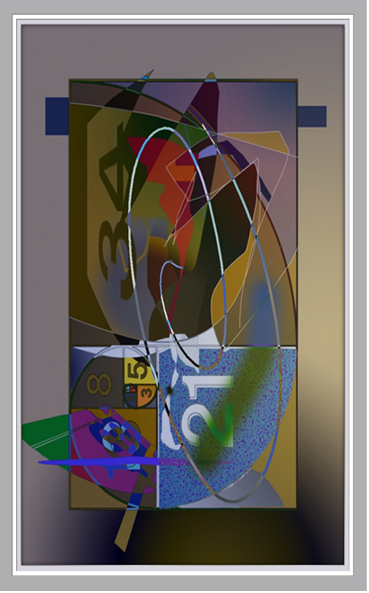
“Unmasking Disappointment: Series XVII”

September 20, 2026

*

“Geometric Allegory” digital painting 2023 by Ricardo Morin (American visual artist born in Venezuela–1954)

*

Scope and Use

This entry forms part of the constitutional corpus presented in the Appendix, comprising the twenty-five constitutions of Venezuela and organized for consultation rather than sequential reading.   Comparison proceeds by means of permanent rubric codes whose identities remain constant across the corpus; absent rubrics signify constitutional silence, while retired rubrics are not reassigned.   Citations are anchored first on the article number and follow the CIDEP recension linked at the close of the entry.   The full corpus definition, methodology, and citation convention are set forth in the Scope and Use note heading the 19th-Century Constitutions, which opens in the installment of “Unmasking Disappointment: Series XI”.

Ricardo F. Morín

Sept 20, 2026

Bala Cynwyd, Pennsylvania


*

13).  The Constitution of 1909

The 1909 Constitución de los Estados Unidos de Venezuela [Constitution of the United States of Venezuela] was ratified by the Asambleas Legislativas de los Estados [State Legislative Assemblies], declared sanctioned by the Congreso [Congress] in Caracas on 4 August 1909, and promulgated in the same city on 5 August, under the presidency of Juan Vicente Gómez.

DOC-PRE—Preamble:

The charter designated its introductory formula as the Prólogo [Prologue]:

“The Congress of the United States of Venezuela, in the name of Almighty God, by authority of the Peoples of the Republic, and in exercise of the faculty conferred upon it by Article 130 of the Constitution, decrees the following:  Constitution.”

The 1909 formula mentions the authority of the Peoples of the Republic and the exercise of the faculty conferred by Article 130.  The 1904 formula identified the Congress as Constituyente [Constituent] and did not cite an article of the preceding Constitution (cf. 1904, formula of sanction:  “THE CONSTITUENT CONGRESS OF THE UNITED STATES OF VENEZUELA, IN THE NAME OF ALMIGHTY GOD AND BY AUTHORITY OF THE PEOPLES OF VENEZUELA, DECREES THE FOLLOWING:  CONSTITUTION”).

FND-TER—Territory:

The Constitution declared that the Venezuelan Nation was the union of all Venezuelans under one covenant of political association for their common utility (Title I, Art. 1; new).  It declared the Nation forever and irrevocably free and independent of every foreign power or “denomination,” according to the word reproduced in the CIDEP recension, and prohibited any authority, Congress, or power from altering its republican, federal, democratic, elective, representative, alternating, and responsible form (Art. 2; new).

The territory comprised everything denominated the Capitanía General de Venezuela [Captaincy General of Venezuela] before the political transformation of 1810, with the modifications resulting from public treaties, and was divided for its better administration into Estados [States], Secciones [Sections], Distritos [Districts], Municipios [Municipalities], and Territorios Federales [Federal Territories] (Art. 3; cf. 1904, Title I, Art. 1:  “The Territory of the United States of Venezuela is the same as that which, in the year 1810, corresponded to the Captaincy General of Venezuela, with the modifications resulting from Public Treaties.”).

The Secciones [Sections] that had formed the Pacto de Unión de 1864 [Covenant of Union of 1864] resumed their sovereignty and united to constitute twenty States enumerated and denominated by the charter (Art. 4; cf. 1904, Title I, Arts. 2–3, which organized thirteen States from Districts).  Their boundaries were governed by those assigned to the former Provinces by the Law of 28 April 1856; boundary controversies were submitted to the arbitral tribunal prescribed by Article 144 (Art. 5; cf. 1904, Title I, Art. 3, § 2, and Title VIII, Art. 126).  The States could unite without relinquishing the faculty to recover their separate character and, while united, retained their rights of representation in the Consejo de Gobierno [Council of Government] and the Corte Federal y de Casación [Federal and Cassation Court] (Arts. 6–8; new in relation to the territorial organization of 1904).

The Territorios Federales Amazonas y Delta Amacuro [Amazonas and Delta Amacuro Federal Territories] could acquire the category of States if they attained the population basis required to elect one Deputy and demonstrated the capacity to attend to public services and their expenditures (Art. 9; cf. 1904, Title I, Art. 4:  “The Federal Territories may attain the category of State provided that they satisfy the following conditions: 1. To have at least one hundred thousand inhabitants; and 2. To demonstrate before Congress that they possess the capacity to attend to the public service in all its branches and to meet the expenditures that it requires.”).  The Distrito Federal [Federal District] comprised the city of Caracas, its outlying parishes, and the Departamento Vargas [Vargas Department]; Caracas was the seat of the General Powers, although the Executive could establish its transitory residence at another place within the District (Art. 10; cf. 1904, Title I, Art. 5).

The national territory could not be alienated, leased, or ceded in any manner to a foreign power (Art. 11; cf. 1904, Title I, Art. 6:  “The territory of the Nation may not be alienated in any manner to a foreign power.”).

POW-LEG—Congress:

The Legislative Power resided in a bicameral Congreso de los Estados Unidos de Venezuela [Congress of the United States of Venezuela], composed of a Cámara del Senado [Chamber of the Senate] and a Cámara de Diputados [Chamber of Deputies] (Title V, Sec. I, Art. 35; cont. 1904, Title V, Sec. I, Art. 30:  “The Legislative Power is exercised by an Assembly denominated the Congress of the United States of Venezuela, composed of two Chambers, one of Senators and the other of Deputies.”).

Each State directly elected one Diputado [Deputy] for every thirty-five thousand inhabitants and one additional Deputy for an excess of fifteen thousand, with at least one Deputy for each State; it elected an equal number of Suplentes [Alternates].  The Deputies served four years and were renewed in their entirety (Arts. 36–38; cf. 1904, Title V, Sec. II, Art. 31:  “To form the Chamber of Deputies, each State shall elect by direct vote and in conformity with its Election Law one Deputy for every forty thousand inhabitants, and one additional Deputy for an excess of twenty thousand. […] The Deputies shall serve six years in their functions.”).  Each Asamblea Legislativa Estatal [State Legislative Assembly] elected from outside its membership two principal Senators and two Alternates, likewise for four years (Arts. 40–41; cf. 1904, Title V, Sec. III, Art. 35:  “To form this Chamber, the Legislative Assembly of each State shall elect from outside its membership two Principal Senators and two Alternates […] The Senators shall serve six years in their functions.”).

Both Chambers judged the qualifications of their members, adopted their regulations, exercised disciplinary authority, enjoyed immunity during the period fixed around their sessions, and observed the prescribed incompatibilities (Arts. 43–56; cont. 1904, Title V, Sec. IV, Arts. 38–51).  When assembled as Congreso [Congress], they examined the presidential message and ministerial accounts and elected the President of the Republic, the Consejo de Gobierno [Council of Government], and the Corte Federal y de Casación [Federal and Cassation Court].  When acting separately as co-legislative bodies, they sanctioned national legislation and exercised the powers respecting taxation, currency, debt, loans, census, sanitation, treaties, national contracts, weights and measures, military organization, Federal Territories, and declarations of war (Arts. 57–58; cf. 1904, Title V, Sec. V, Arts. 52–53).

Bills received three readings in each Chamber.  Once sanctioned, they were communicated to the President for execution and publication; the Minister of the respective branch could also initiate designated codes after prior publication of the bill in the press (Arts. 59–72; cf. 1904, Title V, Sec. VI, Arts. 54–67).

ECO-TES—Treasury:

The Congreso [Congress] decreed national taxes, determined all matters pertaining to the national debt and its interest, decreed loans upon the credit of the Nation, and sanctioned the Presupuesto General de Rentas y Gastos Públicos [General Budget of Public Revenues and Expenditures] (Title V, Art. 57, nums. 6, 10, 11, and 15; cont. 1904, Title V, Art. 52, nums. 5, 9, 10, and 14:  “To decree national taxes”; “To determine all matters pertaining to the National Debt and its interest”; “To decree loans upon the credit of the Nation”; “To sanction the General Budget of Public Revenues and Expenditures”).  The Ministros del Despacho [Ministers of the Departments] presented annually the General Budget and the general account of the preceding year (Title VI, Art. 103; cf. 1904, Title VI, Art. 86, which required biennial accounts).

No expenditure could be made from the Tesoro Nacional [National Treasury] without an express congressional appropriation in the General Budget or an additional credit approved by the Consejo de Gobierno [Council of Government].  Officials acting in contravention incurred civil liability to the Treasury; ordinary expenditures had precedence over extraordinary expenditures, and every additional credit had to be submitted to Congress for approval (Title VIII, Art. 134; cf. 1904, Title VIII, Art. 116:  “No expenditure shall be made from the National Treasury for which Congress has not expressly appropriated an amount in the General Budget of Public Expenditures […] In every disbursement, ordinary expenditures shall have precedence over extraordinary expenditures.”).

Neither the Legislative Power nor any authority of the Republic could issue paper currency, declare banknotes or other paper-represented values to be legal tender, or authorize the coinage of silver or nickel currency without prior congressional authorization conferred through the ordinary legislative procedure (Art. 135; cont. 1904, Title VIII, Art. 117).  Exports remained free from duties throughout Venezuela (Art. 133; cf. 1904, Title II, Art. 7, Basis 10:  “Not to impose contributions upon national products destined for exportation.”).

POW-EXE—Executive:

The Administración General de la Unión [General Administration of the Union] belonged to the Ejecutivo Nacional [National Executive] in every matter not attributed to another authority.  The Executive was exercised by the Presidente de los Estados Unidos de Venezuela [President of the United States of Venezuela], with the Ministros del Despacho [Ministers of the Departments] as his organs and with the Consejo de Gobierno [Council of Government] in the powers expressly conferred upon that body (Title VI, Arts. 73–74; cf. 1904, Title VI, Arts. 68–69:  “[…] the Federal Executive […] is exercised by a Magistrate denominated the President of the United States of Venezuela, in union with the Ministers of the Departments, who are his organs.”).

Within the first fifteen days after their installation, the Chambers assembled as Congreso [Congress] elected the President directly, in a public and permanent session and by secret ballot; the citizen obtaining an absolute majority of the members present was elected (Arts. 75–77; cf. 1904, Title VI, Arts. 70–72:  “There shall be an Electoral Body composed of fourteen members of the National Congress, elected by it […]”).  The Constitution of 1909 does not contain the Cuerpo Electoral [Electoral Body] prescribed by Articles 70–72 of 1904.

The President was required to be Venezuelan by birth, of secular status, more than thirty years of age, and in possession of his civil and political rights (Art. 78; cf. 1904, Title VI, Art. 73:  “The President of the United States of Venezuela shall be Venezuelan by birth and more than thirty years of age […]”).  Temporary or absolute absences were supplied by the Vocal [Member] presiding over the Consejo de Gobierno [Council of Government].  If an absolute vacancy occurred during the first two years of the term, the Councillor exercising the presidency convened Congress to elect the citizen who would complete the term (Art. 79; cf. 1904, Title VI, Art. 74, which prescribed First and Second Vice Presidents).

The President’s exclusive powers included appointing and removing the Ministers; administering the Federal District and the Federal Territories; directing war and commanding the Army and Navy; executing and publishing the Constitution, laws, and decrees; issuing regulations without altering the spirit or rationale of the law; organizing the Army and the National Militia; negotiating loans decreed by Congress; supervising national revenues; regulating posts, telegraphs, and telephones; and exercising the other enumerated functions (Art. 80; cf. 1904, Title VI, Arts. 75 and 80).

With the consultative vote of the Consejo de Gobierno [Council of Government], the President convened Congress extraordinarily, declared a war decreed by Congress, directed the prescribed proceedings of the Procurador General de la Nación [Procurator General of the Nation], administered public lands, mines, saltworks, and the distilled-spirits revenue, directed diplomatic negotiations, concluded national contracts, and could exclude or expel designated foreigners (Art. 81).  With the deliberative vote of the Council, he exercised the extraordinary powers applicable during foreign war, internal commotion, or armed rebellion; employed the public force to terminate armed collisions between States or suppress rebellions; and granted amnesties and pardons (Art. 82; cf. 1904, Title VI, Art. 80, nums. 8, 9, and 11).

The President presented an annual message to Congress (Art. 83; cont. 1904, Title VI, Art. 76).  He could not be reelected for the immediately succeeding term, even if he had not completed the term for which he was elected.  Neither could a citizen who had exercised the presidency during the last year of the preceding term, nor a relative of either citizen within the fourth degree of consanguinity or the second degree of affinity, be elected for the immediately succeeding term (Art. 84; cf. 1904, Title VI, Art. 77:  “The President of the United States of Venezuela may not be reelected for the immediately succeeding term.”).  His salary was fixed by law and could not be increased except for the succeeding term (Art. 85; cont. 1904, Title VI, Art. 78).

The President ceased exercising his functions on 19 April of the final year of the term; on that date, the President of the Corte Federal y de Casación [Federal and Cassation Court] assumed the Executive until the newly elected President took office (Art. 86; cf. 1904, Title VIII, Art. 133:  “[…] precisely on 23 May, the President […] shall cease […] and the Minister of Interior Relations shall enter upon the exercise of the Presidency […]”).  The President was responsible for treason against the Fatherland and ordinary crimes (Art. 87; cont. 1904, Title VI, Art. 79).

The charter established a Consejo de Gobierno [Council of Government] composed of ten Vocales [Members], elected by Congress every four years to represent ten regional groupings.  The Council rendered the consultative and deliberative votes required for presidential powers, authorized additional credits, and could report upon legislation and administration (Arts. 88–97).  The Constitution of 1904 does not contain a Consejo de Gobierno [Council of Government].  The Ministros del Despacho [Ministers of the Departments] were the President’s sole and necessary legal organs, countersigned his acts, incurred personal responsibility for them and joint responsibility for matters resolved in the Consejo de Ministros [Council of Ministers], and presented annual reports and accounts to Congress (Arts. 98–105; cf. 1904, Title VI, Arts. 81–88).

POW-JUD—Judicial Power:

The Judicial Power resided in the Corte Federal y de Casación [Federal and Cassation Court] and in the other tribunals and courts established by law.  Judicial officials were responsible for treason against the Fatherland, bribery or corruption, violation of the Constitution and laws, and ordinary crimes (Title VII, Arts. 106–107; cont. 1904, Title VII, Arts. 89–90).

The Corte Federal y de Casación [Federal and Cassation Court] was the Supreme Tribunal of the Federation and the States.  It was composed of seven Vocales [Members] elected by Congress every four years; the groupings of States and the Federal District presented two candidates, and those not elected became Alternates (Arts. 108–111; cf. 1904, Title VII, Arts. 91–94:  “The Federal and Cassation Court […] shall be composed of seven Members […]”, whose members served six years).  The Members were required to be Venezuelan by birth, more than thirty years of age, and attorneys of the Republic (Art. 108, sole paragraph; cont. 1904, Title VII, Art. 91, sole §).

The Court heard constitutional accusations against the President, Councillors of Government, Ministers, the Procurador General [Procurator General], the Governor of the Federal District, and its own members; proceedings against senior State officials; diplomatic causes; civil suits in which the Nation was defendant; cassation proceedings; prize causes; jurisdictional controversies; the constitutionality of laws; the nullity of acts contrary to the Constitution or State autonomy; controversies arising from presidential contracts; the recognition of foreign judgments; and the other matters attributed by the Constitution and laws (Art. 112; cf. 1904, Title VII, Art. 95).  It presented annually to Congress an account of its work and a report upon impediments to the uniformity of civil, criminal, and commercial legislation (Art. 113; cf. 1904, Title VII, Art. 96, which required a biennial account).  Its Members could not accept employment dependent upon the Executive while exercising their functions, and their remuneration was fixed by law (Arts. 114–115; cont. 1904, Title VII, Arts. 97–98).

The Ministerio Público [Public Ministry] was entrusted to the Procurador General de la Nación [Procurator General of the Nation], who was required to be Venezuelan by birth, more than thirty years of age, and an attorney, and who served two years with two Alternates (Arts. 116–118; cont. 1904, Title VII, Arts. 99–101).  The Procurator promoted the execution of laws, issued legal opinions, supervised federal officials, instituted the prescribed accusations, exercised the Ministerio Fiscal [Fiscal Ministry], and defended the interests of the Nation (Art. 119; cont. 1904, Title VII, Art. 102).

Recensional note:  the CIDEP reproduction of Article 109 omits the Sixth Grouping and enumerates six groupings for a Court of seven Members.  The same recension proceeds from Article 130 to Article 132.  This corpus records both lacunae without supplying text.

POW-SUB—Subnational Government:

The States of the Union were autonomous and equal as political entities and retained the sovereignty not delegated by the Constitution, subject to the obligations of the Bases de la Unión [Bases of the Union] (Title II, Art. 12; cont. 1904, Title II, Art. 7:  “The States forming the Venezuelan Union are autonomous and equal as political entities and retain in its plenitude the sovereignty not delegated by this Constitution […]”).  Every matter not expressly attributed to the General Administration of the Nation belonged to the States; their constitutional terms were to endure four years from 20 February 1910 (Title VIII, Art. 120; cf. 1904, Title VIII, Art. 103:  “[…] the constitutional terms of their Public Powers shall be three years, counted from 1 January 1905.”).

The State tribunals were independent, subject to no review other than that of the Corte Federal y de Casación [Federal and Cassation Court] in the cases permitted by law (Art. 122; cont. 1904, Title VIII, Art. 105).  Every act of the Legislative Chambers or the Federal Executive that violated rights guaranteed to the States or attacked their autonomy was to be declared null by the Court (Art. 123; cont. 1904, Title VIII, Art. 106).

The Federal Government could not maintain within the States resident officials vested with jurisdiction or authority other than the express exceptions for the Treasury, Public Instruction, administration of mines, public lands, saltworks, and the distilled-spirits revenue, and military services at frontiers, fortresses, parks, naval stations, and authorized ports (Art. 129; cont. 1904, Title VIII, Art. 112).  Any citizen could accuse national or State officials before the tribunals or authorities designated by law (Art. 132; cont. 1904, Title VIII, Art. 115).  For the civil and political acts of the States, the governing population was that determined by the latest census approved by Congress (Art. 151; cont. 1904, Title VIII, Art. 134).

CON-AMD—Amendment of the Constitution:

The Constitution admitted amendments and additions, but Congress could decree them only in ordinary sessions, upon the request of three-fourths of the State Legislative Assemblies meeting in ordinary session and upon the points on which a majority of the States concurred.  They could not enter into force until after the renewal of the Public Powers that had requested or sanctioned them (Title VIII, Art. 145; cf. 1904, Title VIII, Art. 127:  “This Constitution is susceptible of amendments or additions; but neither may be decreed by the National Congress except in ordinary sessions and when requested by three-fourths of the Legislative Assemblies of the States in ordinary sessions.”).

The amendments followed the ordinary legislative procedure; once approved by Congress, its President remitted them to the Legislative Assemblies for definitive ratification.  Congress could also initiate amendment, but it required ratification by three-fourths of the Assemblies.  Irrespective of the origin of the initiative, the definitive vote returned to Congress for canvass (Arts. 146–149; cont. 1904, Title VIII, Arts. 128–131).

CIV-SUF—Suffrage:

All Venezuelans more than twenty-one years of age who satisfied the constitutional and legal conditions were electors and eligible for public office (Title III, Art. 15; cont. 1904, Title III, Art. 10:  “Venezuelans more than twenty-one years of age are electors and eligible, subject only to the conditions expressed in this Constitution and the laws.”).  Freedom of suffrage appeared among the guaranteed rights (Art. 23, num. 11; cont. 1904, Title III, Art. 17, num. 11).

The Bases de la Unión [Bases of the Union] required direct vote for the Concejos Municipales [Municipal Councils], the Asambleas Legislativas [Legislative Assemblies], and the Cámara de Diputados [Chamber of Deputies], and indirect or delegated vote for the other officials of popular election; both forms were to be secret and based upon the electoral census (Title II, Art. 12, num. 19; cf. 1904, Title II, Art. 7, num. 19:  “[…] the direct vote, and for their other officials of popular election, the direct or delegated vote […]”).  During electoral periods, the National Public Force and the forces of the States remained quartered during popular elections (Title VIII, Art. 137; cont. 1904, Title VIII, Art. 119).

CIV-CIT—Citizenship:

The Constitution distinguished between Venezuelans by birth and by naturalization (Title III, Art. 13; cont. 1904, Title III, Art. 8:  “Venezuelans are such by birth or by naturalization.”).  Venezuelans by birth were those born in Venezuela and the children of Venezuelan parents, irrespective of their place of birth.  Venezuelans by naturalization were the children of a Venezuelan father or mother by naturalization, born outside the Republic, who established domicile in the country and manifested their will; persons born in the Hispanic-American Republics who established residence and declared their will; foreigners who obtained letters of naturalization; and a foreign woman married to a Venezuelan under the prescribed conditions (Art. 13; cf. 1904, Title III, Art. 8).

The declaration of will was made before the Registrador Principal [Principal Registrar] of the applicant’s domicile and transmitted to the Executive for publication in the Gaceta Oficial [Official Gazette] (Art. 14; cont. 1904, Title III, Art. 9:  “The declaration of the will to be Venezuelan must be made before the Principal Registrar […] who […] shall send a copy of it to the National Executive for publication in the Official Gazette.”).  Venezuelans were required to serve the Nation in conformity with law and enjoyed equal rights throughout the territory of the Republic (Arts. 16–17; cont. 1904, Title III, Arts. 11–12).

The rights of citizenship were suspended for undertaking to serve against Venezuela; for a sentence carrying interdiction or disqualification; for an official’s acceptance of offices, honors, or rewards from a foreign government without authorization from the Senate; and for judicial interdiction (Art. 18; new).  The rights and duties of foreigners were remitted to law, subject to the provisions respecting political participation, indemnities, and treaties (Arts. 19–22; cont. 1904, Title III, Arts. 13–16).

RTS-GAR—Rights:

The Nation guaranteed the inviolability of life and abolished capital punishment, irrespective of the law establishing it or the authority ordering it (Title III, Art. 23, num. 1; cf. 1904, Title III, Art. 17, num. 1:  “The inviolability of life, capital punishment being abolished.”).  It protected property, subject to legislative contributions, judicial decision, and taking for public utility after prior indemnification and adversarial proceedings (Art. 23, num. 2; cont. 1904, Title III, Art. 17, num. 2).

The charter guaranteed correspondence and private papers, the domestic home, personal liberty, expression and the press, transit, industry, assembly and association, petition, suffrage, education, religion, individual security, and equality (Art. 23, nums. 3–15).  The text of 1909 provided that, in causes relating to expression, the accused could not be detained before final judgment; included the right to depart from the Republic and return with one’s property; subjected industry to public order and good morals and prohibited games of chance, raffles, and lotteries; prohibited a second trial for the same offense; and declared infamous punishments abolished (cf. 1904, Title III, Art. 17, nums. 6–8 and 14).

The enumeration did not prevent the States from recognizing other rights and did not deny other rights that might belong to citizens (Arts. 24–25; cf. 1904, Title III, Art. 18:  “The preceding enumeration does not restrict the faculty of the States to accord other rights to their inhabitants.”; new in relation to the general clause of Art. 25).  A person who issued, signed, executed, or ordered the execution of decrees or resolutions violating the guaranteed rights was culpable under law and was required to indemnify the injured party (Art. 26; cf. 1904, Title III, Art. 20).  Regulatory laws that impaired those rights were unconstitutional and without effect (Art. 27; cont. 1904, Title III, Art. 21).

REG-MIL—The Armed Force:

The Congreso [Congress] fixed annually the number of naval and land forces, issued Army ordinances and the law for the formation and replacement of the forces, determined the manner of conferring military grades and promotions, conferred grades from Lieutenant Colonel upward, and decided upon the admission of foreigners into the service of the Republic (Title V, Art. 57, nums. 23–27).  The power respecting admission of foreigners belonged to Congress under Article 57, num. 23, of 1909 and to the Executive under Article 80, num. 21, of 1904.  The President directed war, commanded the Army and Navy, and organized the Army and the National Militia (Title VI, Art. 80, nums. 6 and 10; cf. 1904, Title VI, Arts. 75, num. 6, and 80, num. 4).

During foreign war, internal commotion, or armed rebellion, and after a declaration that public order was disturbed, the President exercised the enumerated extraordinary powers with the deliberative vote of the Consejo de Gobierno [Council of Government] (Art. 82; cf. 1904, Title VI, Art. 80, num. 8).  The Fuerza Pública Nacional [National Public Force] was divided into naval and land forces and was composed of citizen militias; it could be increased in time of war.  Military and civil authority could not be exercised simultaneously by the same person or corporation except during disturbances of public order.  During elections, the National Public Force and the State forces remained quartered.  The armed force could not deliberate, was passive and obedient, and could require assistance only through the civil authorities (Title VIII, Arts. 124–127, 137, and 140; cont. 1904, Title VIII, Arts. 107–110, 119, and 122).

The Constitution of 1909 does not contain the office of Comandante en Jefe del Ejército Nacional [Commander in Chief of the National Army].  Article 43 of the Estatuto Constitucional Provisorio [Provisional Constitutional Statute] of 19 April 1914 regulated that office for the provisional period.  Article 57, num. 2, of the June 1914 Constitution authorized Congress to appoint that officer annually.

REG-REL—Religion:

Religious liberty could not impair the Republic’s derecho de Patronato [right of Patronage], which was to be exercised in conformity with law, and the Federal Executive retained supreme inspection over every established or future form of worship (Title III, Art. 23, num. 13; cf. 1904, Title III, Art. 17, num. 13:  “Religious liberty in conformity with the laws and under the supreme inspection of the President of the Republic.”).  The Nation was to exercise the Patronato Eclesiástico [Ecclesiastical Patronage] in conformity with the Law of 28 July 1824 (Title VIII, Art. 128; cont. 1904, Title VIII, Art. 111).

ECO-INF—Infrastructure:

The States ceded to the Federal Government the territory necessary for fortresses, wharves, warehouses, shipyards, penitentiaries, and other works indispensable to the administration (Title II, Art. 12, num. 7; cont. 1904, Title II, Art. 7, num. 7:  “To cede to the Government of the Federation the territory necessary to erect fortresses, wharves, warehouses, shipyards, penitentiaries, and other works indispensable to the general administration.”).  They reserved to the Federal Power legislative and executive jurisdiction over maritime, coastal, and river navigation, wharves, and national roads; roads passing beyond the boundaries of one State and leading to another State, the Federal District, or the Federal Territories were national roads (Art. 12, num. 9; cont. 1904, Title II, Art. 7, num. 9).

The President regulated federal posts, telegraphs, and telephones and could create or abolish stations or offices when urgently required, reporting to Congress (Title VI, Art. 80, num. 14; cont. 1904, Title VI, Art. 80, num. 17).  Congress legislated respecting the Federal District and the Federal Territories, sanitation, statistics, and works encompassed within the general powers of the Federal Power (Title V, Art. 57, nums. 4, 12, 16, and 21).

CON-FIN—Final Provisions:

The Constitution was to be promulgated and enter into force when Congress, after canvassing the votes of the State Legislative Assemblies, ascertained ratification of the amendments and additions (Title VIII, Art. 153; new).  It opened a provisional period until 19 April 1910 for preparation of the definitive organization of the Republic (Art. 154; new).  During that period, Congress was to elect a Provisional President under the formalities established for the office, and the Provisional President could issue the measures, decrees, and regulations necessary for political and administrative organization (Transitory Provisions, Arts. 155–156; new).

The constitutional terms of the Federal Power were to endure four years from 19 April 1910 (Art. 150; cf. 1904, Title VIII, Art. 132:  “The constitutional terms of the Federal Power shall endure six years, counted from 23 May 1905.”).  The date of Independence was to be computed from 19 April 1810 (Art. 152; cf. 1904, Title VIII, Art. 135:  “[…] the date of Independence from 5 July 1811 […]”).  The Final Provision repealed the Constitution of 27 April 1904 (Art. 157; new).  The charter was given at the Palacio Federal Legislativo [Federal Legislative Palace] in Caracas on 4 August 1909 and ordered executed on 5 August by J. V. Gómez and the Minister of Interior Relations.

Note:  the original text of the 1909 Constitution may be consulted in the CIDEP Recopilación de Leyes y Decretos de Venezuela [Compilation of the Laws and Decrees of Venezuela]:  https://cidep.online/files/constituciones/1909.pdf

*

14).  The Constitution of 1914

The 1914 Constitución de los Estados Unidos de Venezuela [Constitution of the United States of Venezuela] was ratified by the Asambleas de Plenipotenciarios de los Distritos de los Estados [Assemblies of Plenipotentiaries of the Districts of the States], declared sanctioned by the Congreso de Diputados Plenipotenciarios [Congress of Plenipotentiary Deputies] in Caracas on 13 June 1914, and promulgated in the same city on 19 June, under the provisional presidency of Victorino Márquez Bustillos.  It was preceded by the Estatuto Constitucional Provisorio [Provisional Constitutional Statute] of 19 April 1914.

Historical reference

President Victorino Márquez Bustillos exercised the provisional presidency from 1914 until 1922.  During that period, President Juan Vicente Gómez held military command as Comandante en Jefe del Ejército Nacional [Commander-in-Chief of the National Army].  Following his election by Congress in 1915, Gómez remained President-elect without assuming the presidency, while Márquez Bustillos continued to exercise the provisional presidency.

Source: Ramón J. Velásquez, “Gómez, Juan Vicente,” Diccionario de Historia de Venezuela, Fundación Empresas Polar.

https://bibliofep.fundacionempresaspolar.org/dhv/entradas/g/gomez-juan-vicente

DOC-PRE—Preamble:

The charter opened with a formula of sanction by the Congreso de Diputados Plenipotenciarios [Congress of Plenipotentiary Deputies]:

“The Congress of Plenipotentiary Deputies of the States forming the Venezuelan Union, in exercise of the power conferred upon it by the Assemblies of Plenipotentiary Deputies of the Districts of the States, in the name of Almighty God, decrees the present:  Constitution.”

The 1914 formula mentions the power conferred by the Assemblies of Plenipotentiary Deputies of the Districts of the States.  The 1909 formula mentioned the authority of the Peoples of the Republic and the faculty conferred by Article 130 of that Constitution (cf. 1909, Prólogo [Prologue]:  “The Congress of the United States of Venezuela, in the name of Almighty God, by authority of the Peoples of the Republic, and in exercise of the faculty conferred upon it by Article 130 of the Constitution, decrees the following:  Constitution.”).

FND-TER—Territory:

The territory comprised everything denominated the Capitanía General de Venezuela [Captaincy General of Venezuela] before the political transformation of 1810, with the modifications resulting from public treaties, and consisted of the territories of the States, the Distrito Federal [Federal District], the Territorios Federales Amazonas y Delta Amacuro [Amazonas and Delta Amacuro Federal Territories], and the Venezuelan islands in the Caribbean Sea (Title I, Art. 1; cf. 1909, Title I, Art. 3:  “The territory of Venezuela comprises everything denominated the Captaincy General of Venezuela before the political transformation of 1810, with the modifications resulting from Public Treaties.  For its better administration, it is divided into States, Sections, Districts, Municipalities, and Federal Territories.”).

The general boundaries of each State were those then existing, determined by the Law of 28 April 1856, subject to the modifications established by the Constitution of 1909 (Art. 2; cf. 1909, Title I, Art. 5).  Boundary controversies were submitted by the Cámara del Senado [Chamber of the Senate], upon the request of one or more of the respective States, to a tribunal of arbitrators exercising equitable powers and freely appointed by the Federal Executive (Art. 3; cf. 1909, Title I, Art. 5, sole paragraph, and Title VIII, Art. 144).

The Distrito Federal [Federal District] comprised the city of Caracas, its outlying parishes, and the Departamento Vargas [Vargas Department]; Caracas was the capital and seat of the General Powers, although the Executive could establish its transitory residence elsewhere within the Federal District (Arts. 4 and 6; cont. 1909, Title I, Art. 10).  The Amazonas and Delta Amacuro Territories could attain the category of States upon satisfying the prescribed population and administrative-capacity conditions.  The Venezuelan islands of the Caribbean Sea depended directly upon the Federal Executive until they could be constituted as one or more Territories (Art. 5; cf. 1909, Title I, Art. 9).

The national territory could not be alienated, leased, or ceded in any manner to a foreign power (Art. 7; cont. 1909, Title I, Art. 11:  “The territory of the Nation may not be alienated, leased, or ceded in any manner to a foreign power.”).

POW-LEG—Congress:

The Legislative Power resided in the Congreso de los Estados Unidos de Venezuela [Congress of the United States of Venezuela], composed of a Cámara de Diputados [Chamber of Deputies] and a Cámara del Senado [Chamber of the Senate] (Title V, Art. 34; cont. 1909, Title V, Art. 35:  “The Legislative Power is exercised by an Assembly denominated the Congress of the United States of Venezuela, composed of two Chambers, one of Senators and the other of Deputies.”).

Each State directly elected one Diputado [Deputy] for every thirty-five thousand inhabitants and one additional Deputy for an excess of fifteen thousand, with at least one Deputy for each State and an equal number of Alternates.  The Deputies served three years and were renewed in their entirety (Arts. 35–37; cf. 1909, Title V, Art. 36:  “[…] one for every thirty-five thousand inhabitants, and one additional Deputy for an excess of fifteen thousand […] The Deputies shall serve four years in their functions and shall be renewed in their entirety.”).  Each Asamblea Legislativa [Legislative Assembly] elected two principal Senators and two Alternates for three years, with the Senate renewed in its entirety (Arts. 39–40; cf. 1909, Title V, Art. 40:  “[…] two Principal Senators, and two Alternates […] The Senators shall serve four years in their functions.”).

The Chambers judged the qualifications of their members, adopted their regulations, maintained the order of their sessions, enjoyed immunity, and observed the constitutional incompatibilities (Arts. 42–53; cont. 1909, Title V, Arts. 43–56).  When assembled as Congreso [Congress], they conducted the constitutional elections, examined the presidential message and ministerial accounts, could appoint annually a Comandante en Jefe del Ejército Nacional [Commander in Chief of the National Army], and could elevate Territories to the category of States (Arts. 54–57; cf. 1909, Title V, Art. 57).  When acting separately as co-legislative bodies, they exercised legislative powers respecting taxation, currency, debt, loans, sanitation, census, treaties, contracts and concessions, the budget, militia, war, ports, and coasts (Art. 58; cf. 1909, Title V, Art. 57).

Laws and decrees could be initiated in either Chamber and also by the competent Minister after prior publication of the bill.  They received three readings in each Chamber and, once sanctioned, were remitted to the President for execution and publication (Arts. 59–71; cont. 1909, Title V, Arts. 59–72).

ECO-TES—Treasury:

The Chambers, acting as co-legislative bodies, decreed national taxes and authorized their collection for each fiscal year, determined the national debt and its interest, decreed loans, and sanctioned the Presupuesto General de Rentas y Gastos Públicos [General Budget of Public Revenues and Expenditures] (Title V, Art. 58, nums. 2, 6, 7, and 11; cf. 1909, Title V, Art. 57, nums. 6, 10, 11, and 15).  The President negotiated the decreed loans and administered public lands, mines, saltworks, and the distilled-spirits revenue (Title VI, Art. 79, nums. 9 and 18; cf. 1909, Title VI, Arts. 80, num. 12, and 81, num. 4).  The Ministros del Despacho [Ministers of the Departments] presented annually the draft General Budget, the Cuenta General de Rentas y Gastos [General Account of Revenues and Expenditures], and the accounts of their departments (Art. 89; cf. 1909, Title VI, Art. 103).

No expenditure could be made from the Tesoro Nacional [National Treasury] without an express congressional appropriation or a Crédito Adicional [Additional Credit] approved by the Consejo de Ministros [Council of Ministers] and authorized by Executive Decree.  Officials acting in contravention incurred civil liability; ordinary expenditures had precedence over extraordinary expenditures, and every credit had to be submitted to Congress at its next meeting (Title VIII, Art. 118).  Article 118 of 1914 required the affirmative vote of the Council of Ministers; Article 134 of 1909 required the affirmative vote of the Consejo de Gobierno [Council of Government] (cf. 1909, Title VIII, Art. 134:  “No expenditure shall be made from the National Treasury […] unless an additional credit has been accorded with the affirmative vote of the Council of Government.”).

Neither the Legislative Power, the Executive Power, nor any authority could issue paper currency, declare banknotes or other paper-represented values to be legal tender, or authorize silver or nickel currency without prior legislative authorization (Art. 119; cf. 1909, Title VIII, Art. 135).  Exports remained free from duties (Art. 117; cont. 1909, Title VIII, Art. 133).

POW-EXE—Executive:

The Administración General de la Unión [General Administration of the Union] belonged to the Ejecutivo Federal [Federal Executive], exercised by the Presidente de los Estados Unidos de Venezuela [President of the United States of Venezuela] with the Ministros del Despacho [Ministers of the Departments] as his organs (Title VI, Arts. 72–73; cf. 1909, Title VI, Arts. 73–74).  Within the first fifteen days after their installation, the Chambers assembled as Congreso [Congress] elected the President by secret ballot in a public and permanent session (Arts. 74–76; cont. 1909, Title VI, Arts. 75–77).

Temporary absences were supplied by the Minister designated by the President.  Upon an absolute vacancy, the President of the Corte Federal y de Casación [Federal and Cassation Court] assumed the Executive and immediately convened Congress to elect the citizen who would complete the term (Art. 77; cf. 1909, Title VI, Arts. 79 and 86:  “Temporary or absolute absences […] shall be supplied by the Member presiding over the Council of Government.”).  The President was required to be Venezuelan by birth, of secular status, more than thirty years of age, and in possession of his civil and political rights (Art. 78; cont. 1909, Title VI, Art. 78).

The Constitution conferred upon him the execution of the Constitution and laws; appointment and removal of Ministers and officials; administration of the Federal District and the Territories; negotiation of loans, treaties, and contracts; administration of public lands, mines, saltworks, and the distilled-spirits revenue; direction and organization of the armed force; regulation of communications; and the other enumerated powers (Art. 79; cf. 1909, Title VI, Arts. 80–82).  The Constitution of 1914 does not contain the Consejo de Gobierno [Council of Government] regulated by Articles 88–97 of 1909.  The powers that Articles 81–82 of 1909 subjected to the consultative or deliberative vote of that Council appear among the presidential powers in Article 79 of 1914.

During foreign war, internal commotion, or armed rebellion, and after a declaration that public order was disturbed, the President exercised the extraordinary powers of Article 79 until the restoration of peace (Art. 79, num. 23; cf. 1909, Title VI, Art. 82).  The military, extraordinary, pacificatory, and amnesty powers in numbers 22–25 were exercised in conformity with the determination of Congress when it appointed a Comandante en Jefe [Commander in Chief] (Art. 79, sole paragraph; no equivalent provision identified in the Constitution of 1909).

The President presented an annual message to Congress, received the salary established by law, was responsible for treason and ordinary crimes, and ceased in office on 19 April of the final year of the term, when the President of the Court assumed the Executive provisionally (Arts. 80–83; cont. 1909, Title VI, Arts. 83, 85–87).  The charter of 1914 does not contain the prohibition upon immediate presidential reelection or the familial disqualifications established by Article 84 of 1909.

The Ministros del Despacho [Ministers of the Departments] were the President’s sole and necessary legal organs, countersigned his acts, incurred personal responsibility and, with respect to matters resolved in the Consejo de Ministros [Council of Ministers], joint responsibility; presented annual reports and accounts; and were responsible for treason, constitutional or legal violation, expenditures exceeding appropriations, bribery, embezzlement, and ordinary crimes (Arts. 84–91; cf. 1909, Title VI, Arts. 98–105).

POW-JUD—Judicial Power:

The Judicial Power resided in the Corte Federal y de Casación [Federal and Cassation Court] and the other tribunals established by law; judicial officials were responsible for treason, bribery, constitutional or legal violation, and ordinary crimes (Title VII, Arts. 92–93; cont. 1909, Title VII, Arts. 106–107).

The Court was the Supreme Tribunal of the Federation and the States and was composed of seven Vocales [Members] elected by Congress.  The term of the Members was seven years in 1914 and four years in 1909.  The Members were required to be Venezuelan by birth, of secular status, more than thirty years of age, and attorneys (Arts. 94–97; cf. 1909, Title VII, Art. 108:  “The Federal and Cassation Court […] shall be composed of seven Members elected by Congress every four years […]”).  The groupings of States and the Federal District presented the candidates, and those not elected became Alternates (Arts. 95–96; cf. 1909, Title VII, Arts. 109–110).

The Court heard accusations against the President, Ministers, the Procurador General [Procurator General], the Governor of the Federal District, and its own members; proceedings against State officials; diplomatic causes; claims against the Nation; cassation proceedings; prize causes; jurisdictional controversies; the constitutionality and collision of laws; the nullity of acts contrary to the Constitution or State autonomy; contractual controversies; recognition of foreign judgments; proceedings for nullity of titles to mines, public lands, and municipal lands; and controversies arising from a refusal to issue those titles (Art. 98; cf. 1909, Title VII, Art. 112).  It presented an annual report to Congress; its Members could not accept employment dependent upon the Executive while exercising office, and their remuneration was fixed by law (Arts. 99–101; cont. 1909, Title VII, Arts. 113–115).

The Ministerio Público [Public Ministry] was entrusted to the Procurador General [Procurator General], who was required to be Venezuelan by birth, more than thirty years of age, and an attorney.  The Procurator’s term was three years in 1914 and two years in 1909; two Alternates supplied his absences (Arts. 102–104; cf. 1909, Title VII, Arts. 116–118).  His functions comprised promoting the execution of laws, issuing legal opinions, supervising federal employees, instituting accusations, exercising the Ministerio Fiscal [Fiscal Ministry], and representing the Nation judicially (Art. 105; cont. 1909, Title VII, Art. 119).

POW-SUB—Subnational Government:

The twenty States of the Union reciprocally recognized their autonomy, were equal as political entities, and retained the sovereignty not delegated to the Nation, subject to the Bases de la Unión [Bases of the Union] (Title II, Art. 19; cf. 1909, Title II, Art. 12:  “The States forming the Venezuelan Union are autonomous and equal as political entities: they retain in its plenitude the sovereignty not delegated by this Constitution […]”).  Two or more States could unite to form one State and subsequently recover their separate character; while united, they retained their rights of representation in the Senate and of presenting Members for the Court (Arts. 20–21; cont. 1909, Title I, Arts. 6–7).

Every matter not expressly attributed to the General Administration of the Nation belonged to the States, whose constitutional terms were to endure three years from 20 February 1915 (Title VIII, Art. 106; cf. 1909, Title VIII, Art. 120:  “[…] the constitutional terms of their Public Powers shall endure four years, counted from 20 February 1910.”).  The State tribunals were independent, subject only to review by the Court in the cases permitted by law (Art. 108; cont. 1909, Title VIII, Art. 122).

The Federal Government could not maintain in the States resident officials vested with jurisdiction or authority other than the exceptions respecting the Treasury, Public Instruction, posts, telegraphs, telephones, sanitation, administration of mines, public lands, saltworks, and distilled spirits, and military establishments (Art. 113; cf. 1909, Title VIII, Art. 129).  Any citizen could accuse national or State officials before the authorities designated by law (Art. 116; cont. 1909, Title VIII, Art. 132).

CON-AMD—Amendment of the Constitution:

Amendments and additions could be decreed only in ordinary sessions of Congress, upon the request of three-fourths of the Legislative Assemblies meeting in ordinary session and upon the points on which a majority of the States concurred (Title VIII, Art. 130).  Article 130 of 1914 does not contain the requirement to await renewal of the Public Powers; Article 145 of 1909 contained that requirement (cf. 1909, Title VIII, Art. 145:  “[…] amendments or additions shall never be made except upon the points on which a majority of the States concur, nor may they be put into force until after the renewal of the Public Powers of the Nation that requested or sanctioned them.”).

Amendments followed the legislative procedure; the President of Congress submitted them to the State Assemblies for ratification; Congress could initiate them, subject to ratification by three-fourths; and the definitive vote returned to Congress for canvass (Arts. 131–134; cont. 1909, Title VIII, Arts. 146–149).

Recensional note:  in the CIDEP reproduction of Article 130, the words “or of additions; but neither shall be decreed” appear twice consecutively.  They appear once in this summary.

CIV-SUF—Suffrage:

Venezuelans more than twenty-one years of age who satisfied the constitutional conditions were electors and eligible (Title I, Art. 12; cf. 1909, Title III, Art. 15:  “All Venezuelans more than twenty-one years of age are electors and eligible, subject only to the conditions expressed in this Constitution and the laws.”).  Freedom of suffrage appeared among the guarantees, subject only to the Constitution and laws (Title III, Art. 22, num. 11; cont. 1909, Title III, Art. 23, num. 11).

All Venezuelans enjoying the rights of citizenship could elect and be elected to public offices (Title VIII, Art. 123; new).  During voting, members of the Fuerza Pública Nacional [National Public Force] who were on duty remained quartered (Art. 124).  Article 124 of 1914 mentions members of the National Public Force who were on duty and does not mention the State forces; Article 137 of 1909 mentioned the National Public Force and the forces of the States (cf. 1909, Title VIII, Art. 137:  “During electoral periods, the National Public Force and those of the States shall remain quartered for the duration of the popular elections.”).

CIV-CIT—Citizenship:

The Constitution of 1914 employed the categories nationality of origin and acquired nationality; the Constitution of 1909 employed the categories birth and naturalization (Title I, Art. 10; cf. 1909, Title III, Art. 13:  “Venezuelans are such by birth or by naturalization.”).  Venezuelans by birth were those born in the territory and the children of Venezuelan parents.  Nationality was acquired by adult children of a Venezuelan father or mother by naturalization, born abroad, who established domicile and manifested their will; by persons born in Hispanic-American Republics who satisfied the enumerated conditions; by persons who obtained letters of naturalization; and by a foreign woman married to a Venezuelan under the prescribed conditions (Art. 10; cf. 1909, Title III, Art. 13).

The declaration was made before the Registrador Principal [Principal Registrar] and did not produce effect until the Executive ordered and completed its publication in the Gaceta Oficial [Official Gazette] (Art. 11; cf. 1909, Title III, Art. 14:  “[…] shall send a copy of it to the National Executive for publication in the Official Gazette.”).  Venezuelans were required to serve the Nation and enjoyed equal rights and duties in the Union (Arts. 12–14; cf. 1909, Title III, Arts. 15–17).  The four causes of suspension enumerated in Article 18 of 1909 also appear in Article 24 of 1914; the latter also mentions gifts from foreign governments among the acceptances prohibited to officials.  The rights and duties of foreigners were remitted to law, could not exceed those of Venezuelans, and were subject to the constitutional provisions respecting political participation, indemnification, and treaties (Arts. 15–18; cf. 1909, Title III, Arts. 19–22).

RTS-GAR—Rights:

The charter guaranteed the inviolability of life and abolished capital punishment irrespective of its source (Title III, Art. 22, num. 1; cont. 1909, Title III, Art. 23, num. 1).  It protected property, subject to legislative contributions, judicial decision, sanitary measures prescribed by law, and taking for public utility after adversarial proceedings and indemnification (Art. 22, num. 2; cf. 1909, Title III, Art. 23, num. 2:  “[…] it shall be subject only to contributions decreed by the Legislative Authority, to judicial decision, and to taking for works of public utility, after prior indemnification and adversarial proceedings.”).

It also guaranteed postal and telegraphic correspondence and private papers, the home, personal liberty, expression and the press, transit, industry, assembly and association, petition, suffrage, education, religion, individual security, and equality (Art. 22, nums. 3–15; cf. 1909, Title III, Art. 23, nums. 3–15).  Article 22 of 1914 authorized entry into the home for sanitary reasons; permitted bail securing release in the specified causes relating to expression; declared the grant of monopolies abolished; subjected freedom of association to the exceptions of the cited laws; fixed thirty days as the maximum duration of the preliminary investigation; and fixed twenty years as the maximum corporal punishment.  Article 23 of 1909 did not contain the sanitary provisions or the maximum duration of the preliminary investigation; provided that an accused person in a cause relating to expression could not be detained before final judgment; prohibited games of chance, raffles, and lotteries; did not cite laws restricting association; and fixed fifteen years as the maximum corporal punishment.

The enumeration did not deny other rights of citizens (Art. 23; cont. 1909, Title III, Art. 25).  The Constitution of 1914 does not contain a provision equivalent to Article 24 of 1909, which permitted the States to accord other rights to their inhabitants.  A person who violated guaranteed rights by decree, order, or resolution was culpable and was to be punished (Art. 25).  Article 25 of 1914 does not contain the sentence respecting indemnification included in Article 26 of 1909 (cf. 1909, Title III, Art. 26:  “The culpable person shall indemnify the injured party for the prejudice caused.”).  Laws that impaired rights in regulating their exercise were unconstitutional and without effect (Art. 26; cont. 1909, Title III, Art. 27).

REG-MIL—The Armed Force:

The Chambers assembled as Congreso [Congress] could appoint annually, if they considered it appropriate and within the first fifteen days after their installation, a Comandante en Jefe del Ejército Nacional [Commander in Chief of the National Army] and determine his functions (Title V, Art. 57, num. 2).  The Constitution of 1909 does not contain that office; Article 43 of the Estatuto Constitucional Provisorio [Provisional Constitutional Statute] regulated it for the provisional period beginning on 19 April 1914.  As co-legislative bodies, the Chambers legislated respecting the militia, issued Army ordinances and the law for formation and replacement of the naval and land forces, decided upon foreigners in the service of the Republic, and decreed war (Art. 58, nums. 8, 16, 18–20; cf. 1909, Title V, Art. 57, nums. 23 and 26–28).

The President declared a war decreed by Congress, directed military operations, commanded the Army and Navy, organized the Army and Militia, and fixed annually the number of the forces (Title VI, Art. 79, nums. 17 and 22; cf. 1909, Title VI, Arts. 80, nums. 6 and 10, and 81, num. 2).  He exercised the extraordinary powers during war, commotion, or rebellion and could employ the public force to terminate armed collisions between States or rebellions (Art. 79, nums. 23–24; cf. 1909, Title VI, Art. 82).  When Congress appointed the Commander in Chief, powers 22–25 were exercised in conformity with its determination (Art. 79, sole paragraph).  Article 138 prescribed for the transitory period that the Provisional President exercise those powers in agreement with the Commander in Chief.

The Fuerza Pública Nacional [National Public Force] was divided into naval and land forces and was composed of citizen militias; the contingent could be increased in time of war.  Military and civil authority could not coincide except during disturbances of public order; all elements of war belonged to the Nation; members on duty remained quartered during voting; and the armed force was passive, obedient, and non-deliberative, without authority to make requisitions or demand assistance except through the civil authority (Title VIII, Arts. 109–111, 115, and 124–125; cf. 1909, Title VIII, Arts. 124–127, 137, and 140).

REG-REL—Religion:

The Constitution guaranteed religious liberty in conformity with law and under the Federal Executive’s supreme inspection of every form of worship (Title III, Art. 22, num. 13; cf. 1909, Title III, Art. 23, num. 13:  “Religious liberty, without impairment for any reason of the right of Patronage possessed by the Republic, which shall continue to be exercised in the manner prescribed by law, it being likewise understood that the Federal Executive shall exercise supreme inspection over every form of worship established or to be established in the country.”).  The Nation continued to exercise the Patronato Eclesiástico [Ecclesiastical Patronage] in conformity with the Law of 28 July 1824 (Title VIII, Art. 112; cont. 1909, Title VIII, Art. 128).

ECO-INF—Infrastructure:

The States ceded to the Federal Government the territory necessary for fortresses, wharves, warehouses, shipyards, penitentiaries, lines of communication, quarantine stations, national buildings, and other works indispensable to the General Administration (Title II, Art. 19, num. 7).  Article 19 of 1914 mentions lines of communication, quarantine stations, and national buildings; those elements do not appear in the enumeration in Article 12 of 1909 (cf. 1909, Title II, Art. 12, num. 7:  “[…] fortresses, wharves, warehouses, shipyards, penitentiaries, and other works indispensable to the administration.”).

Article 19, num. 9, reserved to the Federal Power legislative and executive jurisdiction over posts, telegraphs, telephones, navigation, wharves, and national roads, and denominated as national roads those traversing a State, a Territory, or the Federal District and passing beyond its boundaries (cf. 1909, Title II, Art. 12, num. 9).  The President regulated public or private posts, telegraphs, and telephones and could create or abolish federal stations (Title VI, Art. 79, num. 10; cf. 1909, Title VI, Art. 80, num. 14).  Congress legislated respecting the security of maritime ports and coasts (Title V, Art. 58, num. 21; no equivalent provision identified in the Constitution of 1909).

CON-FIN—Final Provisions:

The Constitution was to be promulgated and enter into force when the Congreso de Diputados Plenipotenciarios [Congress of Plenipotentiary Deputies], after canvassing the district votes, ascertained ratification by at least two-thirds of the Asambleas de Plenipotenciarios [Assemblies of Plenipotentiaries].  The votes were to be inserted at the foot of the text (Title VIII, Arts. 135–136; cf. 1909, Title VIII, Art. 153:  “The present Constitution shall be promulgated and shall enter into force as soon as the National Congress, having canvassed the votes of the Legislative Assemblies of the States, finds that they have ratified the amendments and additions.”).

The constitutional terms of the Executive and Judicial branches of the Federal Power were to endure seven years from 19 April 1915 (Art. 128; cf. 1909, Title VIII, Art. 150:  “The constitutional terms of the Federal Power shall endure four years and shall be counted from 19 April 1910.”).  The legislative and State terms were three years (Title V, Arts. 35 and 39; Title VIII, Art. 106).  The governing population was that determined by the latest census approved by Congress, and official dates computed Independence from 19 April 1810 and the Federation from 20 February 1859 (Arts. 127 and 129; cont. 1909, Title VIII, Arts. 151–152).

The Disposiciones Transitorias [Transitory Provisions] retained the Provisional President, the Provisional Vice Presidents, the Members of the Court, and the Procurator until their successors took office; retained the Commander in Chief until the constitutional President took office; authorized the Provisional President to issue the measures required to institute the new organization; and required the Provisional President and the Commander to render an account to the succeeding Congress (Arts. 137–140; new).  The Disposición Final [Final Provision] repealed the Estatuto Constitucional Provisorio [Provisional Constitutional Statute] of 19 April 1914 (Art. 141; new).  The charter was given at the Palacio Federal Legislativo [Federal Legislative Palace] on 13 June 1914 and ordered executed on 19 June by Provisional President Victorino Márquez Bustillos and the Ministers of the Departments.

Note:  the original text of the 1914 Constitution and the Estatuto Constitucional Provisorio [Provisional Constitutional Statute] of 19 April 1914 may be consulted in the CIDEP Recopilación de Leyes y Decretos de Venezuela [Compilation of the Laws and Decrees of Venezuela]:  https://cidep.online/files/constituciones/1914.pdf