*

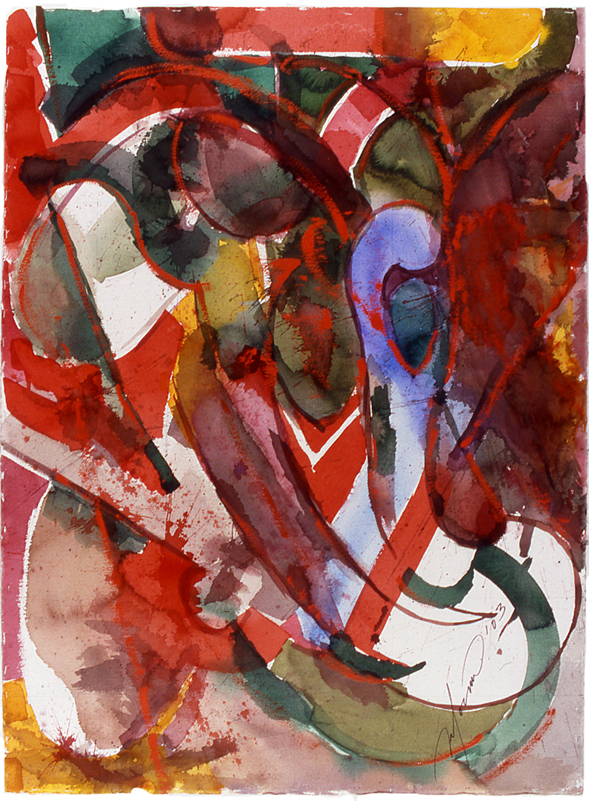
Infinity Strata
14″ x 20″
Watercolors, charcoal, dyes, oil and white-out on paper
2005
People learn about the past through what others tell them. Parents recount earlier times, teachers explain events in sequence, officials issue statements, and communities preserve stories that explain what happened and why it mattered. These accounts do not present the past in full. They select certain events, connect them to one another, and give them weight, while leaving other events aside. Over time, these explanations become familiar ways of understanding where things came from.
As circumstances change, people return to these same accounts to make sense of new situations. Without discovering new facts, speakers may emphasize different events, draw new connections, or describe the same outcomes in a different light. An episode once mentioned briefly may later be treated as decisive. An outcome once described as accidental may later be explained as necessary. What changes is not what occurred, but how people organize and invoke it.
The people who recount the past do so from their own positions. Each account reflects what its speaker can see, remember, and explain. No one holds the entire picture. Authority does not arise because any single account is complete or neutral. Authority arises when multiple accounts begin to overlap. When different people, speaking from different positions, refer to the same events in similar ways, their accounts reinforce one another. What gains standing is not a privileged viewpoint, but a pattern of references that becomes easier to repeat, teach, and rely upon.
Because of this, continuity is not discovered in the past; it is assembled after the fact. People draw lines between events that were not experienced as connected at the time. Periods receive names, turning points are identified, and beginnings are assigned only after later developments make such arrangements appear sensible. The coherence that history presents reflects how events are organized in retrospect, not how they were lived as they unfolded.
Historical authority does not grow from adding more facts alone. It grows from stabilizing a way of arranging those facts. Once a particular ordering becomes familiar, it serves as a reference point. Other explanations are not dismissed because they lack information, but because they do not fit the prevailing way of connecting events. Authority attaches to the arrangement that holds together, not to the archive itself.
As the principles used to organize the past shift, authority shifts quietly with them. The same dates, names, and events remain visible, yet their relationships and implications change. Because the surface details persist, the deeper reorganization often goes unnoticed. What changes is not the record, but the logic through which the record is made intelligible.
History therefore does not offer a fixed account of what occurred. It offers a way of making sense of what occurred that holds long enough to guide understanding and action in the present. That coherence remains contingent on the conditions that sustain it. When those conditions change, historical accounts do not disappear; they reorganize. Authority persists not because the past has been settled, but because a particular ordering continues to function.
History acquires authority not by fixing the past, but by stabilizing an arrangement of events that can endure long enough to orient judgment, even as the principles that produce that arrangement continue to change.
Ricardo F. Morín
January 31, 2026
Oakland Park, Fl