*
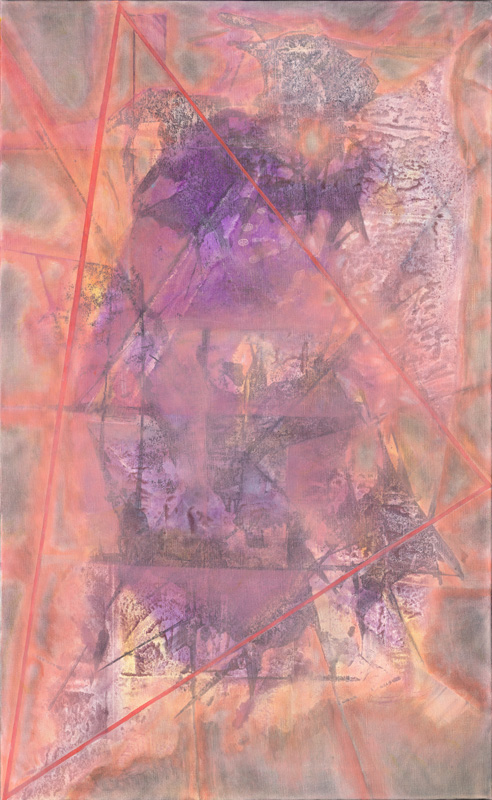
Triangulation Series Nº 10: Method
37″ x 60″ x 2″
Oil on linen
2006
*
PREFACE
i
Clarity begins where boundaries appear. A boundary is not a restraint but a distance, an interval in which perception can separate itself from emotion long enough for understanding to take shape. When that distance collapses, experience is reorganized by impulse; the world becomes an extension of what one feels rather than what one sees.
ii
Boundaries are the only defense against this collapse. They prevent meaning from dissolving into reaction and keep perception from being redirected by purpose. Purpose, when allowed to speak first, narrows the field of vision and turns inquiry into confirmation. A boundary interrupts this tendency; it holds intention in suspension so that attention can return to what is actually present.
iii
Inquiry depends on this interruption. Without boundaries, the movement of thought cannot be distinguished from the movement of desire, and doctrine quietly replaces observation. Boundaries do not resolve uncertainty, but they make uncertainty legible. They create the conditions in which questions can be asked without predetermining their answers.
iv
Humility is inseparable from this act. It is not a posture but a condition that allows perception to proceed without the weight of intention. Clarity requires more than sincerity or restraint; it requires a mind that is not driven by the need to accumulate, whether knowledge, virtue, certainty, or self-justification. Accumulation reorganizes perception around a desired result. Discipline, in this sense, is not the pursuit of an ideal but the maintenance of boundaries that protect perception from being redirected by purpose. It is a discipline of subtraction rather than achievement: an effort that becomes effortless when it no longer seeks reward.
This preface introduces the method that follows. Method is not a technique, nor is it a path toward improvement. It is the sustained practice of observing without coercion, distinguishing structure from projection, and permitting meaning to emerge without forcing it into preexisting shapes. Boundaries make that discipline possible. They are the ground on which clarity stands.
Ricardo F. Morín
November, 2025
Oakland Park, Florida
1
Every attempt to understand the world begins with a simple but often overlooked fact: we see in fragments. Human perception operates like a lamp in a large room; perception illuminates what is near, dimming what is distant, and leaves most of the room in shadow. We navigate life with the assumption that our partial view is complete, even though experience repeatedly proves otherwise. Knowledge helps us organize what we see, but it also defines the edges of our understanding; it clarifies one portion of the room while it obscures another. No one escapes this condition. No historian, philosopher, commentator, or citizen sees the world in its entirety, and acknowledging this is not an act of modesty but the foundation of honest inquiry.
2
Two different intellectual traditions help illuminate the tension between seeing and understanding. One comes from the kind of clarity found in Krishnamurti’s observations: the discipline of perceiving without the distortion of fear, motive, or the narratives we inherit without noticing. He insisted that much of what we call “knowledge” is actually memory, habit, or reaction, and that these patterns cloud perception rather than sharpen it. The second tradition, rooted in Western civic philosophy and historical analysis, insists that societies cannot be understood without structure: without categories that describe institutions, without distinctions between authority and power, or between law and the decisions made in its name. This tradition demands reasoning, evidence, and articulation.
3
Neither tradition is sufficient on its own. Pure perception can become impressionistic; it dissolves the world into sensations without offering any explanation of how things work. Pure structure can become rigid; it treats human experience as an abstraction, flattening its subtleties into neat but inaccurate theories. A method emerges when these approaches intersect. Its first movement is subtraction. It asks the observer to remove the noise that interferes with perception: the assumptions that rush ahead of reality, the narratives that interpret the world before we have actually seen it, the emotional recoil that transforms a fact into a grievance, or a possibility into a threat. Subtraction does not eliminate complexity; it makes room for it. It allows us to look at familiar situations, conflict, political argument, civic breakdown, inequality, without immediately reaching for slogans or for the explanations we already prefer.
4
The second movement is structure: identifying the patterns that persist once distortion has been removed. Structure appears in the way institutions operate, in the incentives that shape public behavior, in the stories societies tell to justify their actions, and in the consequences that repeat themselves across time. A society punishes in one way rather than another for reasons that can be traced. A population interprets progress according to a set of assumptions that can be examined. A system favors certain outcomes because its design makes other outcomes unlikely. Structure is not the enemy of perception; it is what perception reveals when it is clean.
5
Meaning arises from the interplay between these two movements. It does not remain stable; it shifts when the conditions that hold it together change. Words like “justice,” “freedom,” “security,” or “progress” acquire new meanings not because thinkers redefine them, but because societies reorganize themselves around different fears, expectations, or pressures. To assume that these meanings are fixed is to mistake living processes for static definitions. The task is not to declare what these concepts should mean, but to examine how they function in the real world; how they guide action; how they justify authority; and how they shape the limits of what people consider possible.
6
This approach allows writing to become neither abstract nor ideological. It is not a performance of expertise nor a confession of personal experience. It is an effort to look at the world as it is lived: how people respond to harm; how institutions drift from their original purpose; how fear transforms into policy; how progress becomes a story that conceals as much as it reveals; how public judgment forms under conditions of uncertainty. These are not theoretical questions but everyday realities, observable to anyone who pays sustained attention.
7
The method does not claim special insight. It does not elevate the observer above the events being described. It argues something simpler and more democratic: that clarity is available to anyone willing to examine both perception and structure without surrendering to either. The observer remains part of the world being studied, affected by its pressures, limited by its uncertainties, and shaped by its histories. The goal is not to escape this condition, but to see it clearly enough that understanding becomes possible.
8
In this sense, method is not a technique but a form of discipline. It is the discipline of perceiving without leaning on the crutch of inherited narratives; the discipline of thinking without allowing ideology to rush ahead of evidence; the discipline of naming structures without pretending they are inevitable; and the discipline of allowing meaning to remain flexible enough to reflect the movement of time. Its purpose is not to simplify the world but to make it legible, without illusion, without theatricality, and without the desire to be right.
9
Such a method offers no certainty. What it offers is honesty: an acknowledgment that truth is not a possession, that the world exceeds every attempt to capture it, and that clarity emerges not from authority but from attention.

