Ricardo F. Morín April 17 through May 14, 2026 In transit
A conversation, a concern, a loss or a moment of joy begin to take shape when they remain present long enough to demand attention, alter our conduct or affect our relation with others. Our lives do not acquire form through intensity or through the scarcity of what occurs.
There are days that pass leaving almost no trace. Conversations are forgotten. One concern gives way to another before it can alter what follows.
At other times, everything demands attention at once. Attention passes from one incident to another before anything acquires consequence. What is immediate displaces what needed to remain present. Priorities begin to blur into one another, and nothing retains enough presence to awaken interest.
An empty day disappears without resistance; a day in which everything demands attention dissolves in much the same way. In both cases, a conversation, a concern or a loss cease affecting the way a person responds to what unfolds around them.
Either nothing succeeds in awakening interest, or what does awaken it loses force among too many competing demands upon attention. Boredom may appear even when nothing seems to be missing.
Proportion allows a conversation, a loss, a concern or a moment of joy to remain present long enough to acquire consequence alongside one another. Without proportion, conversations, concerns and responsibilities begin to disperse before they can remain related to one another. With proportion, a conversation, a loss or a responsibility may preserve enough presence to continue affecting the way a person attends or responds.
When that relation weakens, judgment begins to weaken with it. What is trivial acquires urgency, while a loss, a responsibility or an important relation recede without drawing attention. Public life eventually reflects the same condition: noise makes it difficult to distinguish what truly demands our attention, and people begin reacting more through accumulation than through understanding.
What is near may impose itself until it occupies everything. What is distant may withdraw until it loses presence. Between those extremes, conversations, concerns and relations still manage to remain separate.
Proportion changes with the demands of life, with attention, fatigue, pressure and the capacity to remain affected by what occurs. It does not remain static. A person may come to no longer recognize what once mattered to them, not because they decided to abandon it, but because the relation to a loss, a responsibility or another person also changes under certain conditions.
Boredom appears when a conversation, a concern, a responsibility or a relation cease remaining present long enough to continue affecting the way a person attends, remembers or responds. For this reason, boredom does not depend upon how much happens or how little does.
Dissatisfaction and skepticism emerge when a conversation, a loss or a responsibility no longer preserve sufficient relation to what continues occurring around them. Dissatisfaction and skepticism are not the origin of this condition.
At times, a person continues speaking, working or responding without knowing what still preserves relation to their life. Even under those conditions, another person’s affection, a remembered conversation or someone’s presence may remain active while many concerns begin losing consequence. At times, they are the only things still preserving relation to what continues.
Proportion exists in allowing a conversation, a loss, a responsibility or a relation to preserve enough presence to continue affecting the way we attend, remember or respond to what occurs. Maintaining proportion does not consist in reducing life.
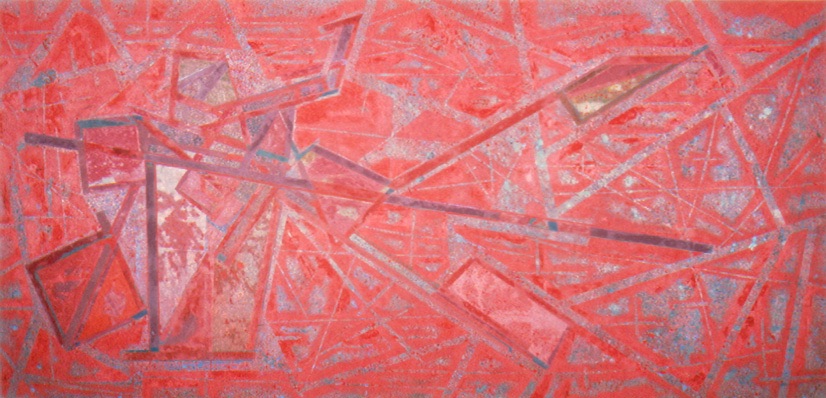
Ricardo F. Morín Buffalo Series, Nº 5 48″ x 56″ Oil on canvas 1979
*
Author’s Note
The conditions examined in this text continue those explored in “The Proportion of Boredom” and “The Impossibility of Recognition.”
+
Ricardo F. Morín April 17 through May 14, 2026 In transit
1. There are people who aspire to live as individuals of conviction because conviction appears inseparable from dignity, seriousness, or moral substance. To remain faithful to certain principles despite uncertainty, pressure, or consequence may seem necessary for self-respect itself. A person capable of conviction may appear less vulnerable to confusion, fear, or circumstance than someone who changes too easily with events or opinion.
2. Under certain conditions, conviction permits endurance. A person may continue acting despite danger, exhaustion, or sacrifice because something appears more important than comfort, approval, or self-preservation. Communities may also remain bound together through convictions strong enough to survive hardship, loss, or instability.
3. Yet convictions do not remain private for long. They shape how people judge conduct, loyalty, responsibility, and trust. What appears principled to one person may appear rigid, dangerous, or intolerant to another. The same conviction capable of sustaining courage may also narrow the conditions under which people continue recognizing one another outside allegiance alone.
4. At times, uncertainty becomes difficult to bear. A person may seek convictions not only because they appear true, but because they provide continuity when circumstances no longer seem stable enough to endure without certainty.
5. A conviction does not remain merely an opinion once a person begins to depend on it for self-respect. It enters conduct. It shapes what can be admitted without humiliation and what must be resisted so the person can remain coherent before himself. At that point, disagreement no longer arrives only as difference. It may also arrive as exposure.
6. Under such conditions, a person may defend not only certain principles, but the self organized around them. Contradiction becomes difficult to tolerate because uncertainty no longer threatens a single idea alone. It threatens the sense that one’s life still holds together, belonging, judgment, and the sense that one’s conduct remains justified before others and before oneself.
7. Yet convictions are not sustained only through conflict. They also persist through familiarity. Families, friendships, religious communities, political movements, and nations may remain bound together through convictions strong enough to survive sacrifice, hardship, or historical change. A person may inherit convictions long before examining them fully, just as another person may remain unable to abandon certain convictions despite prolonged doubt or disappointment.
8. Convictions cannot be understood through logic alone. People may continue defending ideas that no longer correspond fully with circumstance because conviction does not depend only upon evidence. It may also depend upon memory, loyalty, fear, gratitude, suffering, or the need to preserve continuity with those through whom life first acquired meaning.
9. At times, conviction permits a person to resist conditions that would otherwise reduce conduct to convenience or fear. Someone may continue defending another person despite public hostility, remain faithful to a responsibility despite exhaustion, or refuse participation in what appears degrading even when conformity would be safer. Under such conditions, conviction may preserve dignity because it resists adaptation to circumstance alone.
10. Yet the same conviction capable of sustaining courage may also narrow perception without announcing the change. A person may begin judging conduct through allegiance before attending to the singularity of those involved. What confirms conviction appears trustworthy more easily; what unsettles it begins requiring justification before it can even be considered fairly.
11. This change does not always emerge through fanaticism. It may appear through ordinary habits of interpretation. Certain words begin carrying fixed meanings before conversations fully unfold. Certain people appear predictable before they have spoken long enough to become recognizable outside inherited assumptions. Conviction then ceases remaining only a way of judging what should be trusted, defended or refused. It begins organizing perception itself.
12. Under those conditions, plurality becomes difficult to sustain. Not because difference disappears, but because difference no longer appears as something through which judgment may widen. It begins appearing instead as instability, confusion, or moral weakness.
13. A person may still believe himself fair under such conditions. He may continue listening, speaking calmly, or permitting disagreement while the boundaries of what appears acceptable have already narrowed inwardly. Conviction does not always announce the moment in which judgment begins organizing itself around allegiance. The change may remain gradual enough to appear compatible with the image a person preserves of himself as reasonable, principled, or humane.
14. At times, convictions survive less because they remain unquestioned than because abandoning them would require a person to reinterpret too much of his own life. Friendships, sacrifices, loyalties, humiliations, and hopes may remain bound to convictions that helped organize the meaning of earlier experience. Under such conditions, doubt no longer threatens a single conclusion alone. It threatens continuity with the self that endured through those experiences.
15. People may therefore defend convictions that no longer correspond fully with what they privately perceive. Public allegiance and inward uncertainty may coexist for long periods without reconciling themselves. A person may continue repeating certain beliefs because abandoning them appears more disorienting than preserving them despite contradiction.
16. Yet uncertainty carries dangers of its own. A person incapable of conviction may become vulnerable to every immediate pressure, every shifting opinion, or every promise of acceptance. Conduct begins adapting too easily to circumstance because nothing remains stable enough to resist convenience, fear, or belonging. Under such conditions, openness itself may lose coherence.
17. Human beings therefore remain exposed to opposing dangers that do not resolve one another. Conviction may preserve dignity while narrowing plurality; uncertainty may preserve openness while weakening conduct. The difficulty does not disappear by choosing one condition entirely over the other, because both arise from needs inseparable from human life.
18. This tension becomes visible during periods of instability. Under fear, humiliation, rapid social change, or prolonged uncertainty, people often seek convictions capable of restoring continuity quickly. A movement, a nation, a faith, an ideology, or a leader may then appear not merely persuasive, but necessary for preserving coherence against conditions that no longer seem bearable without certainty.
19. Under such circumstances, plurality may begin appearing less as a condition of civic life than as an obstacle to stability itself. Disagreement becomes associated with fragmentation; hesitation with weakness; ambiguity with danger. What once appeared compatible with coexistence may begin appearing incompatible with order, belonging, or survival.
20. Yet even under those conditions, convictions do not become complete. Contradictions continue appearing within every system of certainty because human experience exceeds the structures through which people attempt to hold experience together. A person may defend convictions publicly while remaining inwardly confronted by experiences that resist full reconciliation with them.
21. Convictions can preserve and disrupt human relations at the same time. They allow people to sacrifice, endure, remain faithful, and act decisively under uncertainty. Yet they may also separate human beings before they have encountered one another outside inherited loyalties, beliefs, or fears. The same convictions capable of sustaining responsibility may also prevent people from perceiving one another except through the boundaries conviction has already established.
22. Convictions do not disappear because people cannot live long without believing that certain things must be defended, preserved, or remained faithful to despite uncertainty. Under those conditions, conviction may permit courage, sacrifice, or endurance where fear alone would otherwise prevail. Yet the same convictions may also separate human beings before they have fully encountered one another outside inherited loyalties, beliefs, or fears.
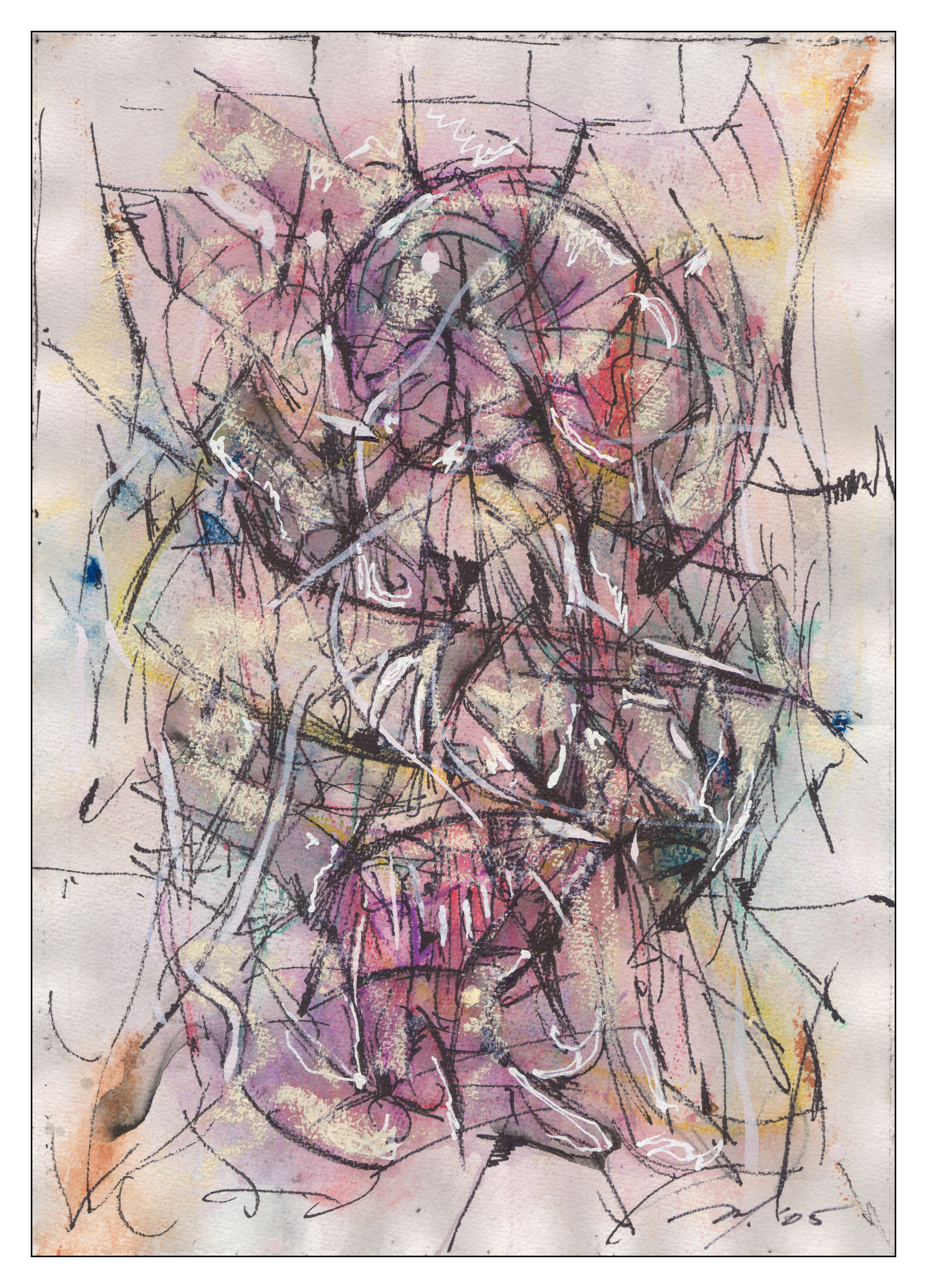
Ricardo F. Morín Restrictions Watercolor, oil sticks, Sumi ink, and correction fluid on paper. 14″ x 20″ 2005
*
Ricardo F. Morín
January 12, 2026
Oakland Park, Fl.
This analysis addresses the operation of institutional constraint once electoral recalibration occurs; a separate diagnostic, “Temporal Asymmetry,” examines what can allow executive action to outrun institutional response prior to that point.
The United States congressional midterm elections scheduled for November 3, 2026 will determine control of all 435 seats in the House of Representatives and 35 seats in the Senate. These elections function as institutional recalibration points designed to test whether executive authority remains subject to legislative constraint, as outlined in Ballotpedia’s overview of the 2026 U.S. congressional elections.
Historical analysis indicates that midterm elections frequently reduce the governing president’s congressional support, restoring oversight capacity through changes in committee leadership, subpoena authority, and budgetary control, as documented in Congressional Research Service analyses of midterm congressional turnover and oversight authority: a pattern also observed in summaries published by the Brookings Institution’s review of midterm patterns.
Executive governance relying on unilateral action through executive orders, discretionary enforcement, and loyalty-based appointments encounters constitutional counterweight through congressional oversight, which conditions authority rather than removing it.
Legislative control enables investigations, compels records, and slows executive initiatives through procedural review rather than unilateral momentum, reflecting constitutional design rather than personal intent.
Impeachment functions as a constitutional accountability mechanism rather than a criminal process. The House of Representatives holds exclusive authority to initiate impeachment in response to abuse of power or sustained impairment of constitutional governance, as clarified in the Congressional Research Service overview of impeachment.
The principal risk associated with the November 2026 midterms concerns normalization of executive action absent effective legislative oversight rather than suspension of elections or formal abolition of constitutional order.
Diminished oversight produces selective enforcement, institutional protection of incumbency, and substitution of political loyalty for procedural accountability, altering governance orientation while formal structures remain intact.
Prolonged absence of constraint reshapes party structure, shifting emphasis from policy formation toward incumbency protection, internal discipline, and defensive alignment.
Constitutional systems rarely fail abruptly. Institutional weakening advances through tolerance of exception and declining expectations. The November 2026 congressional midterm elections determine whether institutional correction resumes or executive insulation persists.
Political systems are often judged by the ideals they proclaim. Yet endurance rarely depends upon the elegance of principle alone. It depends upon whether ordinary disputes can be carried, day after day, through institutions that keep public life intelligible even when citizens do not agree.
Among critics across the political spectrum, democracy is often treated as an ideology. In that interpretation, democratic language appears indistinguishable from other doctrines that claim moral authority through appeals to equality, popular sovereignty, or the will of the people. Yet political thought has not understood democracy in a single way. At different moments it has been conceived as a doctrine expressing normative ideals, as a set of institutional procedures regulating the exercise of power, and as a political framework capable of sustaining plurality within a shared order. Each interpretation captures a dimension of democratic life. The difficulty arises when one of these dimensions is mistaken for the whole. Democracy does not endure because it advances a doctrine or perfects a mechanism. Its difficulty lies in the persistent effort to hold these dimensions together without reducing democratic governance to any single interpretation.
The interpretation of democracy as ideology arises from the language through which democratic ideals have historically been expressed. Appeals to equality, popular sovereignty, and the authority of the people carry a moral force that resembles the claims made by political doctrines. In public discourse these principles are frequently invoked to justify particular programs or to confer legitimacy upon political movements. A platform speech can borrow the vocabulary of rights while demanding uniformity. A banner can invoke the people while treating dissent as treachery. When democratic language is used in this manner it can appear indistinguishable from ideological persuasion. Critics therefore conclude that democracy itself functions as a doctrine competing with other systems of belief. Yet this interpretation rests upon a confusion between the ideals invoked in democratic rhetoric and the institutional structure through which democratic governance actually operates.
A second interpretation approaches democracy not as doctrine but as institutional procedure. In this view the defining features of democratic governance are the mechanisms through which authority is organized and restrained: representation, periodic elections, constitutional limits, and the possibility of peaceful political alternation. Democracy becomes identifiable less by the ideals it proclaims than by the procedures through which power is exercised and transferred. The most ordinary scenes illustrate this procedural character: a contested ballot is reviewed, a recount is ordered, a hearing is scheduled, and a ruling is issued that is binding even on those who dislike it. These arrangements establish a framework within which political conflict can occur without dissolving the continuity of the state. By emphasizing procedure rather than doctrine, this interpretation clarifies an essential dimension of democratic life. Yet procedural definitions alone do not fully explain why democratic systems remain difficult to sustain.
Institutional mechanisms describe how democratic systems operate, but they do not fully explain the conditions that allow those mechanisms to function. Elections and constitutions may persist even where the distribution of authority gradually narrows. Formal institutions can remain visible while their capacity to regulate power weakens. The change is often incremental and practical rather than dramatic: rules remain in print, but exceptions multiply; oversight exists, but deadlines slip; inquiries open, but findings are withheld; the vocabulary of accountability persists, but the public learns to expect delay. In such circumstances democratic procedure survives in appearance while democratic practice becomes increasingly constrained. The endurance of democratic institutions therefore depends on more than the existence of rules. It depends on a political environment capable of sustaining the disagreements those institutions were designed to manage.
A third interpretation approaches democracy from a different perspective. Rather than defining democracy through doctrine or institutional procedure alone, it understands democratic governance as a framework capable of sustaining plurality. Within democratic societies individuals and groups hold competing convictions about justice, authority, and the direction of public life. These differences are not temporary disagreements awaiting resolution. They represent enduring features of political life. Plurality in this sense is not simply the presence of diversity but a condition in which individuals appear to one another as distinct participants within a shared political world. The everyday evidence is familiar: a city council meeting where residents argue over zoning and taxes, a school board hearing where parents disagree about curriculum, a courtroom where opposing counsel present incompatible claims and still accept the same judgment as final for that case. Democratic institutions therefore do not eliminate conflict; they regulate its expression. They establish conditions under which diverse claims can coexist within a common political order. The difficulty of democracy lies precisely in this task of maintaining institutional continuity while allowing disagreement to persist.
Plurality introduces a persistent tension within democratic governance. A political system must preserve legal continuity while accommodating competing interpretations of public life. Institutions must remain stable enough to sustain authority, yet flexible enough to permit disagreement and political change. The balance required to maintain this equilibrium is inherently fragile. Democratic systems often appear unsettled not because they are failing, but because they operate within a field of claims that cannot be fully reconciled. The signs of health and strain can look similar from a distance: noisy debate, contested outcomes, changing majorities, and continuous scrutiny. The difference becomes visible in whether contestation remains inside shared procedures, and whether losing parties retain a credible path back into public life. This structural tension also clarifies why political systems organized around centralized authority encounter greater difficulty accommodating plurality.
Political systems organized around centralized authority approach plurality differently. Authoritarian forms of governance rely upon a final source of decision capable of resolving conflict through directive power. While such systems may tolerate limited diversity of opinion, their stability depends upon the presence of an authority able to determine the boundaries of acceptable disagreement. In practical terms the boundaries are enforced not only by decree but by predictable signals: which topics may be discussed without consequence, which questions are treated as disloyal, which associations are permitted to assemble, and which public claims are allowed to circulate. The persistence of open and competing claims therefore represents a structural challenge to authoritarian order. Where democratic systems attempt to regulate disagreement through institutional balance, authoritarian systems seek to contain or resolve disagreement through concentration of authority.
Despite this structural difference, authoritarian systems frequently adopt the vocabulary of democracy. References to the people, representation, and popular legitimacy appear even within political orders that do not sustain genuine plurality. Democratic language functions in these contexts as a source of symbolic legitimacy. The vocabulary signals participation and consent, even when the institutional conditions necessary to support those principles remain absent. Ambiguity in democratic language can itself become a form of accommodation. Citizens across the ideological spectrum may adopt expansive definitions of democratic ideals because such language allows their own convictions to appear universally justified while leaving competing interpretations unresolved. The pattern is recognizable: elections occur without credible competition; legislatures convene to affirm decisions already made; courts exist yet rarely contradict executive preference; newspapers publish, but certain subjects disappear from print. Democratic terminology may therefore coexist with political practices that limit or direct the scope of public disagreement.
The coexistence of democratic language with constrained political practice produces a recurring tension between institutional form and political function. Legal codes may continue to affirm representative authority and constitutional order while their application becomes selective, deferred, or postponed. Institutions remain formally intact, yet their capacity to regulate power gradually diminishes. This is often experienced by citizens as a change in expectation: procedures still exist, but outcomes become predictable; rules still apply, but not to everyone; hearings still occur, but decisions appear settled in advance. In such circumstances the outward architecture of democracy persists while the conditions necessary for sustaining plurality become increasingly limited.
Plurality therefore does more than describe the diversity of democratic societies. It explains why authority in democratic government cannot remain concentrated in a single locus but must instead be distributed across institutions capable of mediating competing claims.
Unlike earlier political forms organized around a single source of authority, democratic government distributes legitimacy across institutions capable of mediating competing claims.
The recurring tendency to treat democracy as an ideology arises from the prominence of its language and ideals. Yet democratic governance cannot be reduced either to doctrine or to institutional procedure alone. Its defining feature lies in sustaining a political order in which plurality remains visible and active within a shared world. Democratic institutions endure not because they eliminate disagreement, but because they preserve the space in which individuals can continue to appear to one another as participants in public life. Democracy therefore remains less a doctrine to be asserted than a political discipline sustained through institutions capable of regulating plurality without extinguishing it.
In an era in which human survival increasingly depends upon cooperation across societies, cultures, and political traditions, the capacity to mediate competing claims becomes more than a domestic institutional question. It becomes a condition for the stability of a shared world. Political systems that suppress plurality may impose temporary order, but they remain structurally limited in their ability to adapt to the scale and diversity of contemporary global challenges. Systems capable of sustaining plurality, by contrast, possess a greater capacity to integrate difference into a durable framework of cooperation. In this respect the institutional discipline of democratic governance corresponds not only to a political preference but to a practical requirement for sustaining a shared world.
*
Ricardo F. Morín, March 5, 2026, Oakland Park, Florida
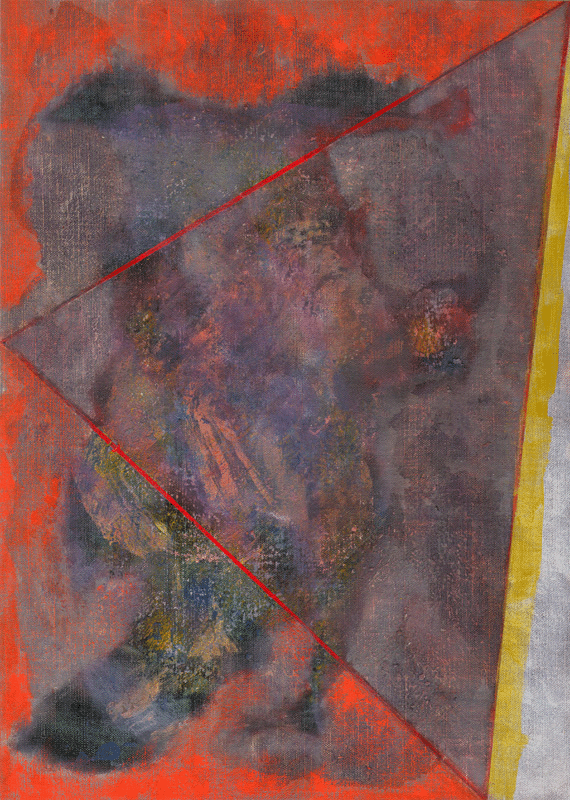
Ricardo F. Morín Triangulation Series Nº 35 13 ½” x 19” Oil on linen 2009
They had been there long enough that no one marked the beginning.
Paths crossed the land without boundary. Some were used often, others only when needed. No one asked who had first walked them. It was enough that they could be followed.
One morning, men arrived with papers.
They did not move through the paths. They stopped at certain points, unfolded documents, and read from them. The words were repeated more than once, as if their repetition secured something not yet established.
A line was drawn.
It did not follow the paths. It cut across them. Those who had walked freely now paused before crossing. Some stepped over it. Others waited. No one could say what would follow.
The men with the papers returned the next day.
They asked for names. They wrote them down. Some names were accepted without question. Others were repeated back differently, then recorded again. No one explained why.
A man who had crossed the line the day before was stopped.
He was told to return. He pointed to the path he had always used. The man with the paper looked at it, then at the line, and said nothing. After a moment, he gestured for him to step back.
The next day, another man crossed at the same place and was not stopped.
No one asked what had changed.
The line remained.
People adjusted their movements around it. Some avoided it. Others crossed only when watched. The paths did not disappear, but they were no longer followed in the same way.
The men with the papers continued to come and go.
Each time, they read the same words.
No one asked who had written them.
*
Ricardo F. Morín, April 19, 2026, in a quiet waiting room.
Ricardo F. Morín Buffalo Series, Nº 2 48″ x 48″ Oil on canvas 1978
At a town hall, one participant says, “They just don’t share our values.” Another replies at once, “That’s freedom of speech.” No one asks who “they” refers to. No one asks which values are meant. The discussion shifts. The reply becomes the center of the discussion.
A participant to the left says, “He can say it.” Across the table, another answers, “He shouldn’t say it.” A third repeats, “It’s freedom of speech.” No one restates the sentence in full. No one asks the speaker to name the values or to identify who is included in “they.” The words that gave rise to the discussion no longer guide it.
Someone tries to return to the sentence. “What do you mean by ‘they’?” The speaker does not answer. Another voice cuts in: “That’s freedom of speech.” The question does not hold. The discussion resumes from the reply.
Then one participant restates the earlier sentence: “They just don’t share our values.” Another replies: “That’s freedom of speech.” For a moment, the sentence and the reply are held together. No one determines whether the reply addresses what is said. No one asks whether the claim can be examined. The moment passes.
From that point on, each response addresses only that same reply. One insists on the right to speak. Another rejects the defense. No one asks the speaker to define “our values.” No one tests the claim that “they” do not share them. The sentence no longer directs the discussion. Those referred to as “they” are not named. They are set apart without being identified. The sentence rejects them without stating who they are.
The phrase is used to defend the speaker and to reject its use as justification. It does not return to the sentence. It allows each participant to take a position without clarifying what was said. Expression itself is treated as evidence of allegiance rather than as an invitation to examination.
At the end, the sentence remains unresolved: it is not examined, it is not sustained, it is not withdrawn. It is left behind. The rejection holds. The phrase remains in use, and the discussion continues from it.
Ricardo F. Morín Buffalo Series, Nº 7 36″ x 78″ Oil on canvas 1979
In a public forum, one participant says: “This country was built by people who came from other places and settled here over time.” Another responds: “People who enter without authorization must be expelled.” Both statements remain. No one relates them to one another.
A participant on one side says: “My parents came here and became citizens.” From the other side, someone responds: “The law must be applied.” A third asserts: “There must be order.” No one asks how those people were received at the time. The statements remain separate.
Someone returns to the earlier point: “How was the situation of those people determined when they arrived?” The interlocutor does not respond. Another voice responds: “People must come through the proper channel.” The question does not hold. The exchange continues from the response.
From that moment on, each intervention turns toward the application of the law. No one asks under what conditions that law is applied or to whom it extends. One insists on borders. Another rejects politics. No one asks how the situation of people is determined. No one asks how those present are classified. The initial statements remain. They are not related to one another.
Then one participant repeats the earlier claim: “This country was built by people who came from other places.” Another repeats: “People who enter without authorization must be expelled.” For a moment, both statements are held together. No one determines whether the same conditions apply to both. No one asks whether one statement limits or includes the other. The moment passes.
Those who arrived under earlier conditions and those now subject to controls can be named. The same terms are not used for both.
The phrases continue to appear. They serve to defend positions and to oppose them. They do not return to the initial statements. They allow each participant to adopt a position without relating them.
In the end, both statements remain: one is not examined against the other, neither is withdrawn. They are left in place. The separation is maintained. The exchange continues without relating them.
Ricardo F Morín Buffalo Series, Nº 3 32″ x 36″ Oil on canvas 1978
At a town hall, one participant says, “This policy removes access to public services—such as health coverage and housing assistance—for legal residents who have depended on them.” Another replies at once, “That’s what people voted for.” Everyone knows the subject is immigration. No one returns to what is being done. The exchange shifts. The reply becomes the center of the discussion.
In another exchange, someone says, “This measure authorizes the detention of individuals without a hearing while their status is reviewed.” The reply comes at once: “That’s what people voted for.” The sentence is not taken up. The exchange proceeds from the reply.
A participant to one side says, “It was decided through a vote.” Across the table, another answers, “That doesn’t justify what it does.” A third repeats, “That’s what people voted for.” No one restates the initial sentence in full. No one asks what the policy does. The words that gave rise to the discussion no longer guide it.
Someone tries to return to the sentence. “Which part of this was voted on?” The speaker does not answer. Another voice cuts in: “It reflects the will of the voters.” What is being done remains unexamined. The phrase remains in use, and the exchange continues from it.
Then one participant restates the earlier sentence in full: “This policy removes access to public services for legal residents.” Another replies: “That’s what people voted for.” For a moment, the sentence and the reply are held together. No one determines whether the vote addresses what is described. No one asks whether the reply accounts for the sentence. The moment passes.
From that point on, each response addresses only that same reply. One insists on the vote. Another rejects that defense. No one asks who loses access under the policy. No one asks how the change is carried out. The sentence no longer directs the exchange. Green card holders, recipients of deferred status, asylum applicants, and citizens by birth can be named, but they are not brought back into the exchange.
The phrase is used to defend the decision and to reject its use as justification. It does not return to the sentence. It allows each participant to take a position without clarifying what was said.
At the end, the sentence is not examined, sustained, or withdrawn. It is left behind, and what is being done is not examined.
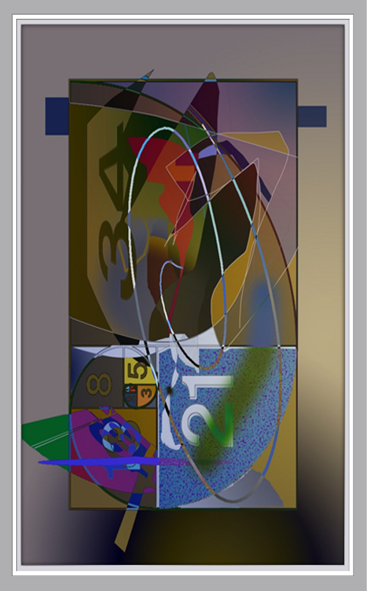
“Geometric Allegory” digital painting 2023 by Ricardo Morin (American visual artist born in Venezuela–1954)
Ricardo F. Morín
January 13, 2026
Oakland Park, Fl.
Author’s Note
This installment continues an ongoing diagnostic examination of Venezuela’s political experience and attends to the conditions under which authority, truth, and institutional responsibility become misaligned. It remains situated within a broader historical inquiry rather than a chronological account and attends to patterns that recur when power is preserved at the expense of governance.
*
Chapter 15
*
The Second Issue
~
On Partial Truths and Repressive Anarchy
*
Partial Truths
1
Politics as a competition among partial truths is relevant to understanding authoritarian dynamics. This concept suggests that political life is inherently pluralistic, with each perspective capturing a fragment of a larger, complex reality. In a healthy democracy, competing truths, reflecting the distinct values, needs, and experiences of various groups, engage in a transparent constructive exchange. Under authoritarianism, however, a regime’s efforts to monopolize truth suppress the diverse voices essential to balanced political discourse.
2
In Venezuela, the government exerts rigorous supervision over information, delegitimizes dissent, and often brands opposition perspectives as inimical or dangerous to the State. [1] This monopoly on truth distorts public discourse and prevents alternative viewpoints from challenging the regime’s narratives. Rather than fostering a platform for opposition, marginalized communities, and civil society, Venezuela’s political arena is reduced to a singular truth aligned with the interests of the regime and designed to solidify its power.
3
When politics is viewed as continuous negotiation among competing values, it becomes clear that the Venezuelan regime disrupts this process by discrediting opposition as subversive. The idea that power shapes knowledge further illuminates this dynamic: in Venezuela, State control over media and public information subjugates alternative narratives and creates an environment where only the regime’s version of truth prevails.
4
This suppression of pluralistic truths invalidates the foundation of democratic governance, which ideally rests upon the coexistence and competition of diverse perspectives. By silencing dissent, the regime transforms politics into a monologue of State propaganda, intensifies authoritarian control, divests citizens of their agency, and ultimately subverts the democratic foundations necessary for a viable social order.
*
Repressive Anarchy
5
Repressive anarchy reveals a profound contradiction within the structure of power, where the State simultaneously acts as an oppressive force and an agent of disorder. In Venezuela, this tension between repression and anarchy underscores a deeper philosophical conflict between the functions of authority and its dissolution. While traditional autocracies rely on centralized power to enforce order, repressive anarchy signifies the collapse of the State’s capacity to govern, even as it intensifies its coercion of political expression and dissent.
6
At the heart of repressive anarchy lies the paradox of control without effective governance. The State’s machinery is oriented toward suppressing political freedoms, curtailing opposition, and eliminating pluralism, yet it simultaneously abandons its responsibility to maintain civil order or to protect citizens from economic collapse, crime, and social decay. [2] This selective exercise of power exposes an evacuated sovereignty, a State that projects authority through repression while neglecting its essential responsabilities, such as ensuring justice, security, and the rule of law. In practice, the State’s authority becomes repressive in form yet anarchic in outcome, creating a chaotic reality in which power exists without purpose.
7
This condition challenges classical notions of power and governance. In political theory, the State derives its legitimacy from the social contract, a mutual obligation between the governing and the governed. [3] When a State prioritizes repression over administration, it dissolves this contract and replaces trust with fear. Repressive anarchy suggests that when power is severed from its foundational responsibilities, it becomes both self-perpetuating and self-destructive, reducing the State to a coercive mechanism rather than a force for societal good.
8
This duality contests the Hobbesian assumption that authoritarianism naturally ensures order.[4] In Venezuela, the centralization of power under Nicolás Maduro has not produced stability but rather resulted in a disintegration of administrative capacity and of the State’s ability to govern. Unchecked power has not led to unity or security but to fragmentation and chaos; repression, rather than compensating for the State’s failures, exacerbates them, accelerates societal disintegration, and fosters its own insecurity.
9
Repressive anarchy also reshapes the relationship between fear and freedom. In such systems, fear is not merely a tool of control but a pervasive condition that governs how individuals relate to both the State and one another. [5] Fear restricts political participation, forecloses avenues for public discourse, and undermines the possibility of genuine freedom. In this way, repressive anarchy represents not only a failure of governance but also a moral failure, as both individuals and society become burdened under the weight of relentless repression.
10
Ultimately, repressive anarchy confronts political philosophy with a contradiction that defies conventional solutions. It exposes the limits of coercive power and the inherent vulnerability of autocratic regimes to self-destruction. More importantly, it underscores the need to reconcile authority with effective governance, not as instruments of mere repression, but as ethical systems that uphold the dignity and welfare of the people. The Venezuelan experience demonstrates that when power is severed from both governance and moral responsibility, it fails to impose order and instead engenders institutionally induced disorder that resists international sanctions or punitive measures.[6]
~
Endnotes, Chapter XV
§2
[1] Reporters Without Borders, World Press Freedom Index 2024: Venezuela, Paris, 2024, https://rsf.org/en/country/venezuela; Freedom House, Freedom in the World 2024: Venezuela, Washington, DC, 2024, https://freedomhouse.org/country/venezuela/freedom-world/2024; United Nations Human Rights Council, Report of the Independent International Fact-Finding Mission on the Bolivarian Republic of Venezuela, A/HRC/57/CRP.5, Geneva, 2024.
§6
[2] Corrales, Javier and Penfold, Michael, Dragon in the Tropics: Hugo Chávez and the Political Economy of Revolution in Venezuela (Washington, DC: Brookings Institution Press, 2011); InSight Crime, Venezuela: A Country Run by Criminal Networks, Bogotá, 2023, https://insightcrime.org; United Nations Development Programme, Governance Indicators: Venezuela Country Profile, New York, 2023.
§7
[3] O’Donnell, Guillermo “Delegative Democracy,” Journal of Democracy 5, no. 1 (1994): 55–69. (Foundational framework for understanding regimes that retain electoral form while hollowing institutional responsibility.)
§8
[4] Hobbes, Thomas, Leviathan (1651; Kindle ed.), chap. 17, loc. 103; United Nations Development Programme, “Governance Indicators: Venezuela Country Profile,” New York, 2023.
§9
[5] Arendt, Hannah, The Origins of Totalitarianism, New York: Harcourt, Brace & Company, 1951).
In a world confronting systemic threats—pandemics, war, environmental instability—the distortion of democratic language by authoritarian regimes introduces a secondary danger: the displacement of shared standards by which political reality is evaluated. When democratic terms are preserved rhetorically but institutionally denuded, they no longer clarify global challenges; they obscure them. [1] Under such conditions, the problem is not merely the absence of democracy, but the misuse of its vocabulary.
2
Within this context, democracy may be examined not as an aspiration, but as a set of operative conditions by which authority is constrained and legitimacy is measured. These conditions do not function symbolically; they function diagnostically. Where they are absent, substituted, or selectively applied, democratic form persists while democratic substance is rendered inoperative.
3
Among these conditions are the rule of law; free and verifiable elections; the protection of civil liberties and human rights; the separation of powers; judicial independence; sustained civic participation; governmental responsiveness; minority protections; transparency and accountability; and the peaceful transfer of power. These are not abstract ideals but necessary conditions. [1] These conditions may be suspended, distorted, or replaced by forms that imitate them without functioning.Governance persists as appearance and thereby operates as subterfuge, while democracy no longer operates.
4
In Venezuela, the disjunction between democratic language and authoritarian operation has become a characteristic feature of political life. Over the past quarter-century, authority has been progressively centralized within a single-party framework, reinforced by military participation and institutional capture. [2] Although electoral and constitutional forms have been retained, their constraining functions have been neutralized, contributing to sustained loss of institutional capacity across political, social, and economic domains.
5
The judiciary illustrates this substitution with particular clarity. Rather than operating as an independent arbiter, it has increasingly functioned as an administrative extension of executive power; it has legitimized arbitrary detention, restricted political participation, and normalized repression through procedural means. [3] As such, the mechanisms of the judiciary are used to authorize repression rather than to constrain power.
6
When courts align with executive authority rather than constrain it, civic participation and political representation cease to function. Elections, legal claims, and public challenge may continue in form, but they no longer permit citizens to influence power or secure redress.
Endnotes, Chapter XVI
§1-§3
[1]Rosanvallon, Pierre, Counter-Democracy: Politics in an Age of Distrust, Cambridge: Cambridge University Press, 2008); Urbinati, Nadia, Democracy Disfigured: Opinion, Truth, and the People, Cambridge: Harvard University Press, 2014.
§4
[2] International Crisis Group, “Venezuela: The Rise of a Militarized State,” Brussels, 2022; Organization of American States, “Report on the Situation in Venezuela,” Washington, 2023.
§5
[3] Foro Penal, “Political Prisoners in Venezuela: Annual Report 2025,” Caracas, 2025; United Nations Working Group on Arbitrary Detention, “Opinion No. 44/2023 (Venezuela),” Geneva, 2023; Inter-American Commission on Human Rights, “Democratic Institutions, Rule of Law, and Human Rights in Venezuela,” Washington, DC, 2024.
Could it be safe to take a shower between 7 and 8 am?
He will take his morning medication just before the shower.
It is 43 degrees Fahrenheit outside, rising to 64 by the time he arrives at Penn Medicine in University City.
He considers scheduling an Uber for 11:45 am; his husband will say it is too early.
It’s 7:05. He hears his husband making the beds in the next room. He goes to shower.
His husband asks whether he would be up to taking a ride tomorrow, the day before departure.
He says he would decide based on how he felt.
Each choice has required assessment.
Two bowel movements. A familiar pattern, a sense of incomplete evacuation. An anti-diarrheal may be needed.
Not diarrhea. An accelerated colon.
He does not exceed 2 mg unless it becomes continuous.
Propulsion. Heartburn. Hiatal hernia. Micro-aspirations. They do not occur separately, especially while recovering from a respiratory infection.
It’s 8:40 am. Three hours before the Uber arrives.
Would a warm compress help?
His husband hears him cough and asks if he wants tea.
The N95 mask was used recently at the ER. The new ones are in the carry-on. Is it necessary to look for them?
His husband helps. He will keep a mask for the flight to London. It is reassuring, even in business class.
Should he take a nasal cleanser on the cruise to the British Isles?
He switches shoes. Cold feet persist. No marked improvement.
With an hour and a half before leaving, better not to wear shoes. Wool slippers instead. Cold feet persist. He will decide on the spot before leaving: the clogs.
The interior temperature is 66 degrees with the humidifier on.
He is dressed warmly, but the air feels nippy.
He does not turn up the heat.
He turns off the humidifier, rests his feet over the yoga bolster, and covers them with a blanket.
*
Scene Two: Monday Afternoon
When he spoke to the physician, she asked, in a friendly tone, how often he visited his family in Venezuela. He said he would not assume she was unfamiliar with Venezuela. For over three decades, it had not been safe for him to return.*
She stated that his resilience was a testament to how far HIV treatment had advanced. He did not respond immediately. When he did, he was not entirely sure whether medication or sheer DNA disposition had protected him from opportunistic infections, though he had developed full AIDS.
She was eager to know who he was. At the same time, he detected a degree of vulnerability in her: a young, enthusiastic virologist, a mother of seven months.
He asked about the baby’s name. She shared it. She said the child was struggling to walk and that the intensity of it felt overwhelming.
When he brought up his infectious disease doctor before moving from New York to Florida, he mentioned that both she and her husband were HIV positive. She had treated him for twenty-five years. Her care was not only clinical. It was also informed by lived knowledge, though she never made it the center of her care. He held that knowledge as a standard to meet.
The physician widened her eyes. She said she knows this was her first child and that much lay ahead; right now it felt demanding. He said she will eventually look back on this time with affection. She completed his sentence.
What he is now talking about is not diagnostic, analytic, or logical. It is something else.
Before they part, she says she looks forward to learning from him. He quips: learning from each other.
The physician led the consultation from the moment she stated her objectives. She said she wanted to show herself and hoped he would do the same. It was unusual. She was poised, centered. He had not experienced this kind of rapport before. Was it his letter of introduction? The way he had organized his clinical history and his team of caregivers?
Afterward, his husband asks whether she is the right fit. He answers with hesitation. Her eagerness repeats itself. Time will tell.
He wonders whether his husband sees himself reflected in his responses, and about his own perception, whether there is intent behind it.
Shortly after they return home, his husband comes to him. He wants to hug and kiss him, pleased with how it went. He says, “we did it; we are now safe to travel with everything in the right place.” Then he returns seconds later to tell him it was because of his generosity.
*
Scene Three: Monday Night
*
After he left the office of the infectious disease doctor at Penn Medicine, and before returning home past 4 pm, he was hungry. They stopped at the hospital cafeteria, where he had chicken noodle soup loaded with condiments, more than he would normally have.
The soup was saltier than his preference.
When he took the first spoonful, his throat and esophageal sphincter contracted, and he paused.
He remembered that small sips, spaced a few minutes apart, were necessary. After a few sips, he reached a level of comfort that allowed him to finish the soup.
They walked outside, and by the main entrance he ordered an Uber back home. He arrived just in time to consider the next meal after the soup.
He had two consecutive meals without heartburn.
He had been weighed at 126 pounds. He had lost six to eight pounds since contracting a viral infection.
At 9:34 pm, he was watching a movie about bodies living with severe disabilities.
His rib cage felt as if it were pressing on his liver.
He had been dealing with a medication-induced fatty liver and elevated enzymes.
He realized that liver failure is possible, though he had been a long-term HIV survivor without ever facing a major opportunistic infection, even when he experienced wasting syndrome thirty years ago and had only thirty-four T cells.
He cannot account for his good fortune, but he knows he has it.
Ricardo F. Morín
April 29, 2026
Bala Cynwyd, Pa
Video portrait set to a Piazzolla tango composition. Mixed media drawing rendered in Maya. Red and black figure study with rotating fields; hair and flame introduced in sequence, drawing from a classical descent motif.