*
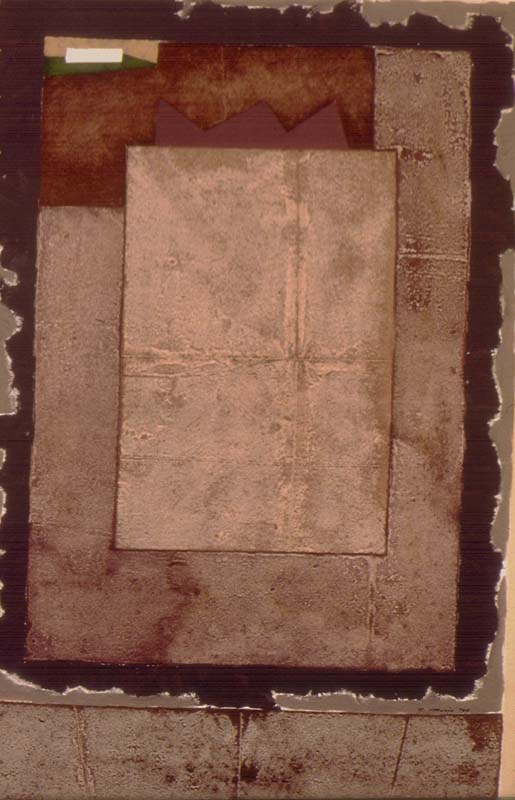
New York Series, Untitled
24″ x 36″
Oil on canvas
1992
1. A person withdrawn from interruption, judgment, dependency, and noise may begin to believe that solitude clarifies the self. Removed from the continual presence of others, one becomes more aware of habits, memories, reactions, and inward movement ordinarily dispersed through daily relation. Silence appears to gather experience into greater clarity. Yet prolonged isolation reveals something less expected: inward life does not remain still simply because it happens alone.
2. Thought begins circling within its own continuity without resistance. Reflection loses proportion when nothing interrupts it from beyond itself. A memory repeated often enough begins to feel increasingly complete when it is not. A fear unanswered by another perspective deepens within its own enclosure. Even silence changes character. No response arrives. No interruption. Nothing enters from outside oneself.
3. This may be why solitude eventually begins searching for relation again, even where no person is present. The hermit speaks to God, to memory, to nature, or to silence itself. The mind reaches beyond its own enclosure not necessarily from weakness, but because inward life alone cannot fully restore proportion to itself.
4. We do not discover ourselves in abstraction alone. Much of what we call individuality becomes perceptible through relation. Patience, resentment, tenderness, vanity, courage, forgiveness, and responsibility do not fully disclose themselves in separation from others. They emerge through contact, disappointment, affection, misunderstanding, dependence, and care. Another person does not diminish individuality. Something in us becomes more visible in relation than in withdrawal.
5. Communication does not eliminate distance between human beings. It reveals it. No person entirely crosses the interior distance separating one consciousness from another. Suffering, mortality, memory, and perception remain singular experiences. Yet it is often through the effort to communicate that this separateness becomes recognizable at all. We discover how far we remain from one another precisely in the attempt to reach across that distance.
6. Another person is neither an extension of oneself nor a symbolic abstraction. The other remains distinct, vulnerable, and finite. Love therefore cannot consist merely in attachment, possession, or dependence. Its deeper force lies in the capacity to recognize another existence without attempting to dissolve it into one’s own needs, fears, or projections. Compassion arises quietly from this condition.
7. Isolation becomes impossible not because solitude lacks value, but because human life continually reaches beyond private continuity. Even withdrawal retains traces of relation: language, memory, longing, recognition, prayer, imagination. The mind does not merely enclose itself. It responds. Seeks. Recalls. Addresses what remains beyond it.
8. Perhaps this is why the deepest forms of love do not abolish aloneness. They allow it to stand without hardening into enclosure. Compassion does not overcome distance by eliminating difference. Each person remains singular and ultimately unreachable in totality, yet still worthy of care. In that recognition, isolation no longer appears possible as a final condition of human life.
Ricardo F. Morín
May 14, 2026
Bala Cynwyd, Pennsylvania

