*
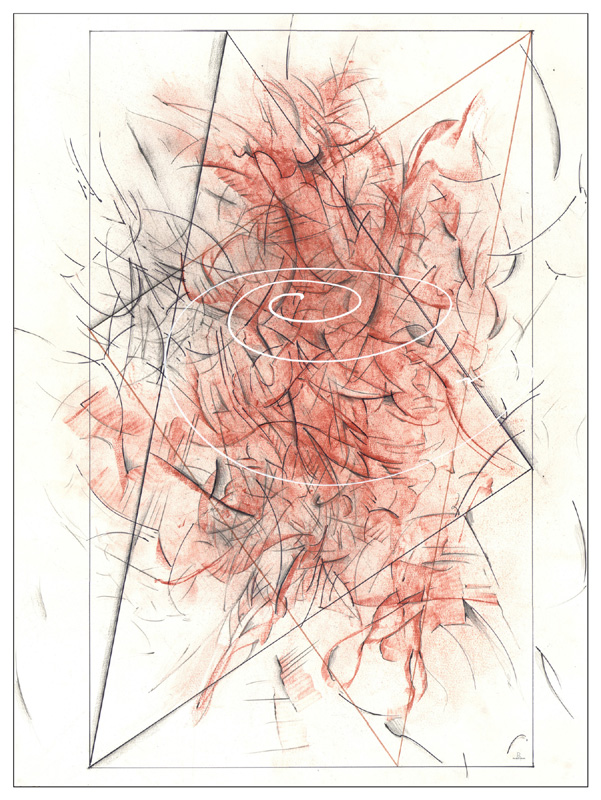
Triangulation III: The Quiet Room
22″ x 30″
Body color, sanguine, sepia and Sumi ink on paper
2008
Author’s Note
This story takes place in a room marked “Quiet Room,” a term that in English is usually understood as a neutral space: a place for silence, rest, or reflection, without any implied ritual purpose. But spaces do not mean the same thing to everyone. In some cultures and languages, silence suggests prayer; the absence of furniture implies prostration; and the presence of a textile can signal ritual use.
These differences in meaning can create misunderstandings where no conflict is intended. What I recount here is not about religion, but about how the meaning of a shared space can shift without warning, and how people interpret the same room through frames of reference that may collide without notice.
Ricardo F Morín
November, 2025
Oakland Park, Florida
1
My driver and I had been talking about the way executive power often disguises its motives—how it presents itself as a force of rescue while pursuing forms of exploitation. We passed the time considering these contradictions and felt, briefly, that we understood our world a little more clearly.
2
We were accompanied by the brisk morning air as we moved through congested traffic toward the Philadelphia airport. I was returning home to Fort Lauderdale after two days of cardiological testing not available to me back home. Without baggage, I went directly to TSA PreCheck with only a shoulder bag. Shortly after I reached the departure gate, a six-hour delay was announced. I decided to buy a backpack and set out in search of a place to reorganize my things in private.
3
I soon found a room marked Quiet Room—plainly identified as a space for silence, rest, or reflection. I entered with that expectation. The room was divided into several intimate areas with benches along some of the walls. The lighting was subdued and the air held a stillness that contrasted with the restlessness of the terminal. Though furnished sparingly, the rooms were lined with pleated curtains that absorbed and muffled sound, and this softening of the acoustics created a muted perimeter that stood apart from the noise outside. Only one of the smaller sections had a vanity with a faucet, a faint glow reflecting off its surface.
4
Atop what appeared to be a tall storage unit, several folded textiles were stacked. Their textures and patterns varied—some silk-like, others woolen or synthetic. At first glance they looked more like blankets than anything else. Nothing in the room suggested any purpose beyond what the sign indicated. It was, in every visible sense, a quiet room open to anyone.
5
I stood facing one of several benches and began to transfer my belongings from the shoulder bag into the new backpack. The simple act of rearranging objects formed its own small rhythm within the subdued quiet. I was nearly finished when a voice behind me broke the stillness. I turned and saw a man repeating with certainty: “This is a place for prayer”.
6
His certainty overrode the posted meaning of the room. There was no courtesy, no explanation, and no acknowledgment of the sign that defined the space I had entered. I turned back to complete what I had nearly finished. The man walked into one of the adjoining sections. A woman remained in the larger space that I stood in, silent, waiting for me to leave. I stepped out. For a moment I felt like a transgressor, though nothing I had done justified it.
7
I was startled by how quickly confidence had given way to a sense of diminishment.
8
I had become a participant in an unexpected encounter. A single assertion—neither explained nor negotiated—had shifted the atmosphere without warning.
9
A short time later and still unsettled, I returned impulsively to the Quiet Room, perhaps to find closure. In the smaller section with the vanity, several men were washing their hands as they murmured chants or prayers, barely audible yet perceptible enough to alter the atmosphere. Their voices blended with the sound of running water, forming a low, continuous undertone. In the larger section, the same woman stood quietly, facing one of the textiles she had placed diagonally across the narrow space she occupied. The room’s physical features had not changed, but its public meaning had been recast. What had been neutral now felt defined by a significance I had not been prepared for or invited to share.
10
I left again and returned to my departure gate. In time the emotion eased, though the moment remained vivid as I wrote it.
11
Later, I replayed the scene and the reply I had not managed to speak: “This is a place for prayer. I am praying myself”.
12
But I found no certainty in the memory of it—only questions that lingered with persistence: how can a plainly posted meaning, “Quiet Room,” be superseded by an unspoken one? Was it grievance or exclusivity that redrew the boundaries of a public room without a single word of justification? How quickly can a neutral space become contested before anyone knows how to meet the shift itself? How does one face the responsibility of communicating with clarity? By any measure, none of us had succeeded.