Archive for July, 2026

“Constitutional Title”

July 4, 2026

*


Ricardo F. Morín
CGI, 2026

Every constitution presupposes a constitutional subject more fundamental than the government it establishes.   Before there can be presidents, legislatures, courts, or public officials, there must already exist the Nation from which public authority derives.   Governments do not constitute the Nation.   The Nation constitutes government through the lawful means prescribed by the constitutional order.

For that reason, constitutions concern themselves with more than the organization of power.   They identify the source from which public authority may arise in law and prescribe the constitutional act through which that authority becomes publicly ascertainable, a function that preserves the Nation’s exclusive constitutional authority to constitute public authority.   Authority is not created by those who exercise it.   It is temporarily entrusted to them by the Nation acting under constitutional forms.   Government therefore possesses neither an autonomous existence nor an independent title.   Every public office derives from a constitutional act antecedent to itself.  

The constitutional significance of an election resides precisely in that antecedent act.   Elections do not merely record political preferences, produce governing majorities, or permit the peaceful succession of governments.   Their constitutional purpose is to render the sovereign will of the Nation publicly ascertainable through a process whose transparency permits the lawful attribution of public authority.   Transparency is therefore neither an administrative virtue nor a procedural safeguard.   It is the constitutional condition through which the title to govern becomes publicly distinguishable from the mere possession of power.  

Whenever that condition ceases to exist, the object of constitutional inquiry changes with it.   The question no longer concerns the constitutional act through which authority became attributable to the Nation, but the government by which authority is presently exercised.   Public offices may remain occupied.   Legislatures may continue to enact laws.   Courts may continue to pronounce judgment.   Taxes may continue to be collected.   International relations may proceed without interruption.   Each describes the continued exercise of public authority.   None identifies the constitutional act from which that authority became publicly attributable to the sovereign will of the Nation.  

The displacement is easily overlooked because governments are visible whereas constitutional title is not.   Political discussion therefore turns almost instinctively toward the recognition of governments, negotiated settlements, transitional authorities, constitutional reforms, sanctions, diplomatic initiatives, and international agreements.   Each concerns the exercise, distribution, or succession of political power.   None identifies the constitutional act through which the Nation confers title upon those who govern in its name.   Without noticing it, the inquiry abandons the constitutional origin of authority and begins instead to examine the political administration of authority already being exercised.  

The Venezuelan constitutional controversy illustrates that displacement with unusual clarity.   International discussion has largely proceeded by asking which government should replace the existing one and under what political arrangements that transition should occur.   Yet every proposal presupposes a condition that remains antecedent to them all.   If the constitutional process through which the Nation makes its sovereign will publicly ascertainable has ceased to provide a transparent and verifiable attribution of public authority, no subsequent political arrangement identifies the constitutional source from which the proposed government derives its title.  

The participation of foreign States introduces no exception to that condition.   Diplomatic recognition, mediation, economic sanctions, military guarantees, political commitments, or negotiated agreements may influence the circumstances within which constitutional decisions are made.   They may alter political outcomes, strengthen institutions, or hasten transitions.   They remain external to the constitutional order through which the Nation alone confers public authority.   A foreign State may recognize a government, encourage a constitutional settlement, or seek to influence political events.   It does not participate in the constitutional act through which another Nation lawfully constitutes its own government, nor can it prescribe the juridical process by which that act acquires constitutional effect.  

Every proposal for constitutional restoration therefore returns to the same antecedent condition from which it first departed.   Before governments may be recognized, replaced, negotiated, or reconstituted, the Nation must first have made its sovereign will publicly ascertainable through the transparent constitutional process from which public authority derives its title.

Toronto, Canada
July 4, 2026


“The Burden of Uncertainty”

July 3, 2026

*

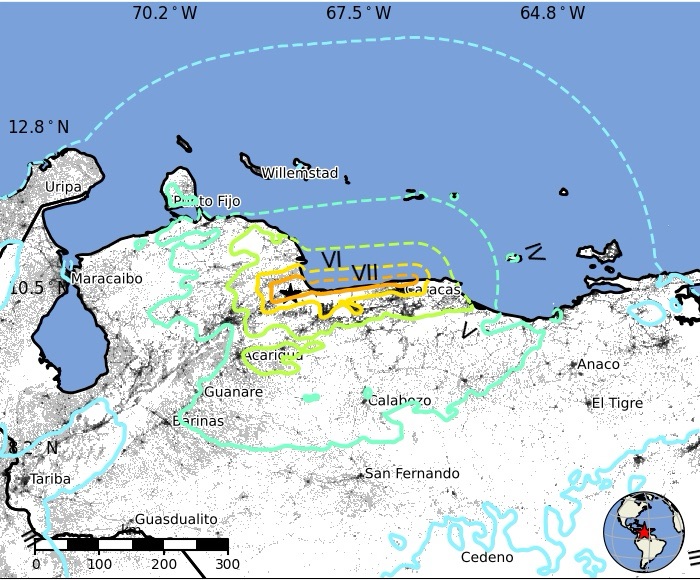
Figure 1. USGS ShakeMap depicting the distribution of ground-shaking intensity produced by the magnitude 7.5 earthquake of Wednesday, June 24, 2026, in north-central Venezuela. The map illustrates the geographical extent and relative intensity of the seismic event rather than structural damage. Courtesy of the U.S. Geological Survey (USGS). [1]

Ricardo F. Morín

July 3, 2026

Toronto, Canada

*

Scientific inquiry does not begin with certainty.  It begins by identifying the boundaries of what is known, what remains unknown, and why the distinction matters.  The absence of sufficient evidence neither confirms nor disproves a hypothesis; it defines the limits of present knowledge and establishes the necessity for further investigation.  Nowhere is this principle more consequential than in environmental policy, where decisions made under conditions of uncertainty may shape the integrity of entire ecosystems for generations.

The first obligation of responsible governance is therefore not to defend a predetermined conclusion, but to ensure that the scientific conditions necessary to reach one exist.  Where those conditions are absent, the appropriate response is neither affirmation nor dismissal, but verification.

Venezuela presents a circumstance that calls for independent scientific inquiry.  The earthquakes of Wednesday, June 24, 2026, brought renewed attention to a question whose importance reaches far beyond those seismic events.  They underscore the need to determine whether the scientific knowledge presently available is adequate to evaluate any interaction that may exist between intensive subsurface carbon extraction and the geological dynamics of one of the most tectonically complex regions in the Western Hemisphere.  The country contains some of the world’s largest hydrocarbon reserves while also being traversed by active fault systems whose behavior demands continuous observation, precise measurement, and independent scientific verification.

Whether recent seismic activity bears any relationship to large-scale subsurface carbon extraction cannot presently be determined without transparent access to operational records, geological mapping, high-resolution seismic observations, and independent scientific analysis.  The necessary evidence must first be established, verified, and subjected to rigorous scrutiny before any responsible conclusion—affirmative or negative—can be sustained.

This absence of verified knowledge is not a procedural inconvenience.  It is itself an environmental concern.  Carbon extraction necessarily alters the subsurface environment through drilling, reservoir depletion, fluid movement, pressure redistribution, and other engineering interventions.  The degree to which those alterations interact with naturally stressed geological systems cannot be assumed.  It must be measured.  Where extensive extraction occurs within tectonically active regions, uncertainty becomes the principal reason for scientific investigation rather than an excuse to postpone it.

The question therefore extends well beyond the explanation of any individual seismic event.  It concerns whether present scientific understanding adequately characterizes the cumulative interaction between industrial intervention and the geological systems upon which entire populations depend.  Resolving that question requires continuous seismic monitoring, comprehensive geological characterization, transparent operational reporting, independent verification, and the willingness to revise conclusions as new evidence emerges.

The implications are not confined to Venezuela.  They concern the broader governance of carbon extraction throughout the world.  Every nation possessing significant hydrocarbon resources situated within geologically sensitive environments confronts the same responsibility:  to ensure that economic activity proceeds within the limits established by demonstrable scientific understanding rather than by commercial urgency or geopolitical expediency.

Under conditions of institutional weakness, diminished regulatory independence, or limited transparency, this responsibility becomes even more critical.  Scientific uncertainty should never become a refuge for either complacency or speculation.  Instead, it imposes a higher standard of public accountability.  The legitimacy of environmental regulation depends not upon confidence in predetermined outcomes, but upon confidence in the integrity of the investigative process itself.

This principle transcends the identity of any particular government, corporation, or foreign investor.  Whether extraction is undertaken by domestic enterprises, multinational corporations, or state-owned entities, the obligation remains identical.  Every operator should be subject to the same independent scientific oversight, the same environmental scrutiny, and the same public disclosure of information necessary to evaluate geological and ecological consequences.  Responsible stewardship cannot depend upon the nationality of capital.  It depends upon the universality of scientific standards.

When those standards are weakened or subordinated to political or economic priorities, the consequences extend far beyond the extraction site.  The risks are borne by landscapes, watersheds, ecosystems, infrastructure, and communities whose stability depends upon geological conditions that cannot be negotiated once altered.  Economic benefit may be immediate; environmental consequences may endure for generations.

The responsible extraction of carbon resources therefore demands more than technological capability or financial investment.  It requires institutions capable of recognizing that uncertainty is not the absence of responsibility but its beginning.  Scientific knowledge is not merely one consideration among many in environmental governance.  It is the foundation upon which every legitimate regulatory decision must rest.

The Earth records every intervention with complete fidelity.  Whether humanity possesses the wisdom to understand those records before they become irreversible consequences remains one of the defining environmental questions of our time.

[1]. https://earthquake.usgs.gov/data/shakemap/?utm_source=chatgpt.com


“Concealed Succession”

July 1, 2026
Ricardo F. Morín
Ascension 2
CGI
2005

This essay examines the political conditions surrounding the final months of the presidency of Hugo Chávez.  Rather than revisiting the episode as a matter of historical controversy, the analysis focuses on the structural dynamics that became visible during that transition.  The objective is diagnostic.  The essay proposes that when political authority becomes inseparable from a single leader, succession may cease to appear as an institutional process and instead emerge through the management of information surrounding the leader’s condition.

Ricardo F. Morín

March 4, 2026

Oakland Park, F


The death of Hugo Chávez did not simply mark the end of a presidency.  It exposed the fragility of a political order that had come to depend heavily on the authority of a single figure whose influence extended far beyond the borders of his own country.  The ambiguity surrounding the final phase of Chávez’s life revealed how closely the stability of that system had become tied to the fate of one leader.  To understand why that moment produced such uncertainty, it is necessary to place it within the longer evolution of revolutionary politics in Latin America during the twentieth century.  

During the early decades after the Cuban Revolution, the government led by Fidel Castro promoted a strategy aimed at transforming Latin America through insurgent movements.  Across the region guerrilla organizations and clandestine networks attempted to replicate the revolutionary experience of Cuba and to challenge existing political systems.  

Venezuela itself became one of the early arenas where these tensions appeared.  During the presidency of Rómulo Betancourt, the young democratic government faced a series of military uprisings and insurgent movements that sought to destabilize the constitutional order.  Episodes such as the Barcelonazo in 1961, the Carupanazo in 1962, and the Porteñazo in 1962 formed part of that turbulent decade.  Although these attempts failed to overturn the Venezuelan State, they revealed the extent to which revolutionary movements inspired by the Cuban example had begun to influence political struggles throughout Latin America.  

Over the following decades the strategy of those movements changed.  Guerrilla campaigns rarely succeeded in seizing power.  Many organizations therefore abandoned armed struggle and entered electoral politics.  Former militants reorganized as political parties and pursued their objectives through institutions rather than insurgency.  

Leaders such as Gustavo Petro in Colombia and José Mujica in Uruguay illustrate how figures once associated with insurgent movements later obtained power through elections.  The ideological ambitions of these movements remained, but their methods adapted to new political conditions.  

Hugo Chávez represented another variation of this transformation.  Chávez emerged from the Venezuelan military rather than from a guerrilla organization, yet he adopted many of the revolutionary narratives that had circulated in Latin America since the Cold War.  After winning the presidency in 1998, he reorganized the Venezuelan State and established close cooperation with the Cuban government.  

During the early twenty first century that cooperation expanded into regional frameworks such as the Bolivarian Alliance for the Peoples of Our America, the Union of South American Nations, and the Community of Latin American and Caribbean States.  These organizations coordinated diplomatic initiatives among participating governments and promoted the idea that Latin America could operate independently of the United States.  Commentators such as Noam Chomsky described this aspiration as part of a broader movement toward a multipolar world.  

The Venezuelan State financed much of this cooperation.  Revenue from petroleum exports allowed the government in Caracas to provide subsidized energy agreements and financial assistance to partner States.  These resources strengthened the regional network associated with the Bolivarian project.  

Within this political structure the health of Chávez acquired strategic importance.  Chávez was diagnosed with cancer in 2011 and traveled repeatedly to Cuba for treatment.  In December 2012 he underwent another surgery in Havana and then disappeared from public view.  

After that moment Venezuelan authorities released only intermittent statements about his condition.  No verified images of the president appeared for extended periods.  Officials asked citizens to assume that the president continued to govern even though the public could no longer observe him performing the duties of the office.  

When a population cannot observe its head of State, public reality becomes difficult to verify.  Statements replace appearances, and narratives replace observable authority.  Under those conditions uncertainty expands because citizens cannot distinguish between political communication and factual information.  

Questions about the chronology of Chávez’s death emerged from that uncertainty.  The Venezuelan government announced in March 2013 that the president had died from complications related to cancer.  Critics questioned whether that announcement corresponded to the actual moment of death.  They pointed to the long absence of the president from public life and the limited information that officials released about his medical condition.  

Events that followed the announcement reinforced suspicion.  Authorities initially declared that Chávez’s body would be embalmed and displayed permanently.  Shortly afterward officials abandoned that plan.  The government also released no autopsy report or detailed medical record that could clarify the exact circumstances of the president’s death.  

Whether the official chronology reflects the full sequence of events remains disputed.  What can be observed with certainty is the political environment that surrounded the transition.  

When a governing coalition depends heavily on the authority of a single leader, succession threatens the stability of the entire system.  In that situation the leader’s illness becomes a political problem rather than a purely medical one.  Those who control the State therefore face an incentive to regulate how information about the leader’s condition reaches the public.  

The Venezuelan transition of 2013 illustrates the phenomenon described here as concealed succession.  The disappearance of Chávez from public life, the limited disclosure about his illness, and the uncertainty surrounding the announcement of his death together produced a political situation in which the transfer of authority could not occur openly.  

Seen across several decades, the end of the Chávez presidency also clarifies the evolution of revolutionary movements in Latin America.  Armed insurgencies of the 1960s gradually transformed into political parties that competed in elections.  Some of those parties later formed governments and created regional frameworks through which they coordinated policy.  In the twenty first century those networks increasingly interact with a wider geopolitical environment in which emerging powers encourage alternative centers of influence.  

This development forms a continuous trajectory rather than a rupture.  Guerrilla organizations became political parties, political parties formed governments, and those governments created regional frameworks that extended their influence.  The illness and death of Hugo Chávez exposed how strongly that architecture depended on the authority of a single leader whose position linked several of these layers at once.  

When political authority becomes inseparable from the physical presence of a single leader, succession cannot occur transparently.  The continuity of the system becomes tied to the management of information surrounding that leader’s condition.  In such circumstances the transfer of power no longer appears as an institutional process.  It emerges instead through the regulation of visibility and the control of public knowledge.  What appeared in Venezuela during the final months of Chávez’s presidency therefore reveals a structural principle of personalized political systems:  when the survival of a regime depends on one figure, succession must first be concealed before it can be resolved.


“The Illusion of Self Protection”

July 1, 2026
Ricardo F. Morin
Platonic 3
CGI
2005

War, division, distrust, and uncertainty do not merely unsettle a society.  Under sustained exposure to threat, whether external or internal, a society can gradually orient itself around protection as its primary civic posture.  What begins as prudence may harden into habit.  What begins as defense may become entitlement.

Threat is sometimes real.  People are assaulted.  Homes are invaded.  No system of governmental vigilance can cover every private moment.  In extreme cases, any citizen may act proportionately to preserve life.  Such moments are tragic and immediate, but emergencies cannot define the structure of a society, because civic order must be built on general conditions rather than exceptional events.

Arms, in this context, are not only instruments of defense.  They are also adopted in response to insecurity.  A weapon promises capacity for defense when institutions appear distant or delayed.  Yet no instrument can abolish vulnerability.  Risk cannot be eliminated.  When weapons of defense are used not only in emergencies but also as a habitual source of reassurance, expectation exceeds reality because no instrument can eliminate risk.  When risk persists, the demand for reassurance grows rather than recedes.

In the United States, the Second Amendment to the United States Constitution, ratified in 1791, inscribed the right to bear arms within constitutional language.  That inscription altered the character of the debate.  A measure framed within a specific historical setting became a continuing constitutional claim.  The right is now defended within civic identity and political standing even where the original historical rationale is no longer accepted as controlling.  When constitutional language is treated as permission without proportion, protection displaces limitation and mediation weakens.

A recursive pattern follows.  Perceived threat justifies defensive expansion.  Defensive expansion heightens vigilance.  Heightened vigilance sustains the perception of threat.  The instrument intended for extremity becomes part of ordinary expectation.  What was meant for emergency becomes routine.  The tool does not create insecurity; it sustains the illusion that insecurity can be permanently mastered.  The logic resembles that of rival states engaged in arms accumulation, where possession is defended as protection while the underlying condition of vulnerability remains unchanged.

The distribution of lethal capacity and normalized readiness develop together.  Even when no weapon is wielded, the normalization of lethal capacity alters civic disagreement, because the standing possibility of force becomes part of ordinary interaction.  Suspicion becomes habit.  Habit alters how citizens meet one another in public and shapes the conditions under which disagreement unfolds.

At the level of nations, the nuclear age produced a parallel logic of reassurance through destructive capacity.  The strategic doctrine of Mutually Assured Destruction sought stability through reciprocal vulnerability, assuming that the certainty of catastrophic retaliation would prevent escalation.  Yet even such systems ultimately depend upon uninterrupted judgment within complex command structures.  During the Cuban Missile Crisis of 1962, the launch of a nuclear torpedo from the Soviet submarine B-59 was prevented only when the officer Vasily Arkhipov refused authorization.  The episode illustrates that systems built upon catastrophic capacity may appear stable while depending upon moments of individual restraint that no doctrine can guarantee.  In these moments the mechanical logic of force can be interrupted by a single act of recognition:  one person acknowledging a shared human condition that no system of power can override.

Proportionality remains decisive because scale alters consequence.  An implement suitable to repel immediate assault differs categorically from weaponry capable of rapid and indiscriminate lethality.  The greater the destructive capacity, the greater the need for regulation.  Rights operate within structures that set limits; they do not suspend them.  When lethal capacity is widely normalized, large scale misuse becomes structurally possible rather than exceptional.  If weapons are treated as a habitual source of reassurance, recurring episodes of mass violence expose the limits of that reassurance rather than resolve insecurity.

The deeper issue concerns collective power and instrumental force.  Collective power arises when citizens act together within a shared framework that presumes conflict will be resolved without violence.  Instrumental force operates through the use of defensive mechanisms that require no agreement beyond their use.  When reliance on such mechanisms increases, shared political action diminishes because reassurance shifts from institutions toward individual capacity.

Defense responds to threat in particular moments.  Freedom requires durable trust that such moments will remain exceptional rather than permanent.  A polity organized primarily around permanent anticipation of threat alters its character because precaution begins to replace confidence in mediation.  Sovereignty shifts from shared institutions toward individual possession.  Assurance becomes individualized.  The presumption that conflicts will be managed through common processes weakens.

The argument does not deny the reality of threat or the tragedy of immediate self defense.  It establishes that arming oneself with weapons of defense cannot serve as a stable foundation of civic assurance, because civic order depends upon mediation, shared limits, and acceptance that vulnerability cannot be abolished.  Emergency thinking cannot become normal thinking.  The task is not to abolish defense but to prevent defense from defining the grammar of coexistence.

Ricardo F. Morín

March 4, 2026

Oakland Park, Florida